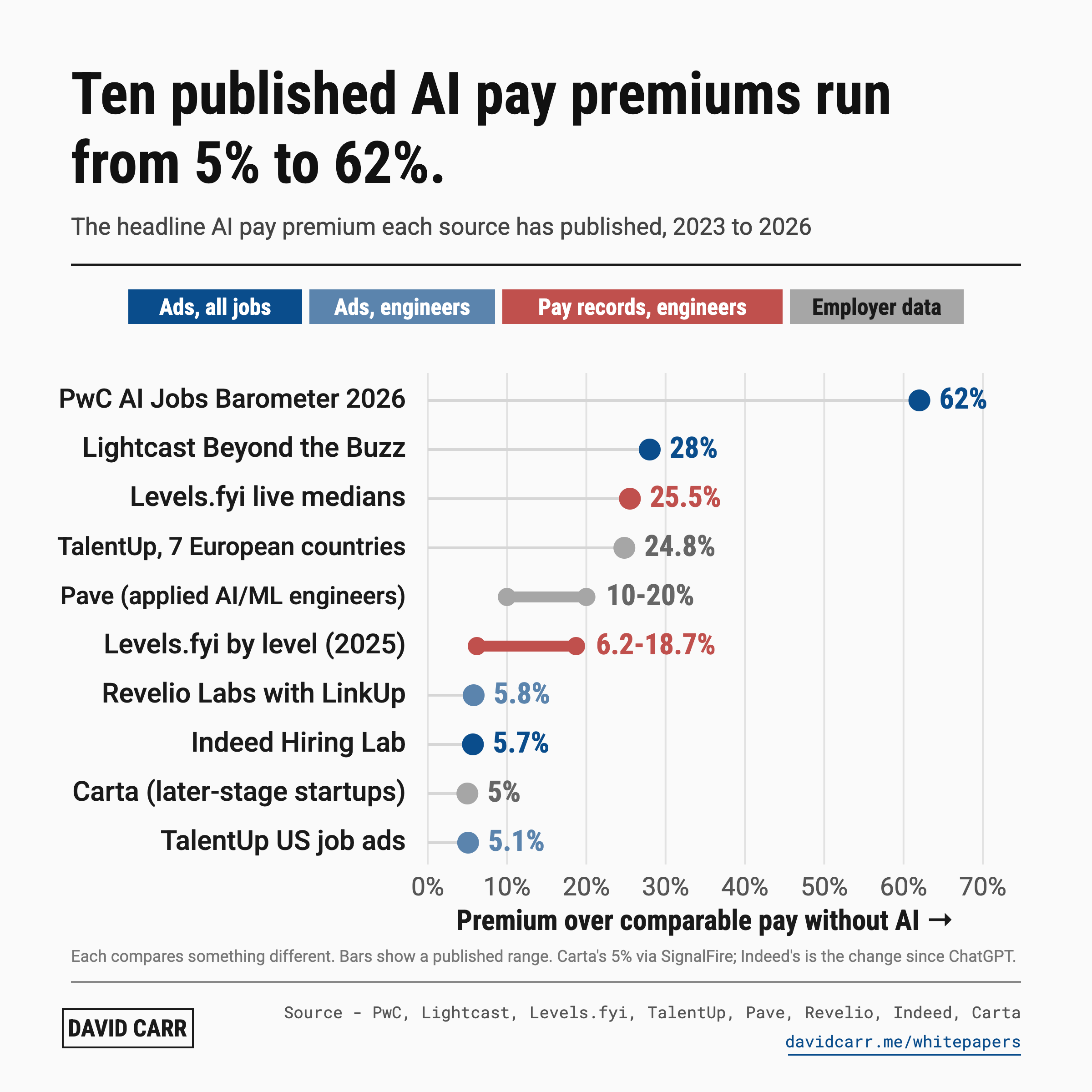
Ten published AI pay premiums run from 5% to 62%.
The big numbers come from job ads across all jobs. The small ones compare engineers with engineers.
Each source measures something different, so these are not a league table. Indeed's 5.7% is the change in the gap since ChatGPT, not a level. Carta's 5% is reported by SignalFire, December 2024.
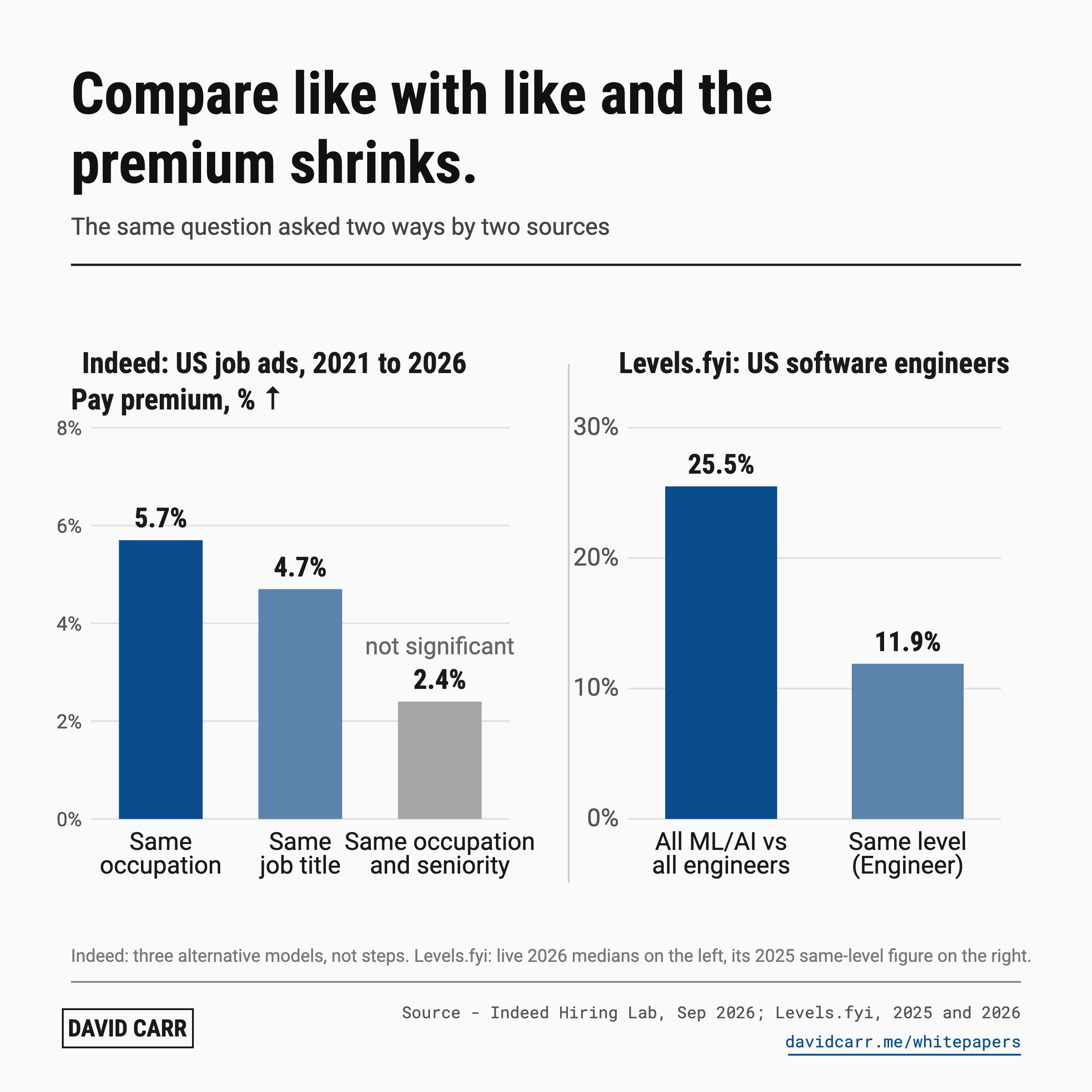
Compare like with like and the premium shrinks.
- Indeed, same occupation: 5.7%
- Same job title: 4.7%
- Same occupation and seniority: 2.4%, not statistically significant
- Levels.fyi, all ML/AI vs all engineers: 25.5%
- Levels.fyi, same level (Engineer, 2025): 11.9%
Much of the headline gap is seniority. AI jobs skew senior, and senior jobs pay more.
Indeed's three figures are alternative models of US job ads, 2021 to mid-2026. The Levels.fyi pair mixes a live 2026 page with a 2025 report.
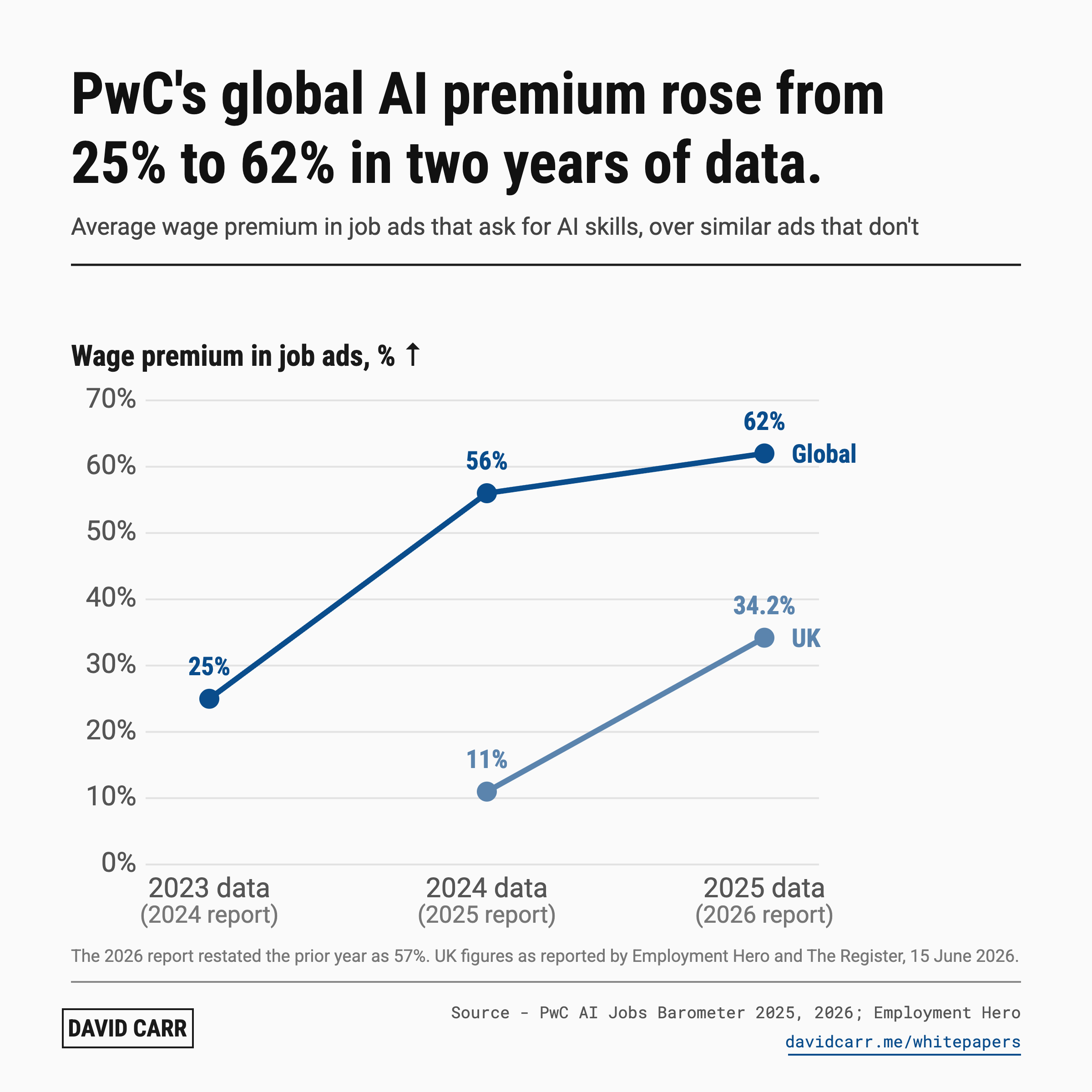
PwC's global AI premium rose from 25% to 62% in two years of data.
On PwC's measure the premium is big and still growing. The UK's tripled in a year.
The 2026 release restated the year before as 57%. PwC compares job ads that ask for AI skills with similar ads in the same sector; its 2026 edition covered more than a billion ads in 27 countries.
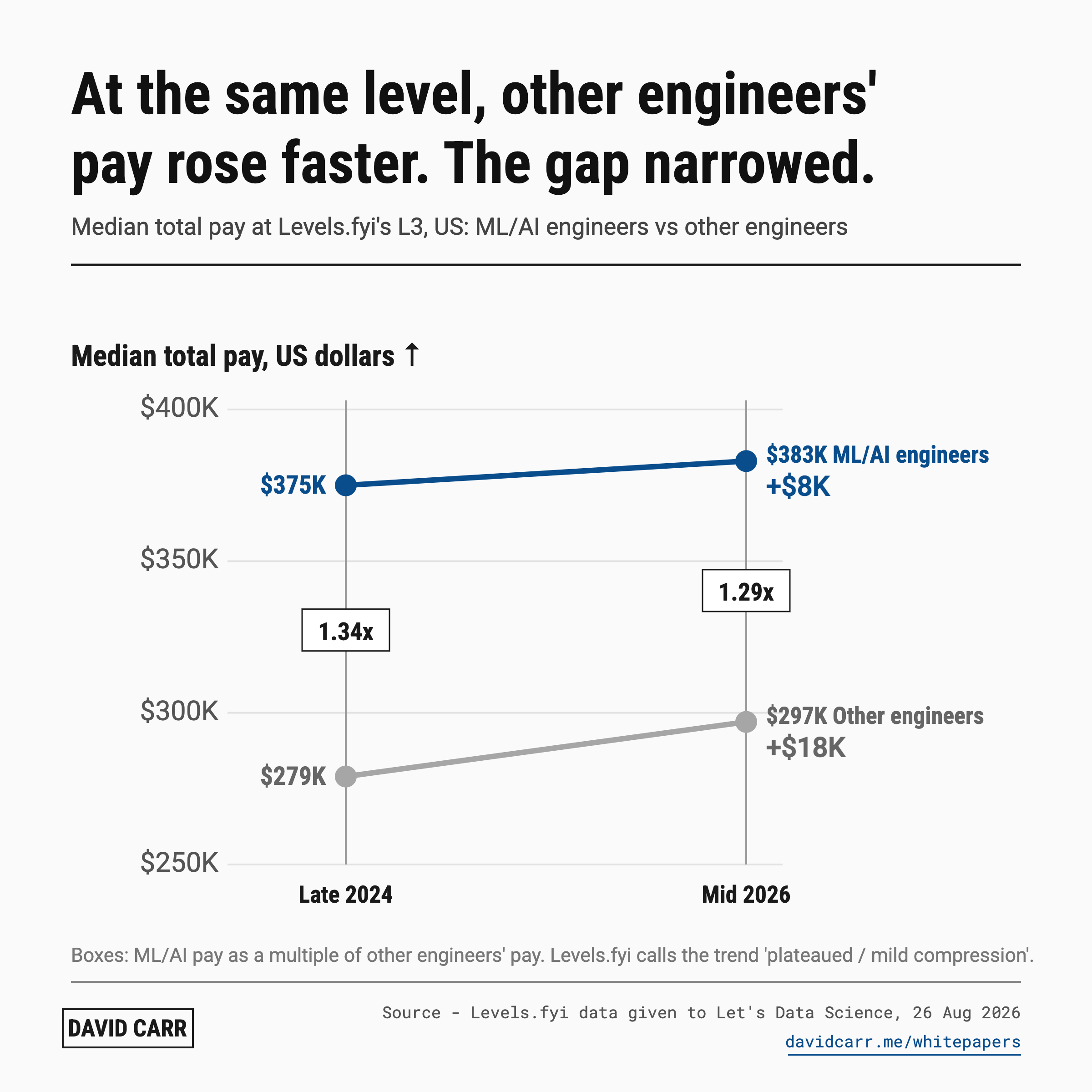
At the same level, other engineers' pay rose faster. The gap narrowed.
- Late 2024: ML/AI $375K, others $279K (1.34x)
- Mid 2026: ML/AI $383K, others $297K (1.29x)
The AI edge at one level is still about a third. It stopped growing.
Levels.fyi data prepared for Let's Data Science, 26 August 2026, US salaries at its L3. Levels.fyi's own words: "plateaued / mild compression".
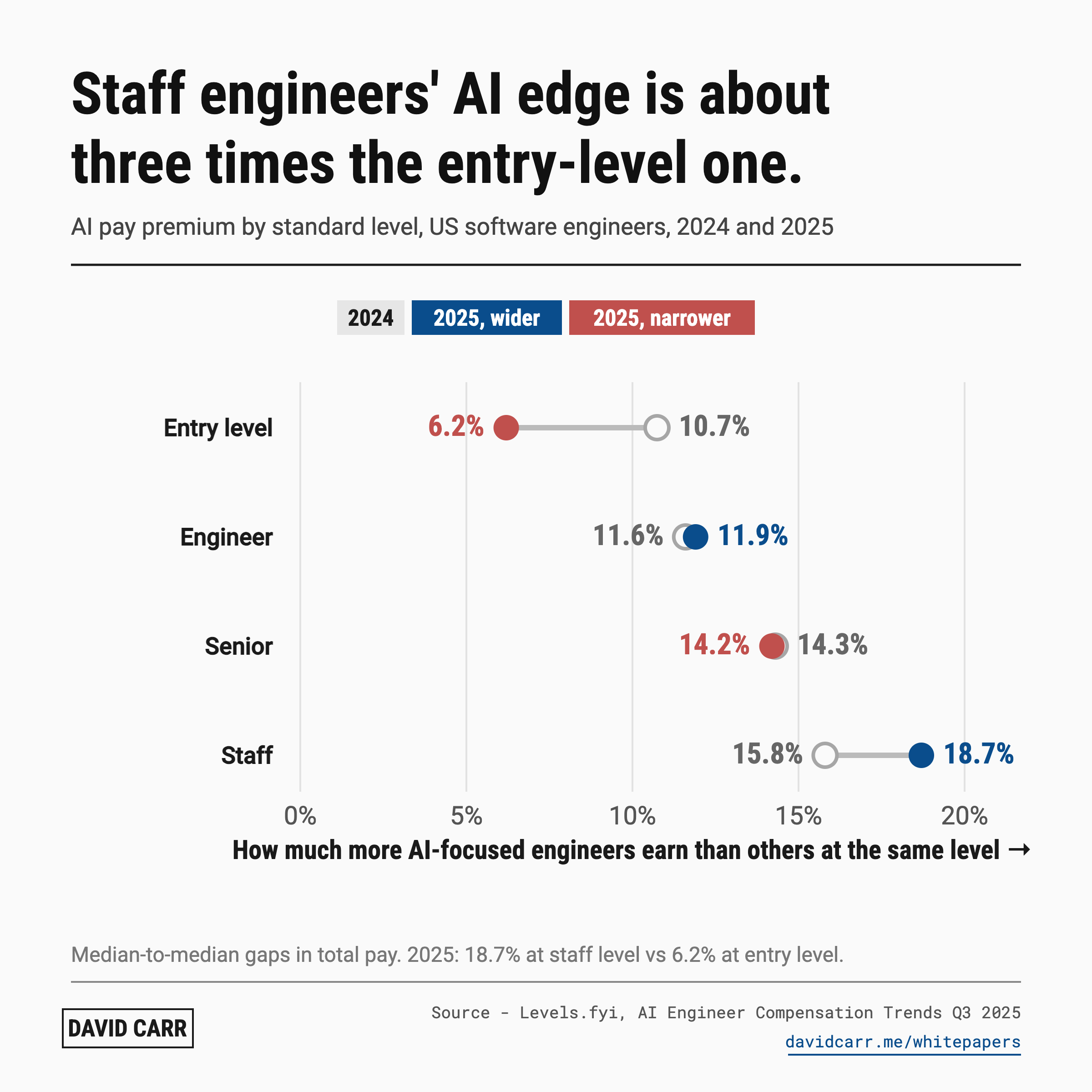
Staff engineers' AI edge is about three times the entry-level one.
- Entry level: 10.7% in 2024, 6.2% in 2025
- Engineer: 11.6% to 11.9%
- Senior: 14.3% to 14.2%
- Staff: 15.8% to 18.7%
The more senior the engineer, the bigger the extra for AI work.
From Levels.fyi's AI engineer pay report, 17 July 2025. The same chart appears as a slope on the Levels.fyi page.
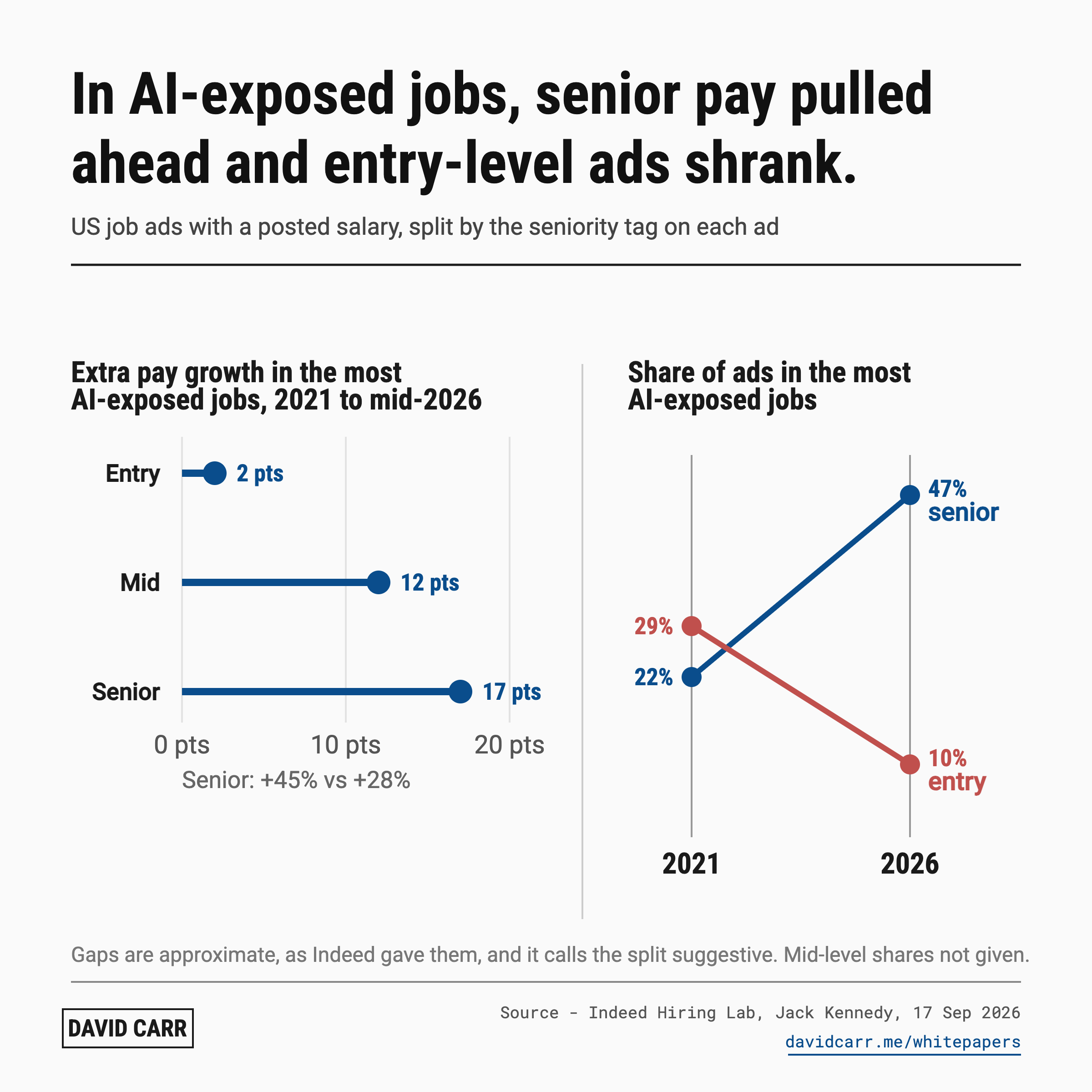
In AI-exposed jobs, senior pay pulled ahead and entry-level ads shrank.
- Senior: pay up 45% in the most exposed jobs, 28% in the least
- Mid-level gap: about 12 points
- Entry-level gap: about 2 points
- Entry-level share of ads: 29% in 2021, 10% in 2026
- Senior share: 22% to 47%
Indeed's data points the same way as Levels.fyi: the extra pay goes to experience.
Indeed Hiring Lab, 17 September 2026, US ads with an annual salary. Indeed calls the seniority split "suggestive". Also covered by CIO.
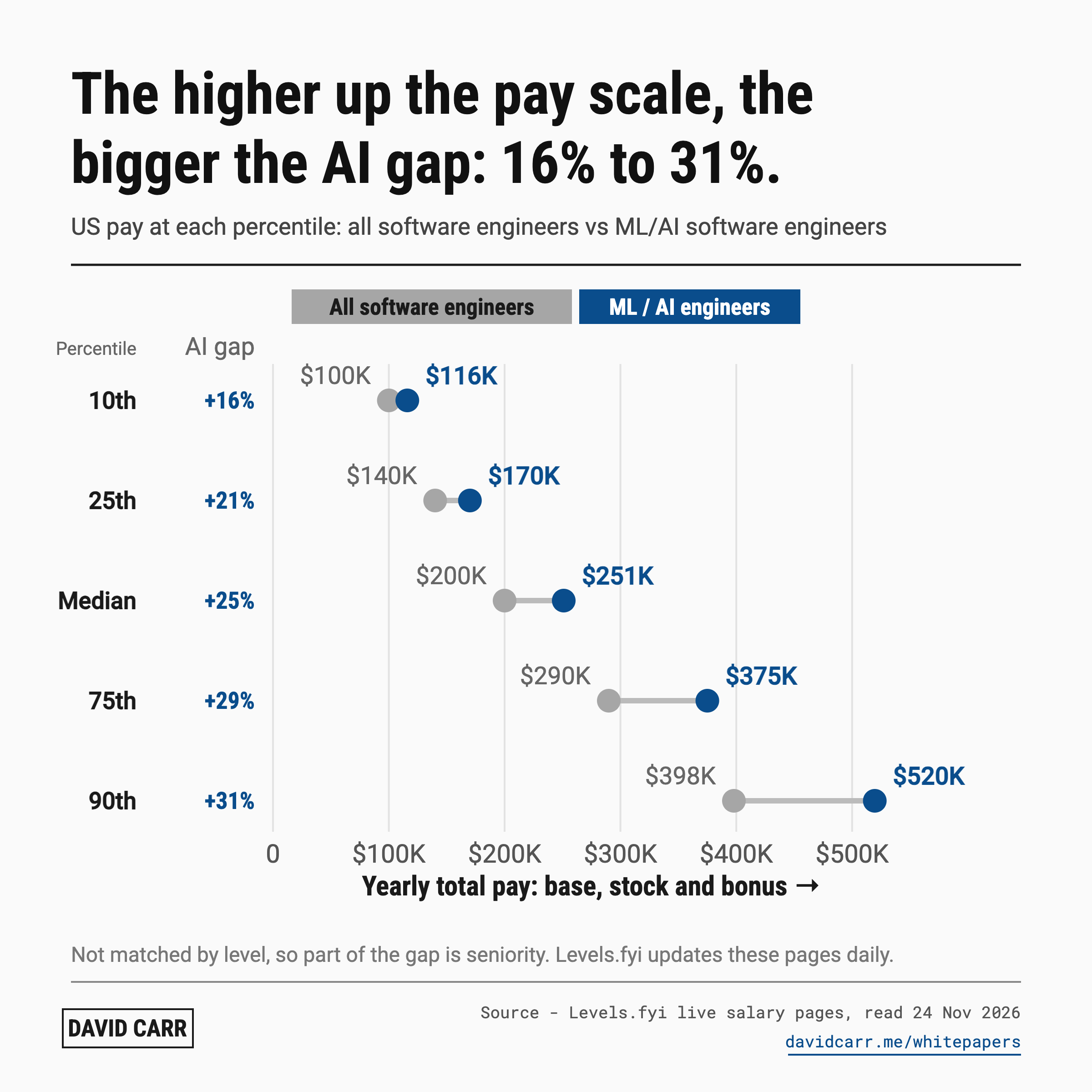
The higher up the pay scale, the bigger the AI gap: 16% to 31%.
- 10th percentile: $100K vs $116K
- Median: $200K vs $251K
- 90th percentile: $398K vs $519.6K
At the bottom, ML/AI engineers earn a sixth more. At the top, nearly a third more.
Live software engineer and ML/AI pages on Levels.fyi, read 24 November 2026. Not matched by level.
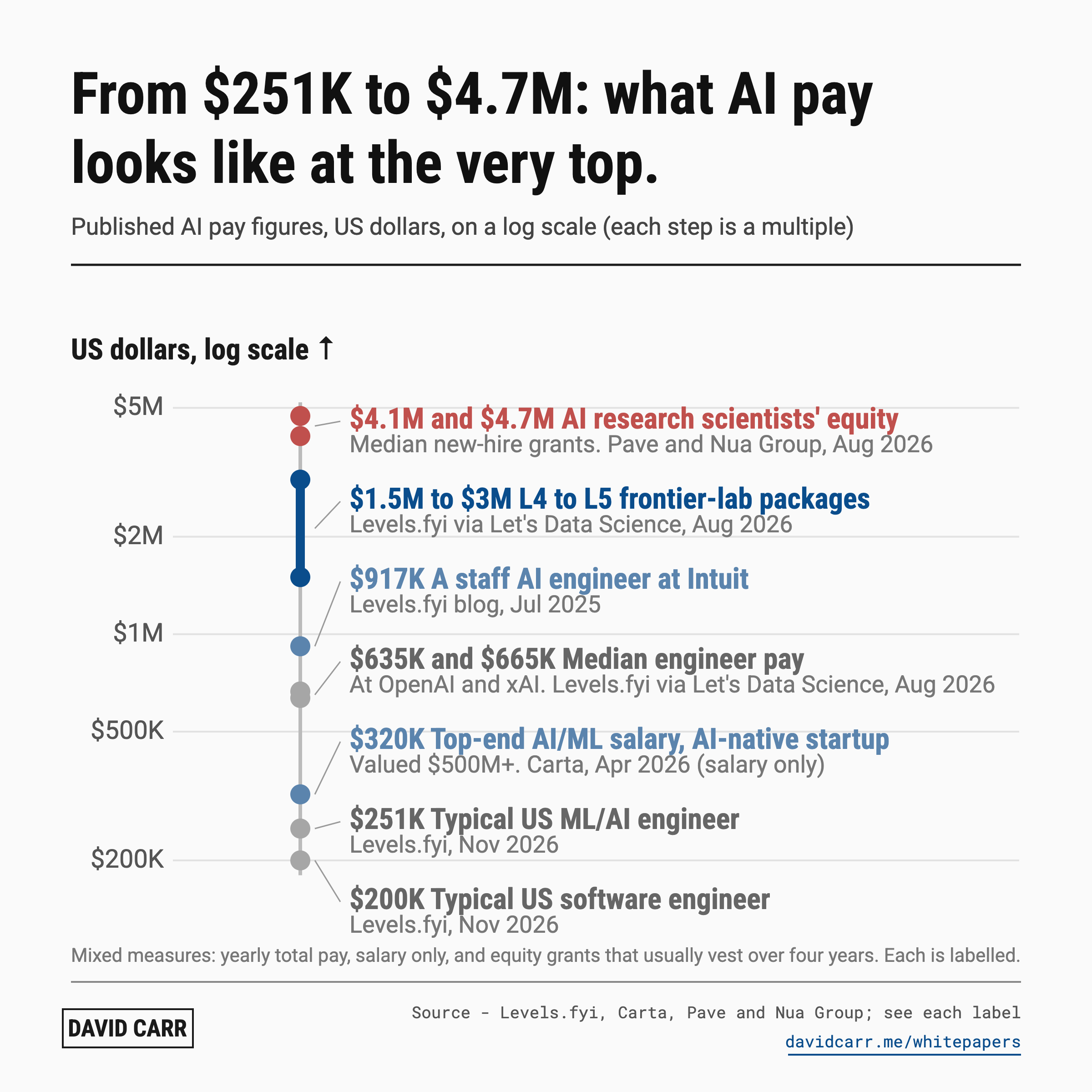
From $251K to $4.7M: what AI pay looks like at the very top.
- Median engineer pay at OpenAI $635K, xAI $665K (Levels.fyi via LDS)
- A staff AI engineer at Intuit: about $917K (Levels.fyi)
- Frontier-lab L4 to L5 packages: $1.5M to $3M (LDS)
- AI research scientists' median new-hire equity: $4.09M and $4.72M (Pave and Nua Group)
The million-dollar stories are real, but they sit with a small group of labs and researchers.
Mixed measures, each labelled: yearly total pay, salary only, and equity grants that vest over years. Pave said in December 2024 that researchers are about 4% of its AI/ML pool.
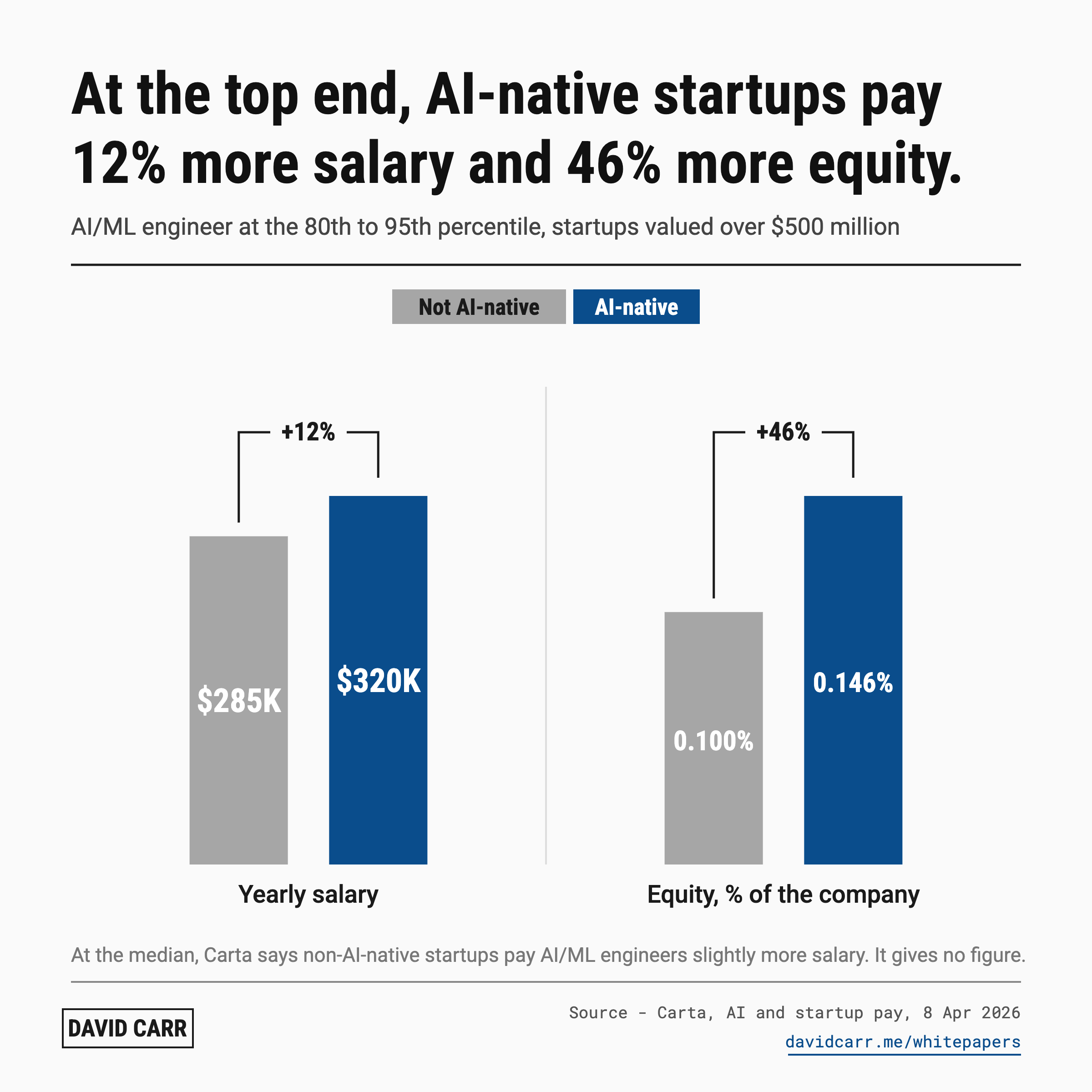
At the top end, AI-native startups pay 12% more salary and 46% more equity.
- Salary: $320,000 vs $285,000
- Equity: 0.146% vs 0.1% of the company
- Startups valued over $500 million, 80th to 95th percentile
AI-native startups pay up for the best engineers. At the median they don't.
From Carta, 8 April 2026. Carta says non-AI-native startups pay slightly more salary at the median, but gives no number.
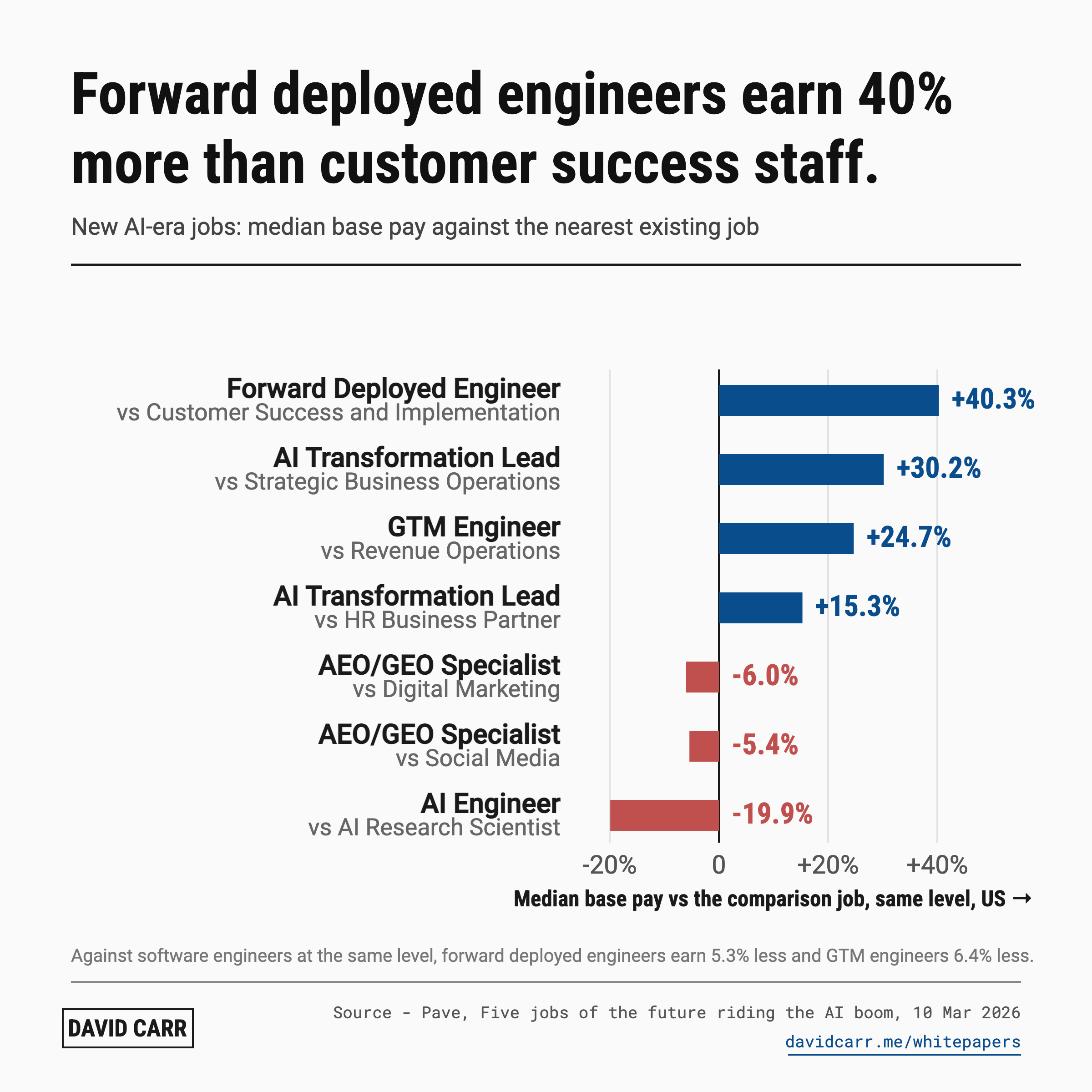
Forward deployed engineers earn 40% more than customer success staff.
- Forward deployed engineer vs customer success: +40.3%
- AI transformation lead vs business operations: +30.2%
- GTM engineer vs revenue operations: +24.7%
- AEO/GEO specialist vs digital marketing: -6.0%
- AI engineer vs AI research scientist: -19.9%
New AI-era jobs pay more than the jobs they grew out of. Against software engineers, they pay a little less.
Median US base pay at the same level, from Pave, 10 March 2026.
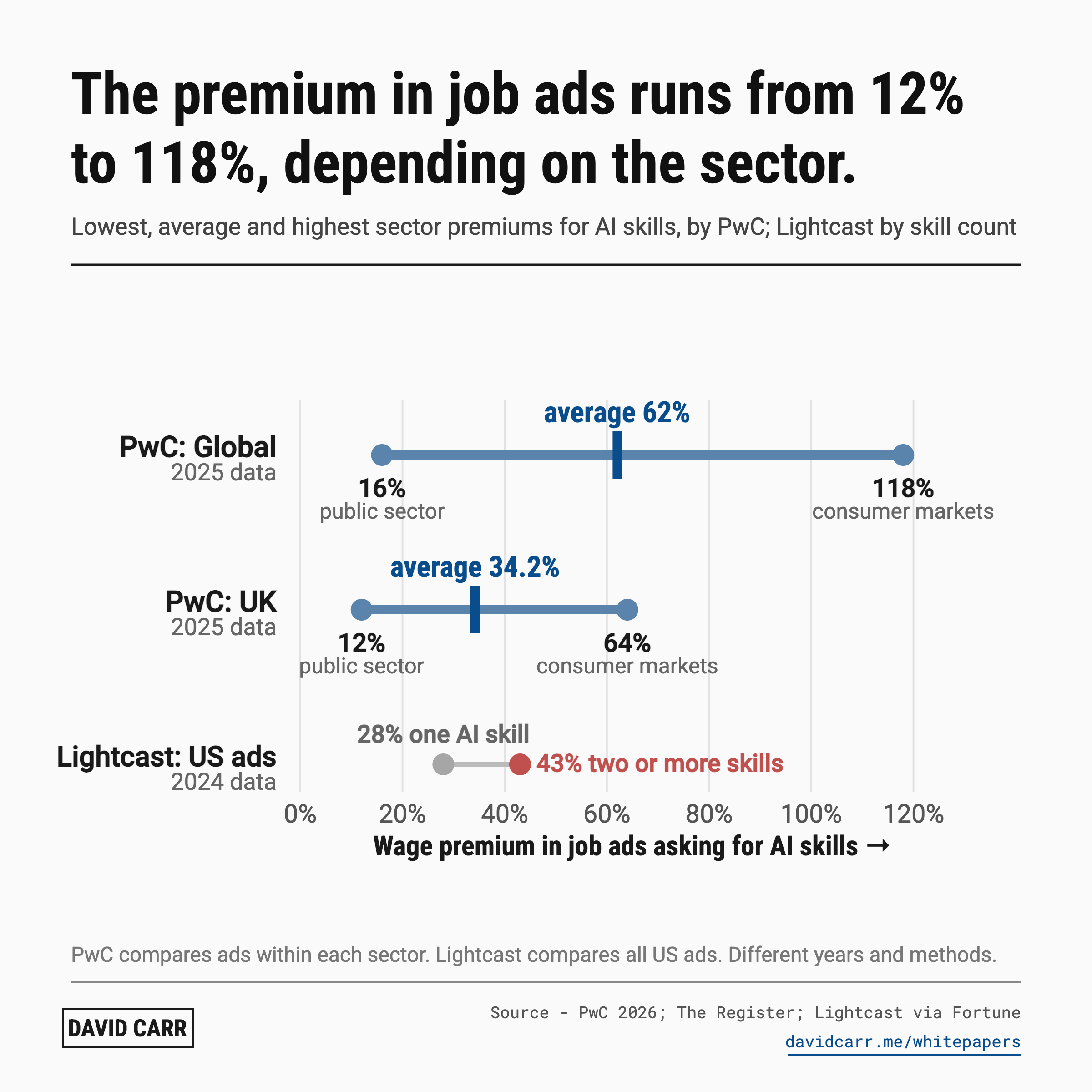
The premium in job ads runs from 12% to 118%, depending on the sector.
- Global: 16% in the public sector to 118% in consumer markets
- UK: 12% to 64%
- Lightcast: 28% for one AI skill, 43% for two or more
The averages hide a wide spread. A second AI skill adds more again.
PwC sector figures from its 2026 release and The Register. Lightcast from its July 2025 release and Fortune.
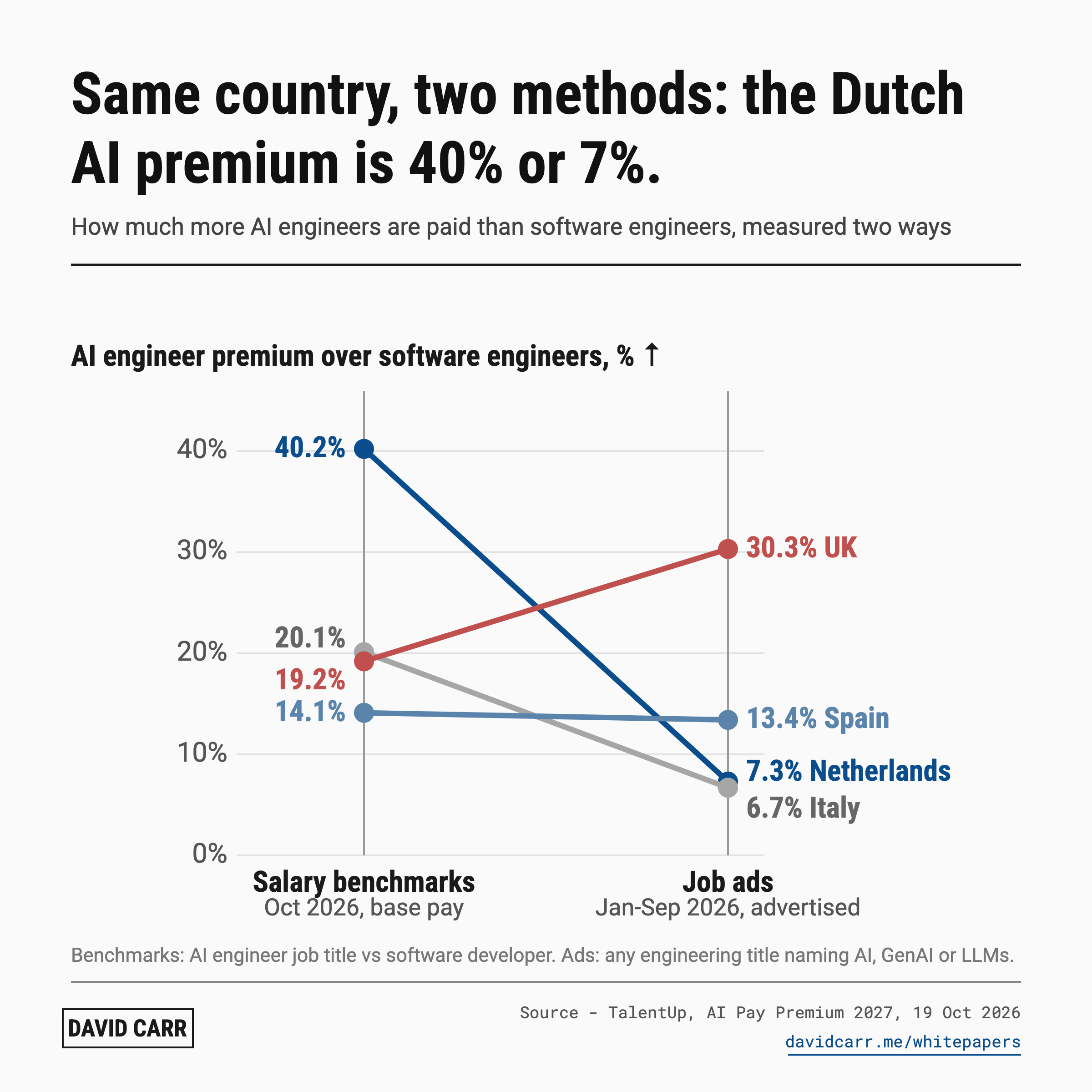
Same country, two methods: the Dutch AI premium is 40% or 7%.
- Netherlands: 40.2% in benchmarks, 7.3% in ads
- UK: 19.2% and 30.3%
- Italy: 20.1% and 6.7%
- Spain: 14.1% and 13.4%
Change the definition of an AI job and the answer moves by up to 33 points.
Both from TalentUp, 19 October 2026. Benchmarks: median base pay of AI engineers vs software developers. Ads: medians of advertised salaries, January to September 2026.
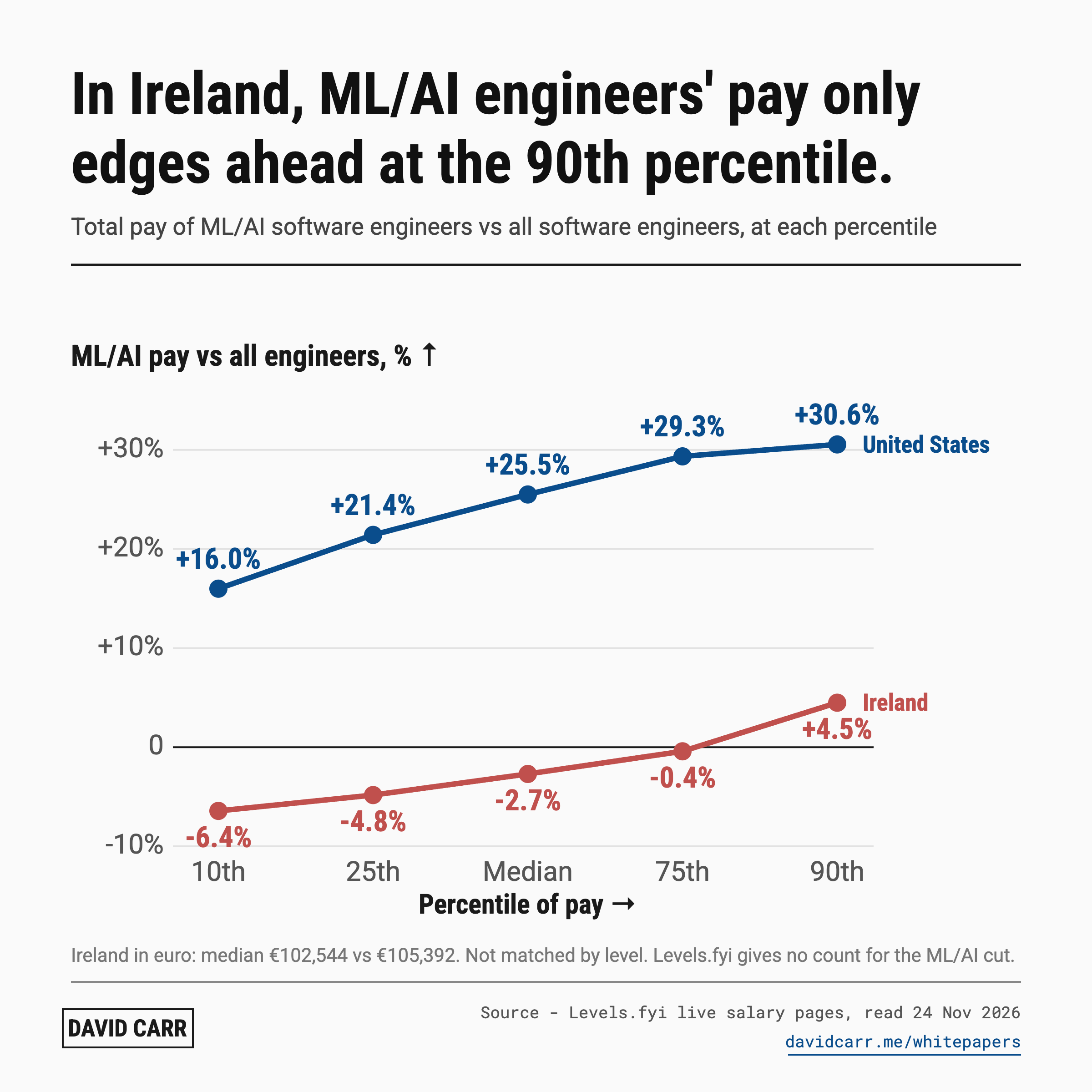
In Ireland, ML/AI engineers' pay only edges ahead at the 90th percentile.
- Median: €102,544 vs €105,392 (-2.7%)
- 75th percentile: -0.4%
- 90th percentile: €178,380 vs €170,707 (+4.5%)
On Levels.fyi's Irish data there is no AI premium at the median. The US shows 25%.
Live Levels.fyi pages for Ireland and Irish ML/AI engineers, read 24 November 2026. The all-engineer figure rests on 1,100+ salaries; no count is given for the ML/AI cut. Not matched by level. In Berlin, a 2026 survey put AI and ML engineers at €95,000 against €88,000 for software engineers.
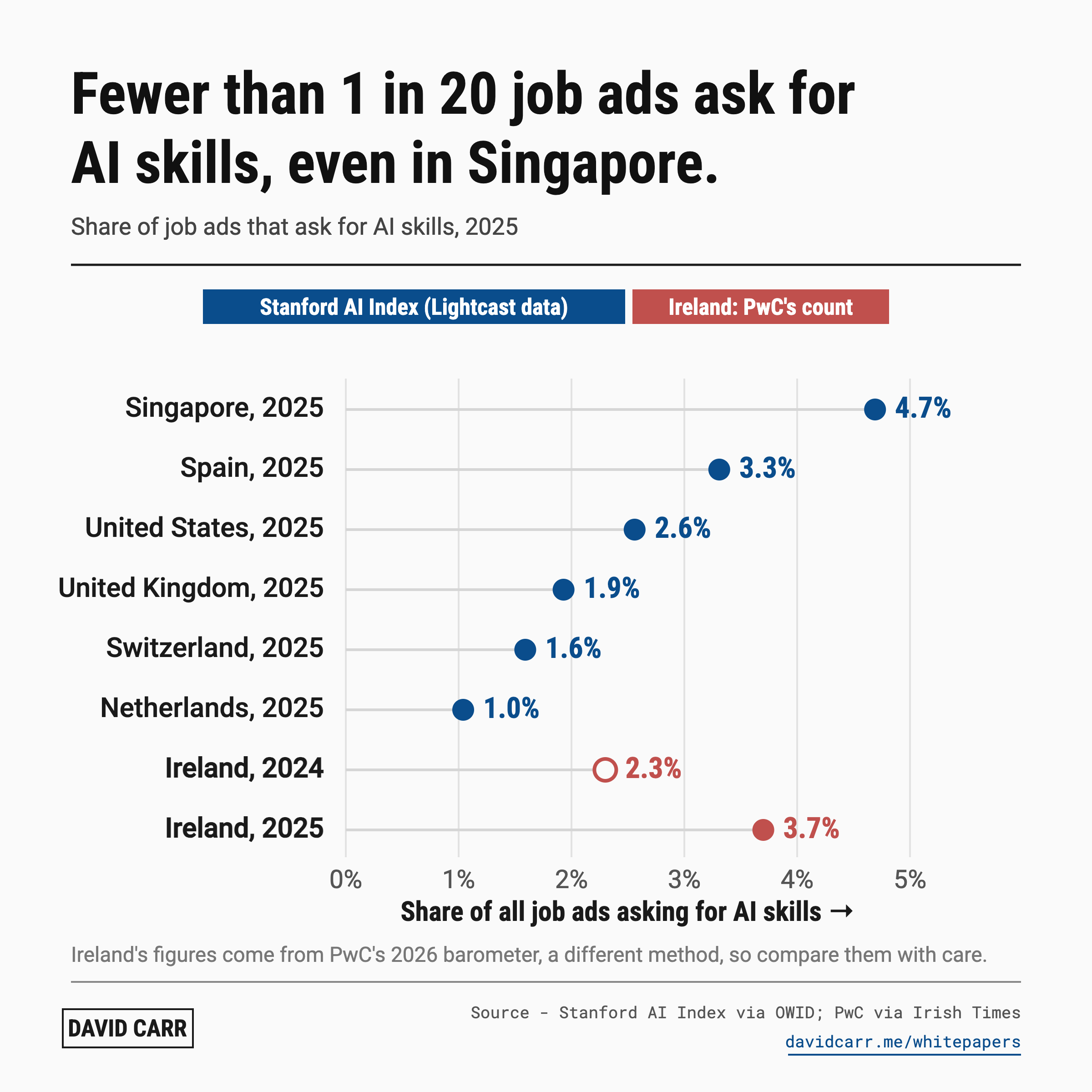
Fewer than 1 in 20 job ads ask for AI skills, even in Singapore.
- Singapore: 4.7%
- Spain: 3.3%
- United States: 2.6%
- United Kingdom: 1.9%
- Ireland: 2.3% in 2024, 3.7% in 2025 (PwC)
The premium applies to a thin slice of the jobs market, though the slice is growing.
Stanford AI Index data from Lightcast, via Our World in Data (downloaded 24 November 2026) and Lightcast. Ireland from PwC via The Irish Times, a different method.
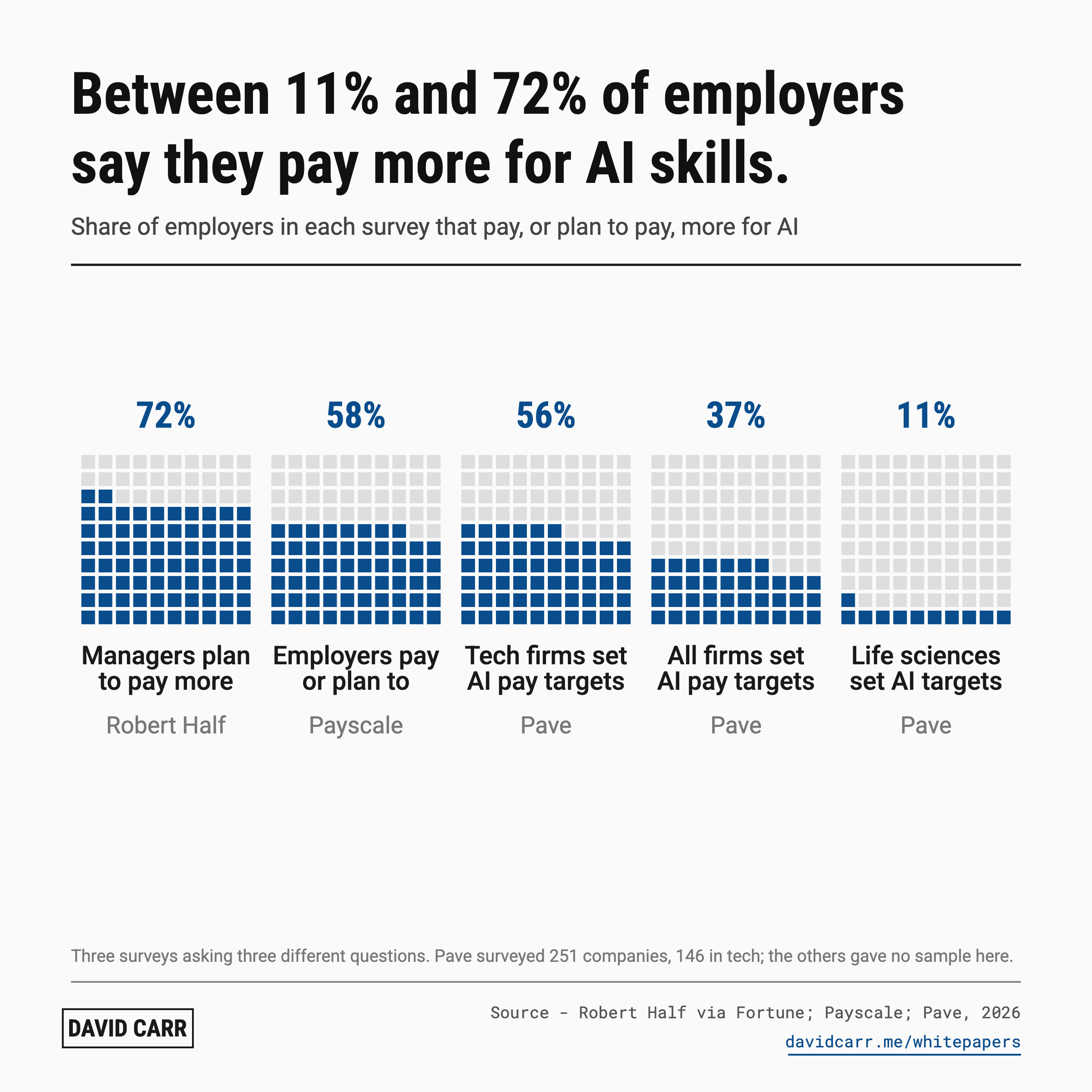
Between 11% and 72% of employers say they pay more for AI skills.
- Robert Half: 72% of hiring managers plan to
- Payscale: 58% pay or plan to
- Pave: 56% of tech firms set separate AI pay targets
- All industries: 37%
- Life sciences: 11%
Tech firms lead. Outside tech, most have not set a separate target.
Three surveys with three questions. Pave and Alpine Rewards surveyed 251 companies, 146 in tech, in September and October 2026.
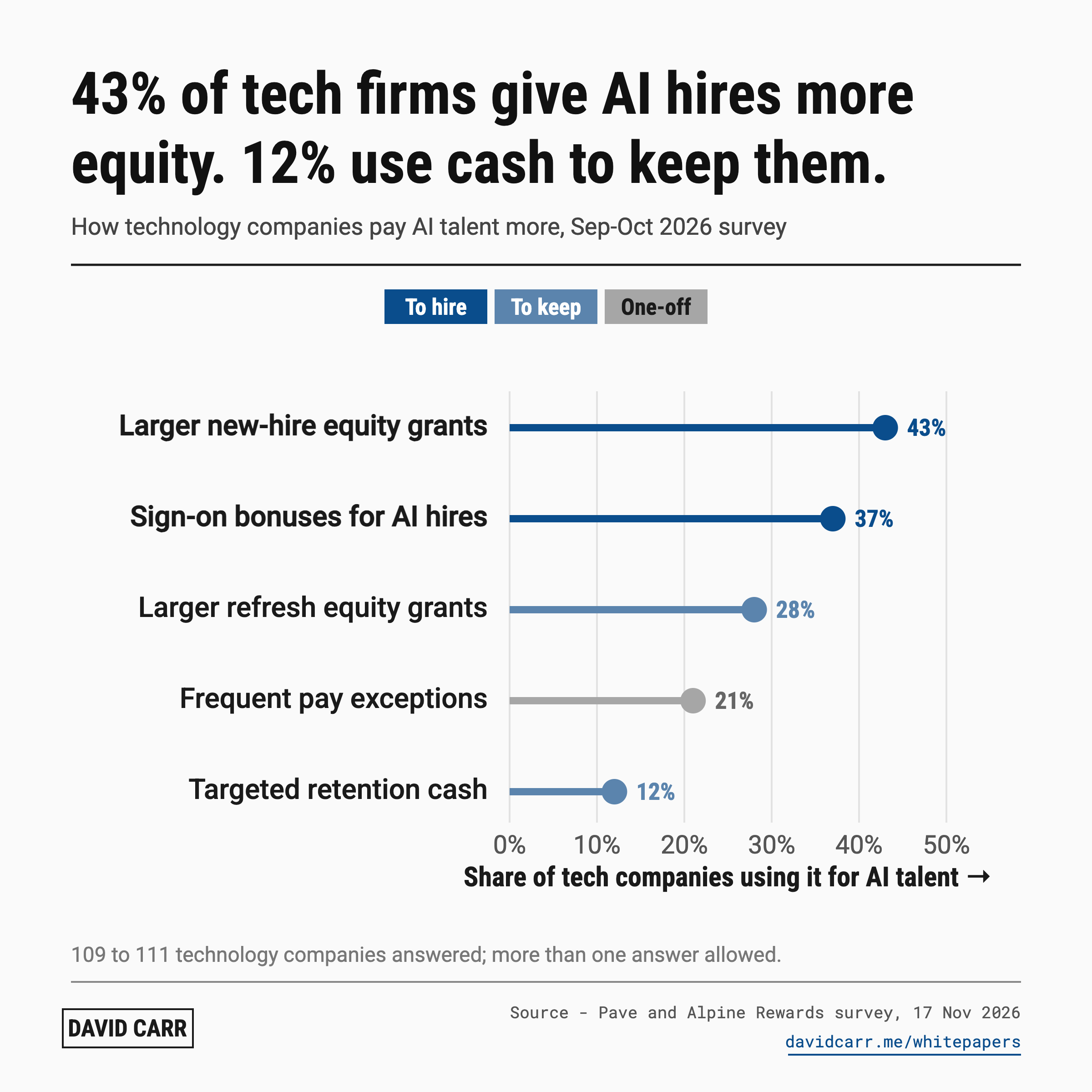
43% of tech firms give AI hires more equity. 12% use cash to keep them.
- Larger new-hire equity: 43%
- Sign-on bonuses: 37%
- Larger refresh grants: 28%
- Frequent pay exceptions: 21%
- Targeted retention cash: 12%
Most of the extra goes into hiring. Less goes into keeping people.
From Pave and Alpine Rewards, 17 November 2026; 109 to 111 tech firms answered. Pave's offer data shows 25% of ML/AI hires got a sign-on bonus, 2.5 times other roles.
Method, caveats and sources
The short answer. It depends on who you ask and what they compare. Job-ad studies across all jobs find 28% to 62%. Studies that compare engineers with engineers at the same level find about 5% to 19%. Everyone agrees on the shape: the premium grows with seniority and is largest at the top. In Ireland, Levels.fyi shows almost none at the median.
Why the numbers differ. Four things move them. Who is compared: AI jobs against all jobs, or AI engineers against other engineers. What pay: advertised pay, base salary, or total pay with stock. Whether level is held fixed: AI roles skew senior, so an unmatched gap includes seniority. And what counts as an AI job: a title, a skill listed in an ad, or a job family an employer chose.
Sources. PwC's Global AI Jobs Barometer (releases of 3 June 2025 and 15 June 2026, read through wire copies because pwc.com refused automated reads). Lightcast's Beyond the Buzz. Levels.fyi's blog, its live salary pages read on 24 November 2026, and data it gave Let's Data Science. Indeed Hiring Lab, 17 September 2026. Pave's own posts (March 2024, September 2024, December 2024, March 2026, June 2026, November 2026). Carta's April 2026 article. TalentUp's European benchmarks. Revelio Labs with LinkUp. Stanford AI Index data via Our World in Data. Robert Half, Payscale.
Pave over time. Pave's own estimate has moved: about 7-8% for ML engineers in March 2024 ($210,000 vs $196,000 at senior level), about 20% salary premium at public companies in September 2024, and about 10-20% for applied AI/ML engineers in December 2024. In its June 2026 merit data, AI and ML engineers got the biggest non-promoted raise in R&D: 4.4% against 3.7%.
Left out. Ravio's European figures and Glassdoor's AI premium analysis could not be read directly, so they are not used. Carta's August 2025 salary-growth figures could not be read either. LinkedIn figures quoted in the press are left out.
Also: Pave, Levels.fyi, Pave and its rivals and Pay in Europe.