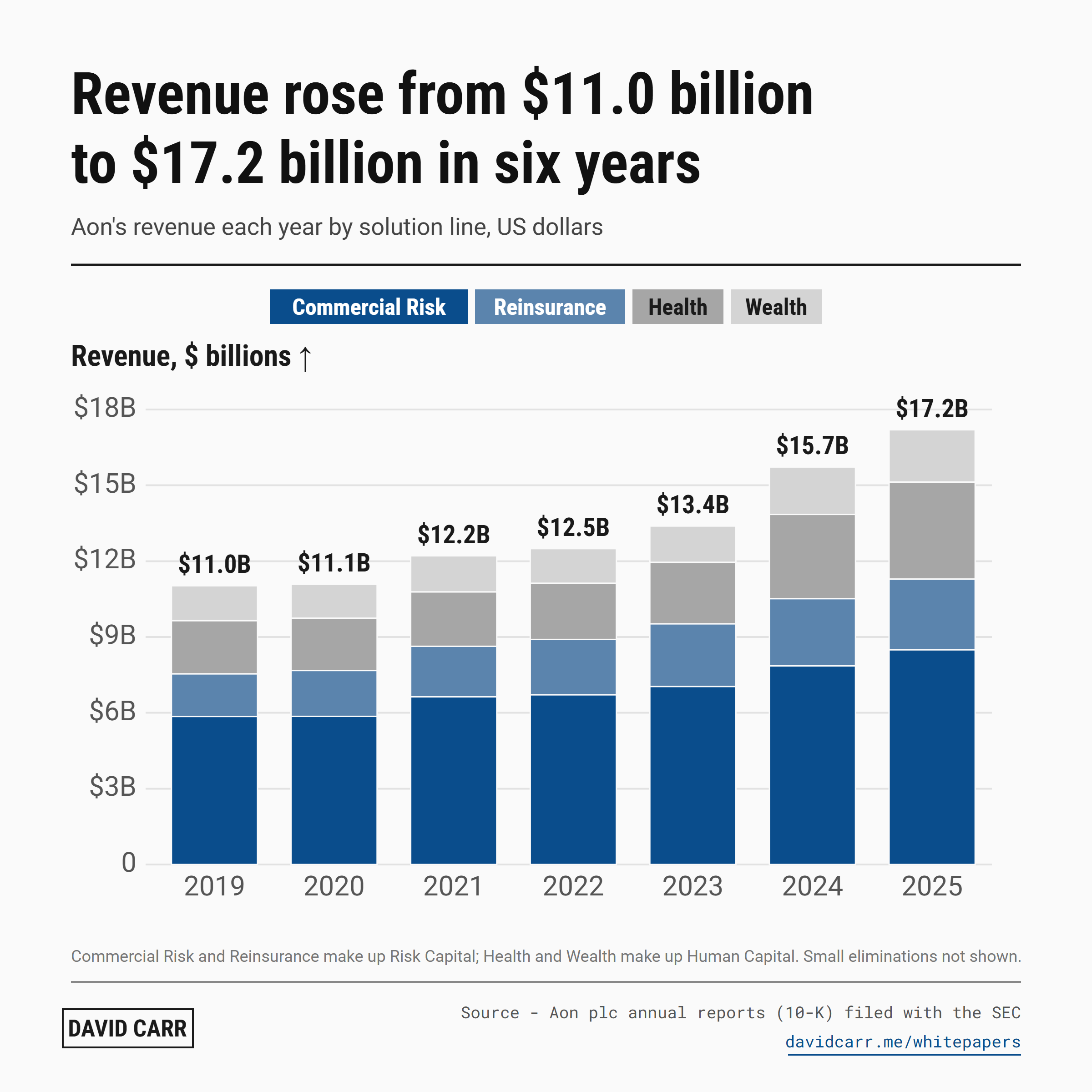
Revenue rose from $11.0 billion to $17.2 billion in six years
- 2019: $11.0 billion
- 2021: $12.2 billion
- 2023: $13.4 billion
- 2024: $15.7 billion
- 2025: $17.2 billion
Commercial Risk, which places business insurance, is almost half the firm: $8.5 billion in 2025. Health and Wealth, the Human Capital side, made $5.9 billion.
From Aon's annual reports on Form 10-K: 2021 (restated to four lines back to 2019) and 2025.
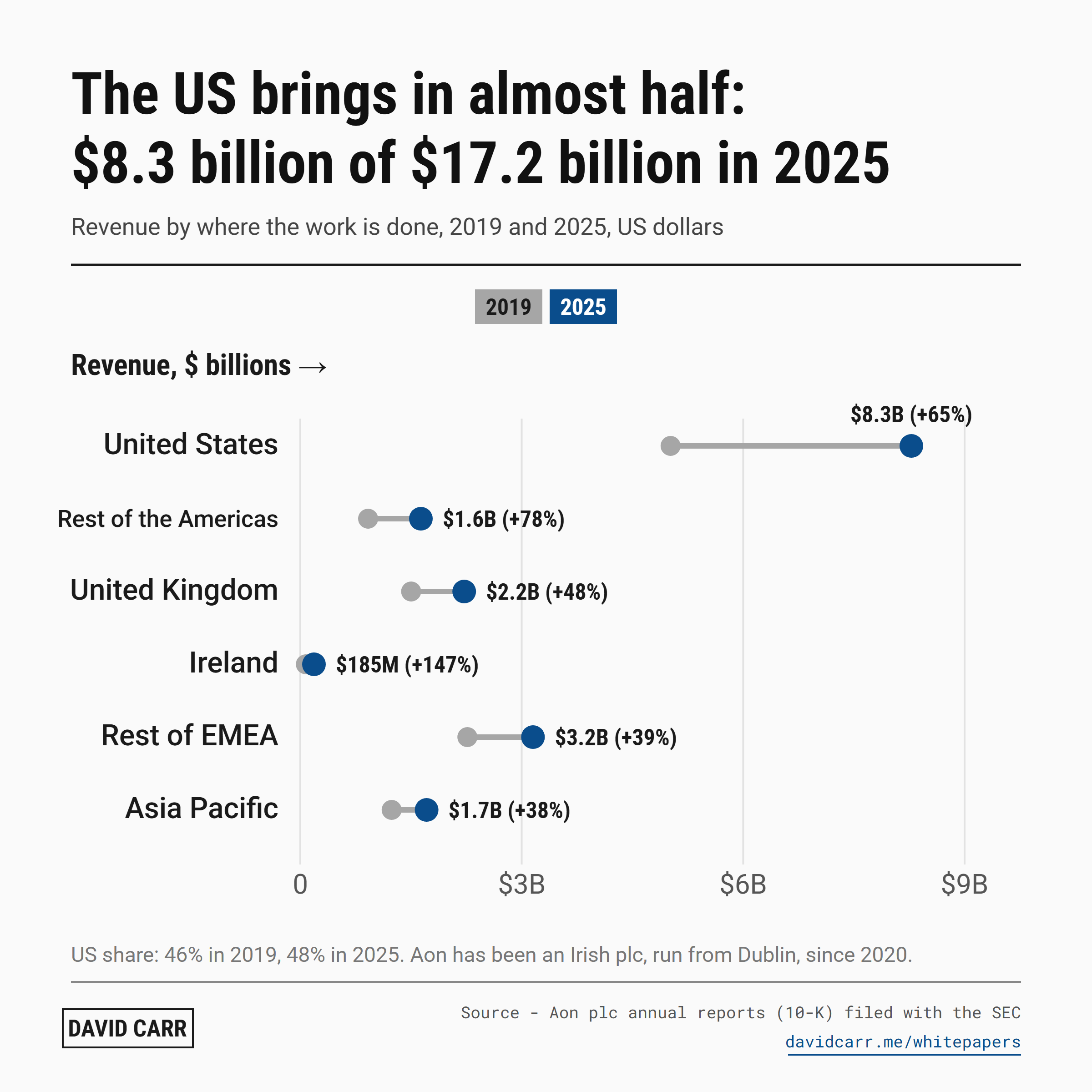
The US brings in almost half: $8.3 billion of $17.2 billion in 2025
- United States: $5.0B to $8.3B
- Rest of EMEA: $2.3B to $3.2B
- United Kingdom: $1.5B to $2.2B
- Asia Pacific: $1.2B to $1.7B
- Ireland: $75M to $185M
The US share rose from 46% to 48%. Ireland is small in revenue, but Aon plc has been an Irish company, run from George's Quay in Dublin, since April 2020.
Revenue is placed where the work is done, as Aon reports it. 2019 is from the 2021 report, which first split out Ireland.
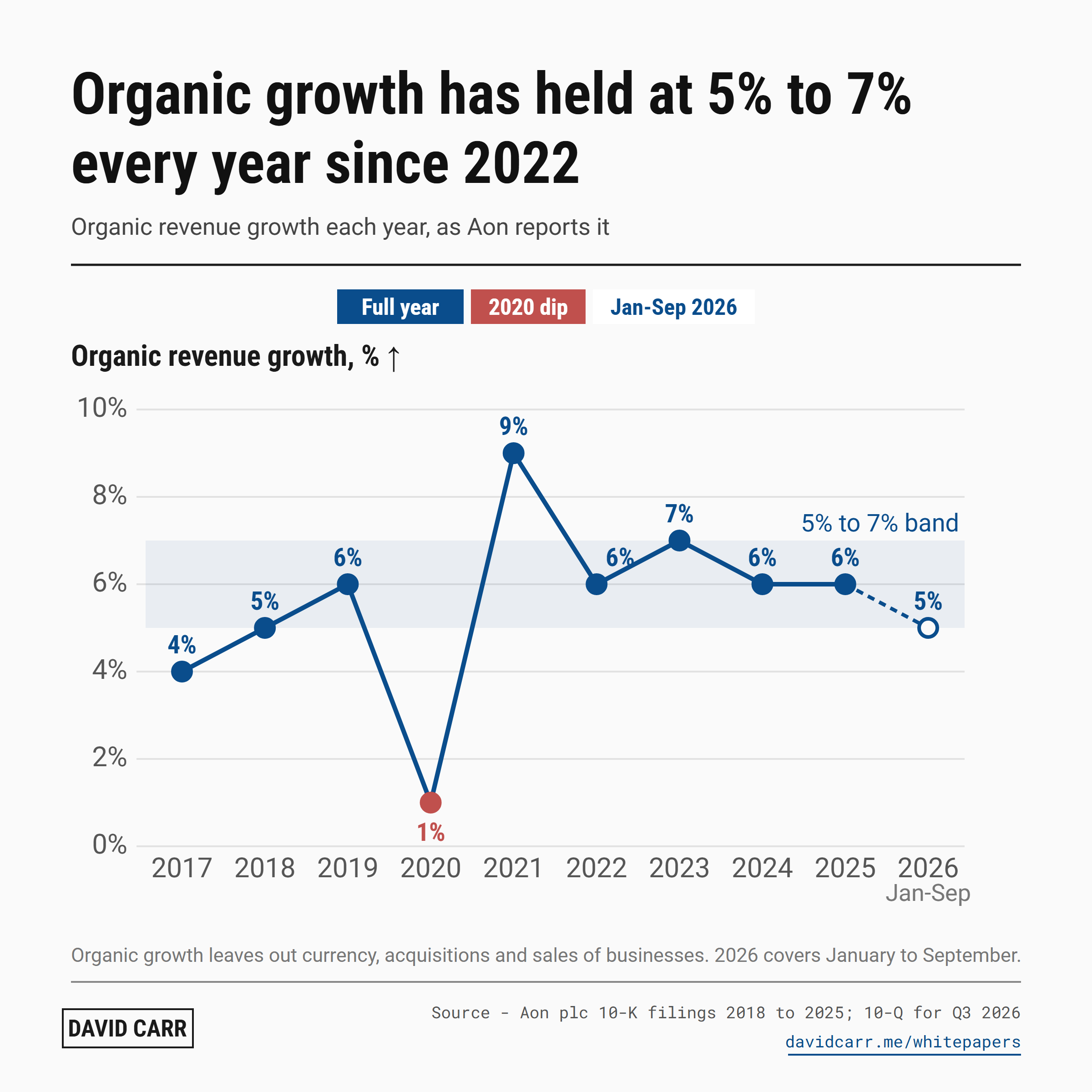
Organic growth has held at 5% to 7% every year since 2022
- 2019: 6%
- 2020: 1%
- 2021: 9%
- 2022 to 2025: 6%, 7%, 6%, 6%
- January to September 2026: 5%
2020 was the dip and 2021 the bounce. Since then the business Aon already owned has grown at a steady clip.
Organic growth is Aon's own measure. It strips out currency, acquisitions and sales. From the 10-Ks and the Q3 2026 10-Q.
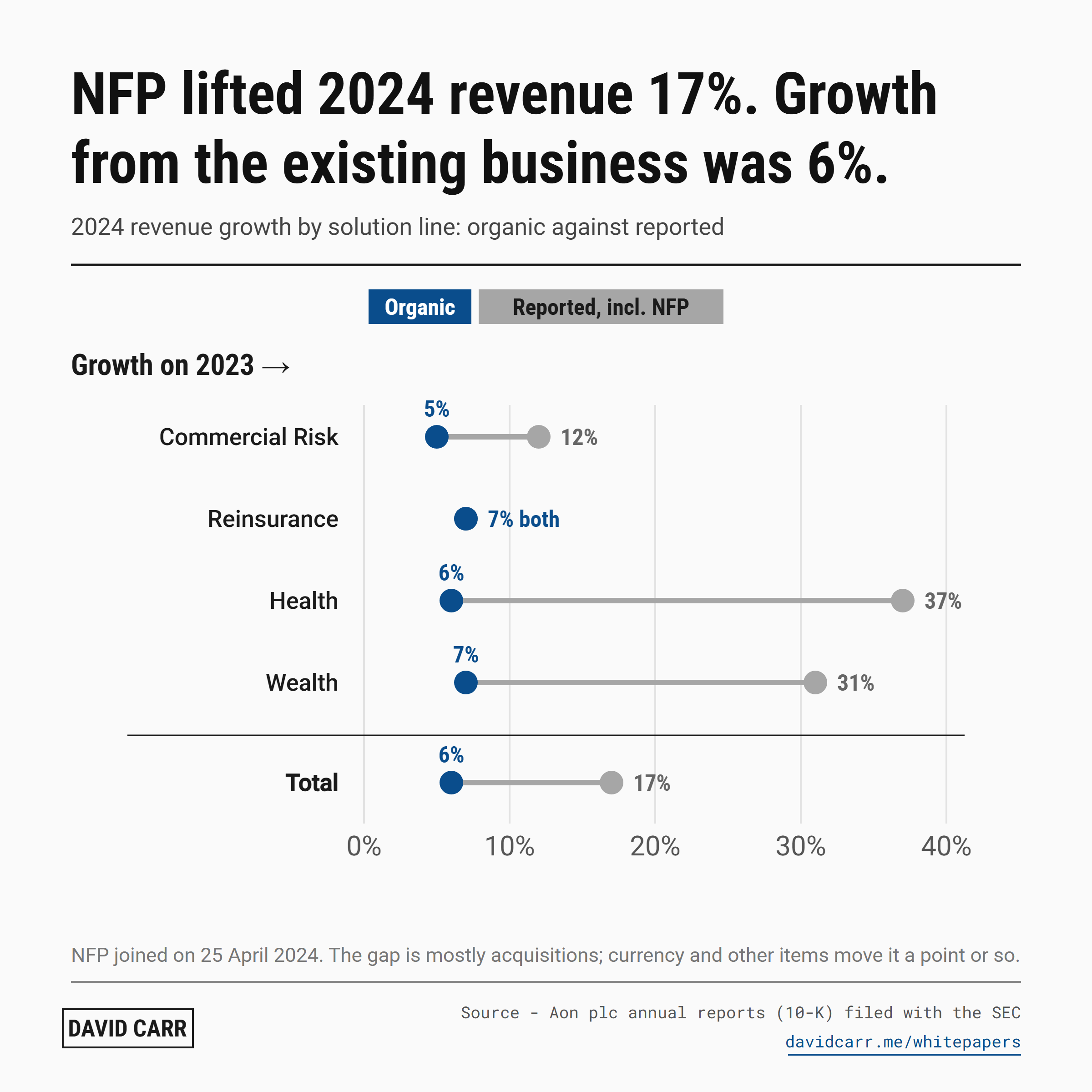
NFP lifted 2024 revenue 17%. Growth from the existing business was 6%.
- Health: 37% reported, 6% organic
- Wealth: 31% reported, 7% organic
- Commercial Risk: 12% reported, 5% organic
- Reinsurance: 7% both ways
- Total: 17% reported, 6% organic
NFP did insurance broking, benefits consulting, wealth management and retirement plan consulting, so the Human Capital lines jumped the most.
From the organic growth table in the 2025 10-K. In 2025 the gap narrowed: 9% reported, 6% organic.
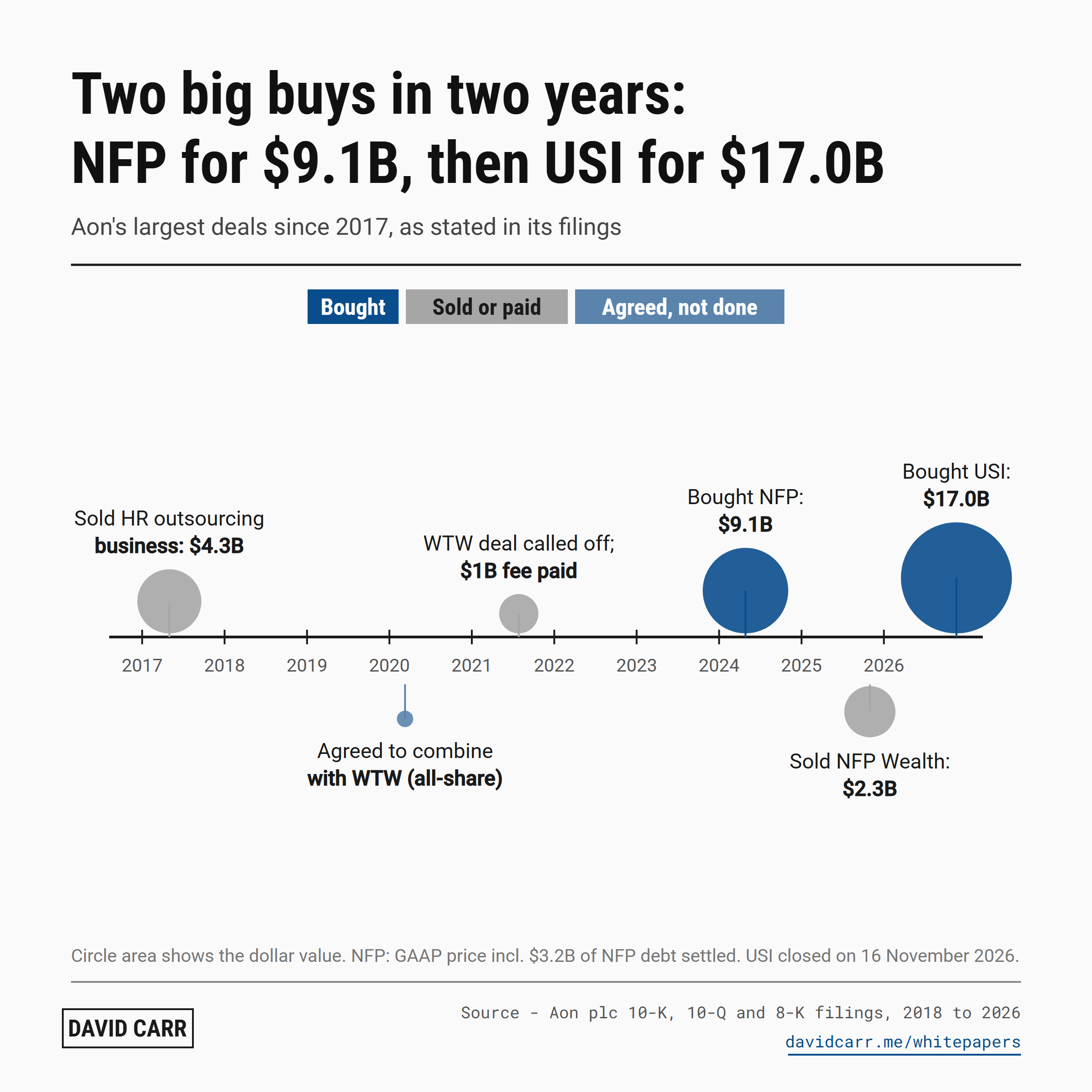
Two big buys in two years: NFP for $9.1B, then USI for $17.0B
- 2017: sold its benefits administration and HR outsourcing business to Blackstone affiliates, $4.3B in cash plus up to $0.5B later
- 2020 to 2021: agreed an all-share combination with WTW, then called it off and paid a $1B fee
- April 2024: bought NFP, $9.1B GAAP price including about $3.2B of NFP debt settled
- October 2025: sold the NFP Wealth business to Madison Dearborn Partners, $2.3B in cash
- 16 November 2026: completed the USI deal, $17.0B
Both big buys aim at the US middle market. Aon says USI is the tenth largest US broker, with about $3 billion in revenue and more than 10,500 people across nearly 200 US offices (release).
Prices as Aon gave them. Aon has also sold Stroz Friedberg; the 10-Q read gives no price or date.
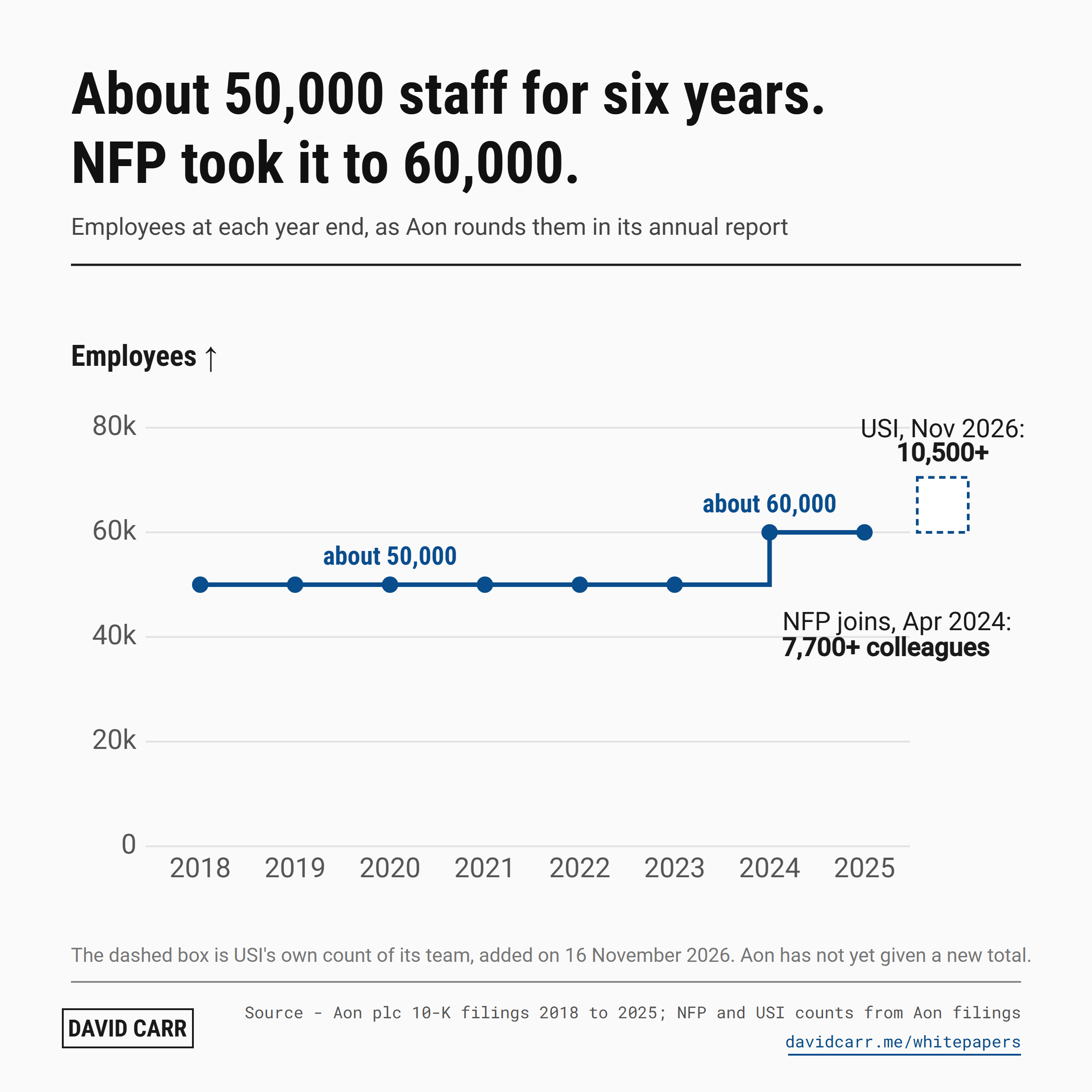
About 50,000 staff for six years. NFP took it to 60,000.
- Year ends 2018 to 2023: about 50,000
- Year ends 2024 and 2025: about 60,000
- NFP brought 7,700+ colleagues
- USI's own count: 10,500+ team members
Revenue grew by over half between 2019 and 2025 while the rounded headcount rose a fifth.
Aon gives headcount to the nearest 10,000 in its annual report. No combined count after USI had been published by 25 November 2026.
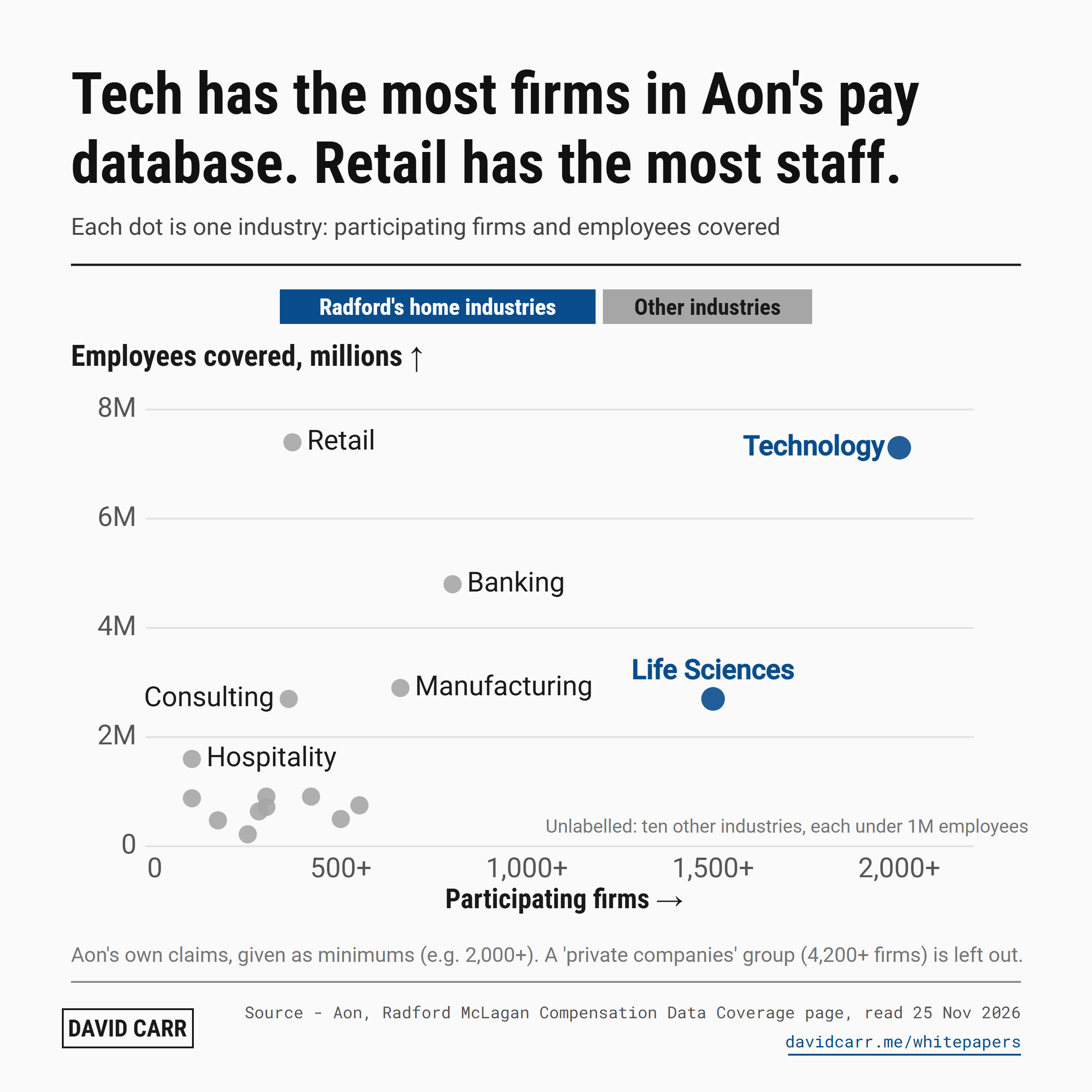
Tech has the most firms in Aon's pay database. Retail has the most staff.
- Technology: 2,000+ firms, 7.3M employees
- Life sciences: 1,500+ firms, 2.7M
- Retail and e-commerce: 370+ firms, 7.4M
- Banking: 800+ firms, 4.8M
- All industries: 8,500+ organisations, 34M+ employees
Tech and life-sciences firms make up the biggest groups of participants.
From Aon's Radford McLagan coverage page, read 25 November 2026. Industry groups can overlap, and Aon does not split Radford's revenue out in its filings.
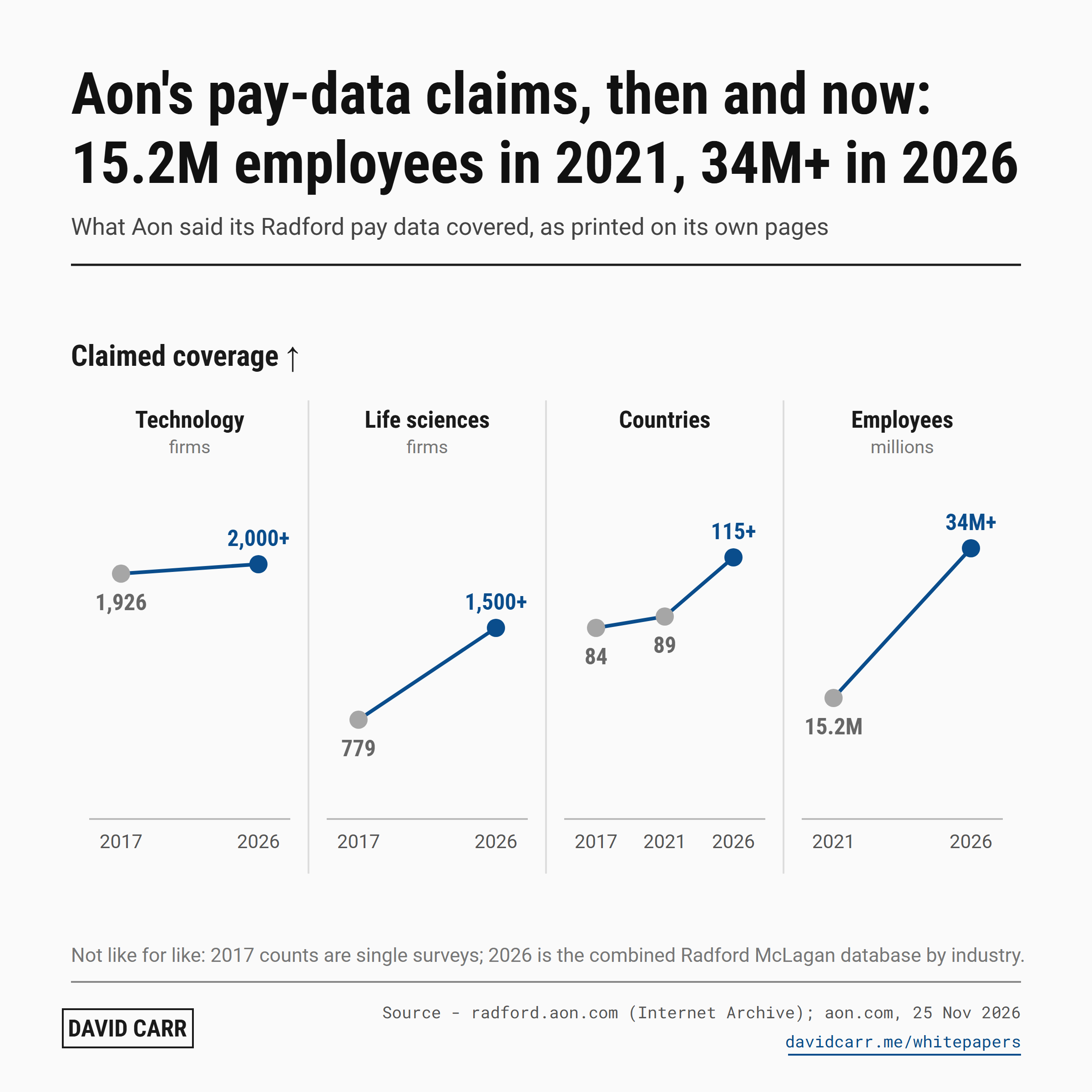
Aon's pay-data claims, then and now: 15.2M employees in 2021, 34M+ in 2026
- March 2017: Global Technology Survey, 1,926 organisations in 84 countries
- March 2017: Global Life Sciences Survey, 779 organisations in 51 countries
- October 2021: 15.2 million employees in 89 countries
- November 2026: 8,500+ organisations, 34M+ employees, 115+ countries
Every measure Aon prints has gone up. They are not all measured the same way, so read the trend rather than the exact multiple.
Older claims from radford.aon.com via the Internet Archive (2017, 2021). The 2026 figures cover the combined Radford McLagan database.
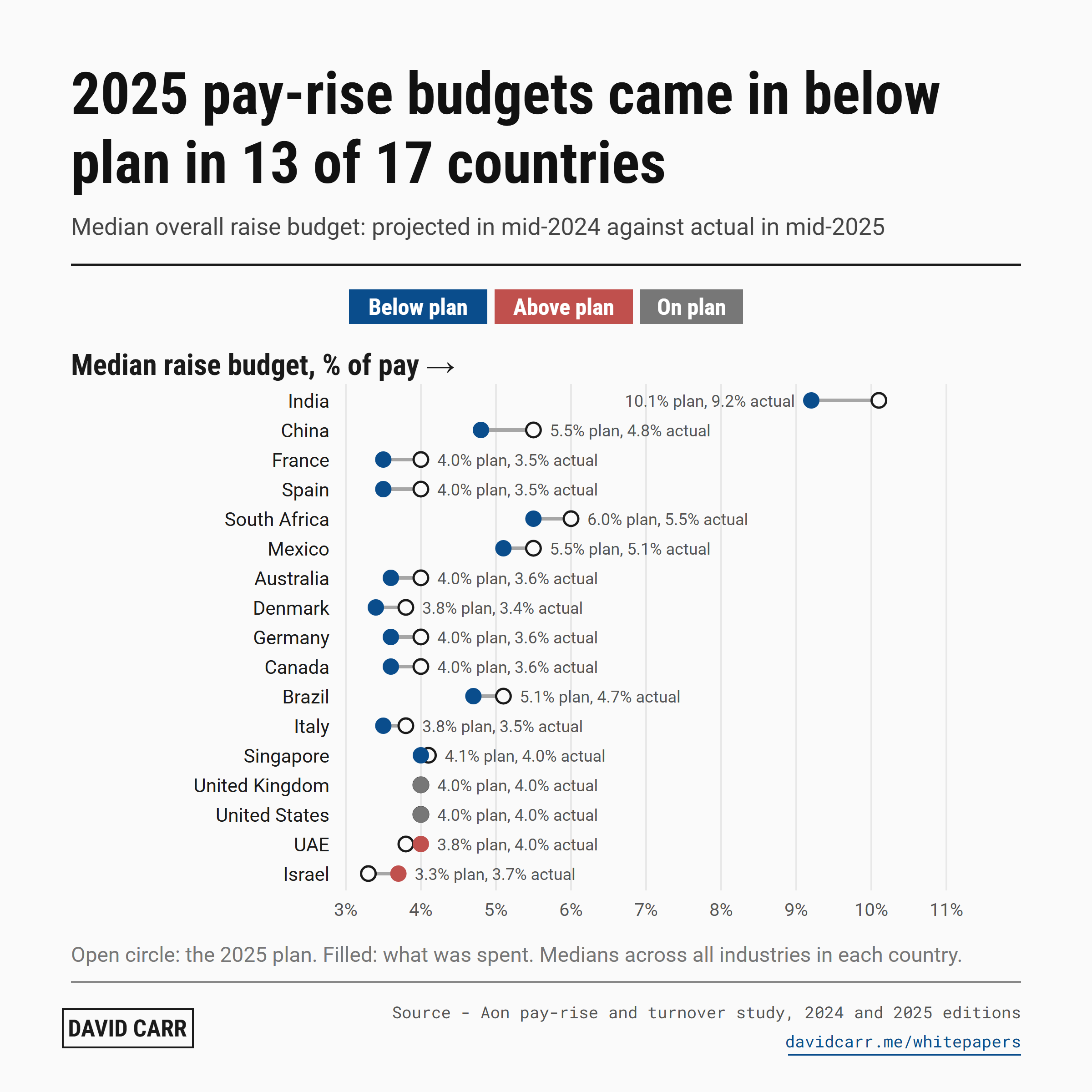
2025 pay-rise budgets came in below plan in 13 of 17 countries
- India: 10.1% planned, 9.2% spent
- China: 5.5% planned, 4.8% spent
- France and Spain: 4.0% planned, 3.5% spent
- US and UK: 4.0% planned, 4.0% spent
- Israel and UAE: came in above plan
Aon's own explanation is low staff turnover: with fewer people leaving, employers felt less pressure to spend. For 2026, Aon says employers are keeping budgets close to 2025 or slightly above.
Medians across all industries from Aon's twice-yearly pay study: the plan from the 2024 edition (2,186 participants), the outcome from the 2025 edition (1,897 participants, 115 countries).
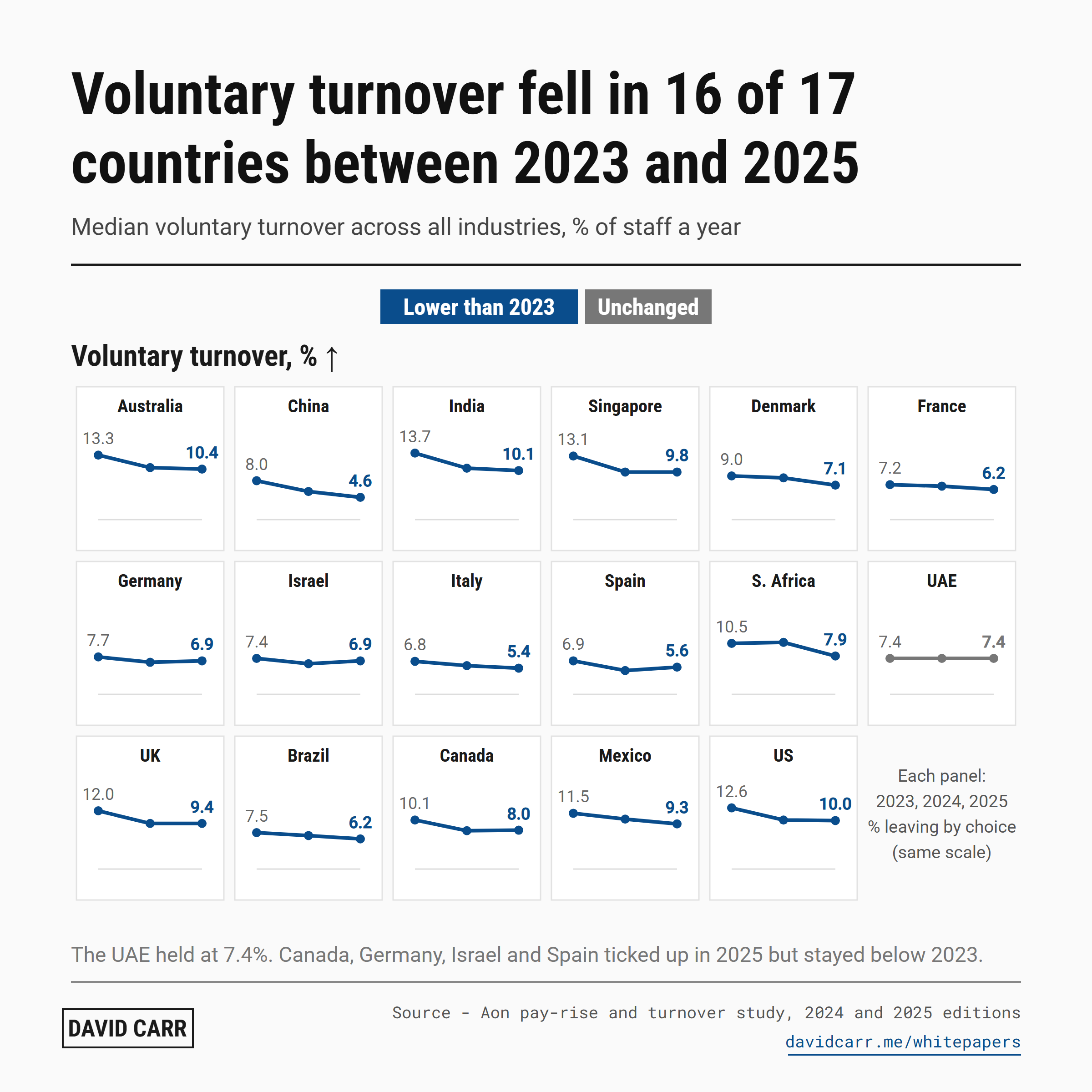
Voluntary turnover fell in 16 of 17 countries between 2023 and 2025
- US: 12.6% to 10.0%
- UK: 12.0% to 9.4%
- India: 13.7% to 10.1%
- China: 8.0% to 4.6%
- UAE: 7.4% all three years
Most of the fall came in 2024. The 2025 changes were smaller, and four countries ticked back up.
Median share of staff leaving by choice, from the same study (2024 and 2025 editions).
Method, caveats and sources
The short answer. Aon made $17.2 billion in 2025, almost half of it in the US. The business it already owned has grown 5% to 7% a year since 2022; buying NFP in 2024 and USI in November 2026 is what has made it bigger. Radford, its pay-data business, is not broken out in the accounts, but Aon says its database now covers 8,500+ organisations and 34M+ employees.
Filings. Revenue, organic growth, geography, headcount and deal values come from Aon's 10-K annual reports, its Q3 2026 10-Q and its 8-Ks of 31 August and 16 November 2026, all on SEC EDGAR, read 25 November 2026. Organic growth is a non-GAAP measure Aon defines itself. Revenue lines were reorganised in 2021; the four-line series here uses Aon's own restatement back to 2019.
Radford. Aon's filings name no Radford figures. The coverage claims come from Aon's own web pages, today's and archived copies. They are marketing figures, not audited, and the 2017 and 2026 numbers count different things.
Pay surveys. Forecasts and outcomes come from Aon's Salary Increase and Turnover Study, as published in its planning articles of November 2024 and October 2025. They are medians of employer budgets, not what any one person received. Aon's November 2026 article gave no country budget figures.
Left out. Aon's share price and market value, its pricing, and any headcount after USI, which Aon had not published.
Also: Stripe, Pave and Pave vs its competitors.