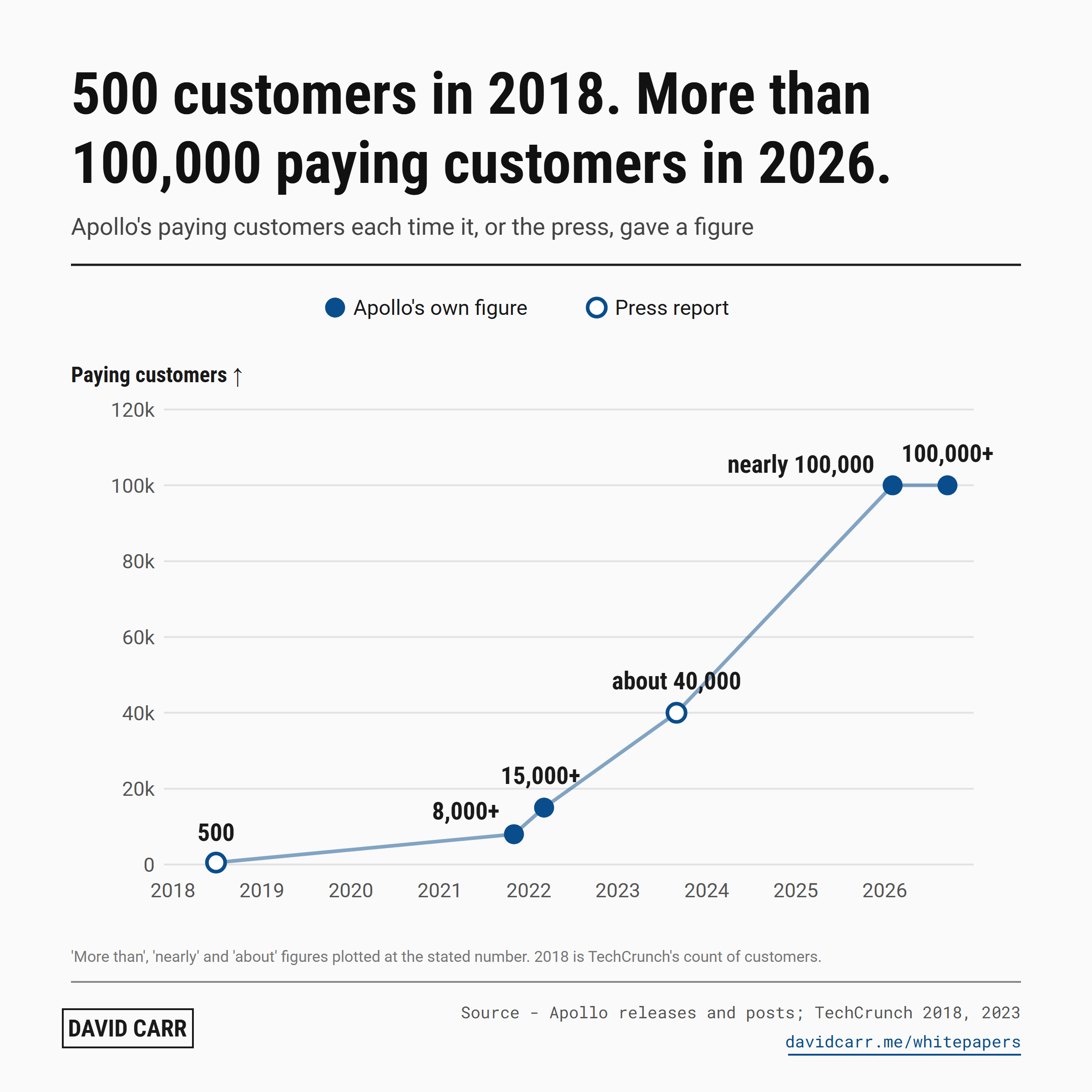
500 customers in 2018. More than 100,000 paying customers in 2026.
The count more than doubled between August 2023 and February 2026.
TechCrunch put the 2021 and 2022 counts a little higher, at 9,000 and 16,000. The chart uses Apollo's own figures where it gave them.
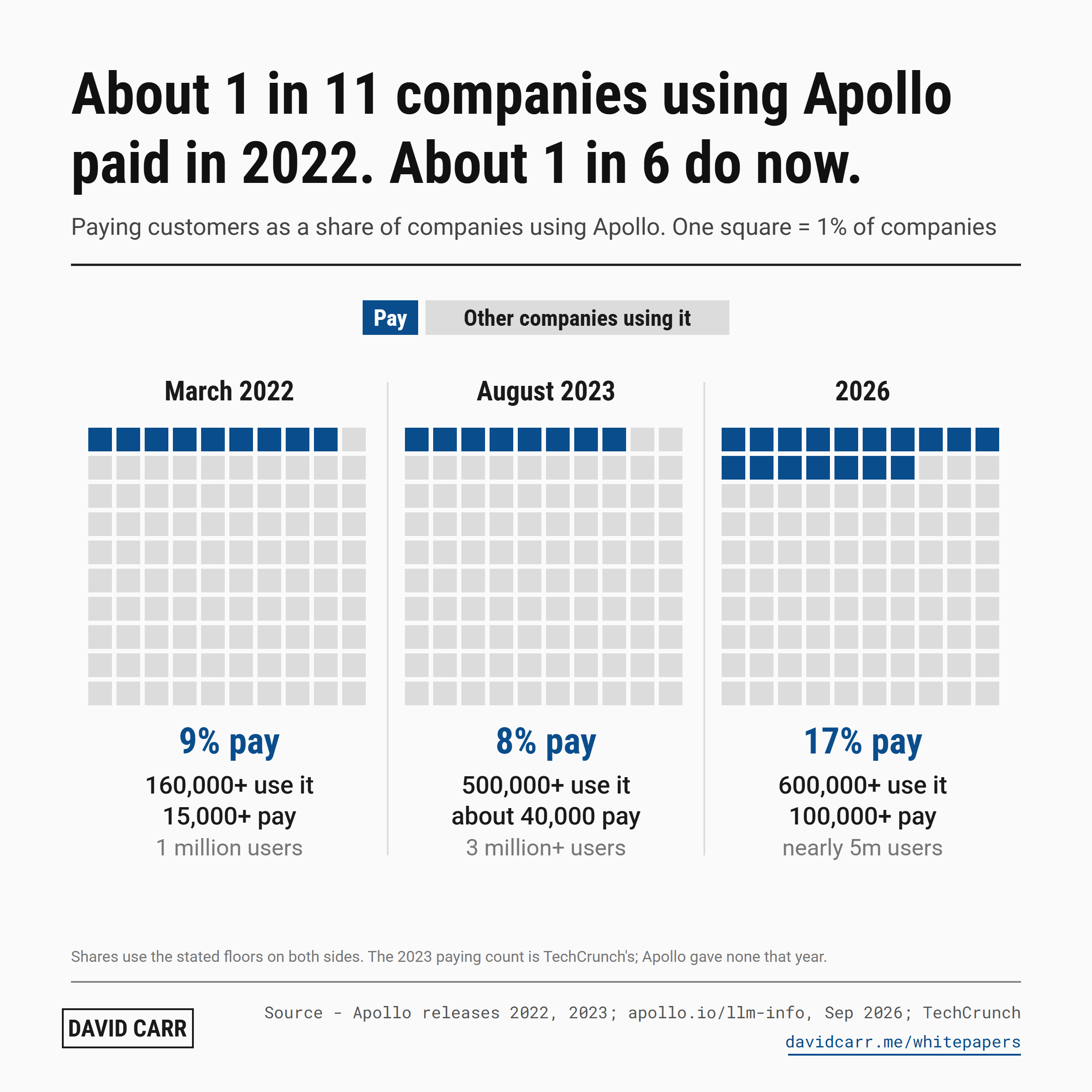
About 1 in 11 companies using Apollo paid in 2022. About 1 in 6 do now.
- March 2022: 160,000+ companies, 15,000+ paying, 1 million users
- August 2023: 500,000+ companies, about 40,000 paying, 3 million+ users
- 2026: 600,000+ companies, 100,000+ paying, nearly 5 million users
Apollo has a free plan. Most companies that use it don't pay, but the paying share has roughly doubled since 2023.
Company counts from Apollo's 2022 and 2023 releases and its facts page. The 2023 paying count is TechCrunch's.
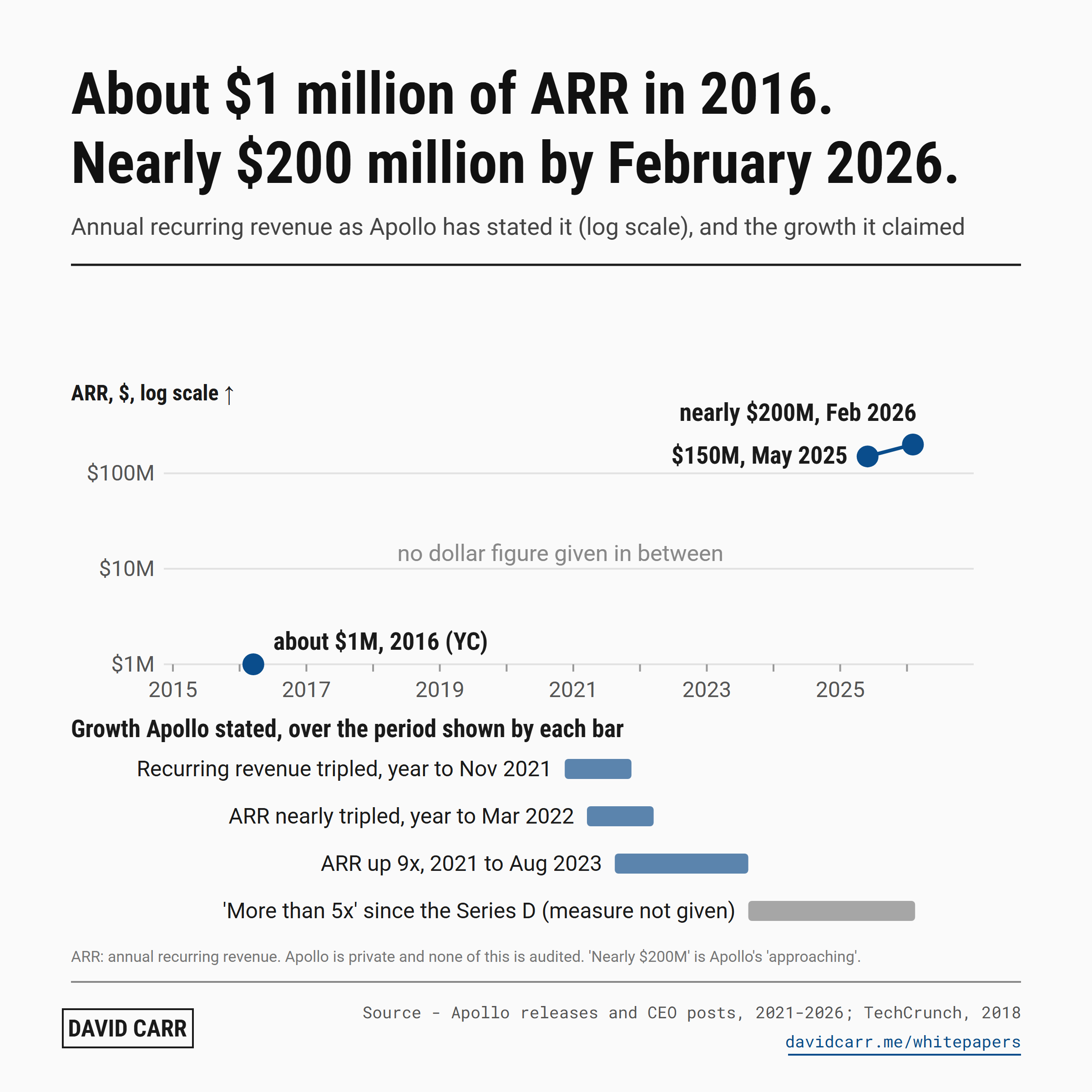
About $1 million of ARR in 2016. Nearly $200 million by February 2026.
Apollo gave growth rates for 2021 to 2023 but no dollar figures. The dollar figures start again in 2025.
ARR is annual recurring revenue. Apollo is private: these are its own statements, not audited accounts. It hasn't given profit figures since 2018.
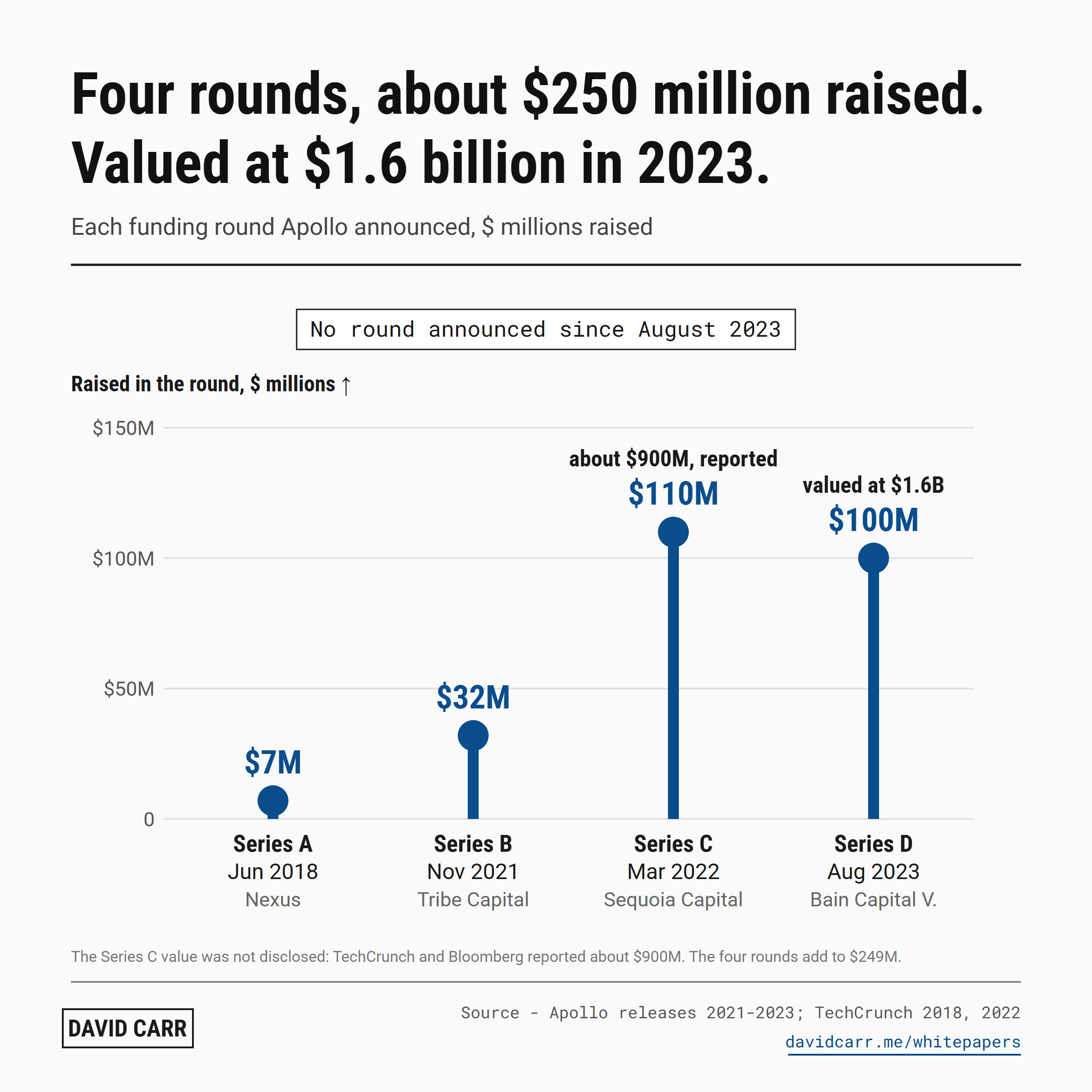
Four rounds, about $250 million raised. Valued at $1.6 billion in 2023.
The 2023 round nearly doubled its value, Apollo said. No round has been announced since.
Apollo didn't disclose the Series C value. TechCrunch and Bloomberg reported about $900 million.
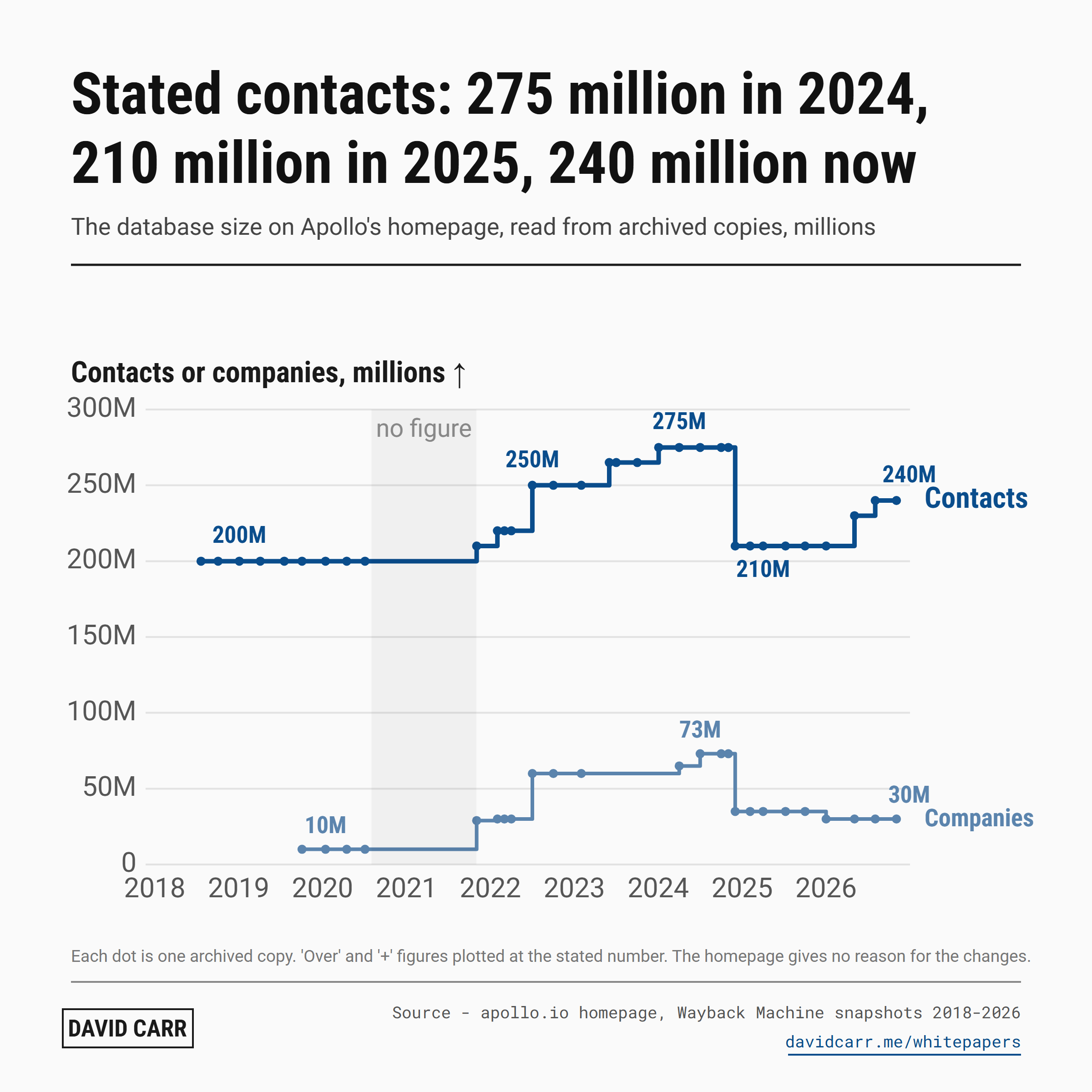
Stated contacts: 275 million in 2024, 210 million in 2025, 240 million now
- 2018 to 2020: over 200 million contacts
- Mid-2022: 250 million contacts, 60 million companies
- 2024: 275 million contacts, up to 73 million companies
- December 2024 to January 2026: 210 million contacts
- August 2026 on: 240 million contacts, 30 million companies
The headline size of the database fell by about a quarter in December 2024, then rose again in 2026.
Read from archived copies of Apollo's homepage in the Wayback Machine. No reason from Apollo for the changes was found.
From ZenProspect in 2015 to a new CEO in 2026
Curl advised Apollo from 2019 and was its chief operating officer before taking over.
TechCrunch reported the 2018 breach at about 200 million records. Apollo says it has renewed SOC 2 and ISO 27001 certification every year since 2019.
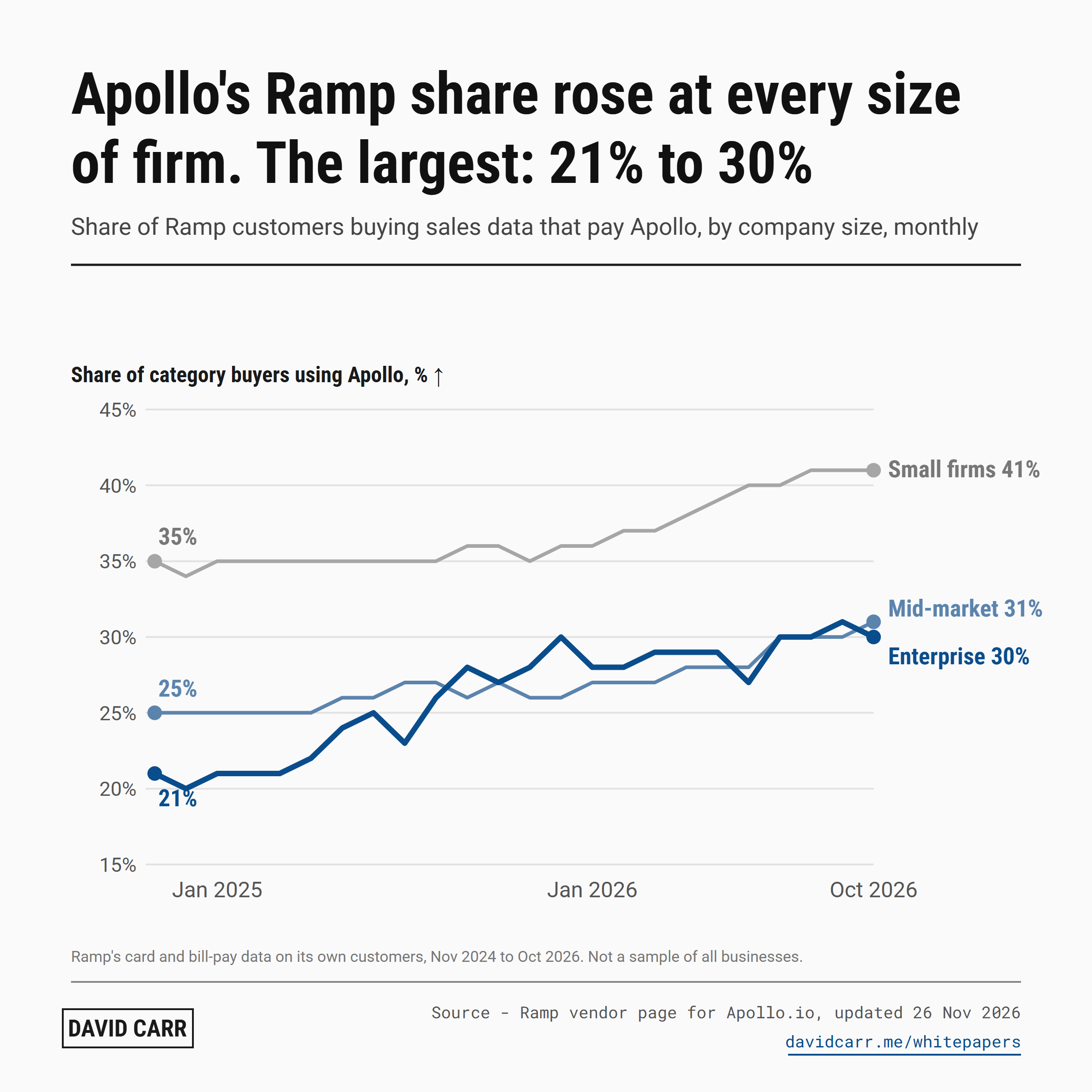
Apollo's Ramp share rose at every size of firm. The largest: 21% to 30%
- Small firms: 35% to 41%
- Mid-market: 25% to 31%
- Enterprise: 21% to 30%
Apollo is still most common at small firms. The fastest rise was at the largest ones.
From Ramp's vendor page for Apollo, Nov 2024 to Oct 2026: the share of Ramp customers buying sales data that pay Apollo. Ramp's customers aren't a sample of all businesses.
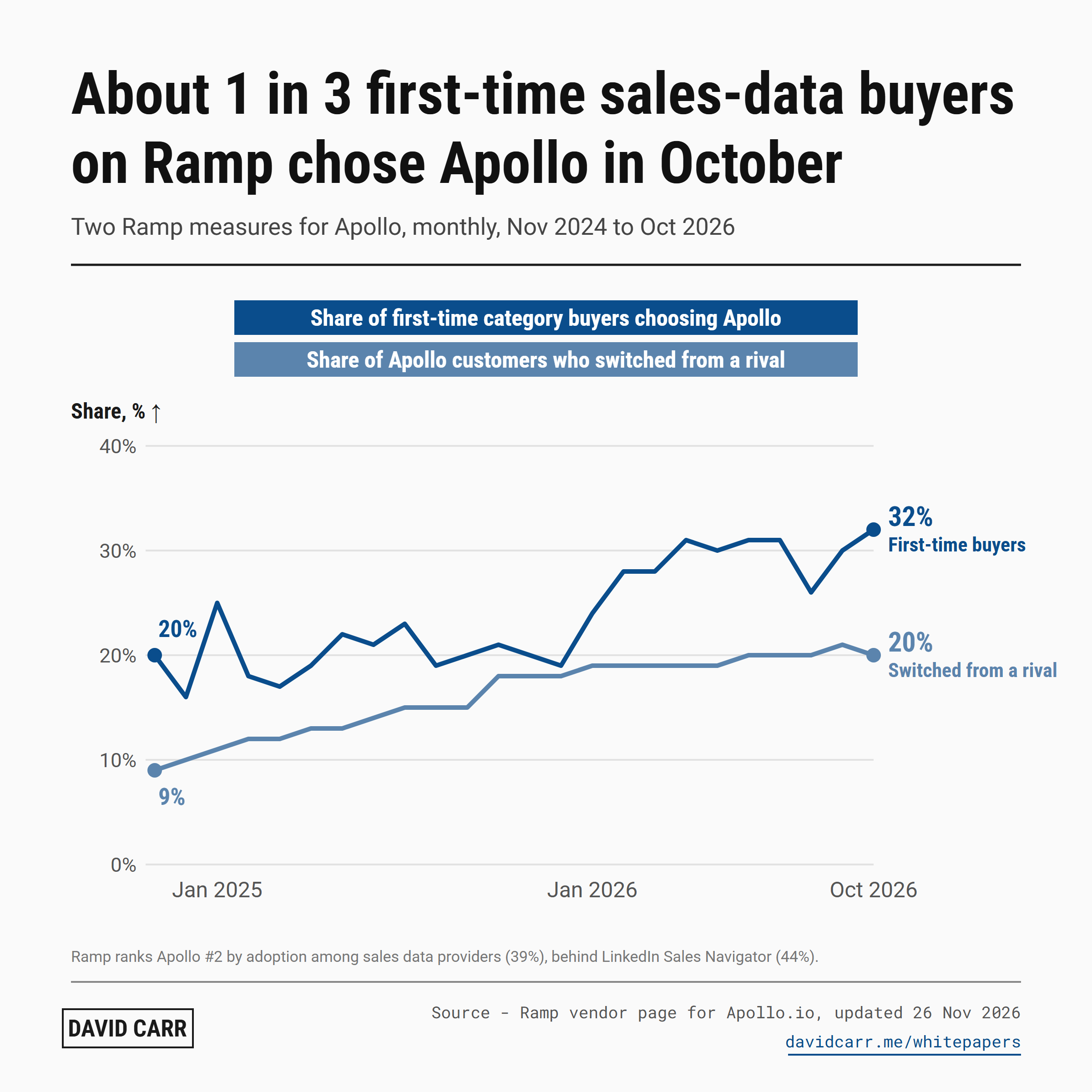
About 1 in 3 first-time sales-data buyers on Ramp chose Apollo in October
- First-time buyers choosing Apollo: 20% to 32%
- Apollo customers who switched from a rival: 9% to 20%
- Overall: 39% of sales-data buyers on Ramp use Apollo, #2 in the category
Ramp ranks Apollo first for new buyers and second overall, behind LinkedIn Sales Navigator at 44%.
Ramp, page updated 26 November 2026. Ramp sees only its own customers' card and bill payments.
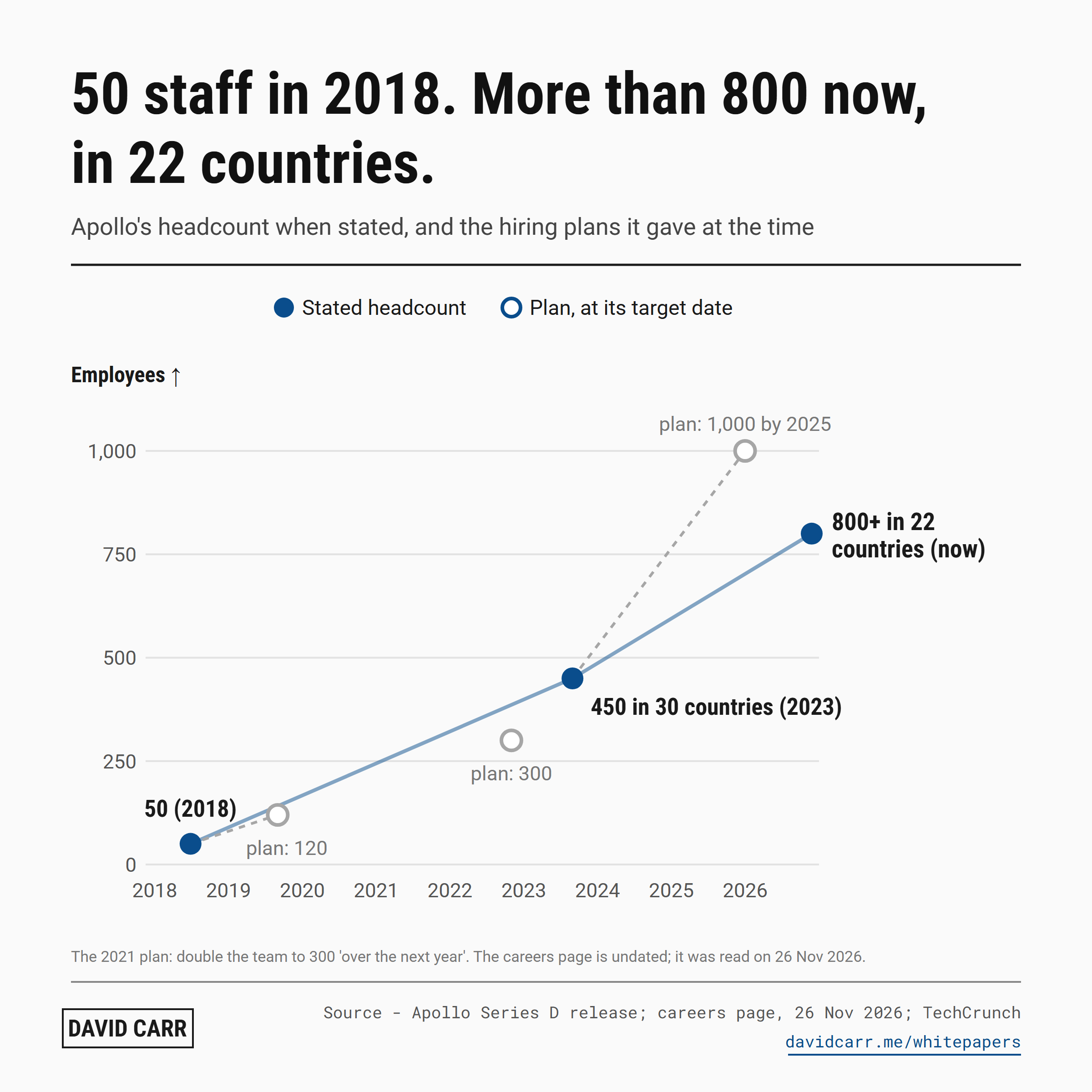
50 staff in 2018. More than 800 now, in 22 countries.
Its sales hubs are Austin and Salt Lake City, and its support hub is Mexico City.
The careers page has no date; it was read on 26 November 2026. Apollo has given no dated headcount since 2023.
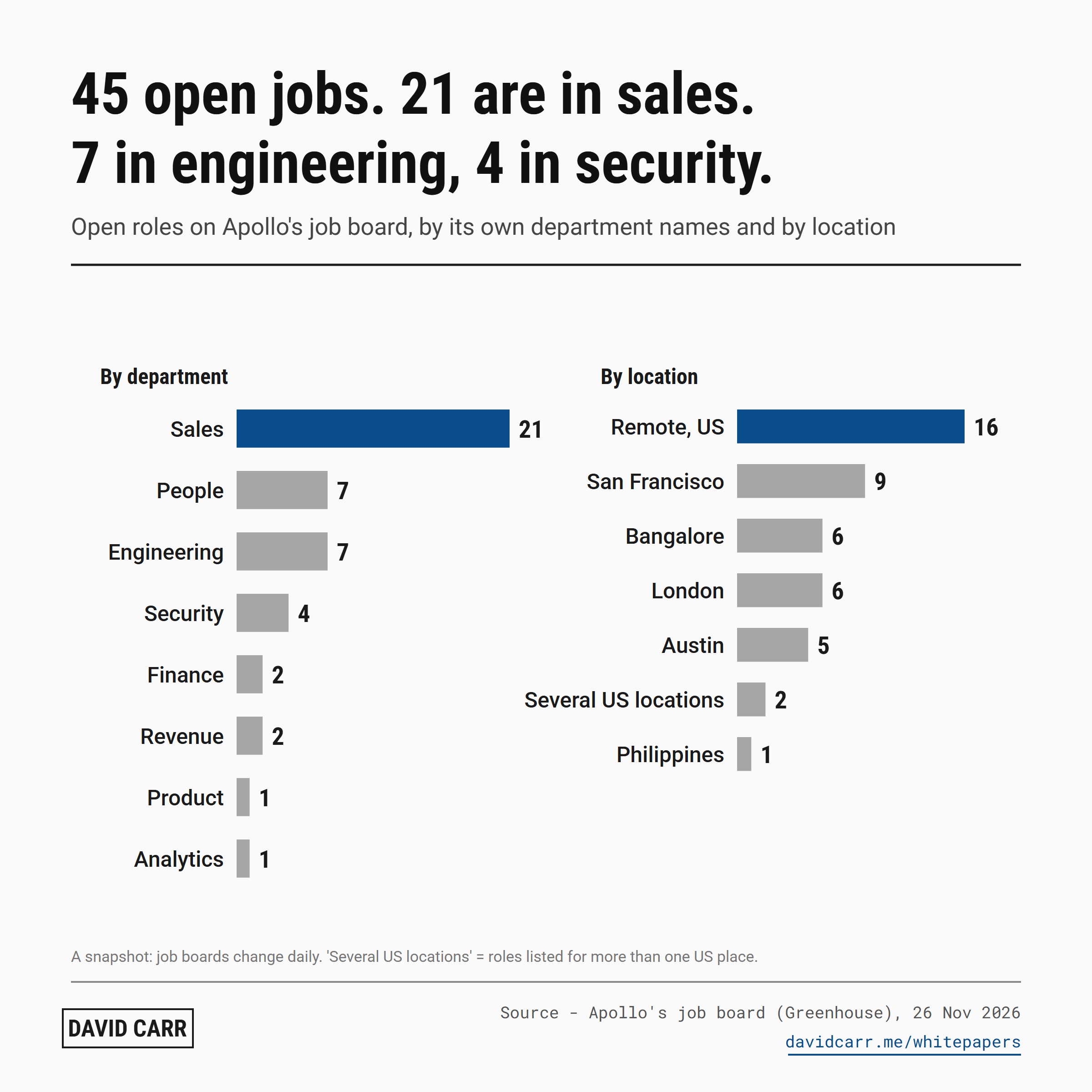
45 open jobs. 21 are in sales. 7 in engineering, 4 in security.
- Sales: 21
- Engineering: 7
- People: 7
- Security: 4
- Remote in the US: 16; San Francisco 9; Bangalore and London 6 each; Austin 5
Nearly half the open roles are in sales, spread across the US, London and Bangalore.
Apollo's job board, 26 November 2026, by its own department names. A snapshot: boards change daily.
Method, caveats and sources
The short answer. Apollo says it has more than 100,000 paying customers and was approaching $200 million of annual recurring revenue in February 2026. It raised about $250 million, last in 2023 at $1.6 billion. Its stated database is 240 million contacts. On Ramp, about a third of first-time sales-data buyers now pick it.
Apollo is private. It files no public accounts. Customers, users, revenue and headcount come from its own releases, posts and pages, or from TechCrunch. None of it is audited. Press figures are marked on the charts.
Database. Read from archived copies of apollo.io in the Wayback Machine, roughly one a quarter where a copy exists, 2018 to November 2026. Copies from late 2020 to late 2021 carry no figure.
Ramp. Ramp's vendor page for Apollo, updated 26 November 2026. Ramp measures card and bill-pay spending by its own business customers. That is a large group, but not a sample of all firms.
Jobs. Every open role on Apollo's Greenhouse job board on 26 November 2026, by its own department names.
Also: Stripe, Ramp and Crunchbase.