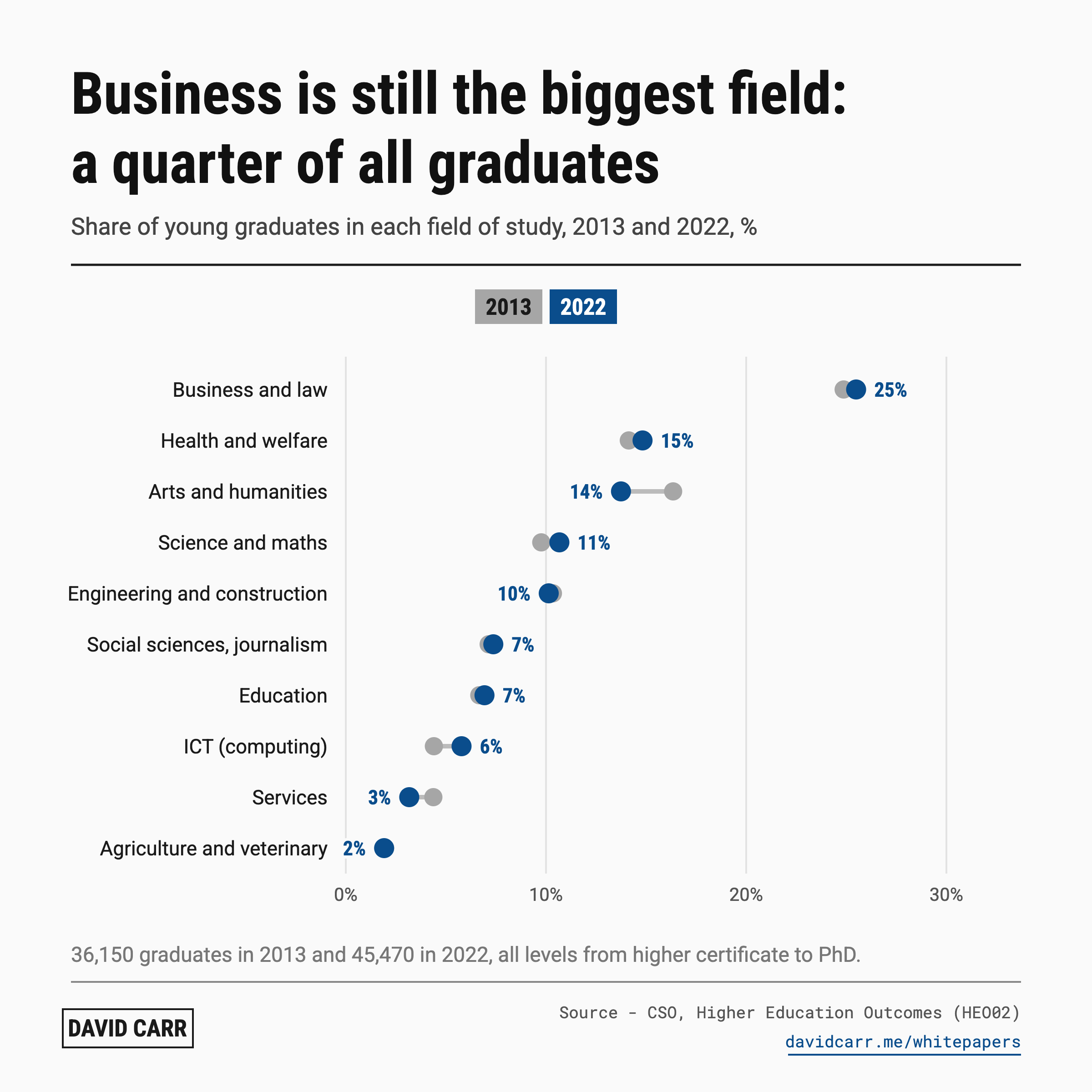
Business is still the biggest field: a quarter of all graduates
- Business and law: 25% in 2013, 25% in 2022
- Health and welfare: 14% to 15%
- Arts and humanities: 16% to 14%
- ICT (computing): 4% to 6%
- Engineering and construction: about 10% in both years
No field's share moved by three points or more. Arts lost the most share. ICT and science gained a little.
CSO, Higher Education Outcomes, table HEO02. Young graduates of all levels from higher certificate to PhD: 36,150 in 2013 and 45,470 in 2022.
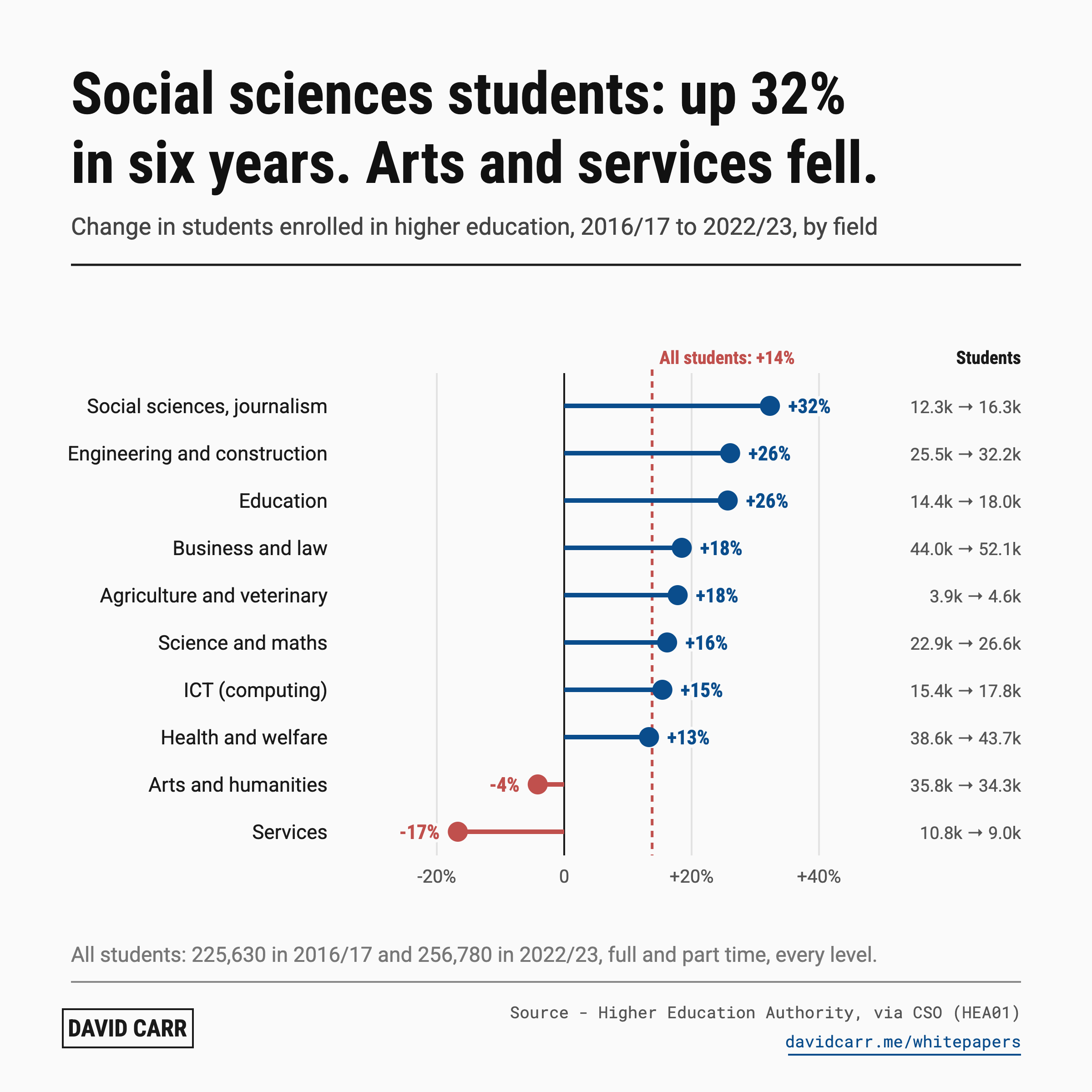
Social sciences students: up 32% in six years. Arts and services fell.
- All students: 225,630 in 2016/17, 256,780 in 2022/23 (+14%)
- Social sciences and journalism: +32%
- Engineering and construction: +26%
- Education: +26%
- Arts and humanities: -4%
- Services: -17%
Eight of the ten fields grew. Business and law is still the largest, with 52,100 students.
Higher Education Authority figures published by the CSO, table HEA01. Full and part-time students at every level.
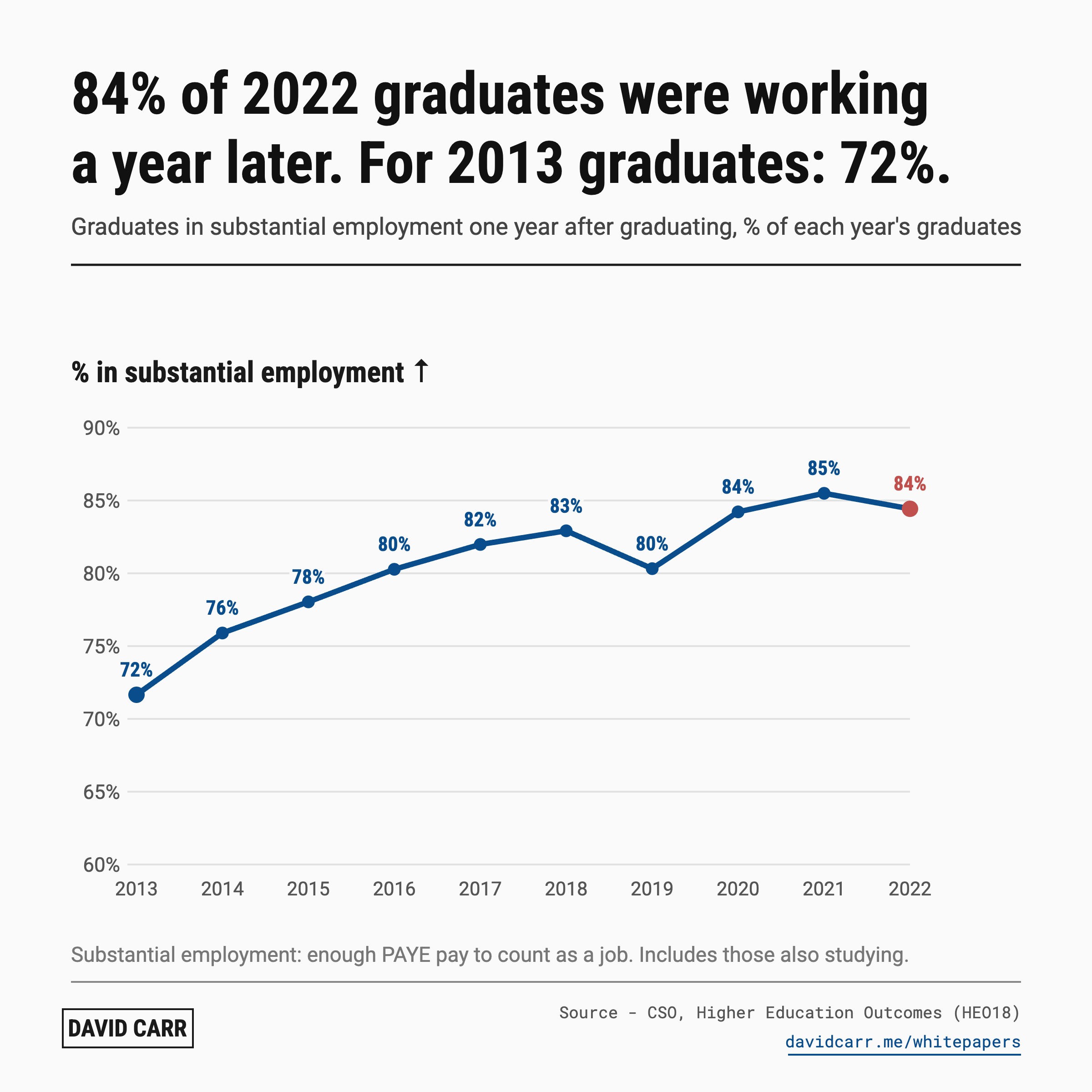
84% of 2022 graduates were working a year later. For 2013 graduates: 72%.
- 2013 graduates: 72%
- 2018: 83%
- 2019: 80%
- 2021: 85%, the highest
- 2022: 84%
The share rose every year to 2018. It dipped for 2019 graduates and again, slightly, for 2022.
CSO, table HEO18. Substantial employment means enough PAYE earnings to count as a real job, and includes graduates who were also studying.
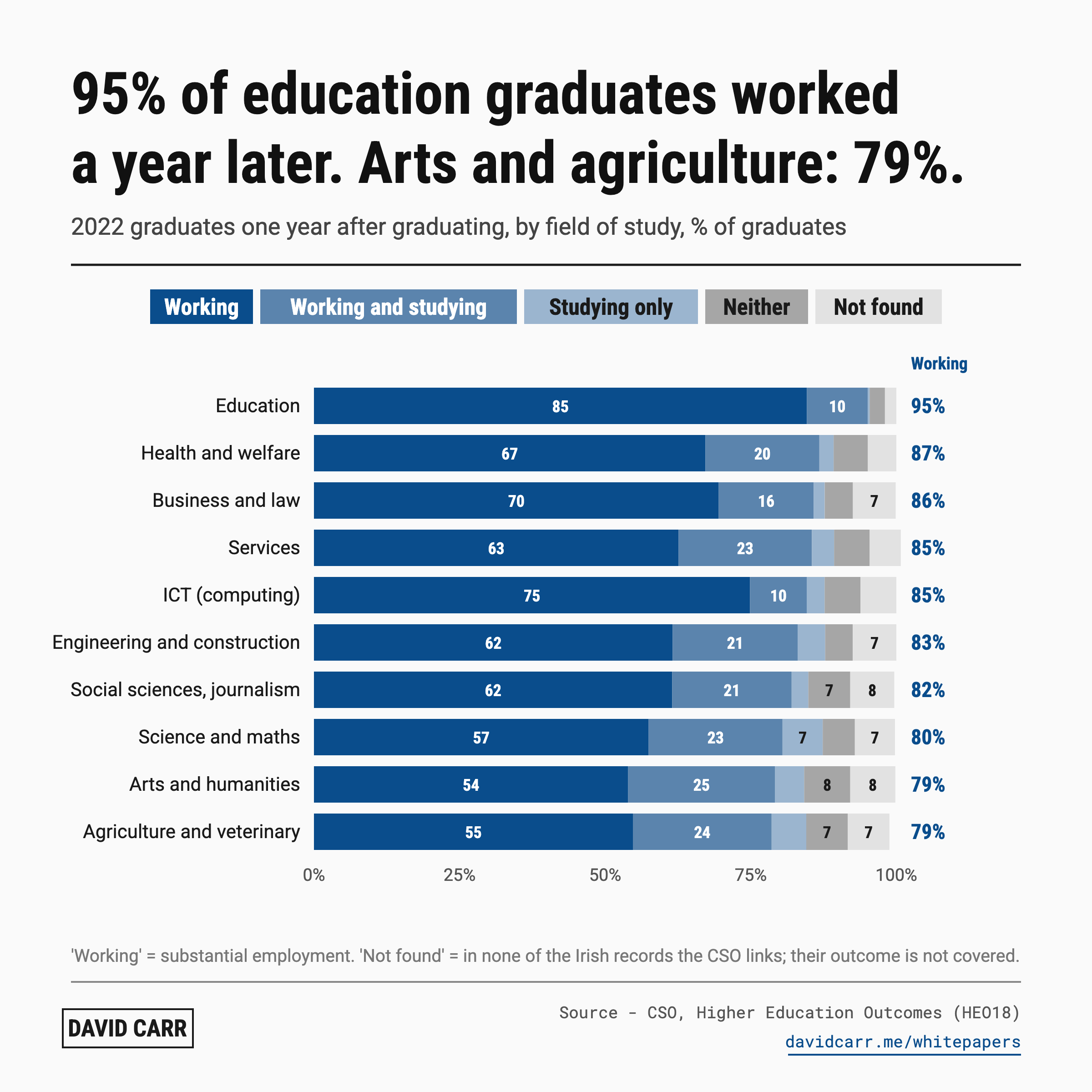
95% of education graduates worked a year later. Arts and agriculture: 79%.
- Education: 95% working
- Health and welfare: 87%
- Business and law: 86%
- ICT: 85%
- Arts and humanities: 79%
- Agriculture and veterinary: 79%
Arts graduates were the most likely to be studying as well as working, at 25%.
2022 graduates. 6.5% of all graduates were not found in any of the Irish records the CSO links. Their outcome is not covered here.
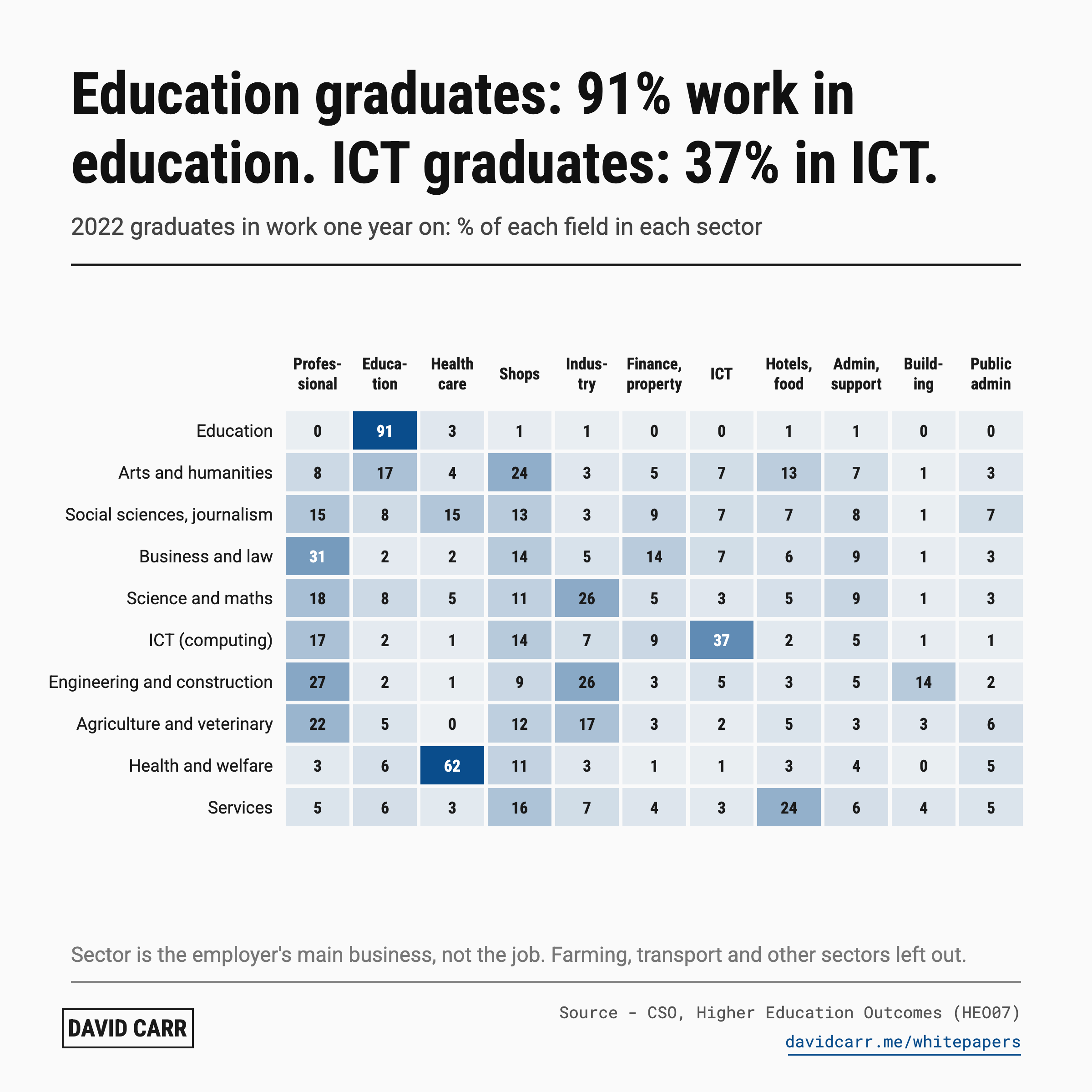
Education graduates: 91% work in education. ICT graduates: 37% in ICT.
- Education graduates in education: 91%
- Health graduates in health and social work: 62%
- ICT graduates in the ICT sector: 37%
- Business graduates in professional services: 31%
- Arts graduates in shops: 24%
Education and health lead mostly to one sector each. In every other field, no one sector takes more than 37%.
CSO, table HEO07, 2022 graduates in work one year on. Sector is the employer's main business, not the job: an ICT graduate working in a school counts in education.
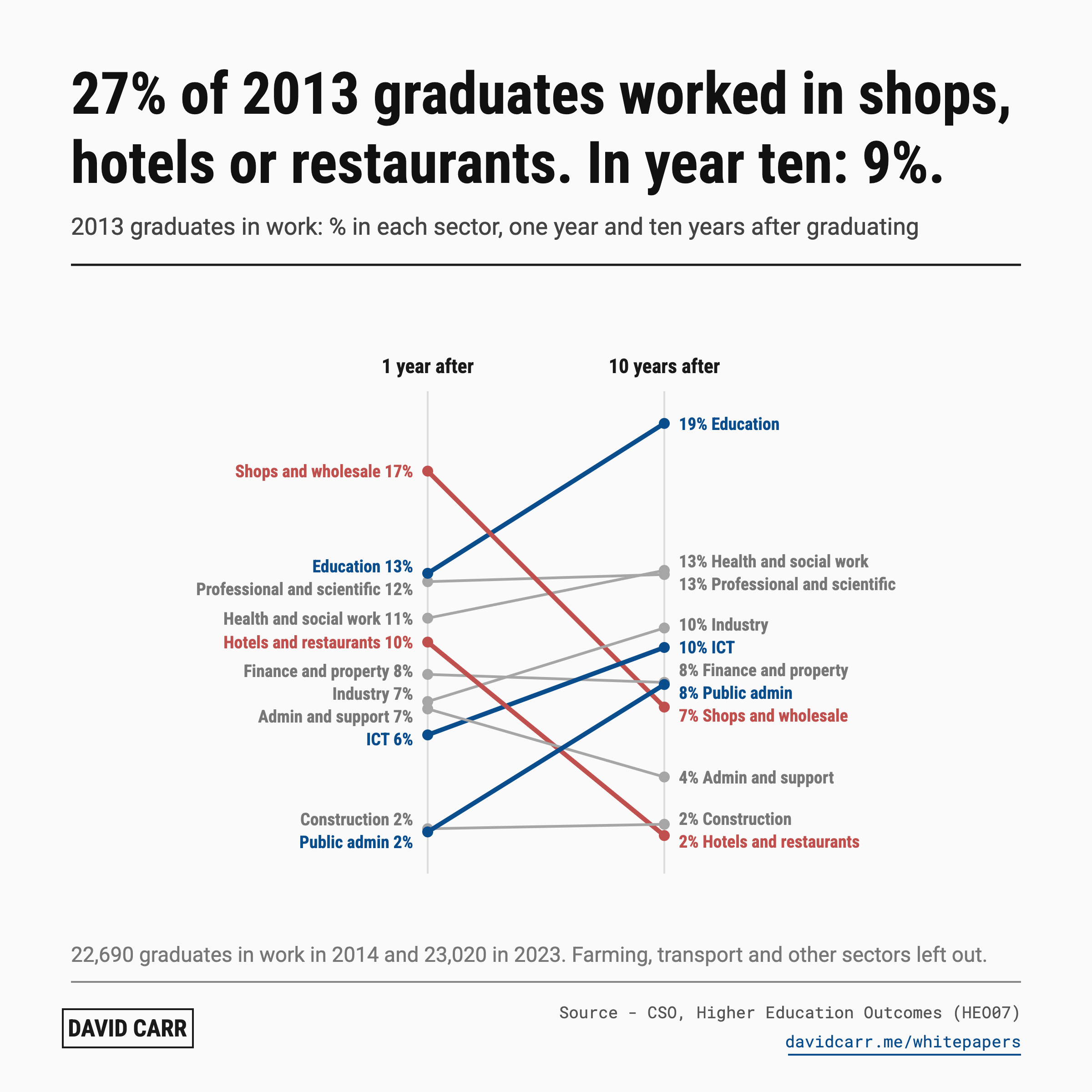
27% of 2013 graduates worked in shops, hotels or restaurants. In year ten: 9%.
- Shops and wholesale: 17% to 7%
- Hotels and restaurants: 10% to 2%
- Education: 13% to 19%
- Public admin: 2% to 8%
- ICT: 6% to 10%
Ten years on, education was the biggest sector for this group of graduates.
The same 2013 graduates, one year (2014) and ten years (2023) after graduating. 22,690 were in work in 2014 and 23,020 in 2023.
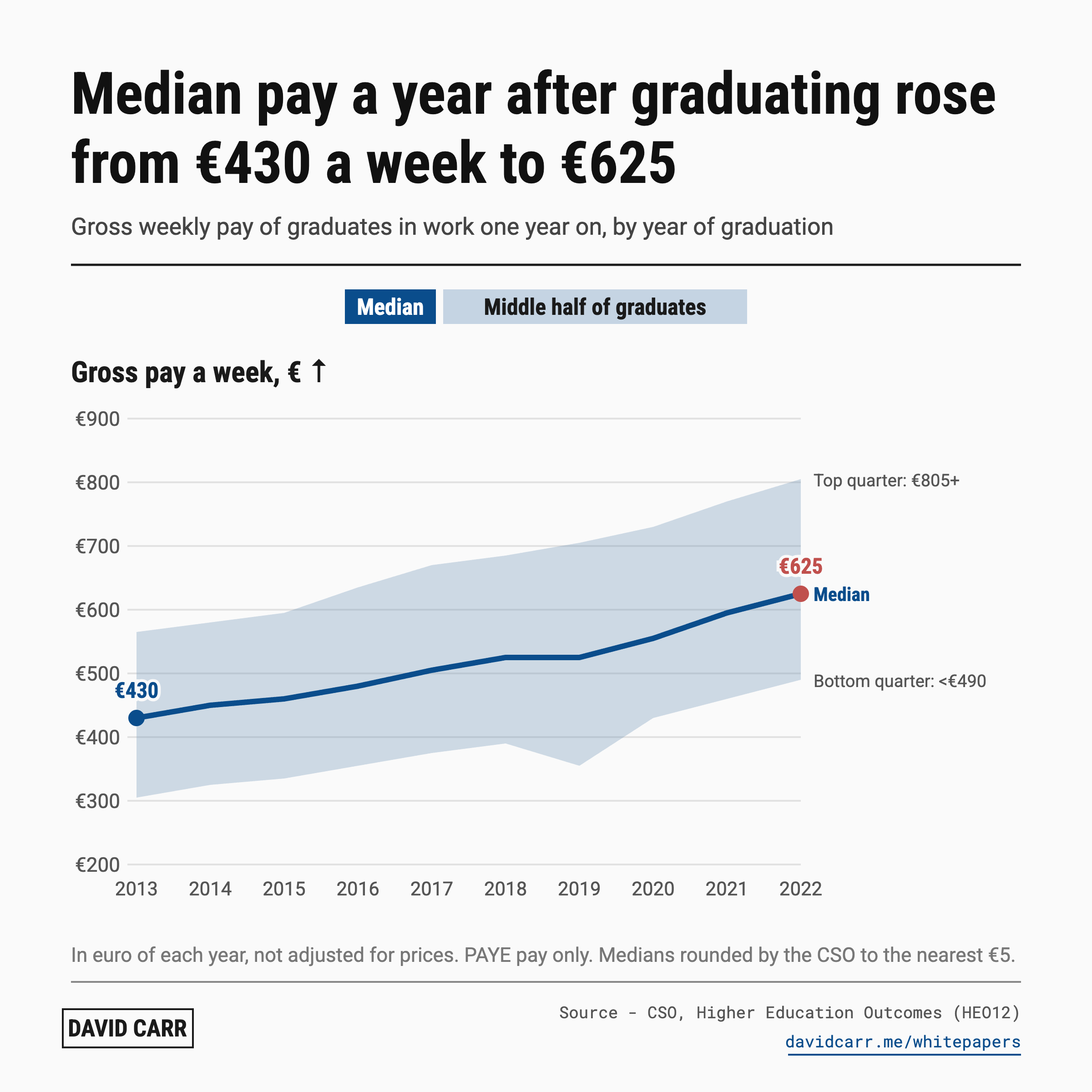
Median pay a year after graduating rose from €430 a week to €625
- 2013 graduates: €430 a week
- 2018: €525
- 2022: €625
- 2022, middle half: €490 to €805
Each year's graduates started higher than the year before, except 2019, which matched 2018.
CSO, table HEO12. Gross weekly PAYE pay, in euro of each year, not adjusted for prices.
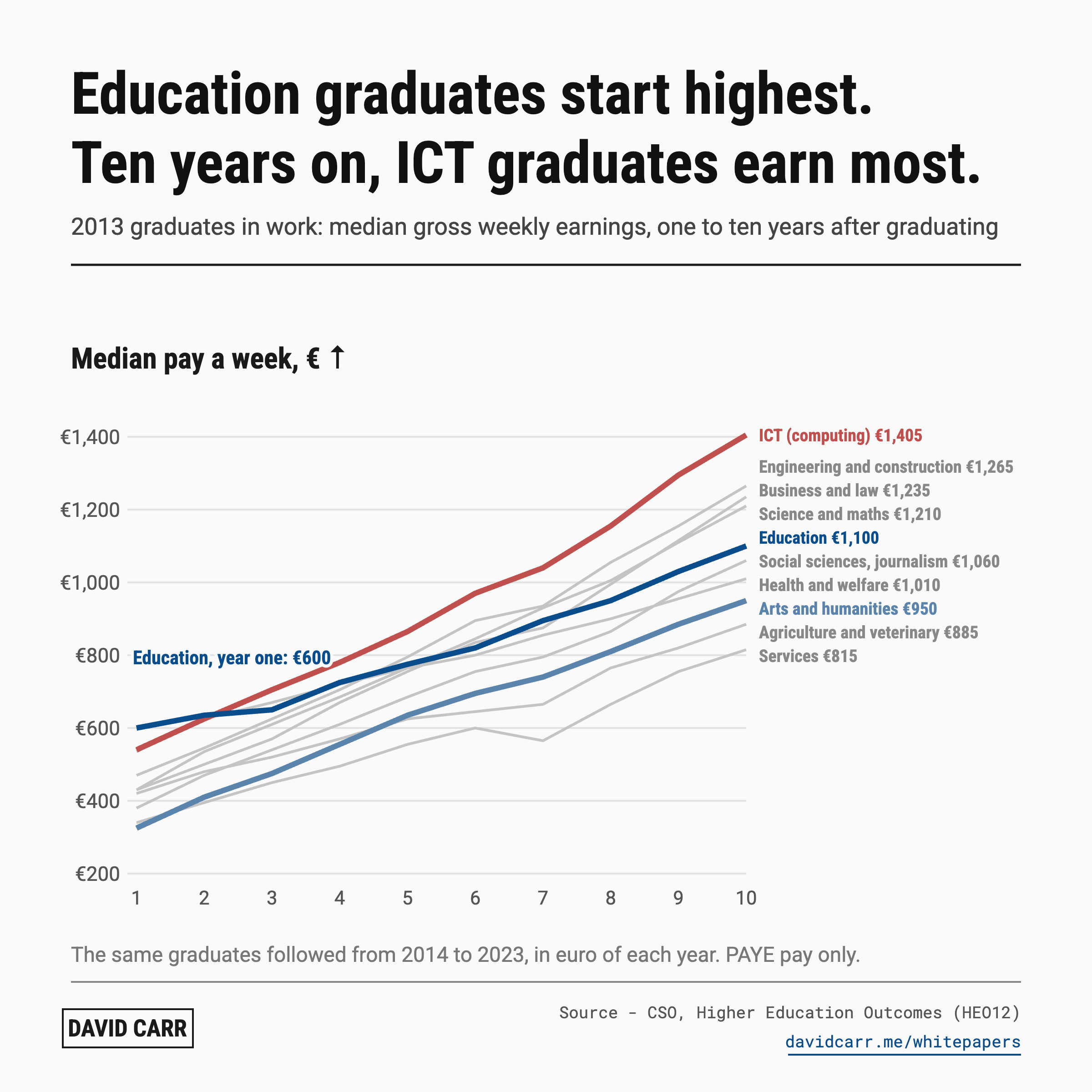
Education graduates start highest. Ten years on, ICT graduates earn most.
- Year one: education €600, ICT €540, arts €325
- Year ten: ICT €1,405, engineering €1,265, business €1,235
- Education, year ten: €1,100
- All 2013 graduates: €430 to €1,090
Every field's pay more than doubled over ten years except education and health, which started highest.
The same 2013 graduates followed from 2014 to 2023. Medians, rounded by the CSO to the nearest €5.
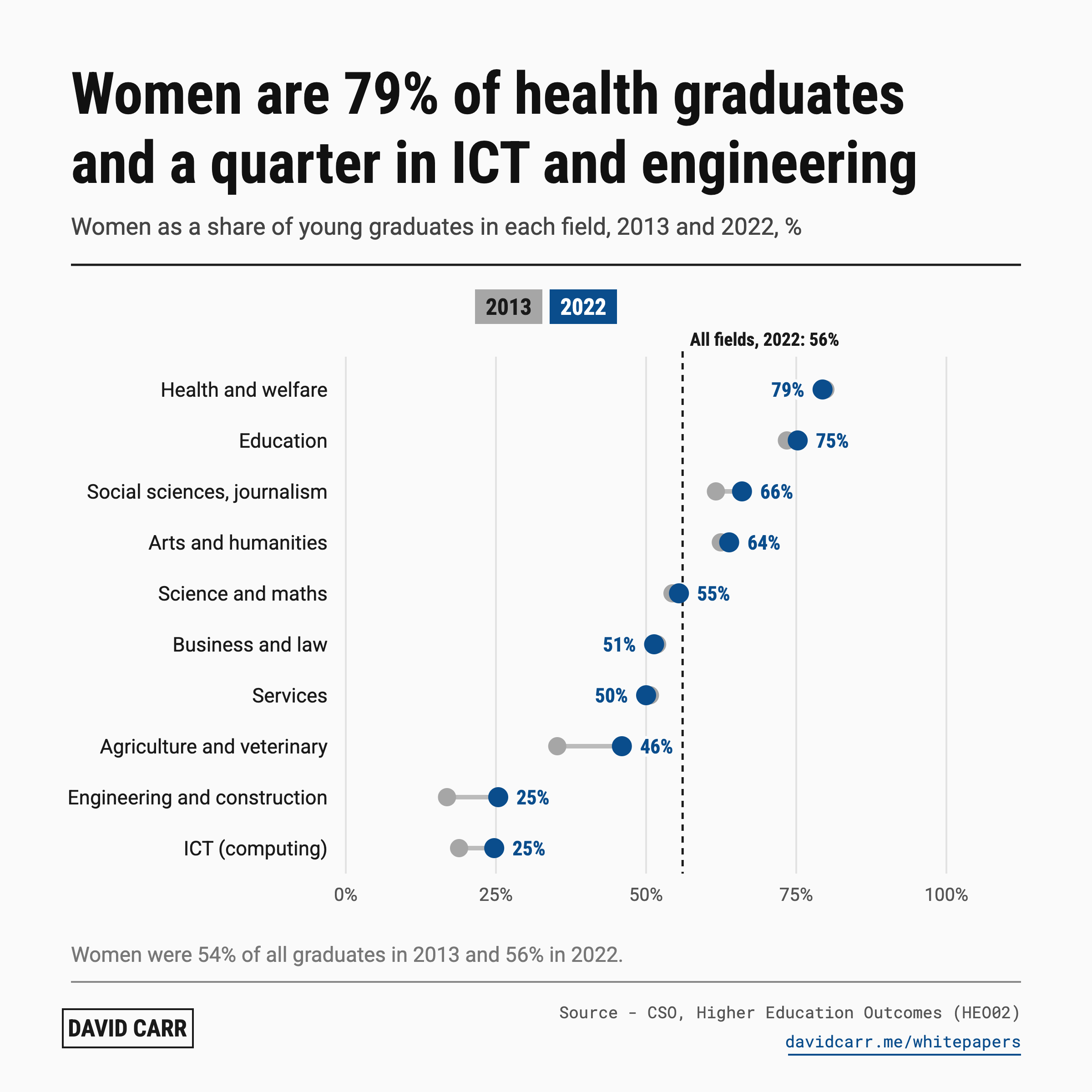
Women are 79% of health graduates and a quarter in ICT and engineering
- Health and welfare: 79%
- Education: 75%
- Business and law: 51%
- Engineering and construction: 17% in 2013, 25% in 2022
- ICT: 19% to 25%
- Agriculture and veterinary: 35% to 46%
Women were 56% of all graduates in 2022. Their share rose most in agriculture, engineering and ICT.
CSO, table HEO02, young graduates of all levels.
Method, caveats and sources
The short answer. A quarter of graduates study business, much as in 2013. Social sciences, engineering and education grew fastest in student numbers. 84% of 2022 graduates were in work a year later, up from 72% for 2013 graduates. Education graduates are the most likely to work in their own field and start on the highest pay, at €600 a week for 2013 graduates. Ten years on, ICT graduates earn the most. Median pay a year after graduating rose from €430 a week to €625.
Data. Pulled on 23 November 2026 from the CSO's open data (PxStat). Graduates: the CSO's Higher Education Outcomes, graduation years 2013 to 2022, released 16 February 2026: tables HEO02 (graduates by field and gender), HEO18 (what graduates do), HEO07 (sector of employment) and HEO12 (earnings). Students: the Higher Education Authority's enrolment counts, published by the CSO as HEA01, 2016/17 to 2022/23. Every figure on this page is computed from those tables; the CSO's own headline figures (84%, 72%, €625, €430, €1,090) match.
Who is counted. 'Young' graduates of HEA-funded colleges, levels 6 to 10, below an age limit for each type of award. Graduates are linked to tax, social welfare and education records. 'Substantial employment' means PAYE earnings above a CSO threshold; self-employment is not counted. Graduates in none of the linked Irish records are shown as 'not found'; their outcome is not covered.
Earnings are gross weekly pay, medians rounded to the nearest €5, in euro of each year with no adjustment for prices. They include graduates who were working while also studying, which pulls some fields down in the first year. The men and women figures are not adjusted for field, hours or sector.
Sector is the employer's main business, not the job the graduate does.
Not covered. Region of work is not published for all graduates (the CSO table by region is the county graduates lived in before college). Pay by college is published, but mixes field and level, so it is left out. CAO points are on another page.
Also: The jobs Ireland does now and How Ireland works now.