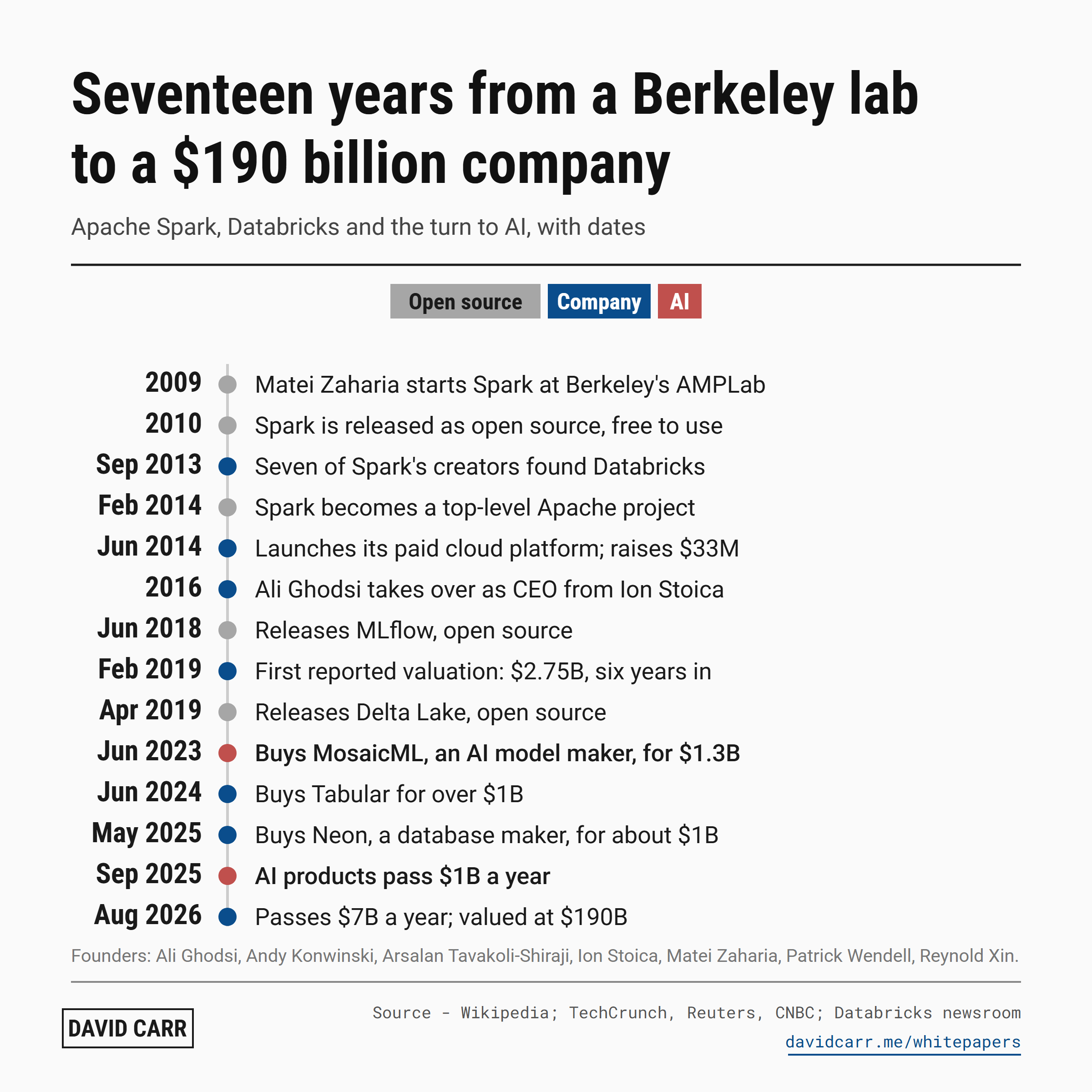
Seventeen years from a Berkeley lab to a $190 billion company
The company gave the engine away and sold the service of running it. It took six years to reach its first reported valuation. The question is what happened next -- and whether the company has now outgrown the project it started from.
Dates from Wikipedia, TechCrunch, Reuters and Databricks. The seven: Ali Ghodsi, Andy Konwinski, Arsalan Tavakoli-Shiraji, Ion Stoica, Matei Zaharia, Patrick Wendell and Reynold Xin.
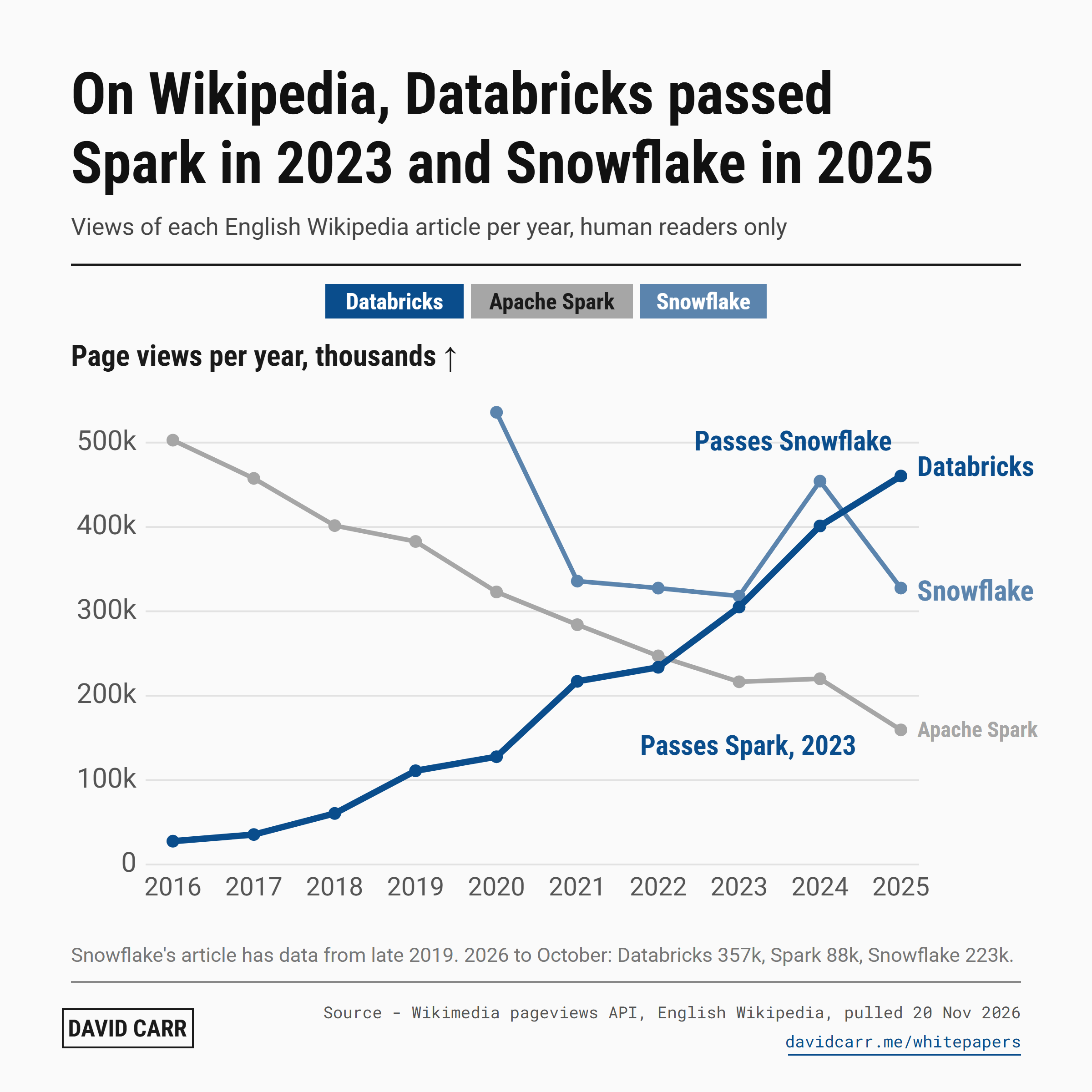
On Wikipedia, Databricks passed Spark in 2023 and Snowflake in 2025
- 2016: Apache Spark 503,000 views, Databricks 28,000
- 2023: Databricks 305,000, Spark 217,000
- 2025: Databricks 460,000, Snowflake 328,000, Spark 159,000
Readers now look up the company more than the open-source project it was built on. In 2025 they also looked it up more than Snowflake, its listed rival. The next question is whether the money has followed.
Monthly English Wikipedia views, human readers only, from the Wikimedia API, pulled 20 November 2026. Snowflake's article has data from late 2019.
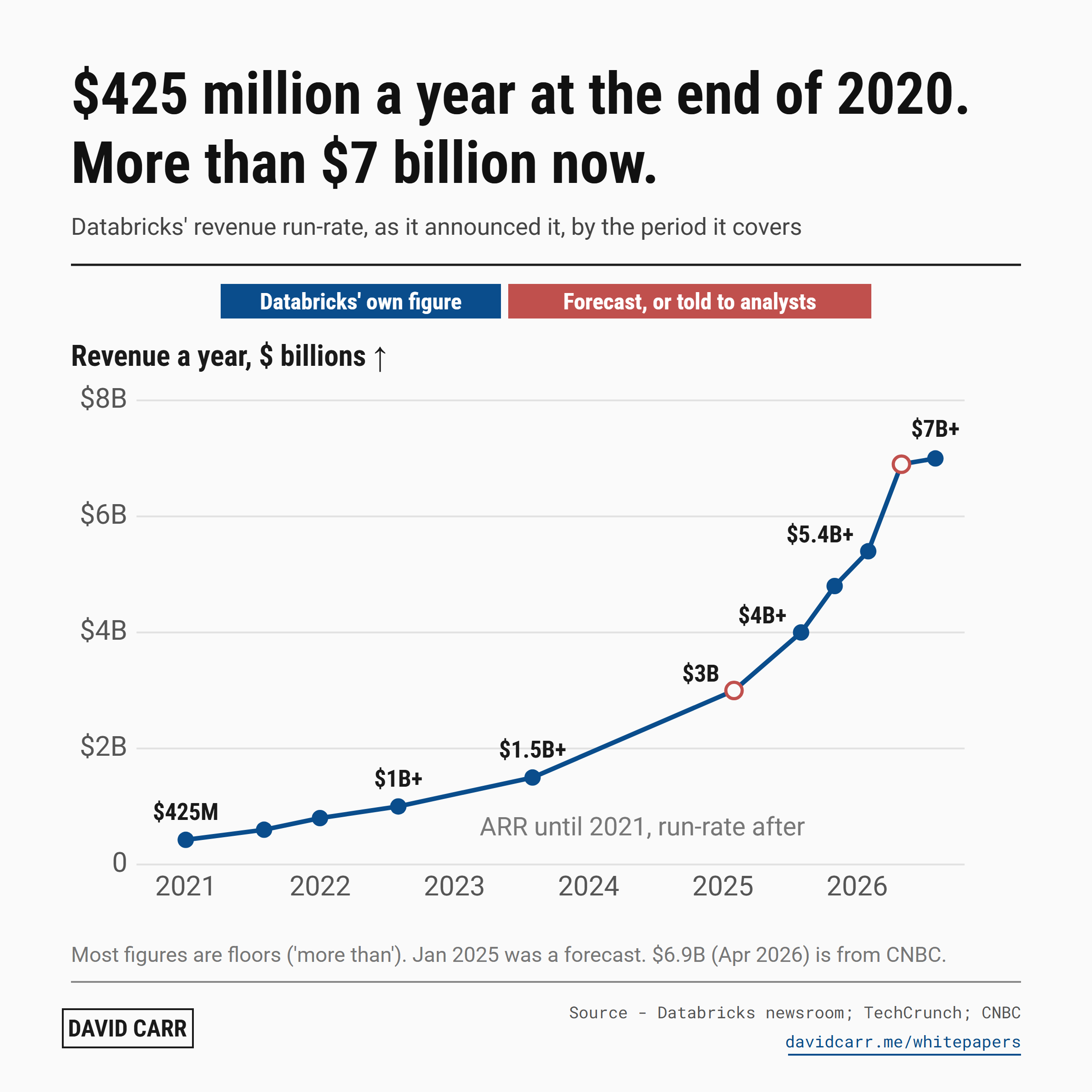
$425 million a year at the end of 2020. More than $7 billion now.
Seven years to reach $425 million. Under six more to pass $7 billion. Investors have priced that in, though less richly than they did in 2021.
In 2022 Databricks stopped counting ARR and began giving quarterly revenue times four. Most figures are floors ("more than"). The January 2025 point was a forecast.
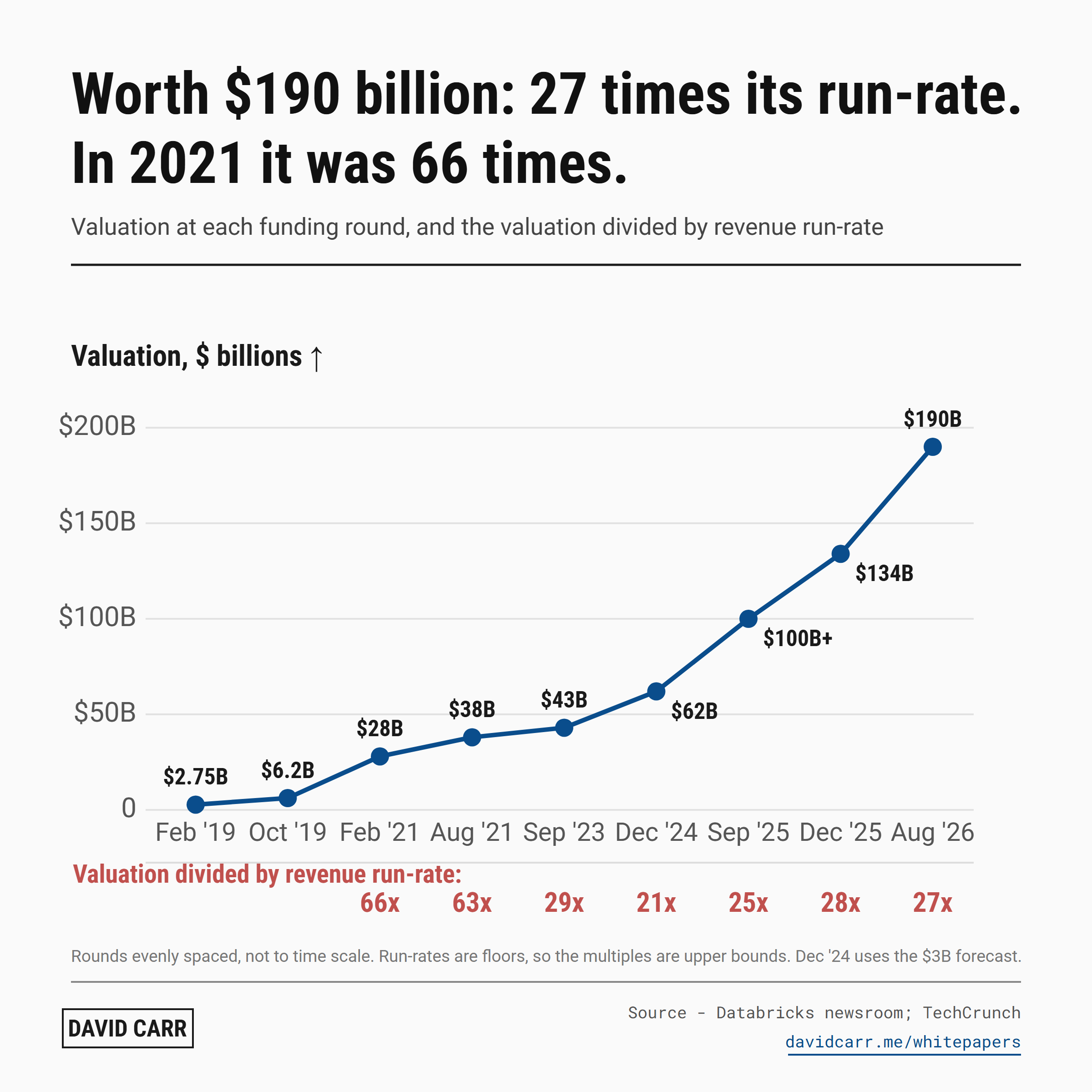
Worth $190 billion: 27 times its run-rate. In 2021 it was 66 times.
- February 2021: $28 billion, 66 times $425M
- September 2023: $43 billion, 29 times
- December 2025: $134 billion, 28 times
- August 2026: $190 billion, 27 times
Since 2021 the valuation is up about 7 times. The run-rate is up more than 16 times. To see whether $7 billion is a lot, it helps to set it against the one rival that publishes its accounts.
Valuation divided by run-rate is my arithmetic. Run-rates are floors, so the multiples are upper bounds.
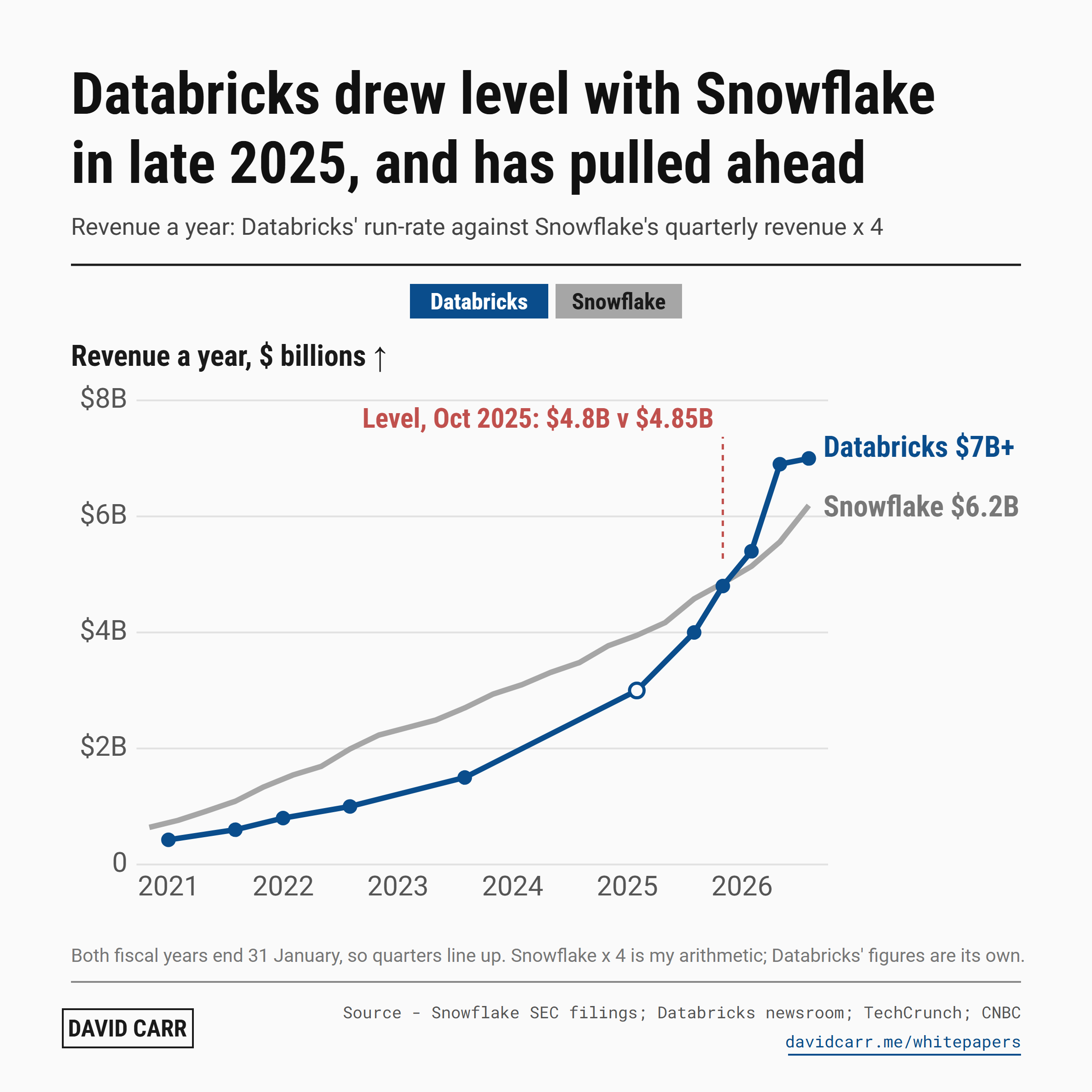
Databricks drew level with Snowflake in late 2025, and has pulled ahead
- January 2021: Snowflake $0.76B, Databricks $0.43B
- October 2025: Snowflake $4.85B, Databricks $4.8B
- January 2026: Databricks $5.4B, Snowflake $5.1B
- July 2026: Databricks $7B+, Snowflake $6.2B
Snowflake is listed, so its filings give a check on Databricks' own numbers. Both financial years end on 31 January. CNBC made the same comparison in June: $6.9B against about $5.6B.
Snowflake's quarterly revenue from its 10-Q and 10-K filings, times four (my arithmetic). Databricks' figures are its own run-rate.
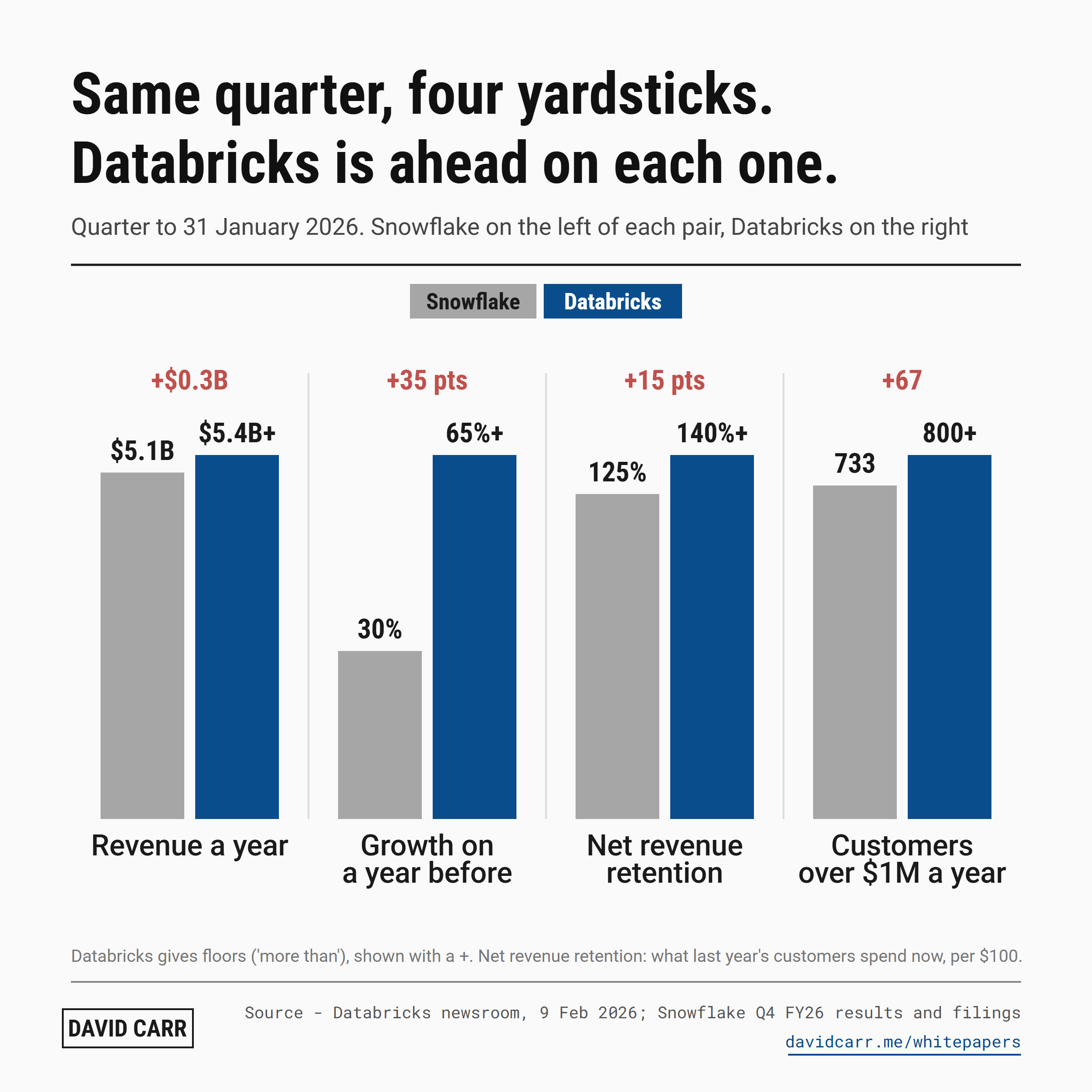
Same quarter, four yardsticks. Databricks is ahead on each one.
- Revenue a year: $5.4B+ against $5.1B
- Growth: 65%+ against 30%
- Net revenue retention: 140%+ against 125%
- Customers spending $1M+ a year: 800+ against 733
Net revenue retention of 140% means last year's customers now spend $140 for every $100 they spent before. So why is Databricks growing faster now than it was a year ago?
Quarter to 31 January 2026. Databricks from its 9 February release; Snowflake from its Q4 results.
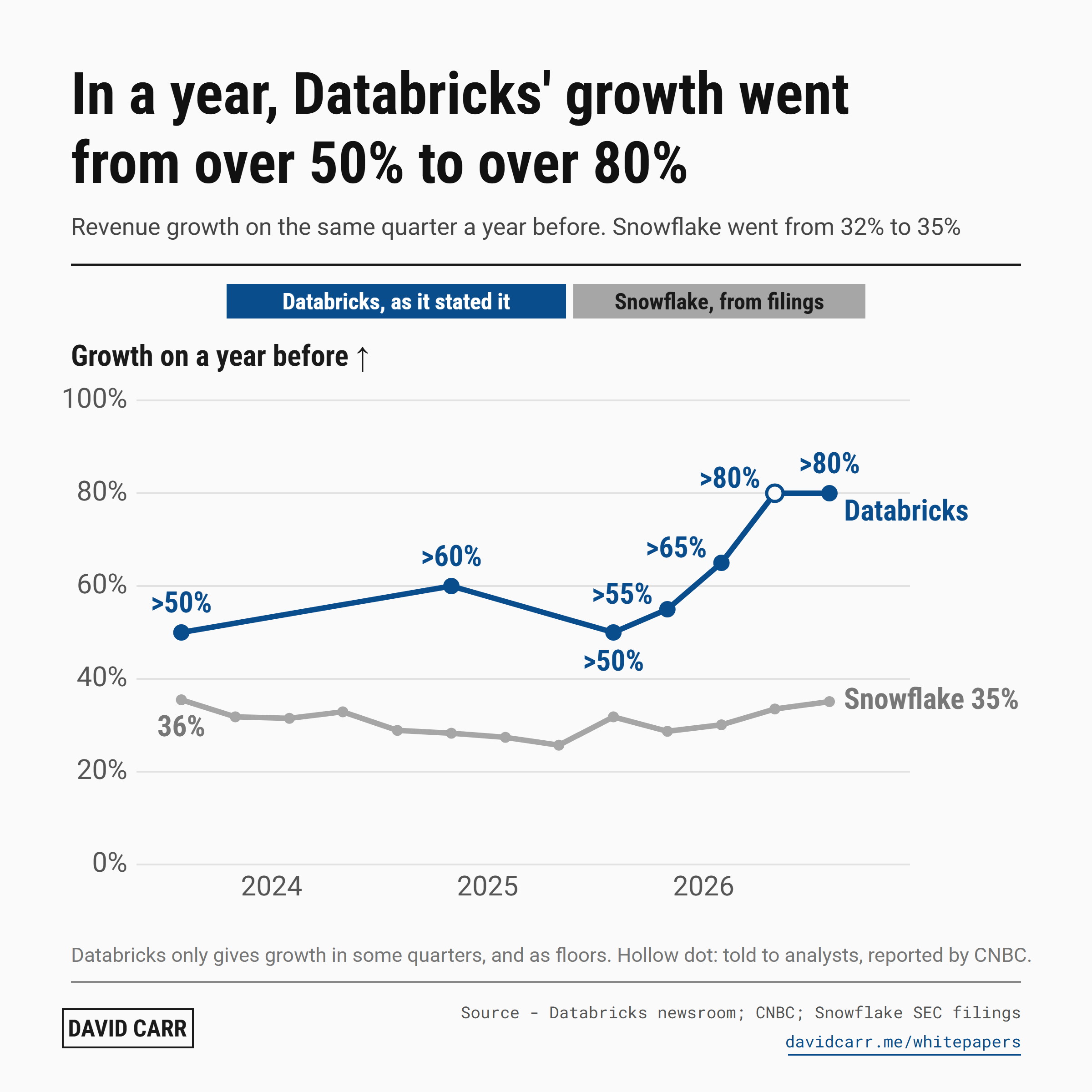
In a year, Databricks' growth went from over 50% to over 80%
- Quarter to July 2025: over 50%
- Quarter to October 2025: over 55%
- Quarter to January 2026: over 65%
- Quarter to July 2026: over 80%
- Snowflake, same quarters: 32% to 35%
It is growing faster as it gets bigger. Ali Ghodsi's explanation to CNBC in June: "It's the consumption-based business model, agentic AI coming." And: "The agents are generating way more queries." Snowflake is speeding up too; its finance chief pointed to a "meaningful step-up in AI revenue".
Customers pay for what they use, so more AI queries mean more revenue. Ghodsi also said gross margin "will go lower" as agent use raises costs. The next chart shows which products the growth comes from.
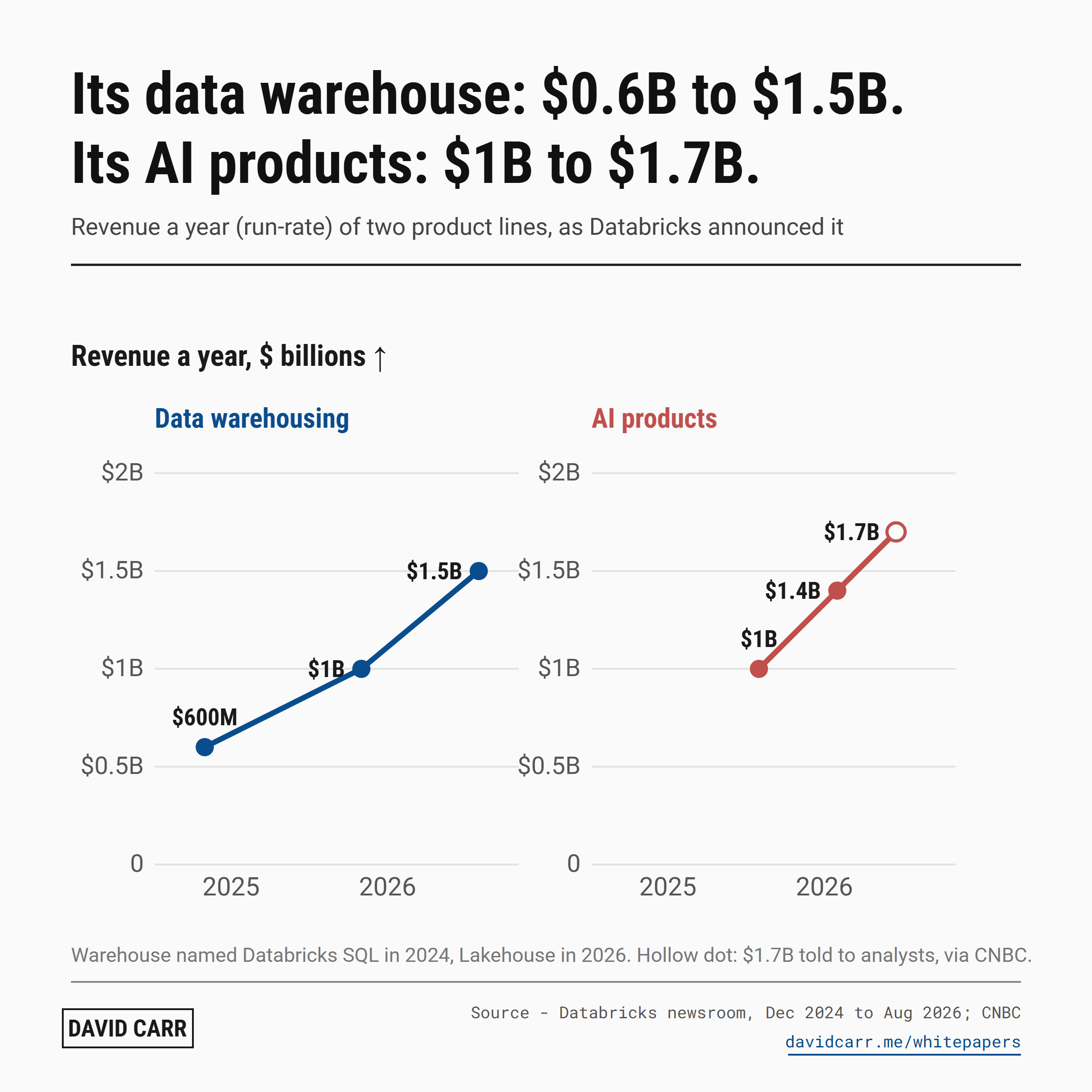
Its data warehouse: $0.6B to $1.5B a year. Its AI products: $1B to $1.7B.
Data warehousing is the business Snowflake was built on, and it is the fastest-growing line Databricks names. The AI line rests on how much its customers spend on AI models, which Databricks has just started to publish.
The warehouse product was called Databricks SQL in 2024 and Lakehouse in 2026. Databricks hasn't said the definitions match.
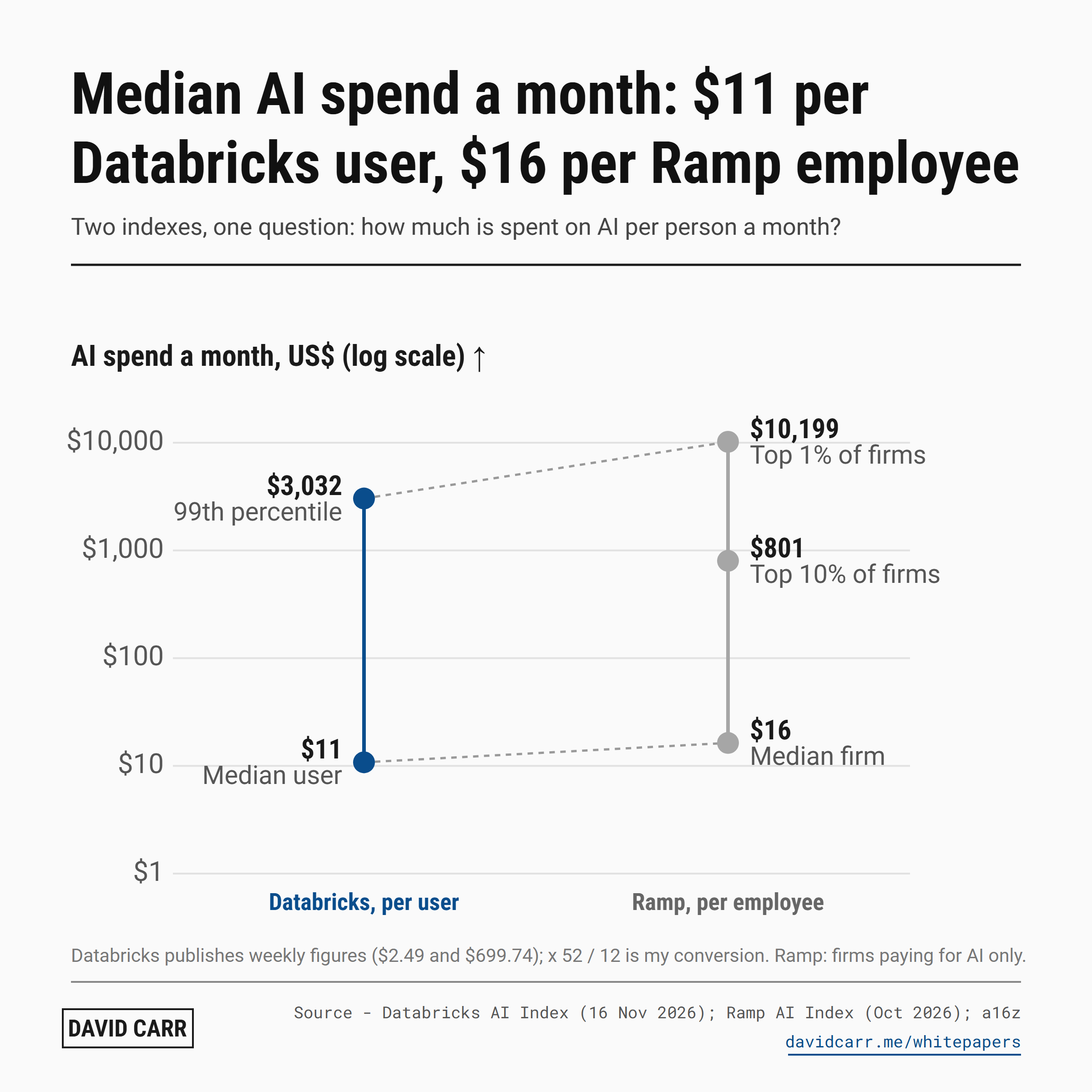
Median AI spend a month: $11 per Databricks user, $16 per Ramp employee
- Databricks, median user: $2.49 a week, about $11 a month
- Databricks, 99th-percentile user: $699.74 a week, about $3,032 a month
- Ramp, median firm: $16.32 per employee a month
- Ramp, top 1% of firms: $10,199 per employee a month
Two indexes, one question, two answers. a16z put them side by side on 20 November. The gap comes from what each one divides by what. Ramp takes everything a firm pays for AI -- seats and tokens, any vendor -- and spreads it over all its staff. Databricks counts only model calls through its own gateway, at list prices, per person who uses it. A top 1% firm and a top 1% user are different things.
Databricks publishes weekly figures; times 52 over 12 is my conversion. Ramp's are for October 2026 and cover only firms that pay for AI. Databricks' data runs from 20 July to 7 November 2026.
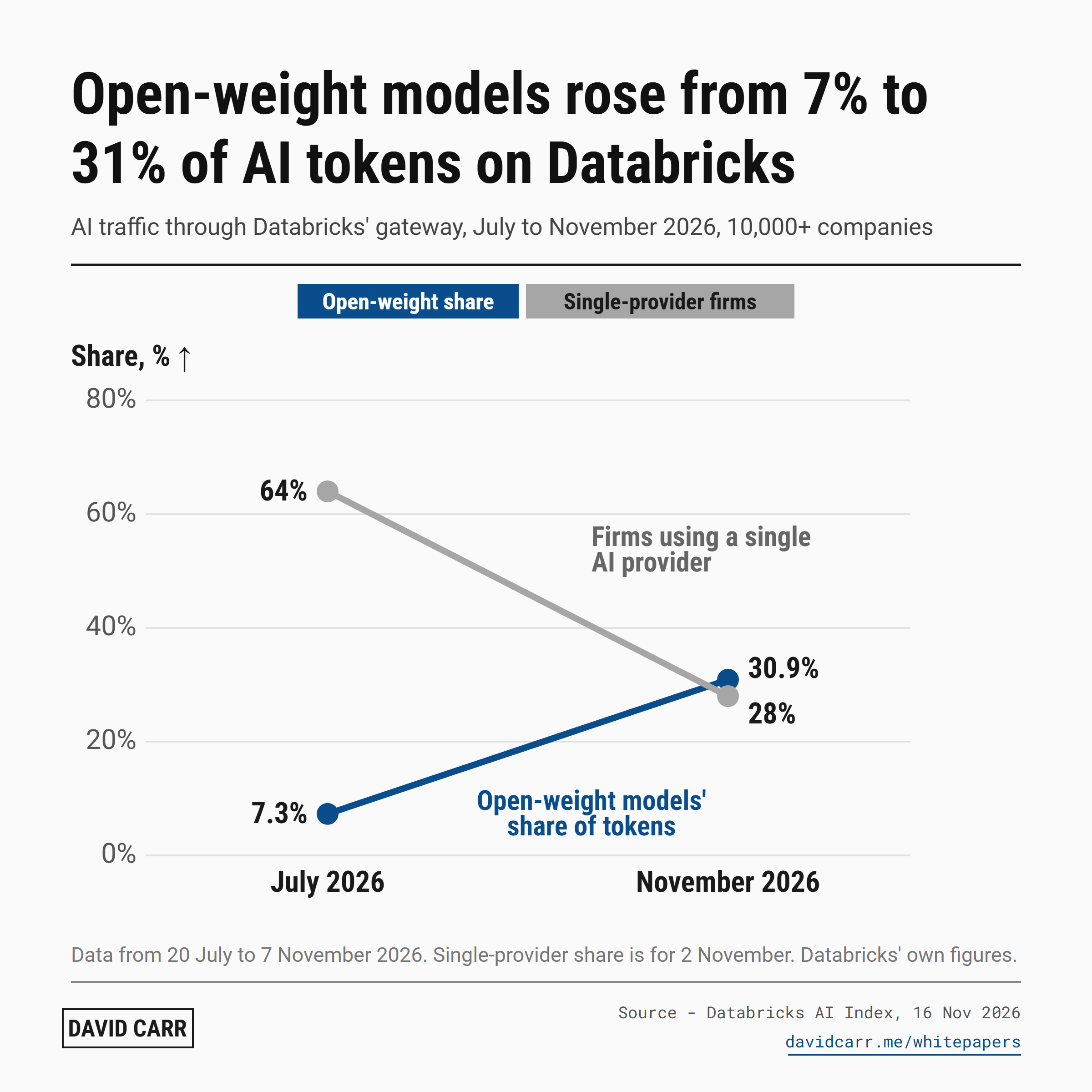
Open-weight models rose from 7% to 31% of AI tokens on Databricks
- Open-weight share of tokens: 7.3% in July, 30.9% in November
- Firms using one AI provider: about 64% in July, 28% by 2 November
The company built on giving software away now routes AI traffic across models open and closed. Its customers are spreading their bets across providers, and the gateway those bets run through is Databricks'.
From the Databricks AI Index, 16 November 2026, built from 10,000+ companies using its Unity Gateway.
Method, caveats and sources
The short answer. Databricks spent a decade turning a free Berkeley project into a paid service, and AI has made it grow faster as it got bigger -- fast enough to pass Snowflake, the listed rival that used to be larger. It passed $7 billion a year in July 2026, growing over 80%, and is valued at $190 billion.
Databricks is private. It files no accounts. Revenue run-rates, growth, retention and customer counts are its own announcements; a few come from press reports of what it told investors and are marked. Most of its figures are floors ("more than"). Valuations come from its newsroom or TechCrunch.
Snowflake. Quarterly revenue from its 10-Q and 10-K filings via the SEC's XBRL data, pulled 20 November 2026; the fourth quarter is the full year less three quarters. Times four is my arithmetic, which is how Databricks says it works out its run-rate. Snowflake's numbers are audited; Databricks' are not.
AI spend. The Databricks AI Index (16 November 2026) and Ramp's AI Index (October 2026) measure different things: per user of one gateway against per employee of firms paying for AI. Both are shown as published, with Databricks' weekly figures converted to a month.
Wikipedia. Monthly views from the Wikimedia pageviews API, English Wikipedia, human readers only, pulled 20 November 2026.
Also: Stripe, Anthropic, Ramp and OpenRouter.