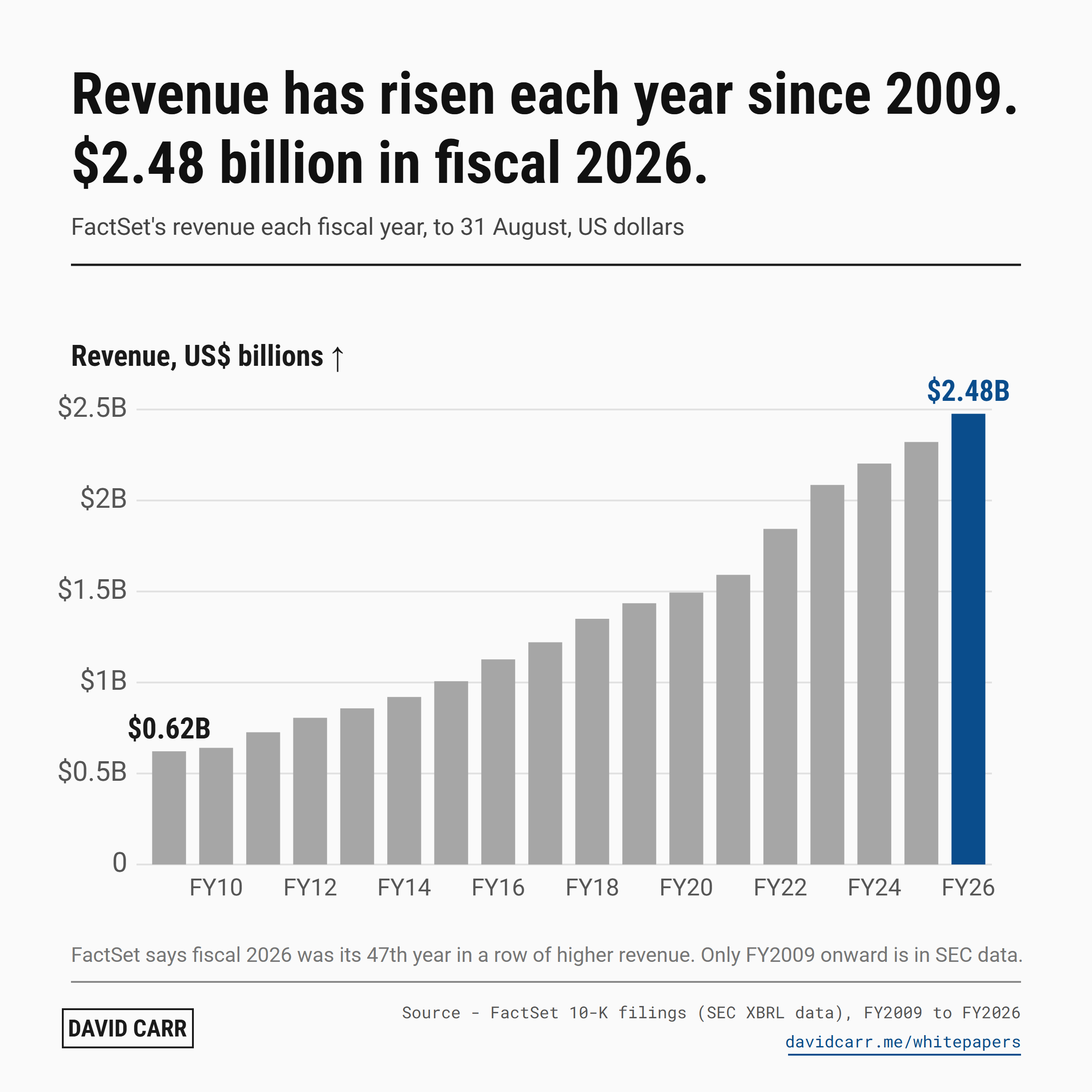
Revenue has risen each year since 2009. $2.48 billion in fiscal 2026.
- Fiscal 2009: $622 million
- Fiscal 2015: $1.01 billion
- Fiscal 2020: $1.49 billion
- Fiscal 2026: $2.48 billion, up 6.7%
About four times what it was in 2009. FactSet says 2026 was its 47th year in a row of higher revenue.
Revenue from FactSet's 10-K filings, via SEC XBRL data. The 47-year run is FactSet's own claim, in its fiscal 2026 results. Its fiscal year ends on 31 August.
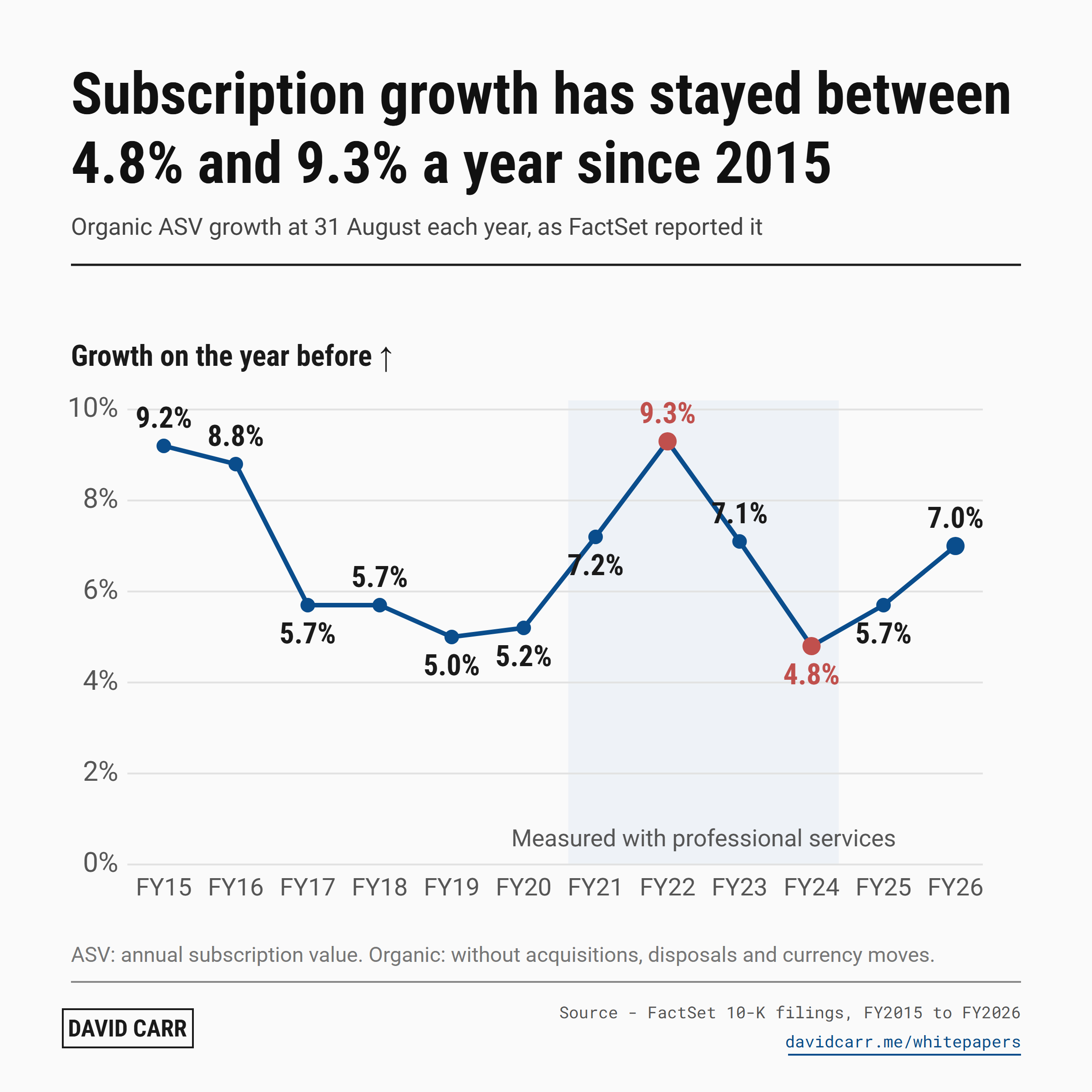
Subscription growth has stayed between 4.8% and 9.3% a year since 2015
- Fiscal 2015: 9.2%
- Fiscal 2022: 9.3%, the high
- Fiscal 2024: 4.8%, the low
- Fiscal 2026: 7.0%, to $2,568.2 million
ASV, annual subscription value, is FactSet's main yardstick: what clients will pay over the next 12 months for the services they have now.
From each year's 10-K, for example fiscal 2026. From 2021 to 2024 FactSet reported the measure with professional services added; from 2025 it went back to subscriptions alone.
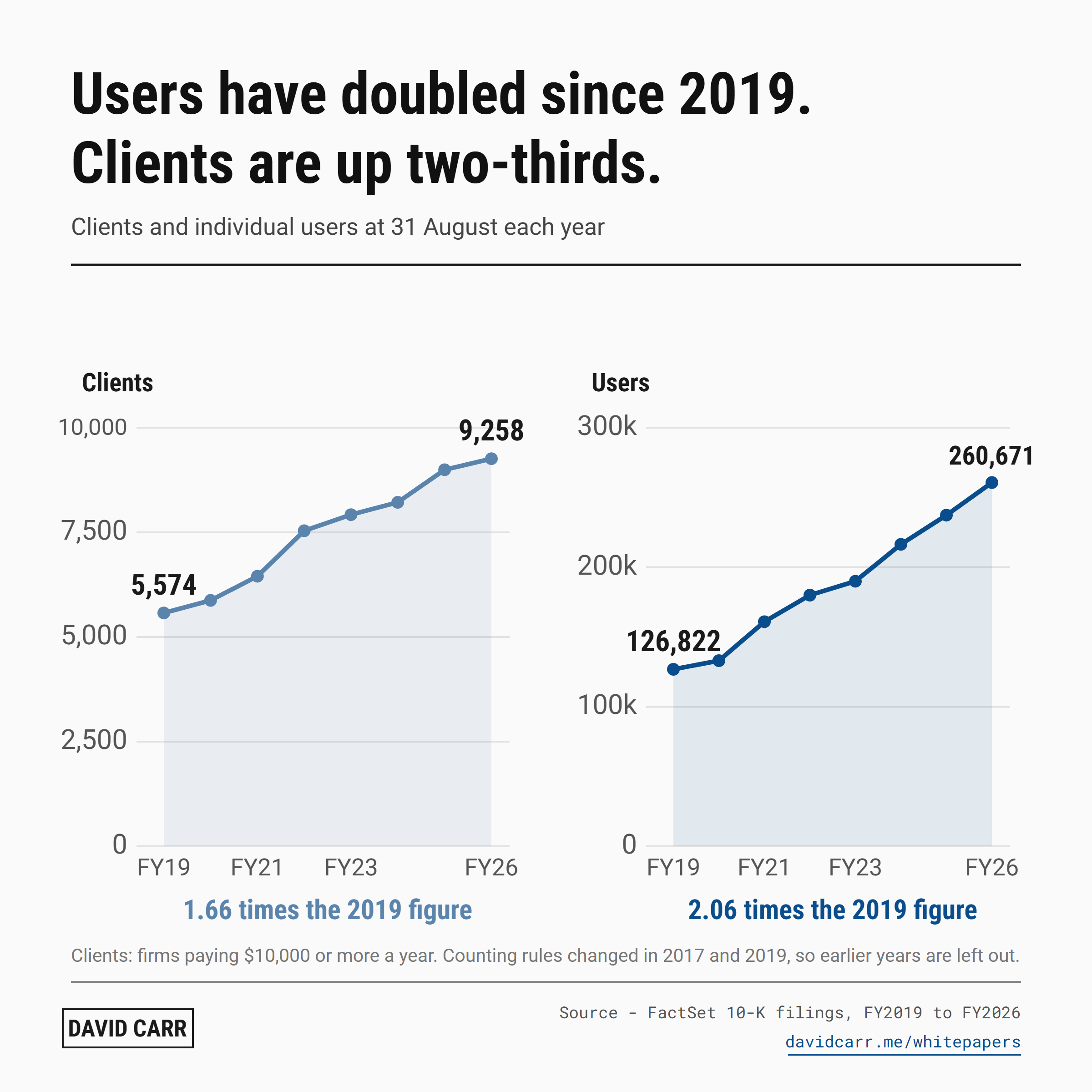
Users have doubled since 2019. Clients are up two-thirds.
- Clients: 5,574 in 2019, 9,258 in 2026
- Users: 126,822 in 2019, 260,671 in 2026
FactSet says most of the new clients in 2026 were corporate firms, and most new users were in wealth management.
From the 2019 and 2026 10-Ks. A client is a firm paying $10,000 or more a year. Counting rules changed in 2017 and 2019.
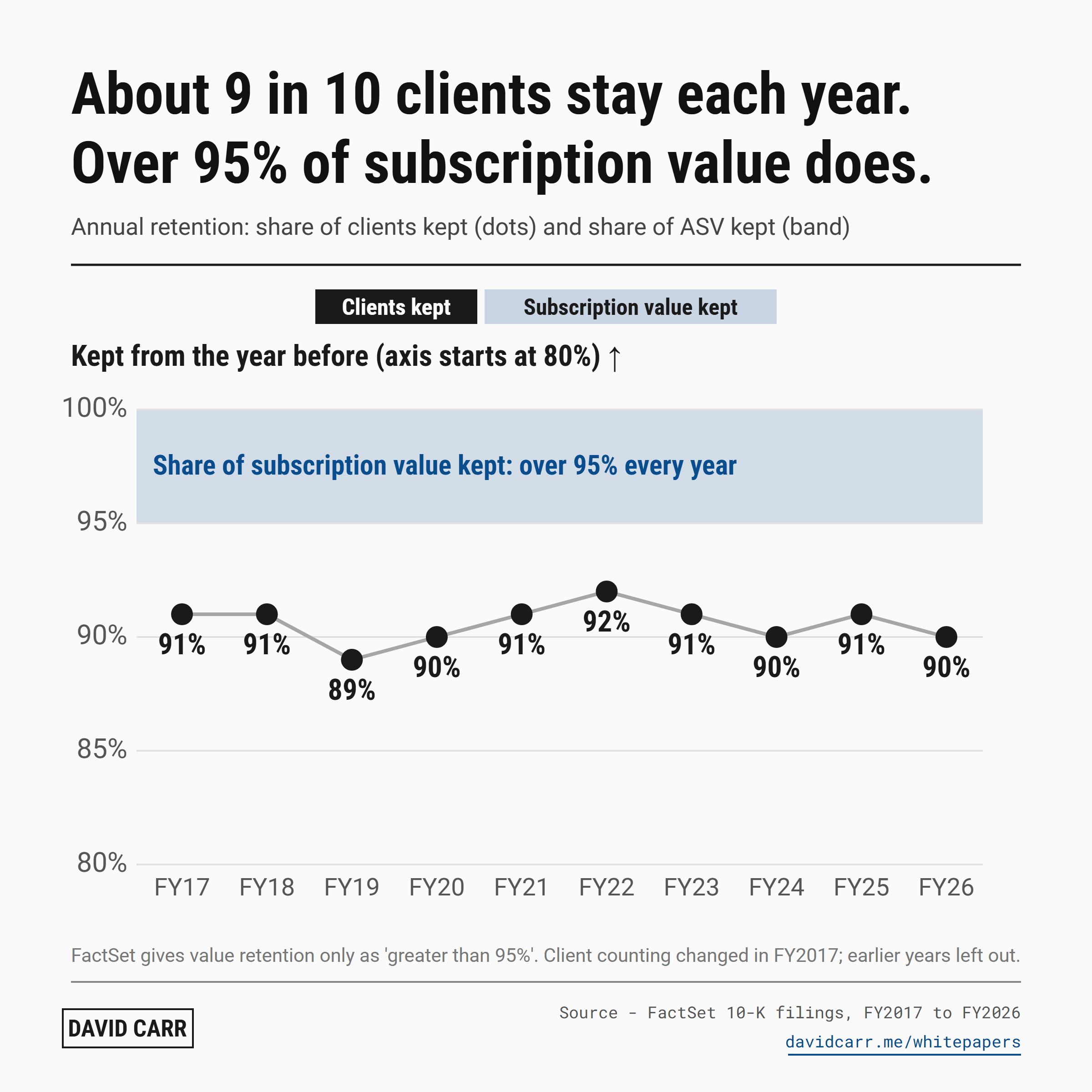
About 9 in 10 clients stay each year. Over 95% of subscription value does.
- Clients kept: between 89% and 92% every year since 2017
- Fiscal 2026: 90%
- Subscription value kept: over 95% every year
More value is kept than clients, so on average the clients who leave are ones that pay less.
FactSet gives value retention only as "greater than 95%". Client retention from each 10-K, for example fiscal 2026.
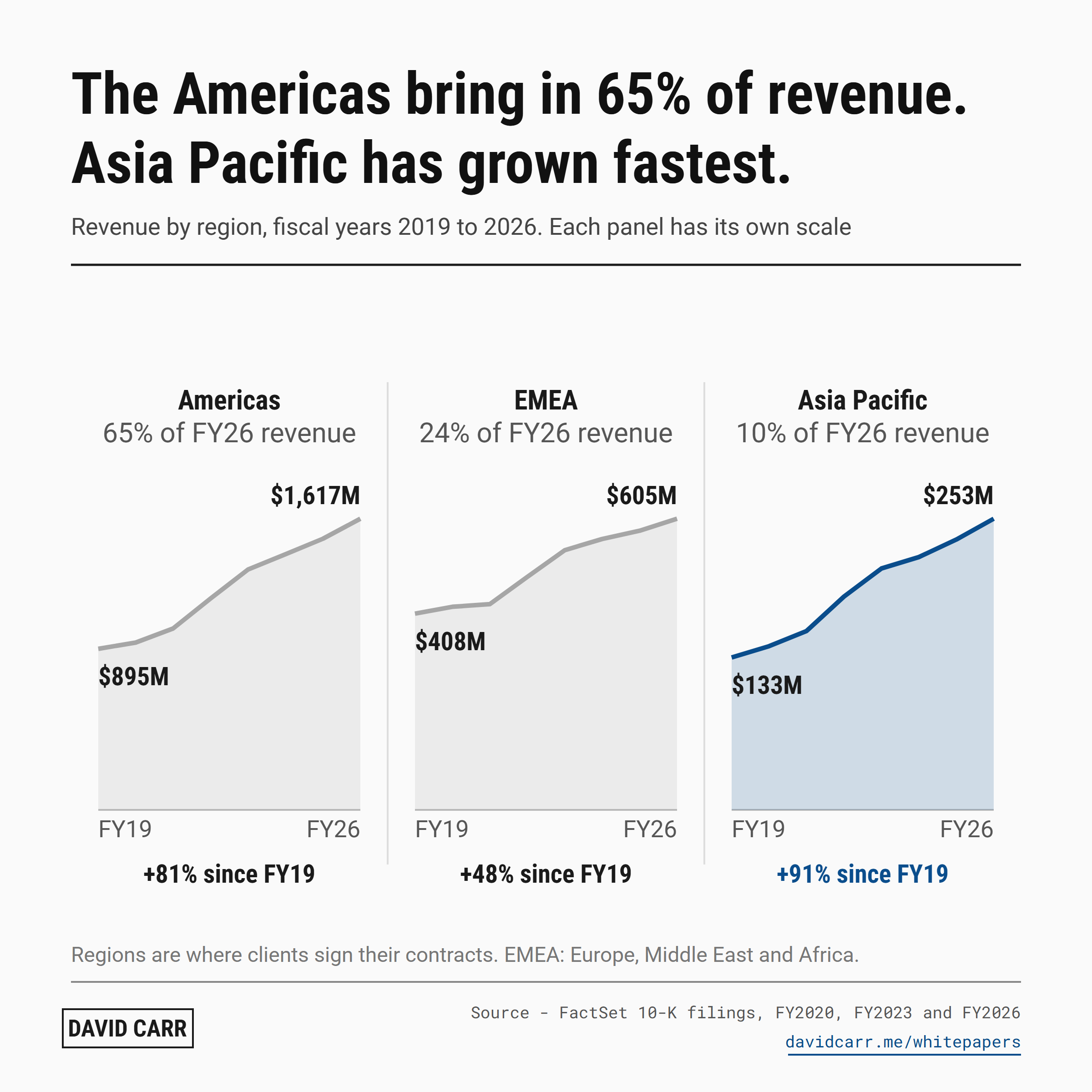
The Americas bring in 65% of revenue. Asia Pacific has grown fastest.
- Americas: $895M to $1,617M, up 81%
- EMEA: $408M to $605M, up 48%
- Asia Pacific: $133M to $253M, up 91%
Fiscal 2019 to fiscal 2026. Asia Pacific is still the smallest region, at about a tenth of revenue.
Segment revenue from the 2020, 2023 and 2026 10-Ks. Regions are where clients sign their contracts.
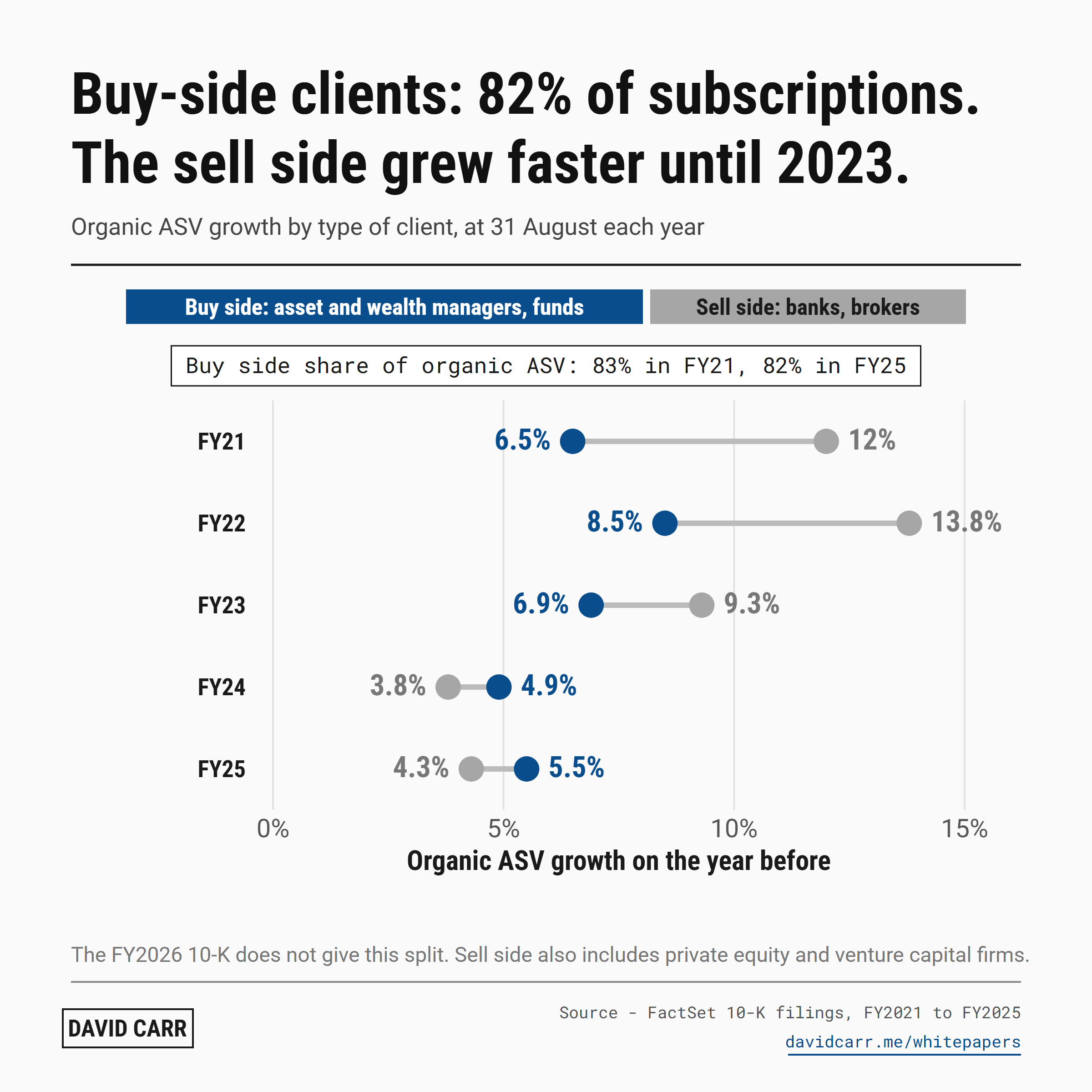
Buy-side clients: 82% of subscriptions. The sell side grew faster until 2023.
- Fiscal 2021: sell side 12.0%, buy side 6.5%
- Fiscal 2022: sell side 13.8%, buy side 8.5%
- Fiscal 2024: buy side 4.9%, sell side 3.8%
- Fiscal 2025: buy side 5.5%, sell side 4.3%
The buy side is asset and wealth managers, asset owners, hedge funds and corporate clients. The sell side is banks, brokers, advisers and private equity and venture capital firms.
Organic ASV growth by client type from the 2021 to 2025 10-Ks. The fiscal 2026 10-K does not give this split.
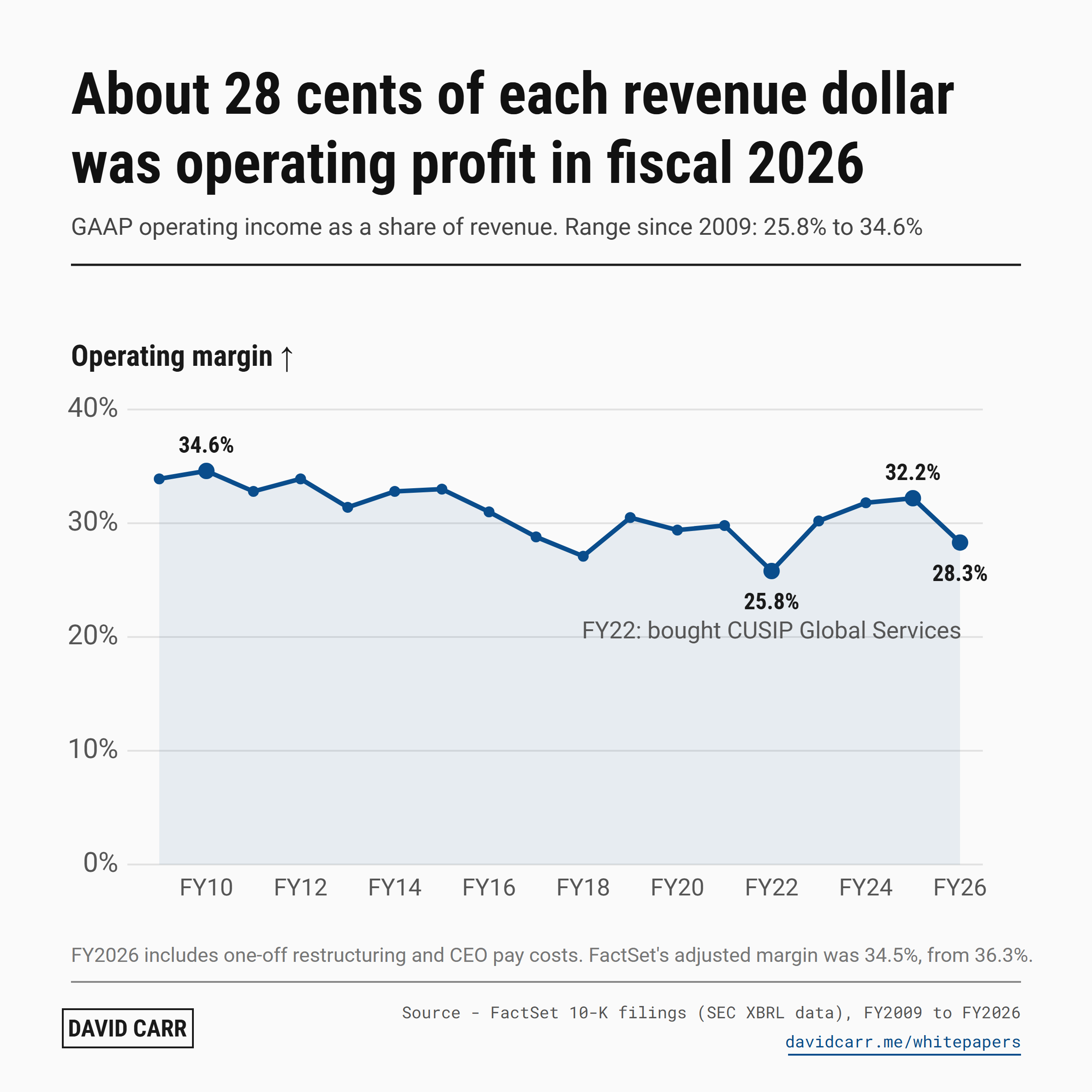
About 28 cents of each revenue dollar was operating profit in fiscal 2026
- Range since 2009: 25.8% (2022) to 34.6% (2010)
- Fiscal 2025: 32.2%
- Fiscal 2026: 28.3%
- Adjusted, FactSet's own measure: 34.5% in 2026
The 2026 figure includes one-off restructuring and CEO pay costs. FactSet's target is an adjusted margin of at least 36% by fiscal 2029.
GAAP operating income over revenue, from SEC XBRL data. Adjusted margin and the target from the fiscal 2026 results and November 2026 investor day.
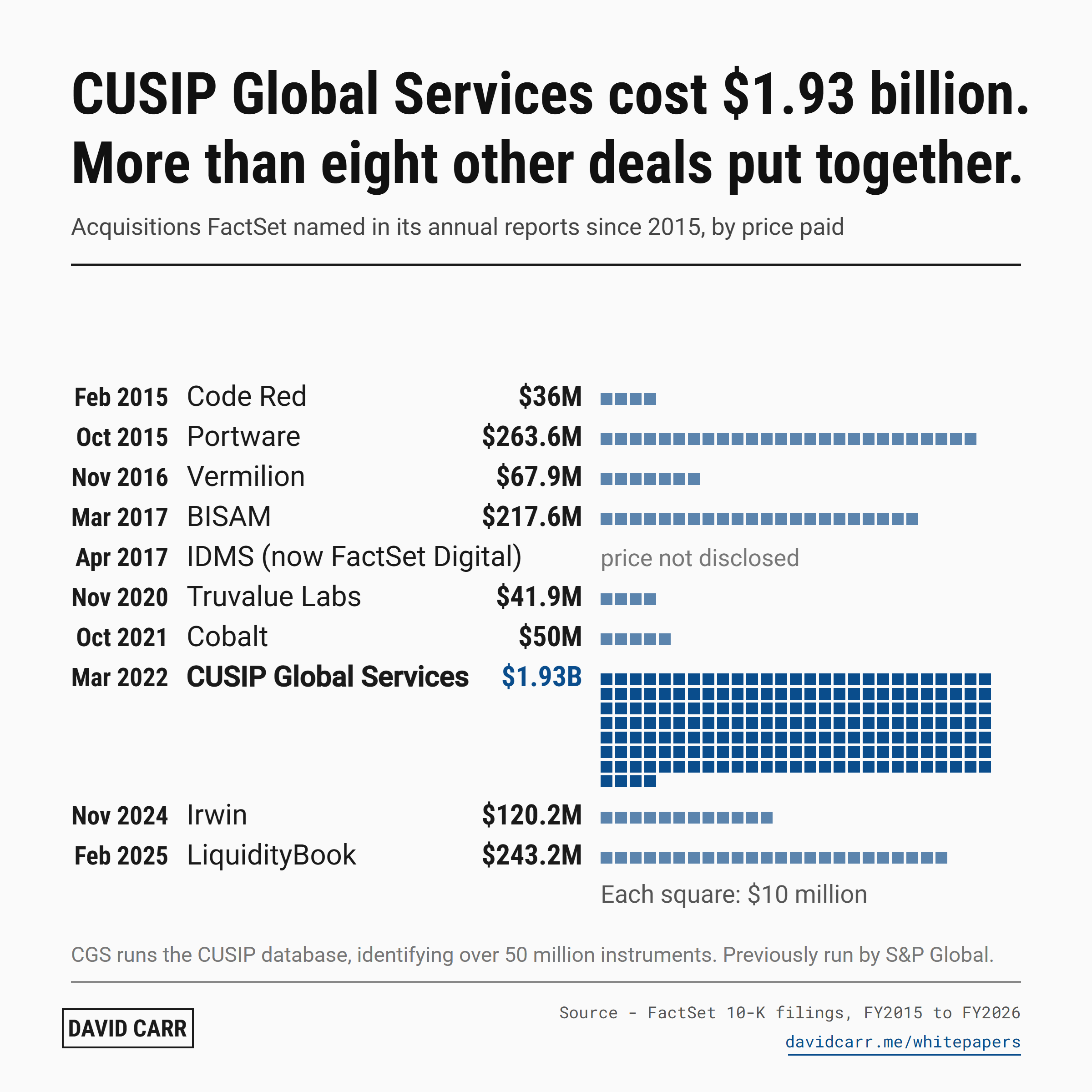
CUSIP Global Services cost $1.93 billion. More than eight other deals put together.
- CUSIP Global Services, March 2022: $1.93 billion
- Portware, 2015: $263.6 million
- LiquidityBook, 2025: $243.2 million
- BISAM, 2017: $217.6 million
CGS runs the CUSIP system, a database identifying more than 50 million financial instruments. It was run by S&P Global for the American Bankers Association before FactSet bought it.
Prices as stated in the 10-Ks, for example fiscal 2022. The eight other priced deals since 2015 add up to $1.04 billion. FactSet gave no price for IDMS in 2017.
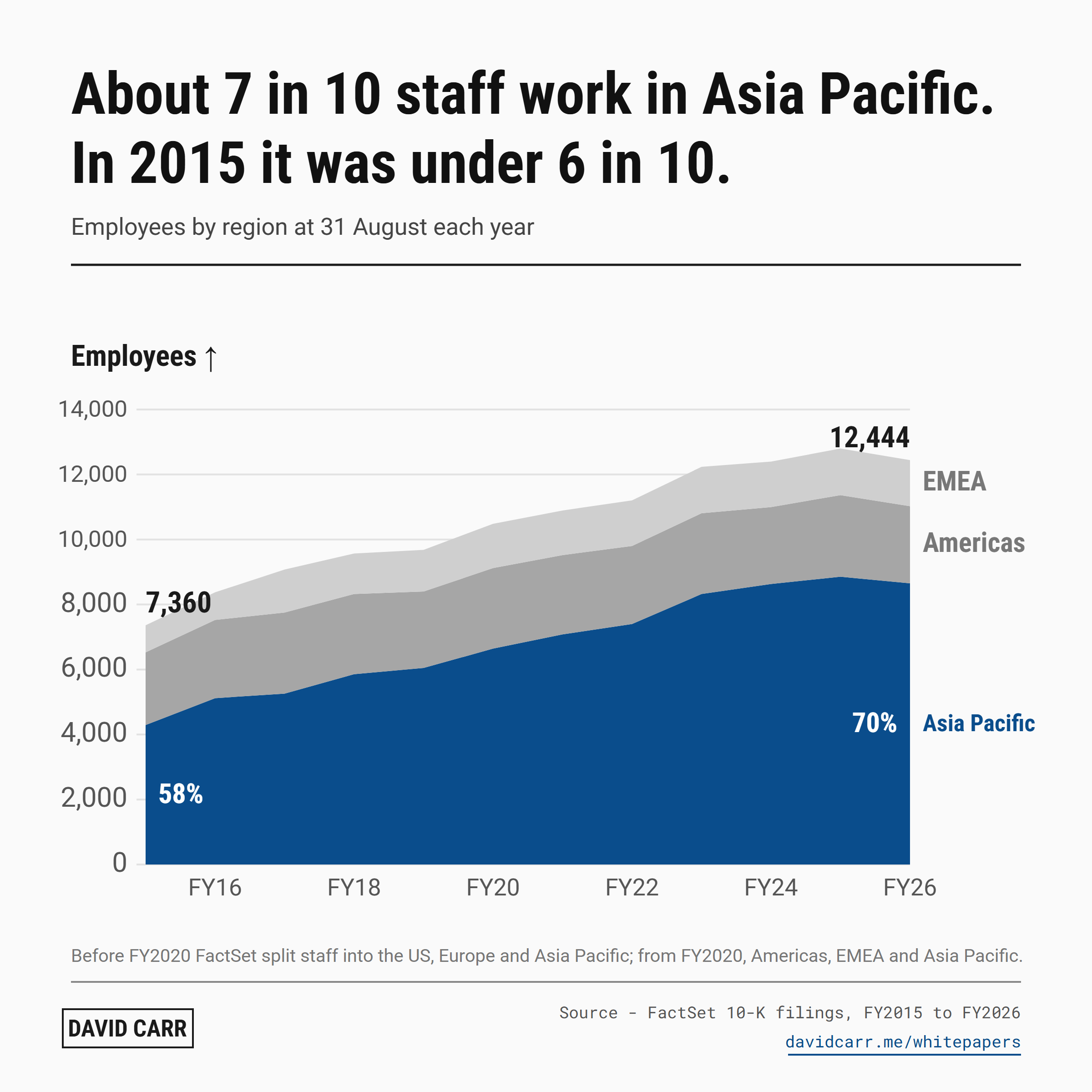
About 7 in 10 FactSet staff work in Asia Pacific. In 2015 it was under 6 in 10.
- 2015: 4,290 of 7,360 (58%)
- 2026: 8,652 of 12,444 (70%)
- Americas, 2026: 2,373
- EMEA, 2026: 1,419
Headcount fell 2.8% in fiscal 2026, the first drop on this chart, after restructuring and slower hiring.
From each year's 10-K, for example 2015 and 2026. Before 2020 the regions were the US, Europe and Asia Pacific.
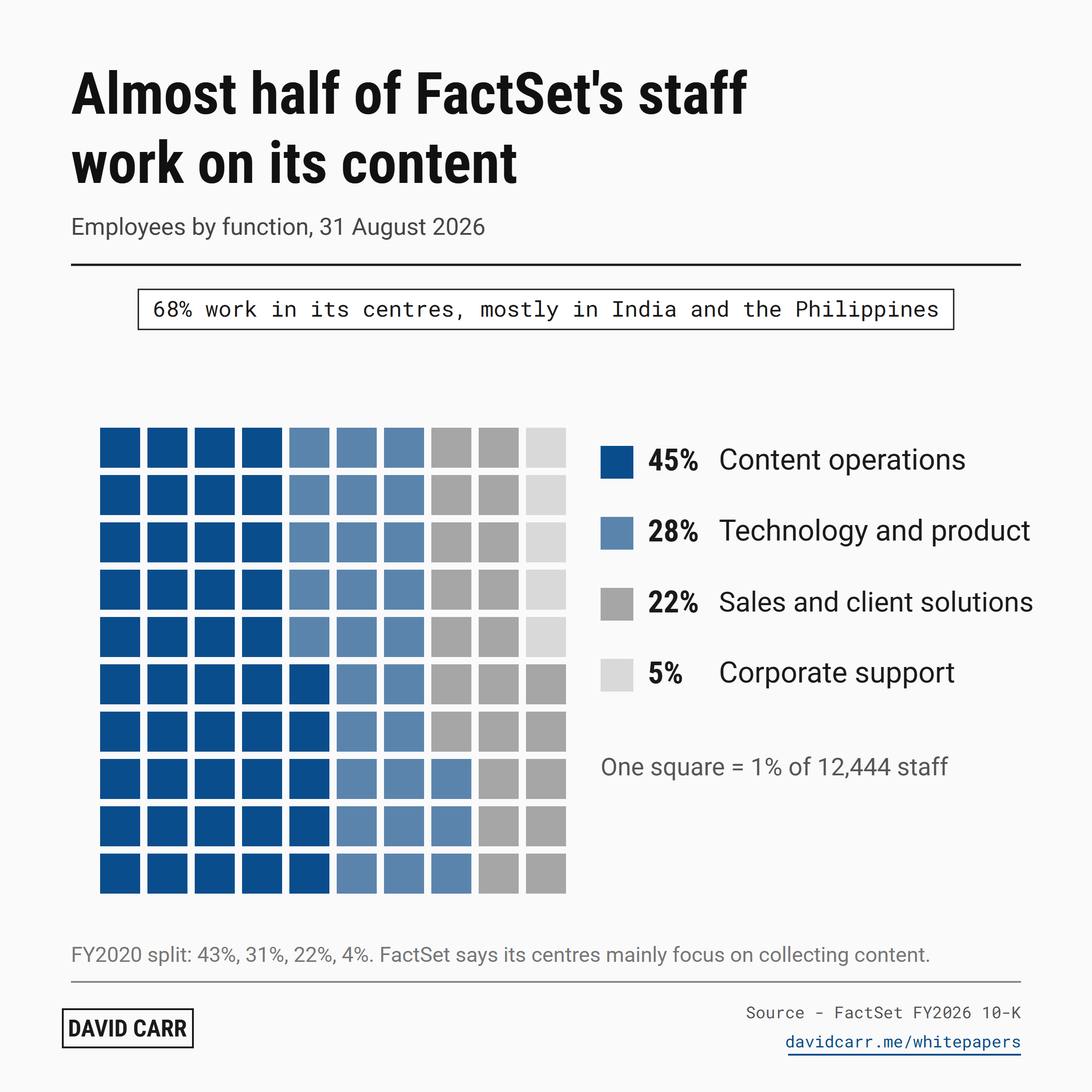
Almost half of FactSet's staff work on its content
- Content operations: 45%
- Technology and product: 28%
- Sales and client solutions: 22%
- Corporate support: 5%
68% of staff work in FactSet's centres of excellence, mainly in India and the Philippines. About 81% work outside the US.
All from the fiscal 2026 10-K. In 2020 the split was 43%, 31%, 22% and 4% (fiscal 2020 10-K).
Method, caveats and sources
The short answer. FactSet made $2.48 billion in the year to August 2026, and its subscriptions grew 7.0%. It has 9,258 clients and 260,671 users, and keeps over 95% of its subscription value each year. Its biggest purchase was CUSIP Global Services, for $1.93 billion. About 7 in 10 of its 12,444 staff work in Asia Pacific.
Filings. FactSet is listed in New York (FDS). Every number here comes from its own 10-K filings on SEC EDGAR, its fiscal 2026 results and its investor day release of 10 November 2026. Revenue and operating income come from SEC XBRL data. All were pulled on 25 November 2026.
Fiscal years. FactSet's year ends on 31 August, so fiscal 2026 runs from September 2025 to August 2026.
Changing measures. FactSet changed how it counted clients and users in 2017 and 2019, and reported subscription growth with professional services added from 2021 to 2024. The charts start after the changes, or mark them.
Not found. FactSet does not give revenue by product in its 10-K, saying it is impracticable. It does not publish a single subscription share of revenue, only that revenue is "primarily derived from subscriptions". Staff by country are not broken out beyond India and the Philippines together.
Also: Stripe, MSCI and Morningstar.