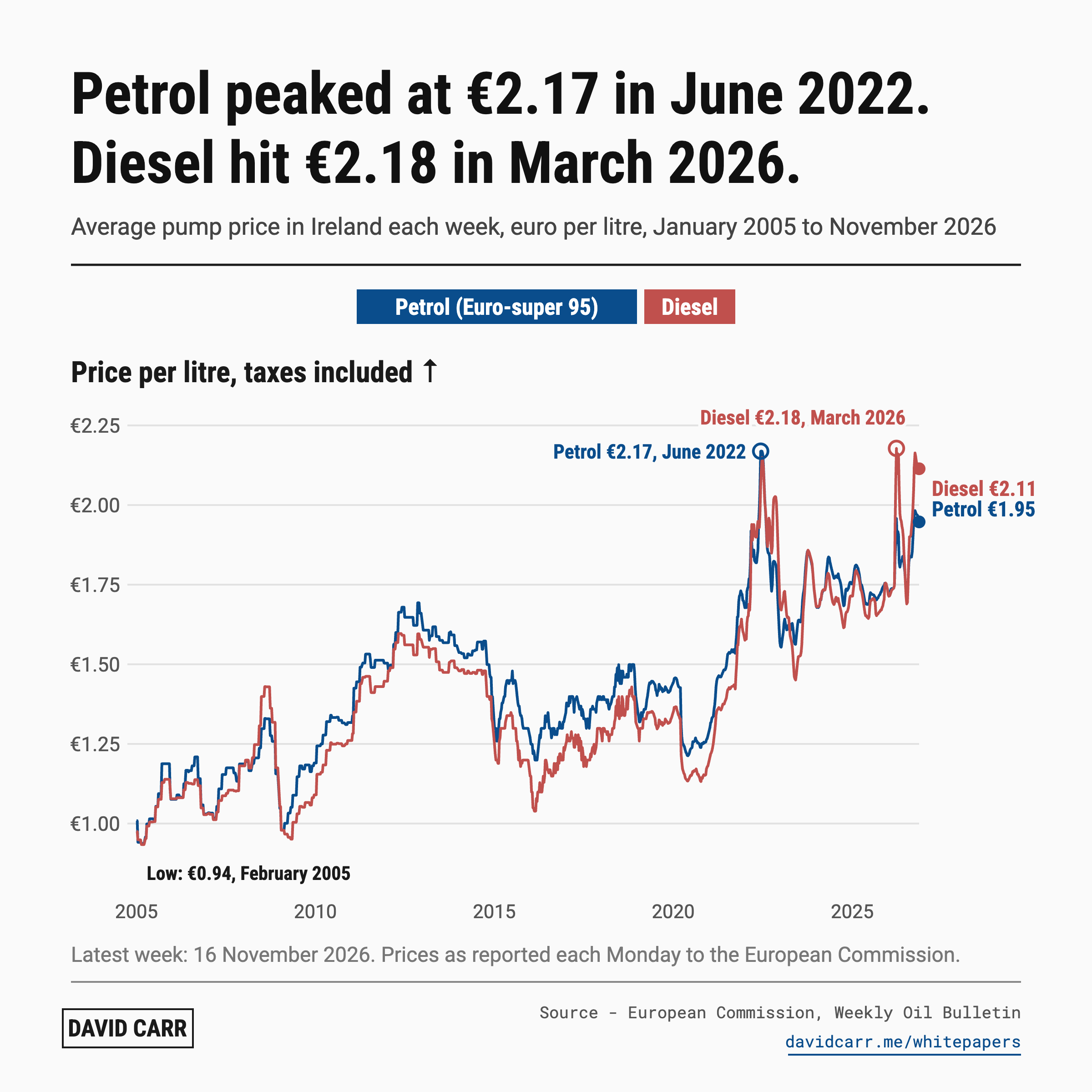
Petrol peaked at €2.17 a litre in June 2022. Diesel hit €2.18 in March 2026.
- Lowest week: 21 February 2005, petrol €0.94 and diesel €0.93
- Petrol's highest week: 13 June 2022, €2.17
- Diesel's highest week: 30 March 2026, €2.18
- Week of 16 November 2026: petrol €1.95, diesel €2.11
Both fuels cost about twice what they did in January 2005.
Weekly average pump prices for Ireland, taxes included, from the European Commission's Weekly Oil Bulletin. Petrol is Euro-super 95.
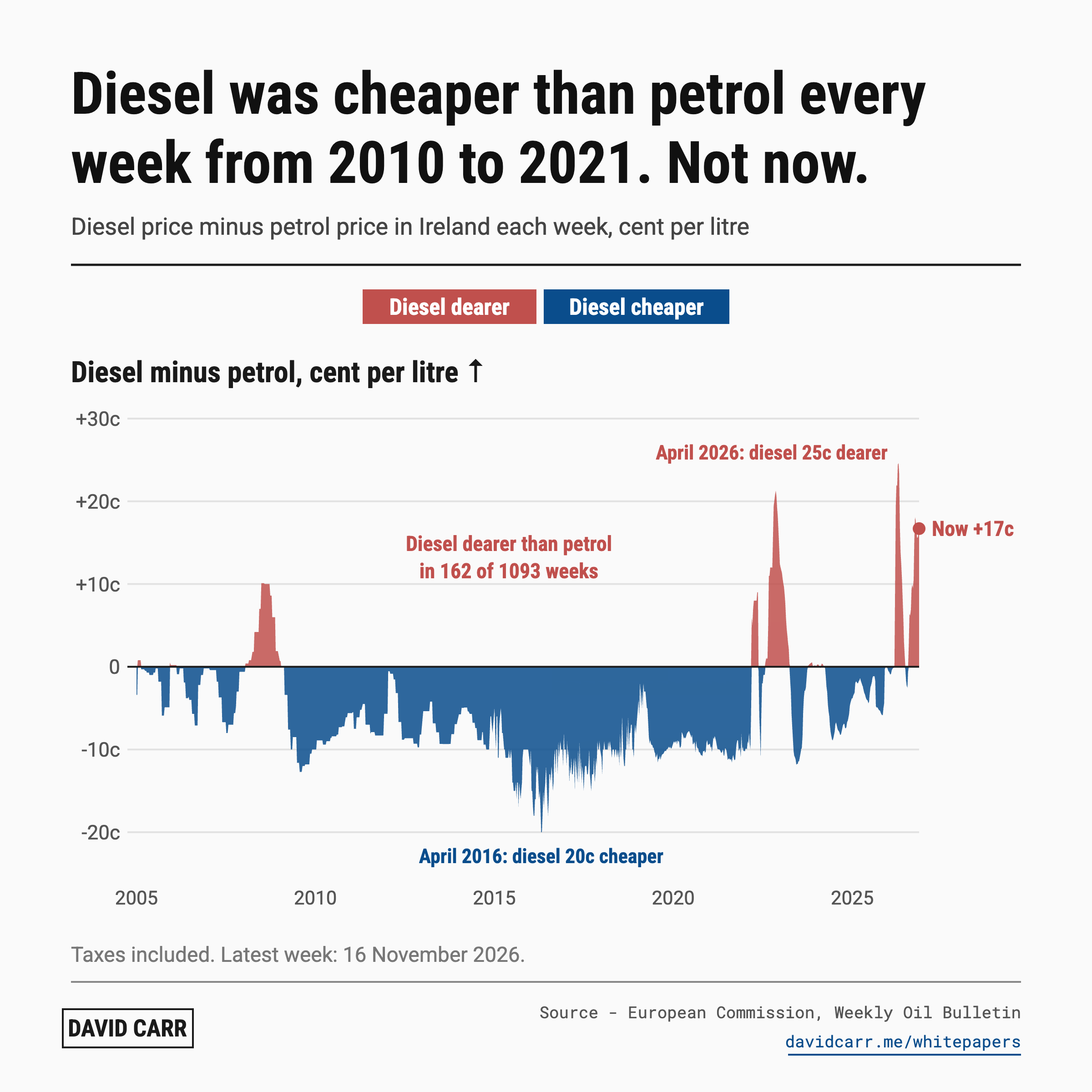
Diesel was cheaper than petrol every week from 2010 to 2021. Not now.
- Diesel dearer than petrol in 162 of 1,093 weeks since January 2005
- Widest gap the other way: diesel 20c a litre cheaper in April 2016
- Widest gap: diesel 25c a litre dearer in April 2026
- Week of 16 November 2026: diesel 17c dearer
Diesel was dearer in most weeks of 2008, 2022 and 2026.
Diesel price minus petrol price each week, both with taxes included.
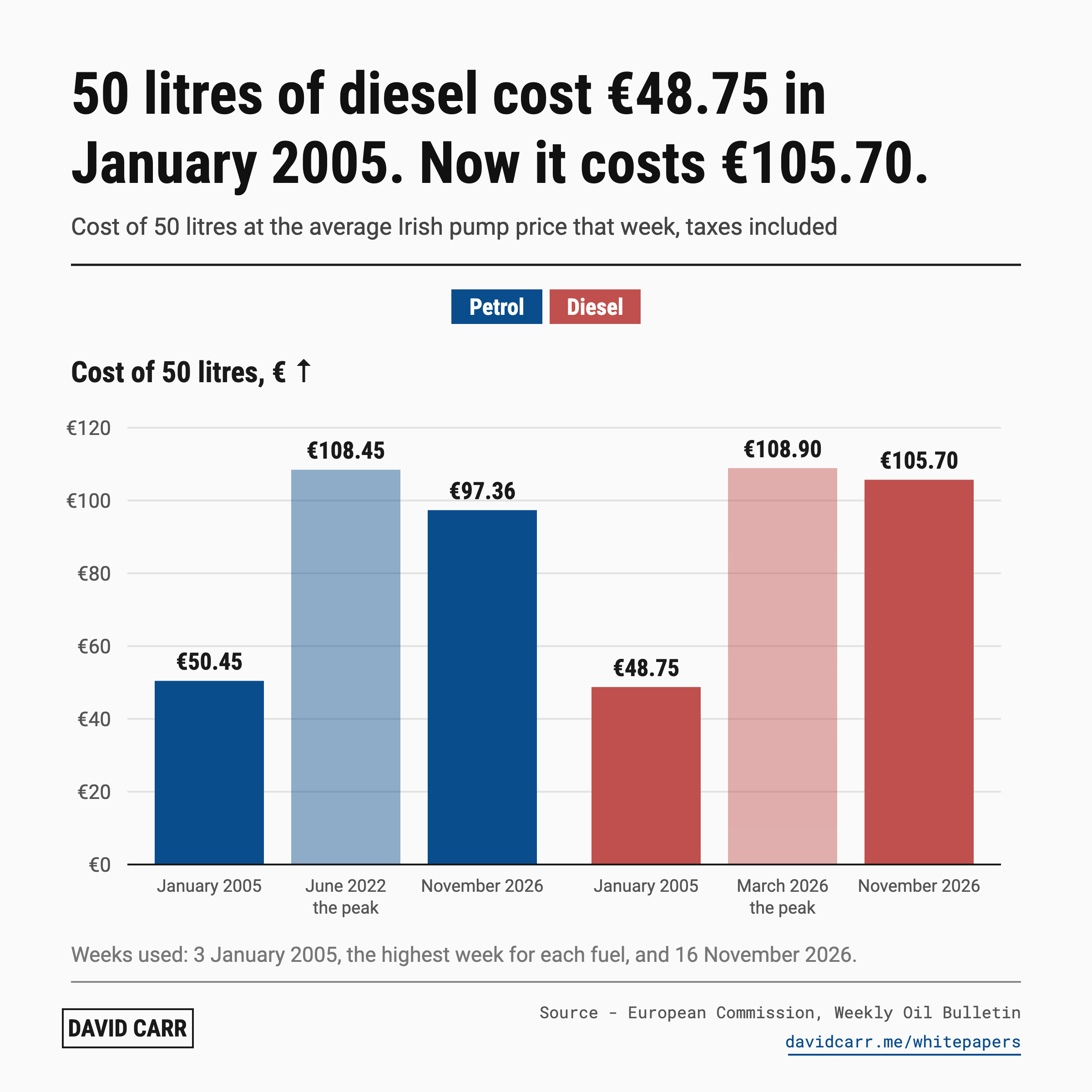
50 litres of diesel cost €48.75 in January 2005. Now it costs €105.70.
- Petrol: €50.45 in January 2005, €108.45 at the June 2022 peak, €97.36 now
- Diesel: €48.75 in January 2005, €108.90 at the March 2026 peak, €105.70 now
A 50-litre fill-up now costs about twice what it did in 2005, for either fuel.
50 litres at the average Irish pump price in the week of 3 January 2005, each fuel's highest week, and the week of 16 November 2026. Real pumps vary from station to station.
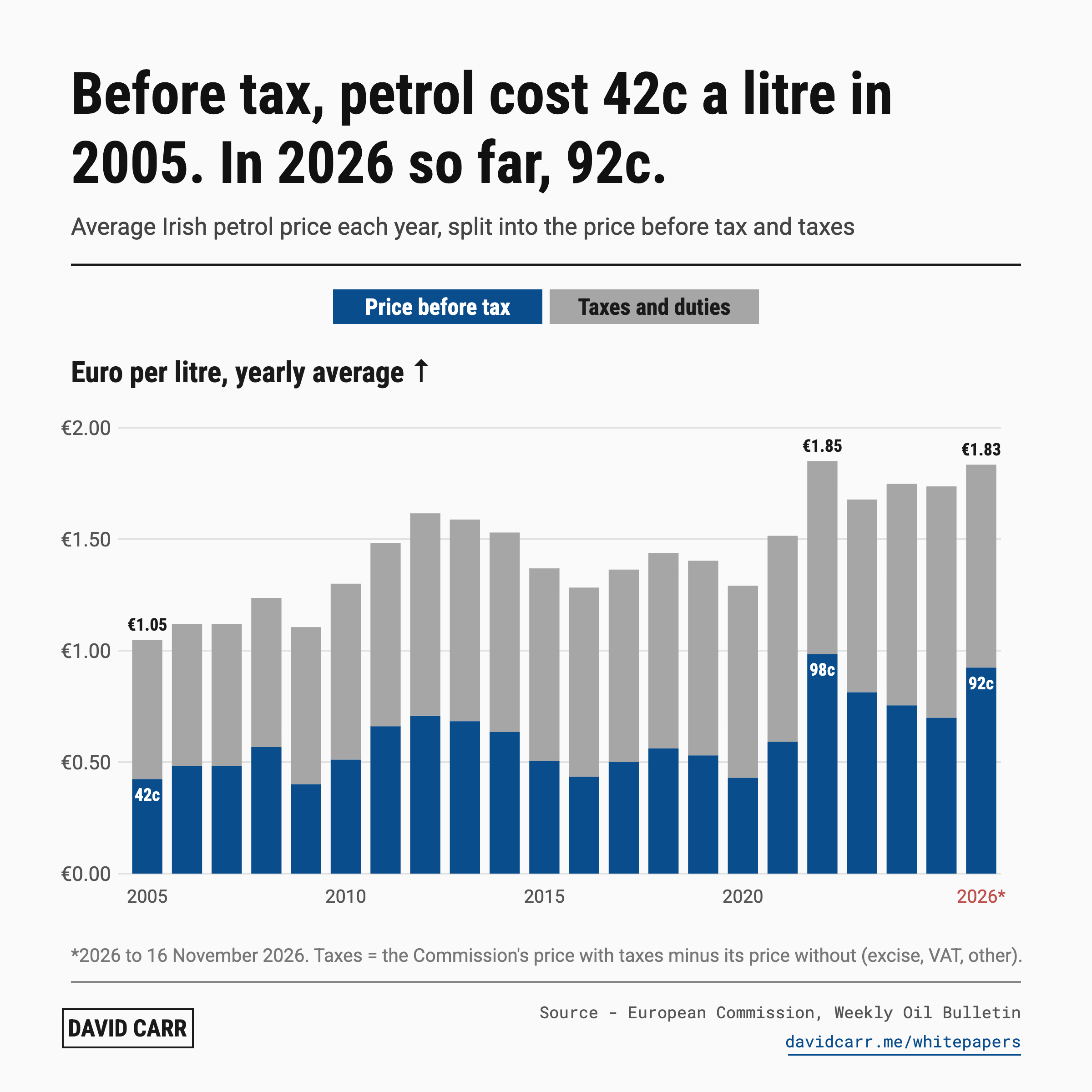
Before tax, petrol cost 42c a litre in 2005. In 2026 so far, 92c.
- 2005: 42c before tax, €1.05 at the pump (yearly averages)
- 2022: 98c before tax, €1.85 at the pump
- 2026 to 16 November: 92c before tax, €1.83 at the pump
- Week of 16 November 2026: taxes and duties were 45% of the petrol price and 36% of the diesel price
In 2022 the price before tax averaged 98c, more than twice the 43c of 2020.
The Commission publishes each country's price with taxes and without. Taxes here is the gap between the two: excise duty, VAT and other indirect taxes. Yearly figures are averages of the weekly prices.
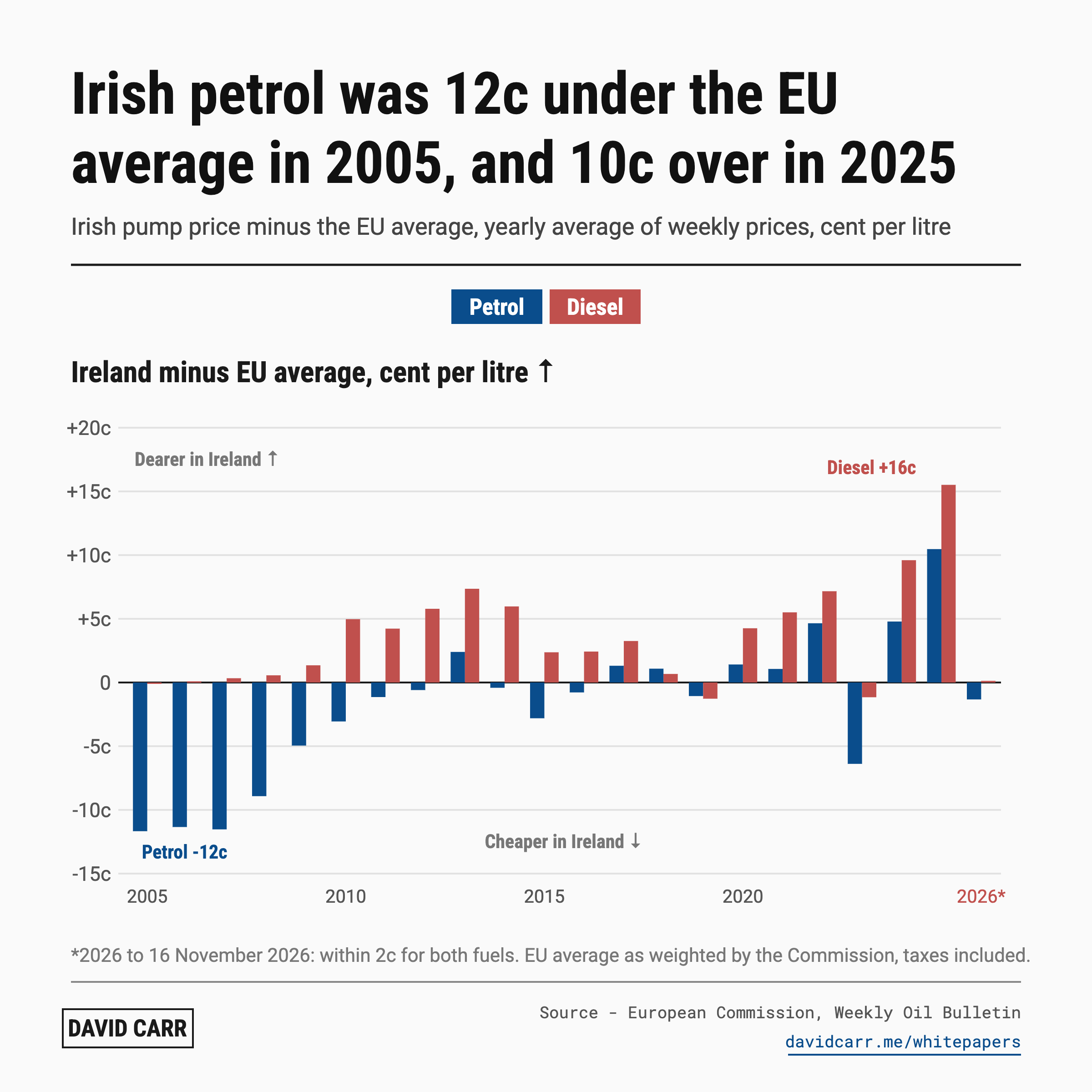
Irish petrol was 12c under the EU average in 2005, and 10c over in 2025
- Petrol: 12c below the EU average in 2005, 10c above in 2025
- Diesel: dearer than the EU average every year from 2009 to 2018, and 16c dearer in 2025
- 2026 to 16 November: both fuels within 2c of the EU average
For most years diesel in Ireland cost a little more than the EU average, and petrol a little less or about the same.
Yearly average of Ireland's weekly price minus the Commission's weighted EU average, taxes included. The EU average covers the member states of the time.
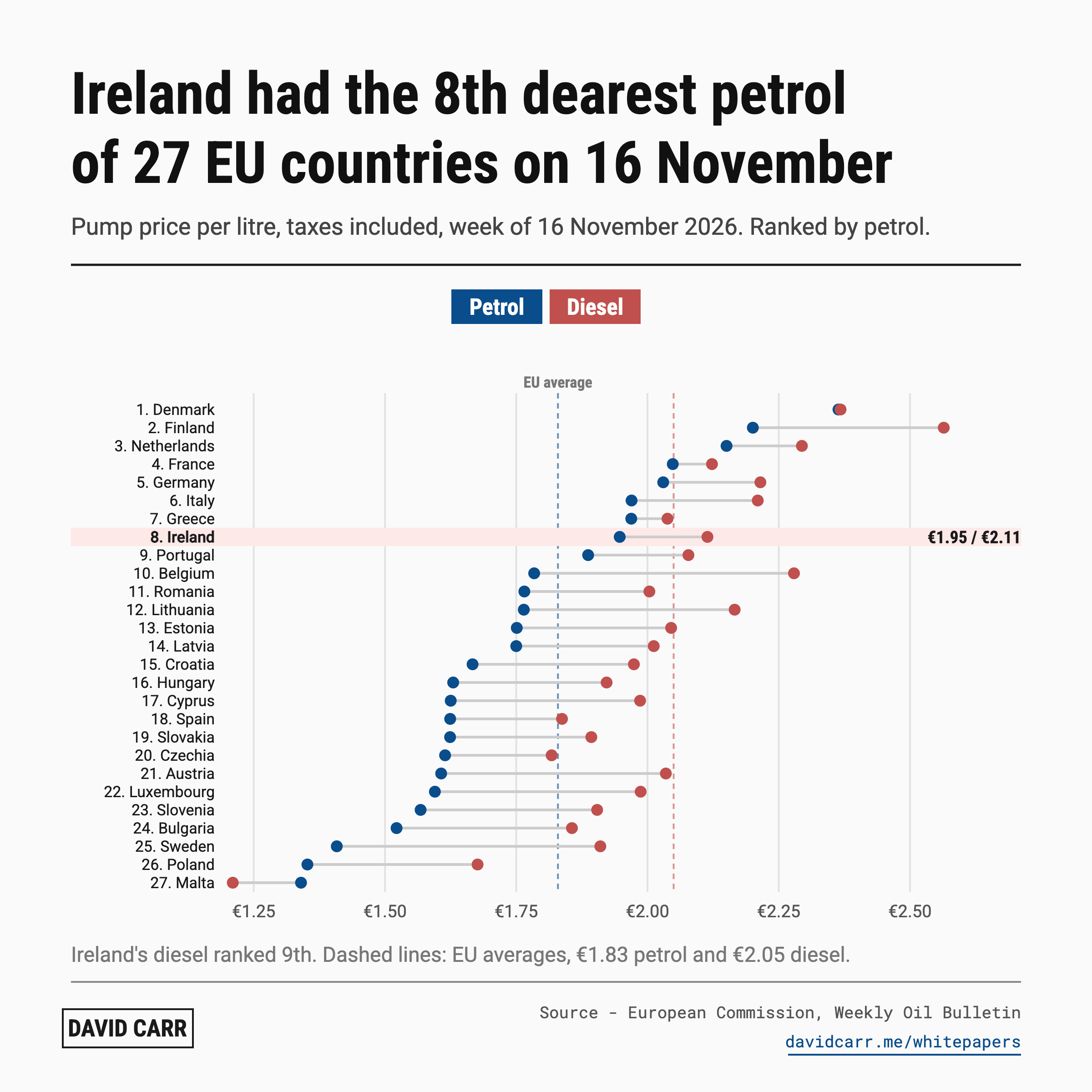
Ireland had the 8th dearest petrol of 27 EU countries on 16 November
- Petrol: €1.95 a litre, 8th of 27. EU average €1.83
- Diesel: €2.11, 9th of 27. EU average €2.05
- Dearest petrol: Denmark, €2.36. Cheapest: Malta, €1.34
Ireland was below Denmark, Finland, the Netherlands, France, Germany, Italy and Greece for petrol.
Pump prices in euro for the week of 16 November 2026, as published by the Commission. Prices in countries outside the euro are converted by the Commission.
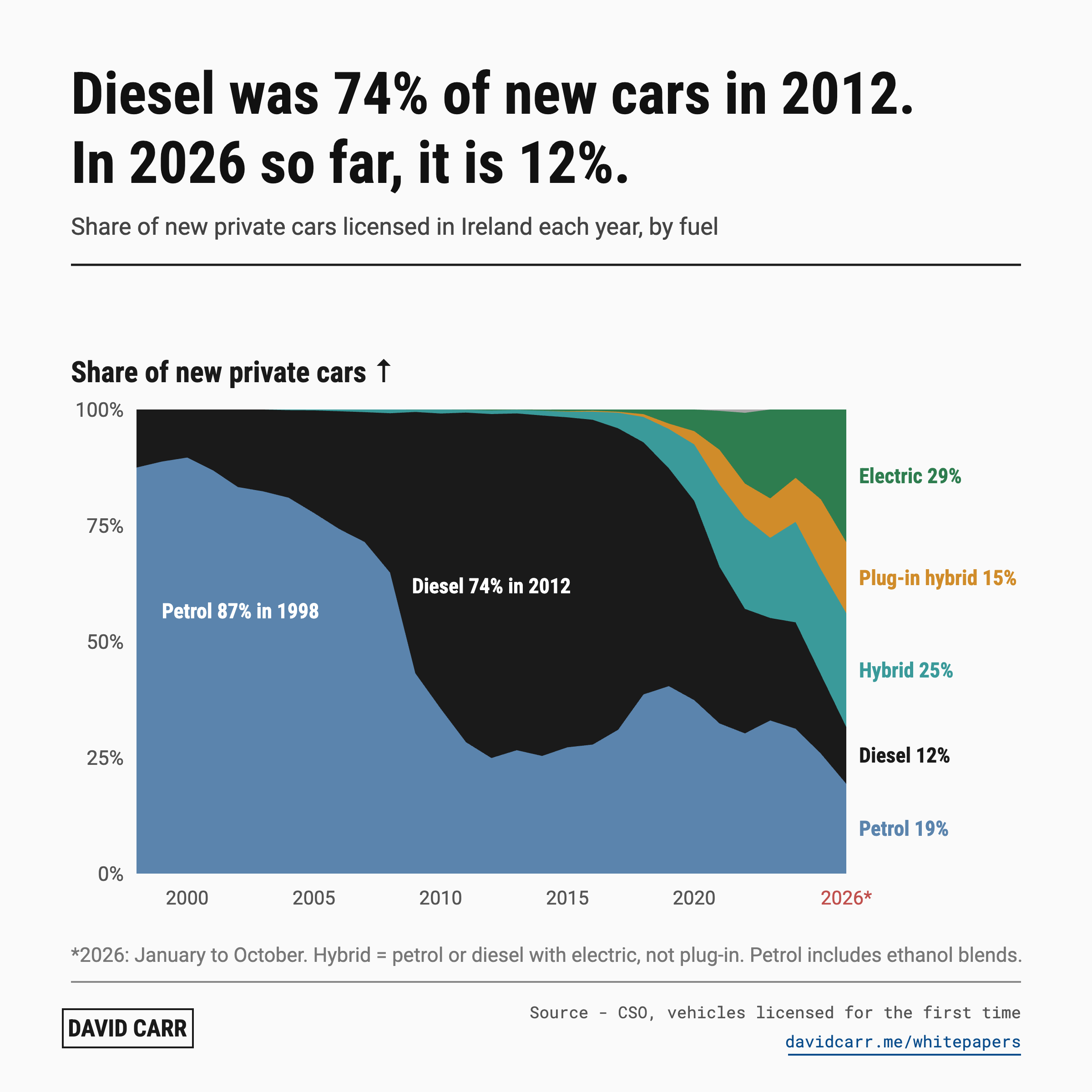
Diesel was 74% of new cars in 2012. In 2026 so far, it is 12%.
- 1998: petrol 87% of new private cars, diesel 13%
- 2012: diesel's highest share, 74%
- January to October 2026: electric 29%, hybrid 25%, petrol 19%, plug-in hybrid 15%, diesel 12%
Diesel's share rose fast from 2008 and fell fast from 2017. Electric and hybrid cars took most of the space.
New private cars licensed for the first time, from the CSO's vehicle licensing tables TEA03 and TEA17 (yearly) and TEM12 (monthly, for 2026). Hybrid here means petrol or diesel with electric, not plug-in.
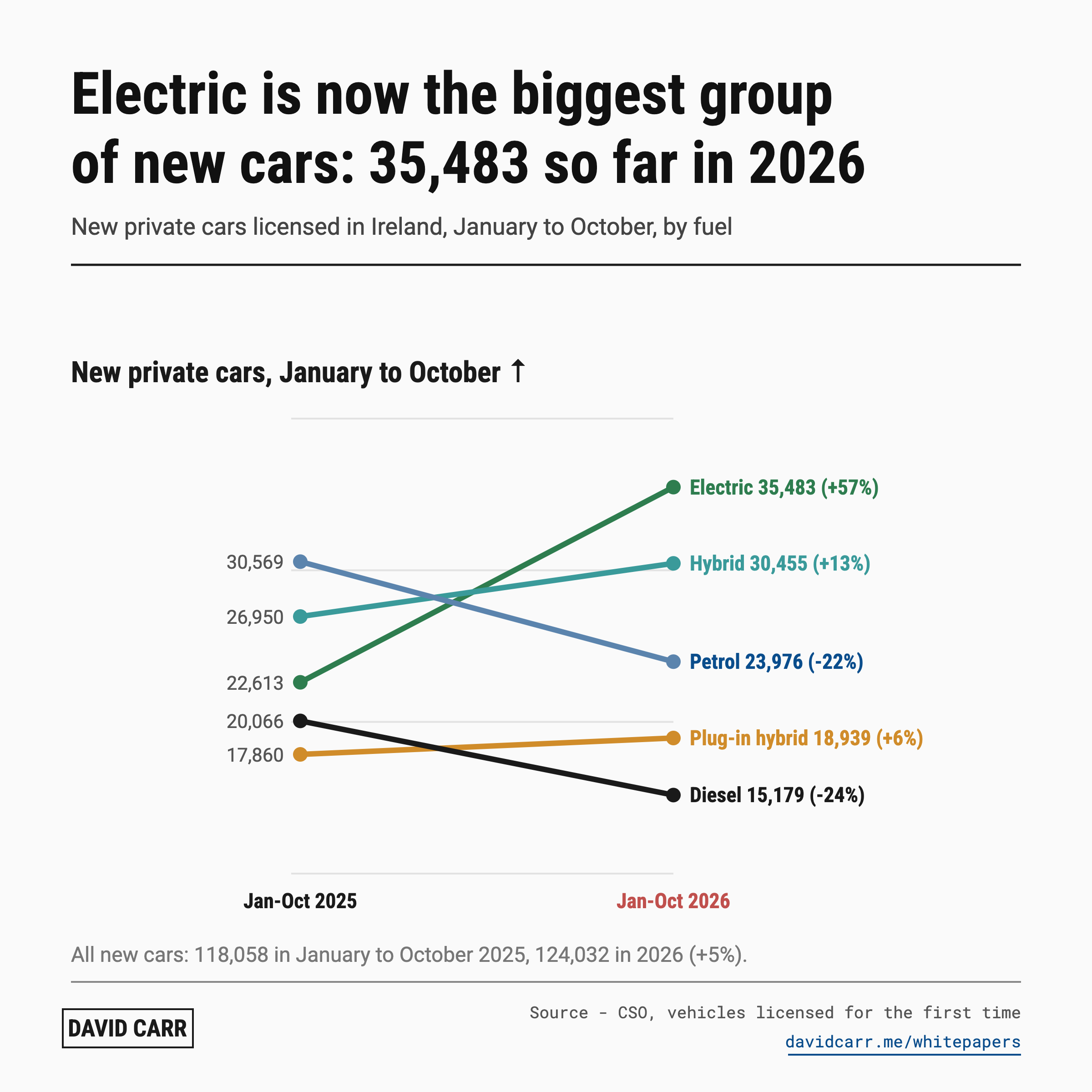
Electric is now the biggest group of new cars: 35,483 so far in 2026
- Electric: 22,613 in January to October 2025, 35,483 in 2026 (+57%)
- Hybrid: 26,950 to 30,455 (+13%)
- Petrol: 30,569 to 23,976 (-22%)
- Diesel: 20,066 to 15,179 (-24%)
- All new cars: 118,058 to 124,032 (+5%)
In the first ten months of 2025 petrol was the biggest group. In the same months of 2026 it was electric.
The same ten months of each year, so the January and July peaks are in both.
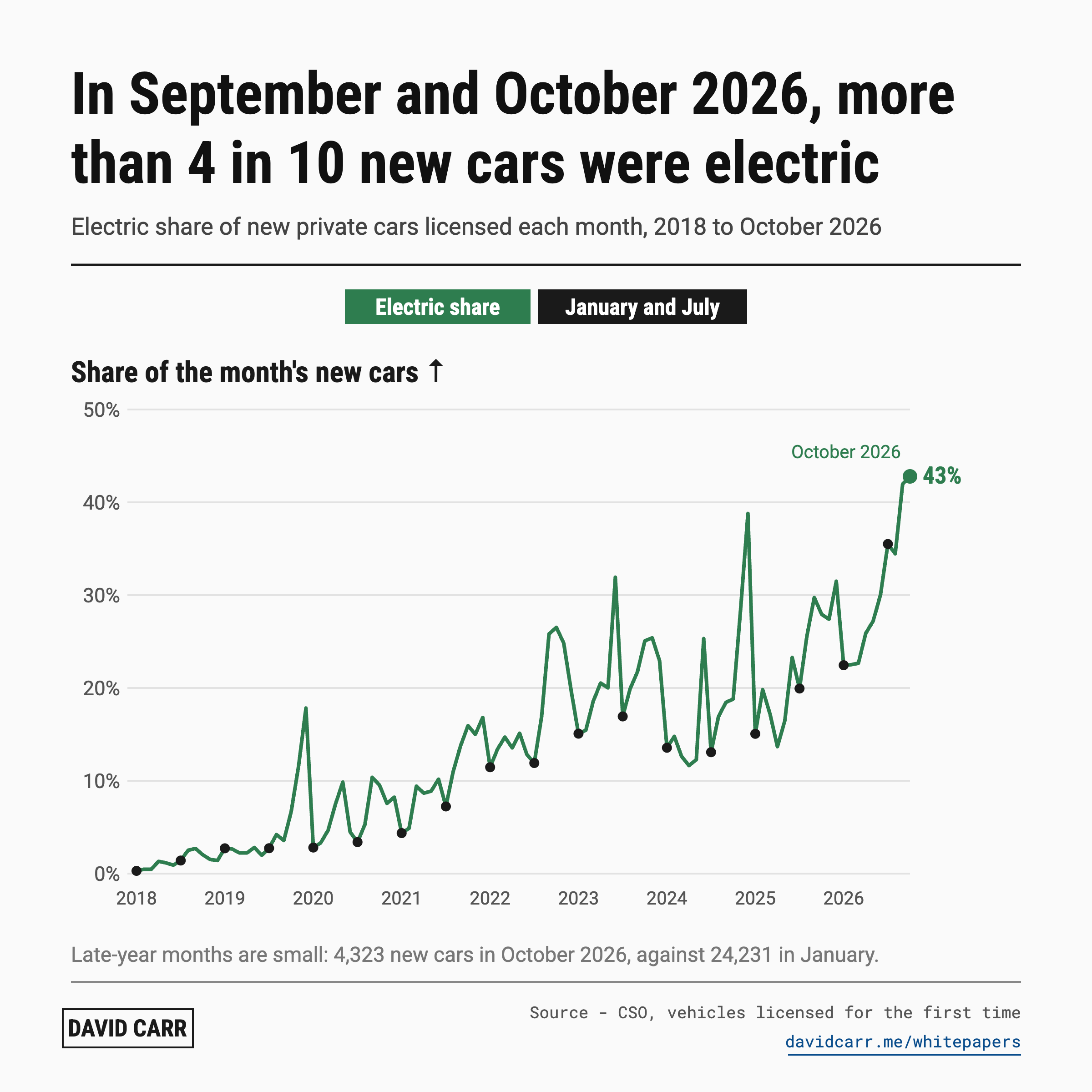
In September and October 2026, more than 4 in 10 new cars were electric
- September 2026: 42%
- October 2026: 43%, the highest month since this table starts in 2015
- January 2026: 22%, against 15% in January 2025
The share jumps around in the small late-year months. The big January and July months show the steadier rise.
Electric cars as a share of all new private cars licensed each month, CSO table TEM12.
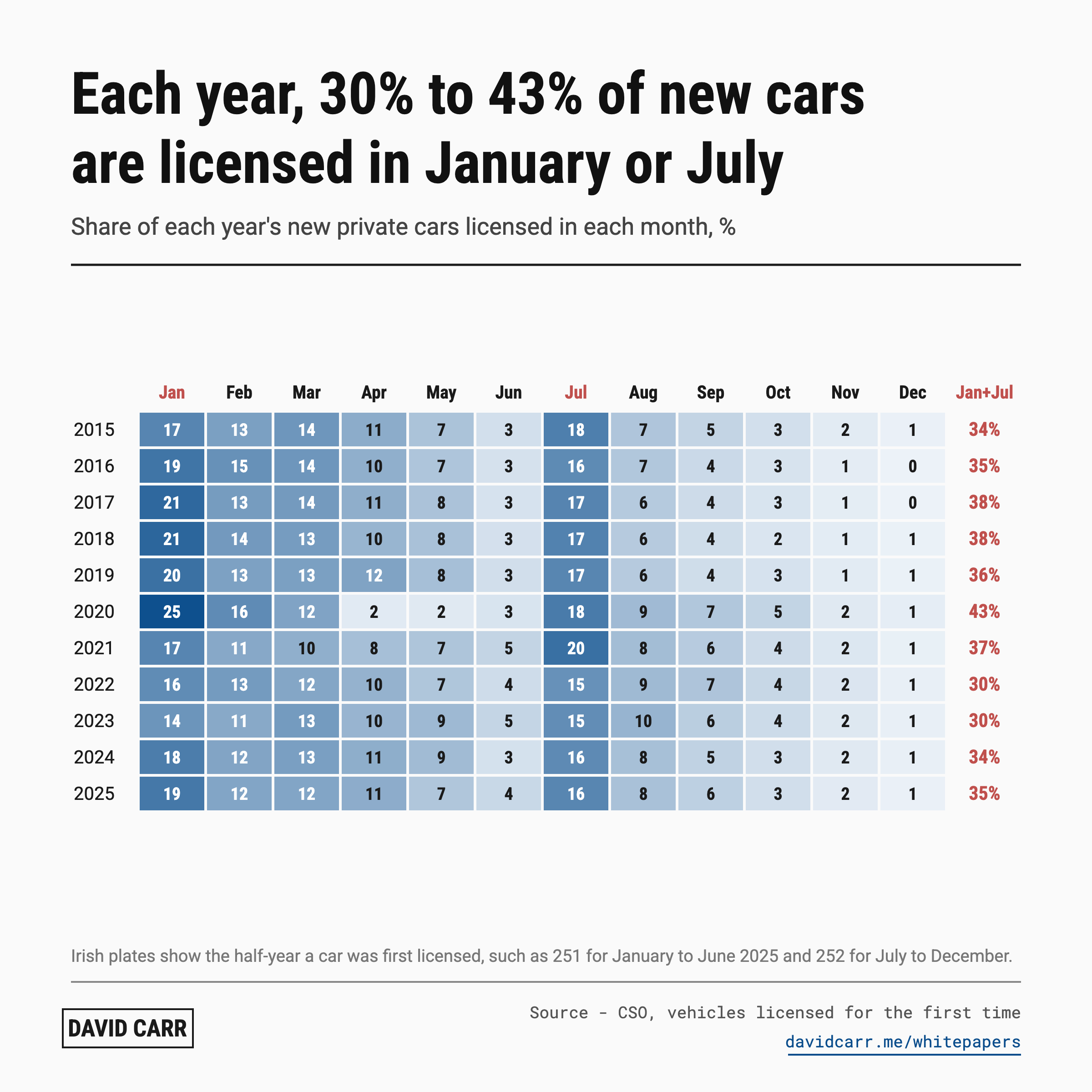
Each year, 30% to 43% of new cars are licensed in January or July
- January was the biggest month in eight of the eleven years, July in the other three
- November and December: 2% or less of the year each
- 2020 had the highest January and July share, 43%
Most new cars arrive at the start of each half-year.
Share of each year's new private cars licensed in each month, 2015 to 2025, CSO table TEM12. Irish plates show the half-year a car was first licensed, such as 251 and 252.
Method, caveats and sources
The short answer. In the week of 16 November 2026 petrol cost €1.95 a litre in Ireland and diesel €2.11. Both are about twice their 2005 price. Petrol's record was €2.17 in June 2022 and diesel's was €2.18 in March 2026. Diesel was the cheaper fuel every week from 2010 to 2021, and is now the dearer one. Ireland's prices were 8th and 9th highest of the 27 EU countries that week. On the road, diesel went from 74% of new cars in 2012 to 12% in 2026 so far, and electric is now the biggest group, at 29%.
Pump prices. From the European Commission's Weekly Oil Bulletin price history file, downloaded on 22 November 2026. It holds the average price each country reports each week from January 2005 to 16 November 2026, with and without taxes, in euro per 1,000 litres. Petrol is Euro-super 95; diesel is automotive gas oil. Taxes are the gap between the two prices, which covers excise duty, VAT and other indirect taxes. The EU average is the Commission's own weighted average. Some early weeks are missing or repeated in the file. As a check, the CSO's monthly average prices for petrol and diesel match the Bulletin's monthly averages to within 5c.
New cars. From the CSO's vehicle licensing tables, also pulled on 22 November 2026: TEA03 for 1998 to 2014, TEA17 for 2015 to 2025, and TEM12 for each month from January 2015 to October 2026. New private cars only, not second-hand imports. Fuel groups are the CSO's: hybrid here is petrol and electric hybrid plus diesel and electric hybrid; plug-in hybrid is the CSO's petrol or diesel plug-in hybrid electric. 2026 covers January to October.
What this does not show. The cost of charging an electric car, and the price at any one station. Averages hide a wide spread between stations and counties.
Also: What Ireland costs and Where Ireland travels, and why.