From boats and planes to cars, then to wrists
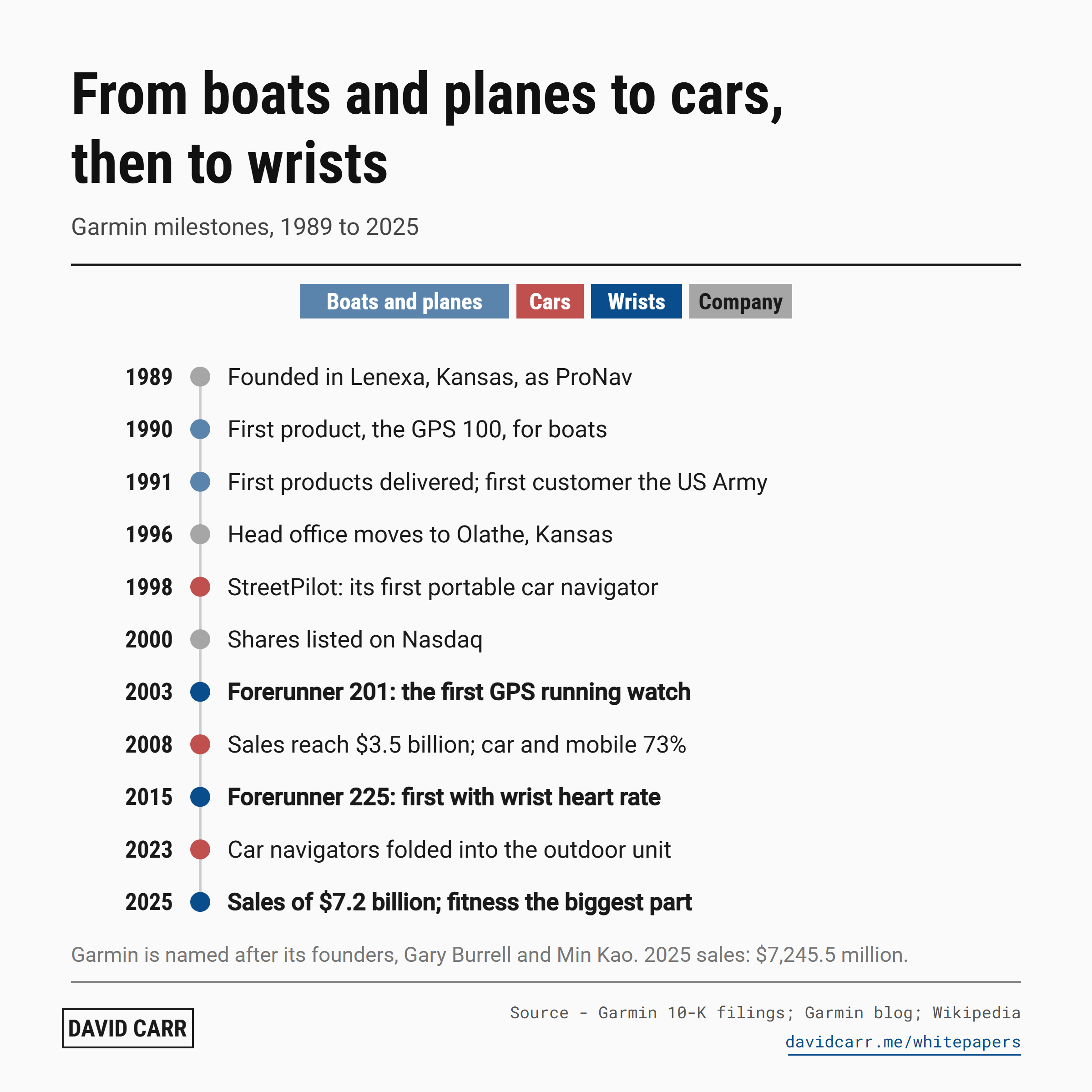
- 1989: founded in Lenexa, Kansas, as ProNav, by Gary Burrell and Min Kao (Wikipedia)
- 1990: the GPS 100, a receiver for boats, is its first product
- 1991: first products delivered; the US Army is the first customer
- 1998: StreetPilot, its first portable car navigator
- 2003: Forerunner 201, the first GPS running watch
- 2025: $7.2 billion of sales and about 23,000 staff
The name is a blend of the two founders' first names. The head office moved to Olathe, Kansas, in 1996.
Founding details, the GPS 100, the US Army, the 1996 move and the StreetPilot date are from Wikipedia. The rest is from Garmin's own filings and blog.
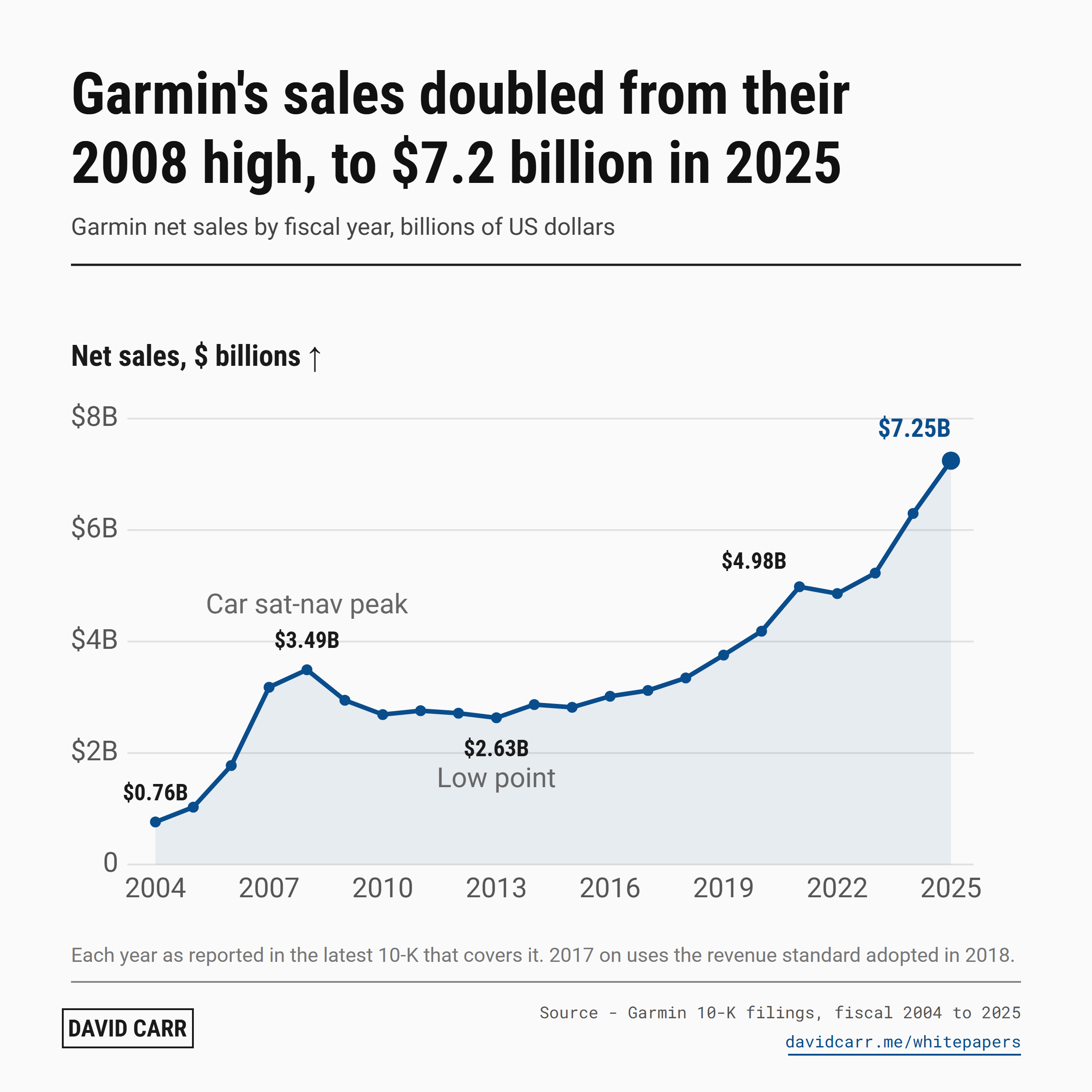
Garmin's sales doubled from their 2008 high, to $7.2 billion in 2025
- 2004: $0.76 billion
- 2008: $3.49 billion, the car sat-nav peak
- 2013: $2.63 billion, the low point since
- 2021: $4.98 billion
- 2025: $7.25 billion
Sales fell in four of the five years after 2008. From 2014 they rose every year except 2015 and 2022.
Net sales from Garmin's 10-K filings. Each year is taken from the latest filing that covers it.
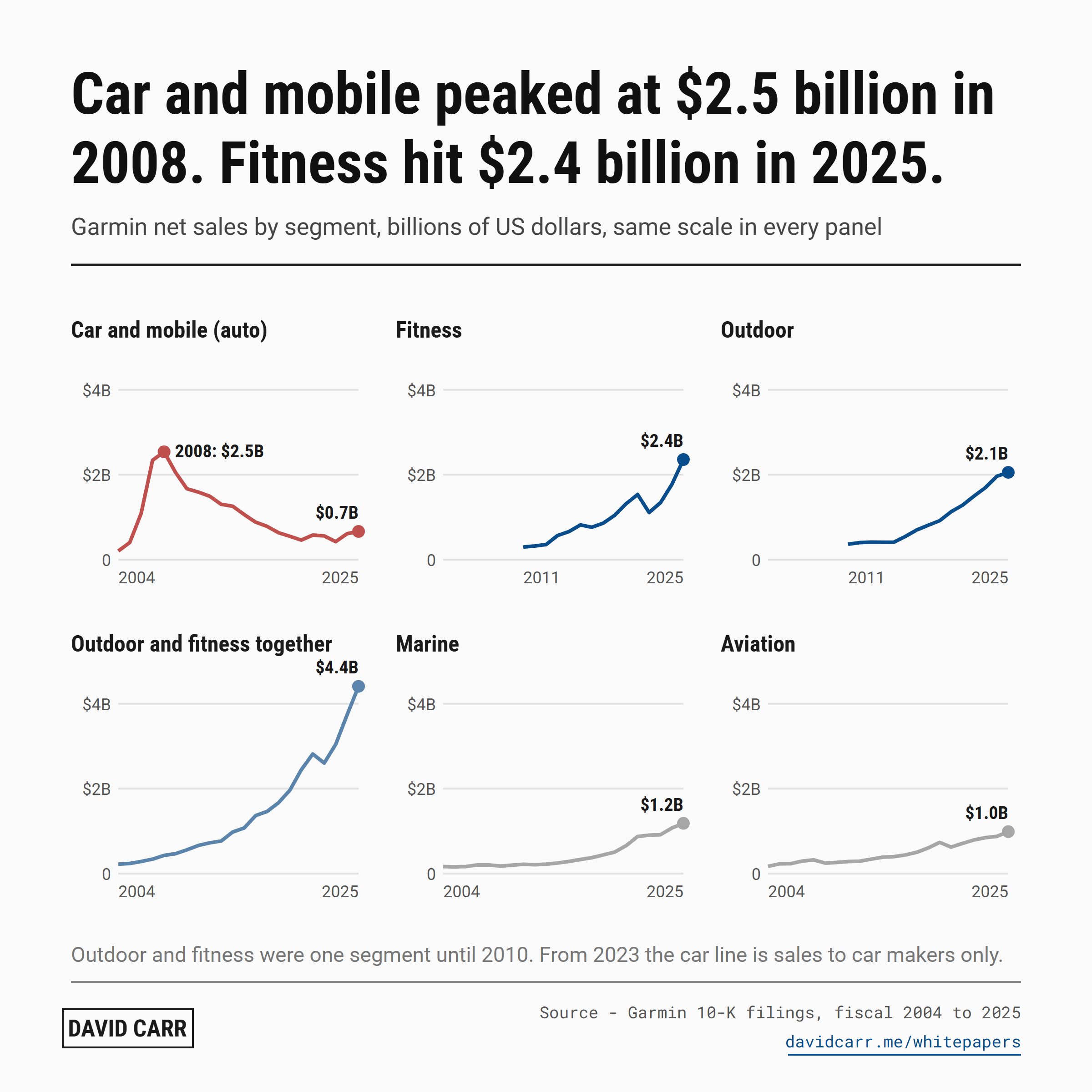
Car and mobile peaked at $2.5 billion in 2008. Fitness hit $2.4 billion in 2025.
- Car and mobile, 2008: $2.54 billion
- Fitness, 2025: $2.36 billion
- Outdoor, 2025: $2.05 billion
- Marine, 2025: $1.18 billion
- Aviation, 2025: $0.99 billion
Every other segment grew while the car line shrank. Outdoor and fitness together went from $0.43 billion in 2008 to $4.41 billion in 2025.
Segment lines change over time: outdoor and fitness were one segment until 2010, and the 2023 10-K moved Garmin's own car products into outdoor.
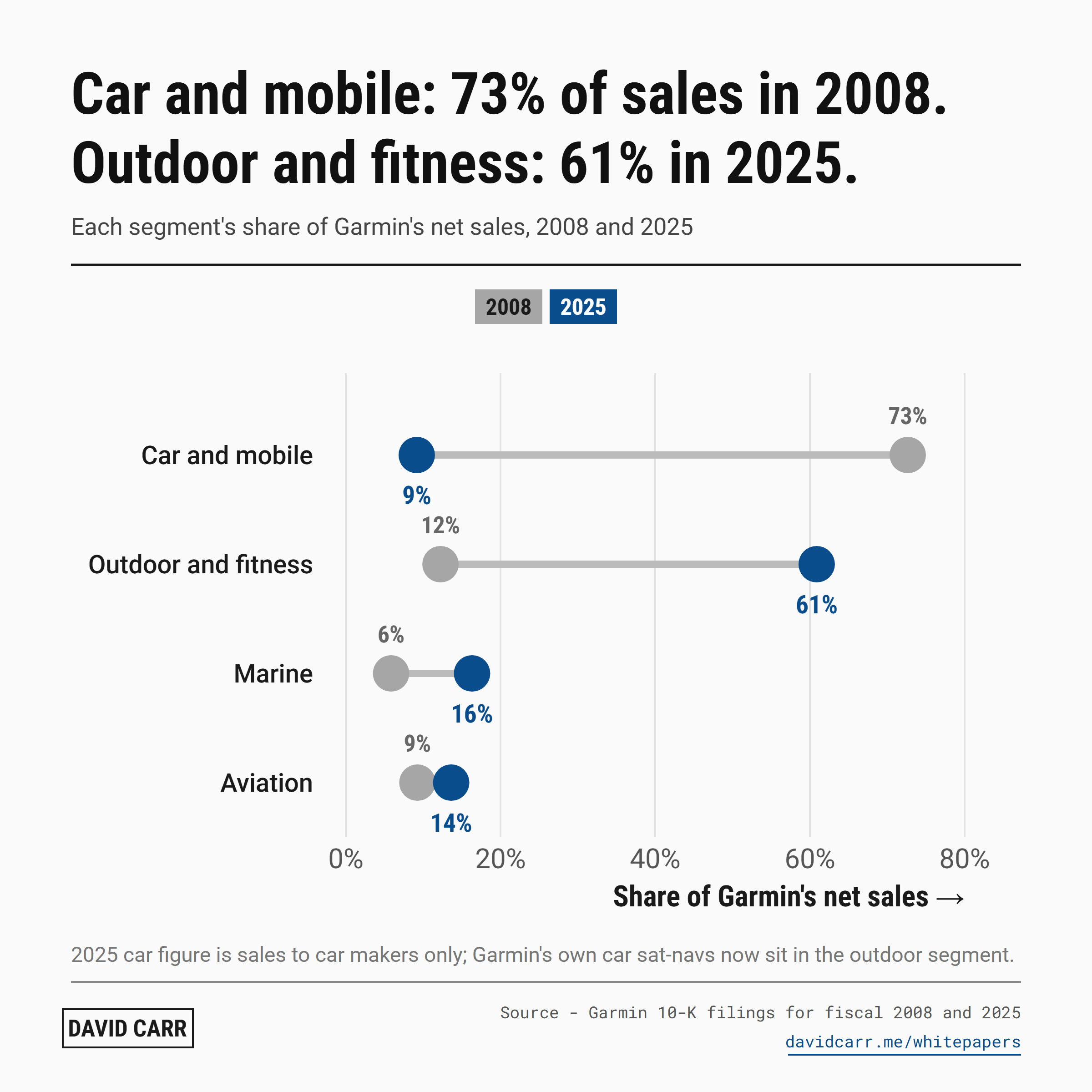
Car and mobile: 73% of sales in 2008. Outdoor and fitness: 61% in 2025.
- Car and mobile: 73% in 2008, 9% in 2025
- Outdoor and fitness: 12% to 61%
- Marine: 6% to 16%
- Aviation: 9% to 14%
No single segment made more than a third of Garmin's sales in 2025.
Shares worked out from the segment tables. The 2025 car figure is sales to car makers only.
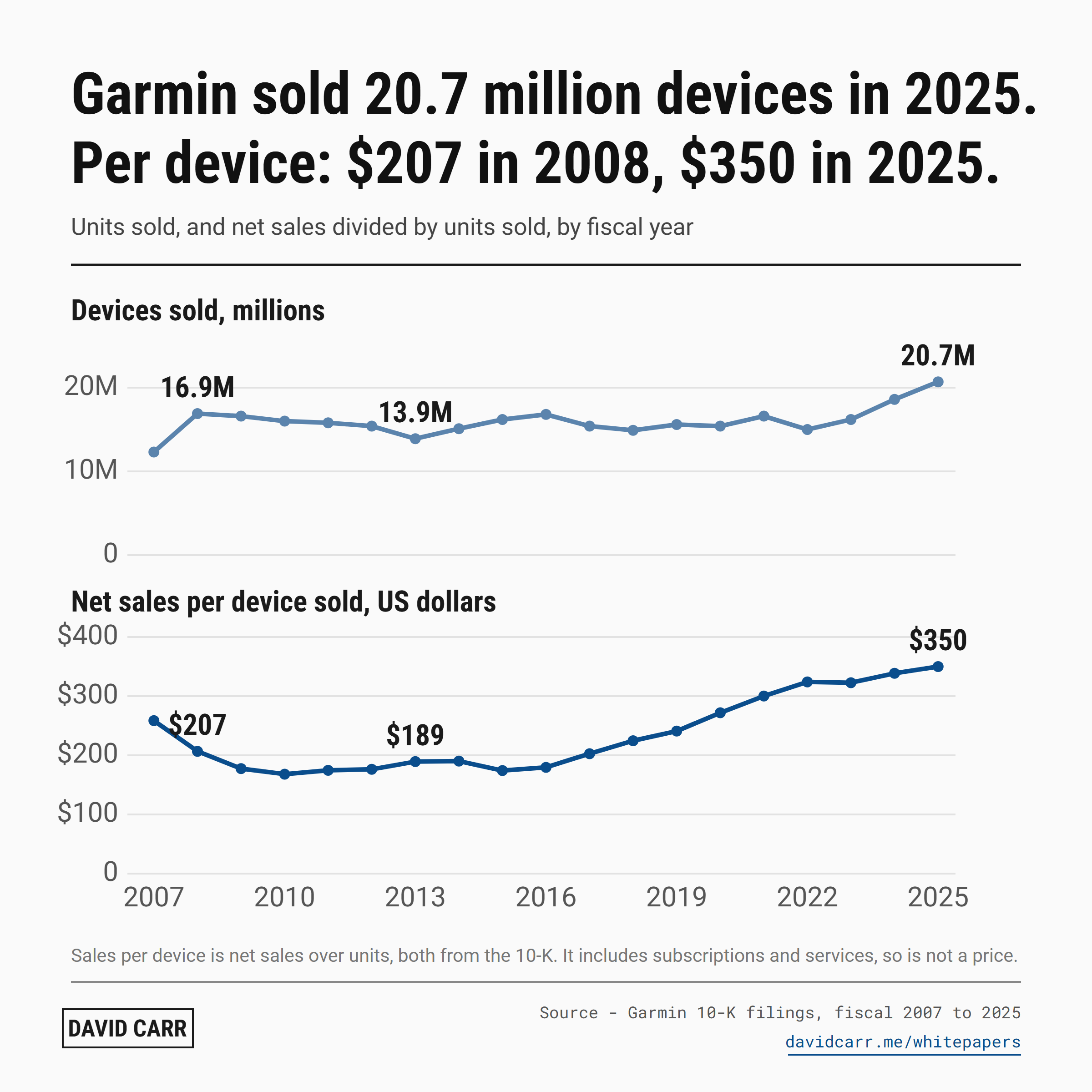
Garmin sold 20.7 million devices in 2025. Per device: $207 in 2008, $350 in 2025.
- Devices sold, 2008: 16.9 million
- 2013: 13.9 million, the lowest from 2008 on
- 2025: 20.7 million, the most in any year shown
- Net sales per device: $207 (2008), $189 (2013), $350 (2025)
For scale on wrists and fingers: Oura said in September 2025 it had sold over 5.5 million rings since 2015.
Per-device figure is net sales divided by units, worked out here. It includes subscriptions and services, so it is not an average price.
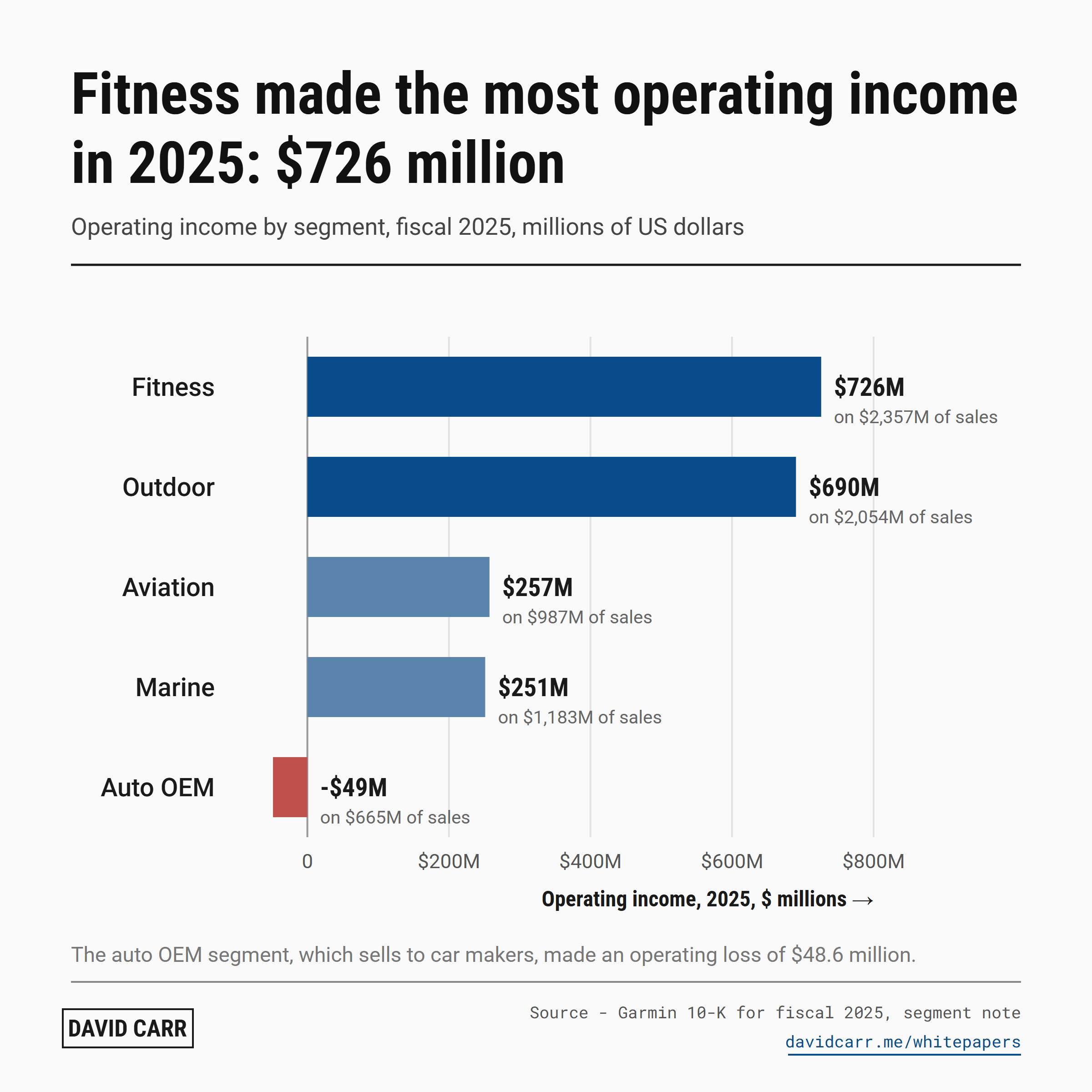
Fitness made the most operating income in 2025: $726 million
- Fitness: $726 million on $2,357 million of sales
- Outdoor: $690 million on $2,054 million
- Aviation: $257 million on $987 million
- Marine: $251 million on $1,183 million
- Auto OEM: a $48.6 million loss on $665 million
Fitness and outdoor made three quarters of Garmin's operating income between them.
From the segment note in the 2025 10-K. Operating income is sales less the costs Garmin assigns to each segment.
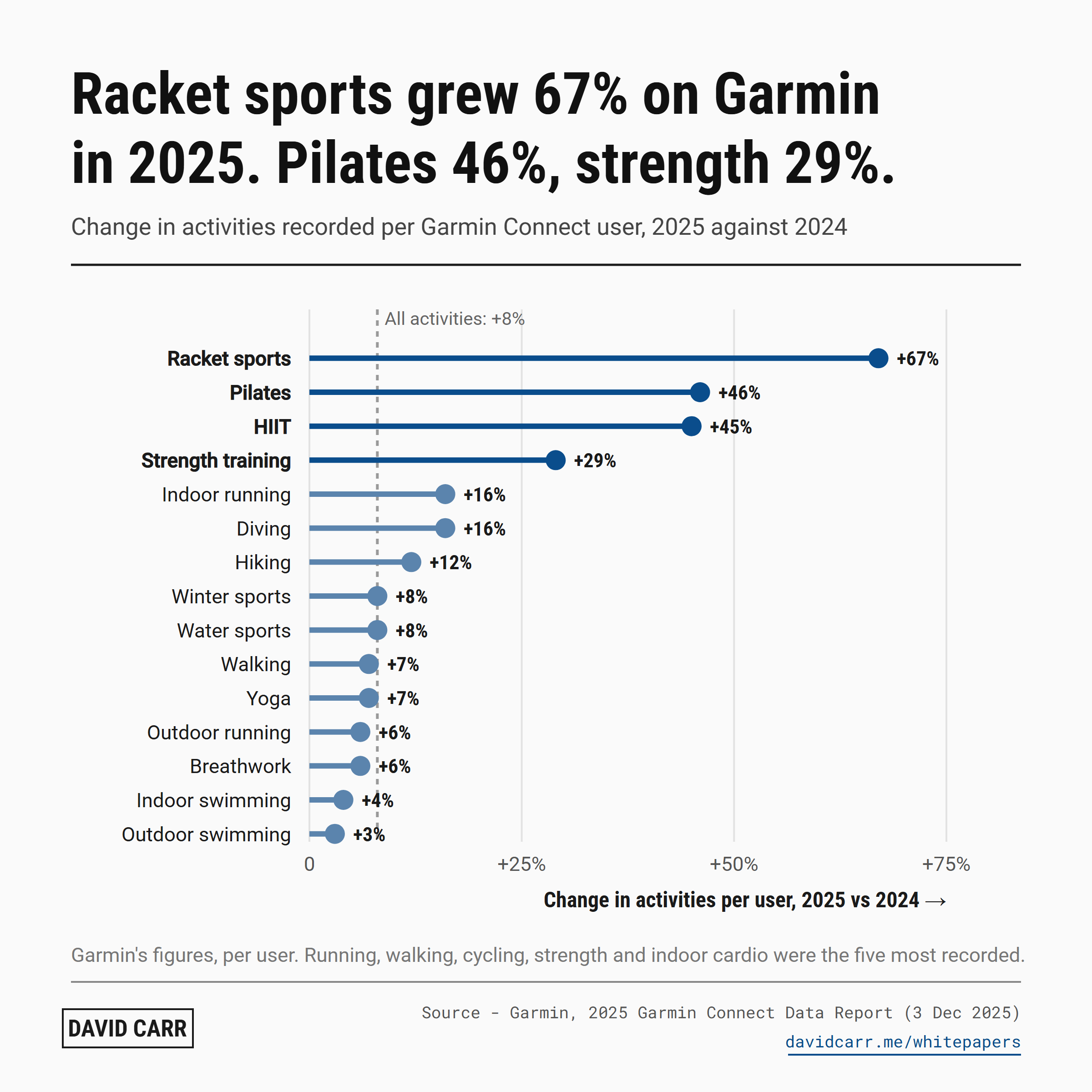
Racket sports grew 67% on Garmin in 2025. Pilates 46%, strength 29%.
- Racket sports: +67%
- Pilates: +46%
- HIIT: +45%
- Strength training: +29%
- Walking and yoga: +7% each
- Outdoor running: +6%
- All activities: +8%
Women logged 6% more strength sessions than men. Running, walking, cycling, strength and indoor cardio were the five most recorded.
From Garmin's 2025 Connect Data Report, 3 December 2025. Figures are per user, against 2024.
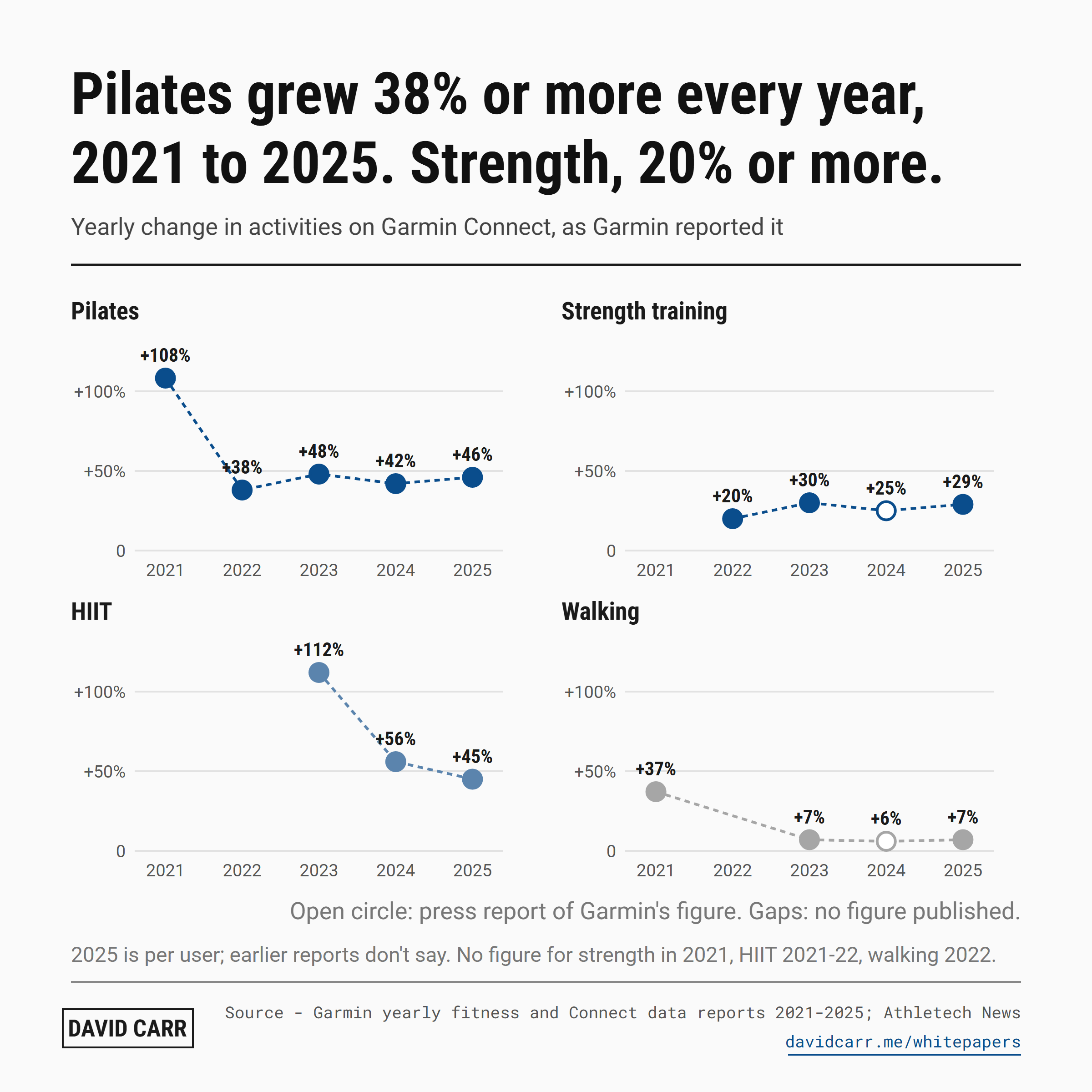
Pilates grew 38% or more every year, 2021 to 2025. Strength, 20% or more.
- Pilates: +108% (2021), +38% (2022), +48% (2023), +42% (2024), +46% (2025)
- Strength training: +20%, +30%, +25%, +29% (2022 to 2025)
- HIIT: +112%, +56%, +45% (2023 to 2025)
- Walking: +37% in 2021, then +6% to +7%
Garmin's 2025 report calls it the fourth year in a row strength training grew more than 20%.
Each figure from that year's Garmin report. The 2024 strength and walking figures are from Athletech News, reporting Garmin's release.
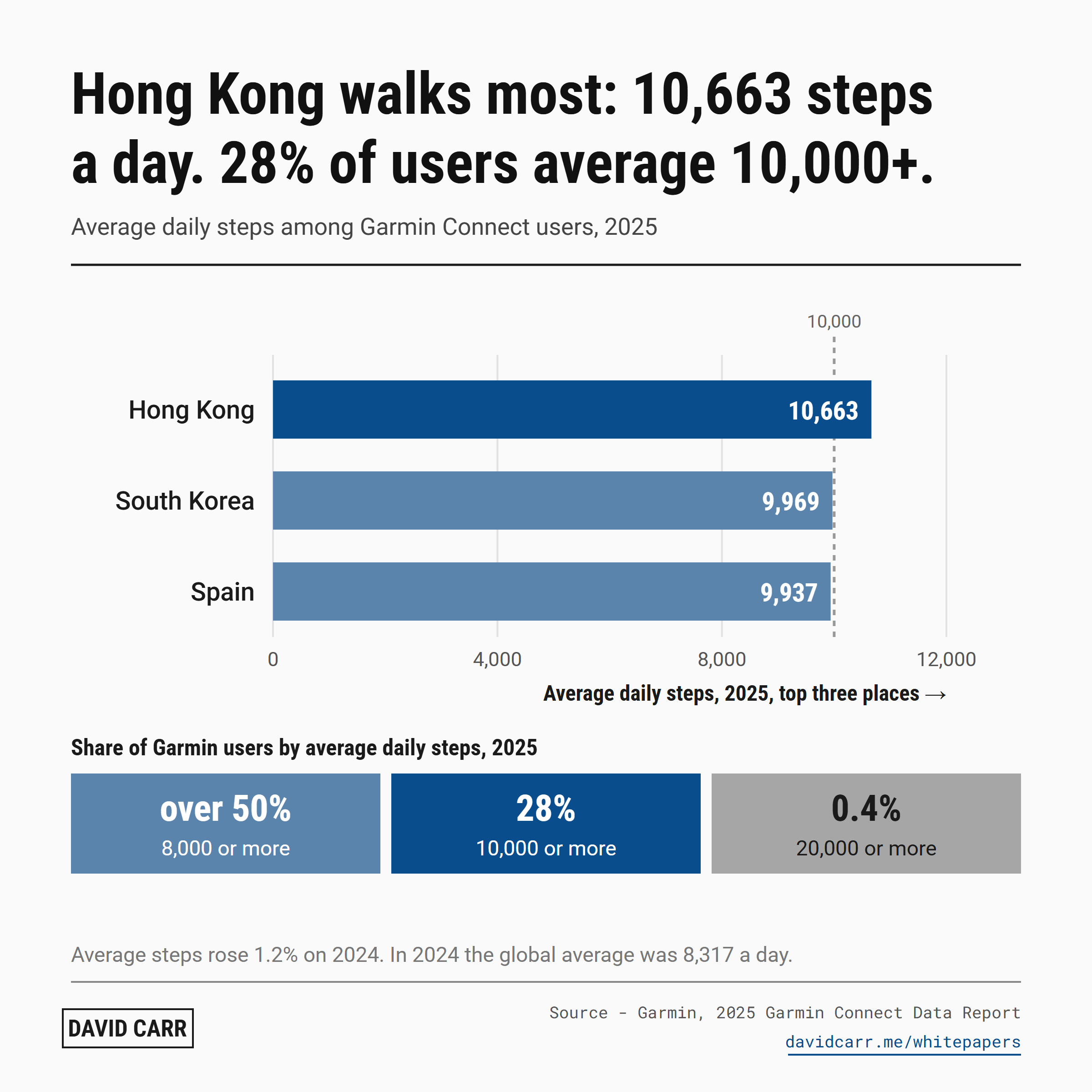
Hong Kong walks most: 10,663 steps a day. 28% of users average 10,000+.
- Hong Kong: 10,663 a day
- South Korea: 9,969
- Spain: 9,937
- Over half of users average 8,000 or more
- 0.4% average 20,000 or more
Average steps rose 1.2% on 2024. The 2024 report put the global average at 8,317 a day.
From Garmin's 2025 Connect Data Report, by where users are.
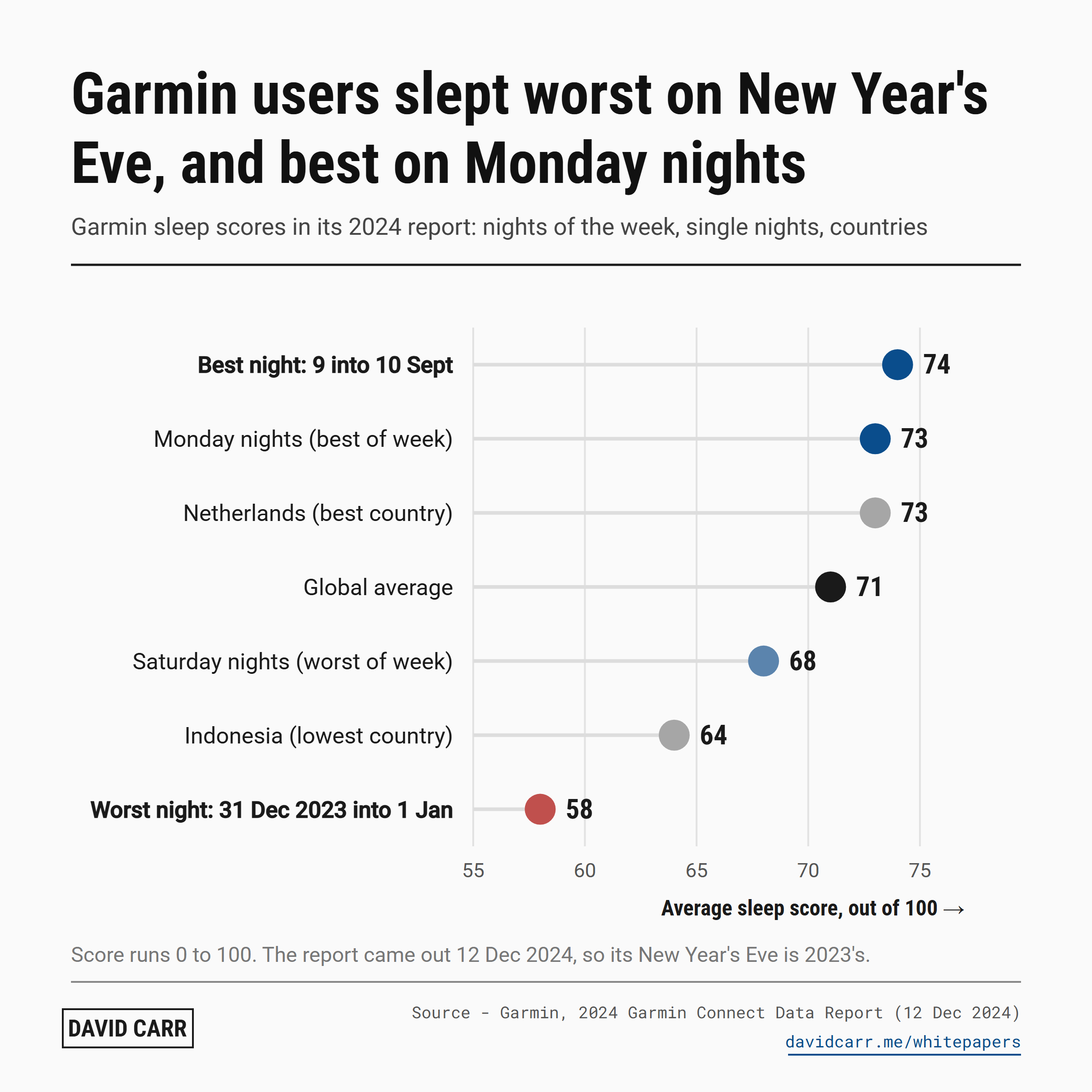
Garmin users slept worst on New Year's Eve, and best on Monday nights
- Global average sleep score: 71
- Monday into Tuesday: 73. Saturday into Sunday: 68
- Best night of 2024: 9 into 10 September, 74
- Worst: 31 December 2023 into 1 January 2024, 58
- Netherlands 73, the best country. Indonesia 64
In the 2025 report, the Netherlands had the lowest average stress, followed by Belgium, Portugal, Ireland and the UK.
Sleep from the 2024 Connect Data Report. The report came out on 12 December 2024, so the New Year’s Eve in it is 2023’s. The 2025 report gave no sleep figures.
Method, caveats and sources
The short answer. Garmin started in Kansas in 1989 making GPS for boats and planes. Car sat-navs made it big: in 2008 they and other mobile devices were 73% of its $3.5 billion of sales. That line then shrank, and watches and outdoor gear took over. In 2025 Garmin sold $7.2 billion, fitness was its biggest segment, and its users logged more strength training, Pilates and racket sports than the year before.
Filings. Sales, segments, units and operating income come from Garmin's annual 10-K filings on SEC EDGAR, fiscal 2004 to 2025, each year taken from the latest filing that covers it. Garmin has changed its segments several times: outdoor and fitness were one segment until 2010, some years were recast later, 2017 on uses the revenue standard adopted in 2018, and from 2023 Garmin's own car products sit in outdoor, leaving only sales to car makers in the auto line. Charts that cross those changes say so. Sales per device is worked out here, not reported by Garmin.
Garmin Connect reports. Garmin publishes a yearly summary of what its users recorded. The 2025 report says its figures are per user; earlier ones don't say. Garmin does not publish user counts or the size of each activity, only the change, so the charts show growth rates. Some years left out some activities; those gaps are left empty. The 2024 strength and walking figures come from a press report of Garmin's release, marked as such.
History. Founding details, the GPS 100, the US Army, the 1996 move and the StreetPilot date are from Wikipedia. First deliveries in 1991 are from Garmin's 2003 10-K; the Forerunner dates are from Garmin's own blog.
All sources read on 23 November 2026: 2025 10-K, 2008 10-K, 2025 Connect Data Report, 2024 report, 2023 report, Athletech News, Oura.
Also: Stripe and Strava.