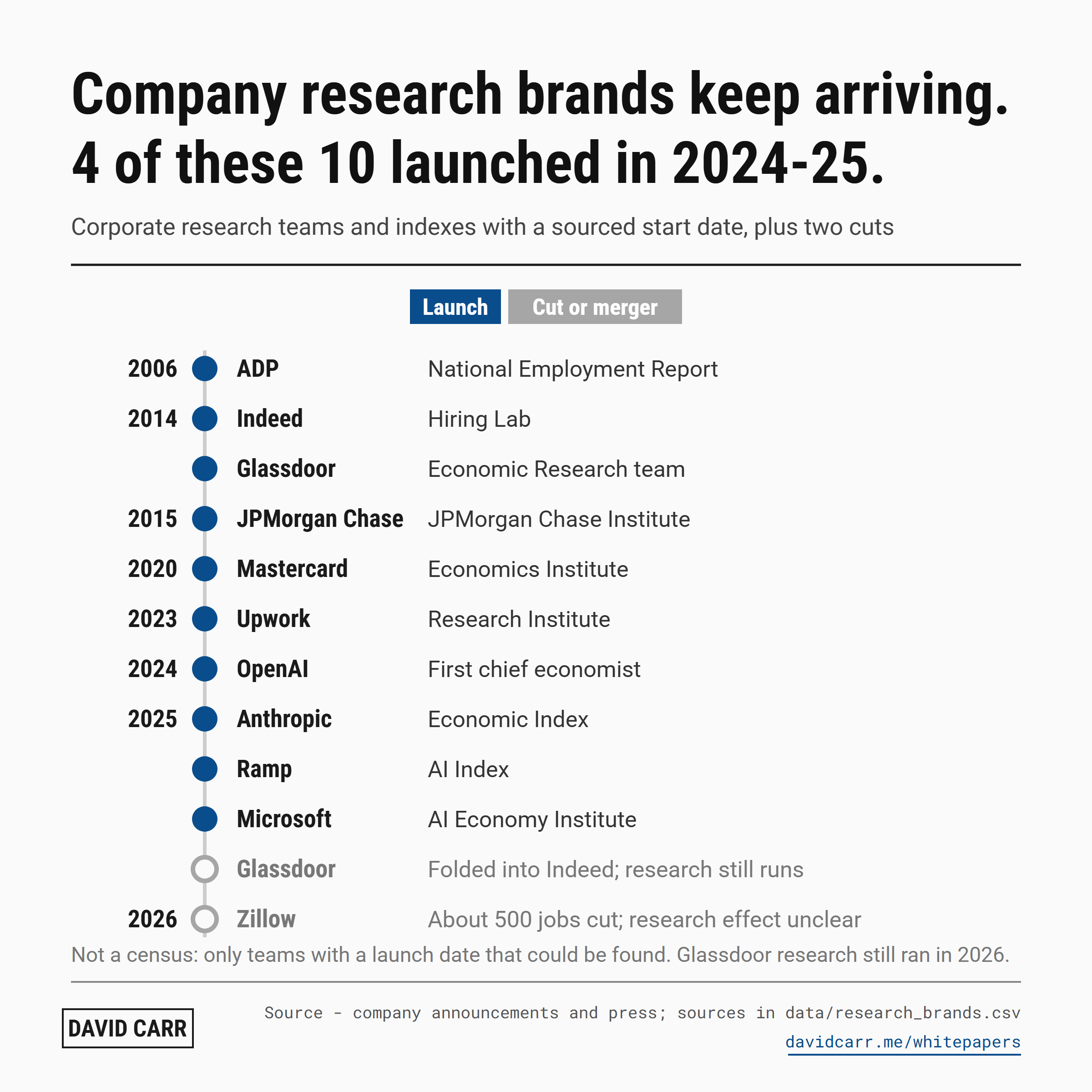
Company research brands keep arriving. 4 of these 10 launched in 2024-25.
Each wave comes from a new kind of company: a payroll firm first, then job sites and a bank, then a card network and a freelance marketplace, and now the AI labs themselves.
Only teams with a launch date that could be found. Gusto, Carta, Stripe, Shopify, Zillow Research and others publish too, but no start date was found. Glassdoor's research team was still publishing in 2026; what the Zillow cut meant for its research team is not confirmed.
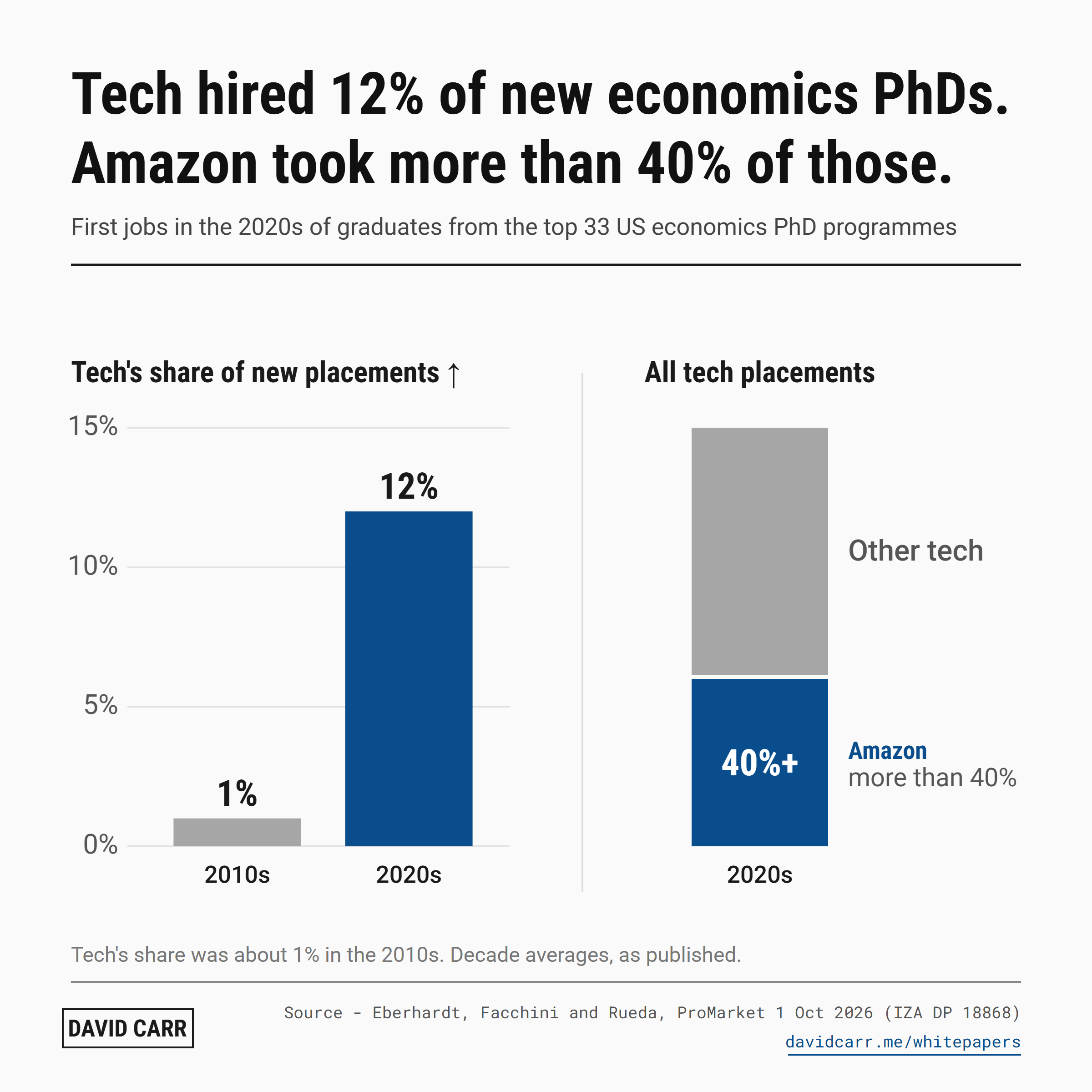
Tech hired 12% of new economics PhDs. Amazon took more than 40% of those.
- Tech's share of first jobs: about 1% in the 2010s, 12% in the 2020s
- Amazon: more than 40% of tech placements
- Graduates of the top 33 US economics PhD programmes since 1998
The biggest company employer of new economists is a retailer, and most of that work is internal: pricing, experiments, platform design. Public-facing research is a much smaller slice.
From Eberhardt, Facchini and Rueda in ProMarket, drawing on their IZA discussion paper 18868. Decade averages, as published.
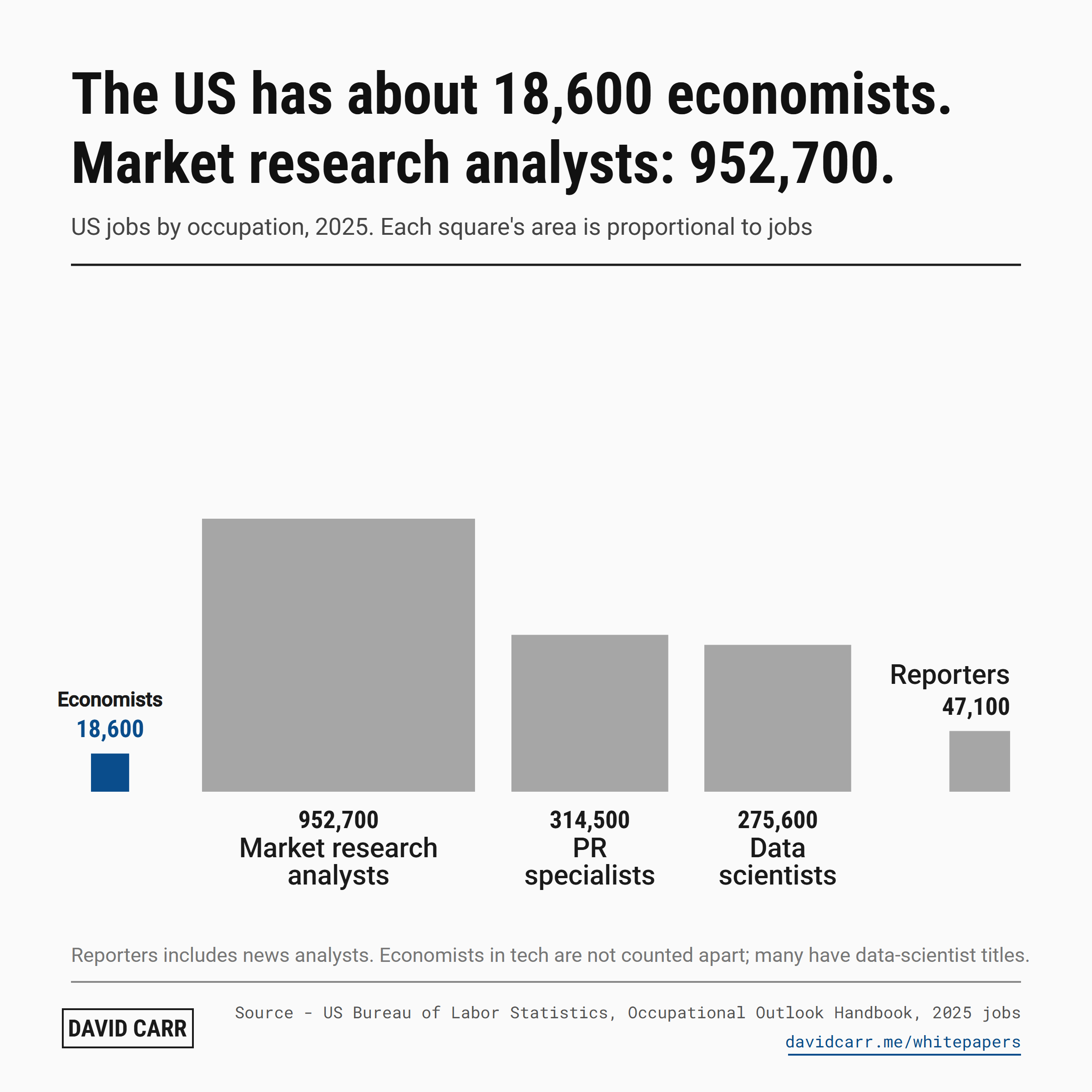
The US has about 18,600 economists. Market research analysts: 952,700.
Economists are a small occupation next to the people who do the day-to-day insights work. Market research analysts outnumber them about 51 to 1.
2025 jobs from the Bureau of Labor Statistics. There is no separate count for economists in tech; many sit under data-scientist or analyst titles, so the economist number understates the function.
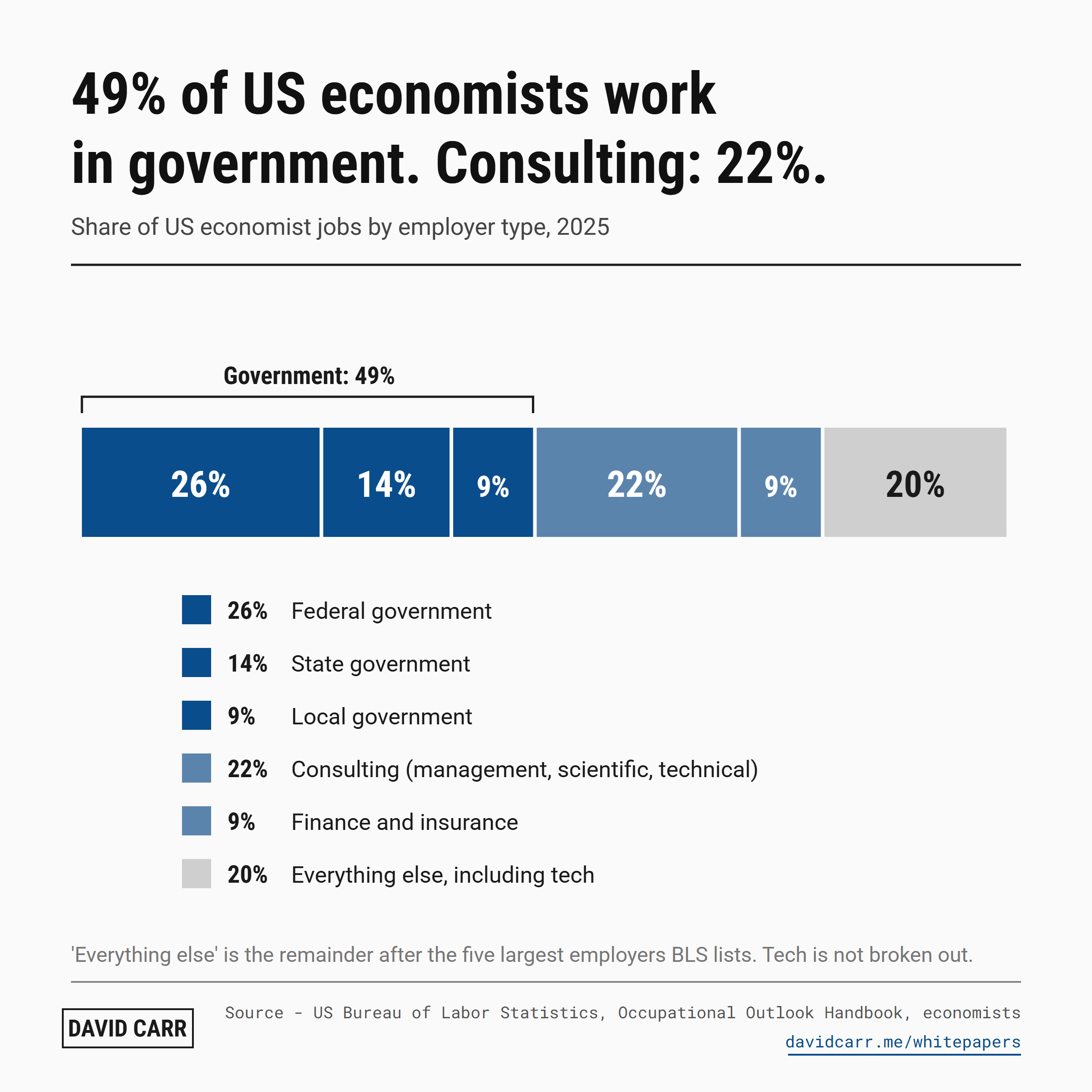
49% of US economists work in government. Consulting: 22%.
- Federal government: 26%
- State government: 14%
- Local government: 9%
- Management, scientific and technical consulting: 22%
- Finance and insurance: 9%
- Everything else: 20%
The company economist with a public research brand is a small part of a small field. Most economists work for government or consultancies.
From the BLS economists page. "Everything else" is 100% minus the five largest employers listed; tech is not broken out.
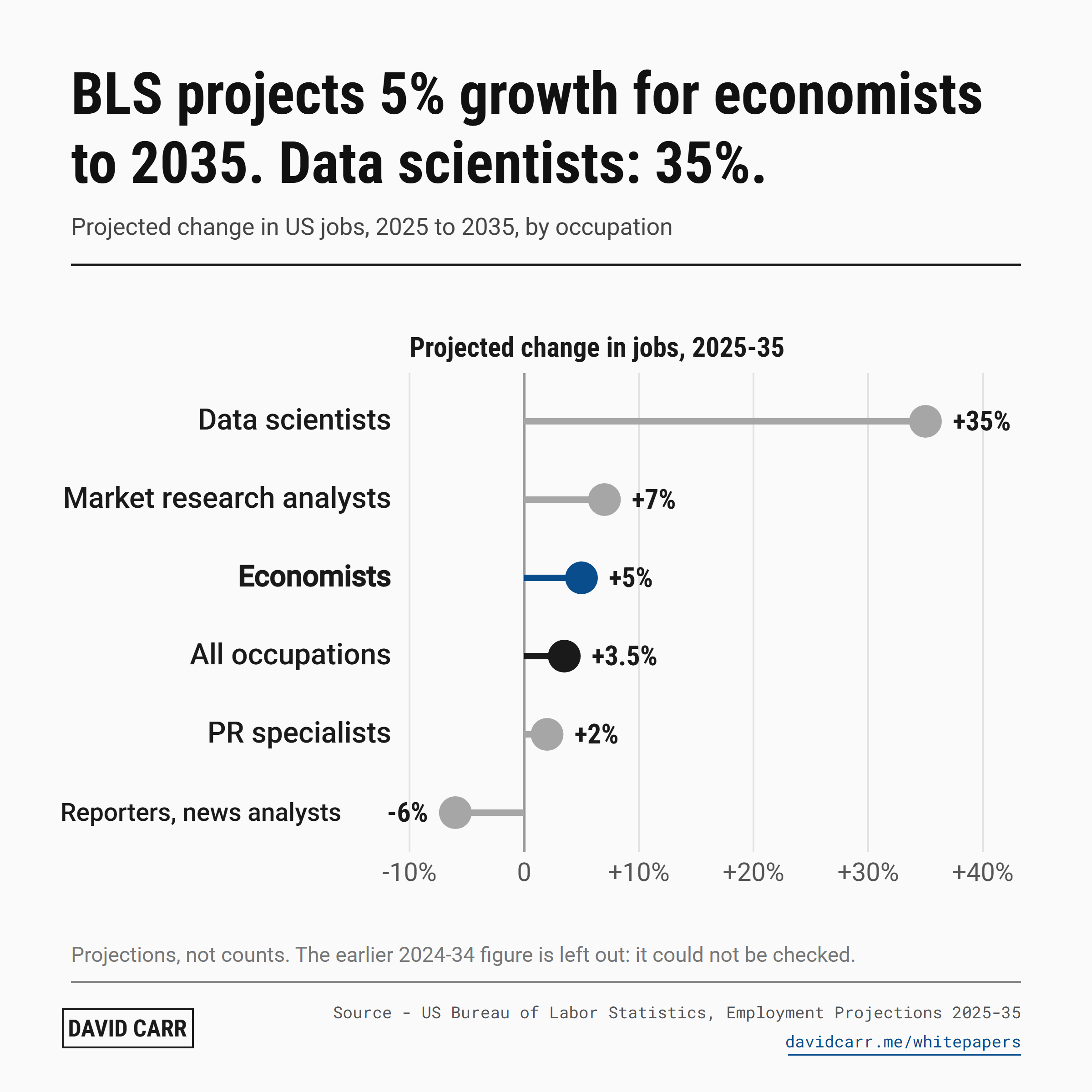
BLS projects 5% growth for economists to 2035. Data scientists: 35%.
- Data scientists: +35%
- Market research analysts: +7%
- Economists: +5%
- All occupations: +3.5%
- PR specialists: +2%
- Reporters and news analysts: -6%
Economists are projected to grow a little faster than the average job, from a small base: BLS expects about 1,100 openings a year.
Projections for 2025 to 2035. The earlier 2024-34 projection is left out: it could not be checked against the archived page, and the two editions are not a time series.
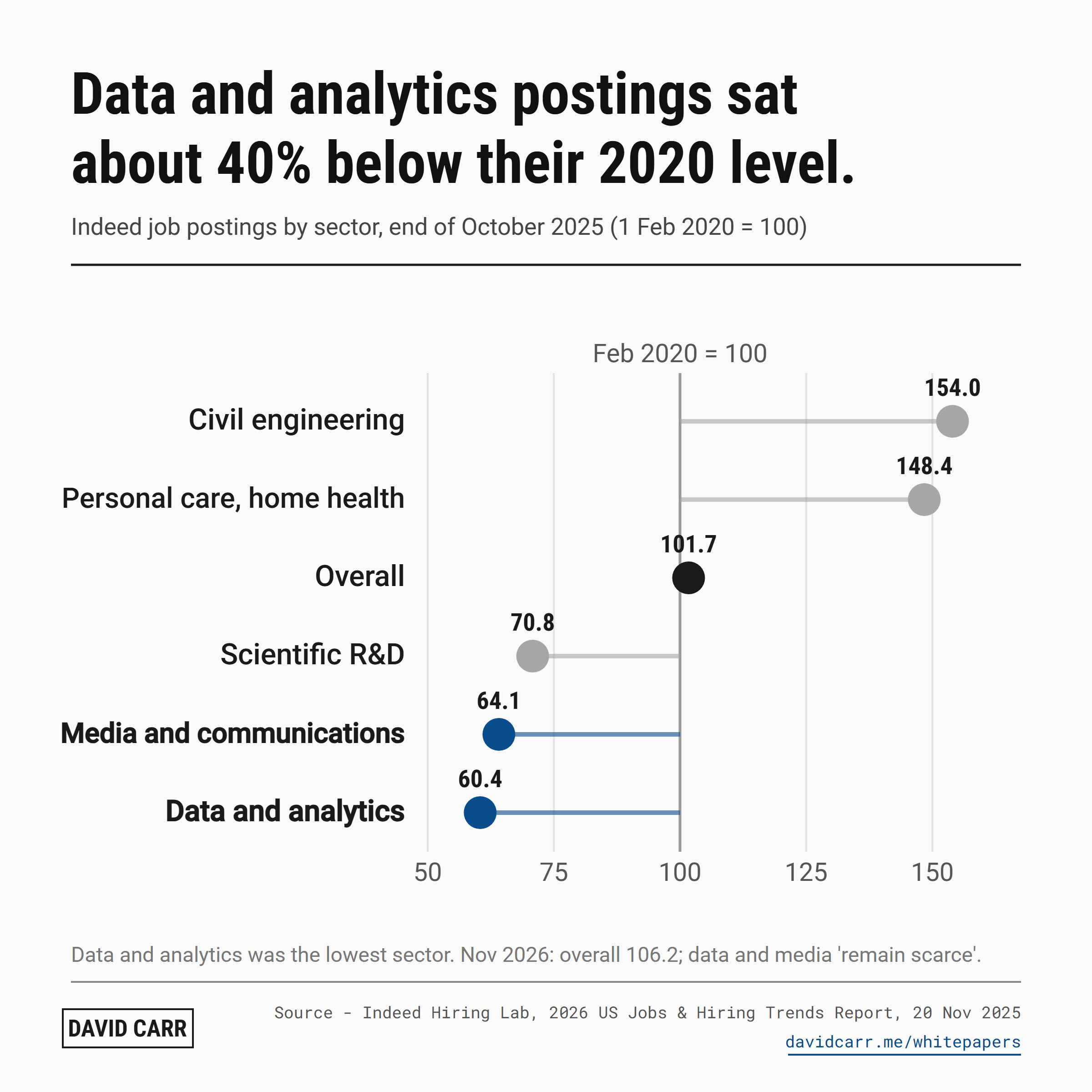
Data and analytics postings sat about 40% below their 2020 level.
- Civil engineering: 154.0
- Personal care and home health: 148.4
- Overall: 101.7
- Scientific research and development: 70.8
- Media and communications: 64.1
- Data and analytics: 60.4
Data and analytics had the lowest reading of any sector Indeed tracked at the end of October 2025, and media and communications was close behind. In November 2026 the overall index was 106.2 and Indeed said both "remain scarce relative to past levels", without a number.
From Indeed Hiring Lab, 20 Nov 2025. Indeed job postings, 1 Feb 2020 = 100. Postings are not jobs, and the sectors are Indeed's own groupings.
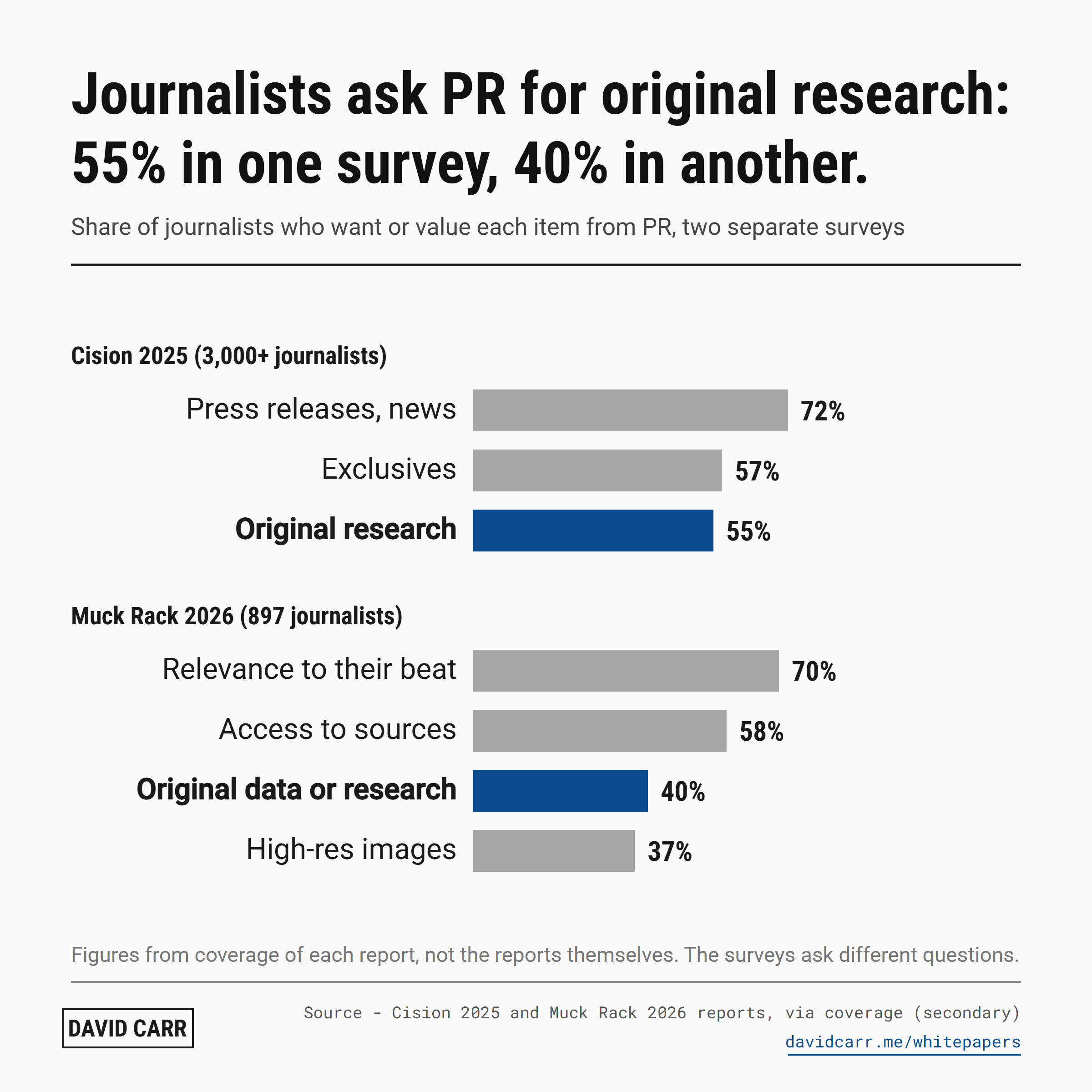
Journalists ask PR for original research: 55% in one survey, 40% in another.
- Cision 2025: press releases 72%, exclusives 57%, original research 55%
- Muck Rack 2026: relevance 70%, access to sources 58%, original data or research 40%, images 37%
This is the marketing case for a company research team. A fresh number gives a reporter a story, and the company's name goes with it.
Both figures come from coverage of each report, not the reports themselves. The surveys ask different questions, so 55% and 40% are not a trend. Cision says 2025 was the first year exclusives beat original research.
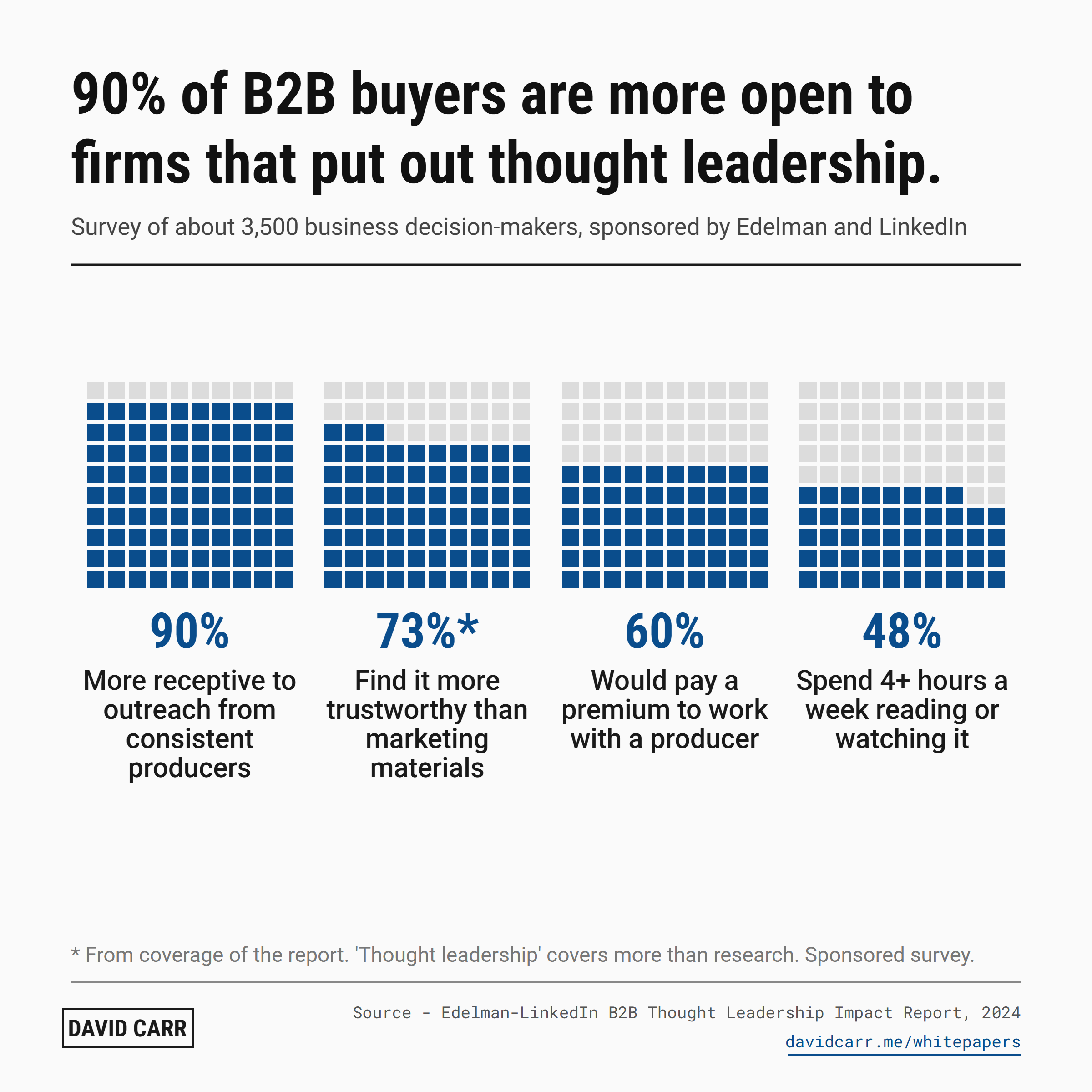
90% of B2B buyers are more open to firms that put out thought leadership.
- More receptive to outreach from consistent producers: 90%
- More trustworthy than marketing materials: 73% (from coverage)
- Would pay a premium to work with a producer: 60%
- Spend 4+ hours a week on it: 48%
Buyers say they read this material and trust it more than ads. That is the commercial reason companies keep paying for research teams.
From the Edelman-LinkedIn 2024 report, about 3,500 respondents. A sponsored survey, and "thought leadership" covers more than research.
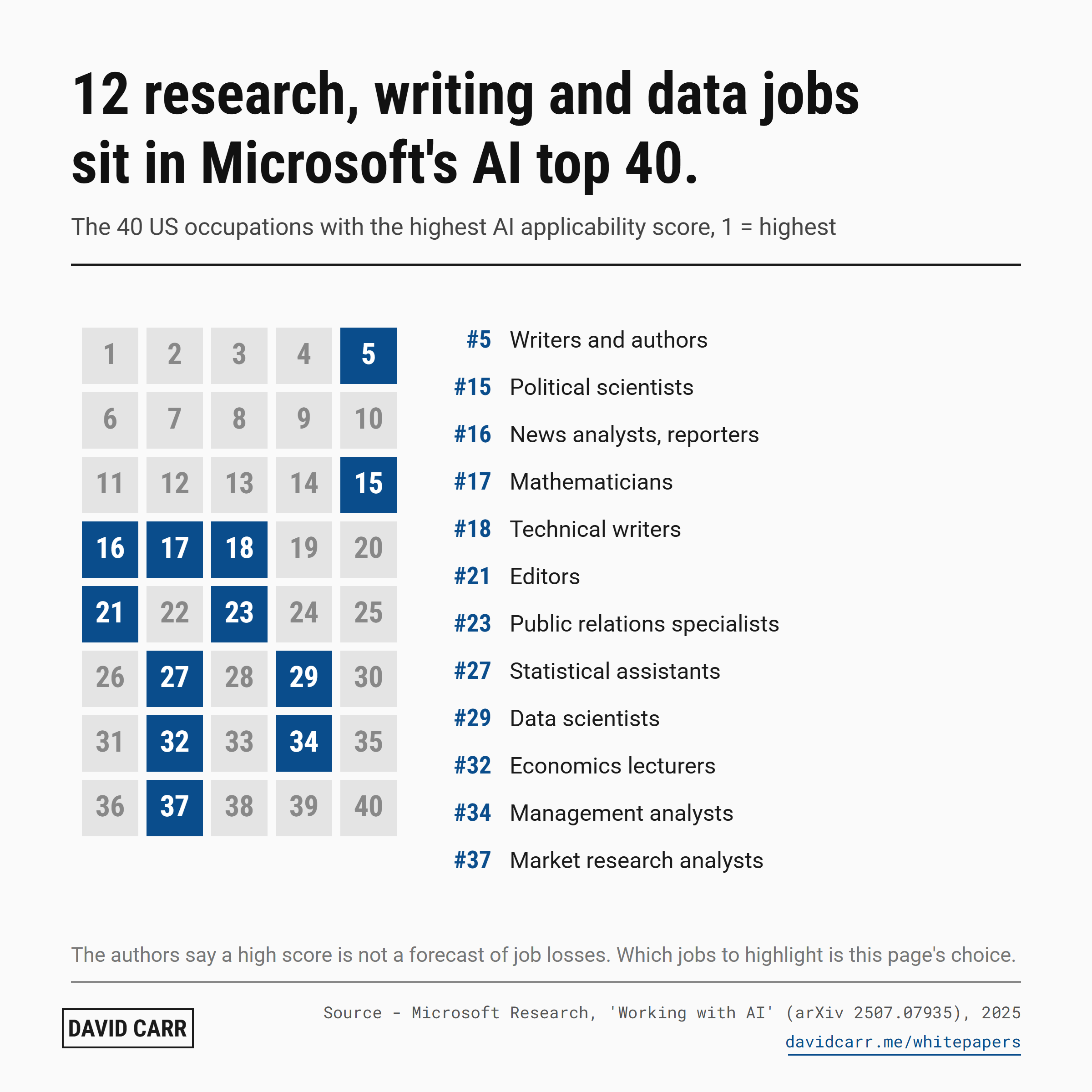
12 research, writing and data jobs sit in Microsoft's AI top 40.
- #5 Writers and authors
- #15 Political scientists, #16 News analysts and reporters, #17 Mathematicians
- #18 Technical writers, #21 Editors, #23 PR specialists
- #27 Statistical assistants, #29 Data scientists
- #32 Economics lecturers, #34 Management analysts, #37 Market research analysts
Writing, analysis and explaining sit at the centre of research and storytelling work, and the jobs built on them score high for AI applicability.
From Microsoft Research's "Working with AI" (2025). The authors say a high score is not a forecast of job losses. Which jobs to highlight is this page's choice.
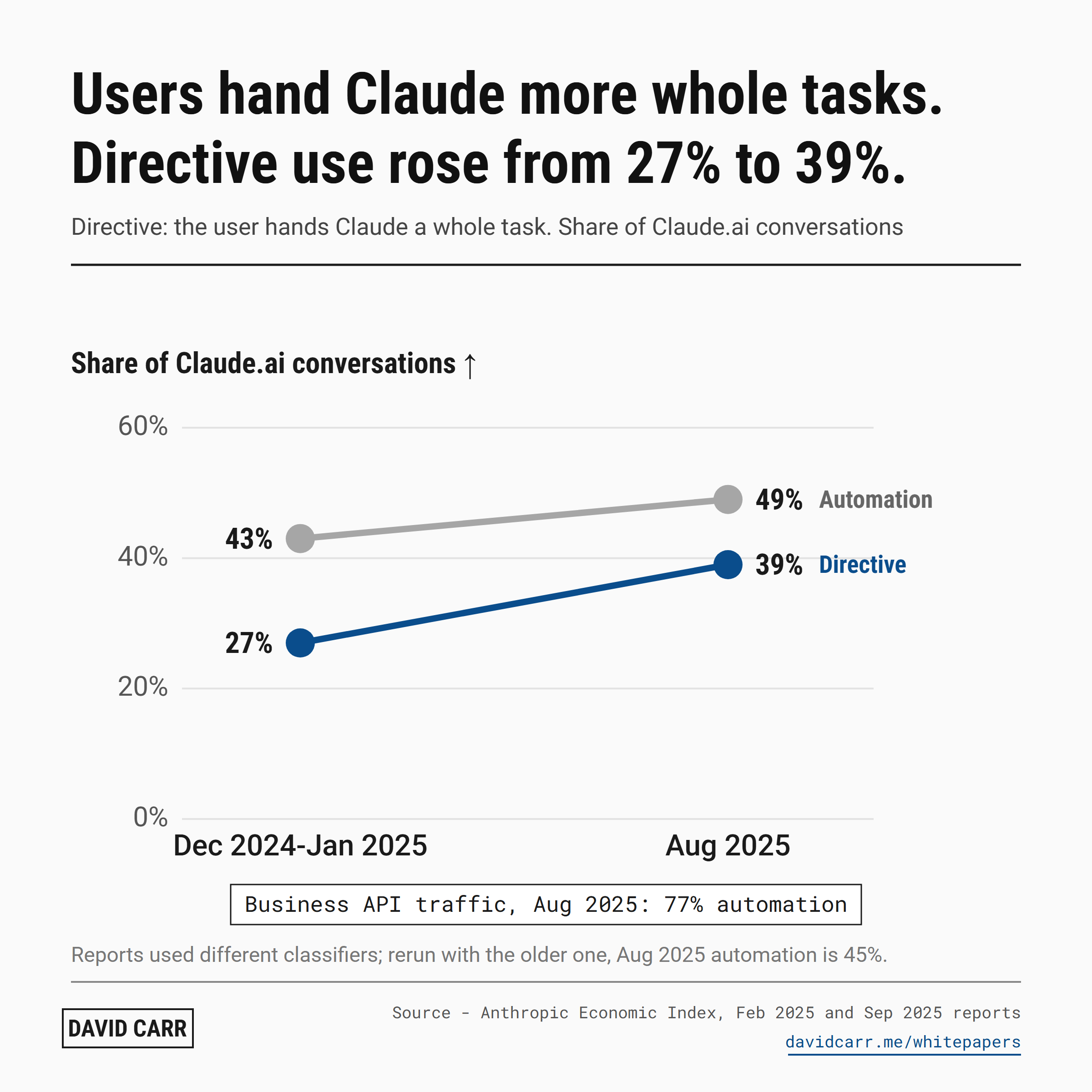
Users hand Claude more whole tasks. Directive use rose from 27% to 39%.
- Directive conversations: 27% (Dec 2024-Jan 2025) to 39% (Aug 2025)
- Automation: 43% at launch, 49% in Aug 2025
- Business API traffic, Aug 2025: 77% automation, 12% augmentation
AI cuts both ways here. It takes on more of the work, and the labs now hire economists and publish their own usage data, the same playbook as Indeed or Mastercard.
From the Anthropic Economic Index launch and September 2025 report. Different classifiers were used; rerun with the older one, August 2025 automation is 45%. Directive means the user hands over a whole task.
Method, caveats and sources
The short answer. Companies keep starting public research teams: four of the ten launches found here came in 2024 and 2025, led by AI labs. The marketing case holds up: journalists ask for original research and B2B buyers say they trust it. But the work is small and exposed. There are about 18,600 US economists, nearly half in government. Data and media job postings were among the weakest Indeed tracked, companies known for their research have cut jobs or merged, and writing and analysis jobs rank high for AI applicability. A small, prestige-driven function that keeps being reinvented by new kinds of company is a fairer description than a growing job market.
Where the numbers come from. Official occupation counts and projections (US Bureau of Labor Statistics), Indeed Hiring Lab, a ProMarket summary of an IZA paper on economics PhD placements, Microsoft Research, the Anthropic Economic Index, and three industry surveys (Cision, Muck Rack, Edelman-LinkedIn). Launch dates come from each company's own announcement or press coverage. Every source is listed in the data files.
Caveats. No source counts company economist or head-of-insights roles directly, and there is no count of companies with a chief economist. The economist count misses economists in tech who hold data-scientist titles. The three surveys are run or sponsored by firms that sell PR or marketing services, and several figures come from coverage rather than the reports; they are marked. Anthropic's reports use different classifiers over time, so levels shift. The two BLS projection editions are not compared: one is not a time series, and the older figure could not be checked.
Left out. Figures that could not be confirmed: a reported Zillow research-team cut that rests on one social post, a "storyteller" job-title trend another firm could not reproduce, and tech's share of private-sector economics PhD entrants by year.
Also: The insights economy, by the numbers, What people really use AI for and Who is hiring, and for what.