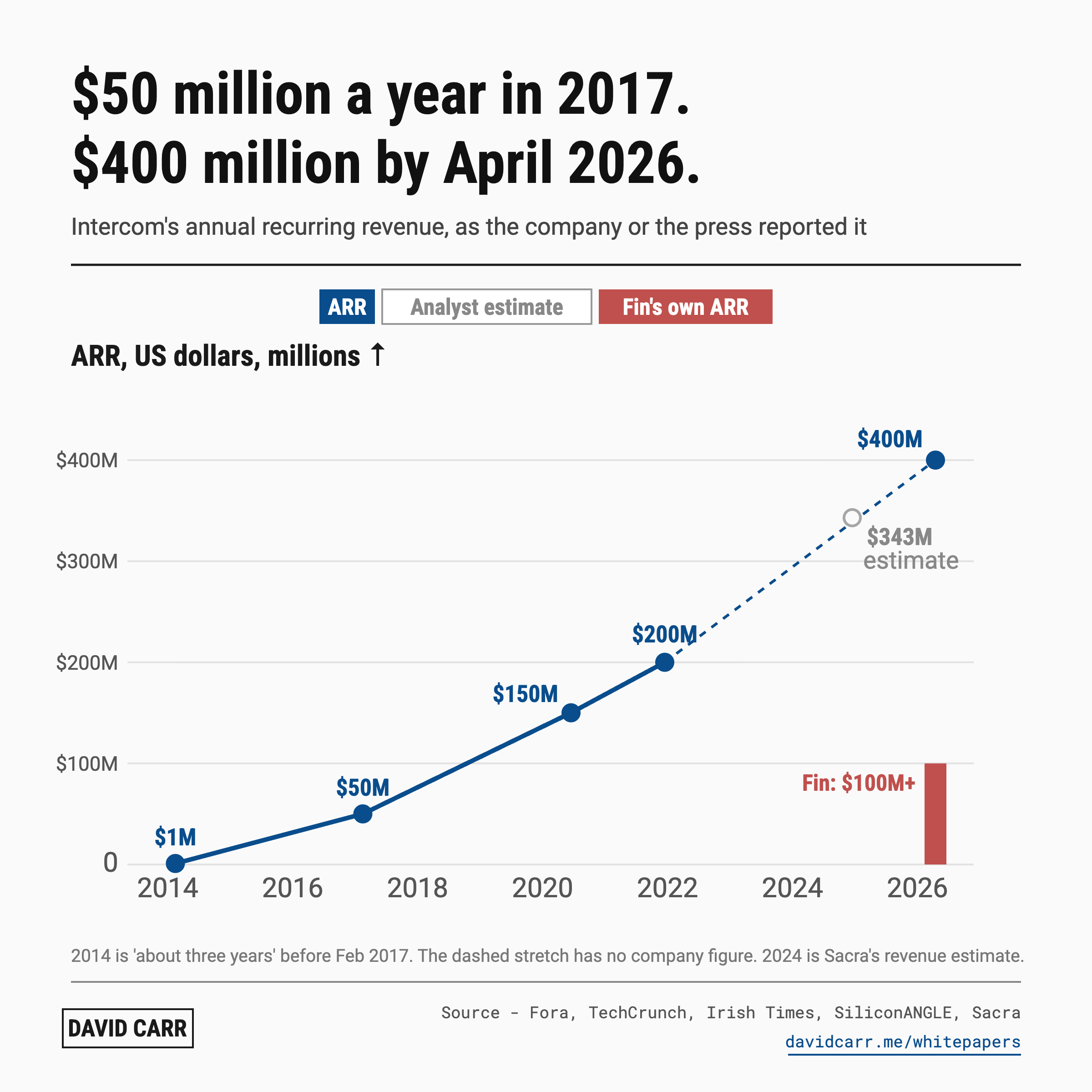
$50 million a year in 2017. $400 million by April 2026.
- About 2014: $1 million (Fora)
- February 2017: $50 million
- June 2020: $150 million (TechCrunch)
- December 2021: past $200 million (Irish Times)
- April 2026: $400 million, of which Fin more than $100 million (SiliconANGLE)
Intercom went from $1 million to $200 million in about eight years. The next $200 million took over four. Fin, its AI agent, made up a quarter of the April 2026 figure.
Between 2021 and 2026 Intercom gave no figure. The 2024 point is an estimate of revenue by Sacra, an analyst firm, not a company number.
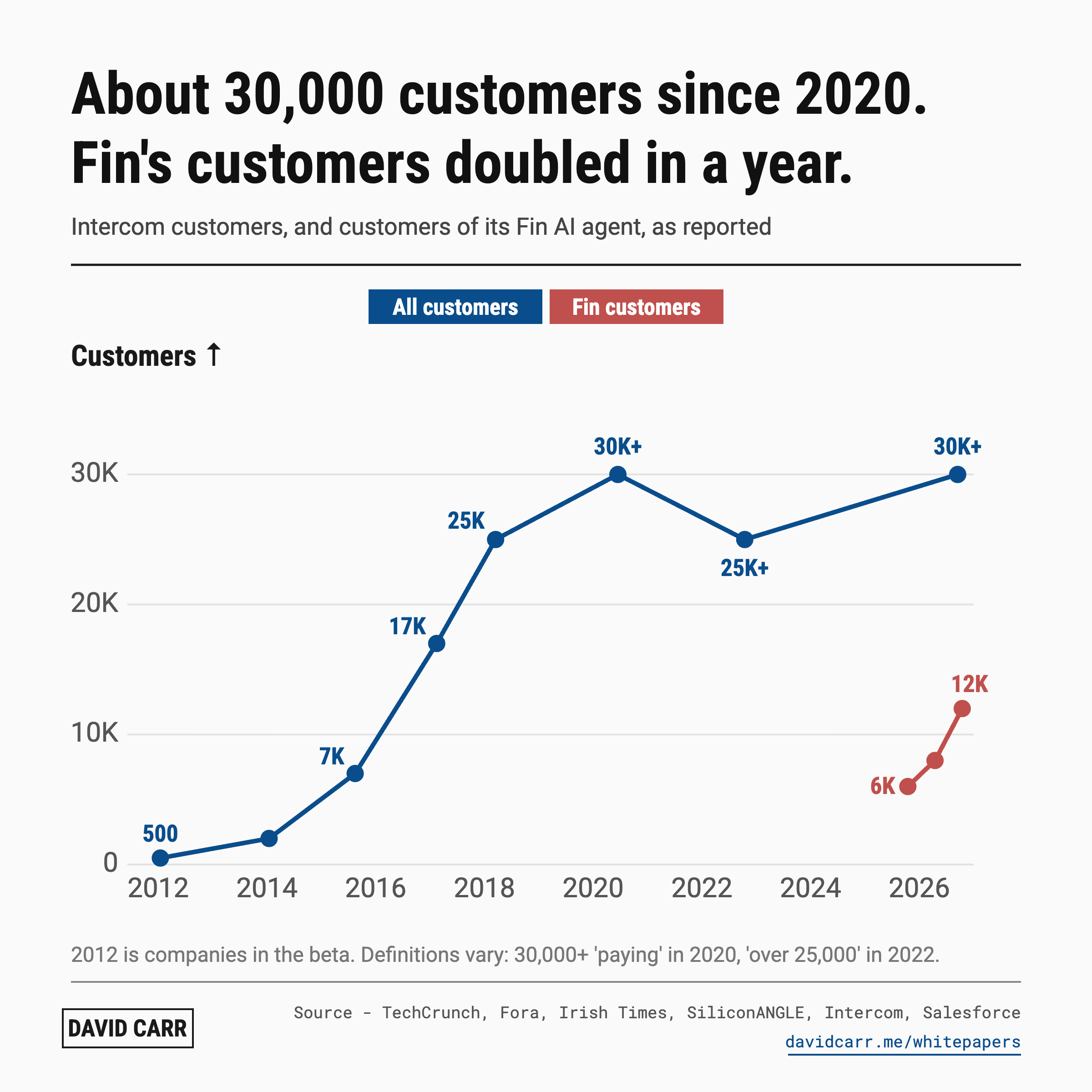
About 30,000 customers since 2020. Fin's customers doubled in a year.
The customer count has hardly moved in six years. With customer numbers flat, the rise in revenue came from each customer paying more.
Definitions vary by source. TechCrunch gave "over 25,000" in 2022, after the Irish Times had 30,000+ in 2020.
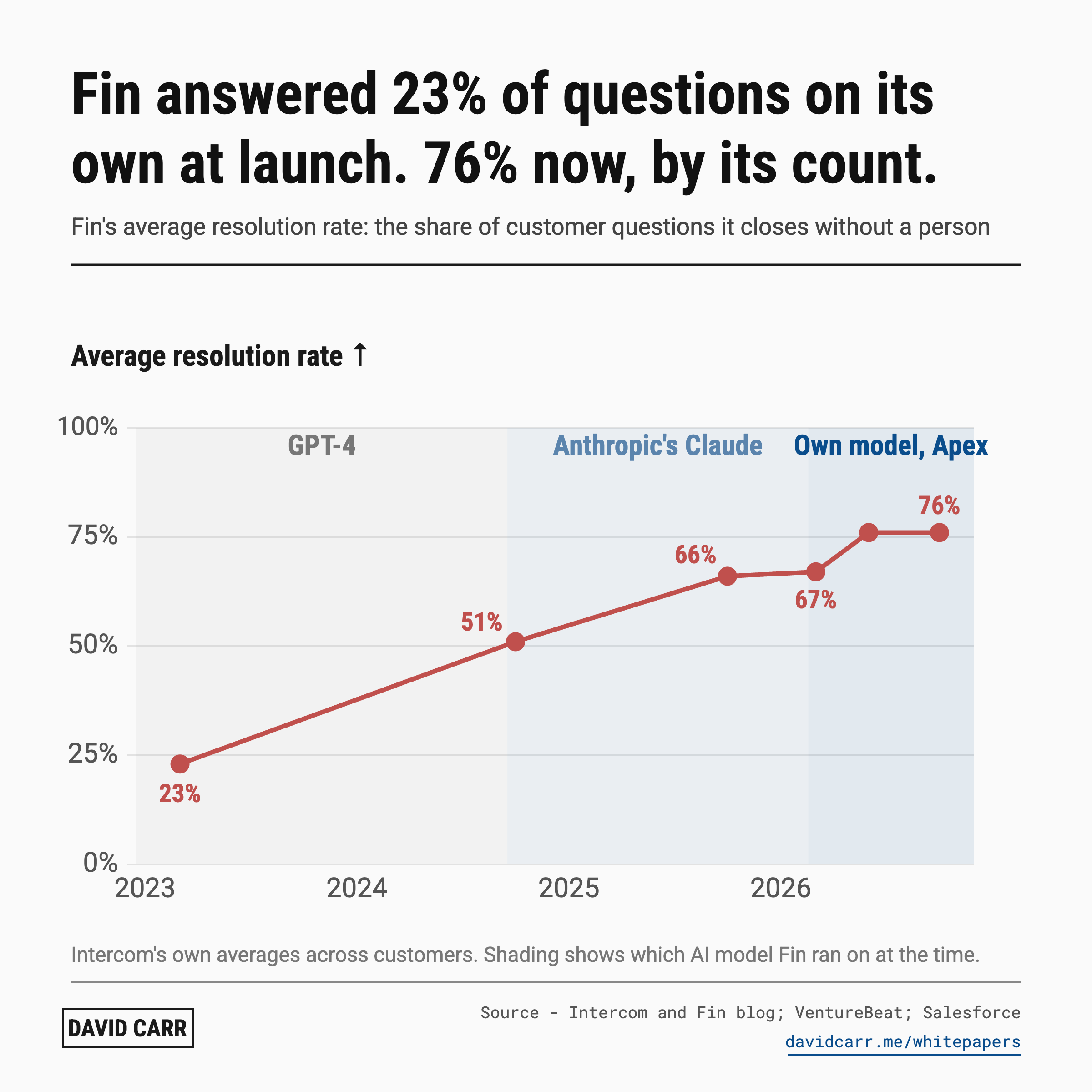
Fin answered 23% of questions on its own at launch. 76% now, by its count.
Fin is charged per answer, not per seat: $0.99 per outcome. So each point of resolution rate is money. Apex 2.0, launched in October 2026, is built on NVIDIA's Nemotron open models.
These are Intercom's averages across its customers. A 'resolution' is its own measure: the customer did not ask for a person.
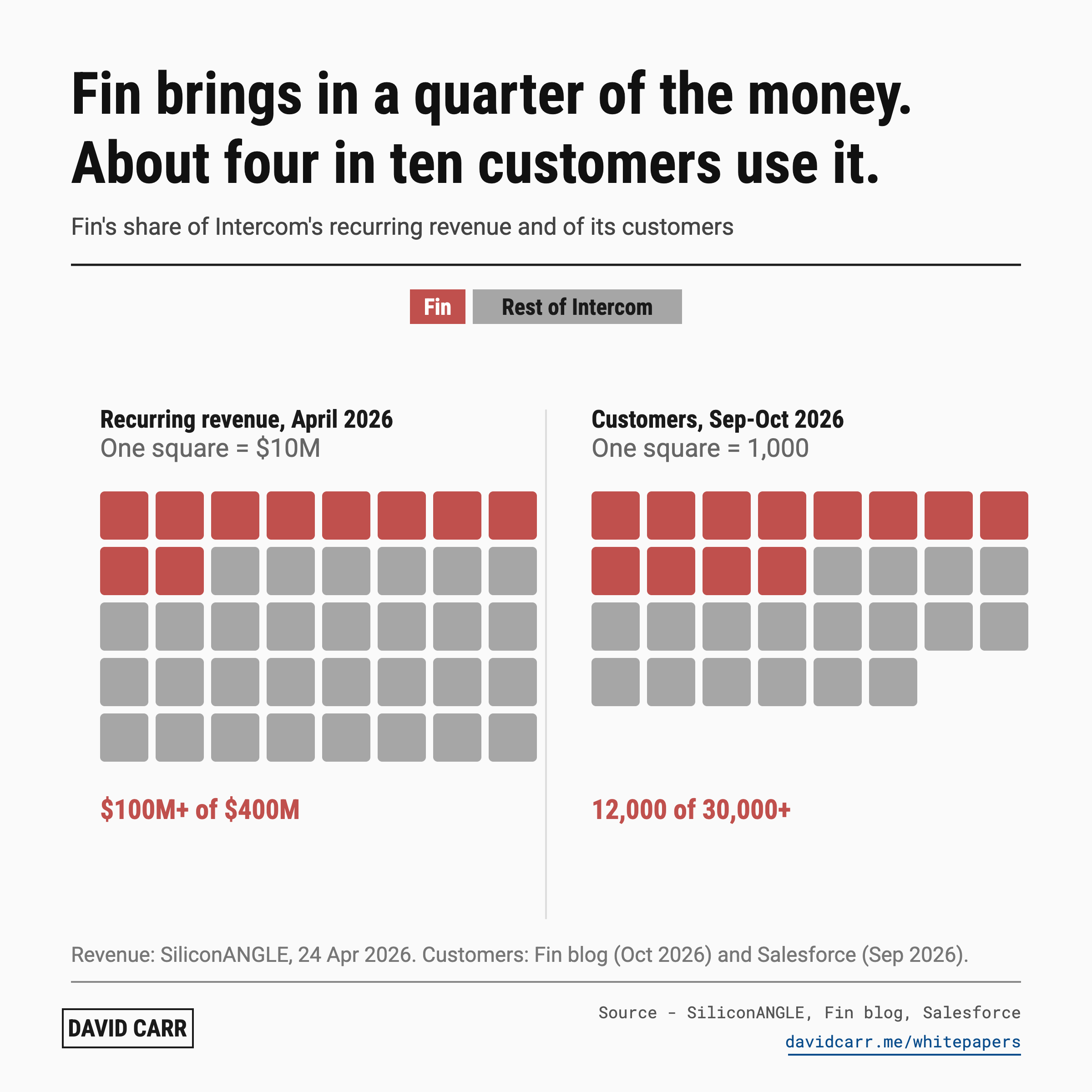
Fin brings in a quarter of the money. About four in ten customers use it.
- April 2026: Fin past $100 million of a $400 million business (SiliconANGLE)
- October 2026: 12,000 Fin customers (Fin)
- September 2026: more than 30,000 customers in all (Salesforce)
- Fin growth: '3.5x' (VentureBeat, March 2026)
In May 2026 the company renamed itself after the product. "Intercom will live on as our customer service software platform, but Fin is our future," Eoghan McCabe wrote.
The two panels are a month or more apart. The revenue split is the company's, as reported; it did not give Fin's exact figure.
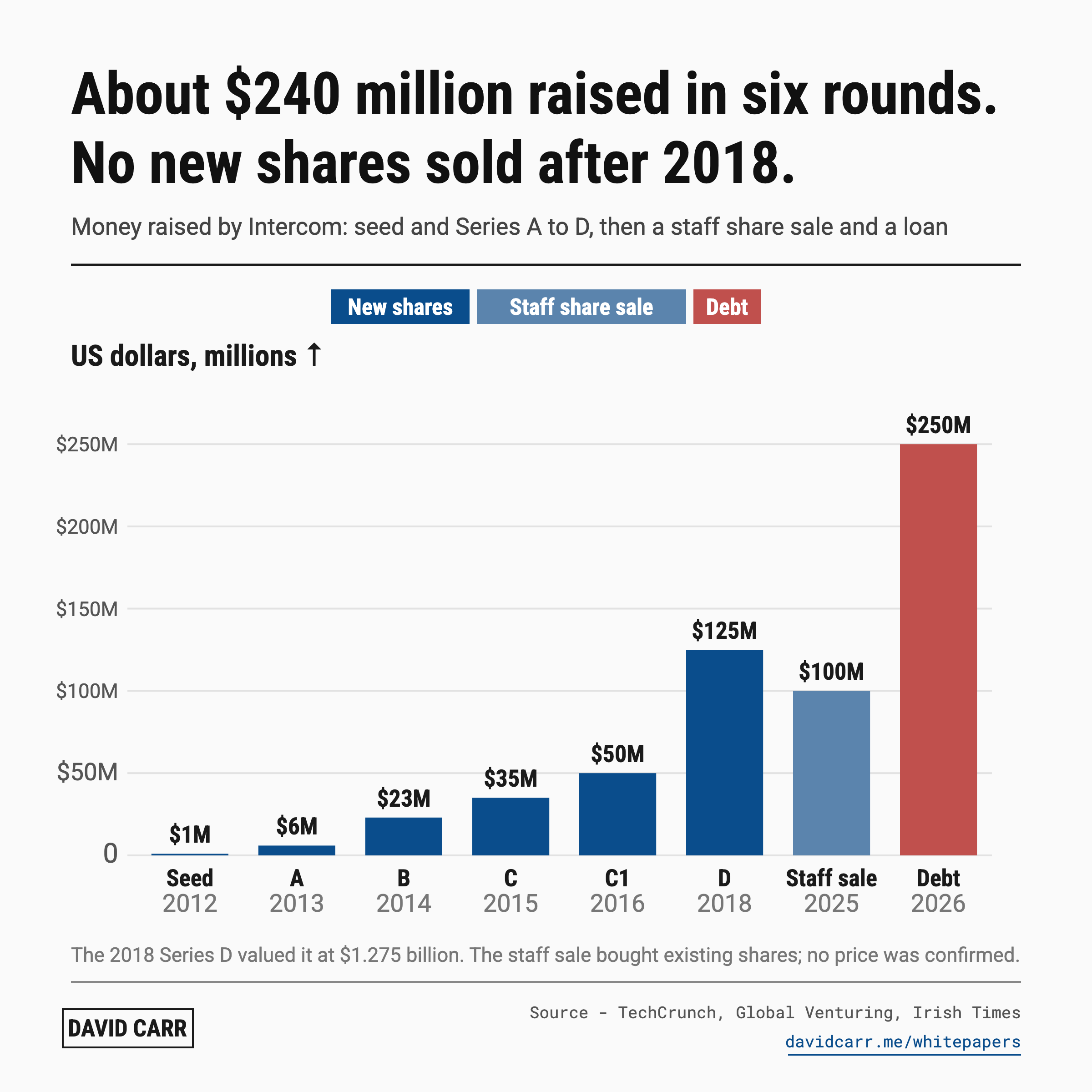
About $240 million raised in six rounds. No new shares sold after 2018.
- 2012: $1 million seed
- 2014: $23 million, led by Bessemer
- 2018: $125 million, led by Kleiner Perkins, at a $1.275 billion valuation (TechCrunch)
- 2025: $100 million for staff to sell shares (Irish Times)
- March 2026: $250 million of debt from Hercules Capital (Irish Times)
Intercom borrowed rather than sell new shares to pay for Fin. Three months after the loan, Salesforce agreed to buy it.
TechCrunch put total equity at $241 million in 2018. Reports of a price for the 2025 staff sale were never confirmed, so none is shown.
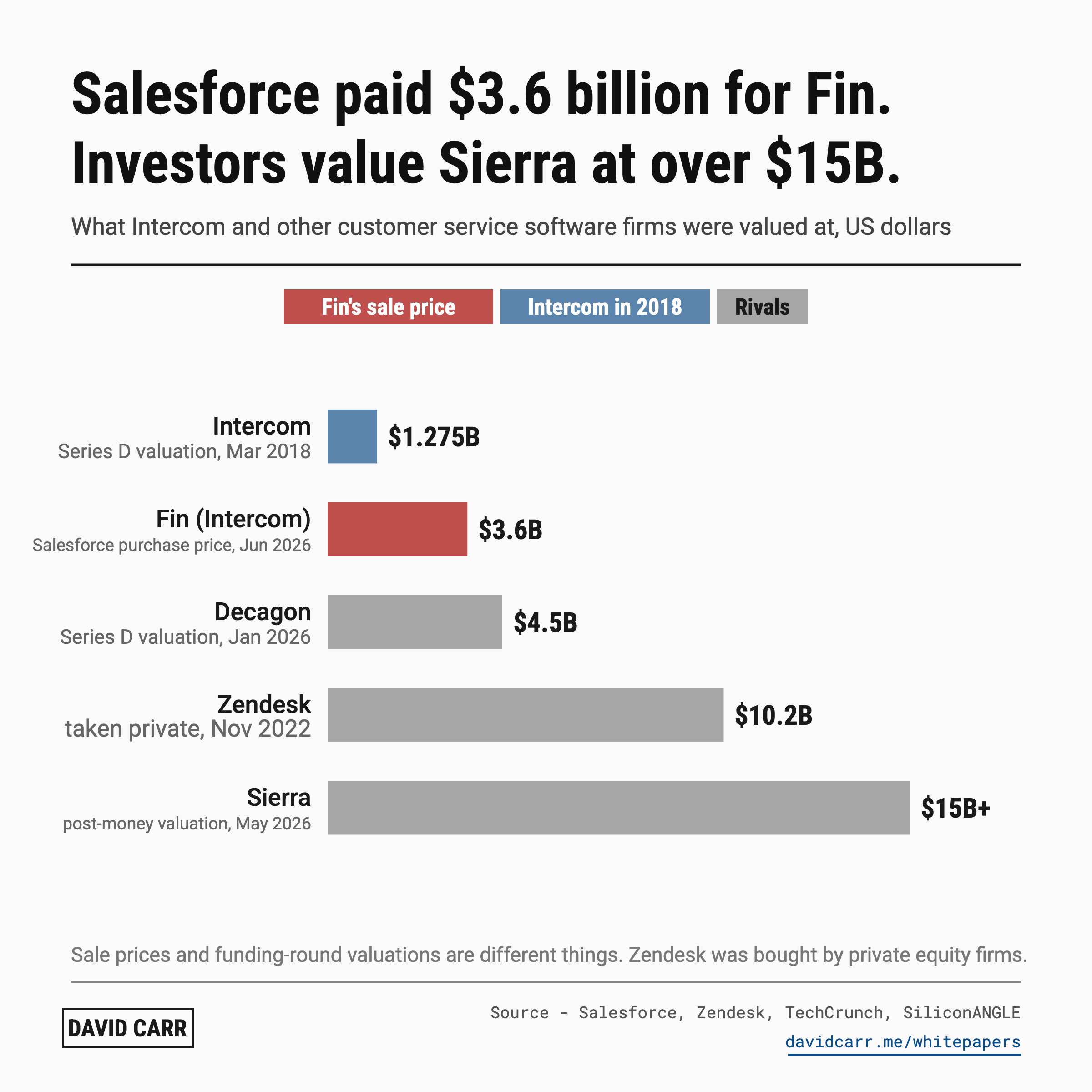
Salesforce paid $3.6 billion for Fin. Investors value Sierra at over $15B.
- Intercom, 2018: $1.275 billion
- Fin, 2026: about $3.6 billion from Salesforce
- Decagon, January 2026: $4.5 billion (SiliconANGLE)
- Zendesk, 2022: about $10.2 billion, taken private (Zendesk)
- Sierra, May 2026: over $15 billion (TechCrunch)
The Irish Examiner called it Ireland's biggest-ever tech sale. The deal closed on 10 September 2026, earlier than first planned. McCabe stays on as Fin's chief executive, inside Salesforce's AI Labs.
A sale price and a funding-round valuation are not the same thing: buyers pay for control, investors for a slice. Treat the comparison as rough.
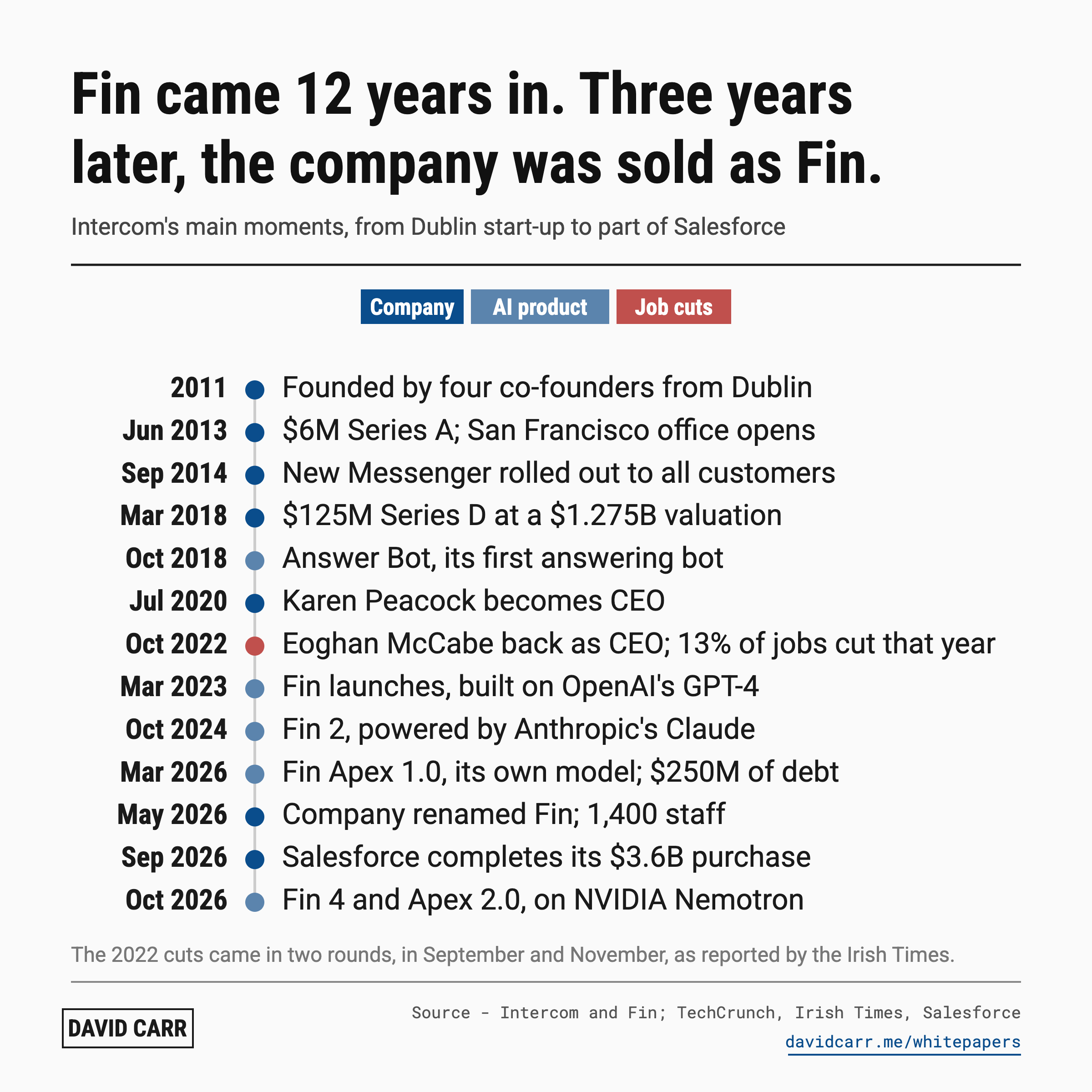
Fin came 12 years in. Three years later, the company was sold as Fin.
- 2011: founded by Eoghan McCabe, Des Traynor, Ciaran Lee and David Barrett
- 2013: San Francisco office opens
- 2020: Karen Peacock becomes chief executive
- 2022: McCabe returns; two rounds of cuts take 13% of jobs (Irish Times)
- 2023 to 2026: Fin, Fin 2, Apex, the rename, the sale
McCabe came back weeks before ChatGPT launched. Intercom says it then committed over $100 million to AI. Fin launched less than four months after ChatGPT.
Dates are when each was announced. Fin's own timeline is on its about page.
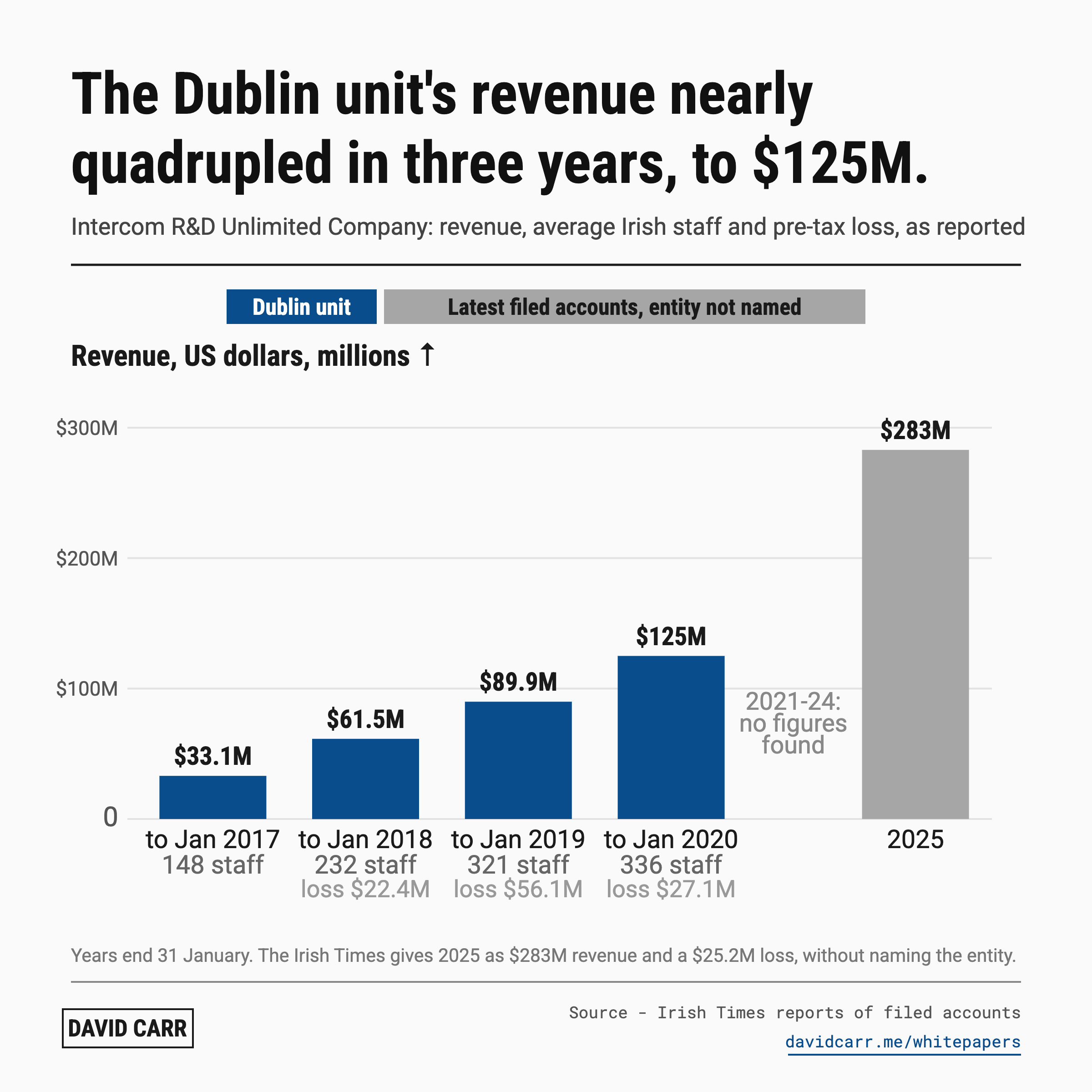
The Dublin unit's revenue nearly quadrupled in three years, to $125M.
- Year to Jan 2017: $33.1 million, 148 staff (Irish Times)
- Year to Jan 2018: $61.5 million, 232 staff
- Year to Jan 2019: $89.9 million, loss of $56.1 million (Irish Times)
- Year to Jan 2020: $125 million, 336 staff (Irish Times)
- 2025: $283 million revenue, $25.2 million loss (Irish Times, entity not named)
Dublin is home to Intercom's research and development unit. It had 228 staff in 2018 and more than 400 by 2021. A new R&D hub opened in Berlin in January 2026.
From the Irish Times's reports of accounts filed in Ireland. No revenue figures were found for 2021 to 2024, except the Irish Examiner's €246 million for 2024.
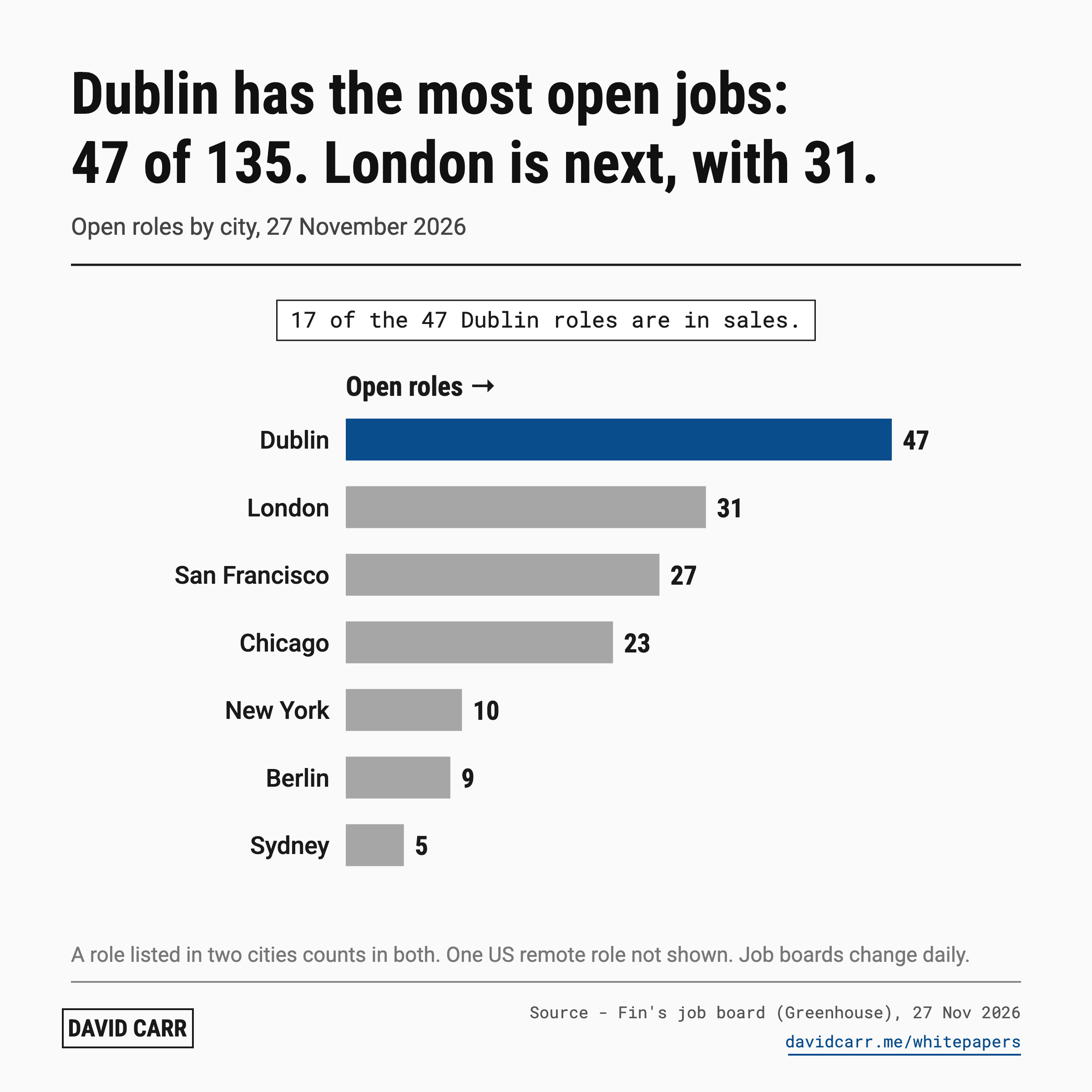
Dublin has the most open jobs: 47 of 135. London is next, with 31.
- Dublin: 47
- London: 31
- San Francisco: 27
- Chicago: 23
- New York: 10
- Berlin: 9
17 of the Dublin roles are in sales and 11 are in the AI group or R&D. Dublin has 20 more open roles than San Francisco, the head office.
Fin's job board (Greenhouse, still under the name intercom), 27 November 2026. A role listed in two cities counts in both.
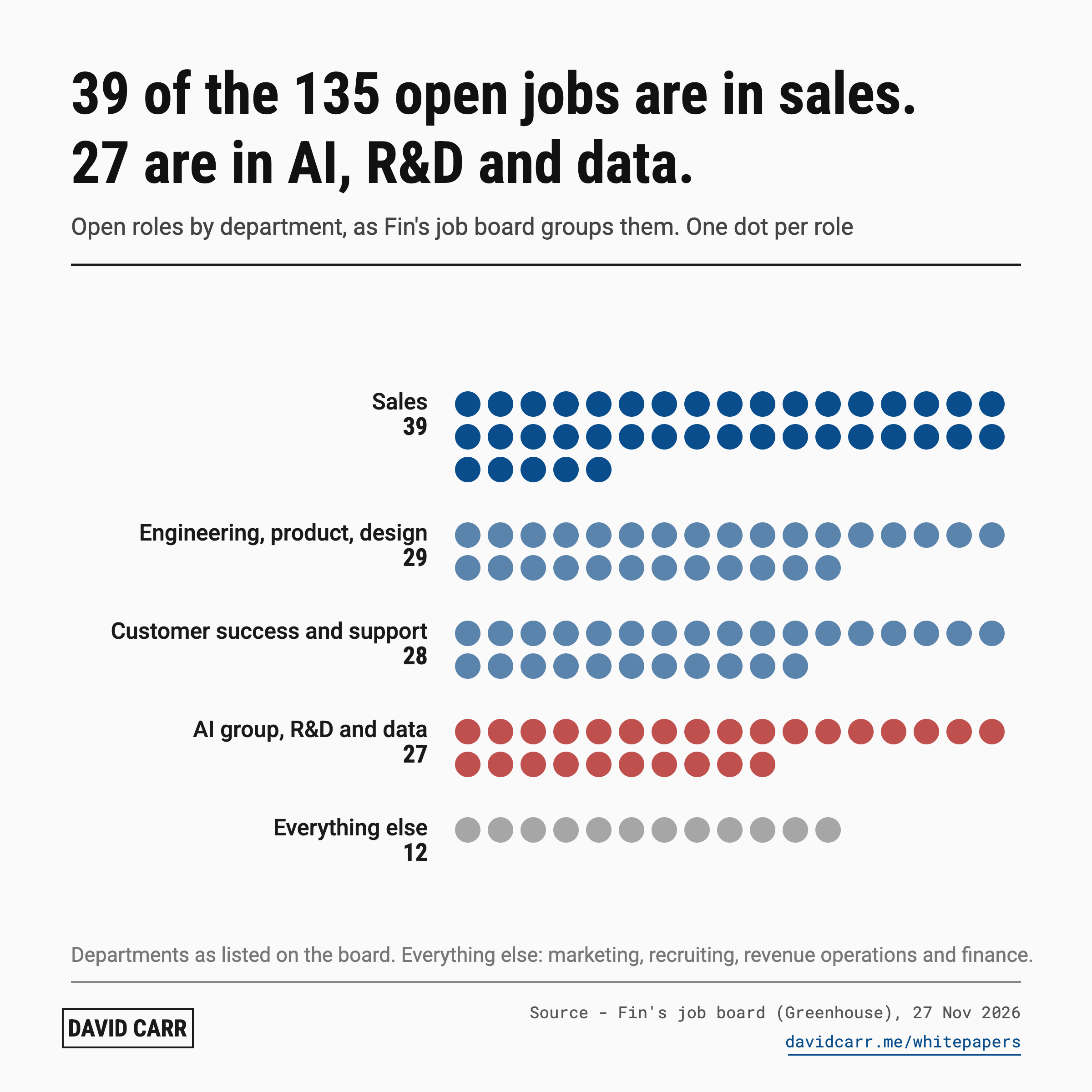
39 of the 135 open jobs are in sales. 27 are in AI, R&D and data.
- Sales: 39
- Engineering, product and design: 29
- Customer success and support: 28
- AI group, R&D and data: 27
- Everything else: 12
Fin still needs people to sell it and help customers set it up: 67 roles are in sales, customer success or support. 56, about four in ten, build the product.
Departments as the job board groups them.
Method, caveats and sources
The short answer. Intercom was started in 2011 by four founders from Dublin and is now based in San Francisco. It grew to about $200 million of recurring revenue by 2021, then grew more slowly. Fin, the AI agent it launched in 2023, now resolves most of the questions it handles, by Intercom's count, and brought in more than $100 million a year of a $400 million business by April 2026. The company renamed itself Fin in May 2026 and Salesforce bought it for about $3.6 billion in September.
Private company. Intercom published no full accounts. Revenue and customer figures are its own, or press reports quoting it. The 2024 revenue figure is an analyst estimate and is marked so. Fin's resolution rates are Intercom's own averages.
AI models. Fin launched on OpenAI's GPT-4 and moved to Anthropic's Claude for Fin 2, as Intercom itself announced. Since March 2026 it runs on Intercom's own Apex models; Fin says Apex 2.0 is built on NVIDIA's Nemotron.
Irish accounts. Intercom R&D Unlimited Company, the Dublin unit, files accounts in Ireland. The figures here are from Irish Times reports of those accounts; the filings themselves were not used.
Jobs. Every open role on the company's Greenhouse board, which feeds fin.ai/careers, on 27 November 2026, using its own departments. A role listed in two cities counts in both for the city chart.
Also: Anthropic, Notion and Canva.