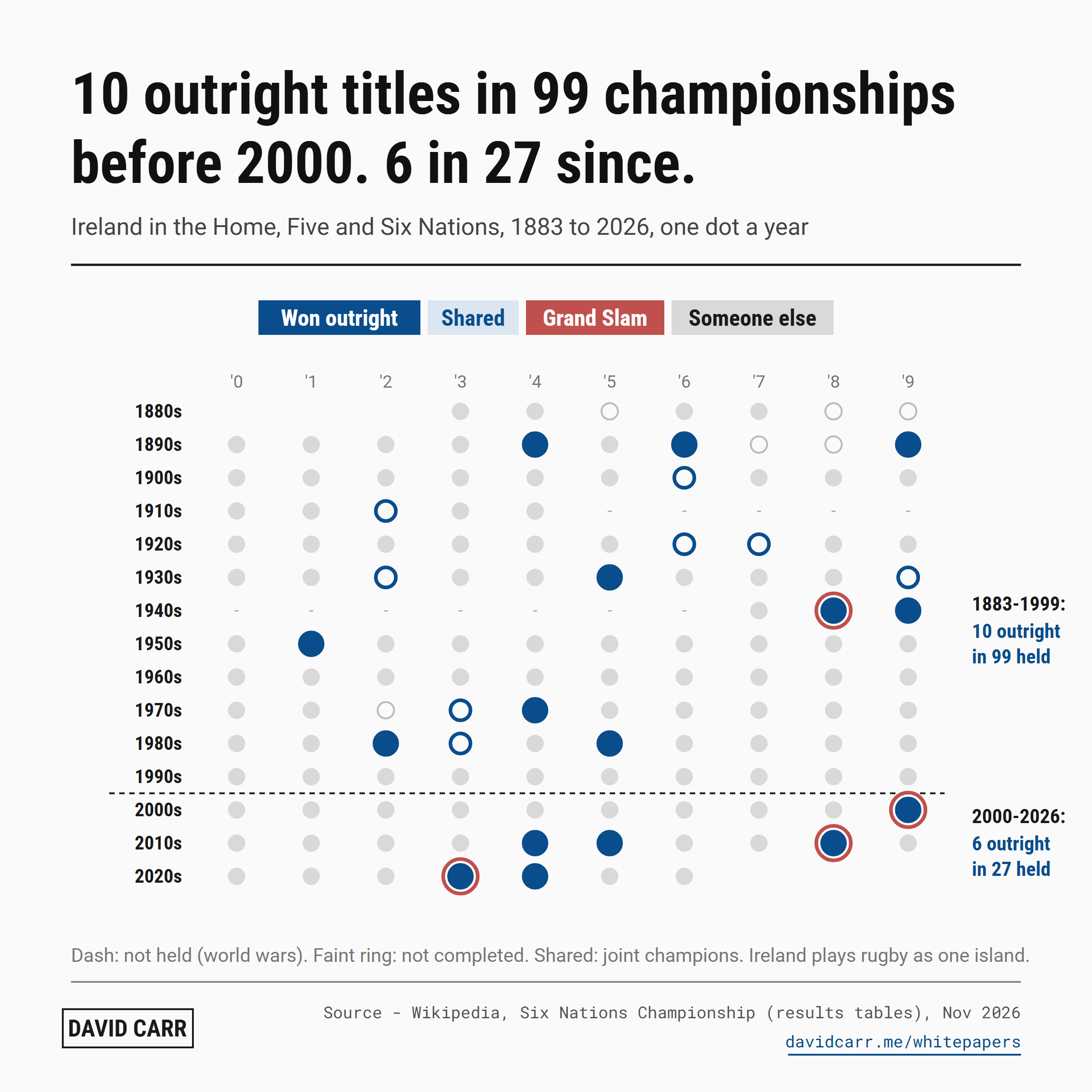
10 outright titles in 99 championships before 2000. 6 in 27 since.
- Outright titles: 16, from 1894 to 2024. Shared: 8 more, all before 1984
- 1883 to 1999: one outright title every 10 championships, roughly
- 2000 to 2026: one every 4 or 5
- Grand Slams: 1948, then 2009, 2018 and 2023
For more than a century Ireland won now and then. Since 2000 they have won often.
The Home Nations, then Five and Six Nations. Rugby in Ireland is run for the whole island, so this is an all-island team.
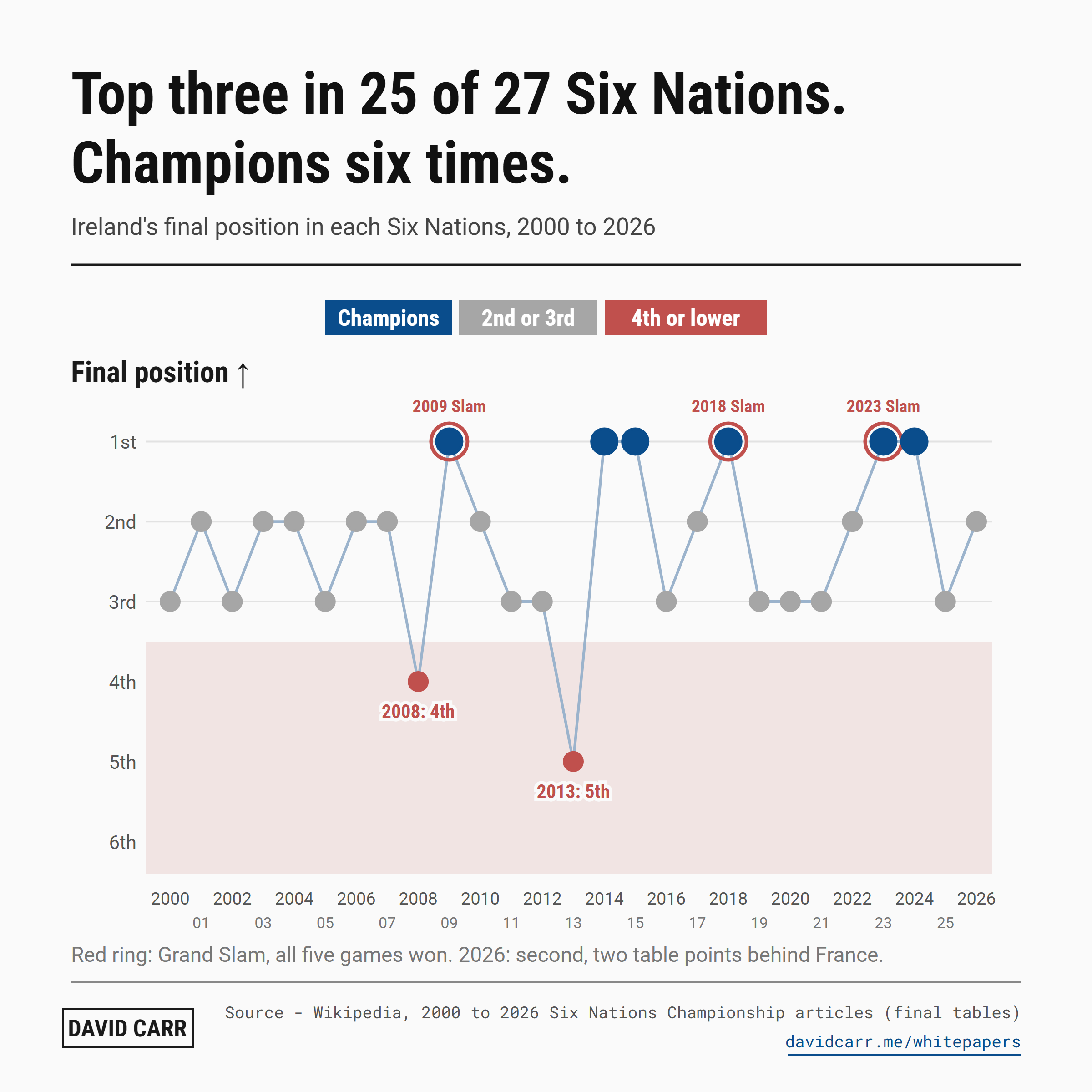
Top three in 25 of 27 Six Nations. Champions six times.
- Champions: 2009, 2014, 2015, 2018, 2023, 2024
- Grand Slams, all five games won: 2009, 2018, 2023
- Below third only twice: 4th in 2008, 5th in 2013
- 2025: third. 2026: second, two table points behind France
The six-team era started in 2000. Ireland have been in the top half of it almost every year.
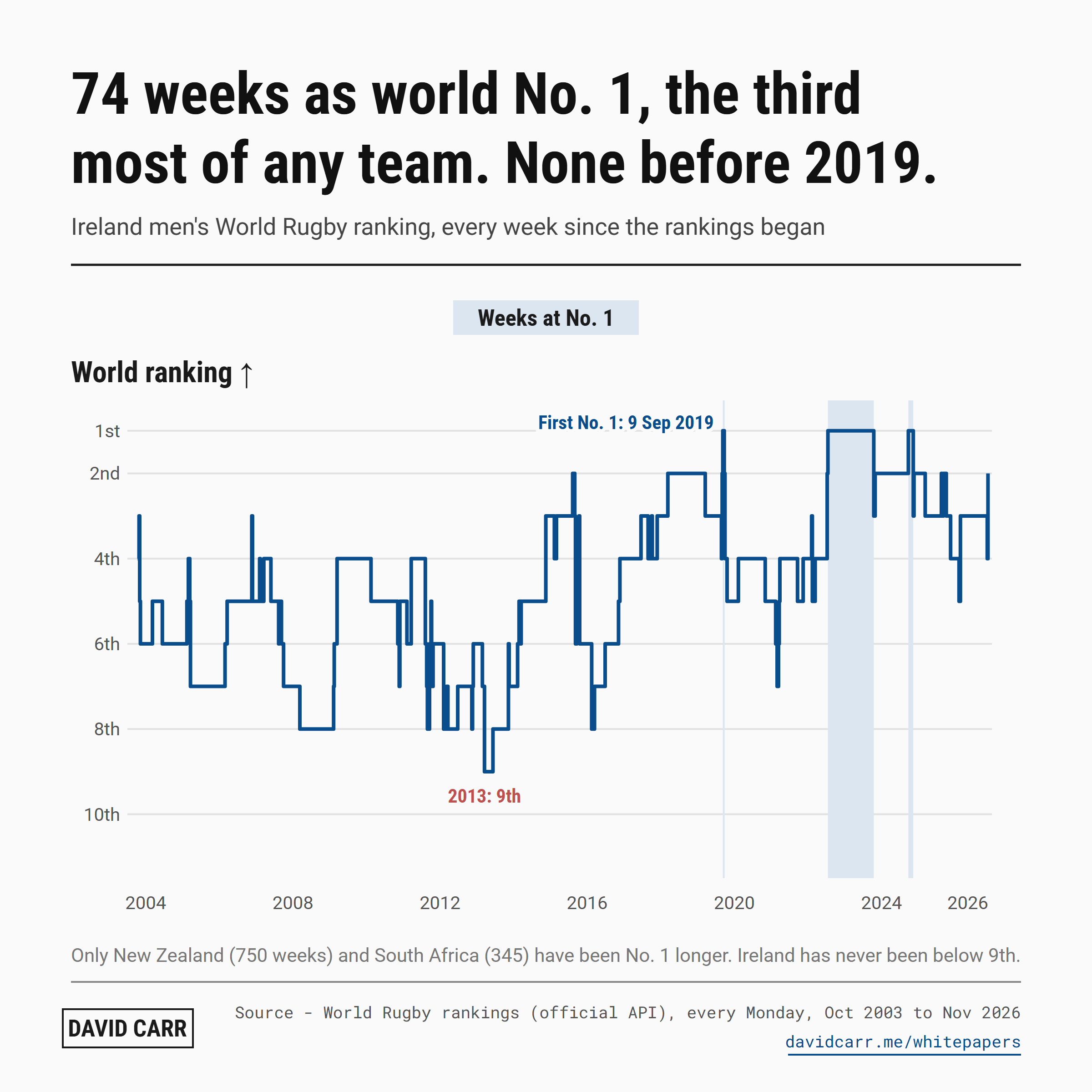
74 weeks as world No. 1, the third most of any team. None before 2019.
- First No. 1: 9 September 2019, just before that year's World Cup. Longest spell: July 2022 to October 2023, 65 weeks in a row
- Best before that: 2nd, first reached in 2015
- Weeks at No. 1 since the rankings began in 2003: New Zealand 750, South Africa 345, Ireland 74, England 35
- Lowest ever: 9th, from March to June 2013. 23 November 2026: 2nd
The climb happened between 2014 and 2018. Ireland has not been outside the top five since March 2021.
Counted from World Rugby's ranking on every Monday from 13 October 2003 to 23 November 2026.
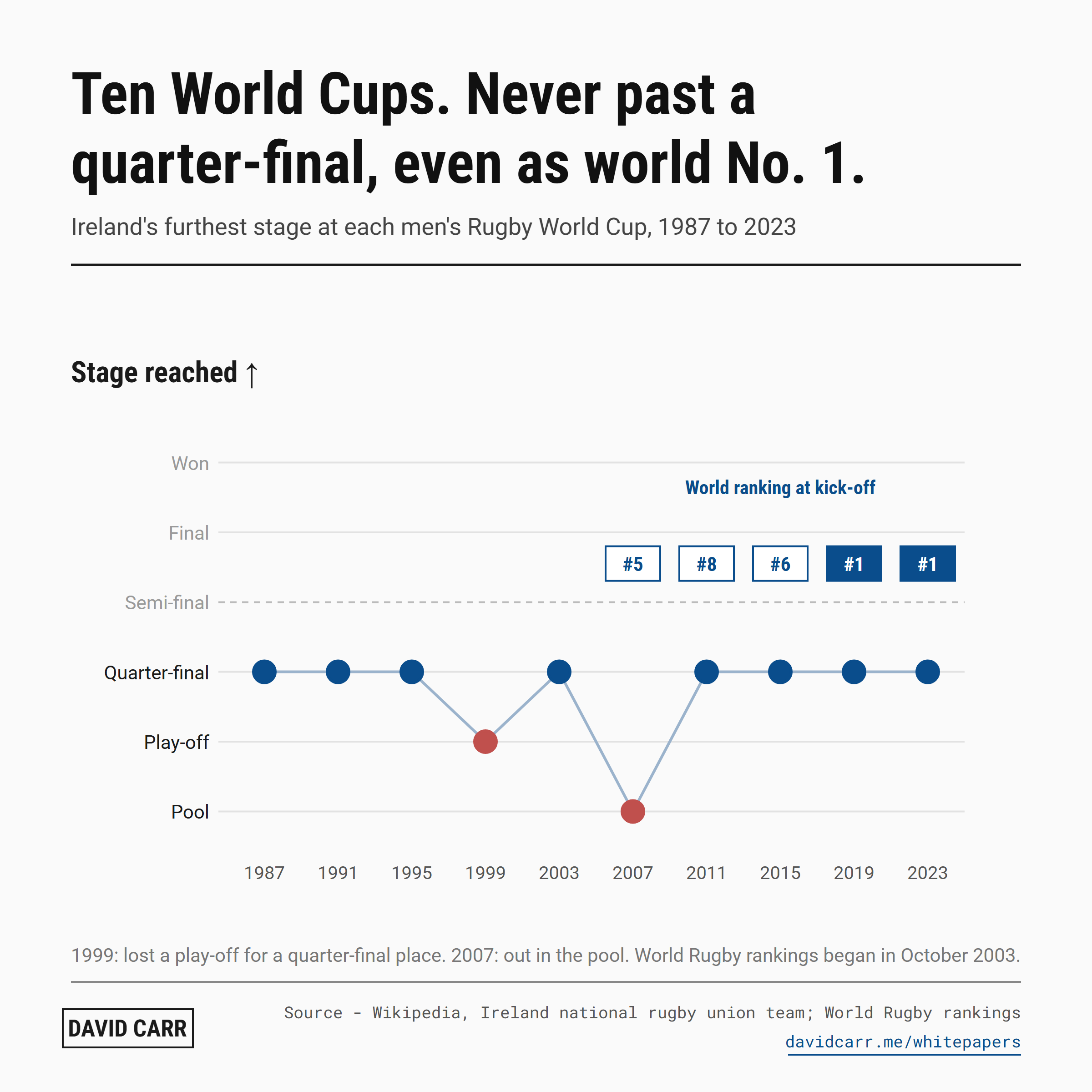
Ten World Cups. Never past a quarter-final, even as world No. 1.
- Quarter-finals: 1987, 1991, 1995, 2003, 2011, 2015, 2019, 2023
- 1999: lost a play-off for a quarter-final place. 2007: out in the pool
- Ranked 1st going into 2019 and 2023. Lost to New Zealand in both quarter-finals
- 2023: beat the eventual champions, South Africa, in the pool
Six Nations titles and 74 weeks at No. 1, but never a World Cup semi-final. The next World Cup is in 2027.
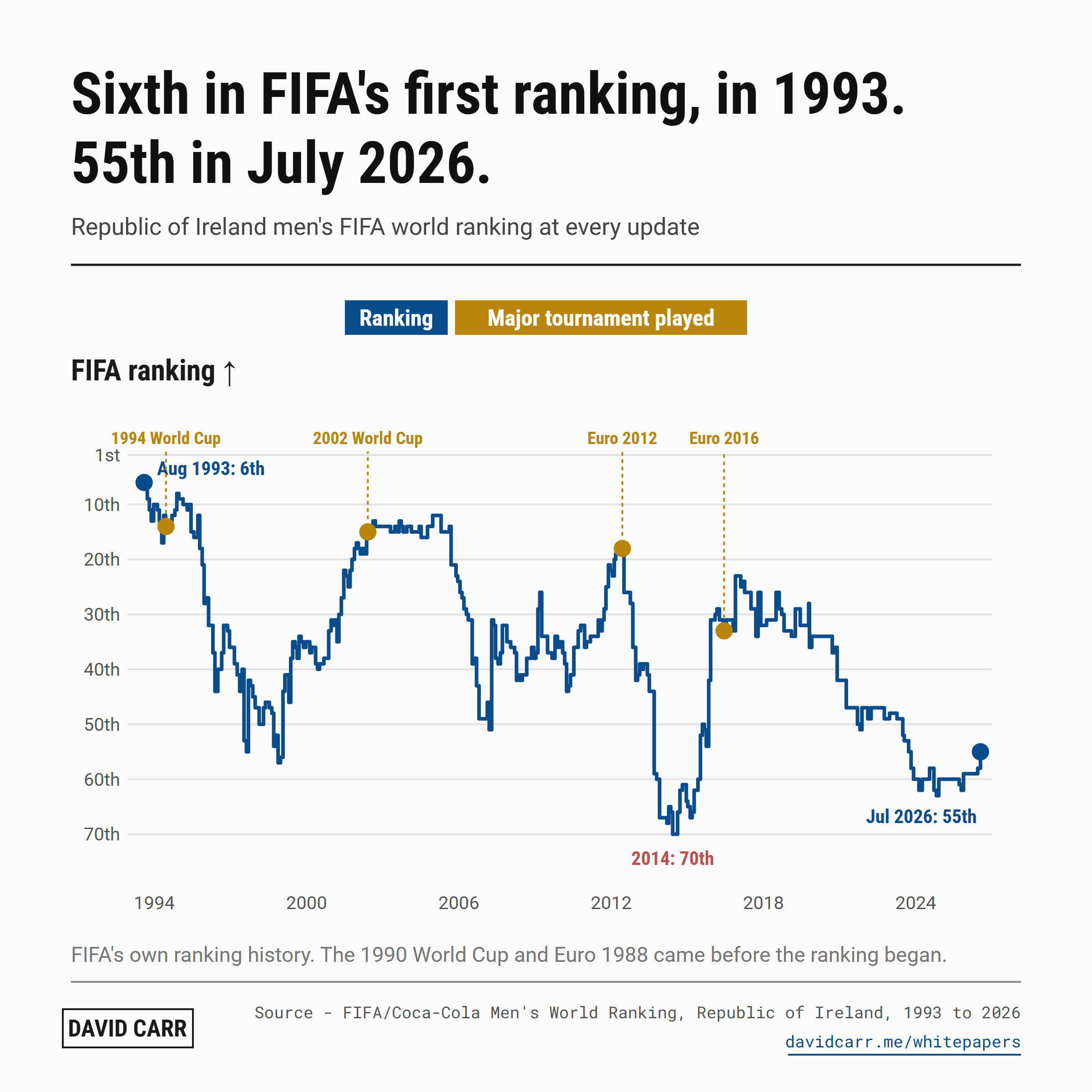
Sixth in FIFA's first ranking, in 1993. 55th in July 2026.
- August 1993: 6th, the best the Republic of Ireland men have been ranked
- 57th in 1998, back up to 12th by 2004, down to 70th in 2014, the lowest
- Major tournaments since the ranking began: World Cups 1994 and 2002, Euros 2012 and 2016
- Played at 3 of 23 World Cups; lost the 2026 qualifying play-off
The ranking has always swung. What is new is how long it has stayed low: outside the top 40 at every update since the start of 2021.
FIFA's ranking started in August 1993, so the 1988 Euros and 1990 World Cup are not on the line.
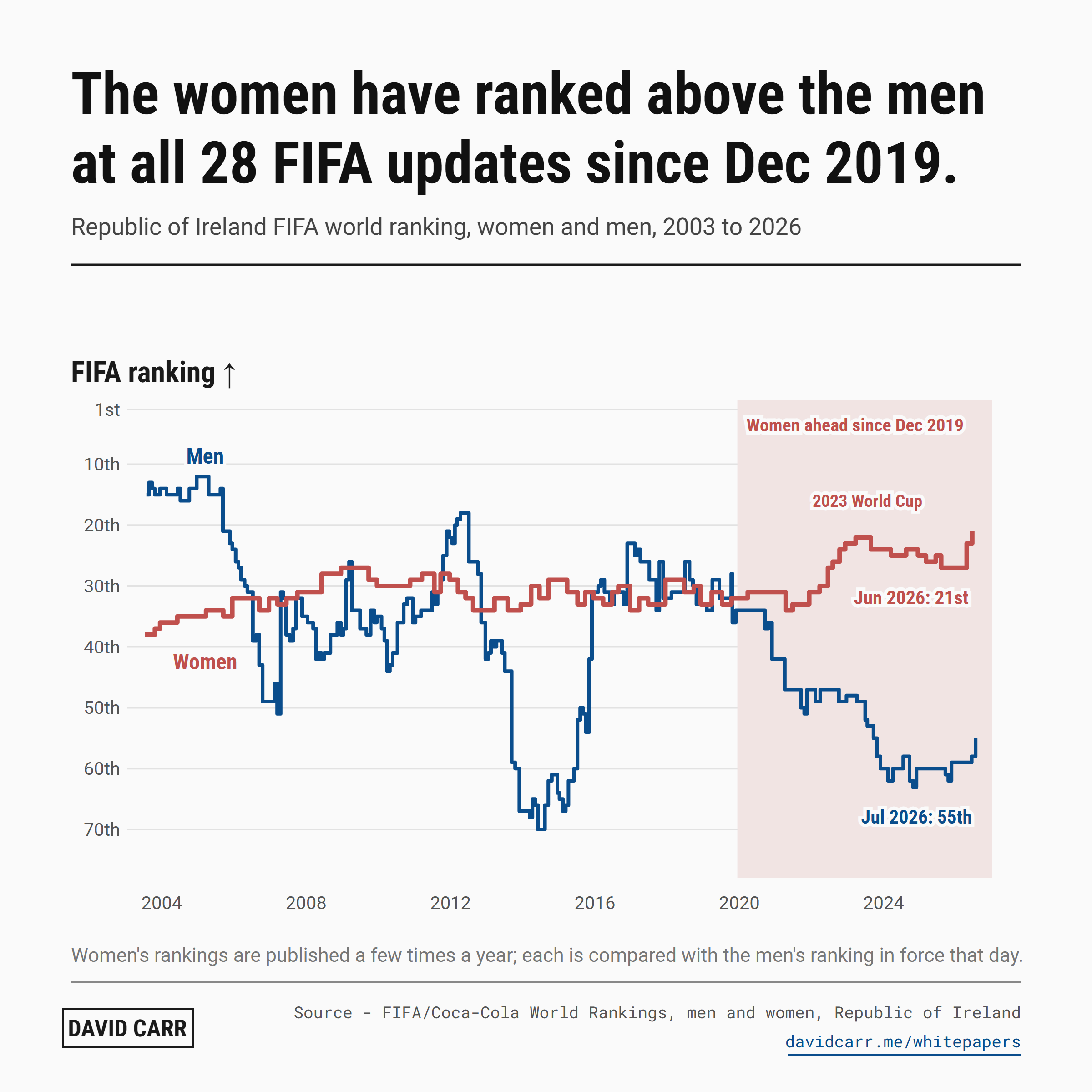
The women have ranked above the men at every FIFA update since December 2019.
- Women: 38th in 2003, their lowest; 21st in June 2026, their highest
- Men over the same years: 12th at best, 70th at worst
- The women played their first World Cup in 2023
- June 2026: women 21st, men 58th
One line went up and one went down. Since 2019 they have not crossed back.
The women's ranking is published a few times a year. Each is set against the men's ranking in force on the same day.
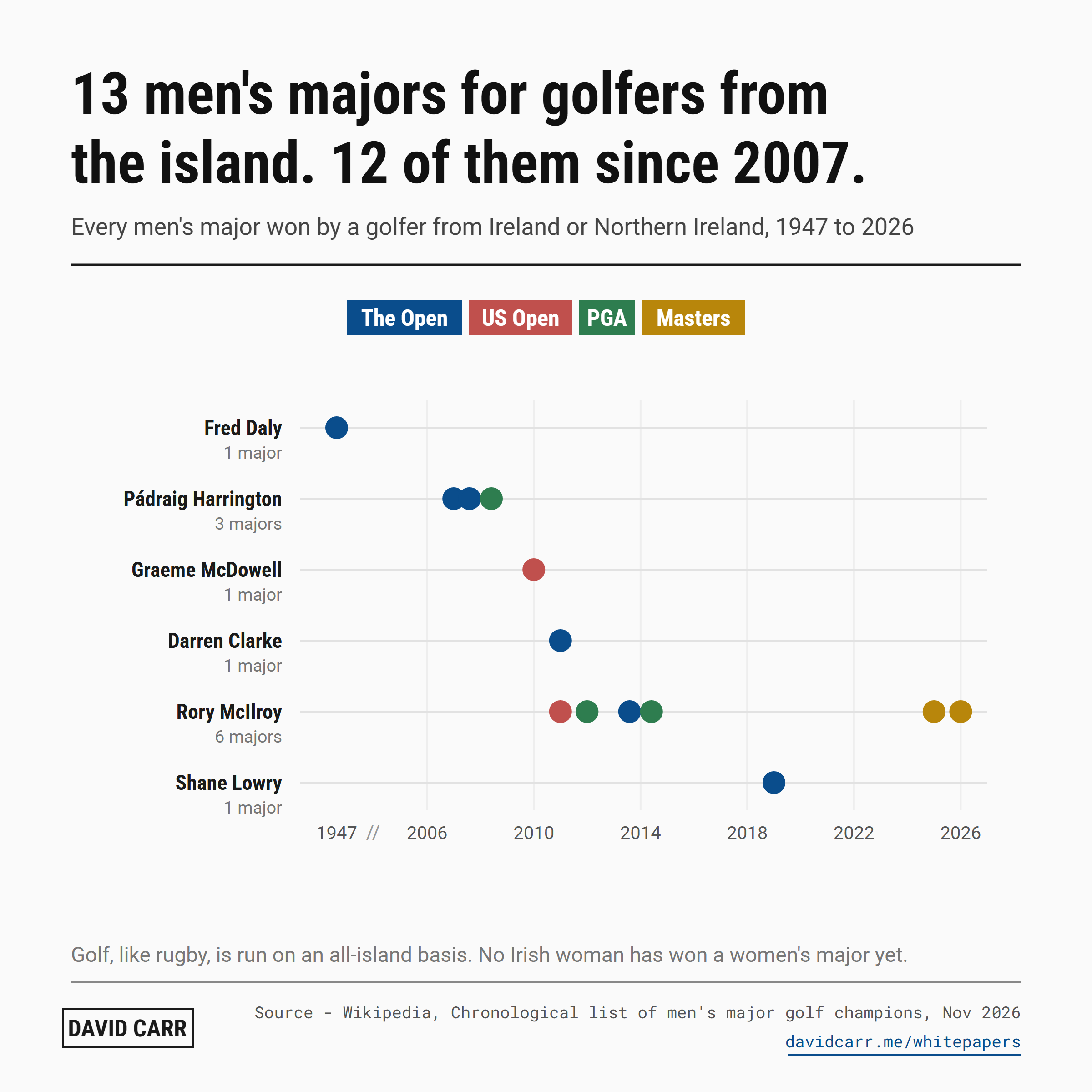
13 men's majors for golfers from the island. 12 of them since 2007.
- 1947: Fred Daly, the Open. Then nothing for 60 years
- Pádraig Harrington: 3 (2007-08). Graeme McDowell: 1 (2010). Darren Clarke: 1 (2011)
- Rory McIlroy: 6, from the 2011 US Open to the 2026 Masters, his second Masters in a row
- Shane Lowry: 1, the 2019 Open
- No Irish woman has won a major. Leona Maguire was the first Irish woman to win on the LPGA Tour
Six golfers, two generations, and a 60-year gap between the first and the second.
Golf in Ireland is run on an all-island basis, so this counts golfers from Ireland and from Northern Ireland.
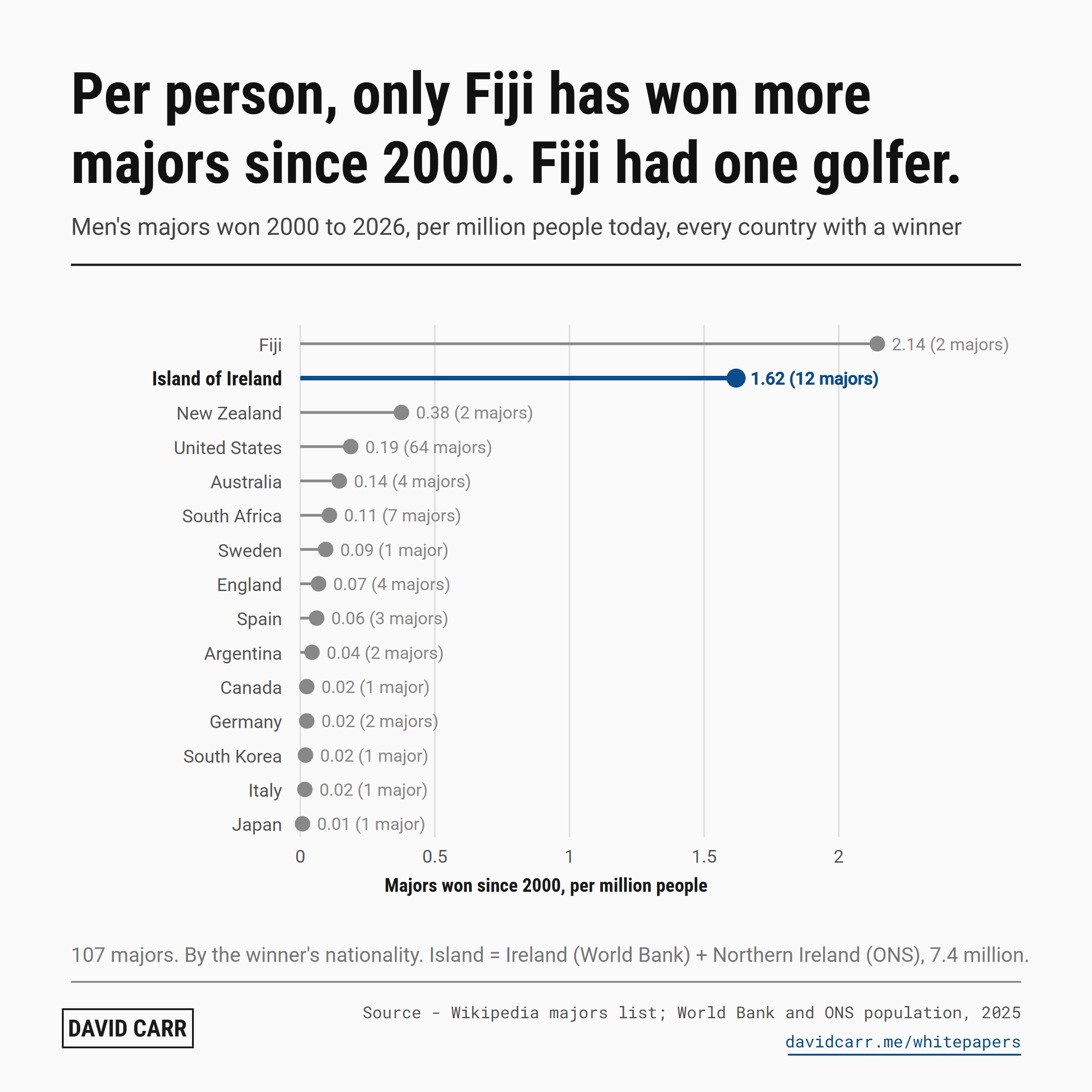
Per person, only Fiji has won more majors since 2000. Fiji had one golfer.
- Island of Ireland: 12 majors since 2000 for 7.4 million people, 1.62 per million
- Fiji: 2 majors, both Vijay Singh's, for under a million people
- United States: 64 majors, the most by far, 0.19 per million
- Only the US has won more majors than the island since 2000
On raw counts the island is second only to the United States. Per person it trails only Fiji, whose total is one man's.
Majors by the winner's nationality as listed by Wikipedia, divided by 2025 population (World Bank; ONS for England and Northern Ireland).
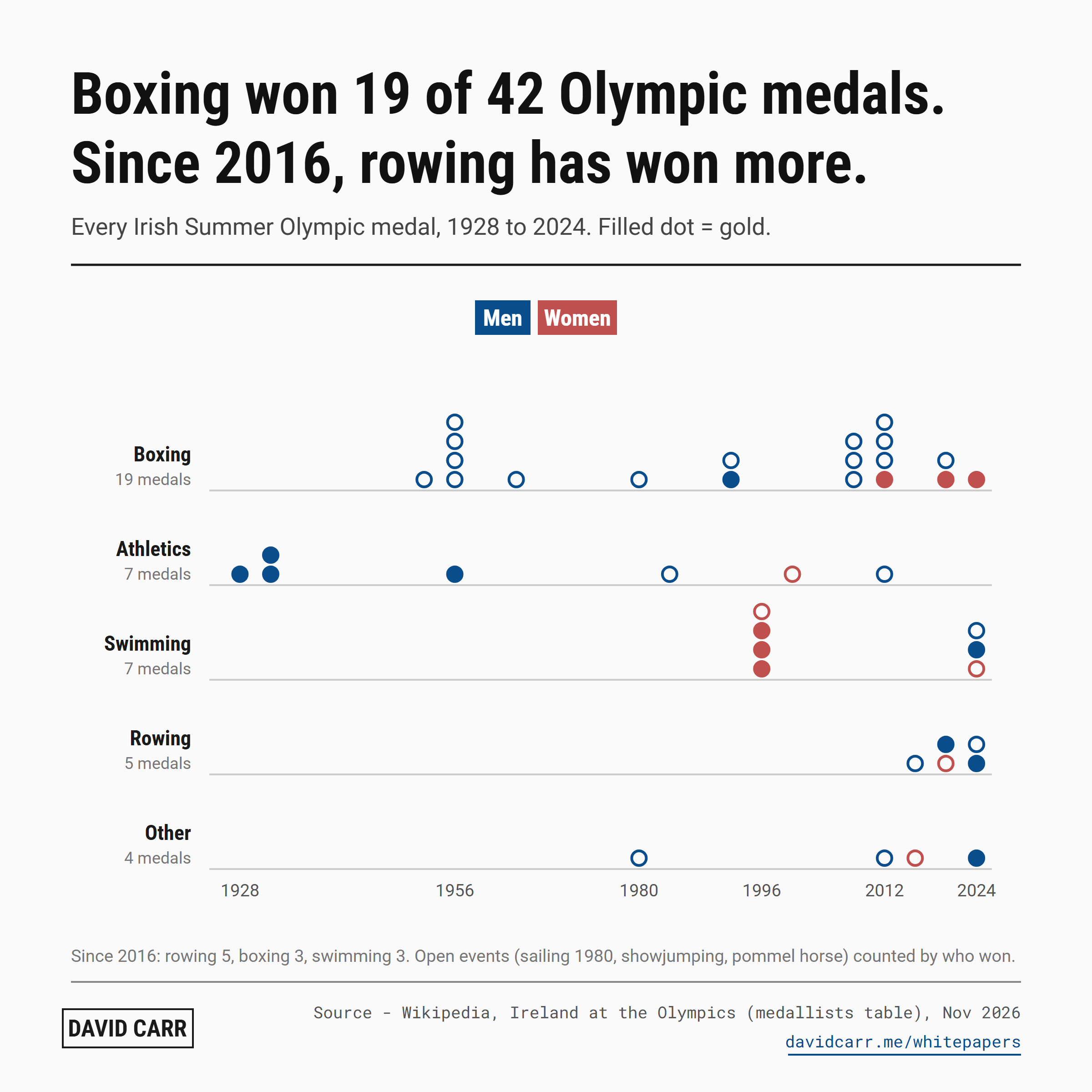
Boxing won 19 of 42 Olympic medals. Since 2016, rowing has won more.
- Boxing: 19 medals, 4 of them gold. 16 of Ireland's first 29 medals
- Athletics 7, swimming 7, rowing 5, sailing 2, equestrian 1, gymnastics 1
- Paris 2024: 7 medals, 4 gold, the best Games yet
- Women: 11 medals. Since 2012 they have won 3 of the 7 golds
Boxing carried Ireland at the Olympics for 60 years. Since 2016 the medals have spread to rowing, swimming and gymnastics.
Medals count once per event, so a crew medal is one medal. See also the per-person Olympic comparison on the Olympic medals page.
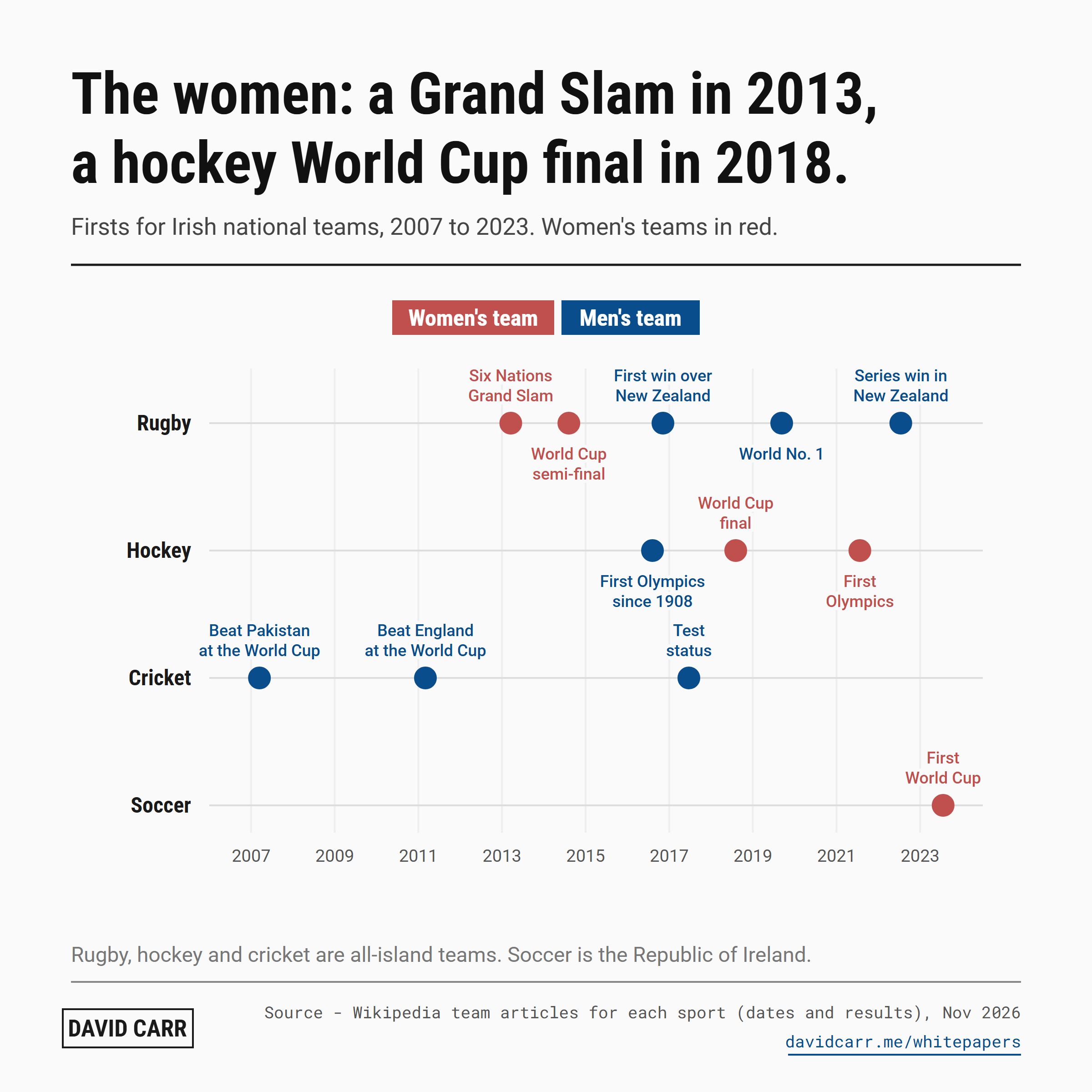
The women: a Grand Slam in 2013, a hockey World Cup final in 2018.
- Rugby: women's Six Nations Grand Slam, 2013, and a World Cup semi-final in 2014 after beating New Zealand
- Hockey: the women reached the 2018 World Cup final, ranked 15th of 16 teams going in
- Soccer: the women's first World Cup, in 2023
- Men: cricket beat Pakistan (2007) and England (2011) at World Cups, then won Test status in 2017; rugby's first win over New Zealand came in 2016
The biggest days for the women's teams are recent, and spread across three sports.
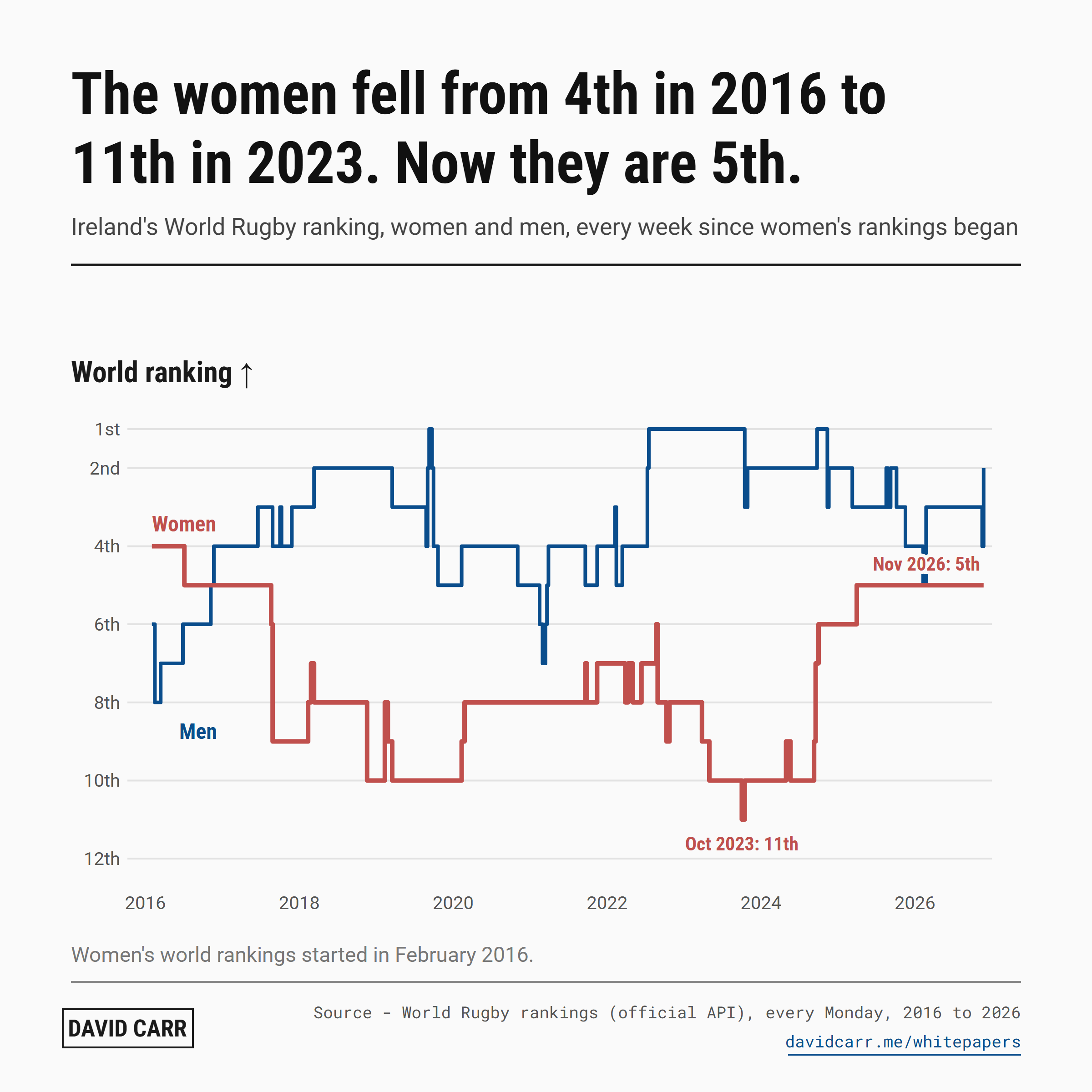
The women fell from 4th in 2016 to 11th in 2023. Now they are 5th.
- Women: 4th when the rankings began in February 2016, their best
- Down to 11th in October 2023, their lowest
- 5th in every ranking of 2026
- Men over the same ten years: never below 8th
The women missed the World Cup played in 2022, and the ranking shows the slide either side of it. The climb back started in 2024.
Women's World Rugby rankings began in February 2016.
Method, caveats and sources
The short answer. Ireland is genuinely world class at two things: men's rugby, in the world's top five at every ranking since March 2021, with six outright championships since 2000 against ten in the 117 years before, and men's golf, with 12 majors since 2007 and more per person than anywhere but Fiji. Olympic medals moved from boxing to rowing, swimming and gymnastics, and Paris 2024 was the best Games yet. Soccer went the other way: the men fell from 6th in the world in 1993 to 55th, and the women have ranked above them since 2019. The rugby team's one gap is the World Cup: never past a quarter-final.
Which Ireland. Rugby, hockey, cricket and golf are organised for the whole island, so those teams and golfers include players from Northern Ireland. Soccer is the Republic of Ireland; Northern Ireland has its own team, not covered here. The Olympic team is Ireland's and can include athletes from Northern Ireland.
Rankings. World Rugby's men's ranking for every Monday from 13 October 2003 to 23 November 2026, and the women's from February 2016, pulled from World Rugby's own rankings service. FIFA's ranking history for the Republic of Ireland men (August 1993 to July 2026) and women (July 2003 to June 2026), from FIFA's own country pages; later 2026 lists are not yet in that history. Weeks at No. 1 are counted from the Monday snapshots.
Results. Championship winners 1883 to 2026 and Grand Slams from Six Nations Championship and Grand Slam (rugby union); each year's final table from the 2000 to 2026 Six Nations articles; World Cup stages from Ireland national rugby union team; every men's major from Chronological list of men's major golf champions, checked against the PGA Tour for the 2026 Masters; Olympic medals from Ireland at the Olympics; and team milestones from the articles for each team. Wikipedia revisions of 23 November 2026, saved with their revision ids.
Per person. Majors won 2000 to 2026 divided by 2025 population: World Bank for countries, ONS mid-2025 for England and Northern Ireland. The island of Ireland is 7.4 million. Using today's population for a 27-year count is rough; it does not change the order.
Left out. Gaelic games, which are not played between countries; professional boxing, which has no single official record; athletics championships and cricket rankings, for want of a clean source; and the women's Six Nations finishing table on Wikipedia, whose rows do not line up.
Also: Ireland at the Olympics, per person, All-Ireland finals and Home advantage.