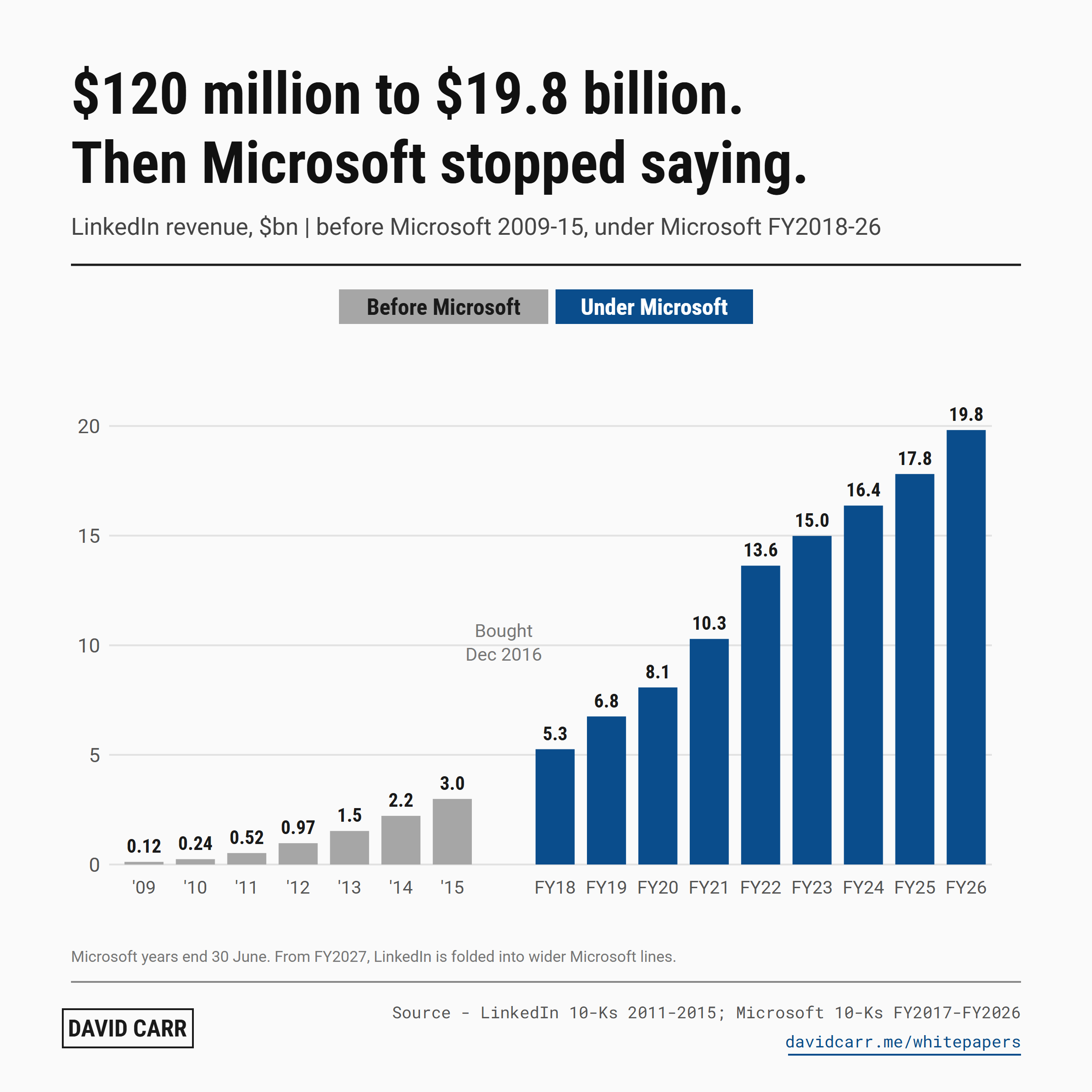
$120 million to $19.8 billion. Then Microsoft stopped saying.
- 2009: $120 million, as a private company
- 2015, its last full year public: $3.0 billion
- FY2026, under Microsoft: $19.8 billion
- From July 2026, Microsoft folds LinkedIn into two wider lines
FY2026, to June 2026, is the last year Microsoft reported LinkedIn on its own. From the quarter to September 2026, it sits inside two wider Microsoft lines.
How we know: the last LinkedIn figure is in Microsoft's FY2026 annual report (10-K), and LinkedIn's own newsroom gives the same $19.8bn. Microsoft's next quarterly report (10-Q, to September 2026) has no LinkedIn line. Search SEC filings for "LinkedIn revenue increased": it's in every Microsoft report up to July 2026, and not in October's. Microsoft bought LinkedIn in December 2016 for $26.2 billion; its years end 30 June.
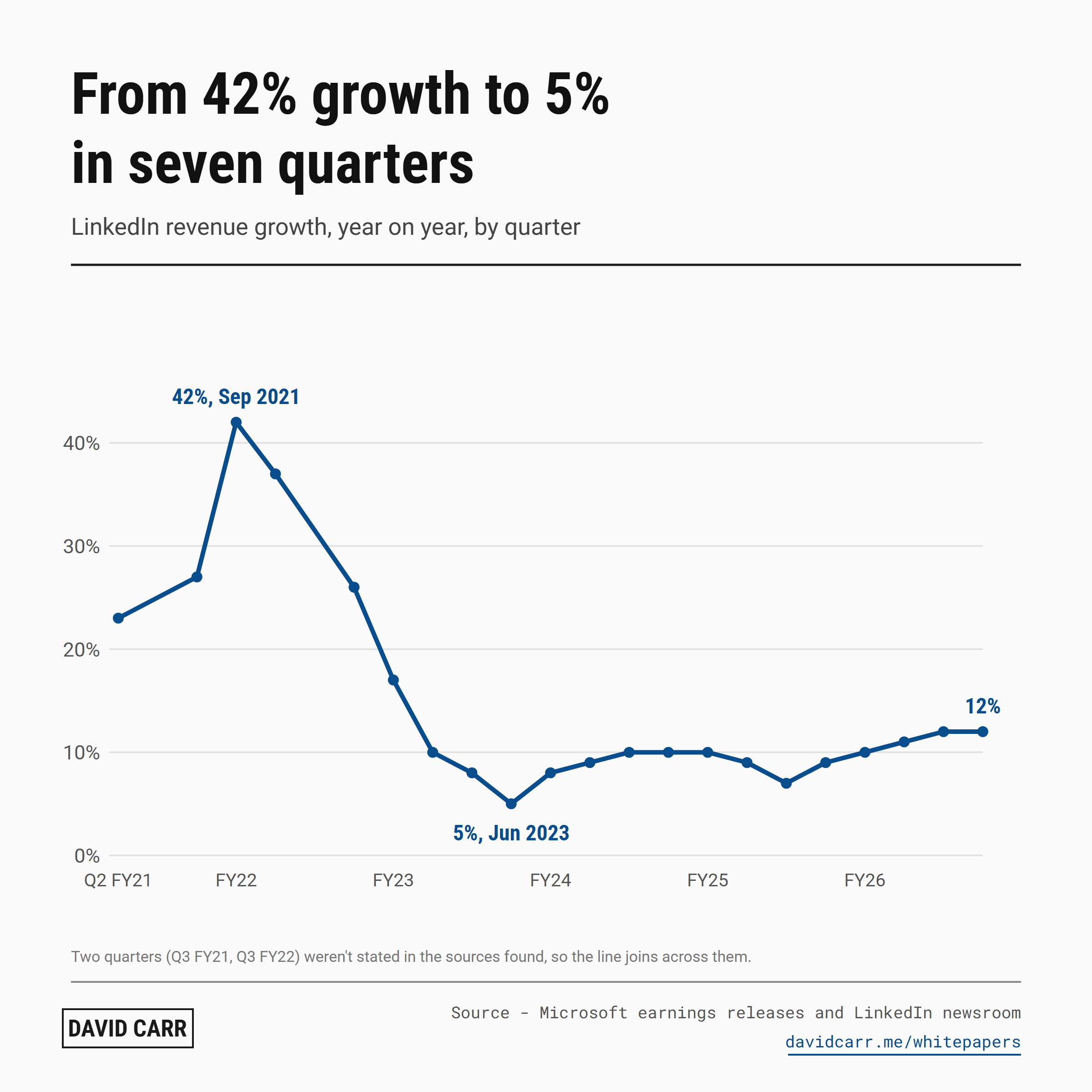
From 42% growth to 5% in seven quarters
- Sep 2021: +42%
- Jun 2023: +5%
- Mid-2026: +12%, two quarters running
The post-pandemic hiring boom and the slowdown after it show up quarter by quarter.
Microsoft's own growth figures, from its earnings releases and LinkedIn's newsroom.
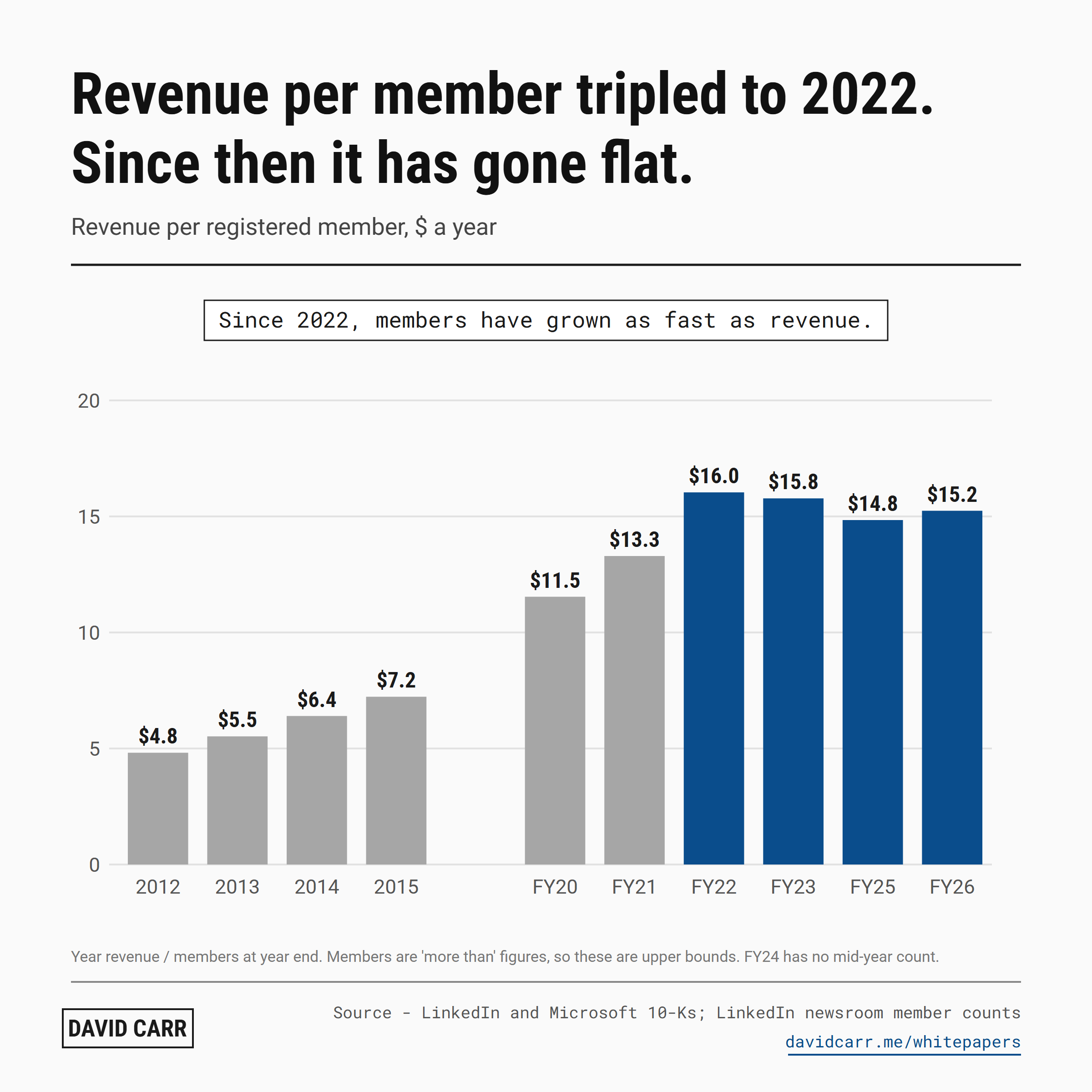
Revenue per member tripled to 2022. Since then it has gone flat.
- 2012: $4.80 a member
- FY2022: $16.00
- FY2026: $15.20
Since 2022, LinkedIn has grown by adding members, not by earning more from each one.
Revenue divided by registered members. An upper bound, since members are 'more than' figures.
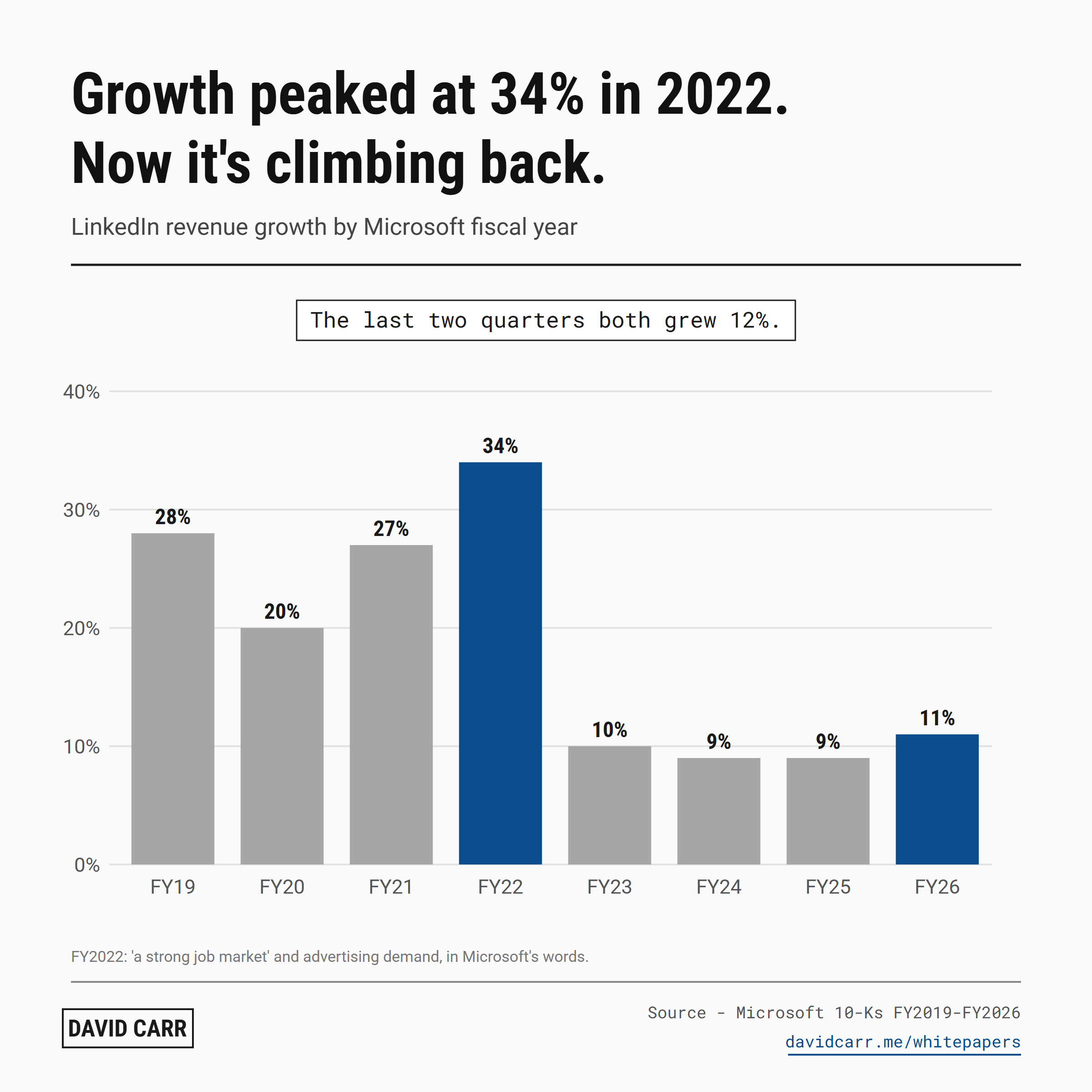
Growth peaked at 34% in 2022. Now it's climbing back.
- FY2022: +34%, a strong job market and ad demand
- FY2023 to FY2025: 9 to 10% a year
- Last two quarters: +12% each
Revenue has grown every single year since the deal. Only the pace changed.
Microsoft's own wording, from each 10-K.
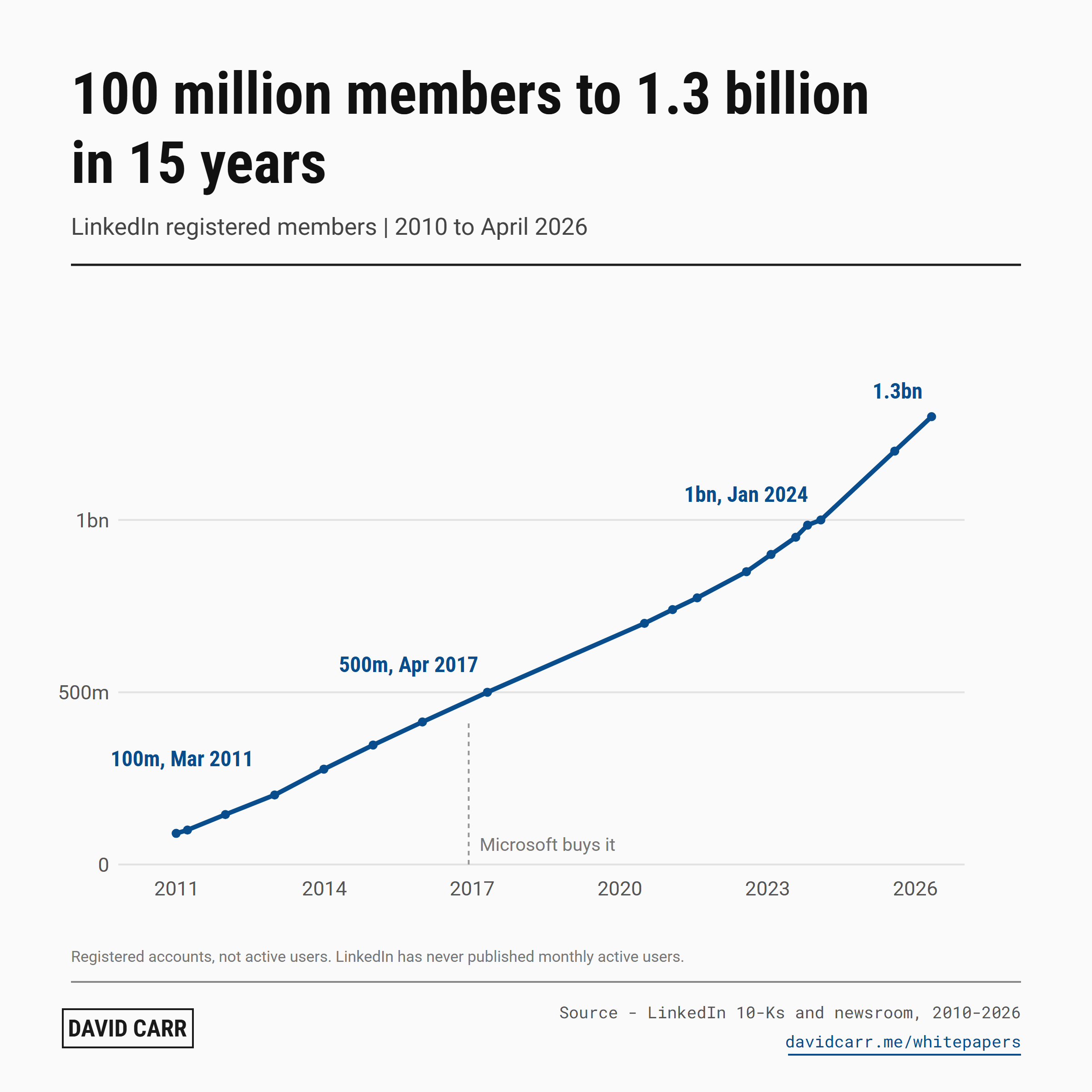
100 million members to 1.3 billion in 15 years
- 100 million: March 2011
- 500 million: April 2017
- 1 billion: January 2024
- 1.3 billion: April 2026
The last 300 million came in about two years.
These are registered accounts, not active users. LinkedIn has never published monthly active users.
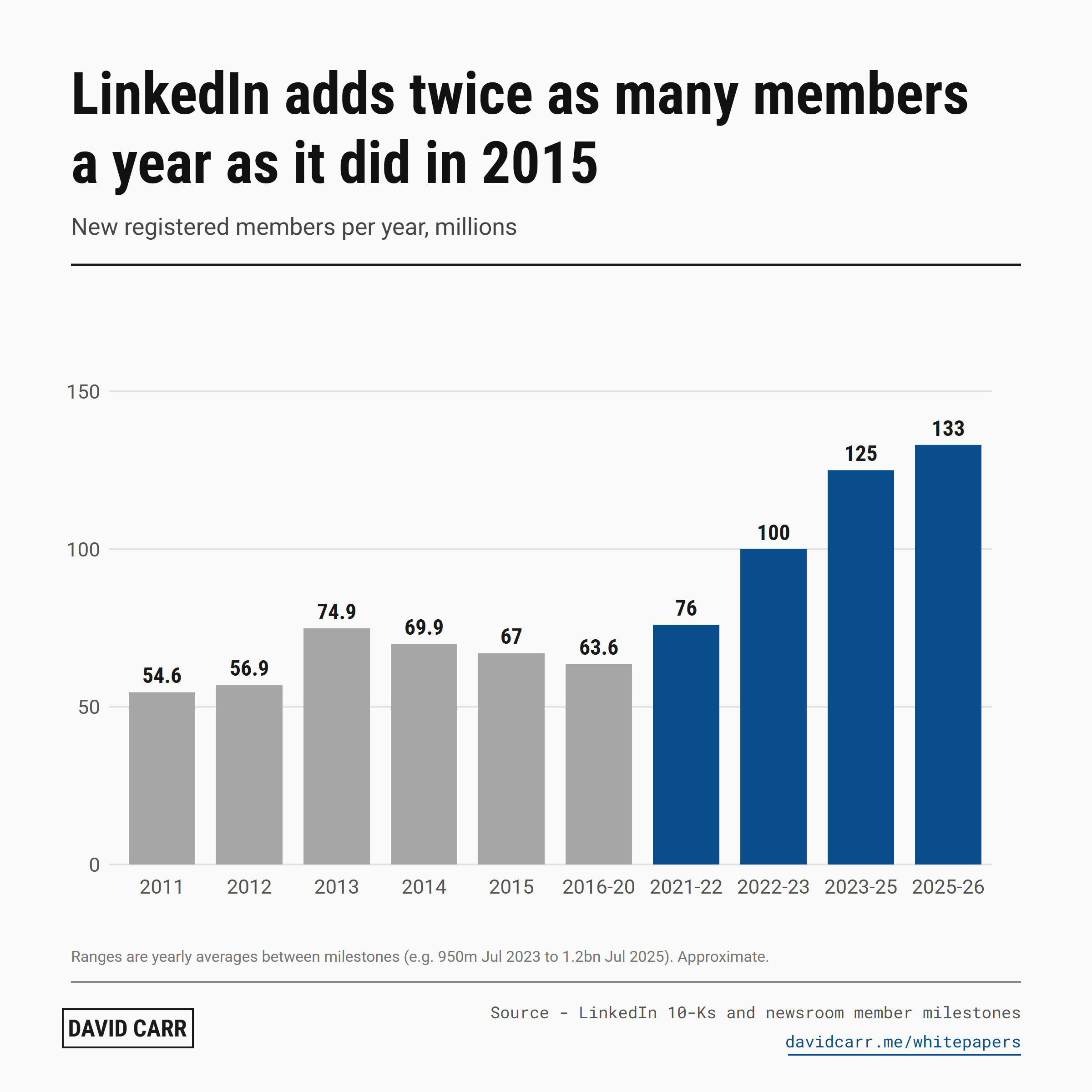
LinkedIn adds twice as many members a year as it did in 2015
- 2015: 67 million new members
- 2022-23: about 100 million
- 2025-26: about 133 million a year
Growth in members is speeding up, not slowing down.
Averages between milestone dates, so approximate.
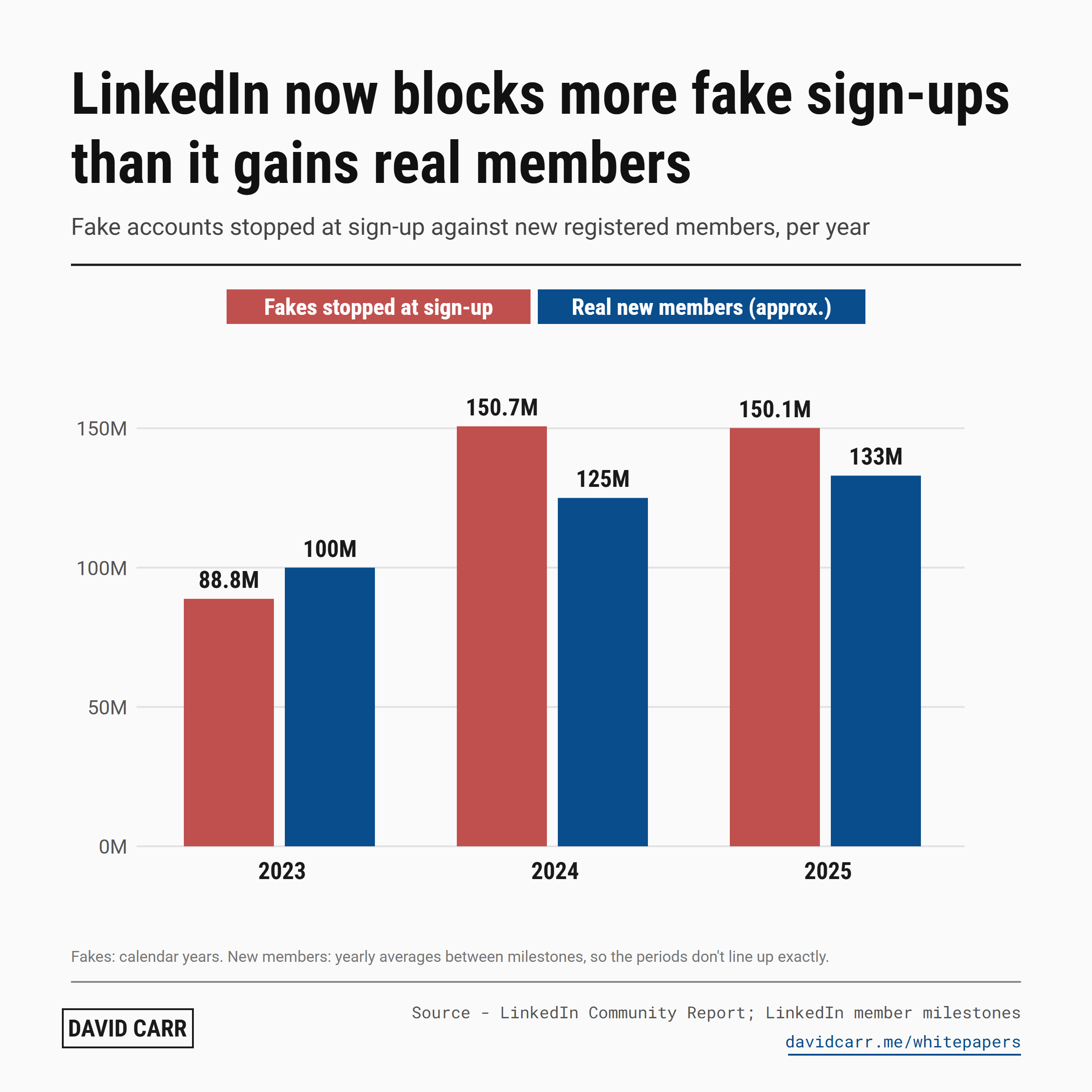
LinkedIn now blocks more fake sign-ups than it gains real members
- 2023: 89M fakes stopped, about 100M real members added
- 2024: 151M against about 125M
- 2025: 150M against about 133M
Since 2024, for every real new member, more than one fake was turned away at the door.
Periods don't line up exactly: fakes are calendar years, members are averages between milestones.
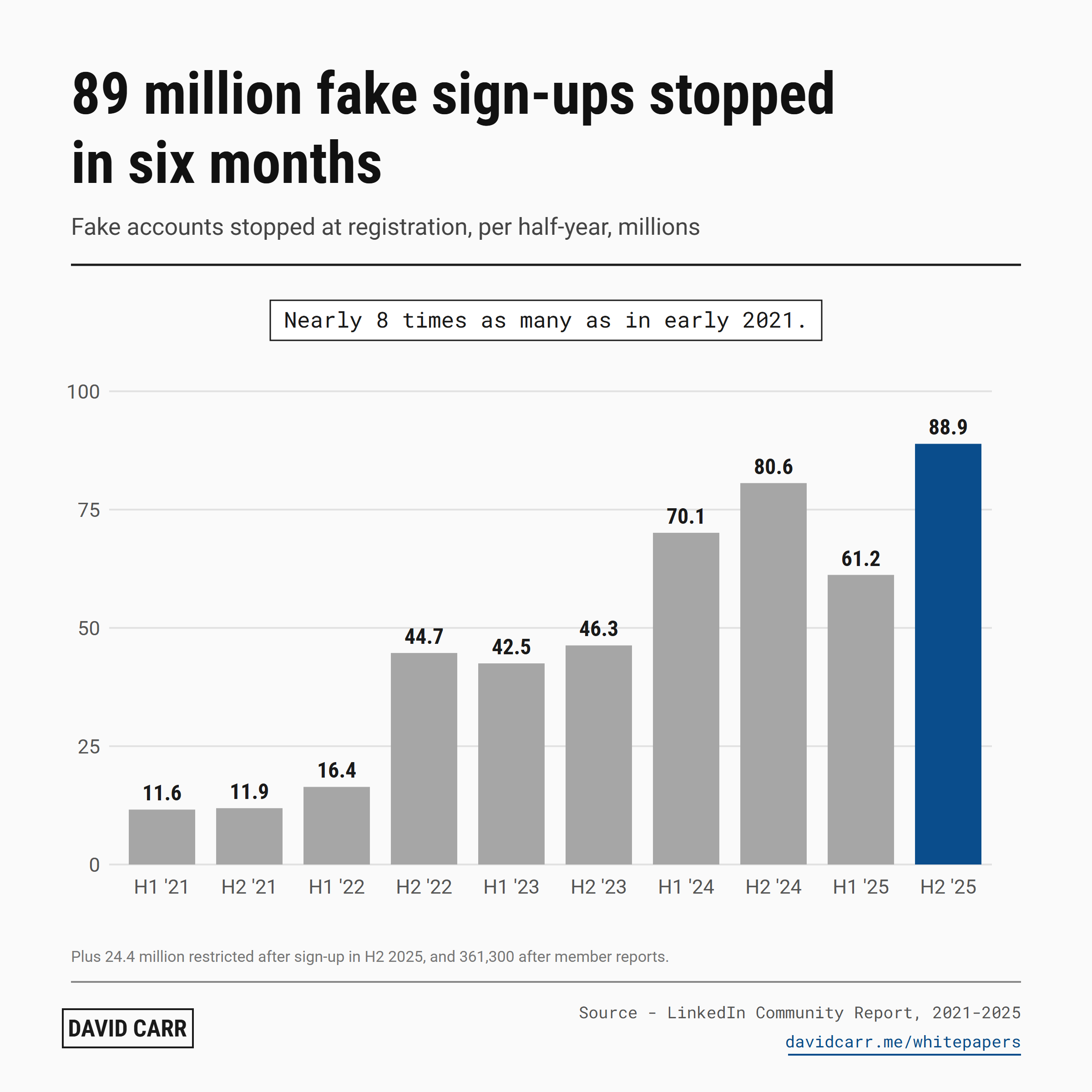
89 million fake sign-ups stopped in six months
- Early 2021: 11.6 million stopped at sign-up
- Late 2022: 44.7 million
- Late 2025: 88.9 million
- Plus 24.4 million restricted after sign-up, late 2025
LinkedIn says 99.7% are stopped before any member reports them.
The jump in late 2022 isn't explained in the report. It may be more attacks or a change in counting.
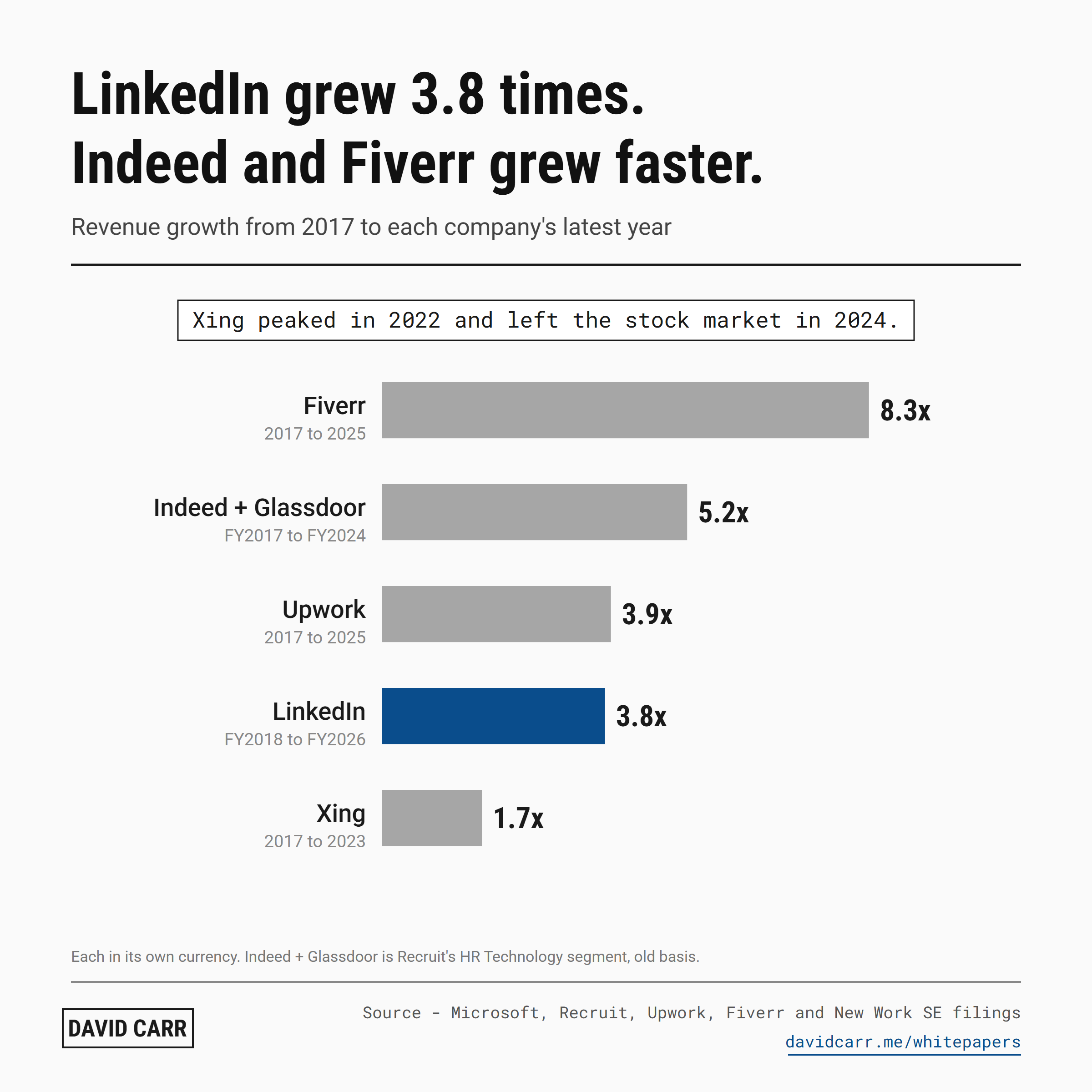
LinkedIn grew 3.8 times. Indeed and Fiverr grew faster.
- Fiverr: 8.3x since 2017, from a small base
- Indeed + Glassdoor: 5.2x
- Upwork: 3.9x, but fewer clients since 2023
- Xing: 1.7x, peaked in 2022, delisted in 2024
Xing was LinkedIn's German rival with 22 million members. Viadeo, the French one, had 68 million in 2015.
Each in its own currency, over slightly different years, as each company reports them.
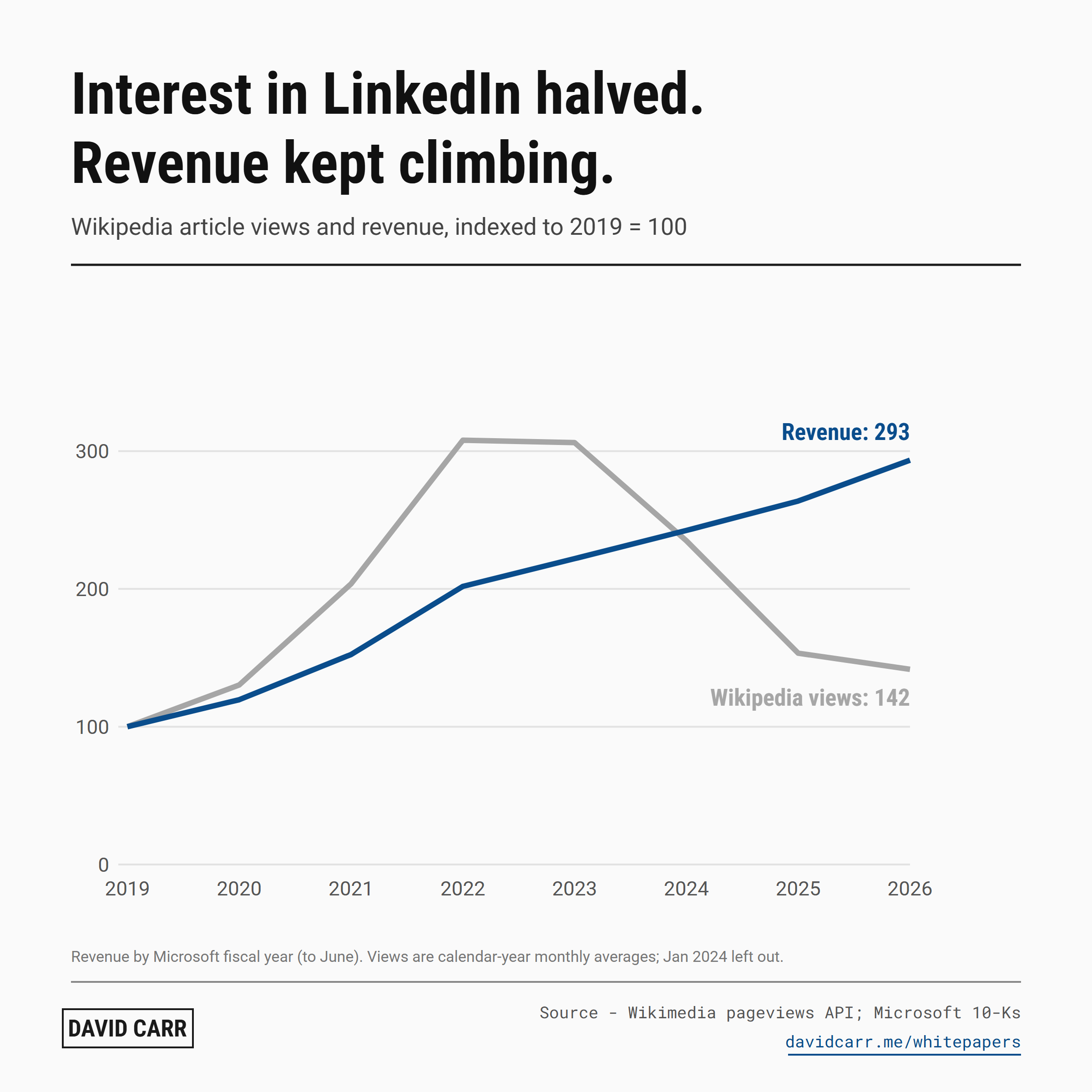
Interest in LinkedIn halved. Revenue kept climbing.
- Wikipedia views: 3x by 2022, back to 1.4x by 2026
- Revenue: up every year, 2.9x since 2019
Attention and money split apart in 2024.
Both indexed to 2019 = 100.
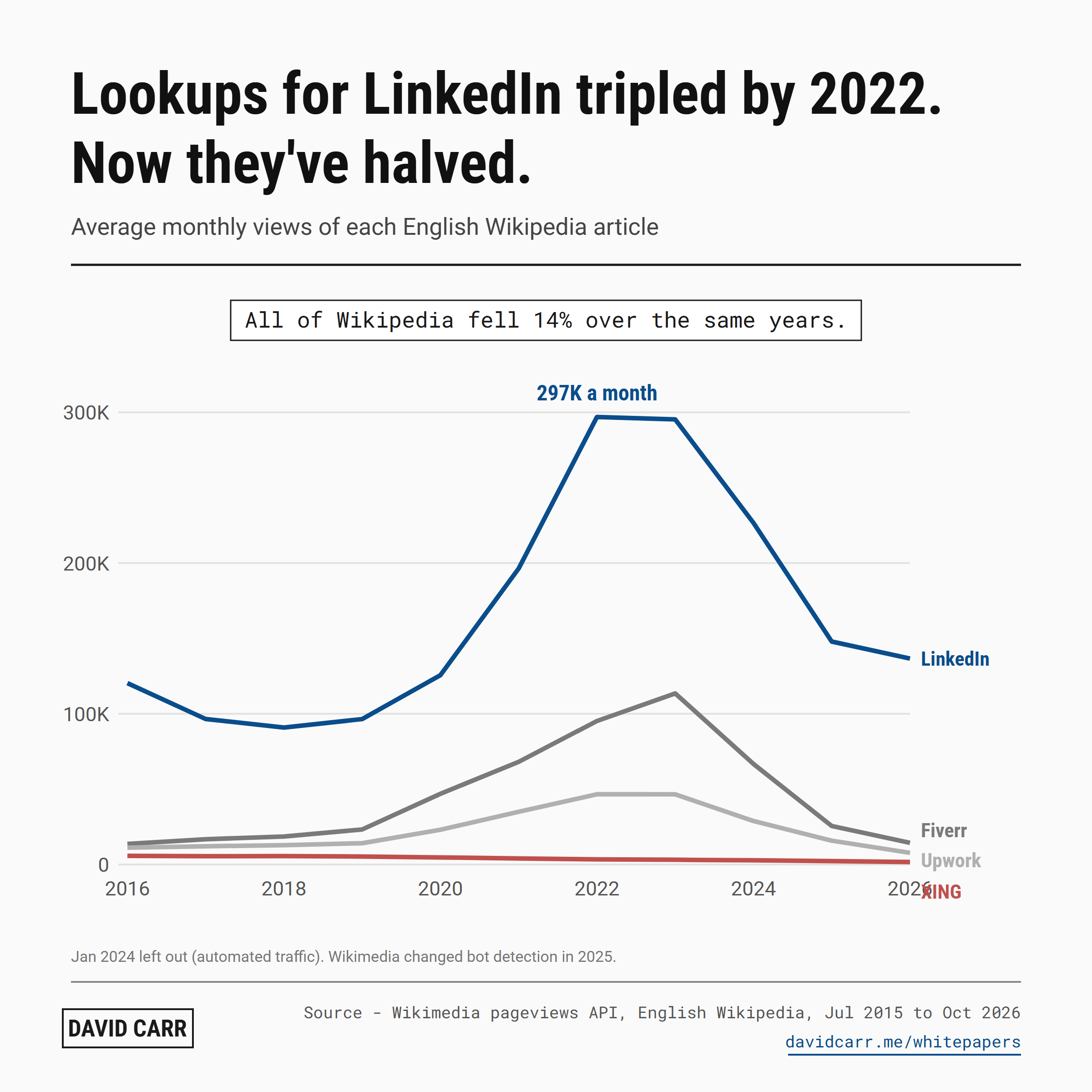
Lookups for LinkedIn tripled by 2022. Now they've halved.
- LinkedIn article: 96K views a month in 2019, 297K in 2022, 137K in 2026
- Fiverr and Upwork rose and fell the same way
- Xing has faded every year since 2016
The remote-work years lifted all of them. The drop since is bigger than Wikipedia's own 14% fall.
January 2024 is left out: the whole month looks like automated traffic. Wikimedia changed how it detects bots in 2025, so some of the drop may be bots, not people.
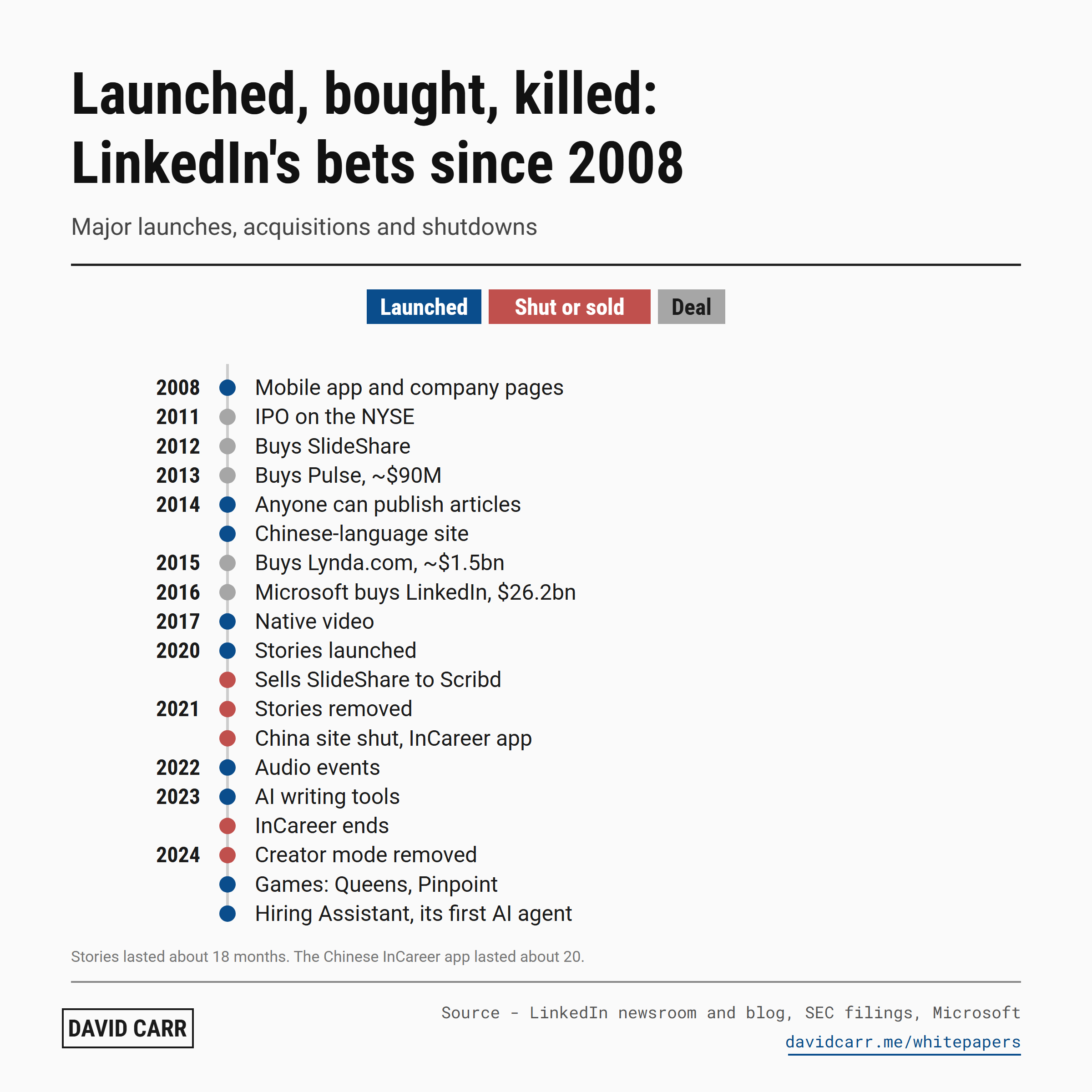
Launched, bought, killed: LinkedIn's bets since 2008
- Bought SlideShare in 2012, sold it in 2020
- Stories: launched 2020, gone by September 2021
- China: a local site in 2014, shut in 2021; the InCareer app that replaced it ended in 2023
- 2024: creator mode removed, games added, its first AI agent launched
Stories and audio rooms followed other networks' hits of the day. Games and AI are the latest bets.
Dates from LinkedIn's newsroom and blog. Creator mode's launch date isn't on a primary source, so it's left off.
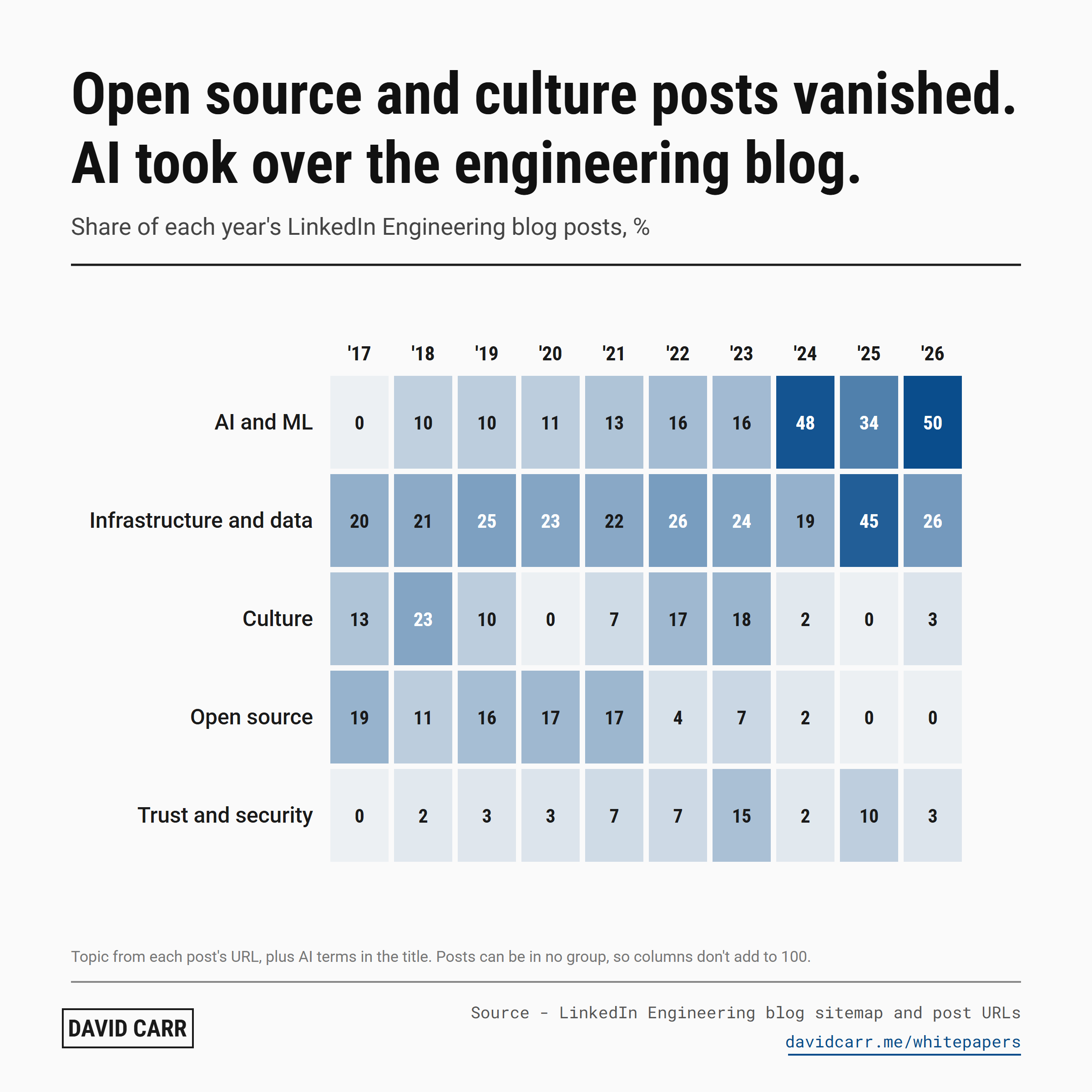
Open source and culture posts vanished. AI took over the engineering blog.
- Open source: 19% of posts in 2017, none in 2025 or 2026
- Culture: 23% in 2018, almost none since 2024
- AI and ML: 0% in 2017, 50% in 2026
LinkedIn used to blog about the open-source tools it built. Now it blogs about AI.
Topic from each post's web address, plus AI terms in titles.
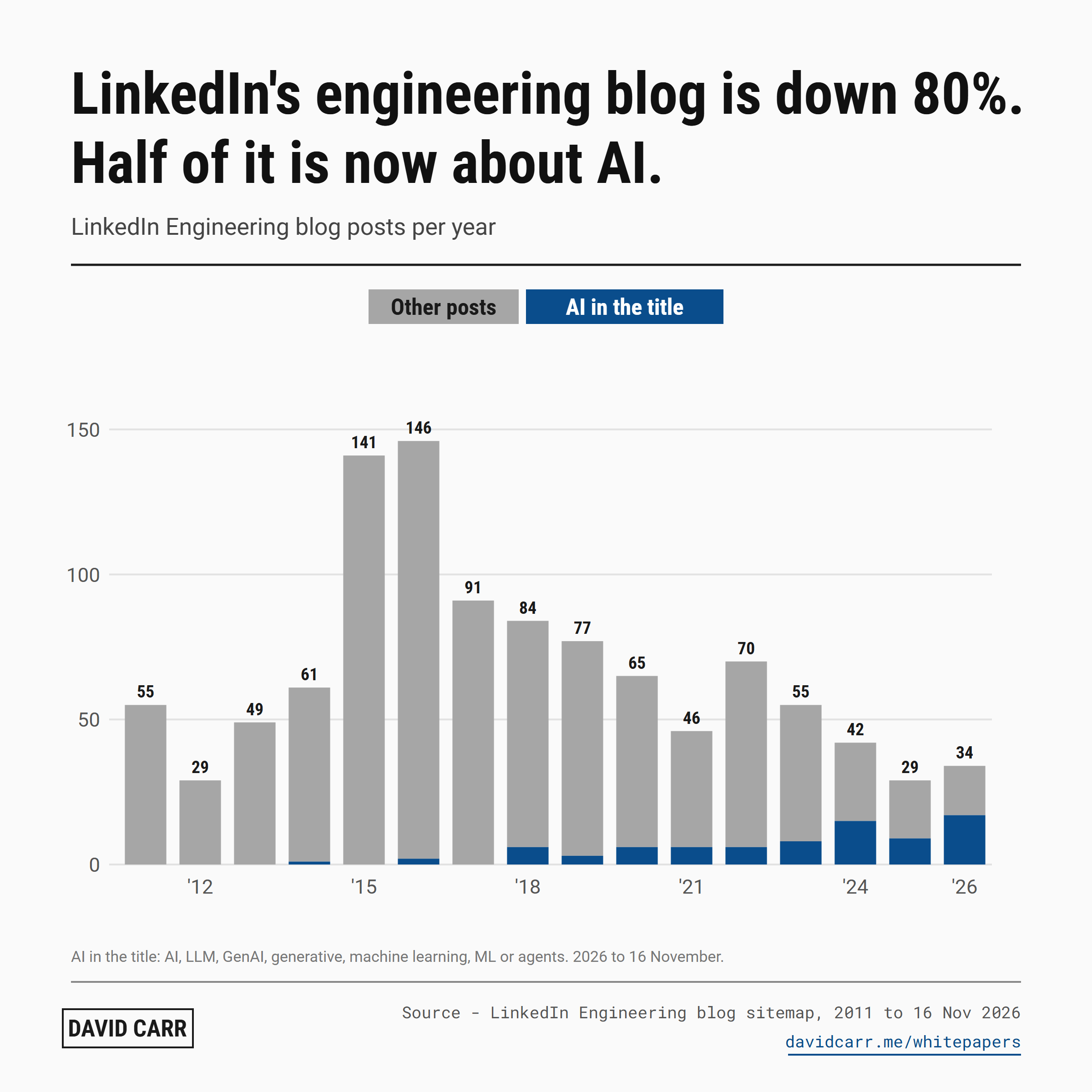
LinkedIn's engineering blog is down 80%. Half of it is now about AI.
- 2016: 146 posts
- 2025: 29
- 2026 so far: 34 posts, 17 with AI in the title
Fewer posts, and the ones left are mostly about AI and infrastructure.
AI in the title means AI, LLM, GenAI, generative, machine learning, ML or agents.
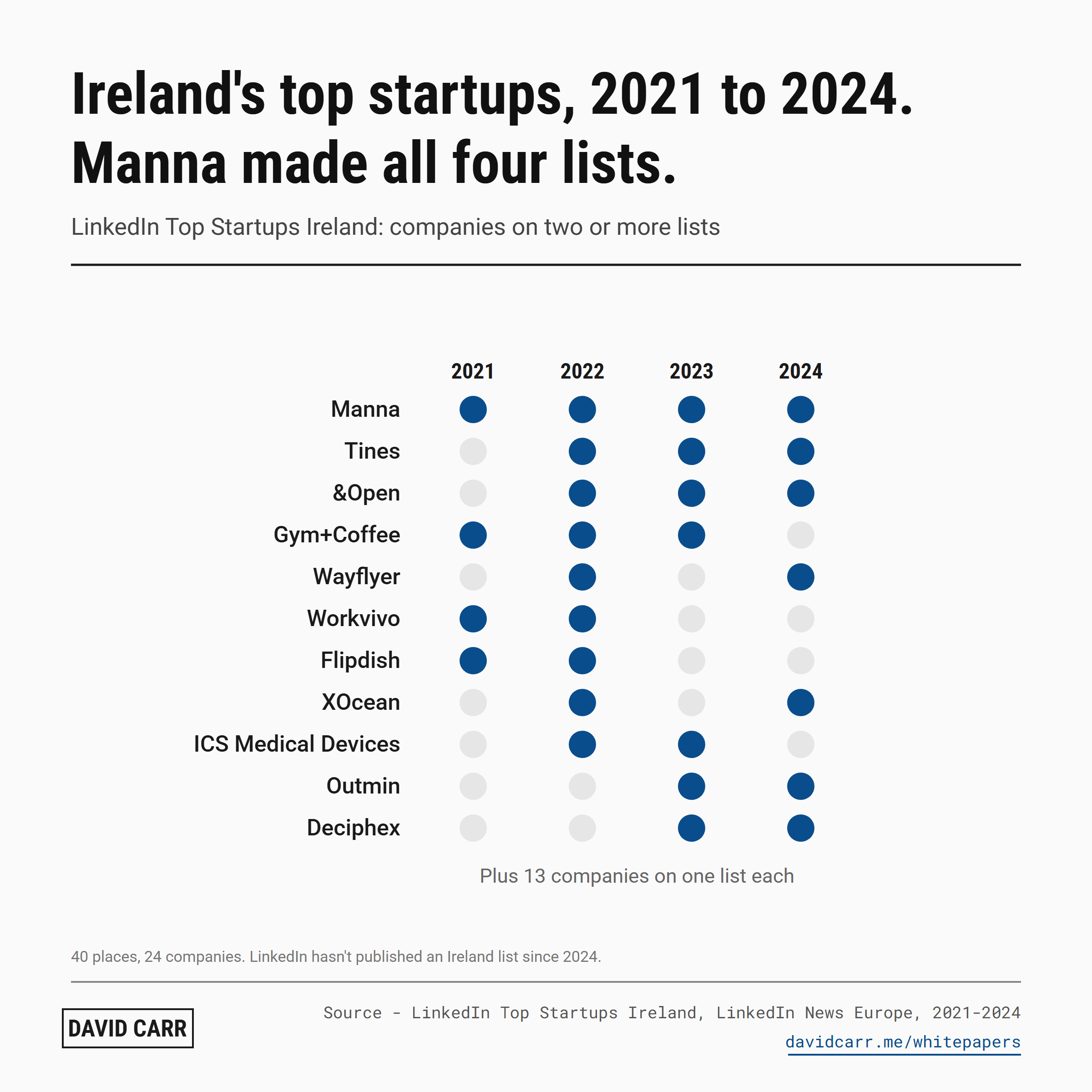
Ireland's top startups, 2021 to 2024. Manna made all four lists.
- Manna, the Dublin drone-delivery company: all four years
- Tines, &Open and Gym+Coffee: three each
- Dublin companies filled 5, 6, 8 and 7 of the 10 places
- 40 places went to 24 companies
Then the Irish list stopped. Europe got a combined list in 2025, and Ireland wasn't in it.
Published by LinkedIn News Europe. The 2021 list called itself the first.
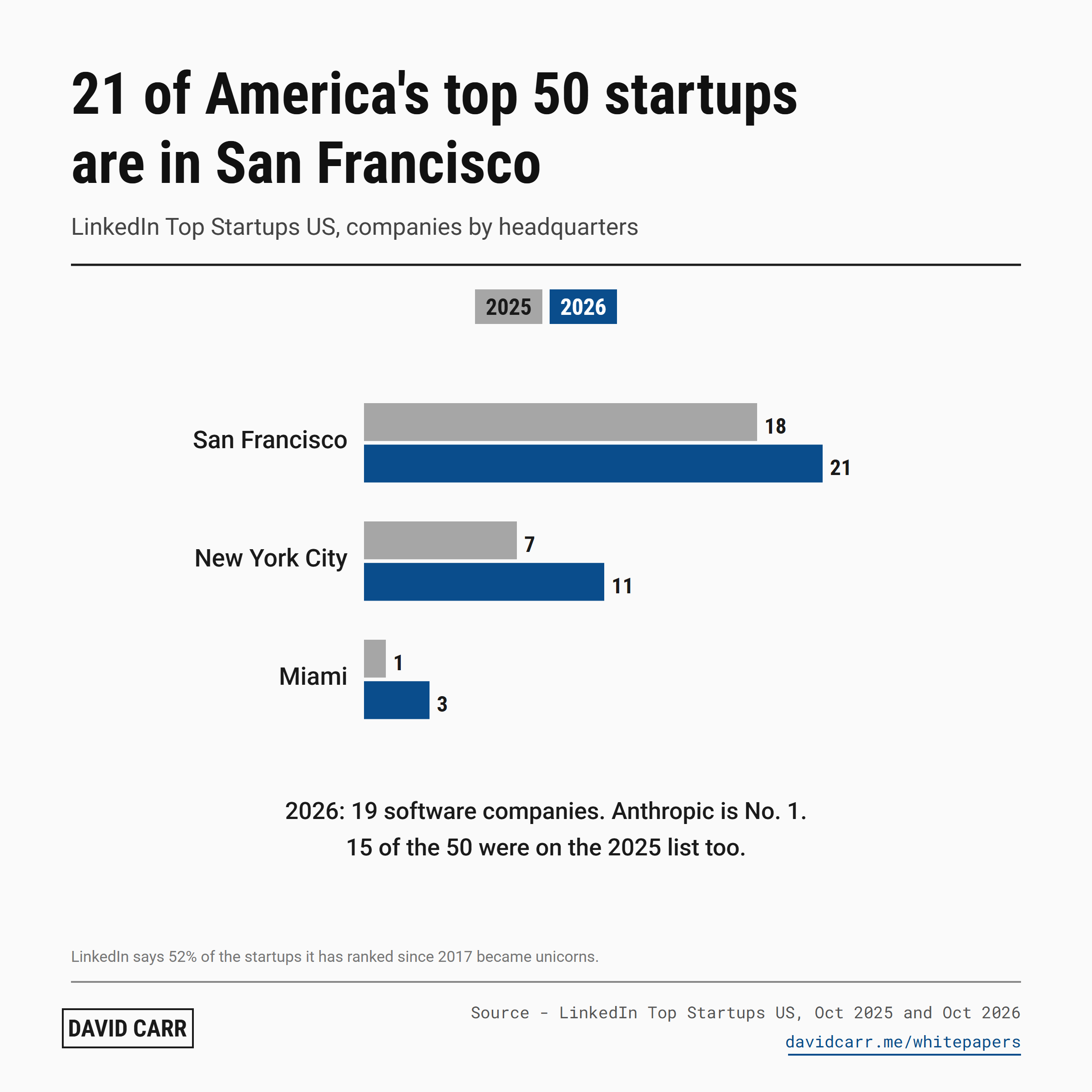
21 of America's top 50 startups are in San Francisco
- San Francisco: 18 in 2025, 21 in 2026
- New York City: 7, then 11
- Anthropic is No. 1 in 2026
- 35 of 2026's 50 are new to the list
LinkedIn says 52% of the 315 startups it has ranked since 2017 became unicorns.
Top Startups is LinkedIn's own ranking, built from its own data.
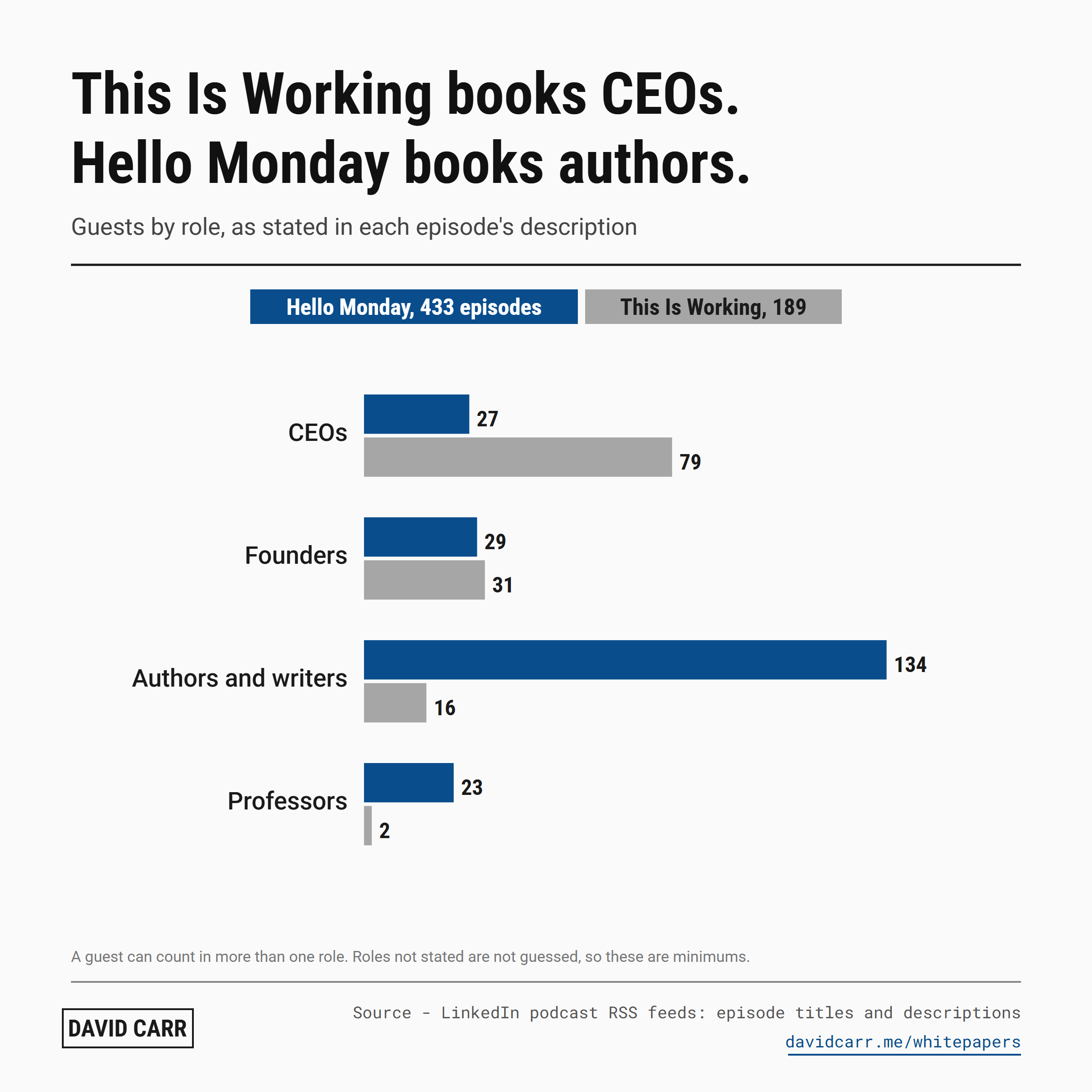
This Is Working books CEOs. Hello Monday books authors.
- This Is Working: 79 CEO mentions against Hello Monday's 27
- Hello Monday: 134 authors and writers against 16
- Most frequent guest across the shows: Reid Hoffman, LinkedIn's co-founder, 9 times
Two shows from the same company, aimed at two different rooms.
Roles as stated in each episode's description. Nothing is guessed, so these are minimums.
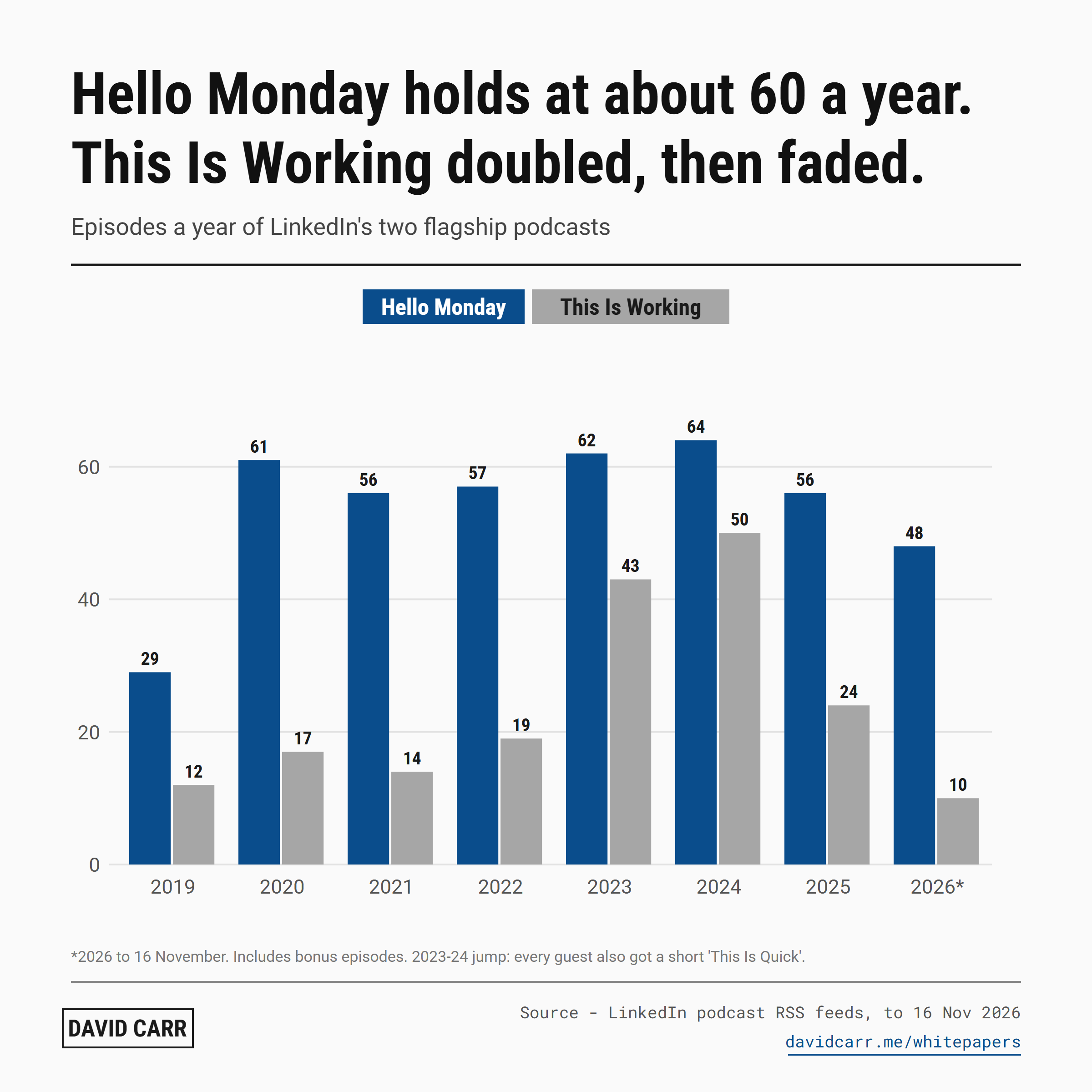
Hello Monday holds at about 60 a year. This Is Working doubled, then faded.
- Hello Monday: 433 episodes since 2019, 56 to 64 a year
- This Is Working: 19 in 2022, 50 in 2024, 10 so far in 2026
- 1,125 episodes across 14 LinkedIn podcast feeds in all
The 2023-24 jump came from pairing each guest with a short 'This Is Quick' episode.
Counts include bonus episodes and trailers, from each show's RSS feed.
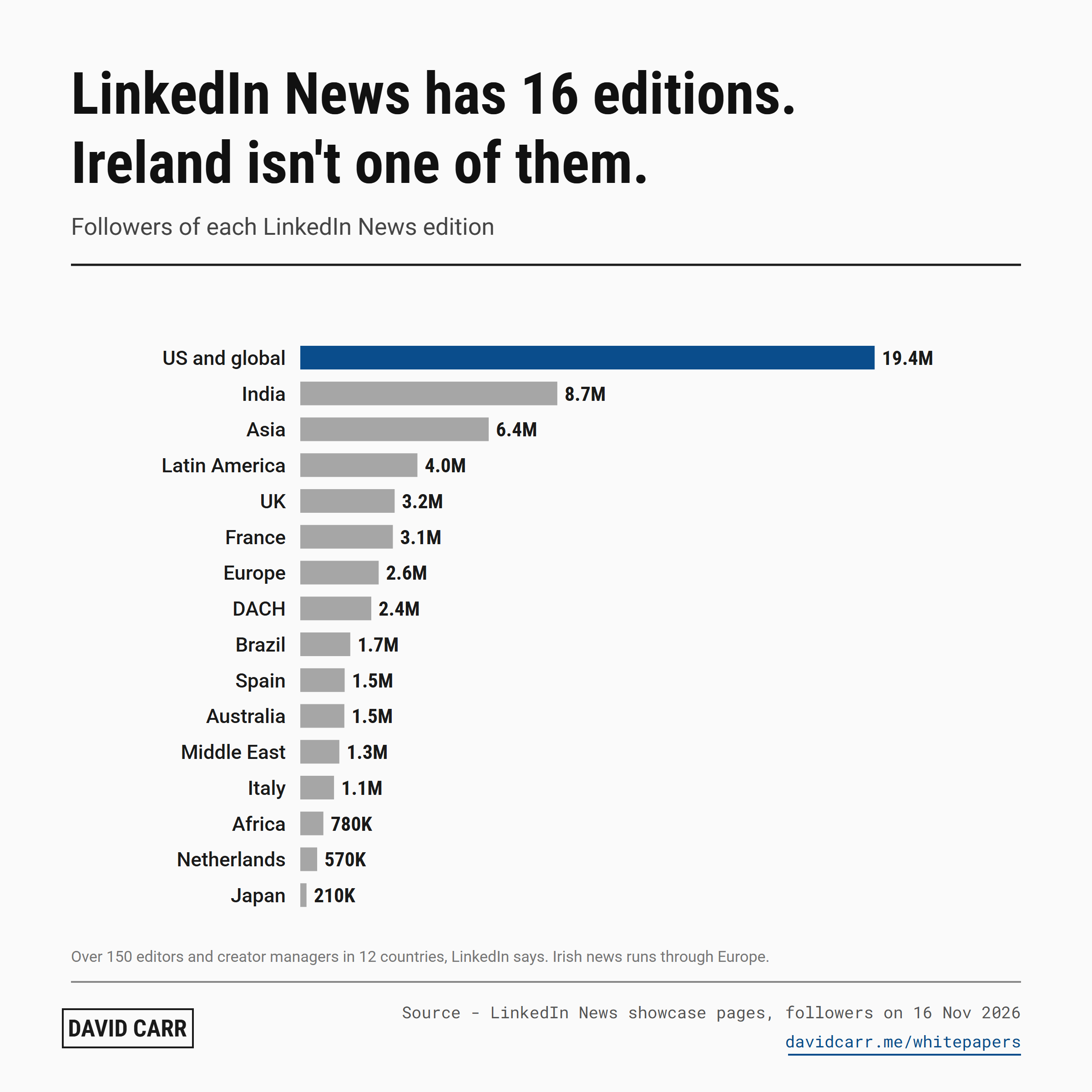
LinkedIn News has 16 editions. Ireland isn't one of them.
- US and global: 19.4 million followers
- India: 8.7 million
- UK: 3.2 million
- Europe, which covers Ireland: 2.7 million
Over 150 editors and creator managers across 12 countries and seven languages, LinkedIn says.
Follower counts from each edition's public page on 16 November 2026.
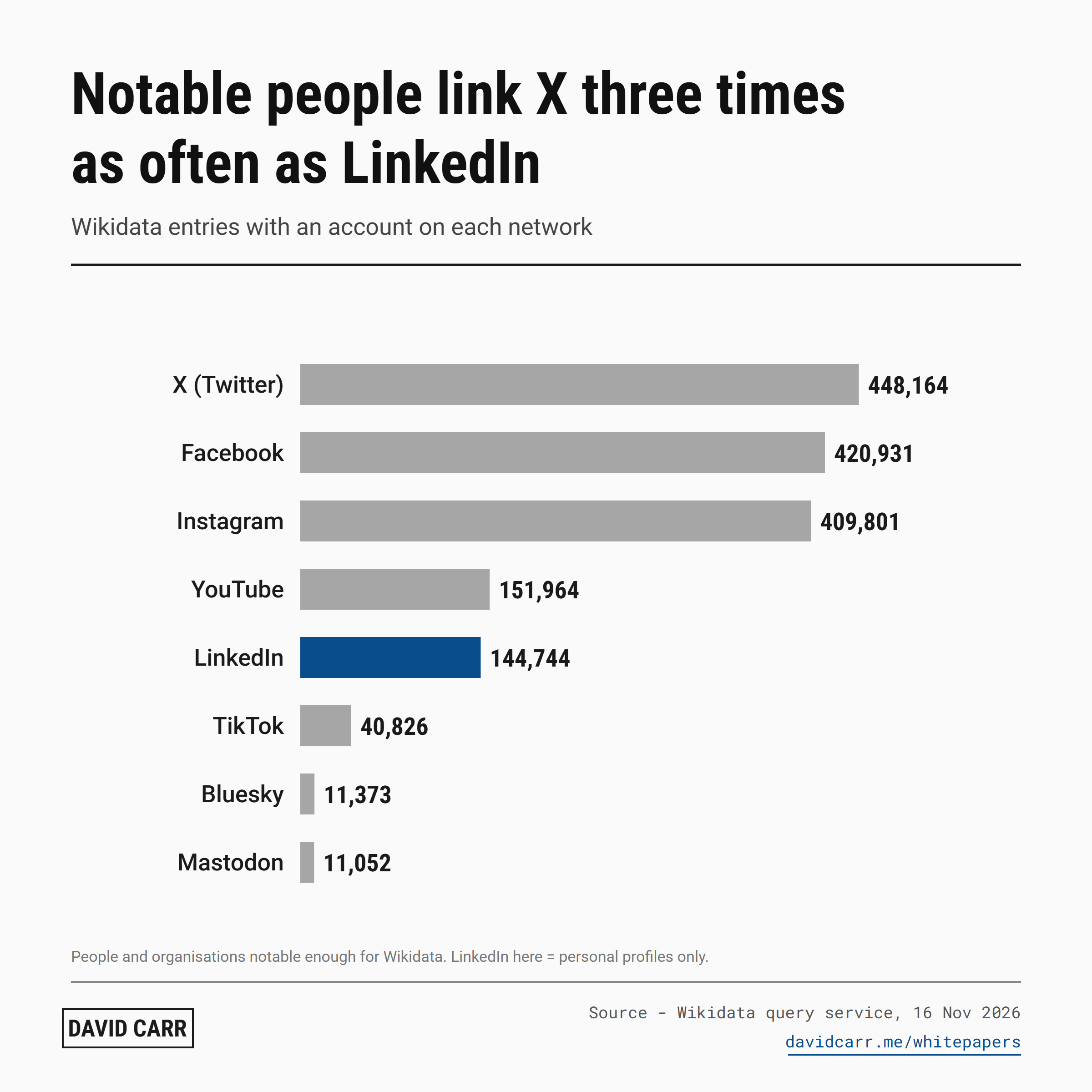
Notable people link X three times as often as LinkedIn
- X: 448,164 entries
- Facebook: 420,931
- Instagram: 409,801
- LinkedIn: 144,744 people, plus 54,117 organisations
LinkedIn is still well ahead of TikTok, Bluesky and Mastodon.
Wikidata is edited by volunteers, so this counts what's been recorded, not every account that exists.
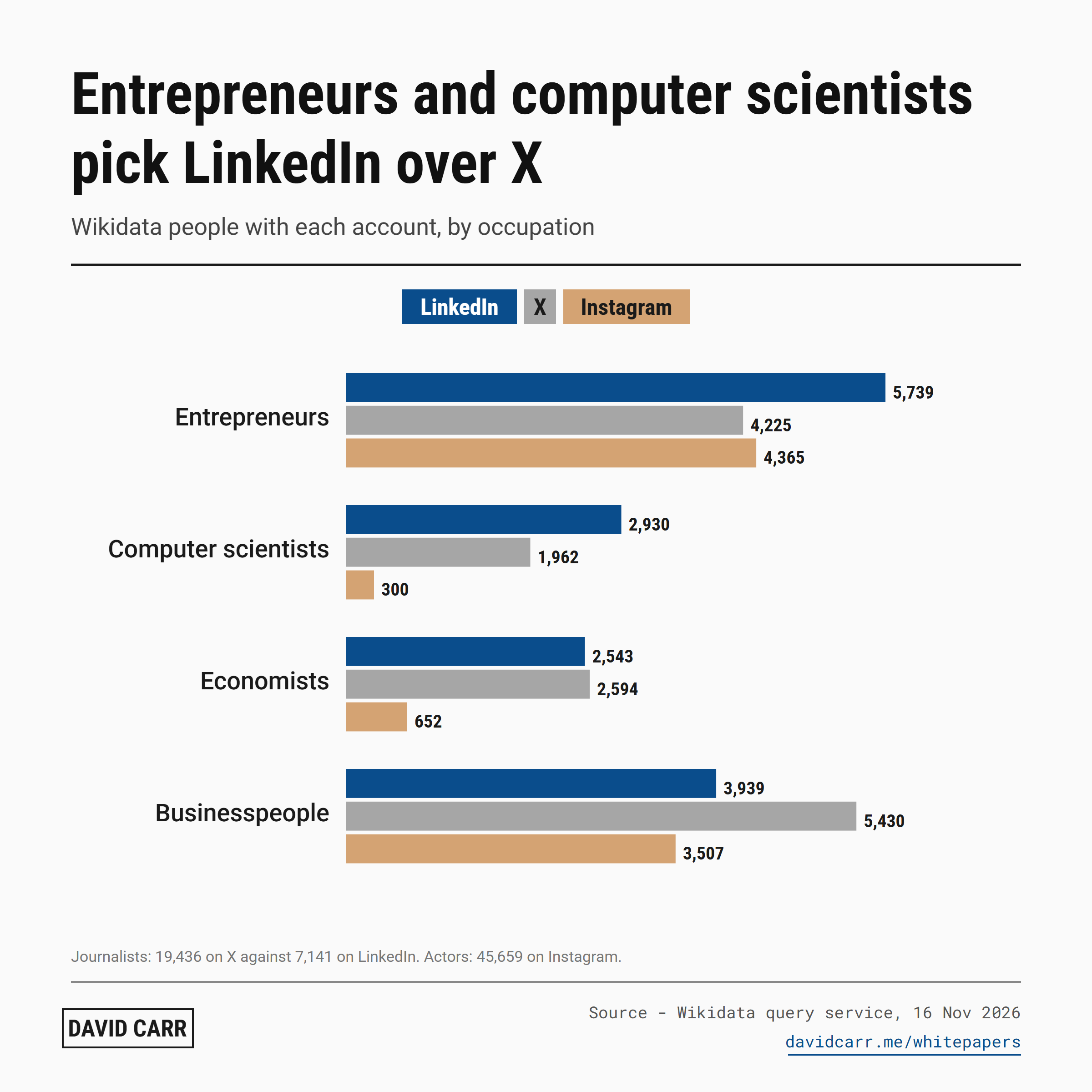
Entrepreneurs and computer scientists pick LinkedIn over X
- Entrepreneurs: 5,739 on LinkedIn, 4,225 on X
- Computer scientists: 2,930 against 1,962
- Economists: about even
- Journalists: 19,436 on X against 7,141 on LinkedIn
Entrepreneurs and computer scientists are the two groups here where LinkedIn leads.
Researchers are the biggest group with a LinkedIn ID: 36,618.
Method, caveats and sources
Revenue. LinkedIn's own 10-Ks for 2009 to 2015 (calendar years). Microsoft's 10-Ks for FY2018 to FY2026 (years to 30 June), using the latest-filed figures: Microsoft restated FY2022 and FY2023 slightly. FY2017 is left off the chart because it only covers December to June. Microsoft's 10-Q for the quarter to September 2026 no longer reports LinkedIn separately. The last figure is in the FY2026 10-K, matched by LinkedIn's newsroom.
Members. LinkedIn's 10-Ks (year-end counts, 2010 to 2015) and LinkedIn's newsroom (milestones and earnings highlights, 2011 to April 2026).
Fake accounts. LinkedIn's Community Report. Figures before 2021 are no longer on LinkedIn's own pages, so they're left out.
Rivals. Recruit Holdings' financial data (HR Technology segment, old basis, years to March). Upwork's and Fiverr's SEC filings. New Work SE's annual reports for Xing. Viadeo's own regulatory filings for its 2014 and 2015 member counts.
Wikipedia. Wikimedia's pageviews API, English Wikipedia, human traffic, July 2015 to October 2026. Yearly figures are monthly averages; 2026 is January to October.
Wikidata. The Wikidata query service on 16 November 2026: entries holding each network's ID property, and the same by occupation.
Podcasts. Each show's public RSS feed: every episode's date, title and description, to 16 November 2026. Guest roles are counted only where the description states them.
Top Startups and LinkedIn News. LinkedIn's own public list articles (Ireland 2021 to 2024, US 2025 and 2026) and each LinkedIn News edition's public page.
Engineering blog. Every post in the blog's sitemap, 1,080 posts from October 2011, with its published date.
From the inside: LinkedIn, from my own account and Giving and Getting.