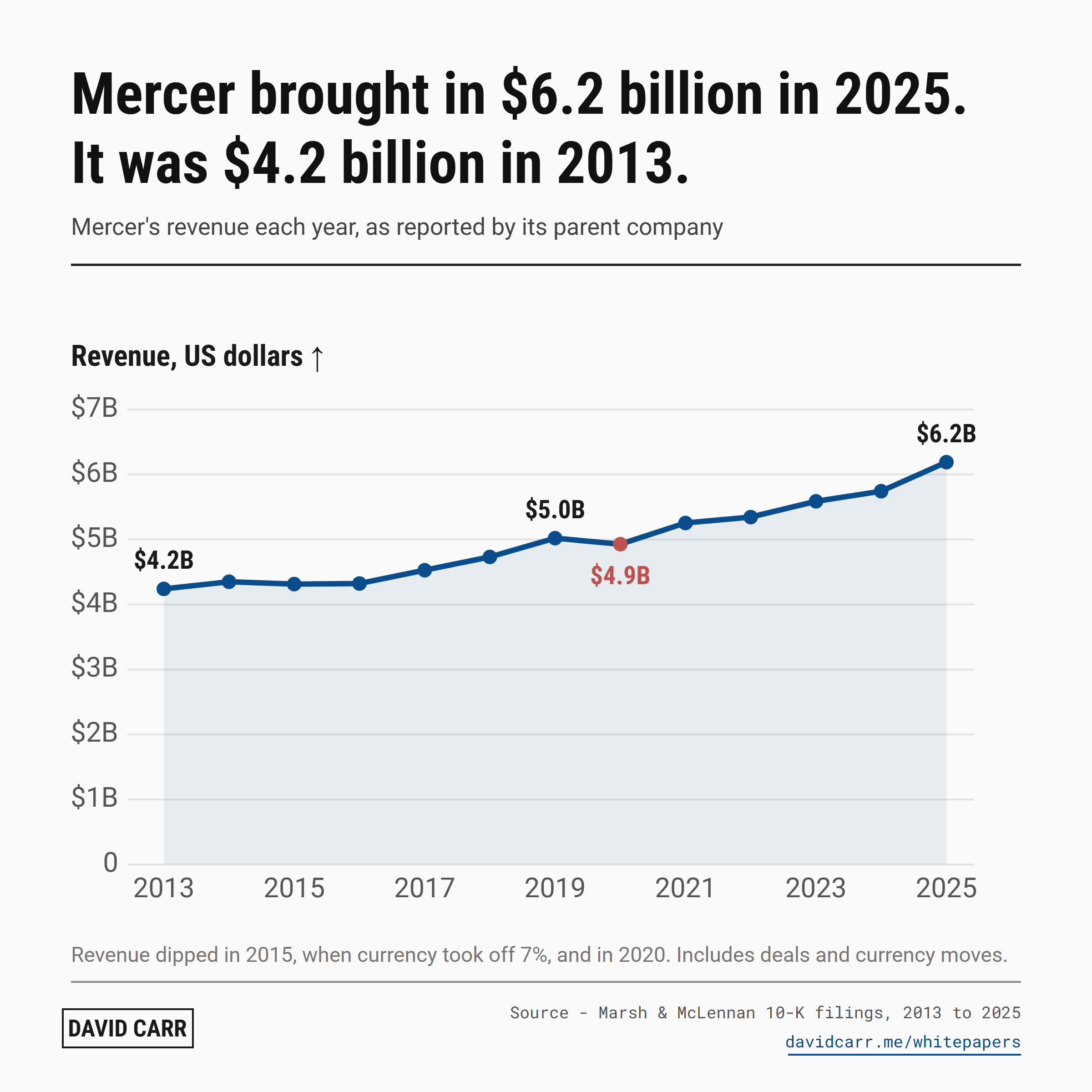
Mercer brought in $6.2 billion in 2025. It was $4.2 billion in 2013.
- 2013: $4.24 billion
- 2019: $5.02 billion
- 2020: $4.93 billion
- 2024: $5.74 billion
- 2025: $6.19 billion
Mercer is not listed on its own. Its parent reports its revenue every year, so the run goes back more than a decade.
From the parent company's 10-K filings, 2013 to 2025. Revenue includes acquisitions and currency moves.
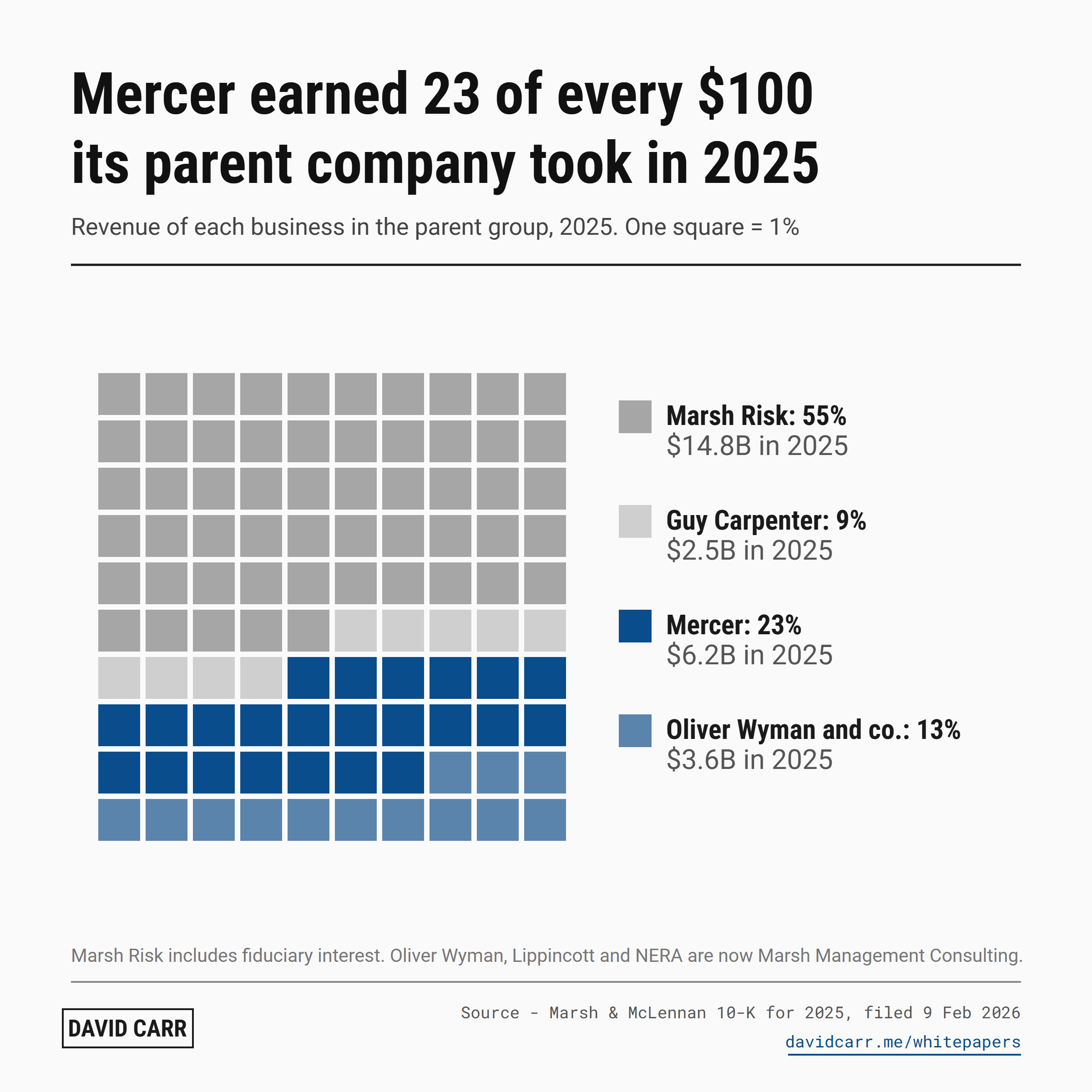
Mercer earned 23 of every $100 its parent company took in 2025
- Marsh Risk (insurance broking, with fiduciary interest): $14.8 billion, 55%
- Mercer: $6.2 billion, 23%
- Oliver Wyman, Lippincott and NERA: $3.6 billion, 13%
- Guy Carpenter (reinsurance): $2.5 billion, 9%
Mercer is the second-biggest of the four businesses. The parent's 10-K puts it at "approximately 23%" of revenue.
From the 2025 10-K. Shares are of segment revenue before a small corporate adjustment.
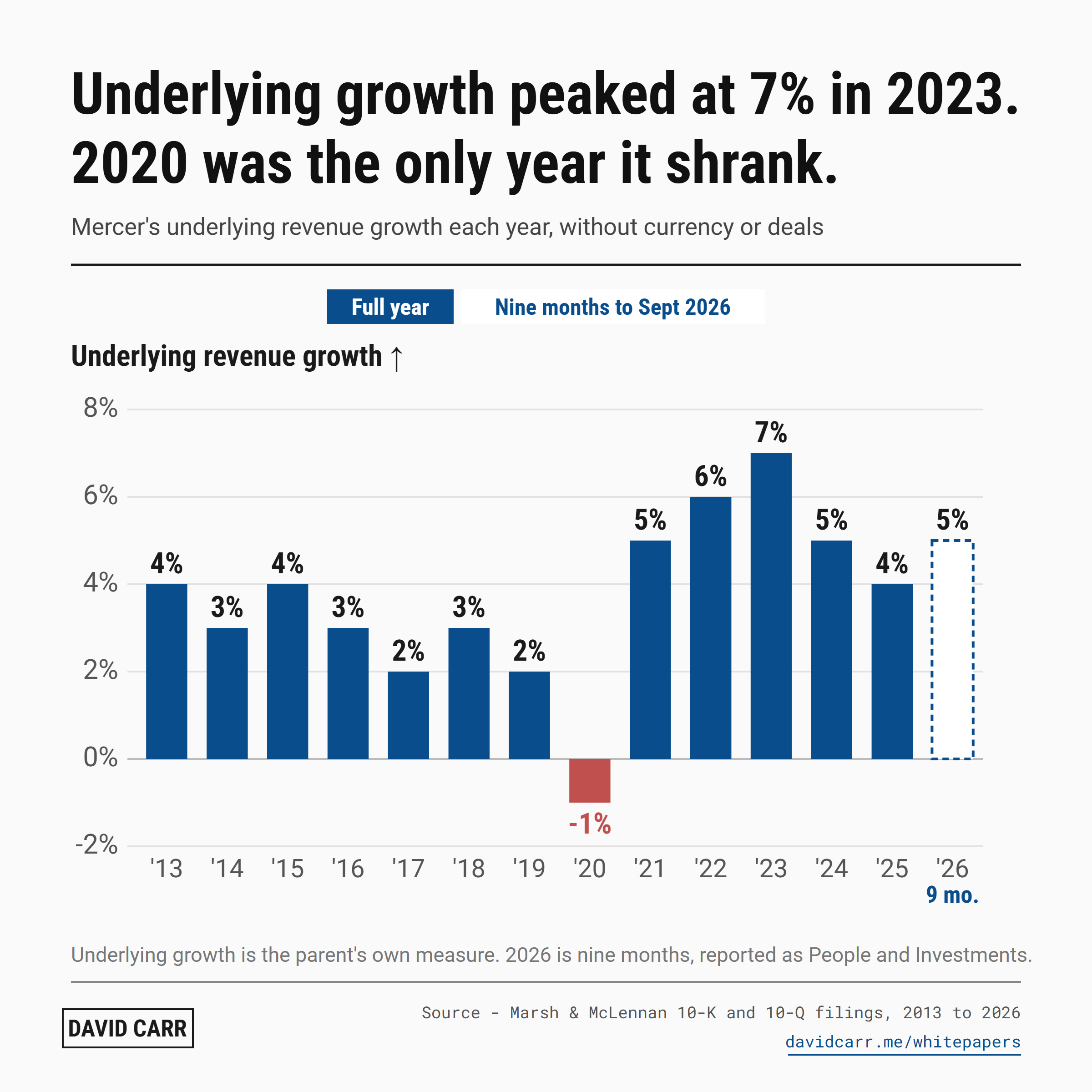
Underlying growth peaked at 7% in 2023. 2020 was the only year it shrank.
- 2013 to 2019: 2% to 4% a year
- 2020: -1%
- 2021 to 2023: 5%, 6%, 7%
- 2024: 5%. 2025: 4%
- First nine months of 2026: 5%
Underlying growth strips out currency and deals. It is the parent's own measure of how the business grew on its own.
Each year's figure from that year's 10-K, and the Q3 2026 10-Q for 2026.
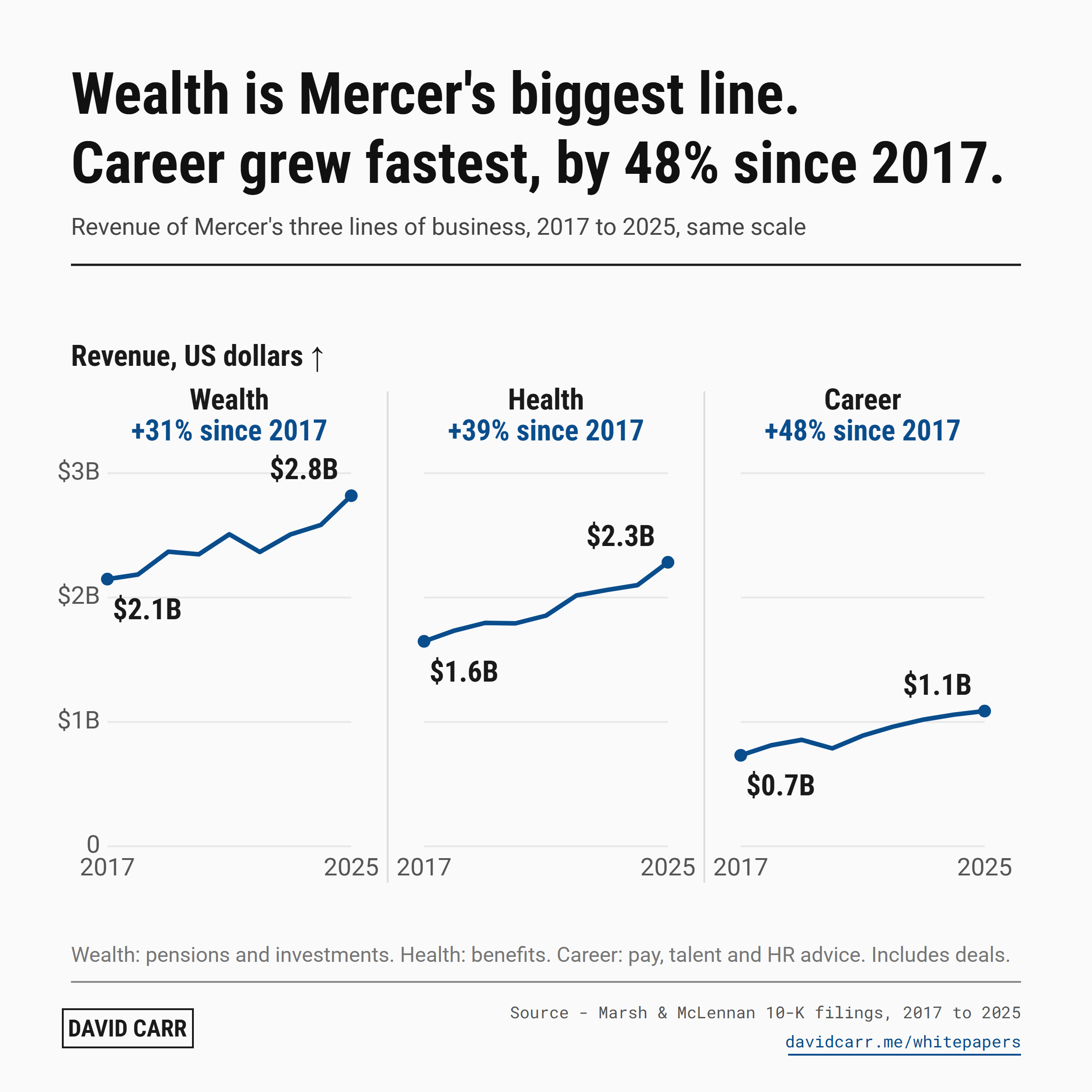
Wealth is Mercer's biggest line. Career grew fastest, by 48% since 2017.
- Wealth: $2.15 billion to $2.82 billion (+31%)
- Health: $1.65 billion to $2.28 billion (+39%)
- Career: $0.73 billion to $1.09 billion (+48%)
Career is the smallest line and the one that has moved most. In 2025 its underlying growth was -2%, and -1% in the first nine months of 2026.
From the 10-Ks for 2019 to 2020 and 2025. In 2026 the lines were renamed Investments and Retirement, Health and Benefits, and Workforce and Rewards.
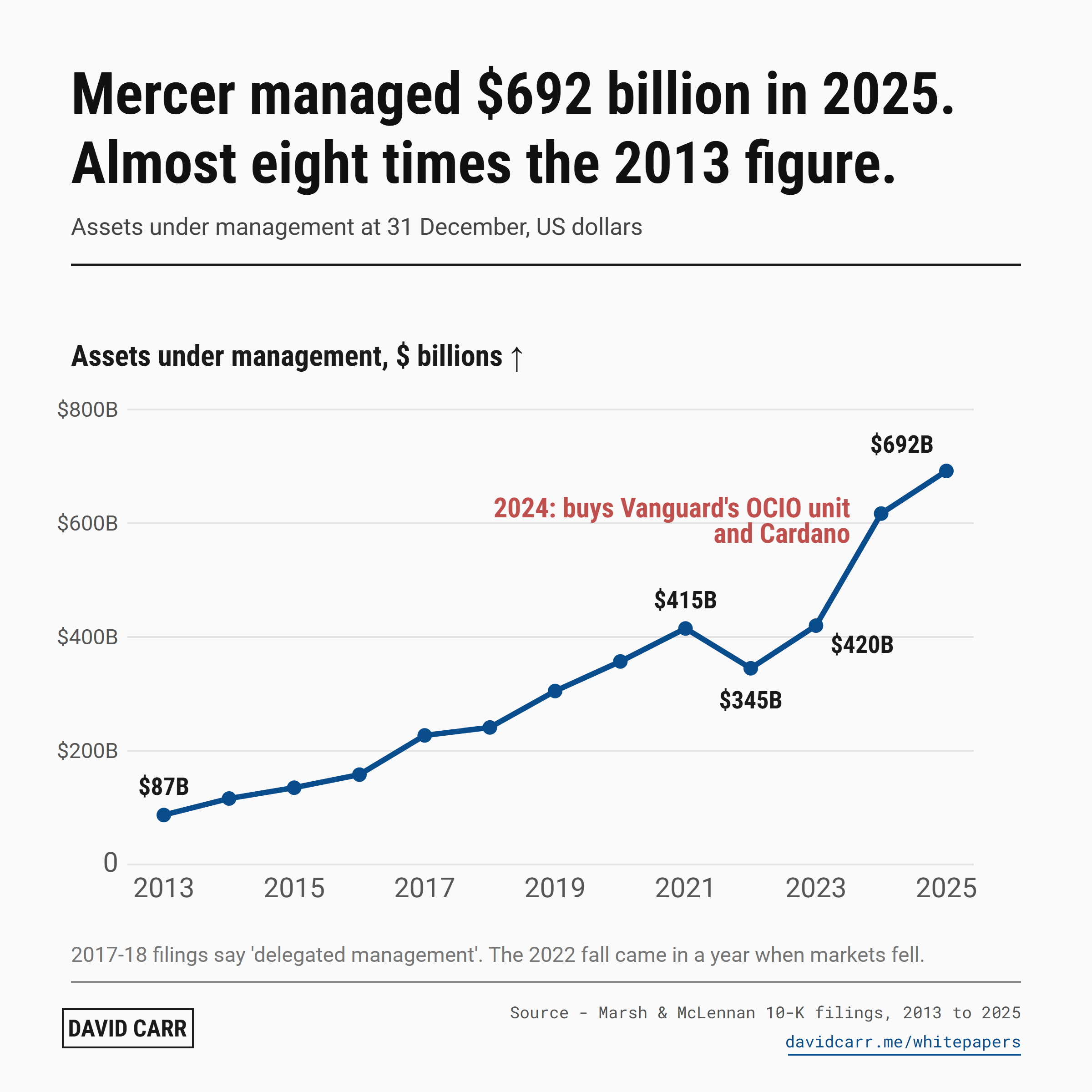
Mercer managed $692 billion in 2025. Almost eight times the 2013 figure.
- 2013: $87 billion
- 2021: $415 billion
- 2022: $345 billion
- 2023: $420 billion
- 2024: $617 billion
- 2025: $692 billion
The biggest jump came in 2024, the year Mercer bought Vanguard's outsourced investment unit and Cardano.
As stated in each 10-K. The 2024 10-K lists both deals but gives no assets for either.
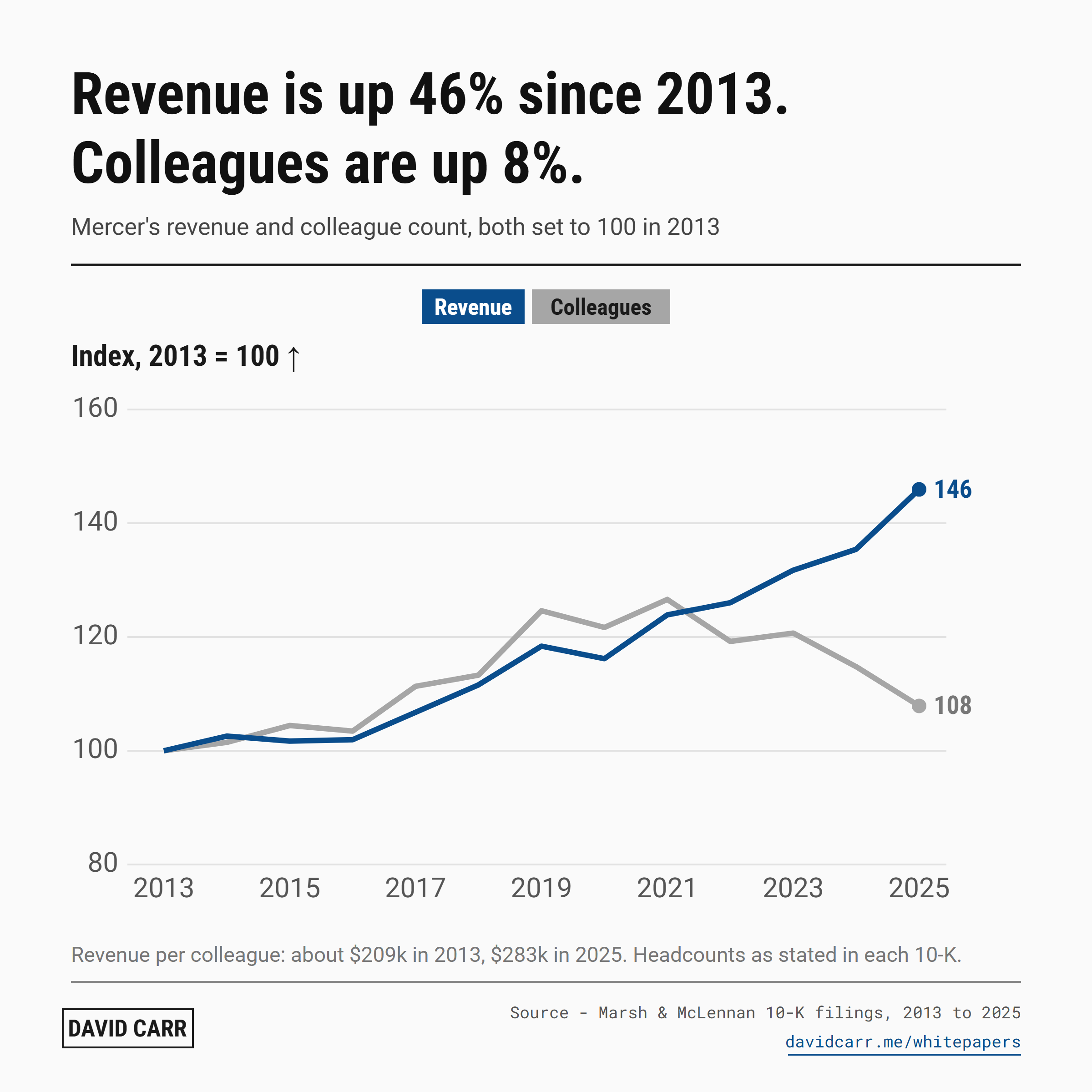
Revenue is up 46% since 2013. Colleagues are up 8%.
- 2013: about 20,300 colleagues
- 2021: about 25,700
- 2025: about 21,900
- Revenue per colleague: about $209,000 (2013), $283,000 (2025)
The headcount peaked around 2021. On 1 January 2024 Mercer sold its UK pension and US benefits administration businesses.
Headcounts as stated in each 10-K, which describe the business early the following year. The sale is in the 2024 10-K.
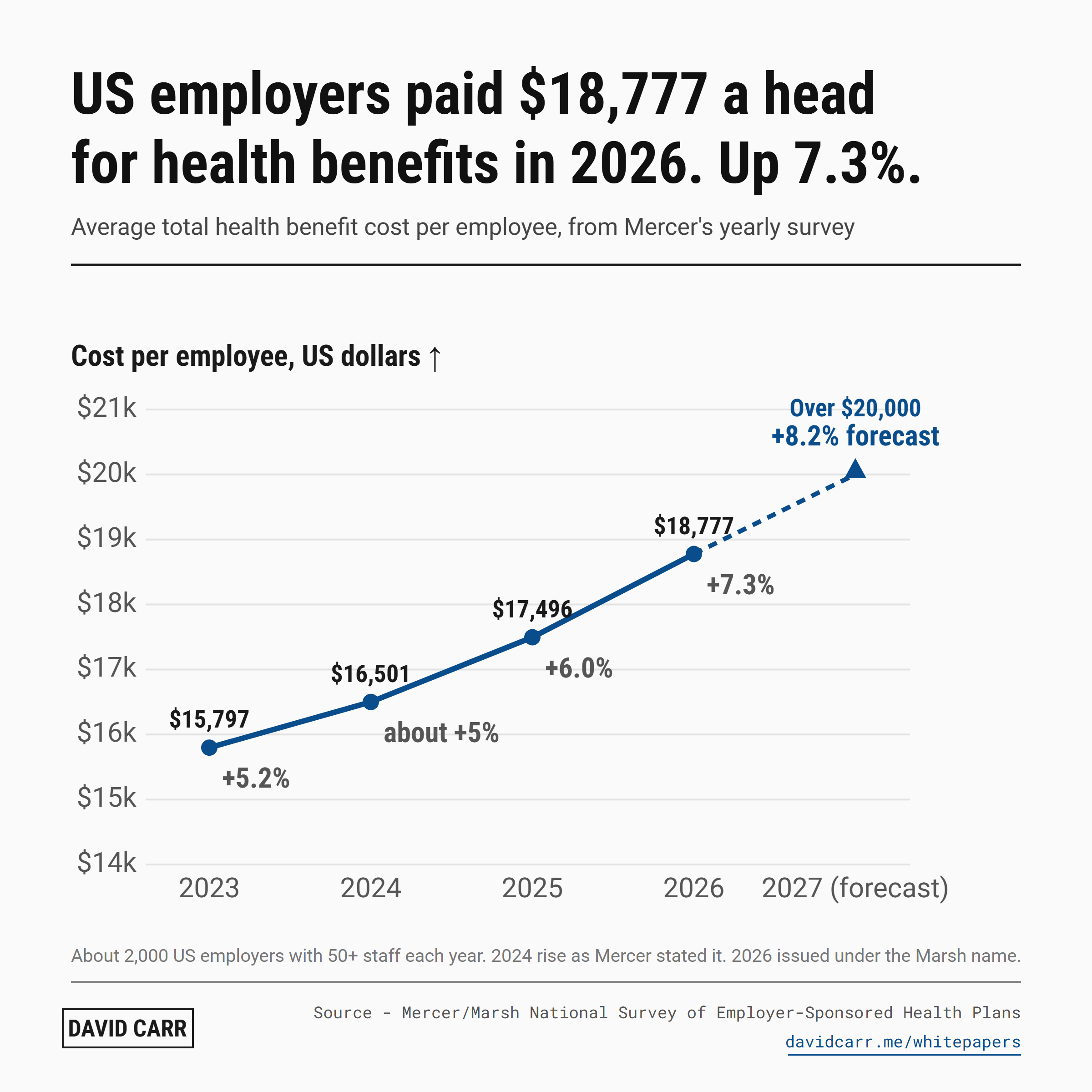
US employers paid $18,777 a head for health benefits in 2026. Up 7.3%.
- 2023: $15,797, up 5.2%
- 2024: $16,501, up "about 5%"
- 2025: $17,496, up 6.0%
- 2026: $18,777, up 7.3%
- 2027 forecast: up 8.2%, to over $20,000
The yearly rise has grown each year since 2024. Mercer's 2023 release said cost growth had averaged 3% a year since 2012.
Mercer's National Survey of Employer-Sponsored Health Plans, about 2,000 US employers with 50 or more staff each year. The 2026 results came out under the Marsh name.
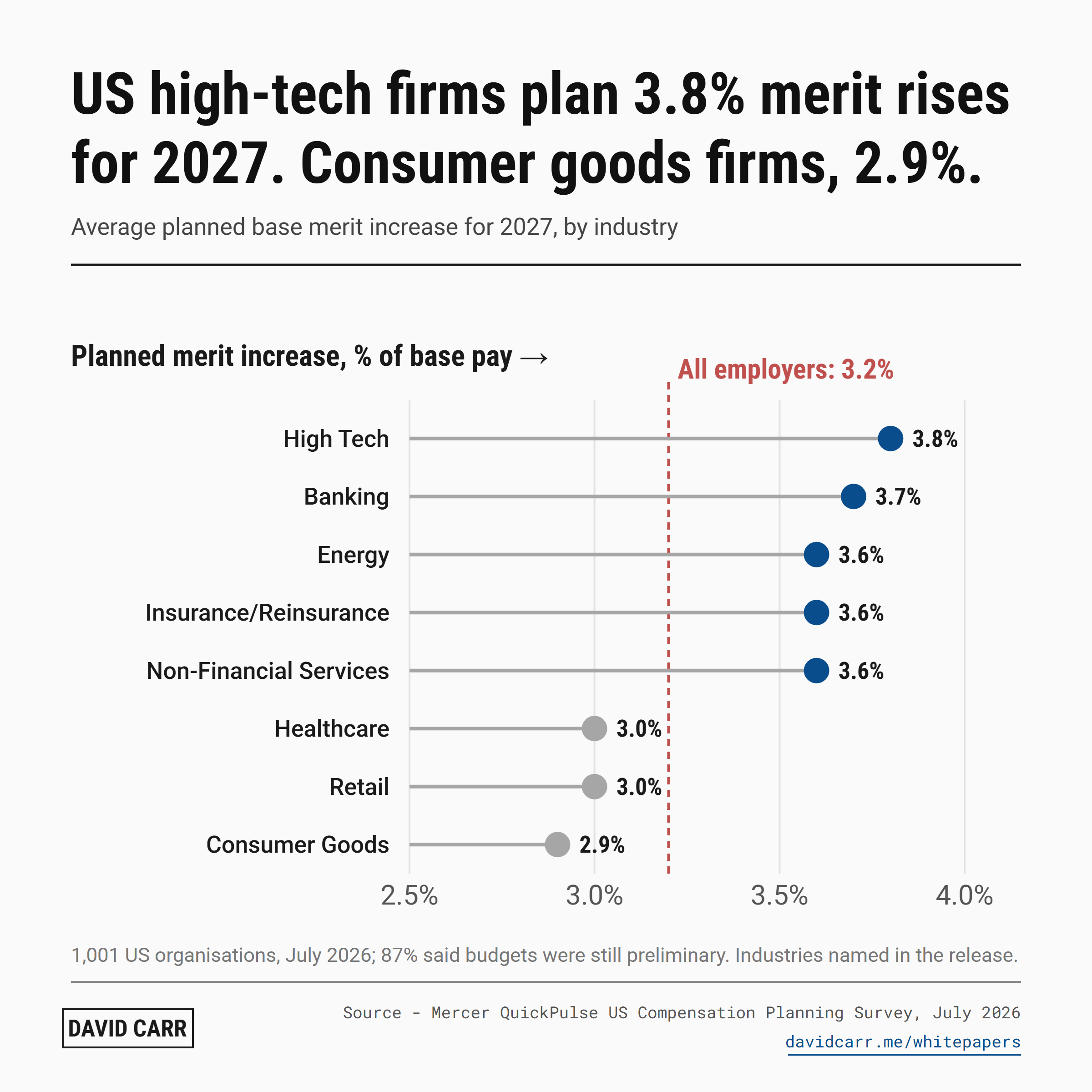
US high-tech firms plan 3.8% merit rises for 2027. Consumer goods firms, 2.9%.
- High tech: 3.8%
- Banking: 3.7%
- Energy, insurance and non-financial services: 3.6%
- Healthcare and retail: 3.0%
- Consumer goods: 2.9%
- All employers: 3.2%
The spread between industries is under one point. Mercer also expects fewer promotions: 8.4% of staff in 2027, from 9.9% in 2025.
Mercer's QuickPulse US Compensation Planning Survey, July 2026, 1,001 organisations. The overall US figures sit alongside other firms' on Pave vs its competitors.
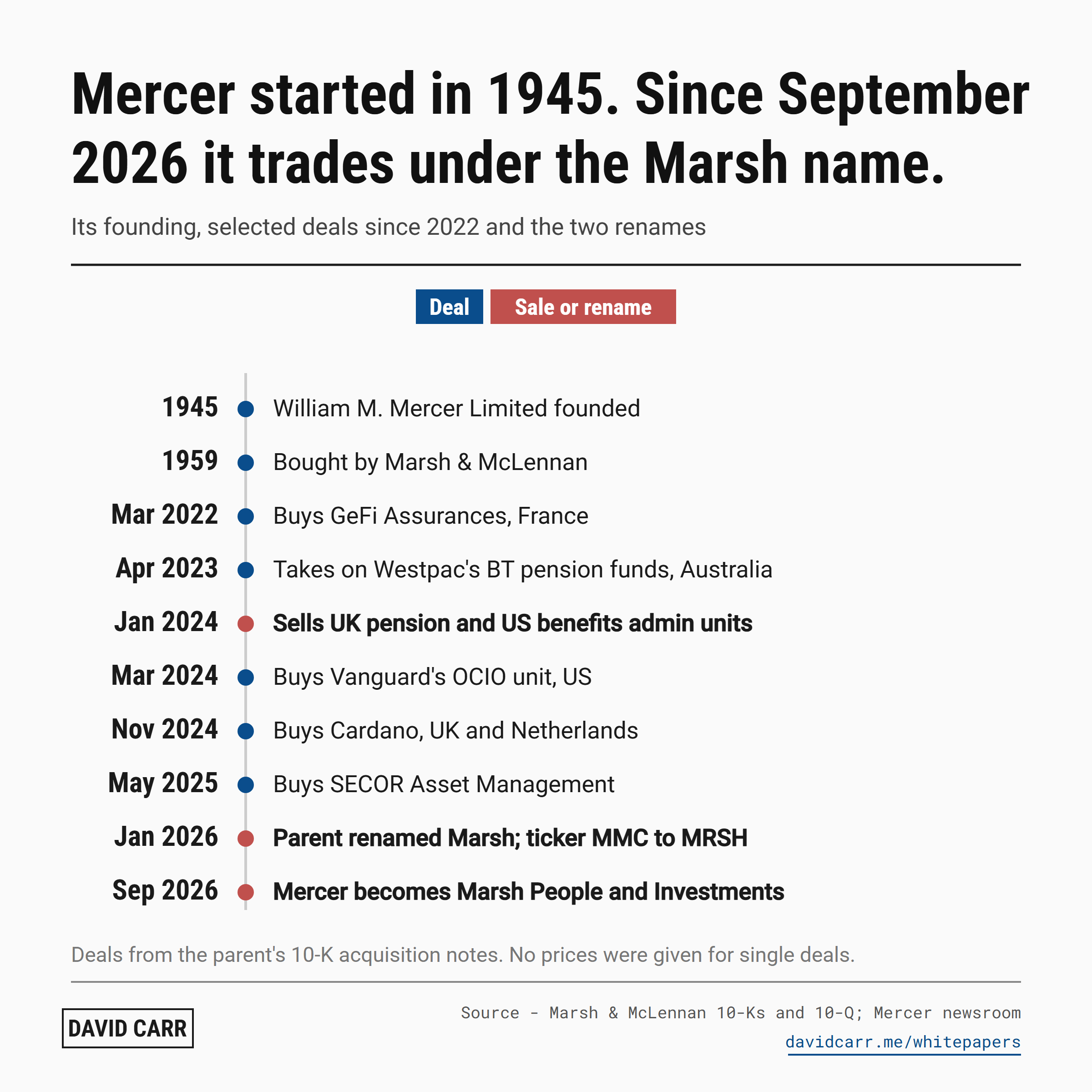
Mercer started in 1945. Since September 2026 it trades under the Marsh name.
- 1945: William M. Mercer Limited founded; bought by Marsh & McLennan in 1959
- 2024: buys Vanguard's OCIO unit and Cardano; sells two admin businesses
- January 2026: the parent renames itself Marsh, ticker MRSH
- September 2026: Mercer becomes Marsh People and Investments
The parent says the renames did not change how it reports its segments. Its filings now say People and Investments where they said Mercer.
Deals from the parent's 10-K acquisition notes; the renames from the 2025 10-K and the Q3 2026 10-Q.
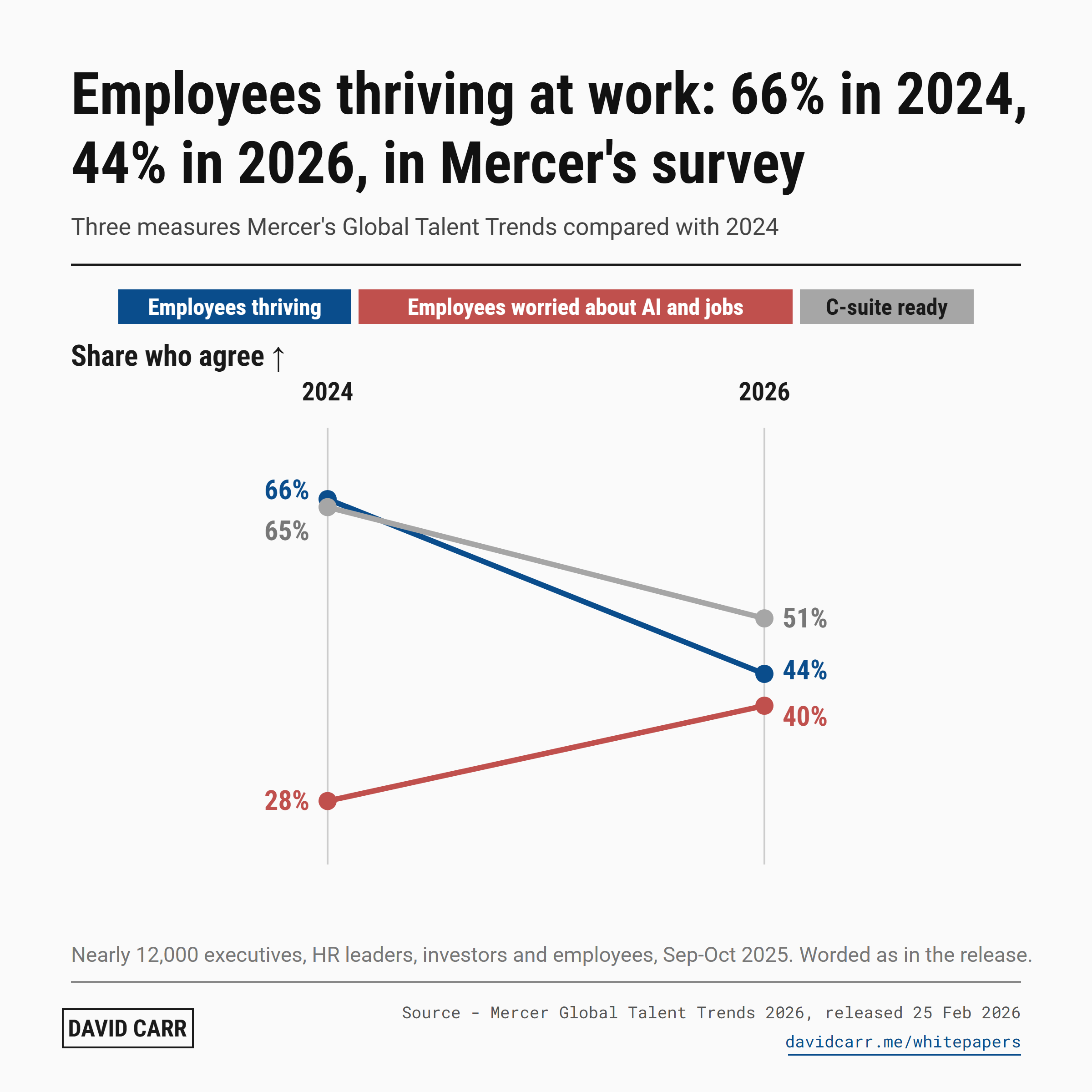
Employees thriving at work: 66% in 2024, 44% in 2026, in Mercer's survey
- Employees thriving at work: 66% to 44%
- Employees worried AI will cost them their job: 28% to 40%
- C-suite confident they are ready for the human-machine era: 65% to 51%
Two of the three measures are about AI. The release said the thriving figure was lower than during the Covid-19 pandemic.
From Mercer's Global Talent Trends 2026 release, 25 February 2026. Nearly 12,000 people surveyed in September and October 2025.
Method, caveats and sources
The short answer. Mercer took in $6.2 billion in 2025, almost a quarter of its parent's revenue, and grew 4% to 7% a year on an underlying basis since 2021. It managed $692 billion of assets. Since September 2026 it is called Marsh People and Investments.
A business inside a listed company. Mercer has no shares of its own. Its parent, Marsh & McLennan Companies, reports Mercer's revenue, its three lines and its assets in its 10-K filings. The parent was branded Marsh McLennan, ticker MMC, until 14 January 2026. It is now branded Marsh, ticker MRSH. Mercer's operating profit is not reported on its own, so it is not shown.
Growth. "Underlying" growth is the parent's own measure, leaving out currency, acquisitions and sales. Revenue figures are as reported and include them. 2019 growth is against 2018 including JLT, which the parent bought that year.
Surveys. Health costs, pay plans and Global Talent Trends are Mercer's own published results, read on mercer.com on 25 November 2026. They are surveys of employers or people, not of Mercer itself. Mercer's dataset claims and its US raise figures are on the comparison page and are not repeated here.
Left out. Prices of single deals, which were not given. A headcount after early 2026. Country scores from the pension index Mercer runs with the CFA Institute.
Also: Stripe, Pave and Pave vs its competitors.