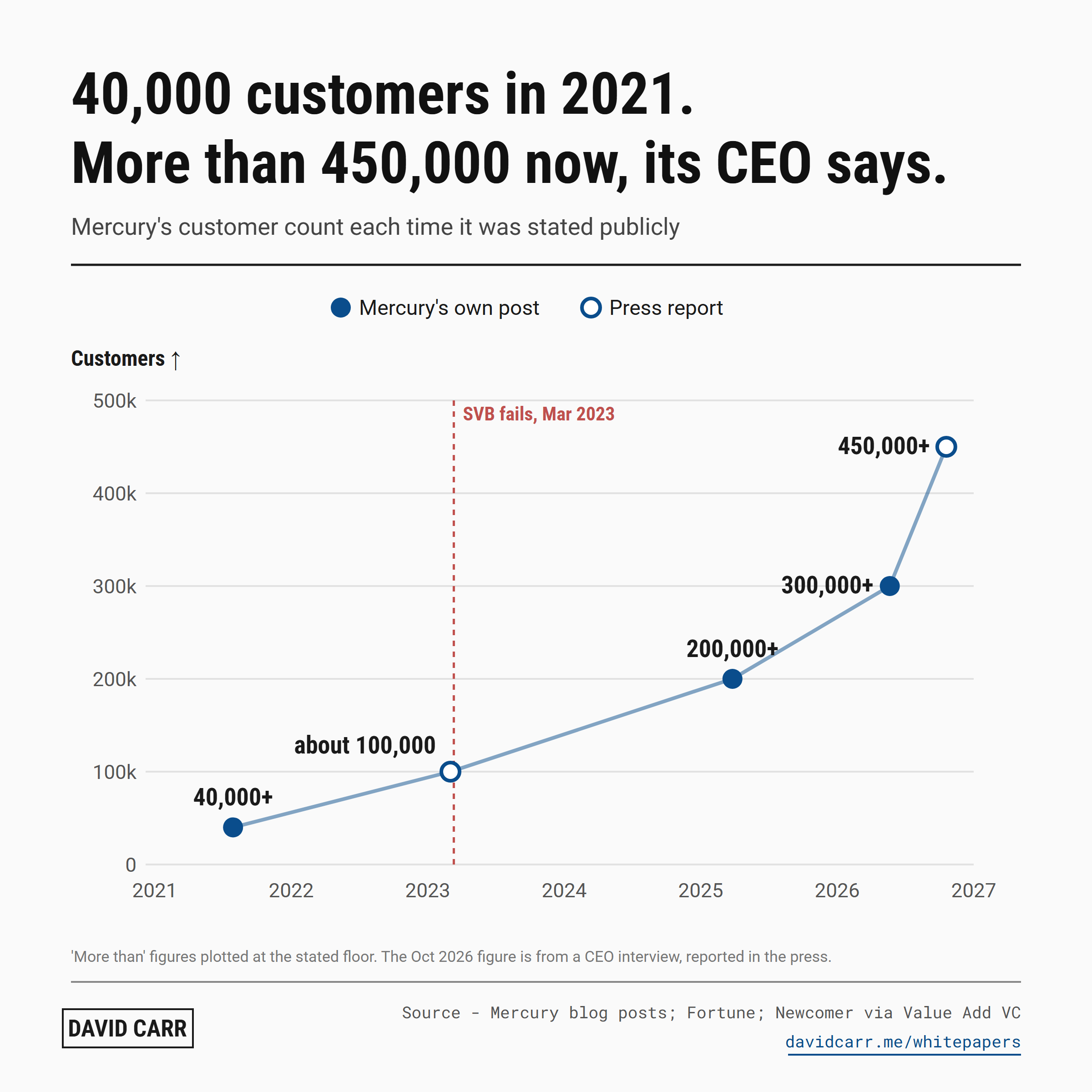
40,000 customers in 2021. More than 450,000 now, its CEO says.
The 2026 figures came fast: more than 300,000 in May, more than 450,000 five months later.
Most figures are from Mercury's own posts. The October figure is from a Newcomer interview with CEO Immad Akhund, as reported by Value Add VC. Mercury has not posted it.
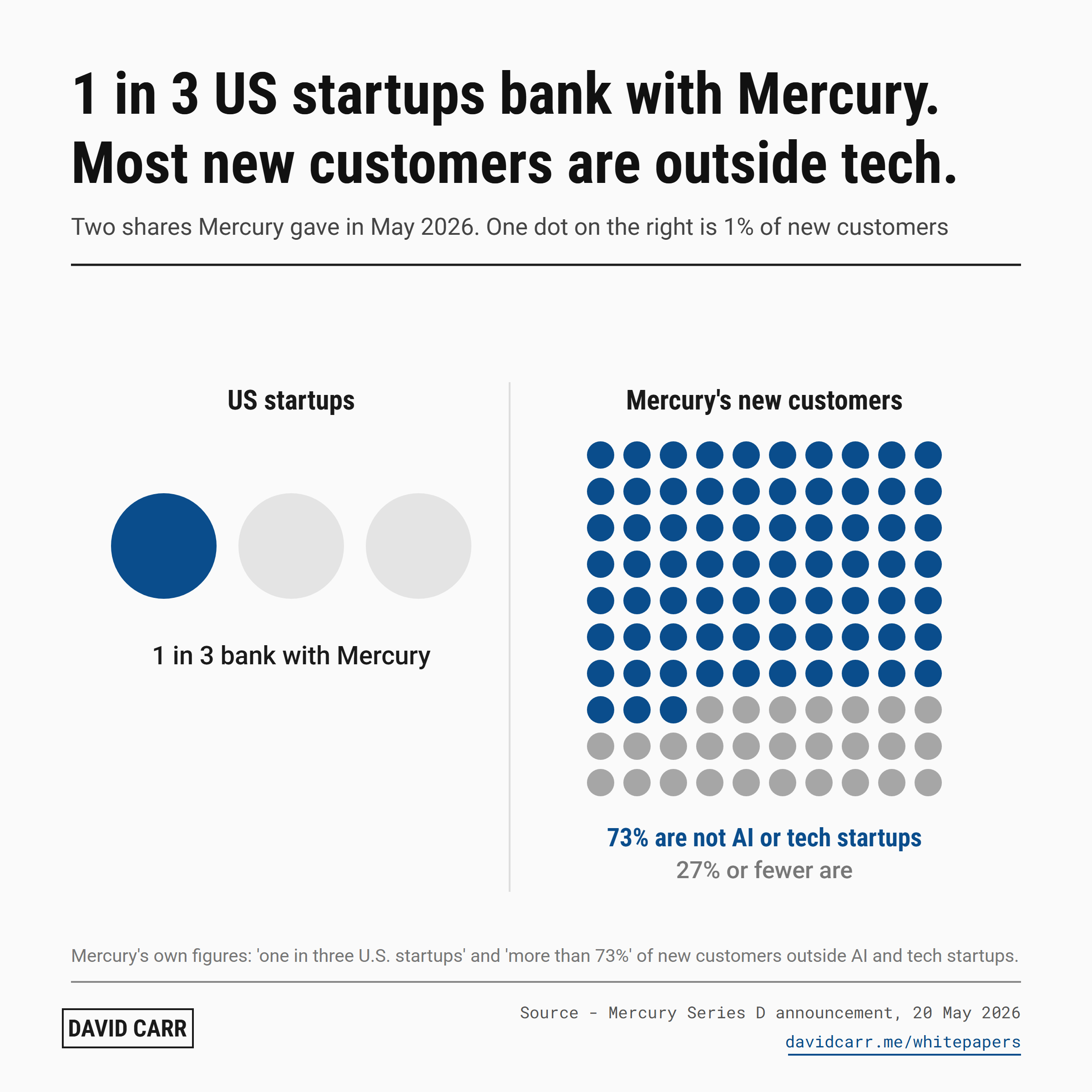
1 in 3 US startups bank with Mercury. Most new customers are outside tech.
- 1 in 3 US startups are customers
- More than 73% of new customers are outside the AI and tech startup category
Mercury started as a bank account for startups. Most of its new customers now come from outside AI and tech startups.
Both figures are Mercury's own, from its Series D post, May 2026. It doesn't say how it counts US startups.
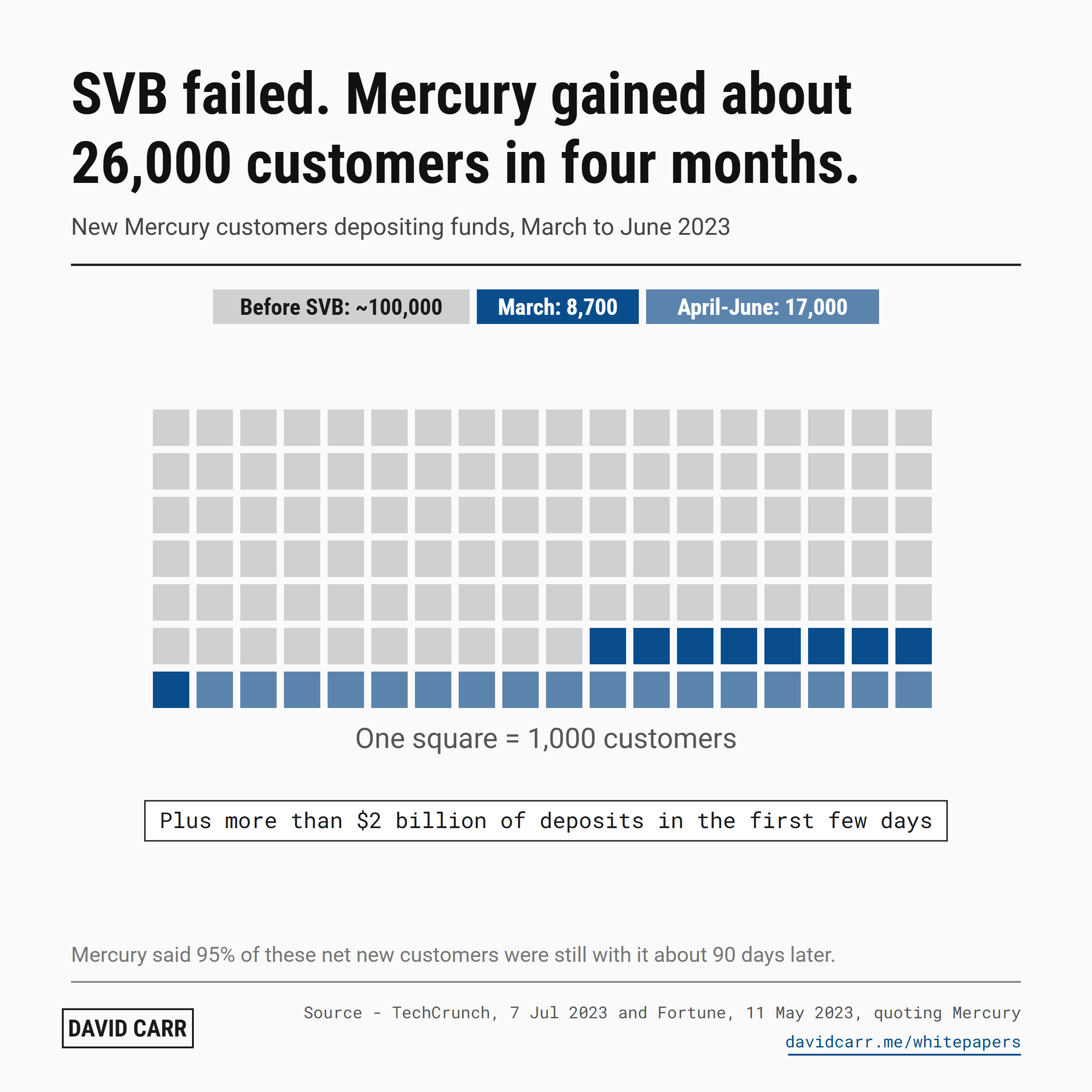
SVB failed. Mercury gained about 26,000 customers in four months.
- Before SVB: about 100,000 customers
- March 2023: nearly 8,700 new customers
- April to June: 17,000 more
- First few days: more than $2 billion of deposits
Mercury said 95% of these net new customers were still with it about 90 days later.
Figures Mercury gave TechCrunch and Fortune. TechCrunch puts the 8,700 across all of March; Fortune later quoted the CEO saying two to five days.
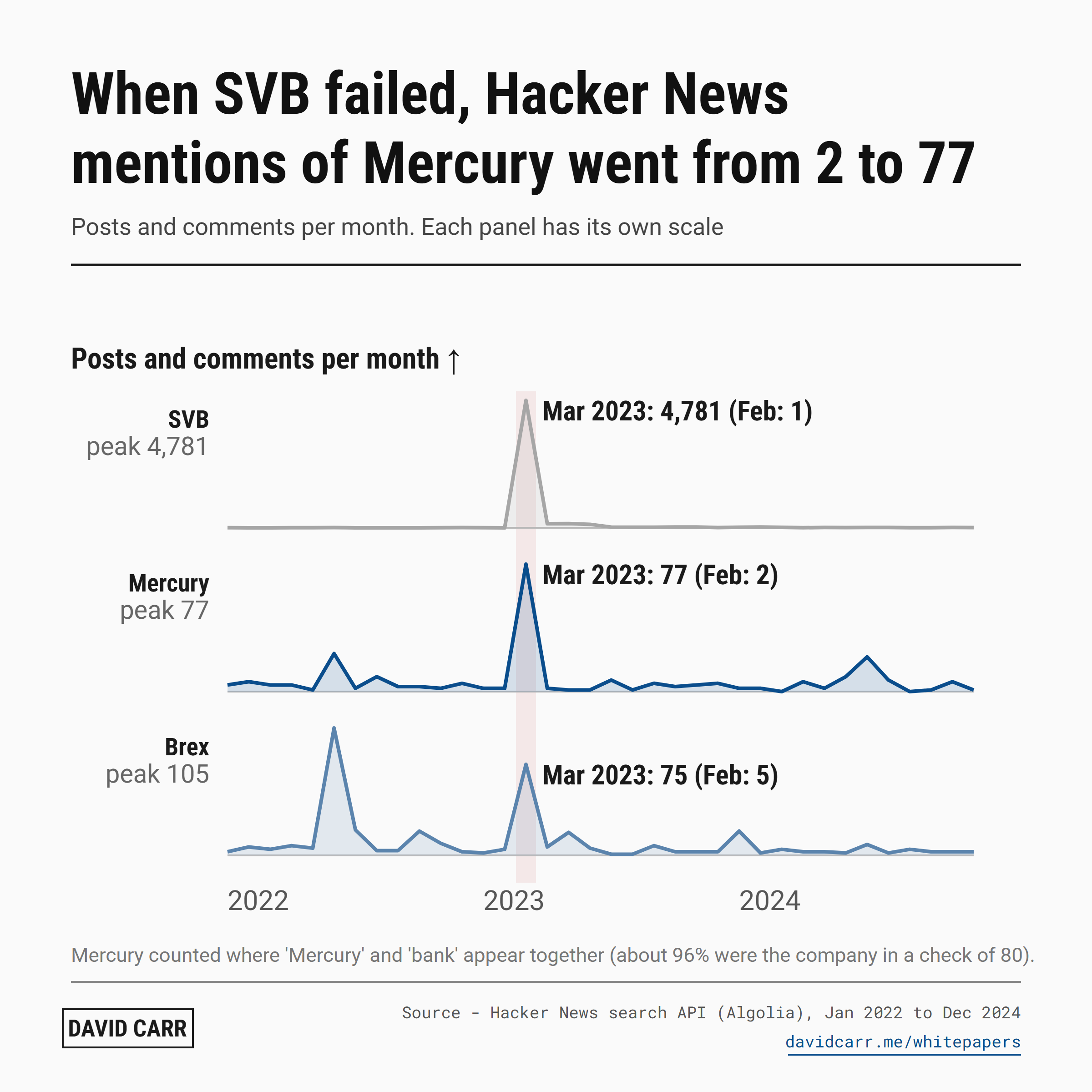
When SVB failed, Hacker News mentions of Mercury went from 2 to 77
- SVB: 4,781 in March 2023 (1 in February)
- Mercury: 77 (2 in February)
- Brex: 75 (5 in February)
Over a full year Brex still gets more. In 2023 it was Brex 133, Mercury 110. In 2026 to October, Brex 113, Mercury 57.
Posts and comments from the Hacker News search API. Mercury is counted only where "bank" appears too, since the word also means a planet.
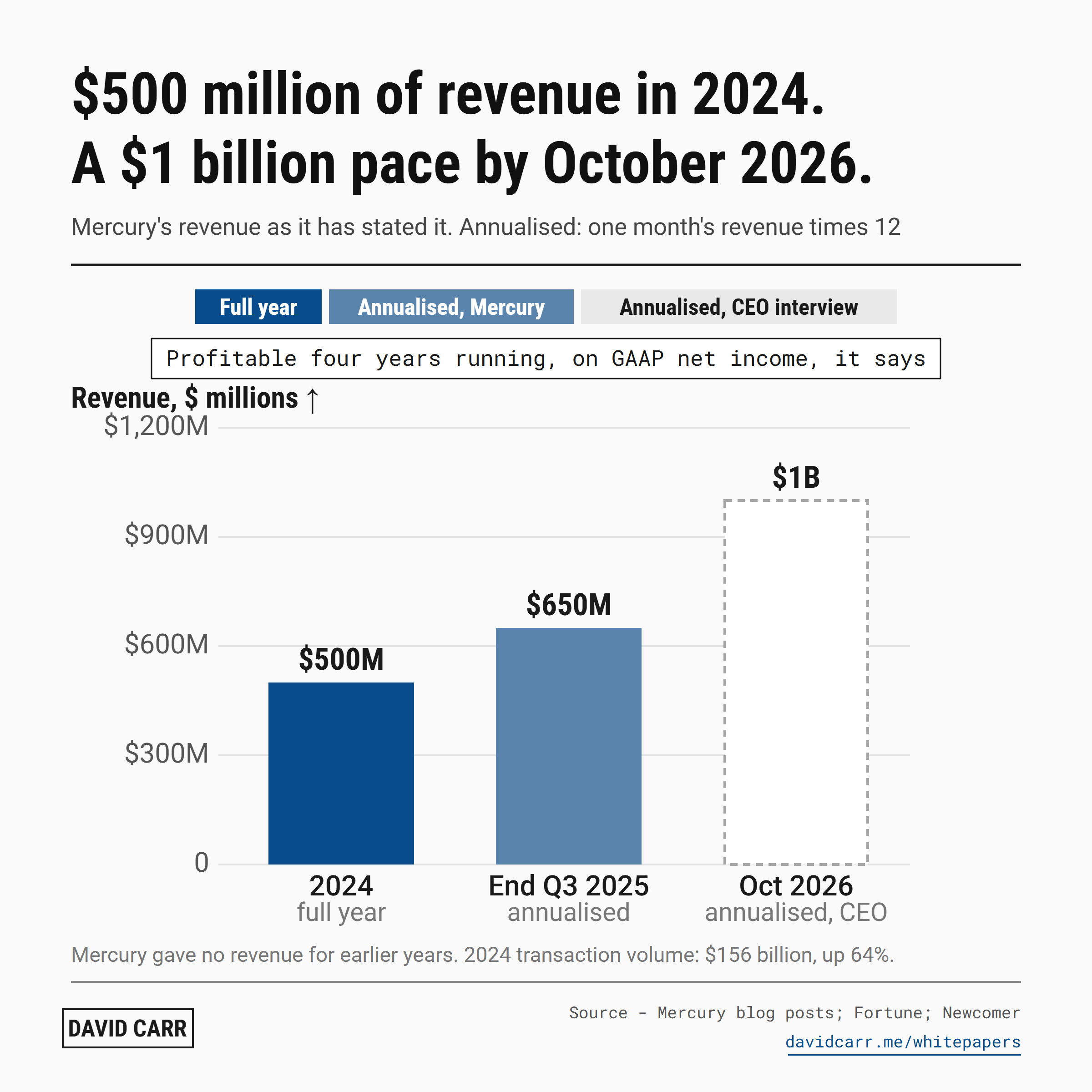
$500 million of revenue in 2024. A $1 billion pace by October 2026.
Mercury says it has been profitable on GAAP net income and EBITDA for four years running.
Annualised means one month's revenue times 12, as the CEO told Fortune. Mercury gave no revenue for years before 2024.
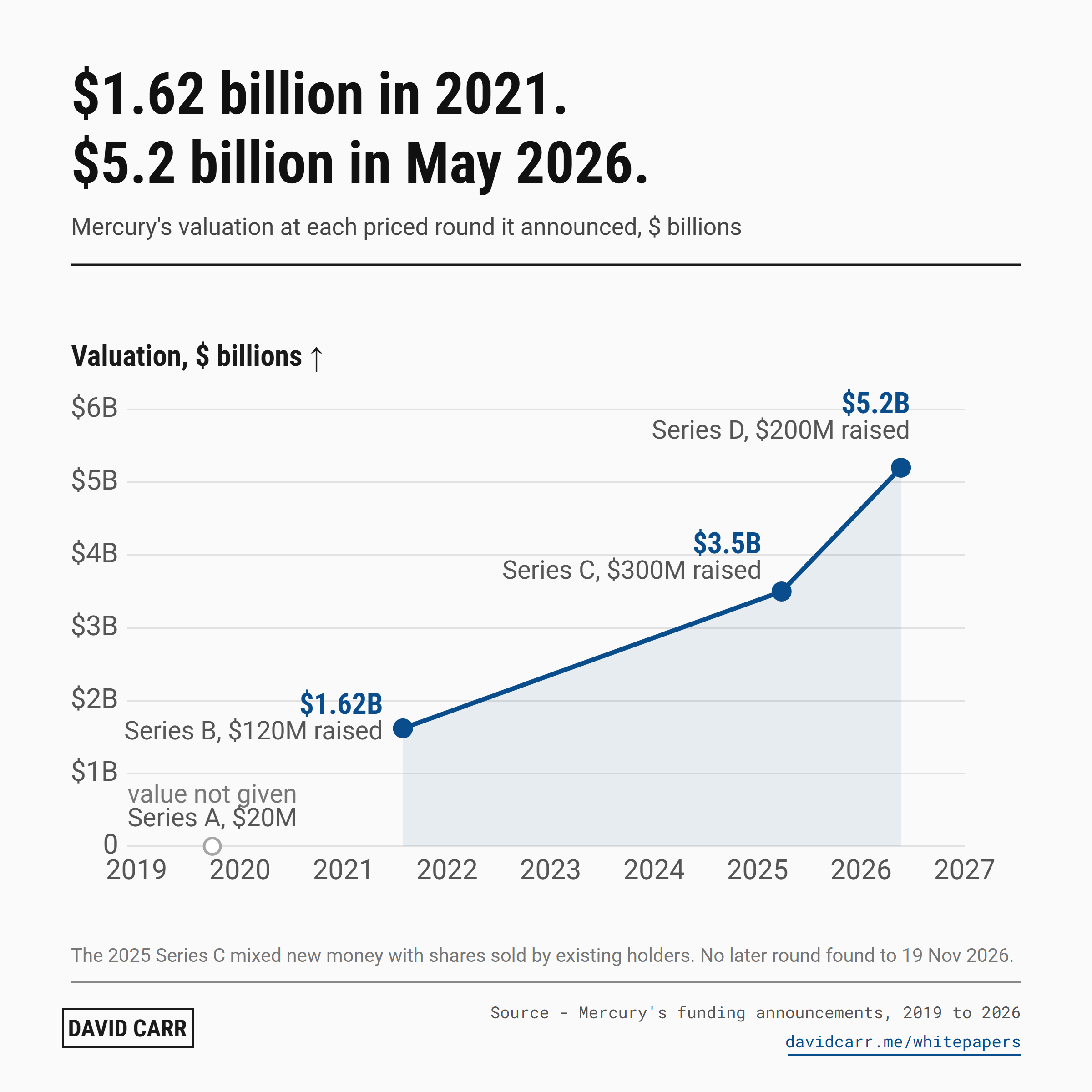
$1.62 billion in 2021. $5.2 billion in May 2026.
Up about 49% in the 14 months between the Series C and the Series D.
The Series C mixed new money with shares sold by existing holders. No later round found to 19 November 2026.
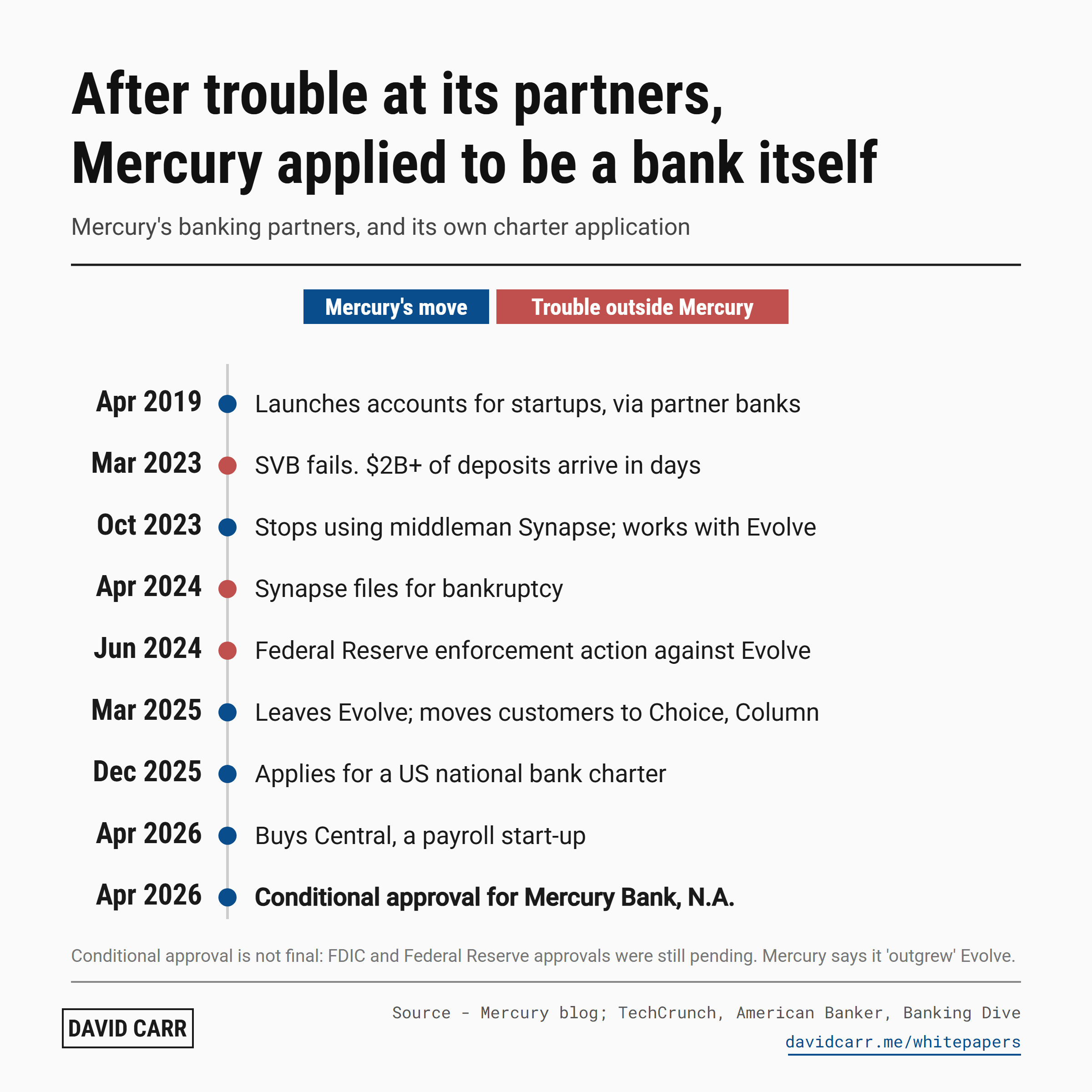
After trouble at its partners, Mercury applied to be a bank itself
Mercury gives its own reasons. A charter, it says, "aligns with our long-term vision". It said it "simply outgrew" Evolve.
Conditional approval is not final: Mercury still needs FDIC and Federal Reserve sign-off. Today its accounts sit with Choice and Column.
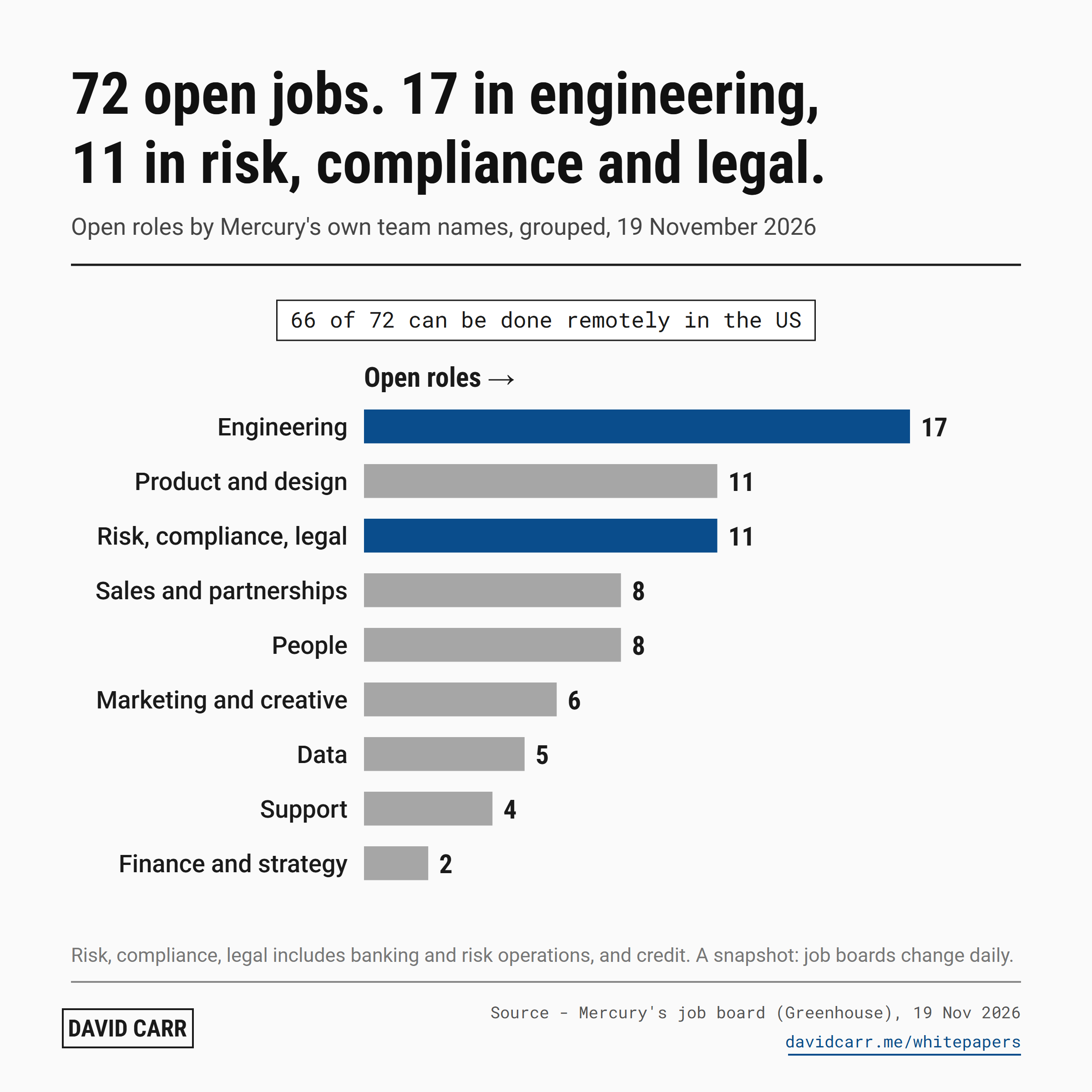
72 open jobs. 17 in engineering, 11 in risk, compliance and legal.
- Engineering: 17
- Product and design: 11
- Risk, compliance, legal: 11
- Sales and partnerships: 8
- 66 of 72 can be done remotely in the US
Its CEO told Fortune about 20% of the company works in risk and compliance.
Mercury's job board, 19 November 2026, grouped from its own team names. No jobs are listed outside the US and Canada.
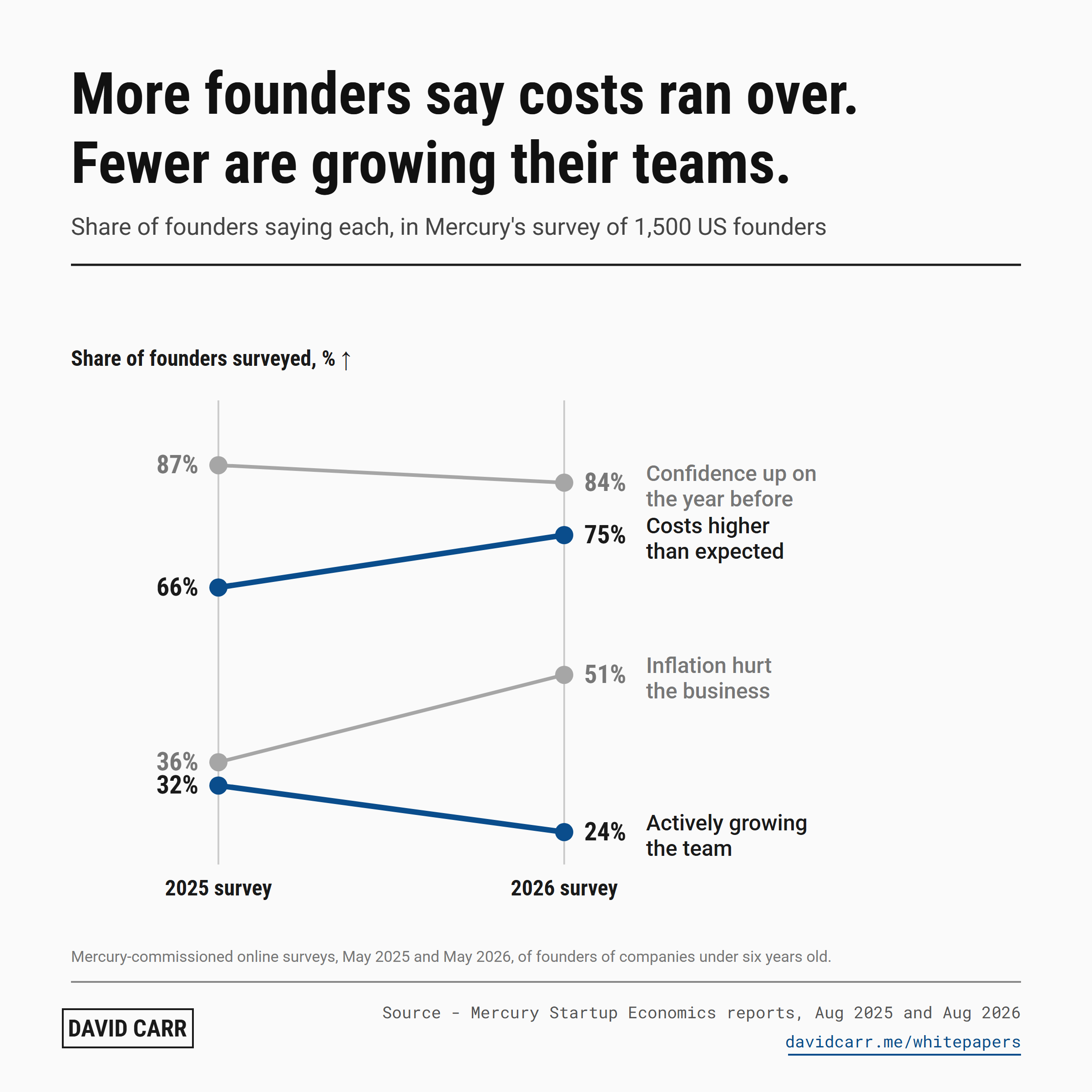
More founders say costs ran over. Fewer are growing their teams.
- Costs higher than expected: 66% to 75%
- Inflation hurt the business: 36% to 51%
- Actively growing the team: 32% to 24%
- Confidence up on the year before: 87% to 84%
Confidence barely moved. Costs and hiring did.
From Mercury's 2025 and 2026 Startup Economics reports: online surveys of 1,500 US founders each May.
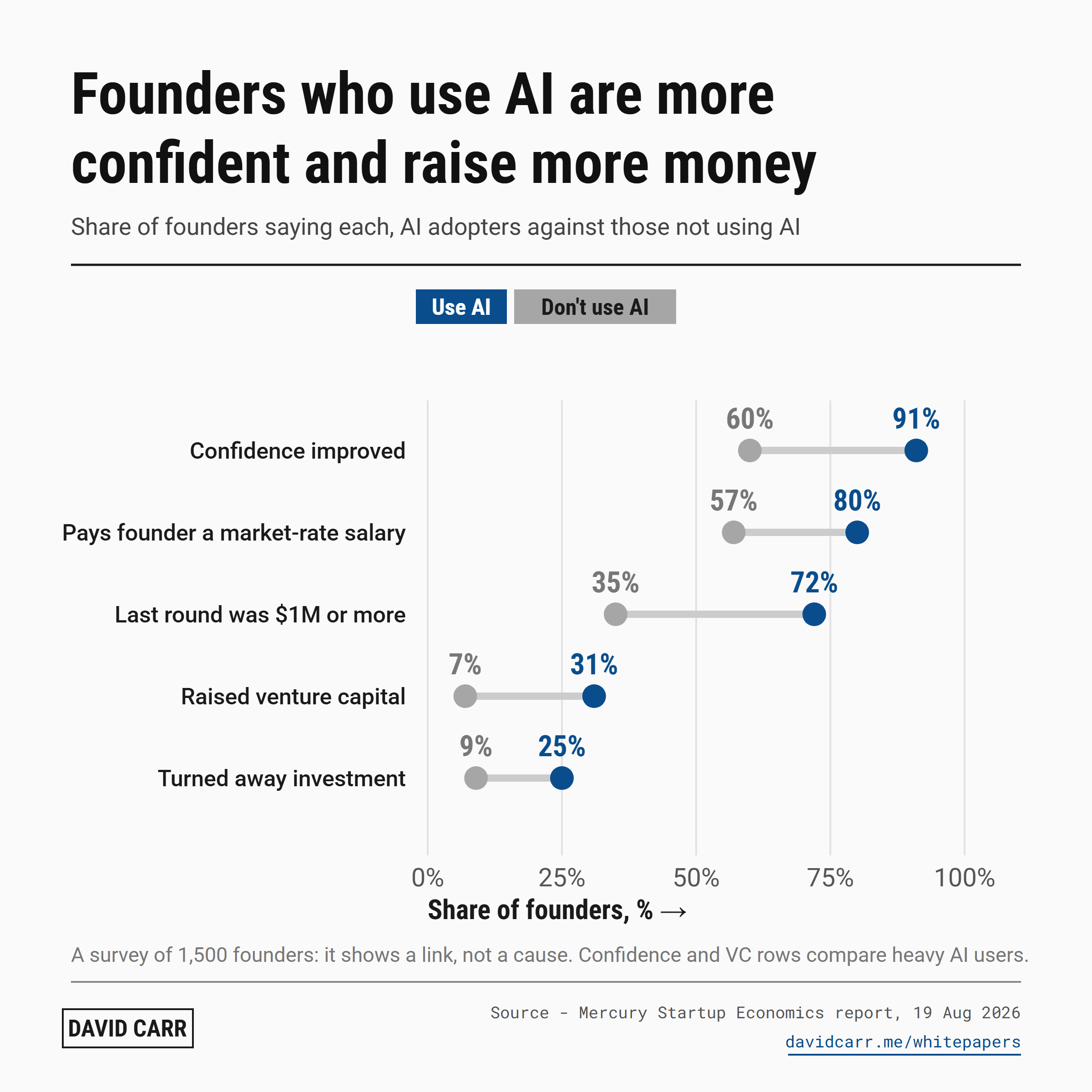
Founders who use AI are more confident and raise more money
- Confidence improved: 91% against 60%
- Last round $1M or more: 72% against 35%
- Raised venture capital: 31% against 7%
The survey shows a link. It can't show which way it runs.
Mercury's 2026 report. The confidence and venture rows compare heavy AI users with non-users; the rest compare any AI users.
Method, caveats and sources
The short answer. Mercury has more than 450,000 customers, its CEO says, and a $1 billion revenue pace. SVB's failure brought it about 26,000 customers in four months. It is worth $5.2 billion, and it has conditional approval to become a bank.
Mercury is private. It files no public accounts. Customer counts, revenue, profit and valuations come from its own posts, or from what its CEO told Fortune, TechCrunch and Newcomer. None of it is audited. Figures from interviews rather than Mercury's own pages are marked on the charts.
Partner banks. The Synapse and Evolve dates come from TechCrunch, American Banker and Banking Dive. Mercury has not linked its charter bid to them, and the page doesn't either.
Hacker News. Counts from the Algolia search API, typo tolerance off. Mercury is counted where "Mercury" and "bank" appear together; in a check of 80 March 2023 matches, 3 weren't the company. That undercounts posts that never say "bank".
Jobs. Every open role on Mercury's Greenhouse job board on 19 November 2026, grouped from its own department names by me.
Surveys. The Startup Economics reports are surveys Mercury commissioned, of 1,500 US founders of companies under six years old, run each May. They are not drawn from Mercury's customer data.
Also: Stripe, Ramp vs Brex and Ramp.