An NFL game has about 12 flags, much as it did in 1999.
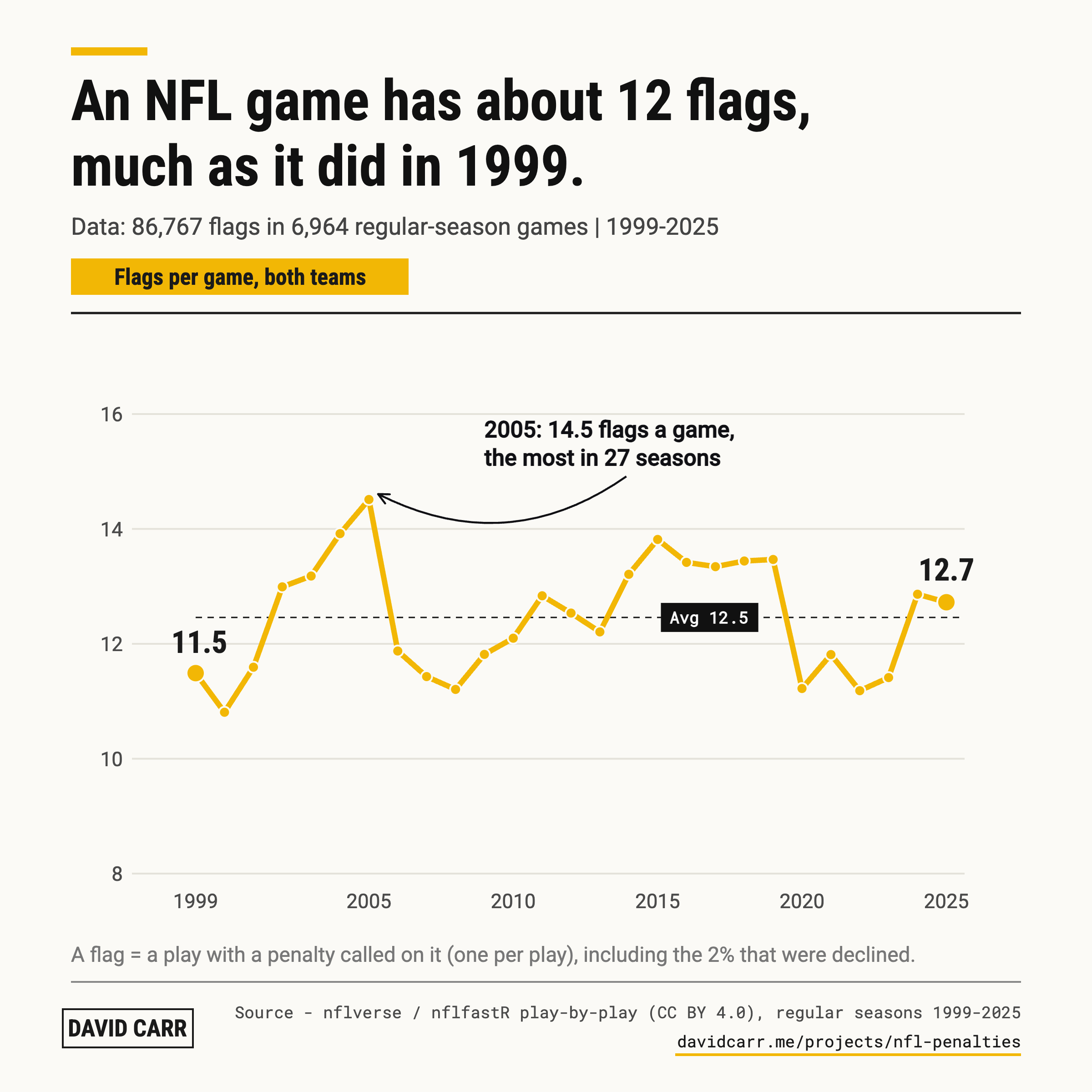
- 1999: 11.5 flags a game, both teams together
- 2005: 14.5, the most in the data
- 2000: 10.8, the fewest
- 2025: 12.7. The 27-season average is 12.5
The number moves up and down by two or three a game from one season to the next, but there is no long trend. 86,767 flags in 6,964 regular-season games.
A flag here is a play where a penalty was called, counted once per play. About 2% were declined by the other team; they still count, because the flag was thrown.
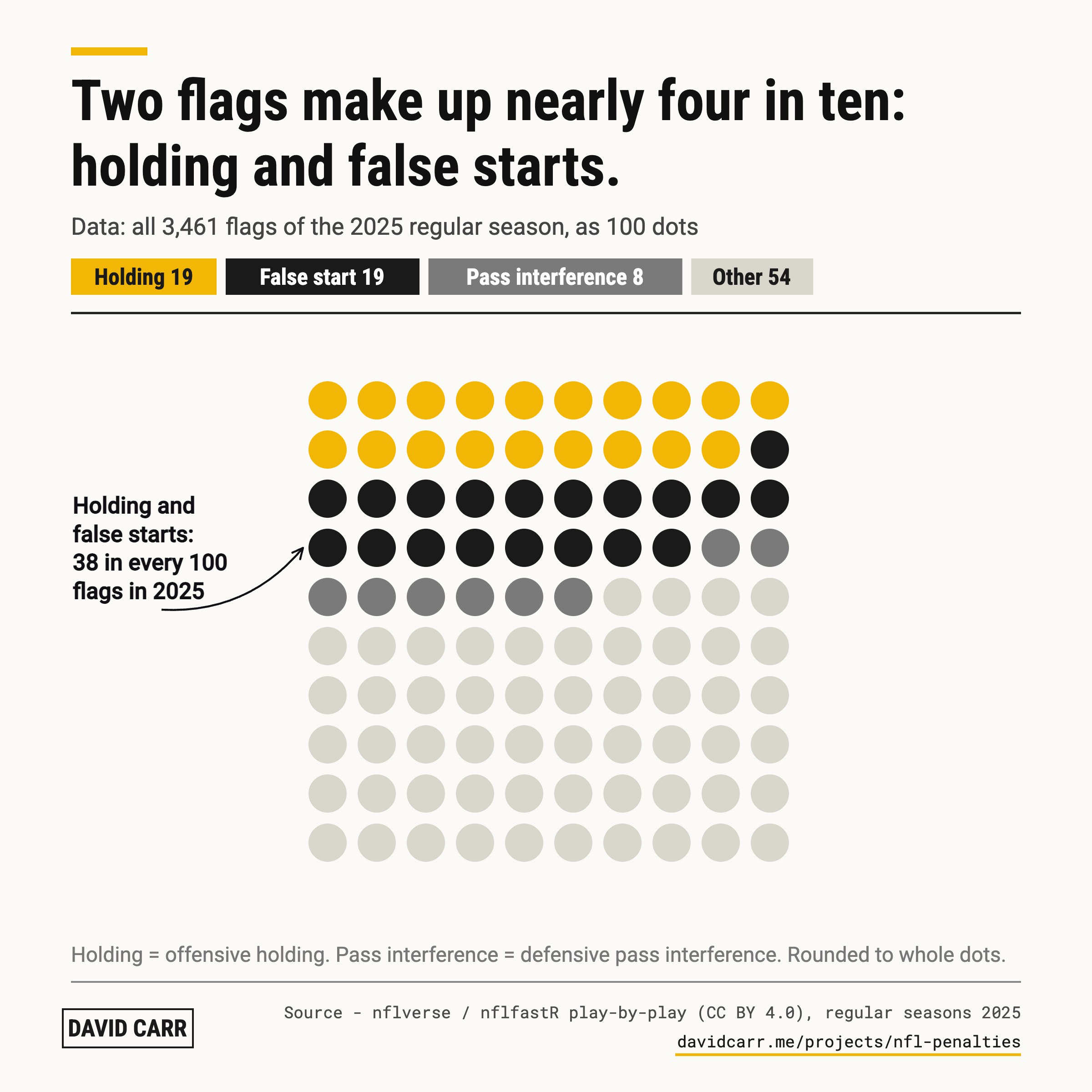
Two flags make up nearly four in ten: holding and false starts.
- Offensive holding: 19.4% of the 3,461 flags in 2025
- False start: 19.0%
- Defensive pass interference: 8.1%
- Next: defensive holding, defensive offside and delay of game, about 5% each
Holding is a blocker grabbing a defender. A false start is an attacking player moving before the snap. Between them, they are 38 of every 100 flags.
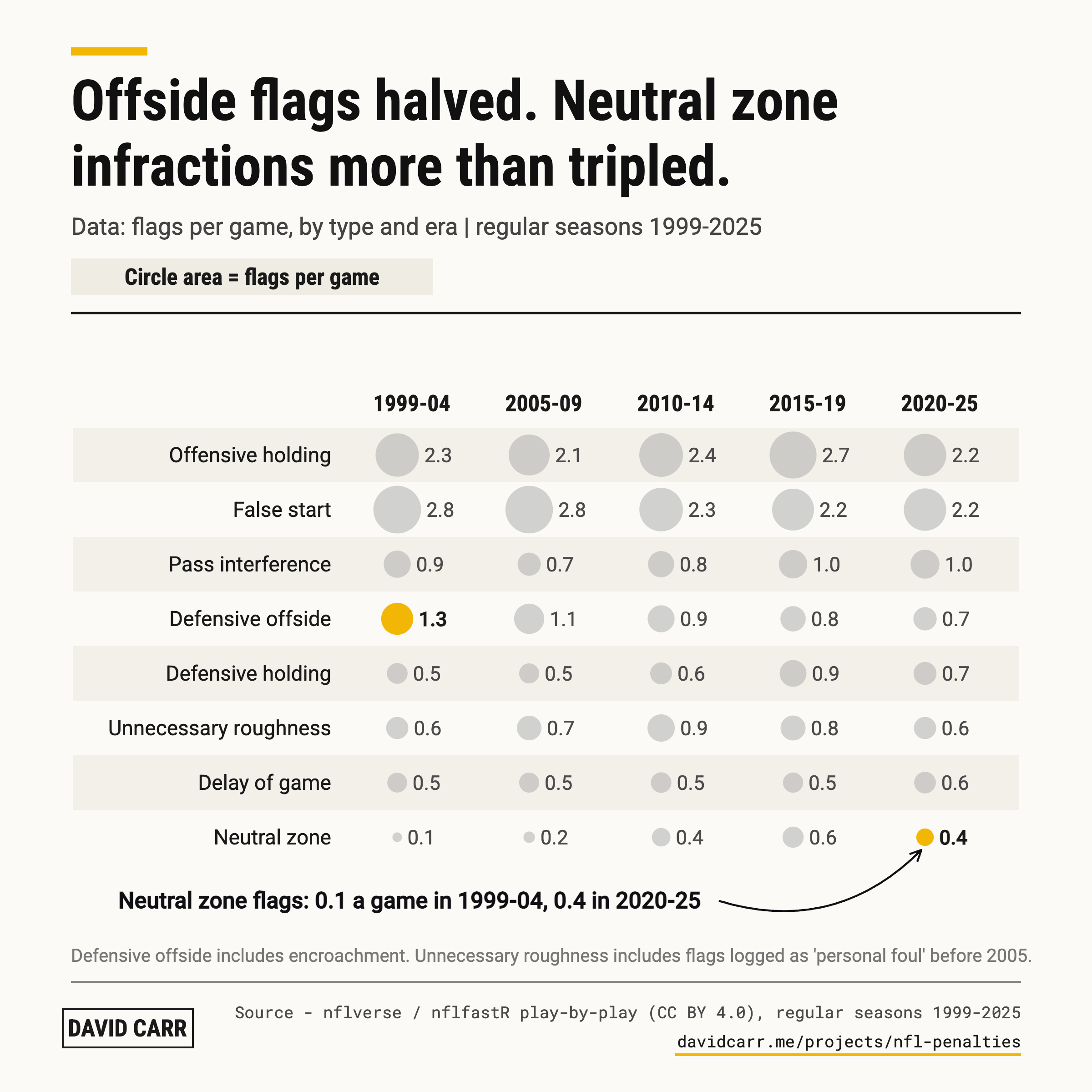
Offside flags halved. Neutral zone infractions more than tripled.
- Defensive offside (with encroachment): 1.3 a game in 1999-2004, 0.7 in 2020-2025
- Neutral zone infraction: 0.1 a game to 0.4
- Pass interference: 0.9 to 1.0, after a dip to 0.7 in 2005-2009
- Unnecessary roughness: 0.6, up to 0.9 in 2010-2014, back to 0.6
Both are a defender crossing the line too early. The total for the two fell from 1.4 a game to 1.1; more of them are now called as neutral zone infractions.
Flag names change over time. 'Encroachment' is counted with defensive offside, and 'personal foul' with unnecessary roughness.
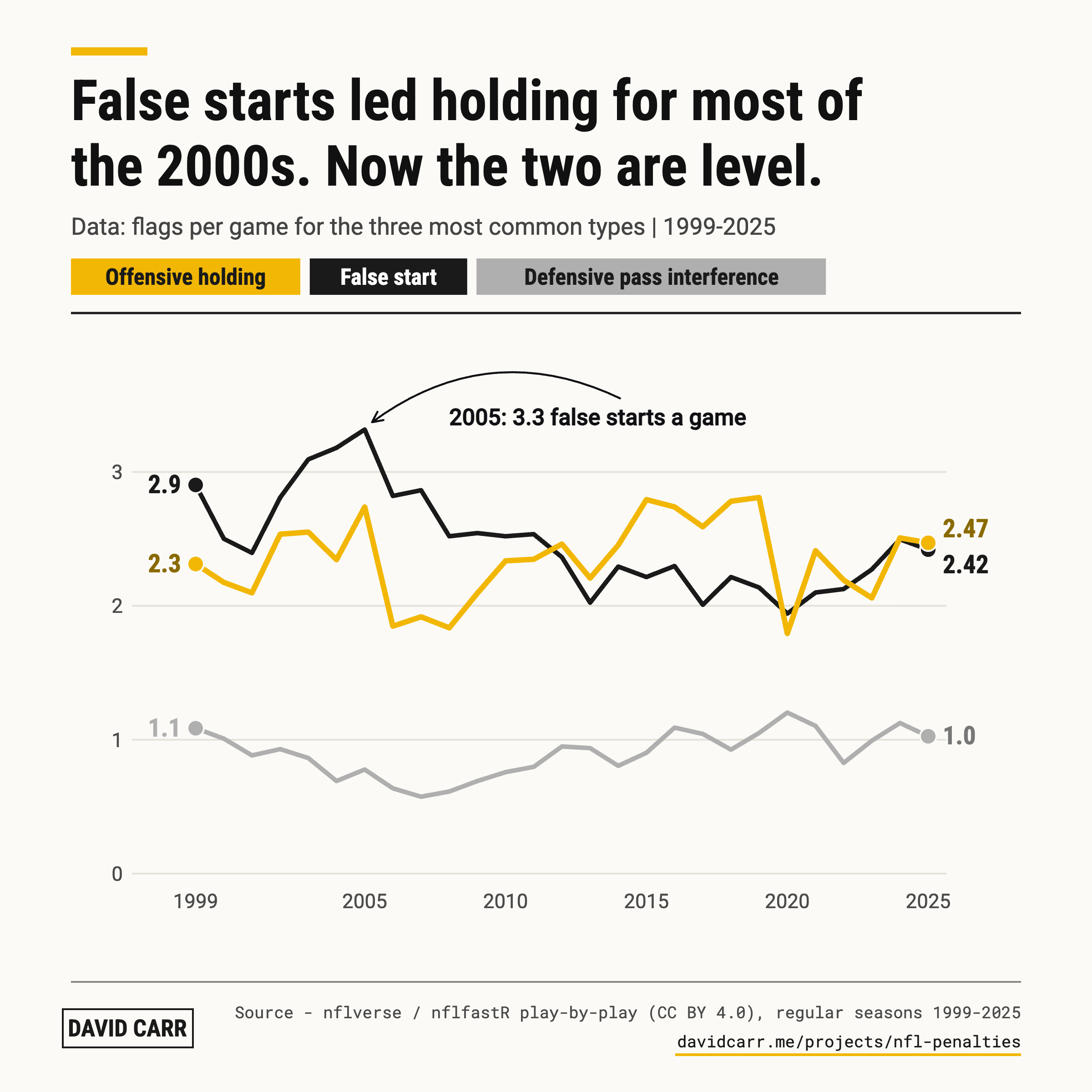
False starts led holding for most of the 2000s. Now the two are level.
- False starts: 2.9 a game in 1999, 3.3 in 2005, 2.4 in 2025
- Holding: 2.3 in 1999, 2.5 in 2025
- False starts were ahead in every season to 2011, and only twice since
- Pass interference: 1.1 in 1999, 0.6 in 2007, 1.0 in 2025
In 2025 there were 2.47 holding flags a game and 2.42 false starts: 672 against 658 over the season.
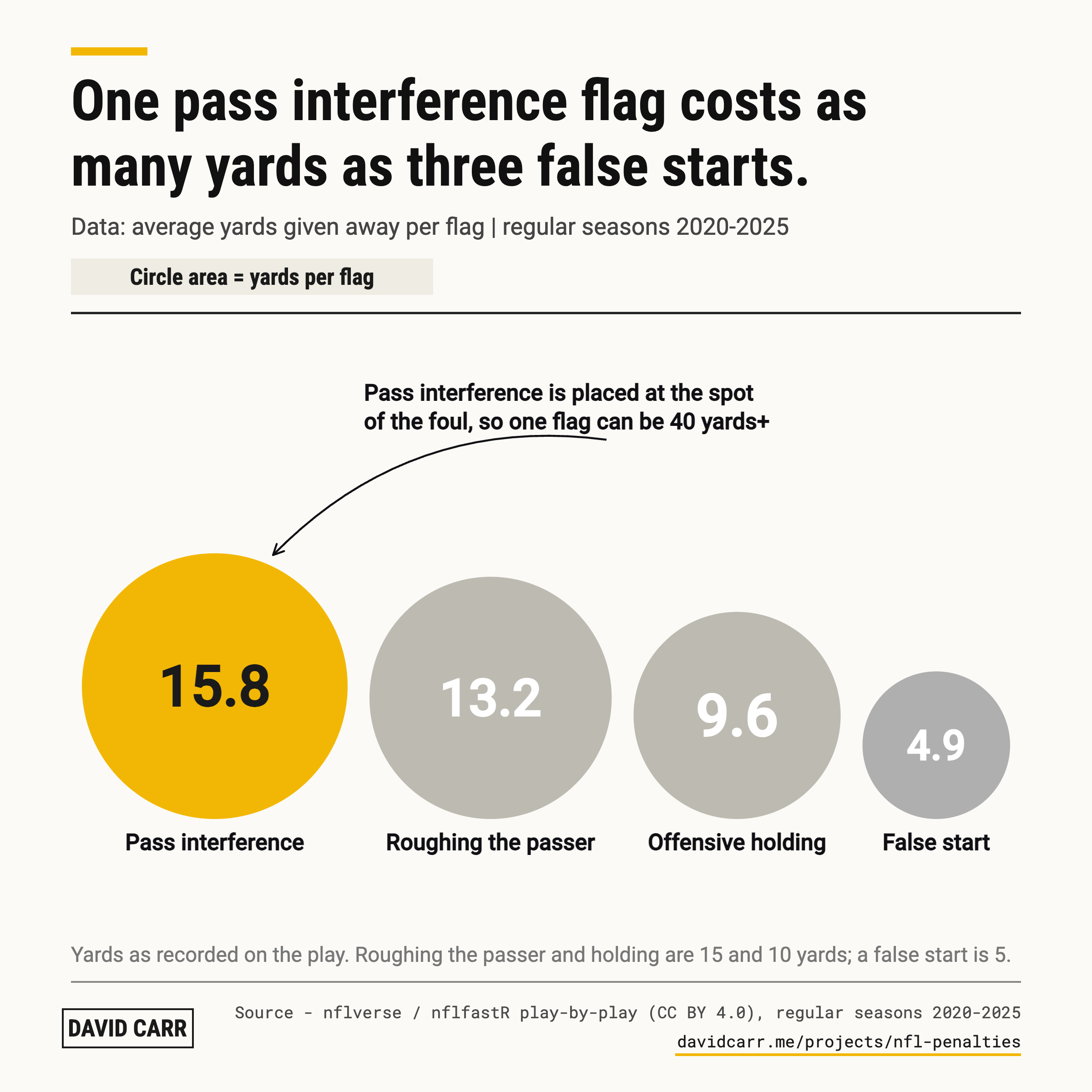
One pass interference flag costs as many yards as three false starts.
- Defensive pass interference: 15.8 yards a flag, 2020 to 2025
- Roughing the passer: 13.2
- Offensive holding: 9.6
- False start: 4.9
Pass interference is placed where the foul happened, so a long pass can mean a long penalty. In 2020 to 2025, 74 of the 1,687 flags were worth 40 yards or more; the longest was 52.
Yards as recorded on the play. Fixed penalties can come out shorter when the ball is close to the goal line, where the distance is halved.
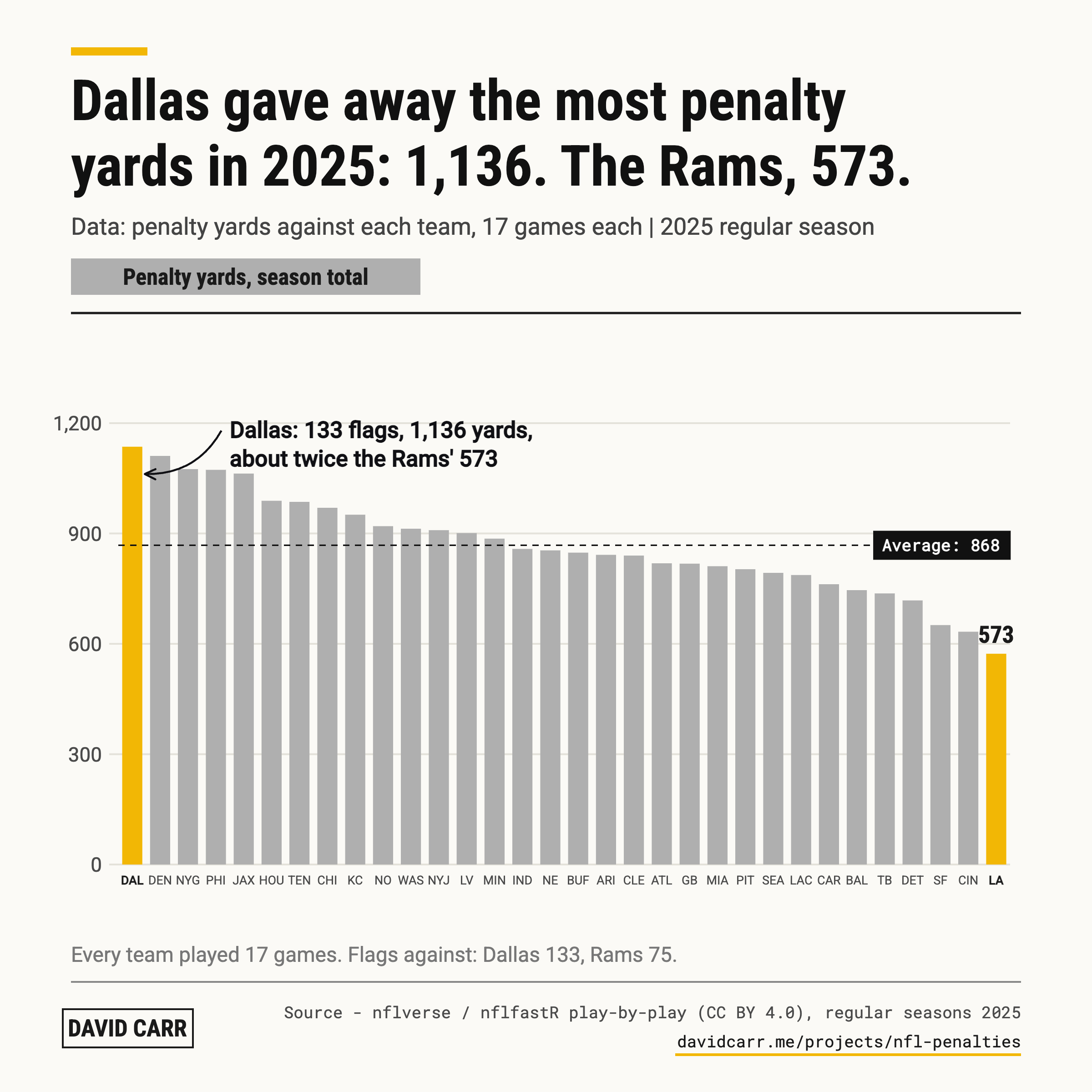
Dallas gave away the most penalty yards in 2025: 1,136. The Rams, 573.
- Most: Dallas 1,136 yards (133 flags), Denver 1,111, New York Giants 1,075, Philadelphia 1,073
- Fewest: Los Angeles Rams 573 (75 flags), Cincinnati 633, San Francisco 651
- Average: 868 yards, or 51 a game
- Every team played 17 games
The gap between the most and the least penalised teams was about 33 yards a game.
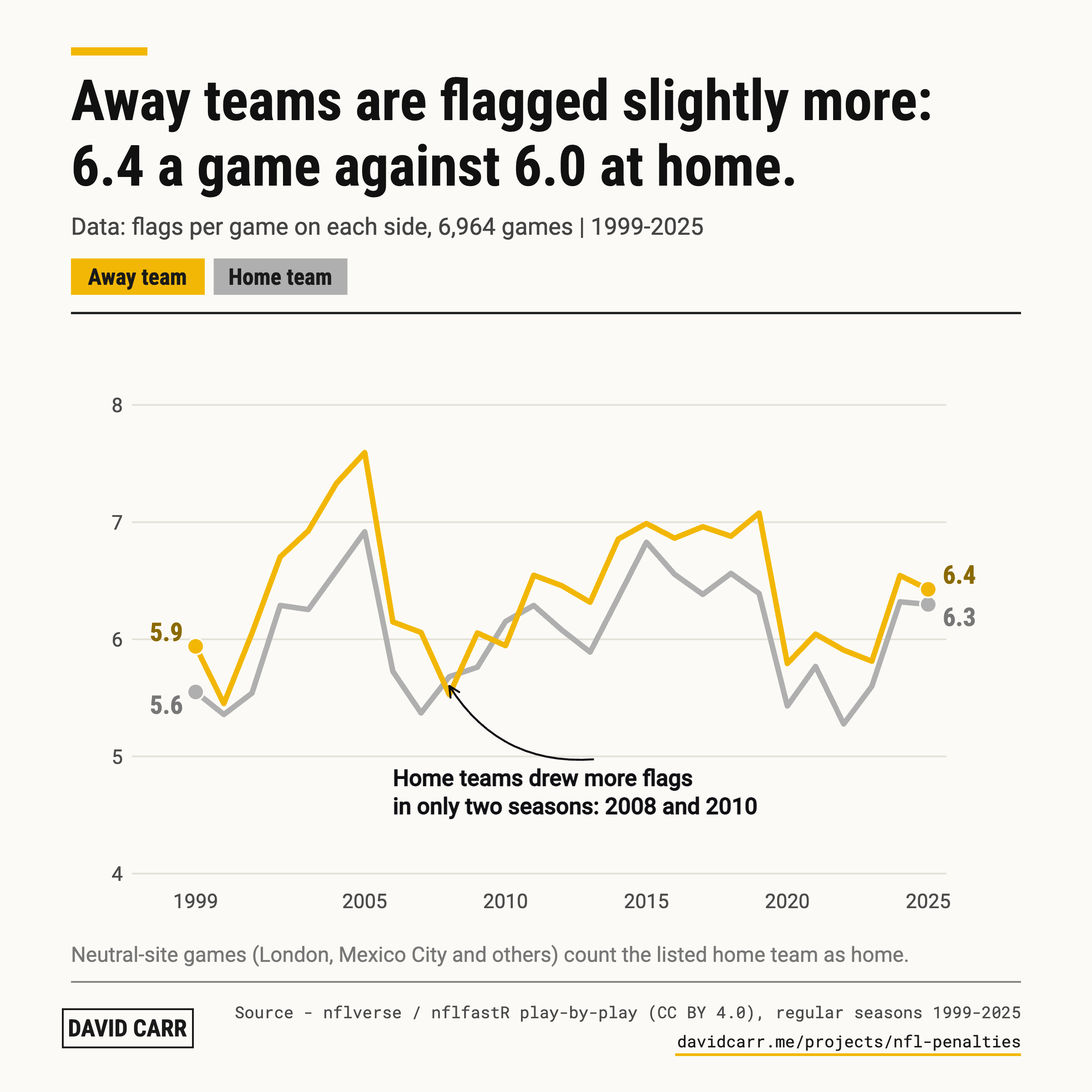
Away teams are flagged slightly more: 6.4 a game against 6.0 at home.
- 1999 to 2025: 6.41 flags a game for the away team, 6.04 for the home team
- Away teams drew more flags in 25 of the 27 seasons
- The two exceptions: 2008 and 2010
- The biggest gap by type is delay of game: 2,087 for away teams, 1,551 for home teams
The difference is about one flag every three games. Delay of game, when the play clock runs out, is the flag that differs most, and visiting teams call their plays in a louder stadium.
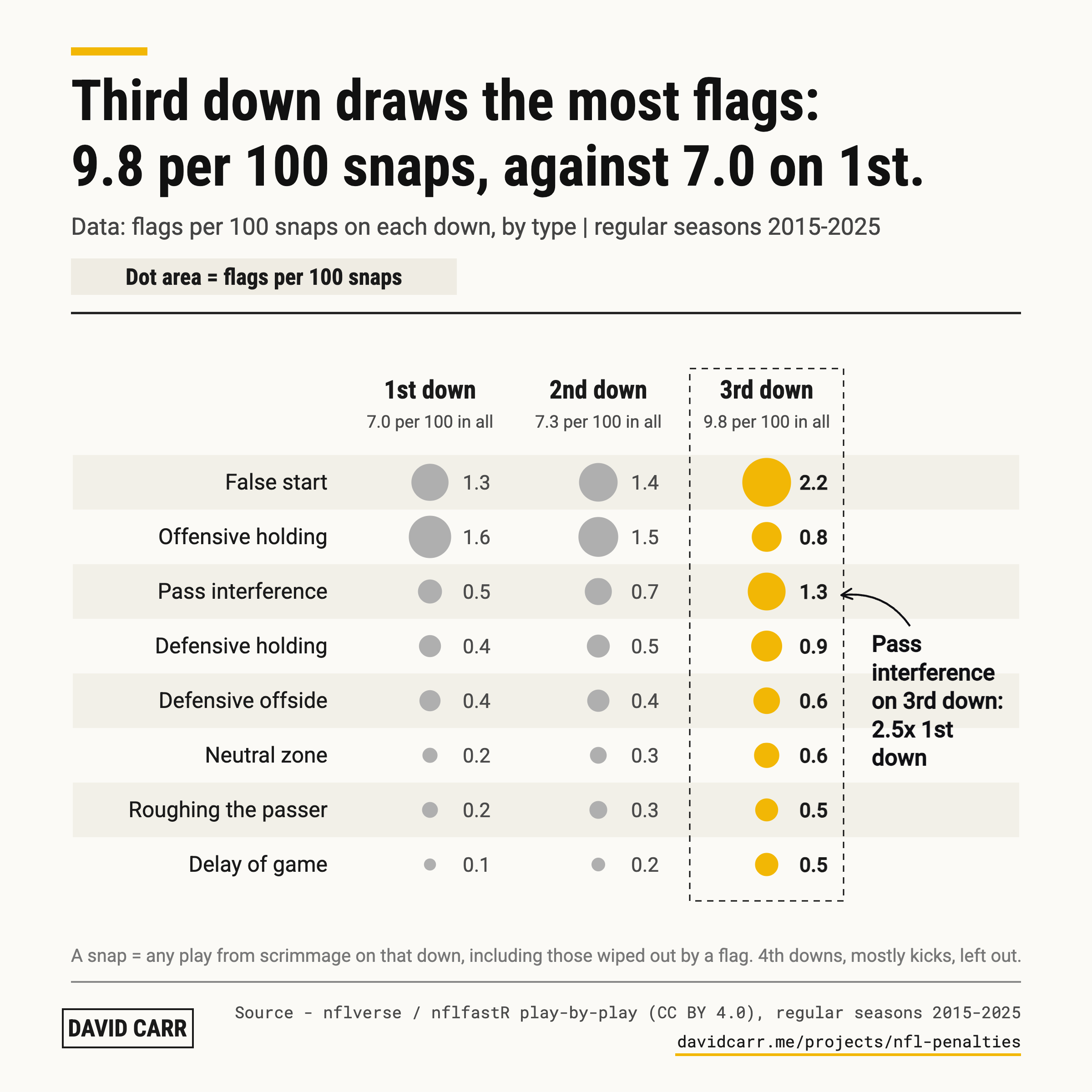
Third down draws the most flags: 9.8 per 100 snaps, against 7.0 on 1st.
- 1st down: 7.0 flags per 100 snaps; 2nd: 7.3; 3rd: 9.8
- False starts: 1.3 per 100 on 1st down, 2.2 on 3rd
- Pass interference: 0.5 on 1st, 1.3 on 3rd
- Holding is the exception: 1.6 on 1st down, 0.8 on 3rd
On 3rd down teams pass more, and a stop usually means a punt. More passes bring more pass interference and more holding of receivers by defenders; fewer runs bring less holding by blockers.
Regular seasons 2015 to 2025. A snap is any play from scrimmage on that down, including those wiped out by a flag.
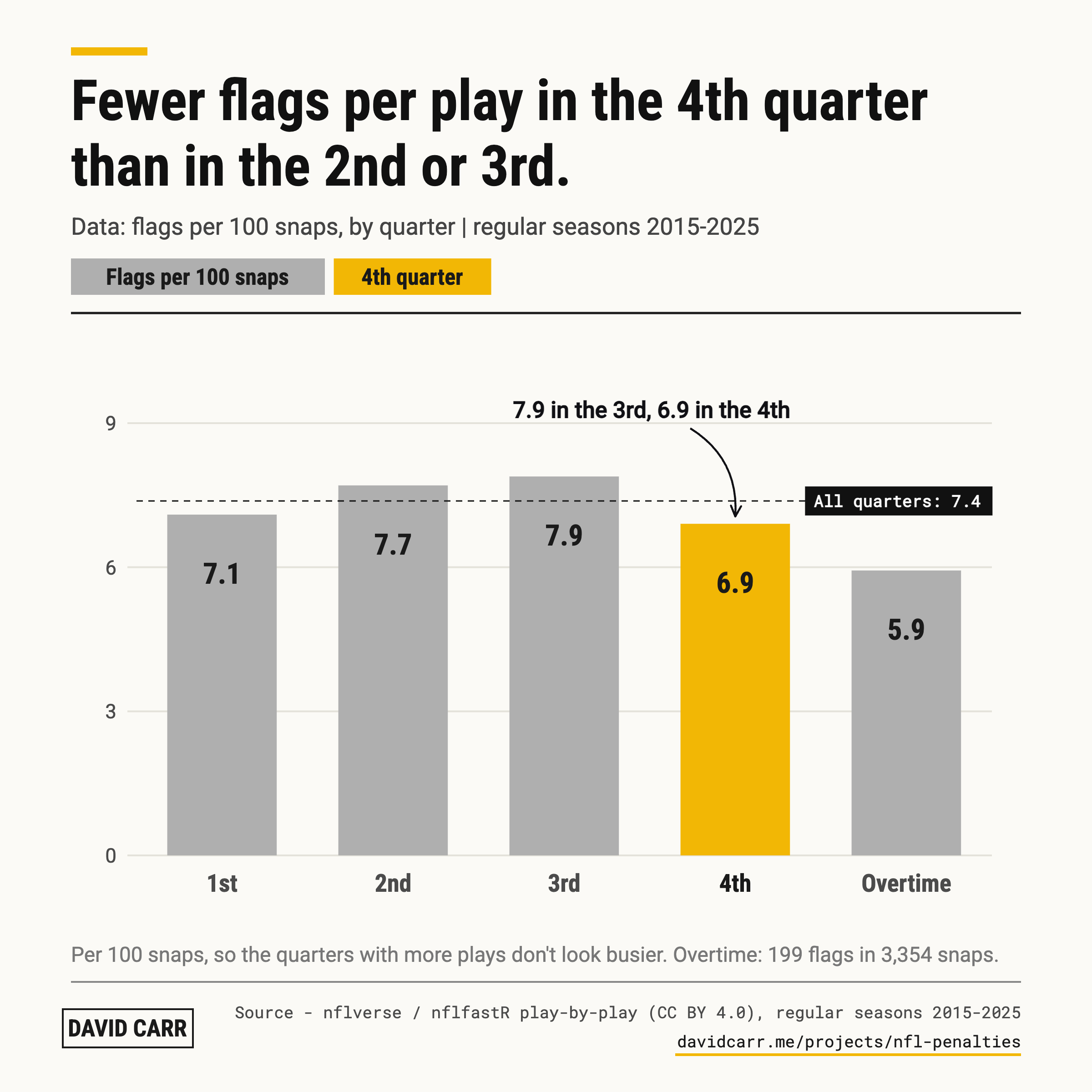
Fewer flags per play in the 4th quarter than in the 2nd or 3rd.
- 1st quarter: 7.1 flags per 100 snaps; 2nd: 7.7; 3rd: 7.9
- 4th quarter: 6.9
- Overtime: 5.9 (199 flags)
- 1999 to 2025 shows the same order: 7.2, 7.6, 7.7, 6.9
Counting per snap matters: the 2nd and 4th quarters have more plays than the 1st and 3rd, as teams hurry at the end of each half.
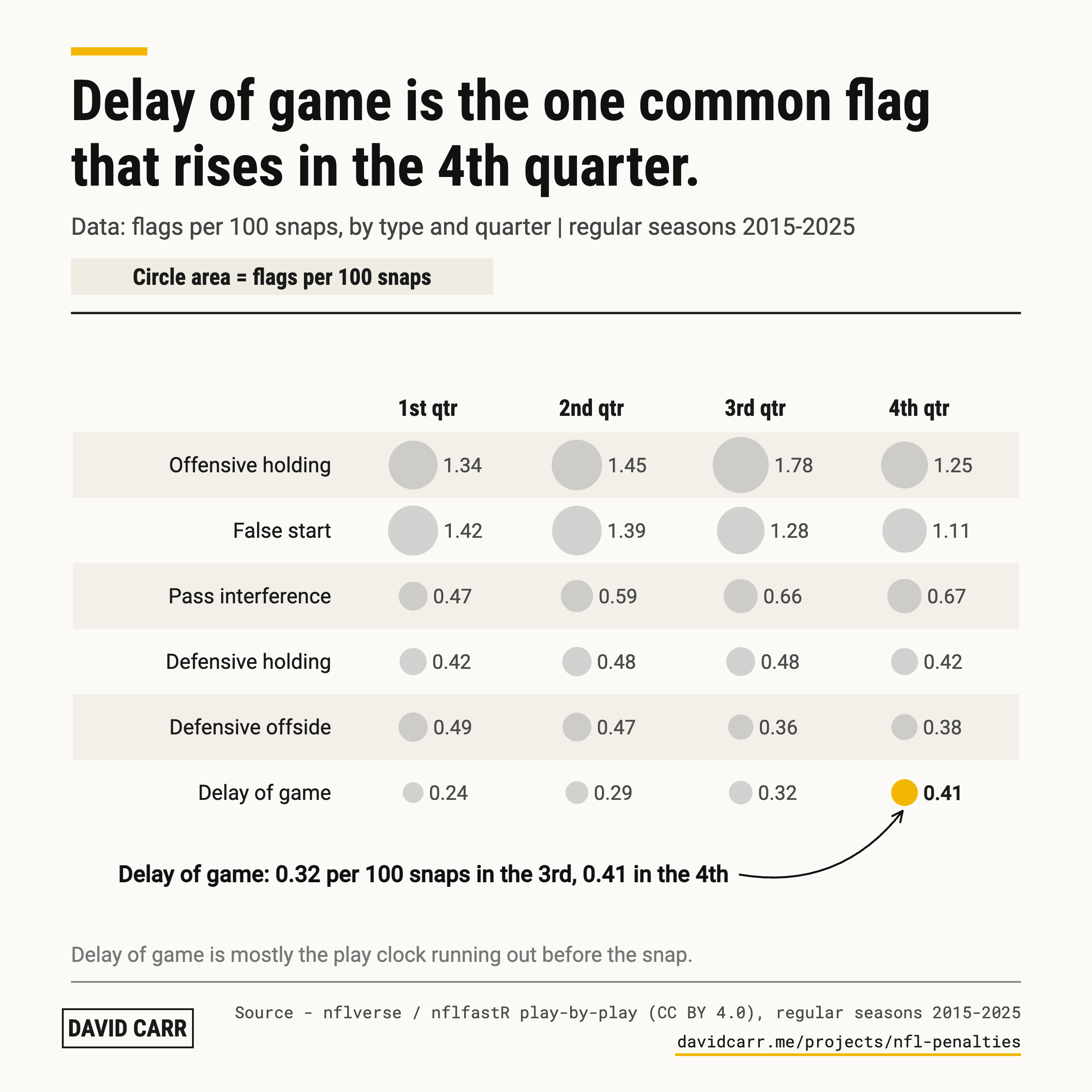
Delay of game is the one common flag that rises in the 4th quarter.
- Delay of game: 0.24 per 100 snaps in the 1st quarter, 0.41 in the 4th
- False starts: 1.42 in the 1st, 1.11 in the 4th
- Holding: 1.78 in the 3rd, 1.25 in the 4th
- Pass interference: 0.47 in the 1st, about 0.67 in the 3rd and 4th
Late in games the clock matters most, and so does the play clock: delay of game rises quarter by quarter. Most other common flags ease off.
Method, caveats and sources
The short answer. An NFL game has about 12 flags, both teams together, and that has barely changed since 1999: the high was 14.5 in 2005 and 2025 had 12.7. Offensive holding and false starts are nearly four flags in ten, and are now about level. A pass interference flag costs the most yards on average, 15.8. Away teams draw slightly more flags than home teams, 6.4 a game against 6.0. Third downs draw the most flags per snap, and the 4th quarter fewer than the 2nd or 3rd, though delay of game rises late in games.
Data. nflverse / nflfastR play-by-play files for every regular season from 1999 to 2025, downloaded on 26 November 2026 and published under the Creative Commons Attribution 4.0 licence. I kept the plays nflfastR marks as having a penalty (86,767 in the regular season) and counted the snaps on each down and in each quarter, and did every count and rate on this page from those. The data stays off the site; only the totals are here.
What counts as a flag. nflfastR records one penalty per play, the main one. When two flags fall on the same play, only one is counted, so these totals run a little below the league's official penalty counts. Declined penalties (about 2%) are included, since a flag was thrown; offsetting penalties are rare. Plays wiped out by a penalty count as snaps. Penalty yards are as recorded on the play. Neutral-site games count the listed home team as home.
Names. Some flags have changed name in the data over the years. I counted "encroachment" with defensive offside, "personal foul" with unnecessary roughness, and the old 5-yard face mask with face mask. Rule changes also move the numbers: for example, the new kickoff rules of 2024 brought new flags such as "kickoff short of landing zone" (43 in 2025).
Caveats. Counts per game are for both teams together. Seasons have had 17 games since 2021, 16 before, which does not affect the per-game figures. These are counts of what was called. They do not say whether a call was right, and they do not separate how teams play from how games are officiated.
Left out. Play-offs, and the 2026 season, which is still under way.
Also: Christmas football, snow and domes, Fourth down in the NFL and What happened to home advantage.