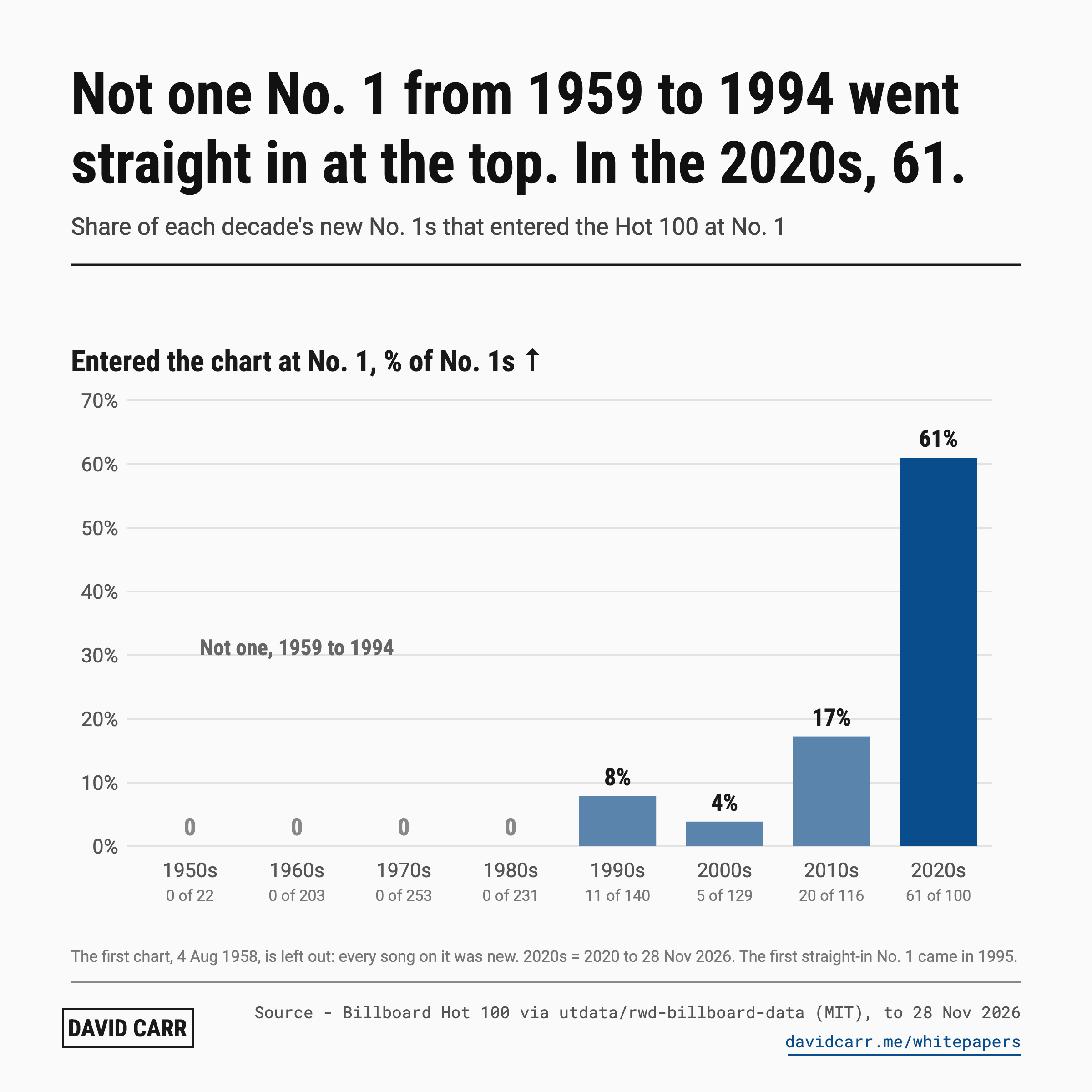
Not one No. 1 from 1959 to 1994 went straight in at the top. In the 2020s, 61 have.
- 1960s, 1970s and 1980s: 0 of 687 No. 1s entered the chart at No. 1
- The first straight-in No. 1 came in 1995
- 1990s: 11; 2000s: 5; 2010s: 20
- 2020s so far: 61 of 100, with 12 in 2020 and 12 in 2021
For 35 years a song had to climb to the top. Now most No. 1s are there in their first week.
Decade of each song's first week at No. 1. The very first Hot 100, on 4 August 1958, is left out, since every song on it was new.
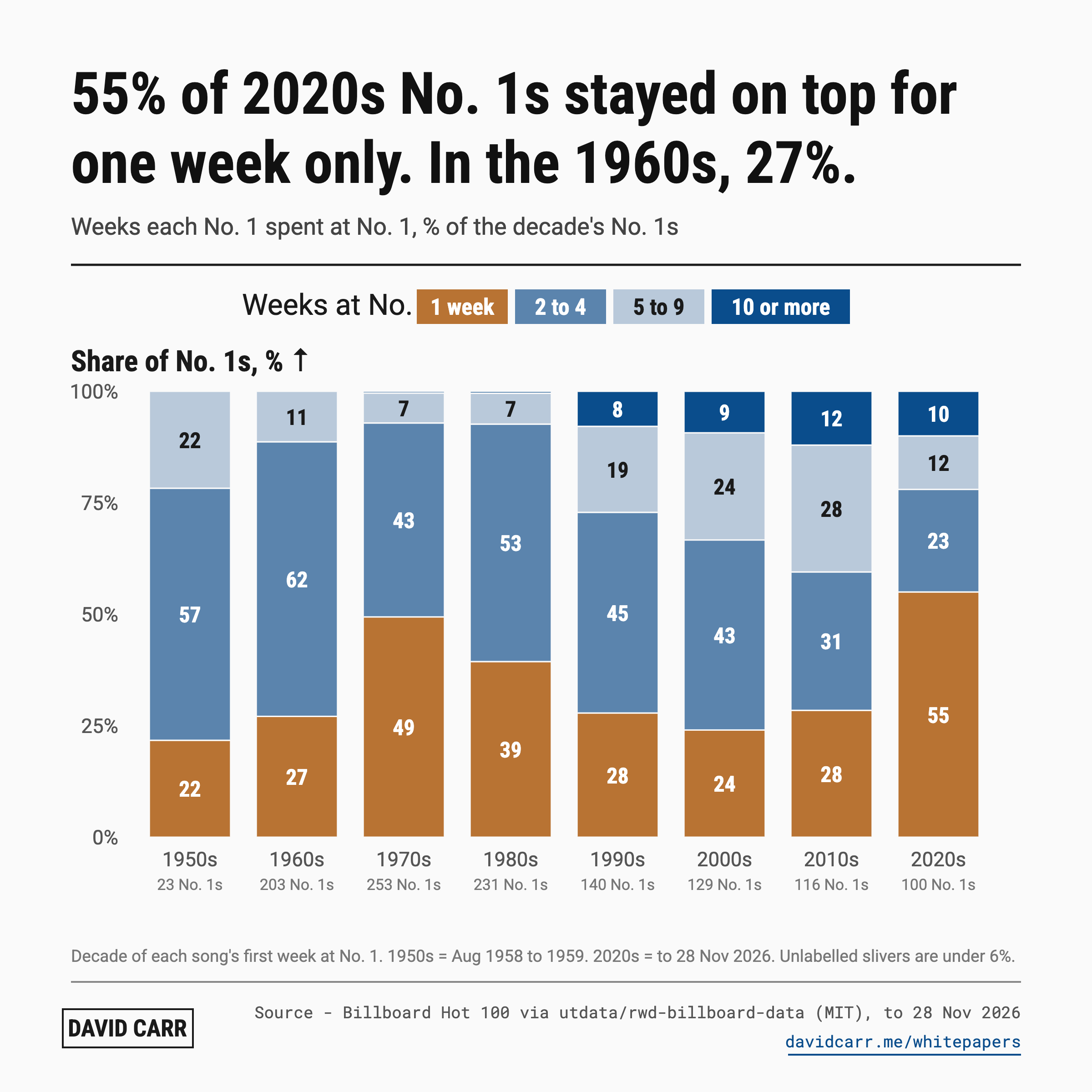
55% of 2020s No. 1s stayed on top for one week only. In the 1960s, 27%.
- One week at No. 1: 27% in the 1960s, 49% in the 1970s, 39% in the 1980s
- Then 28% in the 1990s, 24% in the 2000s, 28% in the 2010s
- 2020s: 55 of 100
- Ten weeks or more: none in the 1960s, 10 in the 2020s so far
Many songs now go in at the top and slip back the next week. The 2020s still have long runs too: 10 songs have spent ten weeks or more at No. 1.
Weeks at No. 1 need not be in a row.
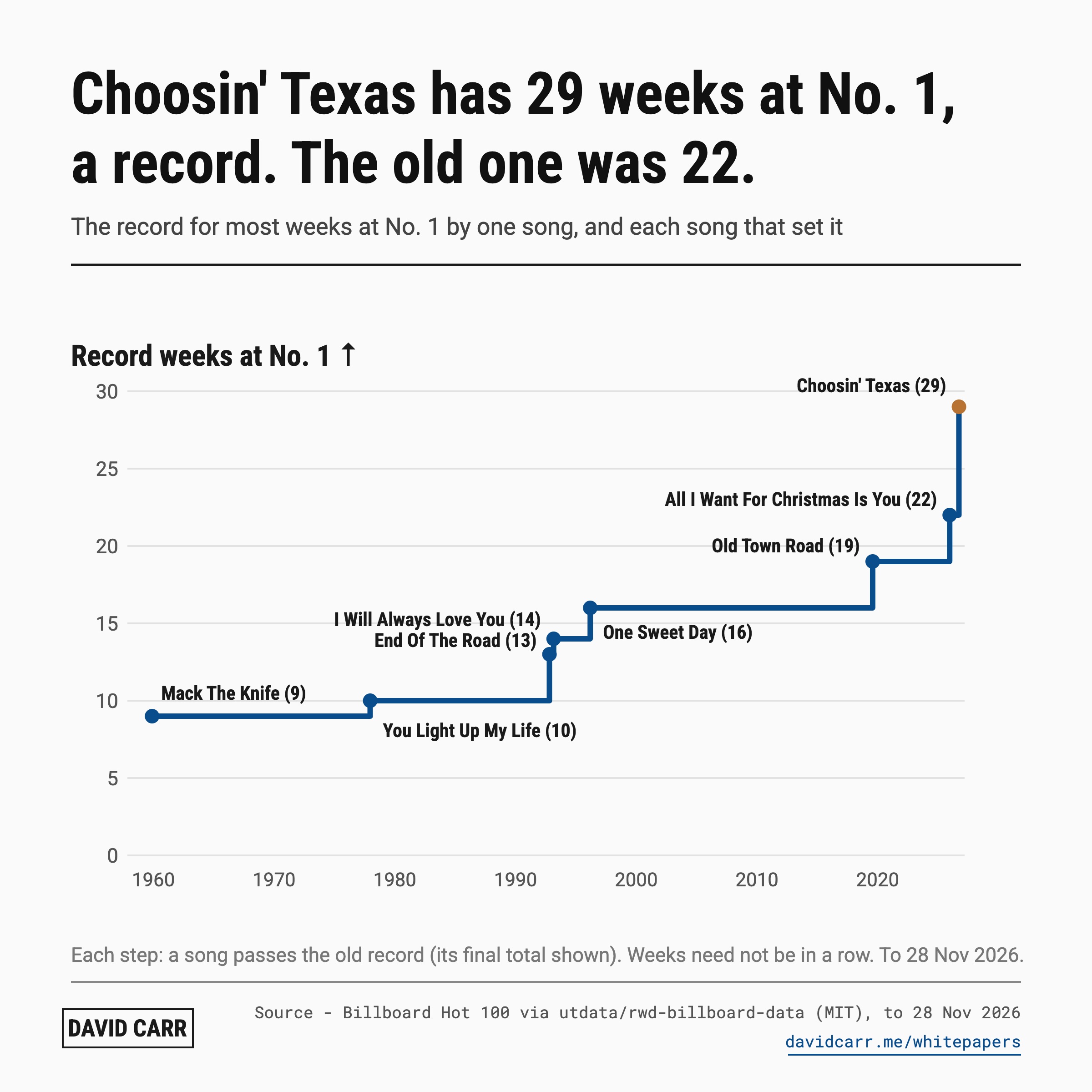
Choosin’ Texas has 29 weeks at No. 1, a record. The old one was 22.
- 1959: Mack the Knife, 9 weeks
- 1977: You Light Up My Life, 10; 1992: End of the Road, 13; 1993: I Will Always Love You, 14
- 1996: One Sweet Day, 16; 2019: Old Town Road, 19
- 2025-26: All I Want for Christmas Is You, 22, over seven Christmases
- 2026: Ella Langley’s Choosin’ Texas, 29 weeks, to the chart of 28 November
After Mack the Knife set it in 1959, the record was broken five times in 60 years. It has been broken twice more since December 2025.
Each step is the week a song passed the old record; the label shows its final total. The Choosin’ Texas record matches its Wikipedia article, which cites Billboard.
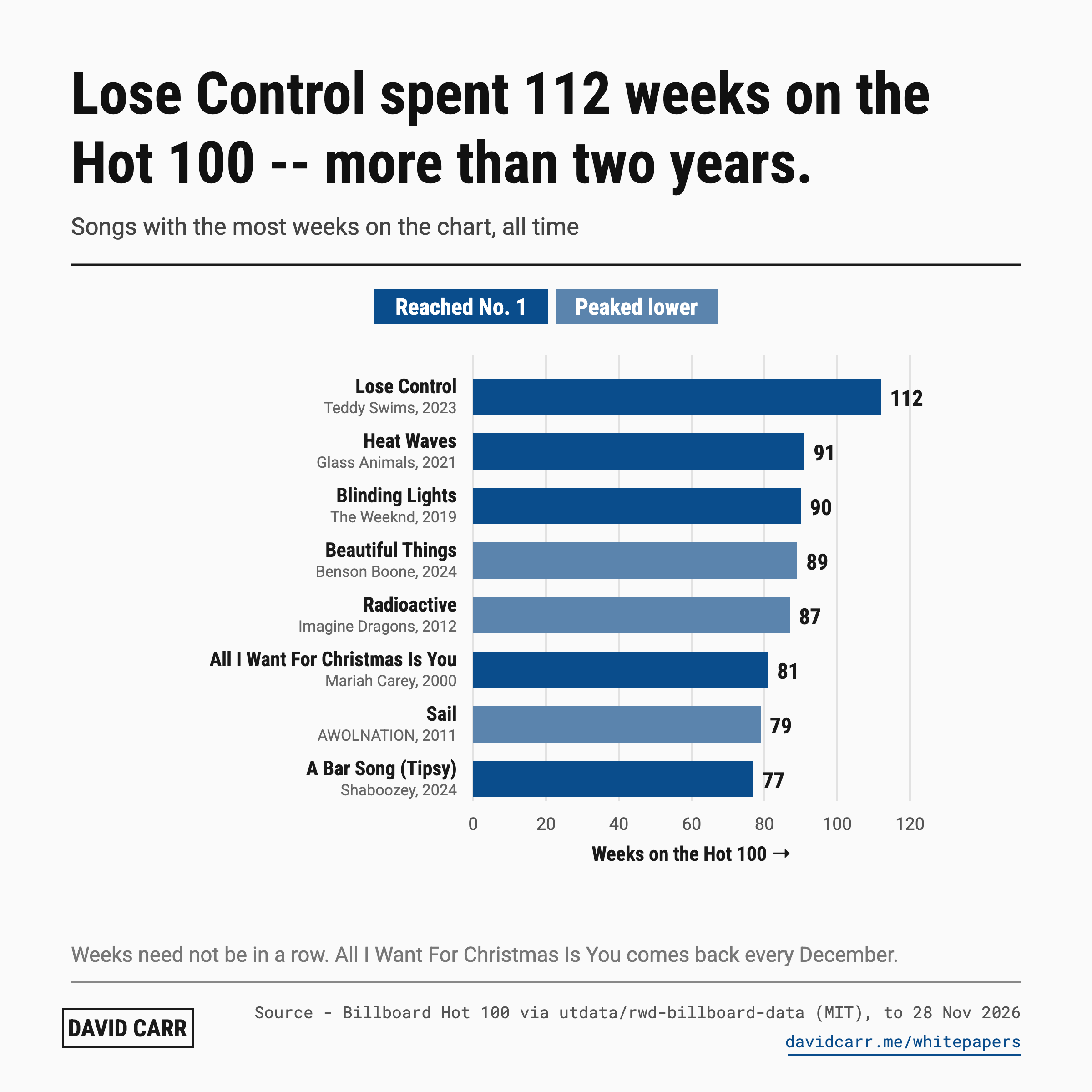
Lose Control spent 112 weeks on the Hot 100 -- more than two years.
- Teddy Swims’ Lose Control: 112 weeks, 2023 to 2025
- Heat Waves: 91; Blinding Lights: 90; Beautiful Things: 89
- All I Want for Christmas Is You: 81 weeks, spread over many Christmas seasons since 2000
- All eight of the longest stays started in 2000 or later
Long chart lives are a recent thing. Five of the eight reached No. 1. Beautiful Things, Radioactive and Sail made the list without it.
Weeks on the chart need not be in a row. Since 1991 Billboard has dropped older songs from the chart once they fall below set positions, which caps how long a song can stay.
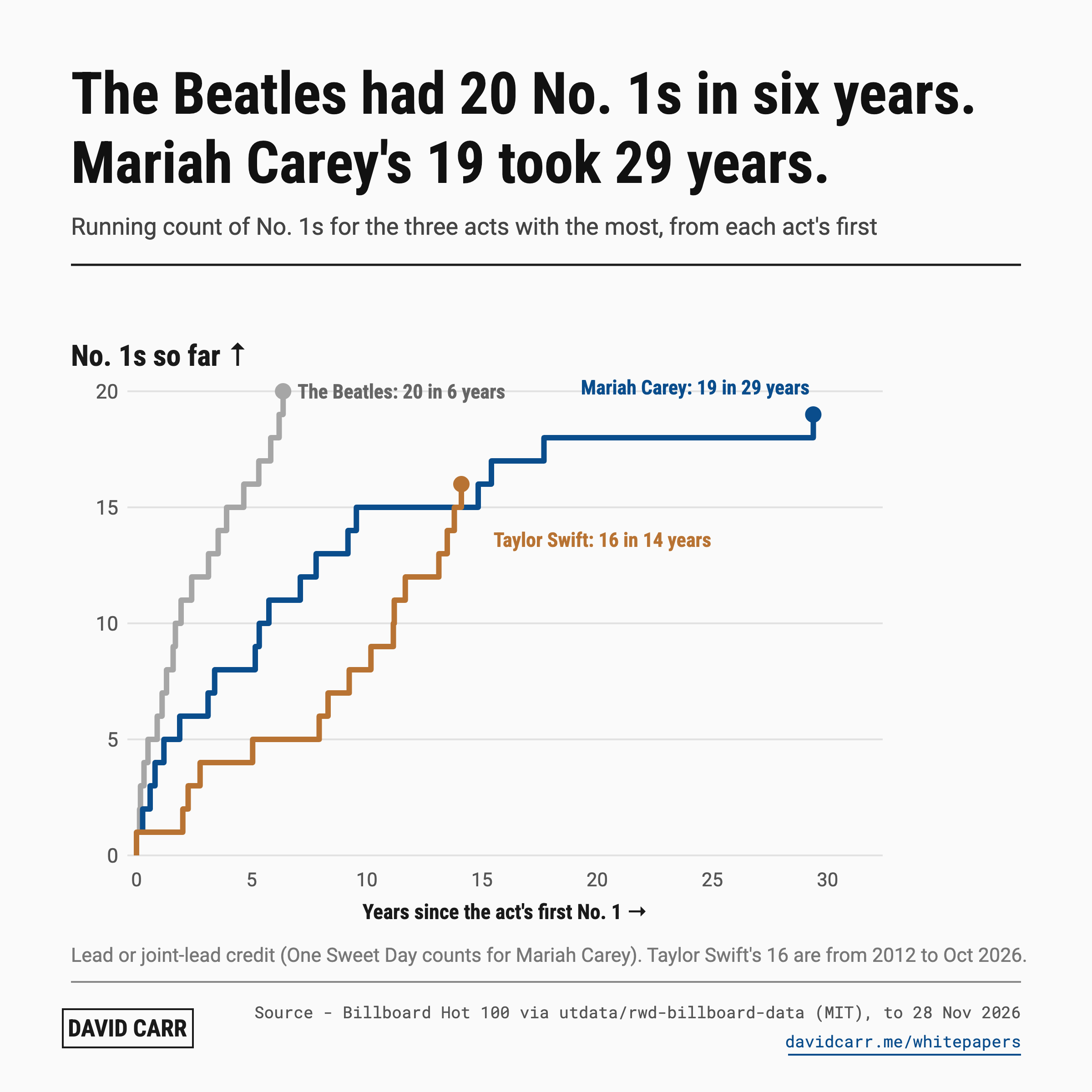
The Beatles had 20 No. 1s in six years. Mariah Carey’s 19 took 29 years.
- The Beatles: 20 No. 1s, from February 1964 to June 1970
- Mariah Carey: 19, from August 1990 to December 2019
- Taylor Swift: 16, from September 2012 to October 2026
Three very different paths to the top of the list. The Beatles’ record of 20 has stood since 1970.
Lead or joint-lead credit, so One Sweet Day (Mariah Carey & Boyz II Men) counts for Mariah Carey.
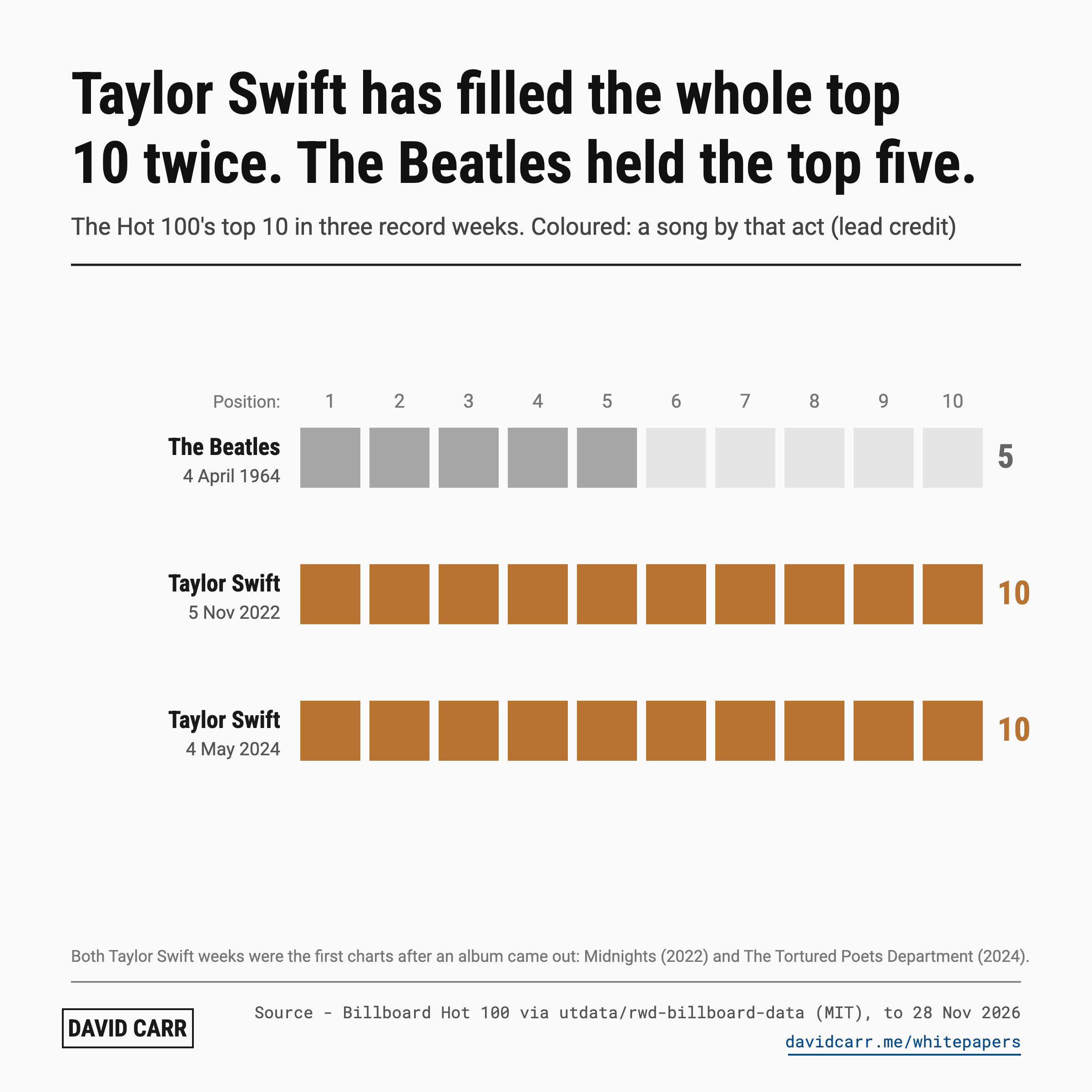
Taylor Swift has filled the whole top 10 twice. The Beatles held the top five in 1964.
- 4 April 1964: The Beatles at No. 1 to No. 5
- 5 November 2022: Taylor Swift at No. 1 to No. 10, after Midnights came out
- 4 May 2024: Taylor Swift at No. 1 to No. 10 again, after The Tortured Poets Department
Streaming lets a whole new album land on the chart in one week. In 1964 it took five singles climbing together.
Lead credit. Three of Taylor Swift’s 20 songs in those two weeks had a featured guest.
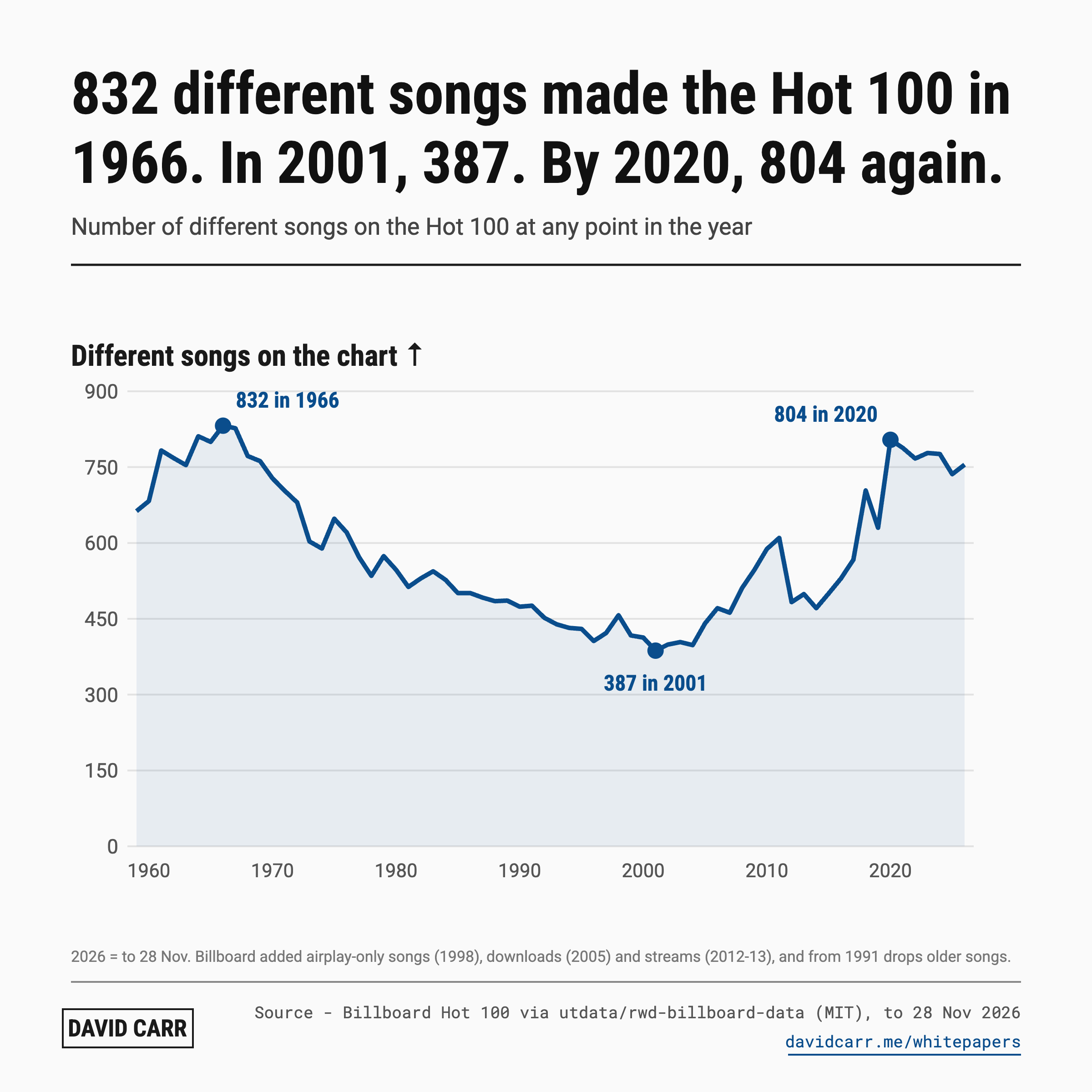
832 different songs made the Hot 100 in 1966. In 2001, 387. By 2020, 804 again.
- 1966: 832 songs, the most in any year
- 2001: 387, the fewest
- 2020: 804; 2025: 736; 2026 to 28 November: 755
The chart turned over fast in the 1960s, slowed right down by 2001, then sped up again with downloads and streaming.
Counts every song that was on the chart in any week of the year. Billboard’s rules changed along the way, so rule changes explain part of the swing.
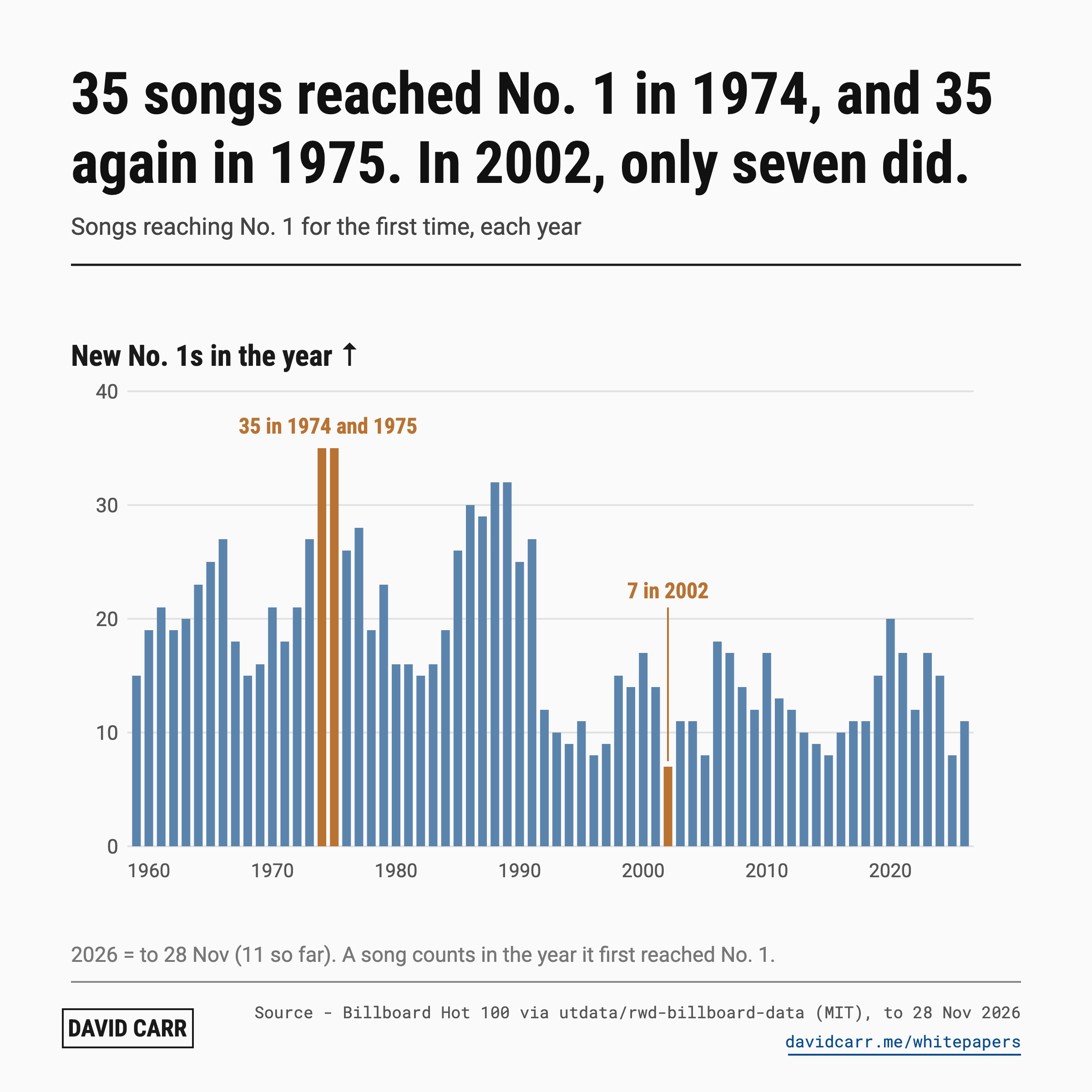
35 songs reached No. 1 in 1974, and 35 again in 1975. In 2002, only seven did.
- 1974 and 1975: 35 new No. 1s each, the most
- 1988 and 1989: 32 each
- 2002: 7, the fewest
- 2025: 8; 2026 to 28 November: 11
In the mid-1970s a new song reached No. 1 about every week and a half. Since the 1990s it has been closer to one a month.
A song counts once, in the year it first reached No. 1.
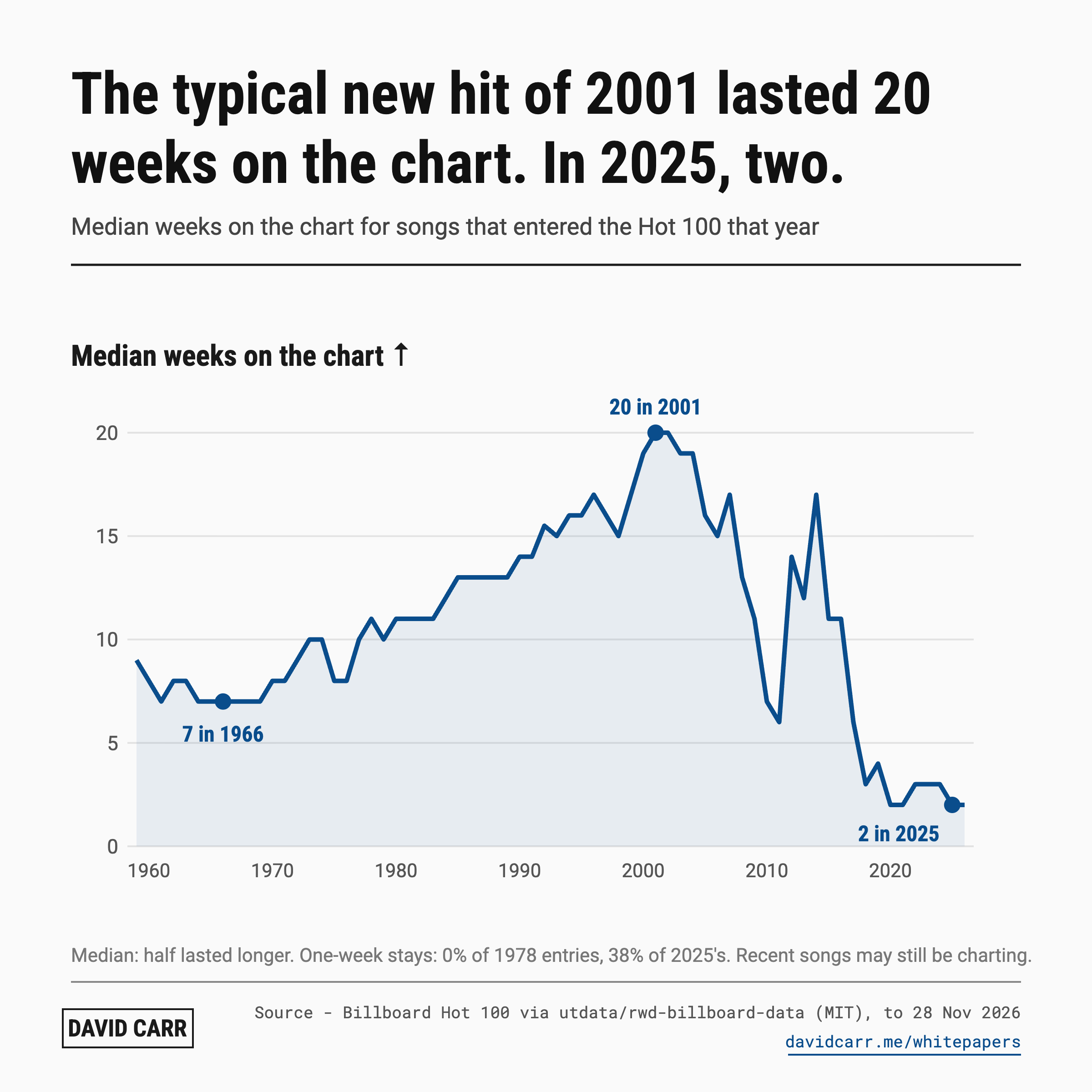
The typical new hit of 2001 lasted 20 weeks on the chart. In 2025, two.
- Median weeks on the chart for new entries: 7 in 1966, 13 in 1985, 20 in 2001
- Then 7 in 2010, 2 in 2020 and 2 in 2025
- One-week stays: none at all from 1978 to 1983; 46% of 2020’s new entries
Album weeks put many songs on the chart for a week, which pulls the typical stay down. Big hits still last a long time, as the longest stays show.
Median = half of the year’s new entries lasted longer, half shorter. Songs from 2025 and 2026 may still be charting.
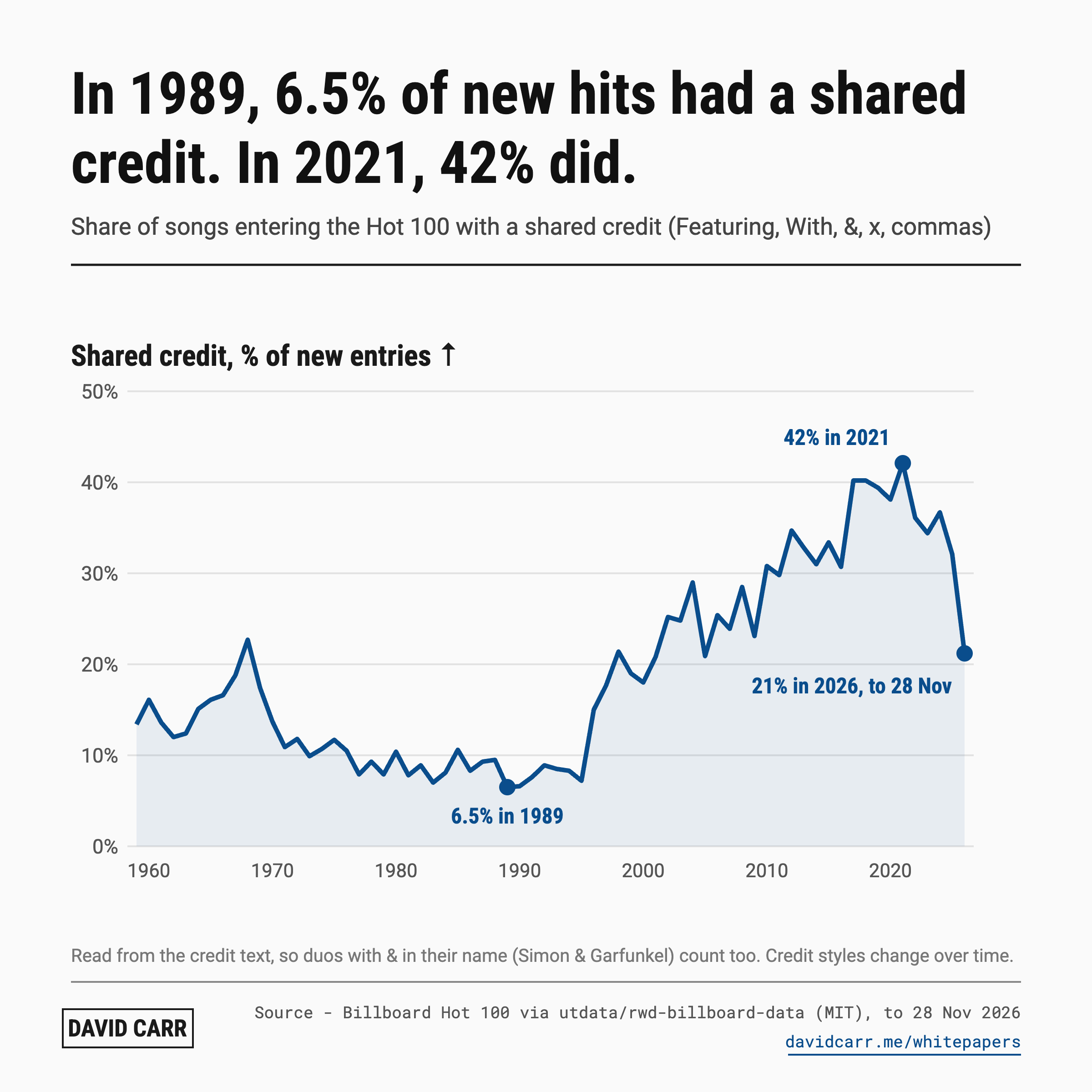
In 1989, 6.5% of new hits had a shared credit. In 2021, 42% did.
- 1989: 6.5% of new entries had more than one act on the credit, the lowest
- 2000: 18%; 2010: 31%
- 2021: 42%, the highest; 2025: 32%
From the mid-1990s, featured guests became part of how hits are made. The share has eased a little since 2021.
Shared credit = Featuring, With, &, x or a comma in the credit. Duos with & in their name count too, which lifts the 1960s. 2026 (21% to 28 November) is a part year, and the way Billboard writes credits has changed, so read the latest years with care.
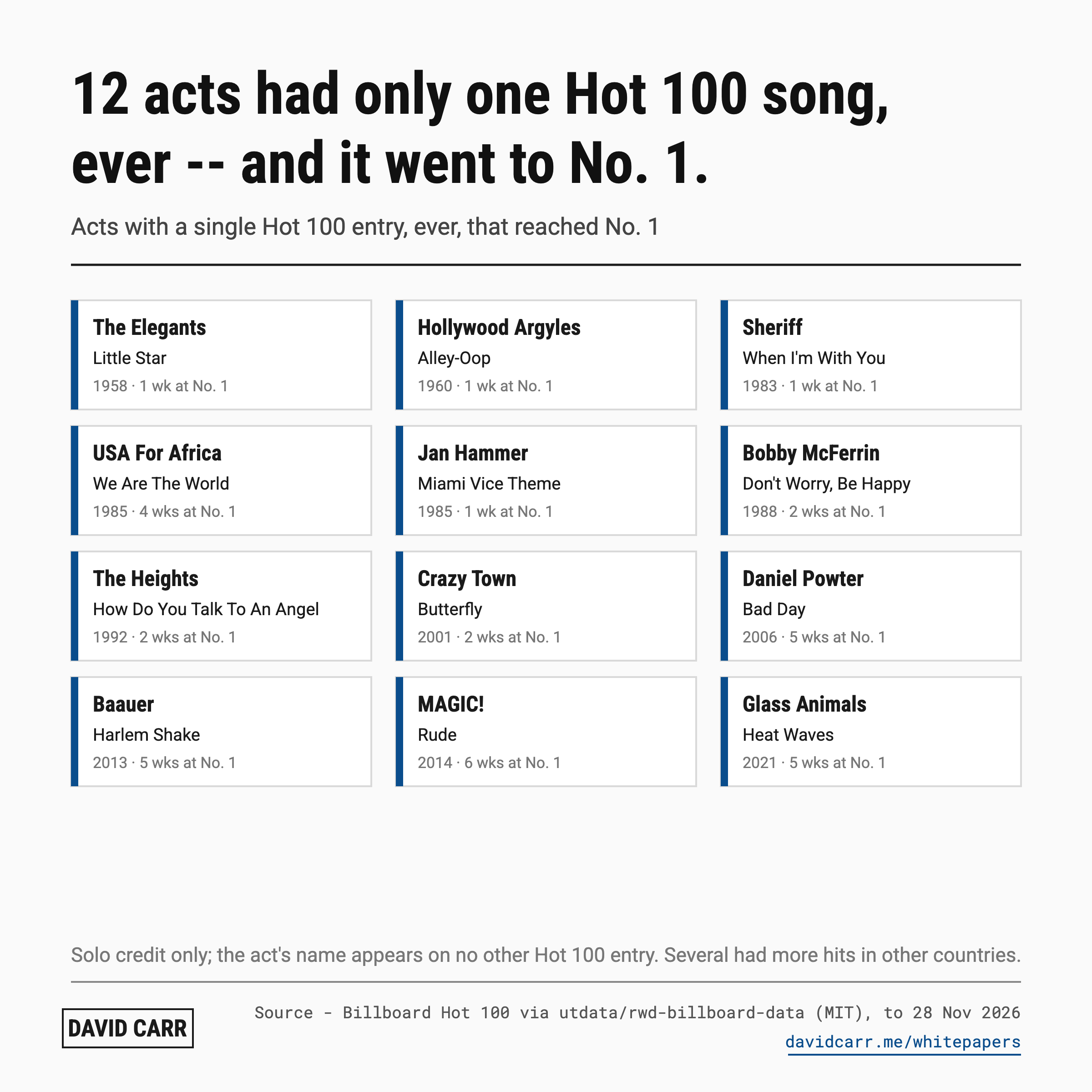
12 acts had only one Hot 100 song, ever -- and it went to No. 1.
- From The Elegants’ Little Star (1958) to Glass Animals’ Heat Waves (2021)
- Bad Day, Harlem Shake and Heat Waves each spent five weeks at No. 1; Rude spent six
- USA for Africa’s We Are the World: four weeks in 1985
- 2,628 acts have had exactly one Hot 100 song; these 12 took theirs to the top
Getting one song to No. 1 is hard. Getting there with your only song is rarer still.
Solo credit, and the act’s name appears on no other Hot 100 entry. Several had other hits in other countries.
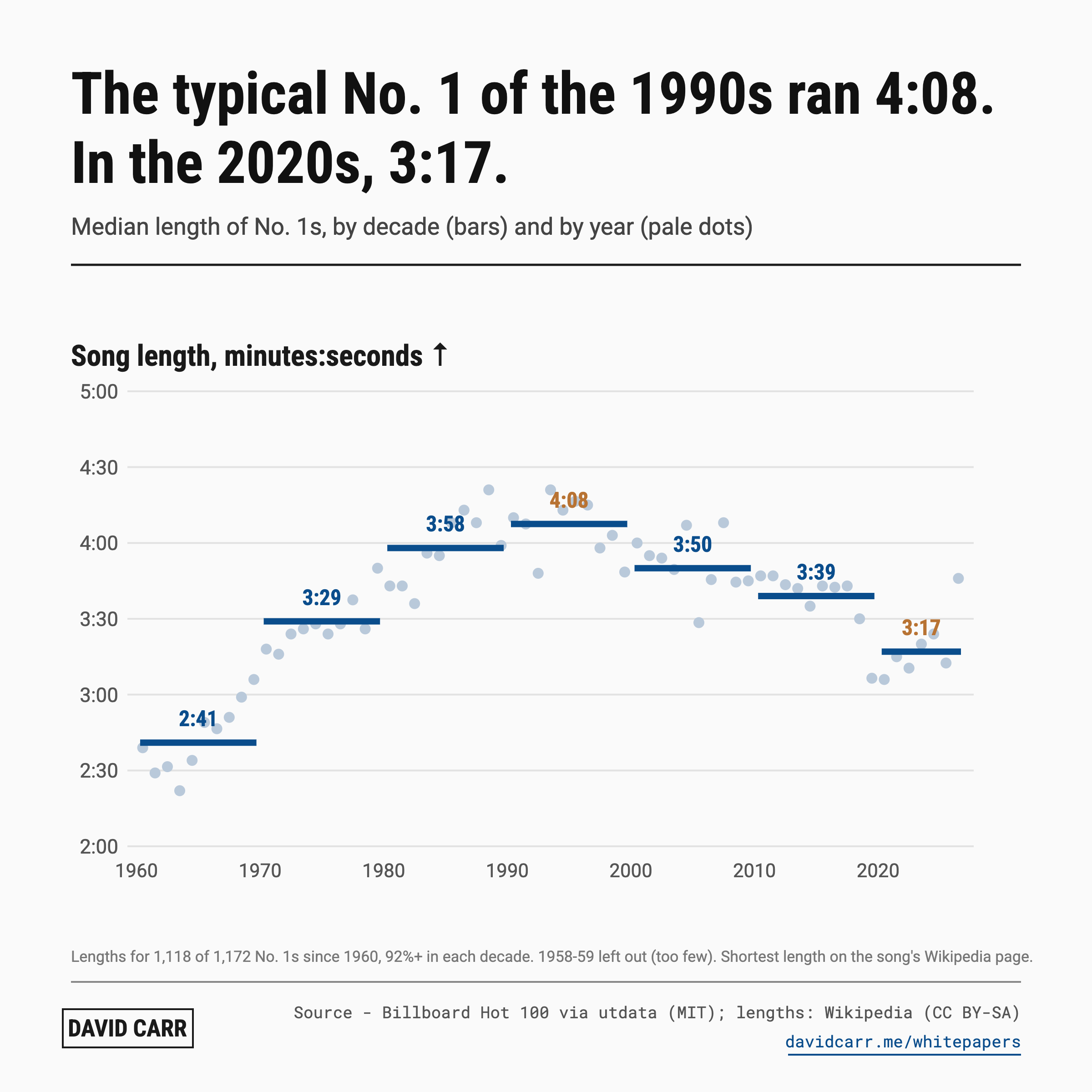
The typical No. 1 of the 1990s ran 4:08. In the 2020s, 3:17.
- Median length of a No. 1: 2:41 in the 1960s, 3:29 in the 1970s, 3:58 in the 1980s
- 4:08 in the 1990s, the longest; then 3:50 in the 2000s, 3:39 in the 2010s
- 2020s so far: 3:17
- Longest No. 1 here: Hey Jude, 7:12 (1968). Shortest: Stay by Maurice Williams and the Zodiacs, 1:36 (1960)
No. 1s got longer for three decades, peaked in the 1990s, and have been getting shorter since. A 2020s No. 1 is still longer than a 1960s one.
Lengths from the infobox of each song’s English Wikipedia article, found through Wikipedia’s yearly lists of No. 1s. Where several lengths are listed, the shortest is used, since single and radio edits are almost always shorter than album versions. Found for 1,118 of 1,172 No. 1s since 1960, and at least 92% in every decade. Two misreads were dropped by hand. 1958 and 1959 are left out.
Method, caveats and sources
The short answer. Reaching No. 1 has changed shape. From 1959 to 1994 no song went straight in at the top; in the 2020s, 61 of 100 No. 1s did, and 55 stayed there for one week only. The record for weeks at No. 1 stood at 16 from 1996 to 2019; Ella Langley’s Choosin’ Texas now has 29. The Beatles still have the most No. 1s, 20, ahead of Mariah Carey on 19 and Taylor Swift on 16. The chart holds as many different songs a year now as in the 1960s, about 750 to 800, after a low of 387 in 2001. The typical new entry lasted 20 weeks in 2001 and two weeks in 2025. Shared credits rose from 6.5% of new entries in 1989 to 42% in 2021. And the typical No. 1 is getting shorter: 4:08 in the 1990s, 3:17 in the 2020s.
Data. Every weekly Billboard Hot 100 from 4 August 1958 to the chart dated 28 November 2026 (3,565 charts, 1,195 No. 1s), from the utdata/rwd-billboard-data repository (MIT licence), pulled on 26 November 2026. Credit: Billboard Hot 100 data via utdata/rwd-billboard-data. Every figure on this page is my own count on that data. Titles and credits are as Billboard prints them. The Choosin’ Texas record was checked against its English Wikipedia article on 27 November 2026. Song lengths come from the infoboxes of English Wikipedia song articles (CC BY-SA), reached through Wikipedia’s yearly lists of Hot 100 No. 1s and read through the MediaWiki API on 27 November 2026.
Definitions. Decades go by the week a song first reached No. 1; the 2020s run to 28 November 2026. “Straight in” means the song’s first week on the Hot 100 was at No. 1. Acts are counted by lead or joint-lead credit; featured guests are not counted. Weeks at No. 1 and weeks on the chart need not be in a row.
Caveats. Billboard’s rules changed many times: from 1991 older songs drop off once they fall below set positions, airplay-only songs were allowed in 1998, paid downloads counted from 2005 and streams from 2012-13. So some of these shifts come from the rules as much as from listeners. 2026 is a part year. Shared credits are read from the credit text, so a duo with & in its name counts as shared.
Also: Song revivals, Christmas songs and Ireland’s top 10s.