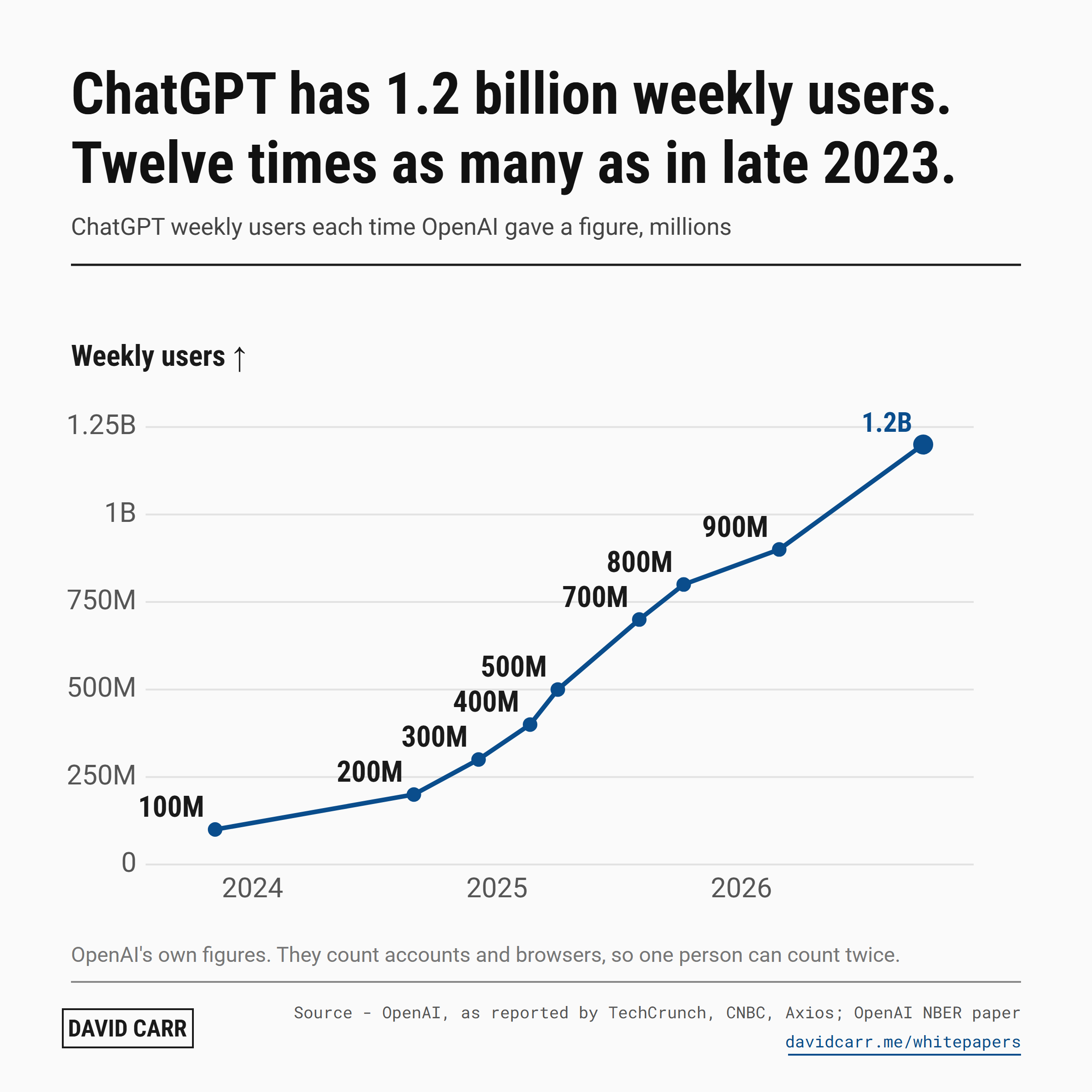
ChatGPT has 1.2 billion weekly users. Twelve times as many as in late 2023.
It took nine months to go from 100 to 200 million, and about three months to go from 200 to 300 million. CNBC reports nearly 100 million paying users at the end of September.
Every figure is OpenAI's own, given at an event, in a post or to the press. OpenAI's own paper says the counts are accounts and browsers, so they run a little ahead of distinct people.
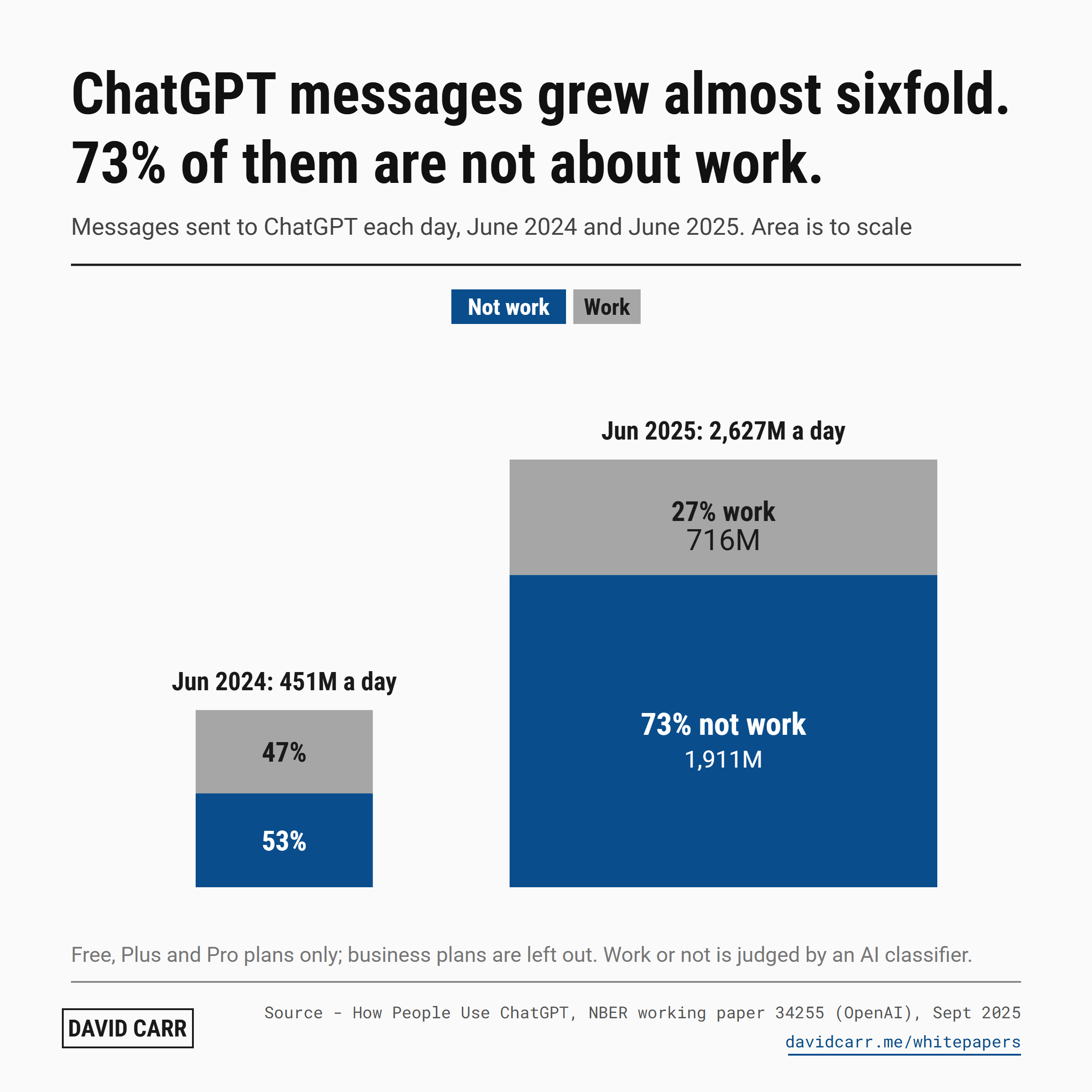
ChatGPT messages grew almost sixfold. 73% of them are not about work.
- June 2024: 451 million messages a day, 53% not about work
- June 2025: 2.6 billion a day, 73% not about work
Work messages more than tripled. Everything else grew eightfold. Most of the use is in people's own lives.
From OpenAI's How People Use ChatGPT (NBER working paper 34255, September 2025). Free, Plus and Pro plans only. An AI classifier, not a person, judged each sampled message.
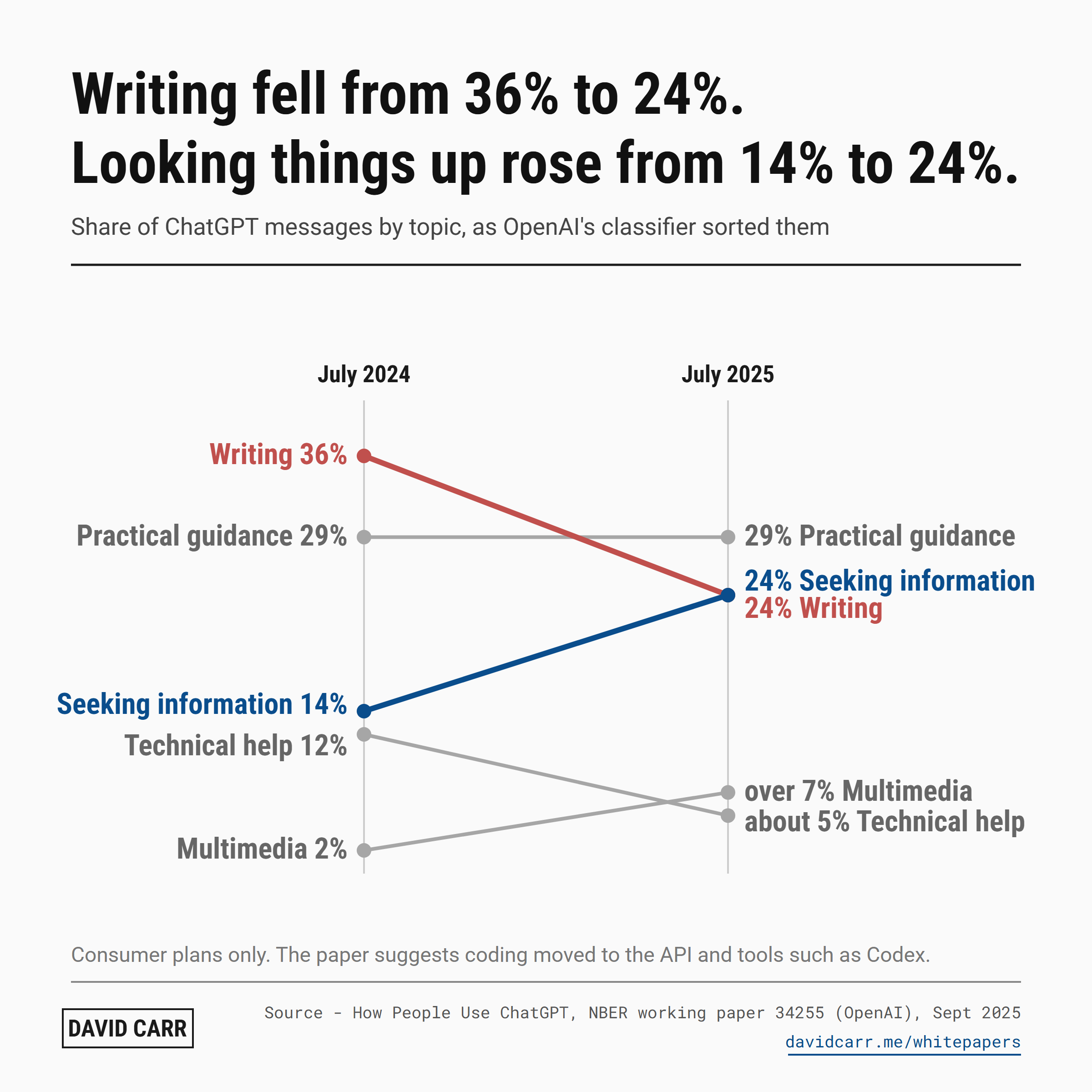
Writing fell from 36% to 24%. Looking things up rose from 14% to 24%.
- Practical guidance: 29%, both years
- Writing: 36% to 24%
- Seeking information: 14% to 24%
- Technical help: 12% to about 5%
- Images and other media: 2% to over 7%
Three topics -- guidance, information and writing -- make up about 77% of messages. Tutoring and teaching alone is about 10%.
July 2024 against July 2025, from the same paper. The authors suggest coding moved to the API and tools such as Codex, outside the sample.
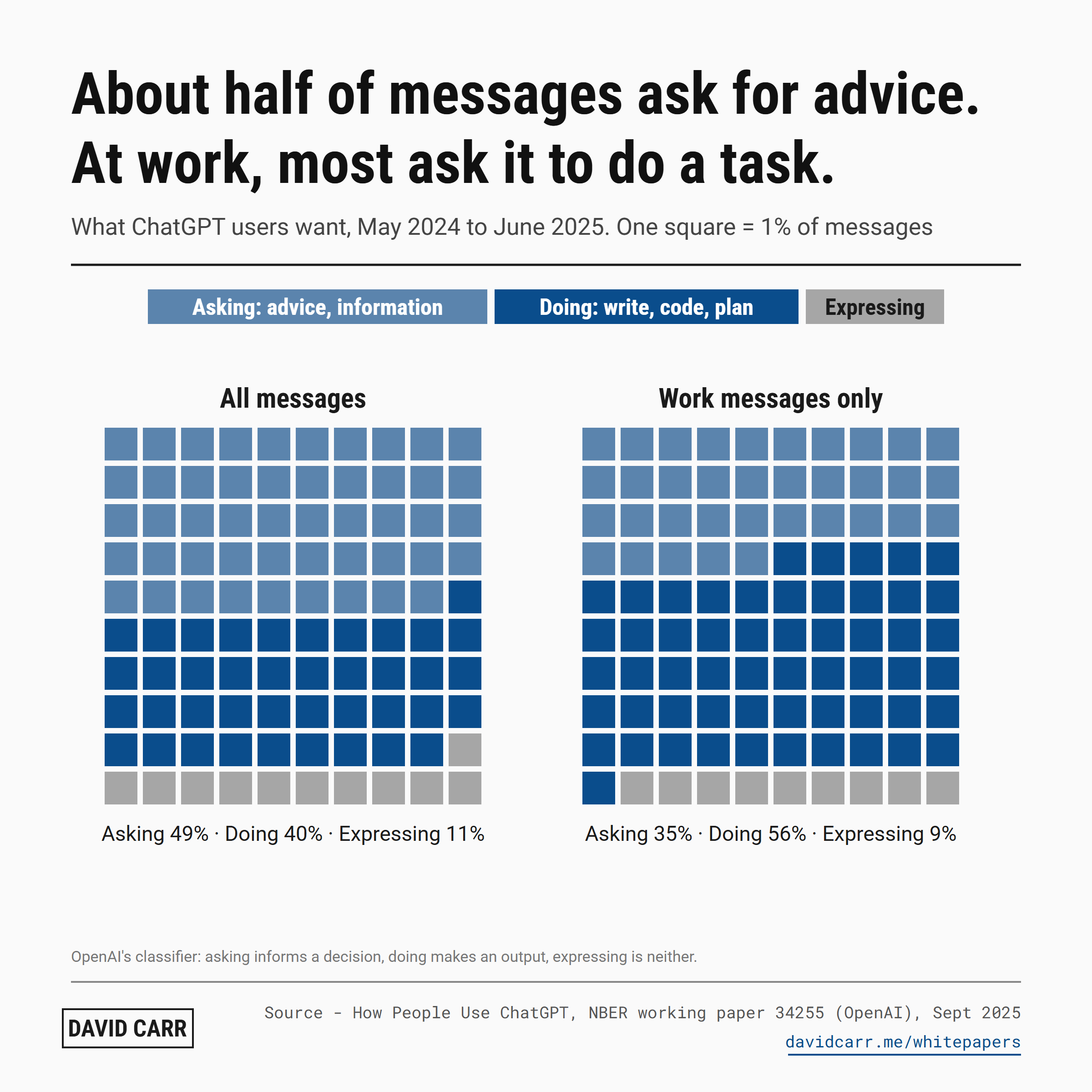
About half of messages ask for advice. At work, most ask it to do a task.
- All messages: asking 49%, doing 40%, expressing 11%
- Work messages: doing 56%, asking 35%, expressing 9%
Asking grew faster than doing: by late June 2025 it was 51.6% of all messages. At work it flips, and most messages ask it to make something: an email, code, a plan.
OpenAI's own labels from the paper, sampled May 2024 to June 2025. Whether a message is about work is also the classifier's call.
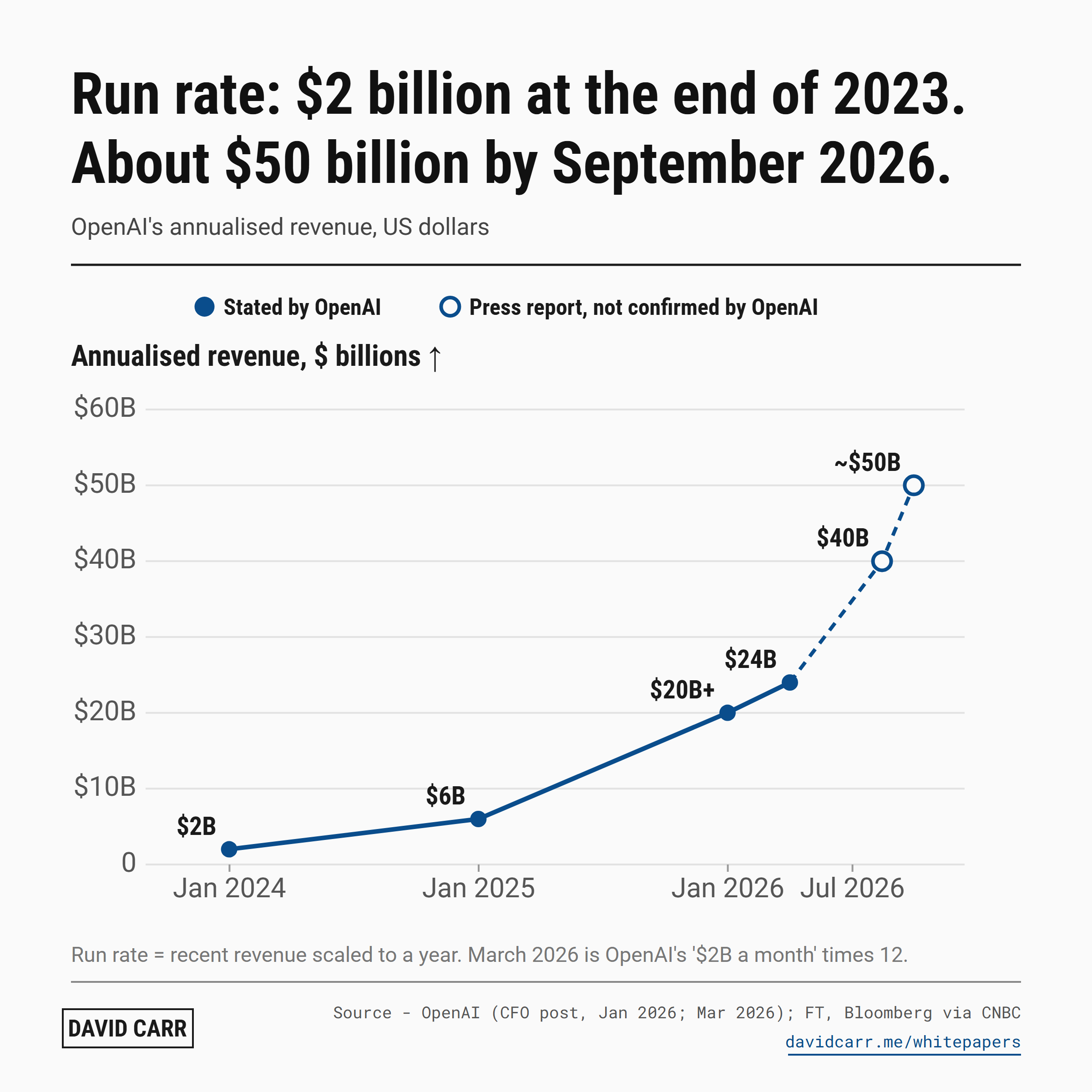
Run rate: $2 billion at the end of 2023. About $50 billion by September 2026.
- End of 2023: $2 billion (OpenAI)
- End of 2024: $6 billion (OpenAI)
- End of 2025: over $20 billion (OpenAI)
- March 2026: "$2 billion a month" (OpenAI)
- August 2026: $40 billion (Bloomberg, CNBC)
- End of September 2026: about $50 billion (FT, CNBC)
The last two are press reports, not OpenAI statements. Its finance chief told investors in August that most revenue now comes from businesses. CNBC reports it made $13.1 billion in 2025 and burned about $8 billion of cash.
A run rate is recent revenue scaled up to a year. A "$68 billion" figure reported in September included partners' gross sales, so it is left out.
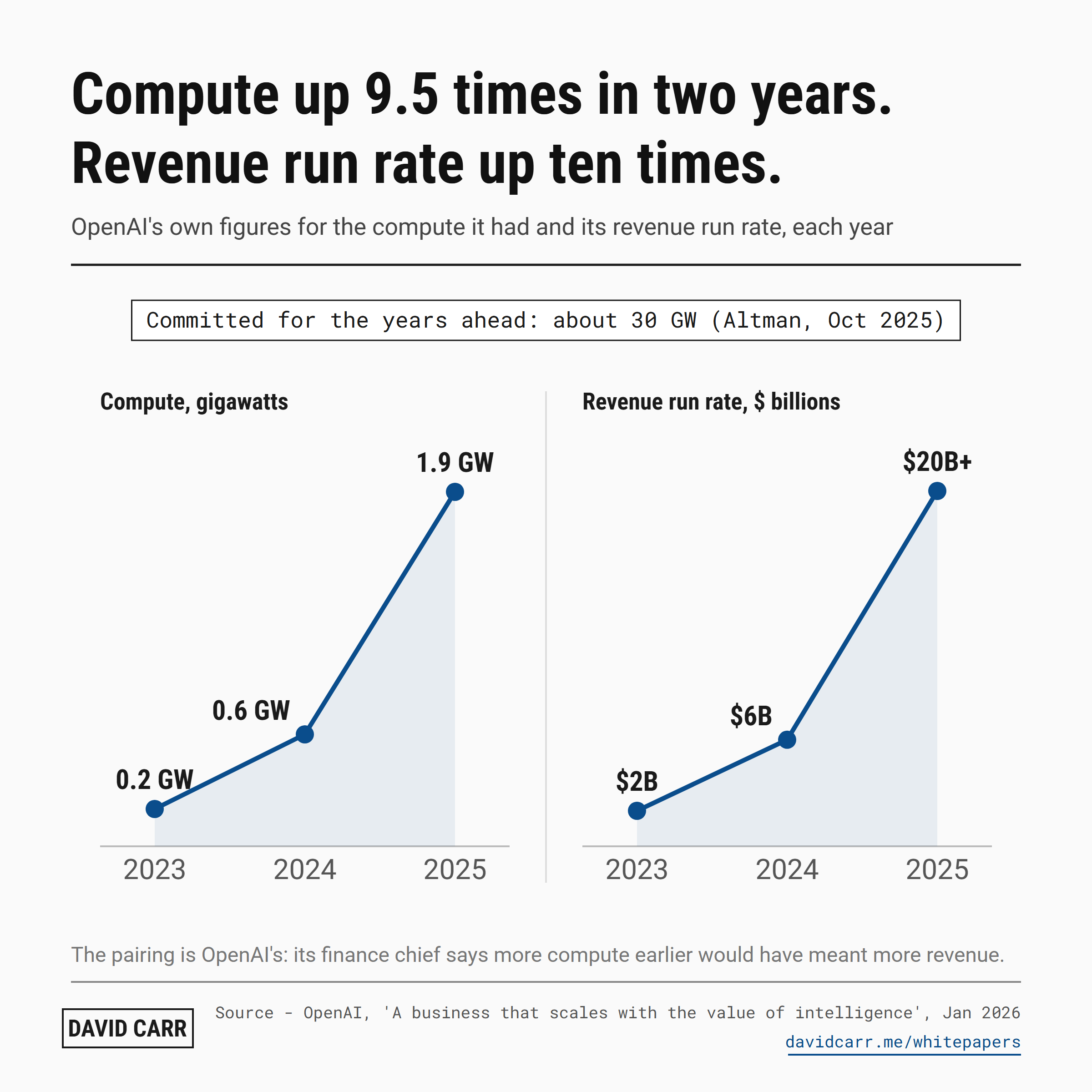
Compute up 9.5 times in two years. Revenue run rate up ten times.
- 2023: 0.2 GW, $2B
- 2024: 0.6 GW, $6B
- 2025: about 1.9 GW, $20B+
OpenAI puts these side by side itself. In October 2025 Sam Altman said it had committed to about 30 GW, around $1.4 trillion. By February 2026 it was telling investors to expect about $600 billion of compute spending by 2030.
From CFO Sarah Friar's post "A business that scales with the value of intelligence", 18 January 2026. A gigawatt is the power drawn by the data centres.
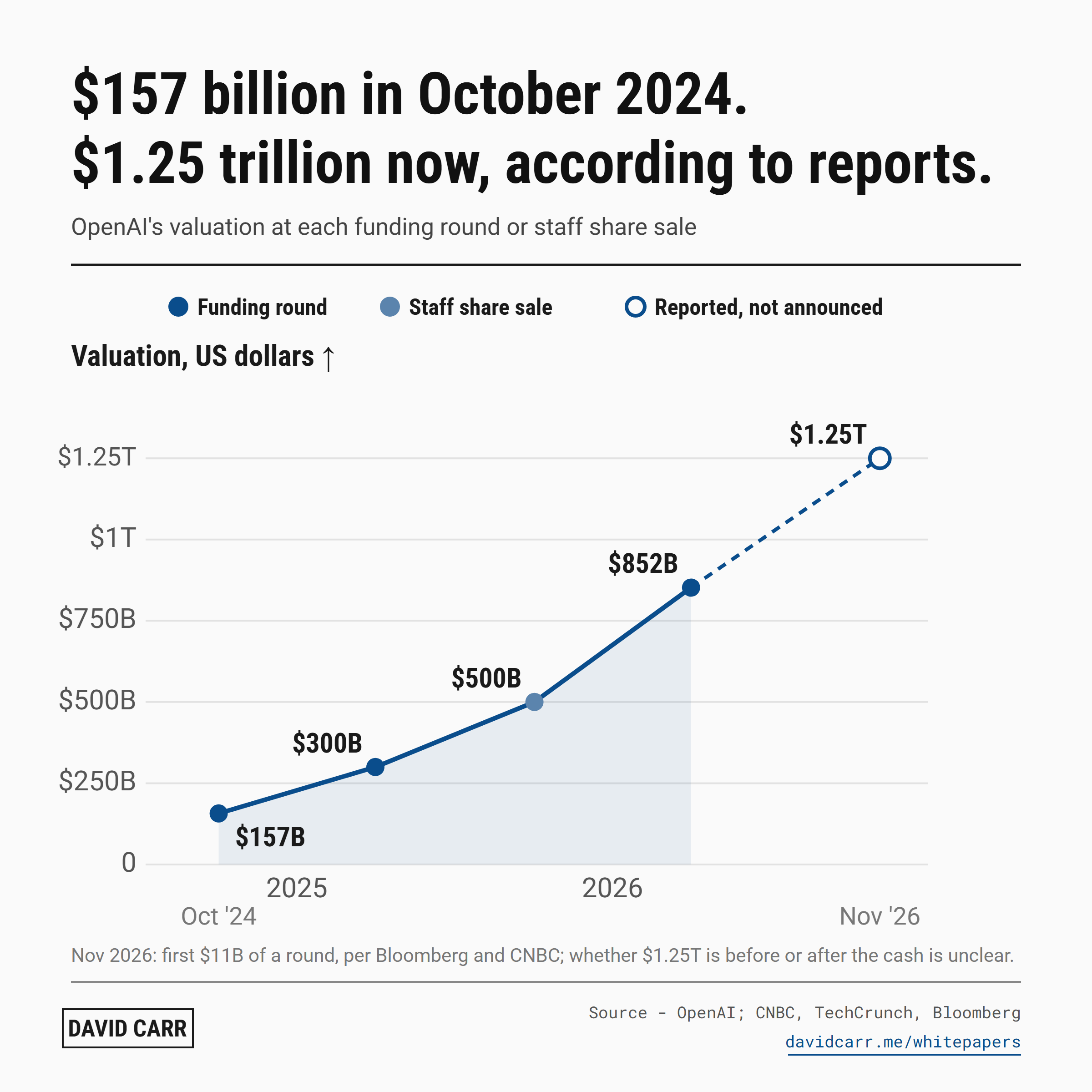
$157 billion in October 2024. $1.25 trillion now, according to reports.
Almost eight times in two years. Reports say it first aimed for $1.4 trillion in this round. OpenAI filed confidentially for a stock market listing in June and is looking at 2027.
The November figure is from Bloomberg and CNBC; OpenAI hasn't announced it, and reports differ on whether it counts the new cash.
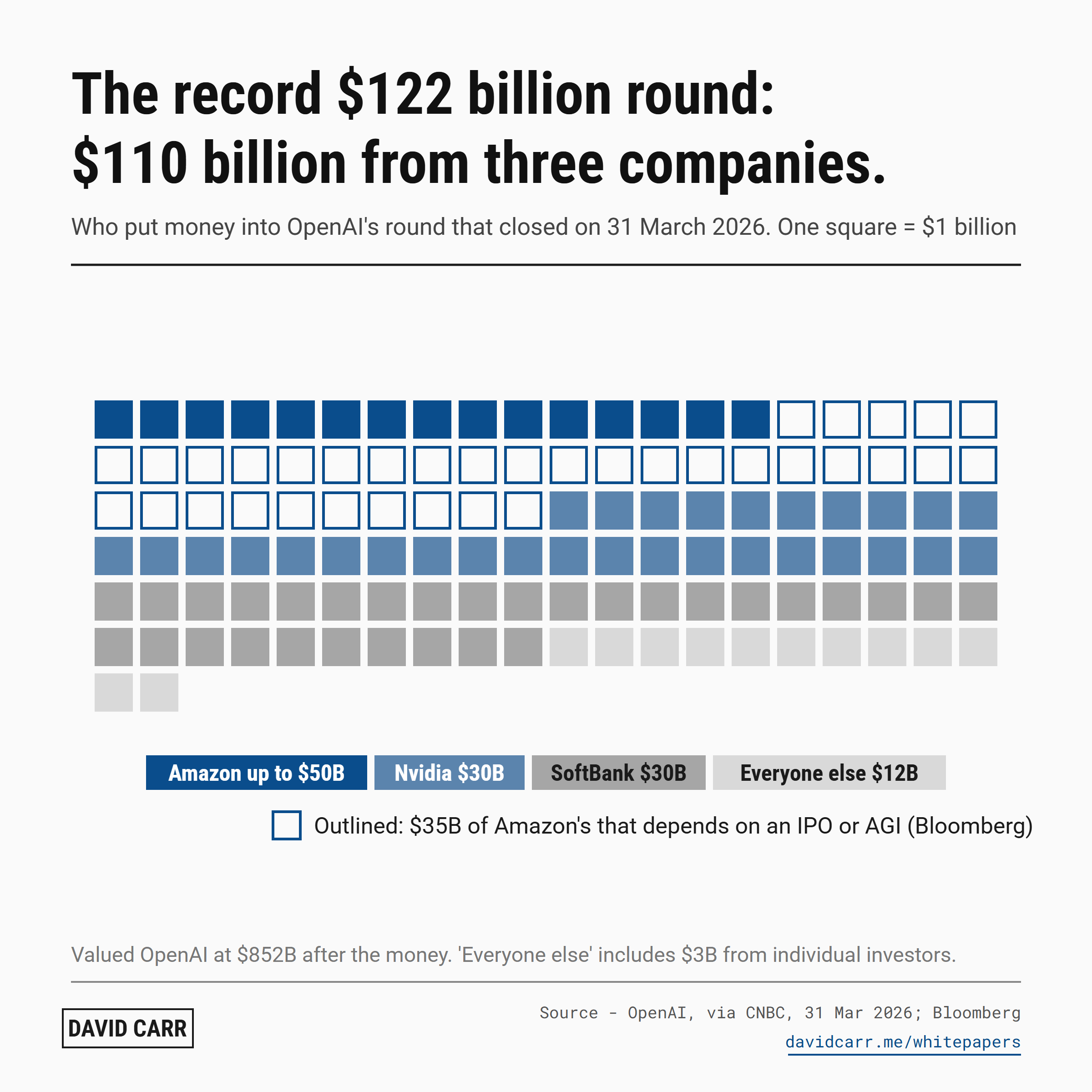
The record $122 billion round: $110 billion from three companies.
- Amazon: up to $50 billion
- Nvidia: $30 billion
- SoftBank: $30 billion
- Everyone else: $12 billion, including $3 billion from individuals
SoftBank also put $30 billion into the March 2025 round. Bloomberg reports $35 billion of Amazon's money depends on a stock market listing or on OpenAI reaching AGI.
Amounts from OpenAI's announcement, as CNBC reported it, 31 March 2026. Microsoft also invested; the amount was not given.
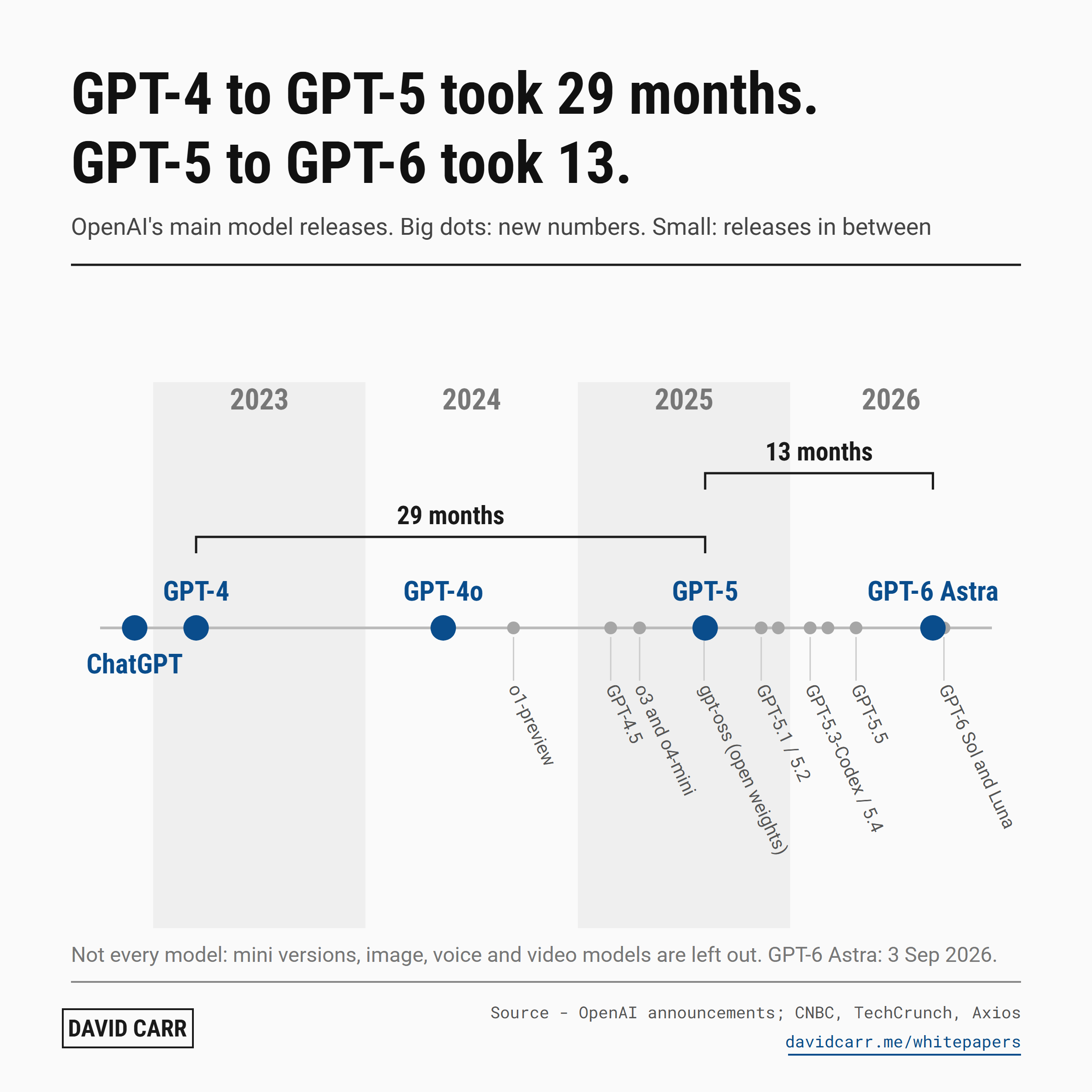
GPT-4 to GPT-5 took 29 months. GPT-5 to GPT-6 took 13.
Between GPT-5 and GPT-6 came at least five numbered updates, roughly one every two months.
Dates from OpenAI's release posts and CNBC, TechCrunch and Axios. Mini, image, voice and video models are left out.
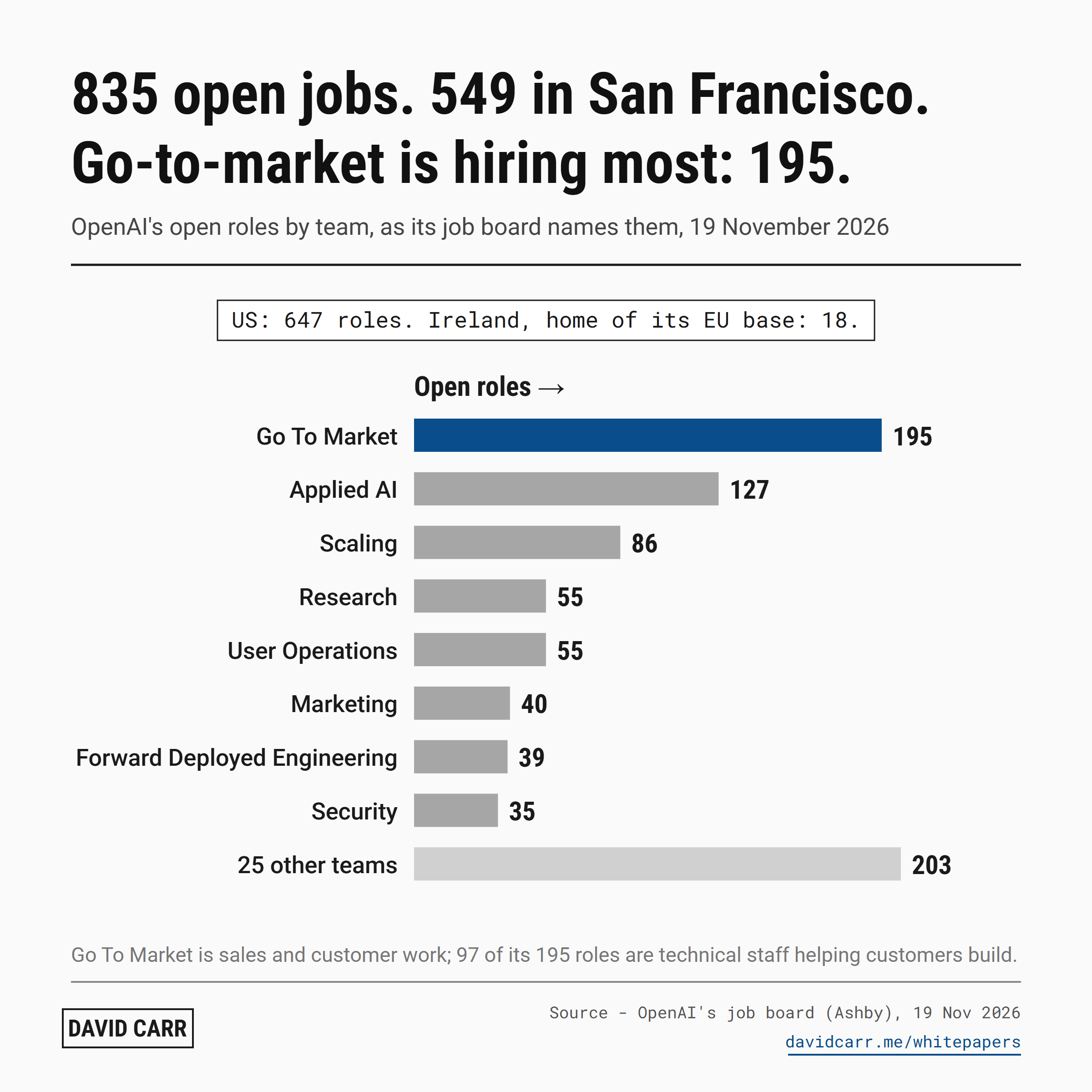
835 open jobs. 549 in San Francisco. Go-to-market is hiring most: 195.
- Go To Market: 195
- Applied AI: 127
- Scaling: 86
- United States: 647 roles
- Ireland: 18 roles
OpenAI's EU base is in Dublin. It has about 120 staff in Ireland, up from 40 at the end of 2025, and has announced 450 more Irish jobs this year. Across the company, it planned to go from about 4,500 to 8,000 staff in 2026, the FT reported.
Every role on OpenAI's job board on 19 November 2026, by the board's own team names. A role listed in two countries counts in both.
Method, caveats and sources
The short answer. ChatGPT has 1.2 billion weekly users, and most of what they send isn't about work. OpenAI's revenue run rate went from $2 billion at the end of 2023 to about $50 billion in September 2026, roughly in step with the compute it could get. Reports value it at $1.25 trillion. It ships a new numbered model about every two months.
OpenAI is private. It files no group accounts. User numbers, the end-of-year run rates and the compute figures are OpenAI's own. Later revenue figures and the November 2026 valuation are press reports quoting people familiar with the numbers, and are marked that way on the charts.
The usage research. Charts 2 to 4 come from How People Use ChatGPT, an OpenAI study with outside economists, published by NBER in September 2025. It covers consumer plans only, from May 2024 to June 2025, and sorts about 1.1 million sampled conversations with AI classifiers that the authors checked against human labels. No person read the messages.
Valuations. Post-money where the source says so. Older valuations (2023, early 2024) are left out because reports disagree on the figure and the date.
Jobs. Every open role on OpenAI's Ashby job board on 19 November 2026, grouped by the team names on the board.
Also: Stripe, the Anthropic Economic Index and OpenRouter.