10 customer logos on Pave's homepage in 2020. 64 today.
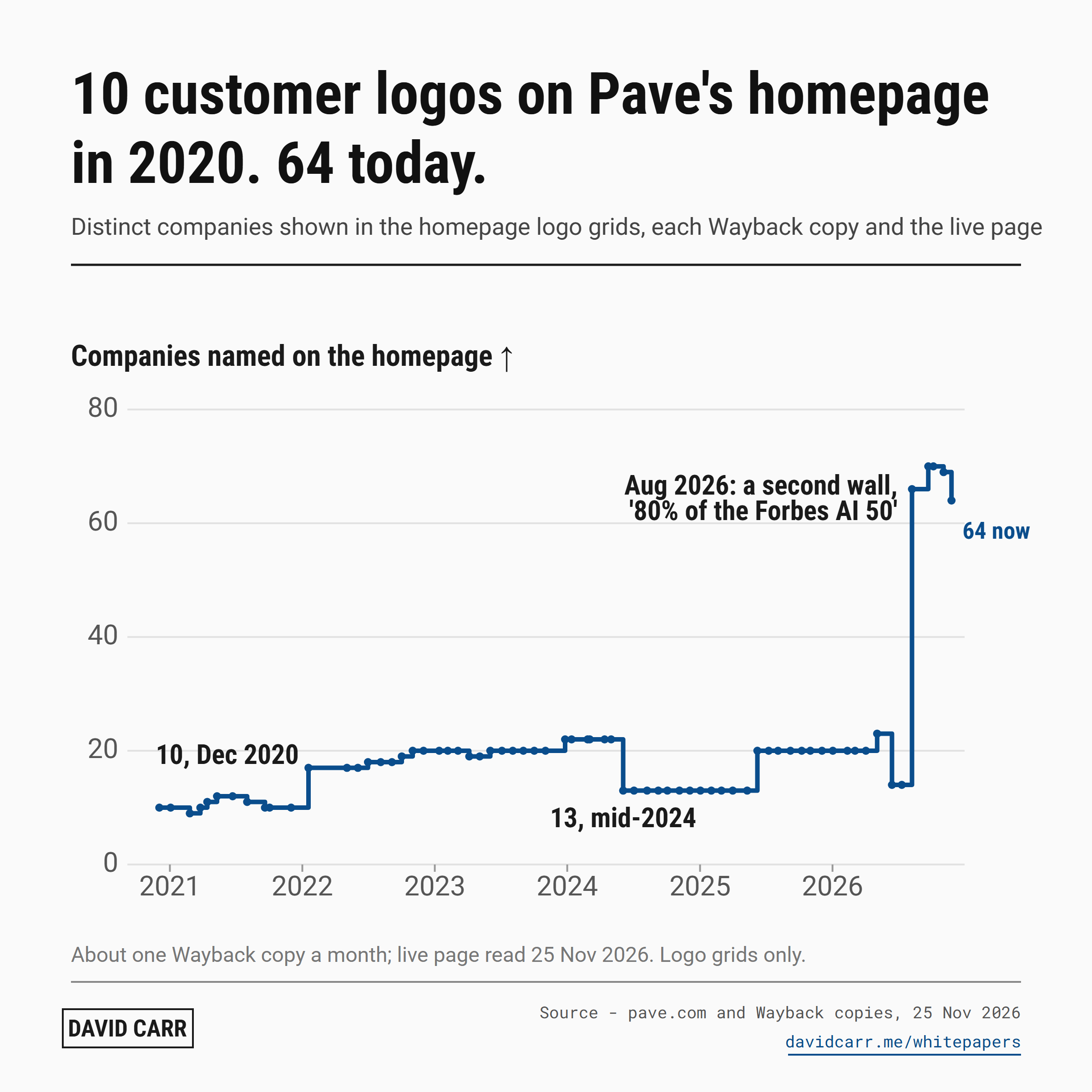
- December 2020: 10 logos
- 2022 to early 2024: about 20
- Mid-2024 to mid-2025: 13
- August 2026: a second wall headed '80% of the Forbes AI 50' takes it to 66
- 25 November 2026: 64
For most of its life the homepage showed about 20 names. The jump came this summer, when a second logo wall was added.
Counted from monthly Wayback Machine copies of the homepage, plus the live page. Only the logo grids are counted.
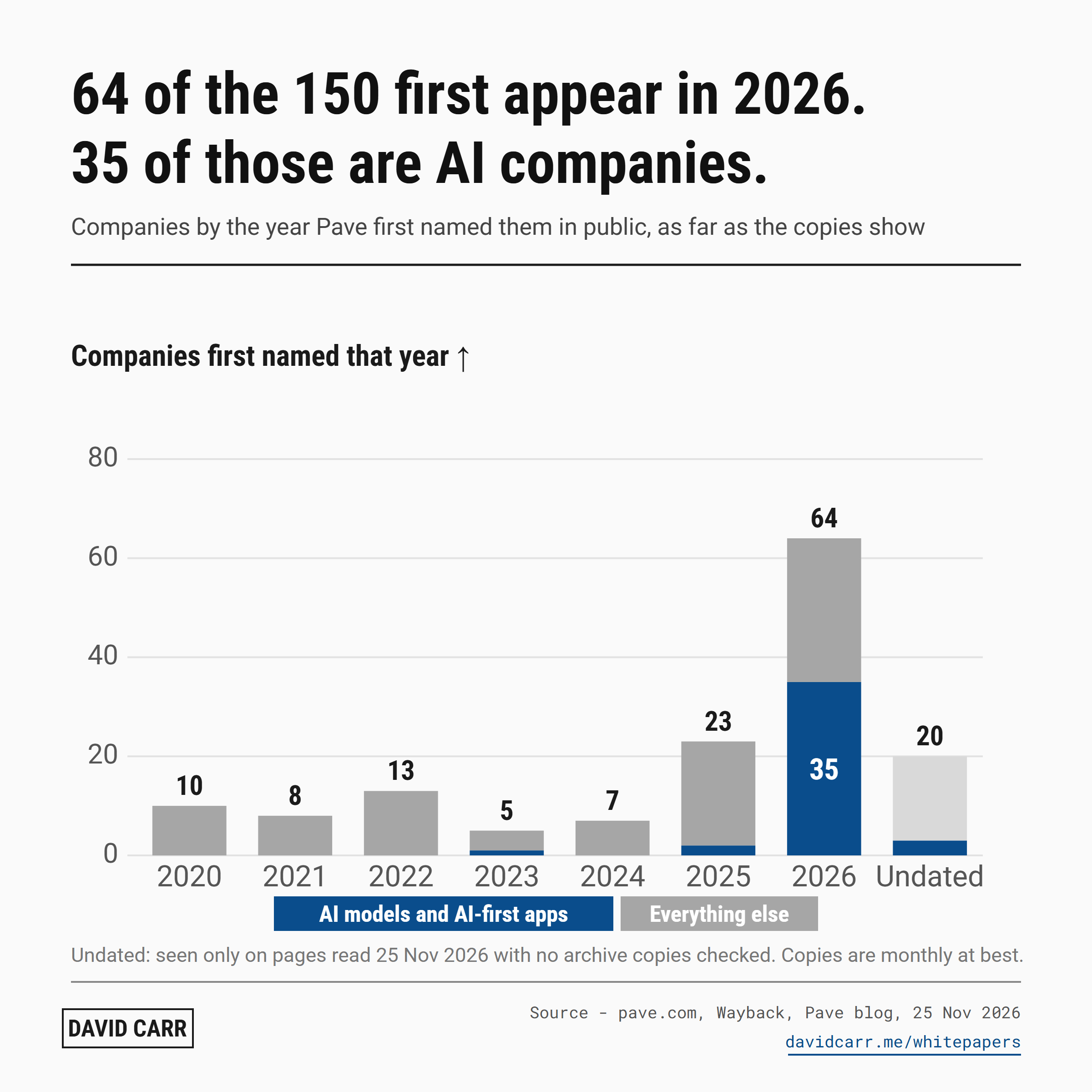
64 of the 150 first appear in 2026. 35 of those are AI companies.
- 150 companies named by Pave in public, 2020 to November 2026
- 2020 to 2024: between 5 and 13 new names a year
- 2025: 23
- 2026: 64, of which 35 are AI companies
- 20 more are undated: they were found only on pages read on 25 November 2026
Many of the names Pave shows today are recent additions, and the AI names arrived almost all at once.
A company's first date is the earliest copy found that names it. Wayback copies are monthly at best and the customers page has long gaps, so some dates are late. The undated 20 sit on industry pages and testimonials whose history was not checked; they may be older.
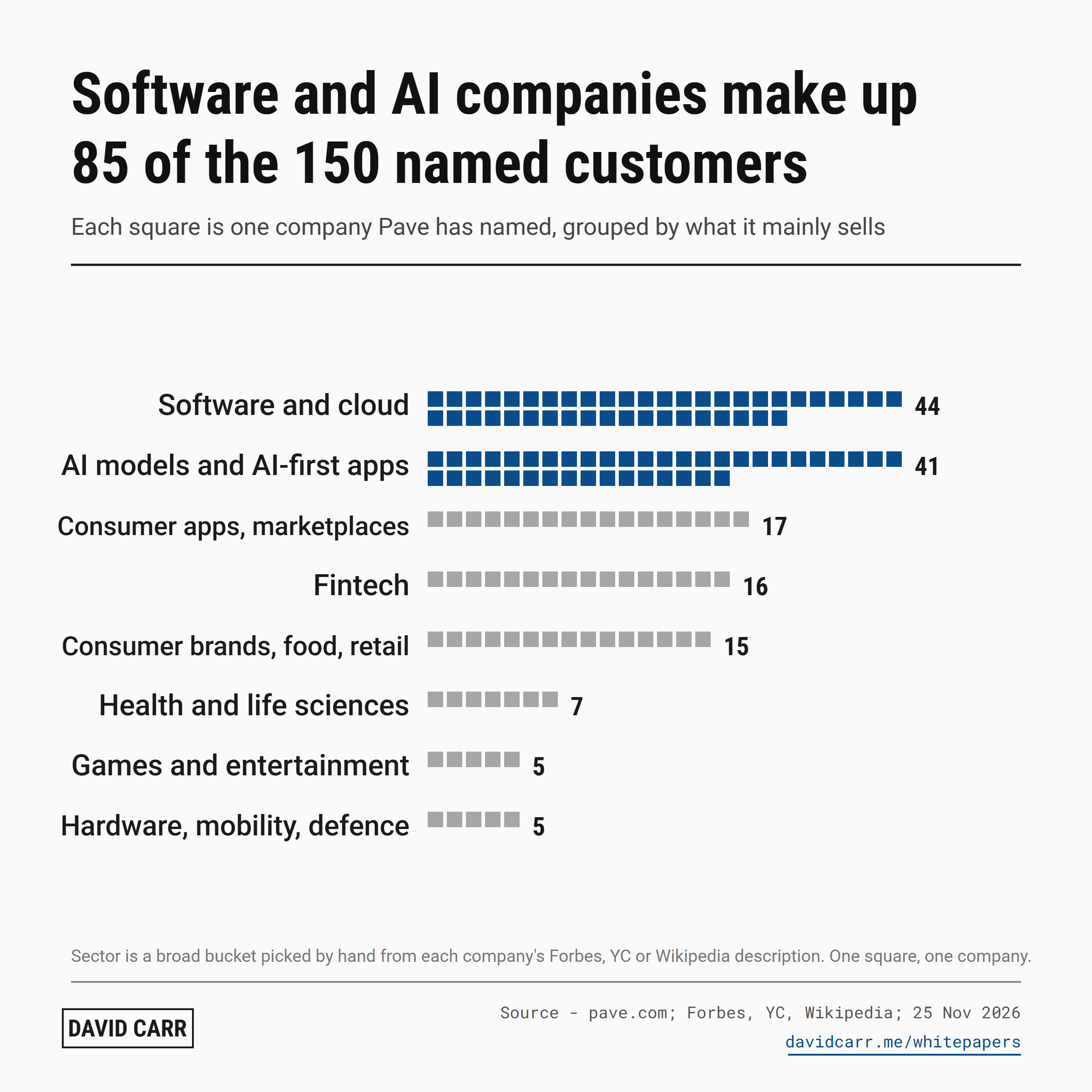
Software and AI companies make up 85 of the 150 named customers.
- Software and cloud: 44
- AI models and AI-first apps: 41
- Consumer apps and marketplaces: 17
- Fintech: 16
- Consumer brands, food and retail: 15
- Health and life sciences: 7; games: 5; hardware, mobility and defence: 5
Pave shows mostly tech firms, but also a run of consumer brands, restaurant chains and drug makers.
The buckets are broad and were chosen by hand from each company's Forbes, YC or Wikipedia description.
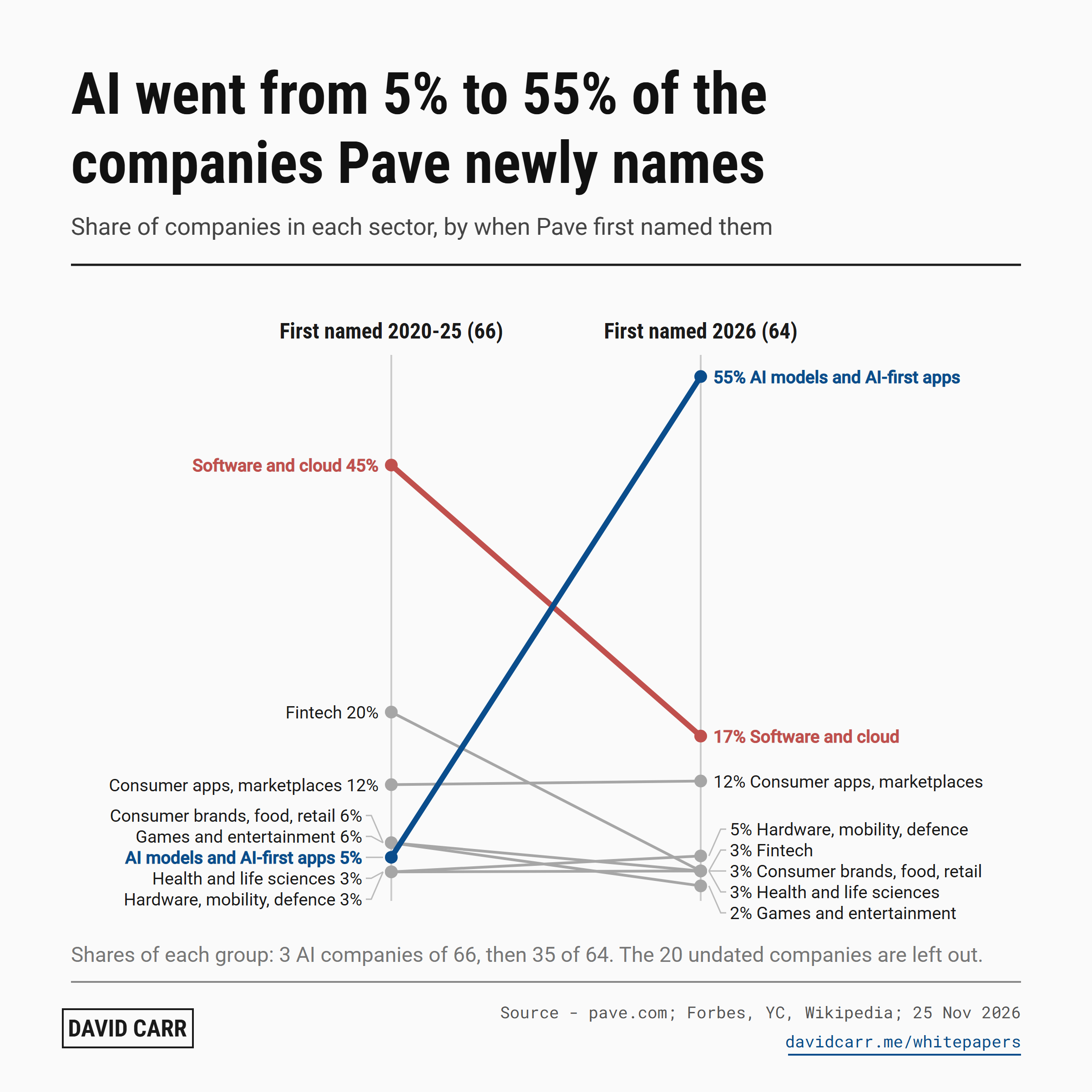
AI went from 5% to 55% of the companies Pave newly names.
- First named 2020-25: 66 companies, three of them AI (5%)
- First named 2026: 64 companies, 35 of them AI (55%)
- Software and cloud: 45% of the earlier group, 17% of the 2026 group
- Fintech: 20%, then 3%
The mix of new names has turned sharply towards AI.
Shares of each group, not of all 150. The 20 undated companies, most of them consumer brands from Pave's retail page, are left out.
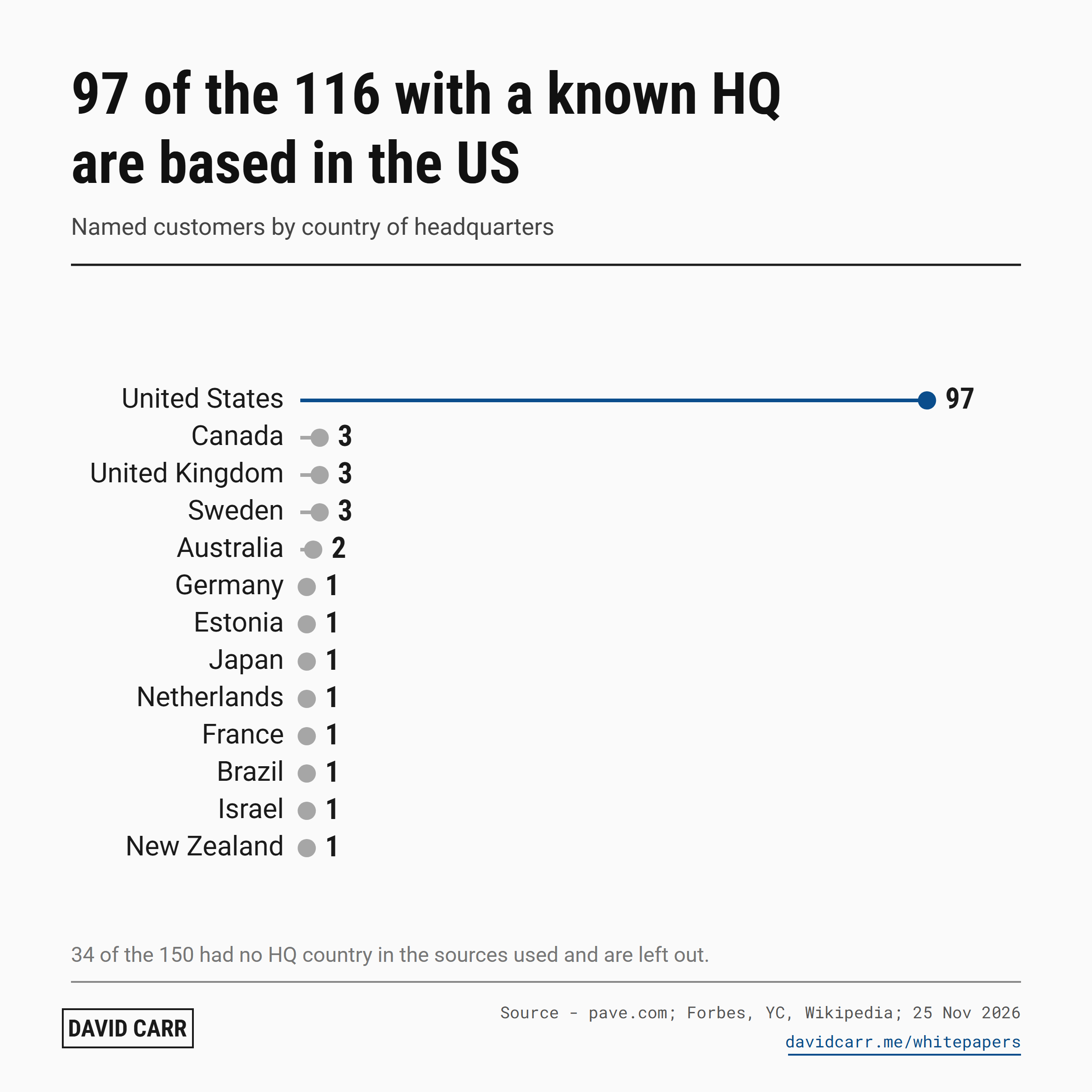
97 of the 116 with a known HQ are based in the US.
- United States: 97
- Canada, the UK and Sweden: 3 each
- Australia: 2
- Germany, Estonia, Japan, the Netherlands, France, Brazil, Israel and New Zealand: 1 each
The names are overwhelmingly American, with a small set from Europe and elsewhere.
HQ country from Forbes, the YC directory or Wikipedia. 34 companies had no HQ country in those sources and are left out rather than guessed.
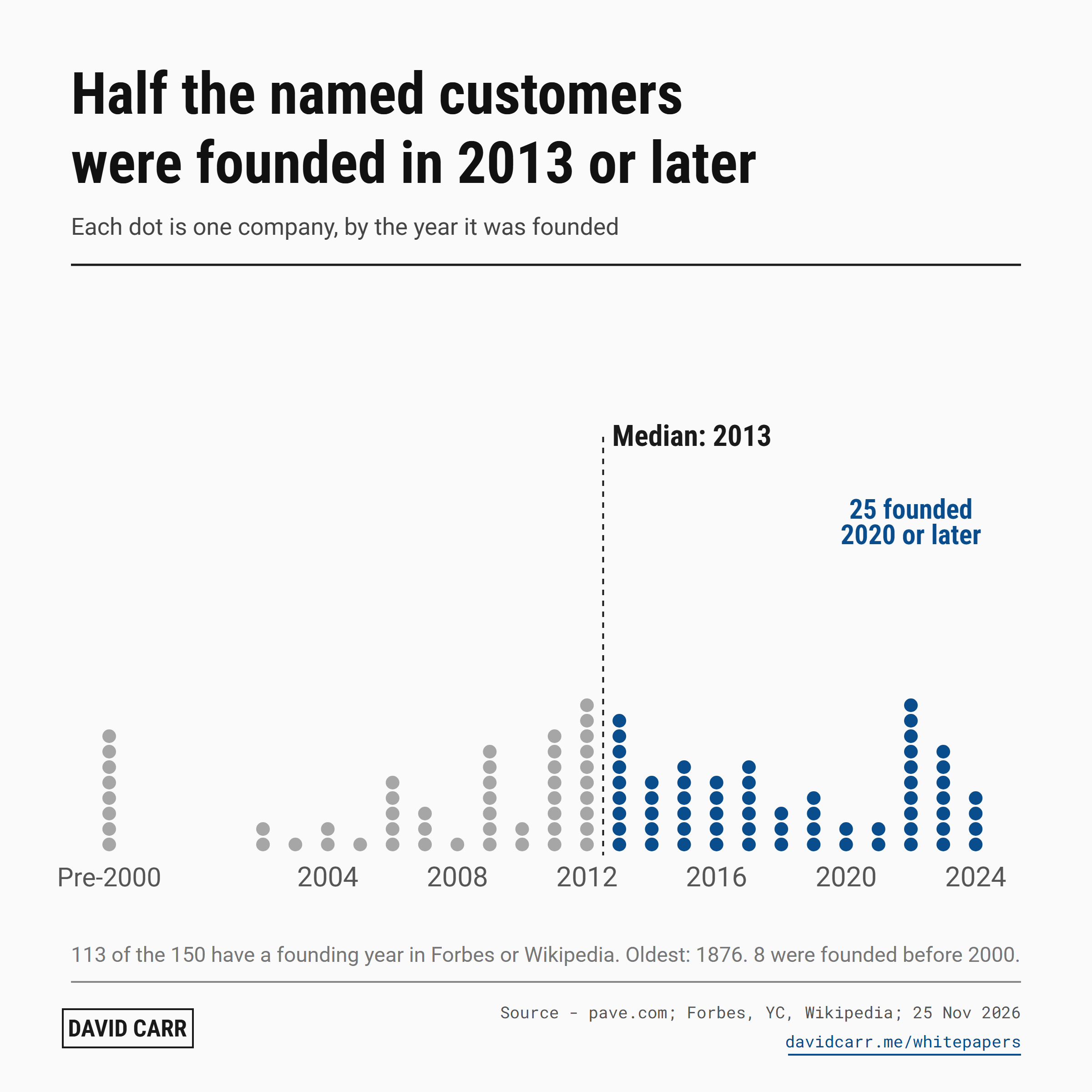
Half the named customers were founded in 2013 or later.
- 113 of the 150 have a founding year in Forbes or Wikipedia
- Median: 2013
- 25 were founded in 2020 or later
- 8 were founded before 2000; the oldest in 1876
58 of the 113 were founded in the 2010s, with a recent cluster of AI firms founded since 2020.
Founding year from Forbes first, then Wikipedia. Waymo is counted from 2009, when the Google project began.
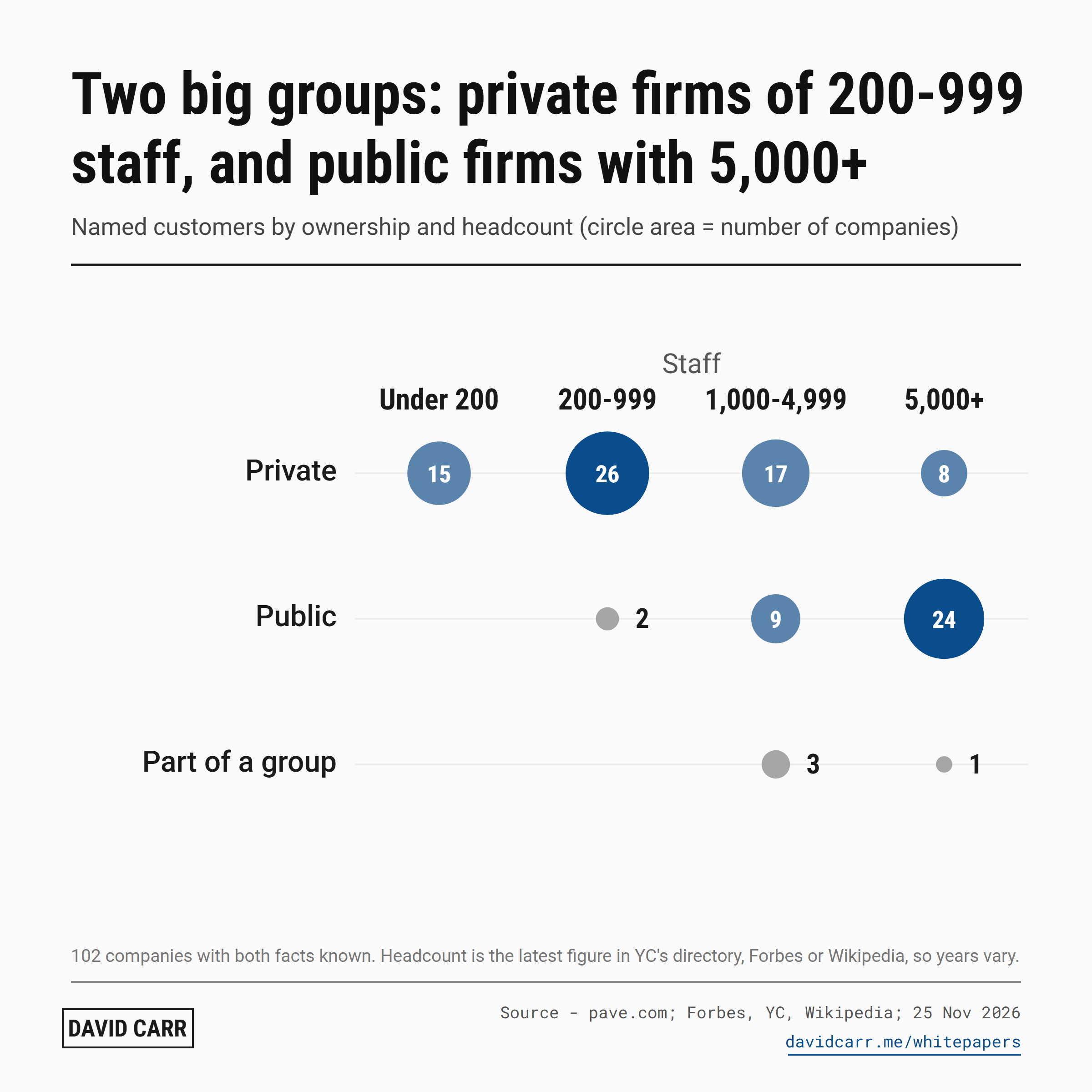
Two big groups: private firms of 200-999 staff, and public firms with 5,000+.
- Private, 200-999 staff: 26
- Public, 5,000+ staff: 24
- Private, 1,000-4,999: 17
- Private, under 200: 15
- Overall: 69 private, 37 public, 5 part of a larger group
The named customers are mostly mid-sized private companies, alongside a group of large listed ones.
102 companies with both facts known. Headcount is the latest figure in the YC directory, Forbes or Wikipedia, so the years differ. 'Part of a larger group' means a subsidiary.
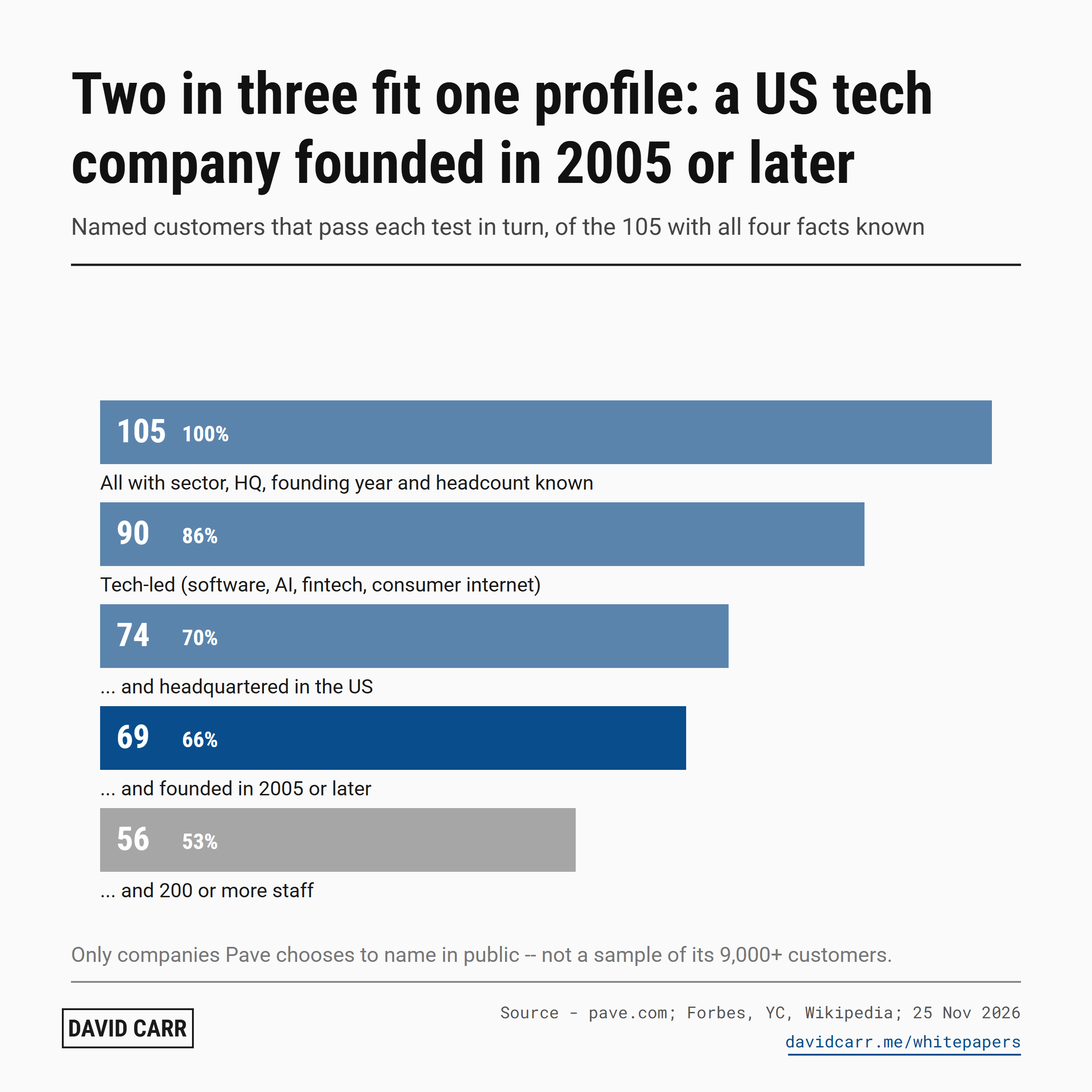
Two in three fit one profile: a US tech company founded in 2005 or later.
- 105 companies have all four facts known
- Tech-led (software, AI, fintech, consumer internet): 90
- ... and US-based: 74
- ... and founded 2005 or later: 69 (66%)
- ... and 200 or more staff: 56 (53%)
That profile describes most of the names Pave chooses to show. It says nothing certain about the rest of its customers.
Pave says it has more than 9,000 clients. In 2021 TechCrunch reported that a third of its customers came from YC. Only 16 of the 150 named here are YC companies, so the names on show are not a cross-section.
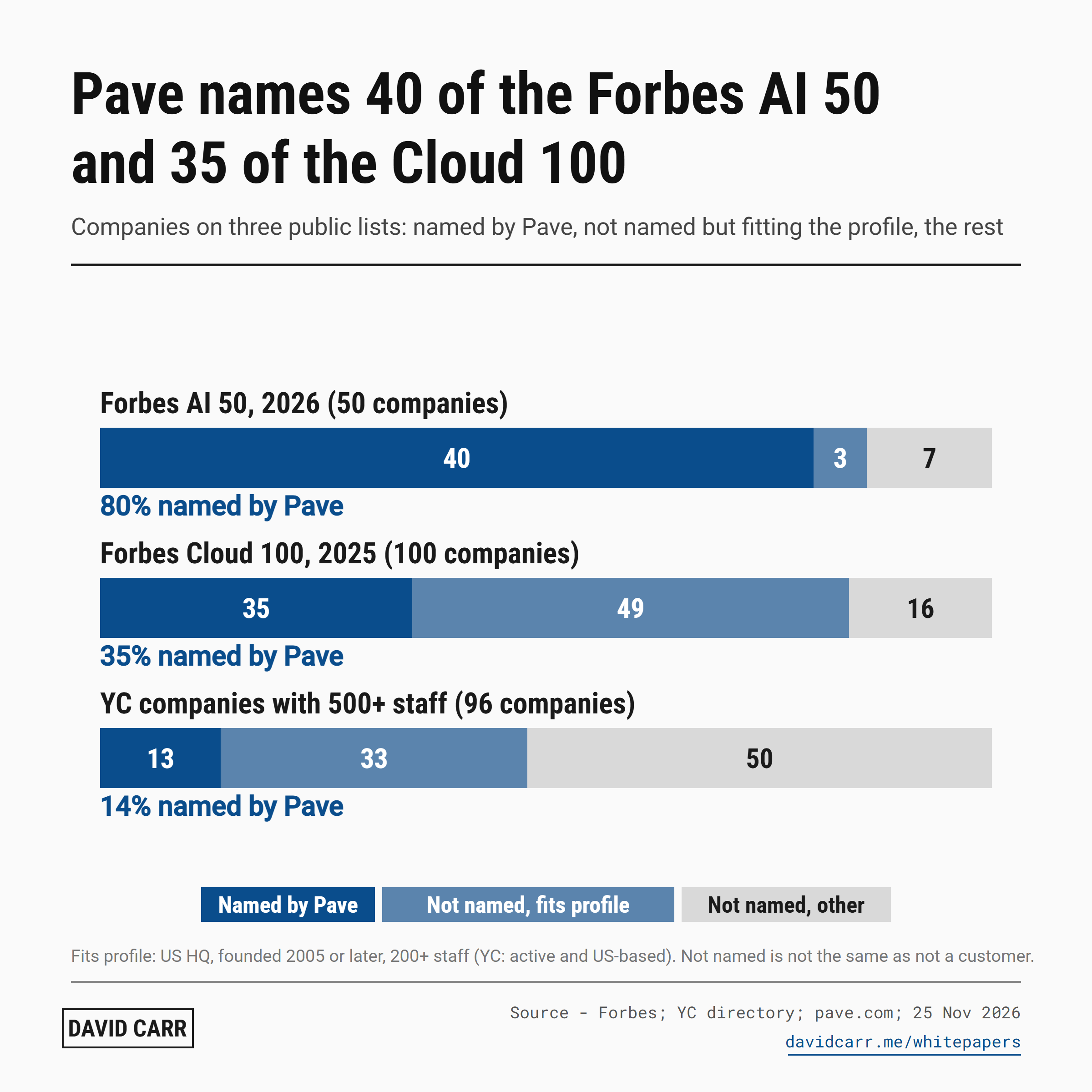
Pave names 40 of the Forbes AI 50 and 35 of the Cloud 100.
Across the three lists, 77 companies that Pave does not name fit the same profile. Some may well be customers that are simply not on show.
Fits the profile: US headquarters, founded in 2005 or later, 200+ staff. For YC: active, US-based, 500+ staff. Some companies sit on two lists, so the per-list counts add to more than 77. Names are not listed here.
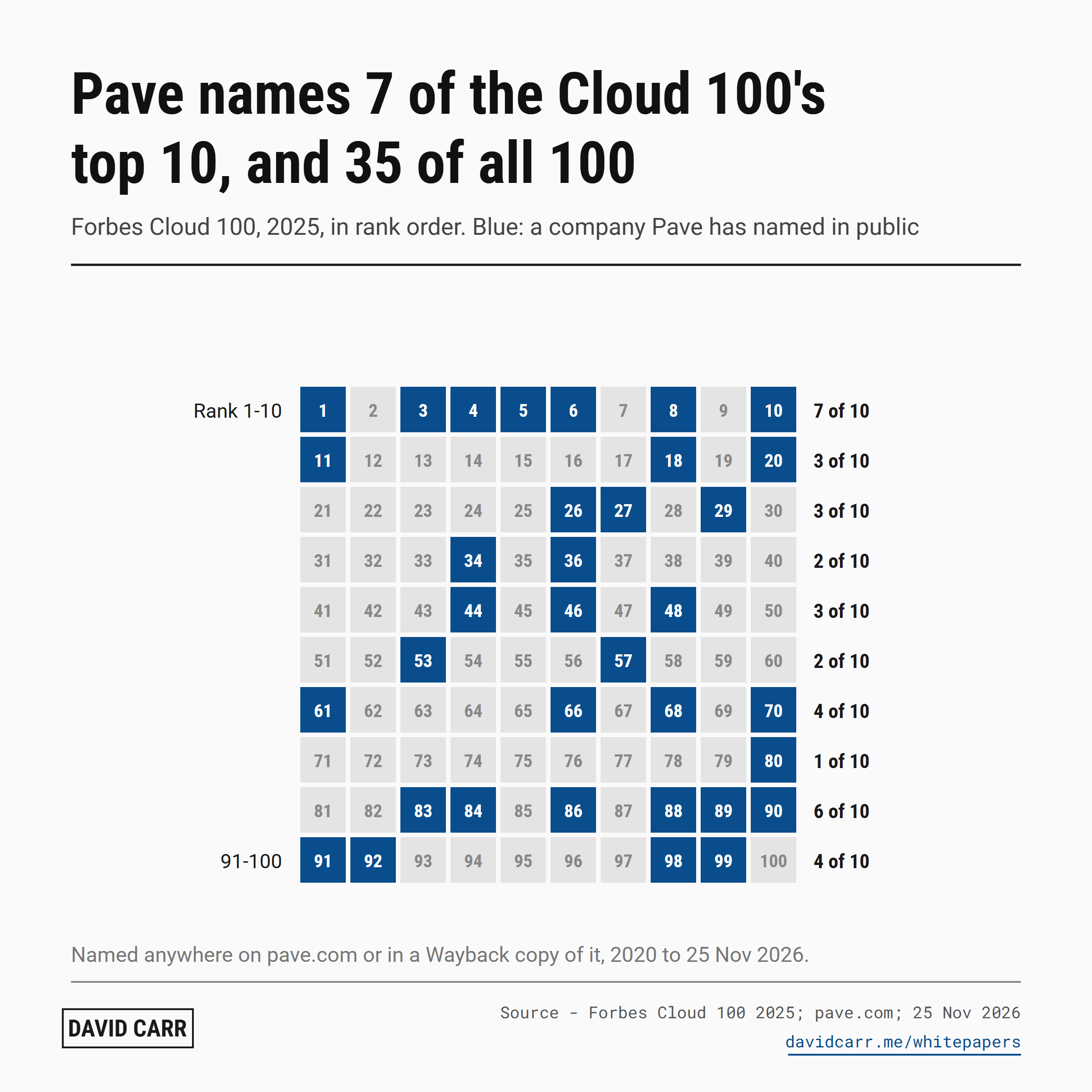
Pave names 7 of the Cloud 100's top 10, and 35 of all 100.
- Ranks 1-10: 7 named
- Ranks 11-50: 11 named
- Ranks 51-100: 17 named
The names Pave shows lean towards the very top of the list, then spread evenly down it.
Forbes Cloud 100, 2025 edition; the 2026 list was not available to read. Named means anywhere on pave.com or in a Wayback copy of it.
Method, caveats and sources
The short answer. Pave names 150 companies in public. Most are US tech companies founded since 2005, and in 2026 the new names turned sharply towards AI: 40 of the 2026 Forbes AI 50 appear on its homepage. This is a sample Pave chooses, not a picture of its 9,000+ customers.
A biased sample, on purpose. A company appears here only if Pave chose to show it: a logo wall, a customer story, a testimonial, a blog post or a release. Companies pick well-known names for these, and customers have to agree to be shown. So the profile describes Pave's shop window. It cannot say what share of Pave's customers are AI firms, or American, or large.
How the list was built. On 25 November 2026 the homepage, customers page, case studies, industry pages and other main pages of pave.com were read for customer logos, testimonials and case studies, and the blog and releases were scanned for "companies like ..." sentences. 75 Wayback Machine copies of the homepage and customers page, from September 2020 to November 2026, were read the same way. Logos without alt text were identified by looking at each image; three from August 2026 could not be pinned to a name and were left out. Only companies are recorded. No person is named or quoted.
How each company was described. Sector, HQ country, founding year, ownership and headcount come from the Forbes AI 50 (2025, 2026) and Cloud 100 (2025) list data, the YC company directory, and the English Wikipedia infobox, in that order. Every value keeps its source link in the data file. Where no source gave a value it was left blank, not guessed: 34 companies have no HQ country, 37 no founding year. Two corrections were made by hand and are noted in the data: Forbes lists Mistral AI with 200,000 employees, plainly a typo, so Wikipedia's 1,000+ is used; and CSL Behring's stock listing belongs to its parent, CSL.
Who else fits. The public lists were compared with the profile in aggregate only. Not being named by Pave does not mean a company is not a customer, and no company is suggested as one.
Left out. Funding stage: the sources give total funding for list companies only, so it is not charted. Pave's partner and investor logos, which are not customers. Pages that require a login.
Also: Pave, Pave vs its competitors and Stripe.