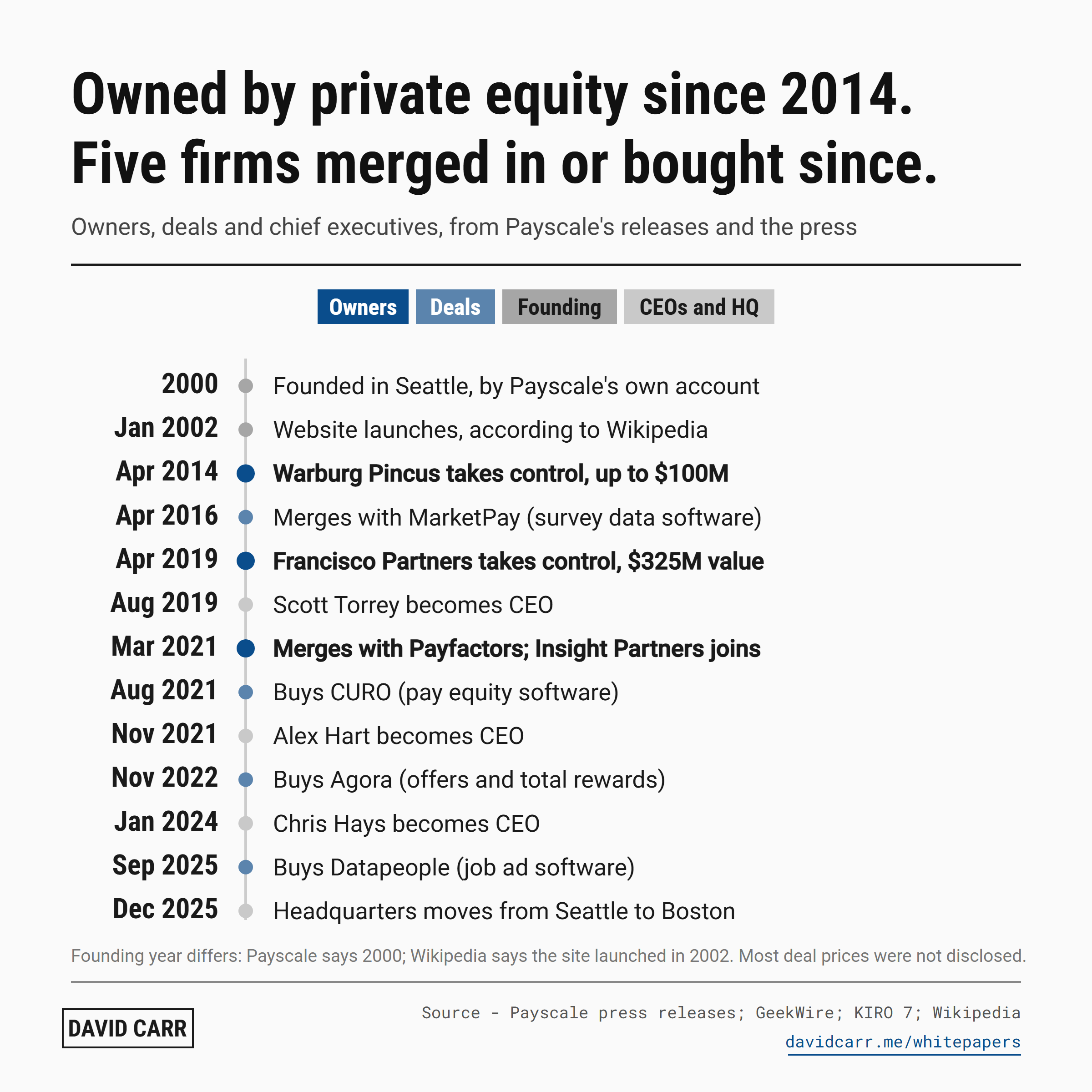
Owned by private equity since 2014. Five firms merged in or bought since.
- April 2014: Warburg Pincus takes a majority stake, up to $100 million
- April 2019: Francisco Partners takes control at a $325 million enterprise value
- March 2021: merges with Payfactors; Insight Partners joins as an owner
- MarketPay (2016), Payfactors, CURO (2021), Agora (2022) and Datapeople (2025)
Each owner has bought or merged in other firms. Most of the deals added software or a new kind of pay data.
Payscale says it was founded in 2000; Wikipedia says the website launched in January 2002. Both are shown. The headquarters moved from Seattle to Boston in 2025, after years as a mostly remote company.
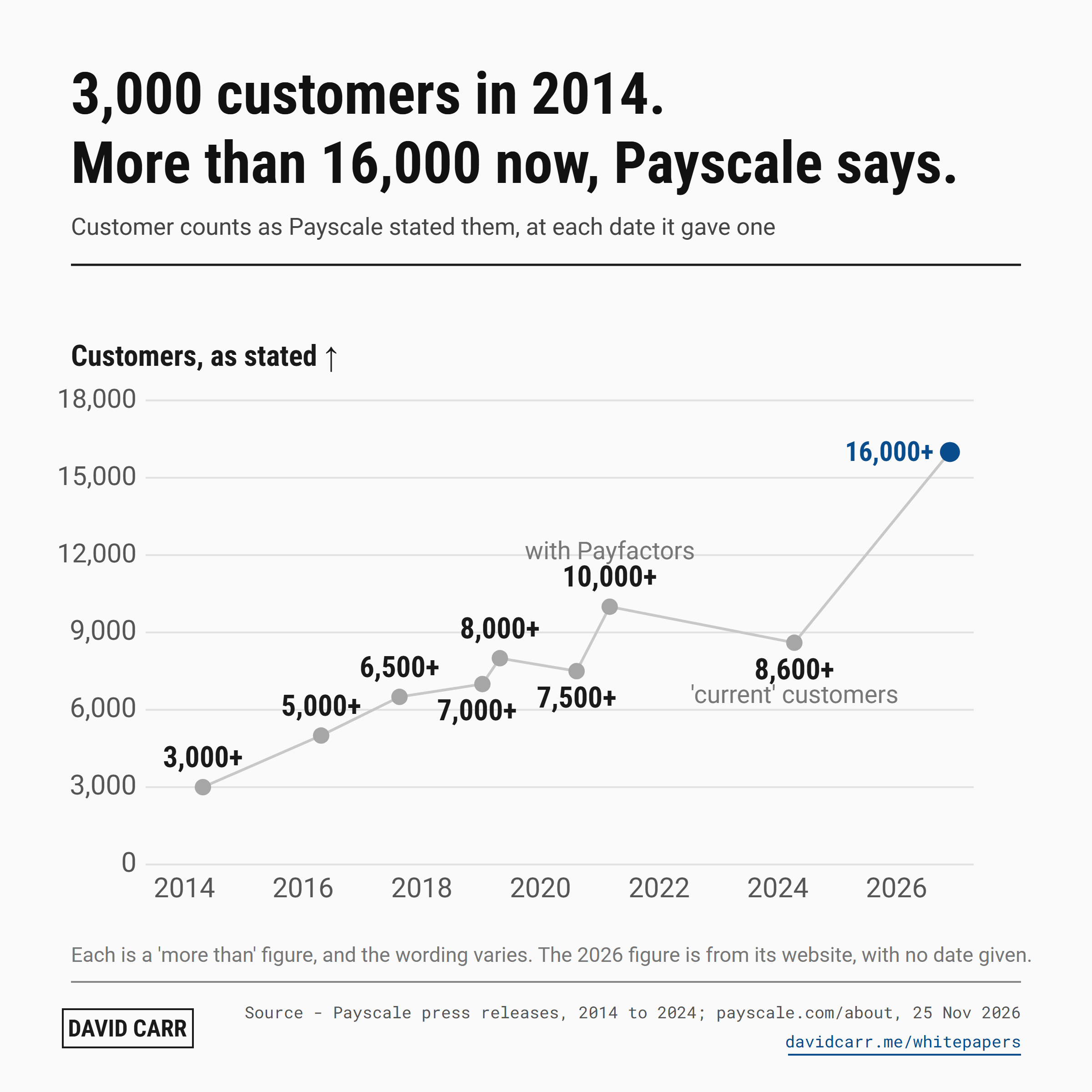
3,000 customers in 2014. More than 16,000 now, Payscale says.
The count has not risen in a straight line. Wording changes between releases, so the dips may be counting, not customers lost.
Every figure is Payscale's own 'more than' number, taken from the boilerplate at the foot of its press releases.
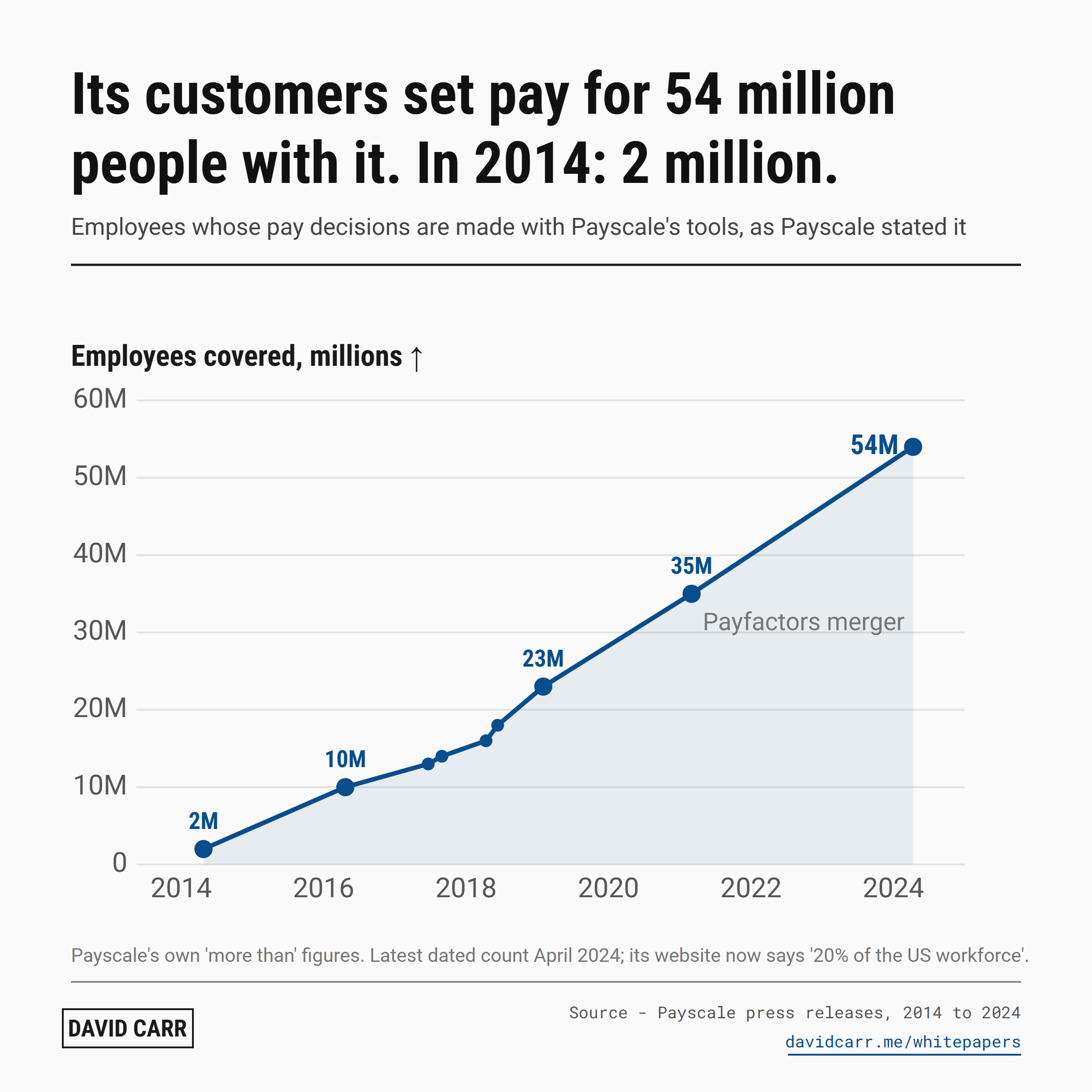
Its customers set pay for 54 million people with it. In 2014: 2 million.
- 2014: 2 million+
- 2016: 10 million
- 2019: 23 million+
- 2021: 35 million+
- 2024: 54 million+
This is the number of employees whose pay is decided with Payscale's tools, not the number of people in its data.
Payscale's own figures. Its About page now says it supports "20% of the US workforce", with no date.
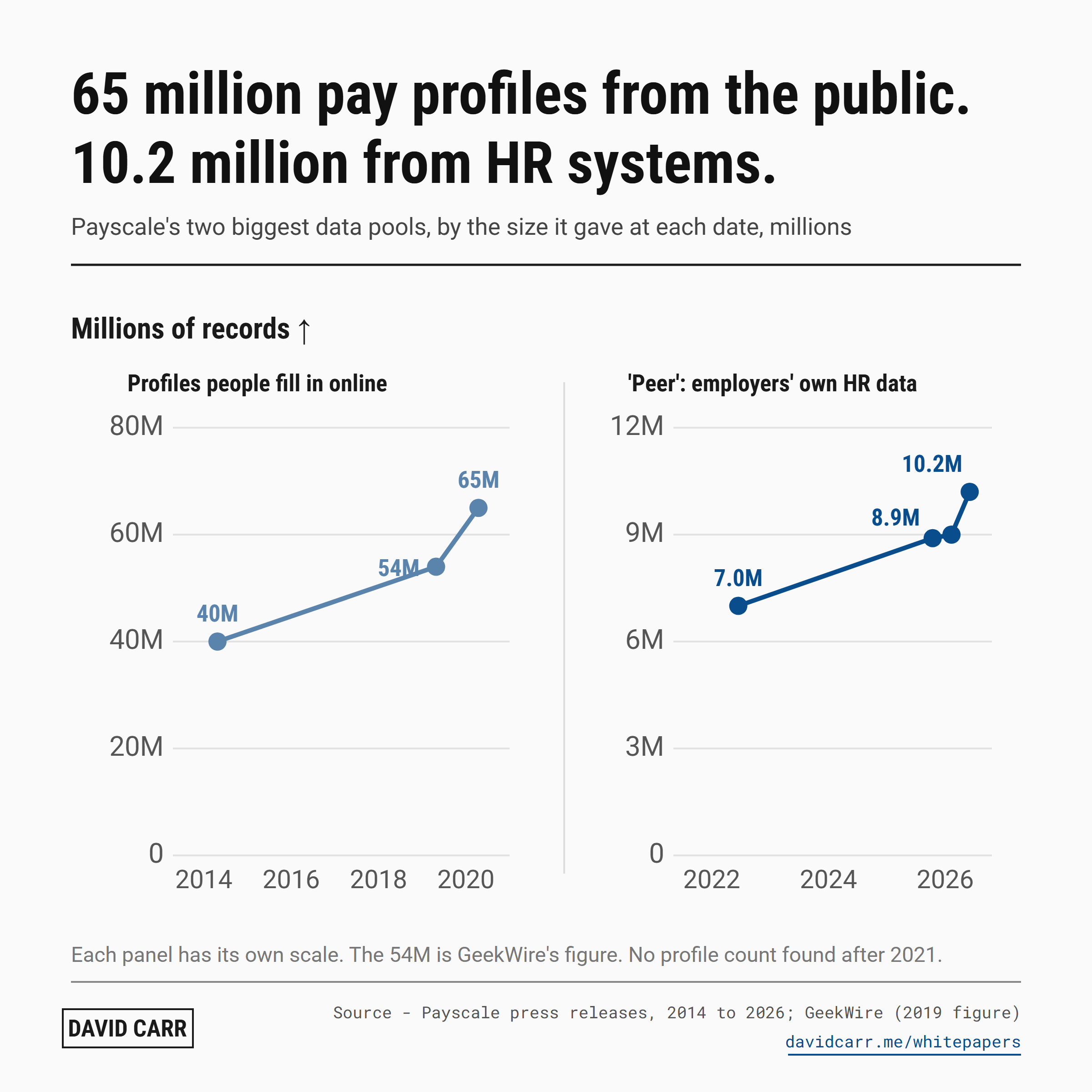
65 million pay profiles from the public. 10.2 million from HR systems.
- Pay profiles people fill in on its website: 40 million (2014), 54 million (2019, GeekWire), 65 million (2020)
- "Peer" employees from employers' own HR systems: 7 million (2022), 8.9 million (2025), 10.2 million (June 2026)
- Peer organisations: more than 4,500 across 60 countries (June 2026)
Payscale began with pay that people reported themselves. Its newer pool comes straight from employers.
Each figure is the size Payscale gave on that date. Its releases stopped quoting a profile count after 2021.
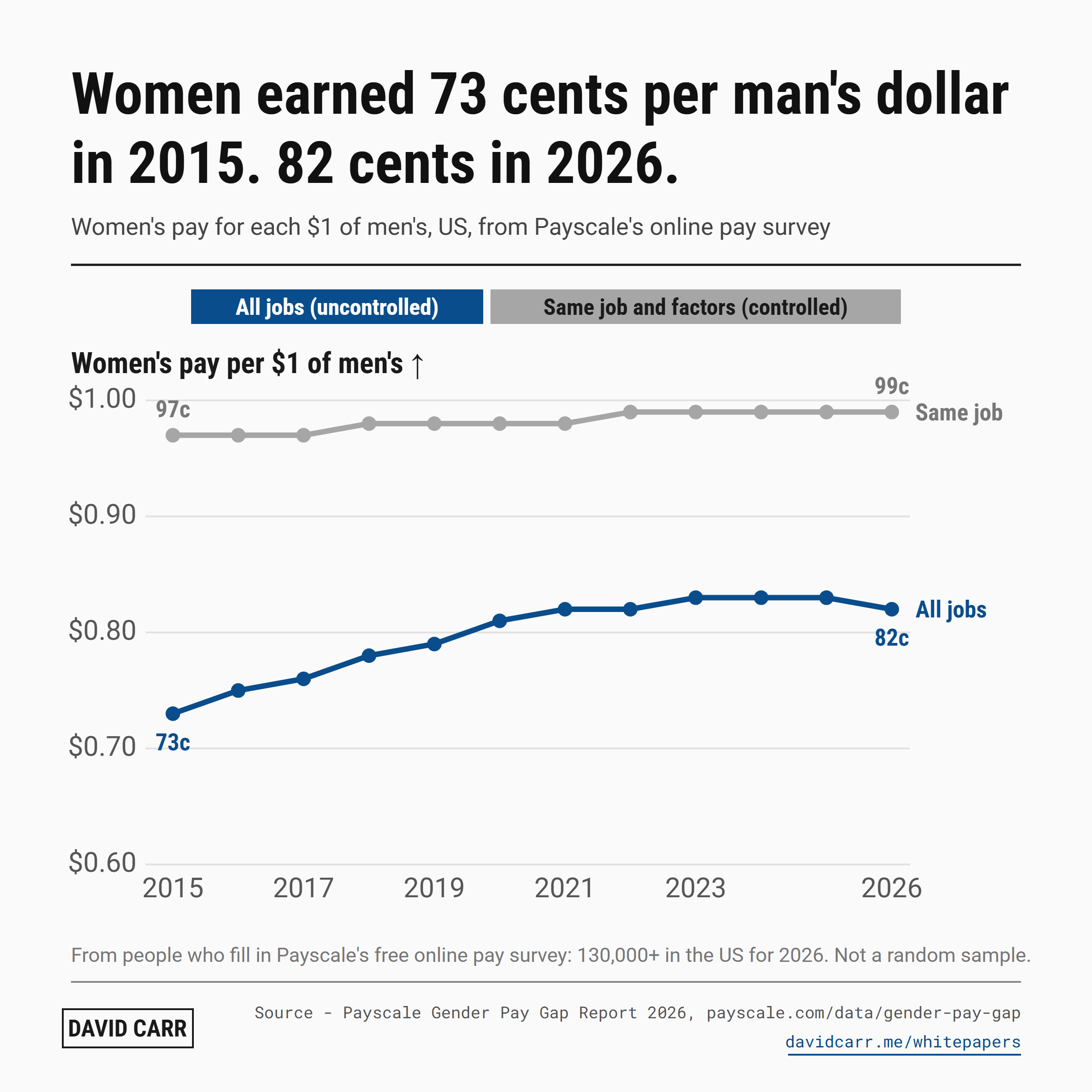
Women earned 73 cents per man's dollar in 2015. 82 cents in 2026.
- 2015: 73 cents (all jobs), 97 cents (same job)
- 2020: 81 cents, 98 cents
- 2023 to 2025: 83 cents, 99 cents
- 2026: 82 cents, 99 cents
The all-jobs gap closed by nine cents in a decade, then held steady. In the same job, the gap is about a cent.
From Payscale's Gender Pay Gap Report 2026. Uncontrolled compares all women with all men; controlled compares people in the same job with the same experience and other factors.
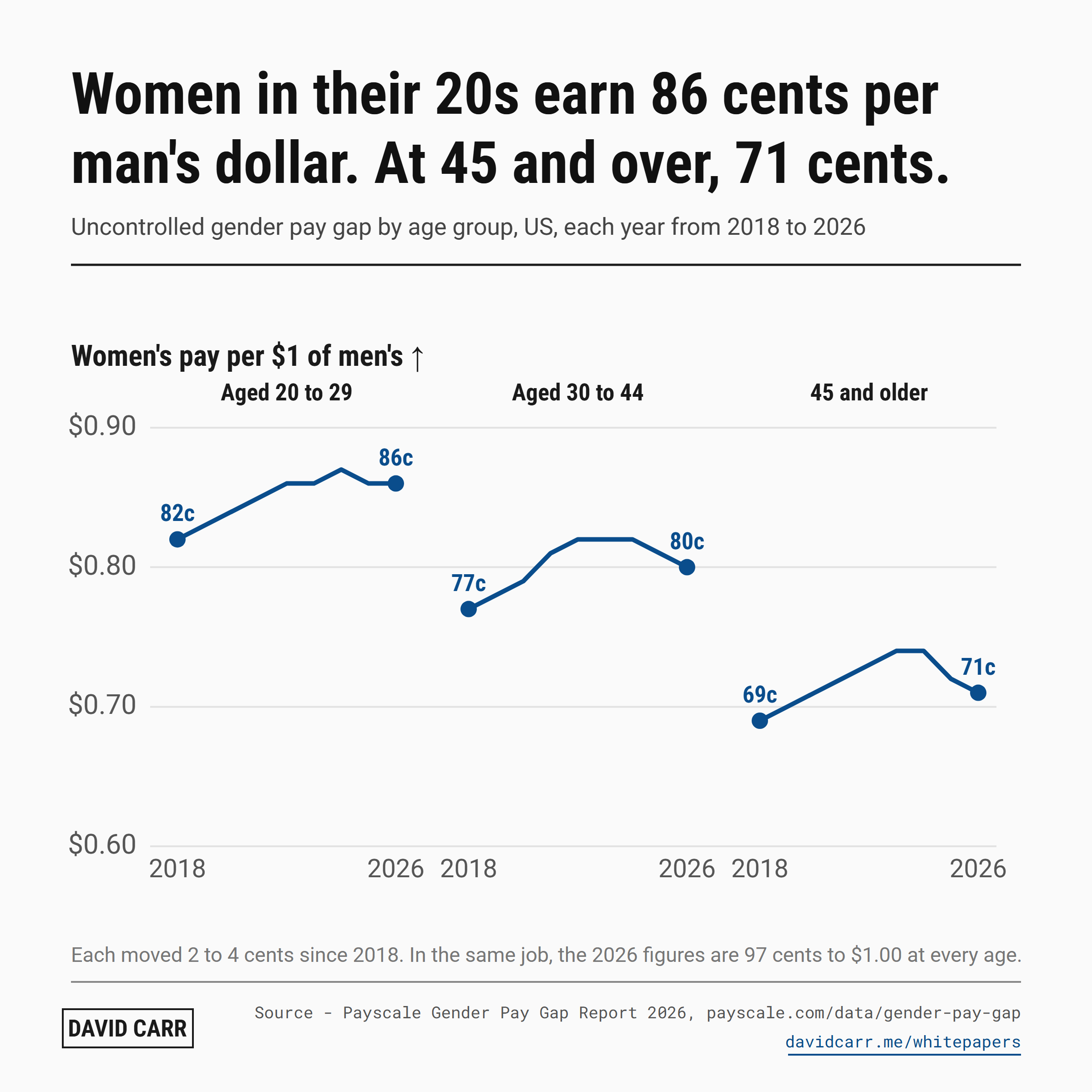
Women in their 20s earn 86 cents per man's dollar. At 45 and over, 71 cents.
- Aged 20 to 29: 82 cents (2018), 86 cents (2026)
- Aged 30 to 44: 77 cents, then 80 cents
- 45 and older: 69 cents, then 71 cents
The gap is widest in the oldest group in every year shown. Controlled for job, it is 97 cents to $1.00 at every age in 2026.
From the same report, based on 130,000+ US people who filled in Payscale's online survey from January 2024 to January 2026.
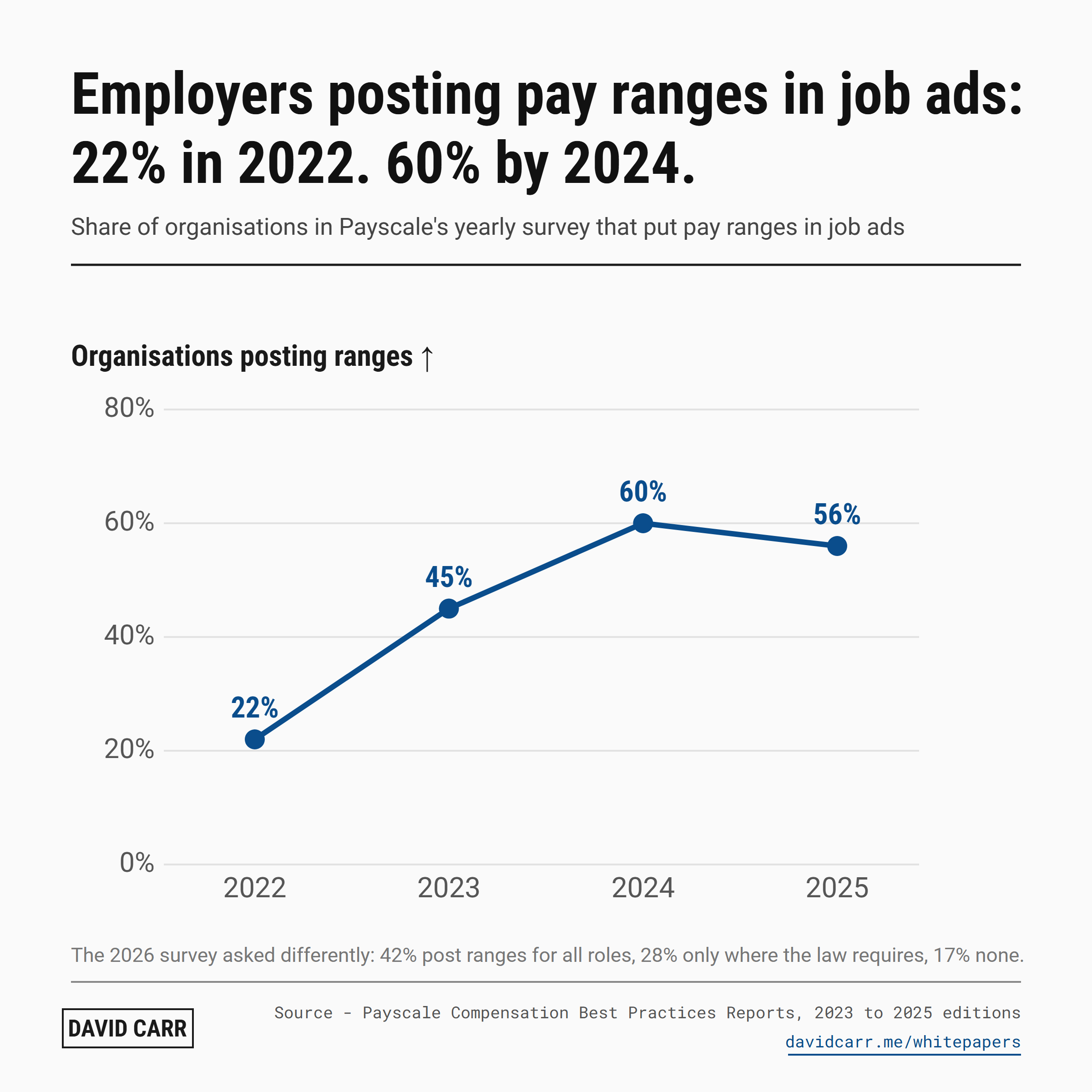
Employers posting pay ranges in job ads: 22% in 2022. 60% by 2024.
Pay transparency went from a minority practice to a majority one in two years.
From Payscale's Compensation Best Practices Reports. The 2026 edition asked differently: 42% post ranges for all roles, 28% only where the law requires, 17% none.
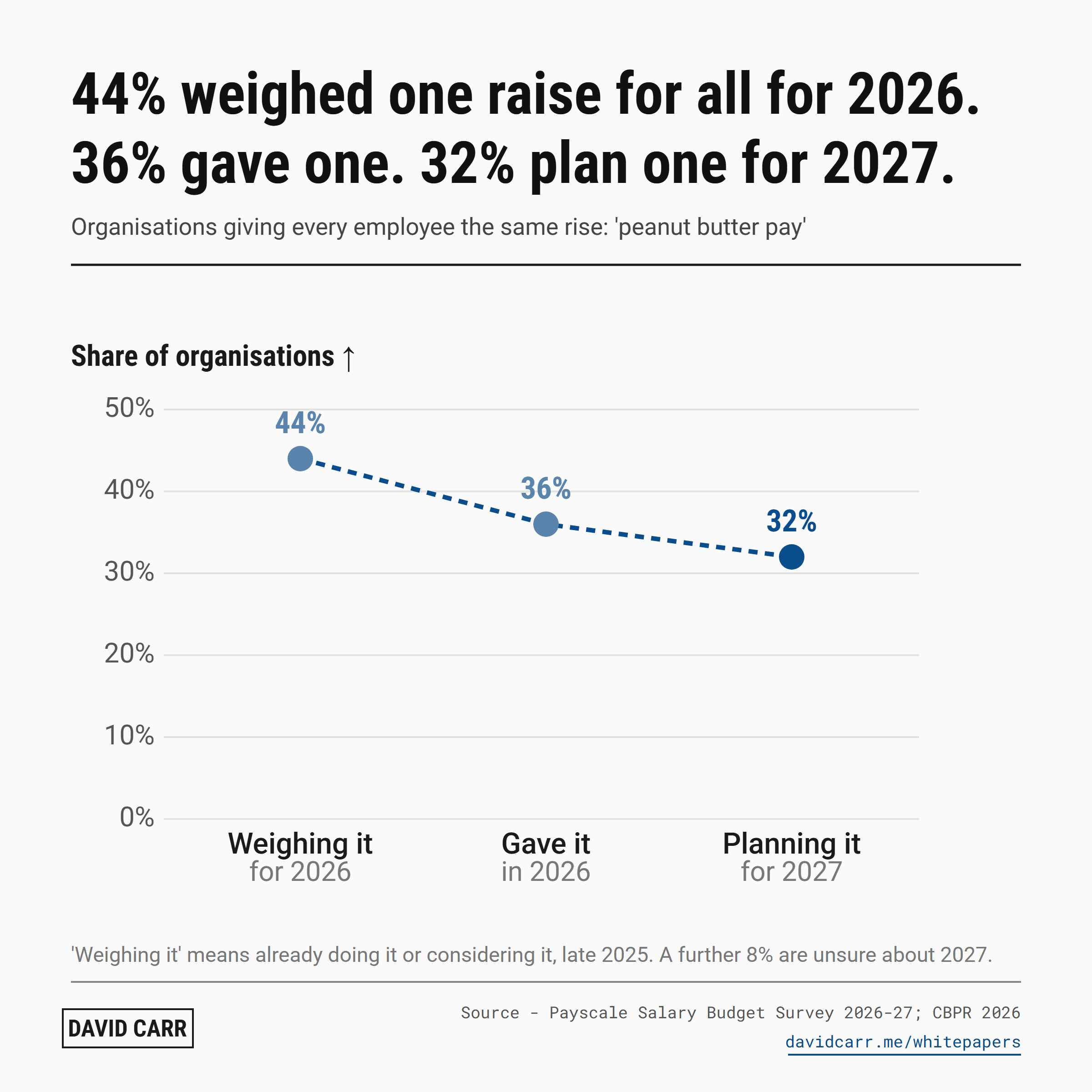
44% weighed one raise for all for 2026. 36% gave one. 32% plan one for 2027.
- Late 2025: 44% giving or considering the same raise for everyone
- 2026: 36% actually did
- 2027: 32% plan to, and 8% are unsure
Payscale calls it 'peanut butter pay': spreading the same rise evenly. Fewer plan it for 2027 than weighed it for 2026.
The first figure is from the 2026 Compensation Best Practices Report; the other two are from the 2026-27 Salary Budget Survey. Different surveys and questions.
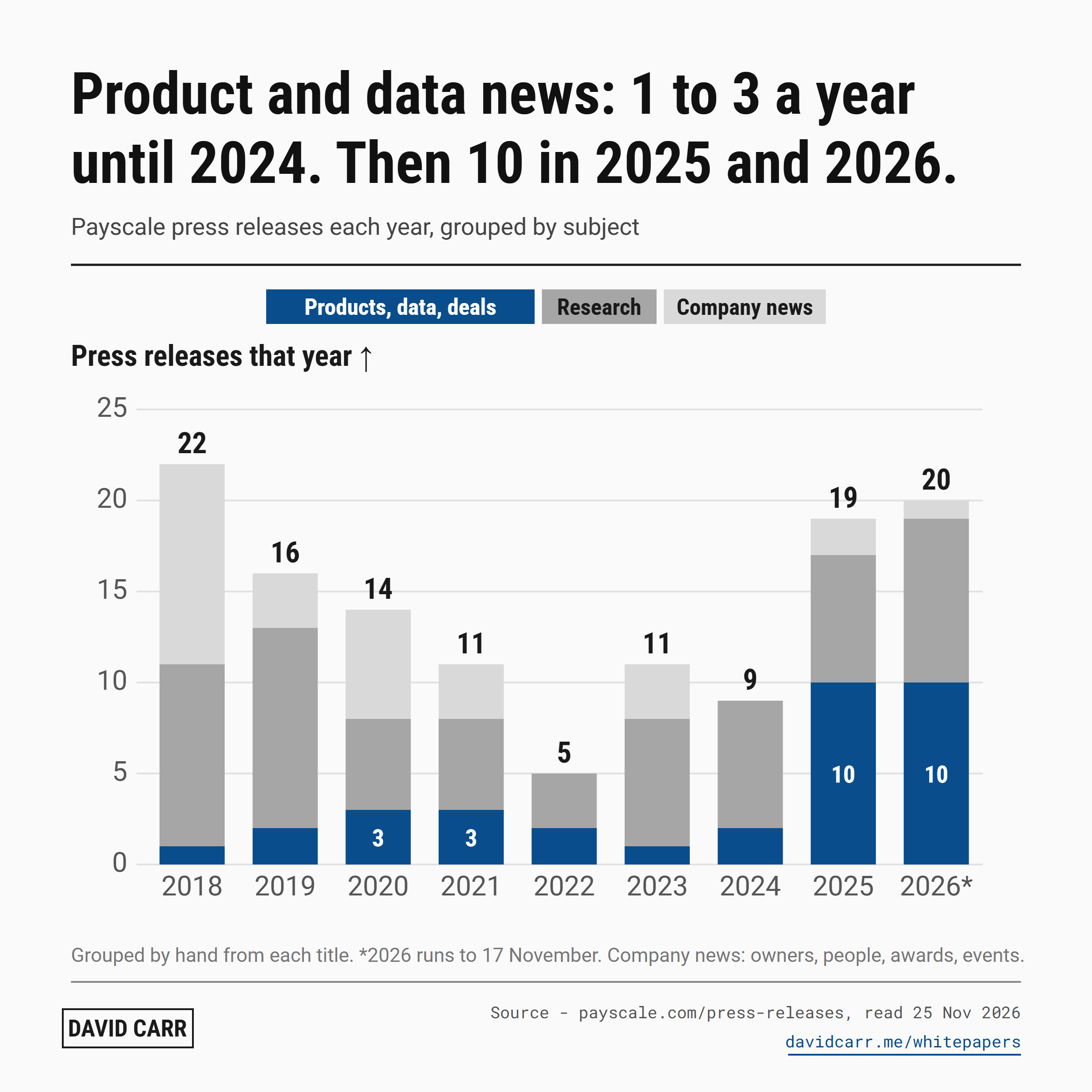
Product and data news: 1 to 3 a year until 2024. Then 10 in 2025 and 2026.
- 2018 to 2024: 14 product, data or deal releases in seven years
- 2025: 10, including three data partnerships and the Datapeople deal
- 2026 to 17 November: 10, including Smart Reporting, Ascent and JobNav
Research led its press releases in most years. Since 2025, product news has overtaken it.
Every release on Payscale's newsroom from 2018 on, 127 in all, grouped by hand from the title. Older releases were moved onto the site with 2017 dates, so years before 2018 are left out.
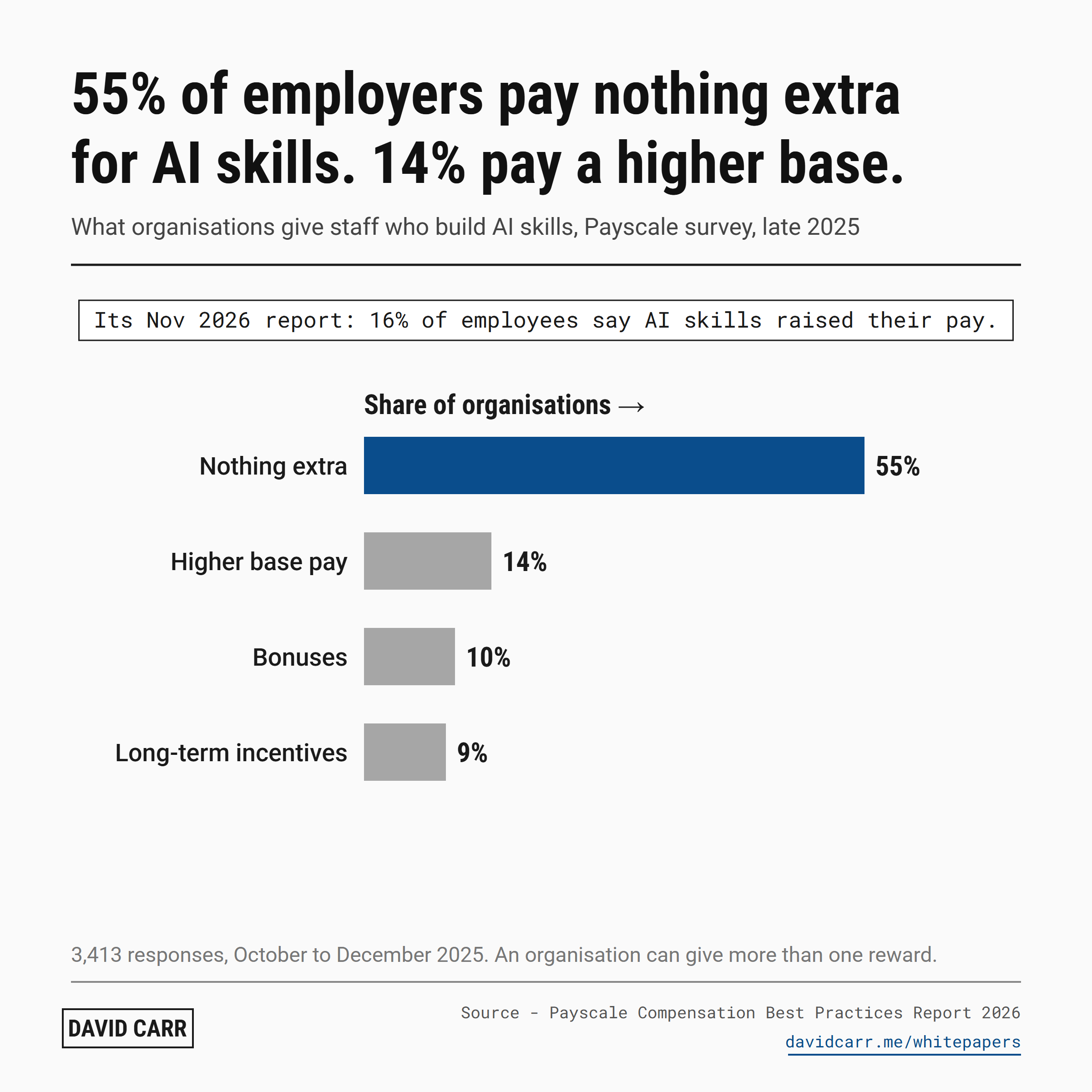
55% of employers pay nothing extra for AI skills. 14% pay a higher base.
- Nothing extra: 55%
- Higher base pay: 14%
- Bonuses: 10%
- Long-term incentives: 9%
Payscale's November 2026 report finds the same from the other side: 16% of employees say AI skills raised their pay, 70% saw no change.
From the 2026 Compensation Best Practices Report: 3,413 responses, October to December 2025. Organisations could give more than one reward.
Method, caveats and sources
The short answer. Payscale has been owned by private equity since 2014 and has folded in five other firms. By its own count it has gone from 3,000 customers to more than 16,000. Its gender pay gap data shows women earning 82 cents per man's dollar across all jobs and 99 cents in the same job. Since 2025 its news has turned towards products and AI.
Payscale is private. It publishes no revenue, and no reported revenue figure was found. GeekWire reported in 2021 a goal of $200 million in revenue by 2022; that is a target, not a result, so it is not charted. The only valuation found is the $325 million enterprise value in the 2019 Francisco Partners deal.
Its own numbers. Customer and coverage counts come from the boilerplate at the foot of Payscale's press releases and its About page. They are 'more than' figures, the wording changes, and none is audited.
Its research. The gender pay gap figures come from people who fill in Payscale's free online pay survey, so they are not a random sample of US workers. The employer survey figures come from Payscale's Compensation Best Practices Report and Salary Budget Survey, filled in by HR and pay professionals. Its 2024 to 2026 US raise figures are compared with other firms on the Pave vs its competitors page and are not repeated here.
Press releases. All 158 releases on its newsroom were read on 25 November 2026. The 127 from 2018 on were grouped by hand into research, products and deals, and company news.
Also: Stripe, Pave and Pave vs its competitors.