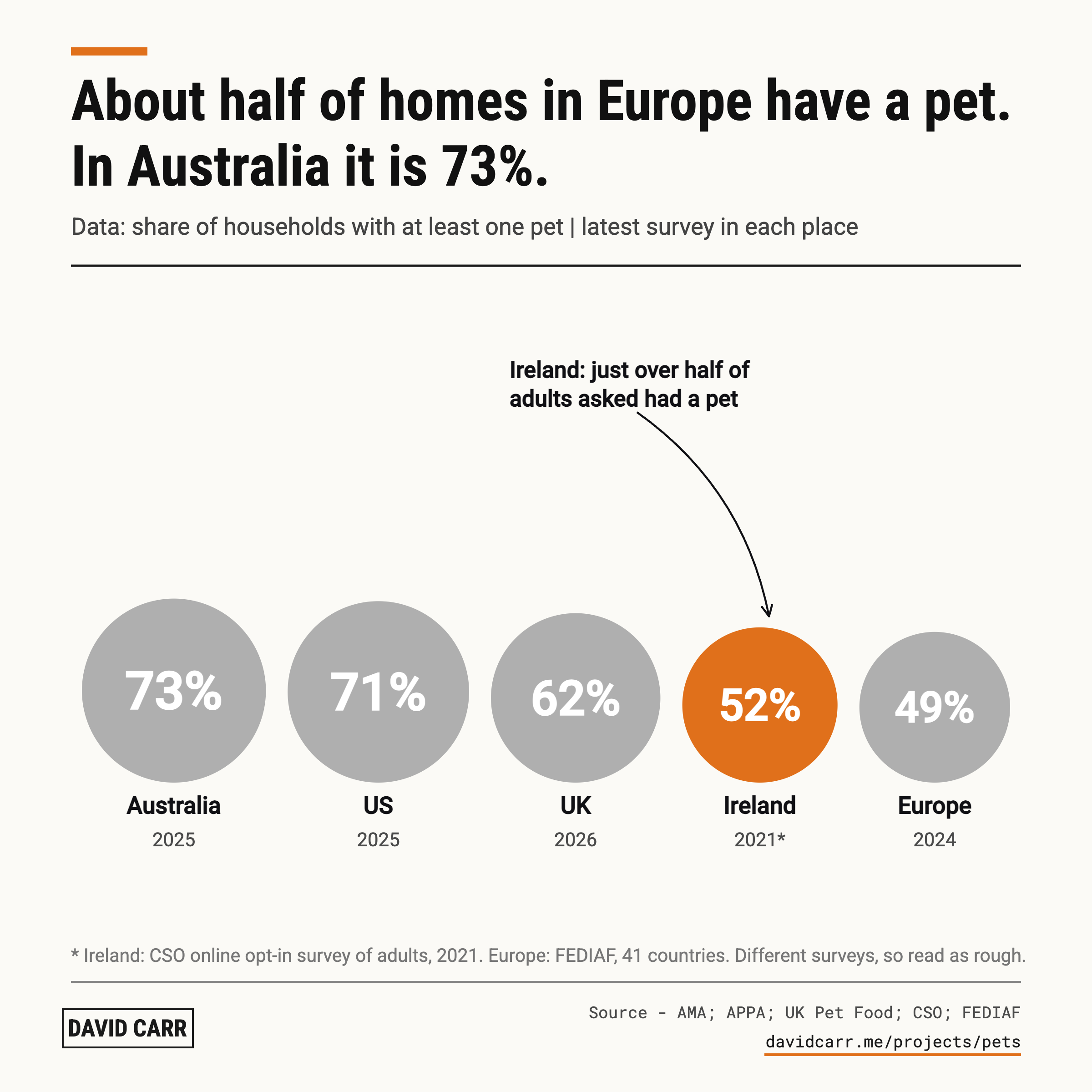
About half of homes in Europe have a pet. In Australia it is 73%.
- Australia: 73% (2025)
- US: 71% (2025)
- UK: 62% (2026)
- Ireland: 52% of adults asked (2021)
- Europe: 49% (2024)
The English-speaking countries sit well above the European average. Every figure is a survey, and each place asks in its own way, so the gaps are a rough guide.
Sources: Animal Medicines Australia, APPA via Pet Food Processing, UK Pet Food, CSO, FEDIAF.
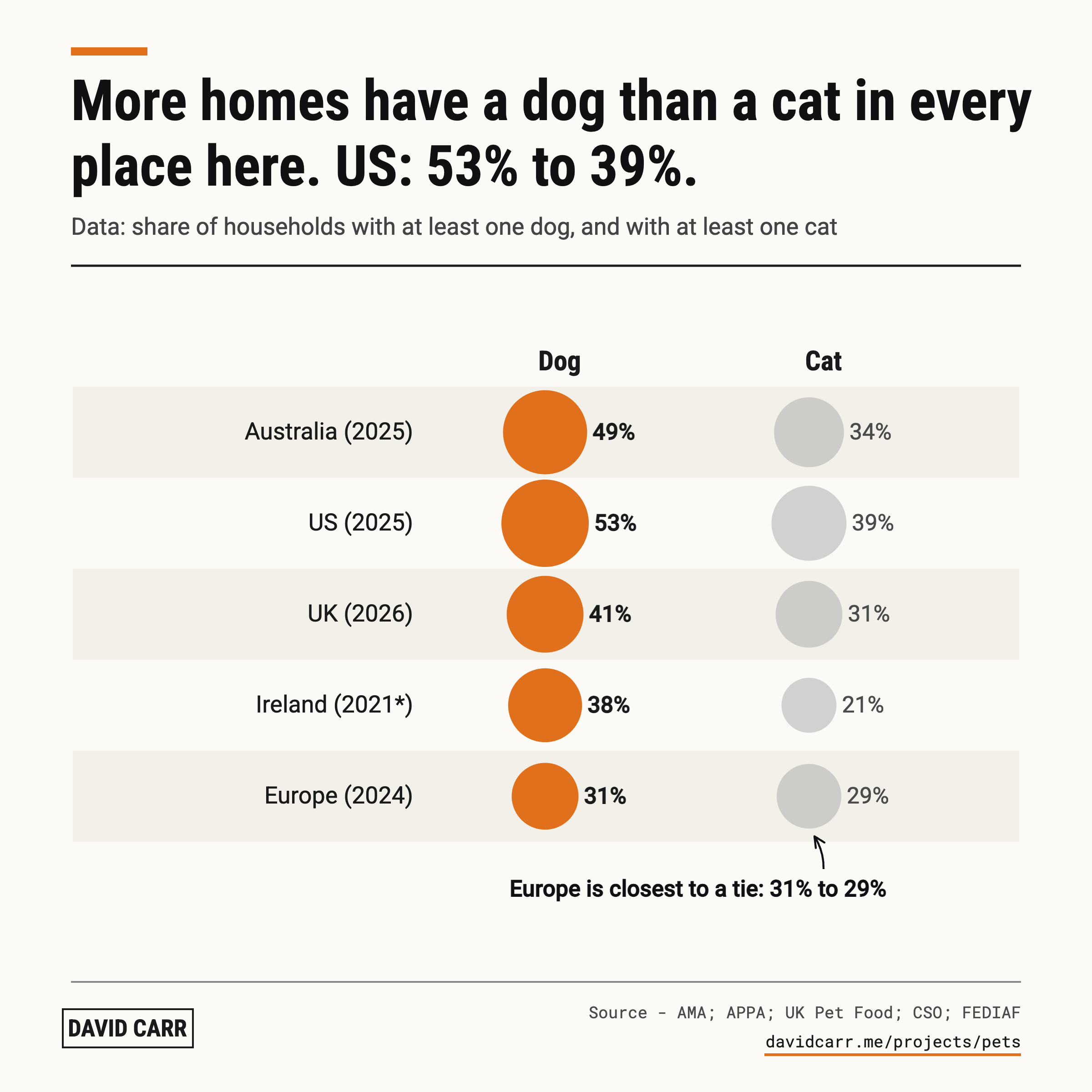
More homes have a dog than a cat in every place here. US: 53% to 39%.
- US: 53% dog, 39% cat
- Australia: 49% and 34%
- UK: 41% and 31%
- Ireland: 38% and 21% (2021)
- Europe: 31% and 29%
Dogs win on homes everywhere. Europe is the close one. It has more cats than dogs, but they live in fewer homes.
US from APPA, March 2026. Others as chart 01. Ireland adds up the CSO's combinations of dog, cat and other pets.
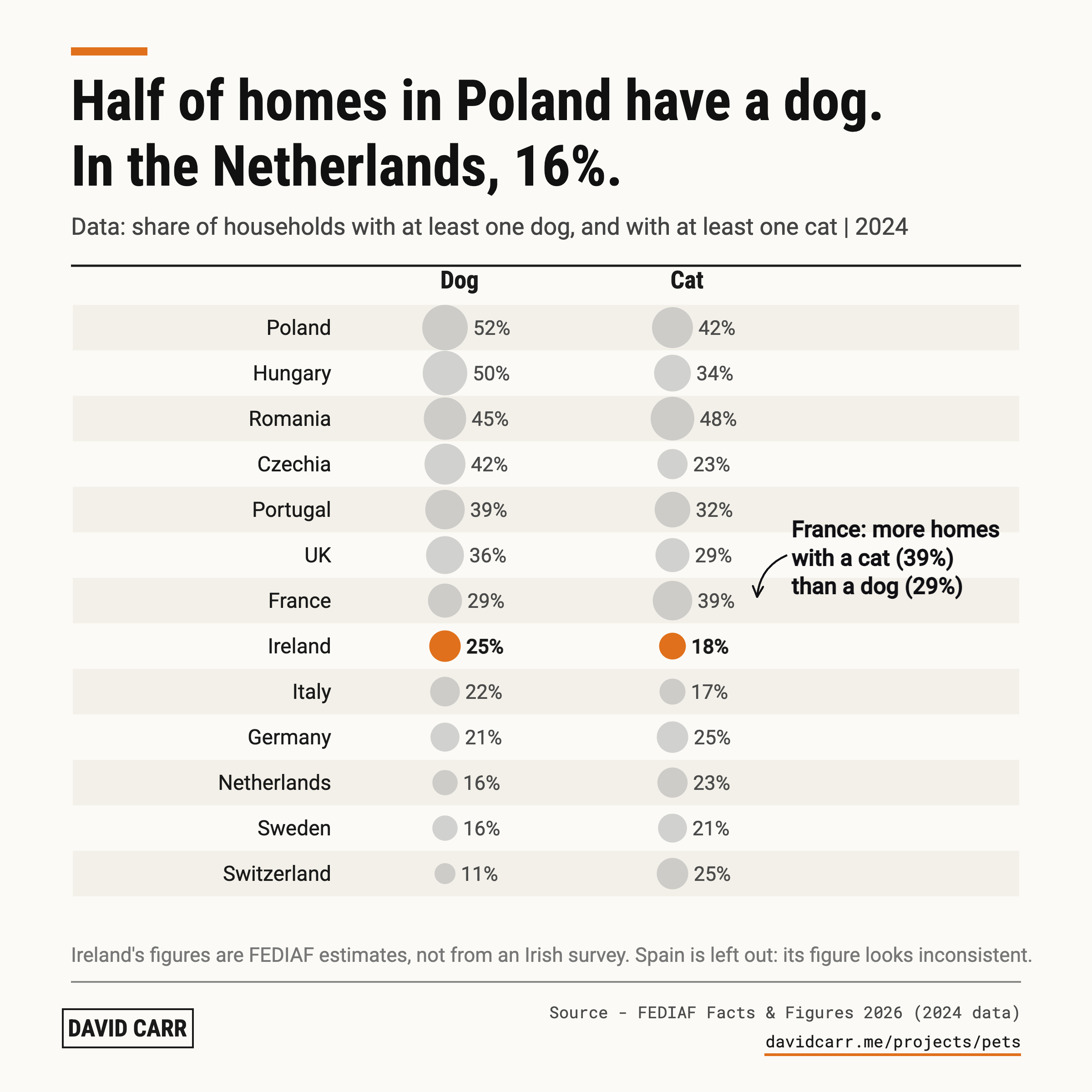
Half of homes in Poland have a dog. In the Netherlands, 16%.
- Poland: 52% dog, 42% cat
- Romania: 48% cat, the highest here
- France: 29% dog, 39% cat
- Ireland: 25% dog, 18% cat (estimate)
- Switzerland: 11% dog, 25% cat
Poland, Hungary and Czechia lean strongly to dogs. France, Germany, the Netherlands, Sweden and Switzerland have more homes with a cat than a dog.
From page 35 of FEDIAF Facts & Figures 2026, 2024 data. FEDIAF estimates some countries, Ireland among them, rather than taking a national survey. Spain is left out: its 70% dog figure does not square with its dog count.
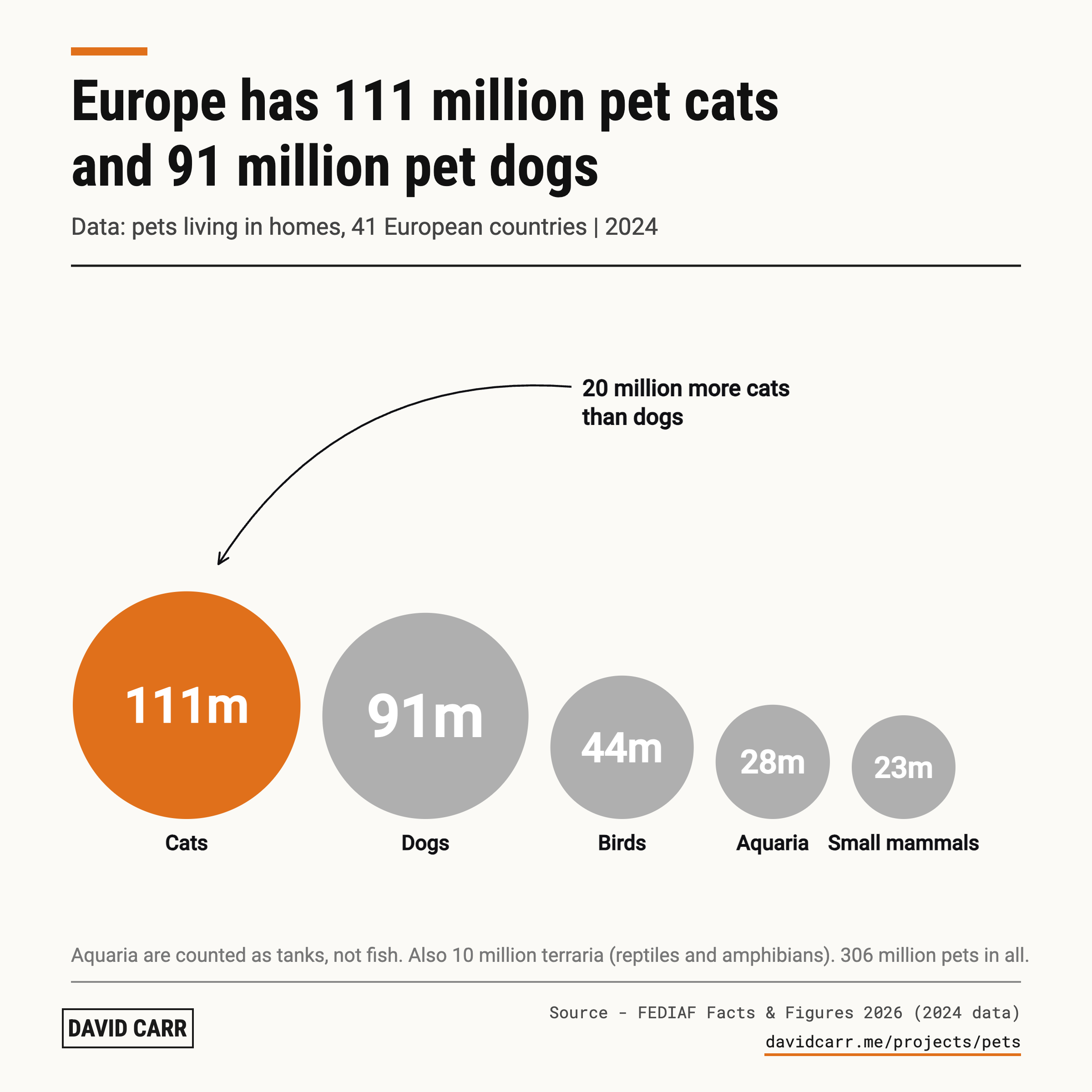
Europe has 111 million pet cats and 91 million pet dogs
- Cats: 111 million
- Dogs: 91 million
- Birds: 44 million
- Aquaria: 28 million
- Small mammals: 23 million
Ireland's share, by FEDIAF's estimate: 563,000 dogs and 404,000 cats. The UK has the most dogs in Europe at 13.4 million, then Germany and France.
FEDIAF, 41 countries, 2024. 306 million pets live in 140 million homes.
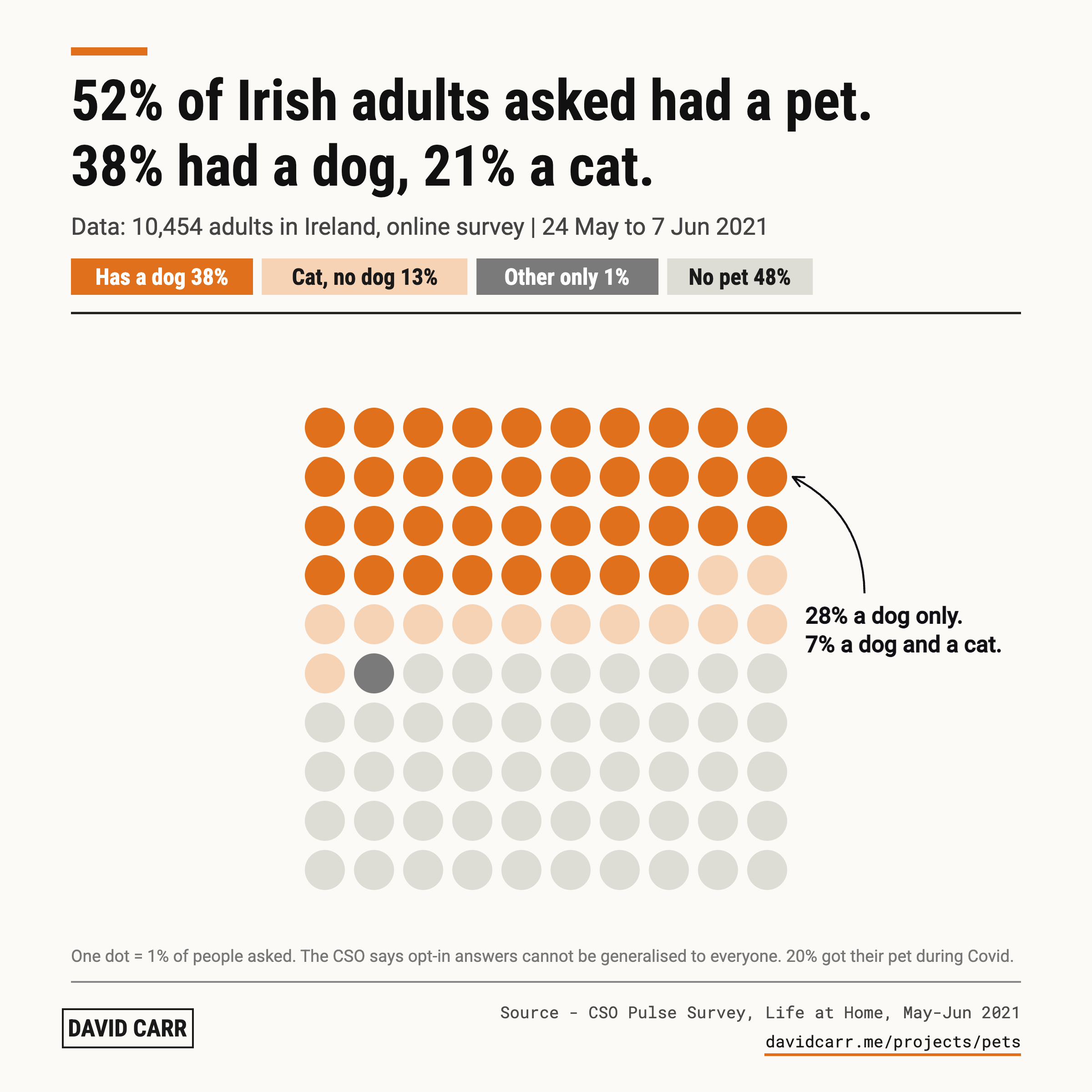
52% of Irish adults asked had a pet. 38% had a dog, 21% a cat.
- Dog only: 28%
- Cat only: 12%
- Dog and cat: 7%
- 20% of owners got their pet after Covid began
Dogs lead in Ireland as they do elsewhere. 87% of owners said their pet had a good effect on their mental health and well-being.
CSO Pulse Survey, Life at Home, May to June 2021. An opt-in online survey, so the CSO says it cannot be generalised. Ireland has no recent official count of pet homes.
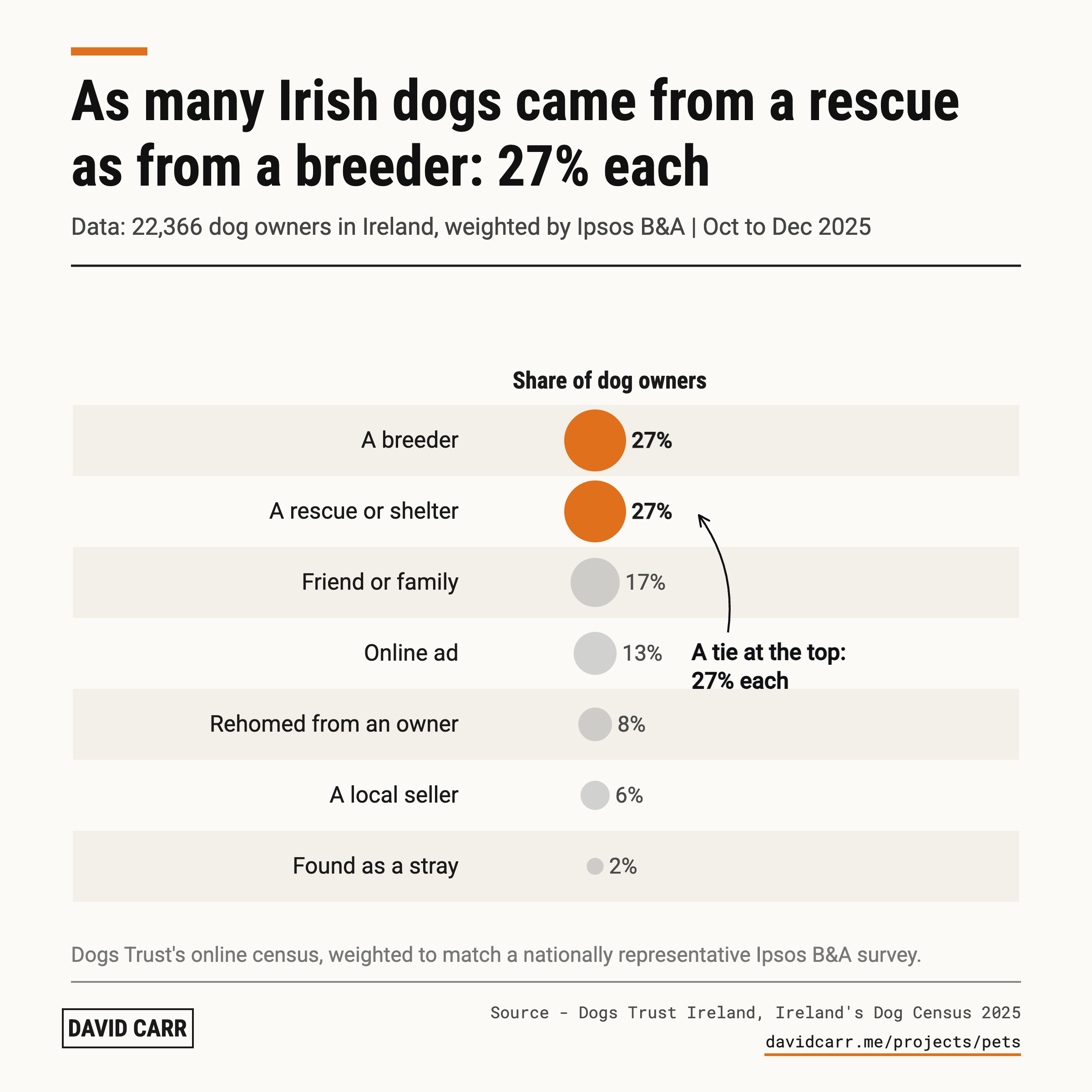
As many Irish dogs came from a rescue as from a breeder: 27% each
- Top breeds: Jack Russell, mixed breed, Border Collie
- Top names: Luna, Bailey, Bella
- 74% of owners have one dog, 7% have three or more
- 13% came through an online ad
The Jack Russell has topped the census two years running.
Ireland's Dog Census 2025, Dogs Trust Ireland: 22,366 owners and 26,289 dogs, weighted by Ipsos B&A.
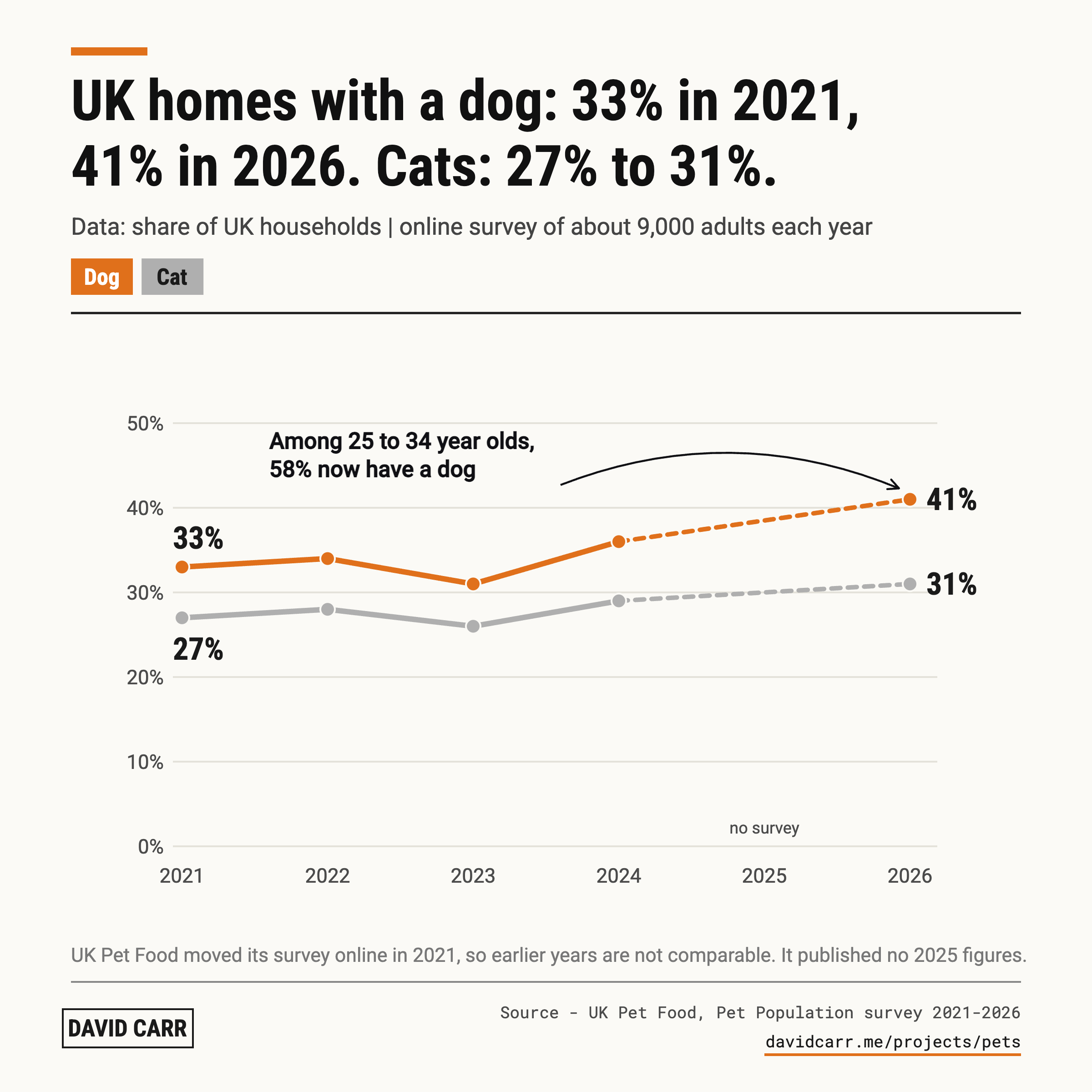
UK homes with a dog: 33% in 2021, 41% in 2026. Cats: 27% to 31%.
- About 15.5 million dogs, up from 12.5 million in 2021
- 25 to 34 year olds: 41% to 58% with a dog
- London has the most dog homes: 49%
- Northern Ireland next: 48%
The biggest jump was among 25 to 34 year olds. UK Pet Food says 62% of UK homes now have a pet of some kind.
UK Pet Food, 31 March 2026 and its historical data. PDSA, which asks adults rather than households, counts 10.2 million dogs (PAW Report 2026).
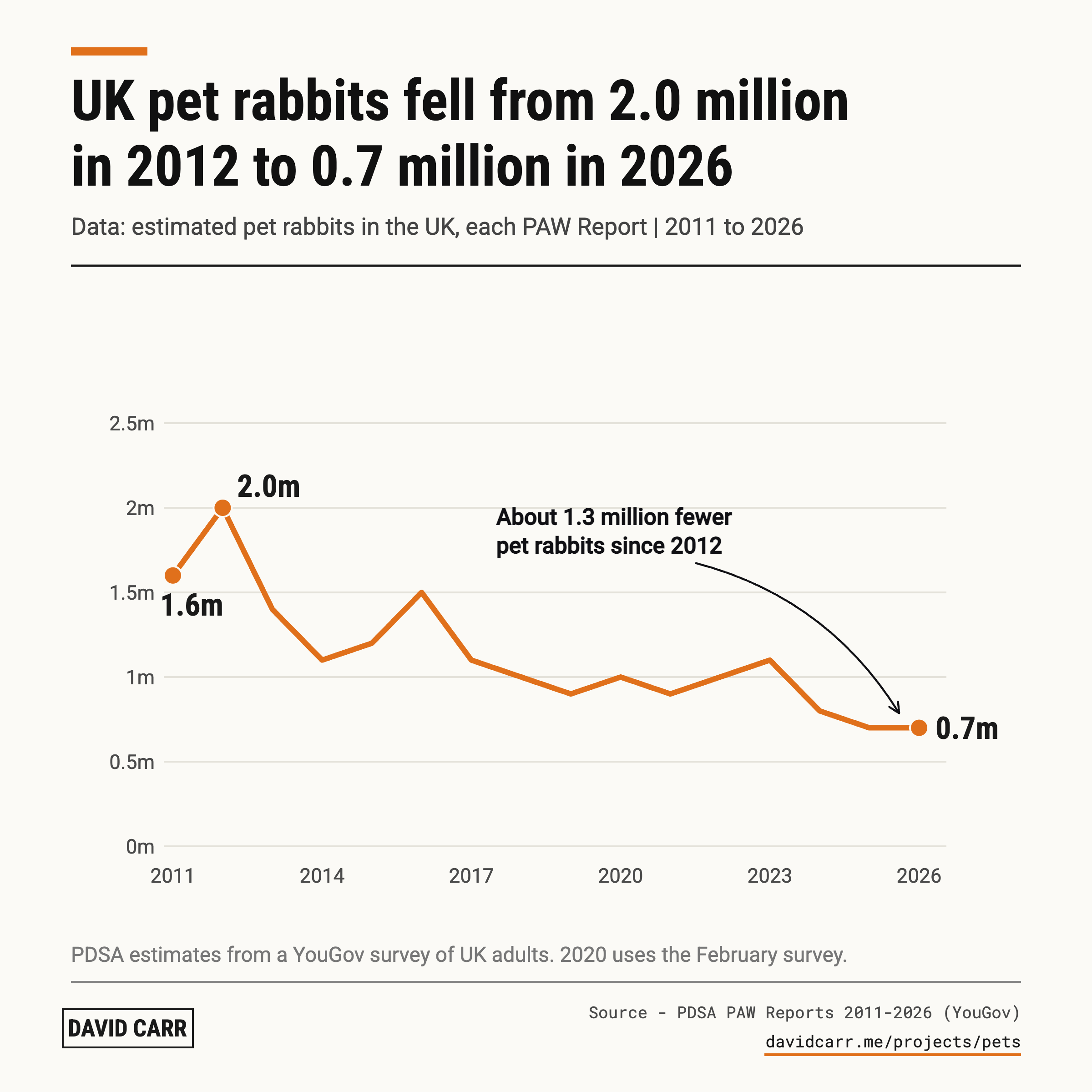
UK pet rabbits fell from 2.0 million in 2012 to 0.7 million in 2026
- 2011: 1.6 million
- 2012: 2.0 million
- 2016: 1.5 million
- 2026: 0.7 million
Rabbits are the pet the UK went off. Over the same years PDSA's dog count rose from 8.2 million to 10.2 million, and cats held at about 11 million.
PDSA PAW Reports, YouGov surveys of UK adults, 2011 to 2026.
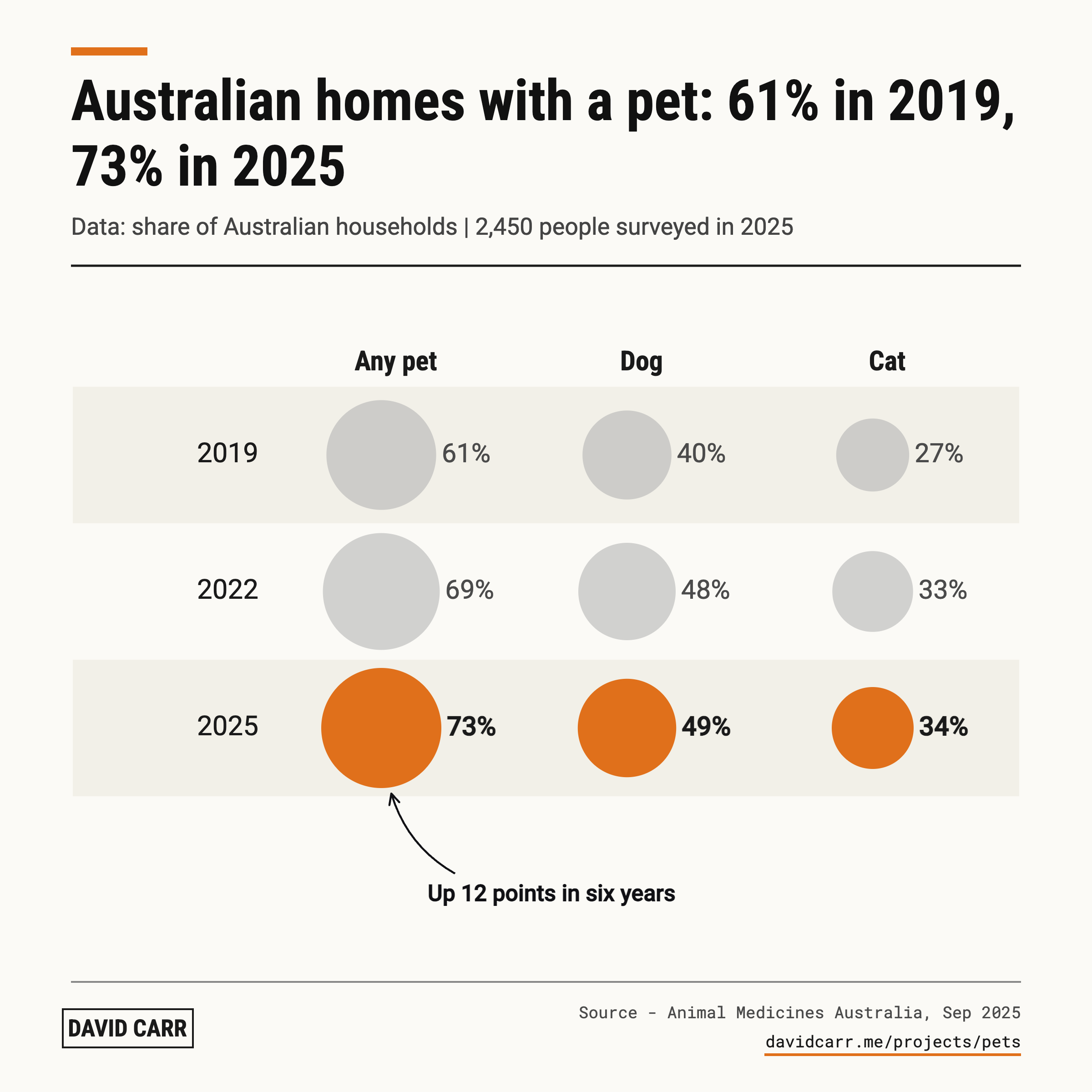
Australian homes with a pet: 61% in 2019, 73% in 2025
- Dogs: 40% to 49%
- Cats: 27% to 34%
- Most of the rise came by 2022
- 31.6 million pets in 7.7 million homes
Most of the rise came between 2019 and 2022, and it has held since.
Animal Medicines Australia, Pets in Australia 2025, 18 September 2025.
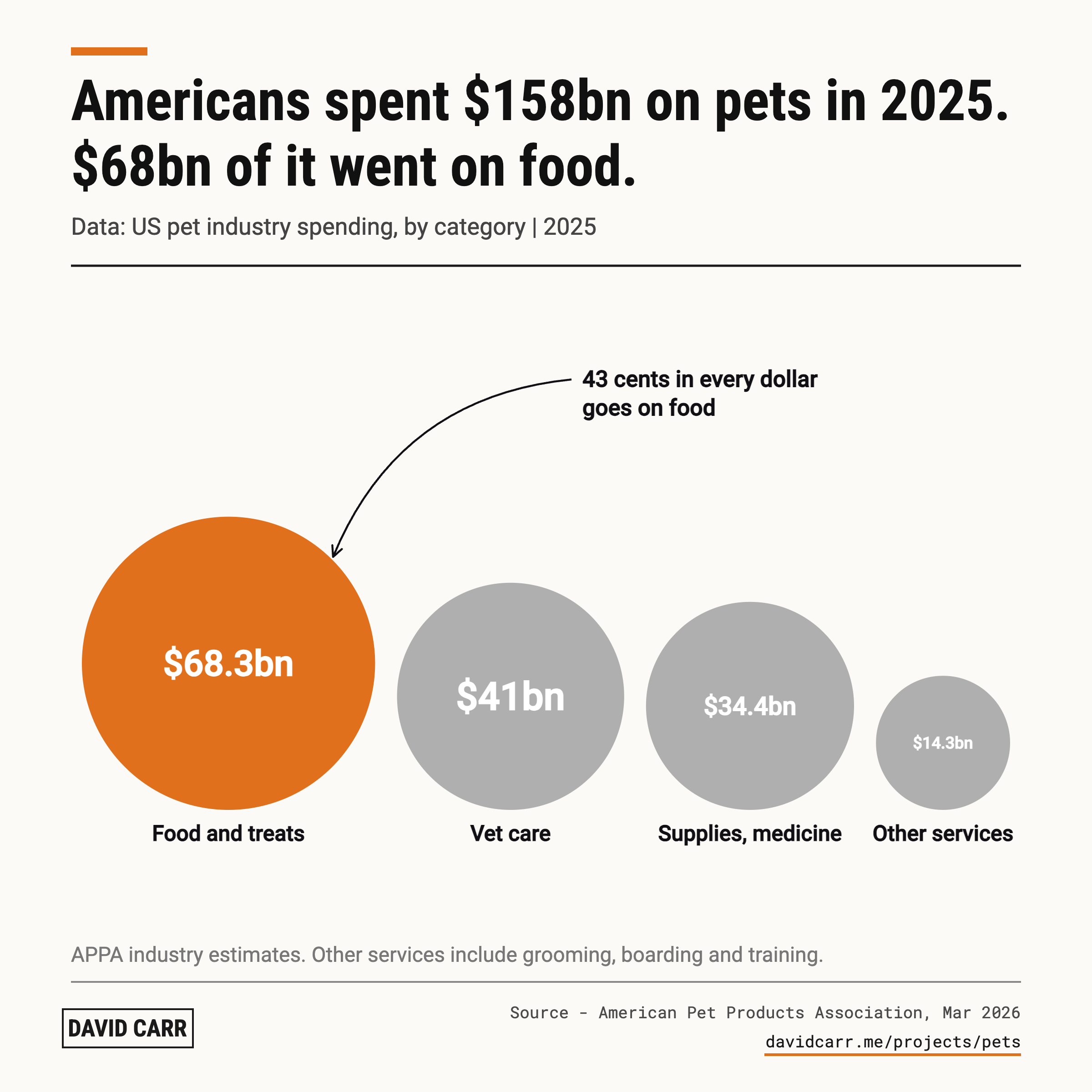
Americans spent $158bn on pets in 2025. $68bn of it went on food.
- Food and treats: $68.3bn
- Vet care: $41.0bn
- Supplies and medicine: $34.4bn
- Other services: $14.3bn
- 2026 forecast: $165bn
Food is the biggest bill by far. Australians spend about A$21.3bn a year on their pets, almost half of it on food too.
APPA industry figures and press release, 26 March 2026. Australia from AMA.
Method, caveats and sources
The short answer. About half of European homes have a pet, and more in the UK, US and Australia. More homes have a dog than a cat everywhere here, but Europe has more cats. Dog ownership is rising in the UK, rabbits are falling, and food is the biggest pet bill.
Surveys, not counts. Every figure here is a survey or an industry estimate. Each country asks in its own way, some count households and some count adults, and the years differ. Read comparisons between places as rough.
Europe. FEDIAF Facts & Figures 2026 (2024 data, 41 countries). FEDIAF takes figures from 15 national pet food associations and estimates the rest, Ireland included. Spain's household figures (70% dog, 56% cat) look out of line with its own dog count, so it is left off chart 03.
Ireland. There is no recent official count of Irish pet homes. The CSO's 2021 Pulse Survey was opt-in and online. Dogs Trust's 2025 census was online too, but weighted to a nationally representative Ipsos B&A survey.
UK. UK Pet Food surveys about 9,000 adults online each year and reports households. It moved online in 2021, so earlier years are left out, and it published nothing for 2025. PDSA surveys adults with YouGov and gets lower numbers.
US. American Pet Products Association figures, from its website and Pet Food Processing. No US government data was used.
Source files and the chart code are kept with the page's working files.