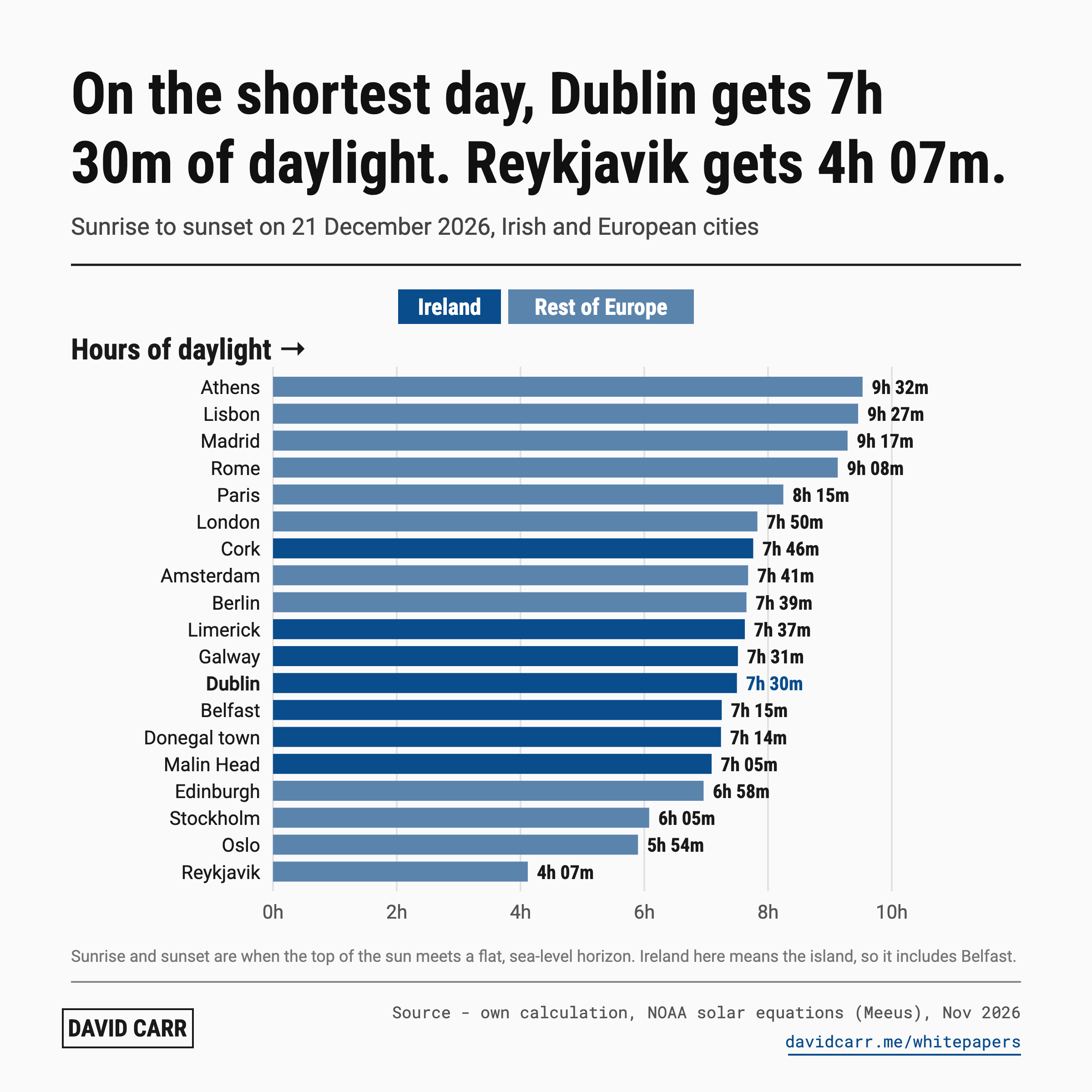
On the shortest day, Dublin gets 7h 30m of daylight. Reykjavik gets 4h 07m.
- Dublin: sunrise 8.38am, sunset 4.08pm, 7h 30m
- Cork 7h 46m, Galway 7h 31m, Belfast 7h 15m, Malin Head 7h 05m
- London 7h 50m, Edinburgh 6h 58m, Oslo 5h 54m
- Athens 9h 32m, Lisbon 9h 27m, Madrid 9h 17m
Every Irish city sits between London and Edinburgh. Cork gets 40 minutes more light than Malin Head.
Own calculation for 21 December 2026. Sunrise and sunset are when the top edge of the sun meets a flat, sea-level horizon. Ireland here means the island.
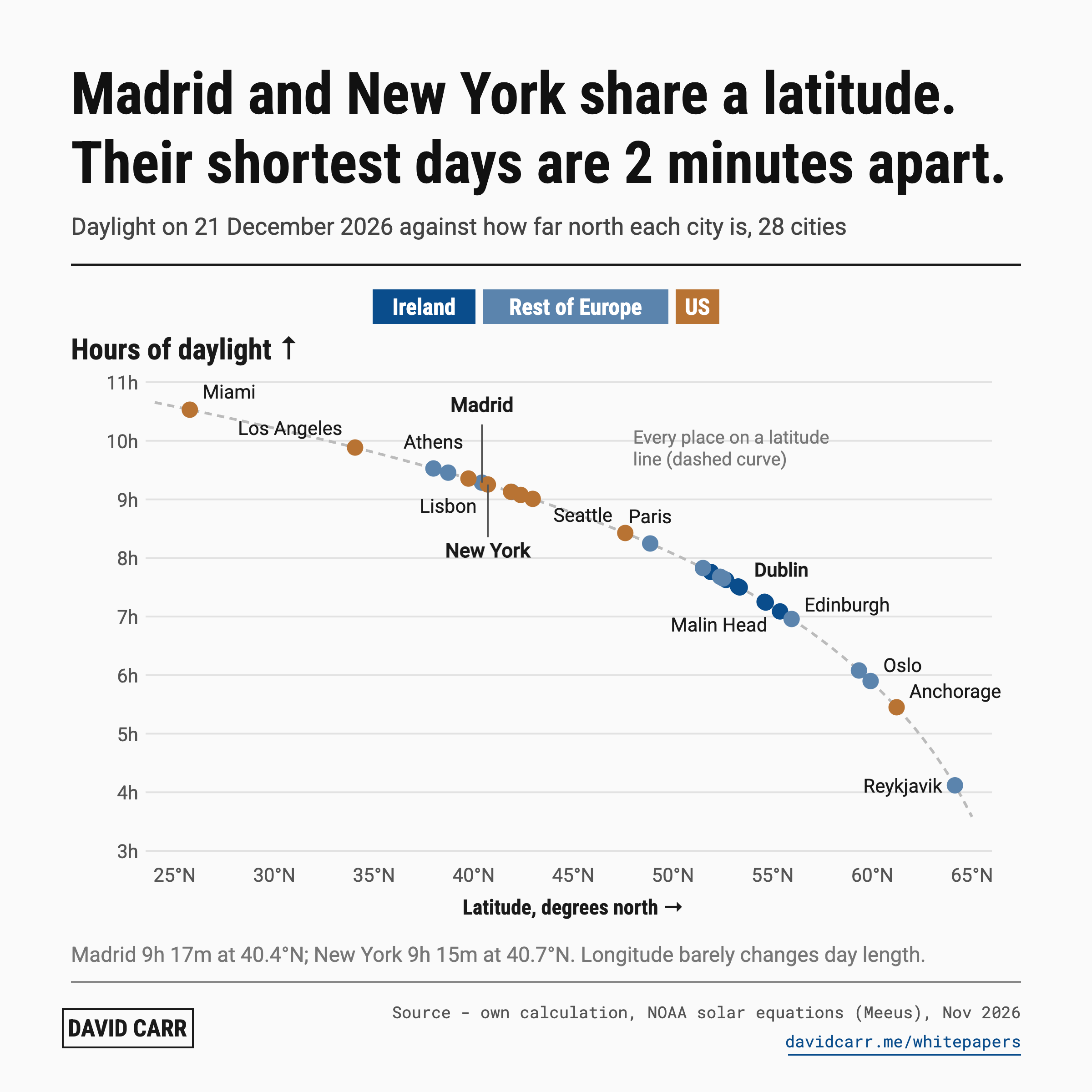
Madrid and New York share a latitude. Their shortest days are 2 minutes apart.
- Madrid, 40.4°N: 9h 17m
- New York, 40.7°N: 9h 15m
- Miami, 25.8°N: 10h 32m
- Anchorage, 61.2°N: 5h 27m
Day length depends on how far north a place is. How far east or west barely matters. Every one of the 28 cities sits on the same curve.
Own calculation for 21 December 2026. The dashed line is the same sum run at every half degree of latitude.
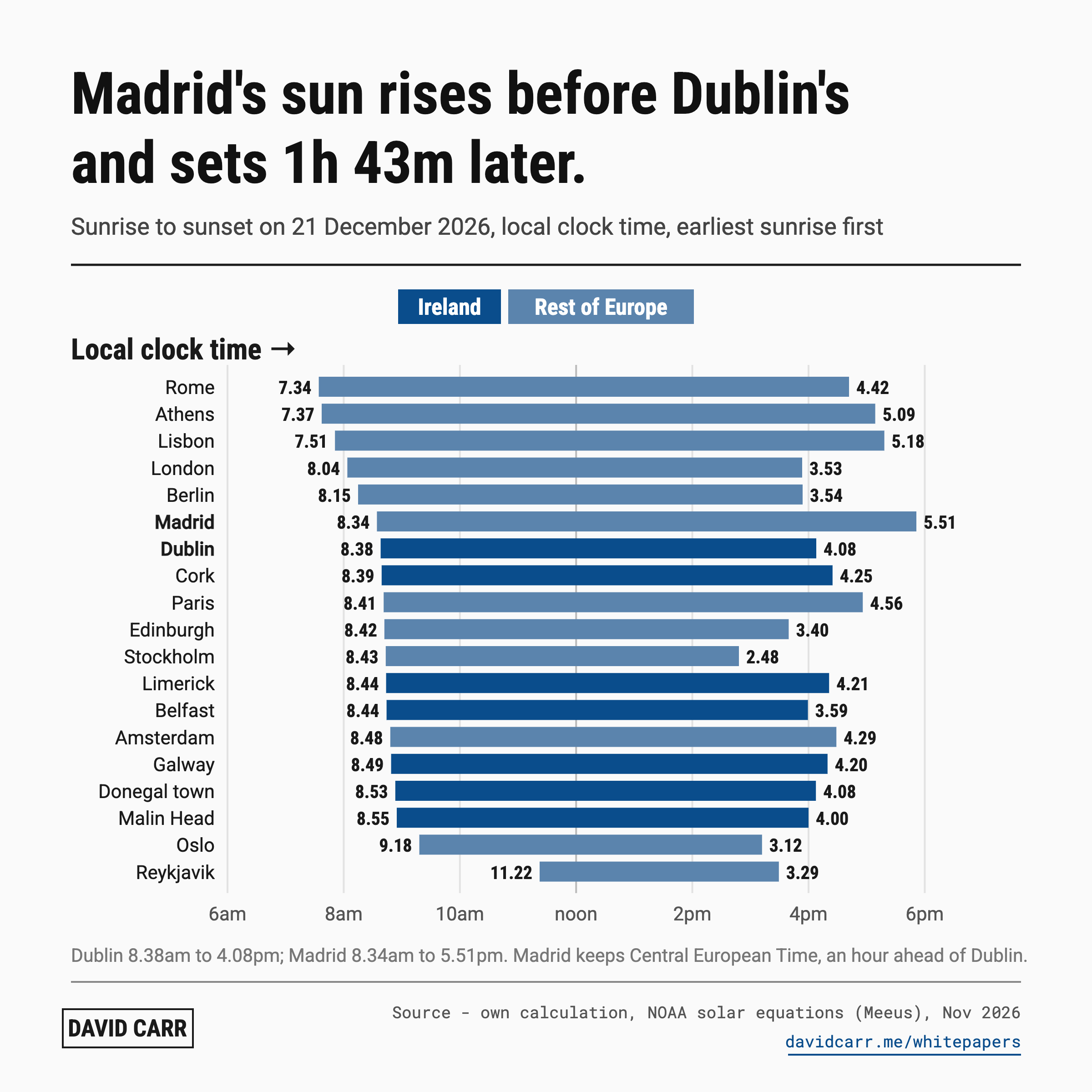
Madrid's sun rises before Dublin's and sets 1h 43m later.
- Dublin: 8.38am to 4.08pm
- Madrid: 8.34am to 5.51pm
- Stockholm: sunset at 2.48pm
- Reykjavik: 11.22am to 3.29pm
The clock matters as much as the latitude. Madrid keeps Central European Time, so its winter sun comes up late and goes down late. Galway's sunrise is 11 minutes after Dublin's.
Local clock time on 21 December 2026. Ireland is on GMT in winter; Belfast and London on GMT too.
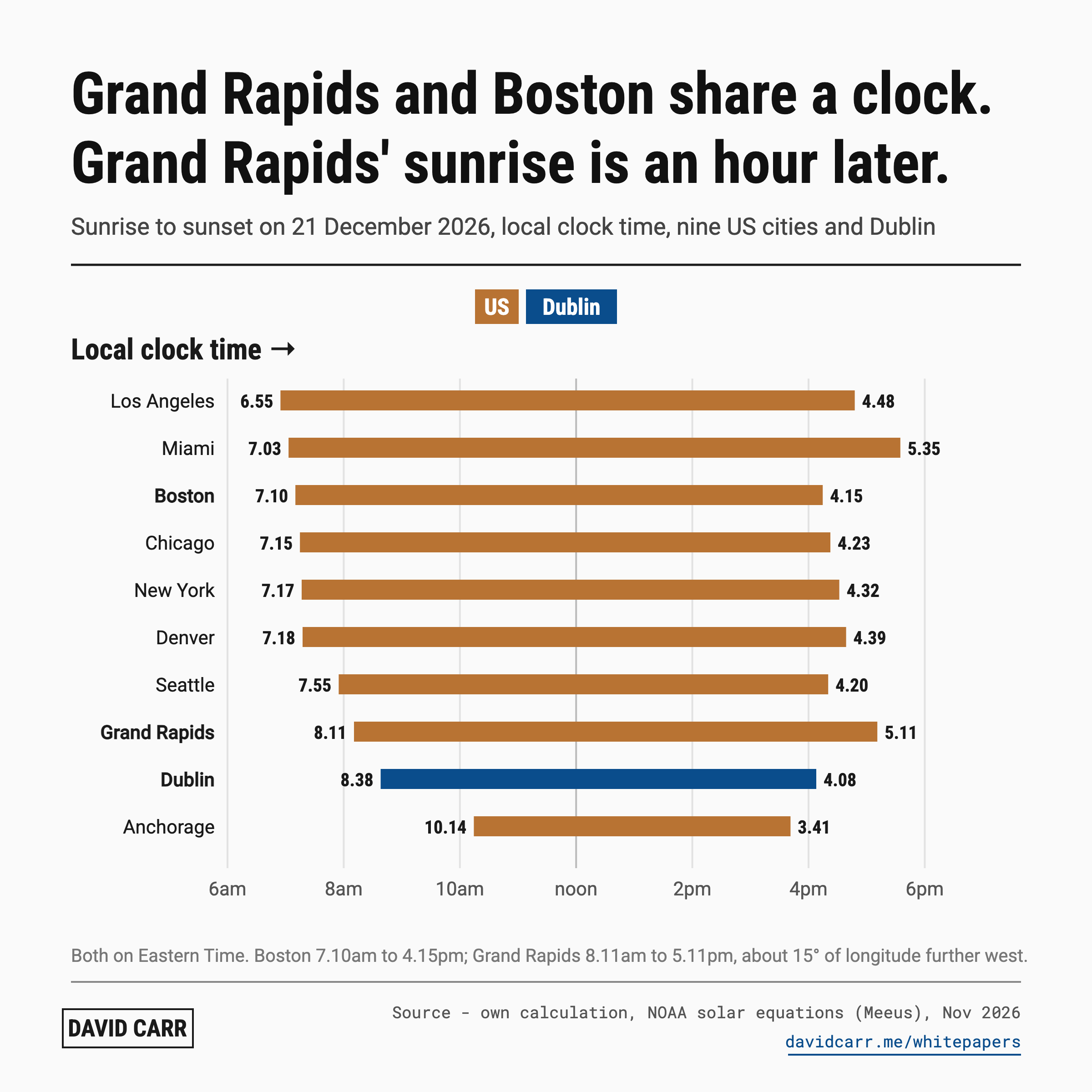
Grand Rapids and Boston share a clock. Grand Rapids' sunrise is an hour later.
- Boston: 7.10am to 4.15pm, 9h 05m
- Grand Rapids: 8.11am to 5.11pm, 9h 00m
- Los Angeles: earliest sunrise on the list, 6.55am
- Anchorage: 10.14am to 3.41pm
Both cities keep Eastern Time, but Grand Rapids is about 15 degrees of longitude further west. Every US city on the list gets more daylight than Dublin except Anchorage.
Local clock time on 21 December 2026, standard time in every city.
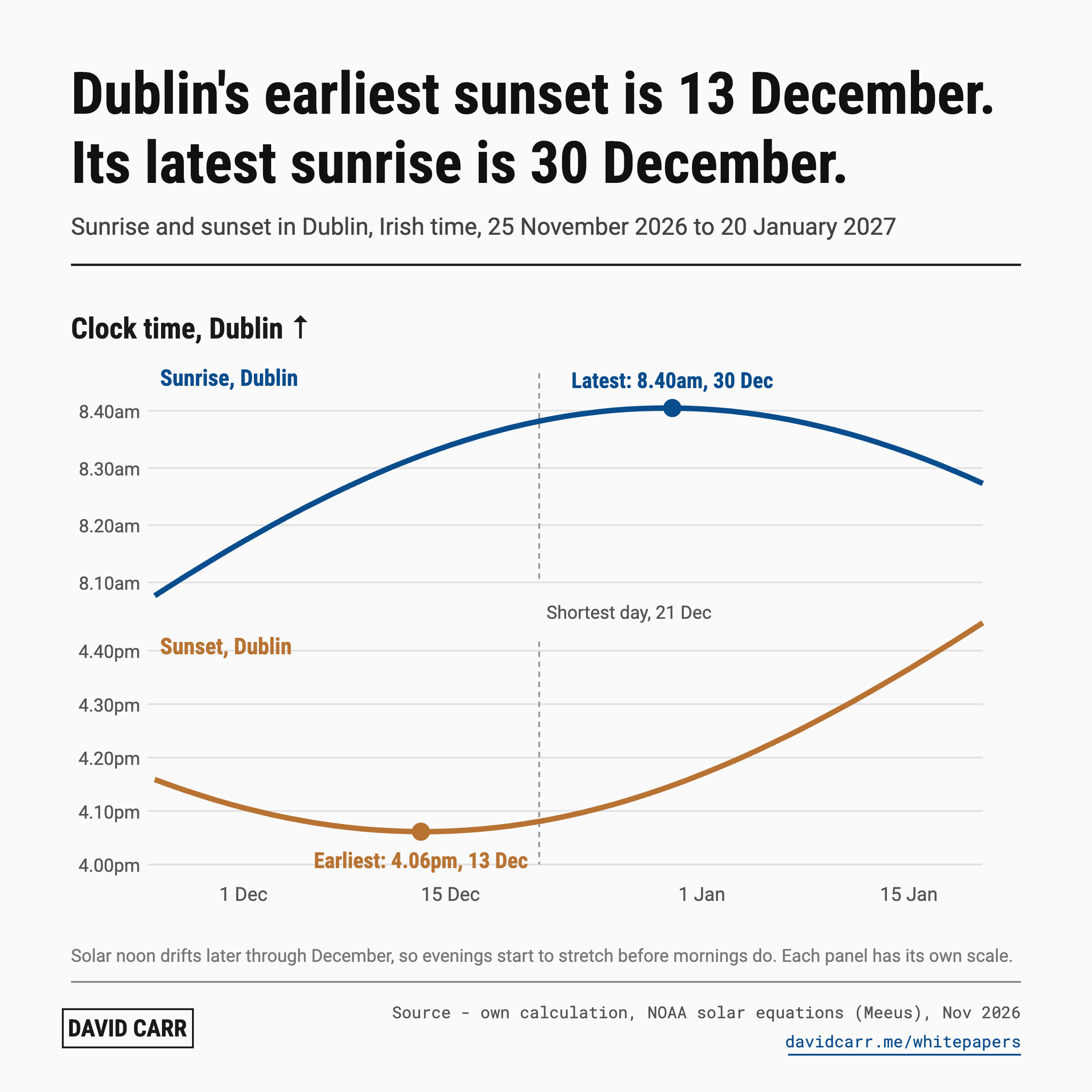
Dublin's earliest sunset is 13 December. Its latest sunrise is 30 December.
- Earliest sunset: 4.06pm on 13 December
- Shortest day: 21 December, 8.38am to 4.08pm
- Latest sunrise: 8.40am on 30 December
- By 20 January sunset is after 4.40pm
The evenings start getting brighter more than a week before the shortest day. The mornings keep getting darker until after Christmas.
This happens because solar noon drifts later through December (the equation of time), while the day itself is still shrinking.
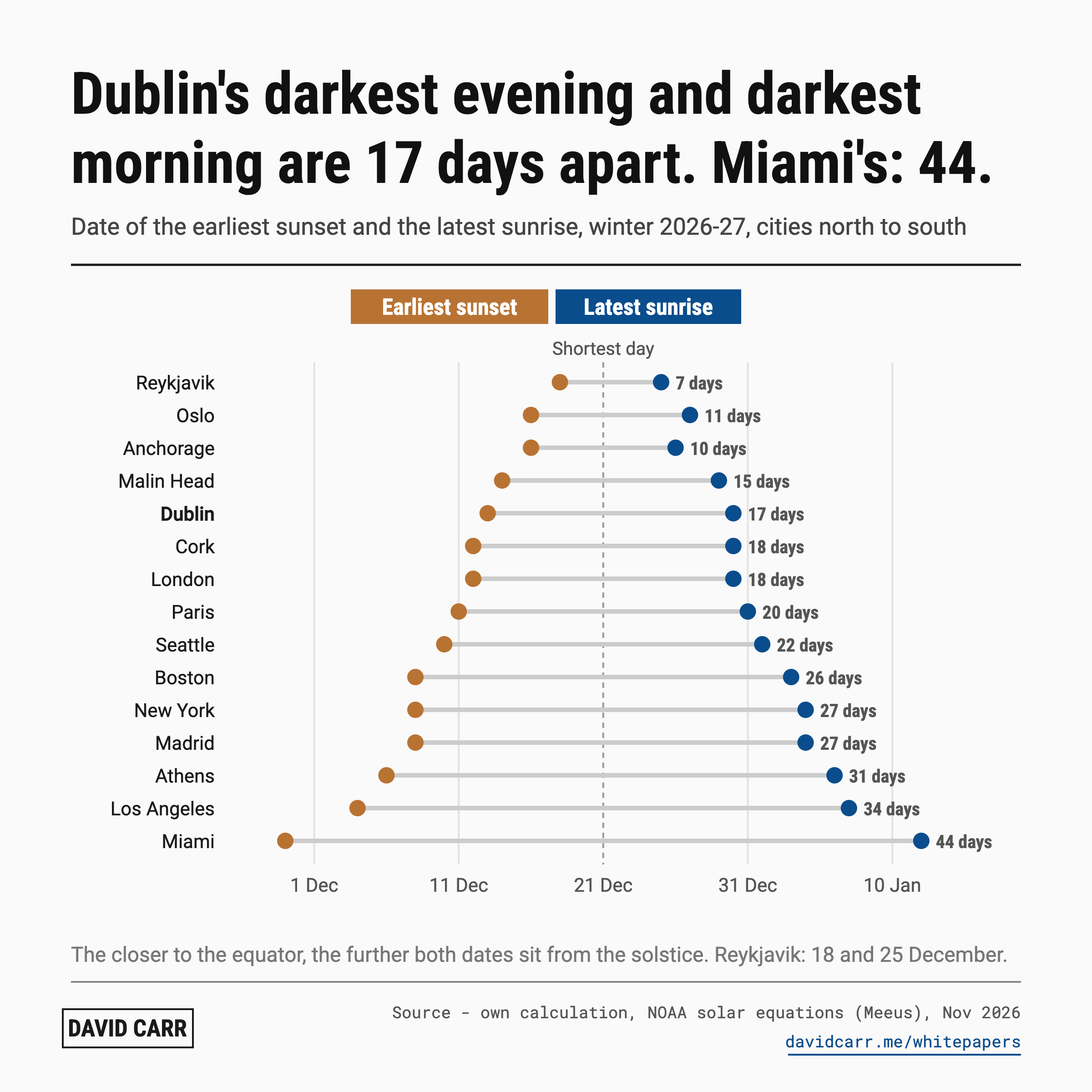
Dublin's darkest evening and darkest morning are 17 days apart. Miami's: 44.
- Reykjavik: 18 and 25 December, 7 days
- Dublin: 13 and 30 December, 17 days
- Madrid: 8 December and 4 January, 27 days
- Miami: 29 November and 12 January, 44 days
The closer to the equator, the further both dates drift from the solstice. In the far north they bunch up around it.
Own calculation, winter 2026 to 2027. Earliest sunset and latest sunrise in local clock time.
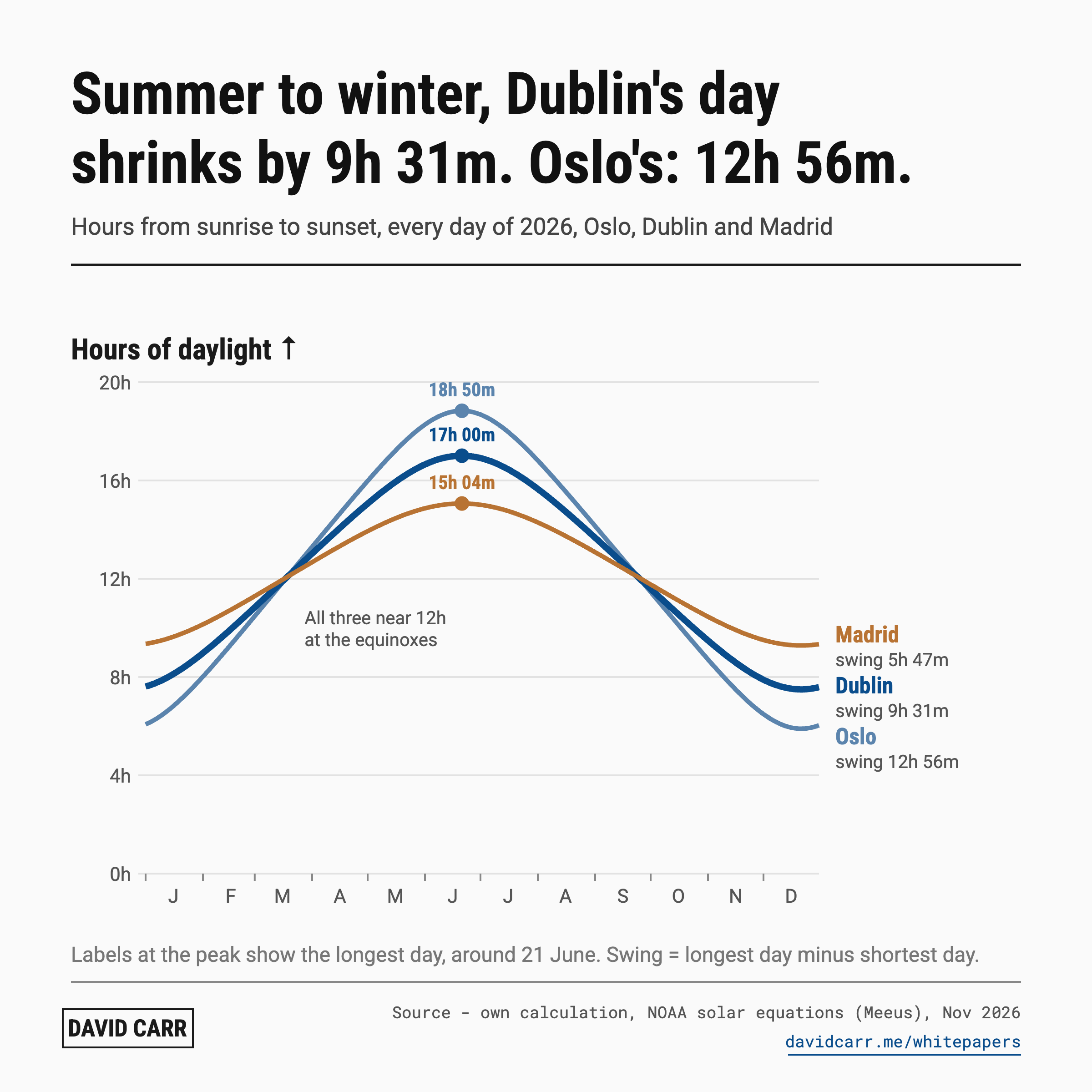
Summer to winter, Dublin's day shrinks by 9h 31m. Oslo's: 12h 56m.
- Dublin: 17h 00m in June, 7h 30m in December
- Oslo: 18h 50m and 5h 54m
- Madrid: 15h 04m and 9h 17m
- All three cross 12 hours around the equinoxes
Dublin's longest day is 1h 57m longer than Madrid's. Its shortest is 1h 47m shorter.
Own calculation for every day of 2026.
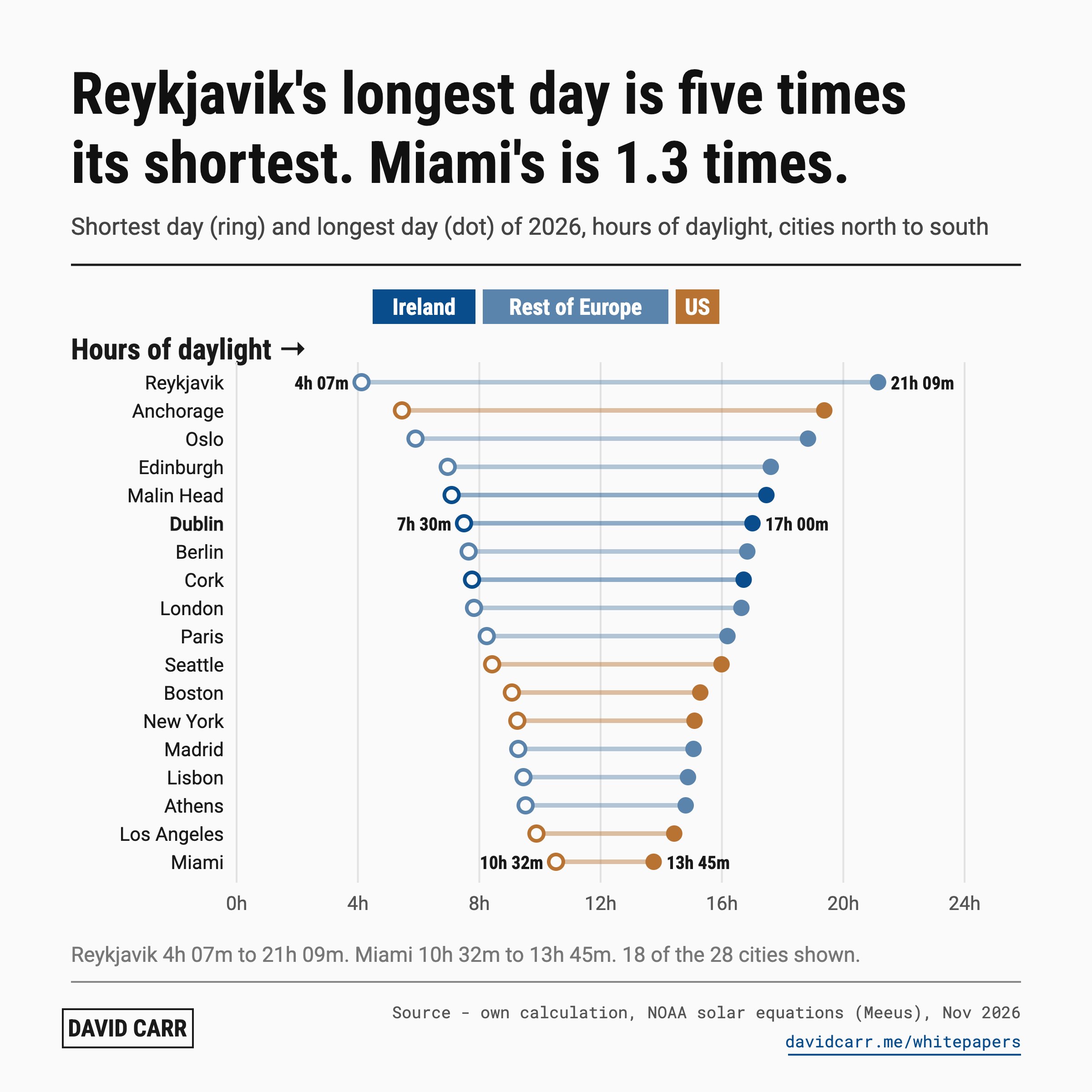
Reykjavik's longest day is five times its shortest. Miami's is 1.3 times.
- Reykjavik: 4h 07m to 21h 09m
- Anchorage: 5h 27m to 19h 22m
- Dublin: 7h 30m to 17h 00m
- Miami: 10h 32m to 13h 45m
The further north, the longer the line. Malin Head's year runs from 7h 05m to 17h 28m.
Own calculation for 2026. 18 of the 28 cities are shown to keep the rows readable; the rest are in the data files.
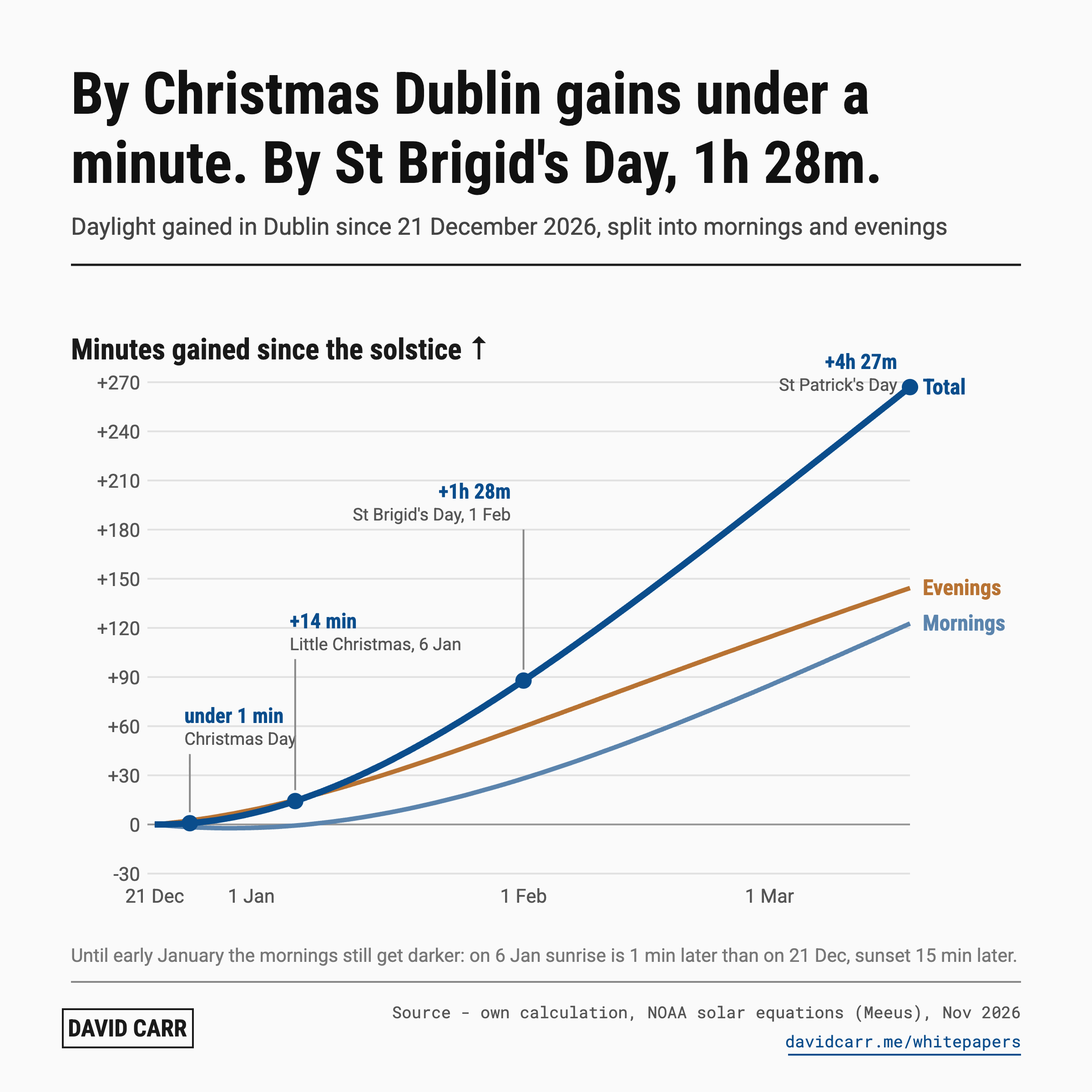
By Christmas Dublin gains under a minute. By St Brigid's Day, 1h 28m.
- Christmas Day: under a minute (0.8)
- Little Christmas, 6 January: 14 minutes
- St Brigid's Day, 1 February: 1h 28m
- St Patrick's Day: 4h 27m
The first fortnight's gain comes almost all in the evening. On 6 January sunset is 15 minutes later than on the solstice, while sunrise is still a minute later.
Own calculation, Dublin, 21 December 2026 to 17 March 2027. Mornings: how much earlier the sun rises; evenings: how much later it sets.
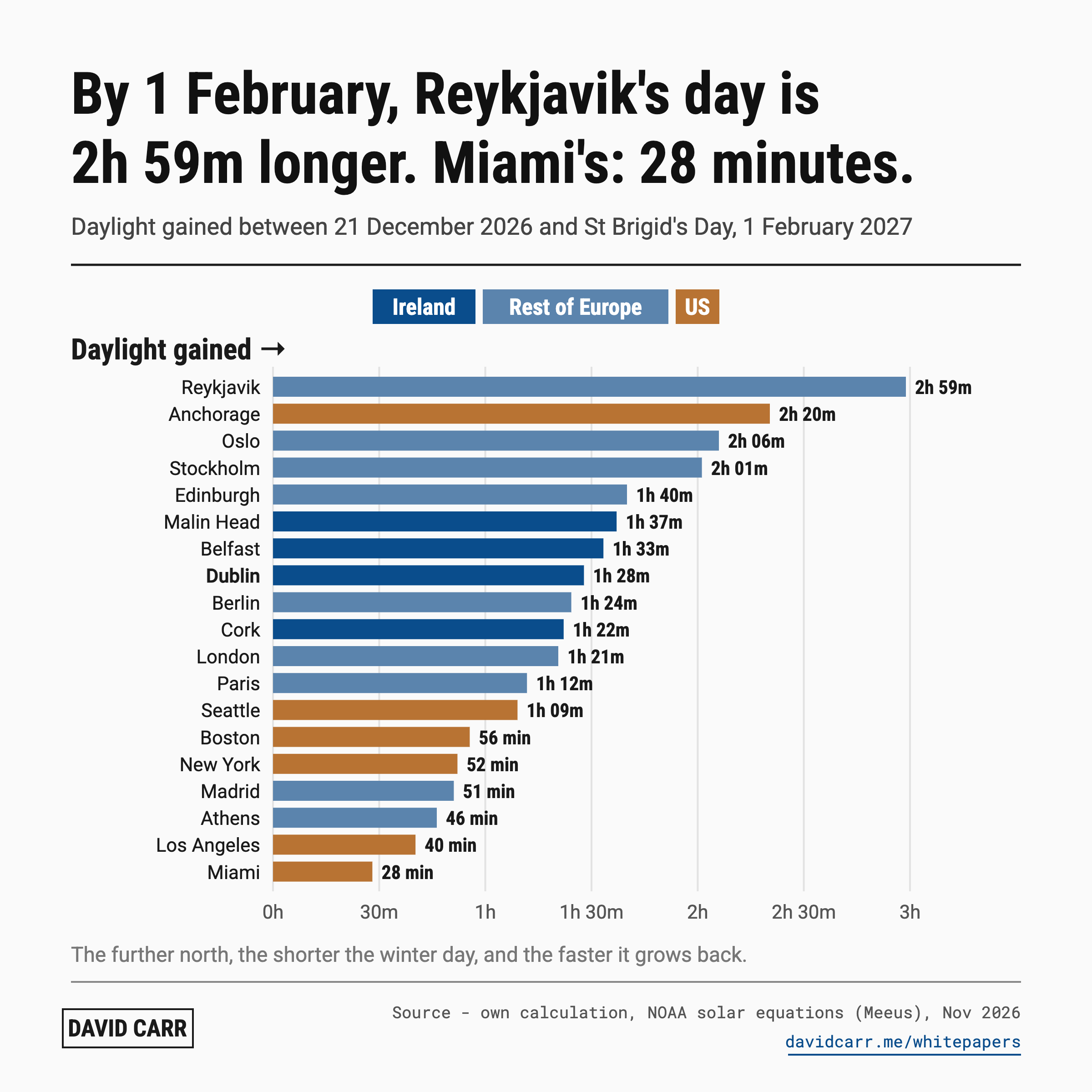
By 1 February, Reykjavik's day is 2h 59m longer. Miami's: 28 minutes.
- Reykjavik 2h 59m, Oslo 2h 06m, Edinburgh 1h 40m
- Malin Head 1h 37m, Dublin 1h 28m, Cork 1h 22m
- Madrid 51 minutes, New York 52 minutes
- Miami 28 minutes
The further north, the shorter the winter day, and the faster it grows back.
Daylight on 1 February 2027 minus daylight on 21 December 2026.
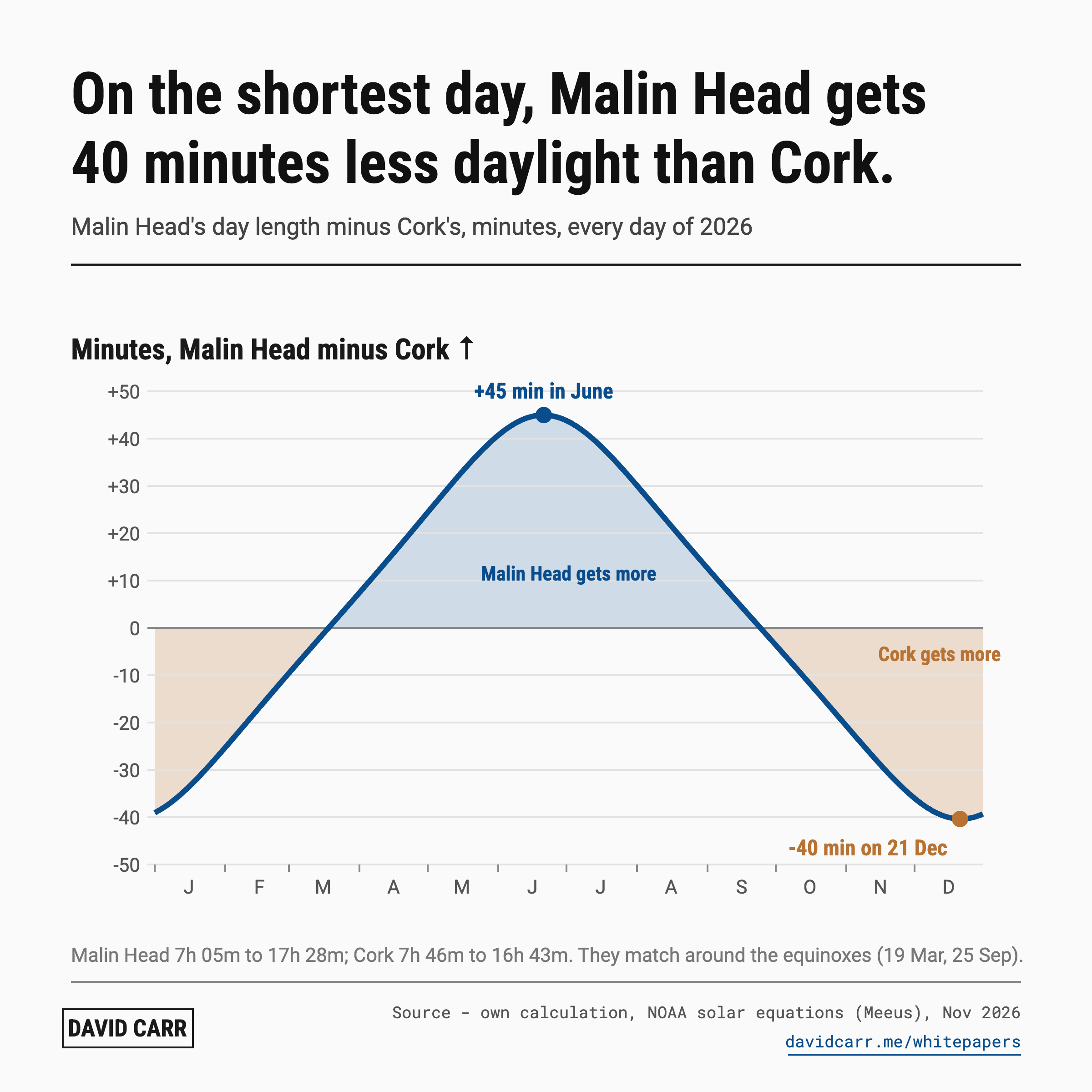
On the shortest day, Malin Head gets 40 minutes less daylight than Cork.
- 21 December: Malin Head 7h 05m, Cork 7h 46m
- June: Malin Head 17h 28m, Cork 16h 43m
- They match around 19 March and 25 September
About 390 km north to south is enough to swap 40 minutes of winter light for 45 minutes of summer light.
Own calculation for every day of 2026. Malin Head is the most northerly point of the island; the distance is a rough figure from the two latitudes.
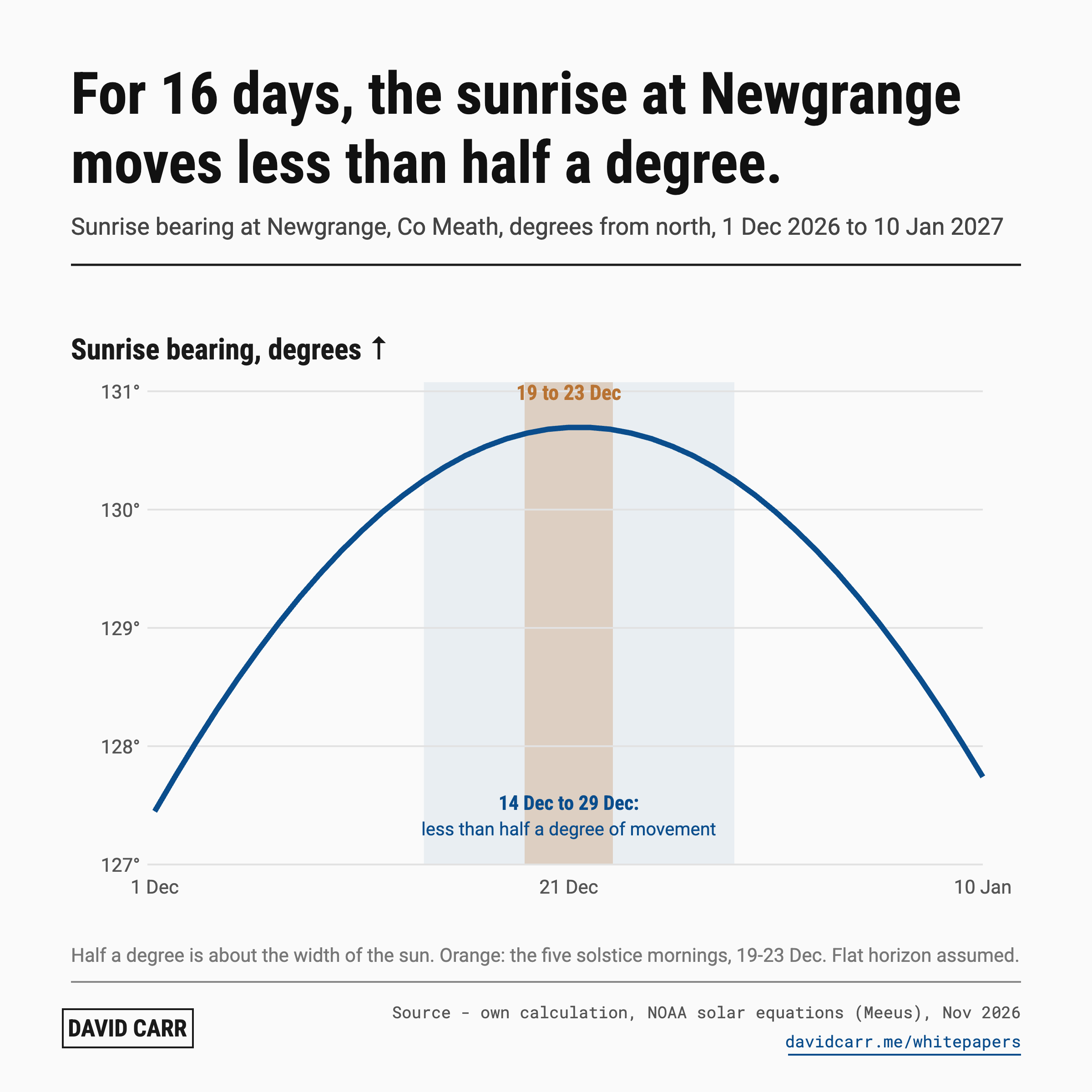
For 16 days, the sunrise at Newgrange moves less than half a degree.
- Sunrise bearing on 21 December: 130.7° from north, in the south-east
- 14 to 29 December: within half a degree of that
- 19 to 23 December: within 0.05°
Newgrange in Co Meath was finished around 3200 BC, before Stonehenge and the pyramids of Giza. On the mornings around the solstice a beam of sunlight comes through a roof-box above the entrance and lights the chamber for about 17 minutes (National Geographic). The chart shows why the effect lasts several days: the sun rises at almost the same spot all week.
Own calculation for Newgrange (53.69°N, 6.48°W), flat horizon. The real hills on the skyline make first light a little later. Half a degree is about the width of the sun.
Method, caveats and sources
The short answer. On 21 December 2026 Dublin gets 7 hours 30 minutes of daylight, from 8.38am to 4.08pm. Cork gets 7h 46m and Malin Head 7h 05m. Reykjavik gets just over four hours, Miami ten and a half. Dublin's earliest sunset comes on 13 December and its latest sunrise on 30 December, so the evenings start to stretch before the shortest day. The light comes back slowly at first: under a minute by Christmas Day, 14 minutes by 6 January and 1h 28m by St Brigid's Day.
Method. Every time on this page is calculated, not downloaded. The sums use the NOAA solar calculator equations, which follow Jean Meeus, Astronomical Algorithms: the sun's mean longitude and anomaly, equation of centre, apparent longitude, obliquity of the ecliptic, declination and equation of time, then the hour angle at which the sun's centre is 0.833° below the horizon (0.567° for refraction plus 0.267° for the sun's half-width). Each sunrise and sunset is recalculated at its own moment rather than at noon. Local times use each city's time zone from the standard tz database, so Dublin is on GMT in December and Grand Rapids on Eastern Time.
Checks. Dublin on 21 December 2026 comes out at 8.38am to 4.08pm, 7h 30m, in line with the usual figure of about seven and a half hours for Dublin's shortest day. The method is generally given as good to about a minute away from the polar regions.
Caveats. Sunrise and sunset assume a flat sea-level horizon. Hills, buildings and height above sea level shift them by a few minutes, and unusual weather can bend the light more or less than the standard allowance. City coordinates are the city centre. Times are rounded to the nearest minute. The day lengths are sunrise to sunset only and leave out twilight.
Newgrange. The age, the roof-box and the 17 minutes of light are from National Geographic. The sunrise bearings on the chart are calculated.
Data. The tables behind every chart (sunrise, sunset and day length for 28 cities, every day from 1 January 2026 to 31 March 2027) were computed on 26 November 2026.
Also: Dublin and the cities of Europe and Christmas Day weather in Ireland.