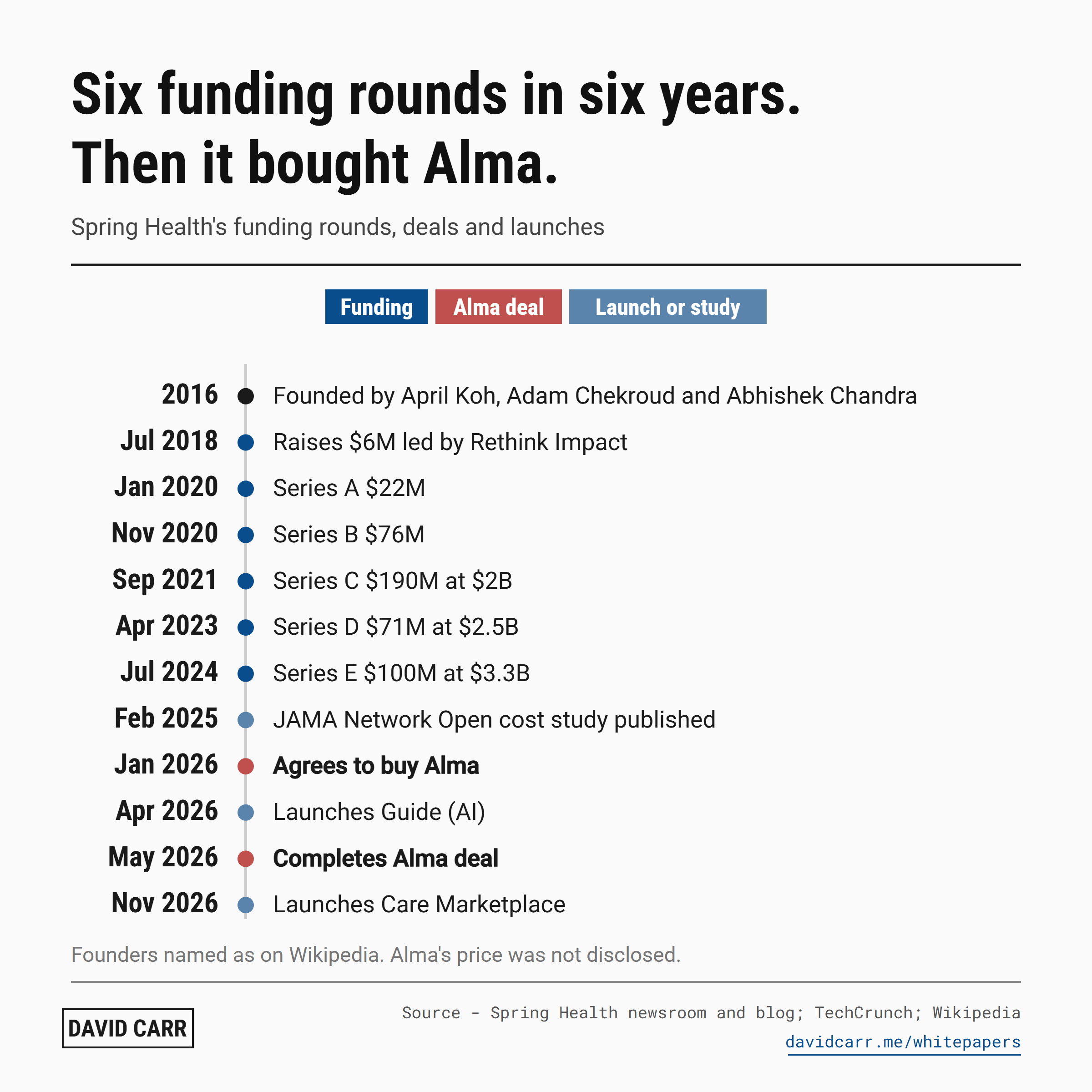
Six funding rounds in six years. Then it bought Alma.
Spring Health sells mental health care as an employee benefit: therapy, coaching, psychiatry and help finding the right one. Alma, the company it bought, helps independent therapists take insurance.
Founded in 2016 by April Koh, Adam Chekroud and Abhishek Chandra. Alma's price was not disclosed.
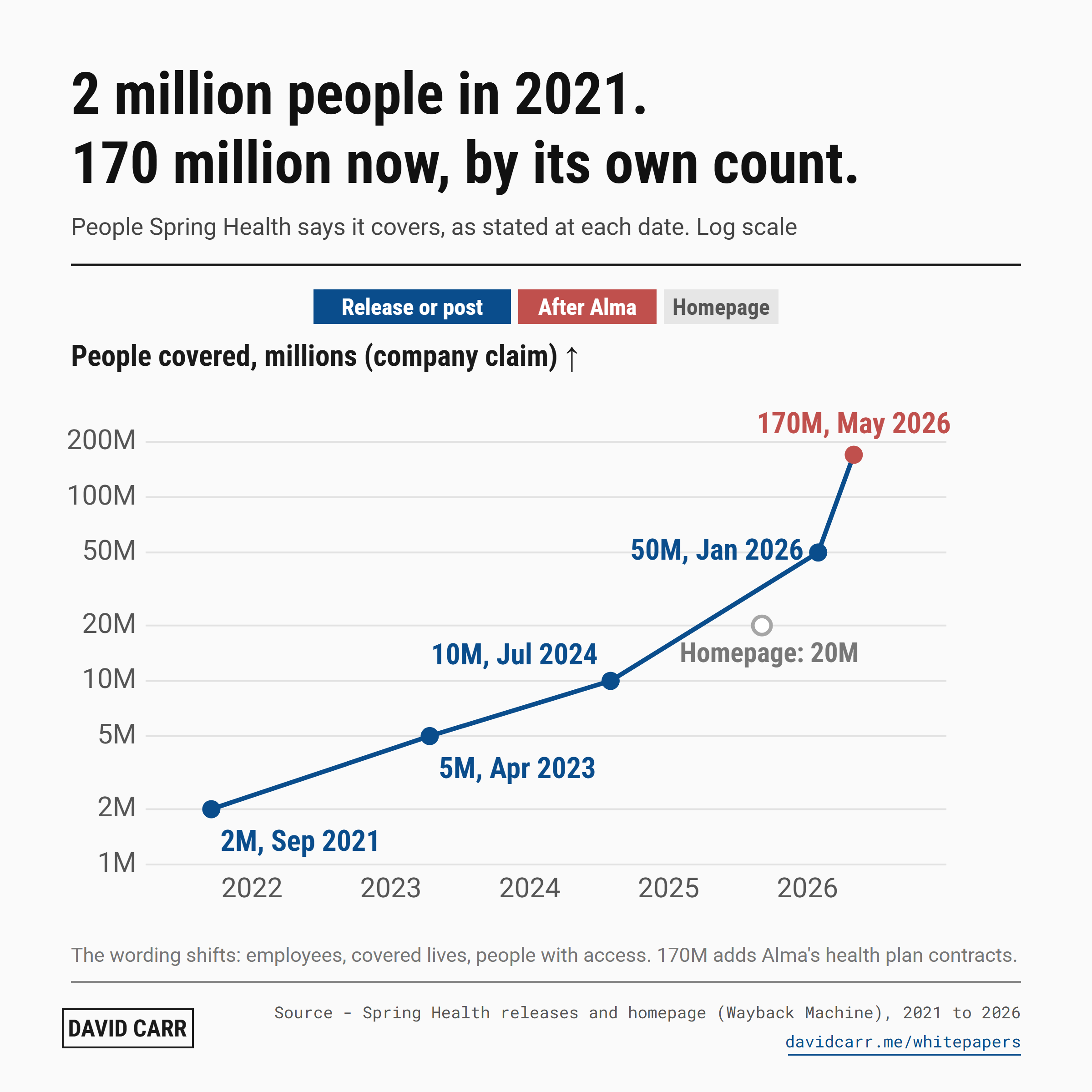
2 million people in 2021. 170 million now, by its own count.
Every figure here is Spring Health's own claim, and the thing being counted changes. The last jump is mostly Alma's health plan contracts.
From September 2025 to March 2026 its homepage said "over 20 million covered lives", while the January release said 50 million. Customer counts vary the same way: "over 150 companies" in 2021, "4,500+ organizations" on the homepage from 2023, and "over 400 employers" plus "27,000 groups" through partners in July 2024.
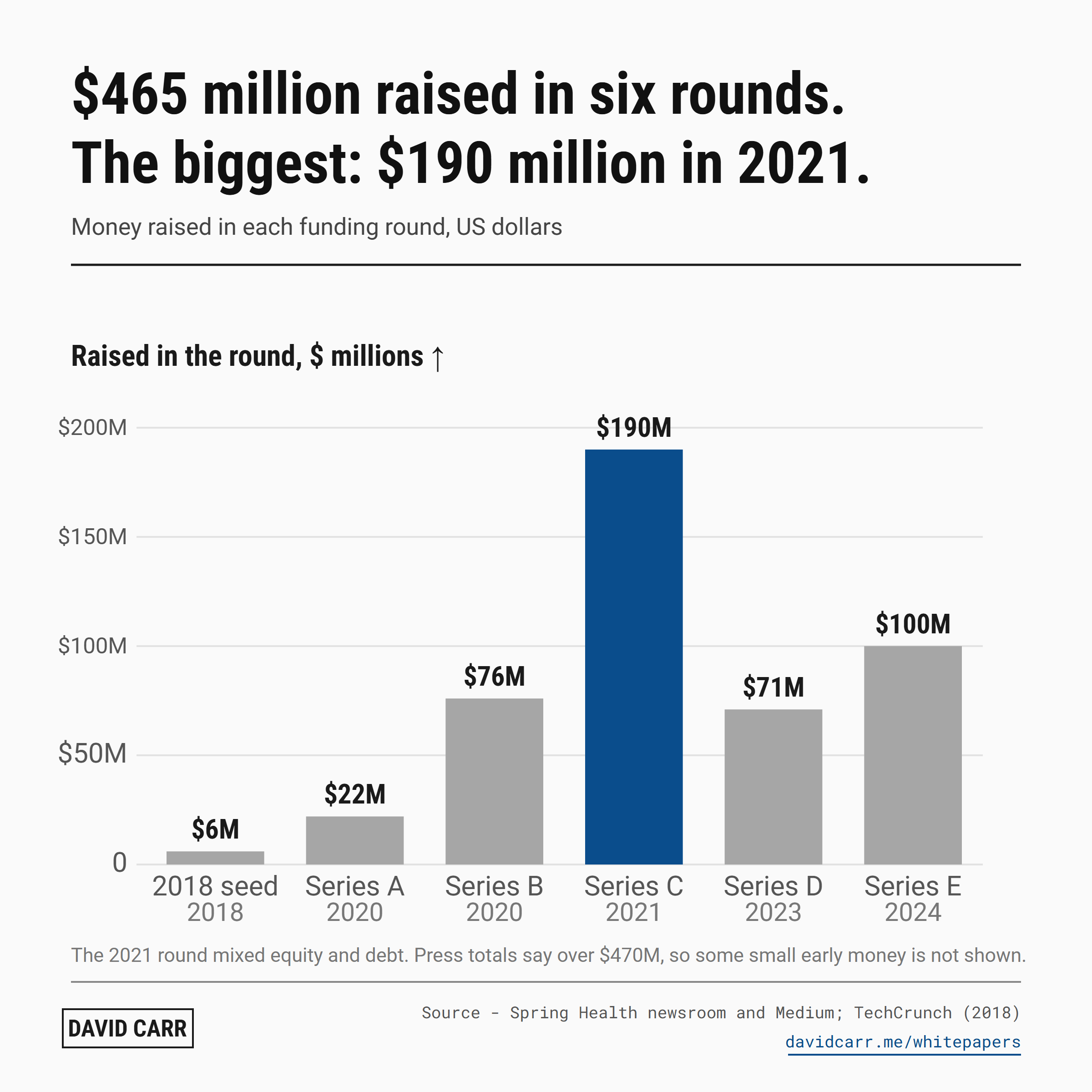
$465 million raised in six rounds. The biggest: $190 million in 2021.
- 2018: $6M
- Series A, January 2020: $22M
- Series B, November 2020: $76M
- Series C, September 2021: $190M
- Series D, April 2023: $71M
- Series E, July 2024: $100M
The 2021 round was the big one. The two rounds since added $171 million between them.
Round sizes from Spring Health's own posts, except the 2018 round (TechCrunch). Press totals say more than $470 million, so a little early money is missing here.
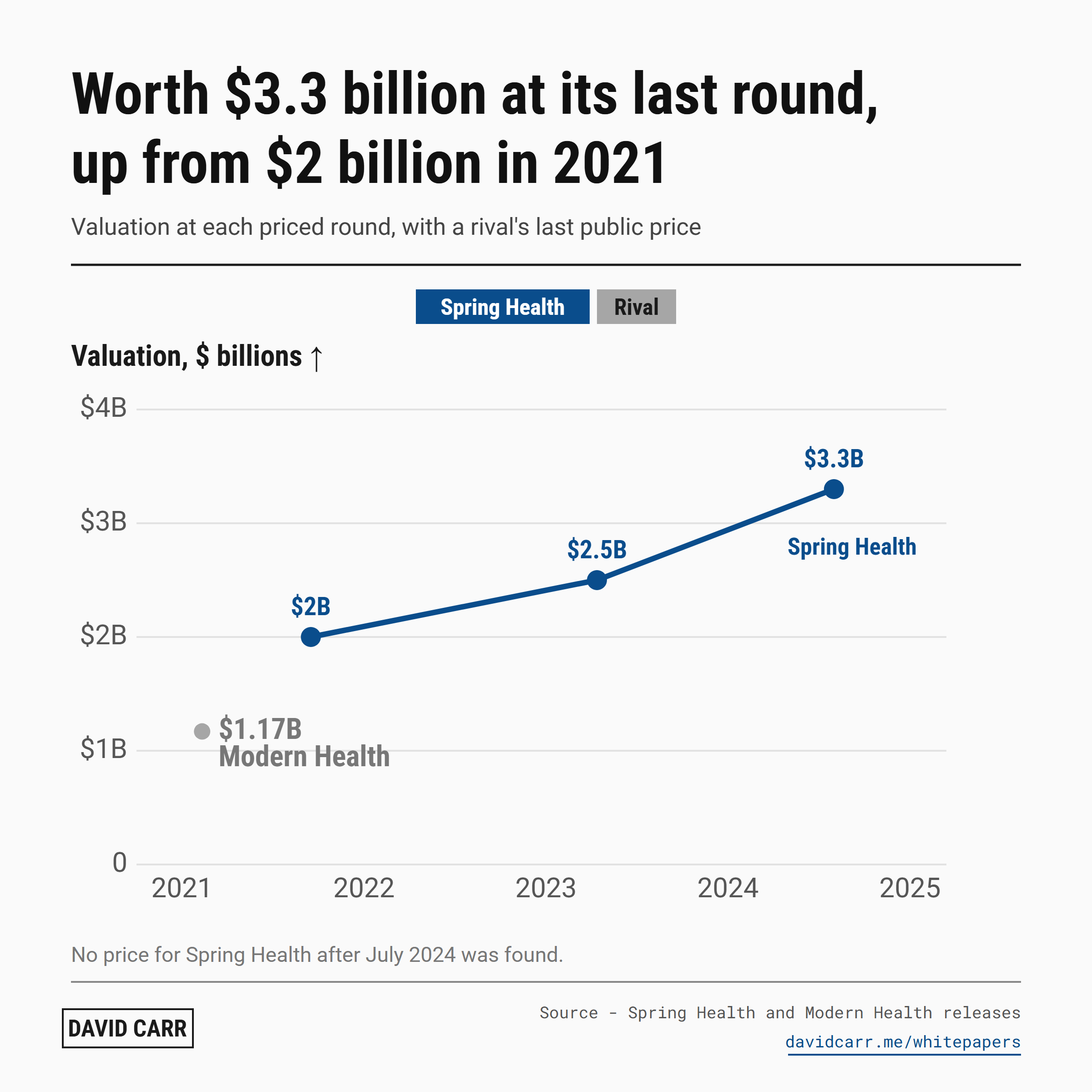
Worth $3.3 billion at its last round, up from $2 billion in 2021
Each round was priced higher than the one before.
Valuations as announced. No price for Spring Health after July 2024 was found, and the Alma deal's terms were not disclosed.
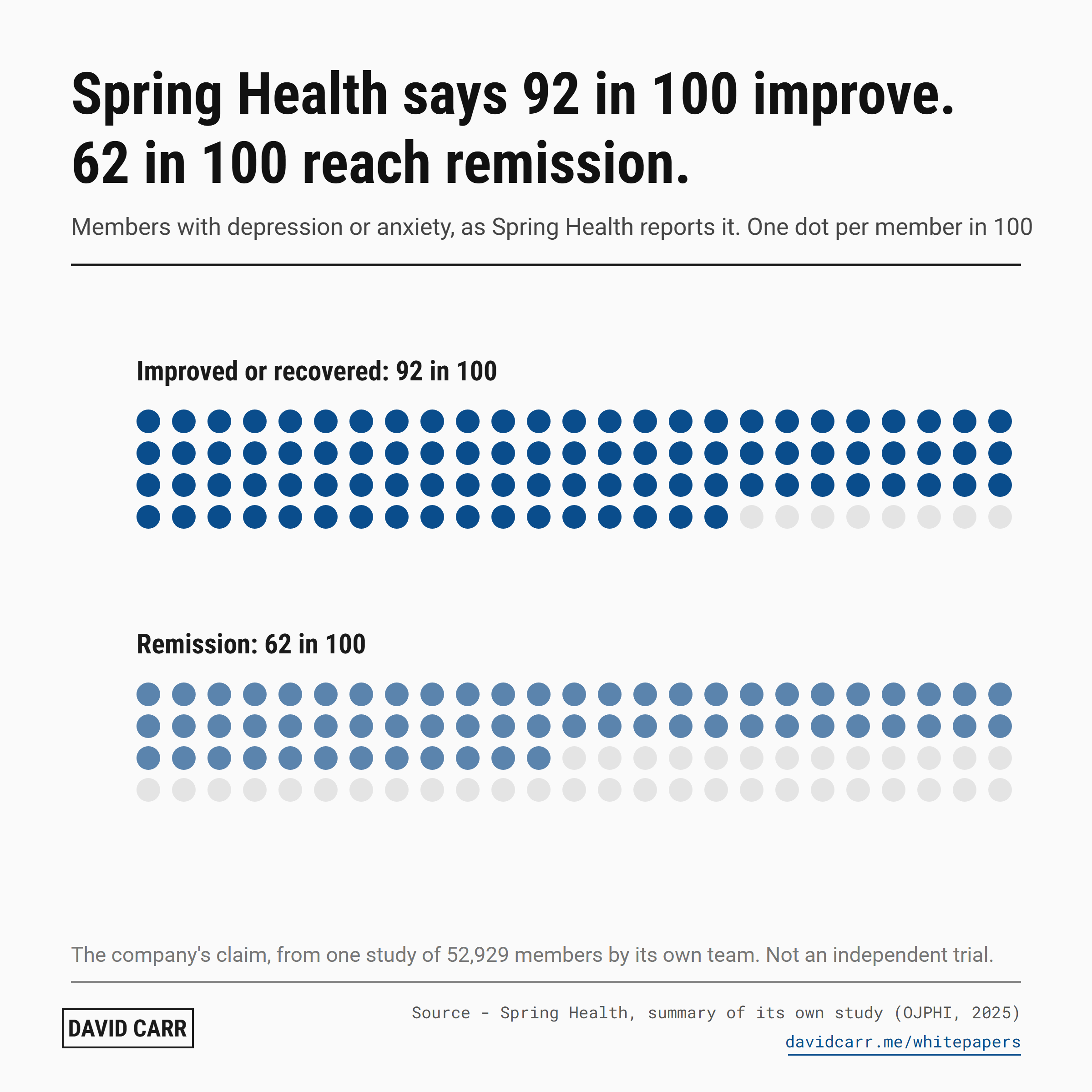
Spring Health says 92 in 100 members improve. 62 in 100 reach remission.
- Reliably improved or recovered from depression or anxiety: 92%
- Reached remission: 62%
- Members in the study: 52,929
This is the figure the company leads with. It comes from a study by its own team, published in a journal, not from an independent trial.
Spring Health's summary on its blog, citing Ward 2025 in OJPHI. How members were chosen for the study is not stated on the page.
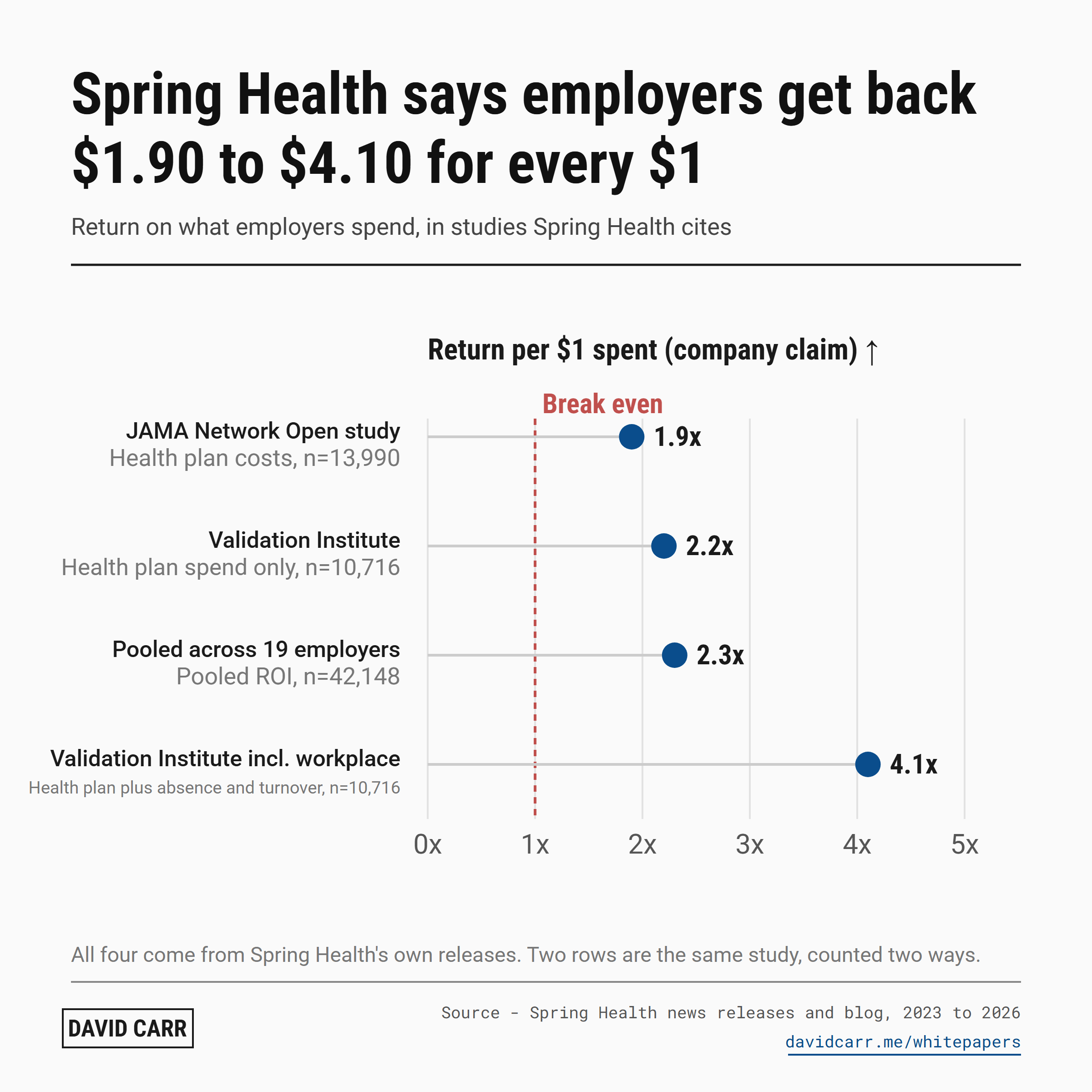
Spring Health says employers get back $1.90 to $4.10 for every $1
- JAMA Network Open study, 7 employers, 13,990 people: 1.9x
- Validation Institute, health plan spend only: 2.2x
- Pooled across 19 employers, 42,148 people: 2.3x
- Validation Institute, adding absence and staff turnover: almost 4.1x
Every number is above break-even. They measure different things, so they don't add up to one answer.
All four as Spring Health reported them. The 2.3x figure is from a meta-analysis listed on its blog.
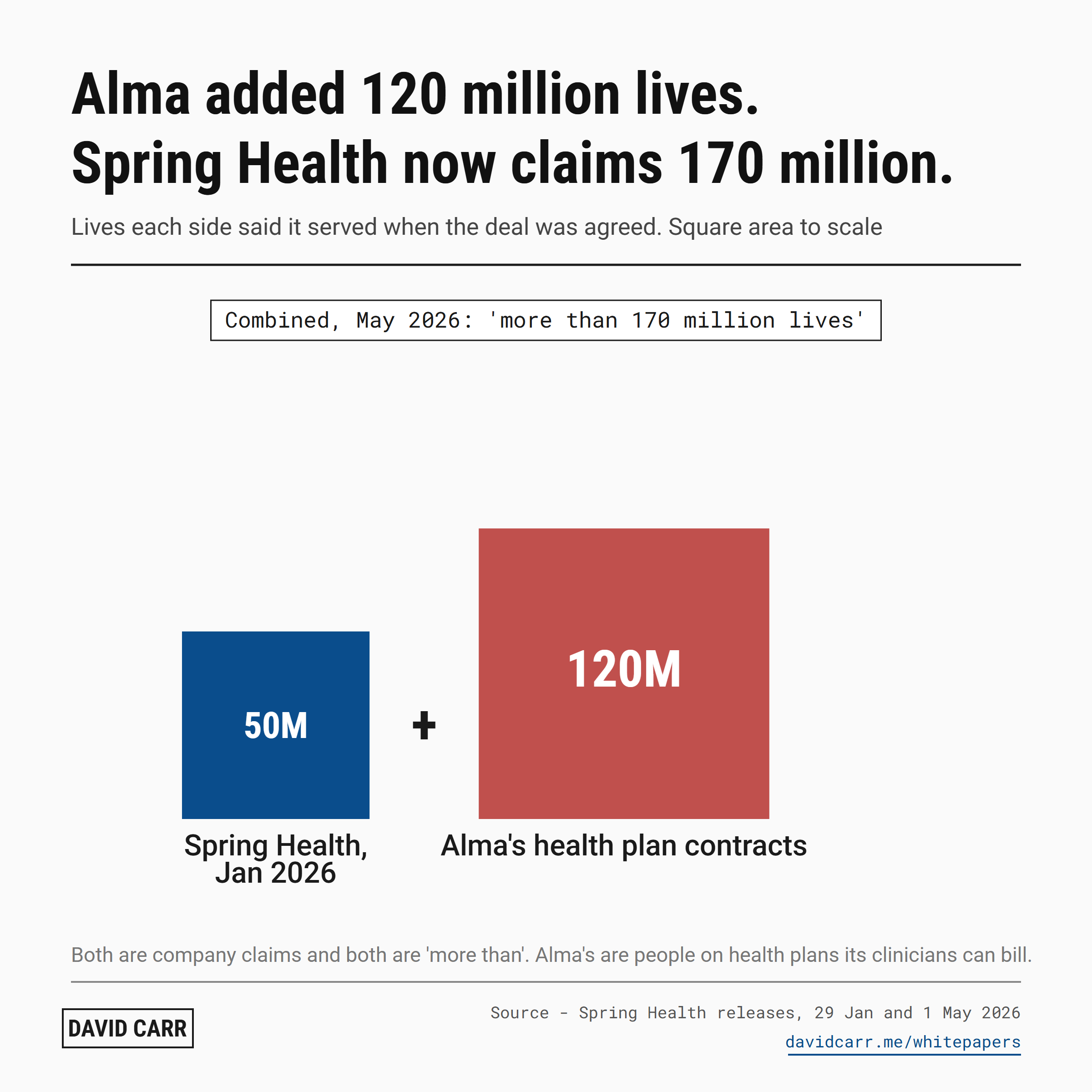
Alma added 120 million lives. Spring Health now claims 170 million.
Alma has contracts with the four largest national health plans in the US. Buying it gave Spring Health a route to people through their insurer as well as their employer.
Both sides' figures are their own. Alma's count is people on plans its clinicians can bill, not people who have used it.
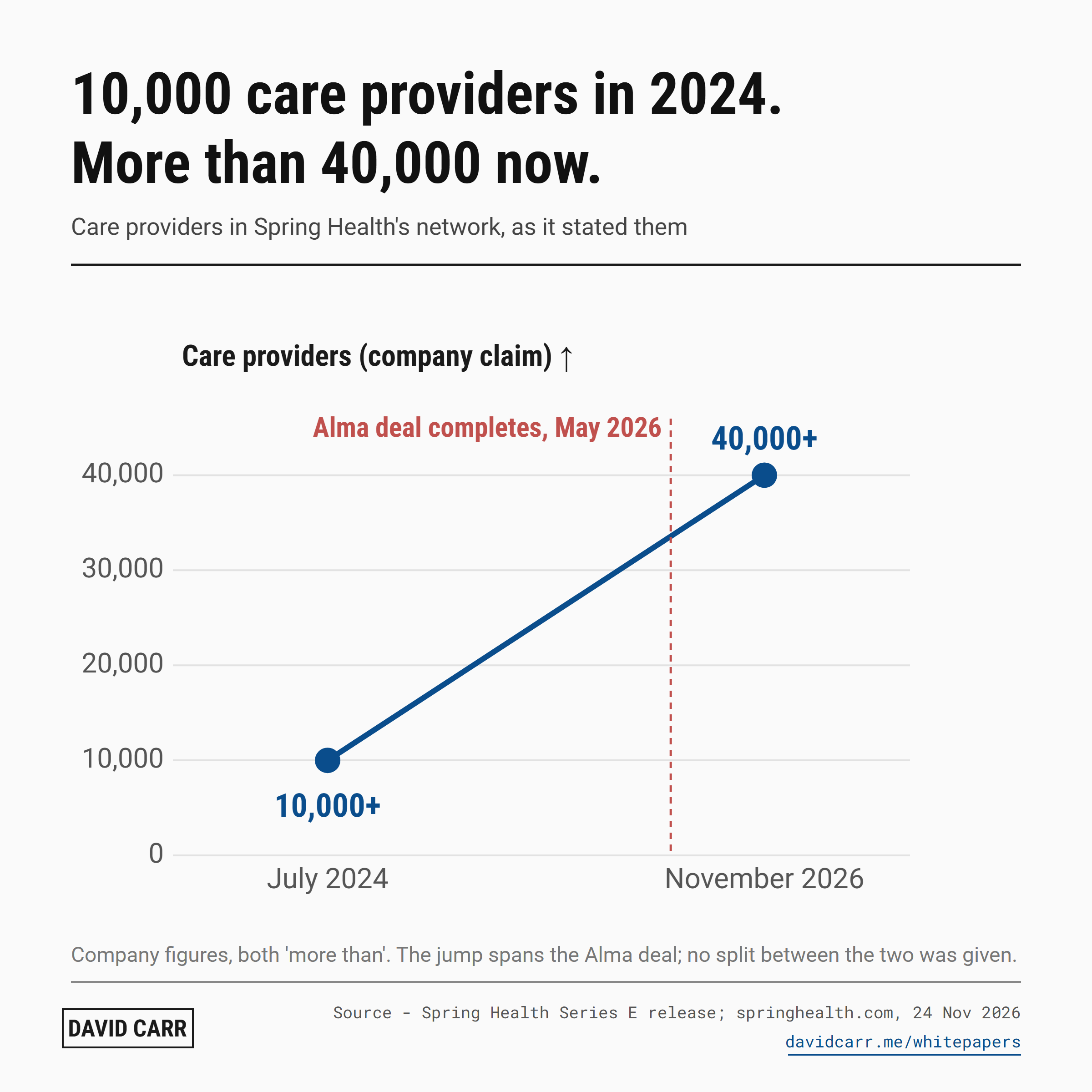
10,000 care providers in 2024. More than 40,000 now.
Four times the network in just over two years, with the Alma deal in between.
Company figures. Spring Health did not split the 40,000 between its own network and Alma's.
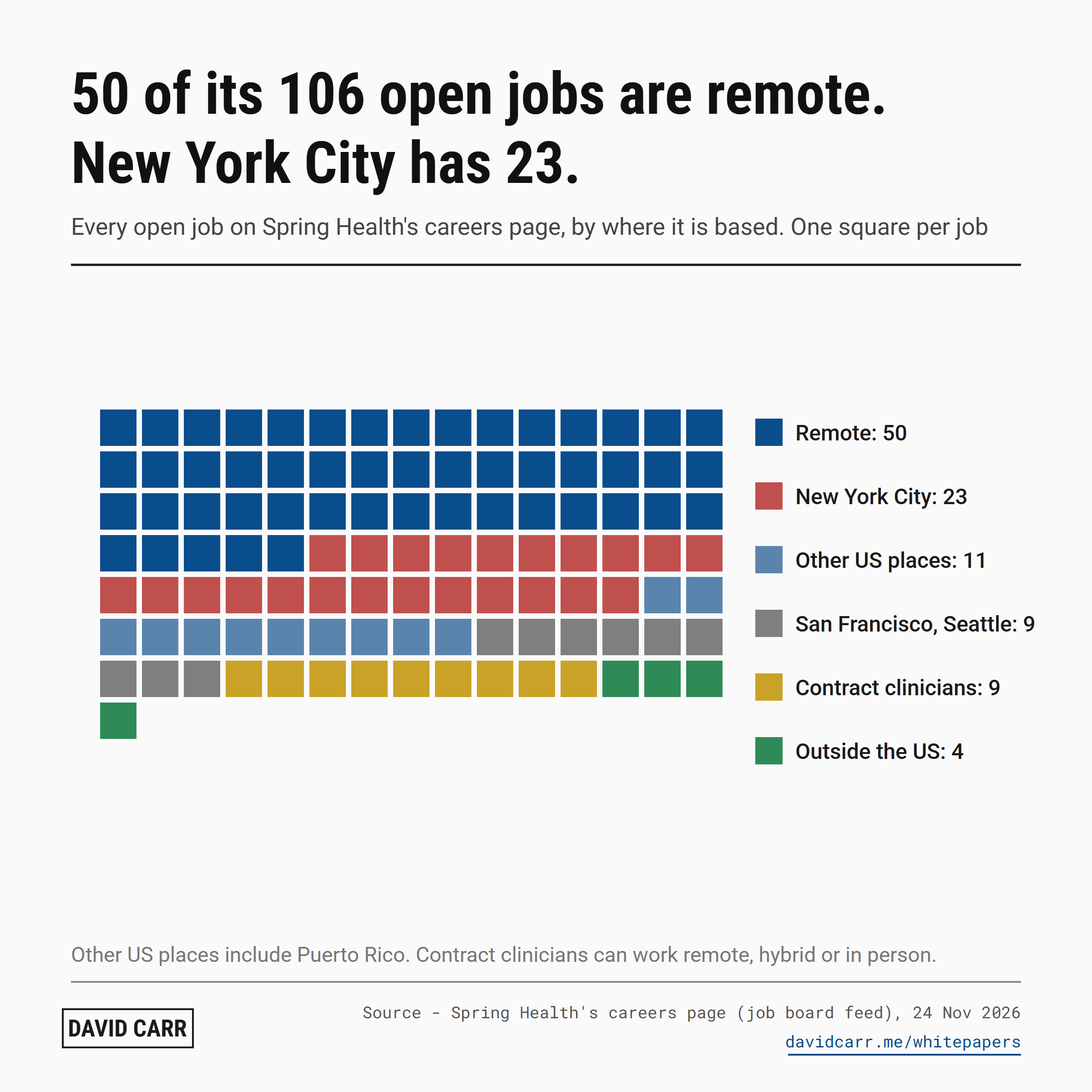
50 of its 106 open jobs are remote. New York City has 23.
- Remote: 50
- New York City: 23
- Other US places, including Puerto Rico: 11
- San Francisco and Seattle: 9
- Contract clinicians: 9
- Canada, Argentina, New Zealand: 4
Spring Health is based in New York. Most of its in-person roles are there or in San Francisco.
Every role on its careers page, 24 November 2026.
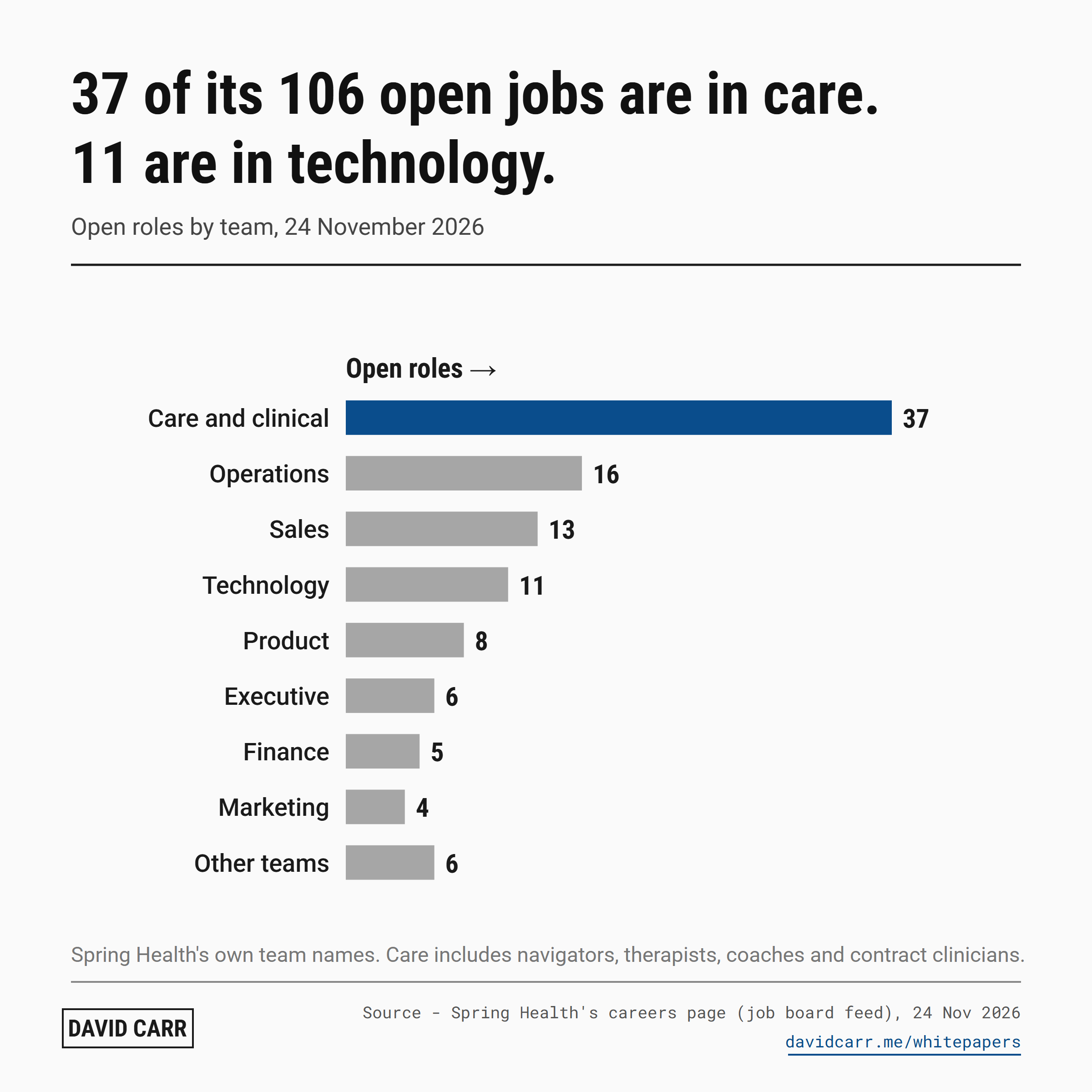
37 of its 106 open jobs are in care. 11 are in technology.
- Care and clinical: 37
- Operations: 16
- Sales: 13
- Technology: 11
- Product: 8
Care navigators, therapists and coaches make up the biggest group.
Spring Health's own team names. I put its clinical network teams in with Clinical and grouped four small teams as other.
Method, caveats and sources
The short answer. Spring Health sells mental health care to employers as a benefit. It raised about $465 million in six rounds and was last valued at $3.3 billion, in July 2024. In 2026 it bought Alma, which helps independent therapists take insurance. It now says it covers more than 170 million people and has more than 40,000 providers. Those figures, and its outcome and savings figures, are its own.
Spring Health is private. It publishes no accounts and no revenue. It has described its growth only in broad terms: "approximately 6x revenue growth" in the year to September 2021, and a compound growth rate "exceeding 80%" over the three years to January 2026. Funding and valuation figures come from its own announcements. The rival valuation comes from Modern Health's own release.
Claims, labelled as claims. People covered, customers, providers, outcomes and returns are all Spring Health's numbers. The outcome and cost studies were run or summarised by the company. They are shown as it states them and not checked against anything independent. The homepage figures come from Wayback Machine snapshots, so their dates are the snapshot dates.
Jobs. Every open role in the feed behind Spring Health's careers page on 24 November 2026: 106 roles. Teams are Spring Health's own labels, lightly grouped by me.
Left out. The Alma price (never disclosed) and press guesses at it. Unconfirmed valuation figures from data sites.
Also: Stripe, Gusto and Deel.