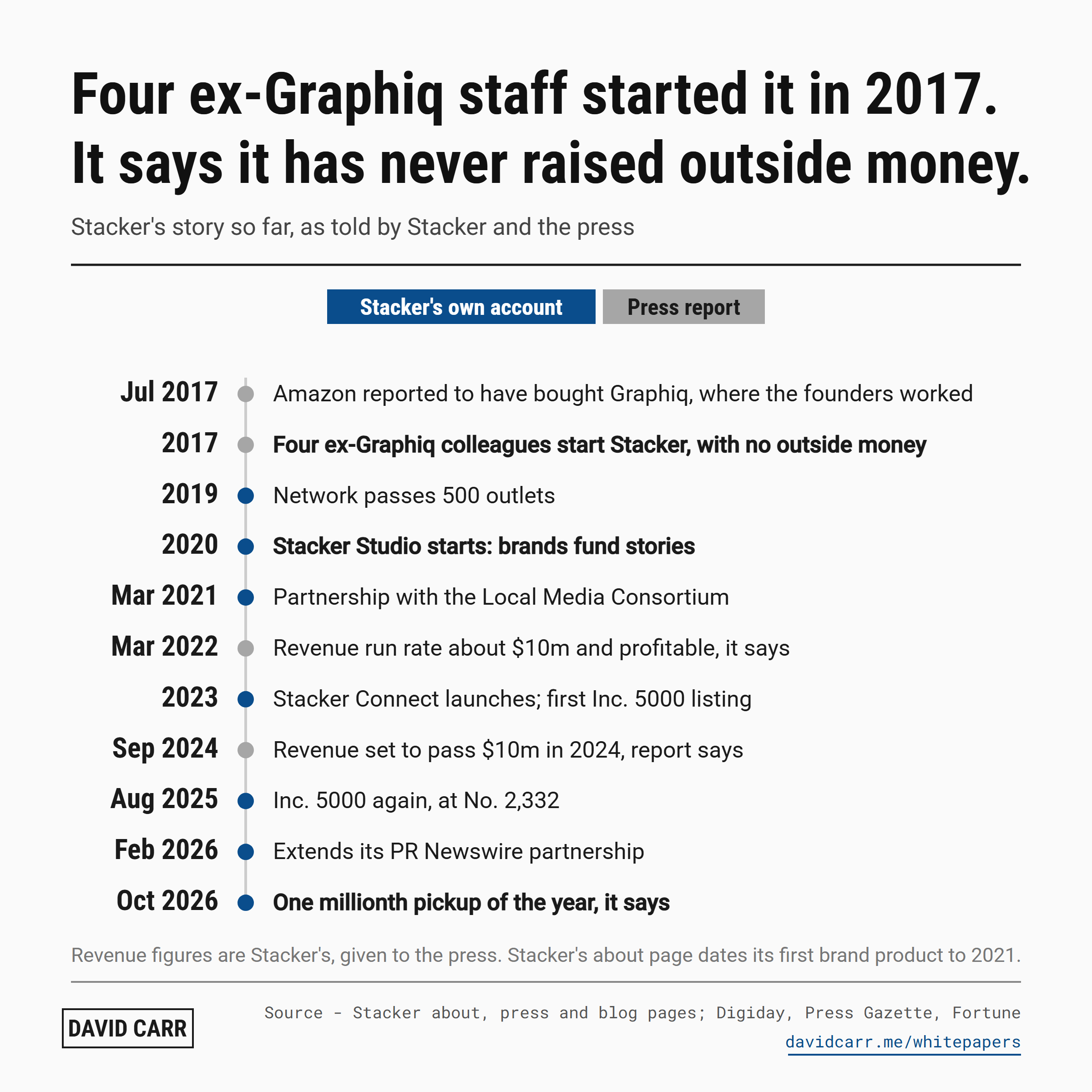
Four ex-Graphiq staff started it in 2017. It says it has never raised outside money.
- 2017: Amazon is reported to have bought Graphiq, a data-chart company
- 2017: Noah Greenberg and three Graphiq colleagues start Stacker
- 2022: revenue run rate about $10 million, and profitable, it says
- 2024: revenue set to pass $10 million, a report says
- 2025: on the Inc. 5000 list of fast-growing private companies, at No. 2,332
No funding rounds, so none of the usual valuation news. The money facts come from what Stacker has told reporters.
The four co-founders are named by Bootstrappers.com and, in part, by Crunchbase. Stacker's own about page does not name them.
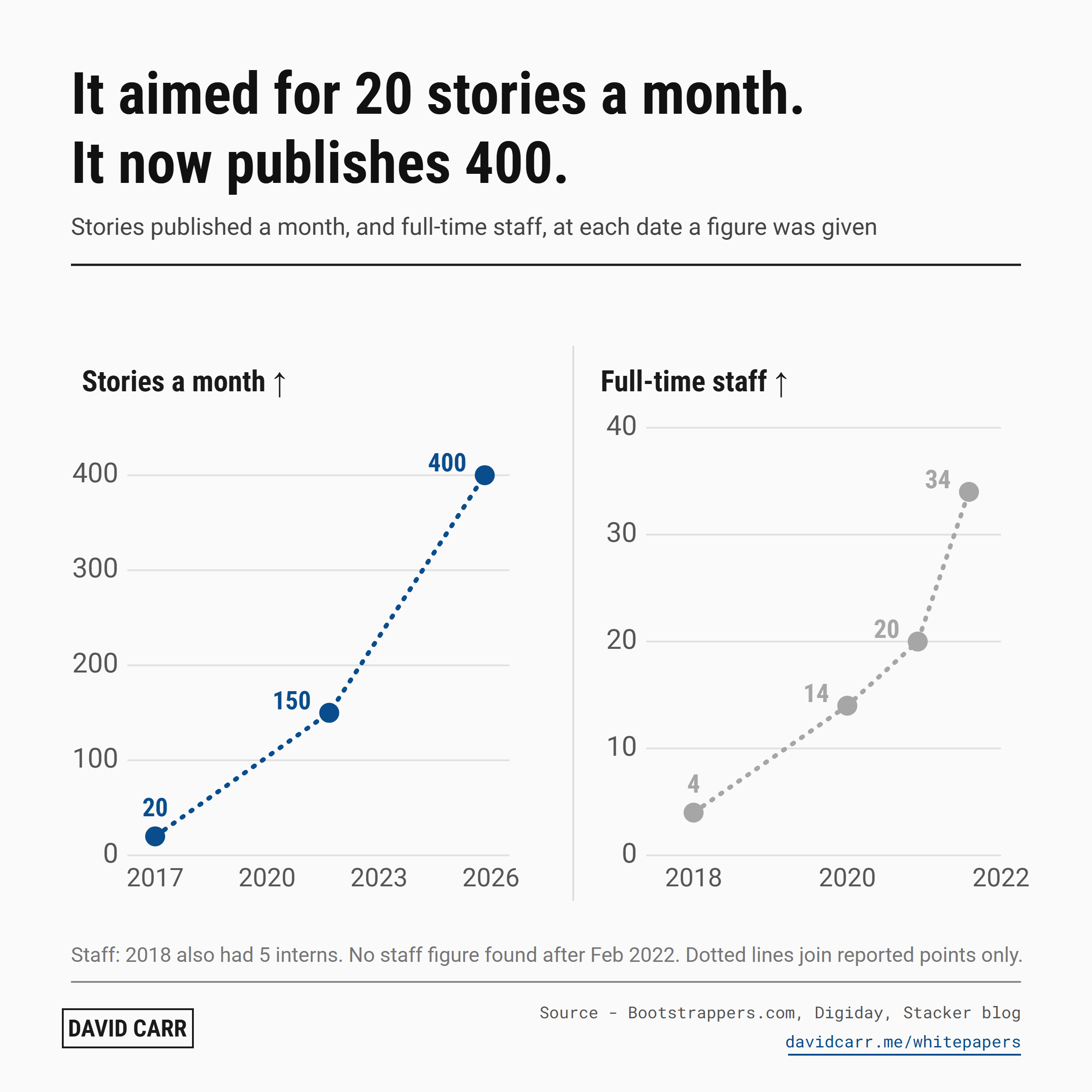
It aimed for 20 stories a month. It now publishes 400.
The 2026 figure takes in stories brands pay for as well as Stacker's own.
A 2021 report said "more than 20 articles per day" (Talking Biz News), which may count local versions of one story. No staff count was found after 2022.
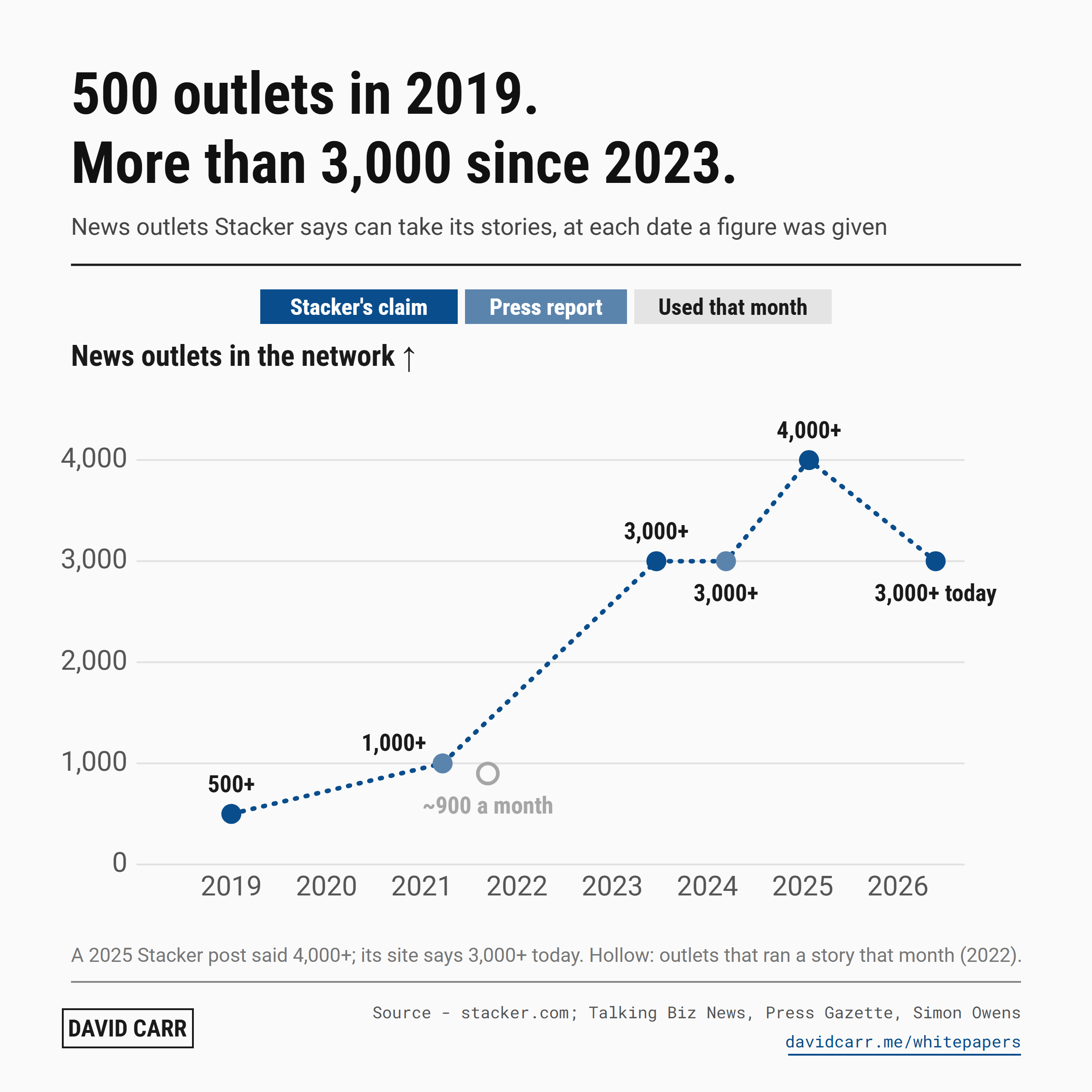
500 outlets in 2019. More than 3,000 since 2023.
- 2019: 500+, Stacker says
- 2021: over 1,000 local newsrooms
- 2023: over 3,000, up 30% in the year
- 2025: over 4,000, said its CEO
- November 2026: 3,000+, on its homepage
The outlets are free to take the stories. In 2022 about 900 ran at least one in a typical month.
All counts are Stacker's own, some reported by Simon Owens and Press Gazette. Nobody outside Stacker audits them.
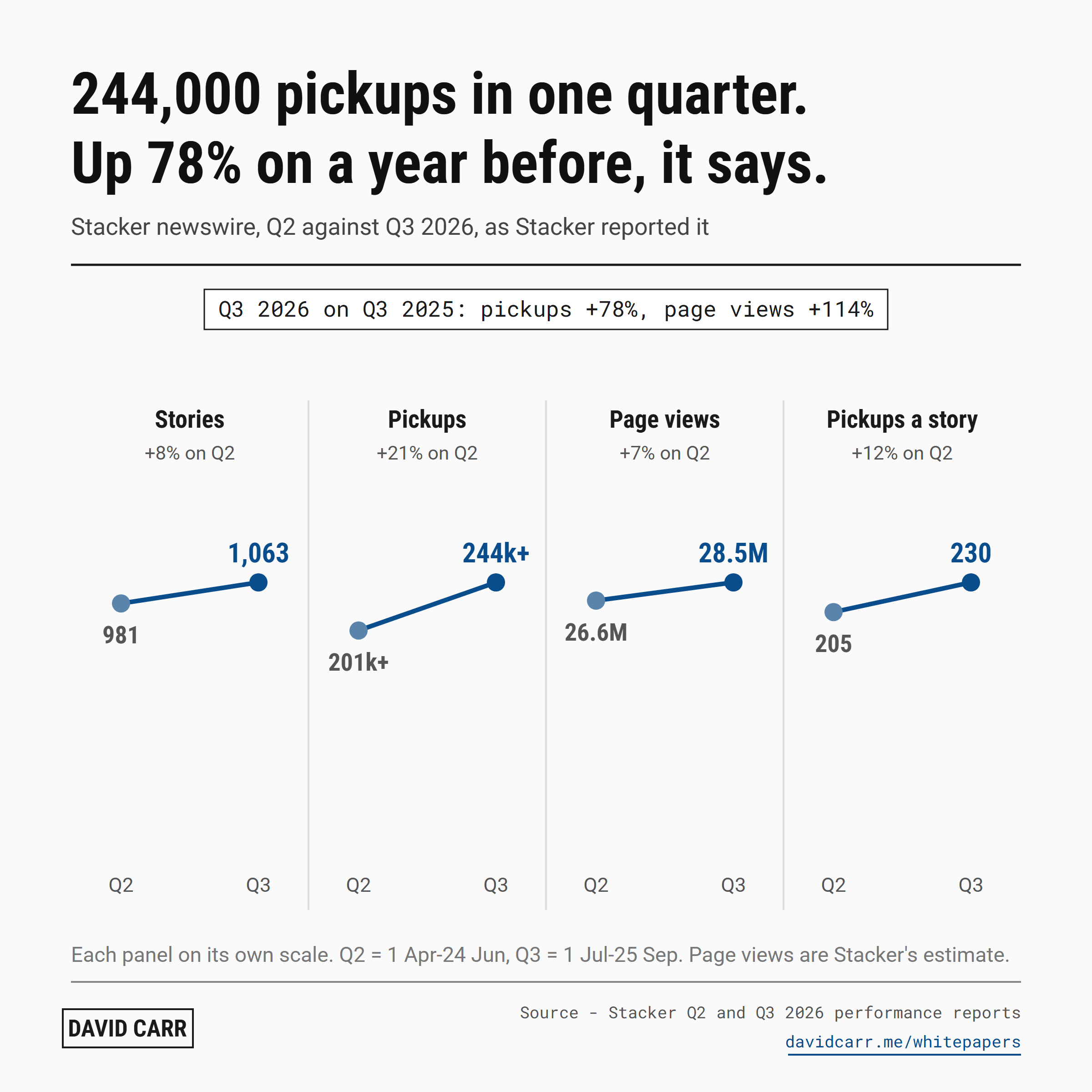
244,000 pickups in one quarter. Up 78% on a year before, it says.
- Q2 2026: 981 stories, 201,000+ pickups, 205 a story
- Q3 2026: 1,063 stories, 244,000+ pickups, 230 a story
- Q3 page views: 28.5 million (estimate), up 114% on a year before
- October 2026: one million pickups so far this year
A pickup is one outlet running one story.
From Stacker's Q2 and Q3 reports. They are self-reported and not audited.
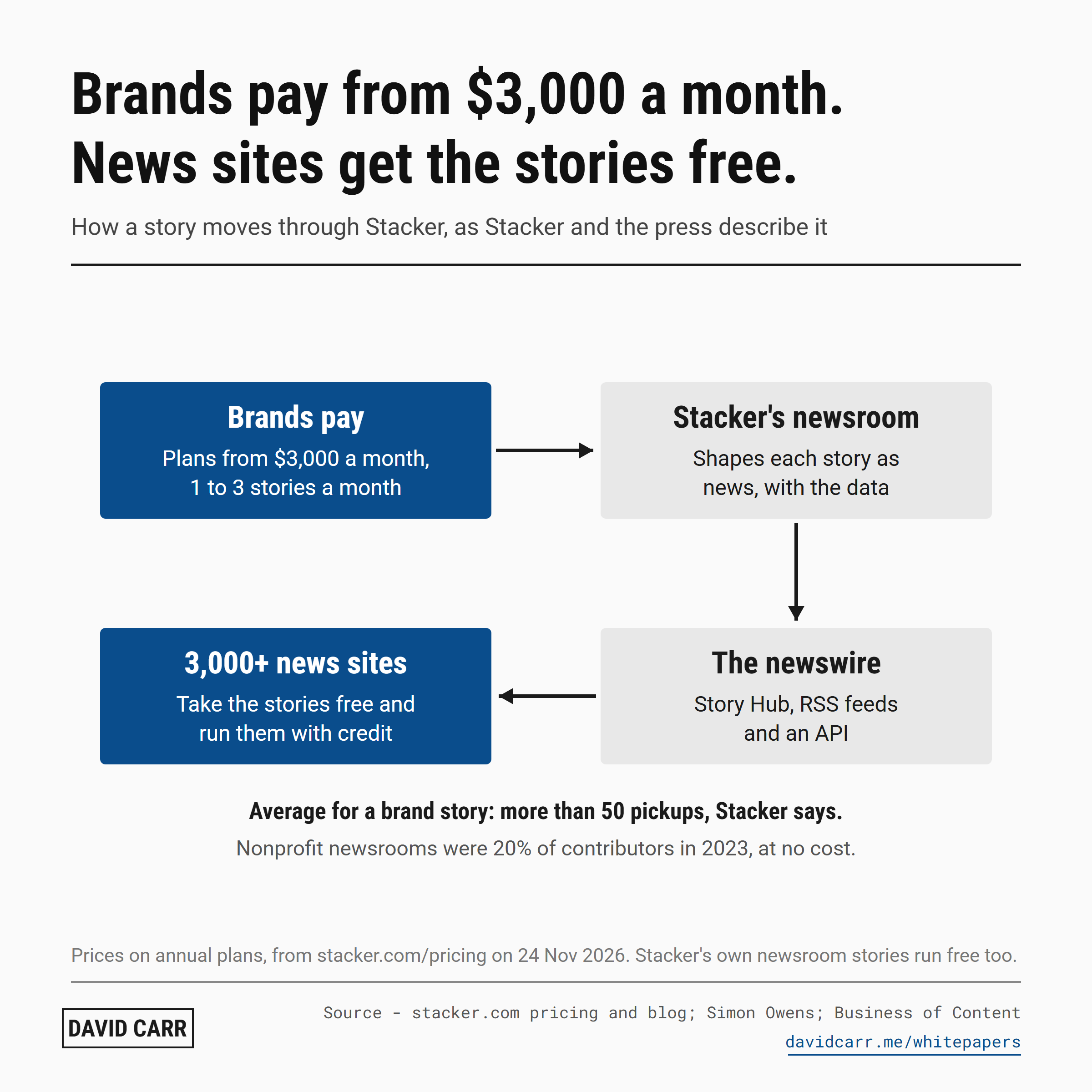
Brands pay from $3,000 a month. News sites get the stories free.
- Plans: from $3,000 a month, on annual terms, for 1 to 3 stories a month
- A brand story averages more than 50 pickups, Stacker says
- Publishers get the feed free, alongside wire services like AP
- 2023: 20% of contributors were nonprofit newsrooms, at no cost
Brands pay for the reach. Newsrooms get free stories with data in them. Stacker sits in the middle.
Press Gazette reported in 2022 that about half of output was brand-funded (source).
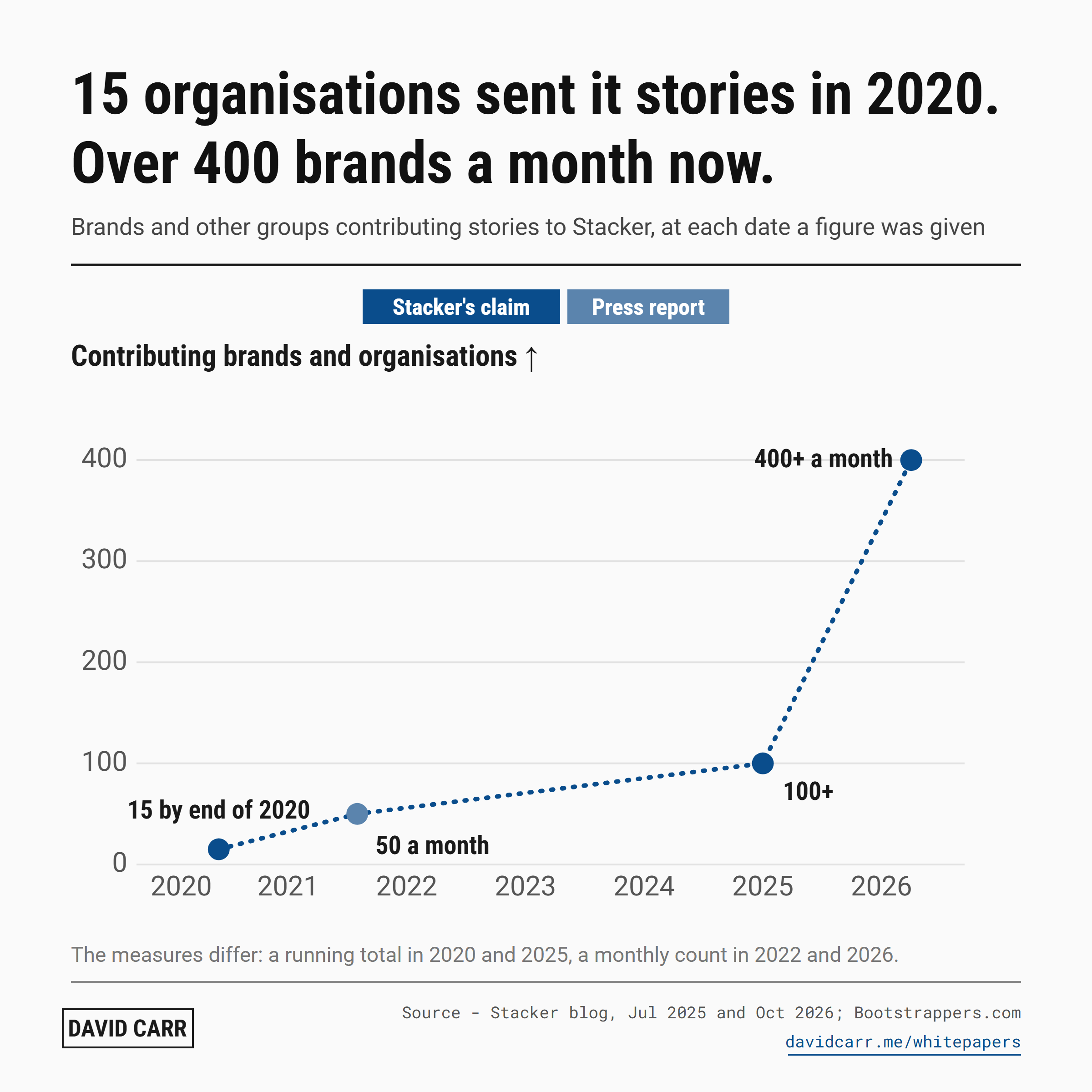
15 organisations sent it stories in 2020. Over 400 brands a month now.
Stacker calls the brand side Stacker Connect. It launched publicly in 2023.
The counts are Stacker's and measure slightly different things, as the chart note says. Stacker's about page dates its first formal brand product to 2021.
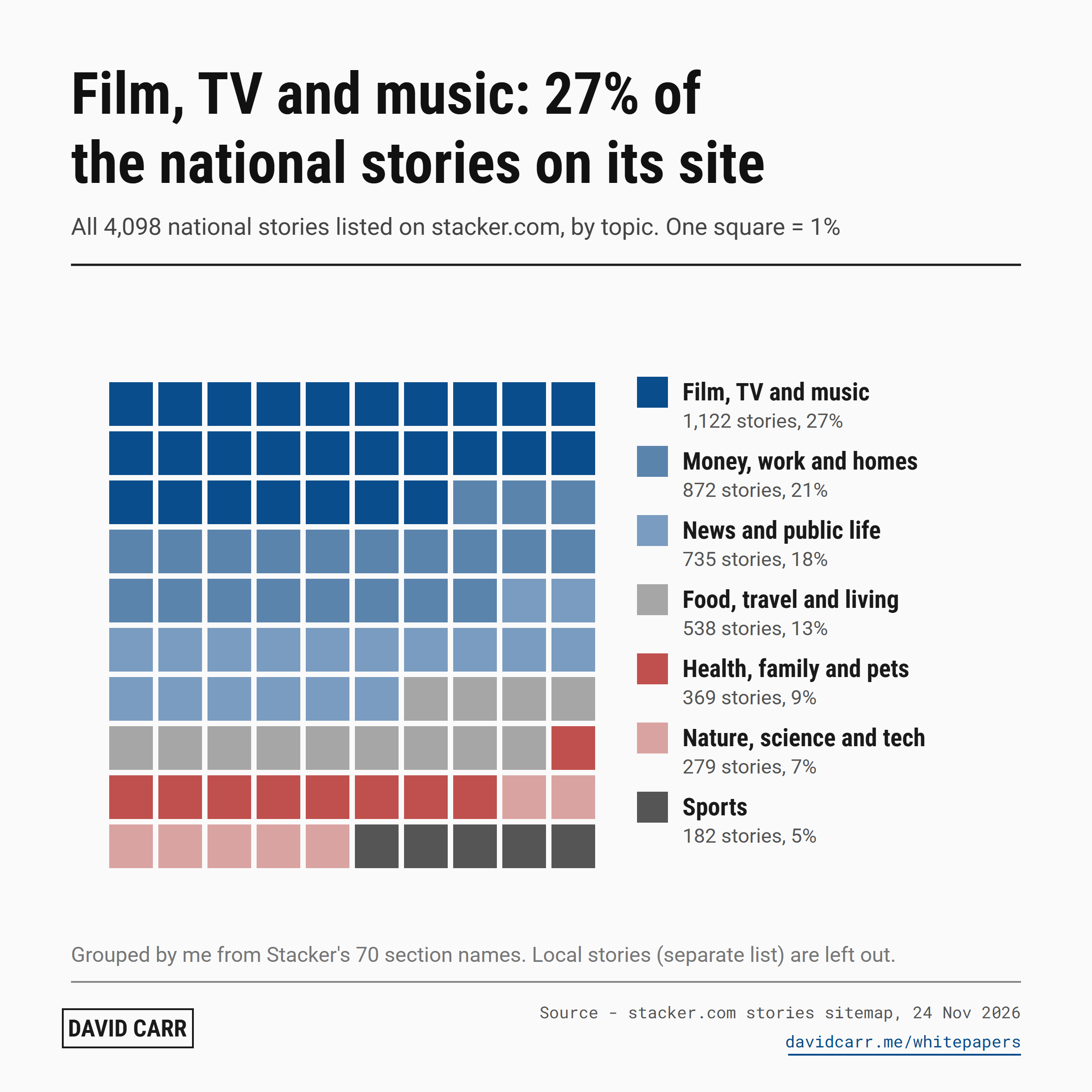
Film, TV and music: 27% of the national stories on its site
- Film, TV and music: 1,122
- Money, work and homes: 872
- News and public life: 735
- Food, travel and living: 538
- Health, family and pets: 369
The archive leans to entertainment: movies alone are 536 stories, the biggest single section.
Every national story in Stacker's stories sitemap on 24 November 2026, grouped by me from its 70 section names. The sitemap is what the site lists, not every story ever sent out.
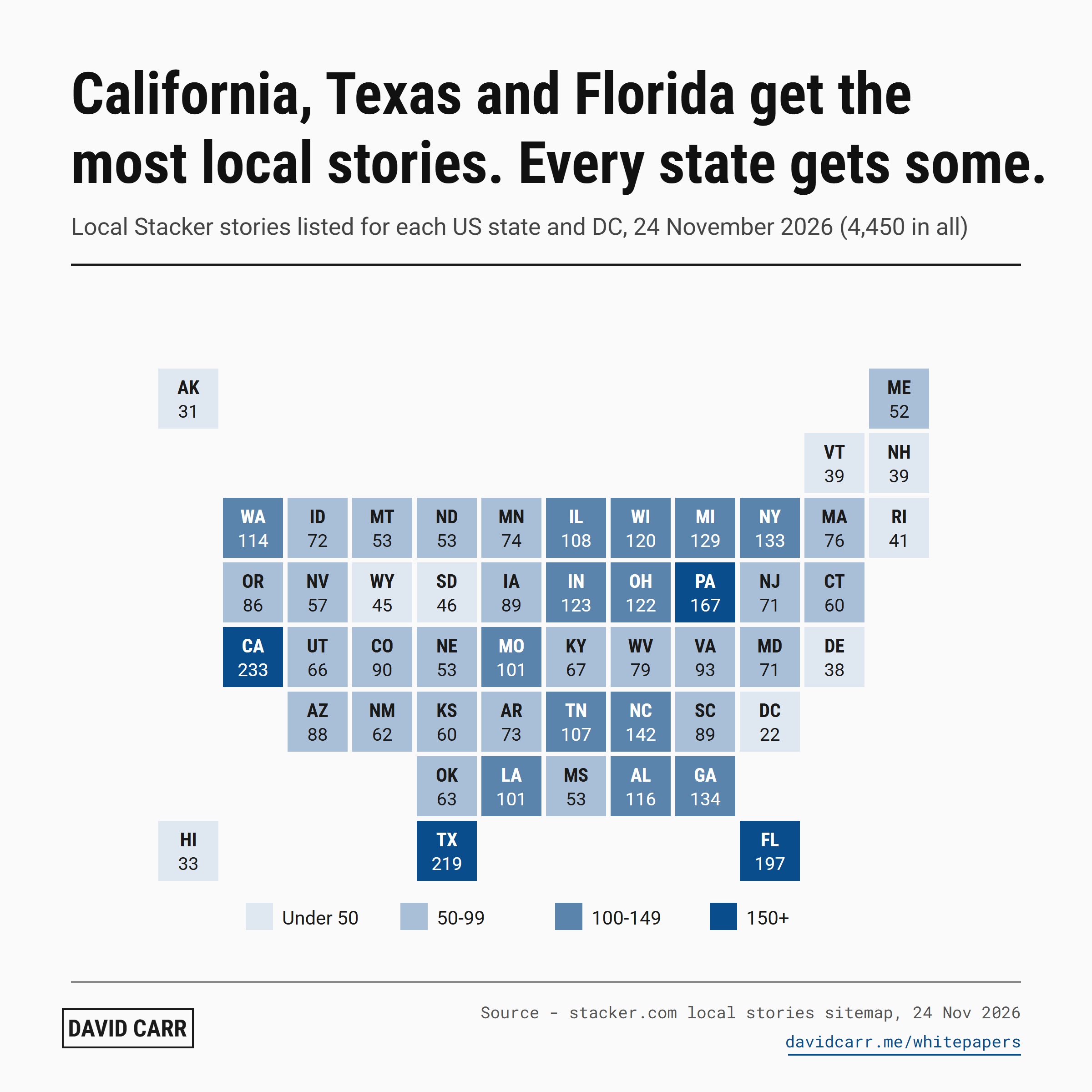
California, Texas and Florida get the most local stories. Every state gets some.
- California: 233
- Texas: 219
- Florida: 197
- Pennsylvania: 167
- Fewest: DC 22, Alaska 31, Hawaii 33
Stacker remakes one data story for many places, so a local paper gets its own state or city's numbers.
Local stories listed in the sitemap, 24 November 2026: 4,450 for the US and DC, and 75 more for Canada.
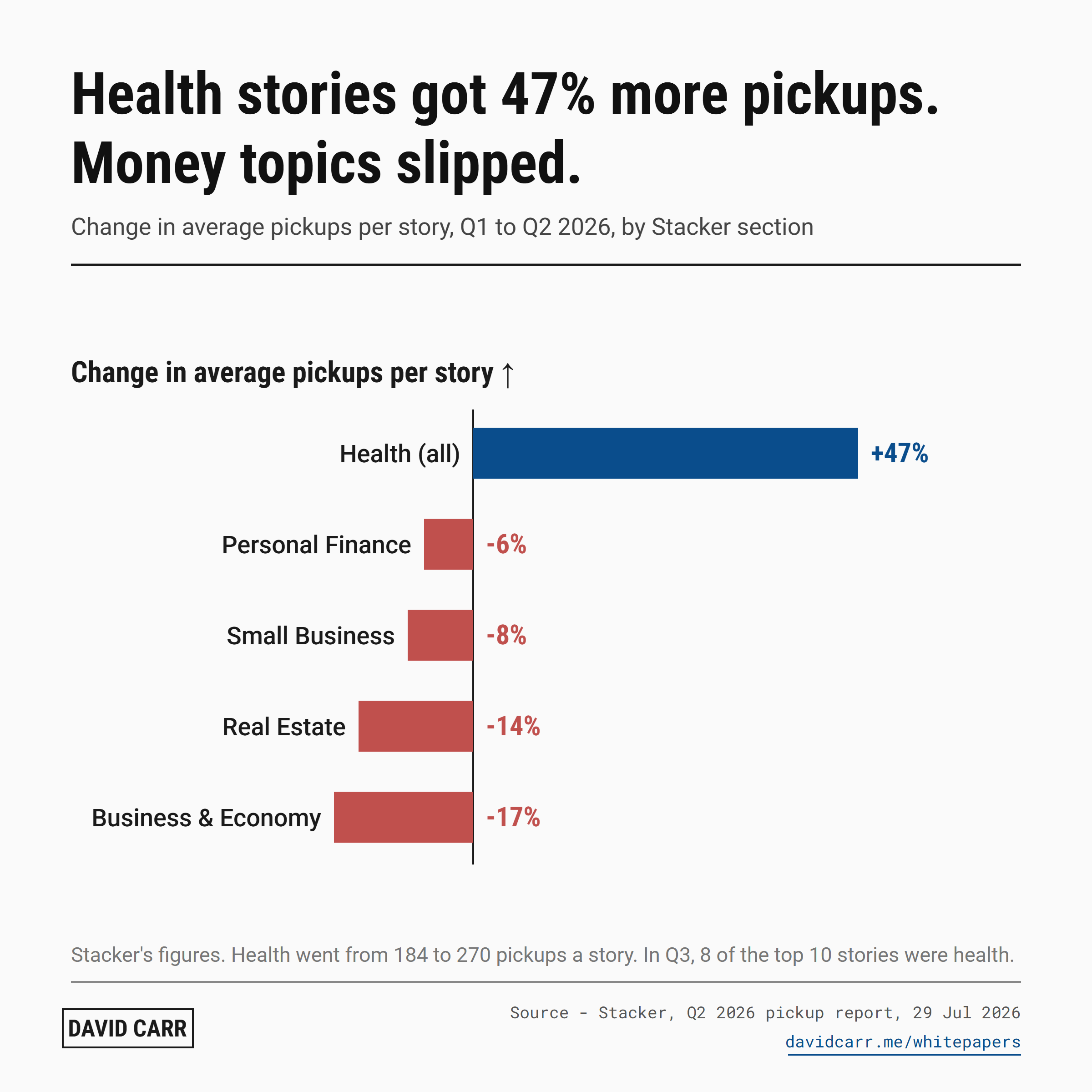
Health stories got 47% more pickups. Money topics slipped.
- Health: 184 to 270 pickups a story, Q1 to Q2 2026
- Personal Finance: down 6%
- Small Business: down 8%
- Real Estate: down 14%
- Business & Economy: down 17%
It kept going. In Q3, 8 of the 10 most picked-up stories were health. In October, 17 of the top 20 were.
From Stacker's Q2 report. Change in average pickups per story, by its own sections.
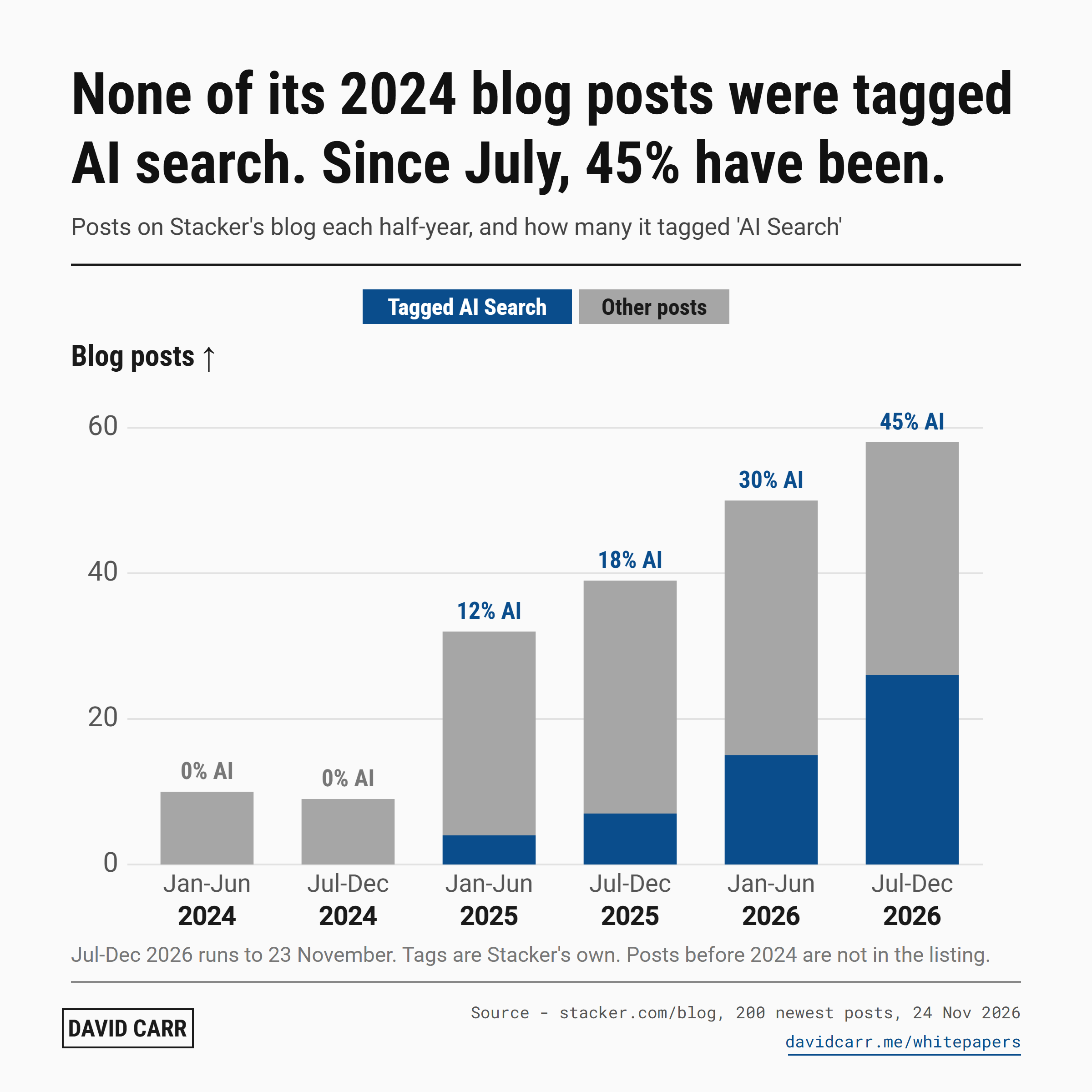
None of its 2024 blog posts were tagged AI search. Since July, 45% have been.
- 2024: 0 of 19
- Jan-Jun 2025: 4 of 32
- Jul-Dec 2025: 7 of 39
- Jan-Jun 2026: 15 of 50
- Jul-Dec 2026 (to 23 Nov): 26 of 58
Stacker now pitches its wire as a way to get cited by AI chatbots, and publishes studies of its own data to make the case. Its headline claim, from a study of 10,000 AI answers: AI search cites stories it distributes 2.4 times more often.
Stacker's own "AI Search" tag on the 200 newest posts on its blog, 24 November 2026. The 2.4x figure is from Stacker's homepage.
Method, caveats and sources
The short answer. Stacker is a newswire that gives news sites free stories built on data, and charges brands to have their stories carried on it. It started in 2017, says it has never raised outside money, and has told reporters its revenue is about $10 million a year. It claims more than 3,000 outlets and a million pickups in 2026 so far. Health stories travel furthest now, and its own marketing has turned to AI search.
Stacker is private. It files no accounts. Almost every number here is one Stacker published or gave to a reporter: outlets, pickups, page views, staff and revenue. They are labelled as claims. Press sources are Digiday, Press Gazette, Talking Biz News, A Media Operator, Simon Owens and Bootstrappers.com.
Counts change meaning. "Outlets" sometimes means the whole network and sometimes the sites that ran a story that month. "Contributors" is sometimes a running total and sometimes a monthly figure. The charts keep them apart where the source does.
Data pulled for this page. Topics and states come from stacker.com's public story sitemaps on 24 November 2026: 4,098 national and 4,525 local story pages. Blog posts come from the 200 newest on its blog listing the same day, back to November 2023. The 70 story sections are grouped into seven topics by me.
Left out. Stacker's jobs page listed no open roles, so there is no hiring chart. Its AI-citation studies are summarised, not charted, because they are its own research on its own product.
Also: Stripe, Morning Brew and beehiiv.