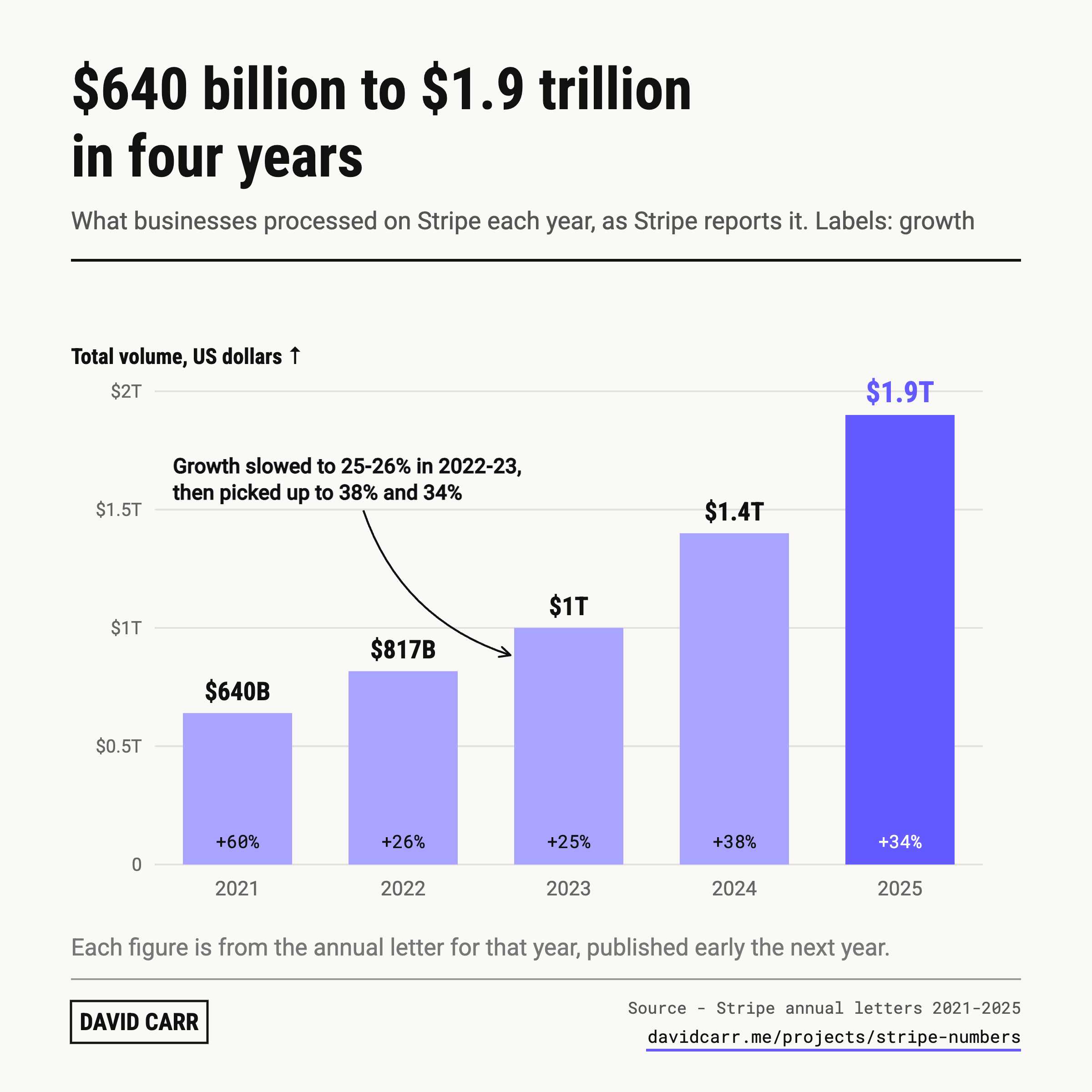
$640 billion to $1.9 trillion in four years
- 2021: $640 billion, up 60%
- 2022: $817 billion, up 26%
- 2023: $1 trillion, up 25%
- 2024: $1.4 trillion, up 38%
- 2025: $1.9 trillion, up 34%
Stripe's volume roughly tripled in four years. It is the total that businesses processed on Stripe, not Stripe's revenue.
Quoted from each annual letter, published in April 2022, April 2023, March 2024, February 2025 and February 2026. The letters say "more than" for 2021 and 2022.
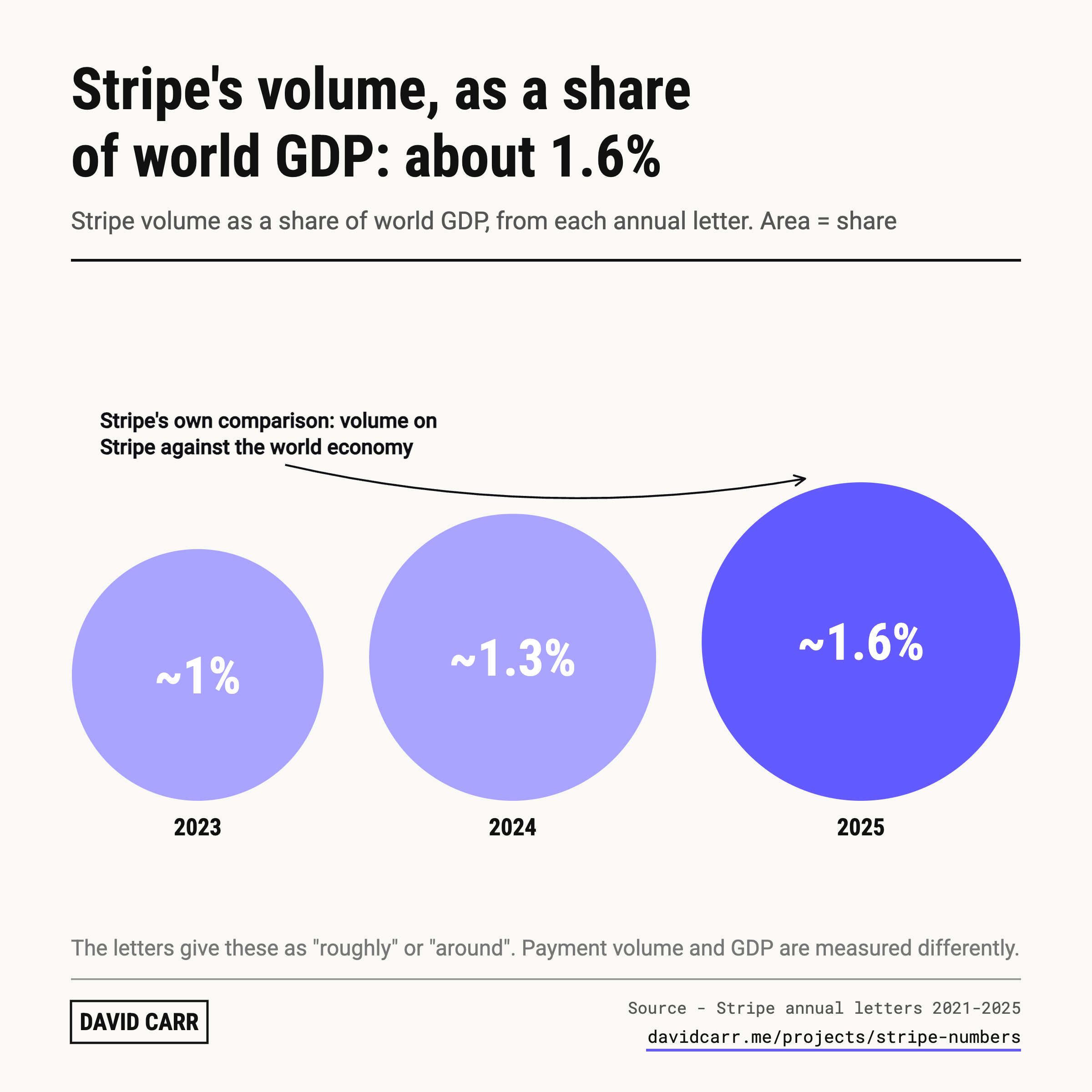
Stripe's volume, as a share of world GDP: about 1.6%
This is the comparison Stripe itself makes. The earlier letters do not give one.
Payment volume counts money moving through Stripe; GDP counts value added. They are not the same kind of number, which is why Stripe says "equivalent to".
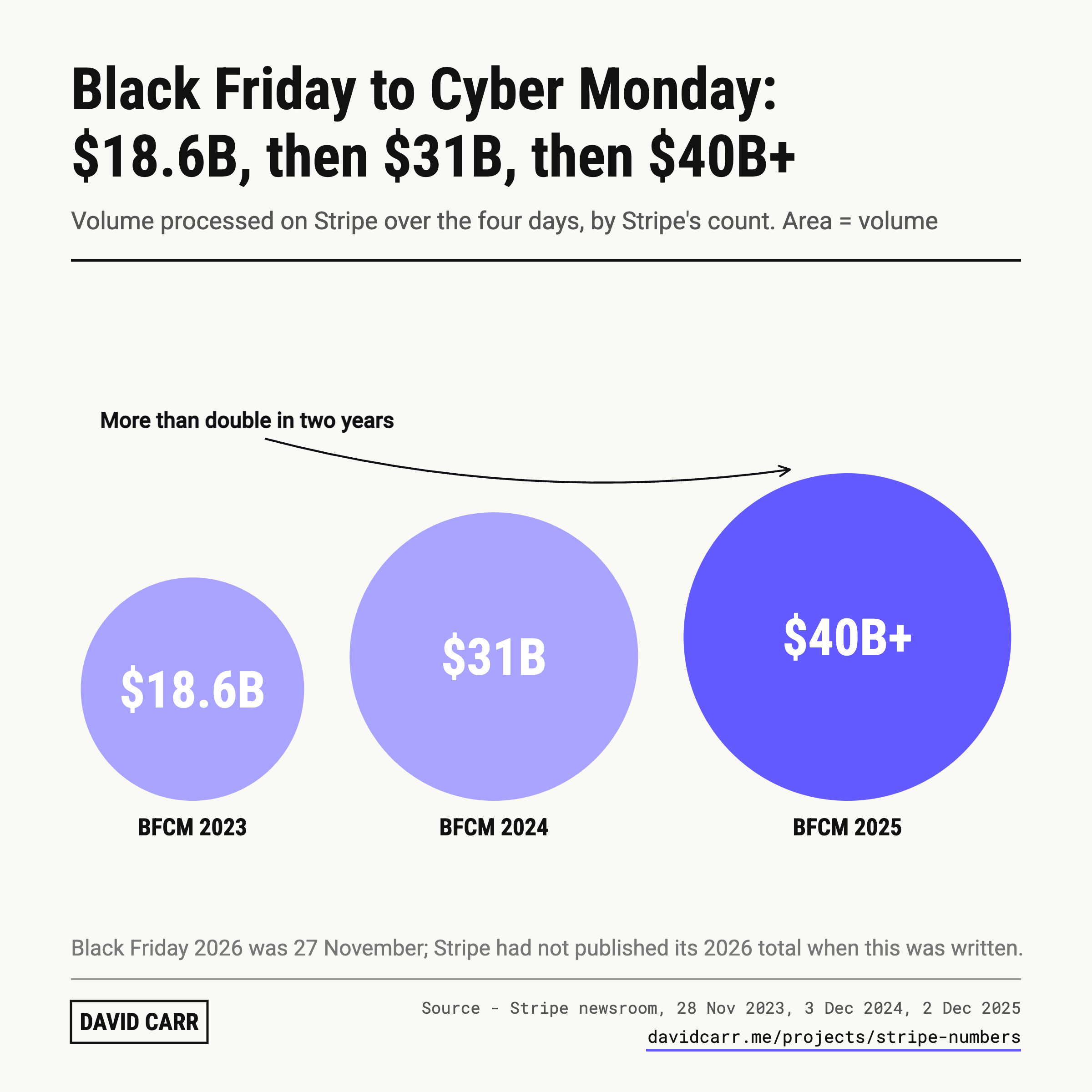
Black Friday to Cyber Monday: $18.6B, then $31B, then $40B+
- 2023: more than $18.6 billion, 300 million+ transactions
- 2024: more than $31 billion, 465 million transactions
- 2025: more than $40 billion, 578 million+ transactions
- Cross-border volume over the four days: $3.2 billion (2024), $4.4 billion+ (2025)
Each year Stripe called it the largest four-day period in its history. Cyber Monday 2025 alone passed $10 billion.
Stripe's 2026 figure was not out on 28 November 2026.
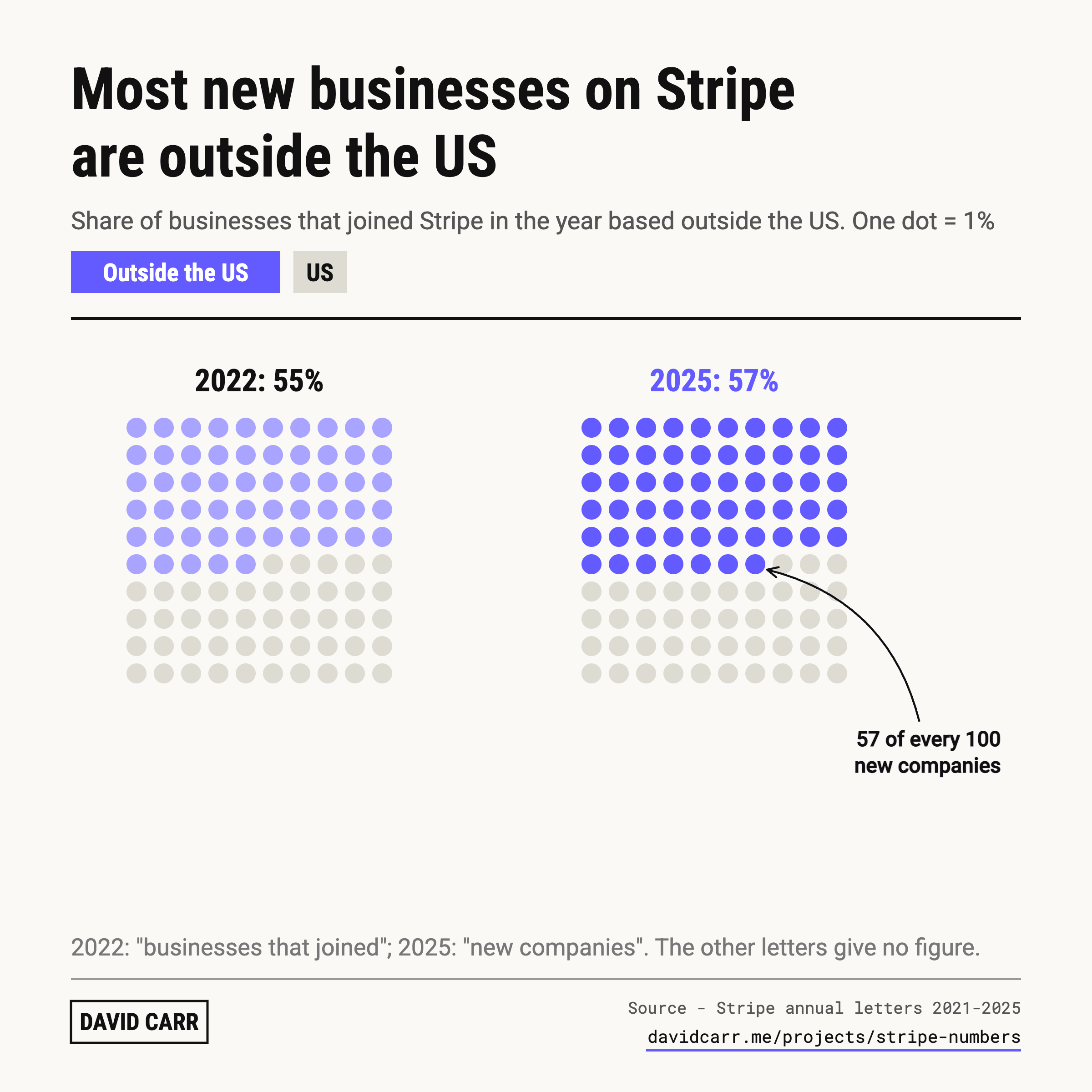
Most new businesses on Stripe are outside the US
- 2022: 55% of the businesses that joined Stripe were outside the US
- 2025: 57% of new companies were outside the US
- Atlas, 2025: 56% of Atlas startups are based in the US; founders came from 169 countries
The 2022 letter calls the US Stripe's largest market. More than half of the businesses signing up are elsewhere.
Only the 2022 and 2025 letters give this split.
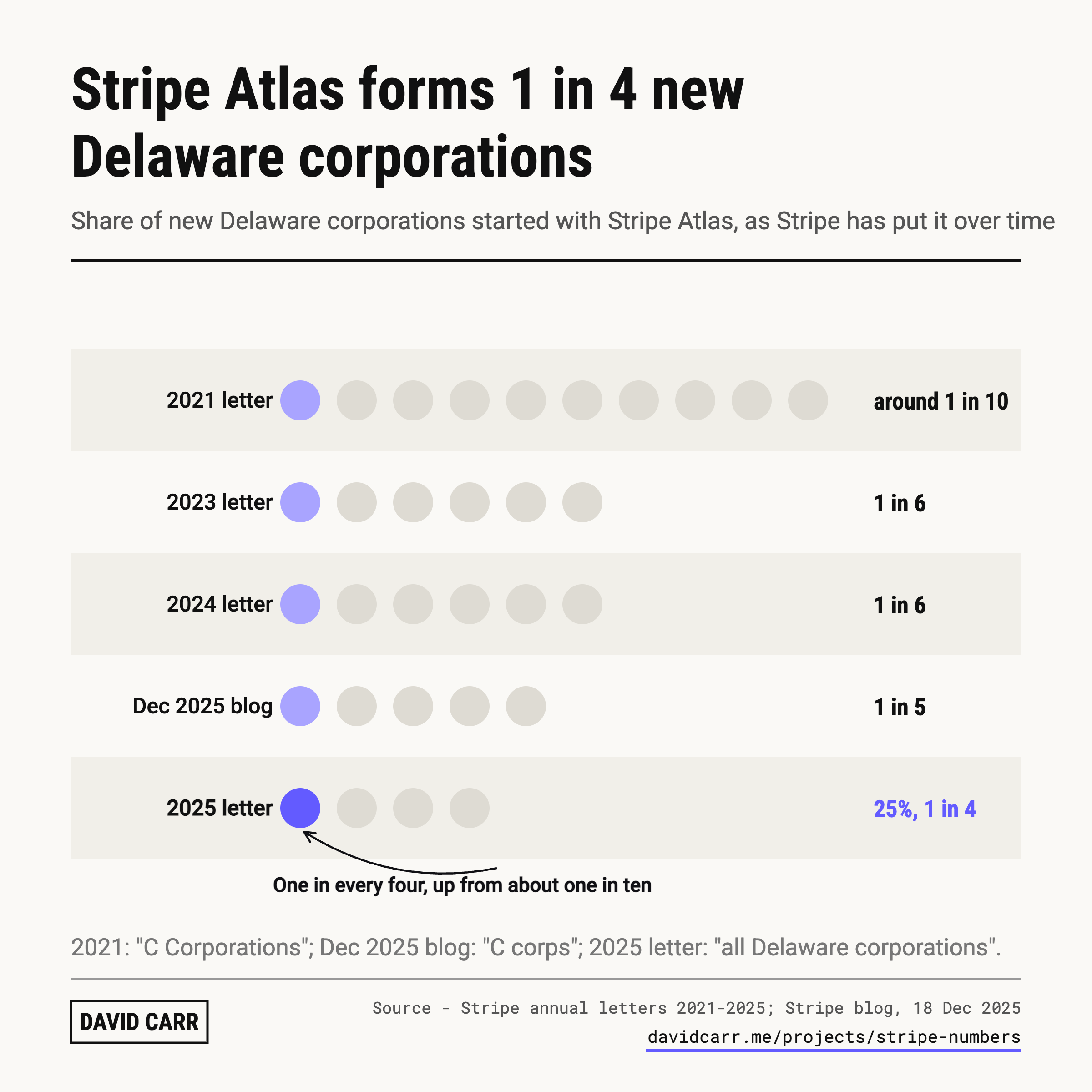
Stripe Atlas forms 1 in 4 new Delaware corporations
Atlas is Stripe's service for setting up a US company. The 2023 letter says 50,000+ companies had started with it.
The wording shifts a little between "C corporations" and "all Delaware corporations", so read the trend, not the exact step.
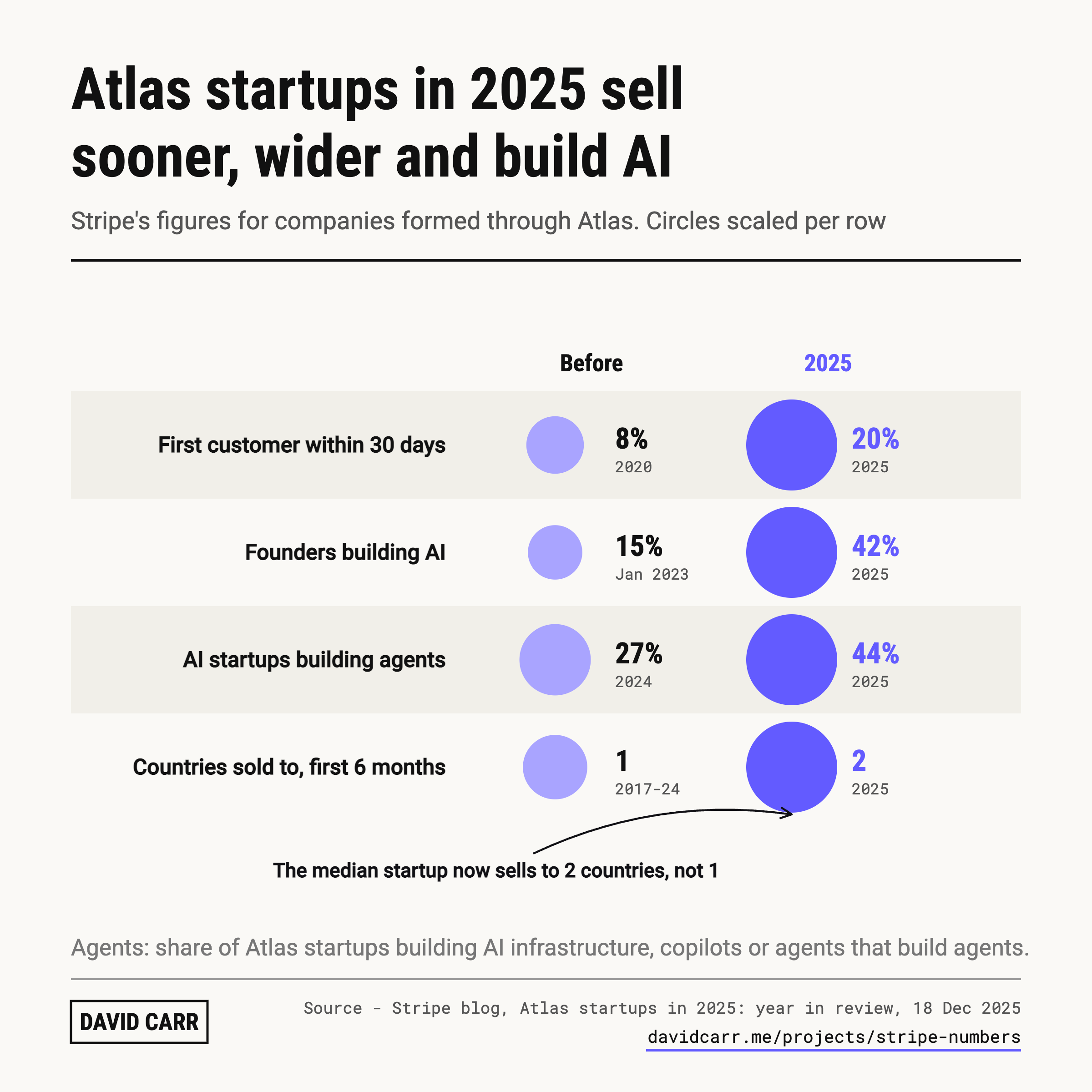
Atlas startups in 2025 sell sooner, wider and build AI
- Charged a first customer within 30 days: 8% (2020) to 20% (2025)
- Founders building AI: 15% (January 2023), 33% (2024), 42% (2025)
- AI startups building agents: 27% (2024) to 44% (2025)
- Countries the median startup sold to in its first six months: 1 (2017-2024) to 2 (2025)
Stripe says 23,000 companies incorporated through Atlas in 2025, and formations rose 41% (2025 letter).
All from Stripe's Atlas year in review, 18 December 2025. "Building agents" is among startups that say they build AI infrastructure, copilots or agents.
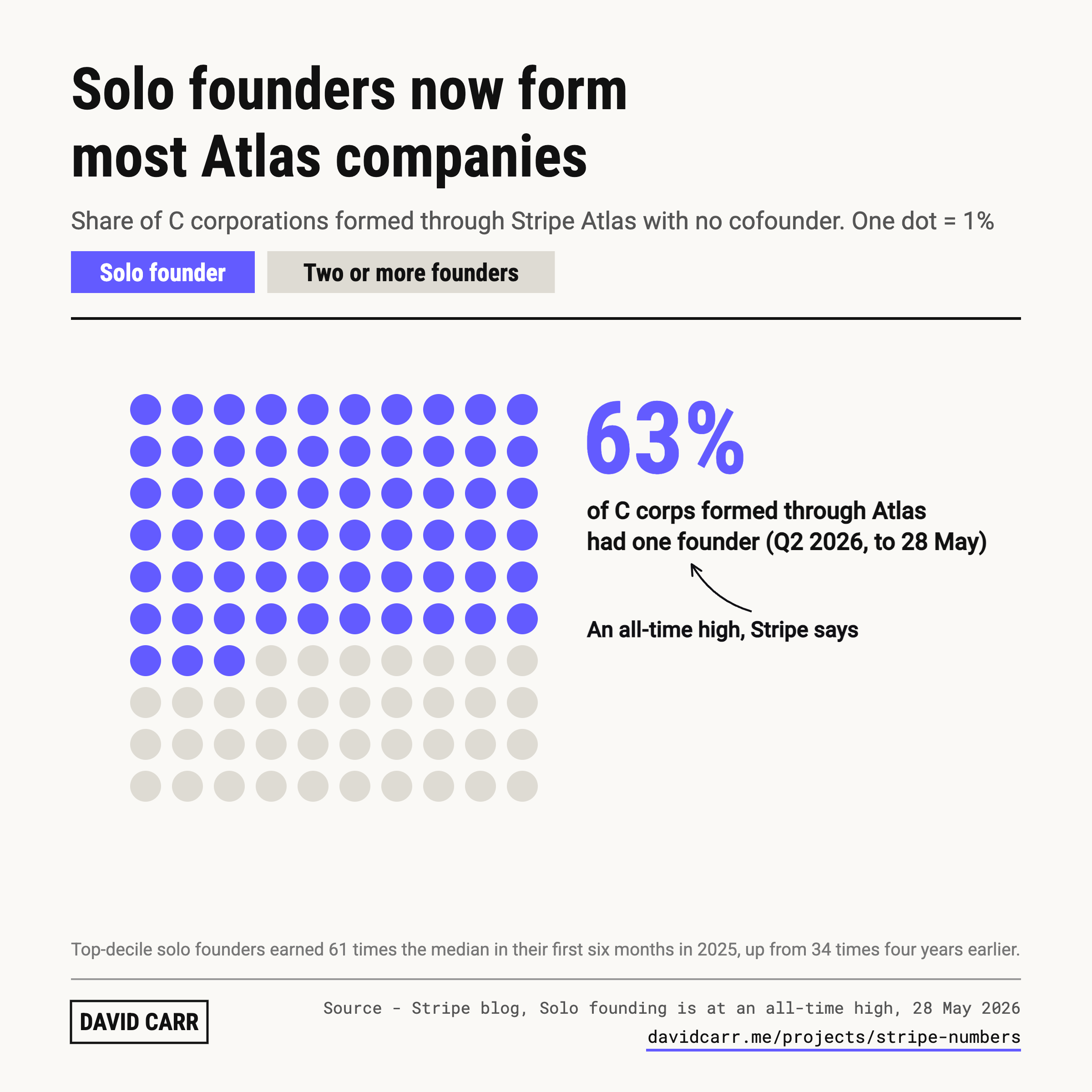
Solo founders now form most Atlas companies
- 63% of C corps formed through Atlas in Q2 2026 (to 28 May) had one founder
- Stripe calls it an all-time high
- Top-decile solo founders earned 61 times the median in their first six months (2025), up from 34 times four years earlier
Stripe found top solo founders more often build AI-native products, sell abroad from launch and sell to businesses.
From Solo founding is at an all-time high, 28 May 2026. The 63% is a part-quarter figure.
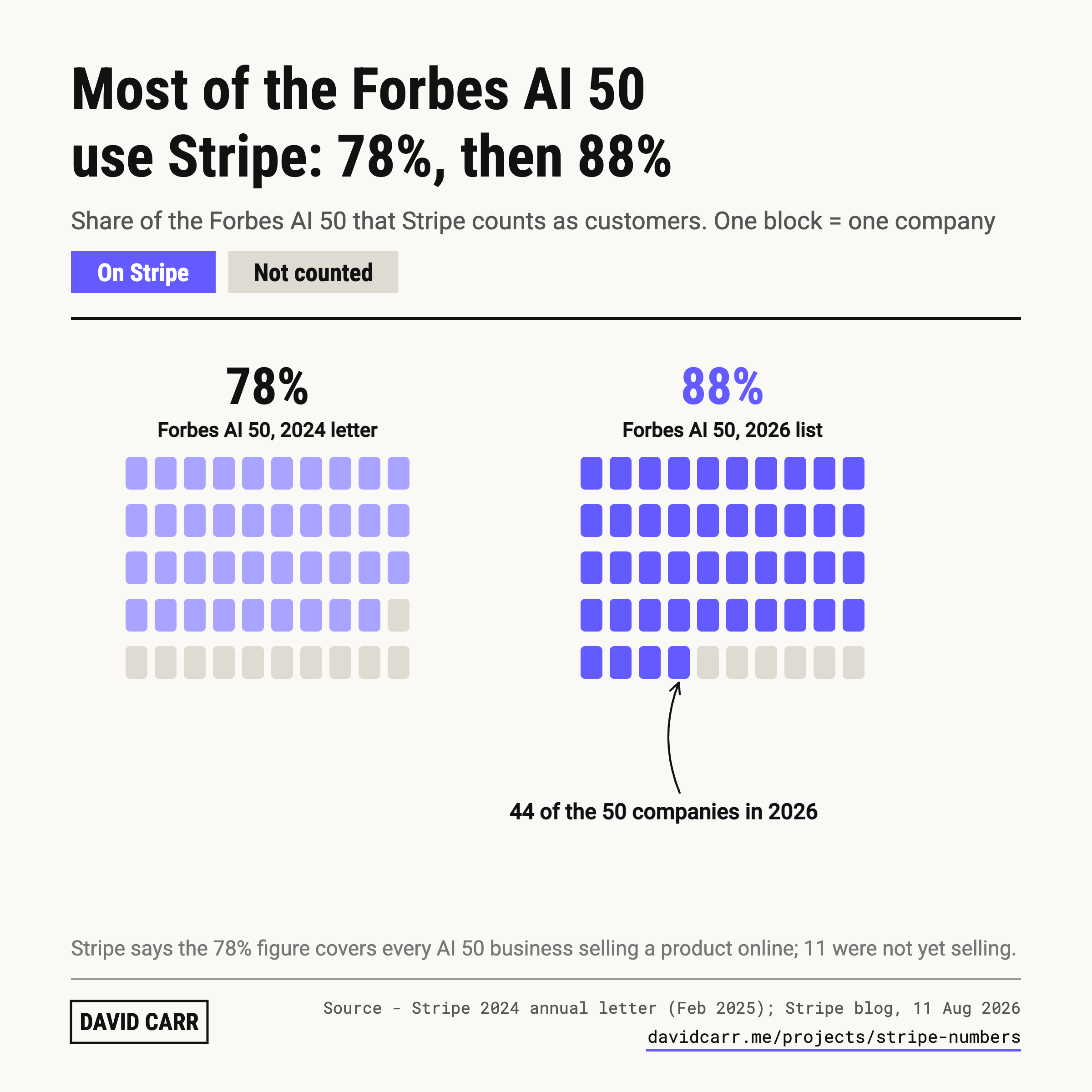
Most of the Forbes AI 50 use Stripe: 78%, then 88%
- 2024 letter (February 2025): 78% of the Forbes AI 50
- August 2026: 88% of the 2026 Forbes AI 50
- 2023 letter: revenue from AI companies on Stripe grew 249% in 2023
- 2024 letter: more than 700 AI agent startups launched on Stripe in 2024
Stripe has returned to the AI economy in every letter since 2022.
Stripe adds that the 78% covers every AI 50 business selling a product online; 11 were not yet selling (Indexing the AI economy).
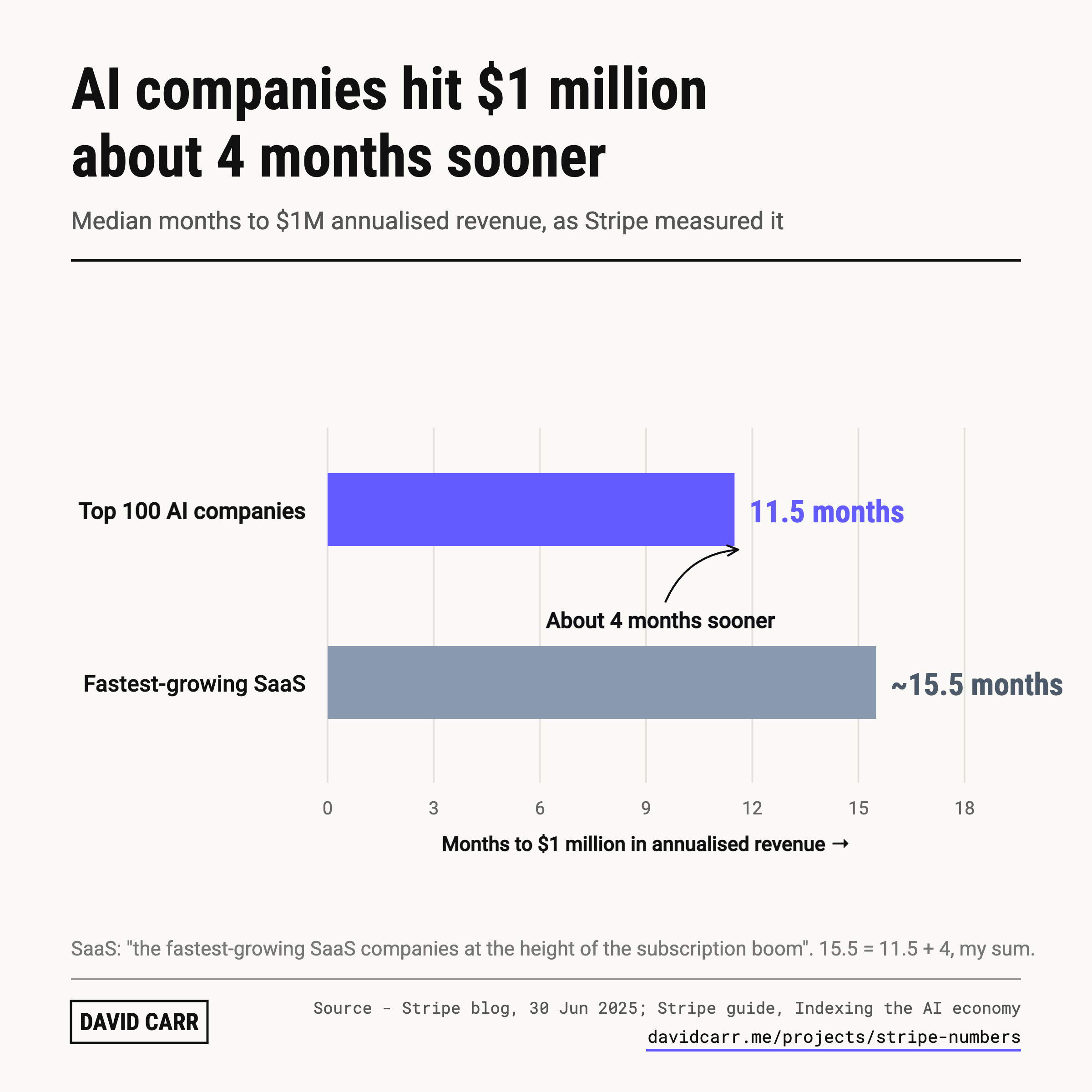
AI companies hit $1 million about 4 months sooner
- Top 100 AI companies on Stripe: median 11.5 months to $1 million in annualised revenue
- Fastest-growing SaaS companies: about 4 months longer, Stripe says
- AI companies founded 2020-2023 hit milestones about three times faster than those founded earlier
Stripe's report, Indexing the AI economy, looked at the 100 largest AI companies on its platform.
From Inside the growth of the top AI companies on Stripe, 30 June 2025. The SaaS bar is 11.5 + 4 months, my sum.
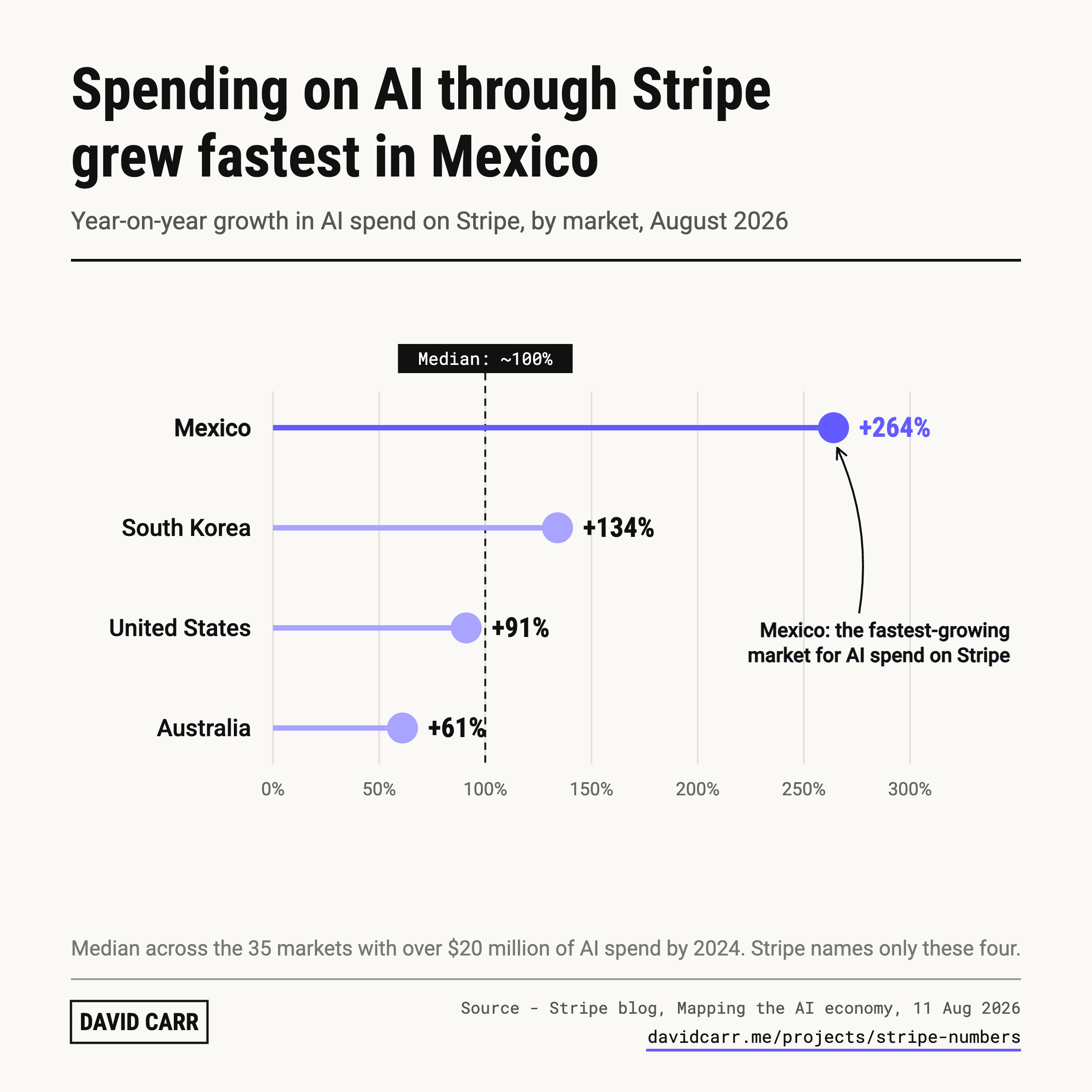
Spending on AI through Stripe grew fastest in Mexico
- Mexico: +264% year on year
- South Korea: +134%
- Median of 35 markets: nearly +100%
- United States: +91%
- Australia: +61%
The 100 largest AI companies on Stripe draw 48% of their revenue from outside their home market, Stripe says.
From Mapping the AI economy, 11 August 2026. The median covers markets with more than $20 million of AI spend by 2024.
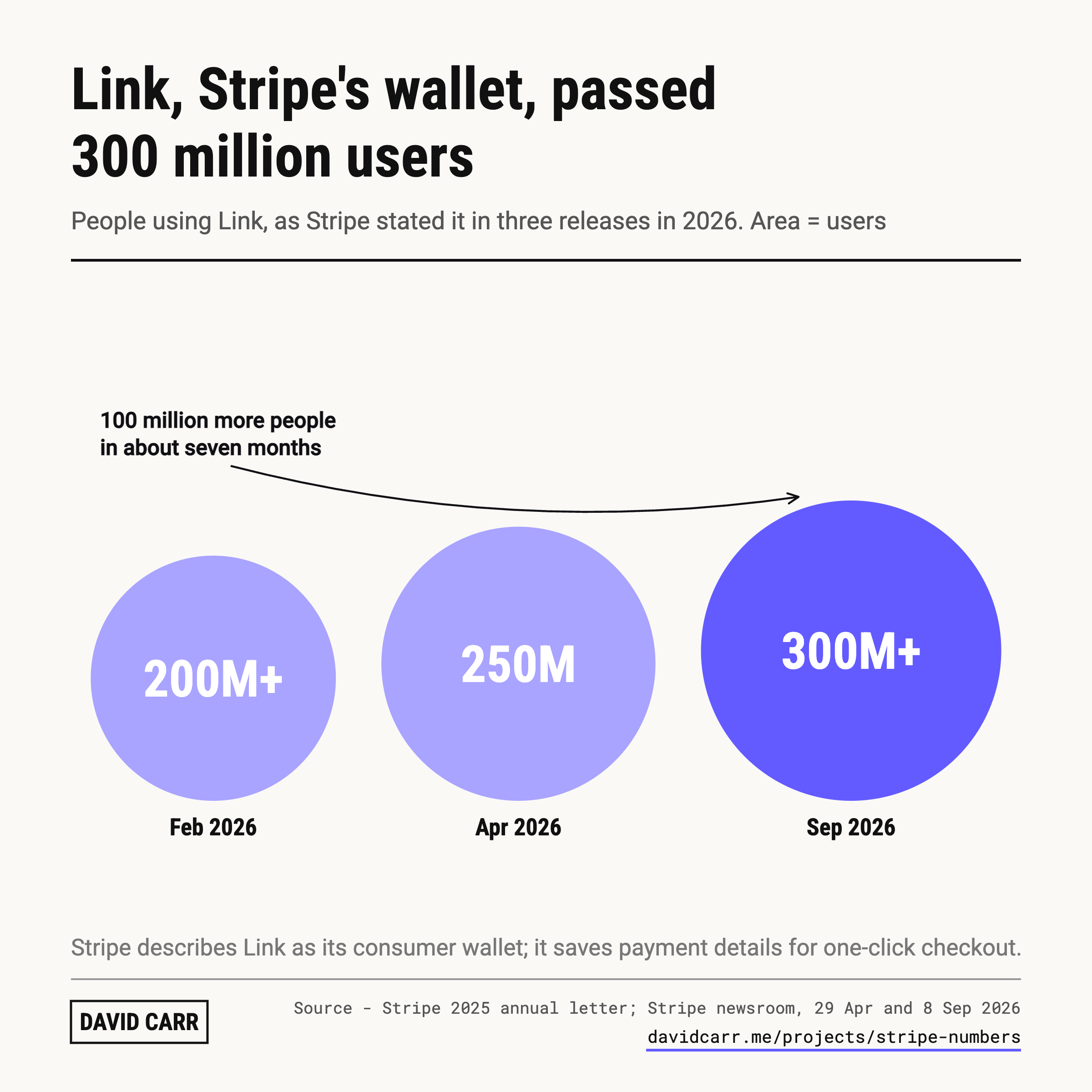
Link, Stripe's wallet, passed 300 million users
Link saves a shopper's details for one-click checkout. In 2026 Stripe opened it to AI agents that pay on a person's behalf.
Each figure is as worded in the release. Stripe does not say whether these are active or registered users.
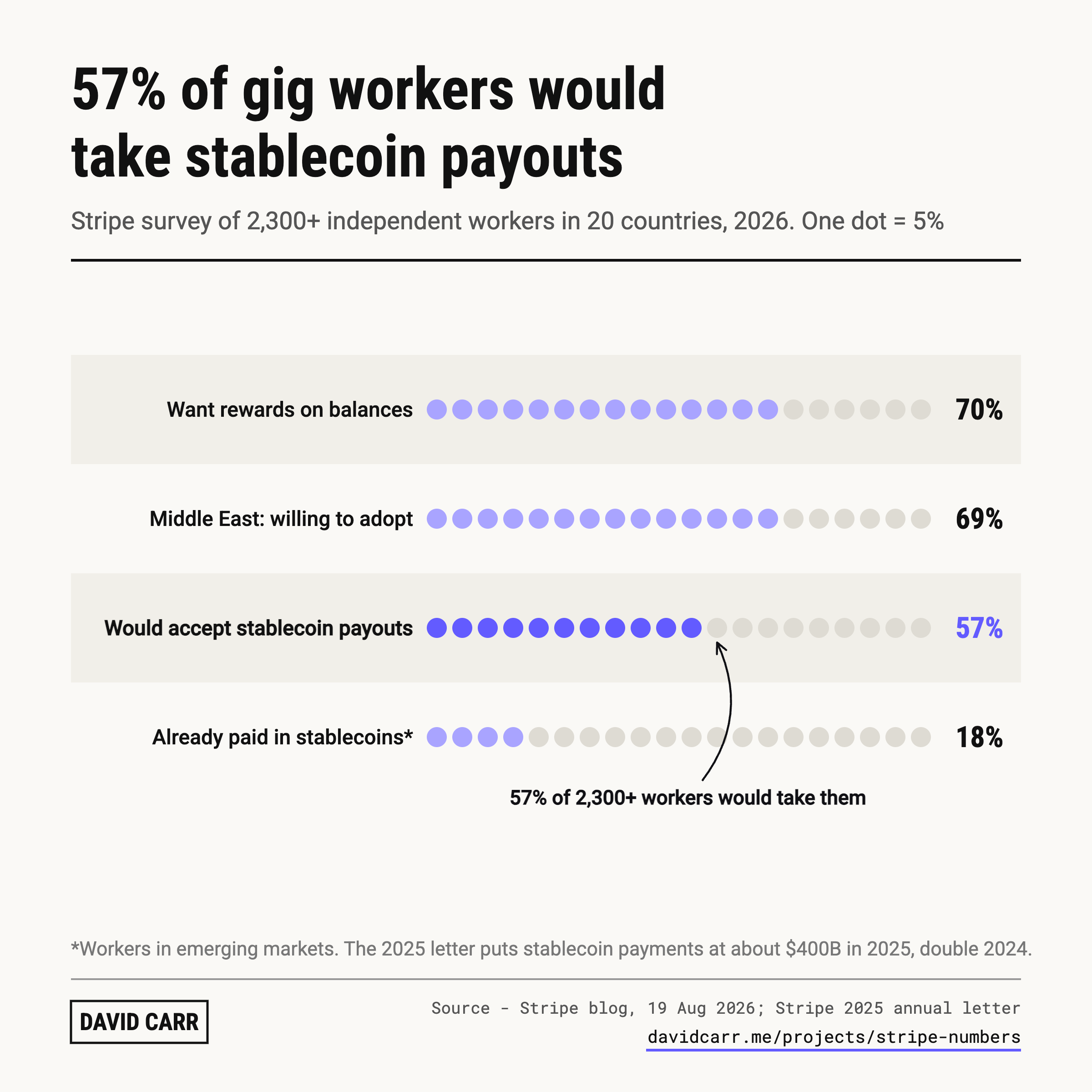
57% of gig workers would take stablecoin payouts
- Would accept stablecoin payouts if offered: 57%
- Middle East, willing to adopt: 69%
- Want rewards on their balances: 70%
- Already paid in stablecoins (emerging markets): 18%
The 2025 letter puts stablecoin payments at about $400 billion in 2025, double the year before, 60% of it business-to-business.
Stripe survey of 2,300+ independent workers in 20 countries (19 August 2026). The $400 billion is a market-wide estimate, not Stripe's own volume.
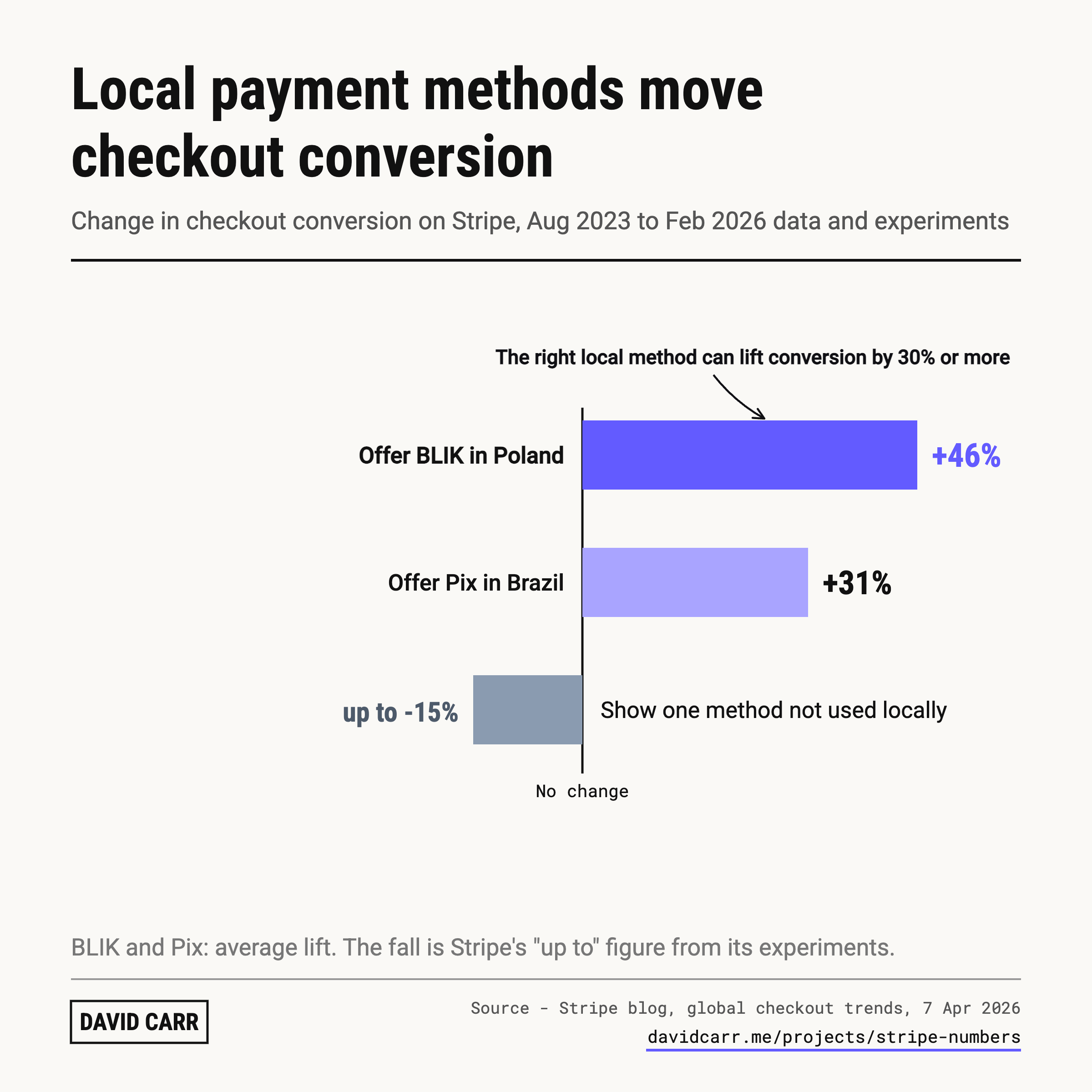
Local payment methods move checkout conversion
- Offering BLIK in Poland: +46% conversion on average
- Offering Pix in Brazil: +31%
- Showing one method that isn't used locally: up to -15%
- 65% of Stripe transactions under $50 happen on mobile
On fraud, Stripe found AI startups faced 4.3 times the attempted fraud rate of startups overall in Q3 2025, falling to 2.6 times by Q1 2026 (15 September 2026).
From How agents, digital wallets, and trust are rewriting checkout, 7 April 2026: nearly 20,000 businesses, August 2023 to February 2026.
Method, caveats and sources
The short answer. By its own figures, Stripe handled $1.9 trillion in 2025, about 1.6% of world GDP. Most new businesses on it are outside the US, a quarter of new Delaware corporations start through its Atlas service, and 88% of the 2026 Forbes AI 50 use it.
Stripe's numbers, as Stripe states them. Every figure here is quoted from Stripe's own annual letters, newsroom or blog, with the link and date. They are Stripe's claims and have not been checked against outside data. Where Stripe writes "more than" or "about", so does this page.
My sums. Only two: the SaaS bar on chart 9 (11.5 + 4 months) and the shares on the waffle charts, which are Stripe's percentages drawn as dots.
Wording changes. Stripe's measures shift a little over time ("new businesses" and "new companies"; "C corporations" and "all Delaware corporations"). Each chart notes the wording.
Not included. Stripe's own revenue and value are on Stripe from the outside.
Part of a series: Stripe from the outside, Stripe and its rivals and How Stripe tells its story.