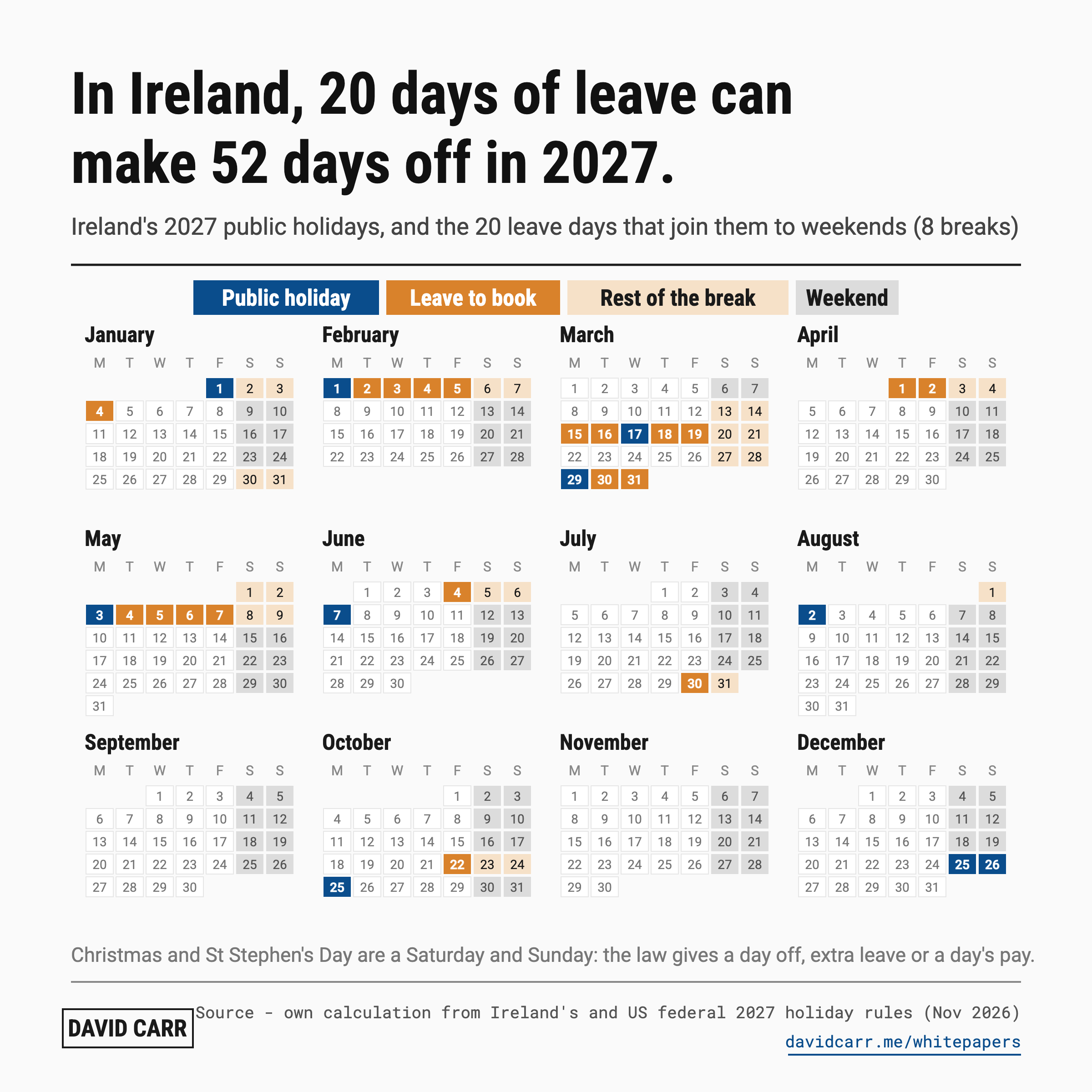
In Ireland, 20 days of leave can make 52 days off in 2027.
- Book Mon 4 Jan: 1 to 4 Jan
- Book Tue 2 to Fri 5 Feb: 30 Jan to 7 Feb (St Brigid's Day)
- Book 15, 16, 18 and 19 Mar: 13 to 21 Mar (St Patrick's Day)
- Book Tue 30 Mar to Fri 2 Apr: 27 Mar to 4 Apr (Easter)
- Book Tue 4 to Fri 7 May: 1 to 9 May
- Book Fri 4 Jun, Fri 30 Jul and Fri 22 Oct for three long weekends
That is eight breaks, four of them nine days long. Twenty leave days is the legal minimum for a full-time worker in Ireland.
Public holiday dates from the rules published by the WRC. The plan is the set of breaks around public holidays that gives the most days off in total for 20 leave days. Other plans tie.
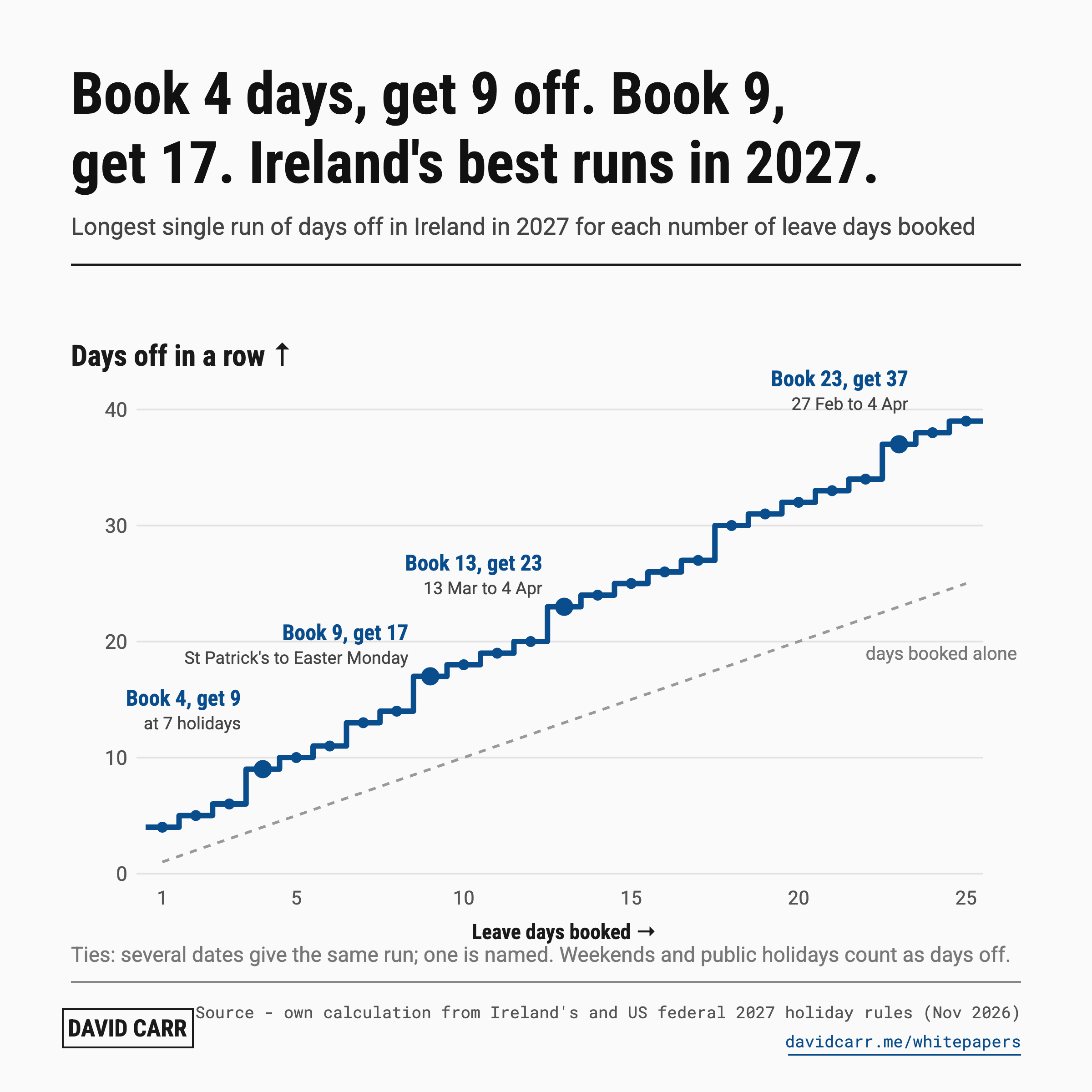
Book 4 days, get 9 off. Book 9, get 17.
- 1 leave day: 4 days off (any bank holiday weekend)
- 4 days: 9 off, at 7 of the 10 holidays
- 9 days: 17 off, 13 to 29 Mar, St Patrick's Day to Easter Monday
- 13 days: 23 off, 13 Mar to 4 Apr
- 23 days: 37 off, 27 Feb to 4 Apr
St Patrick's Day falls on a Wednesday in 2027, 12 days before Easter Monday. That makes March the best month to take a long break.
Longest single run of days off for each number of leave days, counting weekends and public holidays. Where several dates tie, one is named.
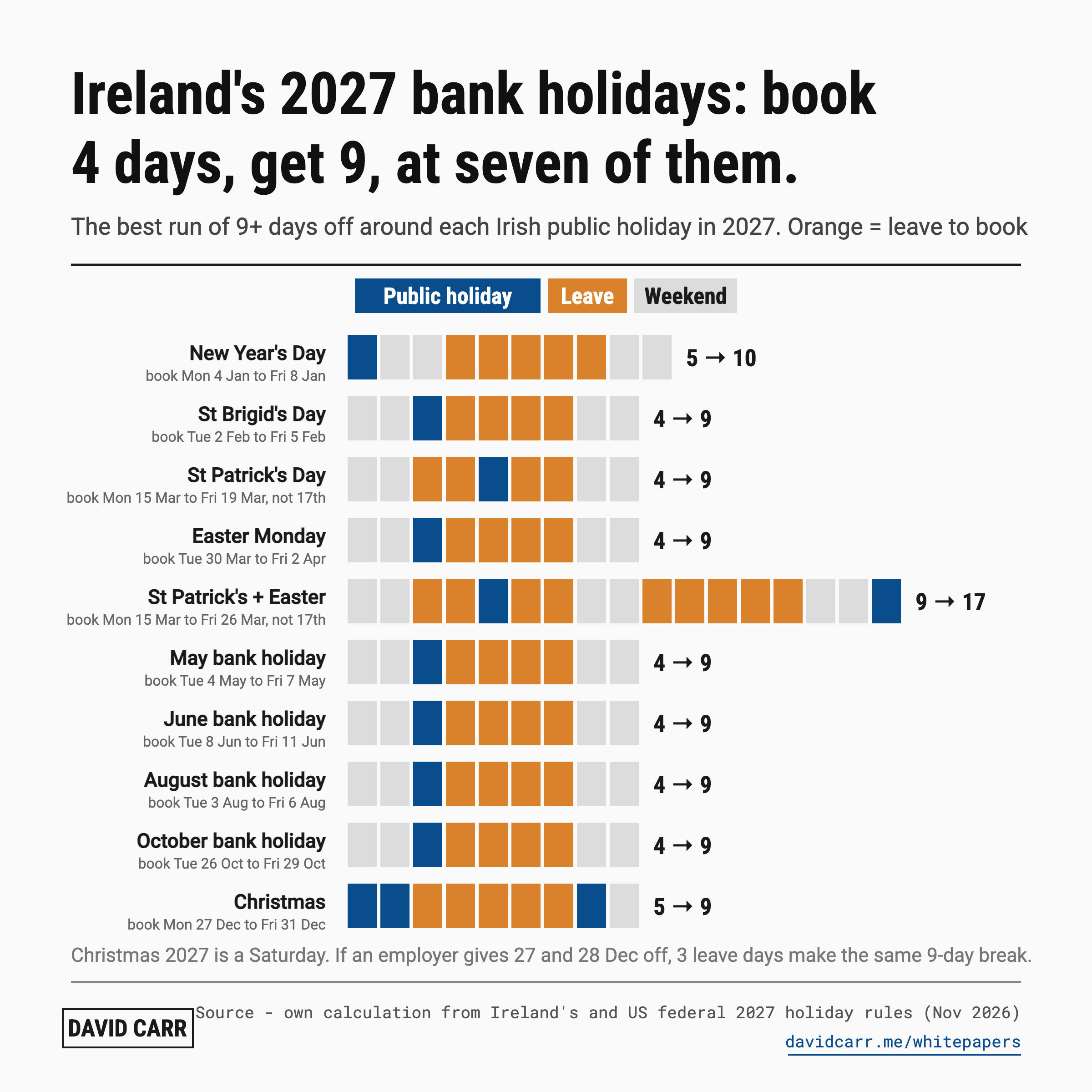
Book 4 days, get 9 off, at seven of Ireland's ten holidays.
- Each Monday holiday: book the Tuesday to Friday after it
- St Patrick's Day (Wed 17 Mar): book Mon, Tue, Thu and Fri
- New Year's Day (Fri 1 Jan): book 5, get 10
- Christmas (Sat 25 Dec): book 27 to 31 Dec, get 9
For a single leave day, the Friday before or Tuesday after any bank holiday Monday gives a four-day weekend.
Christmas Day and St Stephen's Day fall on a Saturday and Sunday in 2027. The law gives a benefit for each (a paid day off within a month, an extra day of leave or an extra day's pay, as the employer decides), but no legal right to the next working day off (WRC). If an employer gives 27 and 28 Dec off, three leave days make the same nine-day break.
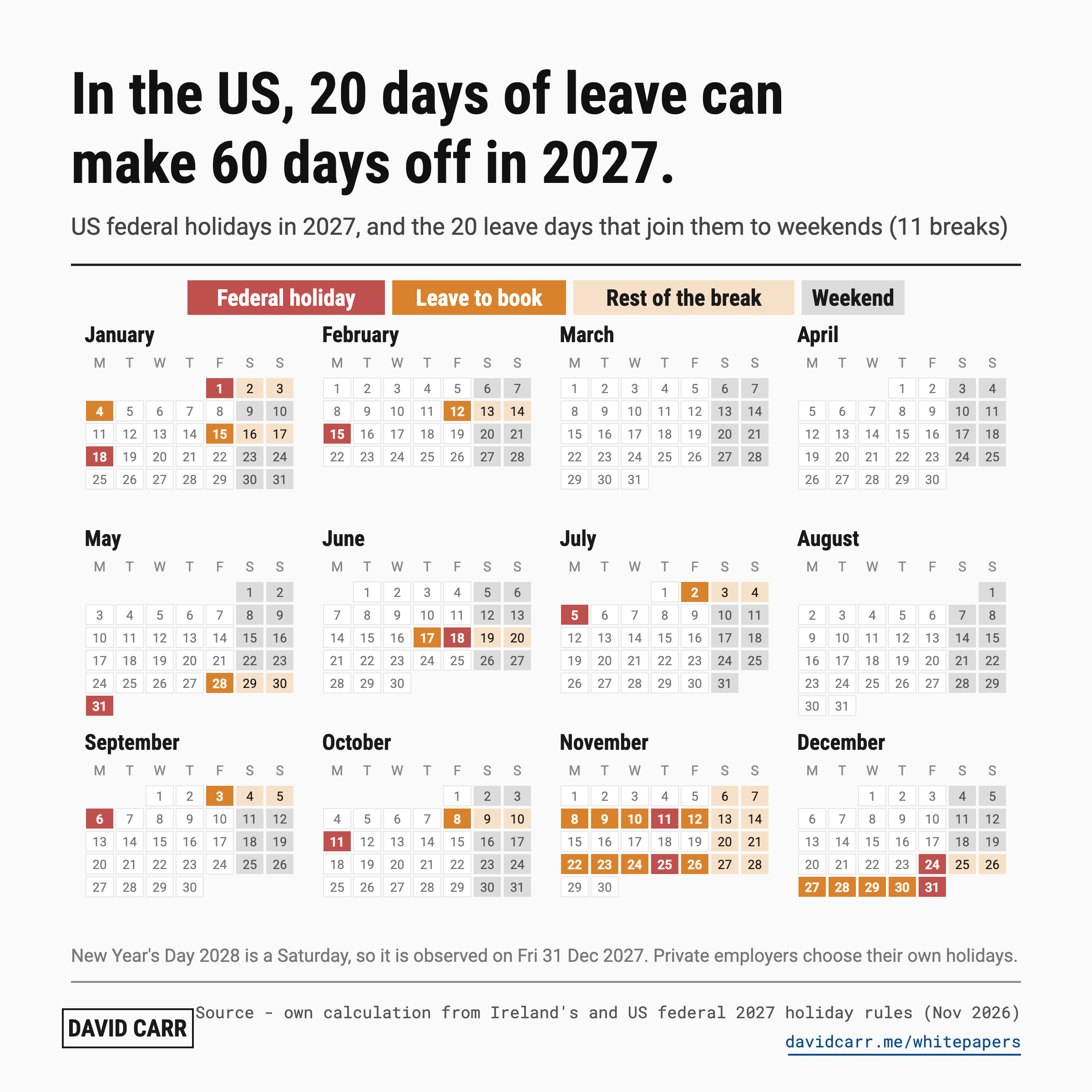
In the US, 20 days of leave can make 60 days off in 2027.
- Eight long weekends from one leave day each
- Veterans Day: book 8, 9, 10 and 12 Nov, get 6 to 14 Nov
- Thanksgiving: book 22, 23, 24 and 26 Nov, get 20 to 28 Nov
- Christmas: book 27 to 30 Dec, get 24 Dec to 2 Jan 2028
That is 11 breaks. The US calendar has more weekday holidays in 2027 because holidays on a weekend move to a Friday or Monday.
Federal holidays computed from their fixed rules, with Saturday holidays observed on the Friday before and Sunday holidays on the Monday after. Federal holidays are paid days off for federal staff; private employers choose which holidays they give.
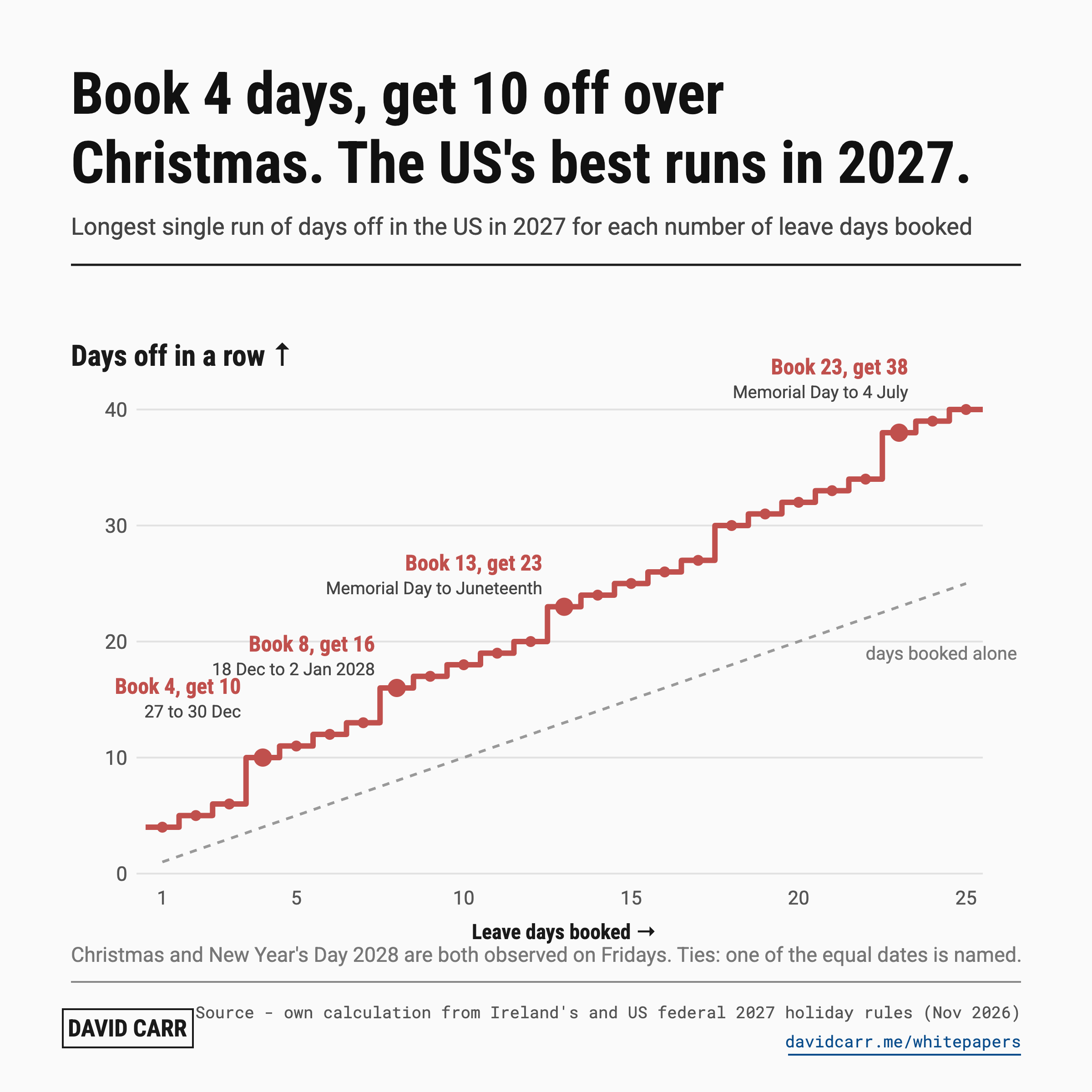
Book 4 days, get 10 off over Christmas 2027.
- 4 leave days: 10 off, 24 Dec to 2 Jan 2028
- 8 days: 16 off, 18 Dec to 2 Jan 2028
- 13 days: 23 off, Memorial Day to Juneteenth (29 May to 20 Jun)
- 23 days: 38 off, Memorial Day to 4 July (29 May to 5 Jul)
Christmas Day 2027 and New Year's Day 2028 both fall on a Saturday, so both are observed on Fridays a week apart.
Longest single run of days off for each number of leave days, assuming all federal holidays are days off.
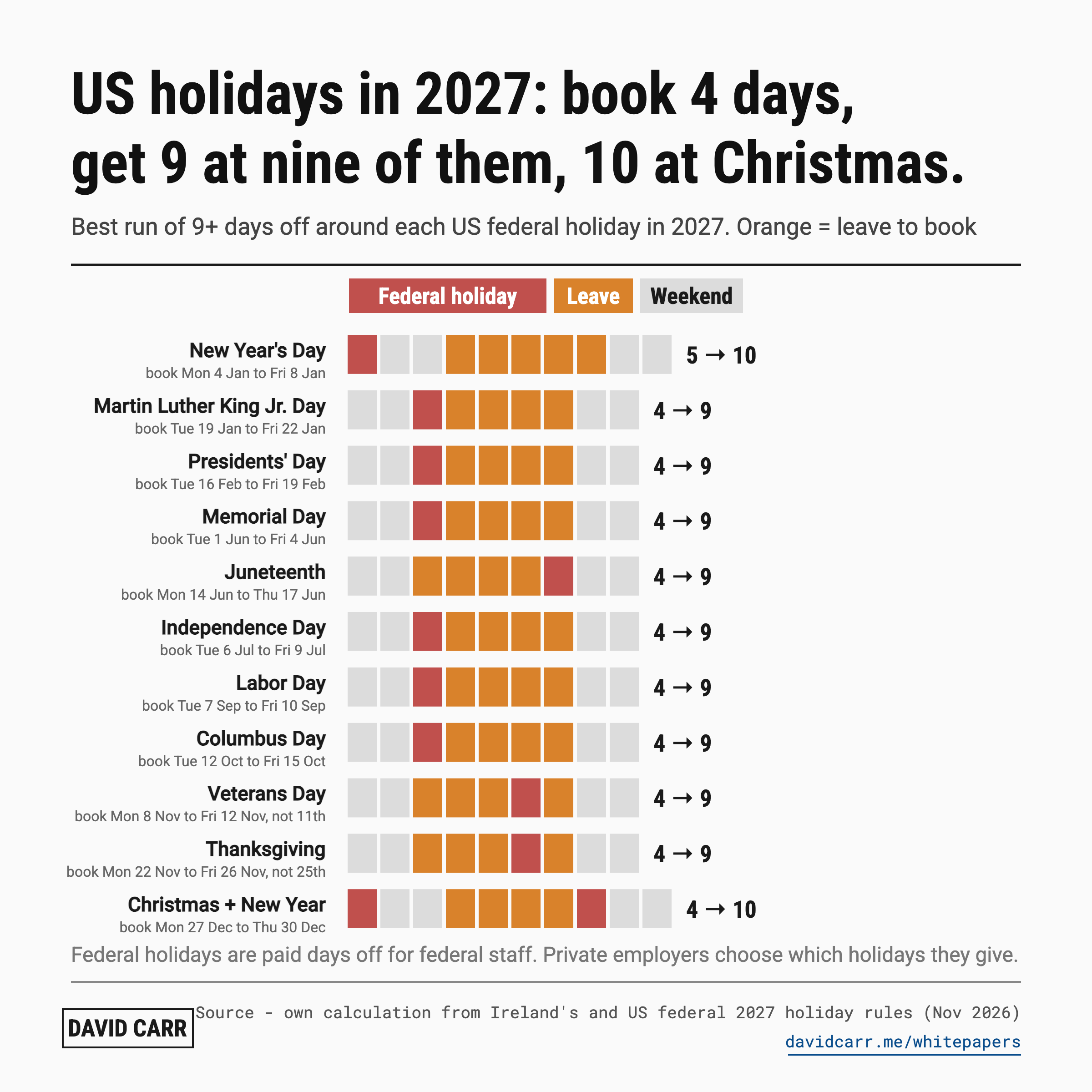
Book 4 days, get 9 off, at nine US holidays. Get 10 at Christmas.
- Monday holidays: book the Tuesday to Friday after
- Juneteenth (observed Fri 18 Jun): book Mon 14 to Thu 17 Jun
- Veterans Day and Thanksgiving (Thursdays): book Mon to Wed and the Friday
- New Year's Day (Fri 1 Jan): book 5, get 10
For a single leave day, the Friday after Veterans Day or Thanksgiving gives a four-day weekend, the same as any Monday holiday.
Uses observed dates. An employer that gives fewer holidays changes these plays.
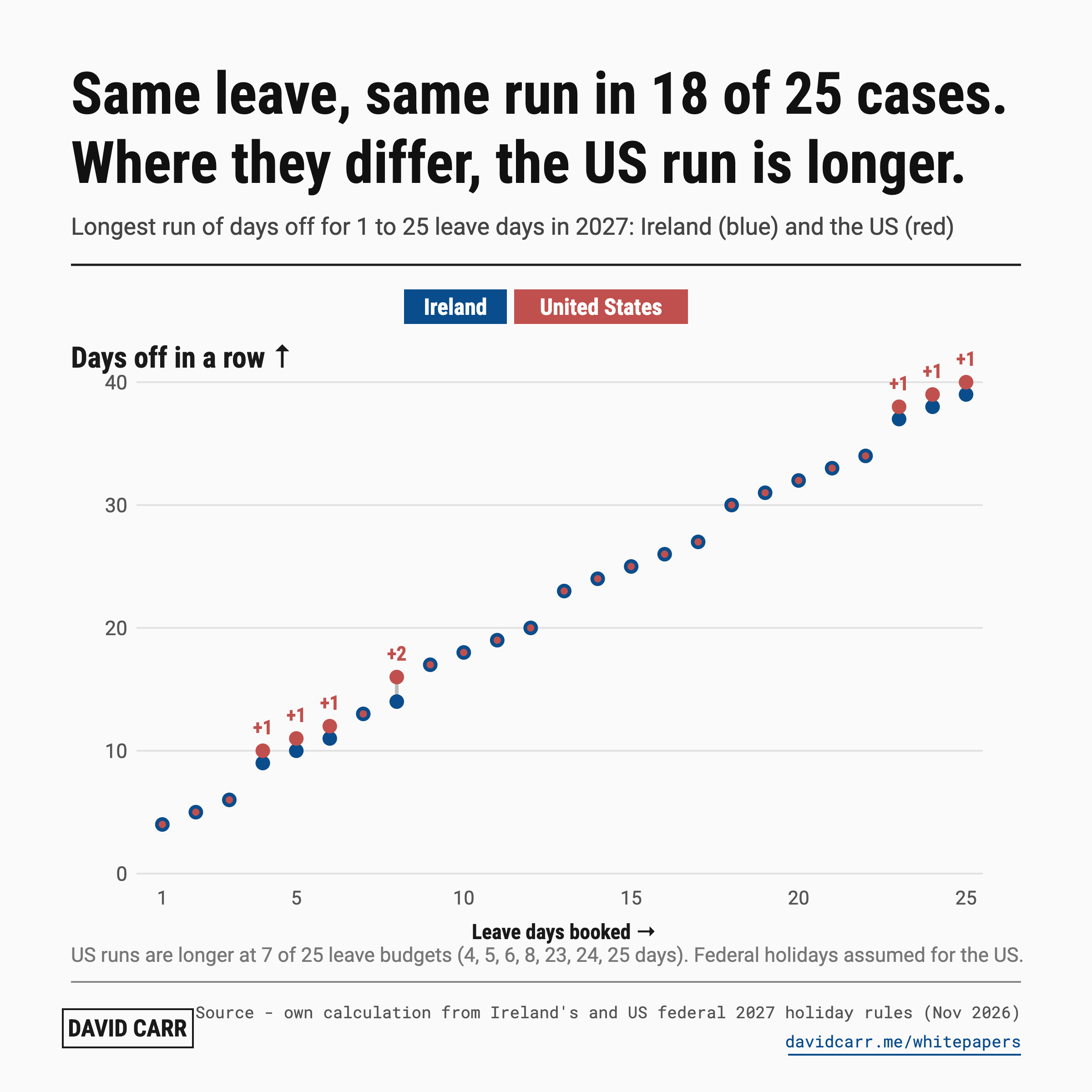
Same leave, same run in 18 of 25 cases. Where they differ, the US run is longer.
- 4, 5 and 6 leave days: the US run is one day longer
- 8 days: Ireland 14, US 16
- 23, 24 and 25 days: the US run is one day longer
- The other 18 budgets: the same
At 4 to 8 days the gap is Christmas, where both US holidays land on Fridays and Ireland's land on the weekend. At 23 to 25 days it is the US run from Memorial Day to 4 July.
US figures assume all federal holidays off. Irish figures do not count any day given in lieu of Christmas or St Stephen's Day.
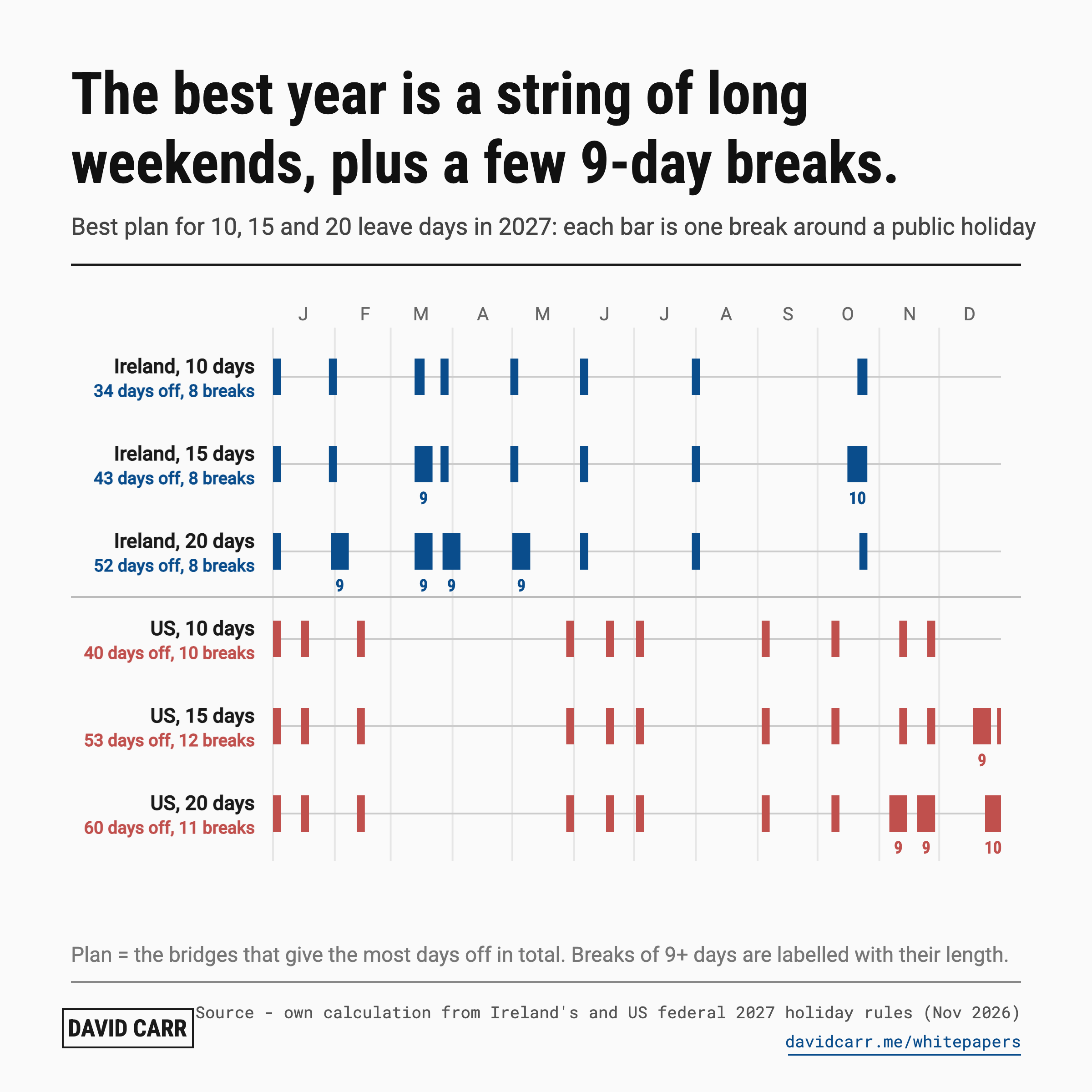
The best year is a string of long weekends, plus a few nine-day breaks.
- Ireland: 10 days make 34 days off, 15 make 43, 20 make 52
- US: 10 days make 40, 15 make 53, 20 make 60
- 5 leave days make 20 days off in both: five four-day weekends
A four-day weekend turns one leave day into four days off. That is the best rate there is, so the best plans use every one first, then stretch some into nine-day breaks.
Plan = non-overlapping breaks around public holidays, chosen to give the most days off in total for the leave budget. Ties are broken towards fewer breaks.
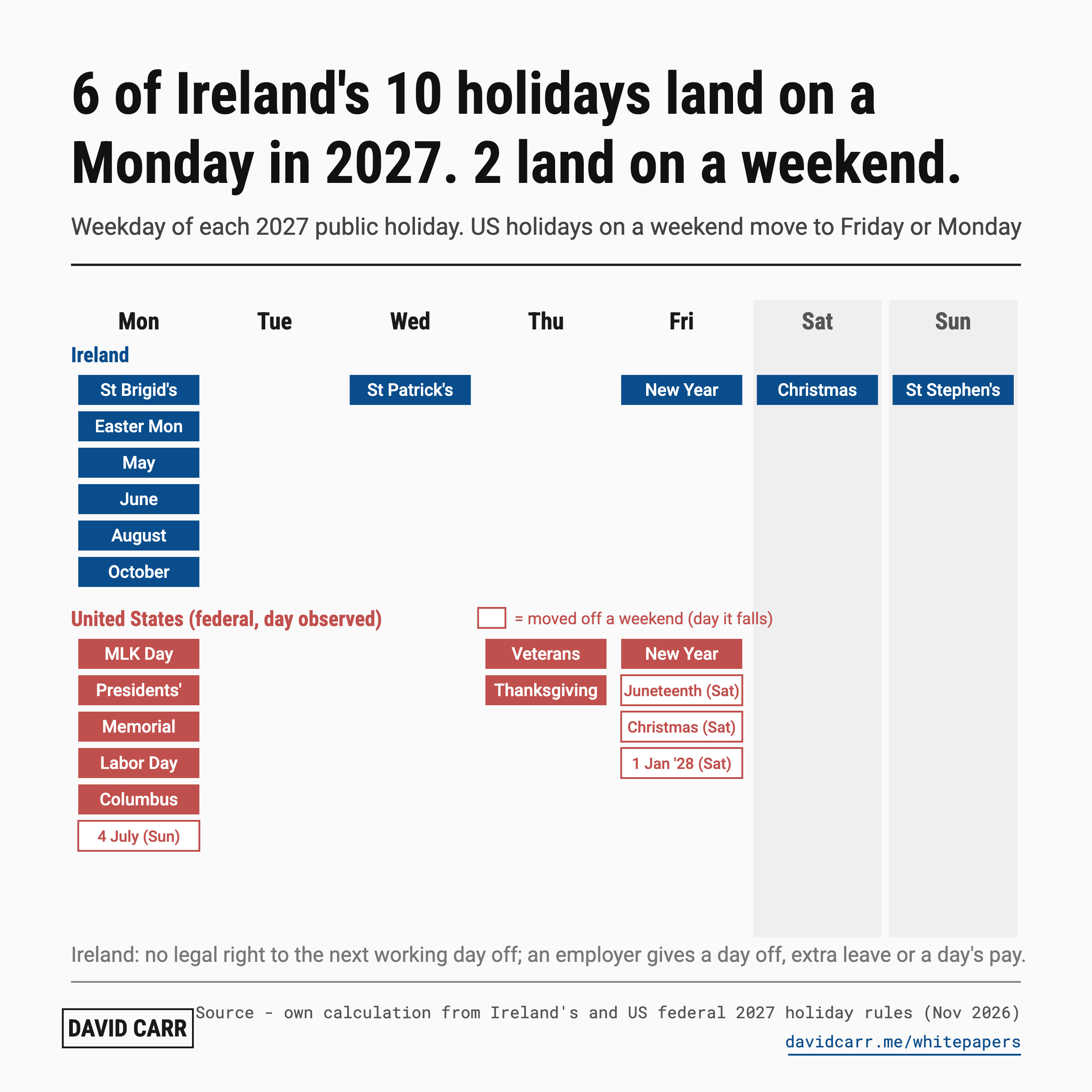
Six of Ireland's ten 2027 holidays fall on a Monday. Two fall on a weekend.
- Ireland, Monday: St Brigid's, Easter, May, June, August, October
- Ireland, weekend: Christmas (Sat), St Stephen's (Sun)
- US: Juneteenth, 4 July and Christmas fall on a weekend and move
- US New Year's Day 2028 is observed on Fri 31 Dec 2027
In 2027 the US calendar has 12 weekday federal holidays, counting both New Year's Days. Ireland's has eight.
Ireland's rules from the WRC. US rules: the fixed dates and weekday rules for the 11 federal holidays, with weekend observance.
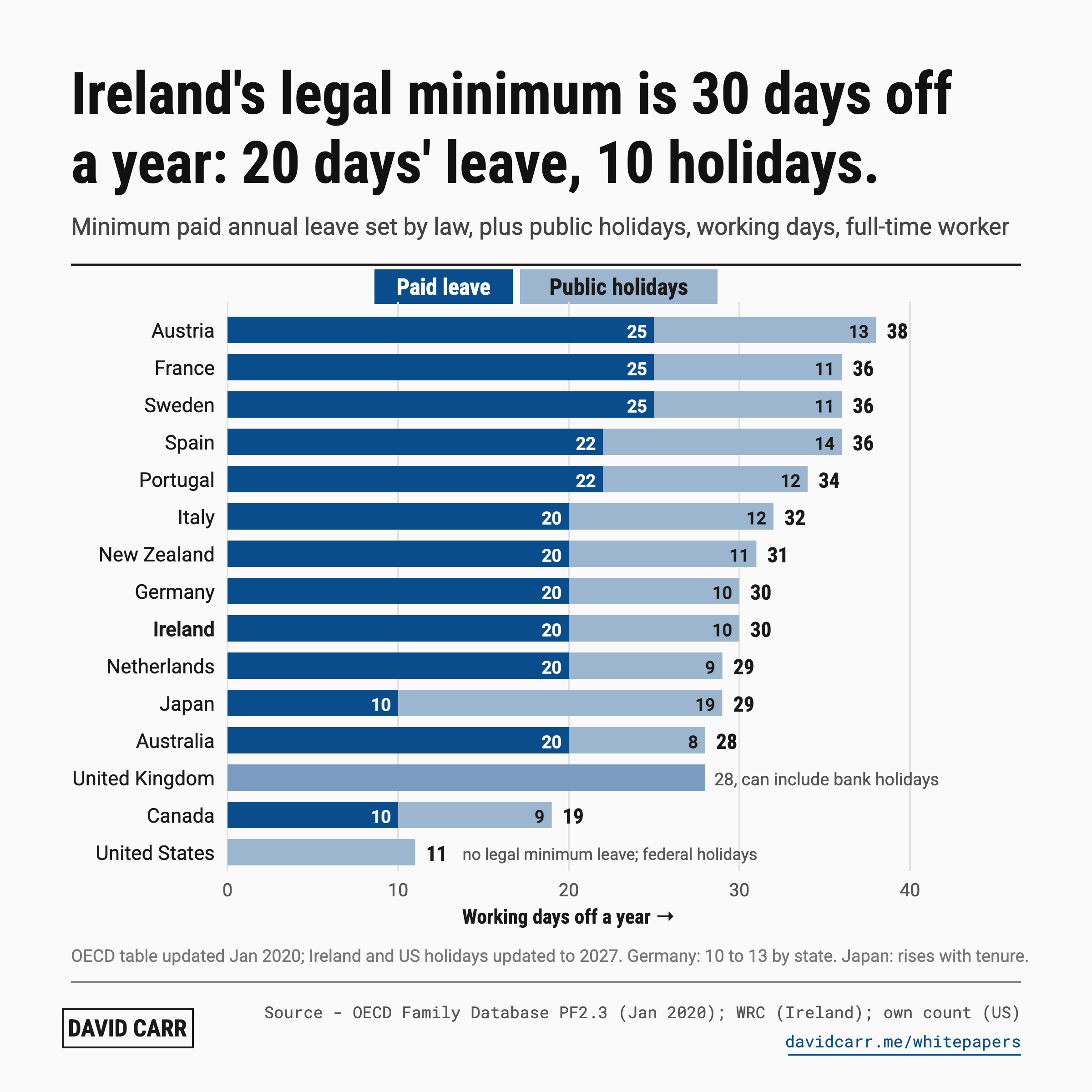
Ireland's legal minimum is 30 days off a year: 20 days' leave and 10 holidays.
- Austria 38, France 36, Sweden 36, Spain 36
- Ireland 30, Germany 30 (or more, by state)
- United Kingdom 28, which can include bank holidays
- Canada 19; Japan 29 (leave rises with tenure)
- United States: no legal minimum; 11 federal holidays
The EU sets a floor of four weeks' paid leave. In the US, paid leave is up to the employer.
Statutory minimums for a full-time worker with one year in the job, from the OECD Family Database, PF2.3 (updated January 2020). Ireland's public holidays updated to 10 (St Brigid's Day added in 2023, WRC); US federal holidays updated to 11 (Juneteenth added in 2021). Employers can give more than the minimum.
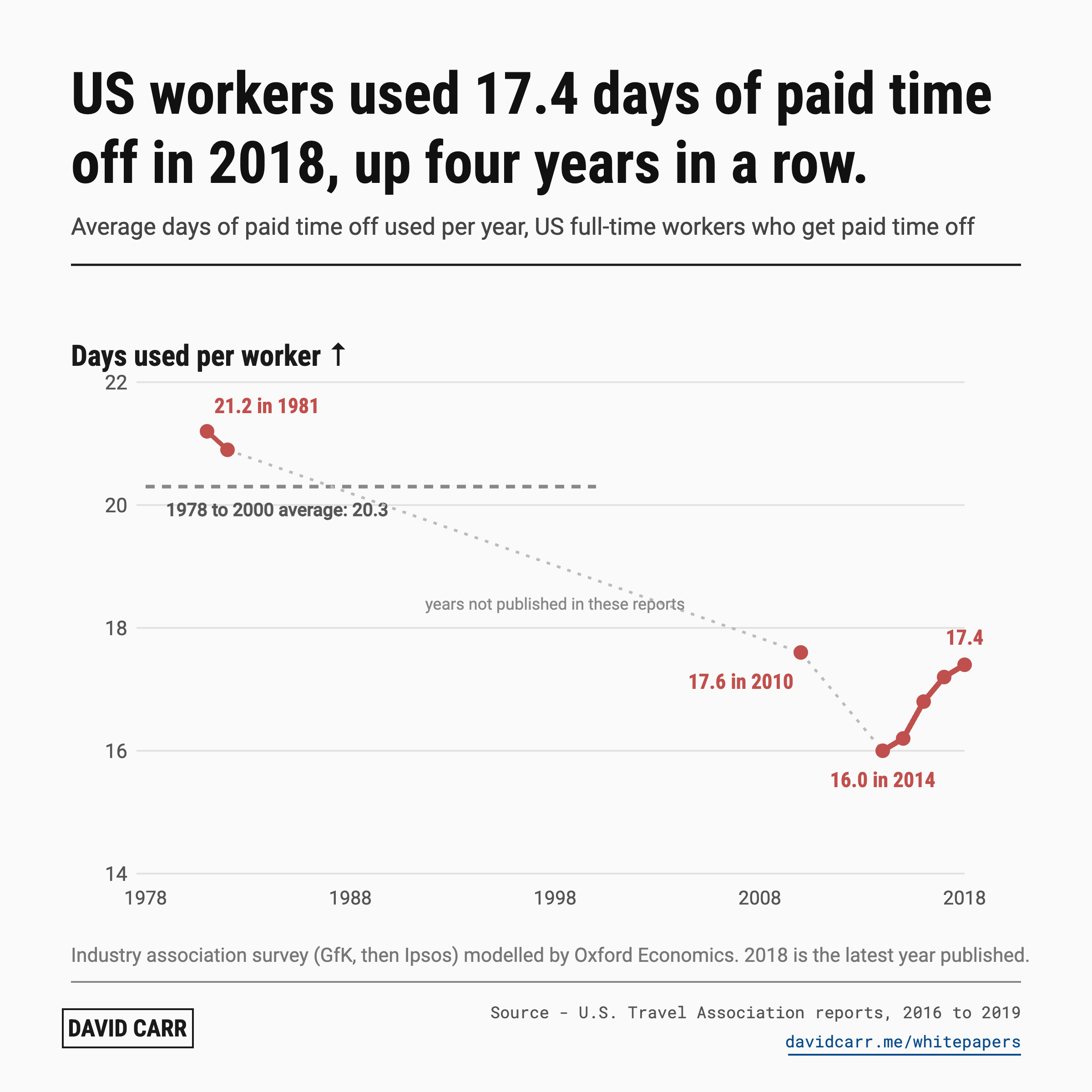
US workers used 17.4 days of paid time off in 2018, up four years in a row.
- 1981: 21.2 days, the peak
- 1978 to 2000 average: 20.3
- 2014: 16.0, the low
- 2015 to 2018: 16.2, 16.8, 17.2, 17.4
Days used rose each year from 2014 to 2018. 2018 is the latest year in the series.
Industry association data: the U.S. Travel Association's State of American Vacation reports (2016, 2018) and its 2019 fact sheet, from GfK and Ipsos surveys of full-time workers who get paid time off, modelled by Oxford Economics.
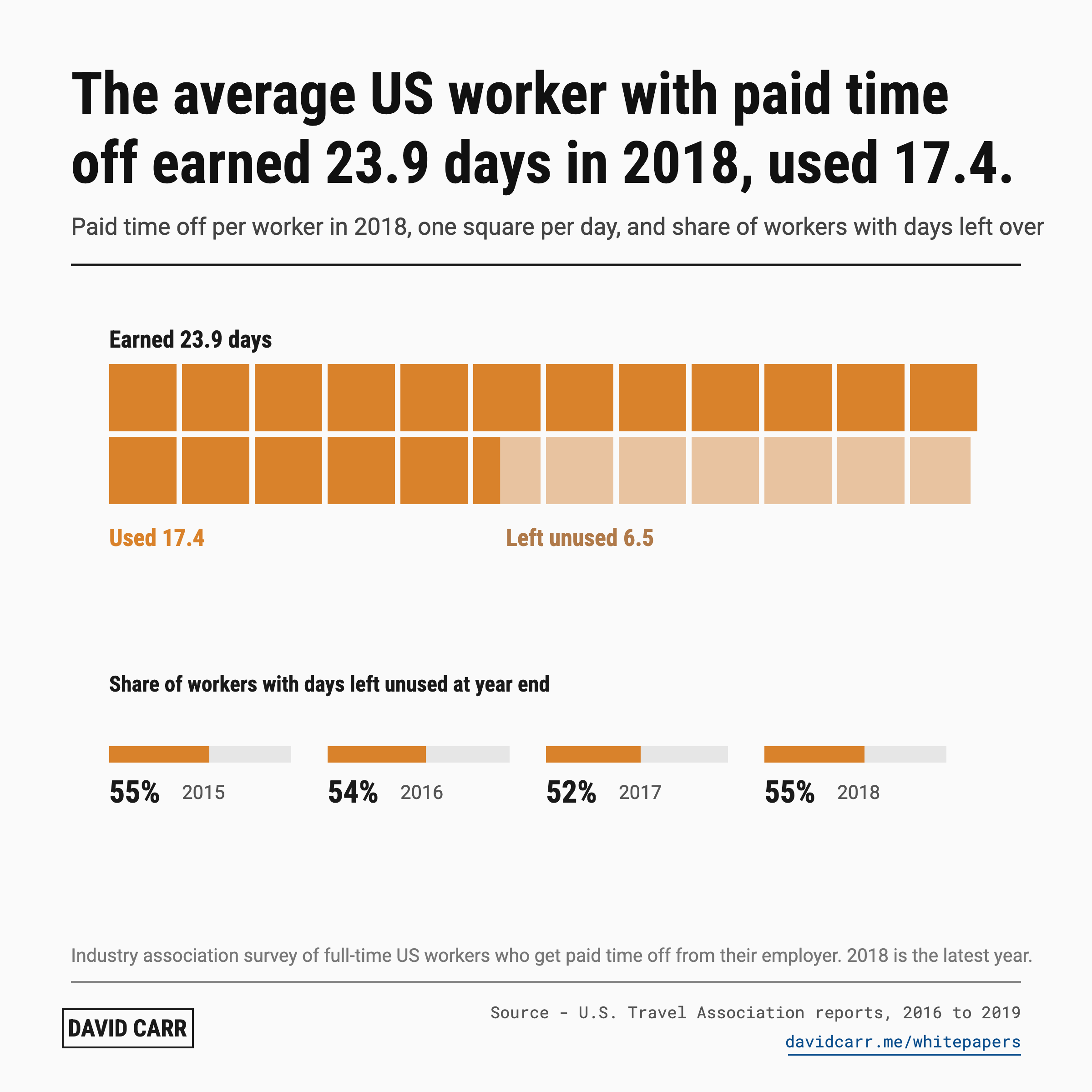
The average US worker with paid time off earned 23.9 days in 2018 and used 17.4.
- Left unused: 6.5 days on average
- Share of workers with days left at year end: 55% in 2015, 54% in 2016, 52% in 2017, 55% in 2018
- Earned days rose from 21.9 (2015) to 23.9 (2018)
Workers earned more days in 2018 than in 2015, and used more too.
Industry association data from the U.S. Travel Association (2016 and 2018 reports, 2019 fact sheet). Survey of full-time US workers who get paid time off from their employer.
Method, caveats and sources
The short answer. In Ireland in 2027, four leave days turn into nine days off at seven of the ten public holidays, and nine days around St Patrick's Day and Easter make 17 days off, 13 to 29 March. In the US, four days between Christmas and New Year make ten days off, 24 December to 2 January 2028. With 20 leave days, the best plan gives 52 days off in Ireland and 60 in the US, mostly as long weekends.
Holidays. Ireland's ten public holidays follow the rules published by the WRC: New Year's Day; the first Monday in February (or 1 February if it is a Friday); St Patrick's Day; Easter Monday; the first Mondays of May, June and August; the last Monday of October; Christmas Day; St Stephen's Day. Good Friday is not a public holiday. The script checks its rules against the 2026 dates the WRC publishes. US federal holidays come from their fixed rules (New Year's Day, Martin Luther King Jr. Day, Presidents' Day, Memorial Day, Juneteenth, Independence Day, Labor Day, Columbus Day, Veterans Day, Thanksgiving, Christmas Day), with Saturday holidays observed on the Friday before and Sunday holidays on the Monday after.
The optimiser. A small Python script marks every day of 2027 as off (Saturday, Sunday or a public holiday) or a workday. A break is a run of days off plus booked leave, with an unbooked workday at each end. For each number of leave days from 1 to 25 it finds the longest single break. For the year plans it picks non-overlapping breaks that contain a public holiday and give the most days off in total, an exact search over every option. Days off that join on from late December 2026 or early January 2028 count towards a break; leave is only booked in 2027.
Caveats. Many plans tie; the page names one. In Ireland there is no legal right to the next working day off when a holiday falls on a weekend: the employer gives a paid day off within a month, an extra day of leave or an extra day's pay. The US figures assume all 11 federal holidays are days off, as they are for federal staff; private employers choose their own. Leave years, shift work and part-time hours are not modelled.
Context data. Statutory leave and public holidays from the OECD Family Database, PF2.3, table PF2.3.A, updated January 2020, with Ireland and the US updated to 2027 counts. US leave use from the U.S. Travel Association, a travel industry association, whose reports come from surveys of full-time workers with paid time off; 2018 is the latest year published. All files pulled 26 November 2026.
Also: How Ireland works now and Where Ireland travels, and why.