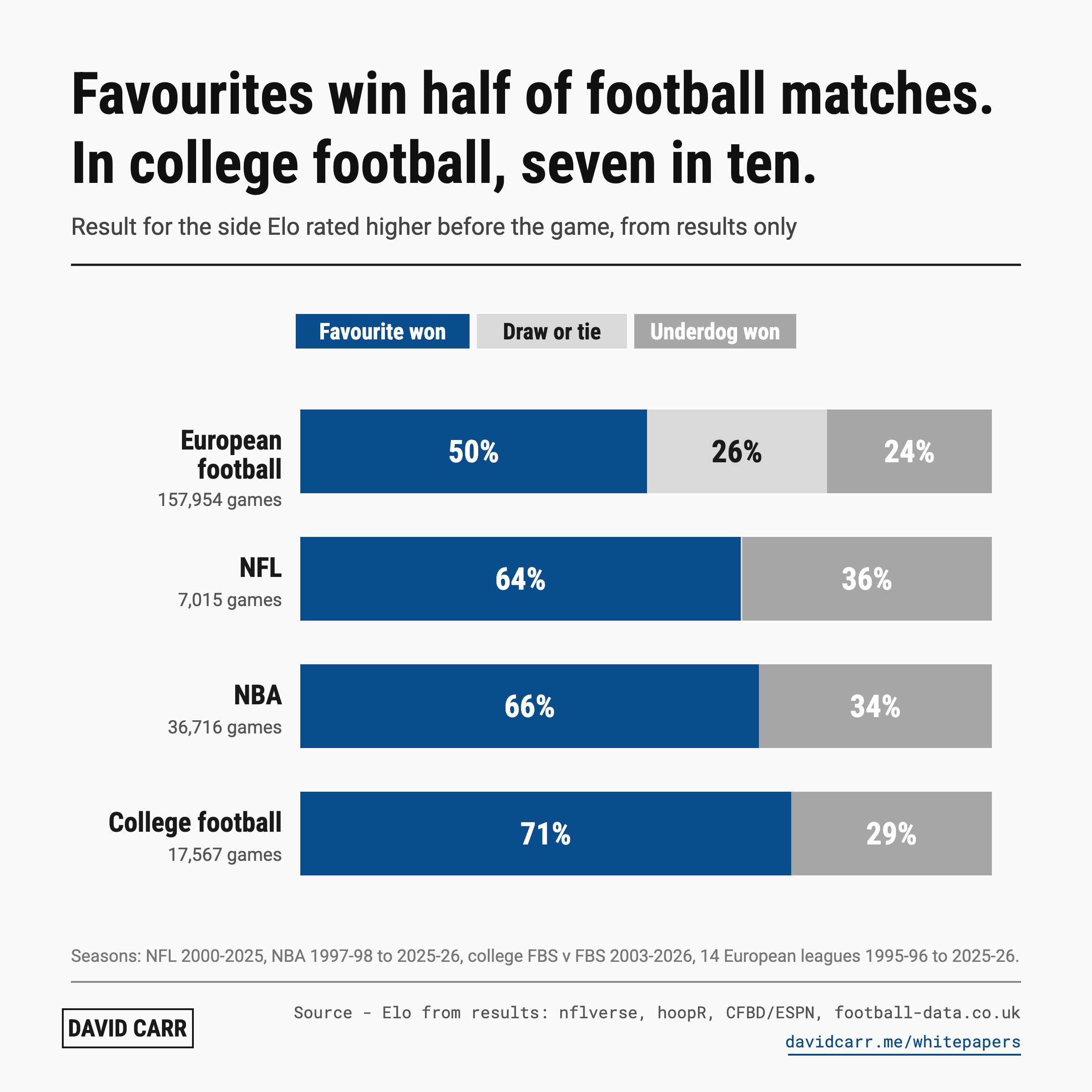
Favourites win half of football matches. In college football, seven in ten.
- European football: favourite won 50.2%, draw 26.0%, underdog won 23.8%
- NFL: favourite won 63.7%
- NBA: 66.3%
- College football: 71.0%
Football is the hardest of the four to call, mostly because of draws. Leave draws out and football favourites win 67.8% of decided games, about the same as in the NBA.
The favourite is the side with the higher Elo rating before the game, home advantage included. Ratings come from results only, never odds.
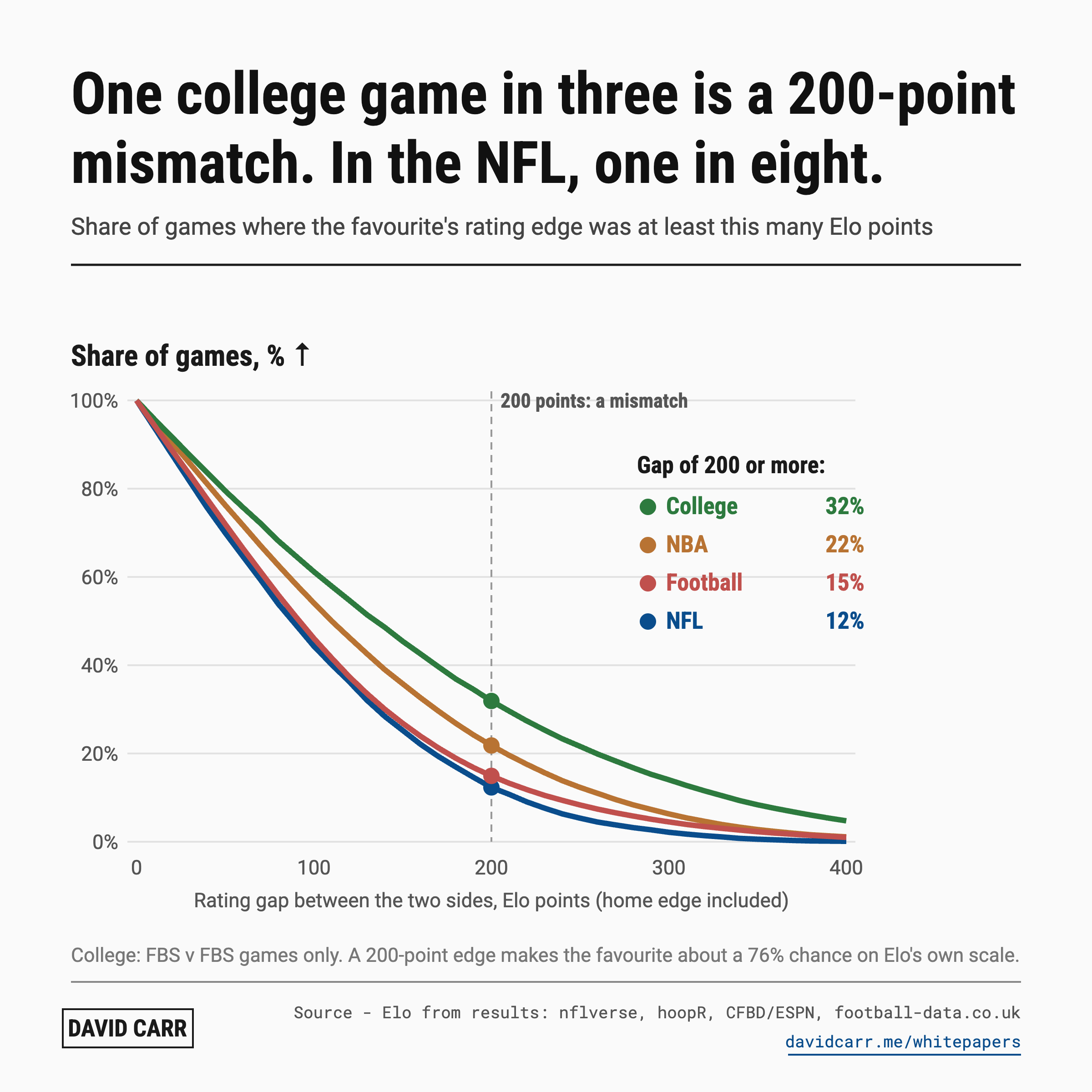
One college game in three is a 200-point mismatch. In the NFL, one in eight.
- Games where the favourite's edge was 200 Elo points or more:
- College football 31.9%
- NBA 21.8%
- European football 14.9%
- NFL 12.3%
College football has the most lopsided games, which is why its favourites win most often. The NFL has the fewest mismatches: its median gap is 88 points, against 135 in college.
College: games between two FBS teams only. A 200-point edge makes the favourite about a 76% chance on Elo's own scale.
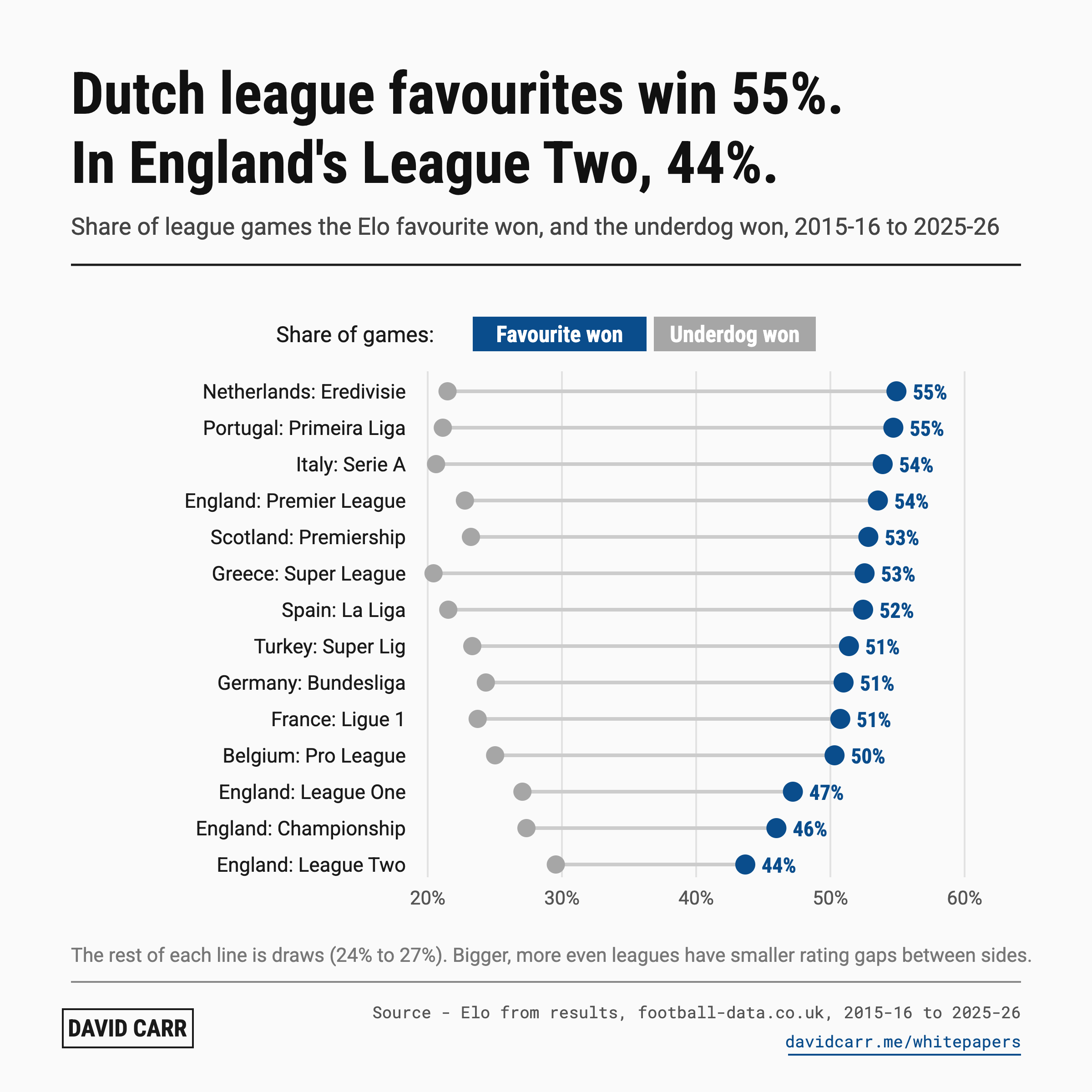
Dutch league favourites win 55%. In England's League Two, 44%.
- Eredivisie 54.9%, Primeira Liga 54.7%, Serie A 53.9%, Premier League 53.5%
- League Two 43.7%, Championship 46.0%, League One 47.2%
- Draws: 23.6% to 27.0% in every league
England's three divisions below the Premier League are the hardest leagues here to call. Their sides are closer together on rating than in most top flights.
League games 2015-16 to 2025-26, from football-data.co.uk. English divisions are rated as one pyramid, so promoted and relegated sides keep their ratings.
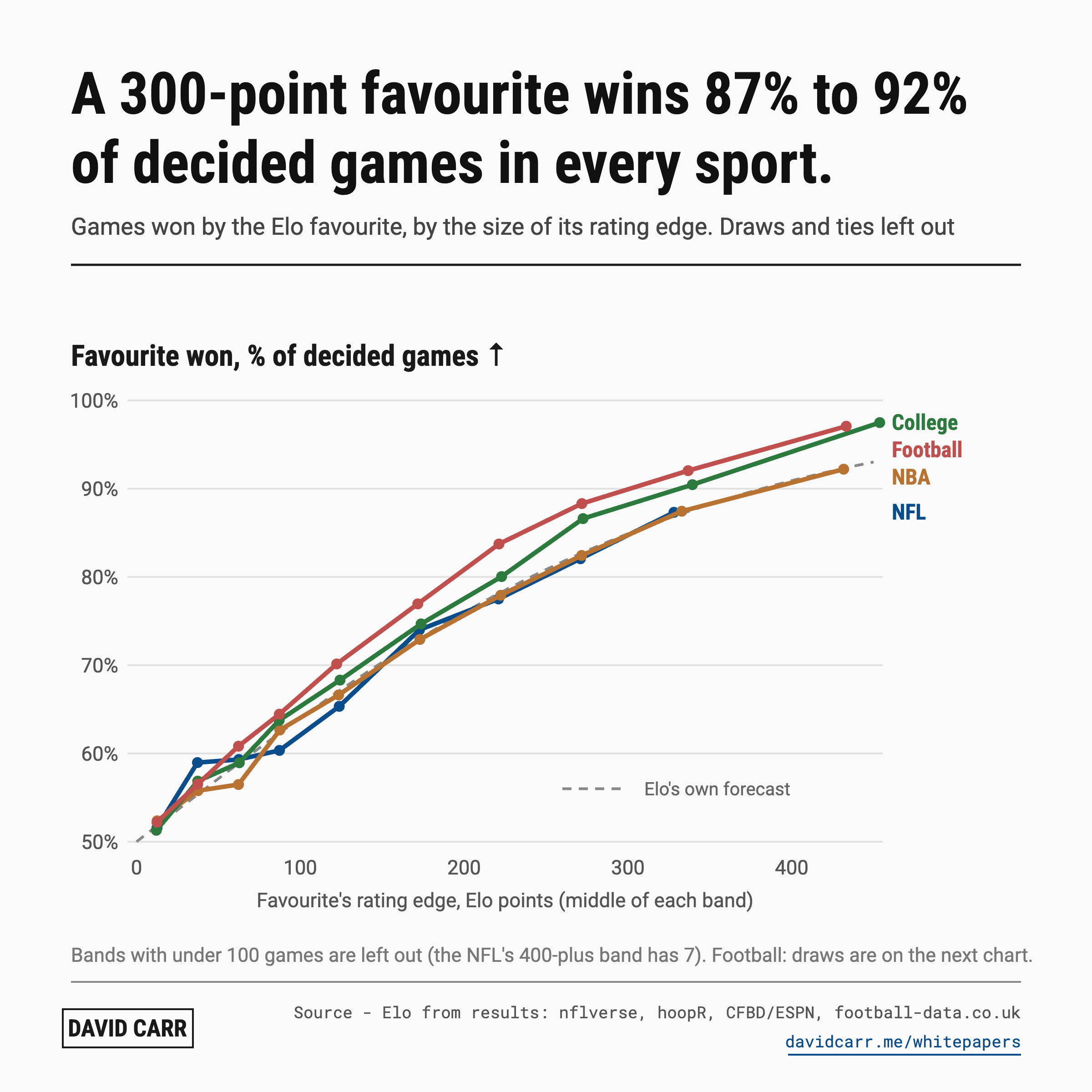
A 300-point favourite wins 87% to 92% of decided games in every sport.
- Edge of 300 to 400 points: NFL 87.3%, NBA 87.4%, college 90.5%, football 92.0%
- Edge under 25 points: 51% to 52% in every sport
The bigger the gap, the surer the win, in every sport, and the curves sit close together. Once you know the gap, the sport matters less than you might think.
Decided games only (draws and ties left out). Bands with under 100 games are not drawn.
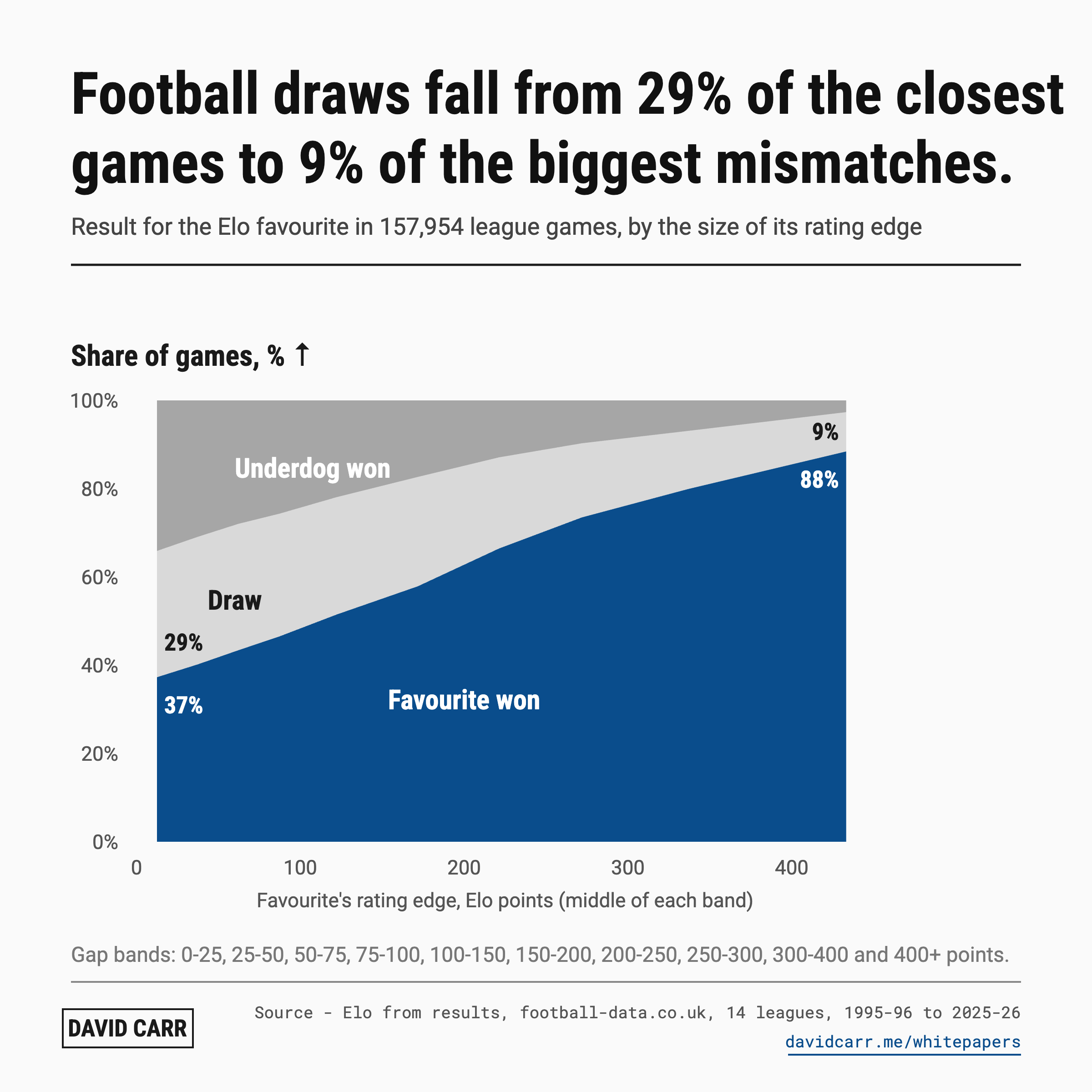
Football draws fall from 29% of the closest games to 9% of the biggest mismatches.
- Edge under 25 points: favourite won 37.3%, draw 28.6%
- Edge of 400 points or more: favourite won 88.4%, draw 8.9%
- Underdog won 2.7% of those biggest mismatches
In an even game a draw is almost as likely as either side winning. That is a big part of why football is harder to call than the American sports.
157,954 league games in 14 European leagues, 1995-96 to 2025-26.
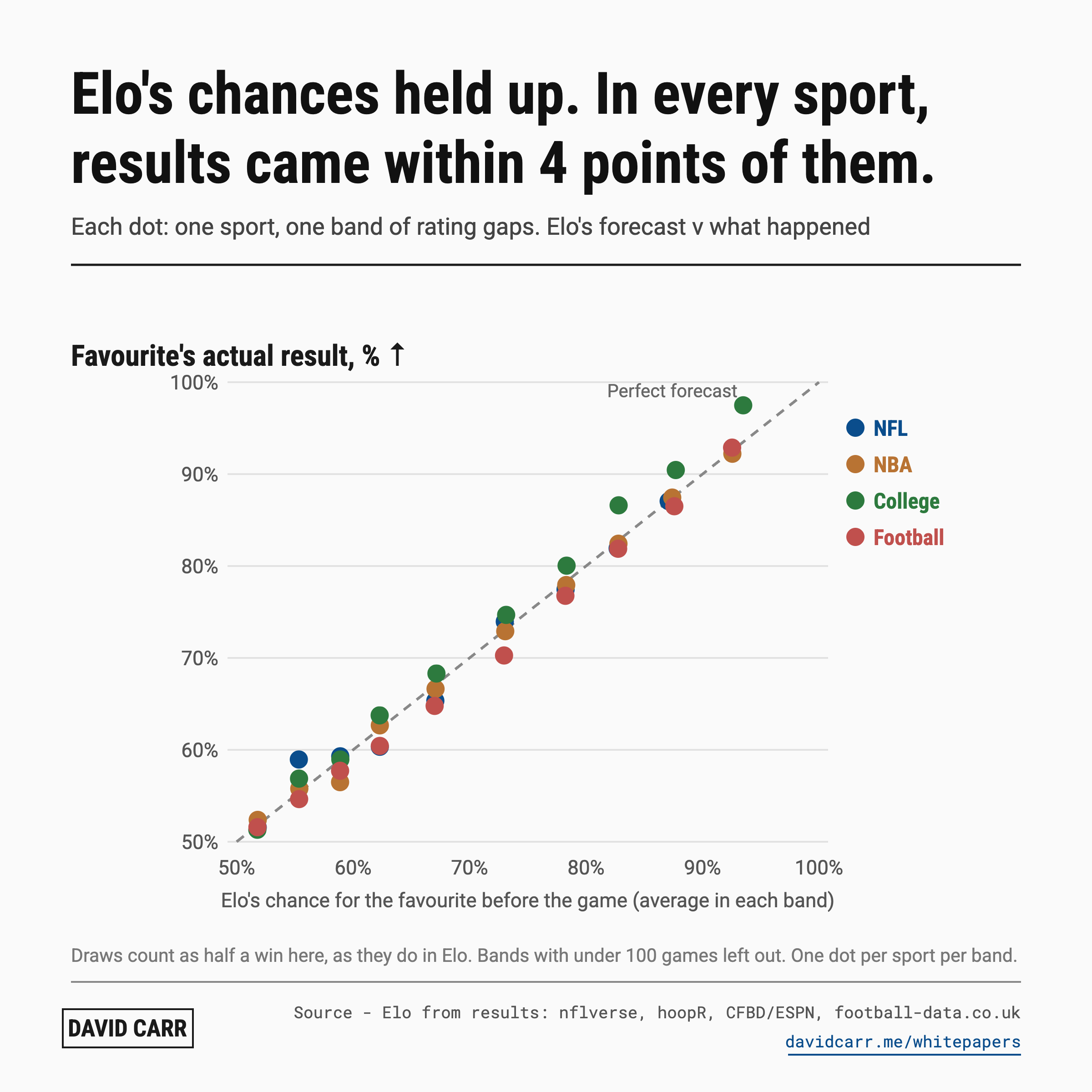
Elo's chances held up. In every sport, results came within 4 points of them.
- 39 bands across four sports, each with 100 or more games
- Largest miss: college football's biggest mismatches, 97.5% actual v 93.5% expected
- Most bands within 2 points
Ratings built from nothing but past results gave fair chances. College favourites with very big edges did a little better than Elo expected.
Draws count as half a win here, as they do inside Elo.
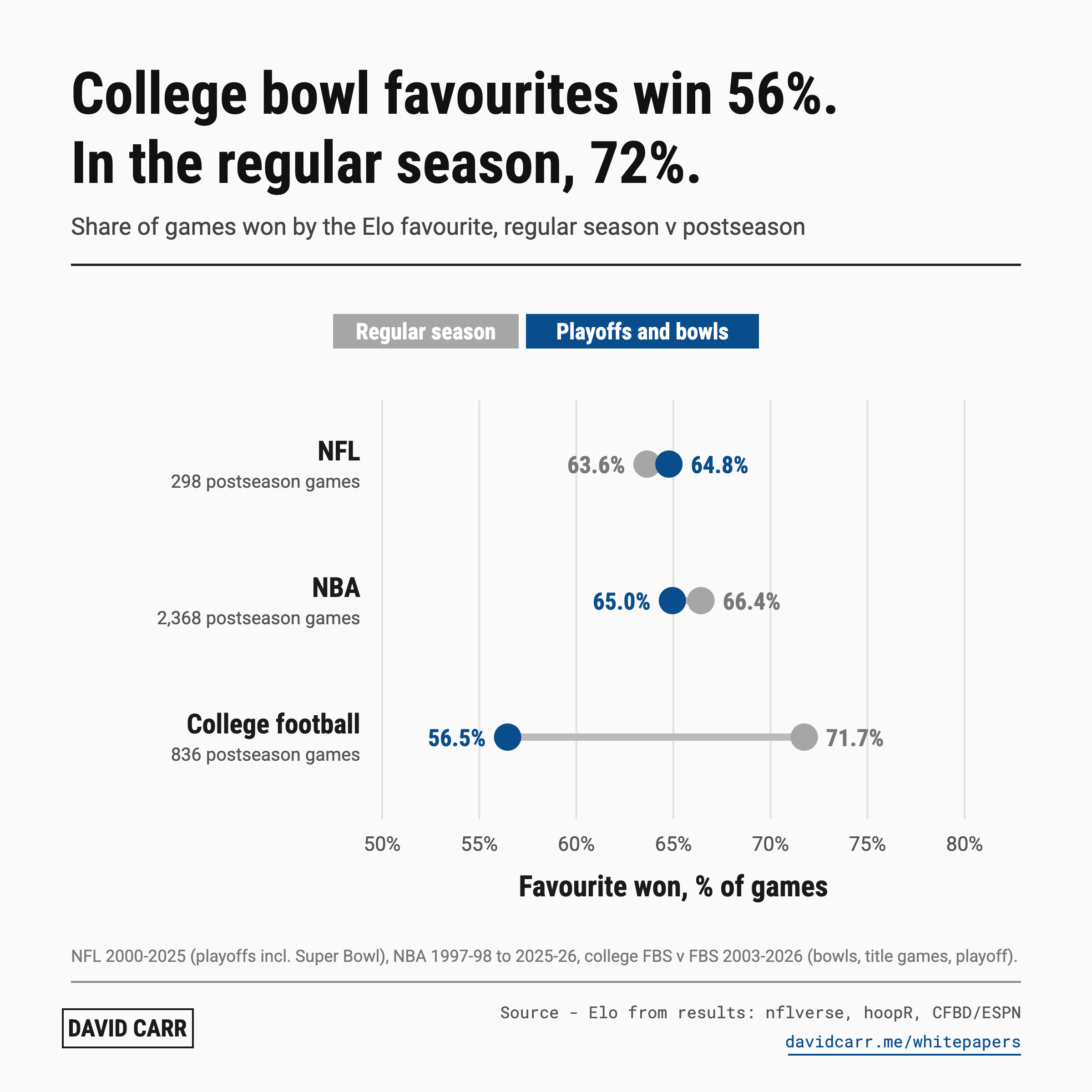
College bowl favourites win 56%. In the regular season, 72%.
- College football: 71.7% regular season, 56.5% bowls and playoff (836 games)
- NFL: 63.6% regular season, 64.8% playoffs (298 games)
- NBA: 66.4% regular season, 65.0% playoffs (2,368 games)
Postseason games tend to be closer match-ups, so some drop is expected. In college it is far bigger than that: Elo itself expected bowl favourites to win 60.2%.
College postseason includes bowls, conference title games and the playoff. NFL playoffs include the Super Bowl.
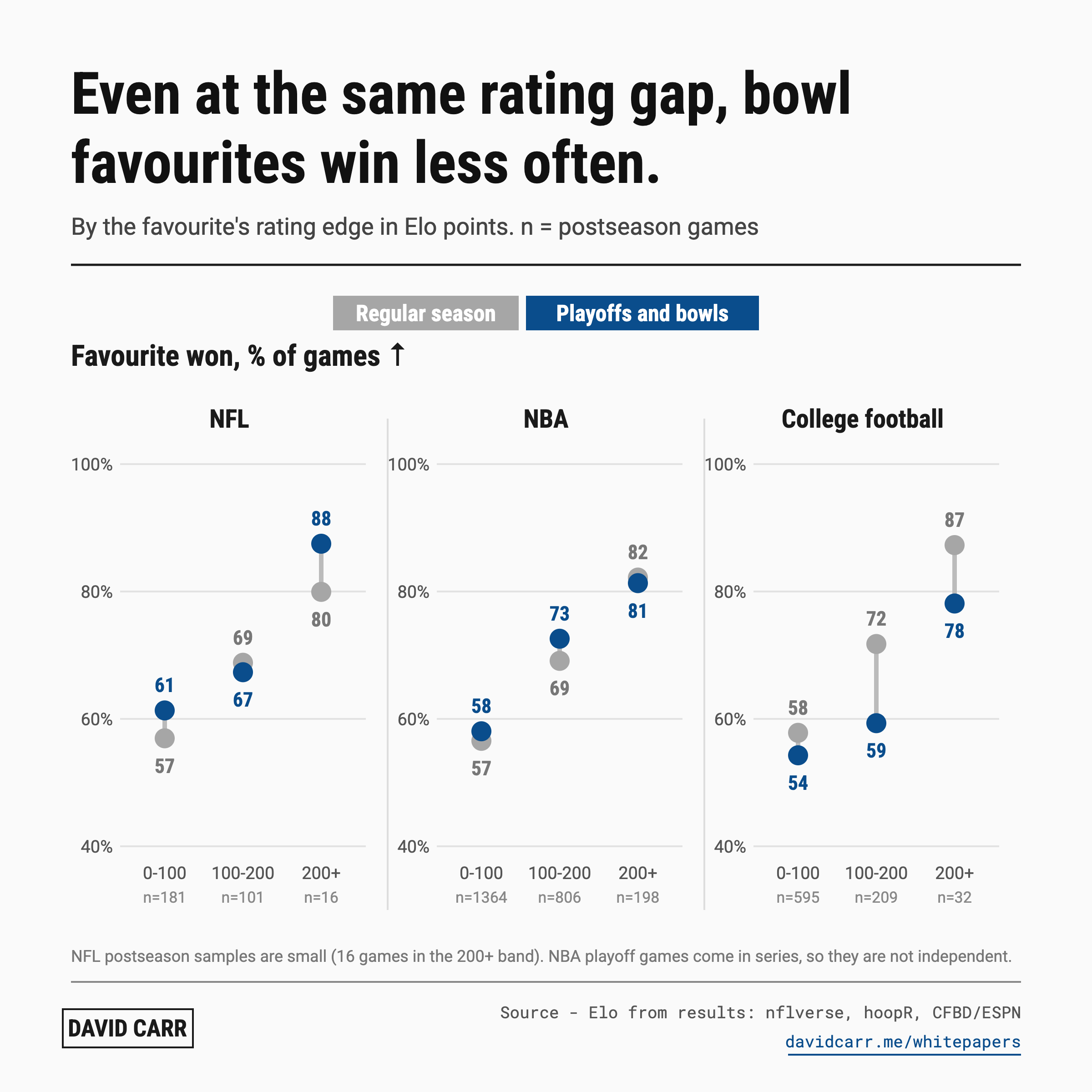
Even at the same rating gap, bowl favourites win less often.
- College, edge of 100 to 200 points: 71.8% regular season, 59.3% bowls
- Edge of 200 or more: 87.3% v 78.1% (32 bowl games)
- NFL and NBA playoffs: no consistent gap
Bowl favourites fall short in all three bands. NFL and NBA playoff favourites do about as well as in the regular season.
Small samples: the NFL has 16 postseason games in the 200-plus band. NBA playoff games come in series, so they are not independent.
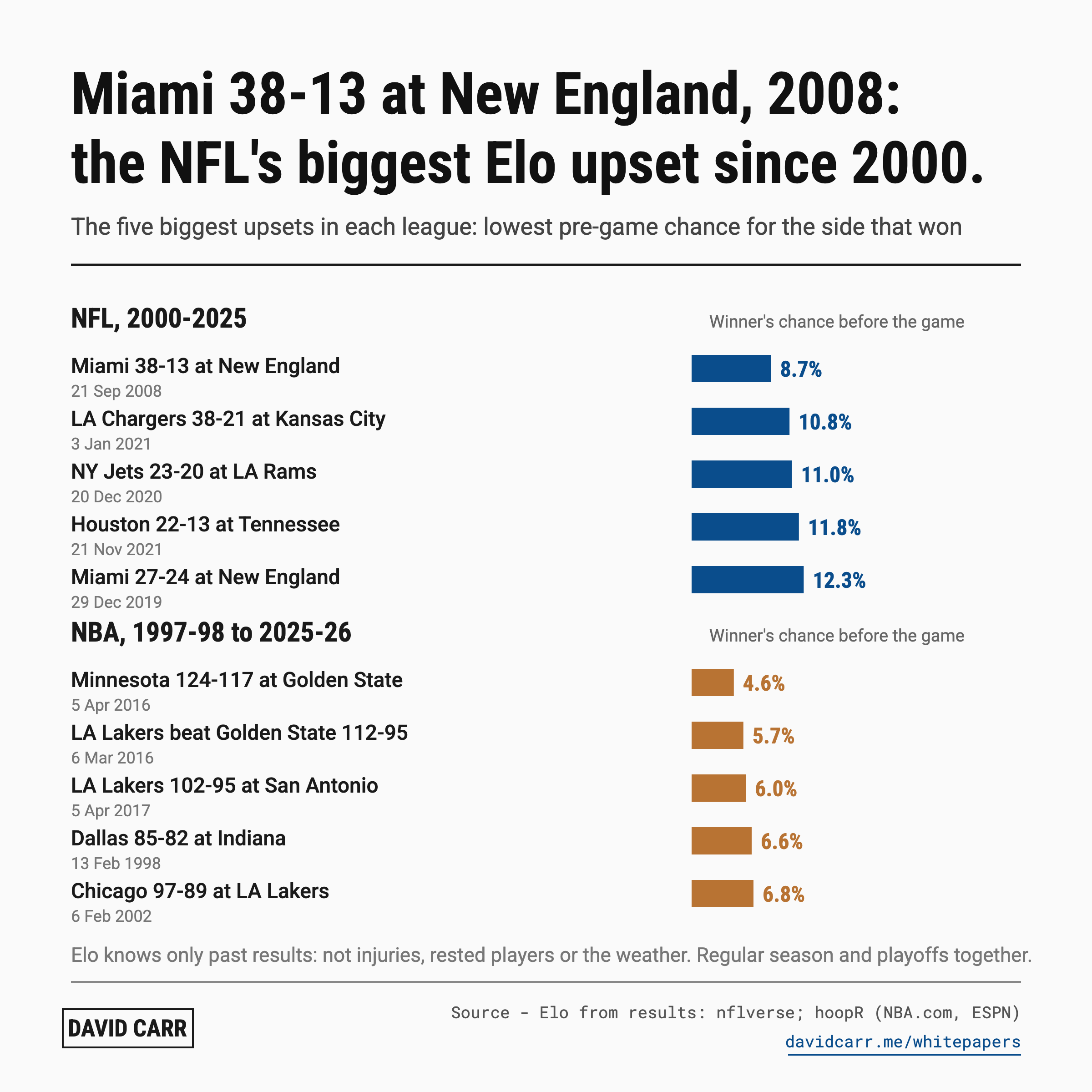
Miami 38-13 at New England, 2008: the NFL's biggest Elo upset since 2000.
- NFL: Miami at New England, 21 Sep 2008, an 8.7% chance
- LA Chargers 38-21 at Kansas City, 3 Jan 2021: 10.8%
- NBA: Minnesota at Golden State, 5 Apr 2016: 4.6%
- LA Lakers beat Golden State, 6 Mar 2016: 5.7%
Golden State lost twice in the 2015-16 season to sides Elo gave under 6%. Two of the five NBA upsets came in early April.
Elo knows only past results: not injuries, rested players or the weather.
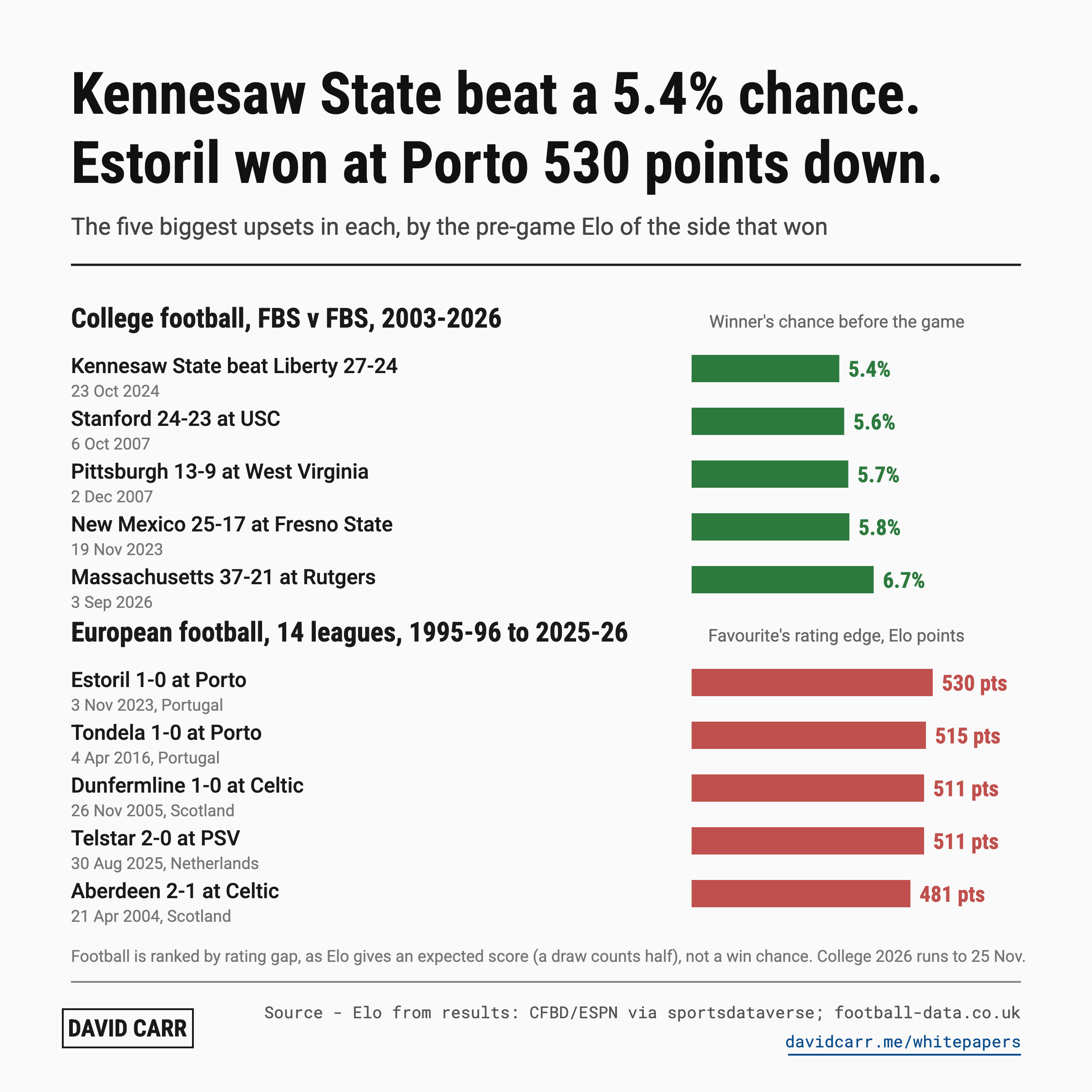
Kennesaw State beat a 5.4% chance. Estoril won at Porto 530 points down.
- College: Kennesaw State 27-24 v Liberty, 23 Oct 2024: 5.4%
- Stanford 24-23 at USC, 6 Oct 2007: 5.6%
- Football: Estoril 1-0 at Porto, 3 Nov 2023, a 530-point gap
- Tondela 1-0 at Porto, 2016: 515 points
Two of the five biggest football upsets came in Portugal and two in Scotland, where a few clubs are rated far above the rest.
Football is ranked by rating gap because Elo gives an expected score (a draw counts half), not a win chance. Kennesaw State was in its first FBS season, rated from its FCS results.
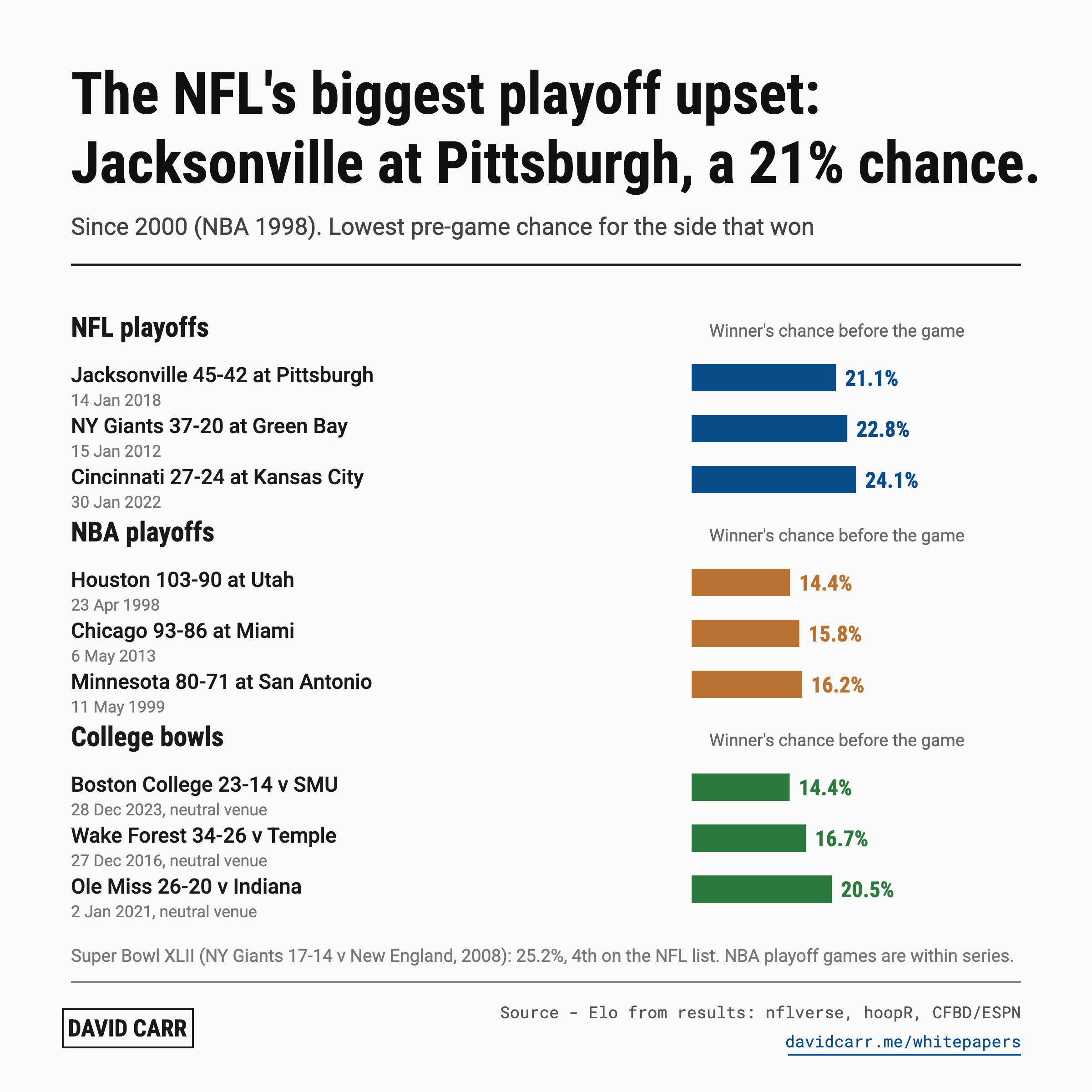
The NFL's biggest playoff upset since 2000: Jacksonville at Pittsburgh, a 21% chance.
- NFL: Jacksonville 45-42 at Pittsburgh, Jan 2018: 21.1%
- NY Giants 37-20 at Green Bay, Jan 2012: 22.8%
- NBA: Houston 103-90 at Utah, Apr 1998: 14.4%
- Bowls: Boston College 23-14 v SMU, Dec 2023: 14.4%
Postseason upsets are milder than regular-season ones, because the sides are closer. The Giants' Super Bowl win over New England in February 2008 was a 25.2% chance, fourth on the NFL list.
NBA 1997-98 to 2025-26; NFL and college from the start of each series.
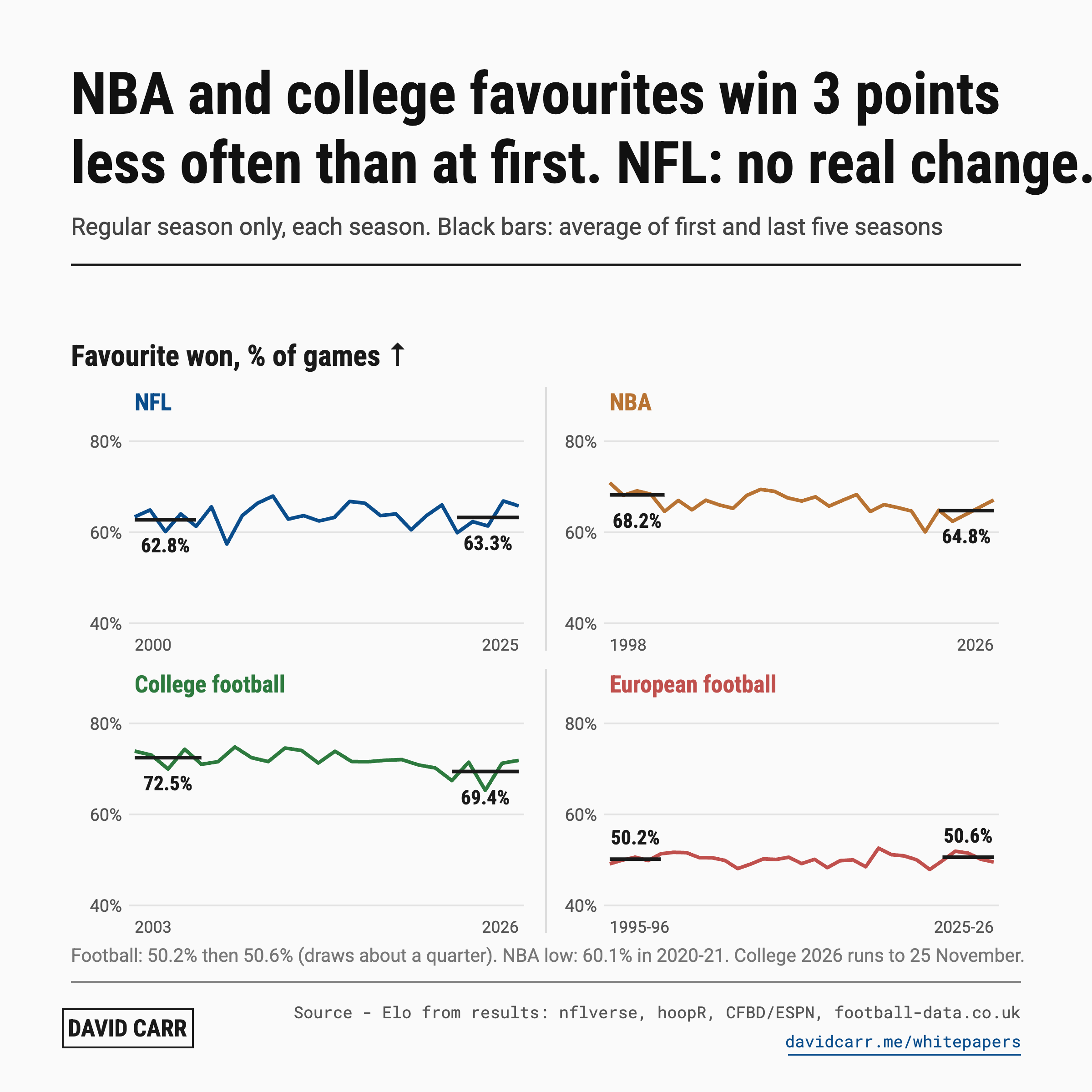
NBA and college favourites win 3 points less often than at first. The NFL: no real change.
- NBA: 68.2% (1997-98 to 2001-02), 64.8% (2021-22 to 2025-26)
- College: 72.5% (2003-07), 69.4% (2022-26)
- NFL: 62.8% then 63.3%
- European football: 50.2% then 50.6%
The NBA's lowest season was 2020-21, at 60.1%. College's was 2024, at 65.3%. Year to year, every sport moves by a few points.
Regular season only. College 2026 runs to 25 November 2026.
Method, caveats and sources
The short answer. The side with the better rating wins about two games in three in the NFL and NBA and seven in ten in college football. In European football the favourite wins half its league games, draws a quarter and loses a quarter. The bigger the rating gap, the surer the win, and in every sport the results came within four points of what the ratings said. College bowl games are much harder to call than the college regular season. NBA and college favourites win about three points less often than at the start of the data; the NFL and football have barely moved.
Ratings. Every rating on this page is an Elo rating built from final scores only. No betting odds, point spreads or prices are used anywhere. Each sport is run game by game in date order, so each pre-game rating uses only earlier results. Before a game the home side's chance is 1 / (1 + 10^(-(home rating + home edge - away rating) / 400)); after it both sides move by K times (result minus chance), with a win 1, a draw or tie 0.5 and a loss 0. Neutral venues get no home edge.
Settings. NFL: K 40, home edge 50 points, a third of the way back to 1500 between seasons. NBA: K 20, home edge 70, a quarter of the way back. College football: K 80, home edge 50, a third of the way back to the team's starting value; all divisions are rated (FBS teams start at 1500, FCS 1250, Division II 1050, Division III 900) but only FBS v FBS games are counted. European football: K 15, home edge 70, no pull back between seasons; England's four divisions are rated as one pyramid (starting at 1600, 1500, 1400 and 1300), and a side arriving in a league starts at the average of the three lowest-rated sides there the season before. K and the home edge were picked from a coarse grid by the smallest squared error between Elo's chance and the result, so the ratings are tuned to these same games. New expansion sides start at 1350. The first season or two of each sport only warm the ratings up and are not counted.
Favourite and gap. The favourite is the side Elo gave the better chance, home edge included. The gap is that difference in Elo points. On Elo's scale a 100-point edge is about a 64% chance, 200 about 76%, 300 about 85%.
Data. NFL: 7,273 games, 1999-2025 seasons, from nflverse play-by-play files (CC BY 4.0), one row per game; counted from 2000. NBA: 37,977 games, 1996-97 to 2025-26, from NBA.com and ESPN data via hoopR / SportsDataverse; counted from 1997-98. College: 48,305 games, 2001-2026, all divisions, from CollegeFootballData.com and ESPN via sportsdataverse; 17,567 FBS v FBS games counted from 2003, with 2026 running to 25 November. European football: 166,464 league games in 14 leagues, 1993-94 to 2025-26, from football-data.co.uk; counted from 1995-96. All files were already pulled for earlier pages on this site (26 November 2026 for the American sports, 23 November 2026 for football).
Caveats. Elo knows nothing but results: not injuries, rested players, transfers or the weather, so some "upsets" are games where the favourite was not really at full strength. NBA regular-season games played at neutral venues abroad are treated as home games. NBA playoff games come in series and are not independent. NFL postseason samples are small. The ratings and the measuring use the same games, so they flatter Elo a little.
Left out. Football cup and European competition (only league games are in the data), tennis (it has its own page in this series) and anything from betting markets. This page uses results, not odds, and it is not a guide to betting.
Also: Do the odds know? and all the sports pages.