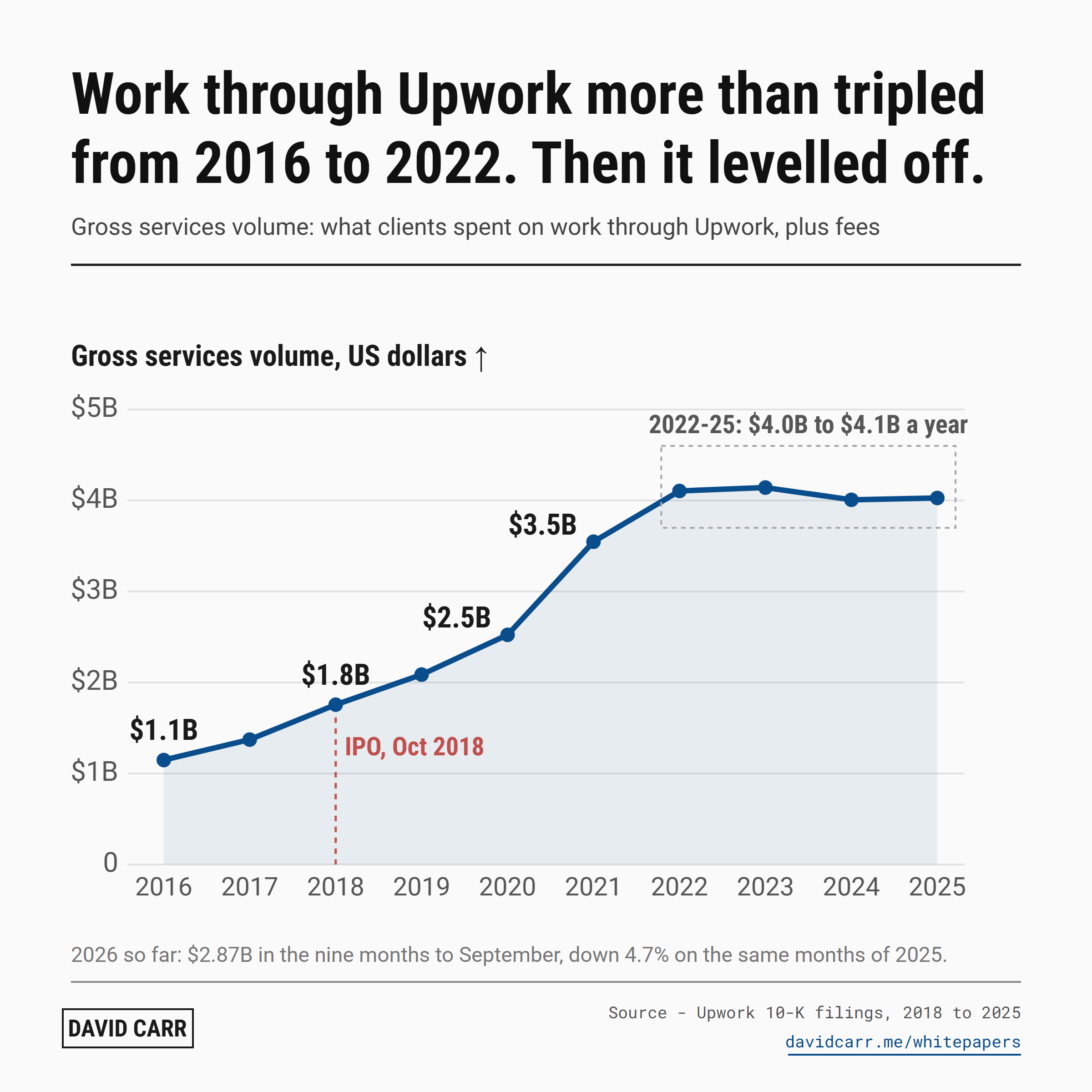
Work through Upwork more than tripled from 2016 to 2022. Then it levelled off.
- 2016: $1.15 billion
- 2019: $2.09 billion
- 2021: $3.55 billion
- 2022: $4.10 billion
- 2025: $4.03 billion
The biggest jump was in 2021, up 41%. Since 2022 the total has stayed between $4.0 and $4.1 billion a year.
Gross services volume (GSV) is what clients spend on work through Upwork, plus fees. From Upwork's 2019, 2021, 2023 and 2025 10-K filings. In the nine months to September 2026 it was $2.87 billion, down 4.7% on a year earlier (Q3 2026 release).
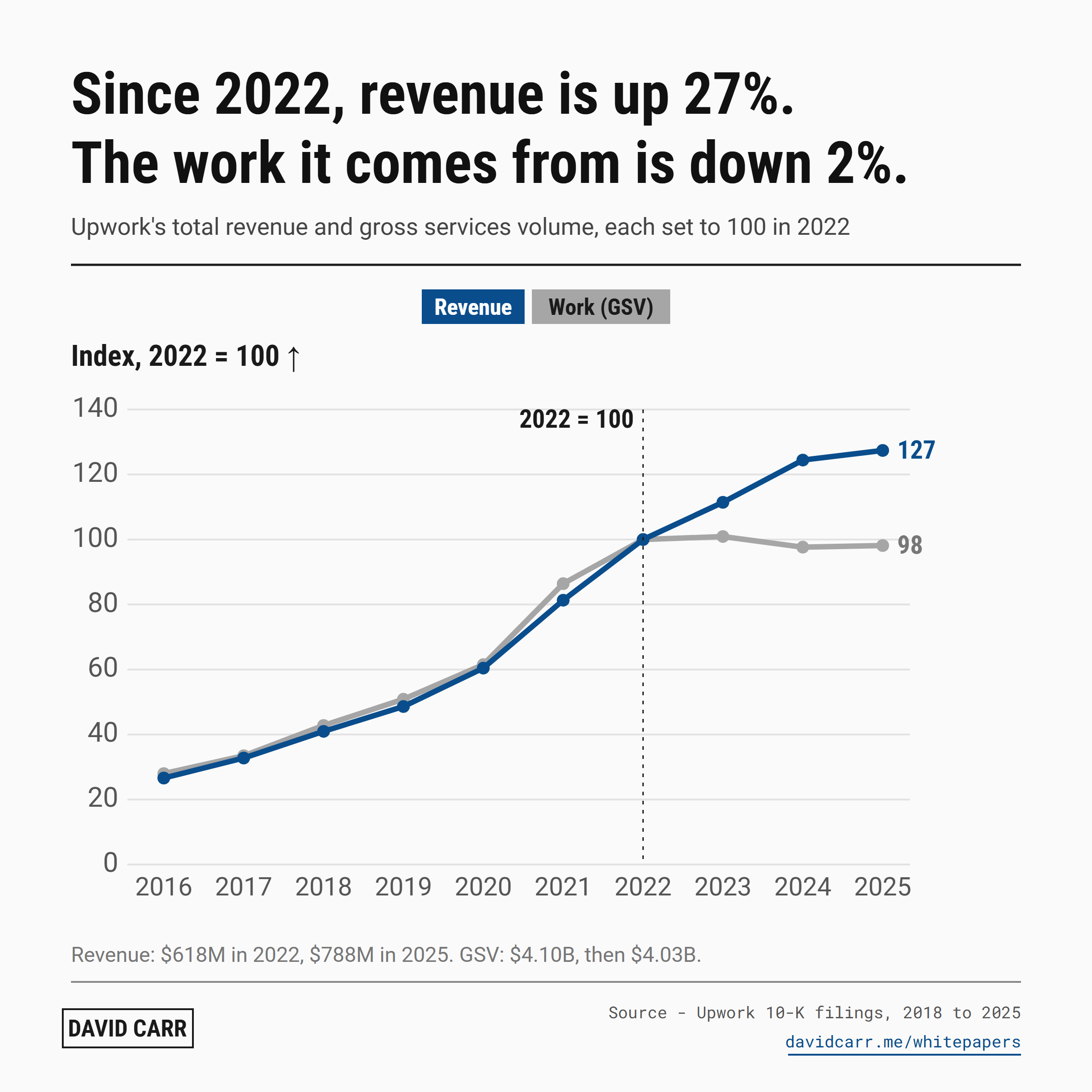
Since 2022, revenue is up 27%. The work it comes from is down 2%.
- Revenue: $618 million in 2022, $788 million in 2025
- GSV: $4.10 billion in 2022, $4.03 billion in 2025
Until 2022 the two lines moved together. Since then Upwork has earned more from the same amount of work. The next chart shows how.
Total revenue and GSV from the 10-K filings, each set to 100 in 2022. Upwork made a profit in 2023, 2024 and 2025 (2025 10-K).
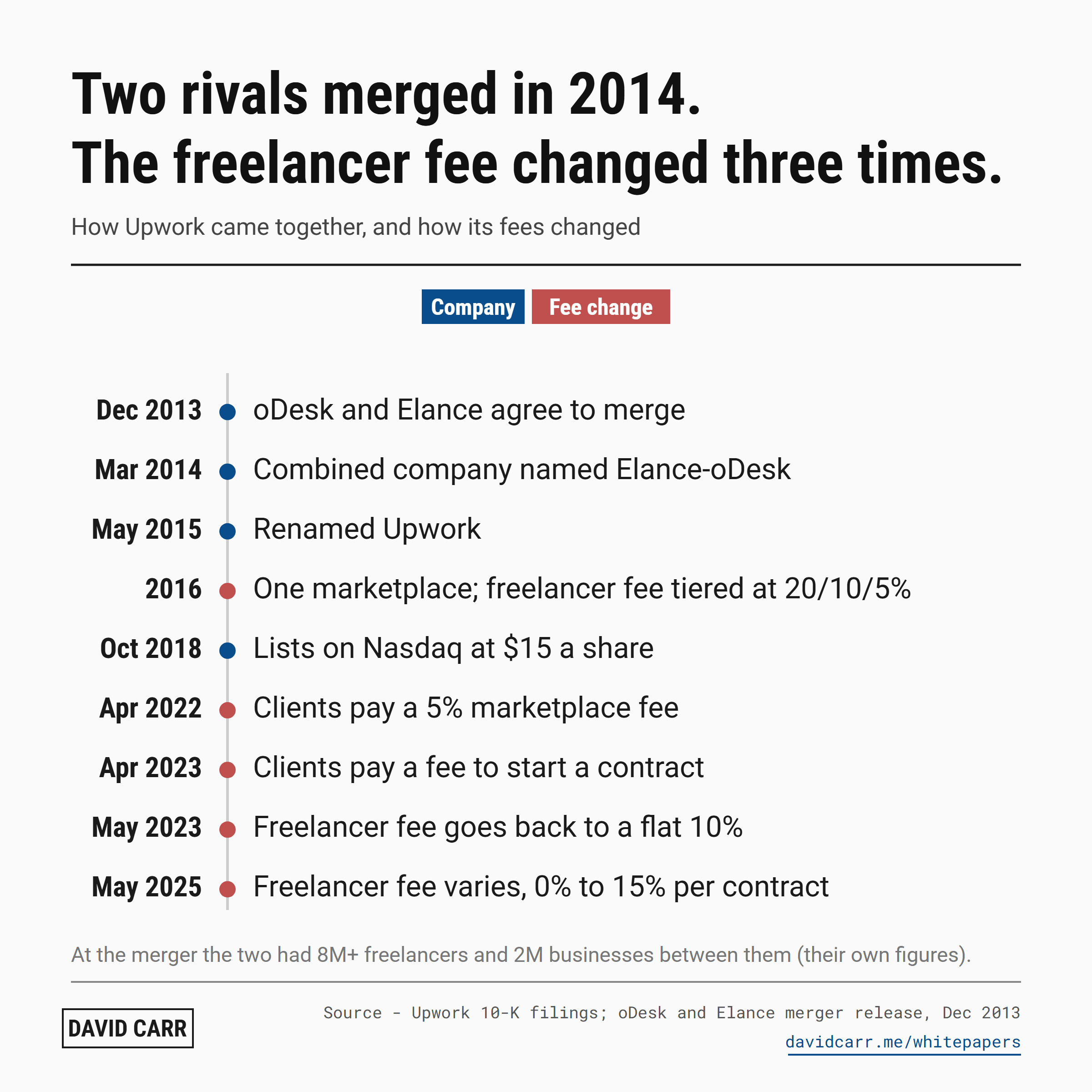
Two rivals merged in 2014. The freelancer fee changed three times.
- Dec 2013: oDesk and Elance agree to merge
- May 2015: renamed Upwork
- 2016: one marketplace, tiered freelancer fee
- Oct 2018: listed on Nasdaq at $15 a share
- May 2023: flat 10% freelancer fee
- May 2025: variable fee, 0% to 15% per contract
At the merger the two had more than 8 million freelancers and 2 million businesses between them, in over 180 countries, by their own count.
Dates from the Corporate Information and fee sections of the 2018, 2022, 2023 and 2025 10-K filings. Clients also started paying a 5% marketplace fee in April 2022.
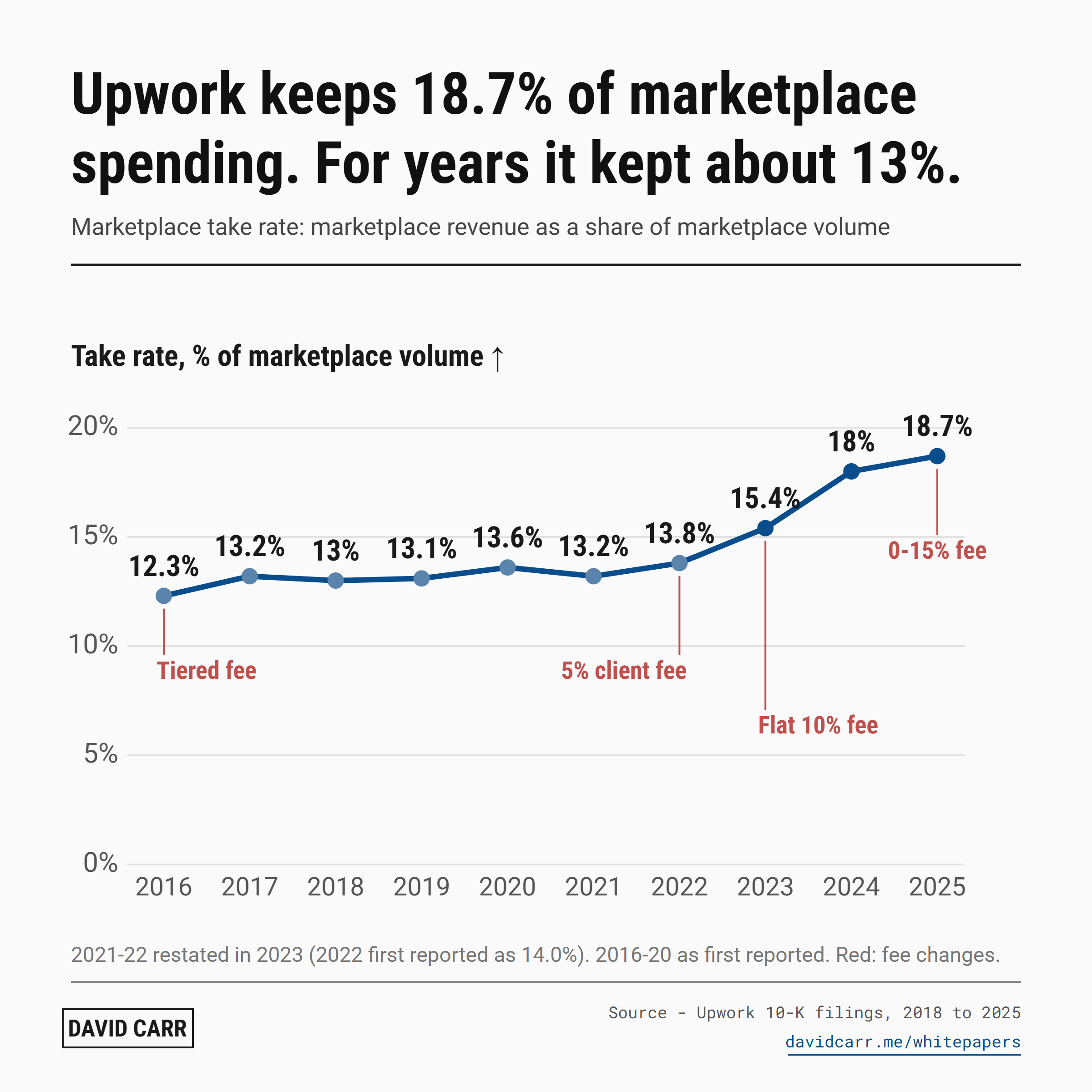
Upwork keeps 18.7% of marketplace spending. For years it kept about 13%.
- 2016: 12.3%
- 2019: 13.1%
- 2022: 13.8%
- 2023: 15.4%
- 2024: 18.0%
- 2025: 18.7%
The rise came with fee changes: a client fee in 2022, then a contract fee and dearer bidding from 2023. That is how revenue grew while the work stayed flat.
Marketplace take rate as stated in the 10-K filings. In 2023 Upwork restated 2021 and 2022 (2022 was first reported as 14.0%); 2016 to 2020 are as first reported.
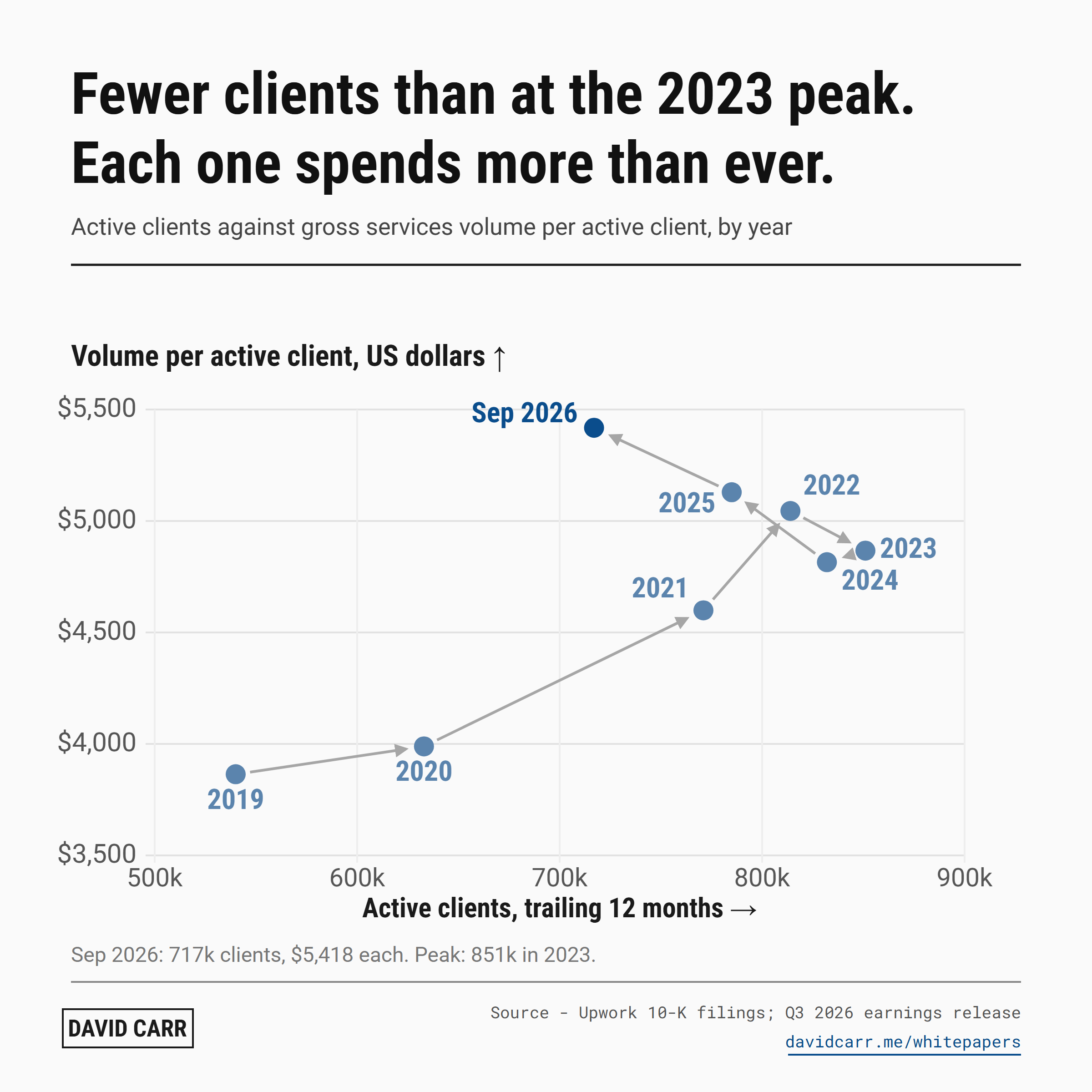
Fewer clients than at the 2023 peak. Each one spends more than ever.
- 2019: 540,000 clients, $3,864 each
- 2023: 851,000 clients, $4,867 each
- 2025: 785,000 clients, $5,129 each
- Sep 2026: 717,000 clients, $5,418 each
Fiverr, the nearest listed rival, shows the same shape: active buyers fell from 3.6 million to 3.1 million in 2025, and spend per buyer rose from $302 to $342 (Fiverr's results).
Active clients and GSV per active client are trailing 12-month figures from the 10-K filings and the Q3 2026 release. Upwork started counting this way in 2021, so the series begins in 2019.
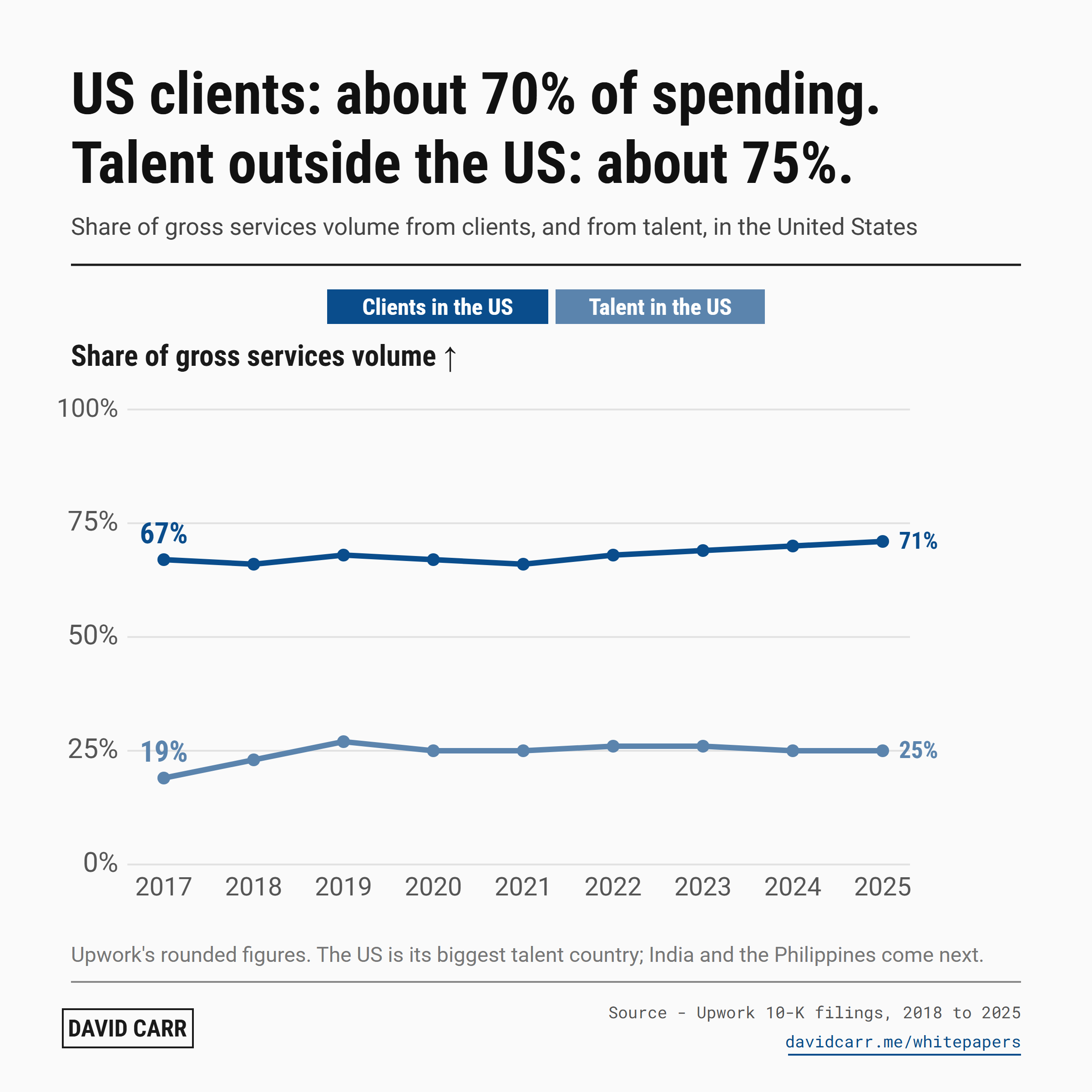
US clients: about 70% of spending. Talent outside the US: about 75%.
- Clients in the US: 67% of GSV in 2017, 71% in 2025
- Talent in the US: 19% in 2017, 25% in 2025
- No other client country above 10%
Most of the money comes from US clients, and most of the work is done by people in other countries. The US is still the biggest single country for talent. India and the Philippines come next.
Upwork's rounded "approximately" figures from each 10-K. It says it has customers in over 180 countries (2025 10-K). It gives no shares for other countries.
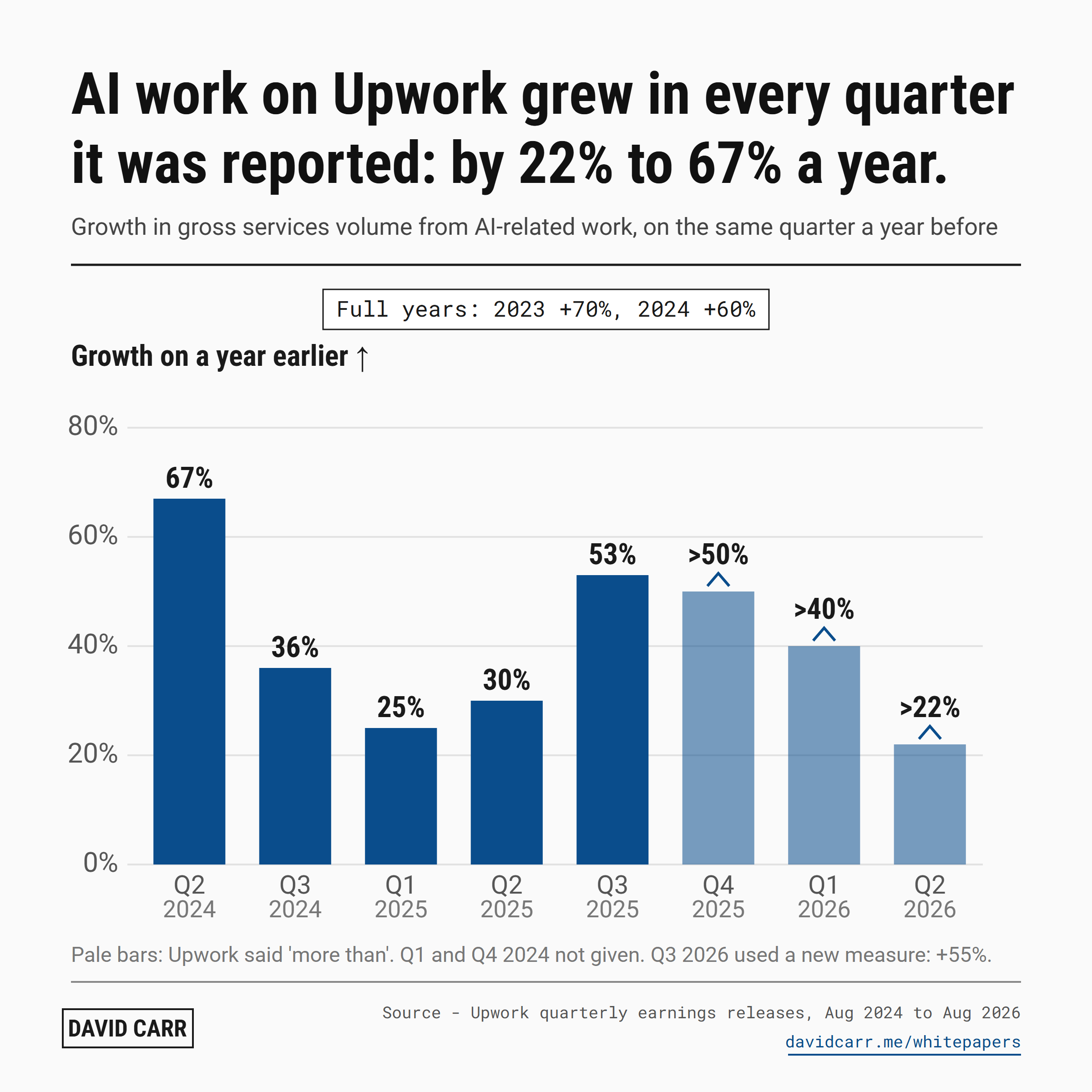
AI work on Upwork grew in every quarter it was reported: by 22% to 67% a year.
- 2023: +70%
- 2024: +60%
- Q3 2025: +53%
- Q4 2025: more than 50%, over $300 million a year
- Q2 2026: more than 22%
While total volume was flat, AI-related work kept growing. In Q3 2026 Upwork switched to a new measure, work by freelancers with AI skills: about $450 million a year, up 55%.
Each figure as stated in Upwork's earnings releases, for example Q4 2023, Q4 2024, Q4 2025, Q2 2026 and Q3 2026. Where Upwork said "more than", the bar shows the stated floor.
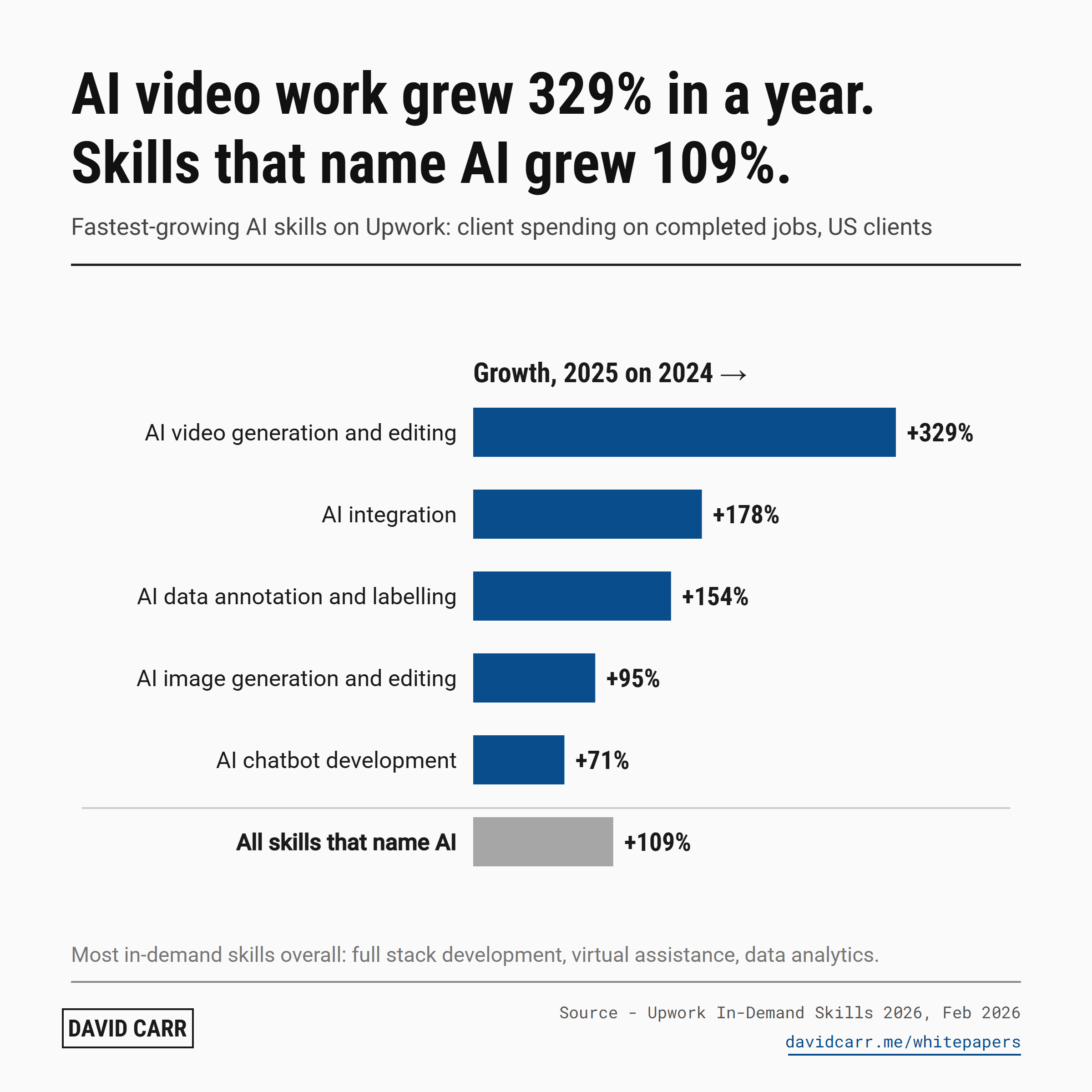
AI video work grew 329% in a year. Skills that name AI grew 109%.
- AI video generation and editing: +329%
- AI integration: +178%
- AI data annotation and labelling: +154%
- AI image generation and editing: +95%
- AI chatbot development: +71%
The fastest growth is in making video and images with AI, and in AI integration. The most in-demand skills overall are full stack development, virtual assistance, data analytics and graphic design.
Upwork's In-Demand Skills 2026 report, February 2026: growth in client spending on completed jobs by US clients, 2025 against 2024.
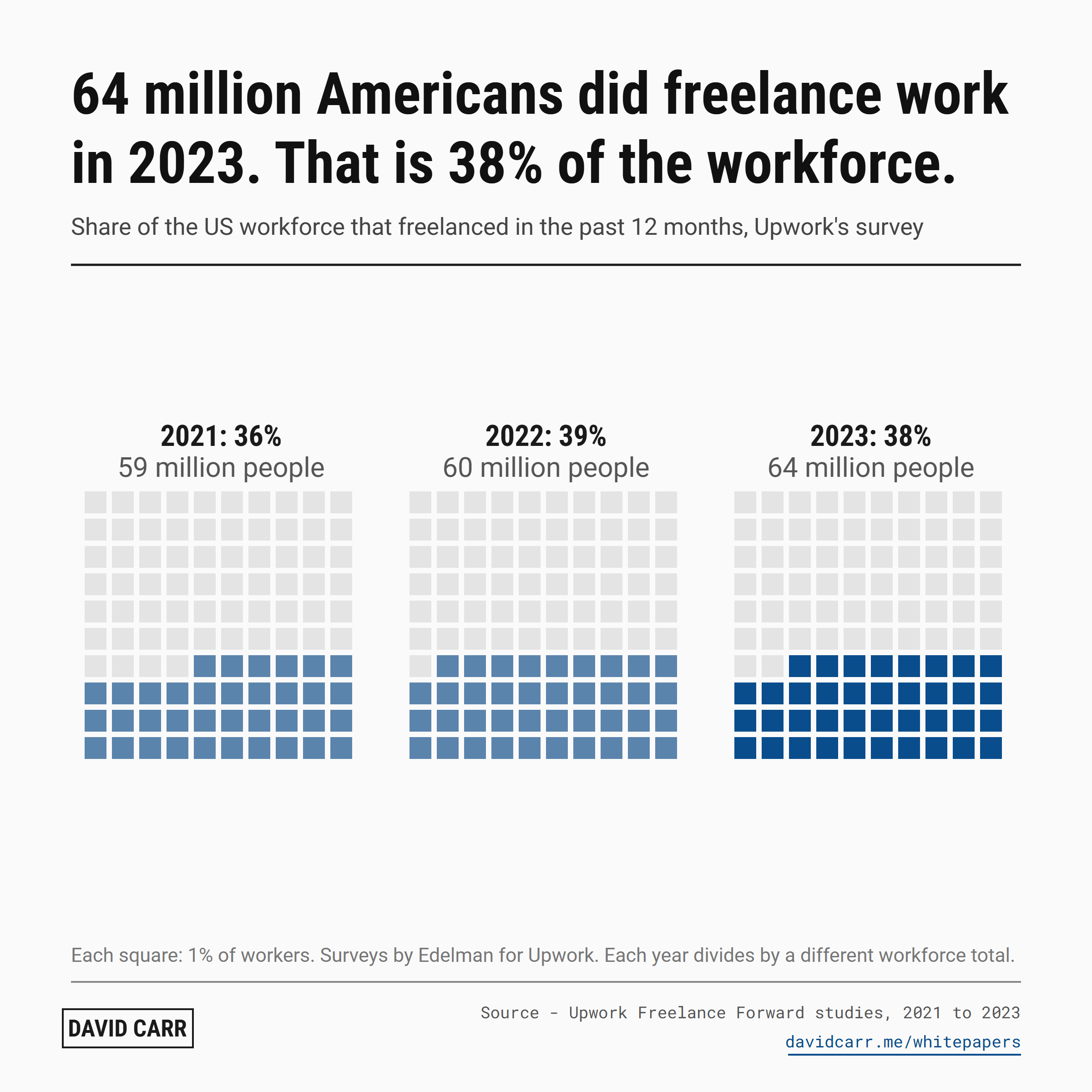
64 million Americans did freelance work in 2023. That is 38% of the workforce.
- 2021: 59 million, 36%
- 2022: 60 million, 39%
- 2023: 64 million, 38%
More than one American worker in three did some freelance work in each year. Upwork's survey counts anyone who did freelance work in the past 12 months.
Surveys of 3,000 to 6,000 US workers, run by Edelman Data & Intelligence for Upwork. Each year divides by a different workforce total, so 64 million shows as a smaller share than 60 million. No Freelance Forward study since 2023 was found.
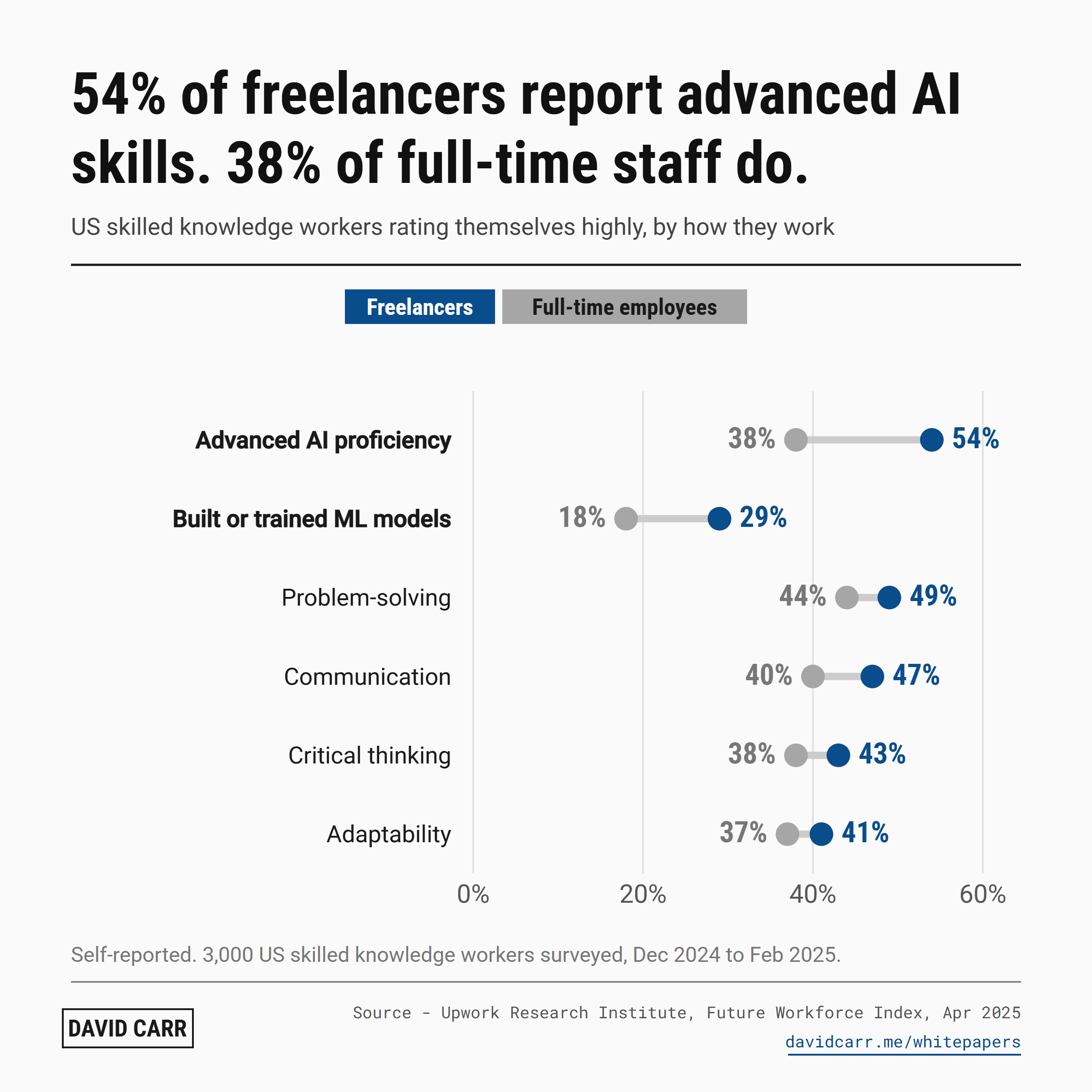
54% of freelancers report advanced AI skills. 38% of full-time staff do.
- Advanced AI proficiency: 54% vs 38%
- Built or trained ML models: 29% vs 18%
- Communication: 47% vs 40%
- Problem-solving: 49% vs 44%
Freelancers rated themselves higher on all six measures shown. The gap is widest on AI. Upwork's index also found 28% of US skilled knowledge workers freelance.
Upwork Research Institute, Future Workforce Index, April 2025. 3,000 US skilled knowledge workers, December 2024 to February 2025. Self-reported.
Method, caveats and sources
The short answer. About $4 billion of work goes through Upwork a year. That more than tripled from 2016 to 2022 and has been flat since. Upwork now keeps 18.7% of marketplace spending, up from about 13%, so revenue kept growing. It has fewer clients, each spending more. AI-related work is the part still growing fast.
Upwork's filings. Volume, revenue, take rate, clients and the US shares come from Upwork's 10-K filings for 2018 to 2025 and its quarterly earnings releases, all read on SEC EDGAR on 23 November 2026. Take rates for 2021 and 2022 were restated in 2023; earlier years are as first reported.
AI work. Growth rates are exactly as Upwork stated them. Some were "more than" a figure, and are shown at that figure. Q1 and Q4 2024 were not given as quarters. In Q3 2026 Upwork moved to a new measure, so that quarter is kept separate.
Surveys. Freelance Forward (2021 to 2023) and the Future Workforce Index (2025) are Upwork's own studies. They are self-reported and use different samples, so the two are not joined. Upwork also publishes earnings and pay figures from these studies; this page leaves them out.
Fiverr. Used once, for context, from its Q4 2025 results.
Also: Stripe, Deel and Working from home.