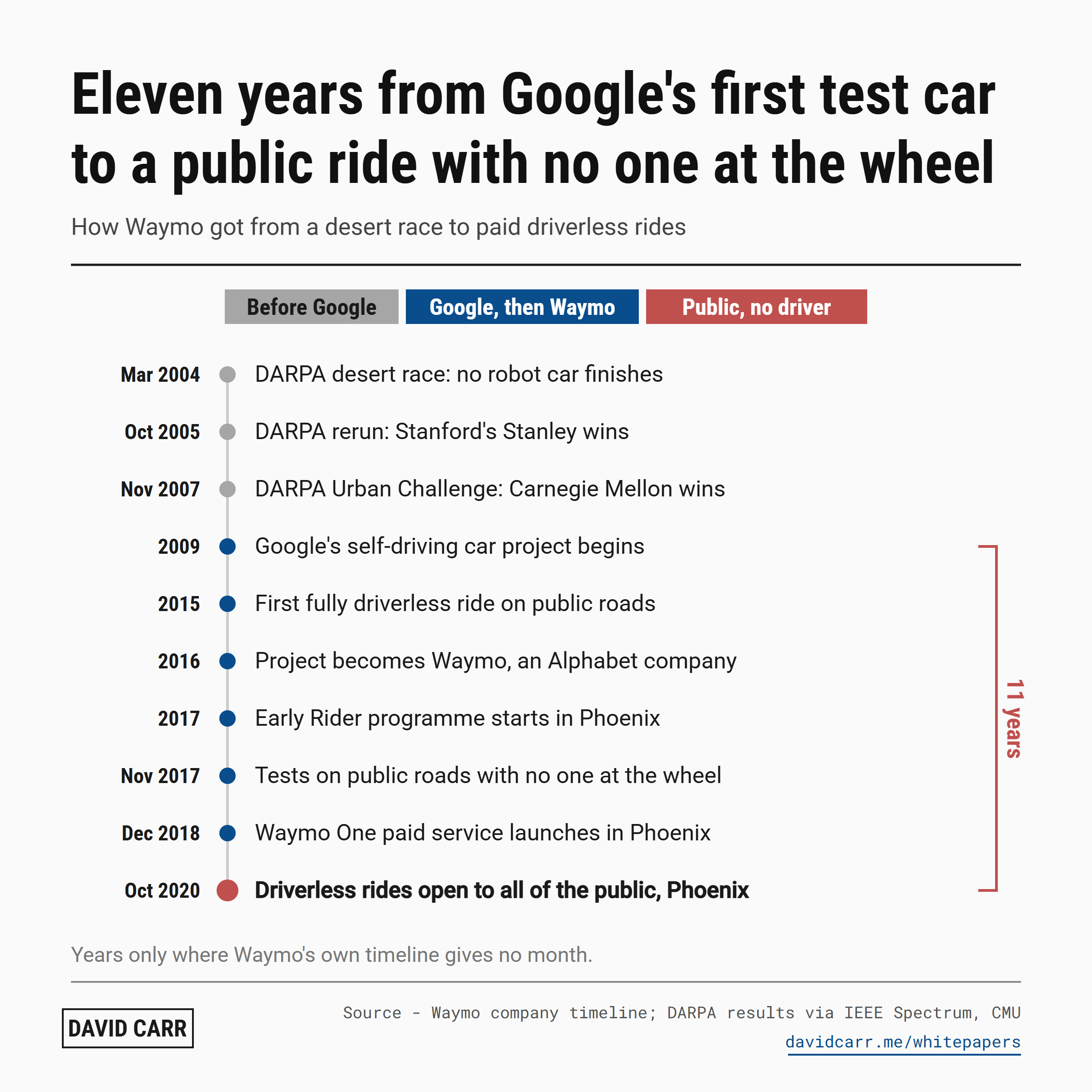
Eleven years from Google's first test car to a public ride with no one at the wheel
- 2004: DARPA's desert race, and no robot car finishes
- 2009: Google's self-driving car project begins
- 2016: it becomes Waymo, an Alphabet company
- Oct 2020: driverless rides open to anyone in Phoenix
The hard part was never a demo. Google had a driverless ride on public roads in 2015. It took five more years before any member of the public could book one, and then only in Phoenix.
From Waymo's own timeline, and IEEE Spectrum on the DARPA races. Next: who paid for those years.
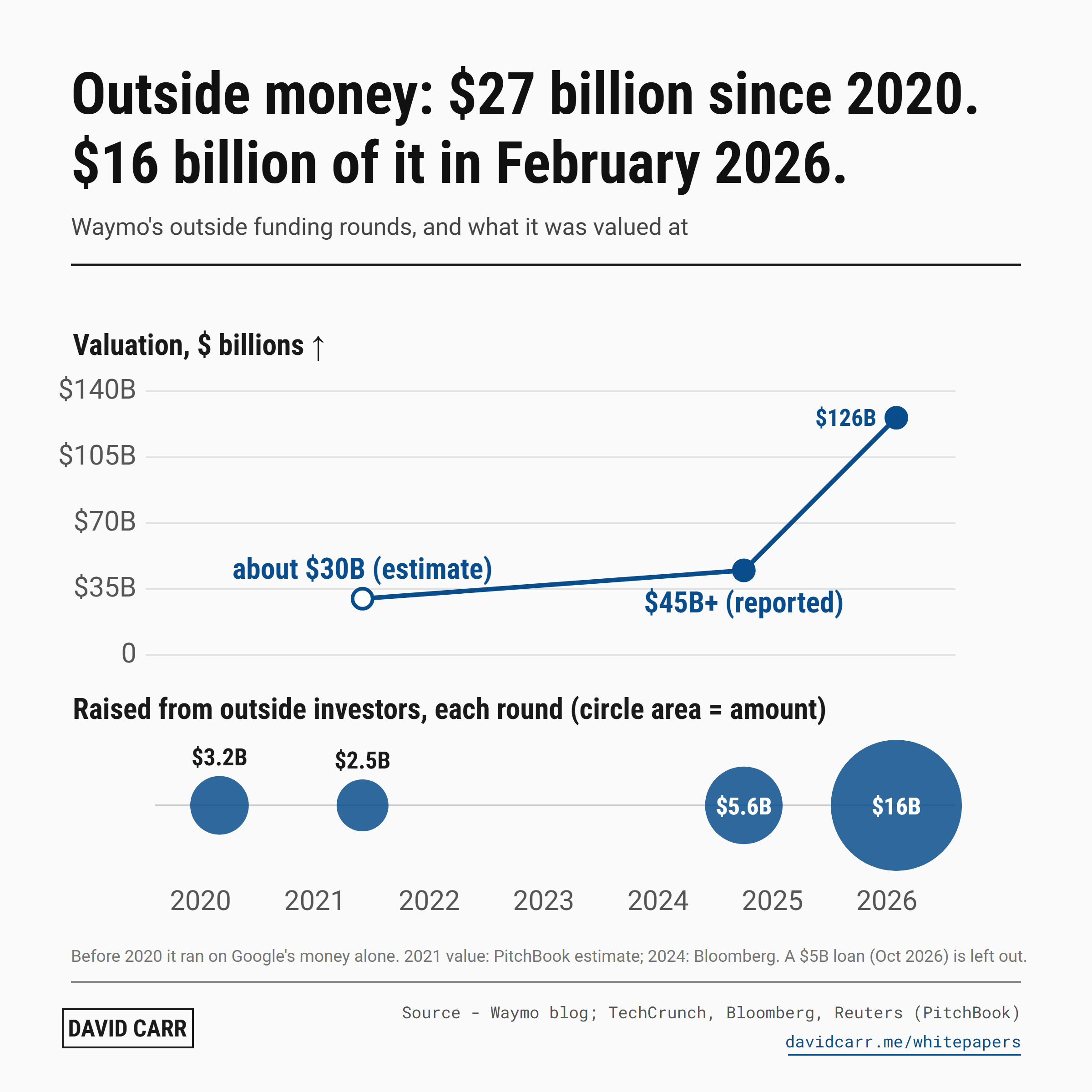
$27 billion from outside investors since 2020. $16 billion of it in February 2026.
- 2020: $3.2 billion, its first outside round
- 2021: $2.5 billion, valued at about $30 billion (estimate)
- 2024: $5.6 billion, valued at more than $45 billion (reported)
- 2026: $16 billion, valued at $126 billion
For its first eleven years it ran on Google's money alone. From 2021 to 2024 the valuation rose by about half. In the 16 months after, as the cars spread to more cities, it nearly tripled.
The 2021 and 2024 values come from PitchBook and Bloomberg, not Waymo. Alphabet's Other Bets, mostly Waymo, lost $2.05 billion in one quarter this year (Fortune). So how many people does that money carry?
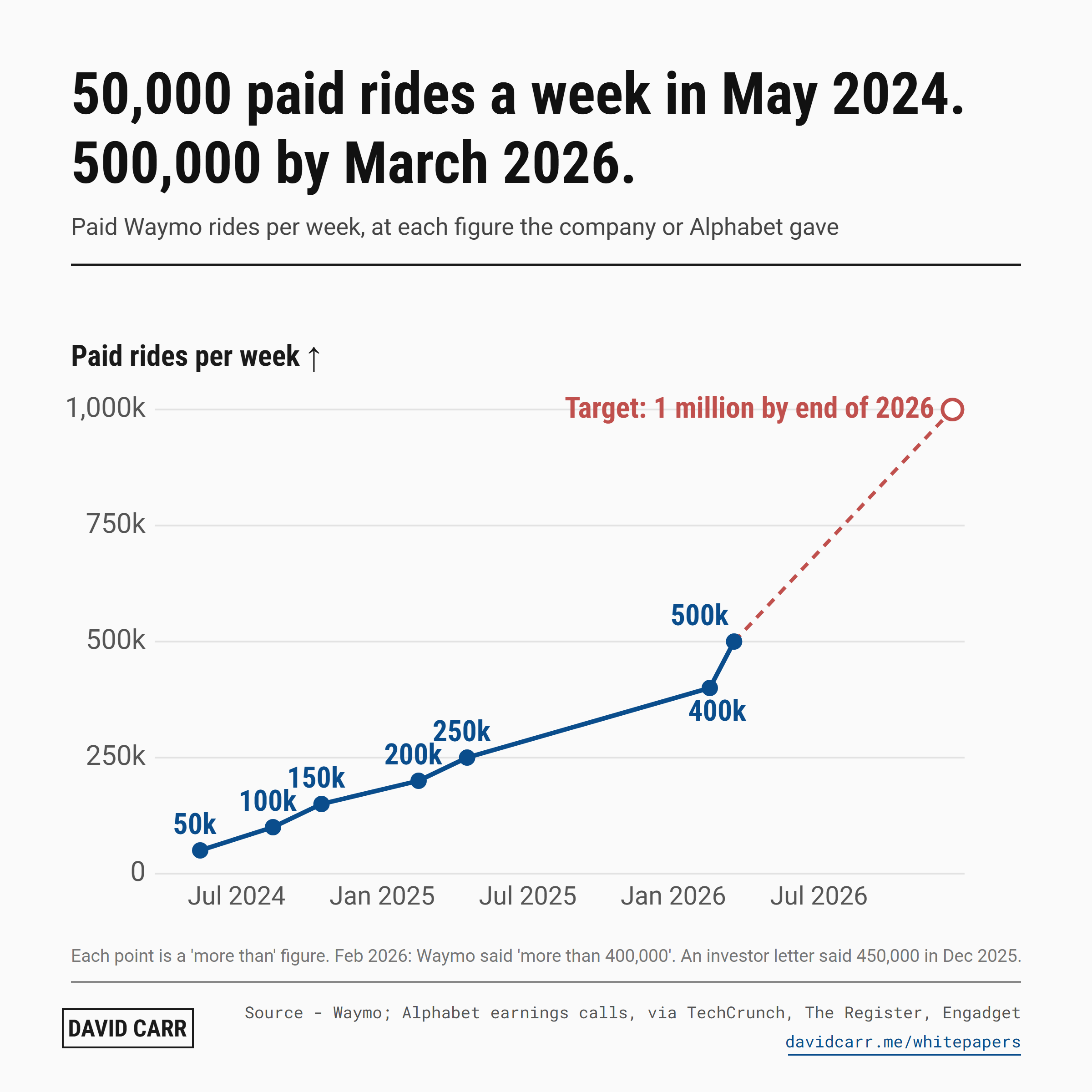
50,000 paid rides a week in May 2024. 500,000 by March 2026.
Ten times as many rides in under two years. Waymo said it gave 15 million rides in 2025, more than three times 2024.
Each figure is one Waymo or Alphabet gave. No newer figure had been published by 20 November 2026. Ten times sounds big, so the next chart puts it next to Uber.
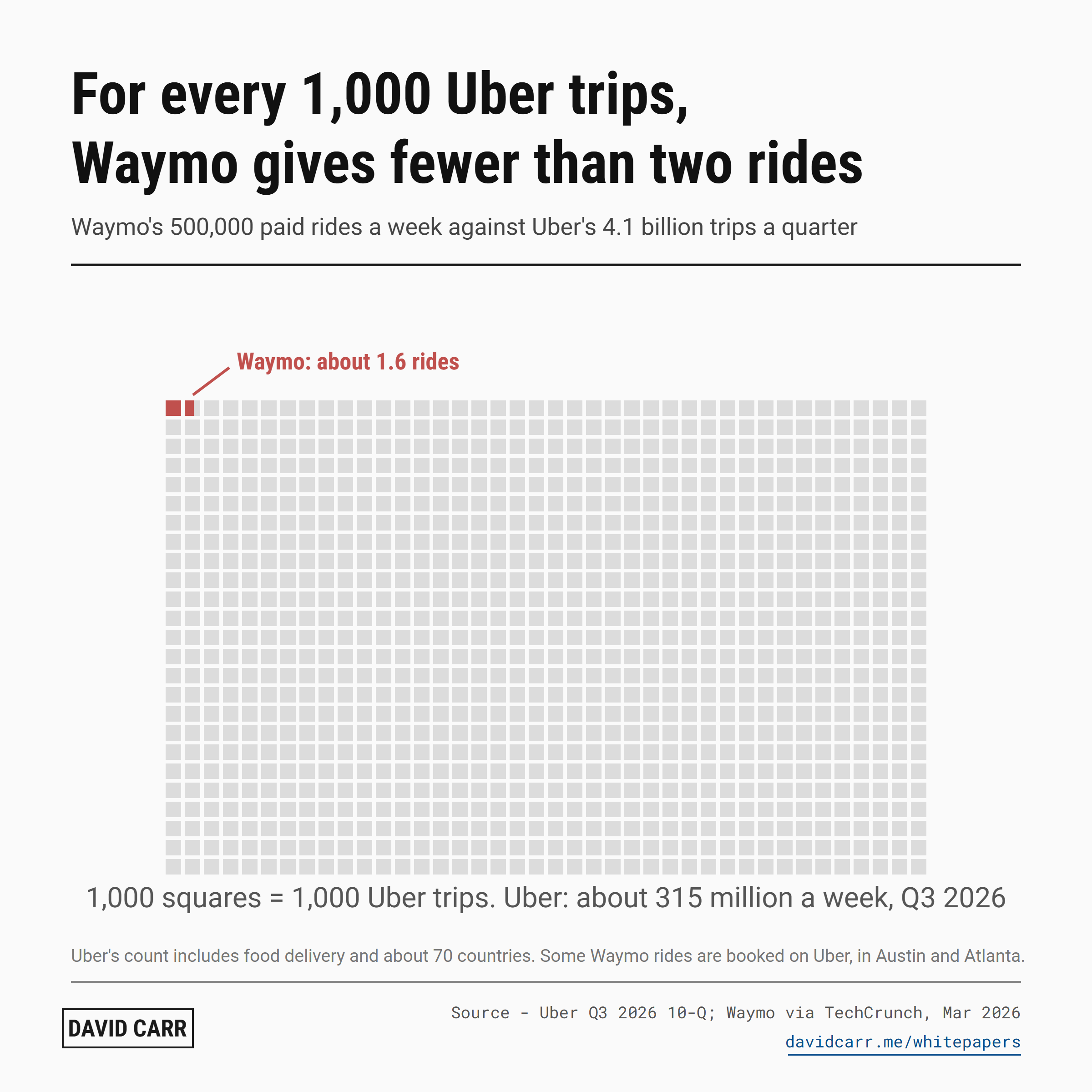
For every 1,000 Uber trips, Waymo gives fewer than two rides
- Uber: 4.1 billion trips in the third quarter of 2026, about 315 million a week
- Waymo: about 500,000 paid rides a week
- About 1.6 Waymo rides per 1,000 Uber trips
Fast growth from a small base. Waymo also works with Uber and Lyft: in Austin and Atlanta its cars are booked through the Uber app.
Uber's count, from its quarterly filing, includes food delivery and about 70 countries, so this is a sense of scale, not a market share. Where is the growth coming from?
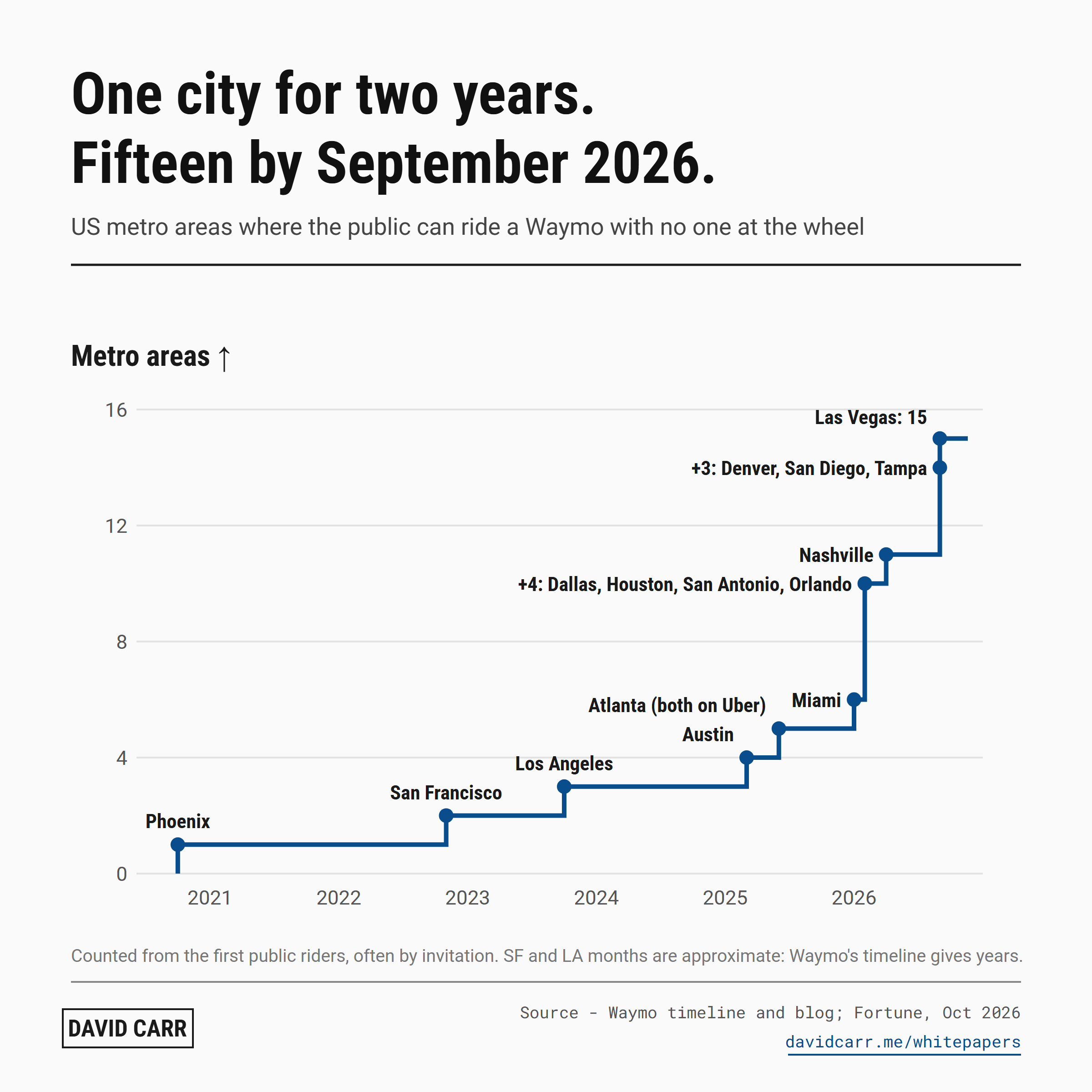
One city for two years. Fifteen by September 2026.
- Phoenix from October 2020
- San Francisco and Los Angeles next
- Austin and Atlanta in 2025, both on Uber
- Ten more in 2026, from Miami to Denver, San Diego and Tampa and Las Vegas
Most of the new cities came in 2026. Waymo opened four at once in February, the first time it had launched more than one city at a time.
Counted from the day the first public riders got in, often by invitation. The next chart asks what happened in the cities it already had.
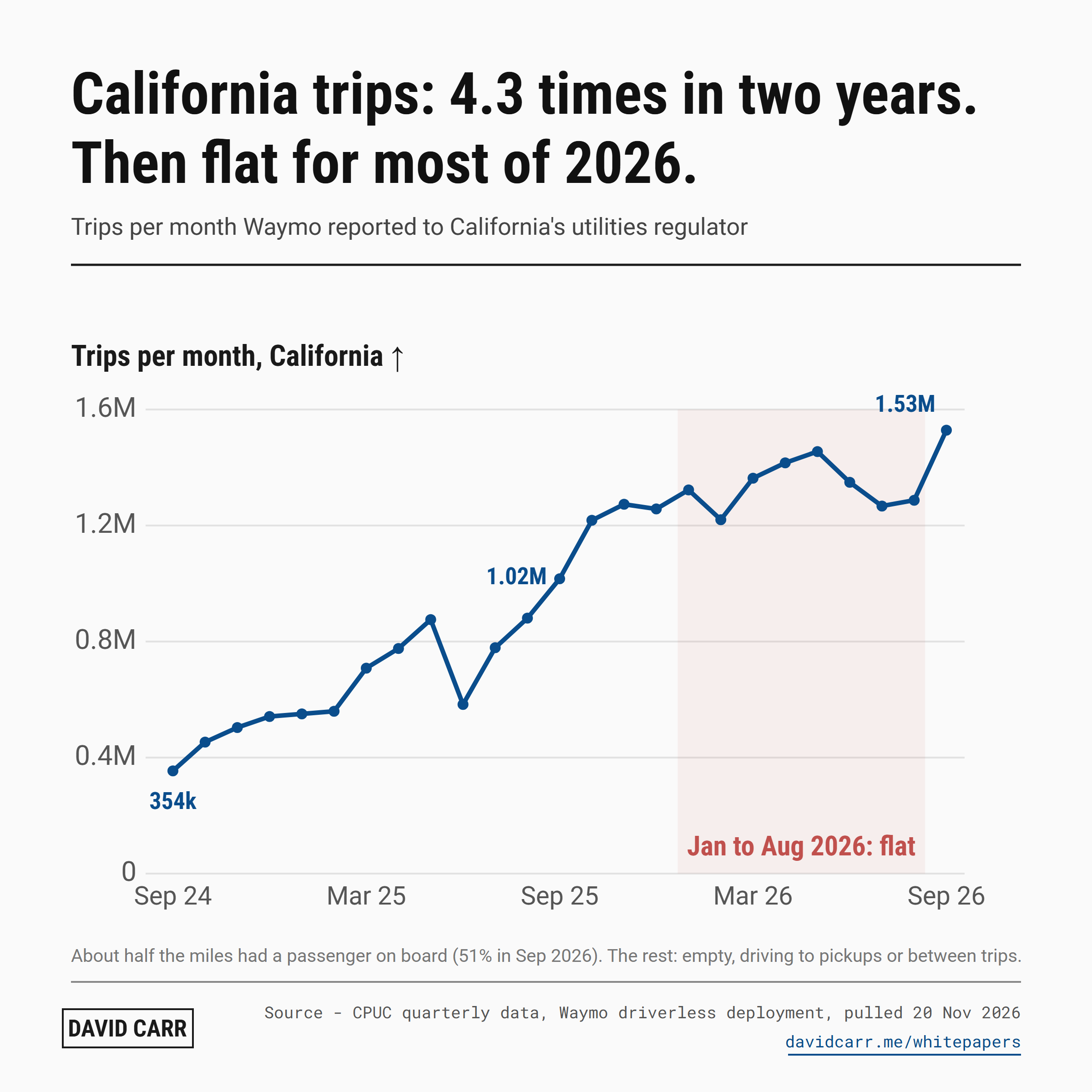
California trips grew 4.3 times in two years. Then flat for most of 2026.
- September 2024: 354,000 trips
- September 2025: 1.02 million
- January to August 2026: 1.2 to 1.45 million a month
- September 2026: 1.53 million
More than half of Waymo's driverless miles to June 2026 were in California. Growth there slowed while new cities opened elsewhere. About half the miles had a passenger on board; the rest were empty, driving to pickups or between trips.
Monthly totals Waymo files with the California Public Utilities Commission, pulled 20 November 2026. More cities and more miles bring the safety question.
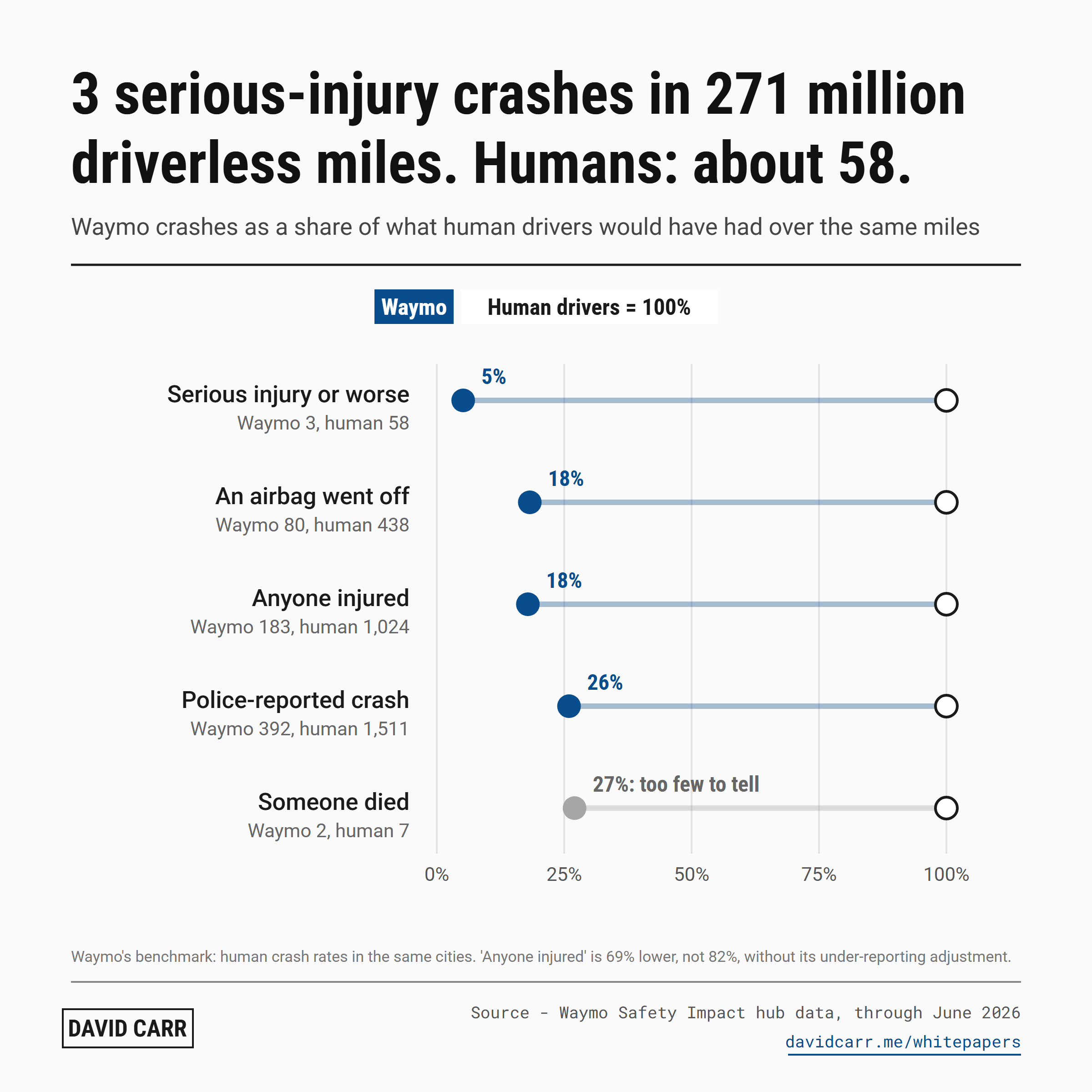
3 serious-injury crashes in 271 million driverless miles. Human drivers: about 58.
- Serious injury or worse: 3, against about 58 expected for human drivers
- Anyone injured: 183, against about 1,024
- Airbag went off: 80, against about 438
- Someone died: 2, against about 7: too few to say either way
Waymo's figures, set against human drivers on the same kinds of roads in the same cities. The serious-injury gap is large. The fatal-crash count is too small to read yet.
From the data files on Waymo's safety hub, through June 2026. The 82% fall in injury crashes includes an adjustment for human crashes that go unreported. Without it, the fall is 69%. Next: the regulator's list.
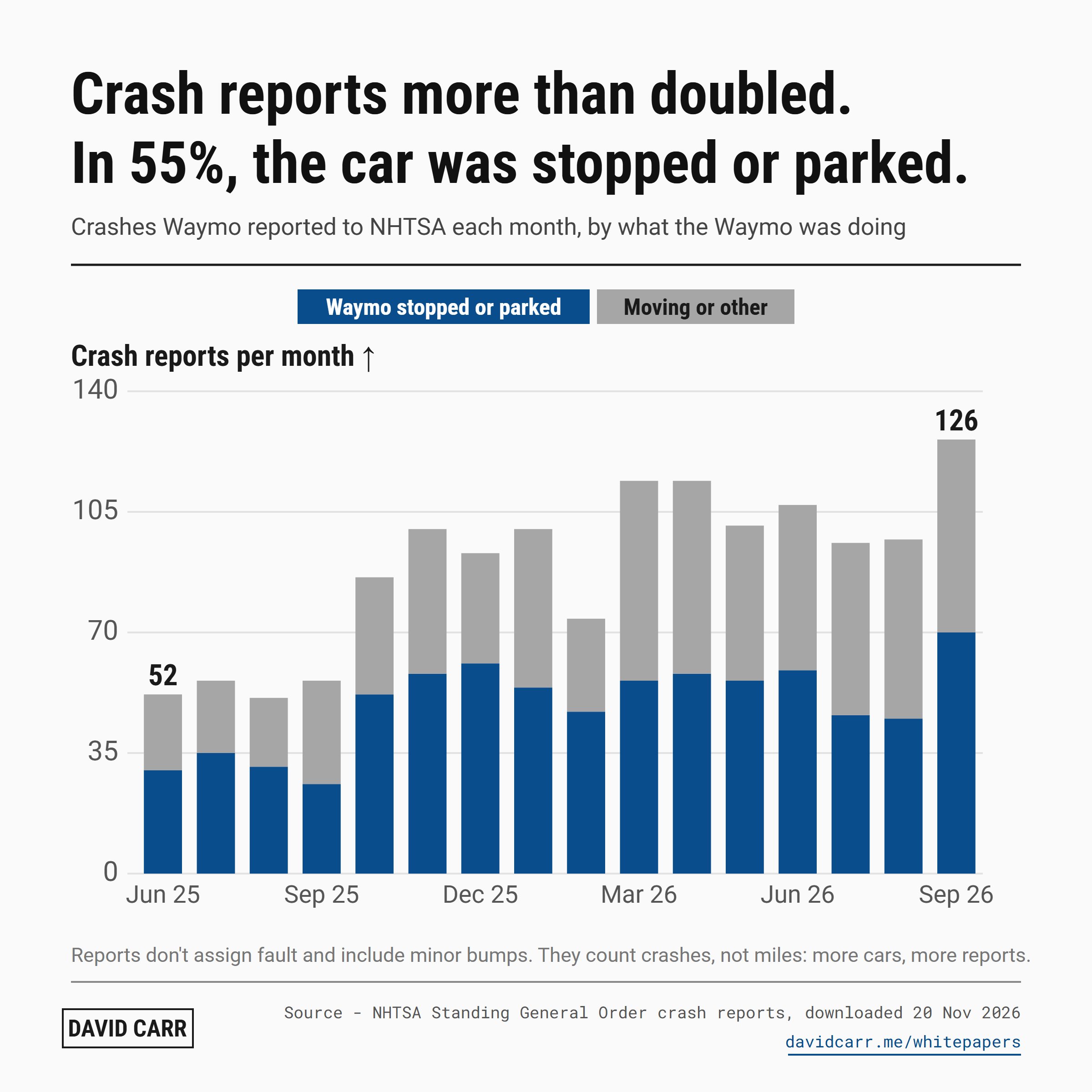
Crash reports to the US regulator more than doubled. In 55% the Waymo was stopped or parked.
- June 2025: 52 reports
- September 2026: 126
- 1,423 reports in those 16 months; in 784, the Waymo was stopped or parked
The two sources agree on what happened. For July 2025 to June 2026, 1,006 of NHTSA's 1,052 Waymo reports appear, by report number, in Waymo's own list. Nearly all the rest had a person on board, which Waymo's safety numbers leave out. They differ on the yardstick: NHTSA counts crashes, Waymo divides by miles.
From NHTSA's Standing General Order data, downloaded 20 November 2026. The rules changed in June 2025, so earlier months aren't comparable. Reports don't assign fault. Safety is also what ended its closest rival.
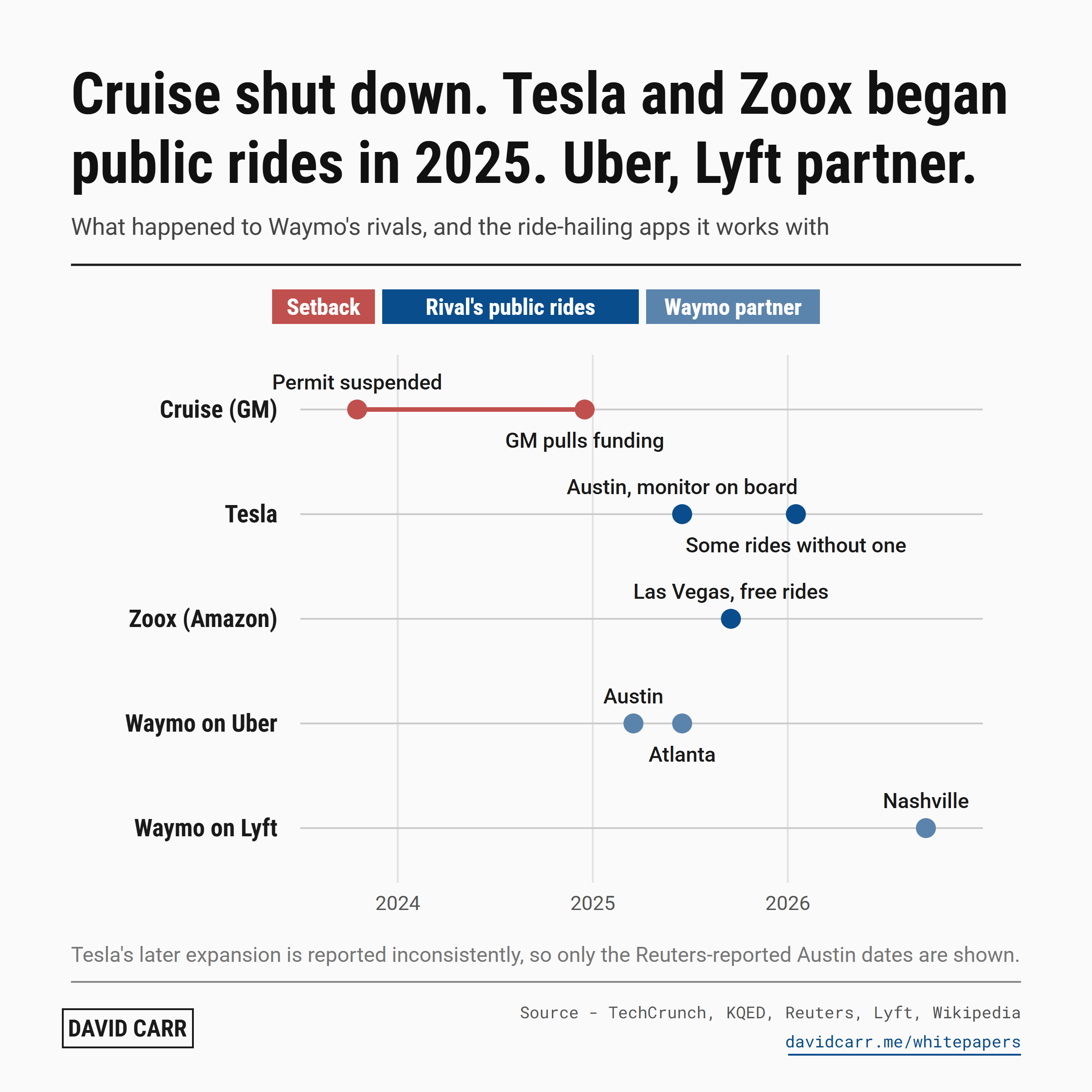
Cruise shut down. Tesla and Zoox began public rides in 2025. Uber and Lyft partner.
GM said it was leaving because of the time and money needed to scale, and a more crowded market. Uber and Lyft now put Waymo cars on their own apps in some cities.
Tesla's later expansion is reported inconsistently, so only the Austin dates Reuters reported are shown. The last question is where Waymo goes next.
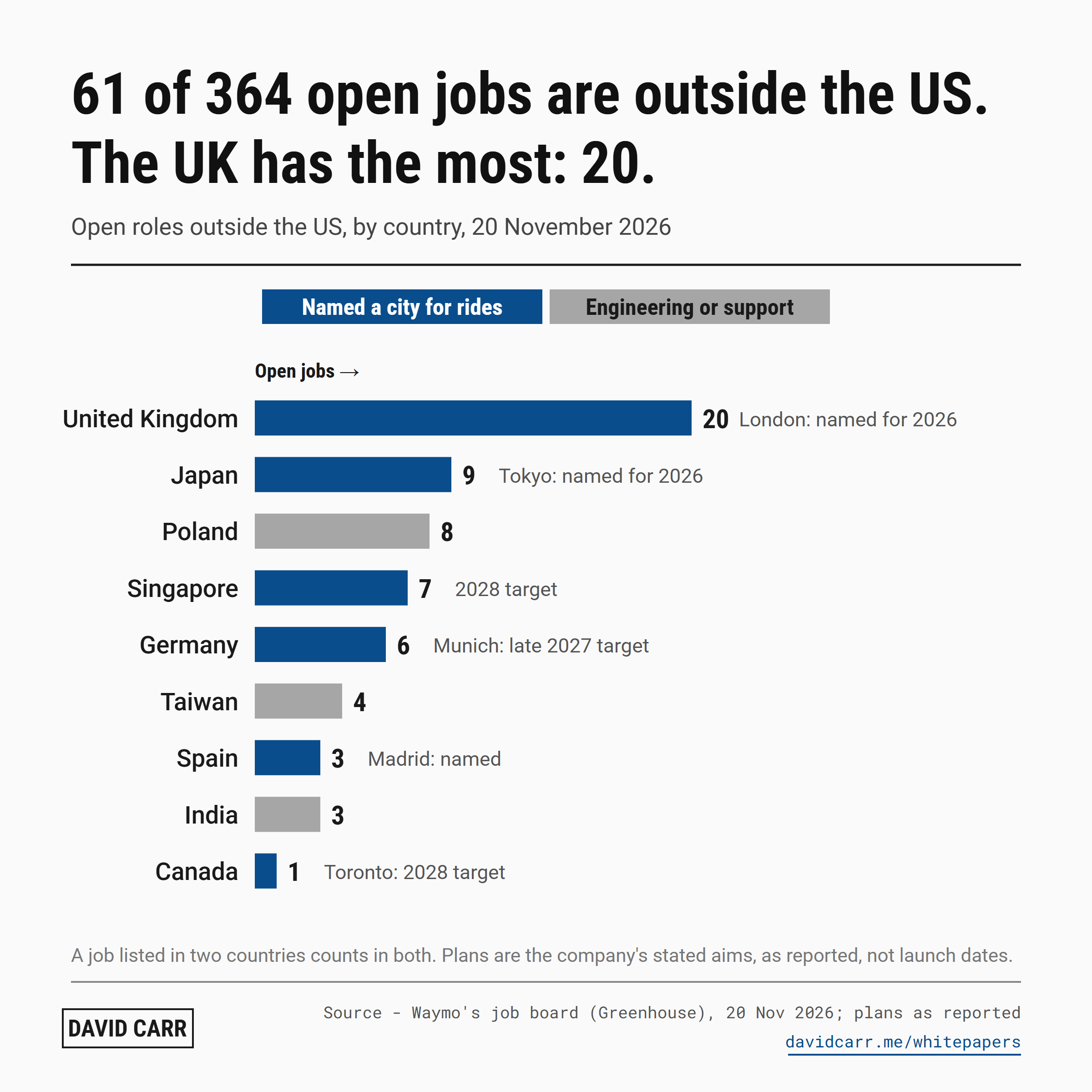
61 of Waymo's 364 open jobs are outside the US. The UK has the most.
- United Kingdom: 20
- Japan: 9
- Poland: 8
- Singapore: 7
- Germany: 6
The titles are the jobs you hire before a launch: market operations leads, emergency services liaisons and local lawyers in Munich, Madrid and Singapore, and a rider-only readiness manager in Japan. Waymo named London and Tokyo for 2026.
Waymo's job board, 20 November 2026. A job listed in two countries counts in both. Munich, Singapore and Toronto dates are the company's aims as reported in the press.
Method, caveats and sources
The short answer. It took Waymo eleven years to put a member of the public in a car with no driver. Since then it has copied what worked in Phoenix into fifteen cities and grown to 500,000 paid rides a week, still under two for every 1,000 Uber trips. Its own crash data and the regulator's crash list both grow as it grows. They agree on the crashes, and per mile Waymo's serious-injury rate is about a twentieth of human drivers'.
Waymo is part of Alphabet. It publishes no accounts of its own. Rides, cities and the 2026 valuation are Waymo's figures. The 2021 and 2024 valuations are a PitchBook estimate and a Bloomberg report, and are marked that way.
California. Waymo files monthly totals with the CPUC each quarter. I used the small monthly summary file in each quarter's data, September 2024 to September 2026. Earlier files are combined with Cruise and have no monthly summary.
Safety, two sources. Waymo's safety hub publishes its crash list, rider-only miles (271 million through June 2026) and a human benchmark built from police-reported crashes in the same cities. NHTSA's Standing General Order file lists every crash a company reports. I matched the two by report number: they share 1,006 of NHTSA's 1,052 Waymo reports for July 2025 to June 2026. Nearly all the rest had a person on board. NHTSA reports are unverified, don't assign fault, and include minor bumps. Counts aren't rates.
Jobs. Every open role on Waymo's Greenhouse job board on 20 November 2026, grouped by country from the listed location.
Also: Stripe and Anthropic.