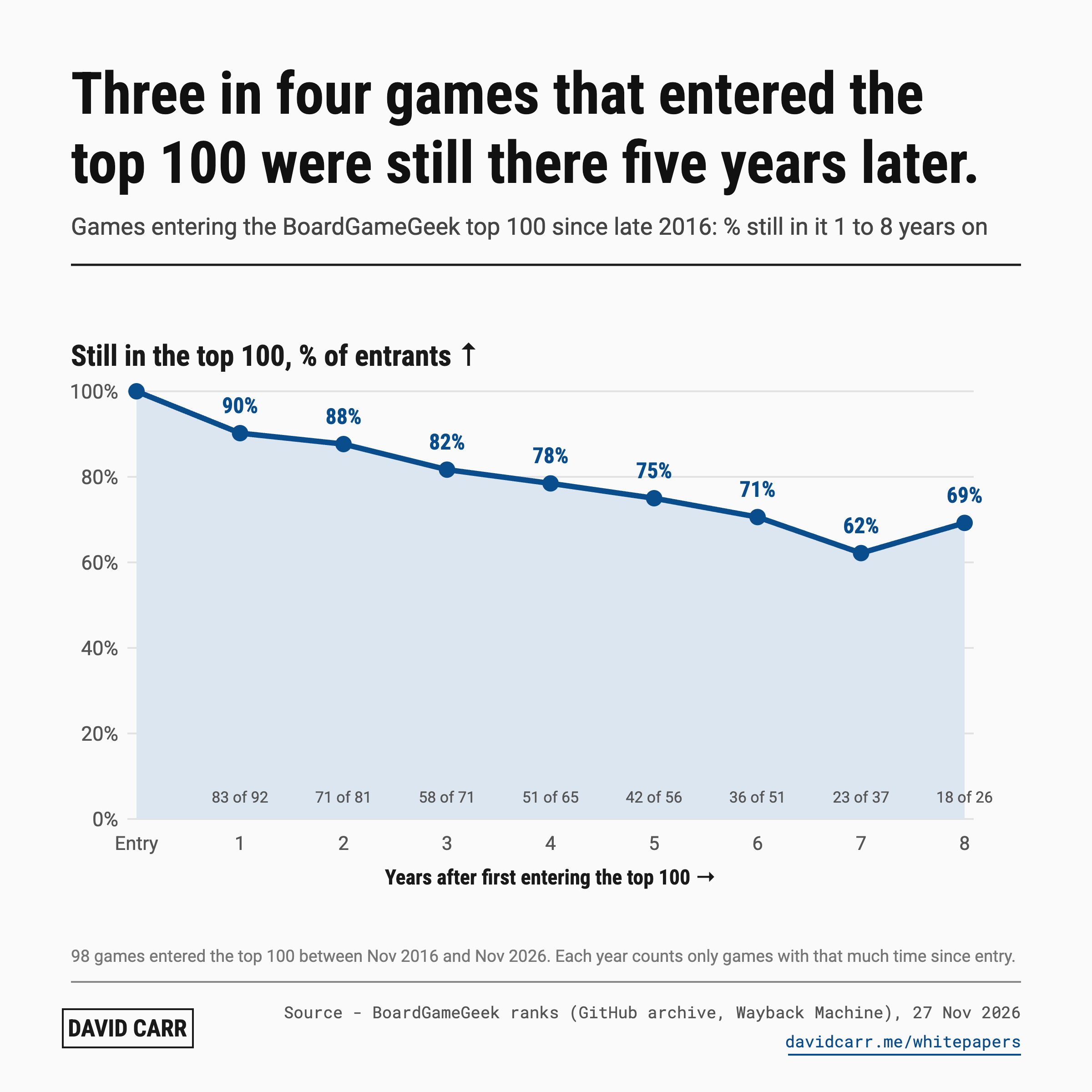
Three in four games that entered the top 100 were still there five years later.
- 98 games entered the BoardGameGeek top 100 between November 2016 and November 2026
- Still in the top 100 one year later: 90% (83 of 92)
- Three years later: 82%; five years later: 75% (42 of 56)
- Eight years later: 69% (18 of 26)
Getting into the top 100 is the hard part. Once a game is in, it tends to stay for years.
Entry = the first monthly check a game was in the top 100, for games not already in it in October 2016. Each year counts only games that entered long enough ago.
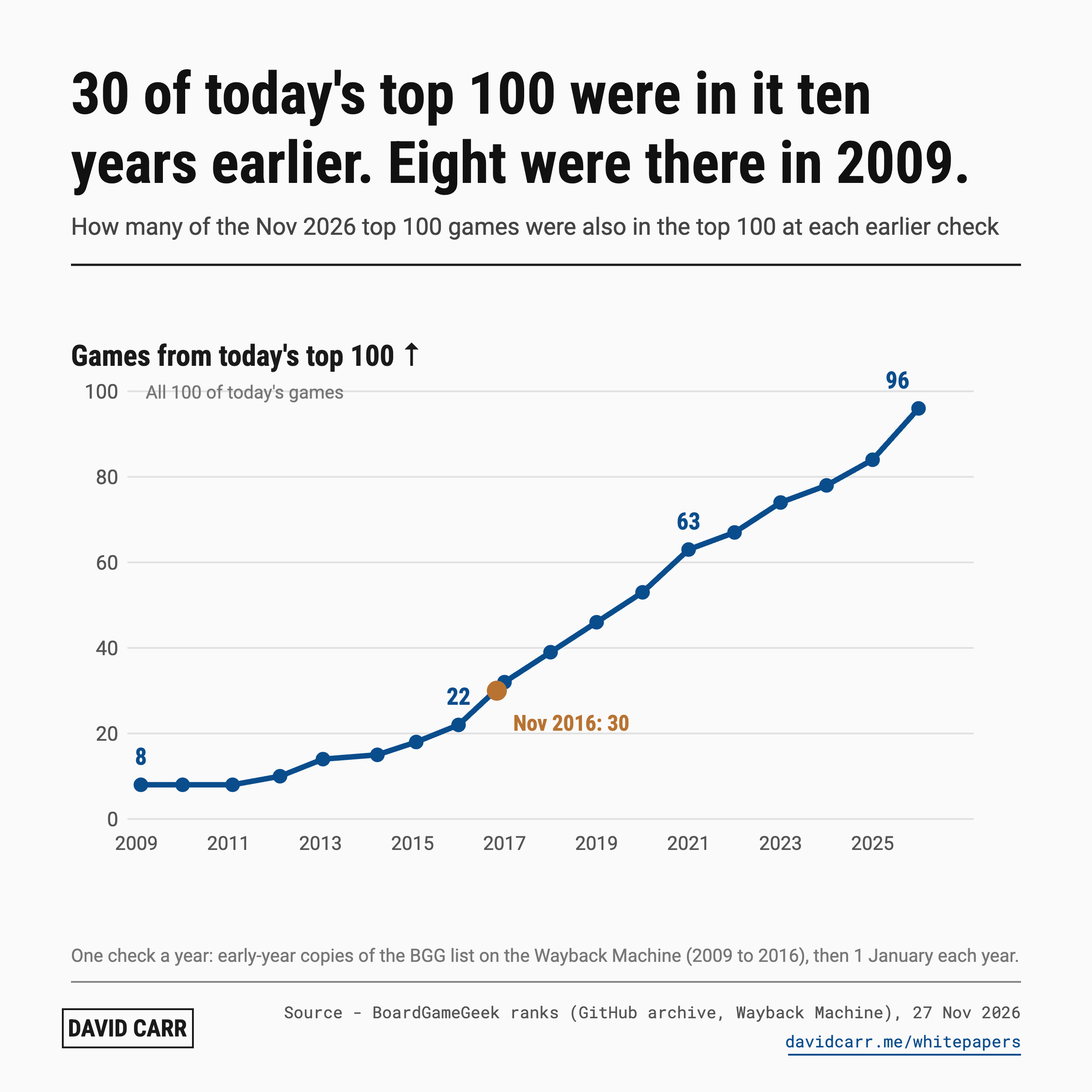
30 of today's top 100 were in it ten years earlier. Eight were there in 2009.
- In the top 100 in November 2025: 95 of today's games
- November 2021: 66
- November 2016: 30
- Early 2009: 8
The list turns over slowly, a few games a year, but over a decade most of it changes.
Today = 1 November 2026. Earlier checks: one a year, plus the same month five and ten years before.
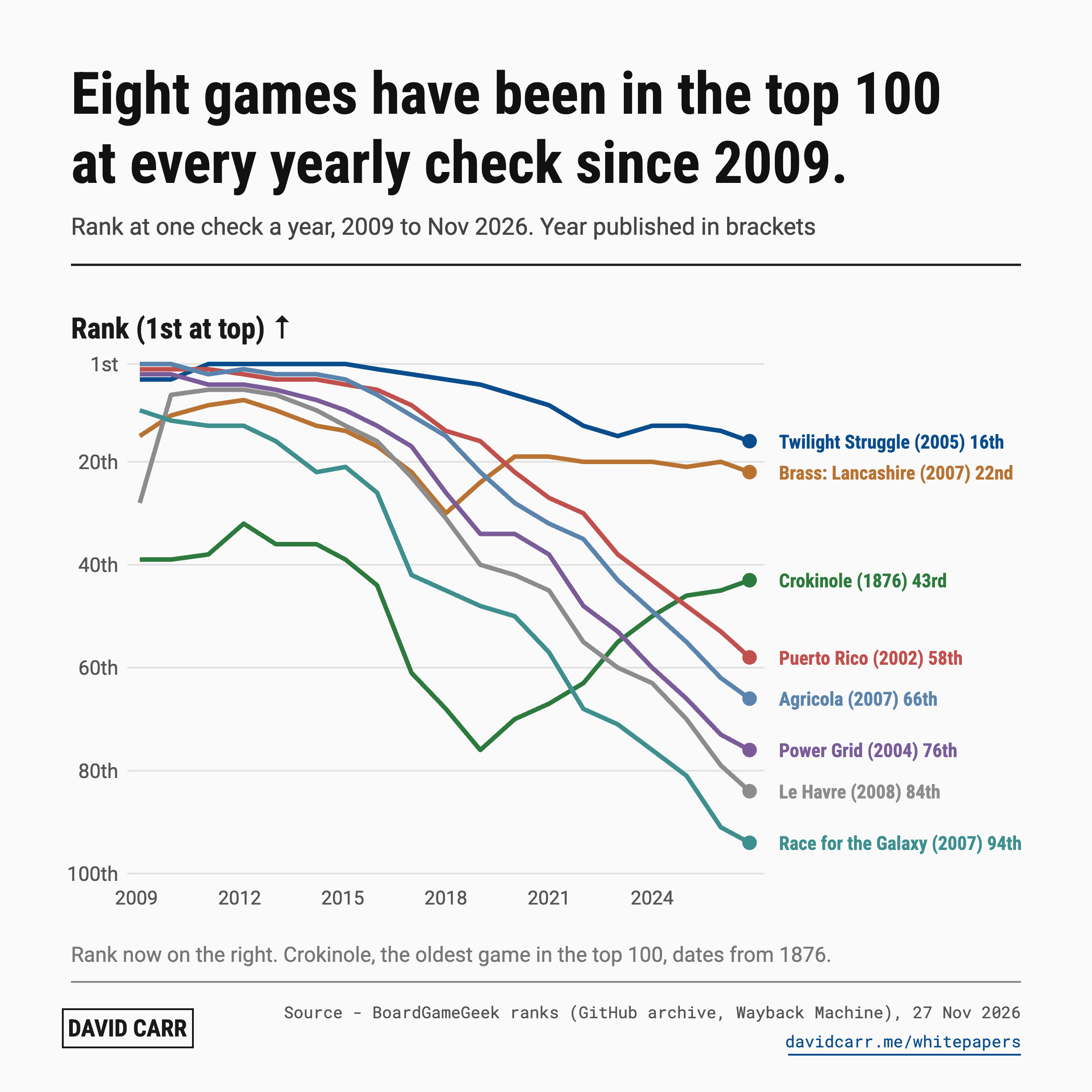
Eight games have been in the top 100 at every yearly check since 2009.
- Twilight Struggle (2005): 4th in 2009, No. 1 from 2011 to 2015, 16th now
- Brass: Lancashire (2007): 15th in 2009, 22nd now
- Crokinole (1876): 39th in 2009, 43rd now, and the oldest game in the top 100
- Puerto Rico, Agricola, Power Grid, Le Havre and Race for the Galaxy: all top 30 in 2009, all still in
Most of the eight have moved down as newer games arrived, but none has left. Crokinole, a wooden flicking game, has climbed back up since 2019.
One check a year, 2009 to 2026. Brass: Lancashire was listed as Brass in the early years; same entry.
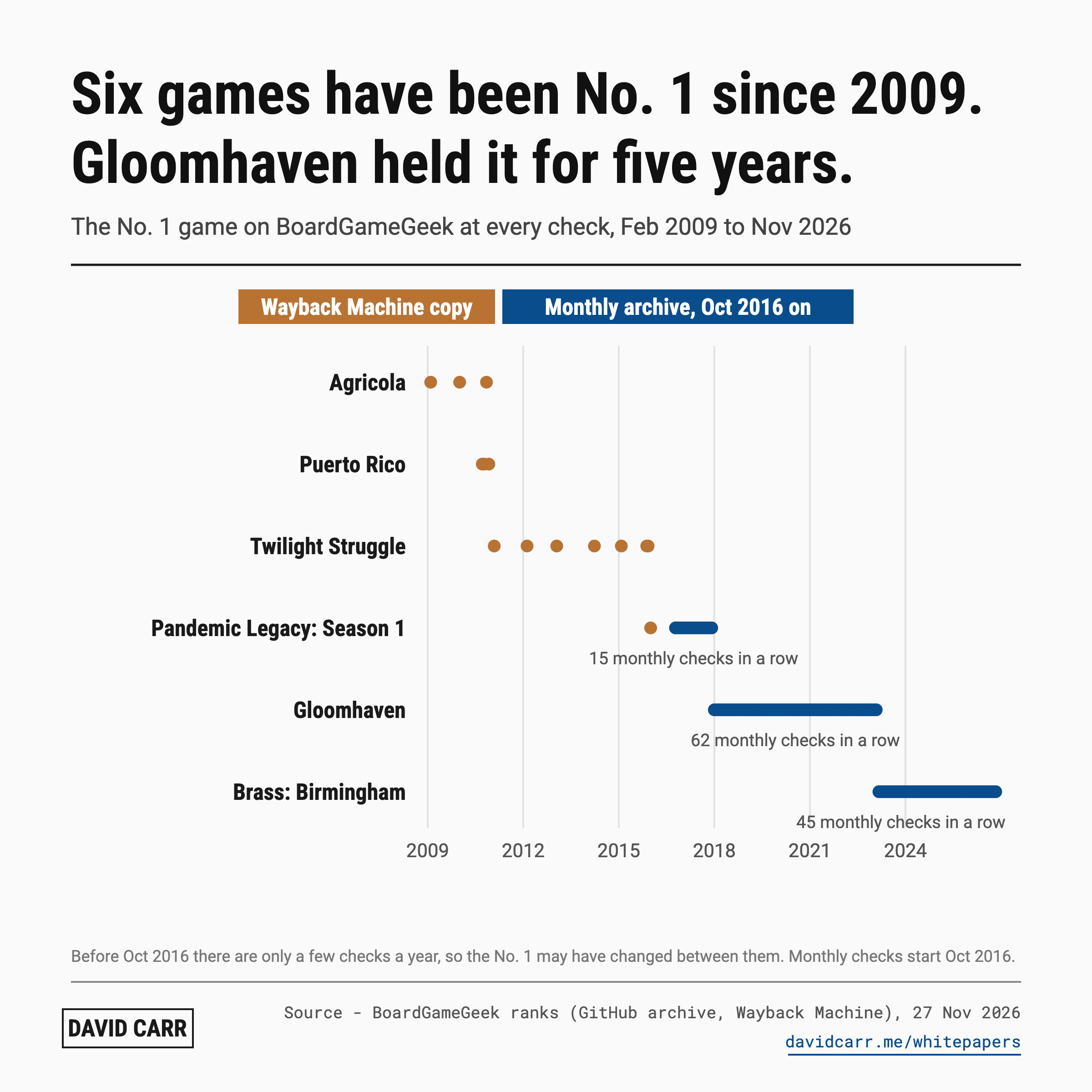
Six games have been No. 1 since 2009. Gloomhaven held it for five years.
- Agricola and Puerto Rico swapped the top spot at the checks in 2009 and 2010
- Twilight Struggle was No. 1 at every check from February 2011 to December 2015
- Pandemic Legacy: Season 1: No. 1 from early 2016 to December 2017
- Gloomhaven: 62 monthly checks in a row, January 2018 to February 2023
- Brass: Birmingham: No. 1 since March 2023, 45 monthly checks so far
The top spot changes hands rarely. Each of the last four No. 1s held it for at least a year and a half.
Before October 2016 there are only a few saved copies of the list a year, so the No. 1 may have changed between them.
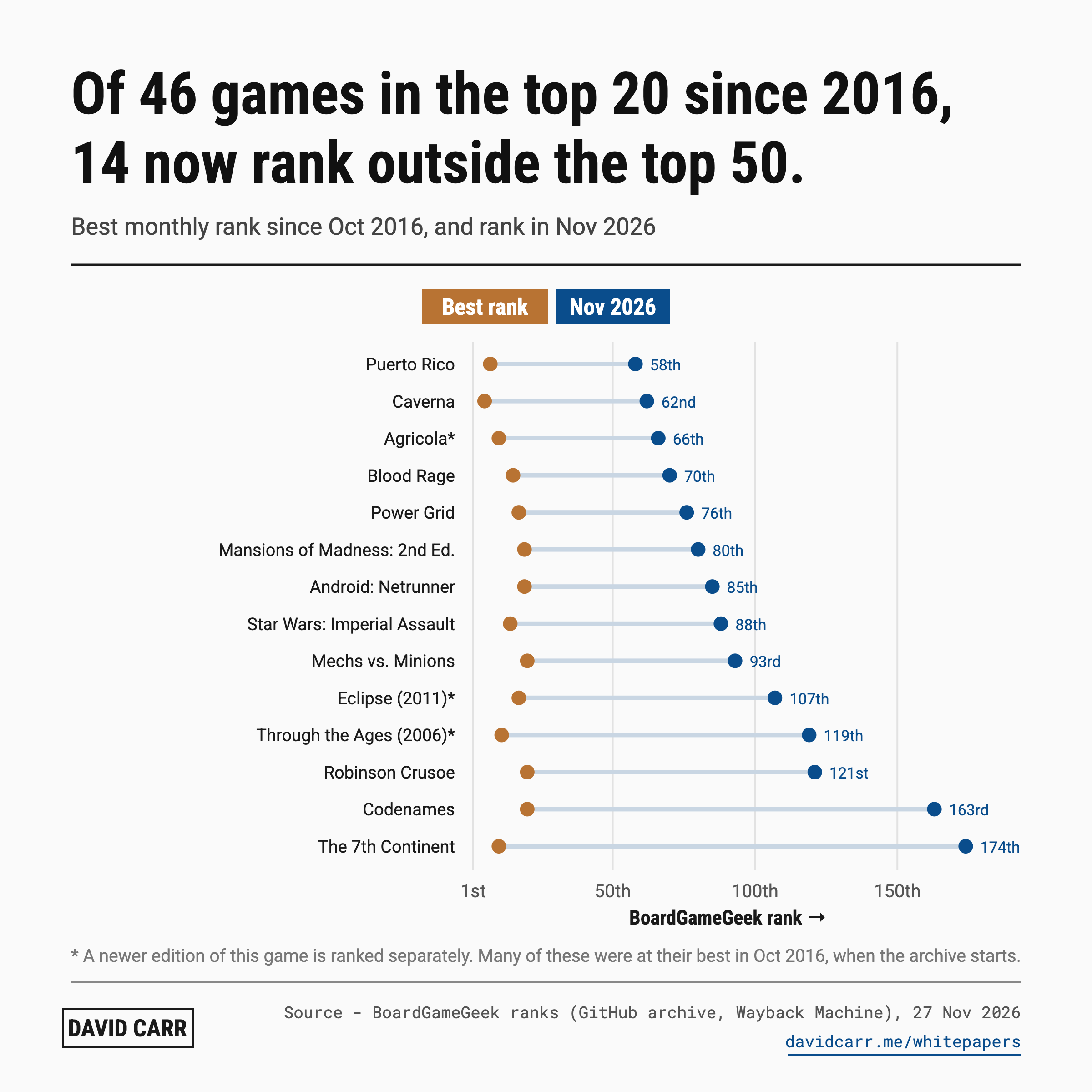
Of 46 games in the top 20 since 2016, 14 now rank outside the top 50.
- The 7th Continent: 10th in June 2018, 174th now
- Mechs vs. Minions: 20th in 2017, 93rd now
- Puerto Rico, Agricola and Power Grid: all top 20 in late 2016, now 58th, 66th and 76th
- The other 32 are still in the top 50, and 25 of them are in the top 25
Moving down the list is mostly about newer games arriving above, and a good few of these have a newer edition ranked on its own.
Best rank = the best rank at any monthly check from October 2016, when the archive starts. Eclipse, Through the Ages and Agricola each have a newer edition ranked separately.
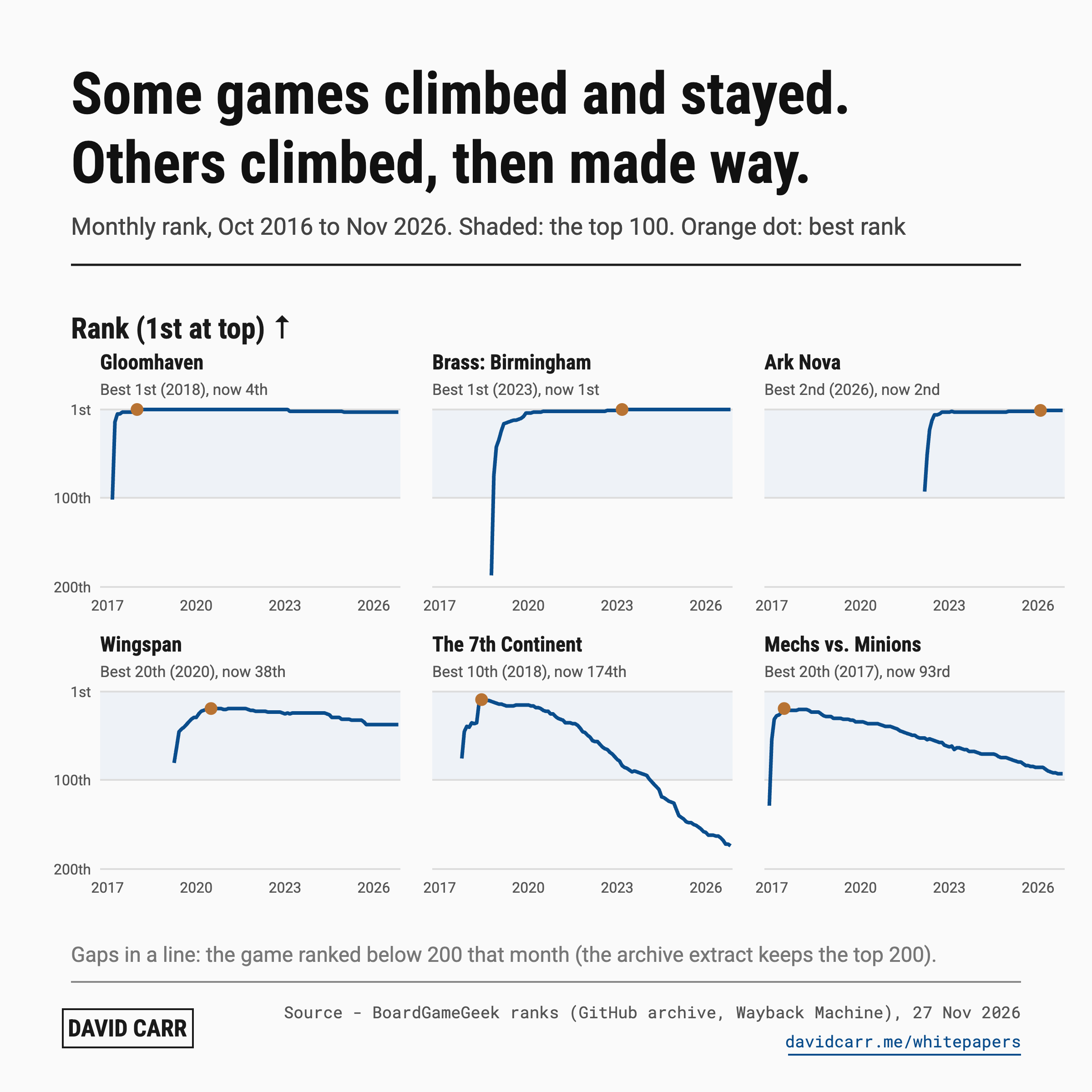
Some games climbed and stayed. Others climbed, then made way.
- Gloomhaven: in the top 100 within months of its 2017 release, No. 1 by January 2018, 4th now
- Brass: Birmingham: from 187th in October 2018 to No. 1 in March 2023, and still there
- Ark Nova: into the top 100 in March 2022, 2nd since February 2026
- Wingspan: best of 20th in 2020, 38th now
- The 7th Continent: 10th in 2018, then a steady move down to 174th
The fastest climbers of the last decade have mostly stayed near the top. The ranking moves slowly, so a long slide takes years.
Monthly checks, top 200 only.
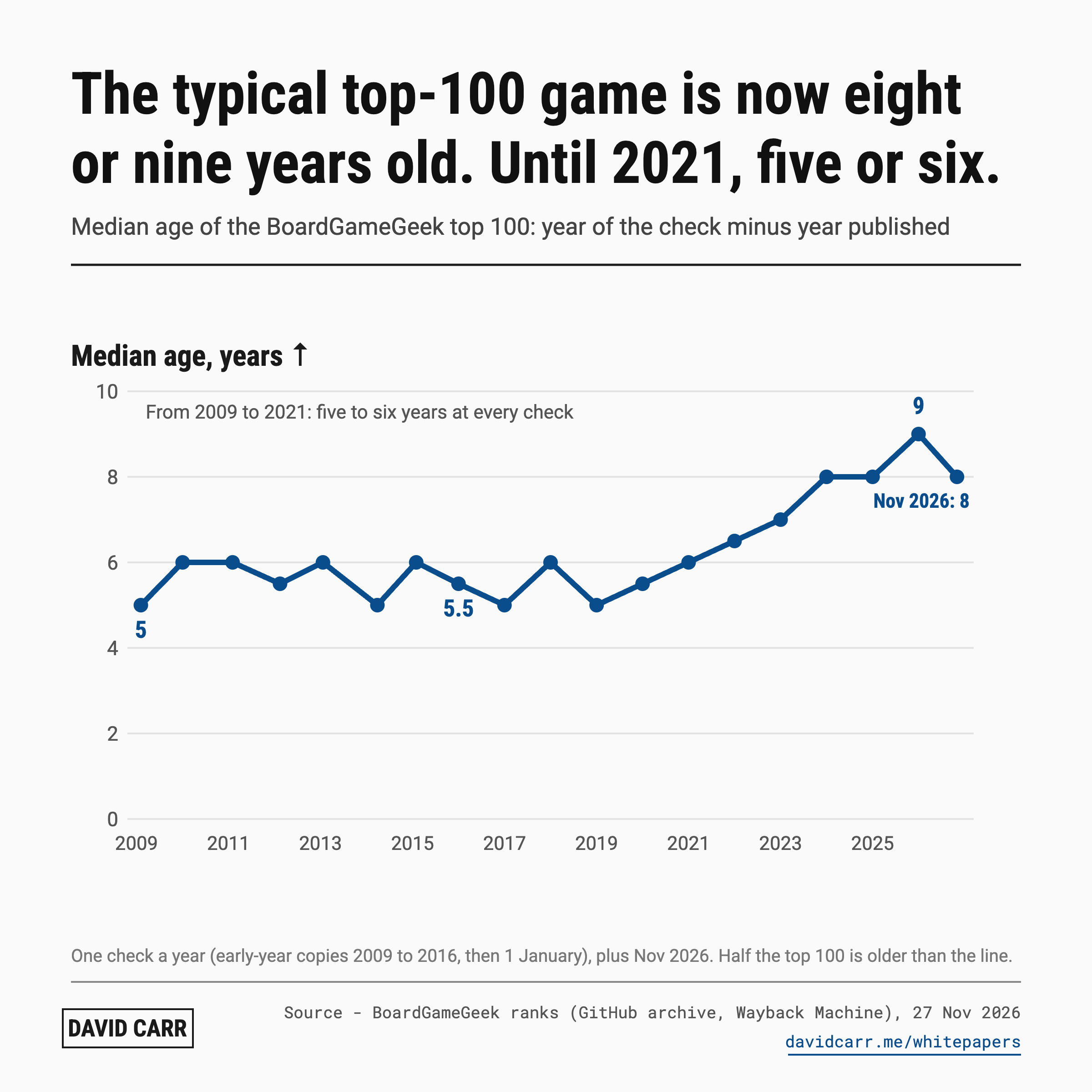
The typical top-100 game is now eight or nine years old. Until 2021, five or six.
- Median age of the top 100: 5 years in 2009, 5.5 in 2016, 6 in 2021
- Then 7 in 2023, 8 in 2024 and 2025, 9 in January 2026
- November 2026: 8
For more than a decade the top 100 stayed about five or six years old. Since 2021 it has been getting older.
Age = year of the check minus the year published, as listed on BoardGameGeek. Median = half the top 100 is older, half younger.
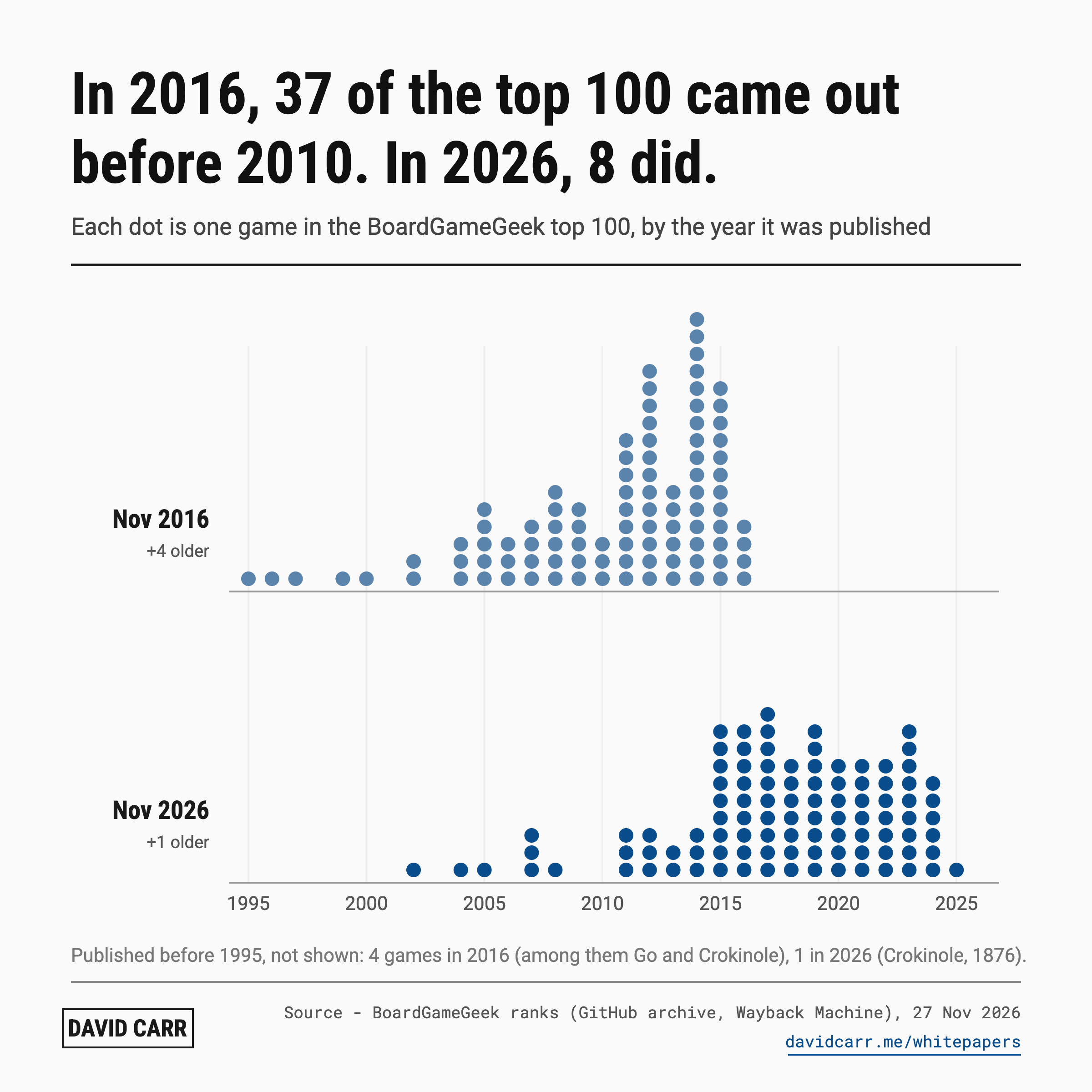
In 2016, 37 of the top 100 came out before 2010. In 2026, 8 did.
- November 2016: the middle half of the top 100 came out between 2007 and 2014
- November 2026: the middle half came out between 2015 and 2021
- November 2026: 37 games from 2020 or later; 81 from 2015 or later
The whole list has shifted forward, but less than the ten years between the two checks.
Year published as listed on BoardGameGeek. Go (listed as 2200 BC) was in the 2016 top 100.
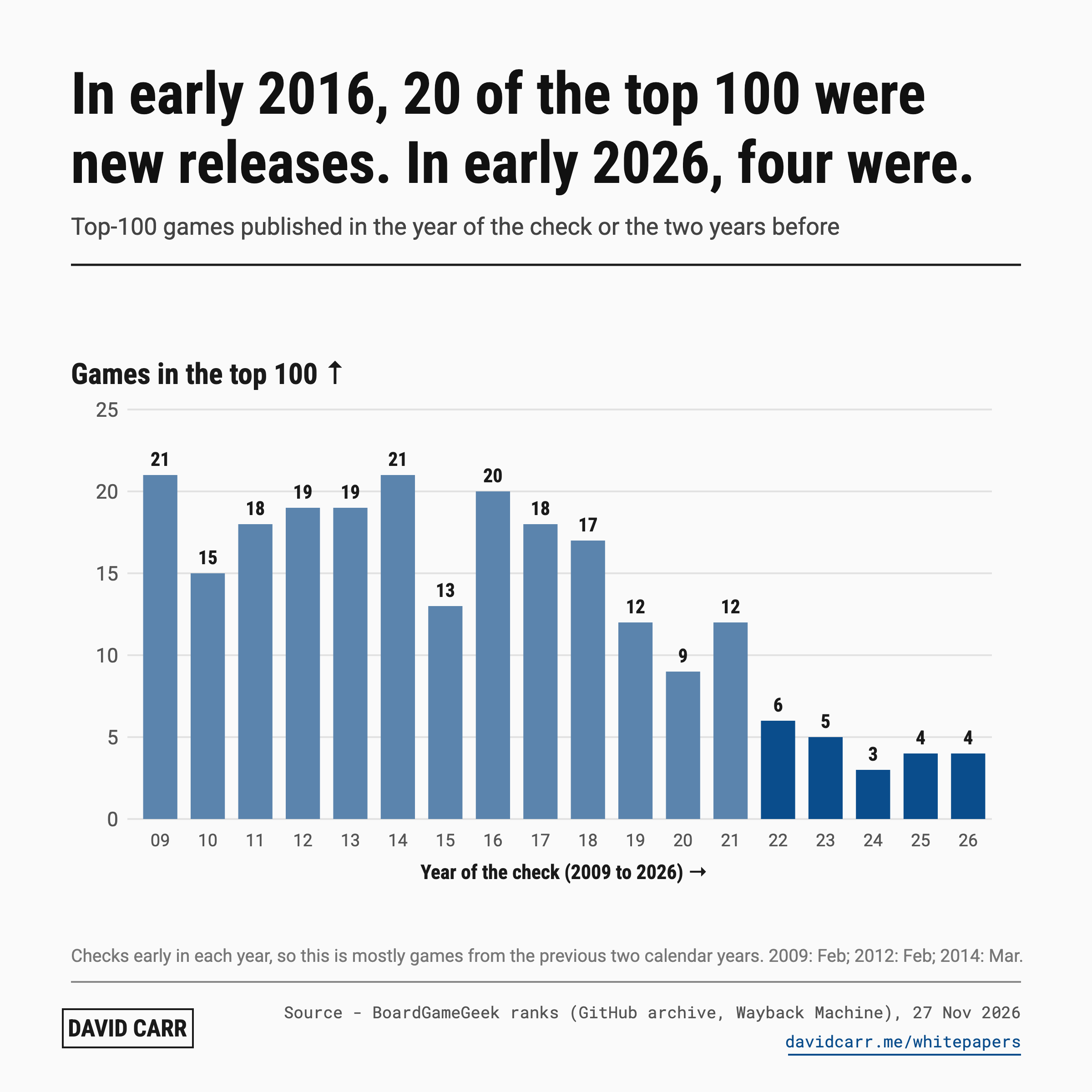
In early 2016, 20 of the top 100 were new releases. In early 2026, four were.
- Games published in the year of the check or the two before: 13 to 21 at every check from 2009 to 2018
- 12 in 2019, 9 in 2020, 12 in 2021
- Then 6, 5, 3, 4 and 4 from 2022 to 2026
New games still reach the top 100, but it takes them longer than it used to.
One check early each year. BoardGameGeek's ranking pulls games with fewer ratings towards the average, so a newer game needs time and ratings to climb; how much that weighting has changed over the years is not public.
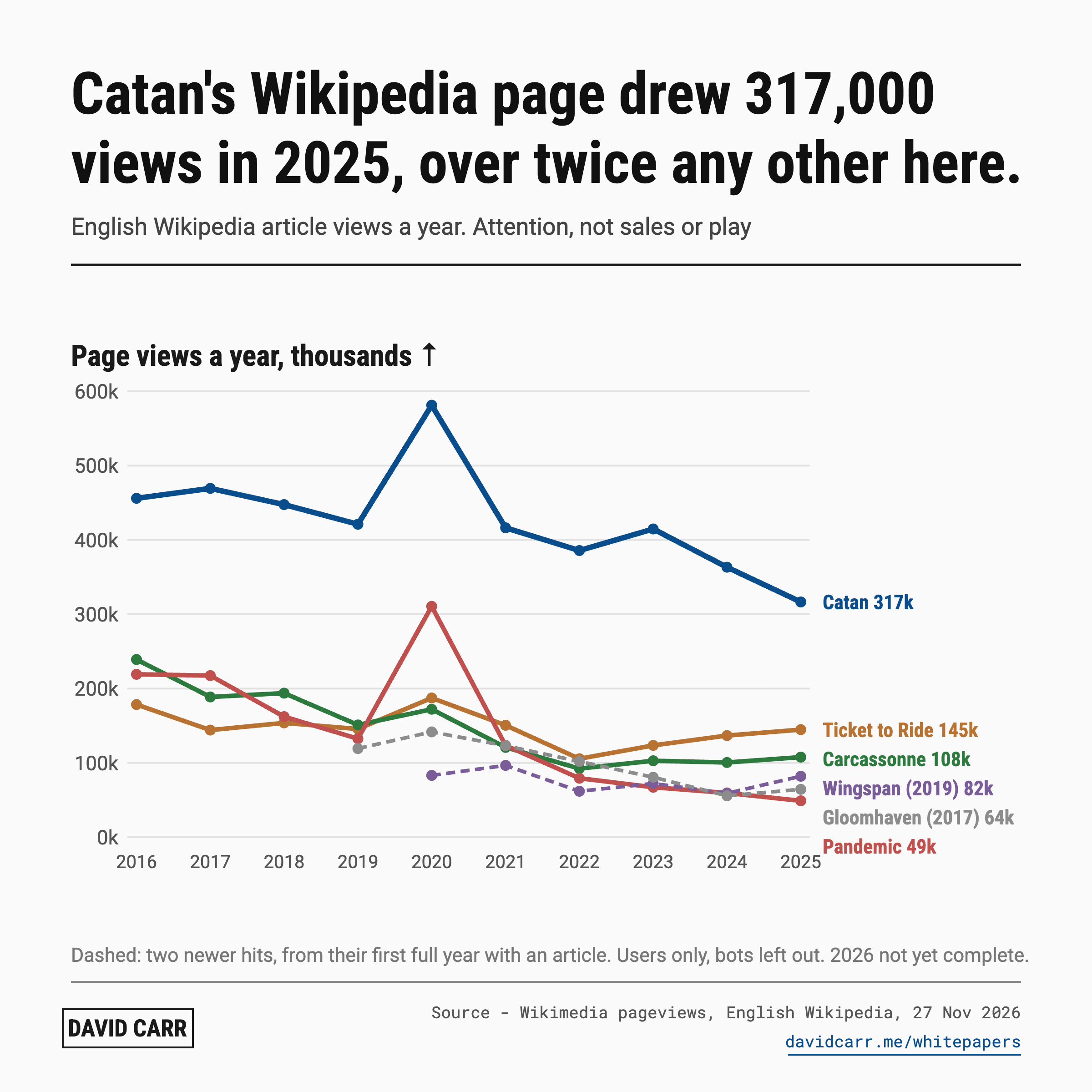
Catan's Wikipedia page drew 317,000 views in 2025, more than twice any other here.
- Catan: 456,000 views in 2016, 581,000 in 2020, 317,000 in 2025
- Ticket to Ride: 145,000 in 2025; Carcassonne: 108,000; Pandemic: 49,000
- Newer hits: Wingspan 82,000 and Gloomhaven 64,000 in 2025
- All six pages had more views in 2020 than in 2019
The family classics sit outside the BoardGameGeek top 100, but they still draw the most attention. This is interest in reading about a game, not a count of who plays it.
English Wikipedia, views by people (not bots), full calendar years. Some views of the Pandemic page may come from people looking for something else.
Method, caveats and sources
The short answer. Board games last. Three in four games that entered the BoardGameGeek top 100 since late 2016 were still in it five years later. Eight games have been in the top 100 at every yearly check since 2009, among them Twilight Struggle, Puerto Rico and Crokinole, which dates from 1876. The top spot rarely changes: Gloomhaven held it for 62 months in a row, and Brass: Birmingham has held it since March 2023. The top 100 is getting older. Its median game was five or six years old at every check from 2009 to 2021 and is eight or nine now, and new releases make up four of the top 100, down from about 20 in 2016. Outside the rankings, Catan's Wikipedia page still draws more than twice the views of any other game here.
Data. Monthly snapshots of the BoardGameGeek board game ranks from the public bgg-ranking-historicals archive on GitHub, which has saved the full ranked list every day since 12 October 2016. I took the first file of each month, October 2016 to November 2026 (122 snapshots), and kept the top 200. For 2009 to 2016, copies of the first page of the BoardGameGeek rankings (the top 100) saved by the Wayback Machine, 14 copies. Wikipedia views from the Wikimedia pageviews API. All pulled on 27 November 2026 at a polite rate; nothing was fetched from BoardGameGeek itself. Every figure on this page is my own count on that data.
Definitions. Top 100 = BoardGameGeek's overall board game rank. Yearly checks = the first Wayback copy of each year 2009 to 2016 (February 2009, January 2010, February 2011, February 2012, January 2013, March 2014, January 2015, January 2016), then 1 January each year from 2017, plus 1 November 2026. Year published and names are as BoardGameGeek lists them. A new edition of a game, such as Through the Ages or Eclipse, is a separate entry with its own rank.
Caveats. BoardGameGeek ranks games by a weighted rating from its users, so this is what its members rate highly, not what sells most or is played most. The weighting pulls games with few ratings towards the average, which makes new games climb slowly; that is one reason the list moves slowly. Before October 2016 there are only a few saved copies a year. Wikipedia views measure attention only, and they swing with news and searches for other things.
Also: Chess by the numbers and Gaming at Christmas.