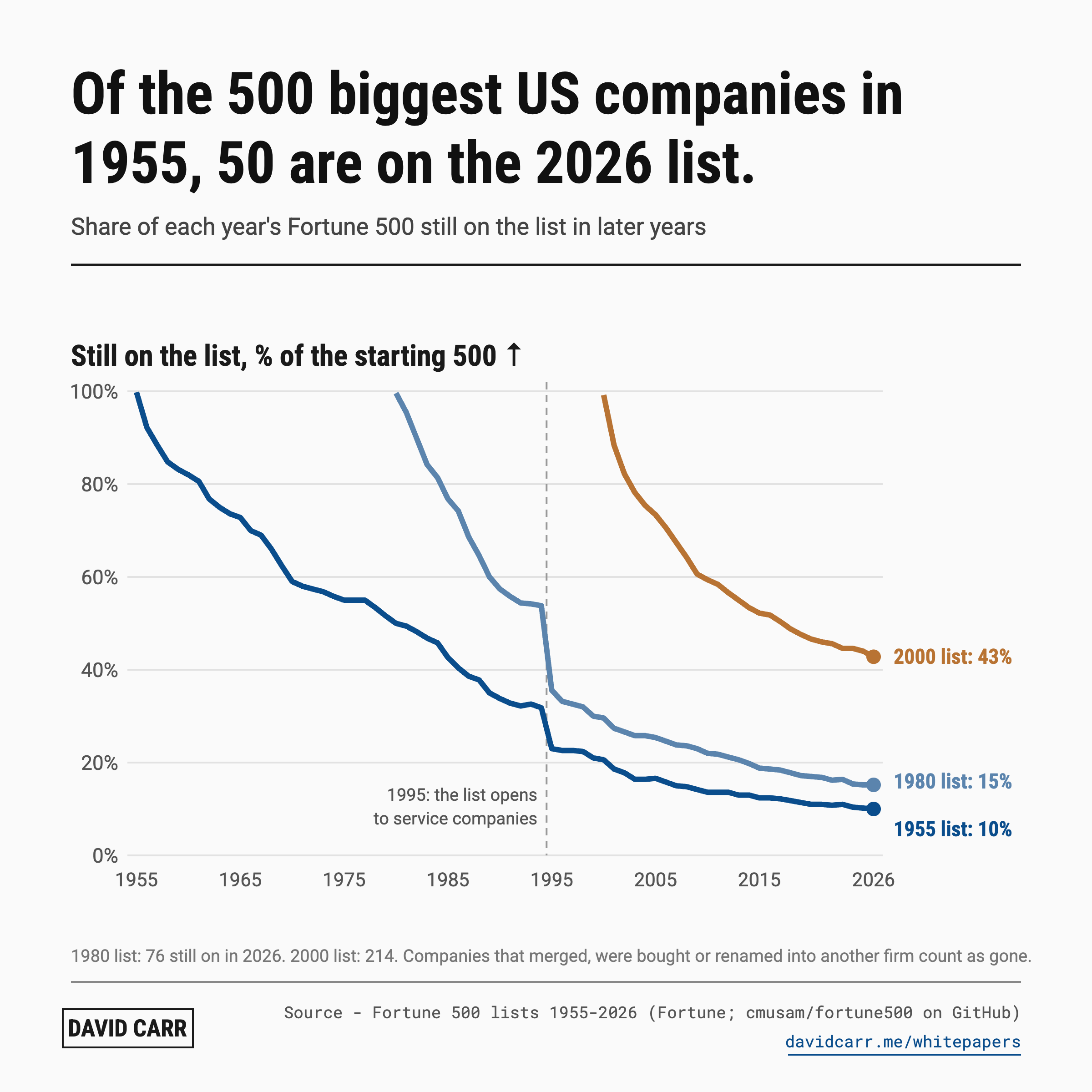
Of the 500 biggest US companies in 1955, 50 are on the 2026 list.
- 1955 list: 10% still on the list in 2026
- 1980 list: 76 companies, 15%
- 2000 list: 214 companies, 43%
- About half the 1955 list was still on in 1980
The fall is steady, not sudden. The one big step is 1995, when the list opened to service companies and many smaller manufacturers were pushed off.
A company that merged, was bought, or was folded into another firm counts as gone, even if its brands live on. Renamed companies count as the same company.
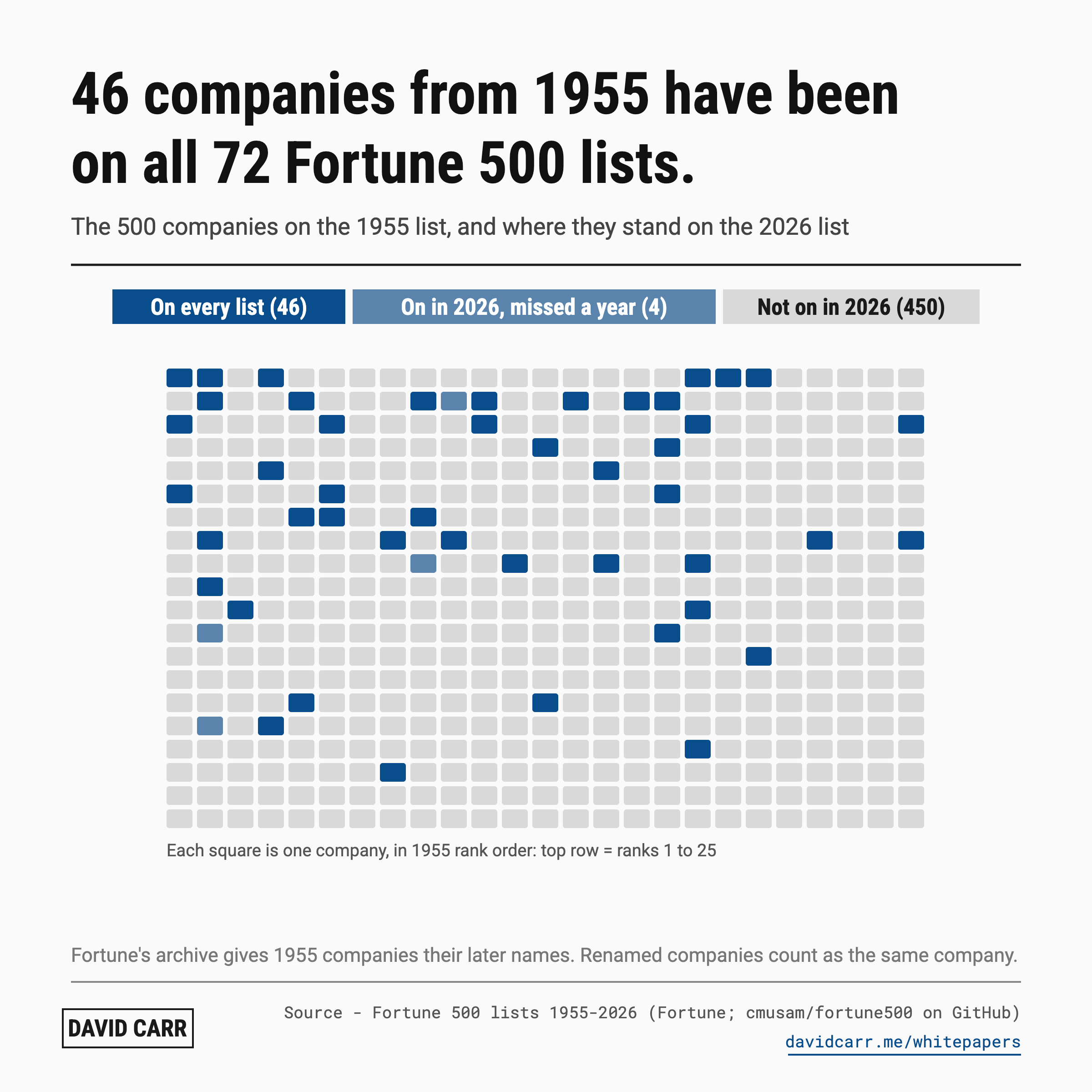
46 companies from 1955 have been on all 72 Fortune 500 lists.
- On every list from 1955 to 2026: 46
- On the 2026 list but missed at least one year: 4
- Not on the 2026 list: 450
The 46 are spread right down the 1955 list, from General Motors at number 1 to Cummins at 434.
Fortune's archive lists some 1955 companies under the names they had decades later, so the 1955 squares are matched by those names.
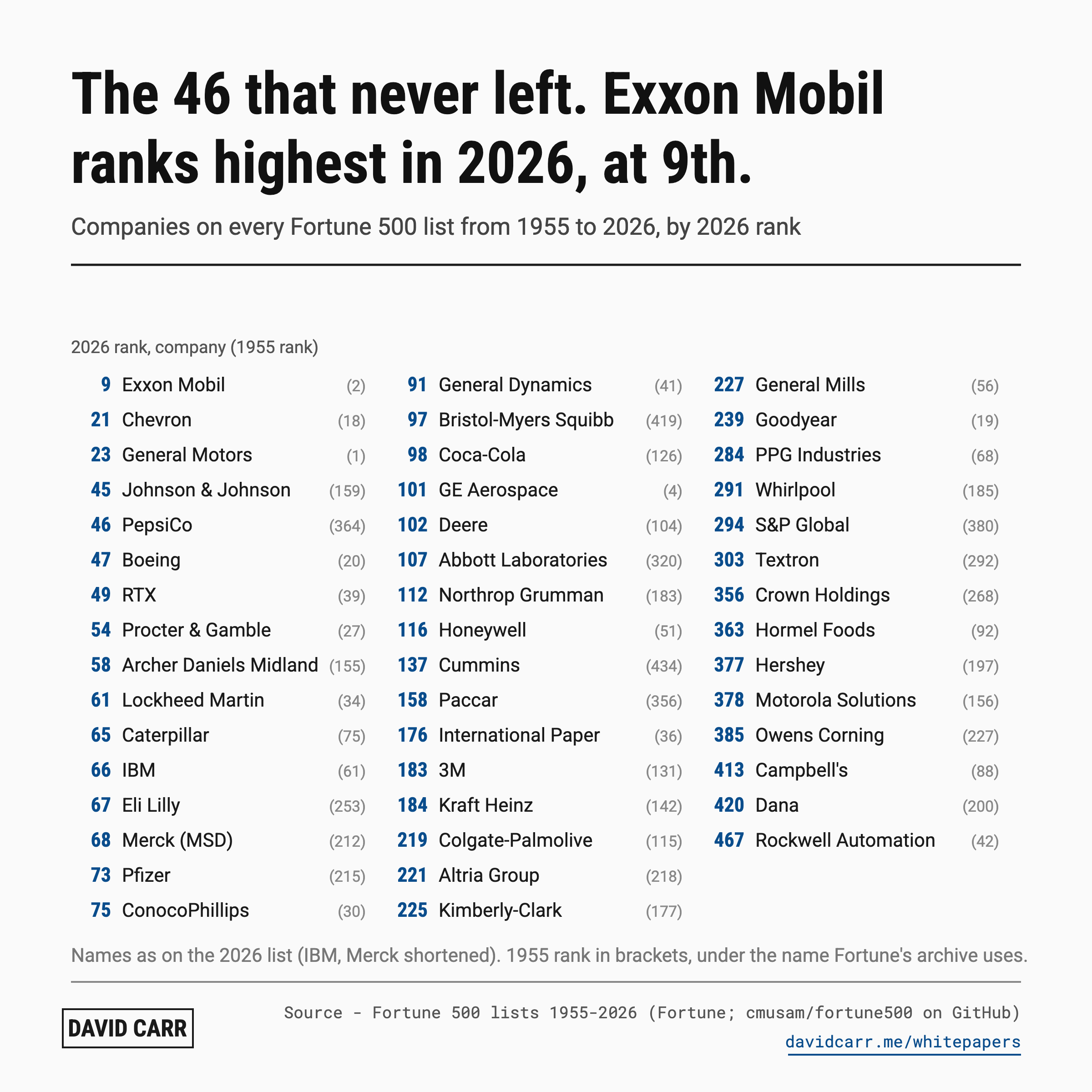
The 46 that never left. Exxon Mobil ranks highest in 2026, at 9th.
- Highest in 2026: Exxon Mobil (9th), Chevron (21st), General Motors (23rd)
- Biggest climbers since 1955: Bristol-Myers Squibb from 419th to 97th, PepsiCo from 364th to 46th, Cummins from 434th to 137th
- Lowest in 2026: Rockwell Automation, 467th
The list mixes drug makers, food and drink, defence firms and heavy industry. All have stayed big enough to make the cut for 72 years running.
Names as on the 2026 list. RTX is United Technologies renamed; GE Aerospace is General Electric; Kraft Heinz continues H.J. Heinz.
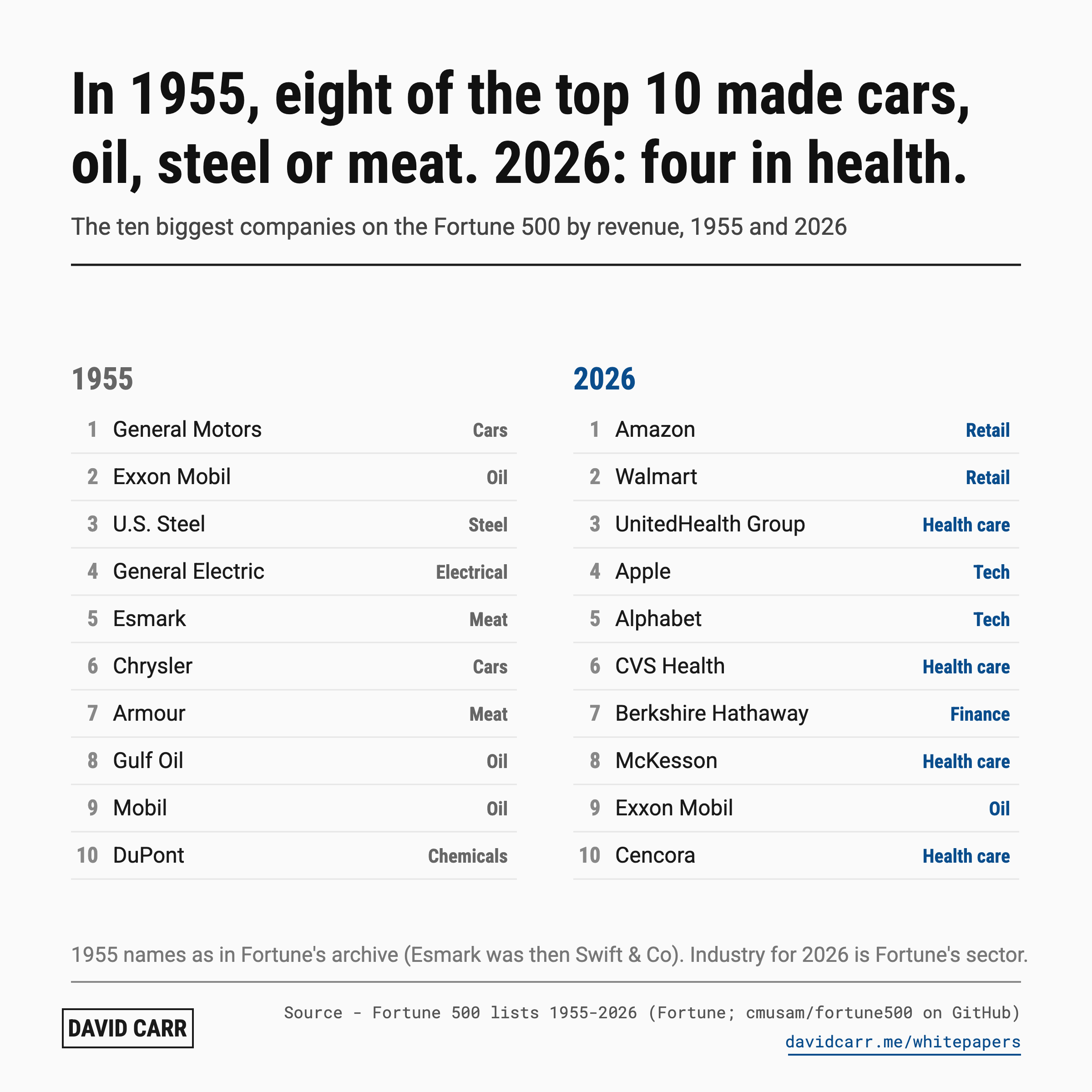
In 1955, eight of the top 10 made cars, oil, steel or meat. In 2026, four are in health care.
- 1955: General Motors, Exxon Mobil, U.S. Steel, General Electric, Esmark (Swift), Chrysler, Armour, Gulf Oil, Mobil, DuPont
- 2026: Amazon, Walmart, UnitedHealth Group, Apple, Alphabet, CVS Health, Berkshire Hathaway, McKesson, Exxon Mobil, Cencora
- Exxon Mobil is in both top tens: 2nd in 1955, 9th in 2026
The biggest companies by revenue moved from making things to selling things, running health care and building technology.
Revenue ranks. The 1955 list covered industrial companies only; retailers and health care firms could not be on it until 1995.
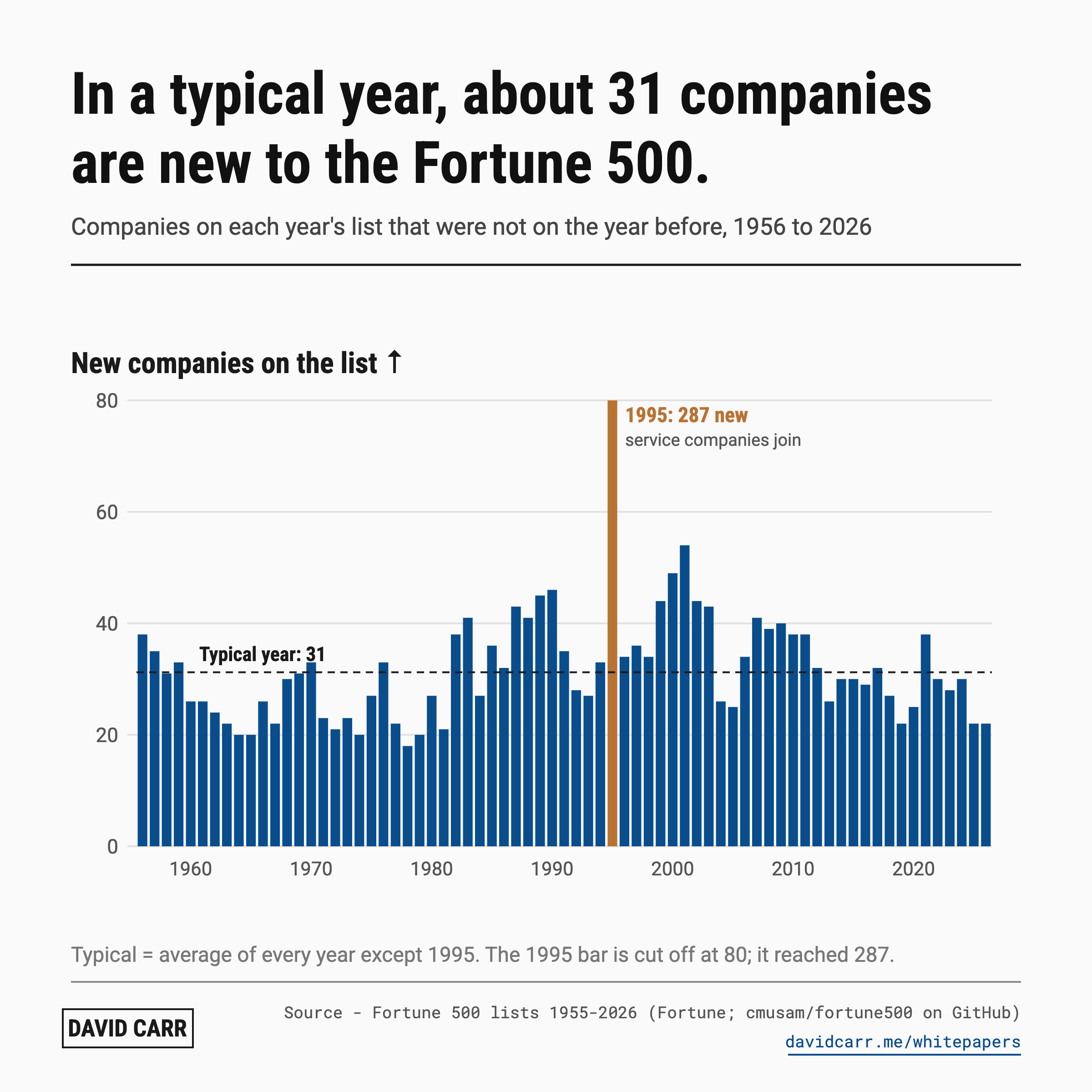
In a typical year, about 31 companies are new to the Fortune 500.
- Fewest: 18 in 1978
- Most, apart from 1995: 54 in 2001
- 1995: 287, when service companies were let in
- 2026: 22
Around one company in 16 is replaced each year. The churn was highest around 2000 and has eased since.
New = on this year's list but not last year's. A company returning after a gap counts as new again.
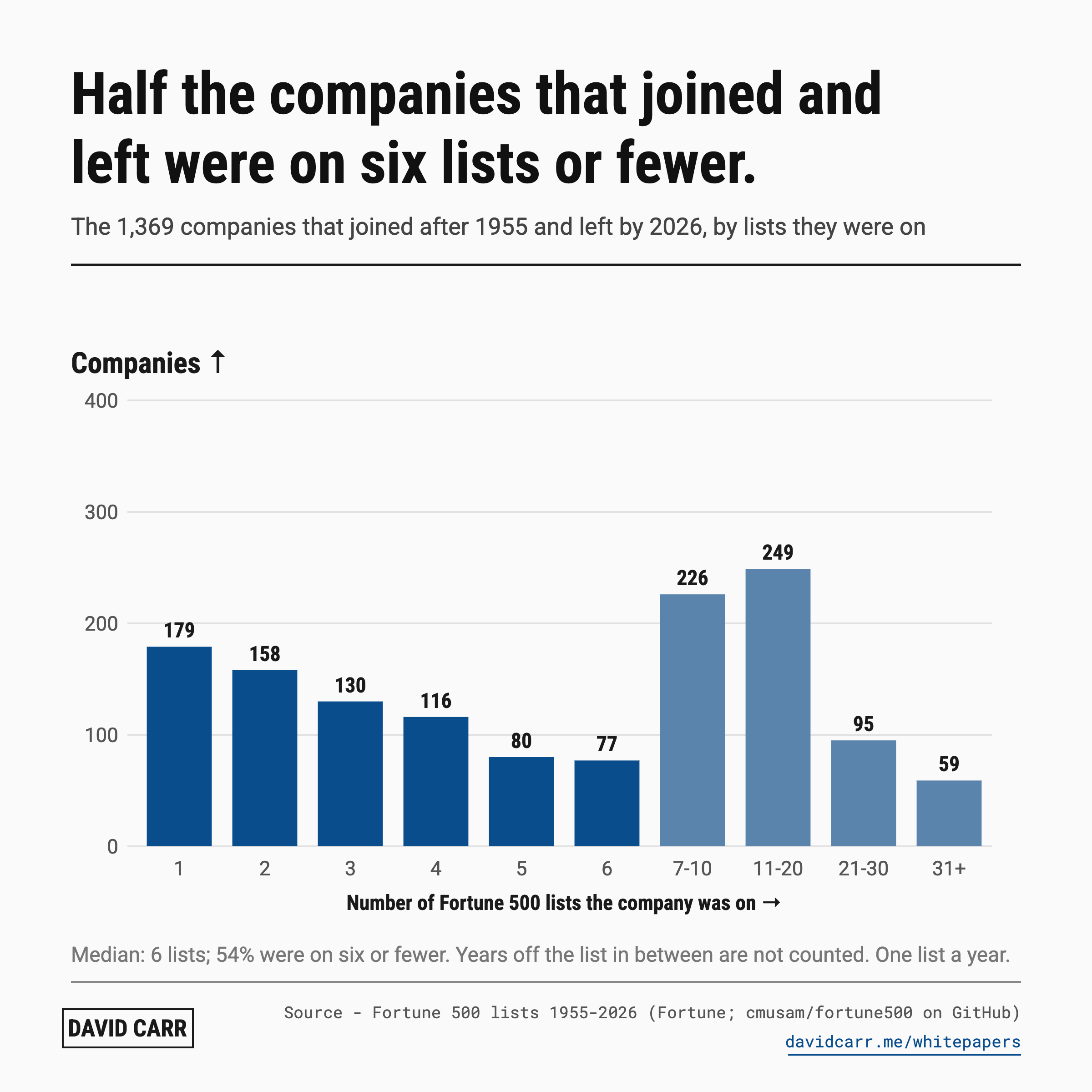
Half the companies that joined and left were on six lists or fewer.
- 1,369 companies joined after 1955 and were gone by the 2026 list
- 179 made the list just once
- 54% were on six lists or fewer
- 59 lasted more than 30 lists
Most stays are short. A few companies stay for decades, which pulls the average up to about nine lists.
Only companies whose whole stay falls inside 1956 to 2025 are counted, so every stay here is complete.
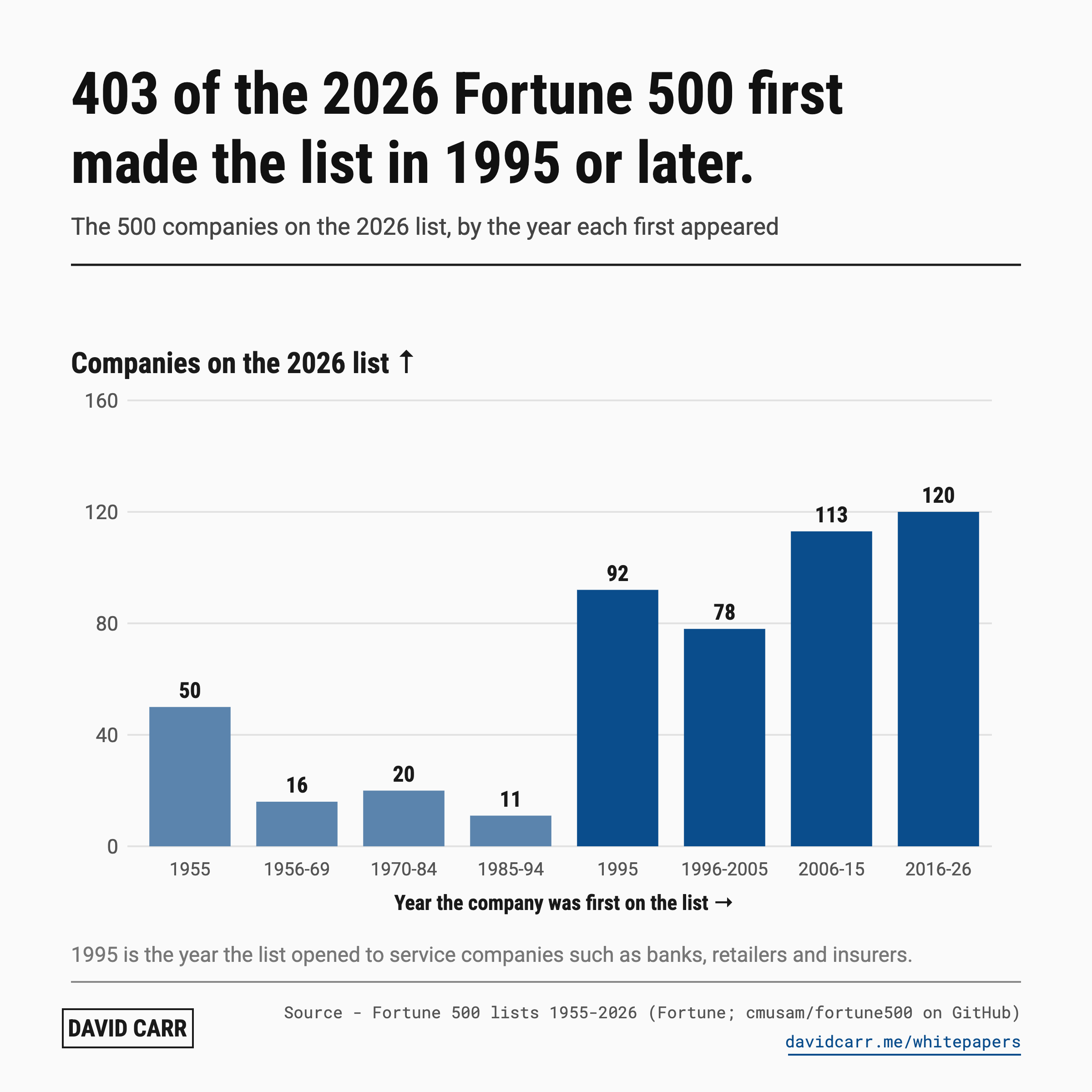
403 of the 2026 Fortune 500 first made the list in 1995 or later.
- First on the list in 1955: 50
- 1956 to 1994: 47
- 1995: 92
- 2016 to 2026: 120
Close to a quarter of the 2026 list has joined in the last eleven years. The 1995 bar is the service companies, such as banks, retailers and insurers, that could not be on the list before.
First appearance is the first list each company is on, under any of its names.
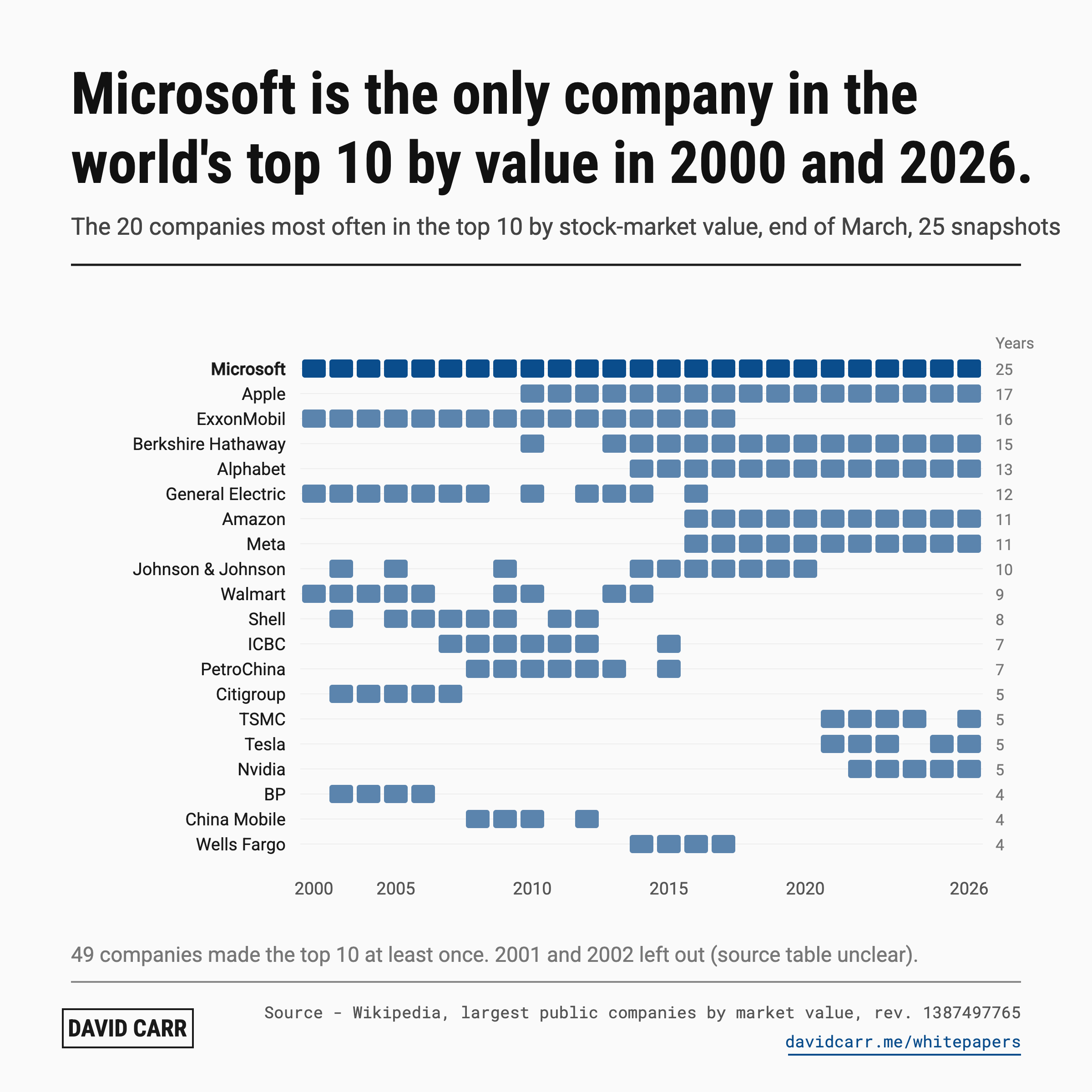
Microsoft is the only company in the world's top 10 by value in 2000 and 2026.
- Microsoft: in the top 10 at all 25 end-of-March snapshots
- Apple: 17; Exxon Mobil: 16; Berkshire Hathaway: 15; Alphabet: 13
- 49 companies made the top 10 at least once
Only a handful of names stay for long. Oil companies, banks and telecoms each had their spell in the 2000s and early 2010s.
Snapshots at the end of March each year, 2000 and 2003 to 2026. Values are as listed on the Wikipedia page, which draws on the Financial Times and other sources.
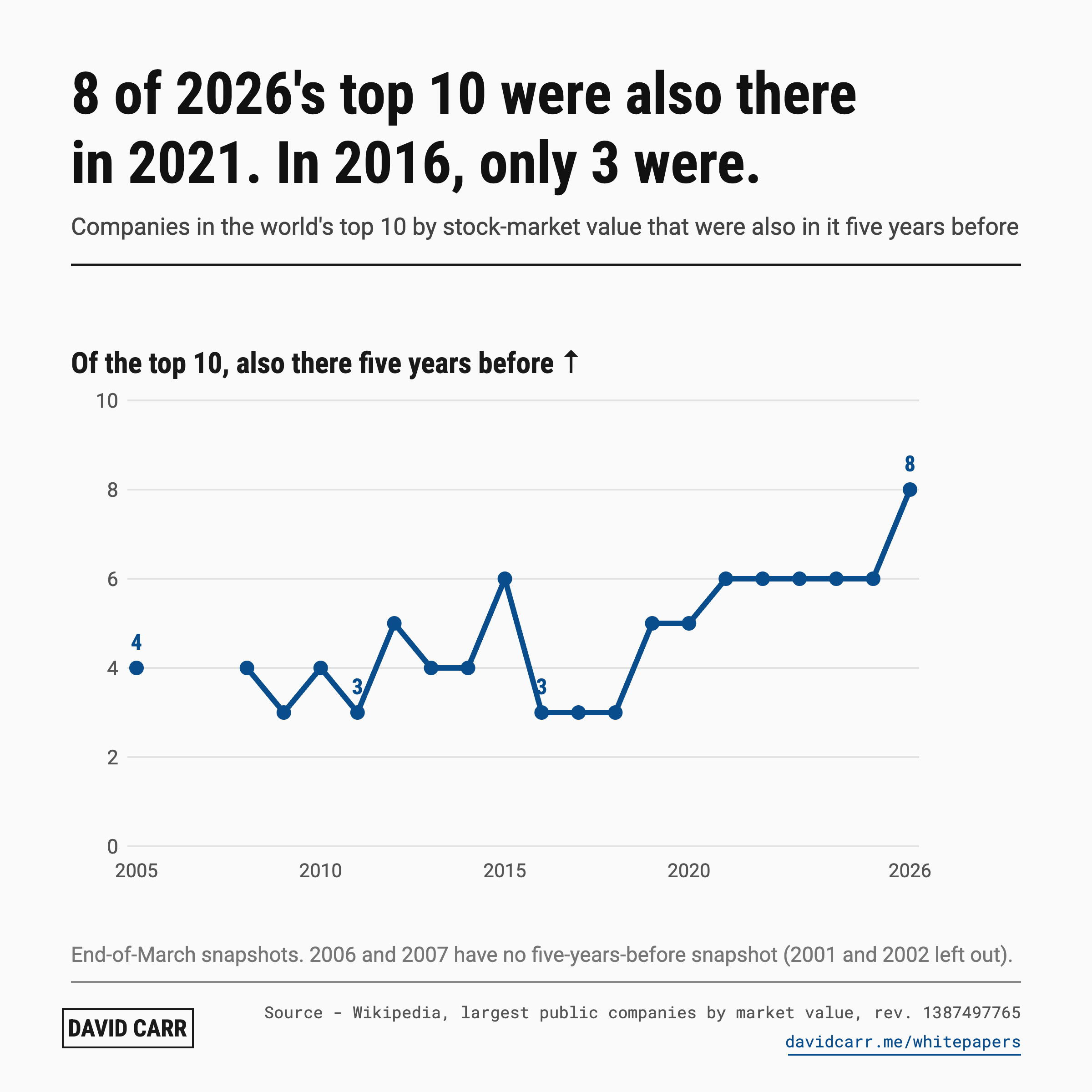
8 of 2026's top 10 were also there in 2021. In 2016, only 3 were.
- Five-year overlap: 4 of 10 in 2005, 3 in 2011, 3 in 2016 to 2018
- 6 in every year from 2021 to 2025, then 8 in 2026
- Year to year, 9 of the 10 stayed from 2025 to 2026
In most years from 2005 to 2018, half or more of the top 10 had changed within five years. Since about 2019 the same group of firms has held on.
Overlap = companies in the top 10 in both years. Facebook and Meta, and Google and Alphabet, count as the same company.
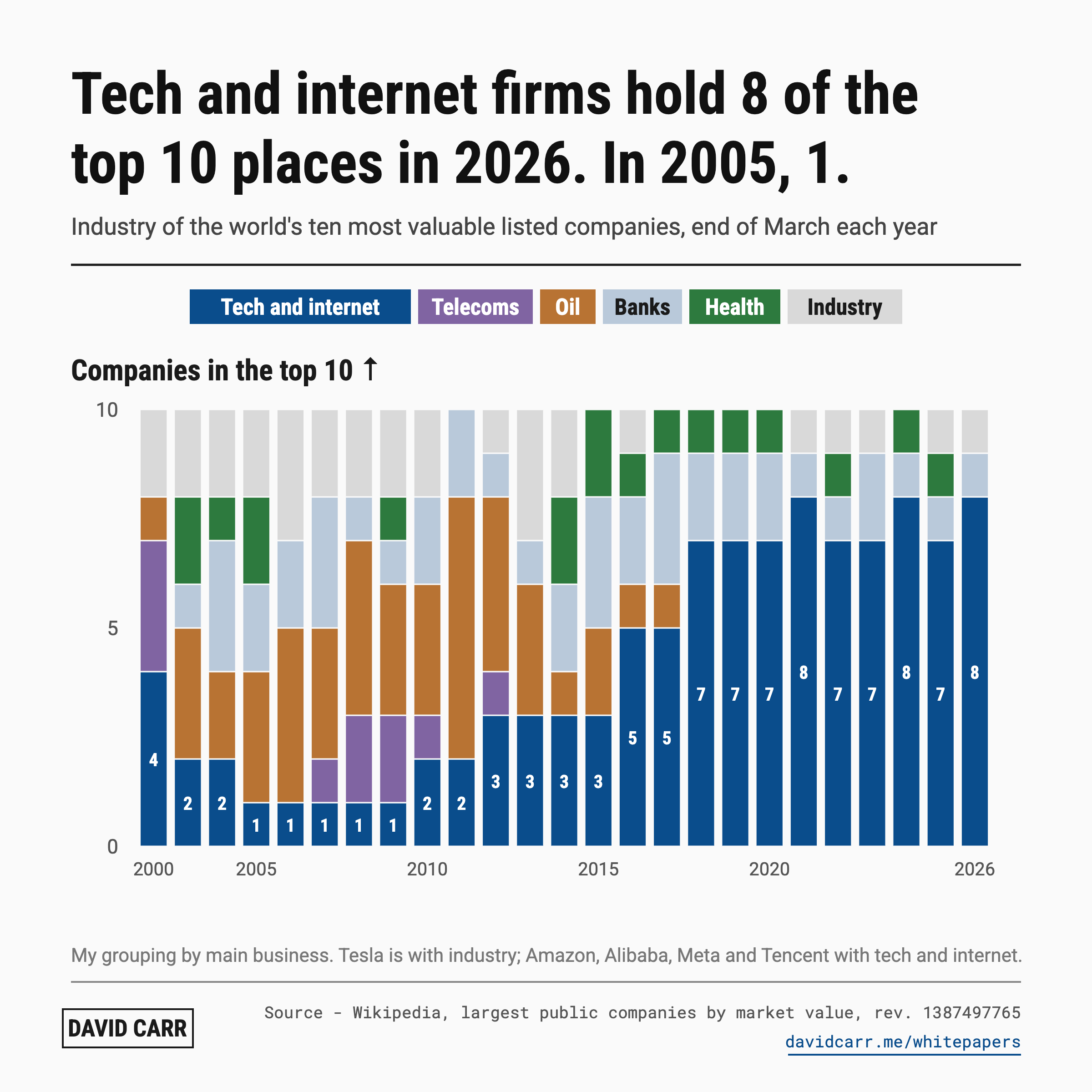
Tech and internet firms hold 8 of the top 10 places in 2026. In 2005, 1.
- Tech and internet: 4 in 2000, 1 from 2005 to 2009, 8 in 2026
- Oil, gas and mining: up to 6 in 2011, none after 2017
- Telecoms: 3 in 2000, none after 2012
Each decade's top 10 reflects what was worth most at the time: telecoms around 2000, oil and mining around 2010, tech and internet since.
My grouping, by each company's main business. Amazon, Alibaba, Meta and Tencent are with tech and internet; Tesla with industry; Berkshire Hathaway with finance.
Method, caveats and sources
The short answer. Not for long, as a rule, but a few last a lifetime. Of the 500 companies on the first Fortune 500 in 1955, 50 are on the 2026 list, and 46 have been on all 72 lists. About 31 new companies join in a typical year, and half of the companies that joined and left were on six lists or fewer. Among the world's ten most valuable listed companies, Microsoft is the only one there in both 2000 and 2026, and tech and internet firms now hold 8 of the 10 places.
Data. Fortune 500 lists for 1955 to 2019 come from the cmusam/fortune500 dataset on GitHub, which its author compiled from Fortune's archive on money.cnn.com, fortunechina.com and fortune.com. Lists for 2020 to 2026 come from Fortune's own Fortune 500 pages, read on 27 November 2026; Fortune's site also supplied each company's revenue change, used to spot renames. The world's top 10 by stock-market value comes from the Wikipedia page List of public corporations by market capitalization (revision 1387497765, read 27 November 2026), using its end-of-March figures: the Financial Times Global 500 for 2000 and 2003 to 2005, and the first-quarter table for 2006 to 2026. Every figure on this page is my own count on that data.
Matching companies across years. Company names change, so names were cleaned of punctuation and legal endings, and renames were joined: by hand for spelling changes in the older lists, and from 2014 on where a "new" name's previous-year revenue matched, within half a per cent, a company that had just left the list. Every automatic match was checked, and wrong ones were thrown out. A company that merged into another, or was bought, counts as gone; the buyer carries on. Where two firms that merged formed a new holding company, as Dow Chemical and DuPont did in 2017, both count as gone. A few old names were later taken by different firms (Lear, Celanese, Ingersoll Rand, BorgWarner, Westinghouse Air Brake, CBS); those are counted as separate companies. Some calls are close, so the totals could move by a few either way.
Caveats. A list's year is the year Fortune published it; revenues are for the year before. Until 1994 the Fortune 500 covered industrial companies only; from 1995 it took in service companies, which pushed 287 new names on in one year. Fortune's archive shows some early companies under names they took later, such as Exxon Mobil for what was then Standard Oil (New Jersey). Fortune's site lists 498 or 499 companies in a few years from 2015 to 2020, so those years are taken from the GitHub dataset instead. Leaving the list says nothing about how a company is doing: many left because they were bought, merged, went private or moved their head office abroad. Market-value rankings move with share prices, so one snapshot a year can catch a company on a high or a low; Wikipedia's 2001 and 2002 tables are left out because their rows do not add up.
Also: Data companies, compared and Stripe.