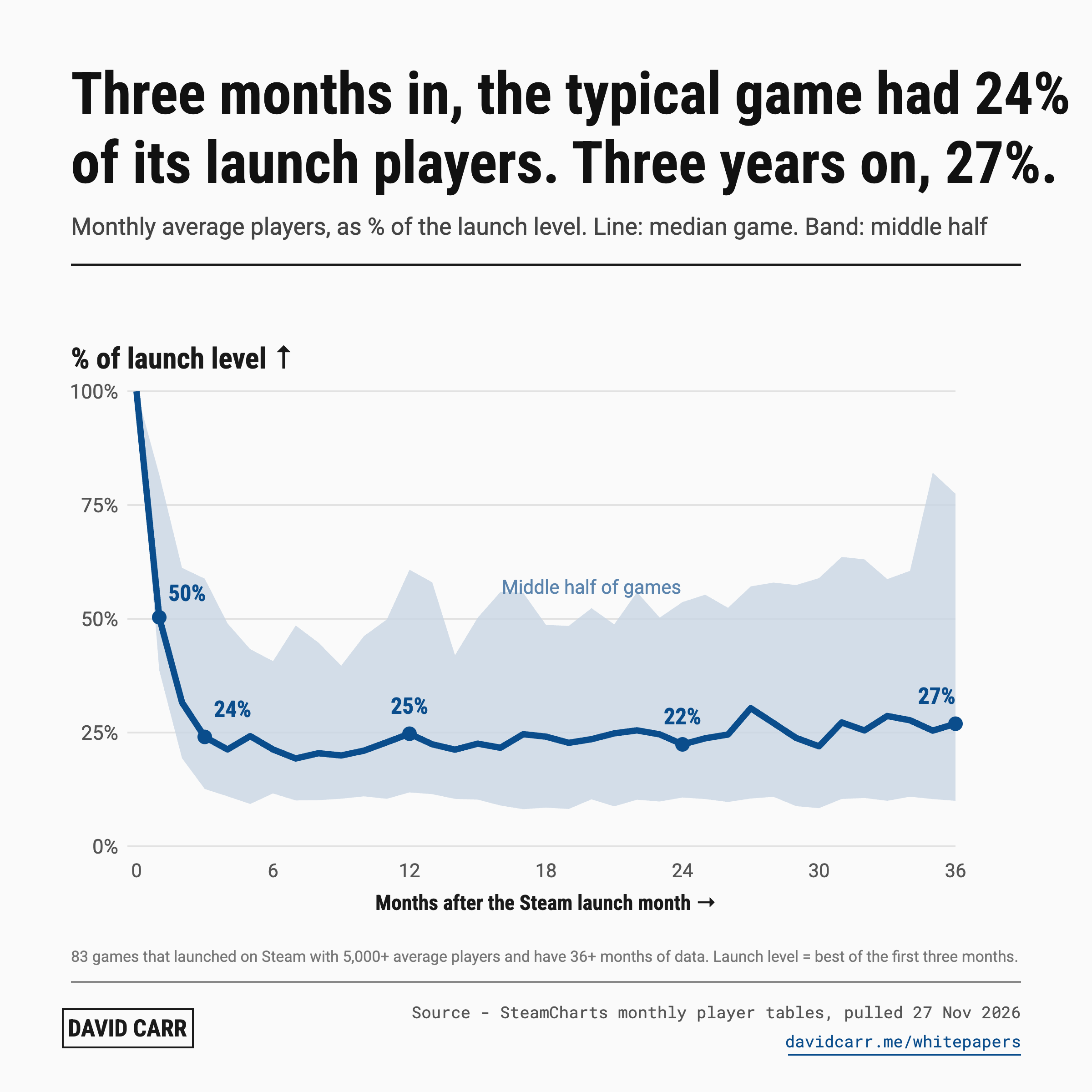
Three months in, the typical game had 24% of its launch players. Three years on, 27%.
- One month after the launch level: a median 50%
- Three months: 24%; one year: 25%; three years: 27%
- The middle half of games at one year: 12% to 61%
Most of the drop happens in the first three months. After that the typical curve goes nearly flat: the players who stay tend to keep playing.
83 games that launched on Steam with 5,000 or more average players and have at least 36 full months of data. Launch level = the best monthly average in the launch month and the two after, so a launch late in a month is not penalised.
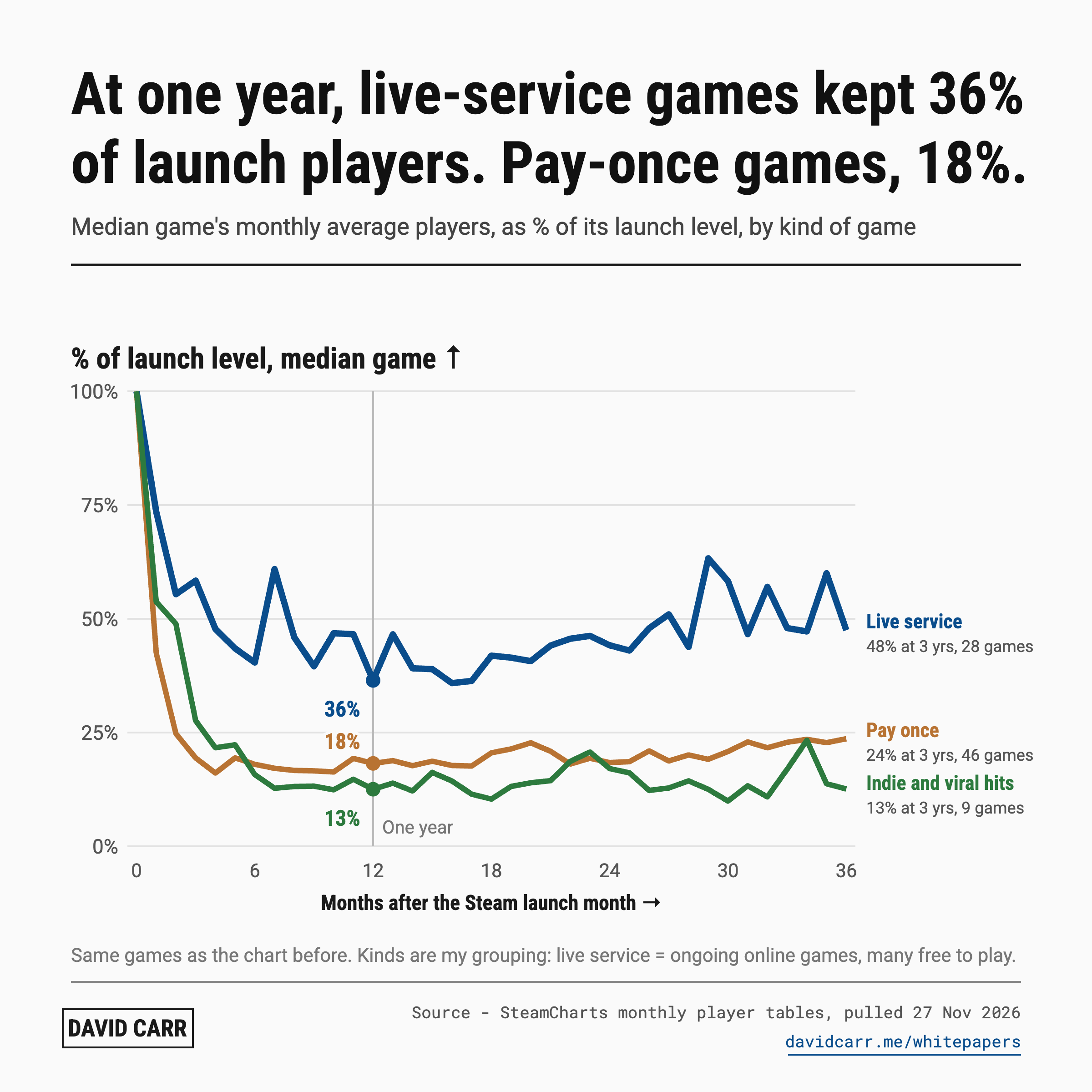
At one year, live-service games kept 36% of launch players. Pay-once games, 18%.
- Live service (28 games): 58% at three months, 36% at one year, 48% at three years
- Pay once (46 games): 19%, 18%, 24%
- Indie and viral hits (9 games): 28%, 13%, 13%
Games built to be played for years do hold more of their crowd. Story games are often finished and put down, which is what they were made for.
The three kinds are my own grouping. Live service = ongoing online games, many of them free to play. Pay once = bought once, including co-op games. Indie and viral hits = smaller games that spread by word of mouth. Only nine games in the last group, so its line jumps around.
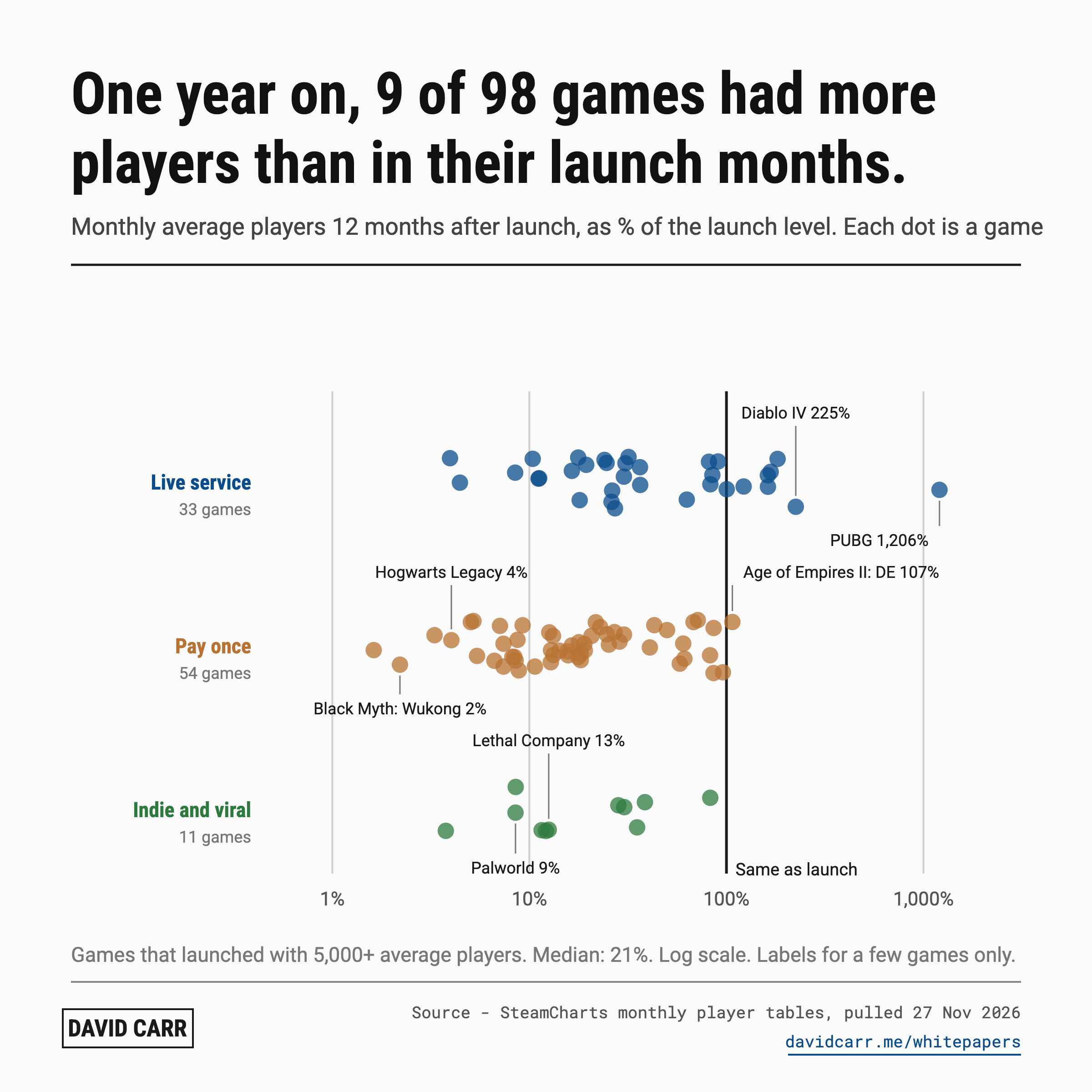
One year on, 9 of 98 games had more players than in their launch months.
- PUBG: 1,206% of its launch level after a year, from early access to a worldwide hit
- Diablo IV 225%, Apex Legends 182%, Rainbow Six Siege 168%, Dota 2 and Counter-Strike 162%
- The median game: 21% of its launch level
- Median by kind: live service 31%, pay once 18%, indie and viral 13%
Eight of the nine games above their launch level a year later are live-service games. The ninth is Age of Empires II: Definitive Edition.
Games that launched with 5,000 or more average players and have at least 12 months of data. Several of these came to Steam after launching elsewhere first, so their Steam launch is not their first day.
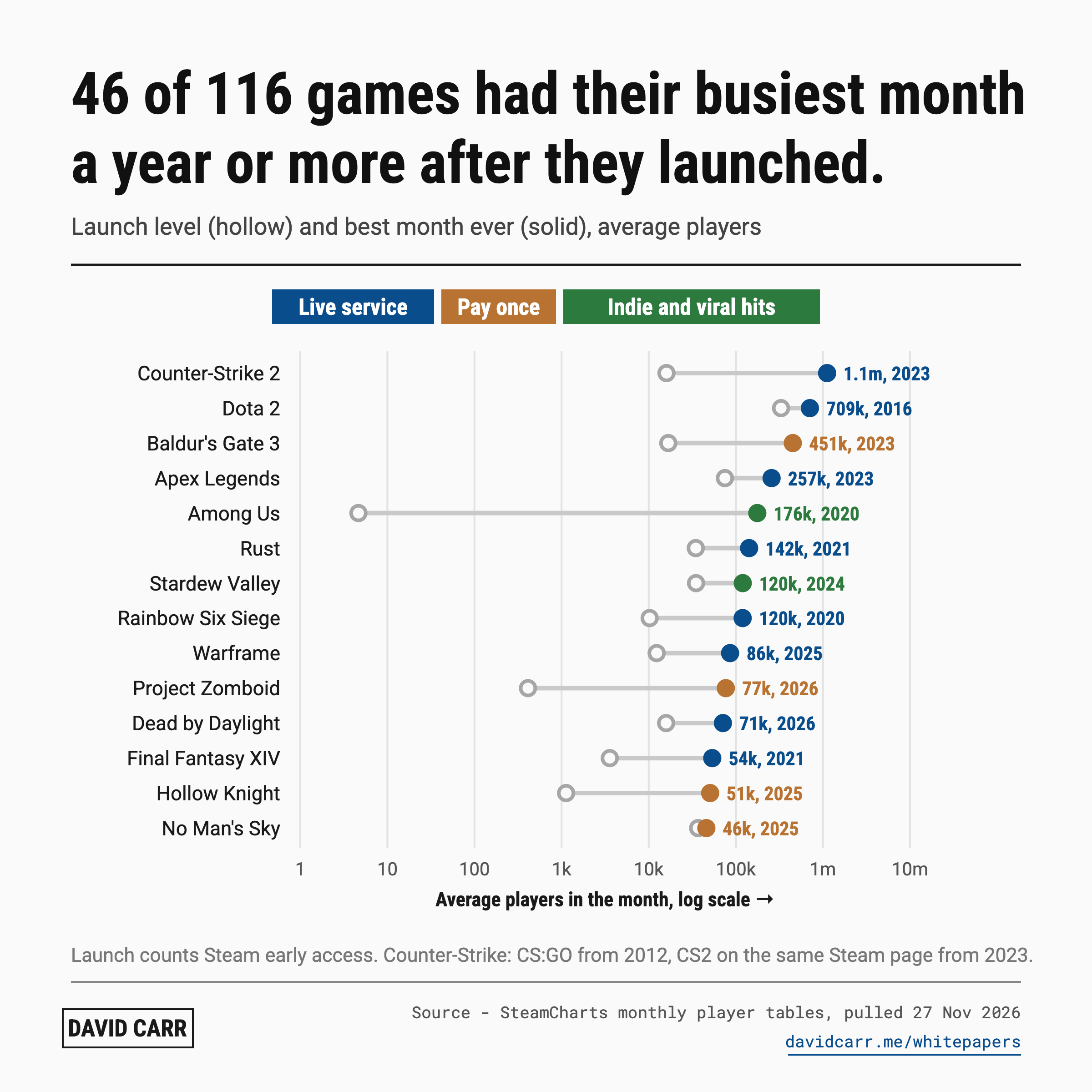
46 of 116 games had their busiest month a year or more after they launched.
- Among Us: 5 or fewer average players a month in its first three months on Steam, from November 2018; 176,454 in October 2020
- Counter-Strike: 16,001 in 2012; 1.1 million in May 2023, the year CS2 arrived
- Baldur's Gate 3: 16,792 in early access in 2020; 450,982 at full launch in August 2023
- Stardew Valley: 34,947 in 2016; 120,134 in April 2024
Big launches get the headlines, but two in five of these games found their biggest crowd later: some at a full release after early access, others years down the line.
Best month = highest monthly average. The Steam launch counts early access. Counter-Strike's Steam page carried CS:GO from 2012 and CS2 from 2023.
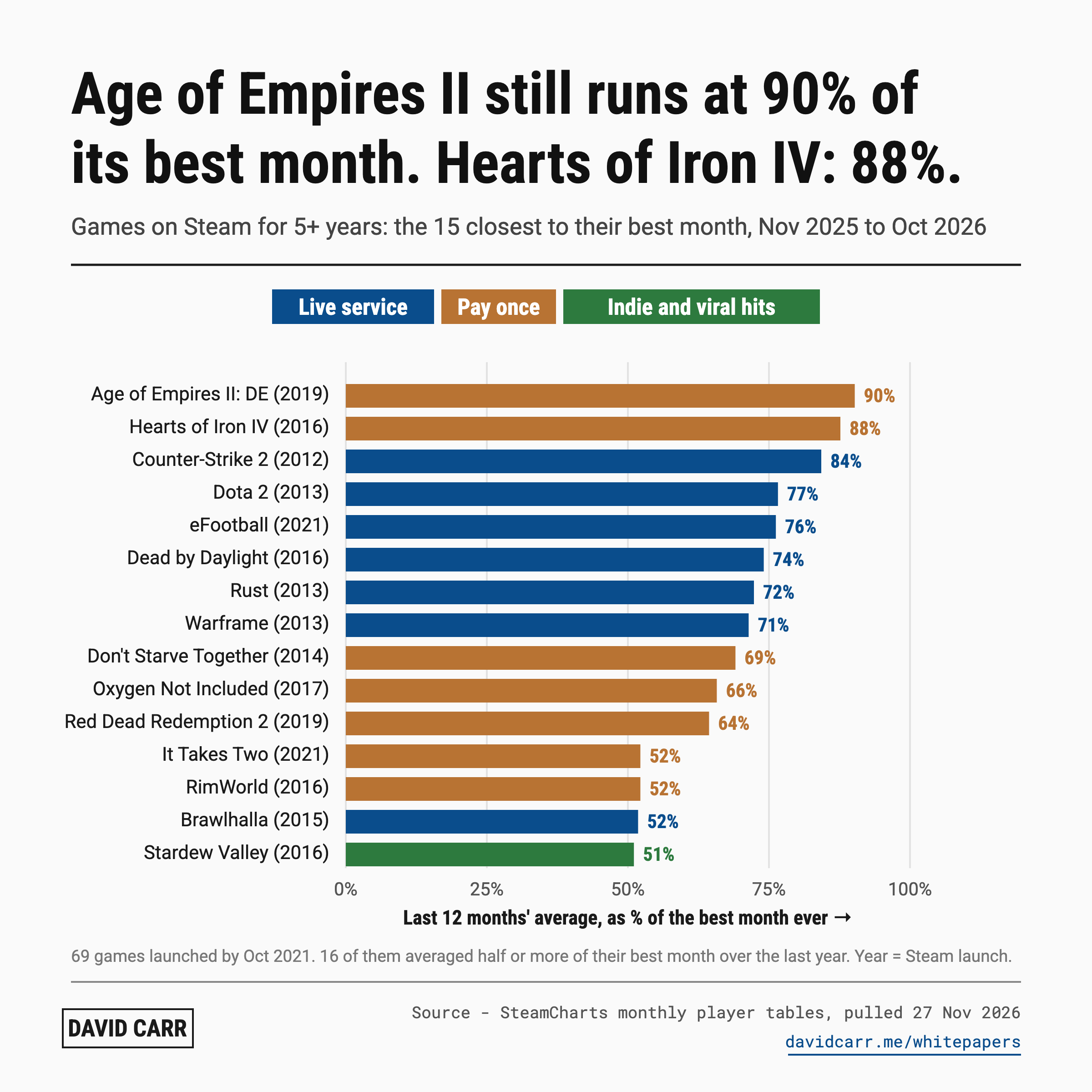
Age of Empires II still runs at 90% of its best month. Hearts of Iron IV: 88%.
- Counter-Strike 2: 84%; Dota 2: 77%
- Dead by Daylight: 74%; Rust: 72%; Warframe: 71%
- Red Dead Redemption 2: 64%
- 16 of 69 games on Steam for five years or more averaged half or more of their best month over the last year
Most of the top 15 are strategy, survival, competitive and co-op games, the kind that play out differently every time.
Last 12 months = November 2025 to October 2026, against the game's best monthly average ever. Games launched on Steam by October 2021.
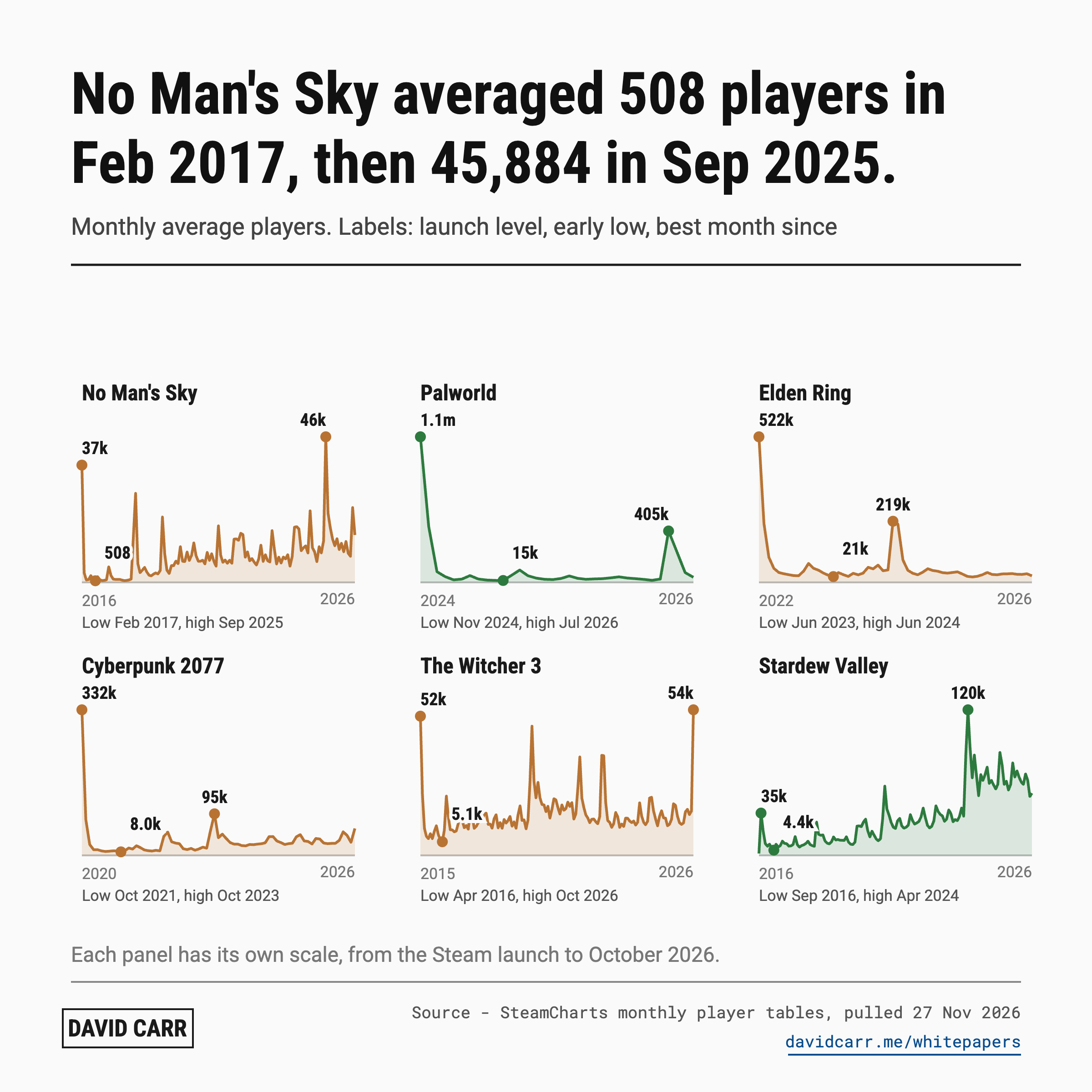
No Man's Sky averaged 508 players in Feb 2017, then 45,884 in Sep 2025.
- No Man's Sky: 36,976 at launch in 2016, 508 in February 2017, 45,884 in September 2025
- Palworld: 1.1 million at launch, 15,396 in November 2024, 404,614 in July 2026
- Elden Ring: 20,992 in June 2023, then 219,195 in June 2024
- Cyberpunk 2077: 8,004 in October 2021, then 94,909 in October 2023
- The Witcher 3: 5,105 in April 2016, then 54,279 in October 2026, its best month on Steam
A quiet spell is not the end of the story. Each of these six came back to many times its low point.
Low = lowest monthly average in the first three years after the launch level. High = best month after that low. Each panel has its own scale.
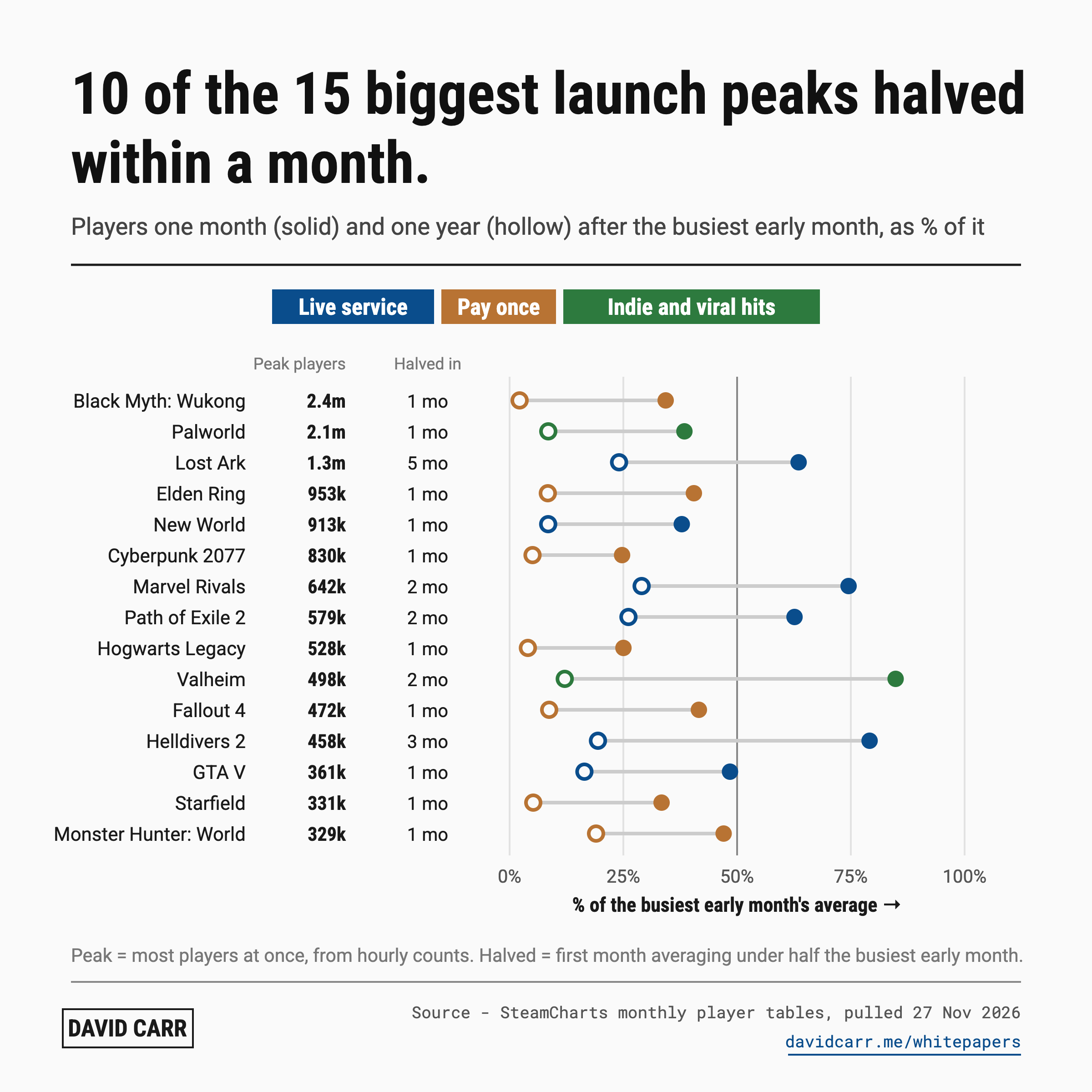
10 of the 15 biggest launch peaks halved within a month.
- Black Myth: Wukong: 2.4 million at once at its peak; a month later, 34% of its launch-month average
- Palworld: 2.1 million; 38% a month later, 9% a year later
- Valheim kept 85% after a month; Helldivers 2, 79%; Marvel Rivals, 74%
- Lost Ark took the longest to halve: five months
The bigger the launch, the bigger the first drop in raw numbers. The games that held up best in month two are mostly online multiplayer games.
The 15 games with the highest player peak ever, where that peak came in the first three months. Peak = most players at once, from hourly counts. Busiest early month = the higher-average of the launch month and the one after (for Marvel Rivals, January 2025). Halved = the first month averaging under half of it.
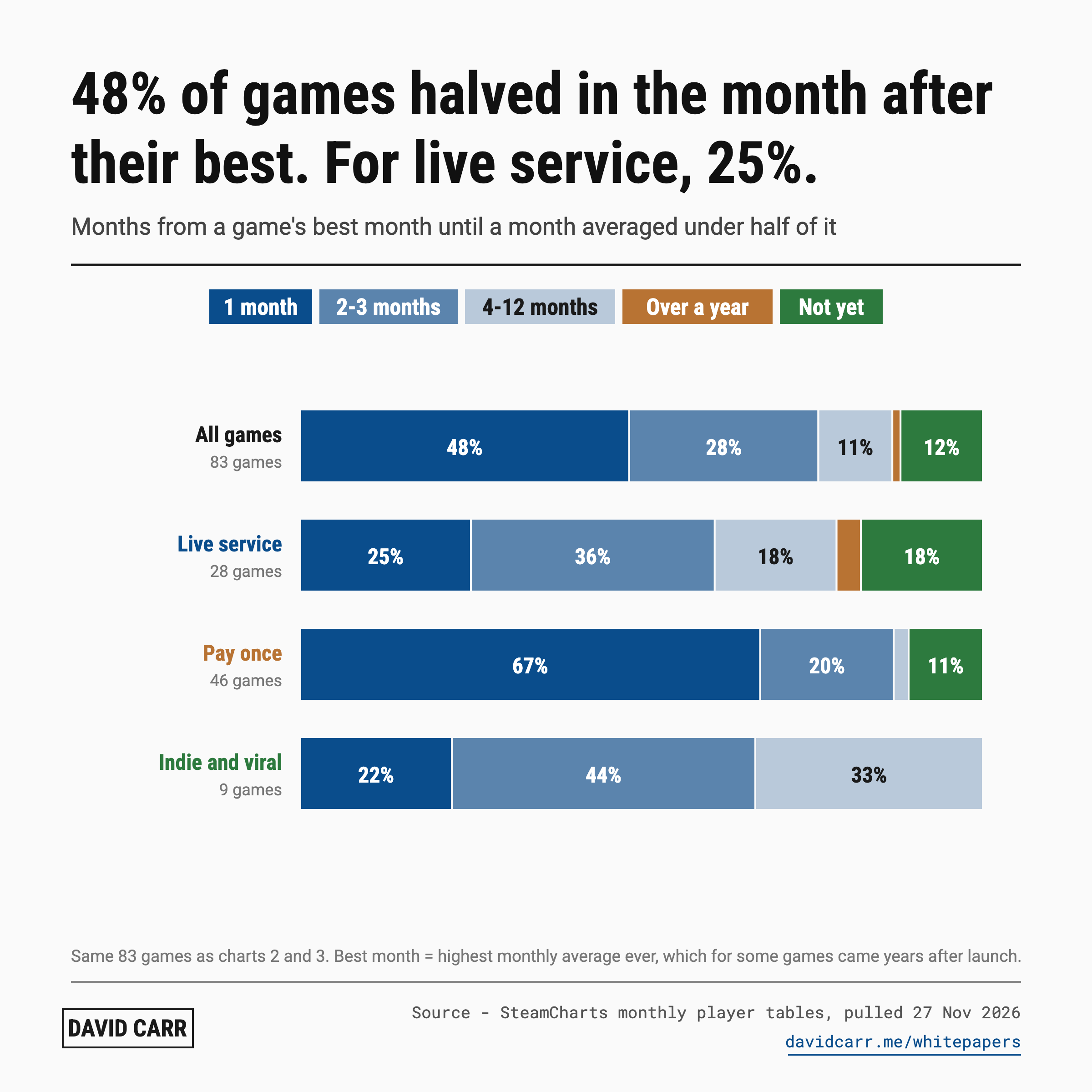
48% of games halved in the month after their best. For live service, 25%.
- All 83 games: 48% halved in one month, 28% in two or three, 11% in four to twelve
- Pay once: 67% halved in one month
- Live service: 25% in one month; 18% have not halved yet
- 10 of the 83 have never had a month under half their best
A fast fall after the best month is the normal pattern on Steam, for every kind of game. Live-service games take longer to get there.
Best month = highest monthly average ever, which for some games came years after launch. Not yet = still at half or more of the best month in every month up to October 2026.
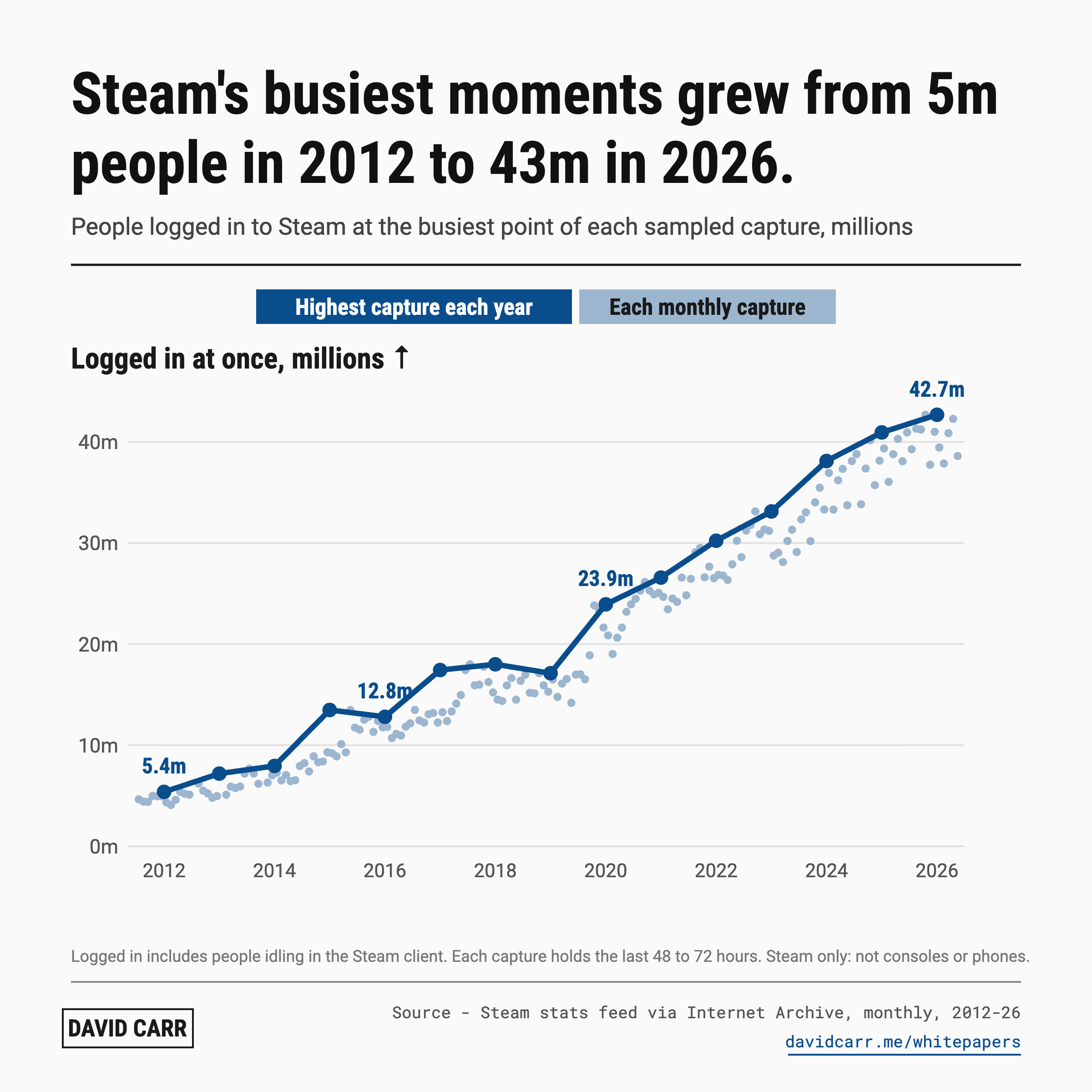
Steam's busiest moments grew from 5m people in 2012 to 43m in 2026.
- Highest monthly capture: 5.4 million in 2012, 13.5 million in 2015, 23.9 million in 2020
- Spring 2020: 18.9 million in March, 23.8 million in April
- 2026: 42.7 million in April; the live feed on 27 November 2026 showed 38.6 million
Steam as a whole grew about eightfold over these years, so the drops on this page happened while the overall crowd kept growing.
One Internet Archive capture of Steam's own logged-in-users feed a month. Each holds the last 48 to 72 hours, and the chart uses its highest point. Logged in includes people idling in the client. Steam only: consoles and phones are not counted.
Method, caveats and sources
The short answer. Most games lose most of their launch crowd fast, and then hold steady. Three months after launch the typical game had 24% of its launch players; three years on it had 27%. Live-service games held more: 36% at one year, against 18% for pay-once games. Yet 46 of the 116 games had their busiest month a year or more after launch, among them Counter-Strike, Baldur's Gate 3, Among Us and Stardew Valley. Age of Empires II, Hearts of Iron IV, Counter-Strike 2 and Dota 2 still run at over three quarters of their best month. Ten of the 15 biggest launch peaks halved within a month. Over the same years the number of people logged in to Steam at its busiest grew from about 5 million to 43 million.
Data. Monthly average and peak concurrent players for 116 well-known games that launched on Steam from August 2012 to December 2024, from the public monthly tables at SteamCharts, which has counted every Steam game's players once an hour since July 2012 using Steam's own Web API. Pulled on 27 November 2026, one page per game at a polite rate; October 2026 is the last full month. Steam's overall logged-in users come from Steam's own public stats feed, one Internet Archive capture a month from 2012 to 2026. SteamDB was not used. Every figure on this page is my own count on that data.
Definitions. Steam launch = the first month a game averaged 100 or more players, early access included (earlier rows are test traffic before release). Launch level = the best monthly average in the launch month and the two after. Best month = highest monthly average ever. Halved = the first month after the best month that averaged under half of it. The three kinds of game are my own grouping, listed in the data notes. The retention curves use the 83 games that launched with 5,000 or more average players and have 36 months of data, so the same games are in every month of the curve.
Caveats. Steam is one shop on PC. It does not count consoles, phones or other PC launchers, and several of these games sell most of their copies elsewhere. Some came to Steam years after their first release, so a Steam launch is not always a game's first day. Monthly averages smooth out single big days. The 116 games are well-known titles picked by hand, not a random sample, so they lean towards hits.
Also: Gaming at Christmas and GTA VI in numbers.