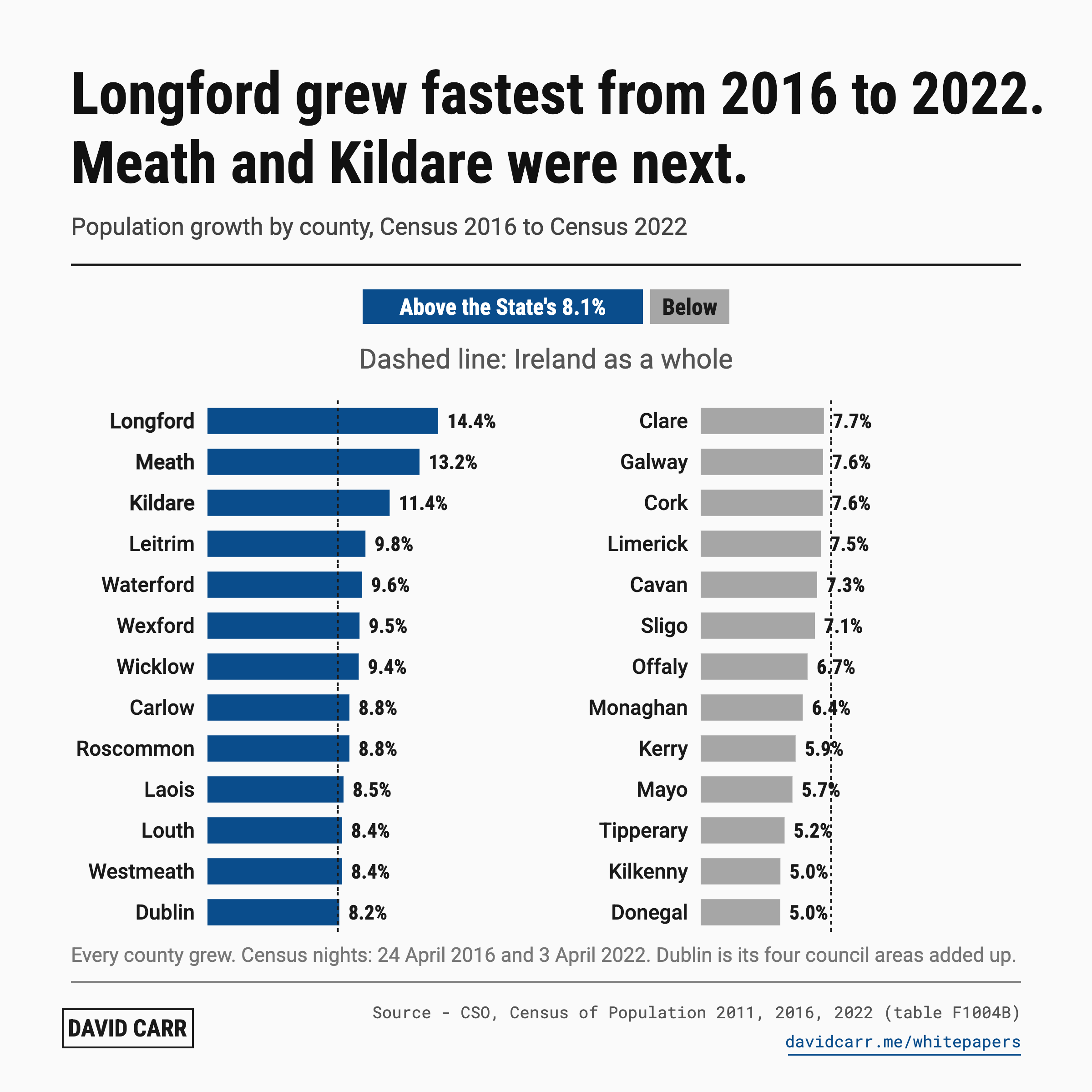
Longford grew fastest from 2016 to 2022. Meath and Kildare were next.
- Longford: up 14.4%, to 46,751
- Meath: up 13.2%, to 220,826
- Kildare: up 11.4%, to 247,774
- Ireland: up 8.1%, to 5,149,139
- Slowest: Donegal and Kilkenny, both up 5.0%
Every county grew. Thirteen grew faster than the country as a whole, most of them in Leinster.
Census population by county, 2016 and 2022, from CSO table F1004B. Dublin is its four council areas added up; Cork, Galway, Limerick and Waterford include their cities.
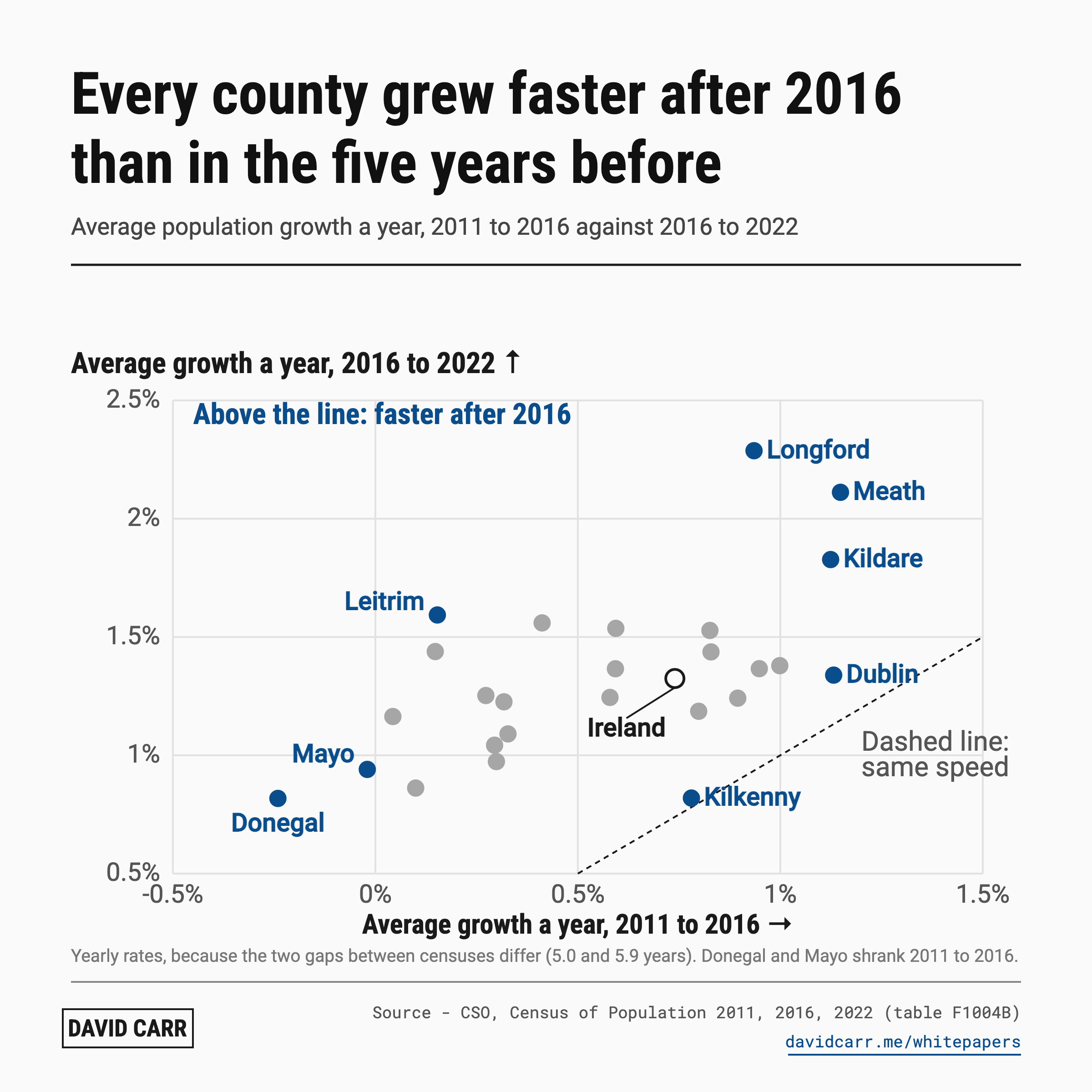
Every county grew faster after 2016 than in the five years before
- Ireland: 0.7% a year (2011 to 2016), 1.3% a year (2016 to 2022)
- Longford: 0.9% to 2.3% a year
- Meath: 1.1% to 2.1% a year
- Donegal and Mayo shrank slightly from 2011 to 2016, then grew
All 26 dots sit above the line. Kilkenny is the closest call: 0.78% a year before, 0.82% after.
The gaps between censuses differ: 5.0 years, then 5.9 (the 2021 census moved to April 2022). So this compares growth a year, compounded.
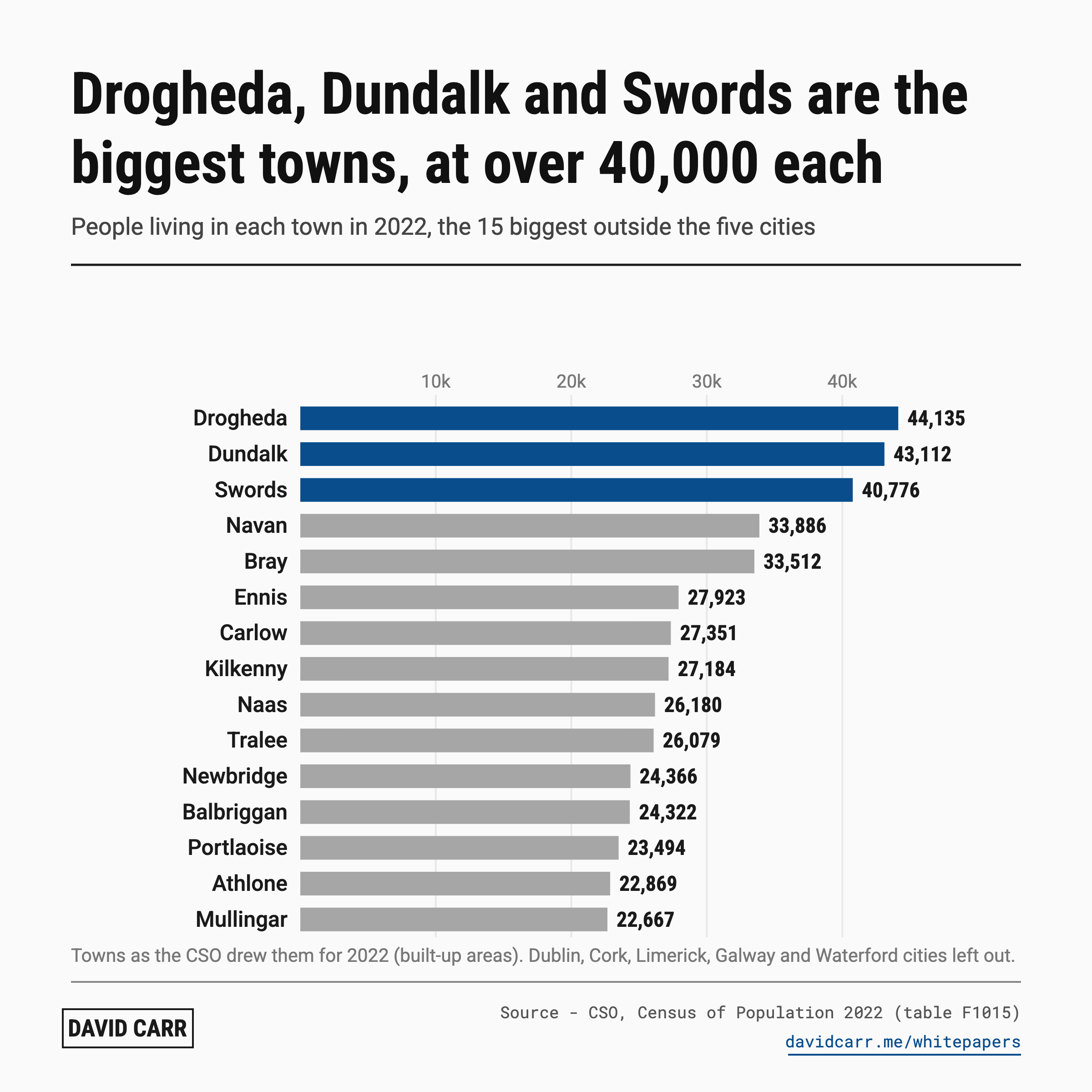
Drogheda, Dundalk and Swords are the biggest towns, at over 40,000 each
- Drogheda: 44,135
- Dundalk: 43,112
- Swords: 40,776
- Navan: 33,886
- Bray: 33,512
Outside the five cities, 49 towns had more than 10,000 people in 2022.
Census 2022, CSO table F1015. For 2022 the CSO drew towns in a new way, as "built-up areas", so these totals can't be set against 2016 town totals directly.
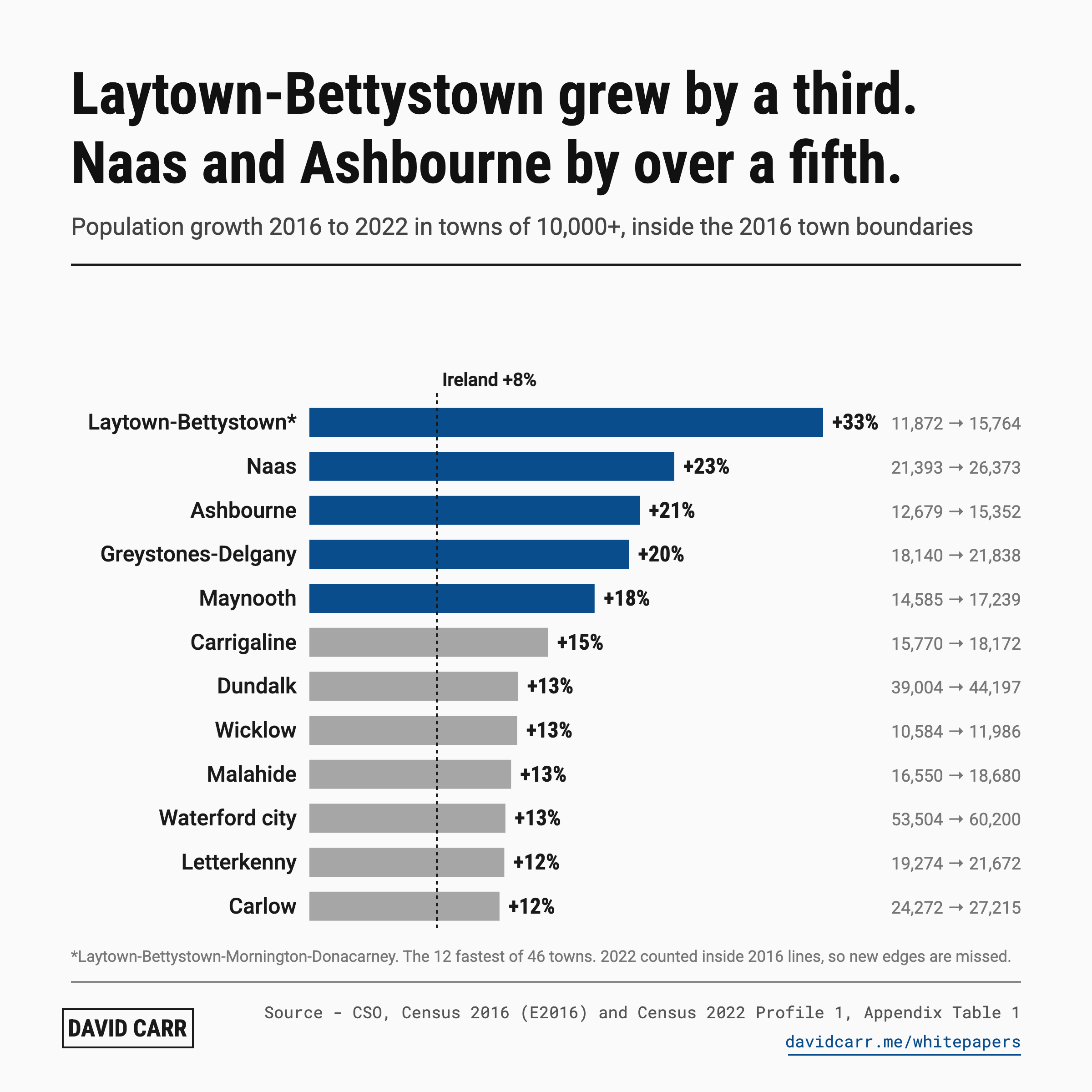
Laytown-Bettystown grew by a third. Naas and Ashbourne by over a fifth.
- Laytown-Bettystown-Mornington-Donacarney: 11,872 to 15,764, up 33%
- Naas: up 23%
- Ashbourne: up 21%
- Greystones-Delgany: up 20%
- Maynooth: up 18%
The five fastest are all in Meath, Kildare and Wicklow. Of the 46 towns with over 10,000 people in 2016, every one grew.
2016 population from CSO table E2016; 2022 population inside the same 2016 lines from the CSO's Census 2022 Profile 1, Appendix Table 1. New estates outside the old line are not counted, so growth at the edges is understated.
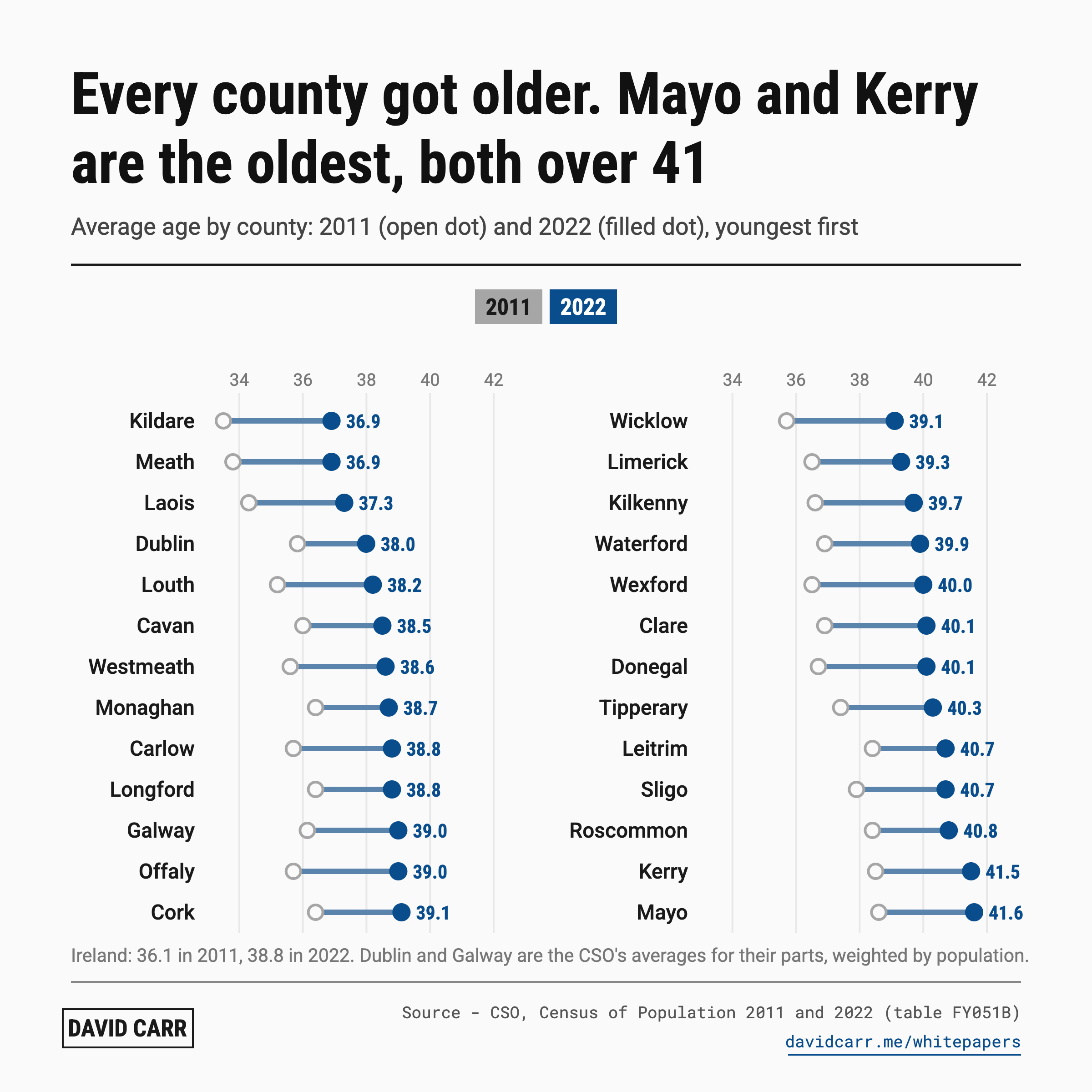
Every county got older. Mayo and Kerry are the oldest, both over 41.
- Ireland: average age 36.1 in 2011, 38.8 in 2022
- Oldest: Mayo 41.6, Kerry 41.5
- Youngest: Kildare and Meath, both 36.9
- Share aged 65+: 11.7% to 15.1% nationally
- Share under 15: 21.4% to 19.7%
Every county's average age rose, by between 2.2 years (Dublin) and 3.5 years (Wexford). The youngest are Kildare, Meath and Laois.
Average age from CSO table FY051B. Age shares from single-year counts in table FY006B. Dublin and Galway are the CSO's figures for their parts, weighted by population.
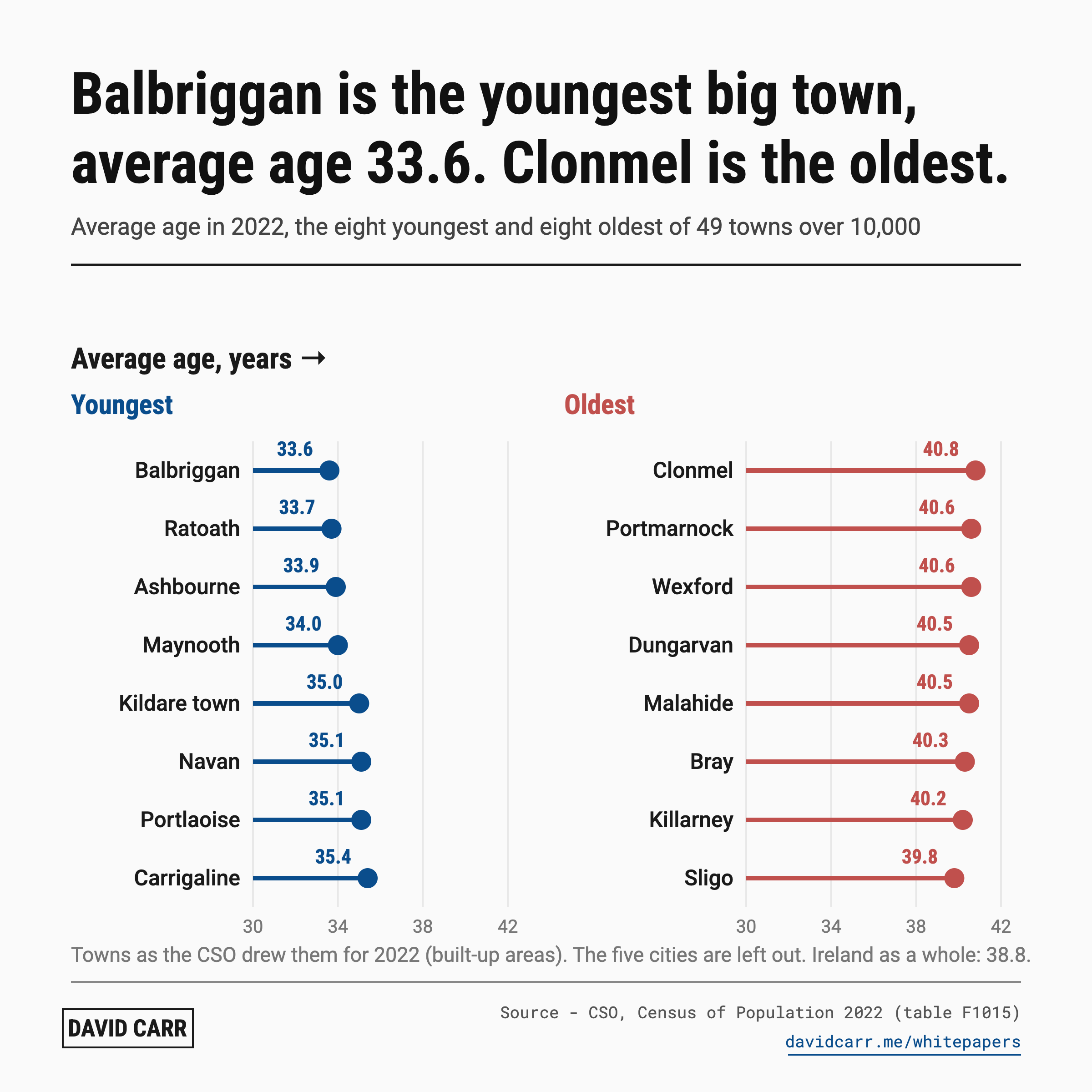
Balbriggan is the youngest big town, average age 33.6. Clonmel is the oldest.
- Youngest: Balbriggan 33.6, Ratoath 33.7, Ashbourne 33.9, Maynooth 34.0
- Oldest: Clonmel 40.8, Portmarnock 40.6, Wexford 40.6
- Ireland: 38.8
Seven of the eight youngest are in Dublin, Meath, Kildare or Laois; the eighth is Carrigaline in Cork. A quarter of Ashbourne's people are under 15.
Census 2022, towns over 10,000 people, the five cities left out. A town's average age says who lives there now, not whether it is growing.
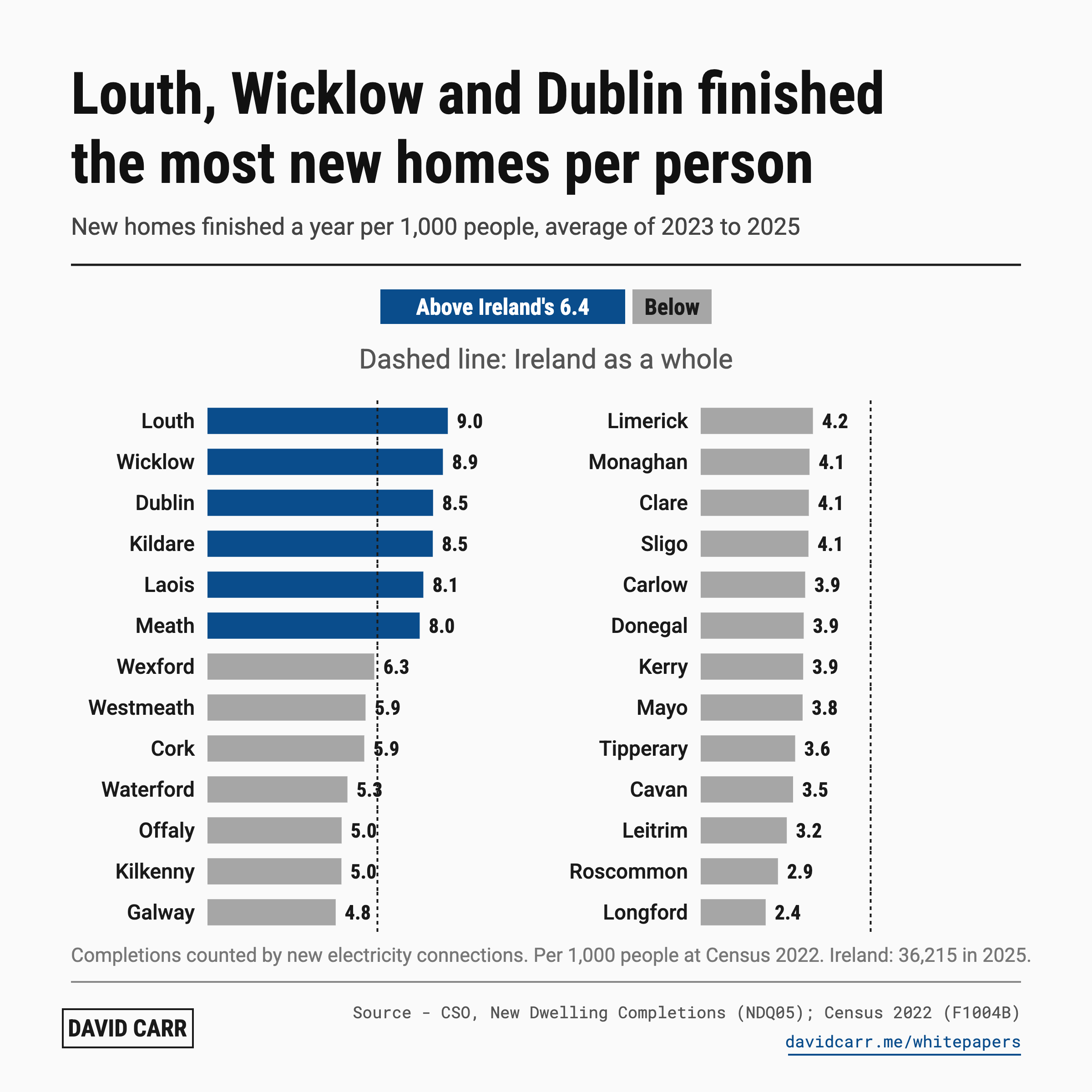
Louth, Wicklow and Dublin finished the most new homes per person
- Louth: 9.0 a year per 1,000 people
- Wicklow: 8.9
- Dublin and Kildare: 8.5
- Ireland: 6.4
- Ireland, total: 4,911 in 2012; 36,215 in 2025
Six counties, all in Leinster, finished more new homes per person than the country as a whole from 2023 to 2025.
CSO New Dwelling Completions, table NDQ05, by council area, added up to counties. 2026 runs to September (26,833 so far) and is left out.
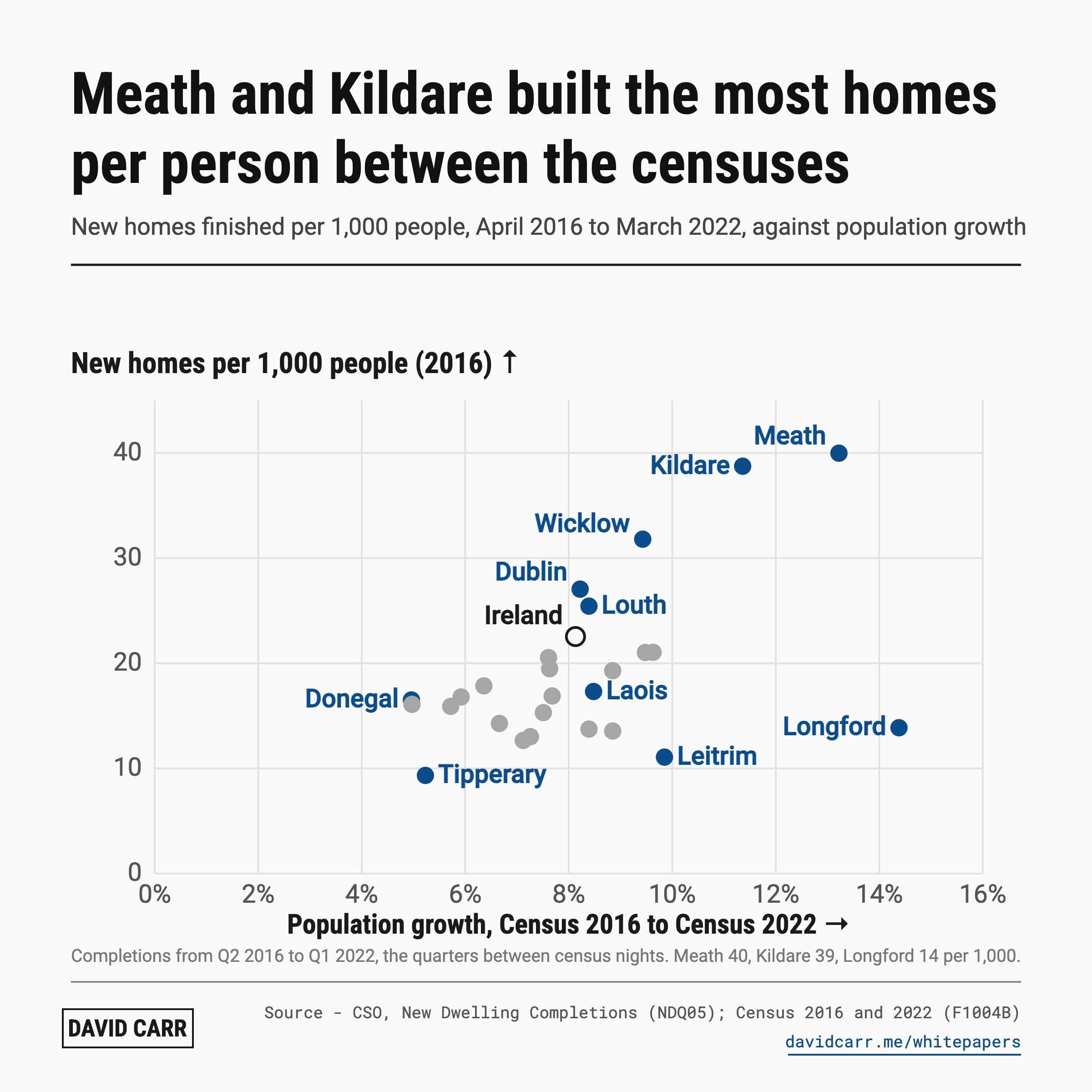
Meath and Kildare built the most homes per person between the censuses
- Meath: 40 new homes per 1,000 people, population up 13%
- Kildare: 39 per 1,000, up 11%
- Wicklow: 32 per 1,000, up 9%
- Ireland: 23 per 1,000, up 8%
- Longford: 14 per 1,000, up 14%
Counties that built more mostly grew more. Longford is the clear exception: fastest growth, and fewer new homes per person than the national rate.
Completions from April 2016 to March 2022, the quarters between the two census nights, per 1,000 people at the 2016 census.
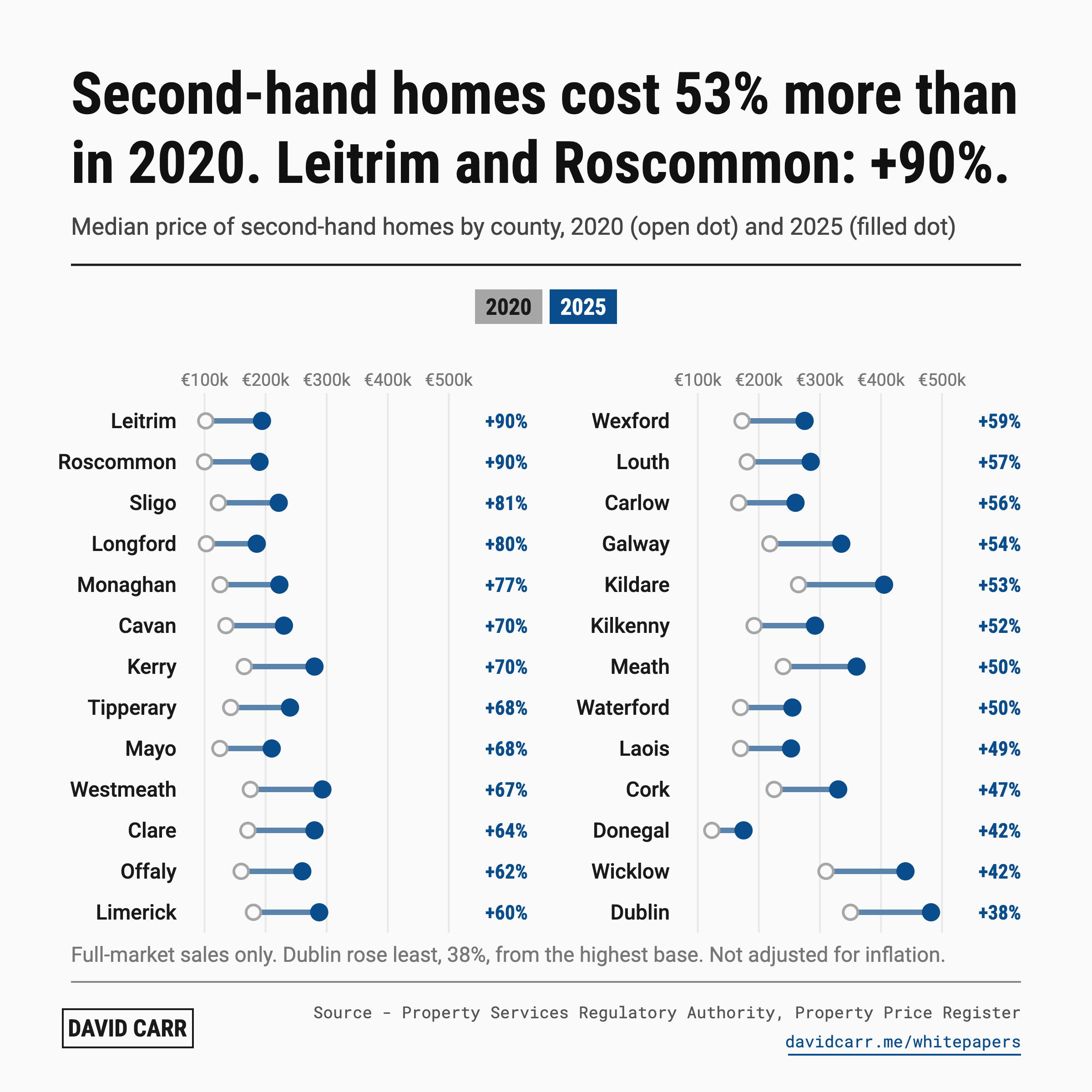
Second-hand homes cost 53% more than in 2020. Leitrim and Roscommon: +90%.
- Ireland: €225,000 to €345,000
- Leitrim: €102,000 to €194,000
- Roscommon: €100,000 to €190,000
- Dublin: €350,000 to €482,000, up 38%
- Sales, all homes: 46,895 in 2020, 58,834 in 2025
Prices tended to rise fastest where they started lowest. The biggest rises were in the north-west and midlands; the smallest in Dublin, Wicklow and Donegal.
Median of full-market second-hand sales on the Property Price Register, 2020 against 2025. Second-hand only, so new-build mix doesn't move it. Not adjusted for inflation.
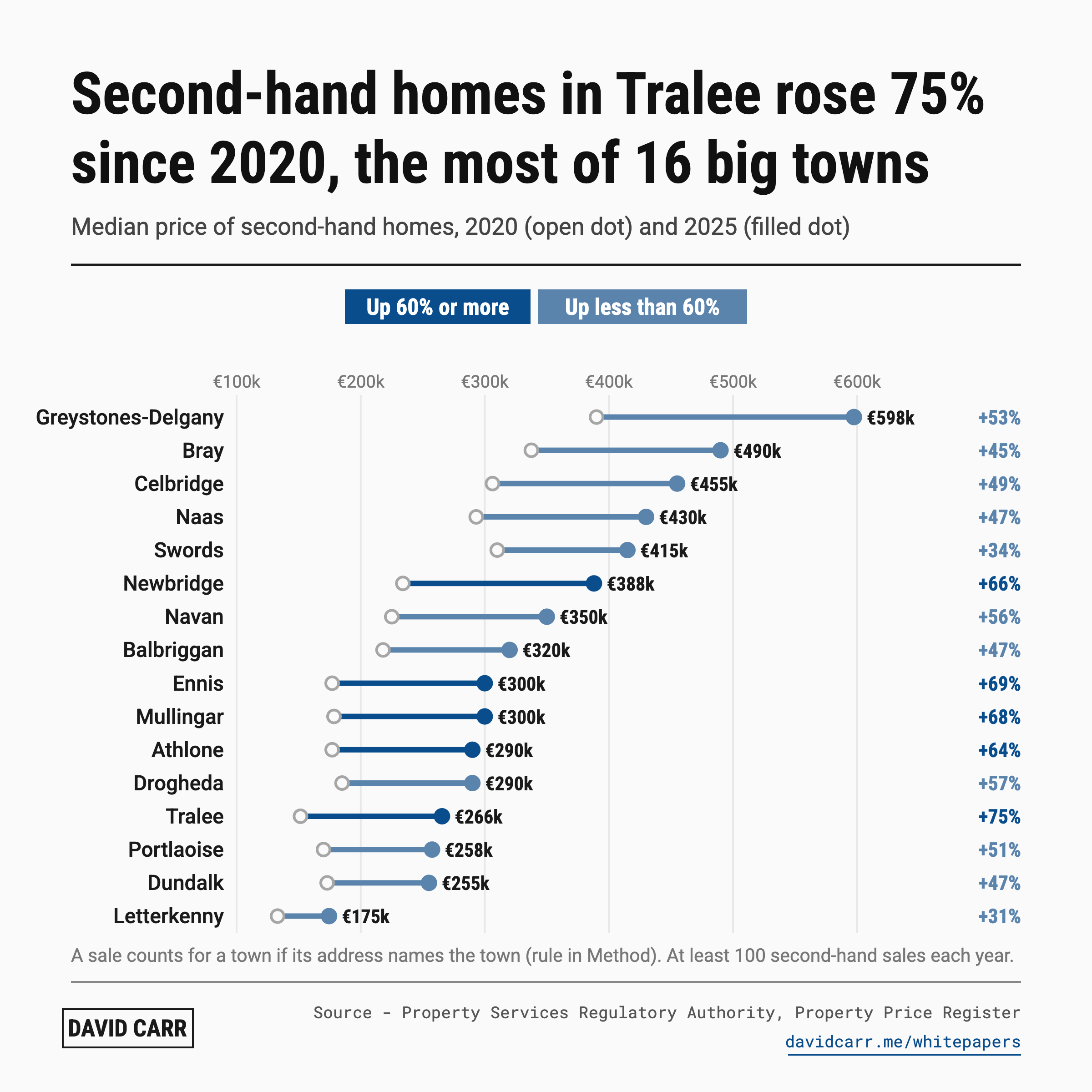
Second-hand homes in Tralee rose 75% since 2020, the most of 16 big towns
- Tralee: €151,500 to €265,500, up 75%
- Ennis: up 69%
- Mullingar: up 68%
- Newbridge: up 66%
- Greystones-Delgany: the highest median, €597,500
Tralee, Ennis and Mullingar rose fastest. Swords and Letterkenny rose least, 34% and 31%.
Rule in Method. Only towns with at least 100 second-hand sales in both 2020 and 2025, and whose name isn't also a county's.
Method, caveats and sources
The short answer. Every county grew between the 2016 and 2022 censuses, and every one grew faster than in the five years before. Longford, Meath and Kildare grew fastest. Among big towns, Laytown-Bettystown grew by a third and Naas and Ashbourne by over a fifth. Every county also got older: the average age rose from 36.1 to 38.8, with Mayo and Kerry the oldest. Louth, Wicklow and Dublin finished the most new homes per person from 2023 to 2025. Second-hand homes cost 53% more in 2025 than in 2020, and the rise was biggest where prices started lowest.
Population. Census of Population 2011, 2016 and 2022, from the CSO's PxStat tables F1004B (population by county), FY051B (average age), FY006B (population by single year of age) and F1015 (towns in 2022). Pulled 22 November 2026. Dublin is Dublin City, Dún Laoghaire-Rathdown, Fingal and South Dublin added up. Cork, Galway, Limerick and Waterford include their cities. The 2021 census was moved to April 2022, so the last gap is 5.9 years; chart 2 uses growth a year for that reason.
Towns. For 2022 the CSO drew towns in a new way, as built-up areas, so 2022 town totals can't be set against 2016 ones. For growth, chart 4 uses the CSO's own count of 2022 population inside the 2016 town boundaries (Census 2022 Profile 1, Appendix Table 1) against the 2016 count (table E2016). That misses new estates built just outside the old line. Towns are matched by name; three spellings differ and are matched by hand.
New homes. CSO New Dwelling Completions, table NDQ05, quarterly by council area from 2011 to September 2026, added up to counties. The CSO uses new connections to the electricity network as the basis for these figures. Per-person figures use census population.
Prices. Every sale on the Residential Property Price Register (Property Services Regulatory Authority), file dated 18 November 2026, sales to 13 November 2026. Sales flagged as not at full market price are left out. Medians, not averages, and not adjusted for inflation. The county charts use second-hand homes only, so a year with many new homes doesn't push the figure up. Only counts and medians are kept; no single sale or address appears here.
Towns on the price register. A sale counts for a town if it is in the right county and the town's name is a whole word in one of the last two parts of the address, ignoring any part that starts "Co" or "County". That takes in homes with the town as their postal address, even a little outside it. Towns whose name is also a county's (Kilkenny, Carlow, Wexford, Sligo and so on) are left out, because "Co. Kilkenny" would match. Sixteen of the biggest towns pass, each with at least 100 second-hand sales in 2020 and in 2025.
Also: What homes in Ashbourne cost and Irish baby names.