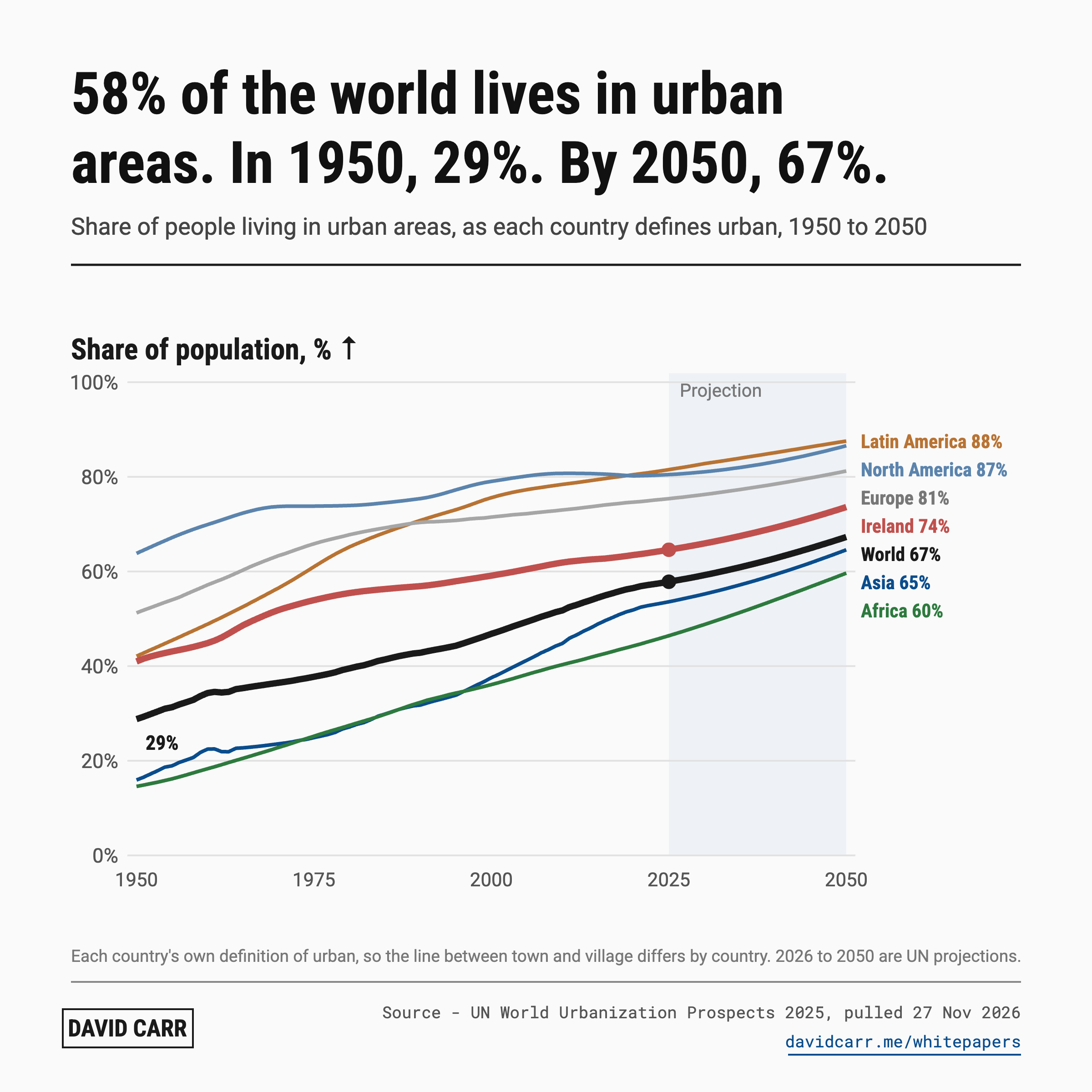
58% of the world lives in urban areas. In 1950, 29%. By 2050, a projected 67%.
- World: 29% urban in 1950, 47% in 2000, 58% in 2025, 67% by 2050
- Ireland: 41% in 1950, 59% in 2000, 65% in 2025, 74% by 2050
- Latin America (82%) and North America (80%) are the most urban regions today
- Africa: 15% in 1950, 46% in 2025, 60% by 2050
Every region is more urban than it was. Asia and Africa started lowest in 1950 and have moved the most since.
Urban as each country defines it, so the line between a town and a village is drawn a little differently in each place. 2026 to 2050 are UN projections.
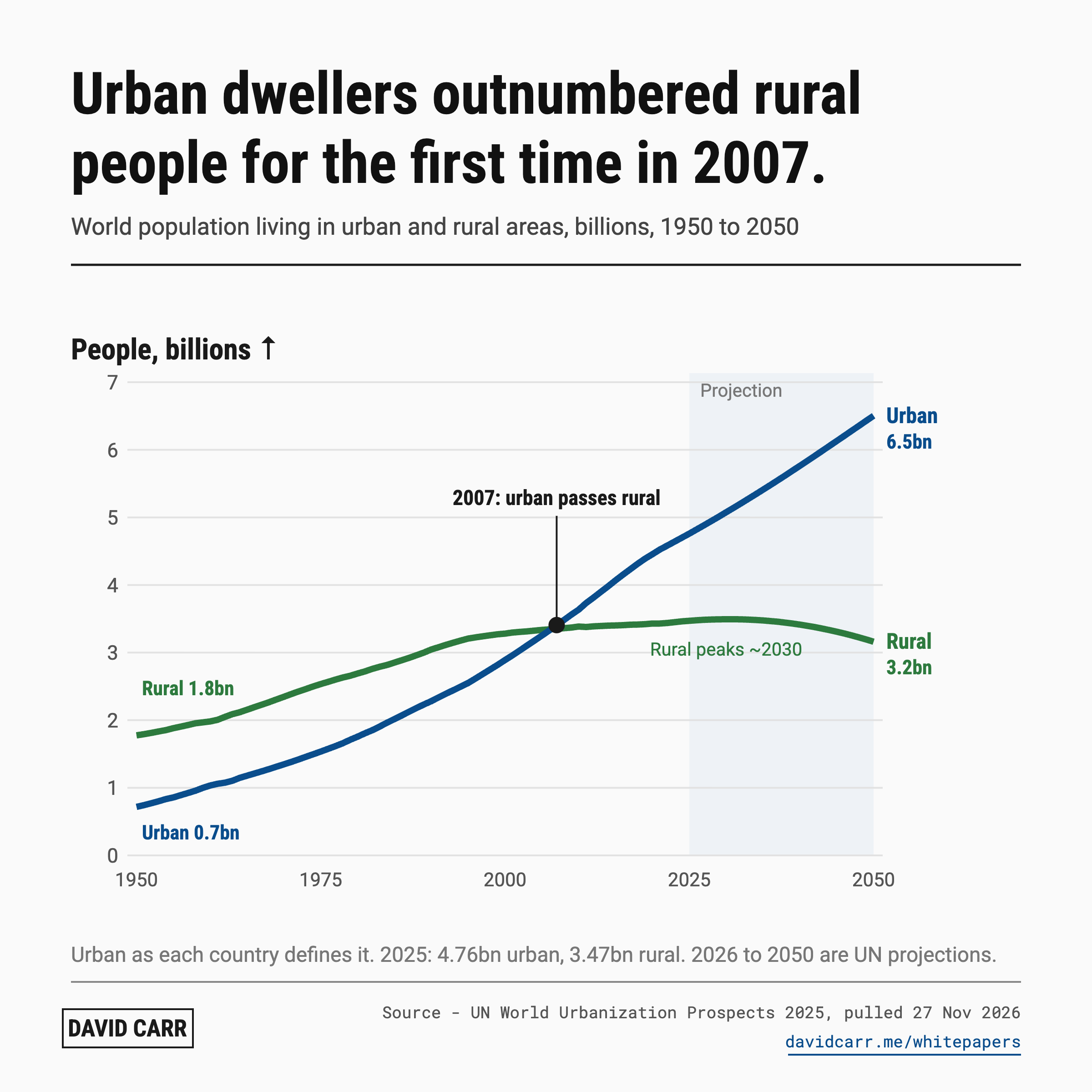
Urban dwellers outnumbered rural people for the first time in 2007.
- 1950: 0.7 billion urban, 1.8 billion rural
- 2025: 4.76 billion urban, 3.47 billion rural
- 2050: 6.5 billion urban, 3.2 billion rural (projected)
- The rural total is projected to peak around 2030, at 3.49 billion
The world's rural population is still growing, just slowly. Nearly all the growth from here is projected to be in towns and cities.
Each country's own definition of urban.
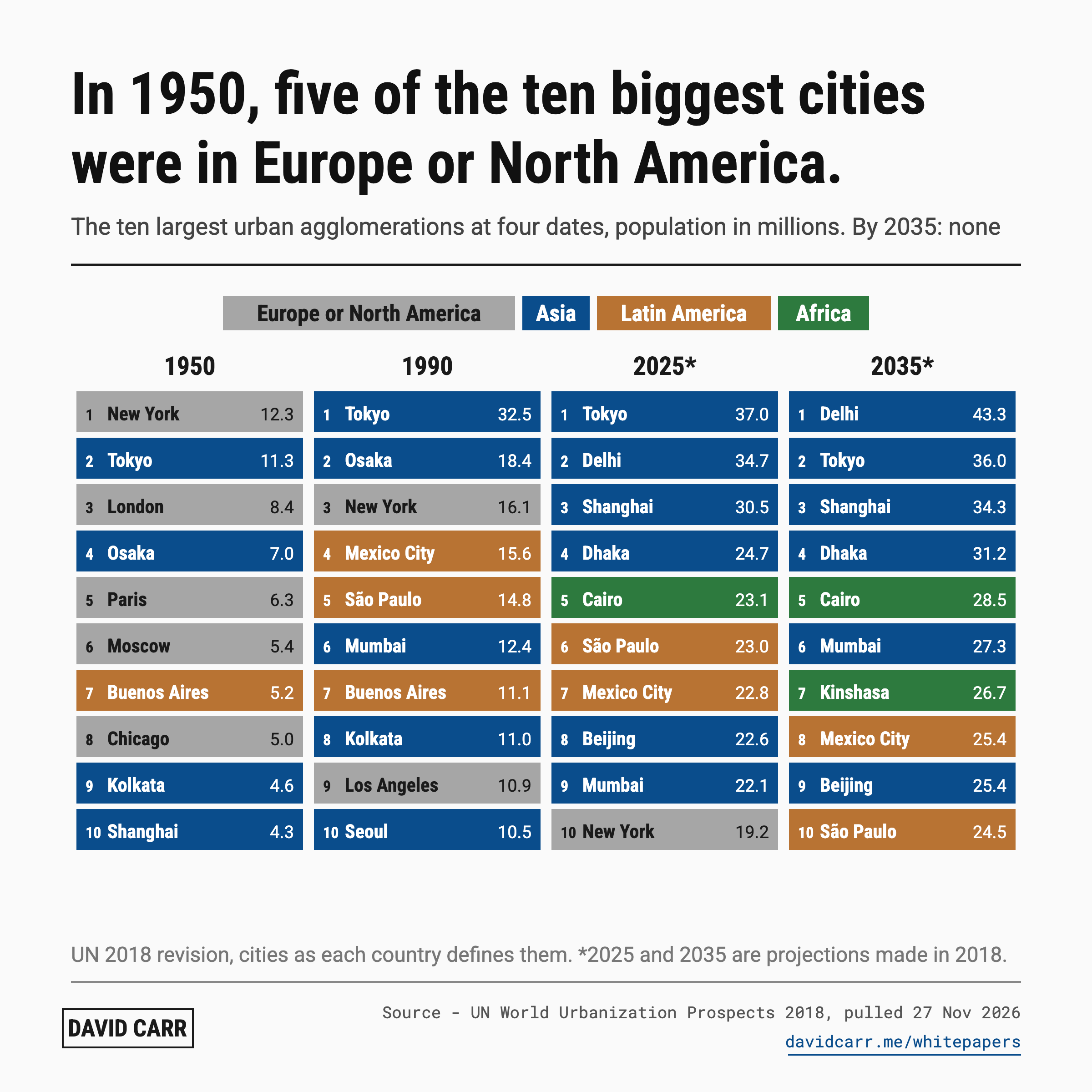
In 1950, five of the ten biggest cities were in Europe or North America. By 2035, none are projected to be.
- 1950: New York (12.3m), Tokyo, London, Osaka, Paris, Moscow, Buenos Aires, Chicago, Kolkata, Shanghai
- 1990: Tokyo (32.5m) top; New York 3rd, Los Angeles 9th
- 2025: Tokyo (37.0m), then Delhi and Shanghai; New York 10th
- 2035: Delhi (43.3m) top; Cairo 5th and Kinshasa 7th
The top ten has moved from the Atlantic to Asia, with Africa and Latin America joining it. Tokyo has stayed in the top two the whole way.
From the UN's 2018 revision, the last to cover 1950. Cities as each country defines them (metro areas). 2025 and 2035 are projections made in 2018.
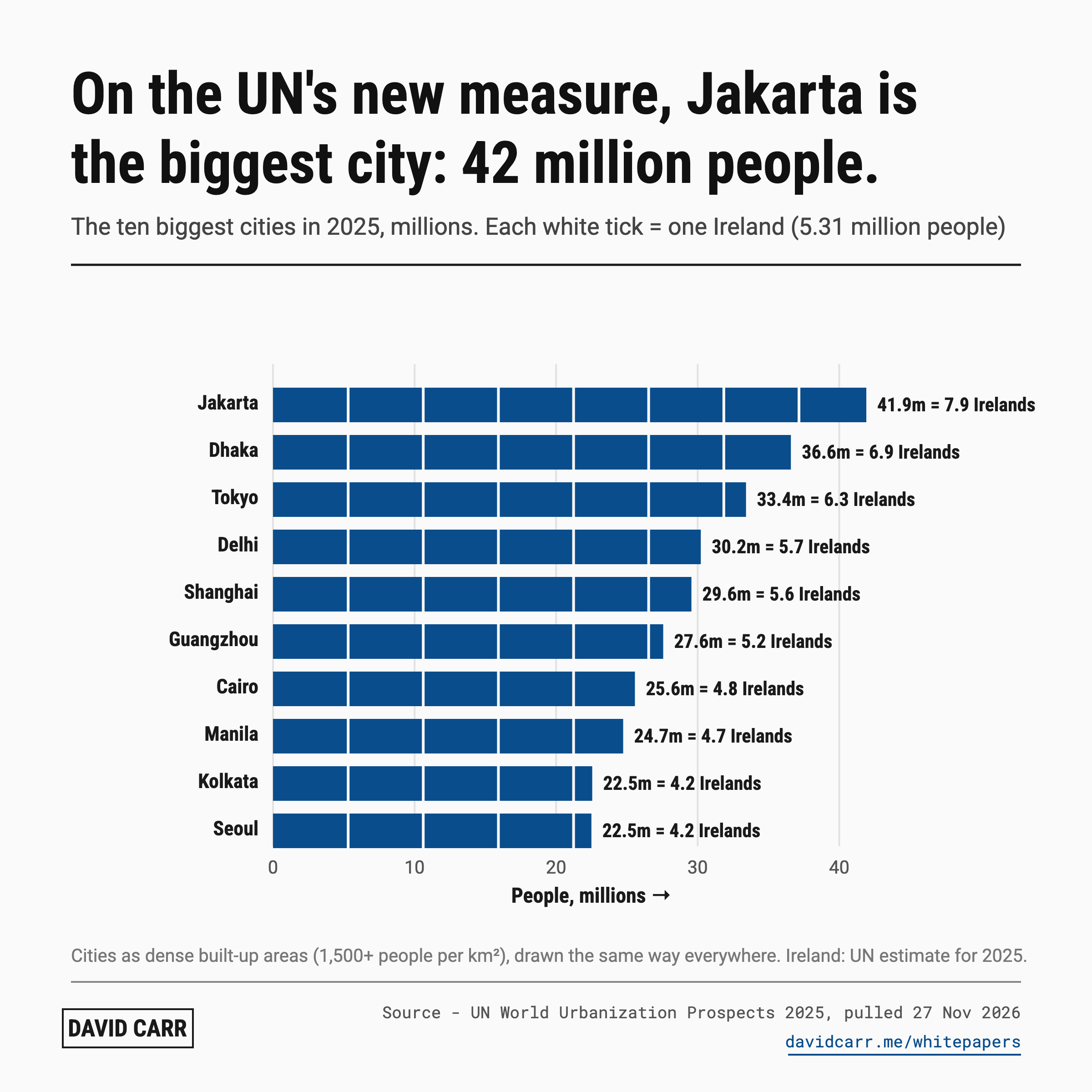
On the UN's new measure, Jakarta is the biggest city: 42 million people, or 7.9 Irelands.
- Jakarta 41.9m, Dhaka 36.6m, Tokyo 33.4m
- Delhi 30.2m, Shanghai 29.6m, Guangzhou 27.6m
- Cairo 25.6m, Manila 24.7m, Kolkata and Seoul 22.5m each
- Ireland: 5.31 million people (UN estimate, 2025)
Tokyo, top of every older list, is third when every city is measured the same way. Even the tenth biggest holds more than four Irelands.
The 2025 revision draws every city with one rule: a joined-up area of 1 km squares with at least 1,500 people per km² and 50,000 people in all. That is why its list differs from the one above.
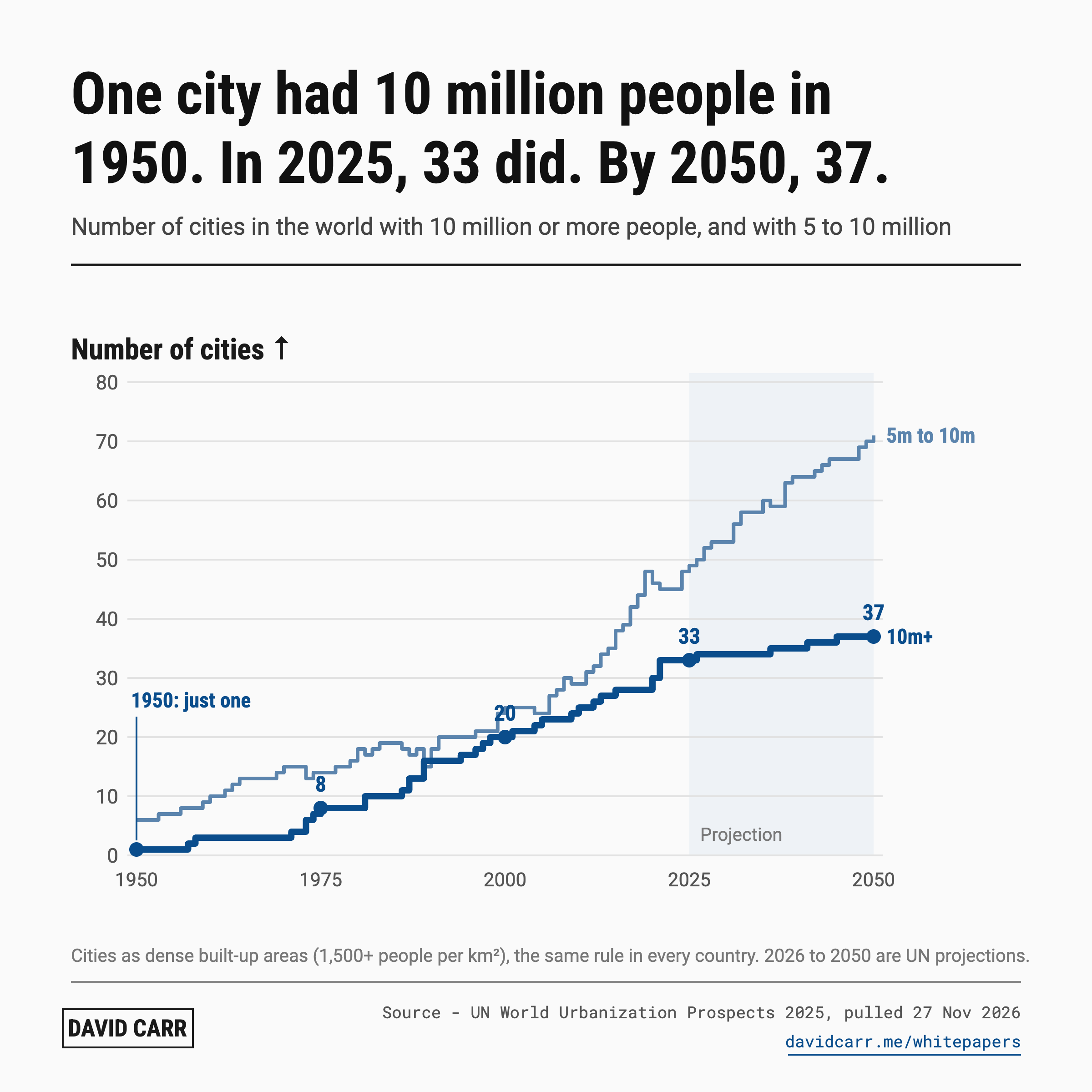
One city had 10 million people in 1950. In 2025, 33 did. By 2050, a projected 37.
- 10 million or more: 1 in 1950, 8 in 1975, 20 in 2000, 33 in 2025
- 5 to 10 million: 6 in 1950, 49 in 2025, 71 by 2050
- 511 cities had a million people or more in 2025
The number of 10-million cities rose fastest from the 1980s to the 2020s. The projection to 2050 is flatter, while the 5-to-10-million group keeps growing.
Cities as dense built-up areas, the same rule everywhere, back-cast to 1950 by the UN.
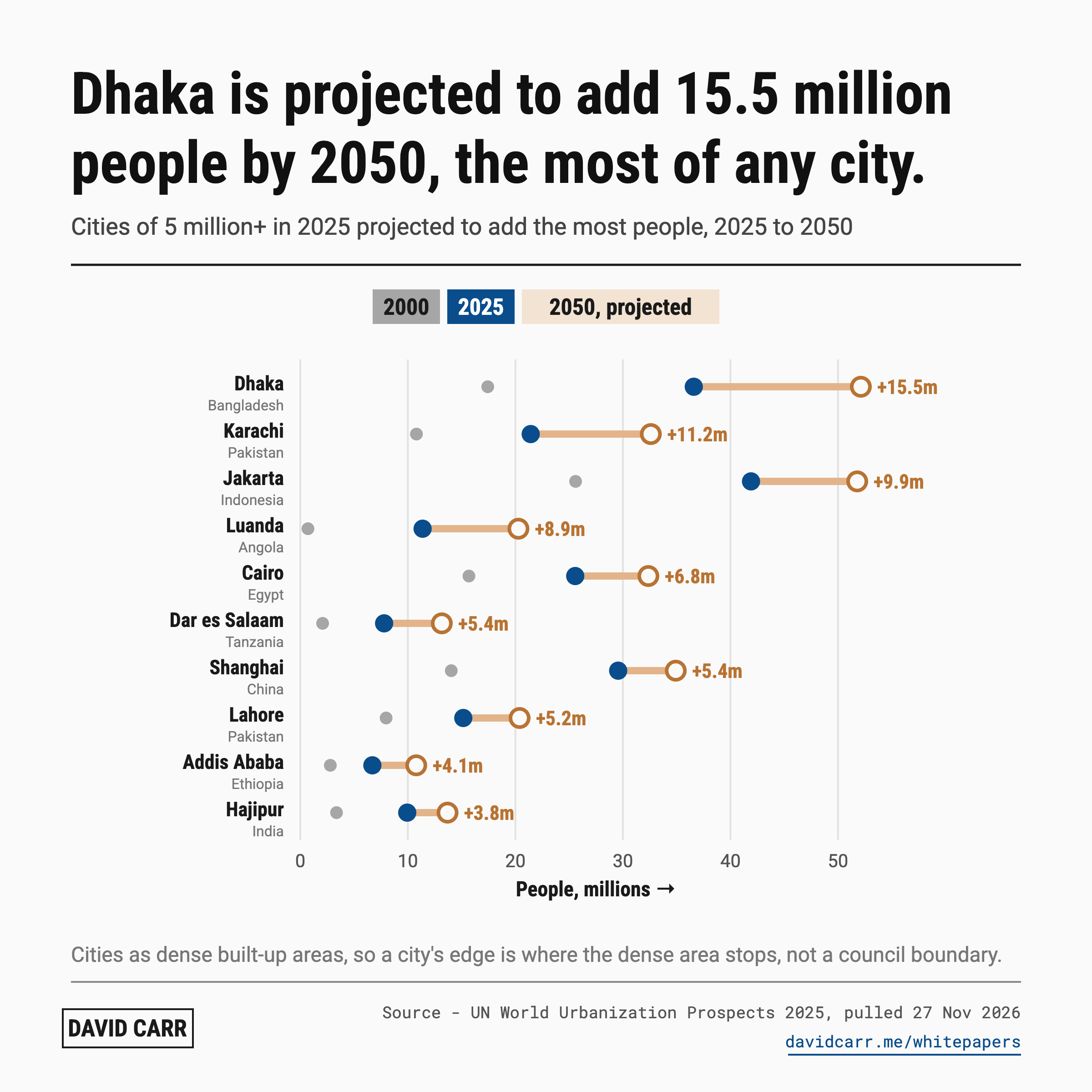
Dhaka is projected to add 15.5 million people by 2050, the most of any city.
- Dhaka +15.5m, Karachi +11.2m, Jakarta +9.9m, Luanda +8.9m
- Cairo +6.8m, Dar es Salaam +5.4m, Shanghai +5.4m, Lahore +5.2m
- Addis Ababa +4.1m, Hajipur (India) +3.8m
- Dhaka added 19.2m from 2000 to 2025, also the most
Four of the ten are in Africa, four in South Asia and two in East or South-East Asia.
Cities of 5 million or more in 2025, 2025 to 2050. A city's edge is where the dense area stops, so a city can grow by joining up with dense places nearby. Luanda's 2000 figure (0.7m) is low for that reason. Hajipur is the UN's name for a dense area in Bihar.
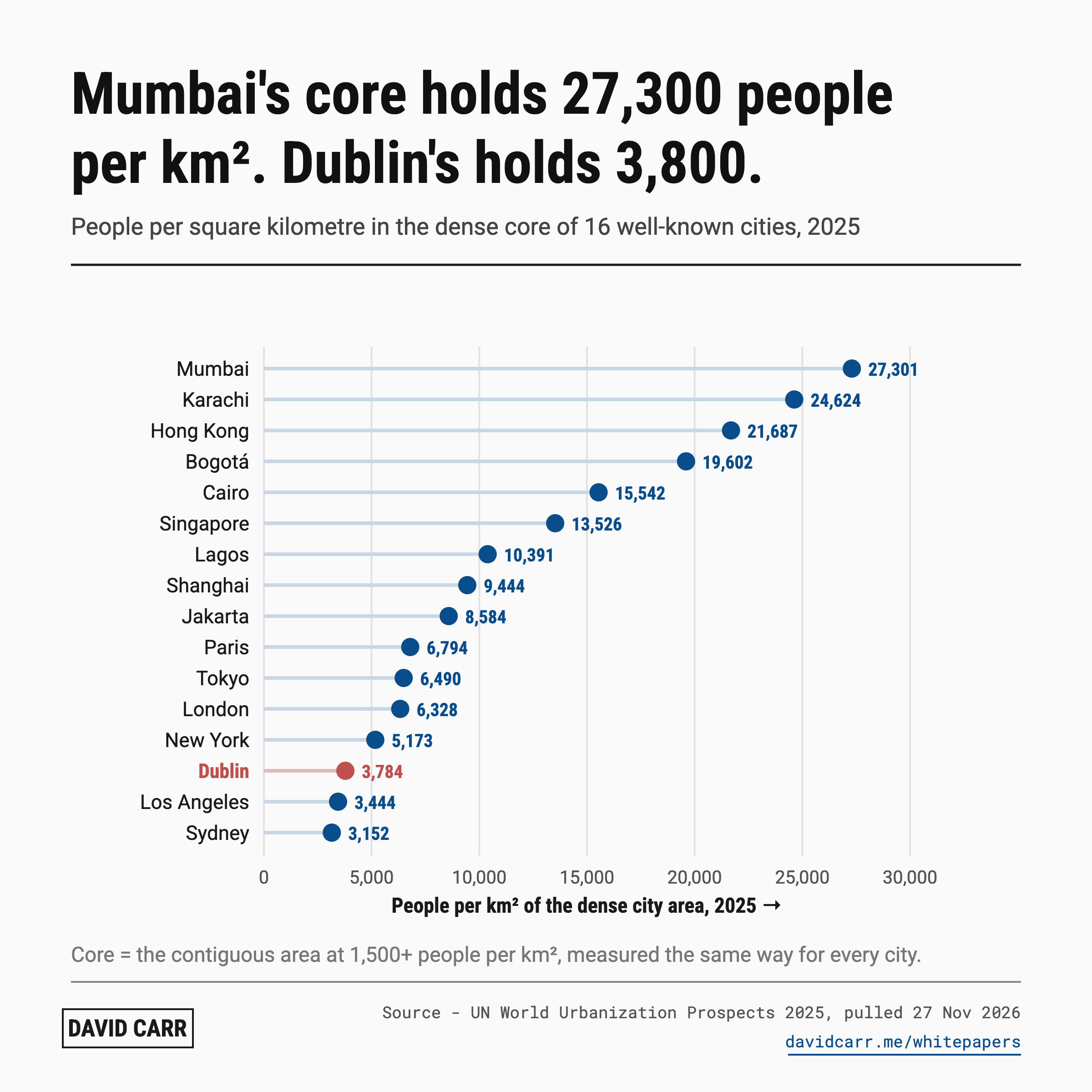
Mumbai's core holds 27,300 people per km². Dublin's holds 3,800.
- Mumbai 27,300; Karachi 24,600; Hong Kong 21,700; Bogotá 19,600
- Paris 6,800; Tokyo 6,500; London 6,300; New York 5,200
- Dublin 3,800; Los Angeles 3,400; Sydney 3,200
Dublin's core is about as tightly packed as Los Angeles or Sydney, and a little over half as dense as Paris or London.
Core = the joined-up area at 1,500+ people per km², measured the same way for every city, so these are like-for-like.
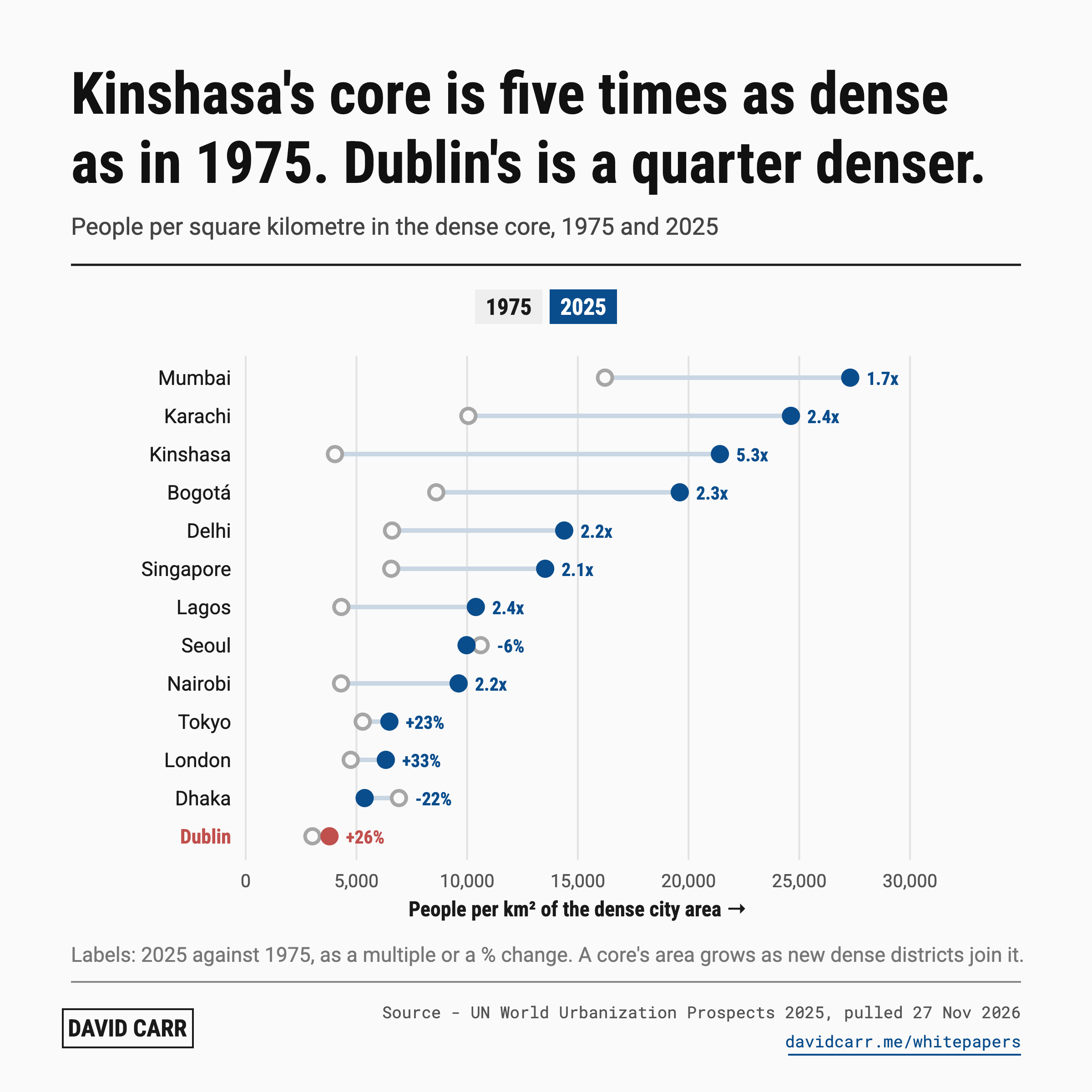
Kinshasa's core is five times as dense as in 1975. Dublin's is a quarter denser.
- Kinshasa: 4,000 to 21,400 people per km², 5.3 times
- Karachi 2.4 times, Lagos 2.4 times, Bogotá 2.3 times, Delhi 2.2 times
- London +33%, Dublin +26%, Tokyo +23%
- Seoul -6% and Dhaka -22%: their cores spread faster than they filled
Most big cities packed in more people as they grew. A few spread outwards fast enough to get less dense.
1975 and 2025, people per km² of the dense core.
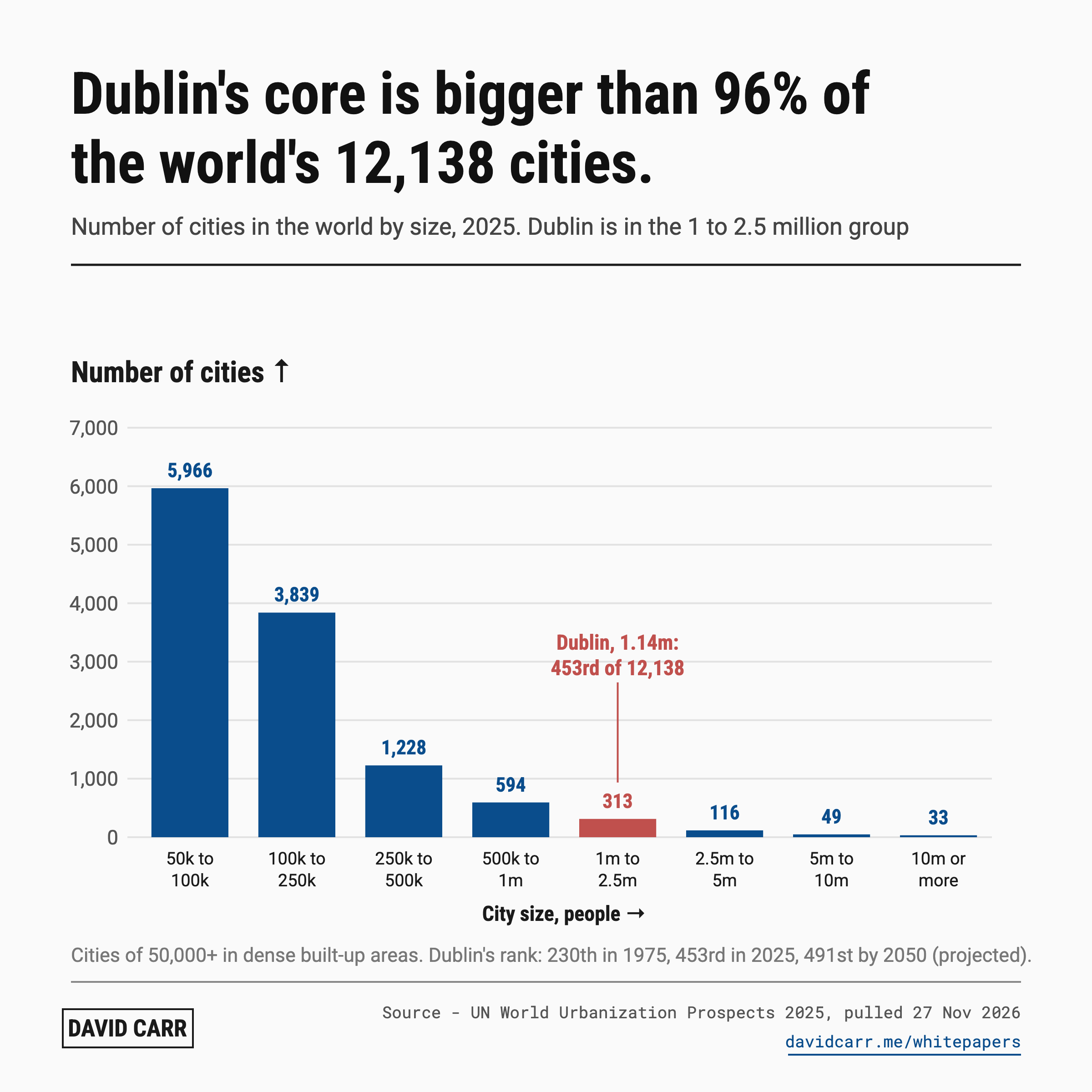
Dublin's core is bigger than 96% of the world's 12,138 cities.
- Dublin: 1.14 million people in 2025, 453rd in the world
- 230th in 1975, 390th in 2000, 491st by 2050 (projected)
- Most cities are small: 5,966 have 50,000 to 100,000 people
- 313 cities have 1 to 2.5 million, Dublin's group
Dublin has grown all the way, from 0.8 million in 1975 to 1.14 million. Its rank slips because thousands of new cities have formed and grown elsewhere.
The UN's measure of Dublin is the dense built-up core, not the county or the commuter belt.
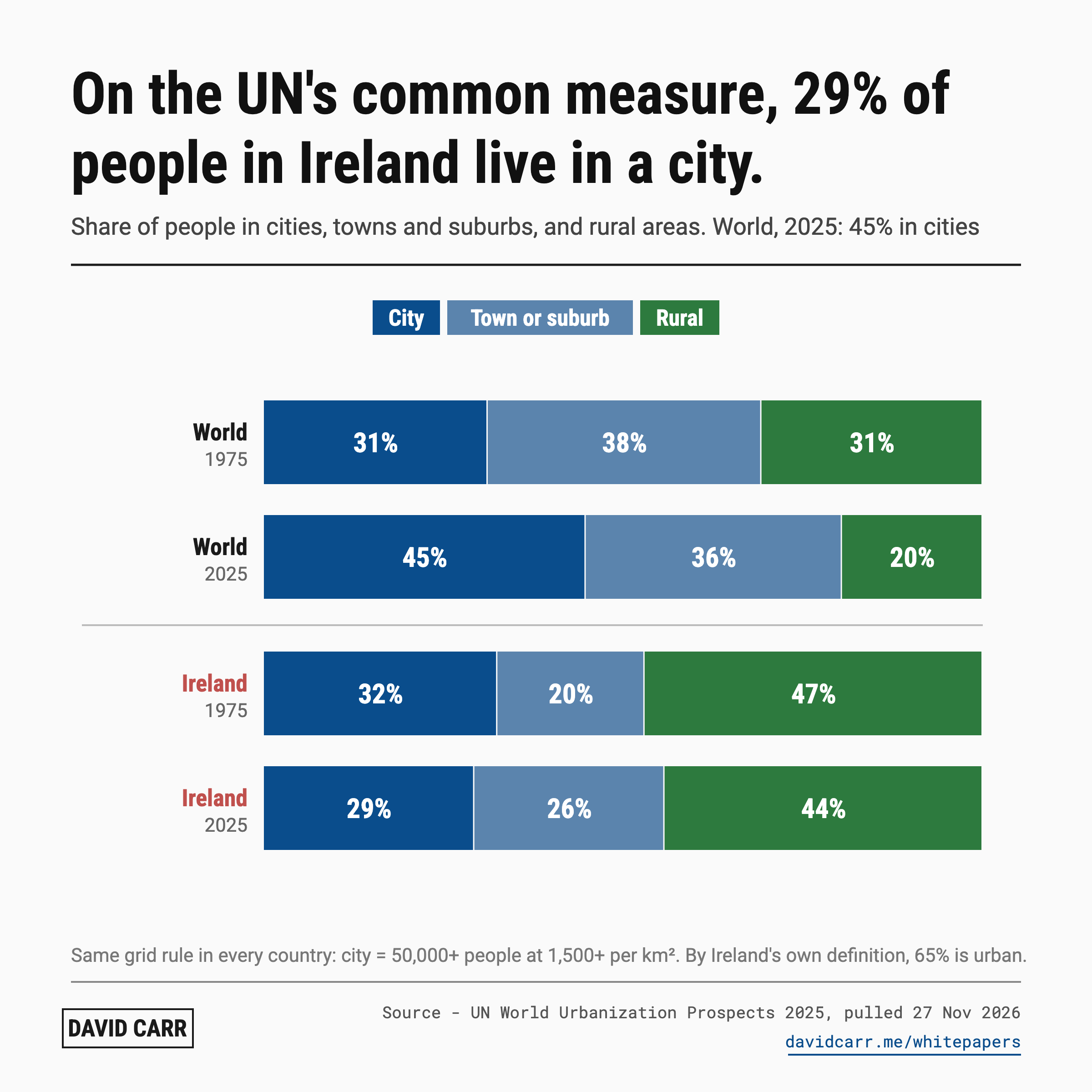
On the UN's common measure, 29% of people in Ireland live in a city. Worldwide: 45%.
- Ireland 2025: 29% city, 26% town or suburb, 44% rural
- World 2025: 45% city, 36% town or suburb, 20% rural
- Ireland 1975: 32% city, 20% town or suburb, 47% rural
- By Ireland's own urban definition: 65% urban in 2025
On the same yardstick as everyone else, Ireland is a country of towns and countryside, with one big city. The share living in towns and suburbs has grown most since 1975.
Same grid rule in every country: city = 50,000+ people at 1,500+ per km²; town or suburb = smaller or less dense clusters; rural = the rest.
Method, caveats and sources
The short answer. 58% of the world lived in urban areas in 2025, against 29% in 1950, and urban dwellers have outnumbered rural people since 2007. In 1950, five of the ten biggest cities were in Europe or North America; by 2035 none are projected to be. Measured the same way everywhere, Jakarta is the biggest city, at 41.9 million people, or 7.9 Irelands. 33 cities had 10 million people or more in 2025, against one in 1950. Dhaka is projected to add 15.5 million people by 2050, more than any other city. Mumbai's dense core holds 27,300 people per km²; Dublin's holds 3,800. Dublin's core, at 1.14 million, is bigger than 96% of the world's 12,138 cities. On the UN's common measure, 29% of people in Ireland live in a city, against 45% worldwide.
Data. The UN World Urbanization Prospects 2025 workbooks (Files 2, 14, 15, 18, 21, 34 and the city-size-class File 34), and the 2018 revision's File 11a (the 30 largest urban agglomerations, 1950 to 2035) from the UN's archive, all downloaded on 27 November 2026. Licence CC BY 3.0 IGO; credit: United Nations, DESA, Population Division. Every figure on this page is my own count or division on those files. Ireland's population for the "Irelands" sums is the UN's 2025 estimate, 5.31 million.
Two ways of counting. Charts 1 and 2 use each country's own definition of urban, which is how the UN has long counted and the only way to go back to 1950. The 2025 revision adds a second measure, the Degree of Urbanisation, which draws every city with one rule: a joined-up area of 1 km grid squares with at least 1,500 people per km² and 50,000 people in all, measured from satellite and census grids. Charts 4 to 10 use it, because it makes cities comparable. Its cities are dense cores, so they can be bigger or smaller than the metro areas people know: Dublin is 1.14 million on it. Chart 3 uses the 2018 revision's metro areas, the last list to cover 1950, so its numbers differ from chart 4.
Caveats. Everything after 2025 is a UN projection. A dense core can grow by joining up with dense places nearby, so some growth figures (Luanda, Hajipur) reflect where the line is drawn as much as people moving. City names follow common English use (Delhi for the UN's "New Delhi" area, Tokyo for "Tōkyō").
Also: Dublin and the cities of Europe and Cities and countries.