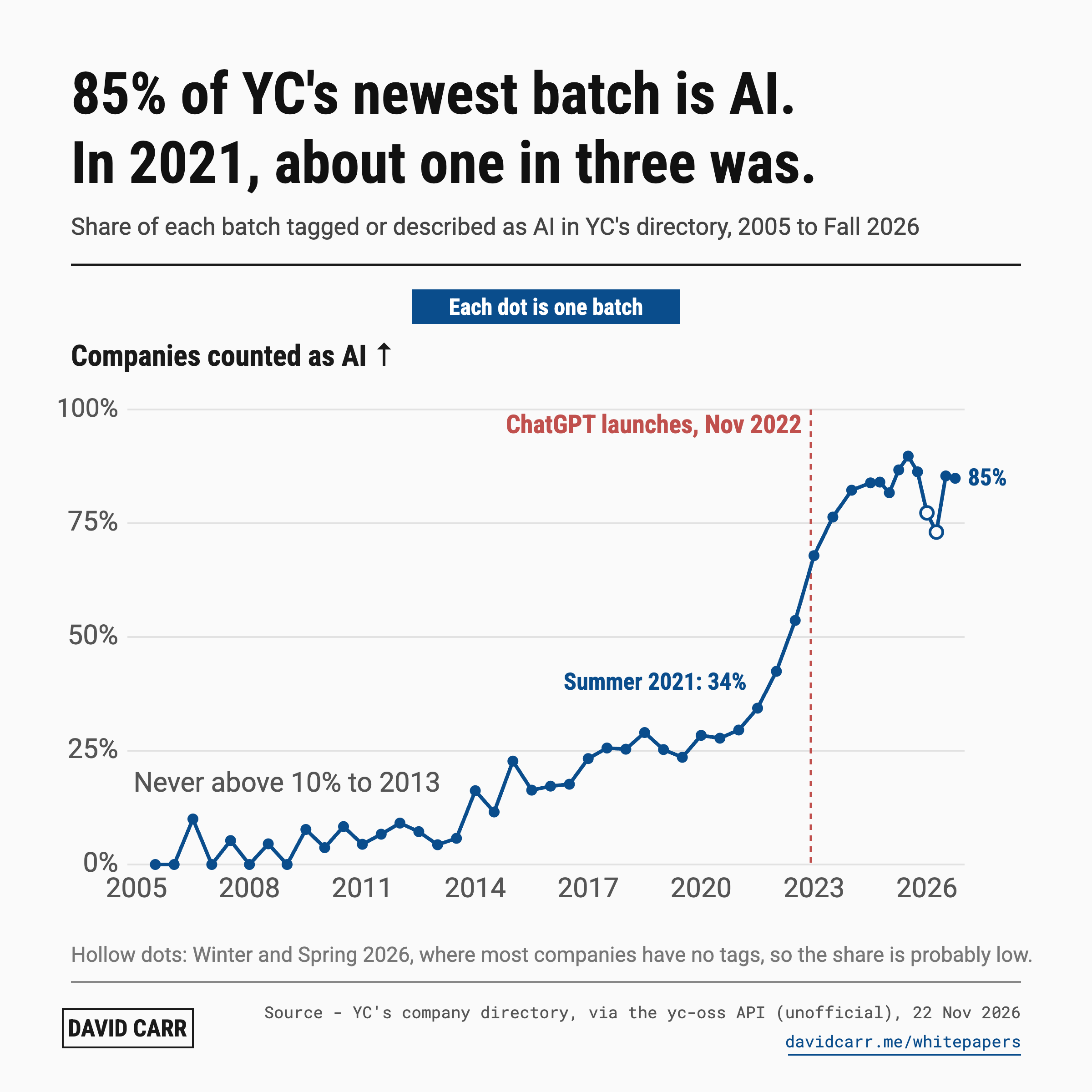
85% of YC's newest batch is AI. In 2021, about one in three was.
- 2005 to 2013: never above 10% of a batch
- 2021: 32% (Winter 30%, Summer 34%)
- Summer 2025: 90%, the high point
- Fall 2026: 85%, 202 of 238 companies
The climb started before ChatGPT. It was 54% by Summer 2022. Since 2024, every batch has been above 80%, apart from the two that are mostly untagged.
AI means: an AI tag in YC's directory (AI, Generative AI, Machine Learning and nine similar), or the description says AI, artificial intelligence, machine learning or LLM. Winter and Spring 2026 are mostly untagged, so their dip is probably the data, not the batch.
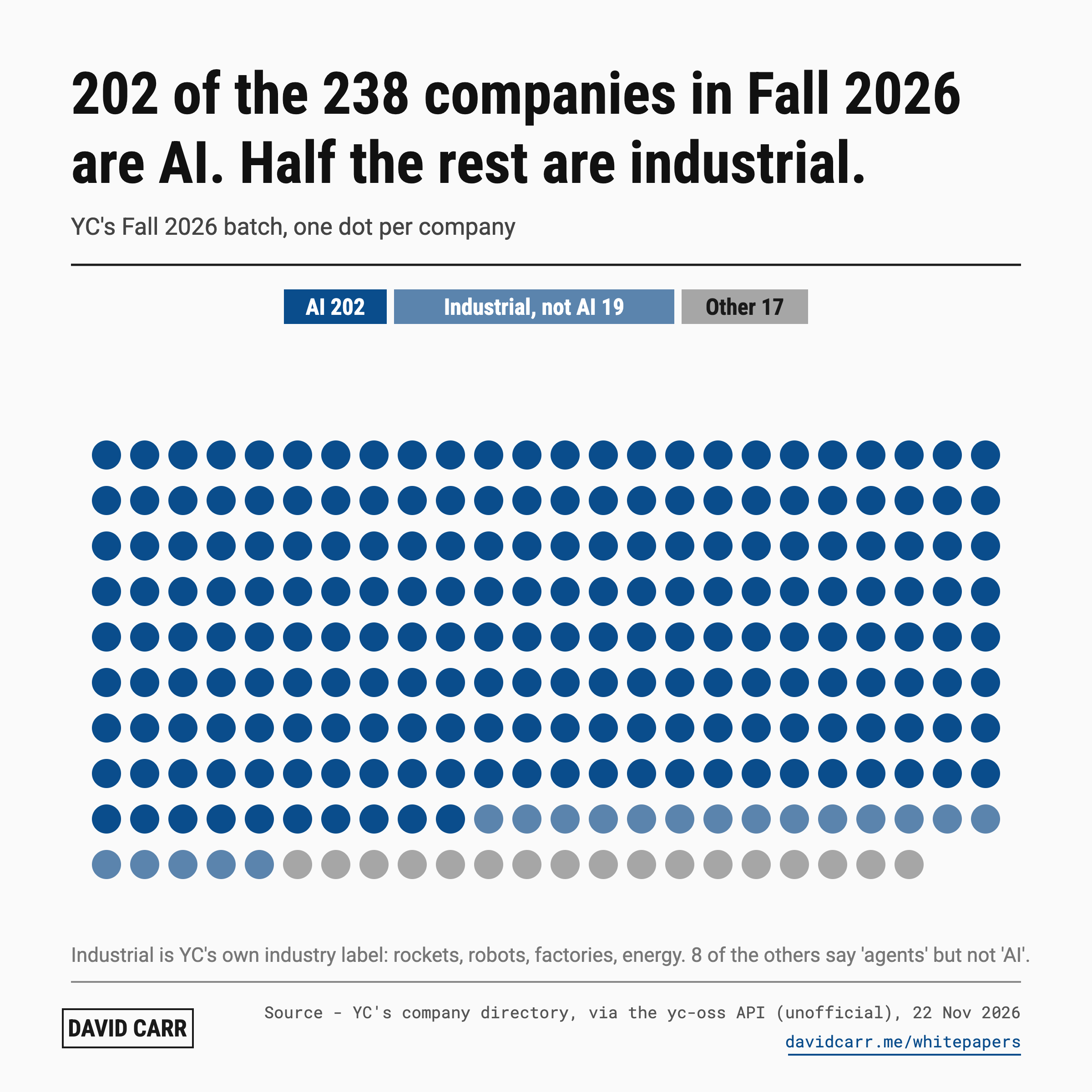
202 of the 238 companies in Fall 2026 are AI. Half the rest are industrial.
- AI: 202
- Industrial, not AI: 19 (rockets, robots, factories, energy)
- Everything else: 17
The non-AI corner of YC is now mostly hardware.
8 of the 36 others describe themselves with 'agents' but never say 'AI', so the rule misses them. If anything, 85% is low.
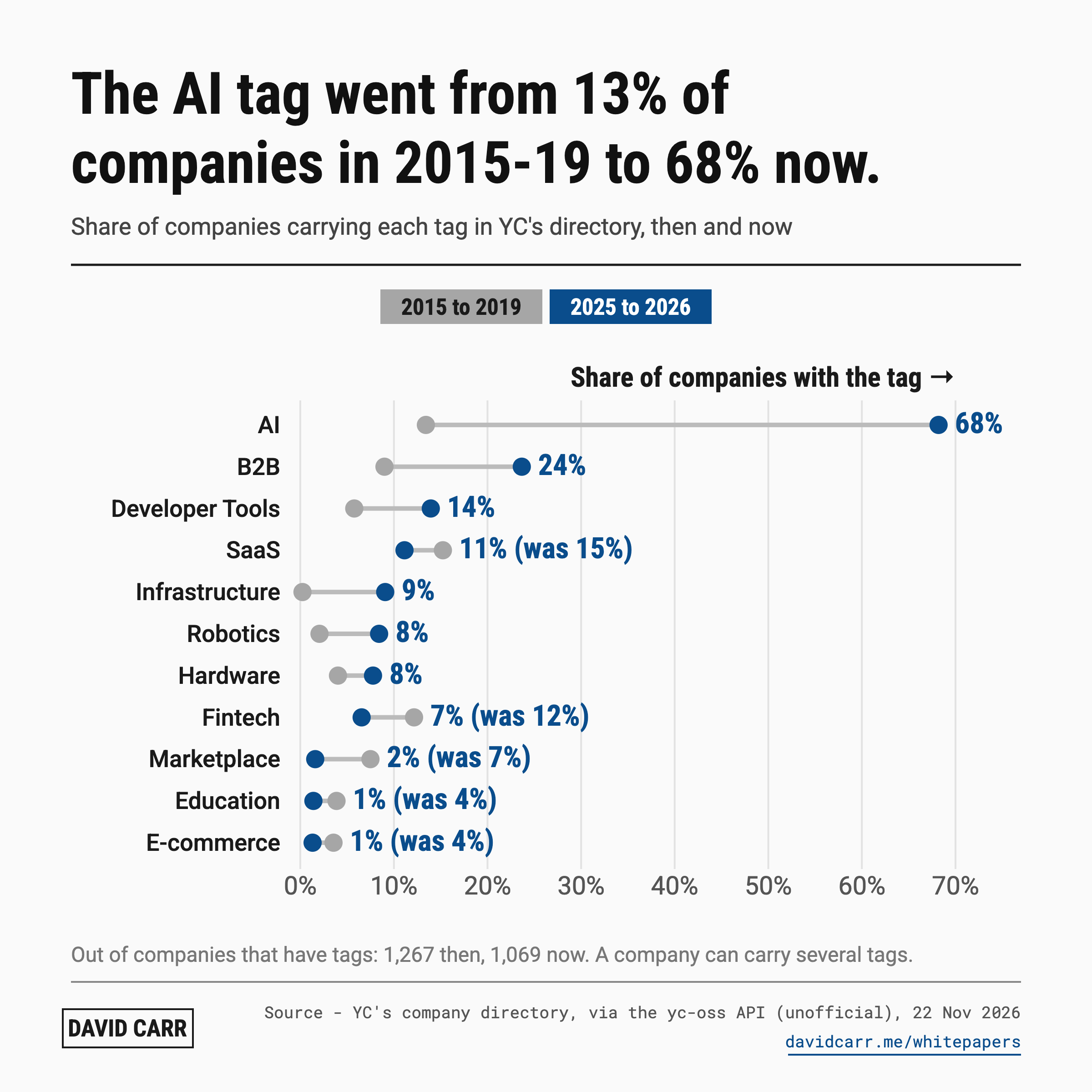
The AI tag went from 13% of companies in 2015-19 to 68% now.
- AI: 13% to 68%
- Developer tools: 6% to 14%
- Robotics: 2% to 8%
- Fintech: 12% to 7%
- Marketplaces: 7% to 2%
Marketplaces, e-commerce and education were YC staples. Now they barely show up.
Share of companies that have tags at all. Tags are what the directory shows today, so an older company that later added an AI tag counts as AI.
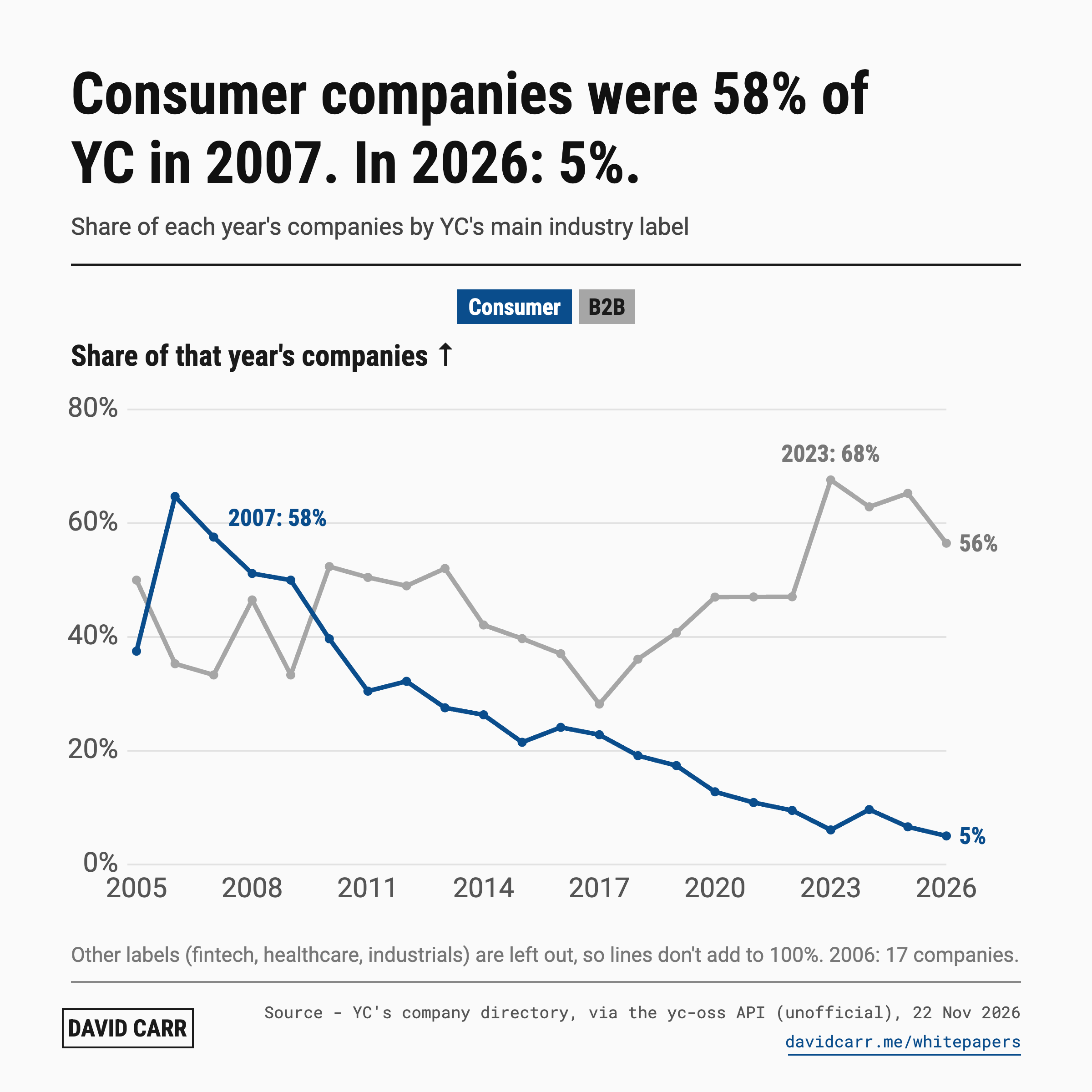
Consumer companies were 58% of YC in 2007. In 2026: 5%.
- 2007: 58% consumer, 33% B2B
- 2017: 23% consumer, 28% B2B
- 2023: 6% consumer, 68% B2B
- 2026: 5% consumer, 56% B2B
YC grew up on consumer apps. Its batches now sell almost entirely to businesses.
YC's main industry label. Fintech, healthcare, industrials and the rest are separate labels, so the lines don't add to 100%. B2B dipped in 2026 as industrials grew.
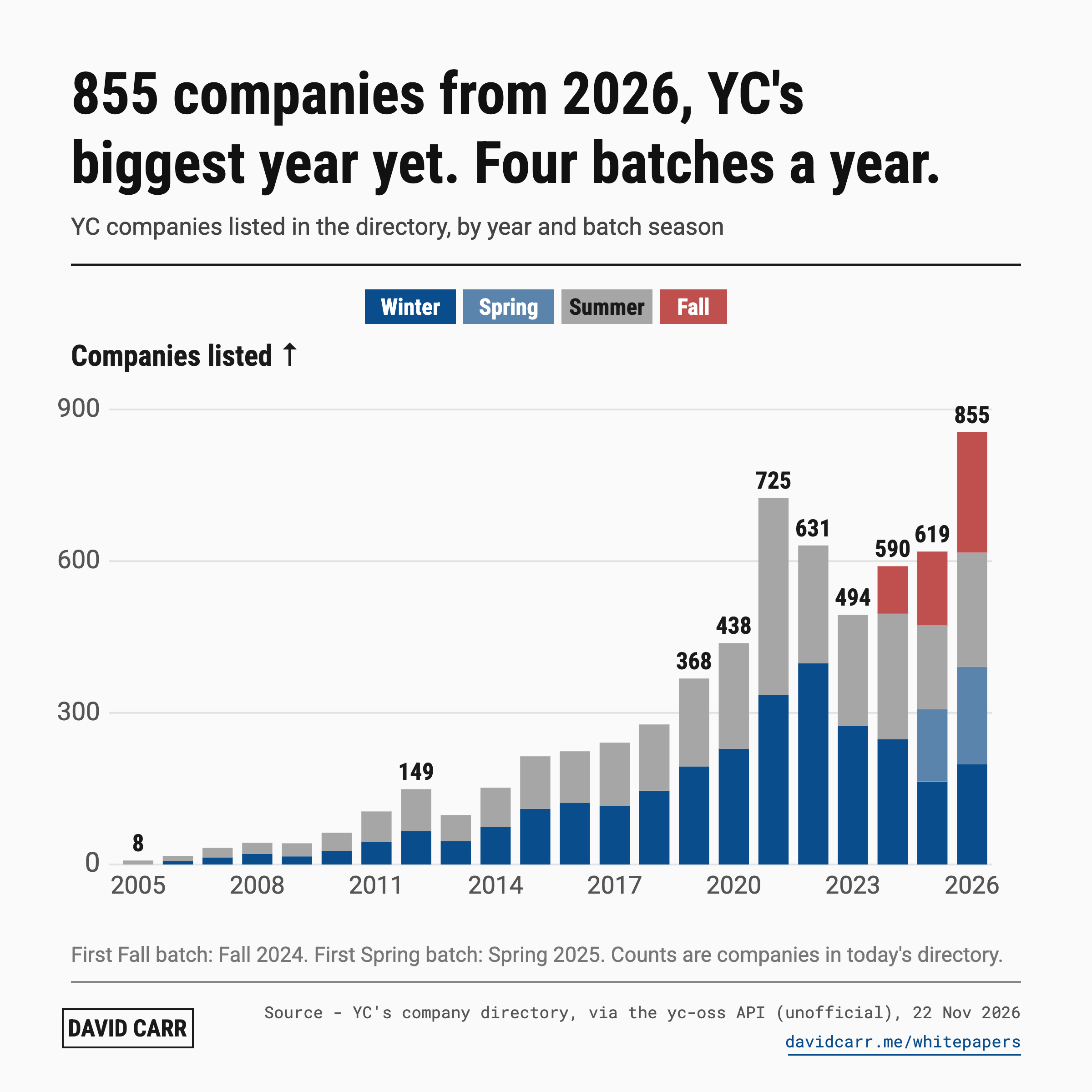
855 companies from 2026, YC's biggest year yet. Four batches a year.
- 2021: 725
- 2022: 631
- 2023: 494
- 2025: 619
- 2026: 855, across Winter, Spring, Summer and Fall
YC ran two batches a year until 2024. Fall 2024 was the first Fall batch and Spring 2025 the first Spring one.
Companies listed in today's directory, which only shows launched companies. YC's own batch counts may be a little higher.
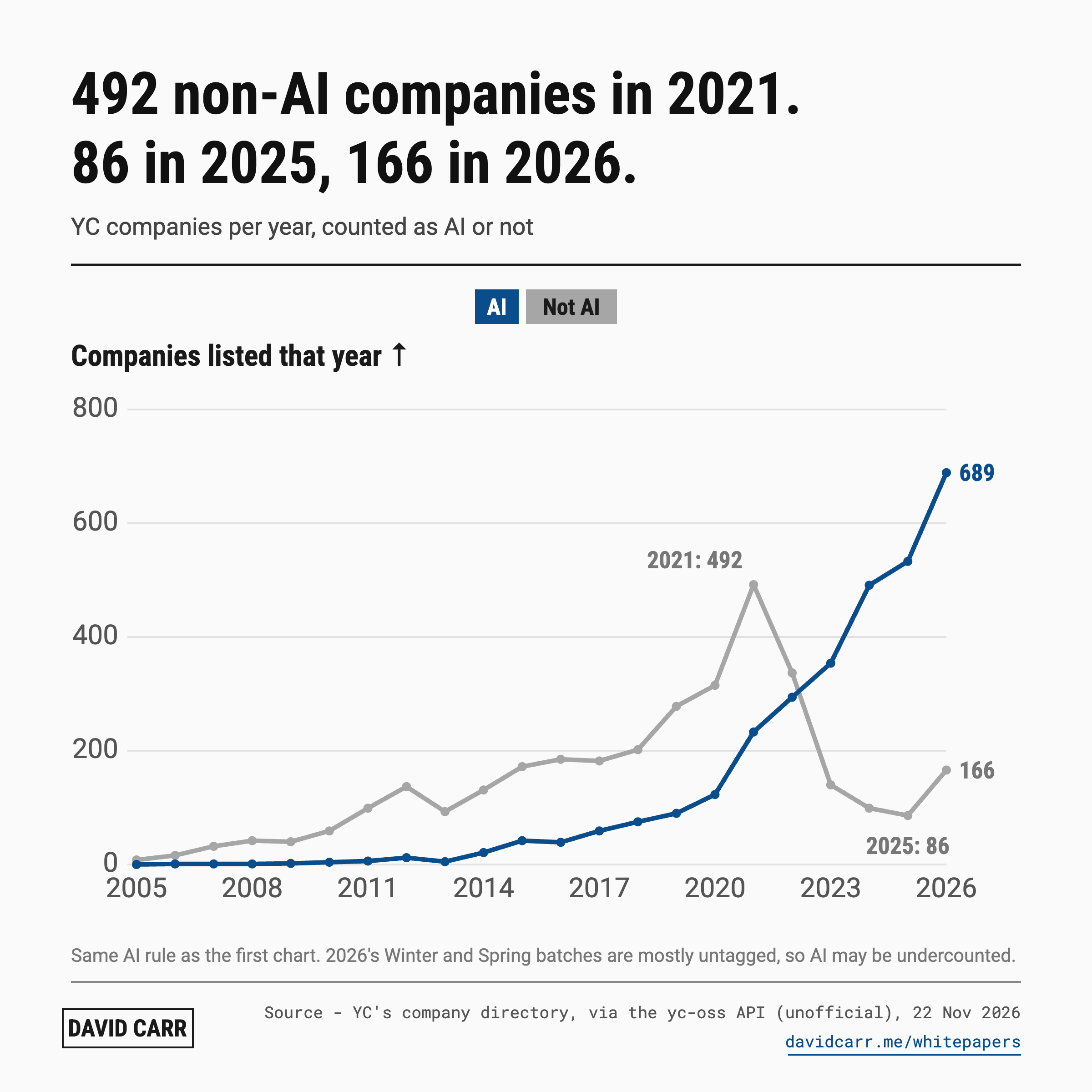
492 non-AI companies in 2021. 86 in 2025, 166 in 2026.
- AI companies: 233 in 2021, 689 in 2026
- Not AI: 492 in 2021, 86 in 2025, 166 in 2026
YC is backing more companies than ever. The number that don't do AI fell by more than four-fifths in four years.
Same AI rule as the first chart. 2026's bounce is partly the two mostly untagged batches, and partly the industrial companies.
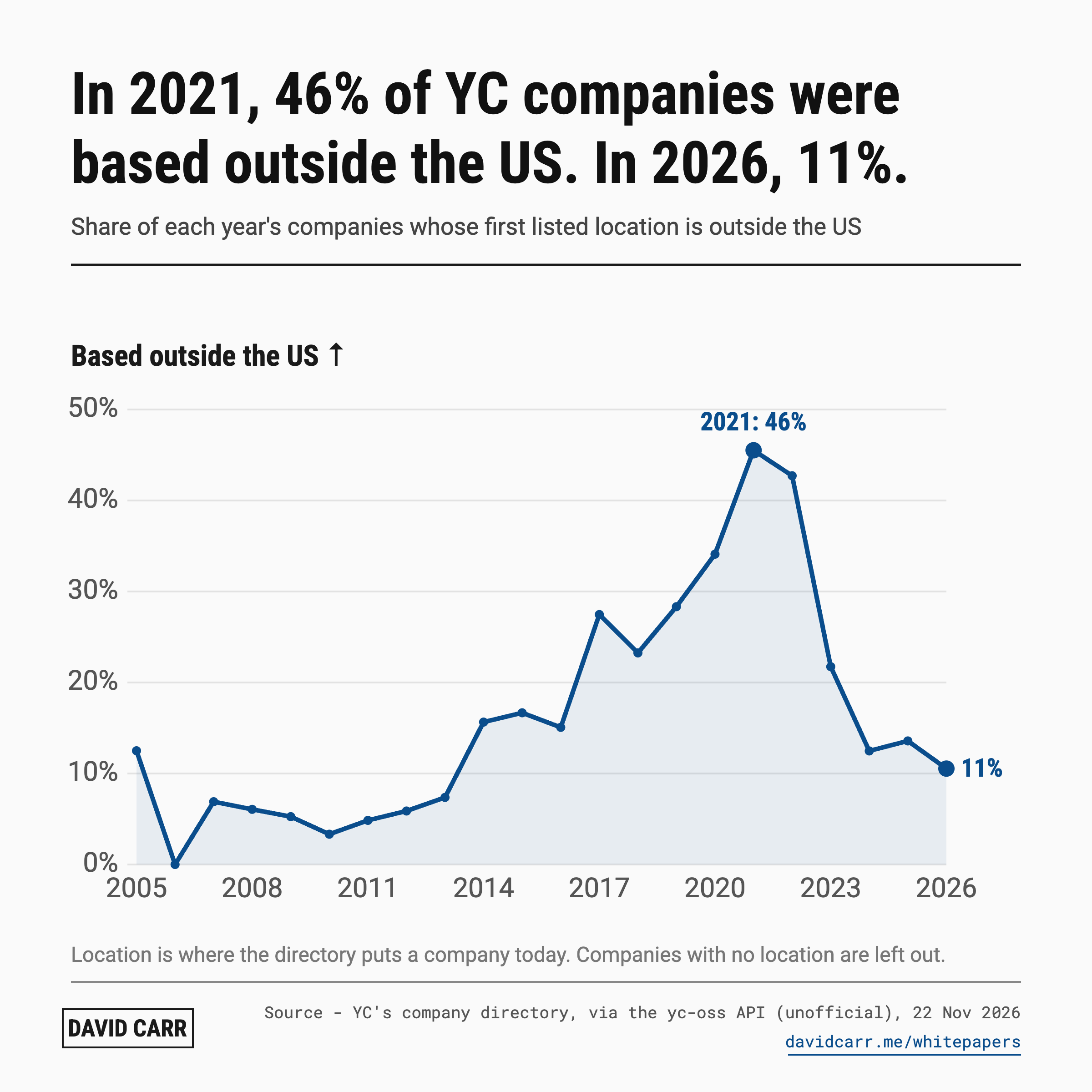
In 2021, 46% of YC companies were based outside the US. In 2026, 11%.
- 2013: 7%
- 2021: 46%
- 2022: 43%
- 2023: 22%
- 2026: 11%
The non-US share rose for a decade, peaked in 2021-22, then fell to 11%, lower than in 2014.
First listed location in the directory, as it stands today. Many companies move to the US after YC, so older years probably looked more international at the time.
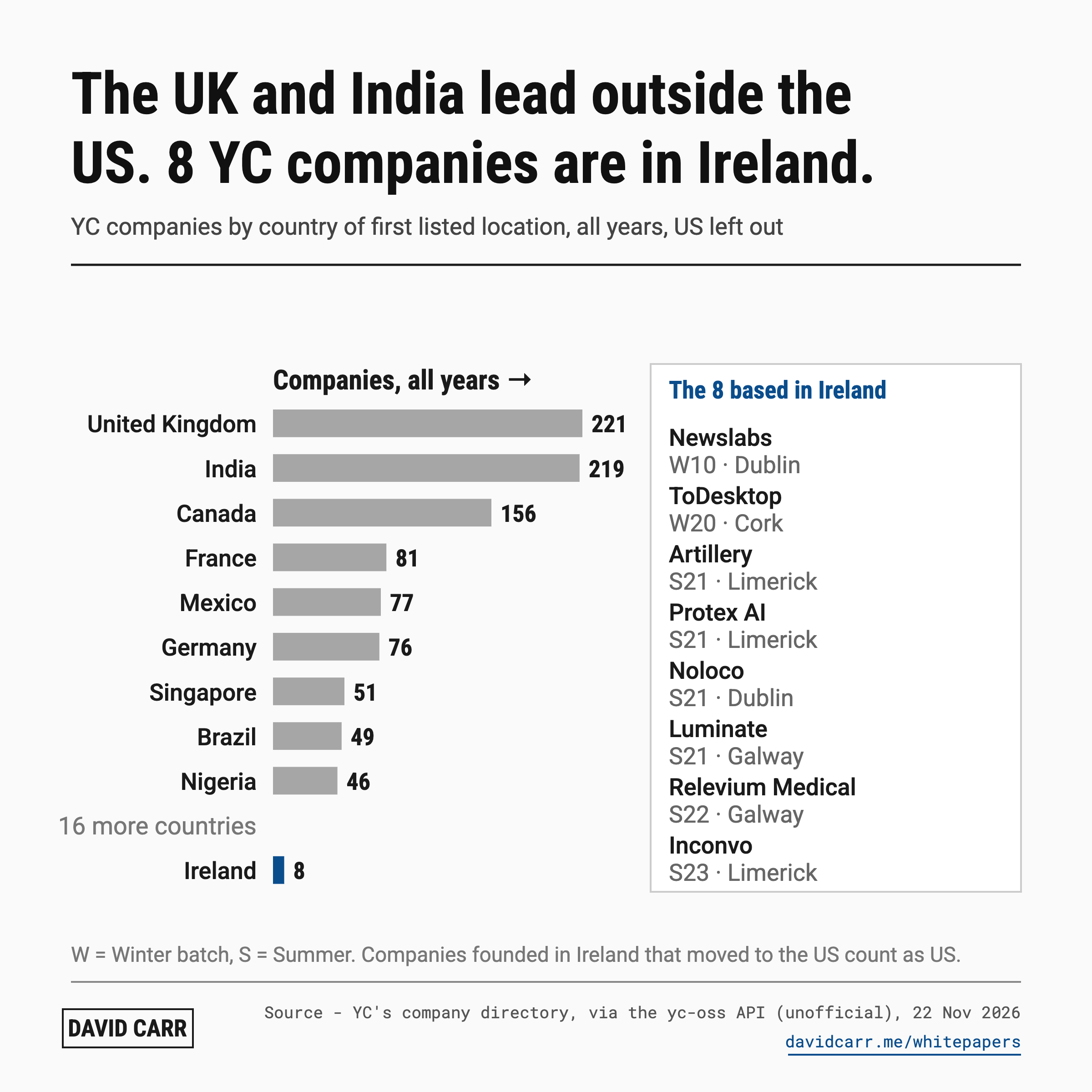
The UK and India lead outside the US. 8 YC companies are in Ireland.
Five of the eight Irish companies came in 2021 and 2022, the years YC was most international.
Counted by first listed location. A company started in Ireland that now lists a US city counts as US. Stripe, for one, is listed in San Francisco.
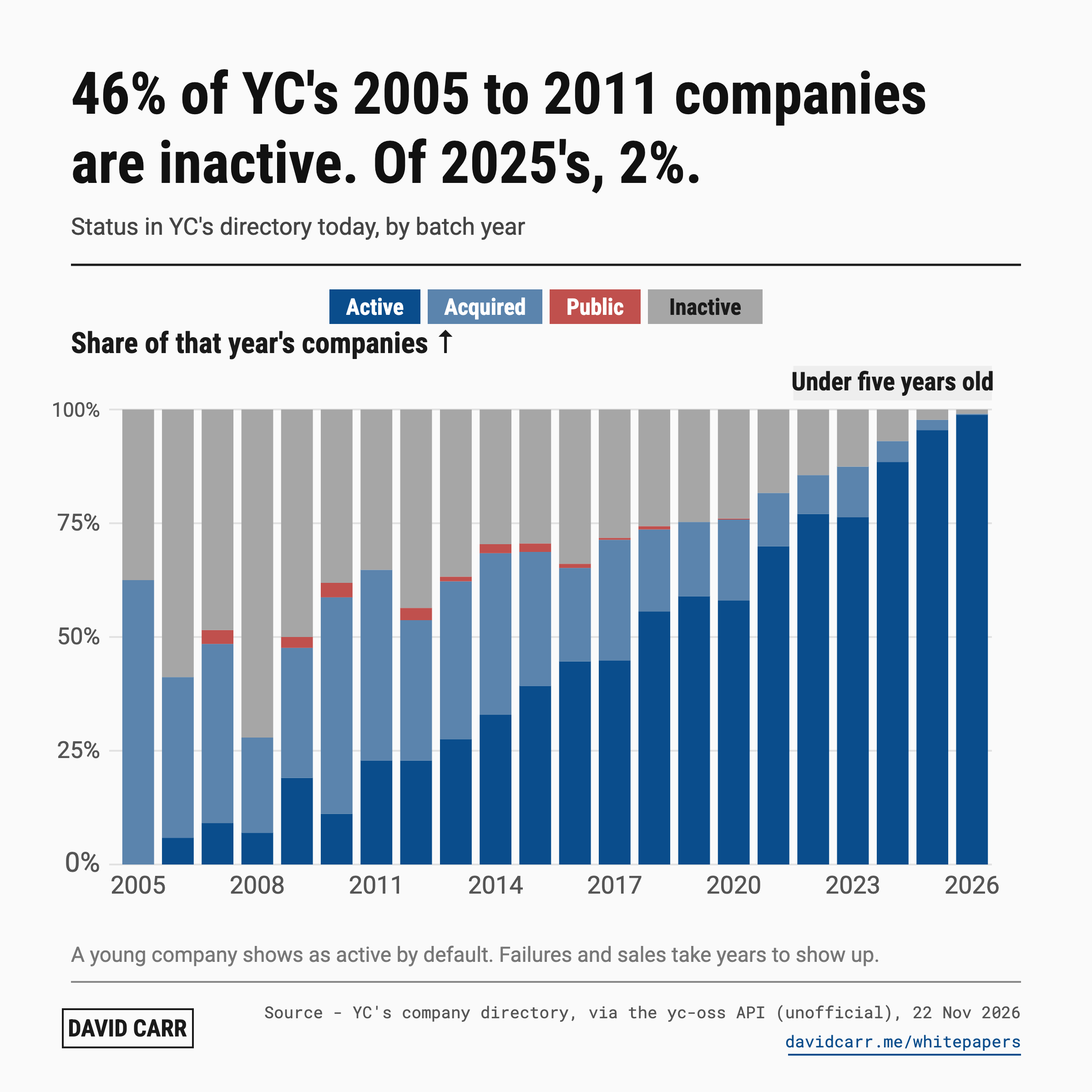
46% of YC's 2005 to 2011 companies are inactive. Of 2025's, 2%.
- 2005 to 2011: 46% inactive, 38% acquired, 15% active
- 2012 to 2016: 34% inactive, 29% acquired, 35% active
- 2021 to 2022: 17% inactive, 10% acquired
- 2025: 2% inactive, over 95% active
This is not a sign that newer companies do better. Shutting down or selling takes years, so young batches look healthy by default.
Status as YC's directory shows it today. Compare batches of the same age, not old against new.
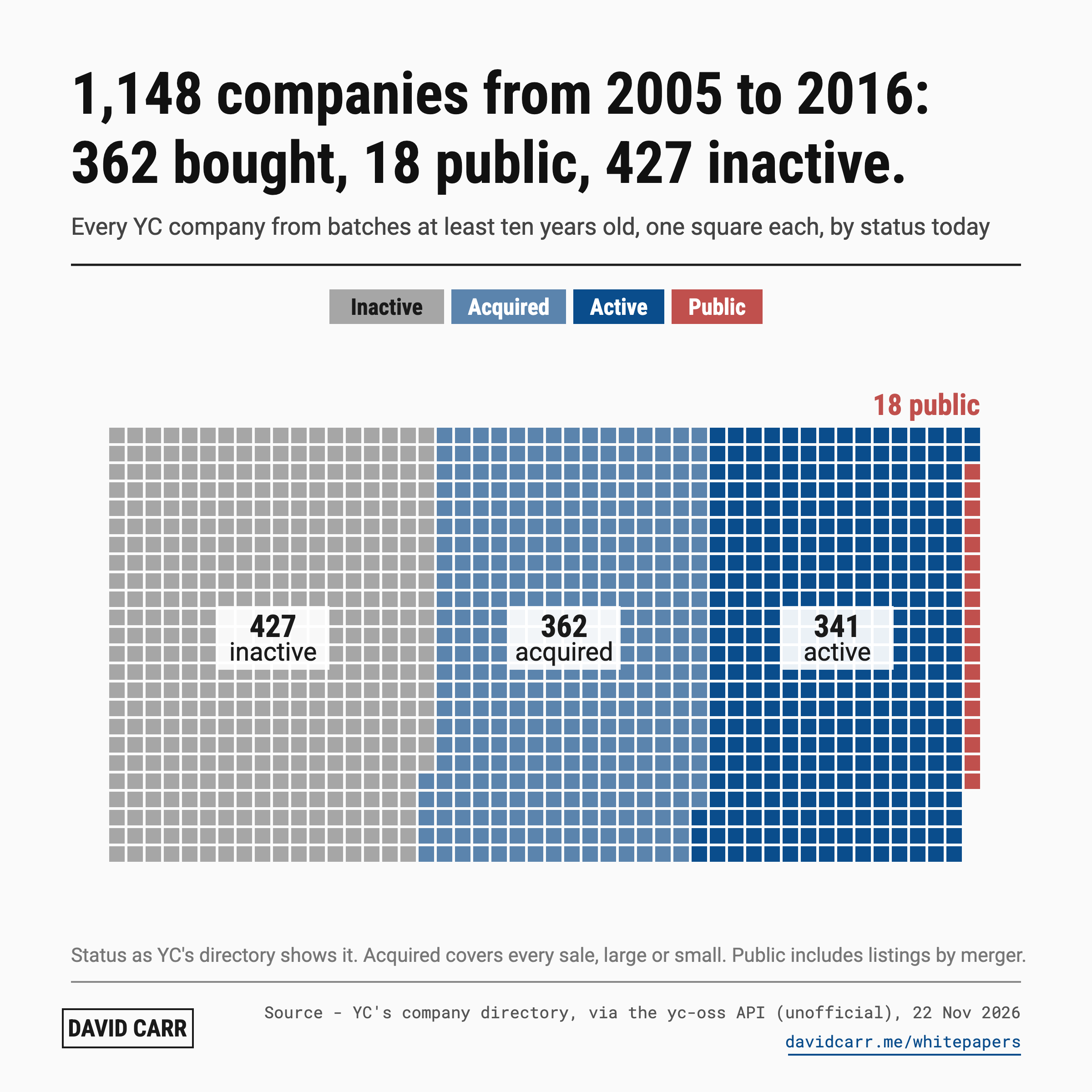
1,148 companies from 2005 to 2016: 362 bought, 18 public, 427 inactive.
Batches that have had ten years to play out. About one in three was sold and fewer than one in fifty went public.
Acquired covers every sale, from acqui-hires to large deals; the directory gives no prices. Public includes listings by merger.
Method, caveats and sources
The short answer. 85% of YC's newest batch is AI, up from about a third in 2021. YC now runs four batches a year and backed more companies in 2026 than ever, but only 166 of them were not AI. Consumer companies have almost gone, and so have most non-US companies. Of the batches old enough to judge, about a third were sold and 2% went public.
The data. Every company in YC's public company directory, from the yc-oss API, pulled on 22 November 2026 (the mirror was last updated 21 November). yc-oss is an unofficial, open-source mirror of YC's directory, not a YC product. It lists 6,406 launched companies. I used the 6,386 in batches from Summer 2005 to Fall 2026. Winter 2027 (18 listed so far), one Summer 2027 company and one with no batch are left out.
What counts as AI. A company counts if its directory tags include AI, Generative AI, Machine Learning, AI Assistant, Conversational AI, Deep Learning, Computer Vision, NLP, AIOps, AI-powered Drug Discovery, AI-Enhanced Learning or Swarm AI, or if its one-liner or description says "AI" (capital letters, as a word), "artificial intelligence", "machine learning" or "LLM". On tags alone, Fall 2026 is 73% AI. Most companies in Winter and Spring 2026 have no tags, so those two batches read low.
It is today's directory. Tags, descriptions, locations and status are what the directory shows now, not what was true when each company joined. A 2015 company that later pivoted to AI counts as AI. A company that moved from Dublin to San Francisco counts as US. Companies that never launched on the directory are missing, which matters most for the earliest batches.
Location. The first location a company lists; 188 companies with none, or only "Remote", are left out of the location charts.
Status. Active, acquired, public or inactive, as YC's directory labels it. The directory gives no prices, valuations or funding, so this page has none.
ChatGPT launch date from OpenAI.
Also: Stripe, OpenRouter and Hugging Face.