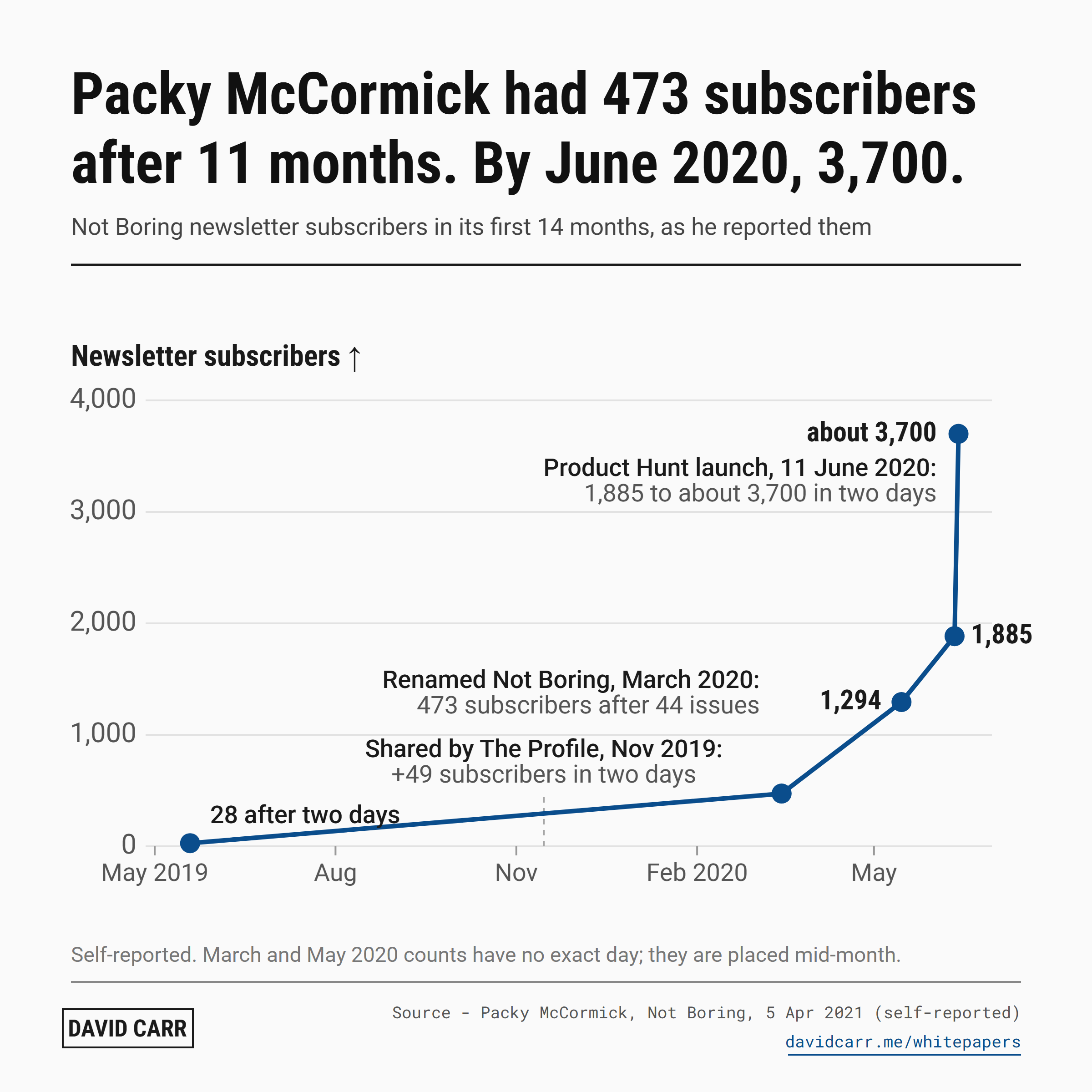
Packy McCormick had 473 subscribers after 11 months. By June 2020, about 3,700.
- 19 May 2019, two days after his first tweet: 28
- November 2019, after The Profile shared him: +49 in two days
- March 2020, renamed Not Boring after 44 issues: 473
- May 2020: 1,294
- 11 June 2020, Product Hunt launch: 1,885, then about 3,700 two days later
The first year is nearly flat. Then one launch doubled the list in two days. All of these are his own numbers, from his one-year review.
Self-reported. A secondary profile gives 3,850 for the Product Hunt jump; his own figure is used.
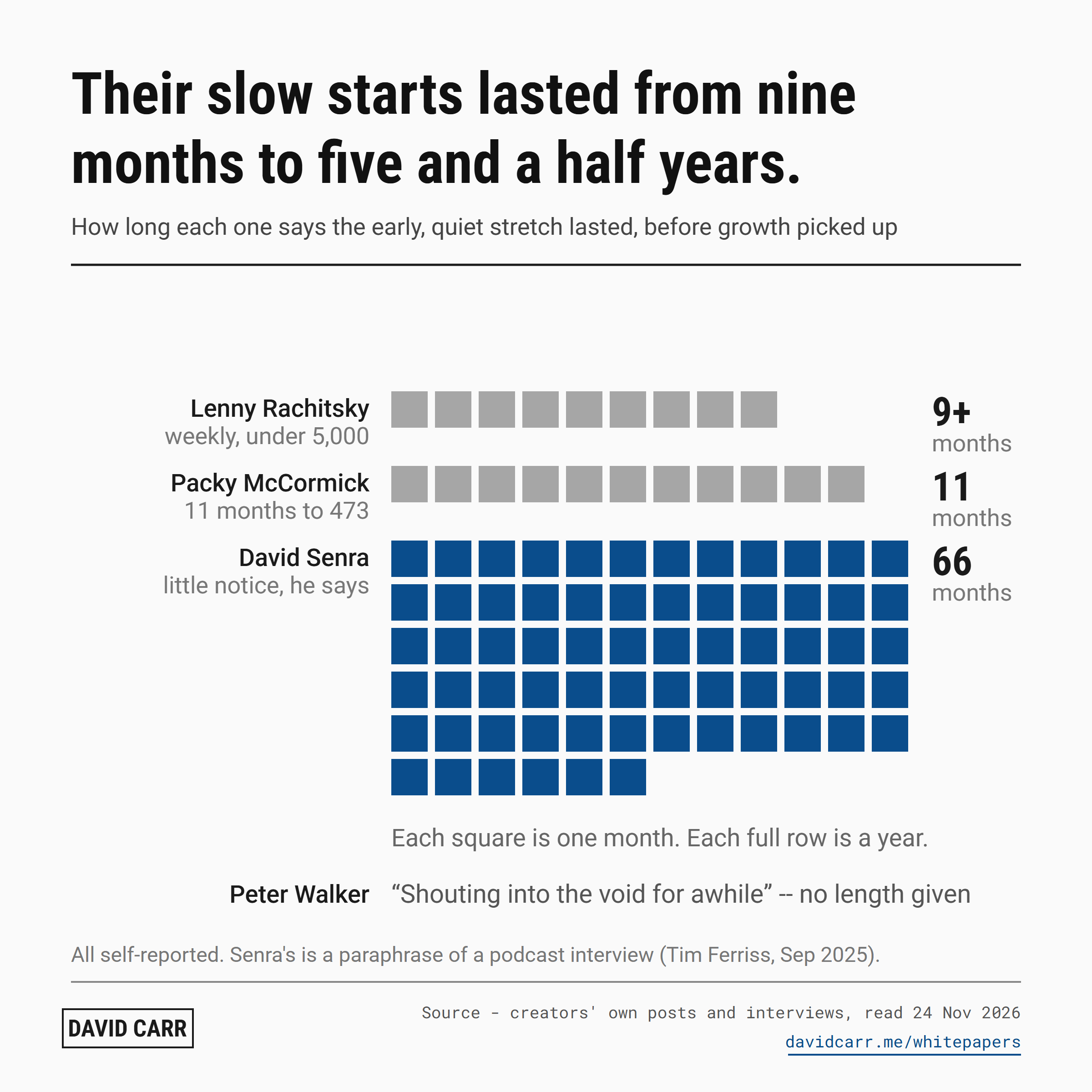
Their slow starts lasted from nine months to five and a half years.
- Lenny Rachitsky: one post every week for "9+ months" while under 5,000 subscribers
- Packy McCormick: 11 months and 44 issues to reach 473
- David Senra: by his account, almost nobody paid attention for five and a half years
- Peter Walker: "shouting into the void for awhile", with no length given
Nobody in this group grew fast from day one. Lenny posted weekly and Packy twice a week through the quiet stretch.
All self-reported. Senra's line is a paraphrase of a spoken interview, not a quote.
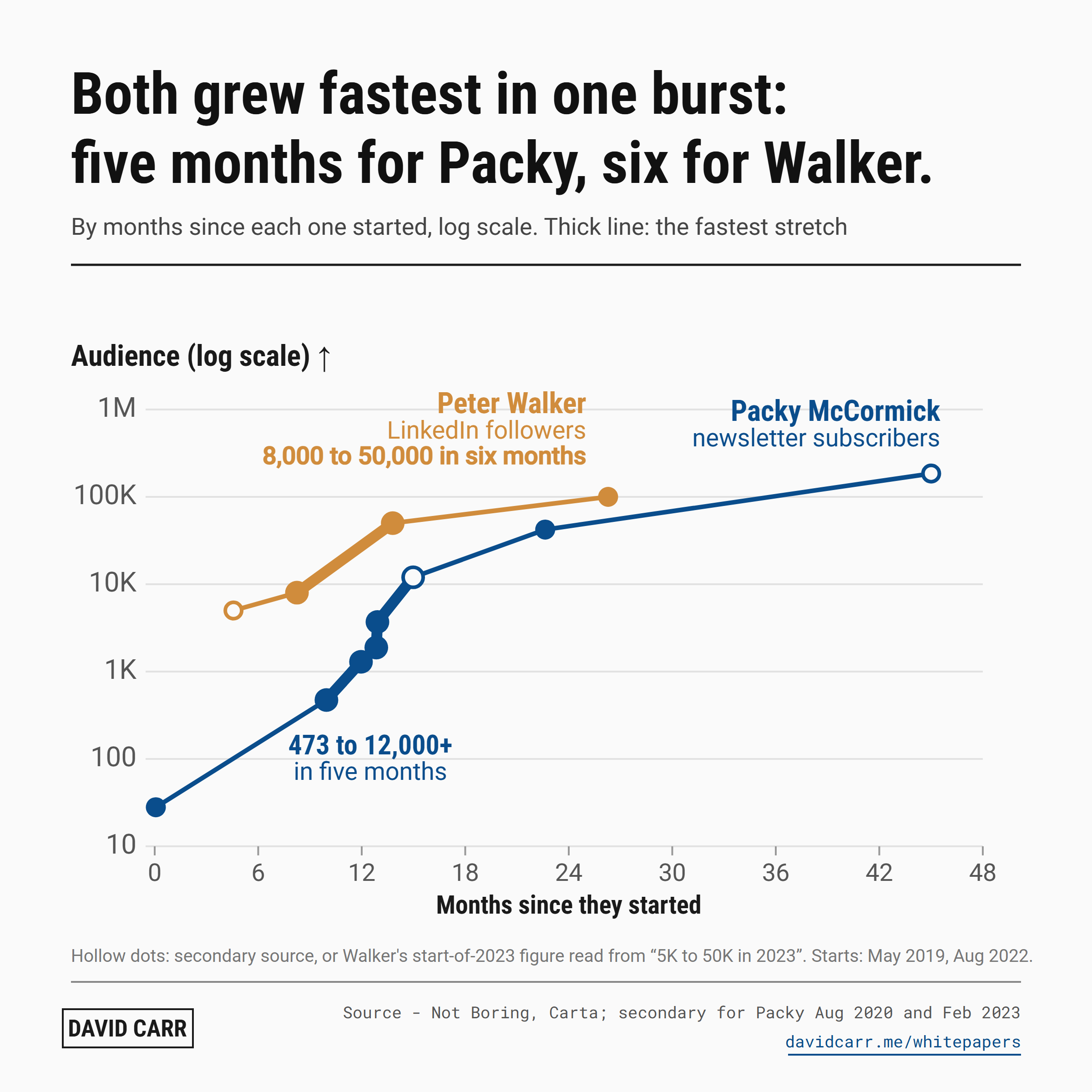
Both grew fastest in one burst: five months for Packy, six for Walker.
- Packy McCormick: 473 in March 2020 to 12,000+ by August 2020 (secondary source)
- Peter Walker: 8,000 LinkedIn followers on 23 April 2023 to 50,000 by 9 October 2023
- After the burst, both kept growing more slowly: Packy 42,205 in April 2021, Walker 100,000 in October 2024
On a log scale, a steady rate of growth is a straight line. Both lines bend sharply for a few months, then flatten to a gentler slope. That is what growth in steps looks like.
Different measures: newsletter subscribers for Packy, LinkedIn followers for Walker. Walker's start is August or September 2022; the start-of-2023 point (about 5,000) is read from the title of his own post.
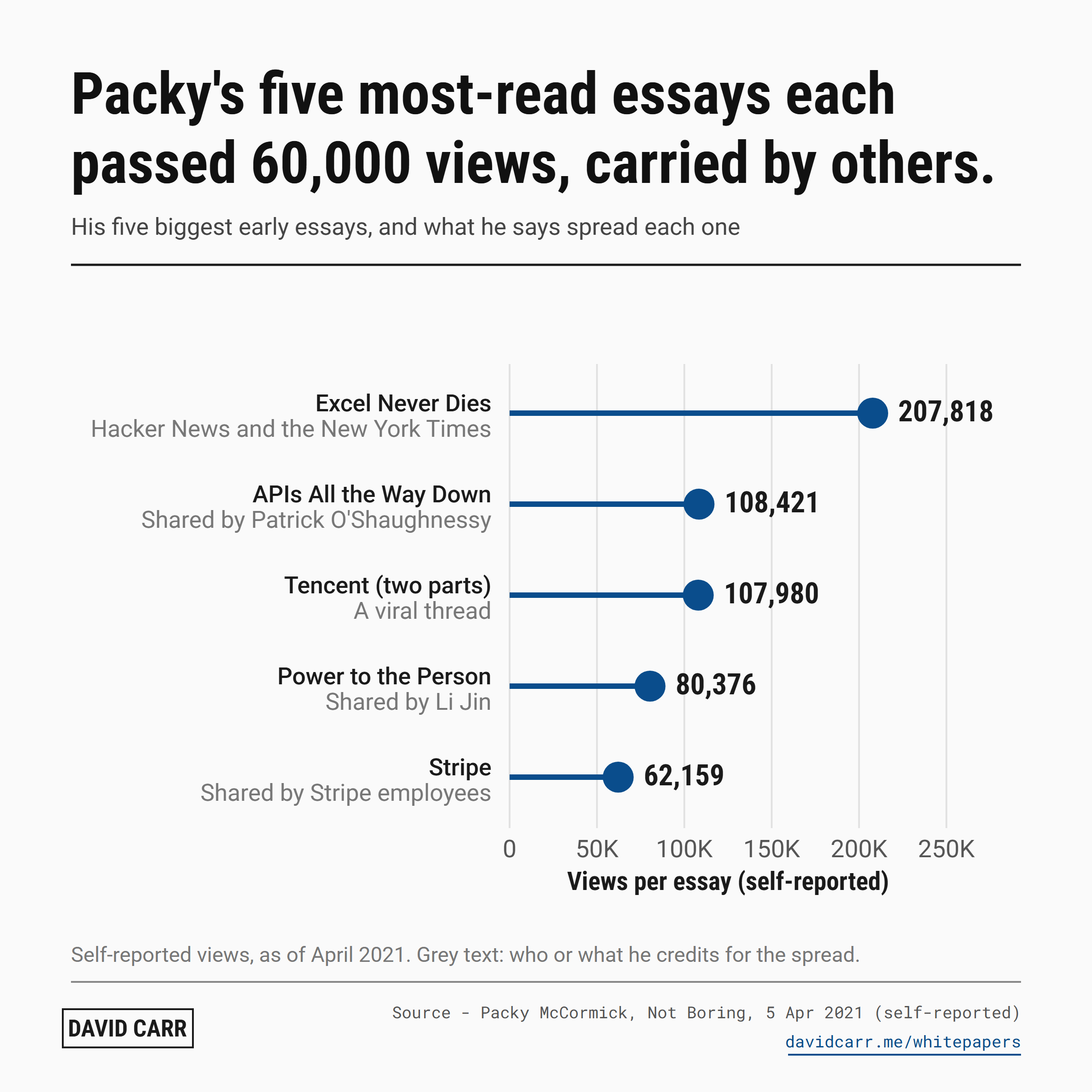
Packy's five most-read essays each passed 60,000 views, carried by others.
- Excel Never Dies: 207,818 views (Hacker News, the New York Times)
- APIs All the Way Down: 108,421 (shared by Patrick O'Shaughnessy)
- Tencent, two parts: 107,980 (a viral thread)
- Power to the Person: 80,376 (Li Jin)
- Stripe: 62,159 (Stripe employees)
Each of the five is a deep piece on a named company or idea. Each spread because someone with their own audience passed it on. Figures from his one-year review.
Self-reported page views as of April 2021.
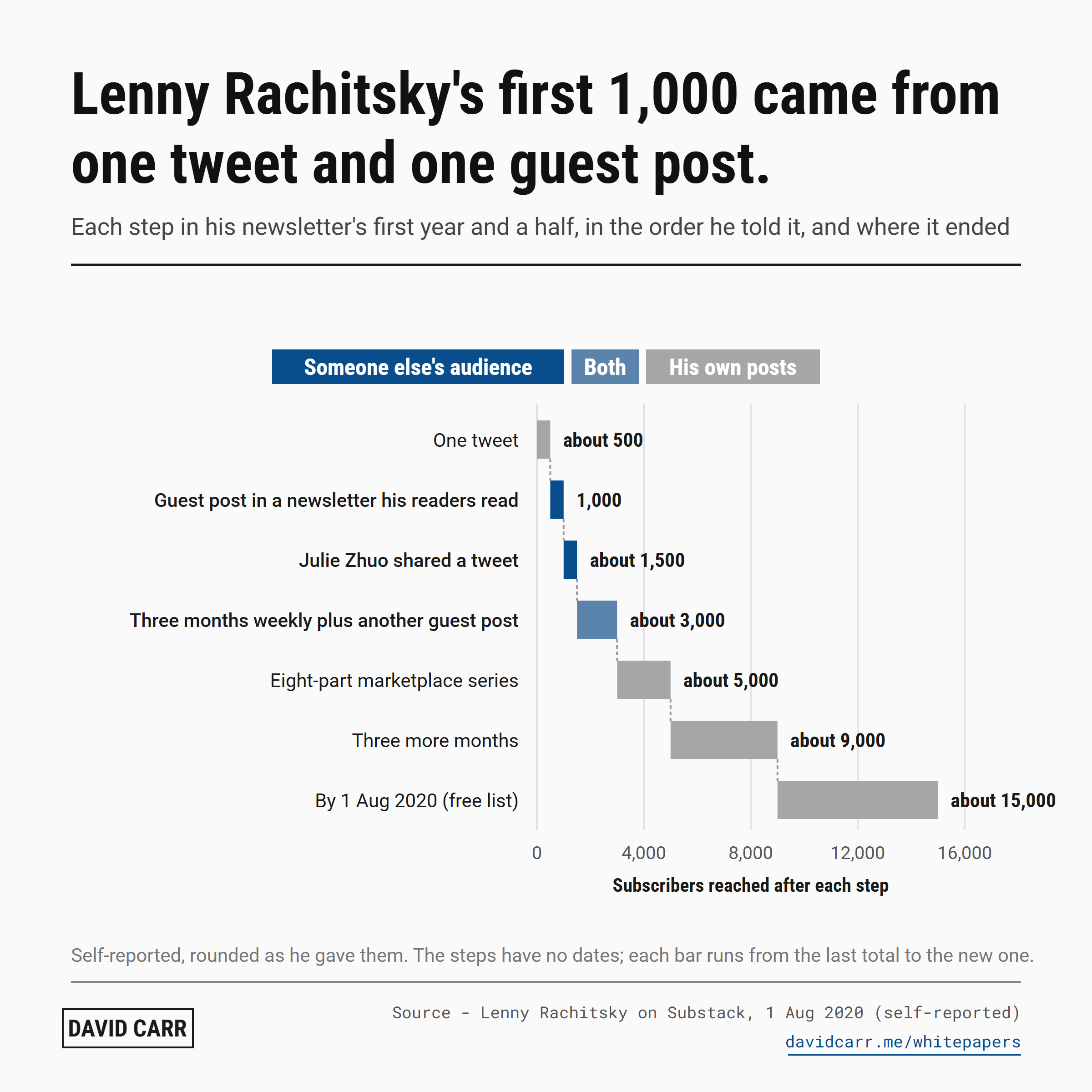
Lenny Rachitsky's first 1,000 came from one tweet and one guest post.
- One tweet: about 500
- A guest post in a newsletter his readers read: 1,000
- Julie Zhuo shared a tweet: about 1,500
- Three months weekly plus another guest post: about 3,000
- An eight-part marketplace series: about 5,000
- Three months later: about 9,000
- 1 August 2020: about 15,000 free and 500 paid
He later said "50% of my growth came from just two posts": the guest posts and the marketplace series (Lenny, March 2025). The steps are from Substack's profile of him.
Self-reported and rounded. The steps have no dates. First Round Review gives slightly different figures for the paid launch.
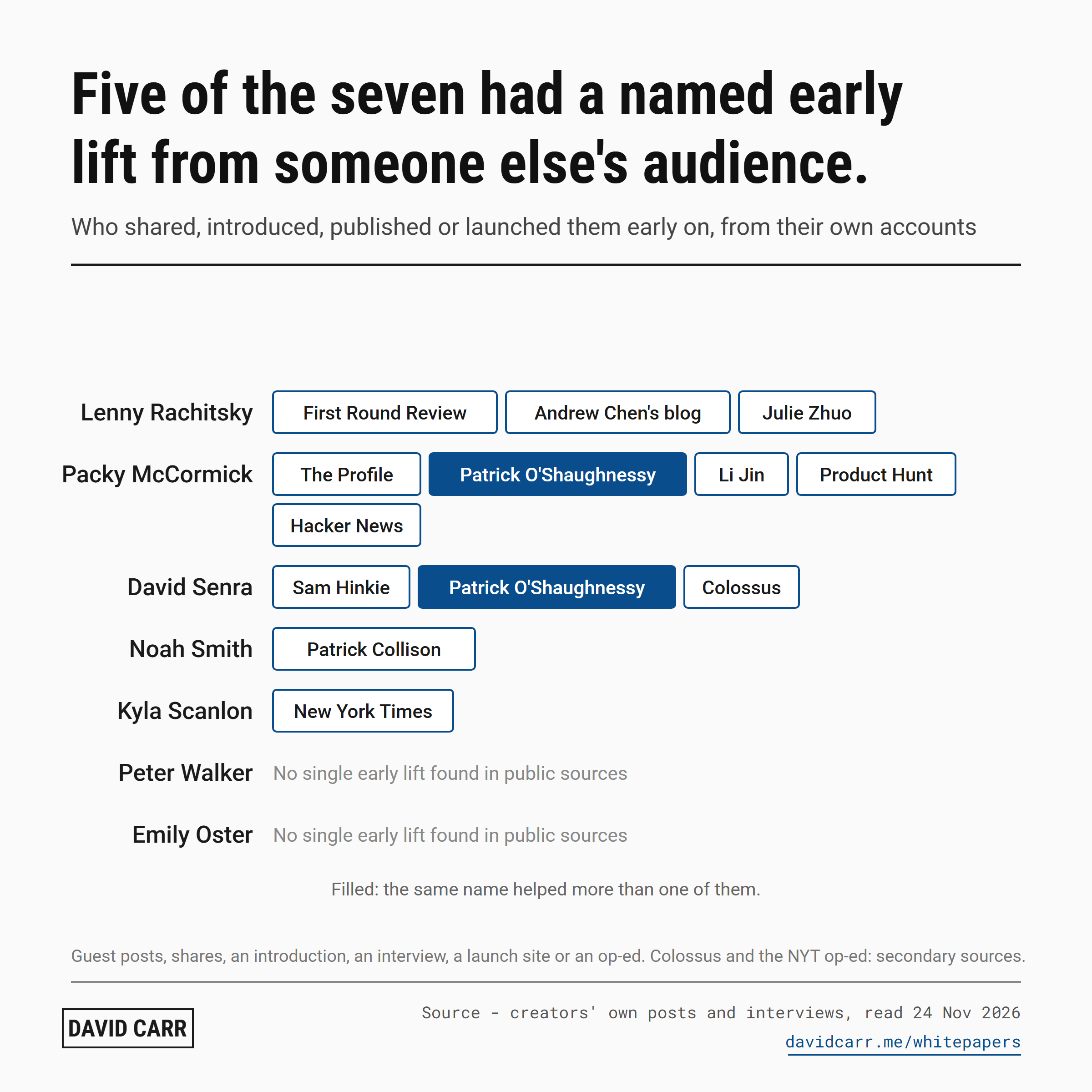
Five of the seven had a named early lift from someone else's audience.
- Lenny Rachitsky: guest posts in First Round Review and Andrew Chen's blog; a share from Julie Zhuo
- Packy McCormick: The Profile, Patrick O'Shaughnessy, Li Jin, Product Hunt, Hacker News
- David Senra: an introduction from Sam Hinkie to Patrick O'Shaughnessy, then Colossus
- Noah Smith: an interview with Patrick Collison, which he says "put my blog on the map"
- Kyla Scanlon: a New York Times op-ed on "vibecession", August 2022
They wrote alone and grew through other people. The same name turns up twice: Patrick O'Shaughnessy helped both Packy and Senra early on.
Peter Walker and Emily Oster have no single early lift on the public record. Colossus and the NYT op-ed come from secondary sources.
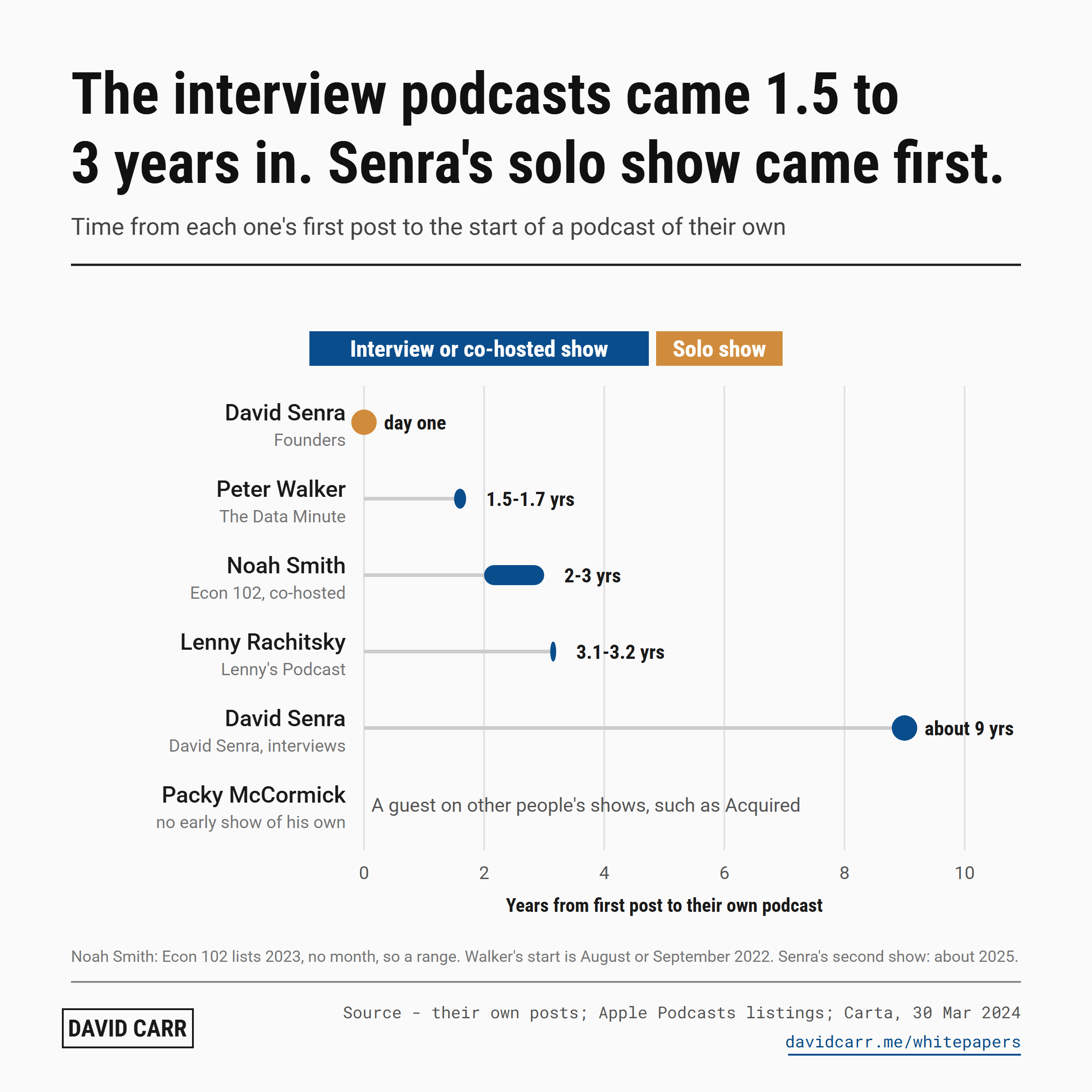
The interview podcasts came 1.5 to 3 years in. Senra's solo show came first.
- Peter Walker: The Data Minute podcast, 30 March 2024, after 20,000 newsletter subscribers and 50,000 LinkedIn followers
- Noah Smith: Econ 102, co-hosted on Turpentine, listed from 2023
- Lenny Rachitsky: Lenny's Podcast, 7 June 2022, about three years in
- David Senra: Founders from day one in 2016, solo; a separate interview show about nine years in
- Packy McCormick: no early show of his own; a guest on others, such as Acquired
The guest-interview shows came after there was an audience to bring guests to. The one show that started first needed no guests at all: one host, one biography per episode.
Noah Smith's start is his Substack, end of 2020; he blogged for years before. Walker's podcast date comes from Carta's announcement, read through a search extract.
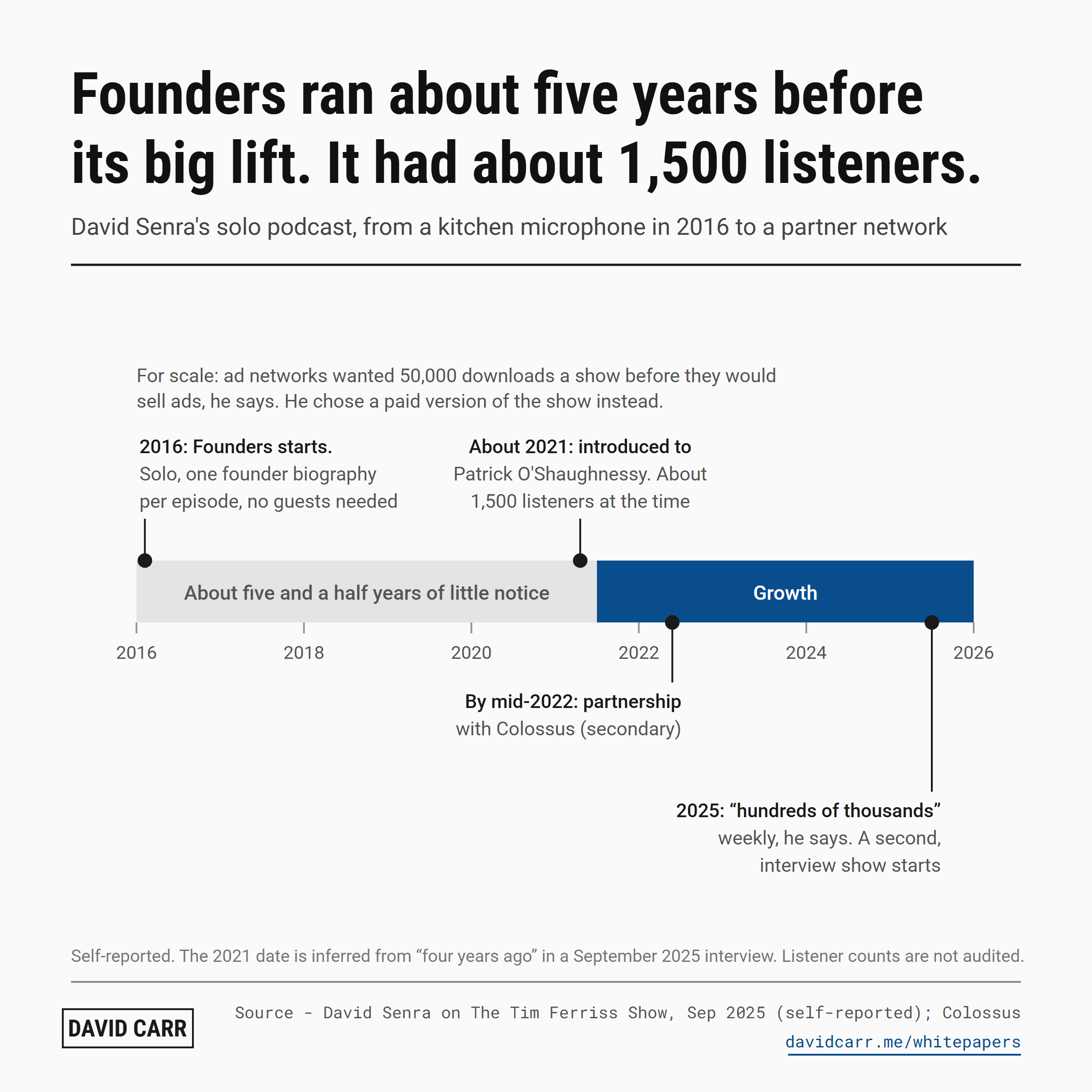
Founders ran about five years before its big lift. It had about 1,500 listeners.
- 2016: Founders launches, recorded at home on a hundred-dollar microphone
- Ad networks wanted 50,000 downloads a show, he says, so he made a paid version instead
- About 2021: Sam Hinkie introduces him to Patrick O'Shaughnessy; about 1,500 listeners and 7,000 social followers then
- By mid-2022: a partnership with Colossus (secondary source)
- 2025: "hundreds of thousands" of weekly listeners, by his own account
The solo format meant he never had to ask anyone for anything to keep going. It still took one listener with a big network to change the curve. All from his interview with Tim Ferriss, September 2025.
Self-reported and unaudited. The 2021 date is inferred from "four years ago" in that interview. The paywall date was not found.
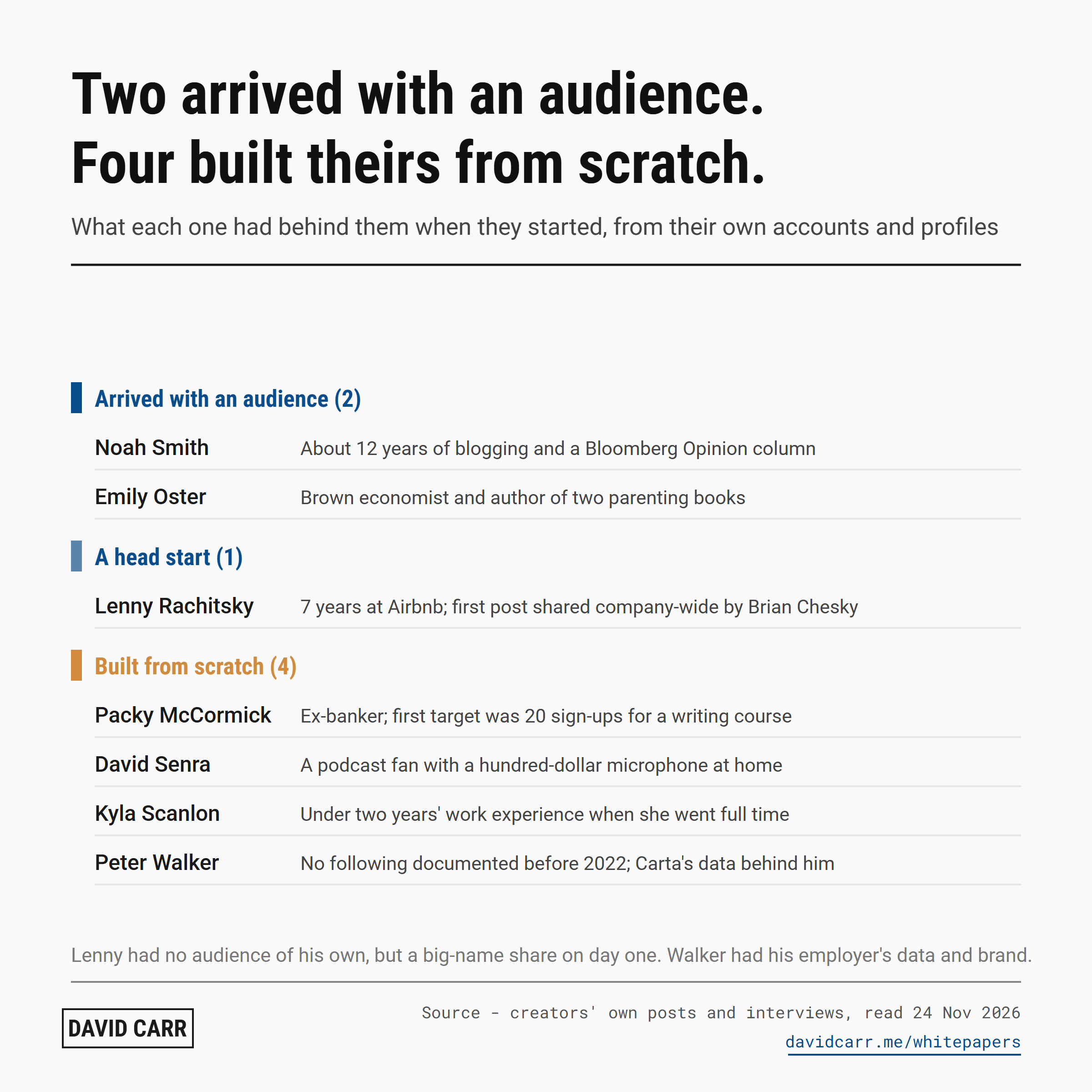
Two arrived with an audience. Four built theirs from scratch.
- Arrived with an audience: Noah Smith (about 12 years of blogging, a Bloomberg Opinion column) and Emily Oster (Brown economist, two parenting books)
- A head start: Lenny Rachitsky (seven years at Airbnb; his first post was shared company-wide by Brian Chesky)
- From scratch: Packy McCormick, David Senra, Kyla Scanlon and Peter Walker
The carried-over group still had to build a newsletter, but readers already knew their names. The from-scratch group had to earn both.
Walker counts as from scratch for his own following, though Carta's data and brand were behind him.
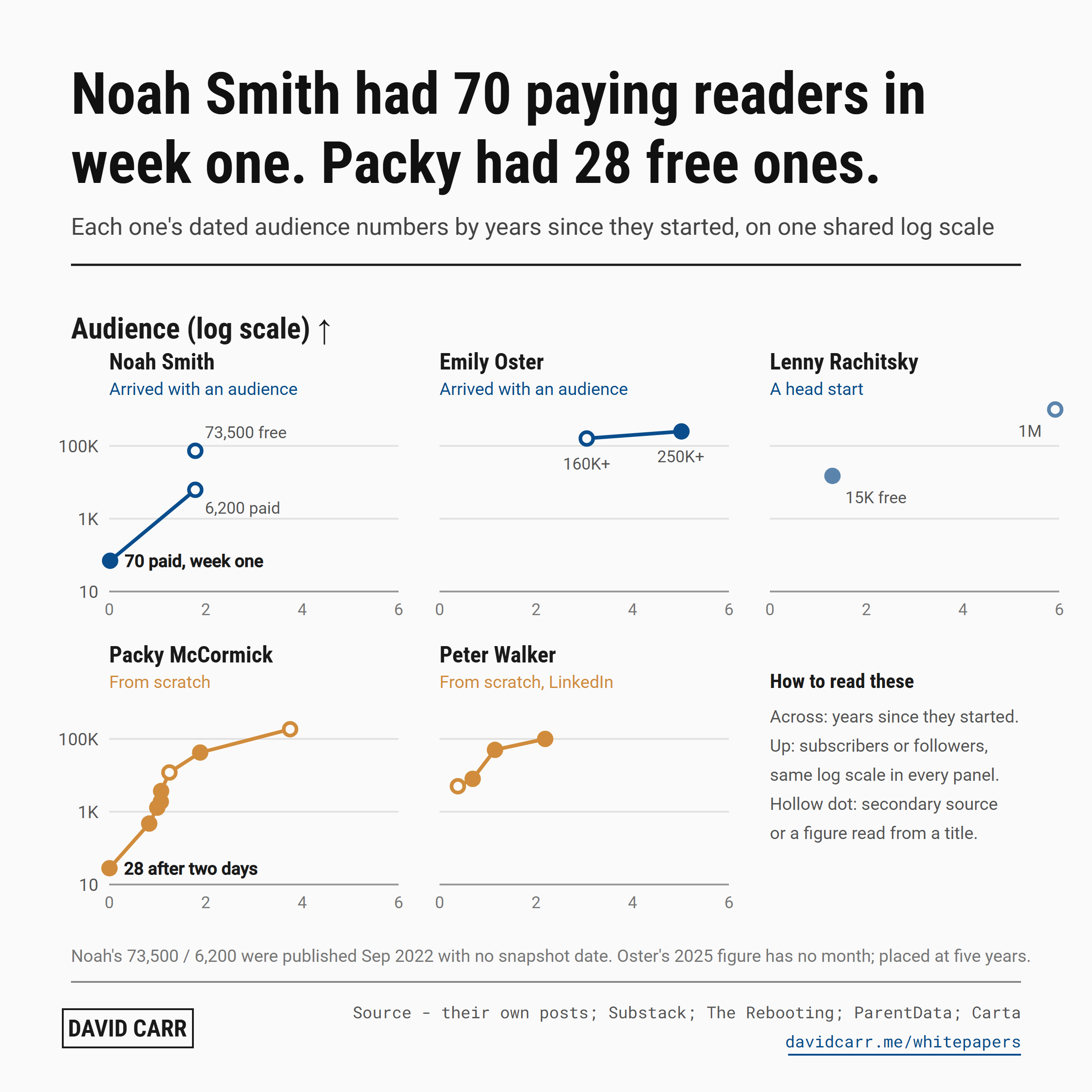
Noah Smith had 70 paying readers in week one. Packy had 28 free ones.
- Noah Smith: 70 paid in his first week; 73,500 free and 6,200 paid by September 2022
- Emily Oster: 160,000+ by March 2023; 250,000+ in 2025
- Lenny Rachitsky: about 15,000 free by August 2020; 1,000,000 by March 2025
- Packy McCormick: 28 after two days; 42,205 by April 2021; 185,000+ by February 2023 (secondary)
- Peter Walker: 8,000 to 100,000 LinkedIn followers in 18 months
A carried-over audience changes where the curve starts, not whether it rises. Noah Smith had a decade of readers behind him before he asked anyone to pay.
Noah says paid began at the end of 2020; Substack's own write-up says November 2021. His 73,500 / 6,200 were published in September 2022 with no snapshot date.
Method, caveats and sources
The short answer. For the writers here who started from nothing, the first year was slow: Packy McCormick had 473 subscribers after 11 months. Growth then came in steps, not a smooth climb: a guest post, a launch, one big share. The first 1,000 mostly came through someone else's audience. Guest-interview podcasts came later, one and a half to three years in. Those who arrived with an audience, like Noah Smith, started higher, but every curve still had a quiet stretch or a step in it.
Who is in it. Seven writers in and around data, economics and insights with some public record of how they grew: Lenny Rachitsky, David Senra, Packy McCormick, Kyla Scanlon, Noah Smith, Peter Walker and Emily Oster. Two more were researched and left out of the charts because no dated growth numbers could be found: Jason Saltzman and Lyn Alden.
Where the numbers come from. Their own posts, interviews and press releases first, read in November 2026. Where only a profile or aggregator had a number, it is marked secondary on the chart (hollow dots) and in the text. Self-reported numbers are not audited and are labelled as such. Figures from wiki-style aggregators that could not be traced to a primary source were left out, including later Noah Smith totals and Kyla Scanlon's TikTok start date.
Dates. Some milestones have only a month or a year. Those are placed mid-month, and the chart says so. Two podcast dates were checked separately: Econ 102's Apple Podcasts listing gives 2023, and Carta's announcement of The Data Minute podcast is dated 30 March 2024.
Different measures. Newsletter subscribers, LinkedIn followers, podcast listeners and paid subscribers are not the same thing. Charts that put two side by side label each one, and none is added to another.
Judgement calls. "Arrived with an audience", "head start" and "from scratch" are judgement calls from each person's own account of what they had before. An "early lift" means a named person, outlet or site that each person credits for a jump.
Also: The insights economy and Research methods.