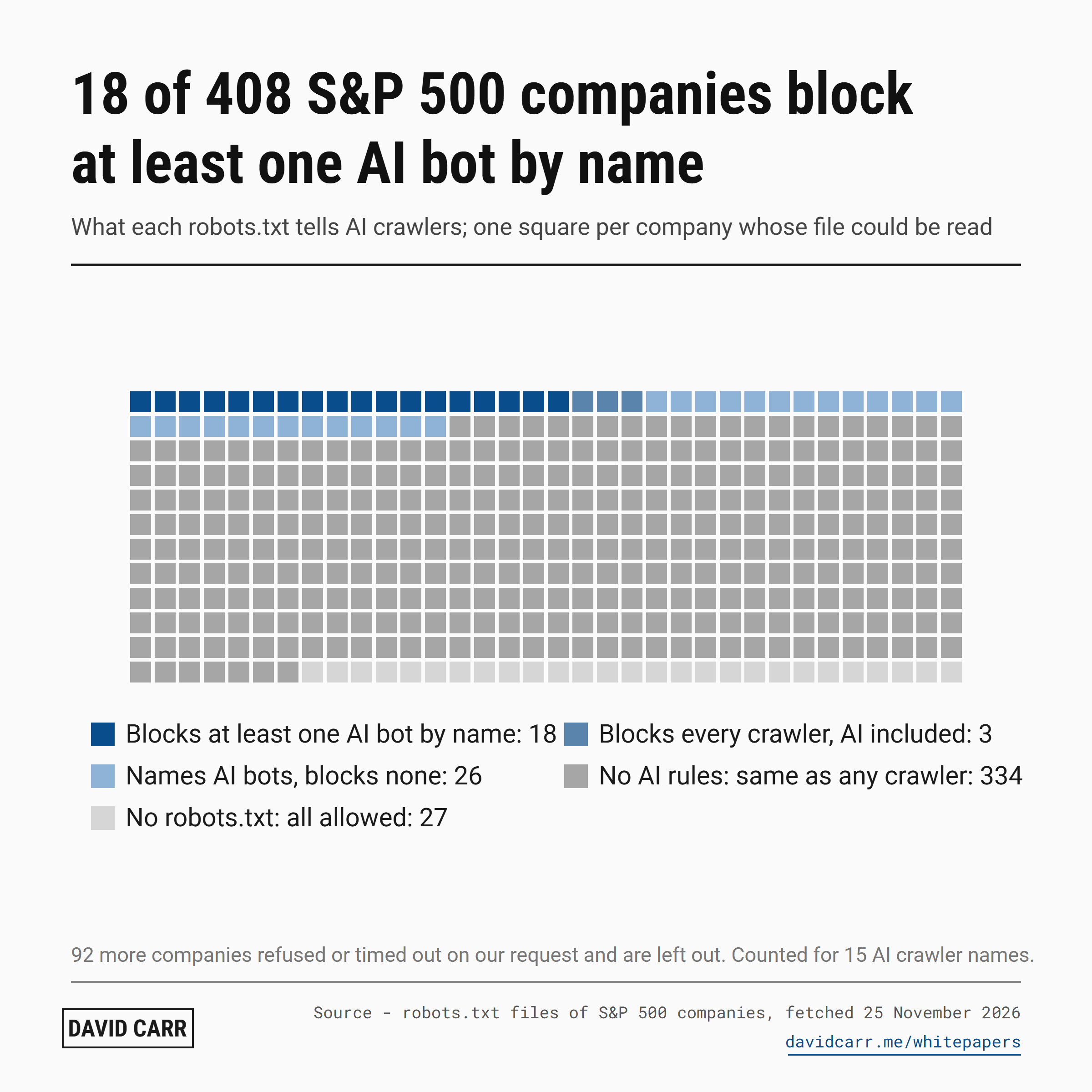
18 of 408 S&P 500 companies block at least one AI bot by name
- Block at least one AI bot by name: 18 (4%)
- Block every crawler, AI bots included: 3
- Name AI bots but block none of them: 26
- No AI rules at all: 334
- No robots.txt: 27
Almost all of America's biggest listed companies treat AI crawlers like any other visitor. Some name AI bots only to welcome them in.
Base: the 408 companies whose robots.txt could be read on 25 November 2026. 92 more refused or timed out on our request and are left out.
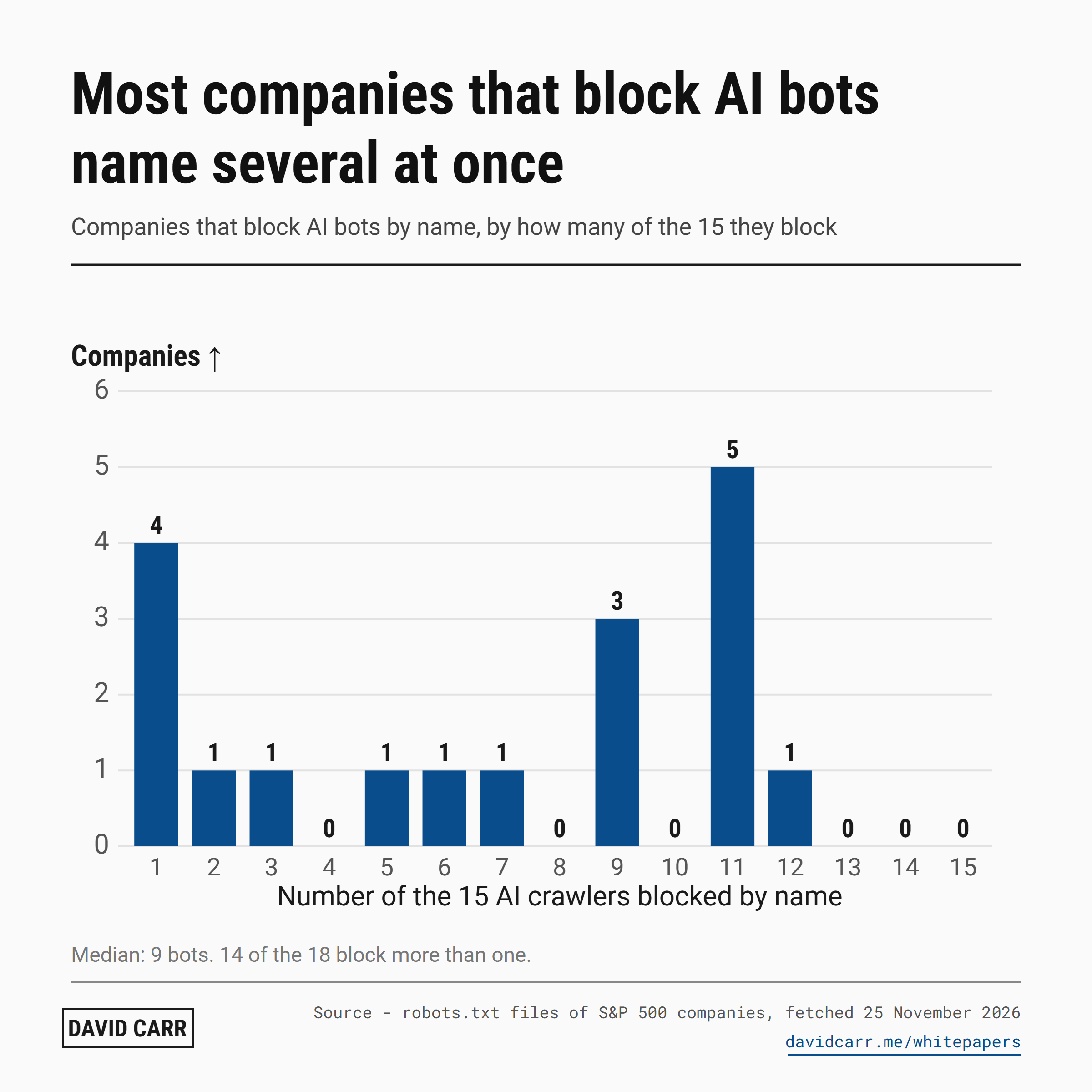
Most companies that block AI bots name several at once
- Median: 9 of the 15 crawlers checked
- Block more than one: 14 of 18
- Block 11 or more: 6
When a company decides to block AI crawlers, it tends to block a long list of them, not one.
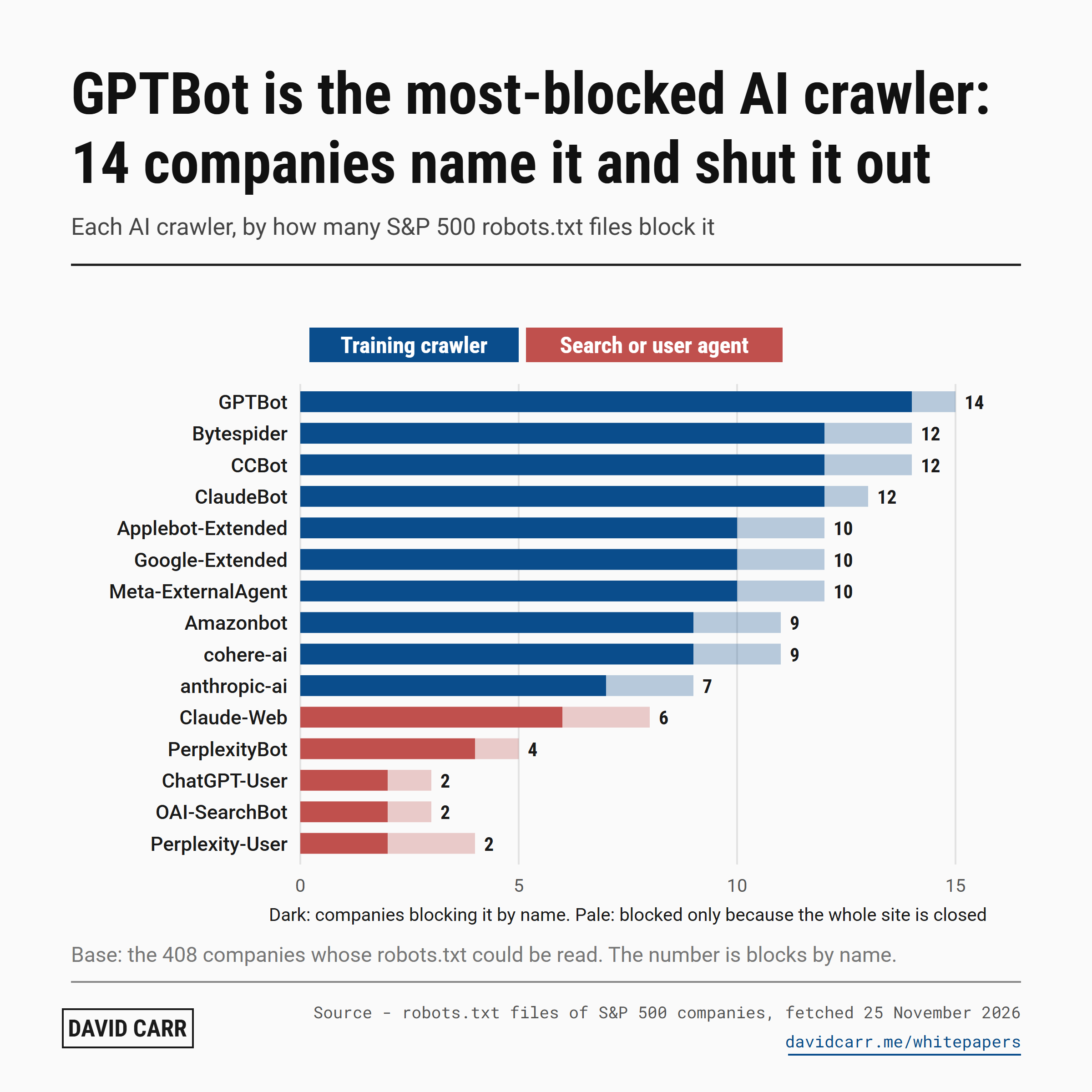
GPTBot is the most-blocked AI crawler
- GPTBot: 14 companies
- Bytespider: 12 companies
- CCBot: 12 companies
- ClaudeBot: 12 companies
- Applebot-Extended: 10 companies
Crawlers that collect training data fill the top ten. The agents that fetch a page when someone asks a chatbot a question are blocked less.
Each bot's name as its maker documents it, for example OpenAI. The pale part of each bar is companies that close their whole site to every crawler.
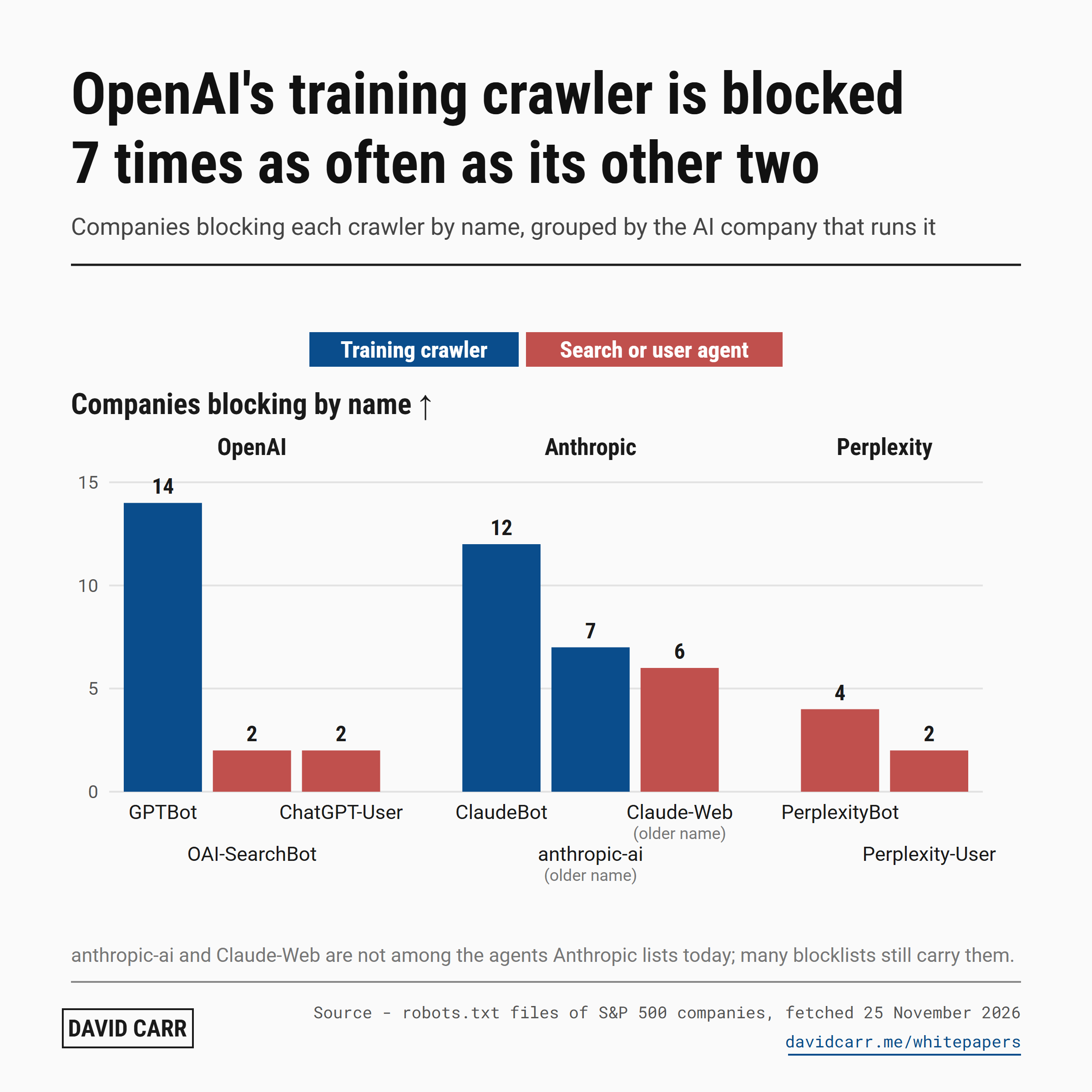
OpenAI’s training crawler is blocked 7 times as often as its other two
- OpenAI: GPTBot 14, OAI-SearchBot 2, ChatGPT-User 2
- Anthropic: ClaudeBot 12, anthropic-ai 7, Claude-Web 6
- Perplexity: PerplexityBot 4, Perplexity-User 2
Each AI company runs more than one crawler and says what each is for. Companies use that split.
anthropic-ai and Claude-Web are not among the agents Anthropic lists today (ClaudeBot, Claude-User, Claude-SearchBot), but some blocklists still carry them.
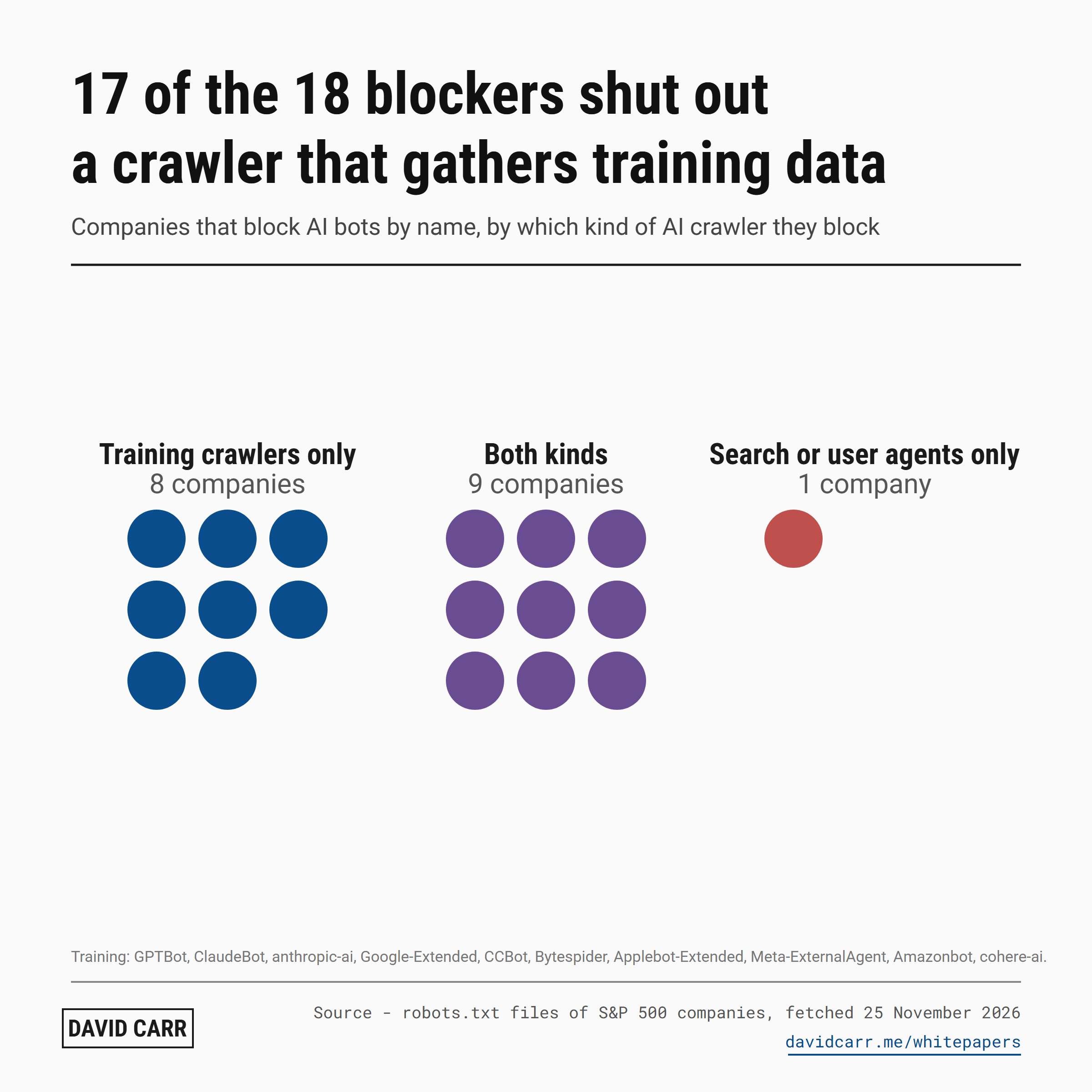
17 of the 18 blockers shut out a crawler that gathers training data
- Training crawlers only: 8
- Both kinds: 9
- Search or user agents only: 1
A training crawler copies pages to build a model. A search or user agent fetches a page to answer a question, and may link back. Companies can treat the two differently, and some do.
Training: GPTBot, ClaudeBot, anthropic-ai, Google-Extended, CCBot, Bytespider, Applebot-Extended, Meta-ExternalAgent, Amazonbot, cohere-ai. Search or user: ChatGPT-User, OAI-SearchBot, Claude-Web, PerplexityBot, Perplexity-User.
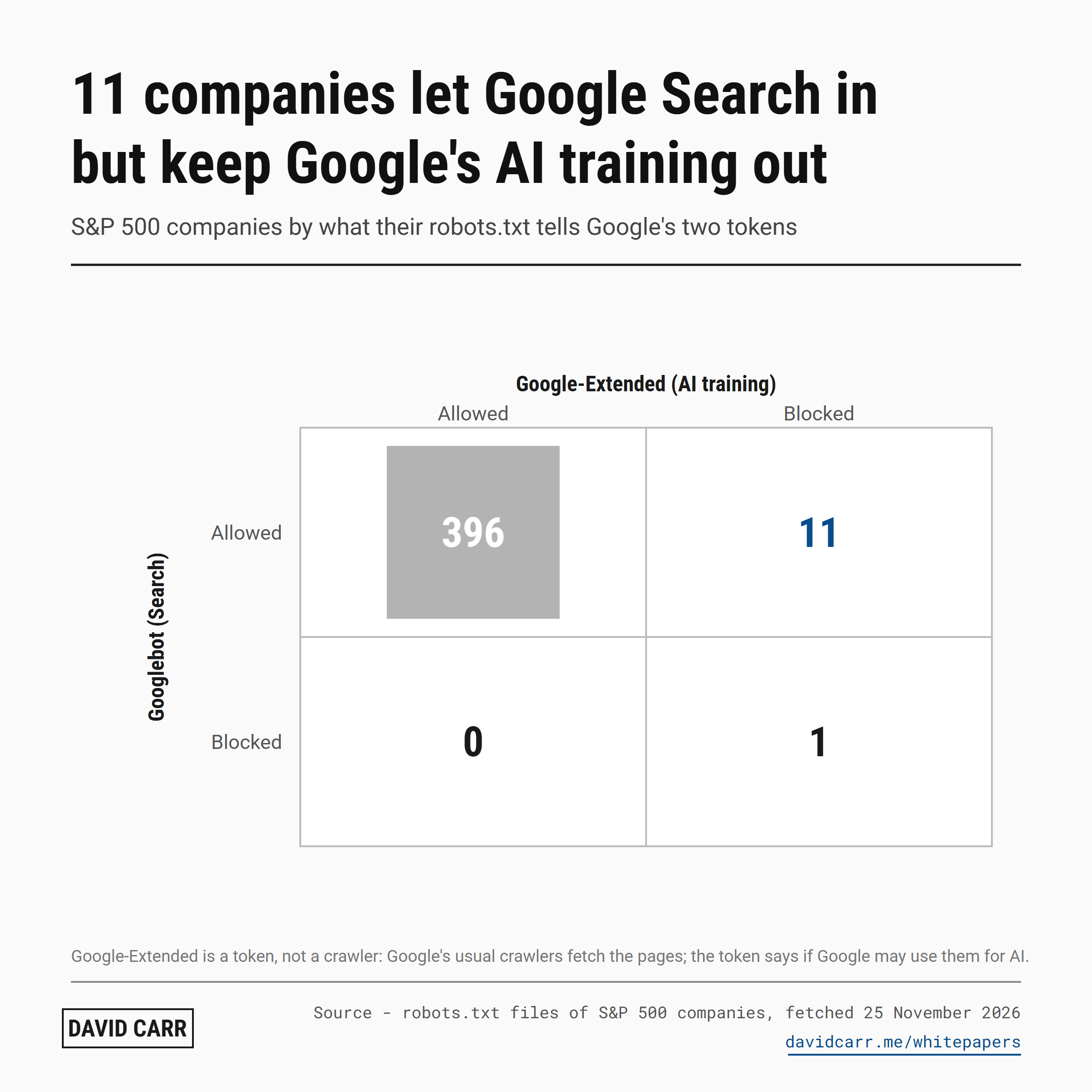
11 companies let Google Search in but keep Google’s AI training out
- Googlebot allowed, Google-Extended blocked: 11
- Both allowed: 396
- Both blocked: 1
- Googlebot blocked, Google-Extended allowed: 0
Blocking Googlebot would take a site out of Google Search. Google-Extended is the switch Google offers to keep pages out of its AI training while staying in search.
Google says Google-Extended has no crawler of its own and does not affect inclusion or ranking in Search. It covers model training and AI answers outside Search.
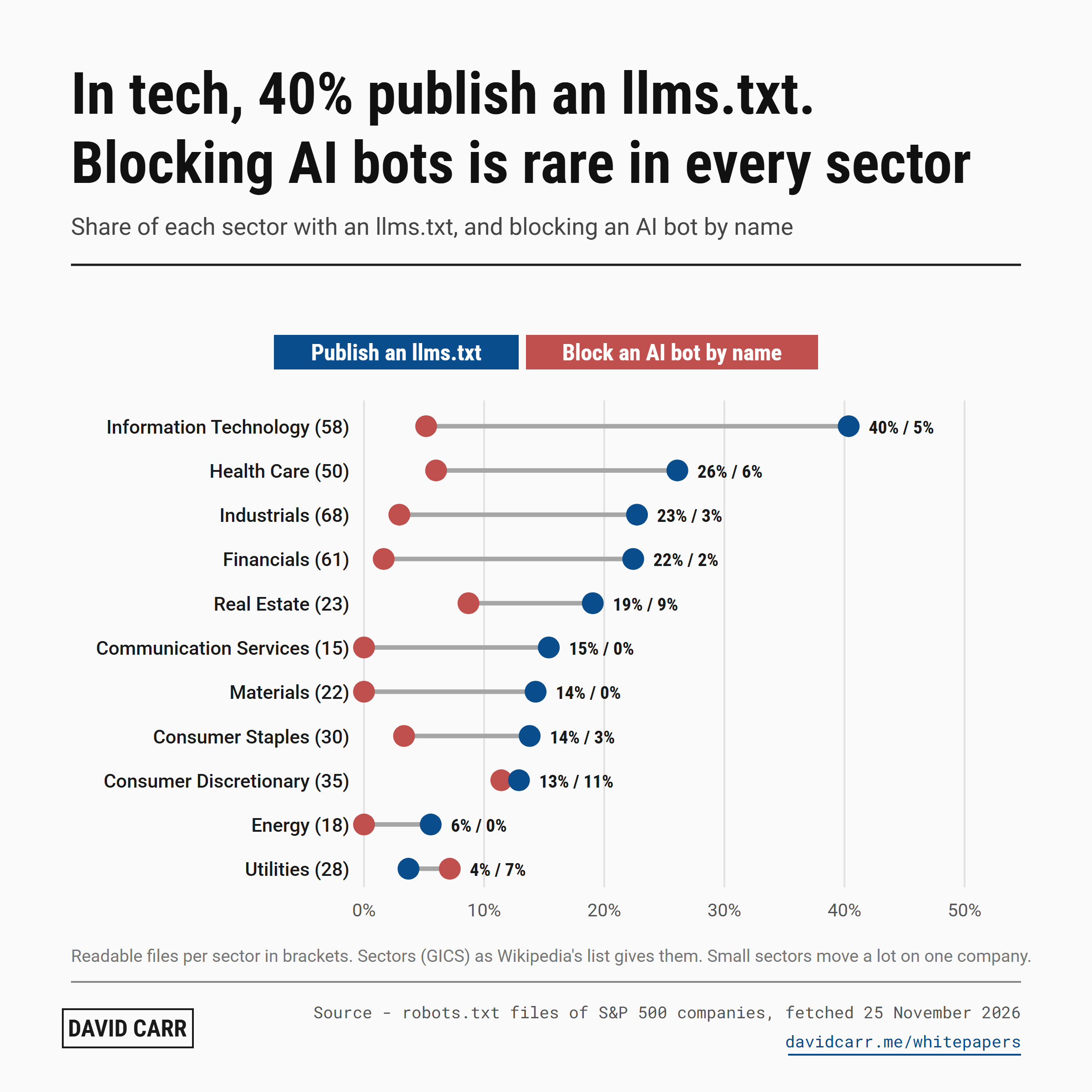
In tech, 40% publish an llms.txt. Blocking AI bots is rare in every sector.
- Information Technology: llms.txt 40%, blocking 5%
- Health Care: llms.txt 26%, blocking 6%
- Industrials: llms.txt 23%, blocking 3%
- Most blocking: Consumer Discretionary, 4 of 35
In 10 of 11 sectors, a bigger share of companies publish a guide for AI tools than block AI crawlers. The exception: Utilities.
Small sectors swing a lot on one company. Sectors as Wikipedia's list gives them (GICS).
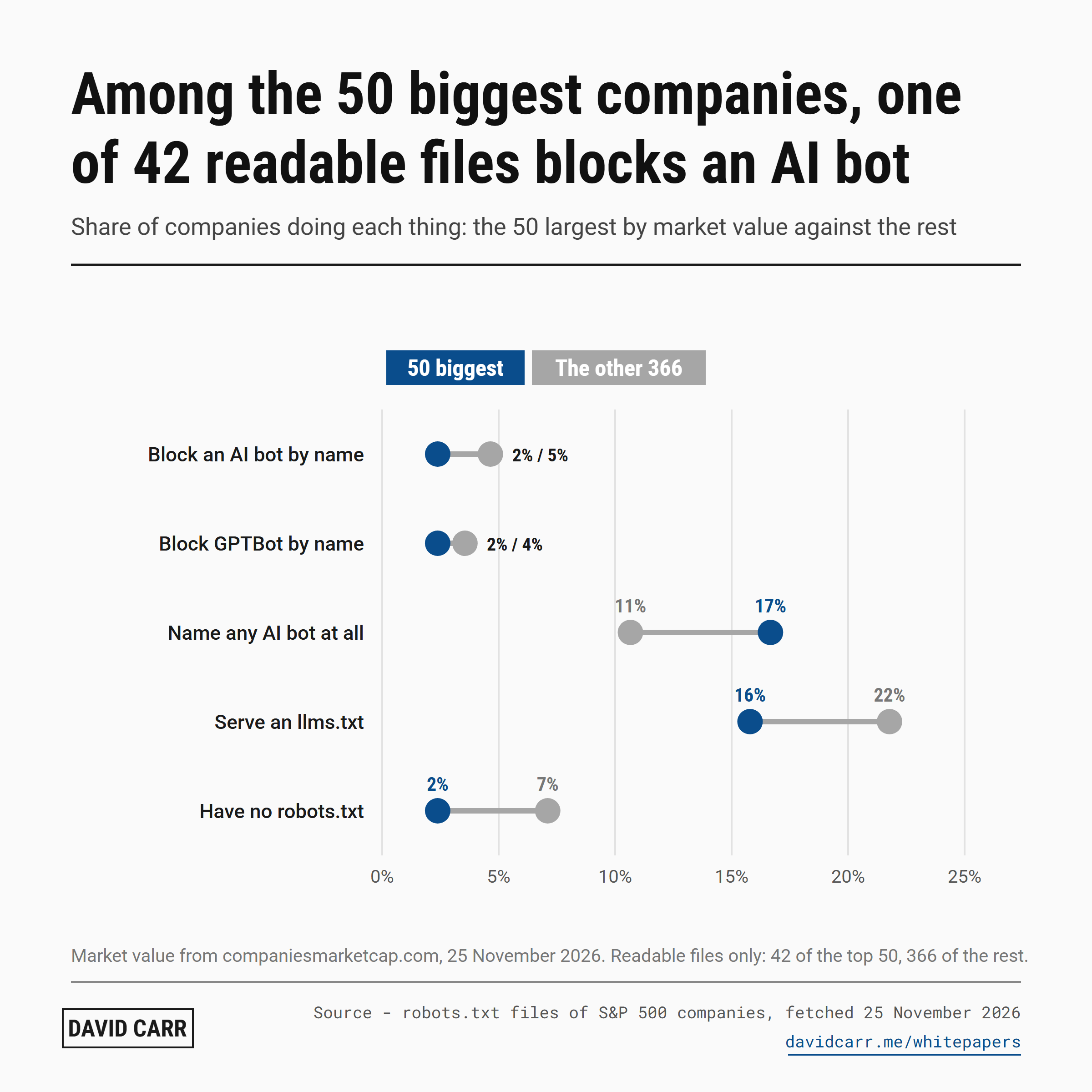
Among the 50 biggest companies, one of 42 readable files blocks an AI bot
- Block an AI bot by name: 2% of the top 50, 5% of the rest
- Block GPTBot by name: 2% of the top 50, 4% of the rest
- Name any AI bot at all: 17% of the top 50, 11% of the rest
- Serve an llms.txt: 16% of the top 50, 22% of the rest
- Have no robots.txt: 2% of the top 50, 7% of the rest
The biggest companies are more likely to mention AI bots in their files, but no more likely to block them.
Top 50 by market value on companiesmarketcap.com, 25 November 2026. Shares are of companies whose file could be read. In a group of 42, one company is 2%.
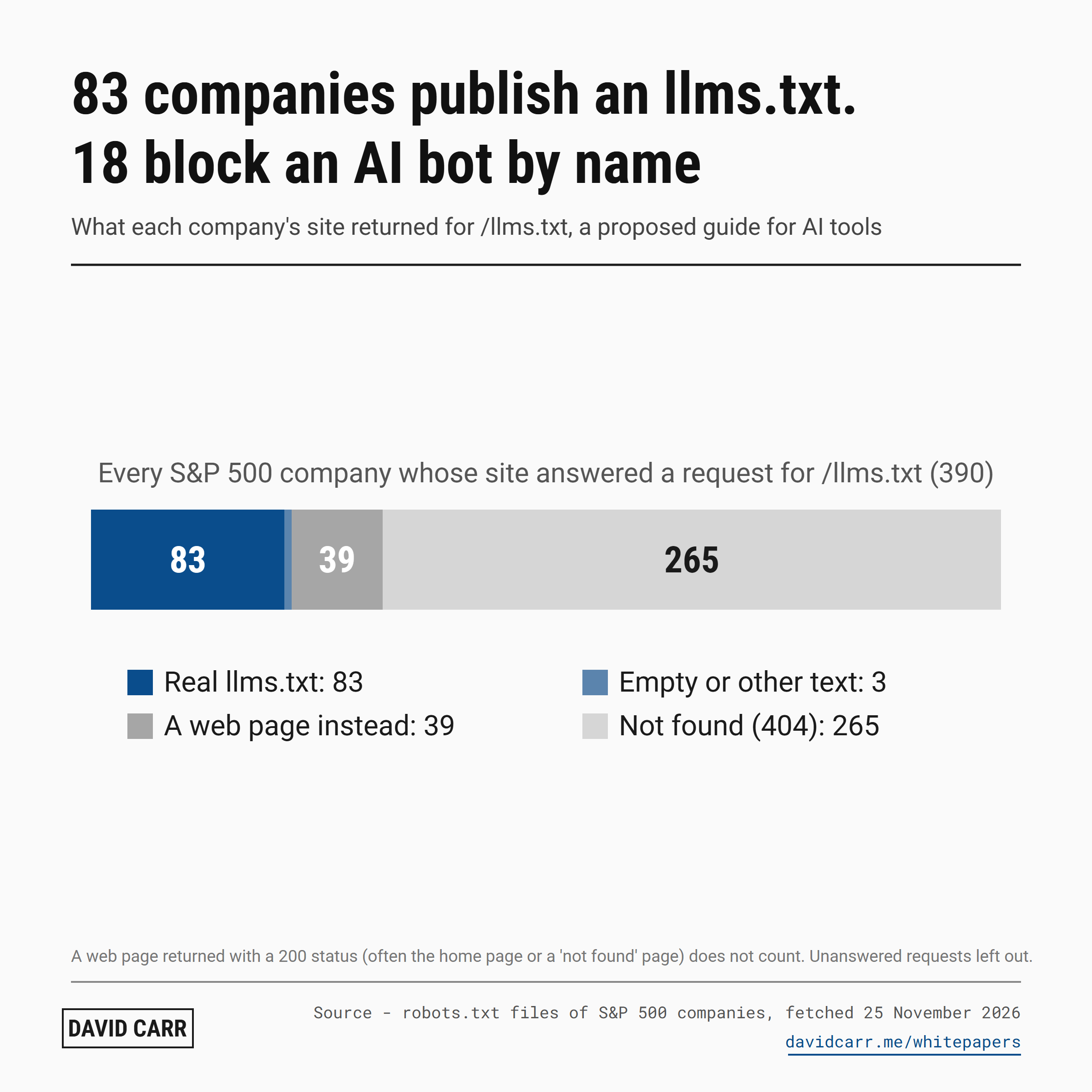
83 companies publish an llms.txt. 18 block an AI bot by name.
- A real llms.txt: 83 of 390
- A web page served instead: 39
- Empty or other text: 3
- Not found: 265
llms.txt is a proposed file that gives AI tools a short, plain map of a site. It has no official standing, yet more big companies have one than block AI crawlers.
Format at llmstxt.org. A page that loads but is really a web page, often a "not found" page, is not counted. Some files are made automatically by website plugins.
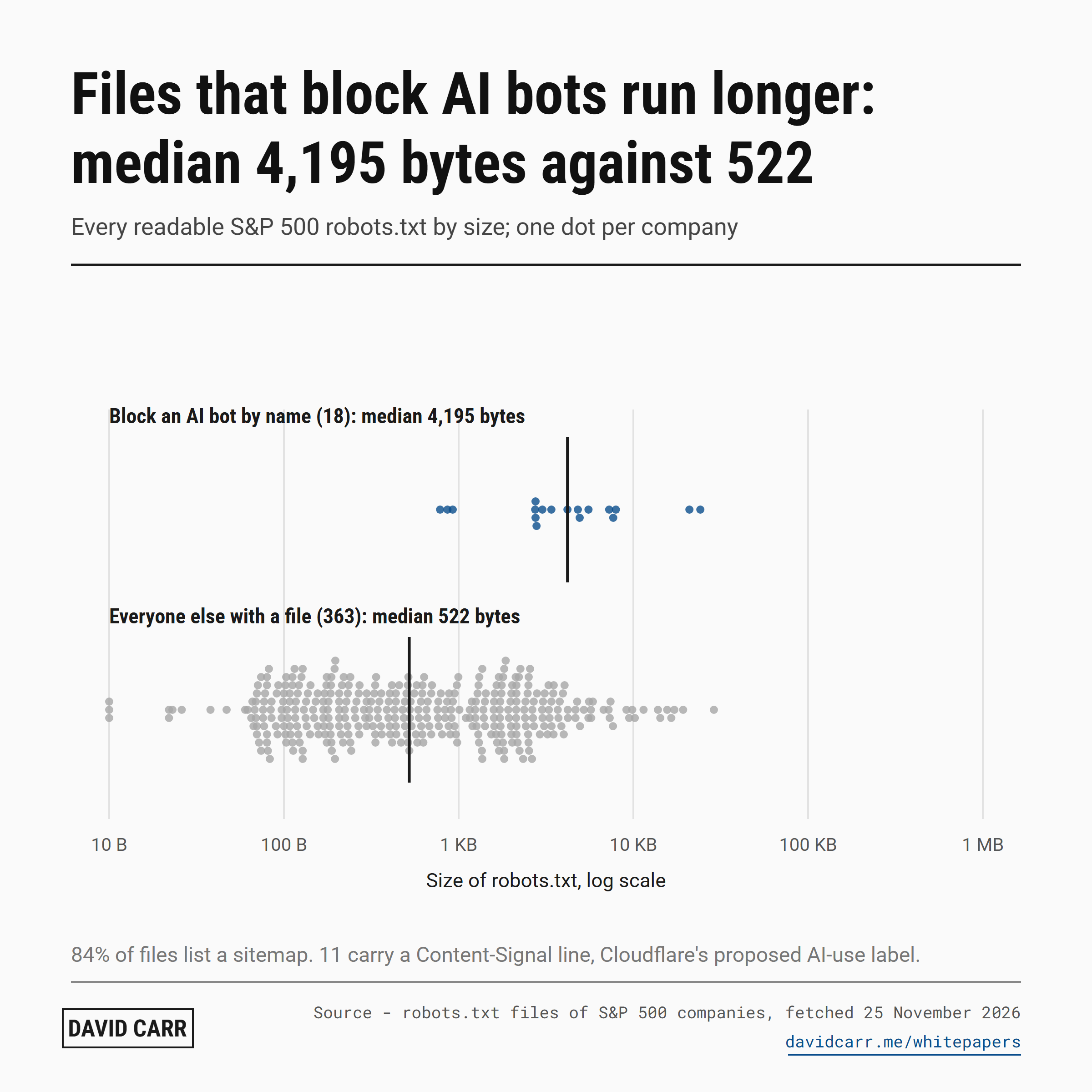
Files that block AI bots run longer
- Median file: 588 bytes
- Blockers' median: 4,195 bytes; everyone else: 522
- List a sitemap: 84% of files
- Carry a Content-Signal line: 11
Each bot named adds at least two lines. Most files are short: half are under 600 bytes.
Content-Signal is Cloudflare's proposal for saying how content may be used, written into robots.txt. It is not part of the robots.txt standard.
Method, caveats and sources
The short answer. 4% of S&P 500 companies whose robots.txt could be read block at least one AI crawler by name. GPTBot is blocked most. Training crawlers are blocked far more often than the agents that fetch pages for search and chat answers. 83 publish an llms.txt, a proposed guide for AI tools: far more than block AI crawlers. Blocking is a choice each company makes about its own site; this page counts the choices and does not grade them.
Why the S&P 500, not the Fortune 500. The S&P 500 list is public, with names, tickers and sectors in one table anyone can check. The Fortune 500 is Fortune’s own product, ranked by revenue, and includes companies that are not listed. The two lists overlap heavily among the biggest firms. The list was read on 25 November 2026; share classes were merged, giving 500 companies.
Which website. Each company’s official website from Wikidata (the one in its Wikipedia infobox), checked by loading the home page. 28 were corrected by hand, mostly where the home page now redirects to a new address, each with a recorded reason.
Fetching. https://<domain>/robots.txt and /llms.txt, redirects followed, 10-second timeout, no more than two requests a second, with a user agent that names this project and links here. 92 sites refused or did not answer, mostly with a 403 (forbidden). They are left out of every share rather than guessed. Big companies often sit behind bot-protection services, so the unreadable group is not random.
Reading the rules. The robots.txt standard (RFC 9309): a crawler follows the group that names it; if none does, the * group. A bot counts as blocked if the home page or an ordinary page is disallowed for it. "By name" means a group names that bot; "every crawler" means only a * rule closes the whole site. Fifteen AI names were checked: GPTBot, ChatGPT-User, OAI-SearchBot, ClaudeBot, Claude-Web, anthropic-ai, Google-Extended, PerplexityBot, Perplexity-User, CCBot, Bytespider, Applebot-Extended, Meta-ExternalAgent, Amazonbot and cohere-ai. Googlebot and Bingbot are the controls.
What robots.txt cannot show. It is a request. Whether a crawler obeys it, and whether a company also blocks bots at its firewall, cannot be seen from the file. Some sites block AI crawlers through a service like Cloudflare without a line in robots.txt.
A tracker. This is the first snapshot, fetched 25 November 2026. The script that made it writes a new dated snapshot each time it runs, so the same companies can be checked again.
Also: Substack vs beehiiv, which checks the same AI rules on two newsletter platforms, and Stripe.