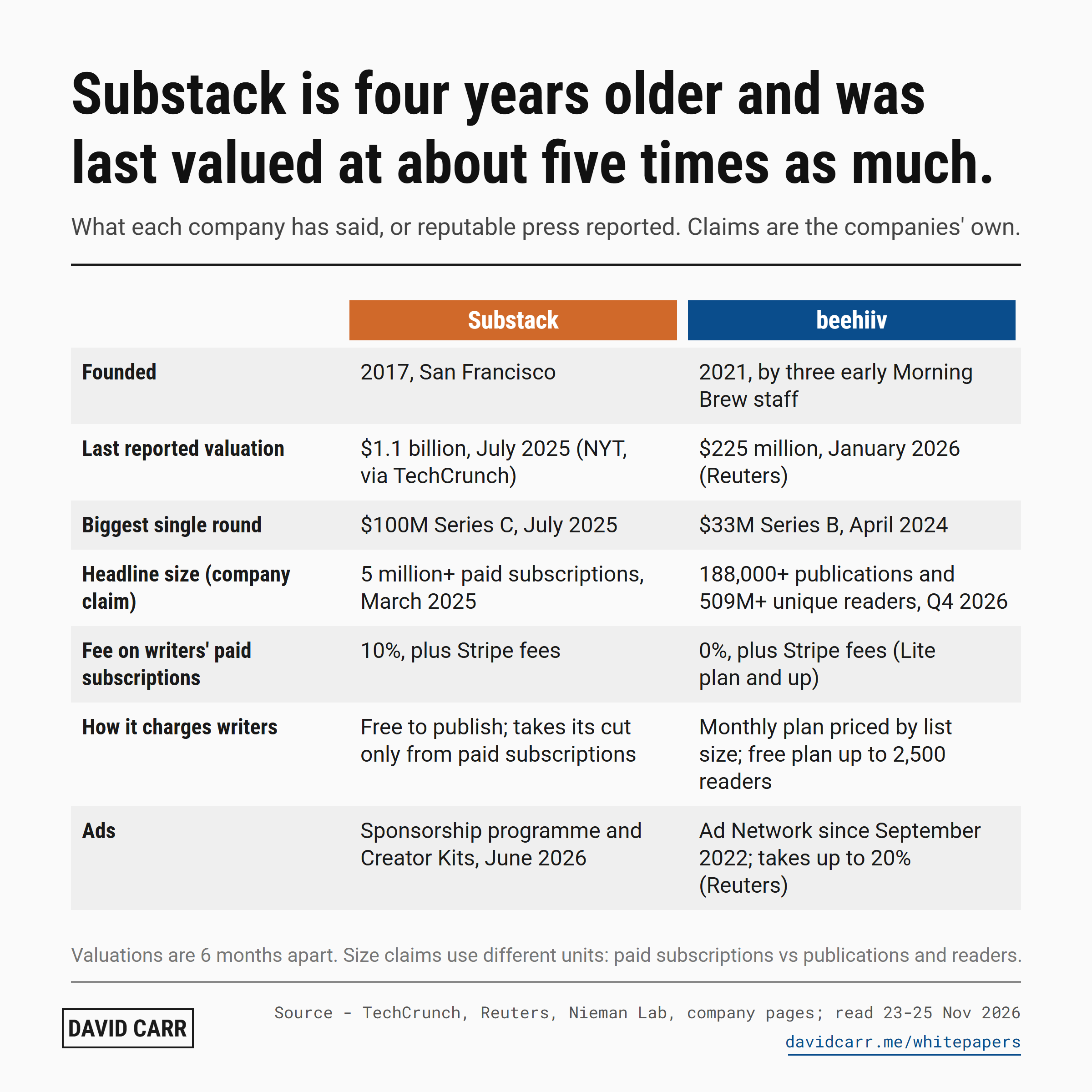
Substack is four years older and was last valued at about five times as much.
They make money in opposite ways. Substack takes 10% of what readers pay writers. beehiiv takes nothing from paid subscriptions and charges a monthly plan.
$1.1 billion is 4.9 times $225 million, but the two valuations are six months apart. Every size figure is the company's own claim, not audited.
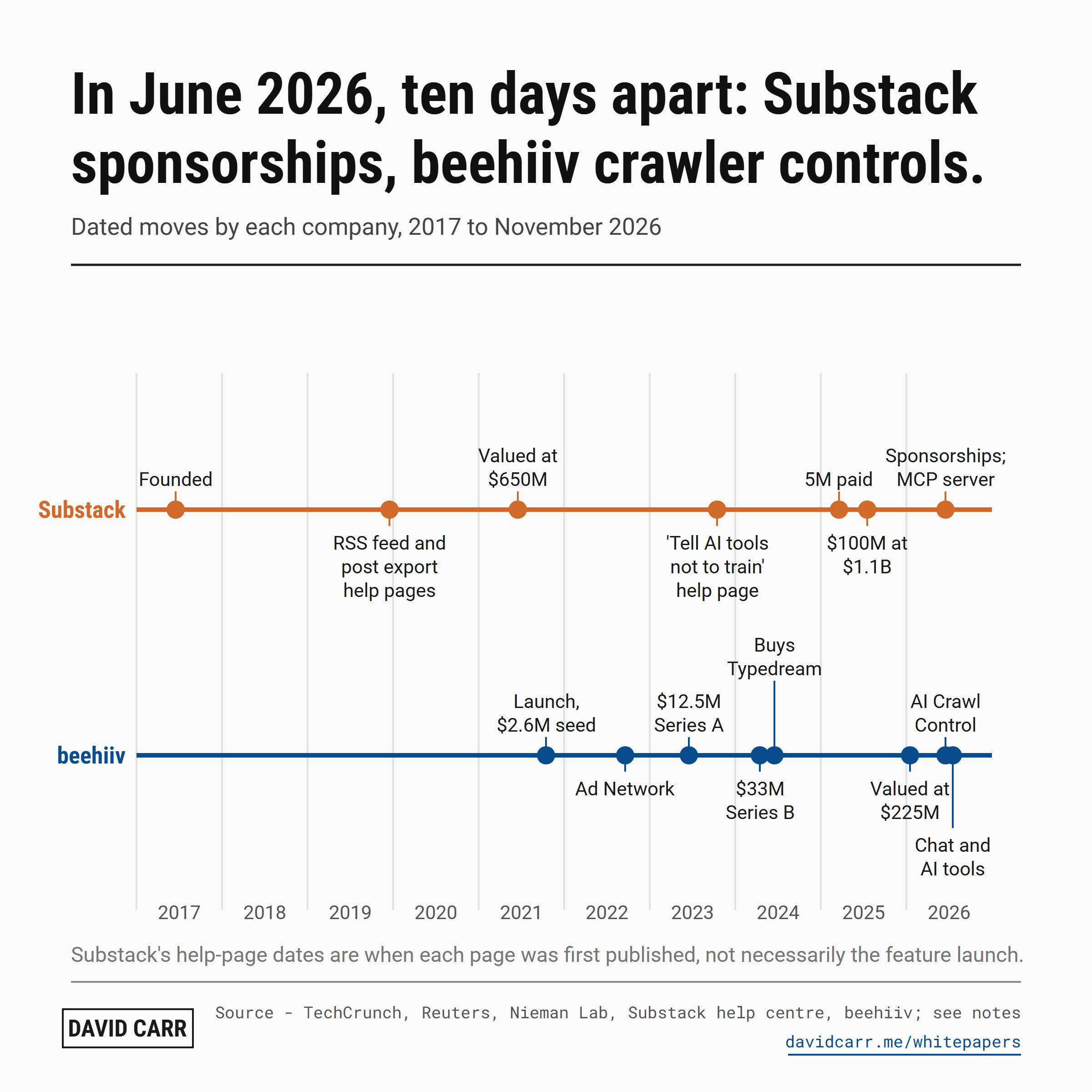
In June 2026, ten days apart: Substack sponsorships, beehiiv crawler controls.
- 15 June 2026: Substack announced a sponsorship programme and Creator Kits (Nieman Lab)
- 25 June 2026: beehiiv and Cloudflare gave creators AI crawler controls (Nieman Lab)
- beehiiv has run an Ad Network since September 2022
Ads arrived at Substack four years after beehiiv. Network-level AI blocking arrived at beehiiv first.
Substack items marked 'help page' are dated by when the page was first published, which may be after the feature itself.
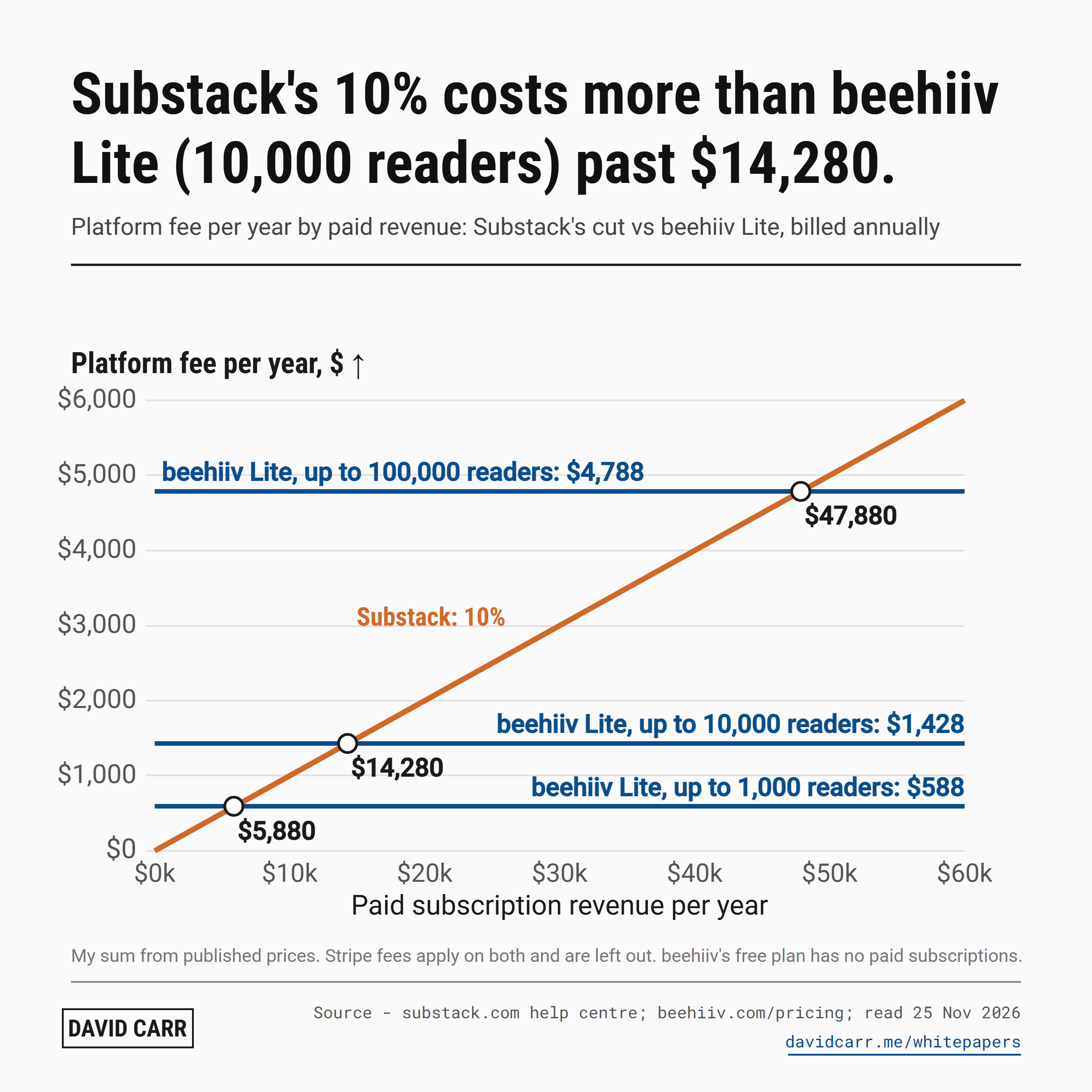
Substack's 10% costs more than beehiiv Lite (10,000 readers) past $14,280 a year.
- Substack: free to publish; 10% of each subscription payment, plus Stripe
- beehiiv Lite: $1,428 a year for up to 10,000 readers, billed yearly; 0% of paid subscriptions
- Crossovers: $5,880 of paid revenue at 1,000 readers, $14,280 at 10,000, $47,880 at 100,000
Below the crossover, Substack's cut is the cheaper of the two. Above it, the flat plan is. A free newsletter pays Substack nothing at any size.
My sum from the published prices on 25 November 2026. Stripe's fees apply on both and are left out. beehiiv's free plan stops at 2,500 readers and has no paid subscriptions.
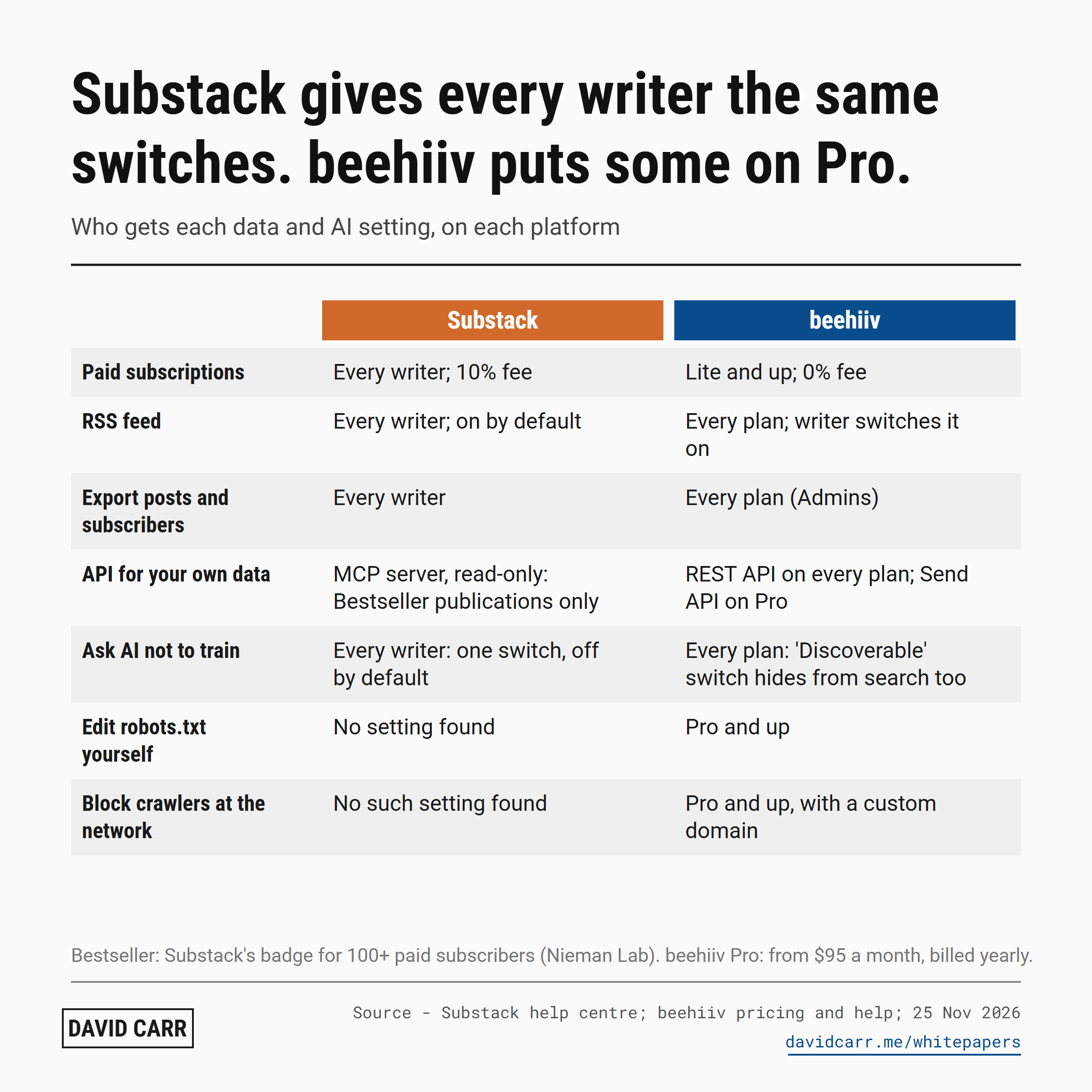
Substack gives every writer the same switches. beehiiv puts some on Pro.
- Every writer on both: RSS, exports, a request to AI crawlers
- Substack only for Bestsellers: a read-only MCP server for AI assistants
- beehiiv Pro and up: custom robots.txt and AI Crawl Control (custom domain needed)
Substack's model is one product for everyone. beehiiv's is a ladder of plans.
From each platform's pricing and help pages, read 25 November 2026. No Substack setting was found for editing robots.txt or blocking crawlers outright.
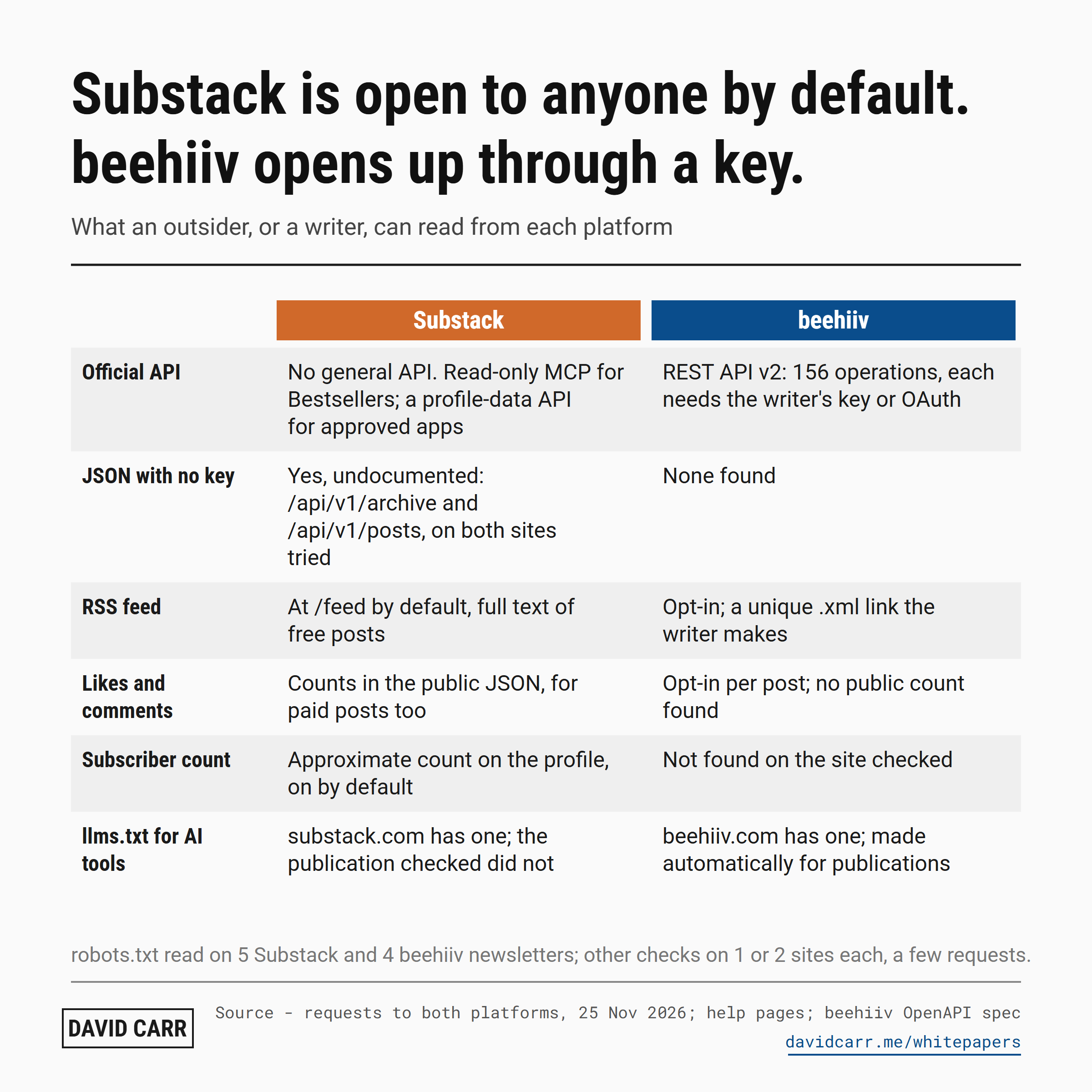
Substack is open to anyone by default. beehiiv opens up through a key.
- Substack: no general public API; a Developer API (terms dated 8 January 2026) returns public profile data to approved apps
- beehiiv: API v2, 156 operations (posts, subscribers, segments, exports, webhooks), every one behind a key or OAuth
- Substack RSS sits at /feed by default; beehiiv RSS is opt-in, at a unique link
Substack's reading side is public. beehiiv's writing side is programmable.
The Substack JSON endpoints are undocumented and unsupported; the page describes what they returned, not how to use them.
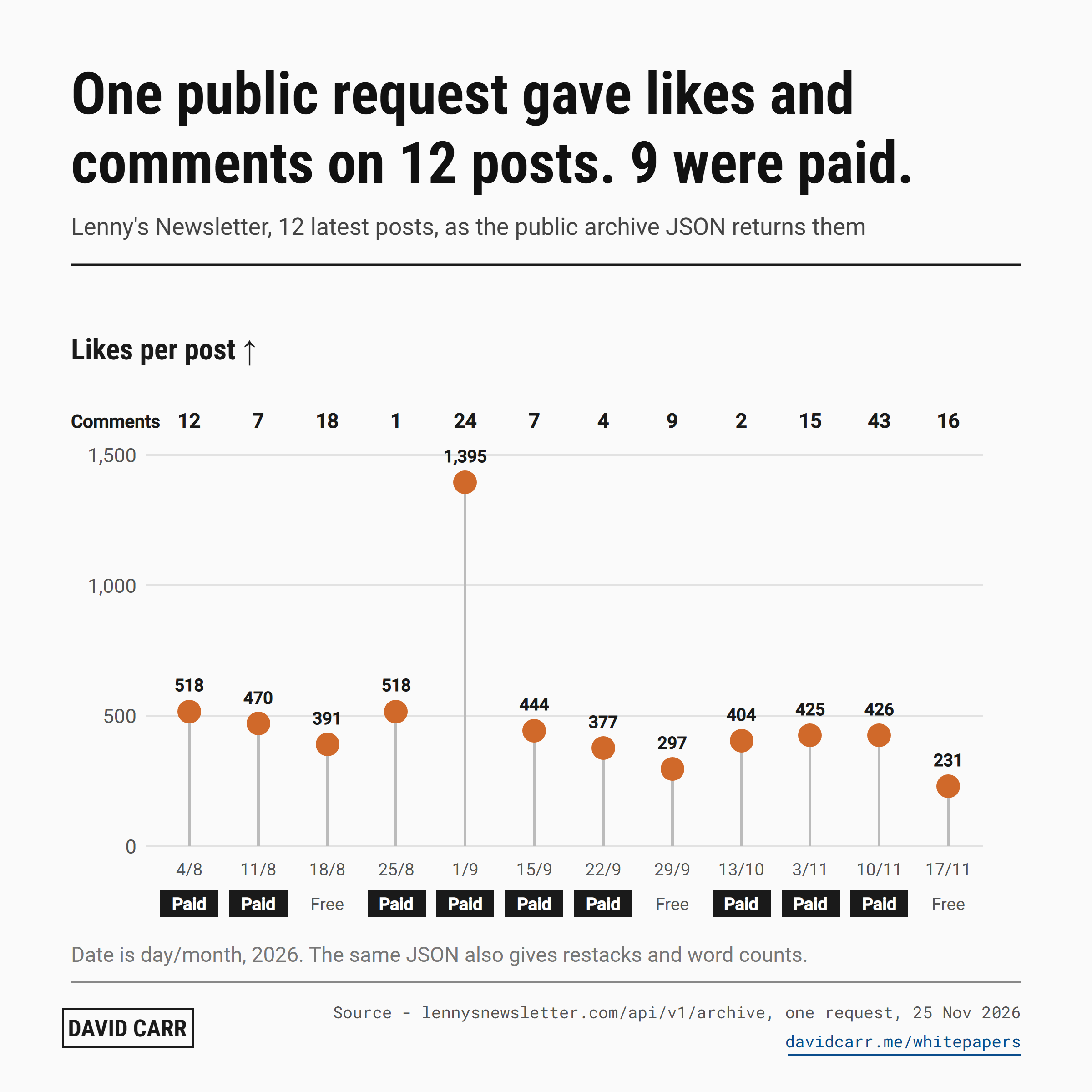
One public request gave likes and comments on 12 posts. 9 were paid.
- Fields returned: likes, comments, restacks, word count, date, paid or free
- Likes ranged from 231 to 1,395; comments from 1 to 43
- For one paid post, the full-post JSON gave the free preview the web page shows (about 1,895 of 2,183 words), not the paid part
Anyone can see how each post landed, including posts they cannot read. beehiiv's likes and comments are opt-in, and no public count was found.
One request to lennysnewsletter.com/api/v1/archive on 25 November 2026, plus one post check. A public business newsletter, chosen as a well-known example.
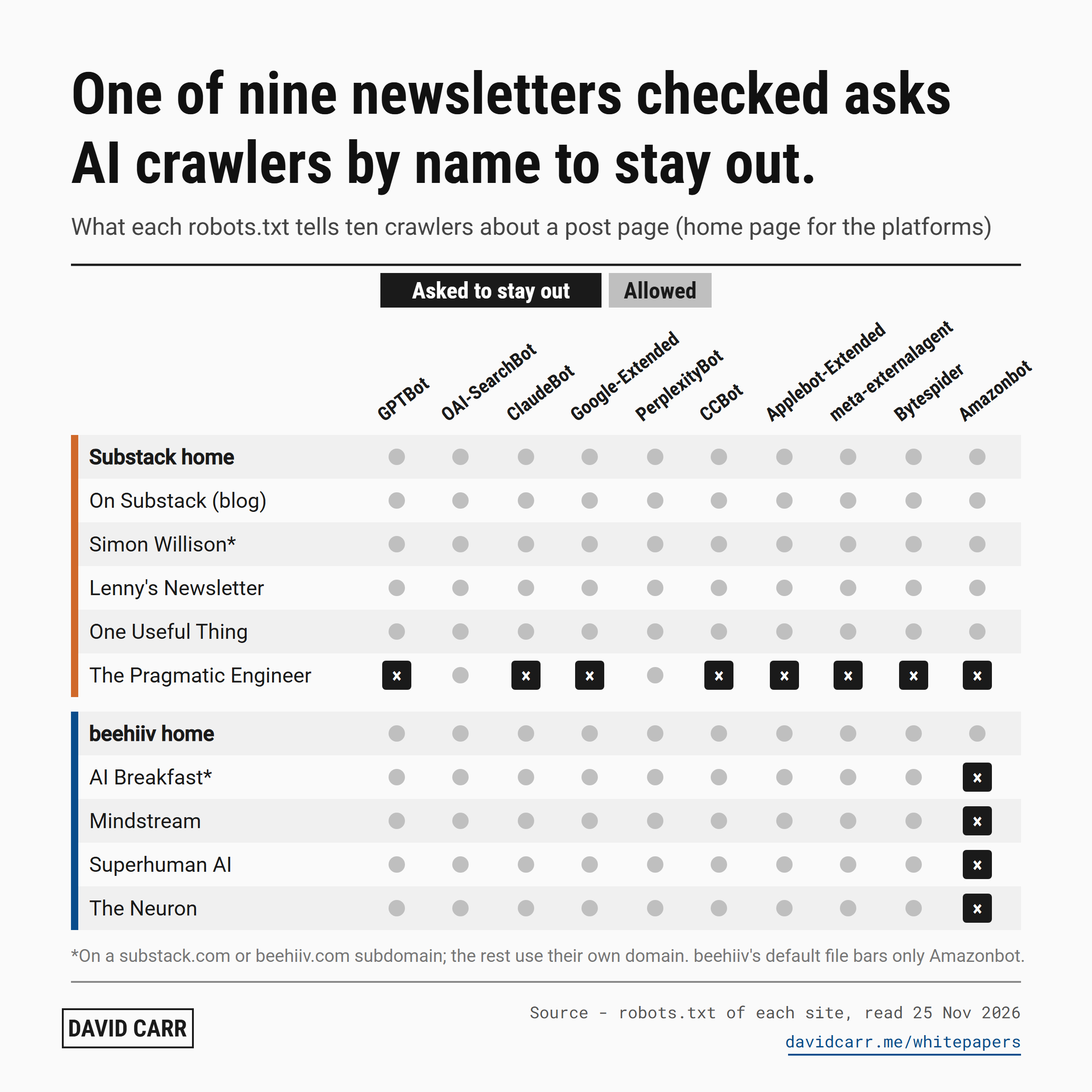
One of nine newsletters checked asks AI crawlers by name to stay out.
- The Pragmatic Engineer (Substack) names GPTBot, ClaudeBot, Google-Extended, CCBot and ten other AI crawlers to turn away
- It still allows OpenAI's search crawler and PerplexityBot
- beehiiv's default file bars Amazonbot and nothing else on this list
beehiiv.com's own robots.txt adds a Content-Signal line: ai-train=no, search=yes. So does The Pragmatic Engineer's. substack.com's has none.
robots.txt read on 25 November 2026. It is a request, not a lock. beehiiv's Cloudflare blocks act at the network and would not show here.
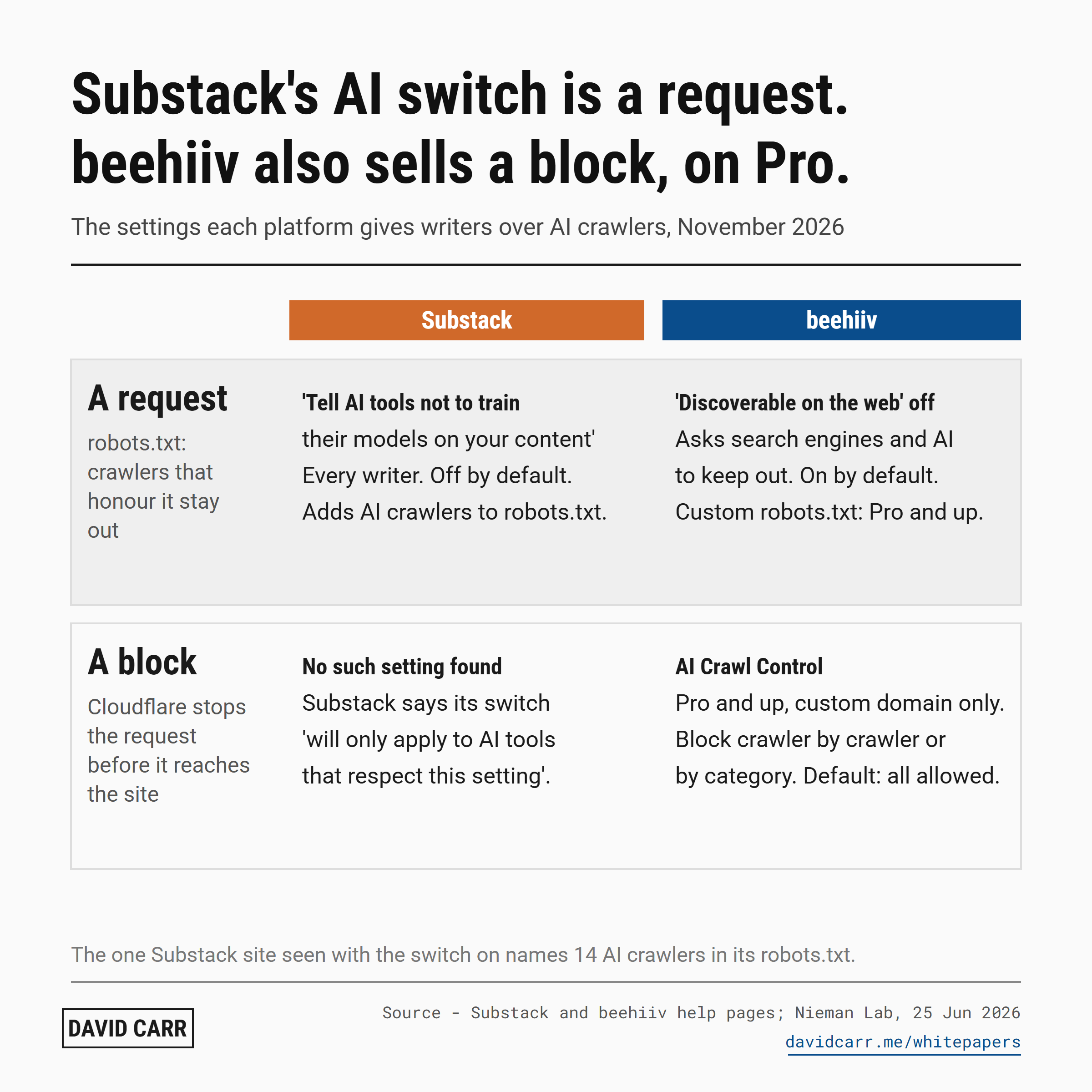
Substack's AI switch is a request. beehiiv also sells a block, on Pro.
- Substack: "Tell AI tools not to train their models on your content", in Privacy settings. It "will only apply to AI tools that respect this setting" (Substack)
- beehiiv: "Discoverable on the web" asks all search engines and AI crawlers to stay out; AI Crawl Control blocks named crawlers through Cloudflare (beehiiv)
- Substack's help page also warns that blocking training may limit discoverability in AI-generated results
A request costs nothing and depends on the crawler. A block is enforced, but on beehiiv it needs Pro and a custom domain.
Default states from each help page. Nieman Lab first reported the Cloudflare deal as beta access for all beehiiv creators; beehiiv's help page, updated 1 October 2026, says Pro and Enterprise.
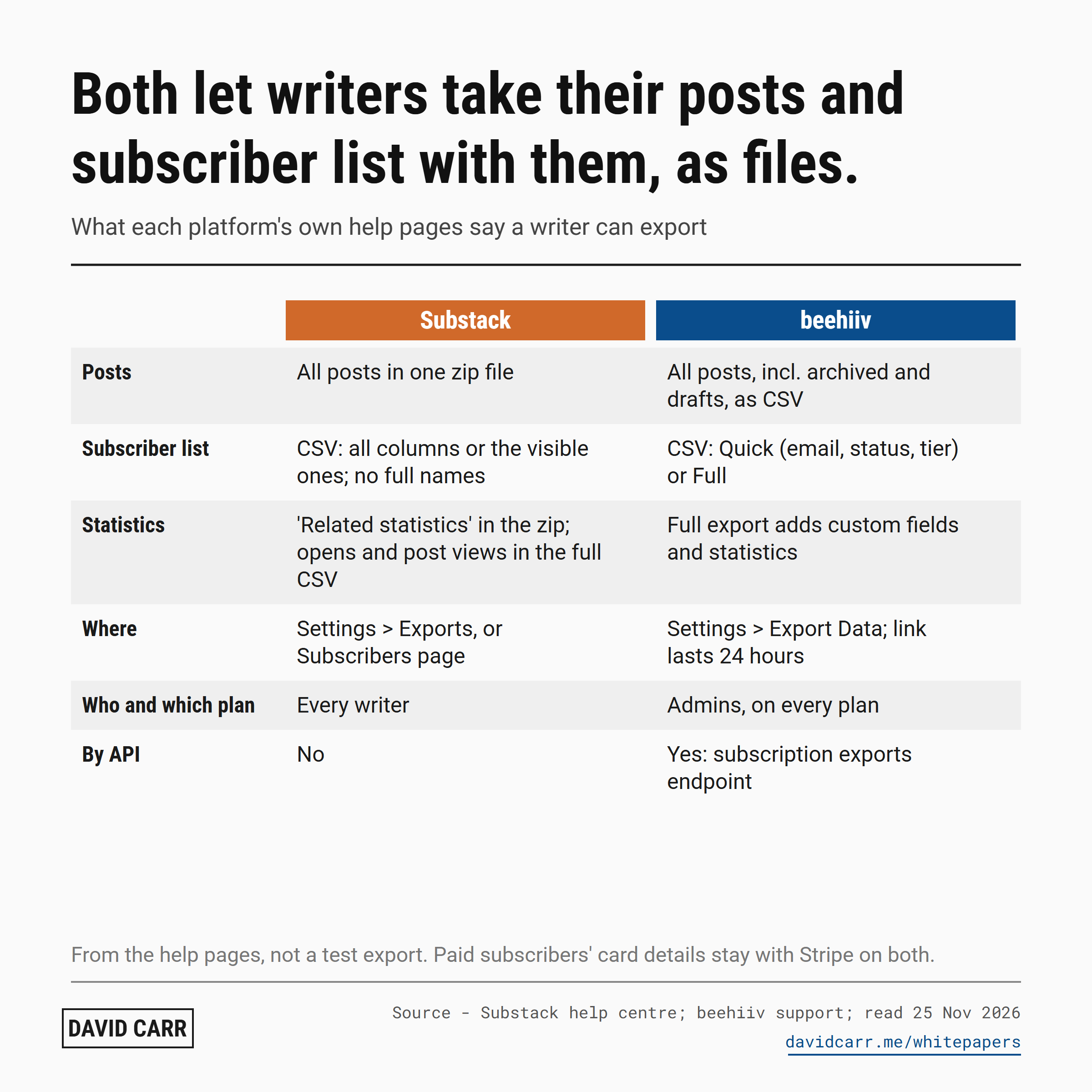
Both let writers take their posts and subscriber list with them, as files.
- Substack: one zip with posts, subscriber list and related statistics; a subscriber CSV without full names
- beehiiv: CSV of all posts, including drafts; subscribers as Quick or Full CSV; also by API
- Both on every plan
Each platform also publishes a guide to moving from the other one.
From the help pages, not a test export.
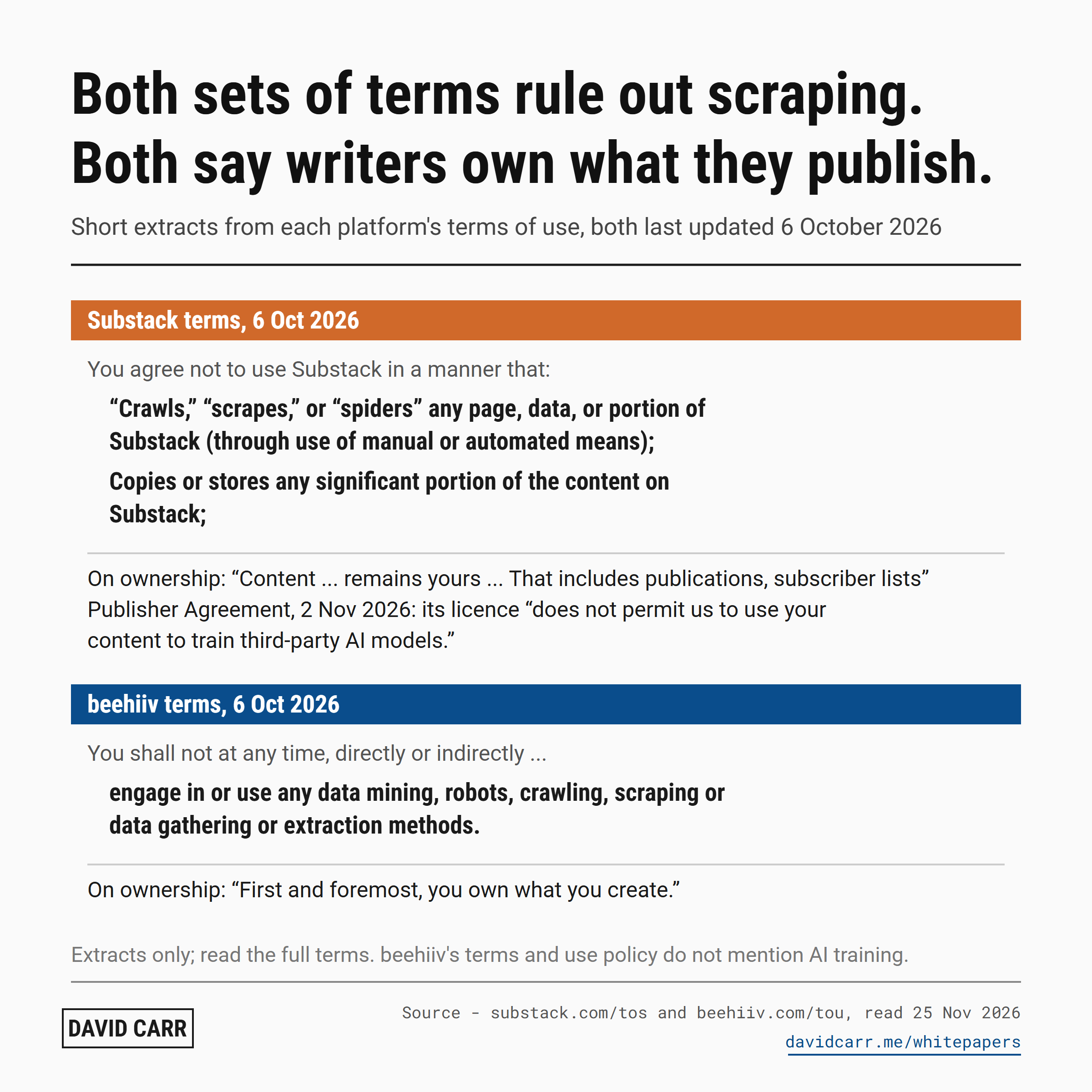
Both sets of terms rule out scraping. Both say writers own what they publish.
- Substack terms: no crawling, scraping or spidering, and no copying "any significant portion" of its content
- beehiiv terms: no "data mining, robots, crawling, scraping or data gathering or extraction methods"
- Substack's Publisher Agreement (2 November 2026) says its licence "does not permit us to use your content to train third-party AI models"
The terms bind people who use the services. The robots.txt and AI settings speak to crawlers. They are different tools.
Both terms were last updated on 6 October 2026. beehiiv's terms and acceptable use policy do not mention AI training.
Method, caveats and sources
The short answer. Substack is the older, bigger-valued company and takes 10% of writers' paid revenue; beehiiv charges a monthly plan and takes none. On data, Substack is open by default: RSS, public JSON with likes and comments, and a subscriber count on every profile. beehiiv is open through a key: a full API for each writer's own data, but little for outsiders. For AI, Substack gives every writer a free request not to train; beehiiv adds a real block through Cloudflare, on its Pro plan.
What was checked, and how. All on 25 November 2026, by hand, a few requests per site. robots.txt for substack.com, beehiiv.com and nine newsletters: five on Substack (On Substack, Simon Willison, Lenny's Newsletter, One Useful Thing, The Pragmatic Engineer) and four on beehiiv (AI Breakfast, Mindstream, Superhuman AI, The Neuron). Each was read with Python's standard robots.txt parser for a post page. The Substack archive JSON was requested once each for two publications, plus two single posts; one post page was read on each platform. beehiiv's API was checked from its published OpenAPI file, not by calling it. Help pages and terms were read on each company's site.
Not tested. No export was run and no setting was switched on; those rows rest on the help pages. Whether a crawler obeys robots.txt cannot be seen from outside. A sample of nine newsletters says nothing about how many writers use each setting.
Business figures. Substack's from TechCrunch and its own posts; beehiiv's from its about page, TechCrunch and Reuters (the Reuters piece read in a syndicated copy). Neither company publishes accounts. The revenue figures in the two single-company studies are left out here because they are an estimate and a forecast, not like for like.
Left out. Substack's Android and iOS app fees, beehiiv's Enterprise pricing, and third-party scraping tools. This page does not describe how to scrape either platform.
Also: Substack, beehiiv and Pave vs its competitors.