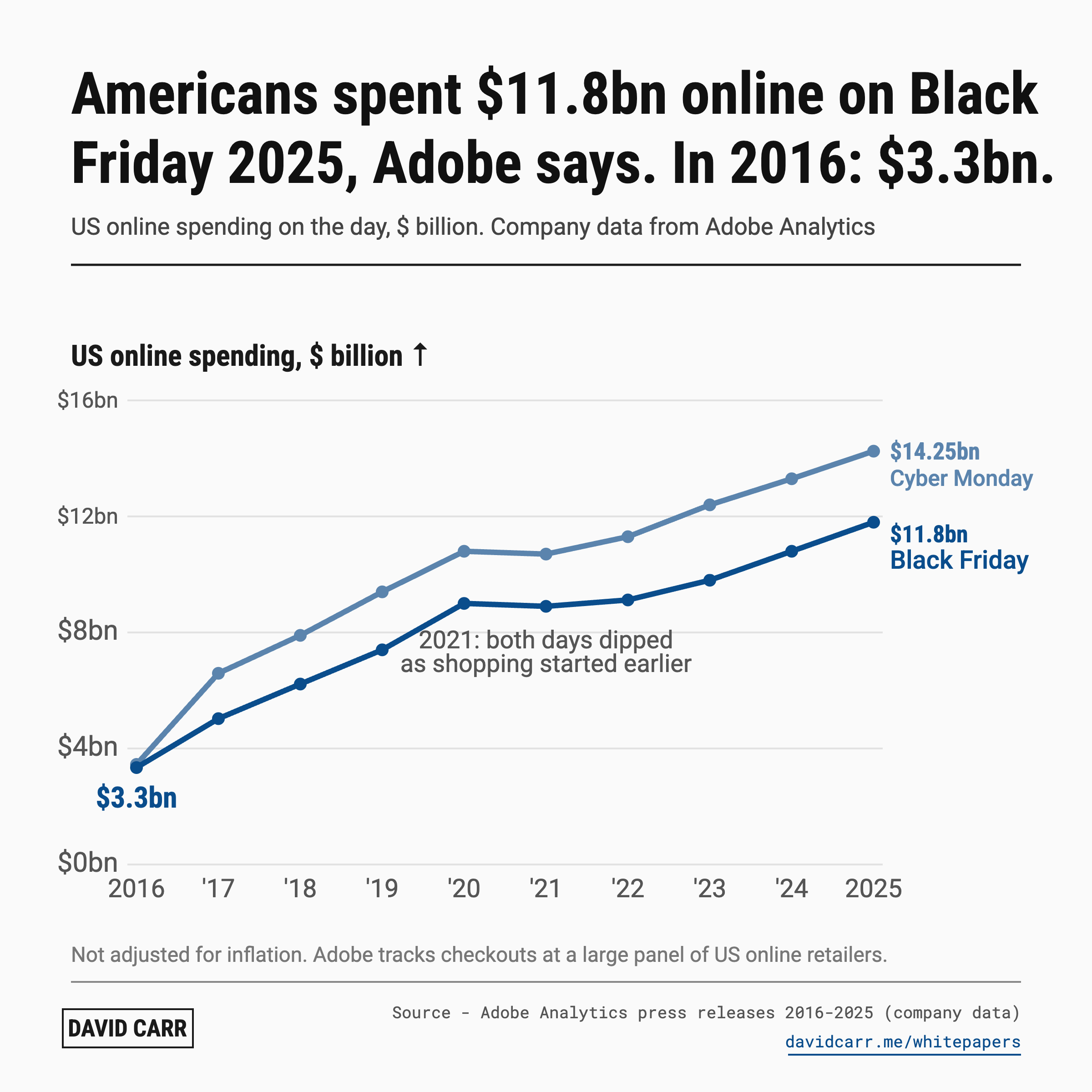
Americans spent $11.8bn online on Black Friday 2025, Adobe says. In 2016: $3.3bn.
- Black Friday: $3.34bn in 2016, $9.0bn in 2020, $11.8bn in 2025
- Cyber Monday: $3.45bn in 2016, $14.25bn in 2025, the biggest US online day of the year
- 2021 was the one dip: $8.9bn and $10.7bn, as people shopped earlier in November
Both days have grown every year but one. In Adobe's count, Cyber Monday has been the bigger online day every year since 2016.
Company data from Adobe Analytics press releases, not official statistics. Not adjusted for inflation. Latest: Adobe, 2 Dec 2025.
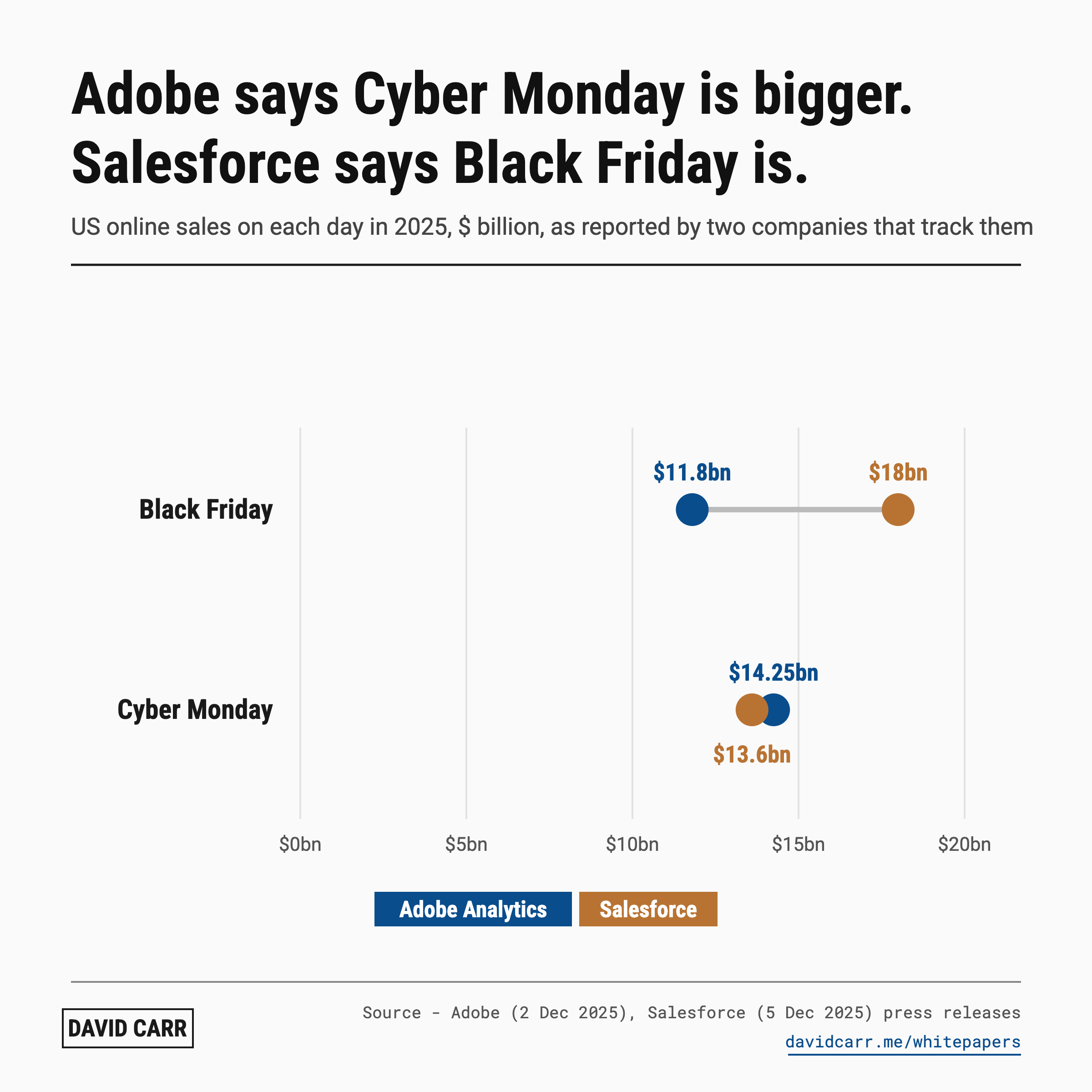
Adobe says Cyber Monday is bigger. Salesforce says Black Friday is.
- Adobe, 2025: Black Friday $11.8bn, Cyber Monday $14.25bn
- Salesforce, 2025: Black Friday $18bn, Cyber Monday $13.6bn
- Salesforce's Cyber Week covers seven days ($79.6bn in the US); Adobe's covers five ($44.2bn)
The two companies measure different things in different ways, so the size of the day depends on who is counting.
Adobe, 2 Dec 2025; Salesforce, 5 Dec 2025. Salesforce's release does not say whether its Black Friday figure is online only.
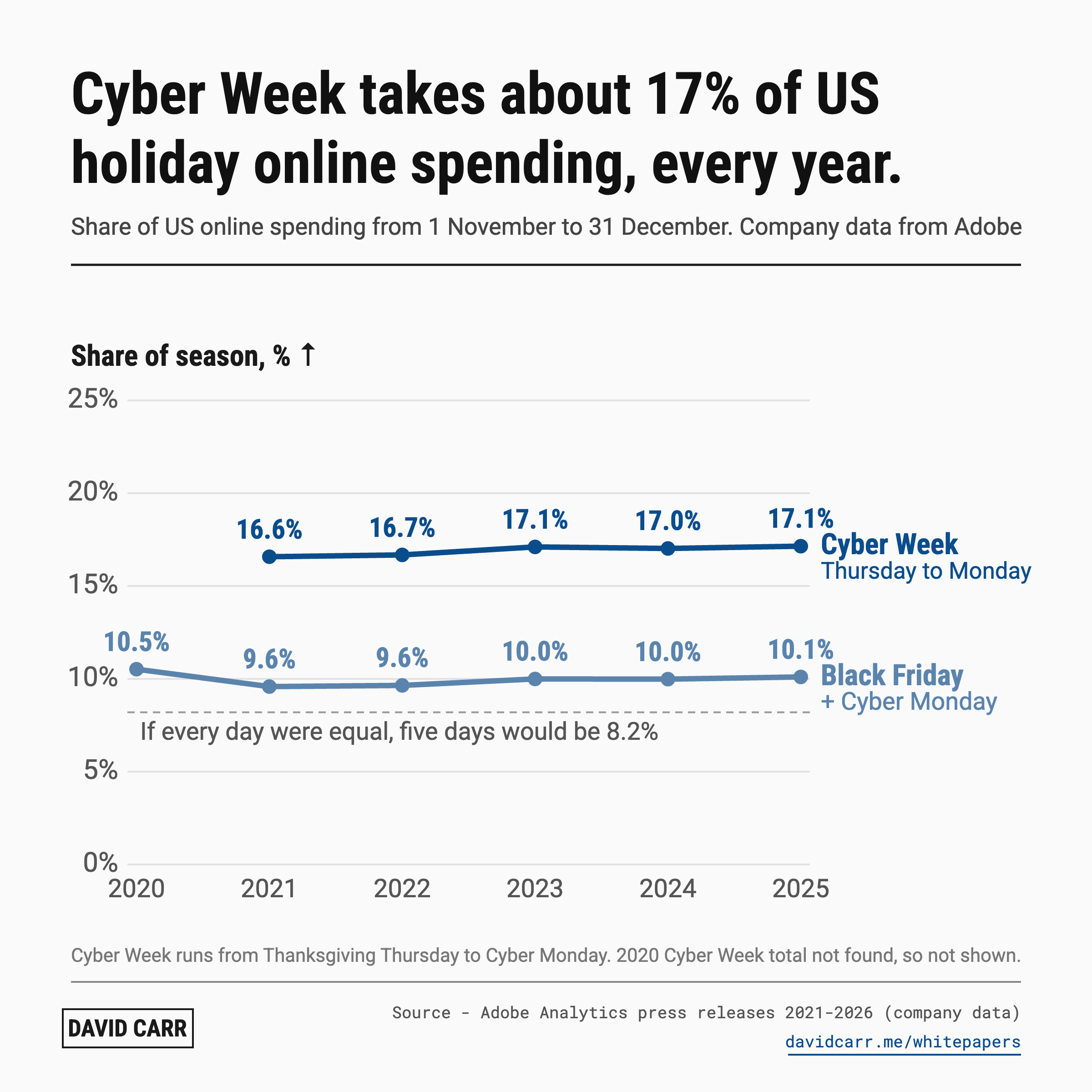
Cyber Week takes about 17% of US holiday online spending, every year.
- Cyber Week (five days) as a share of 1 November to 31 December: 16.6% in 2021, 17.1% in 2025
- Black Friday plus Cyber Monday: between 9.6% and 10.5% each year from 2020 to 2025
- If every day were equal, five days would be 8.2% of the season
The big days still take about twice their share, and that share has barely moved. Adobe counted 25 days over $4bn in 2025, up from 18 in 2024.
Shares are my own sums on Adobe's published day, week and season totals. Season 2025: $257.8bn (Adobe, 7 Jan 2026).
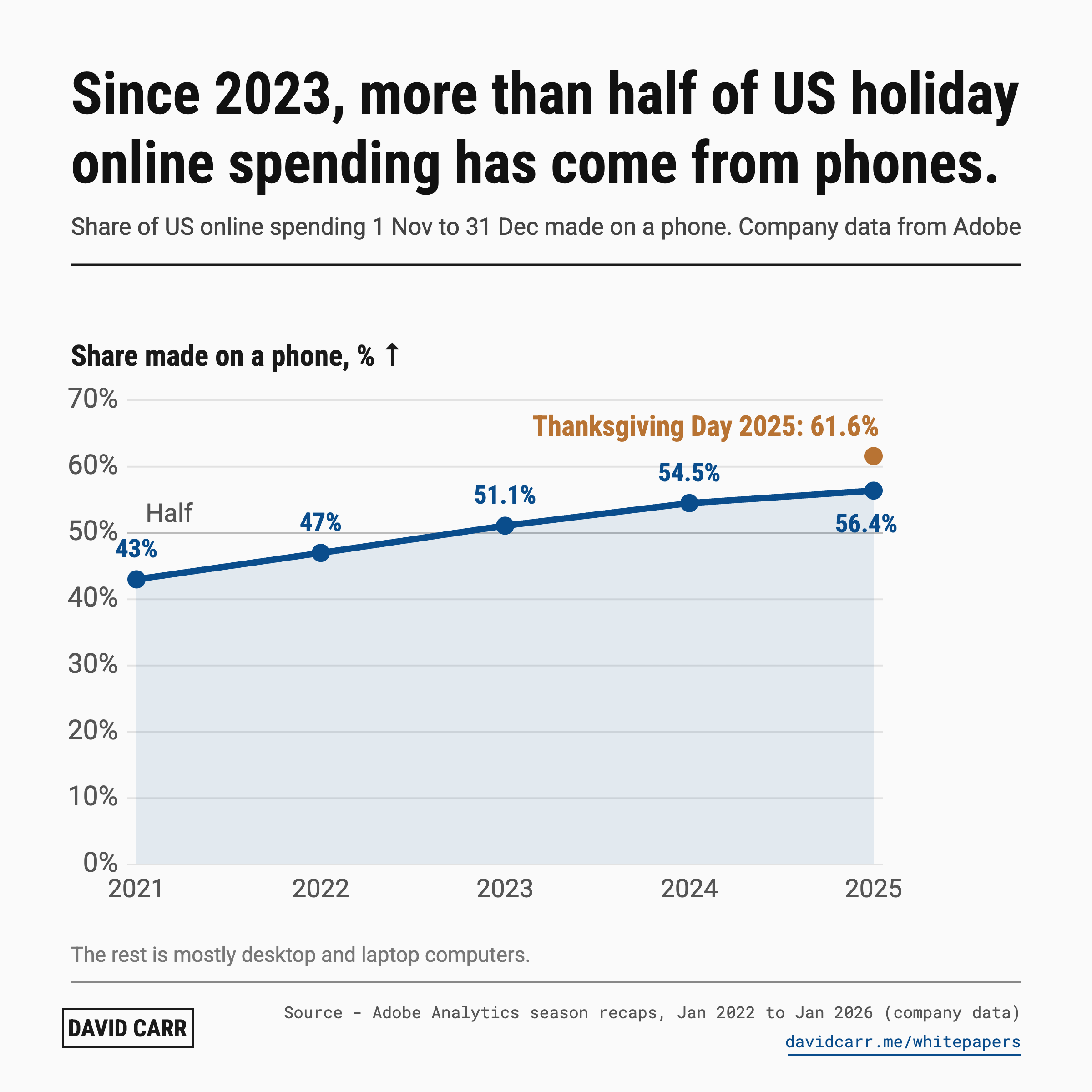
Since 2023, more than half of US holiday online spending has come from phones.
- Smartphone share of the season's online spending: 43% in 2021, 47% in 2022, 51.1% in 2023, 54.5% in 2024, 56.4% in 2025
- Thanksgiving Day 2025: 61.6%
- Cyber Monday 2025: 57.5%, or $8.2bn
Phones passed half of the season in 2023 and have kept gaining.
Company data from Adobe's January season recaps; latest Adobe, 7 Jan 2026.
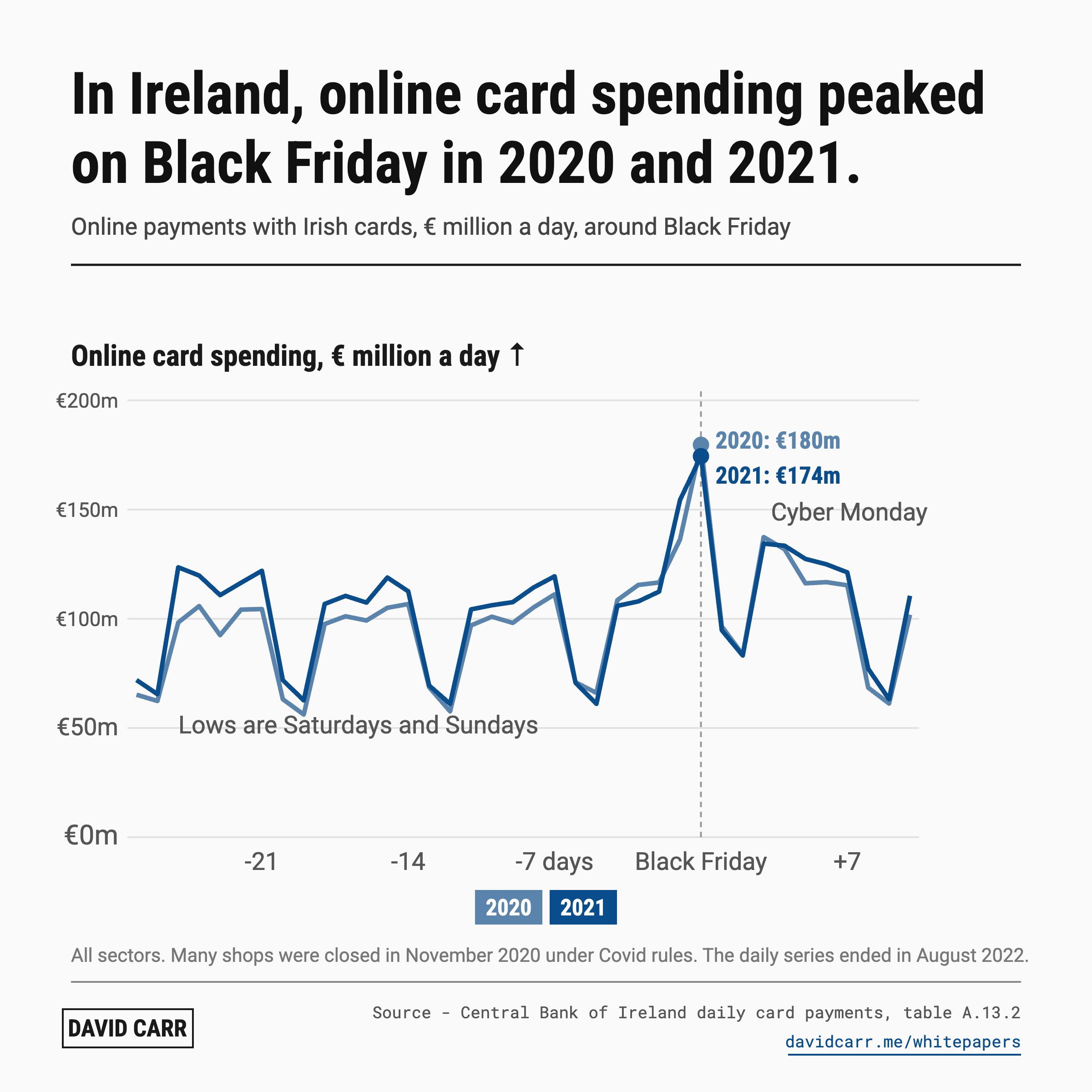
In Ireland, online card spending peaked on Black Friday in 2020 and 2021.
- Black Friday 2020: €180m online, 67% above the three Fridays before
- Black Friday 2021: €174m online, 48% above the three Fridays before
- Cyber Monday: 36% (2020) and 27% (2021) above the three Mondays before
In Ireland's card data, Black Friday was the biggest online day in the four weeks before and ten days after it, and Cyber Monday came well behind. This is the opposite of Adobe's US order.
Central Bank of Ireland card statistics, daily table A.13.2, online payments with Irish cards in all sectors. The series ran from 2020 to August 2022 only. Many shops were closed in November 2020 under Covid rules. How Ireland shops for Christmas shows the whole 2021 season.
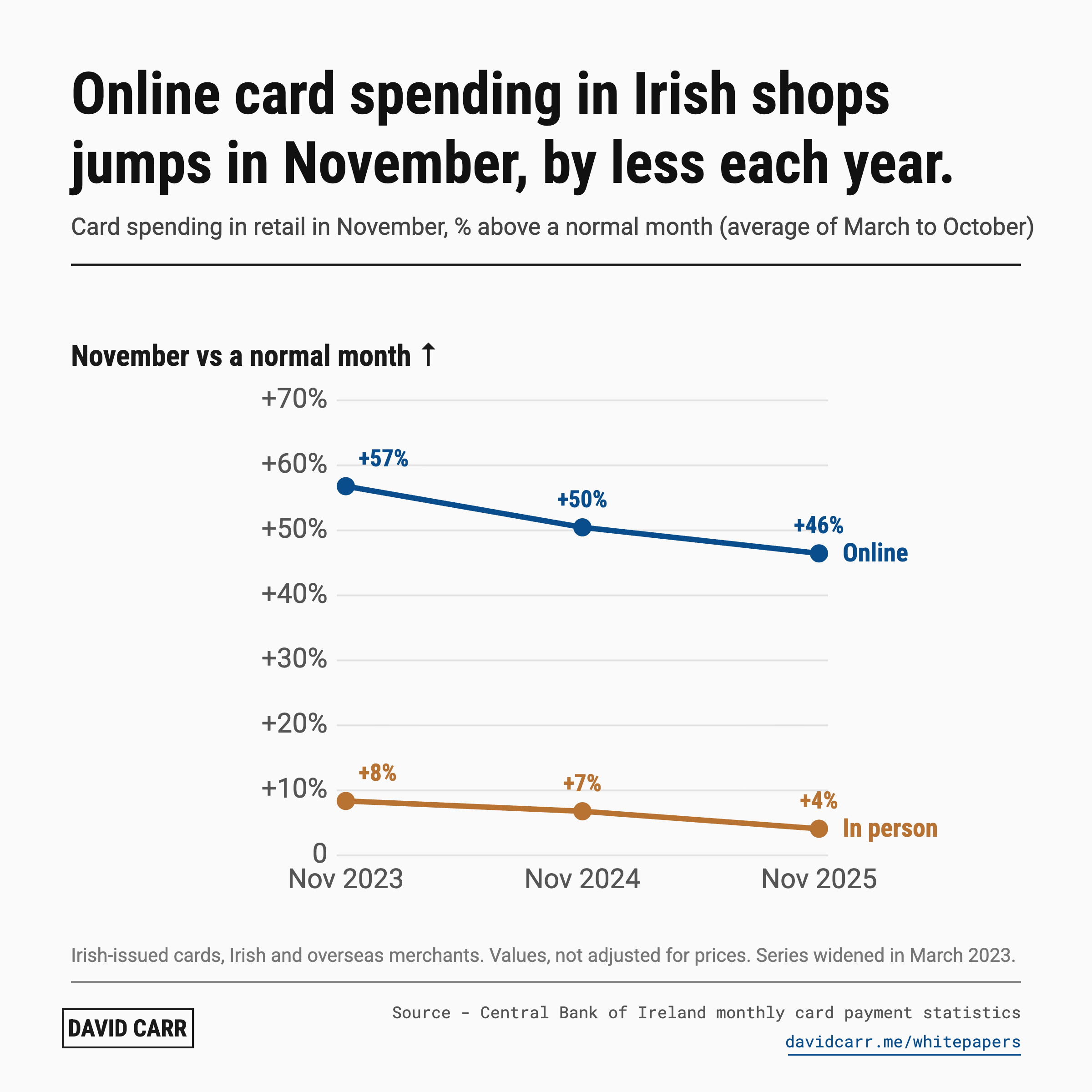
Online card spending in Irish shops jumps in November, by less each year.
- Online, November vs a normal month: +57% in 2023, +50% in 2024, +46% in 2025
- In person: +8%, +7%, +4%
- Online retail card spending in November 2025: €1.37bn
November is a big online month in Ireland, but its lead over the rest of the year has narrowed each year since 2023.
Central Bank of Ireland card statistics, monthly Table 4, retail sector, Irish-issued cards at Irish and overseas merchants. Normal month = average of March to October of the same year (the series widened in March 2023).
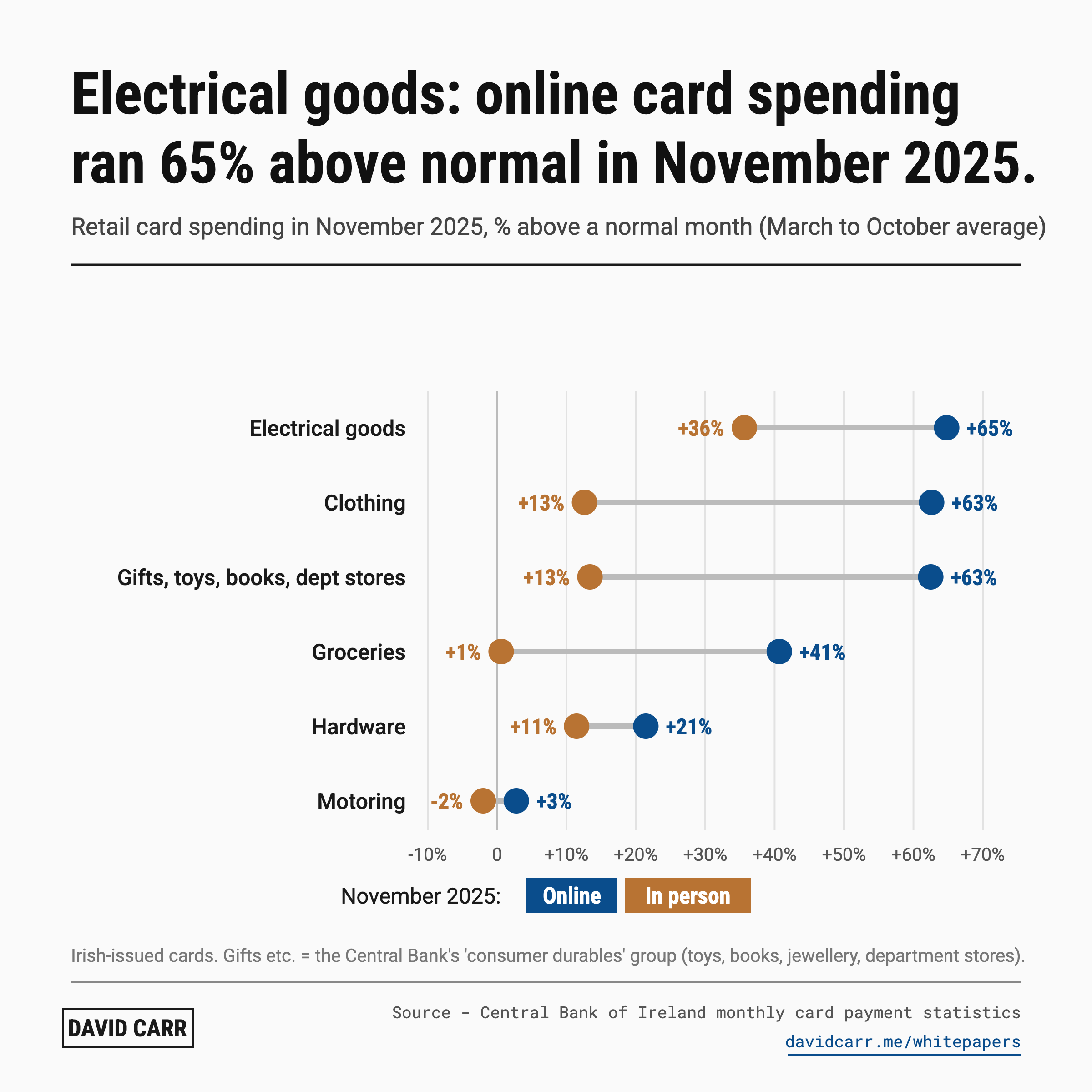
Online card spending on electrical goods ran 65% above normal in November 2025.
- Electrical goods: +65% online, +36% in person
- Clothing and gifts, toys, books, department stores: +63% online, +13% in person
- Groceries: +41% online, +1% in person
- Hardware +21% online; motoring +3%
In every retail group, November's lift was bigger online than in person.
Central Bank of Ireland card statistics, monthly Table 4. Normal month = average of March to October 2025. 'Gifts, toys, books, department stores' is the Central Bank's consumer durables group.
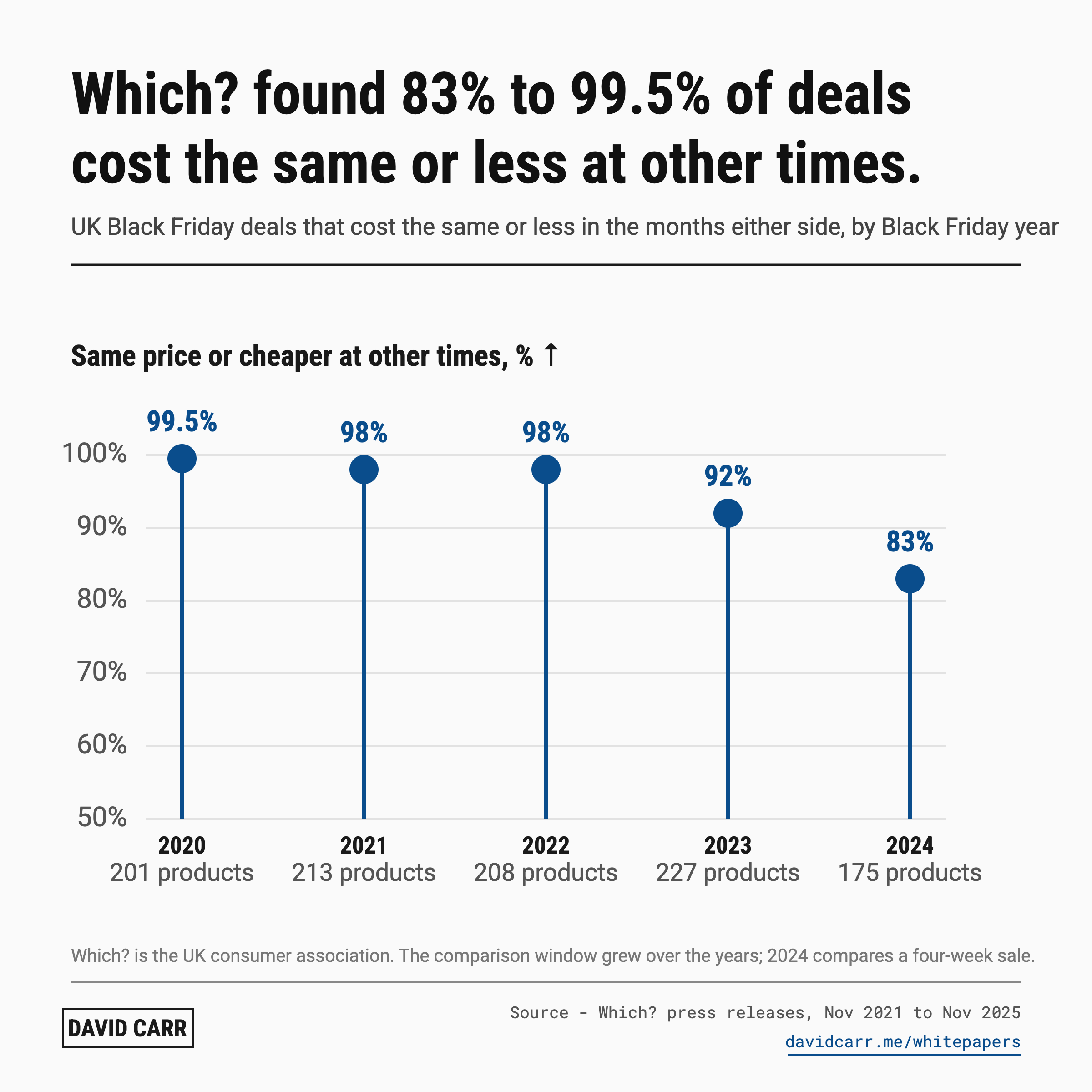
Which? found 83% to 99.5% of deals cost the same or less at other times.
- Black Friday 2020: 99.5% of 201 deals (published 2021)
- 2021: 98% of 213; 2022: 98% of 208
- 2023: 92% of 227; 2024: 83% of 175
In each of five studies, a large majority of Black Friday deals could be bought for the same price or less at some other point in the year.
Which?, the UK consumers' association, press releases from 2021, 2022, 2023, 2024 and 2025. Home, tech and health products at six to eight big UK retailers. The comparison window changed between studies; the 2024 study compared a four-week sale period.
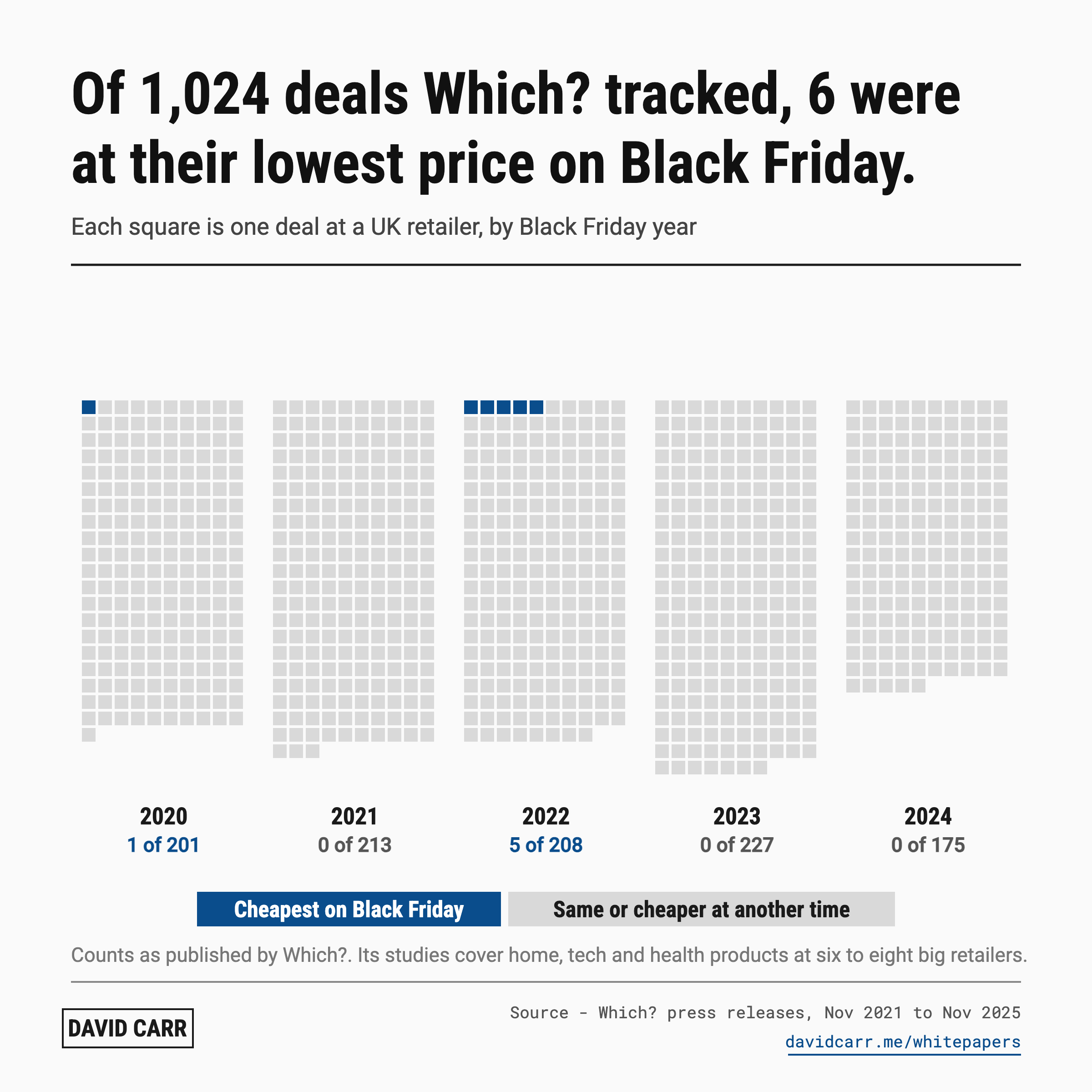
Of 1,024 deals Which? tracked, 6 were at their lowest price on Black Friday.
- 2020: 1 of 201
- 2021: none of 213
- 2022: 5 of 208
- 2023: none of 227
- 2024: none of 175
Which?'s finding is that a deal on the day is often real, but rarely the lowest price of the year.
Counts as published by Which? (2021, 2022, 2023, 2024, 2025). The 2023 study found every deal at the same price or less at another time; the 2024 study found none at its cheapest of the year.
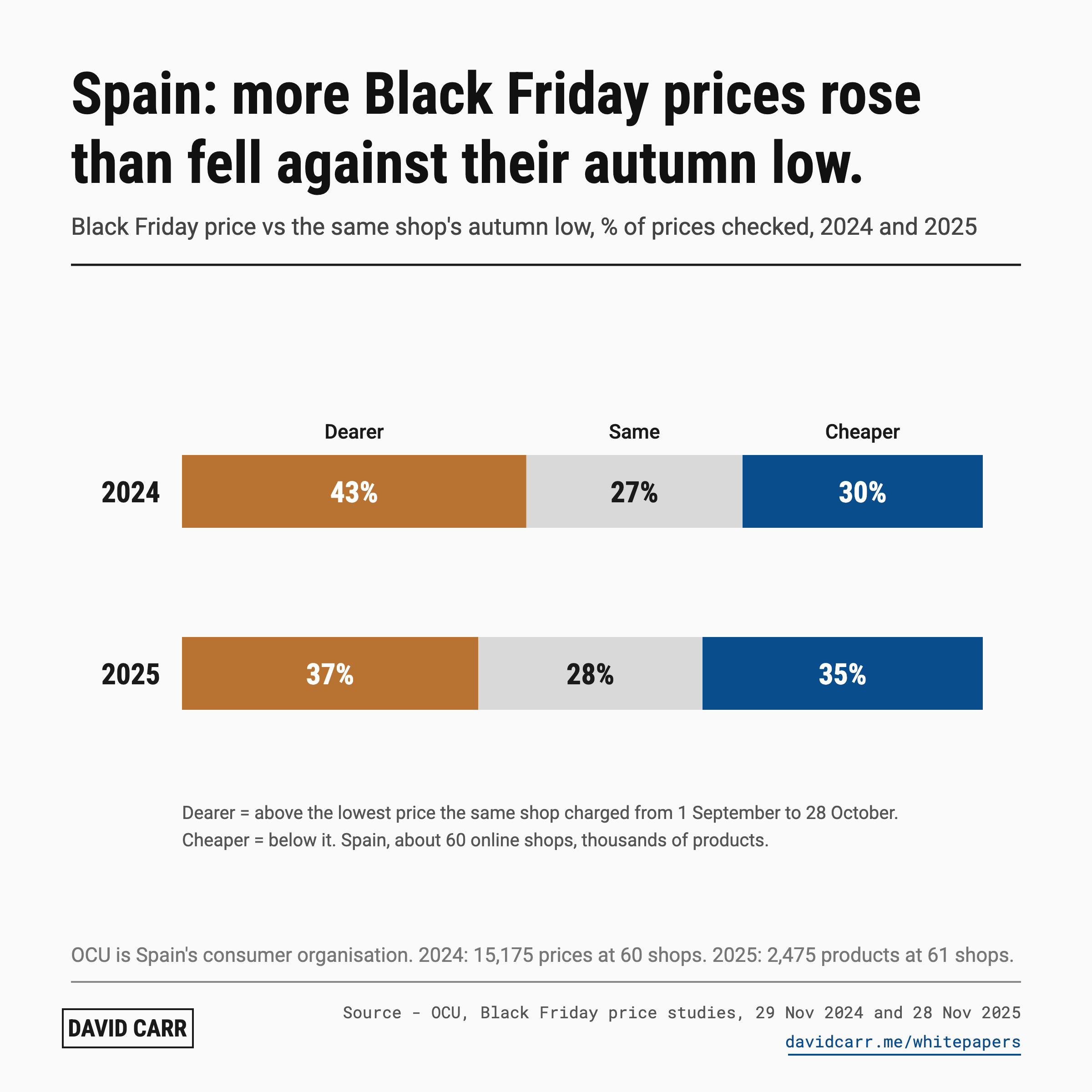
In Spain, more Black Friday prices rose than fell against their autumn low.
- 2024: 43% dearer, 27% the same, 30% cheaper (15,175 prices, 60 shops)
- 2025: 37% dearer, 28% the same, 35% cheaper (2,475 products, 61 shops)
- Average rise where prices rose: 13% (2024), 12% (2025); average fall: 8% both years
A second consumer group, using a different method, found a similar picture: about a third of Black Friday prices were real reductions.
OCU, Spain's consumers' organisation, studies of 2024 and 2025. Each product's Black Friday price is compared with the lowest price the same online shop charged from 1 September to 28 October.
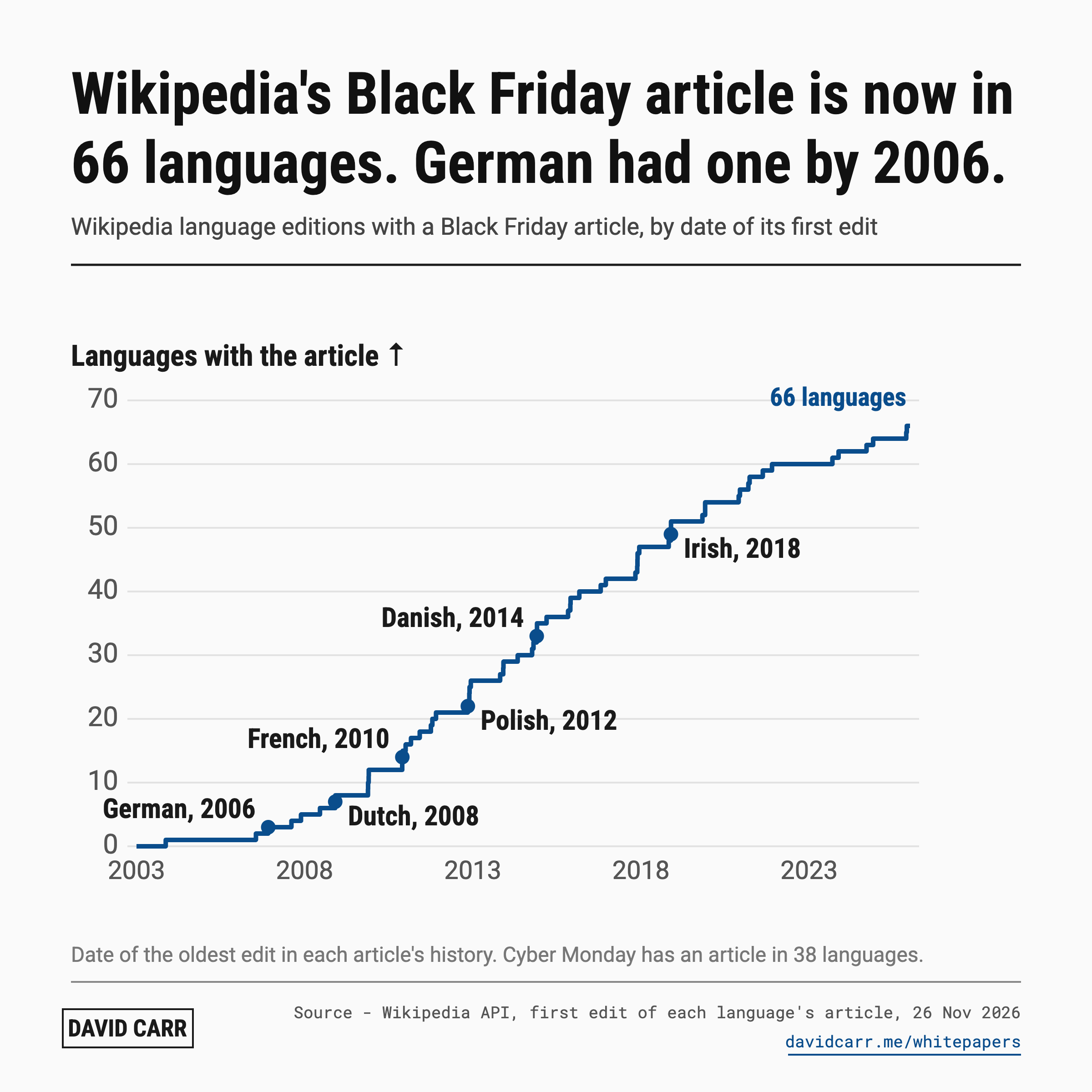
Wikipedia's Black Friday article is now in 66 languages. German had one by 2006.
- English: 2003
- German: 2006; Dutch and Italian: 2008; French: 2010; Polish: 2012
- Irish (Aoine Mhór na Siopadóireachta): 2018
- Estonian, the latest: 2025
The idea spread through Europe's Wikipedias over about fifteen years. Cyber Monday has an article in 38 languages.
Wikipedia API, pulled 26 November 2026: the date of the oldest edit in each language's article history.
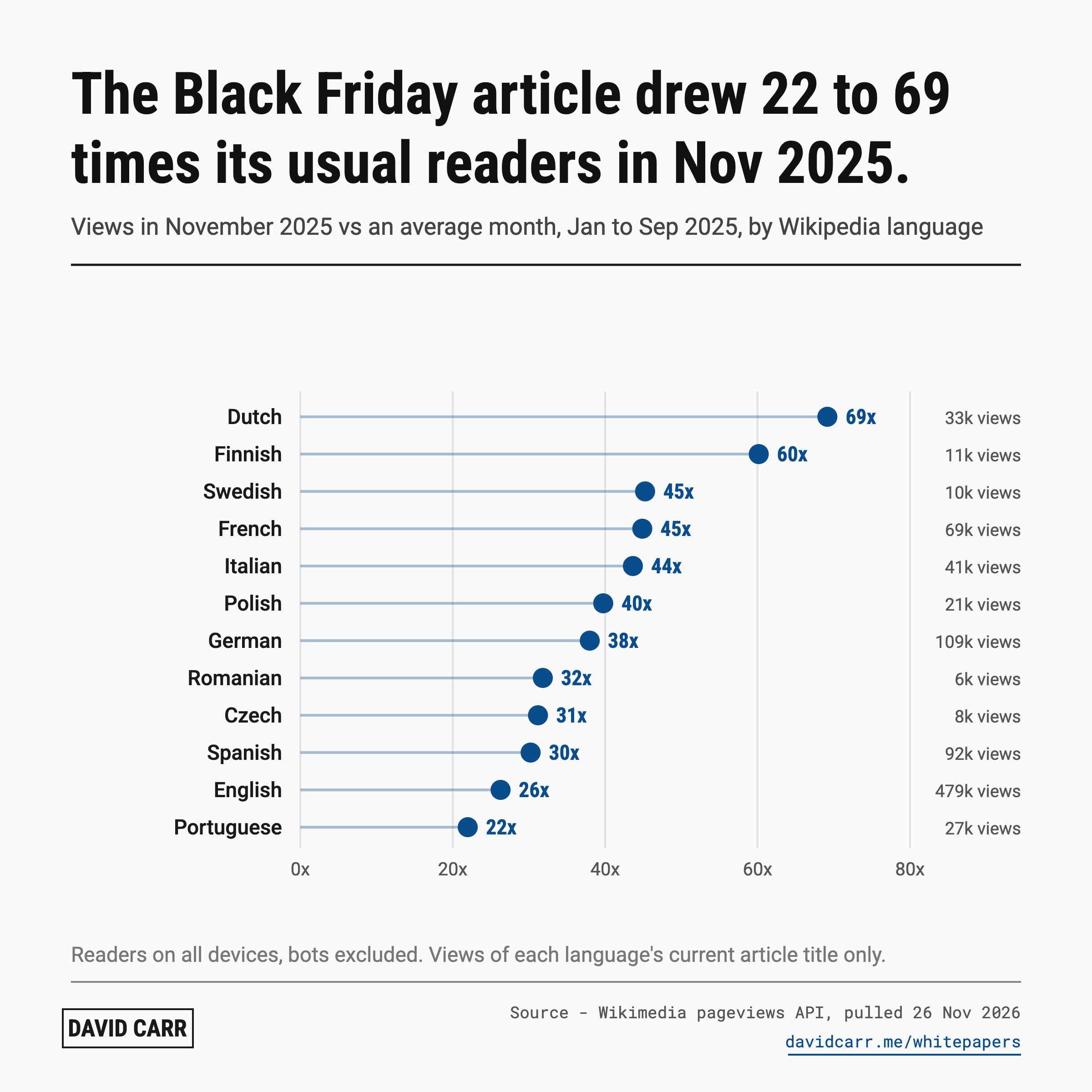
The Black Friday article drew 22 to 69 times its usual readers in November 2025.
- Dutch 69x, Finnish 60x, Swedish and French 45x, Italian 44x, Polish 40x, German 38x
- English 26x, with 479,000 views in November 2025
- Portuguese the lowest of these, at 22x
Across European languages, readers look the topic up almost only in November. Views have fallen in most languages since 2016, as they have across much of Wikipedia.
Wikimedia pageviews API, pulled 26 November 2026: user views (bots excluded), all devices. November 2025 compared with the average of January to September 2025. Views of each language's current title only.
Method, caveats and sources
The short answer. Black Friday is big: Adobe counted $11.8bn of US online spending on the day in 2025, against $3.3bn in 2016, and Cyber Monday was bigger again. But the day has not swallowed the season: Cyber Week has taken about 17% of US holiday online spending every year since 2021. In Ireland, online card spending peaked on Black Friday in 2020 and 2021, and November online spending now runs about half above a normal month. On deals, consumer groups find most Black Friday prices can be matched at other times of year: Which? found 6 of 1,024 deals at their lowest price on the day, and Spain's OCU found more prices up than down on their autumn low.
US figures are company data. Adobe Analytics and Salesforce publish them in press releases; they are not official statistics, and the two use different methods and different definitions of Cyber Week. Adobe figures before 2021 are as reported in press coverage of Adobe's releases (CNBC, NBC News, Phys.org). Shares of the season are my own sums on Adobe's published totals. No figures are adjusted for inflation.
Ireland. Central Bank of Ireland card payment statistics: the daily table A.13.2 (March 2020 to August 2022, now discontinued) and the monthly card payment statistics (from October 2022). Files downloaded 23 November 2026. "Online" is the Central Bank's remote (card not present) channel. A normal month is the average of March to October of the same year, because the monthly series widened in March 2023.
Deals. The price figures are the published findings of two consumer organisations, Which? in the UK and OCU in Spain, quoted as they reported them. They cover selected products at selected retailers, and their methods changed between years. They are not a judgement on any one shop.
Wikipedia. Pulled from the Wikipedia and Wikimedia pageviews APIs on 26 November 2026. Pageviews count each language's current article title only, so an article that was renamed loses its earlier views; first-edit dates are the oldest edit in each article's history.
Left out. Ireland's daily card data stops in August 2022, so there is no daily view of later Black Fridays. No Irish price-tracking study was found to set beside Which? and OCU.
Also: How Ireland shops for Christmas and What things cost, country by country.