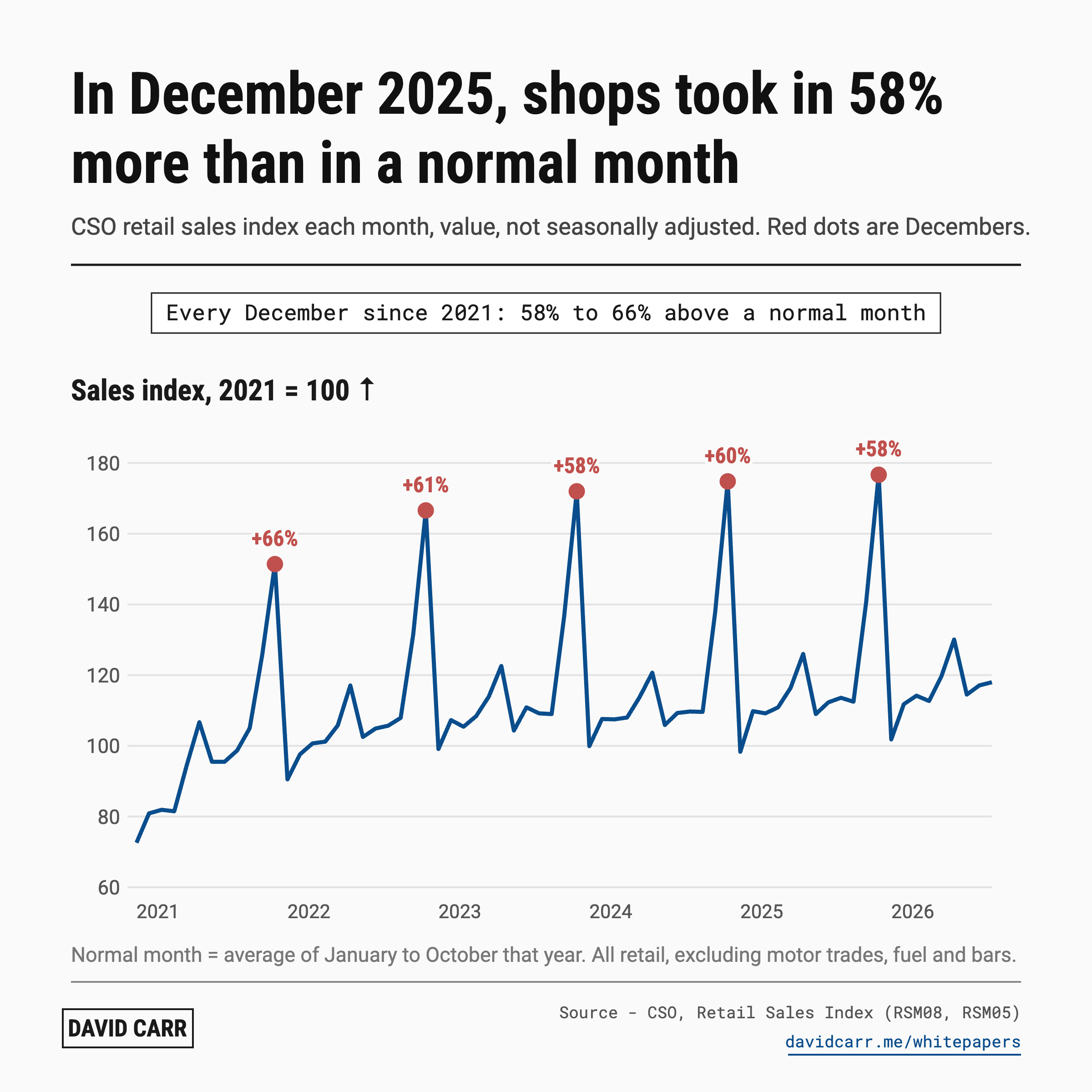
In December 2025, shops took in 58% more than in a normal month
- December 2021: 66% above a normal month
- December 2022: 61%
- December 2023: 58%
- December 2024: 60%
- December 2025: 58%
December was the biggest month of every year from 2021 to 2025. The size of the jump has stayed in a narrow band.
The CSO's retail sales index, by value and not seasonally adjusted, so the Christmas spike stays in. A normal month is the average of January to October that year. All retail, leaving out motor trades, fuel and bars.
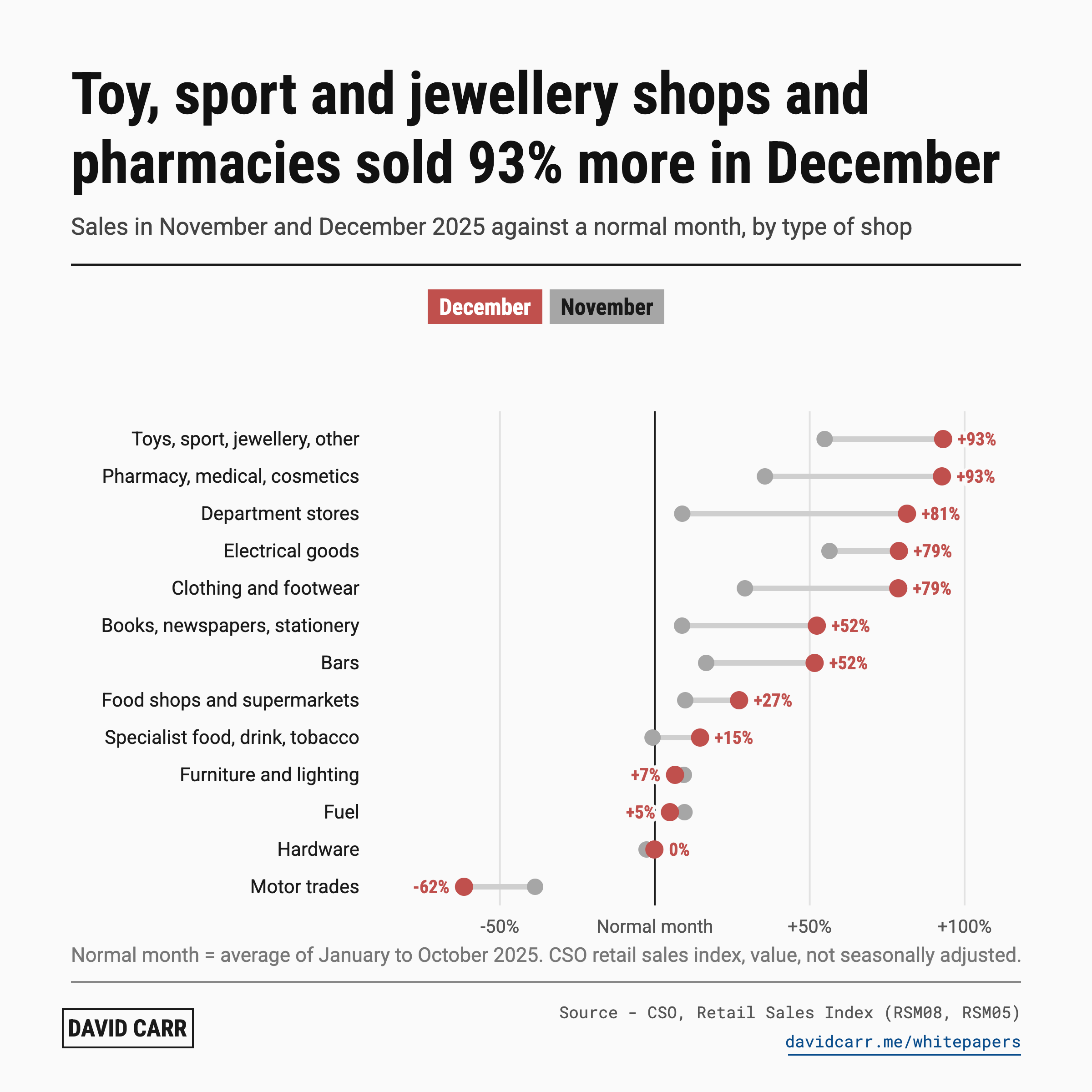
Toy, sport and jewellery shops and pharmacies sold 93% more in December
- Toys, sport, jewellery and other shops: +93% in December, +55% in November
- Pharmacies, medical and cosmetics: +93%
- Department stores: +81%, but only +9% in November
- Electrical goods: +79% in December, +56% in November
- Food shops and supermarkets: +27%
- Motor trades: 62% below a normal month
Electrical shops and toy shops are already busy in November. Department stores wait for December.
Sales in November and December 2025 against the average of January to October 2025. The CSO groups toys with sport, jewellery, flowers and some other shops; it does not publish toy shops on their own.
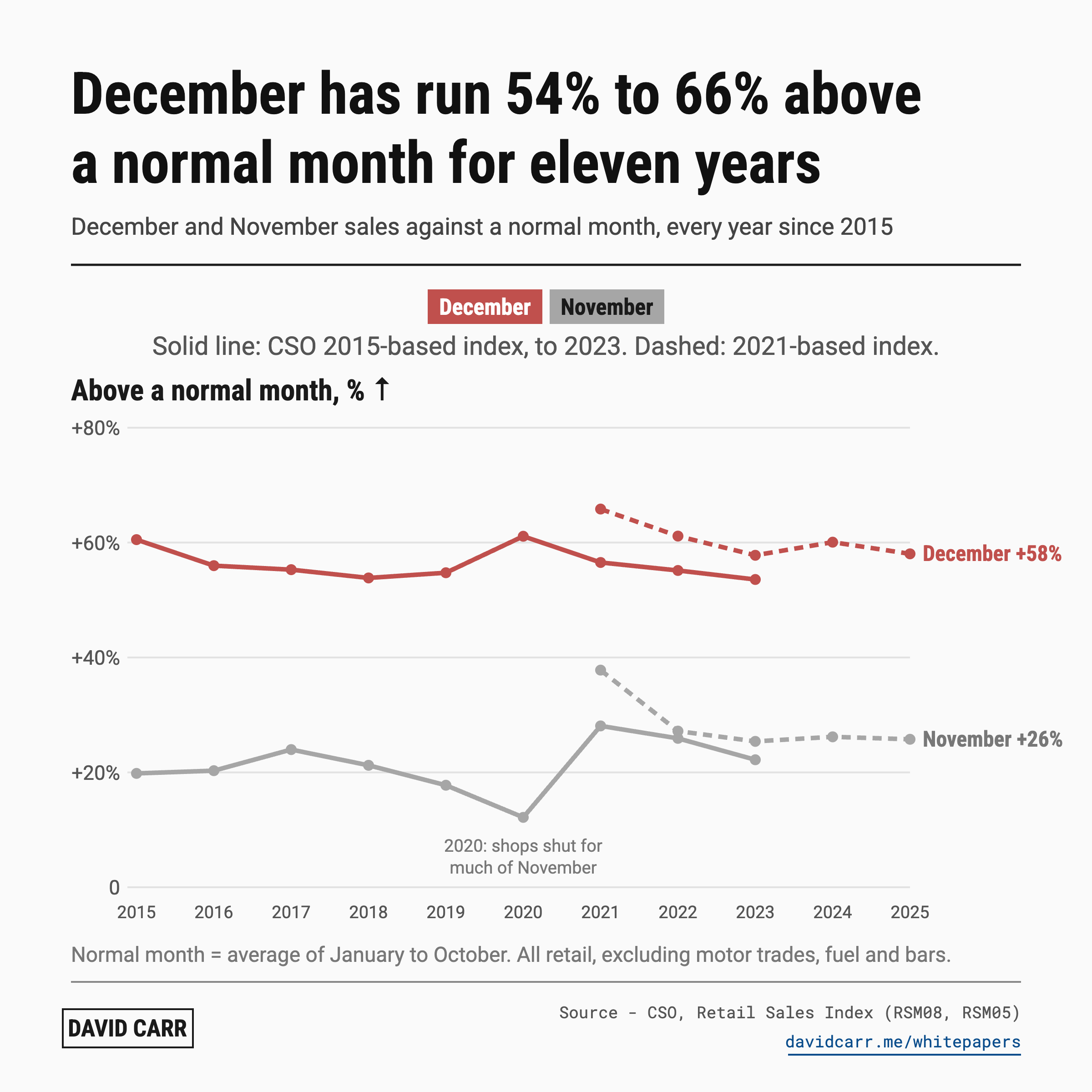
December has run 54% to 66% above a normal month for eleven years
- 2015-based index: between +54% and +61% each year, 2015 to 2023
- 2021-based index: between +58% and +66%, 2021 to 2025
- November: +20% in 2015, +26% in 2025
- December's share of the November and December total: 55% to 59% every year
The shape of the Christmas rush has barely moved. November has not taken a bigger slice from December.
Two CSO tables: the 2015-based index runs to mid-2024 and the 2021-based index from 2021. They give slightly different answers for the three years they overlap, so both are shown. 2020 and 2021 were Covid years.
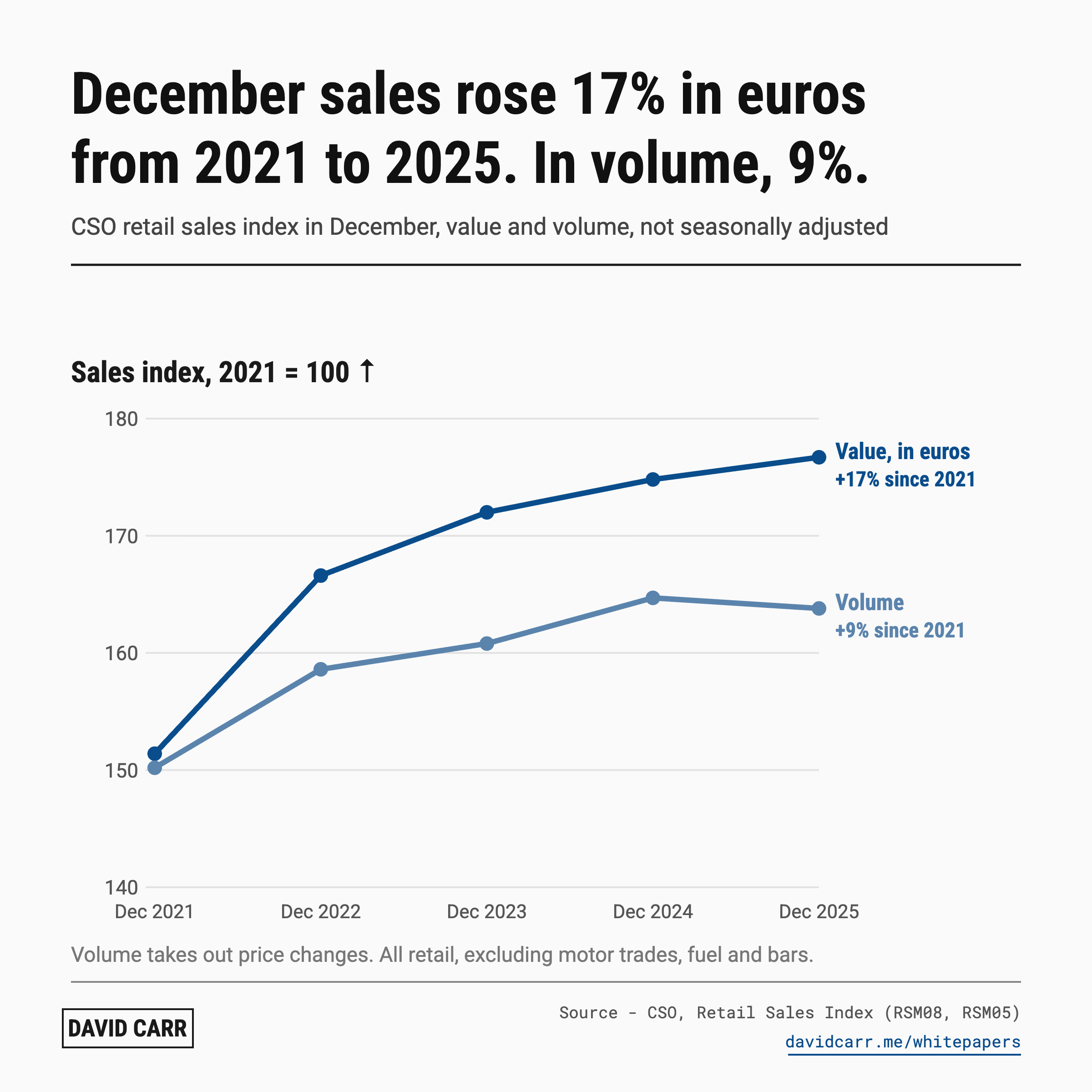
December sales rose 17% in euros from 2021 to 2025. In volume, 9%.
- Value: +17% from December 2021 to December 2025
- Volume: +9%
- Volume dipped slightly from December 2024 to December 2025, while value rose
Part of the rise in December takings since 2021 is higher prices. The rest is people buying more.
Volume is the CSO's value index with price changes taken out. All retail, excluding motor trades, fuel and bars.
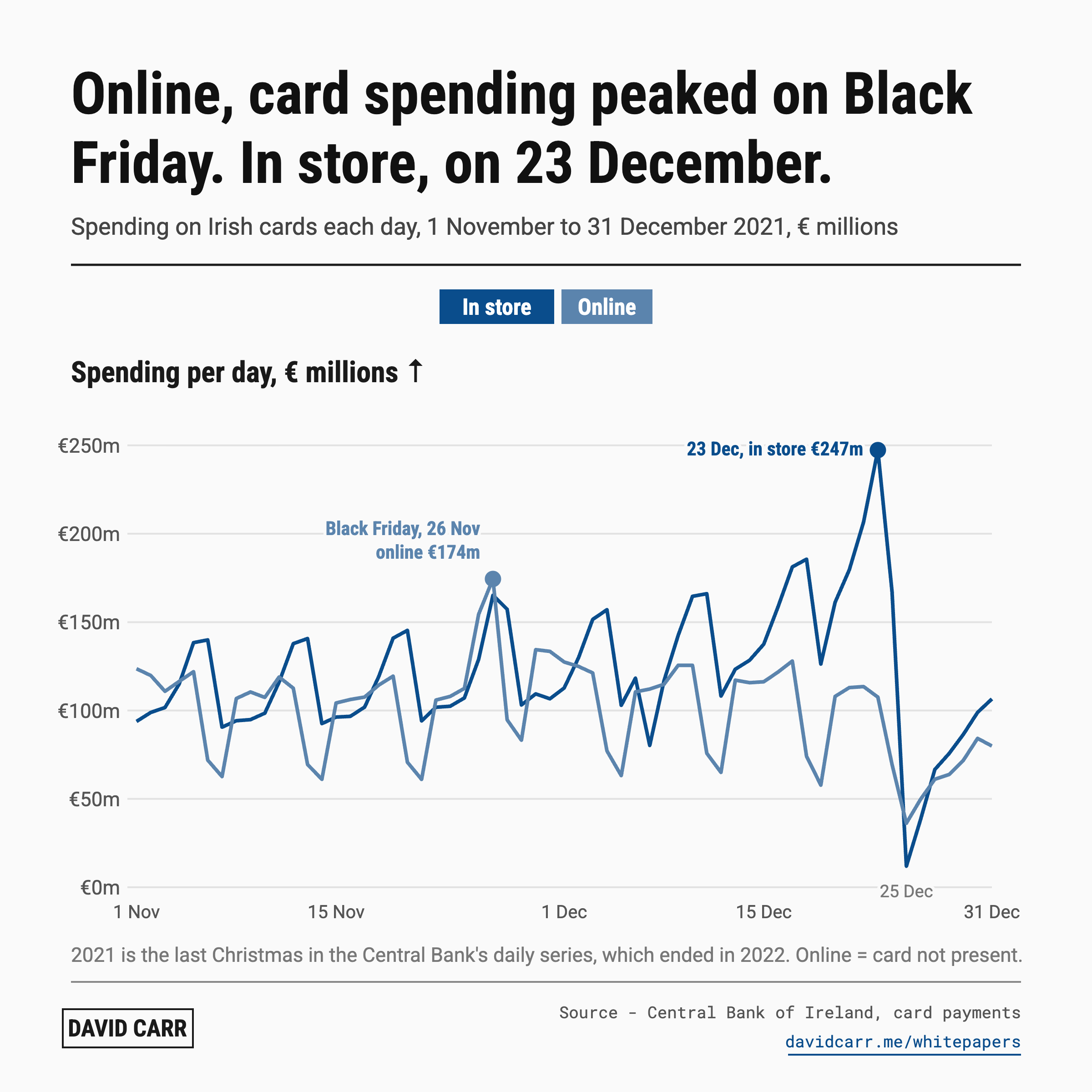
Online, card spending peaked on Black Friday. In store, on 23 December.
- Black Friday, 26 November 2021: €174m spent online, the highest of the two months
- 23 December 2021: €247m spent in store, and €437m in all, the biggest day
- Christmas Day: €12m in store
Online spending had its own peak a month before Christmas. Shops in person were busiest in the last days before it.
From the Central Bank's daily card spending series, which ran from 2020 to September 2022, so 2021 is the latest Christmas it covers. Online means the card was not present.
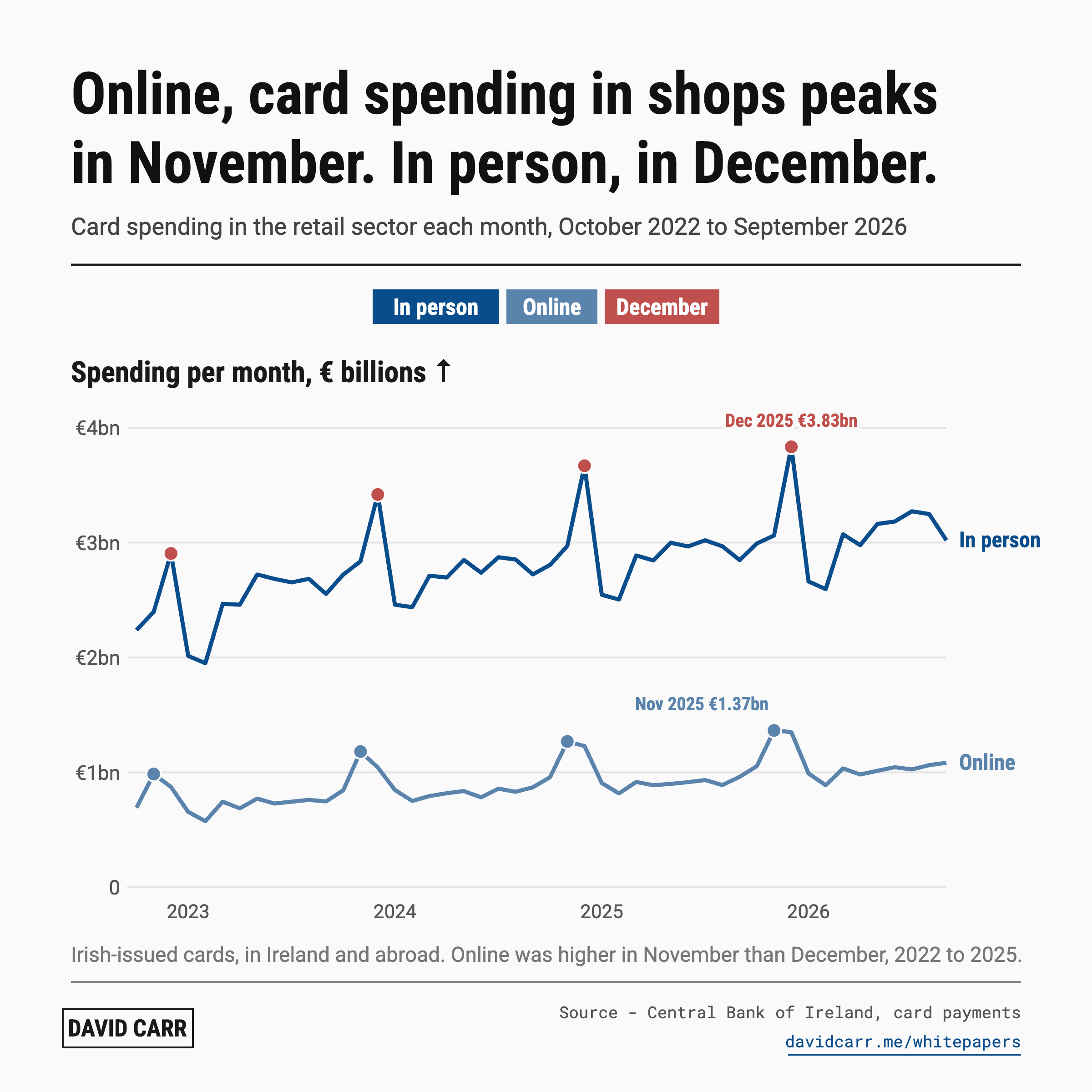
Online, card spending in shops peaks in November. In person, in December.
- Online, November 2025: €1.37bn, December: €1.35bn
- In person, November 2025: €3.06bn, December: €3.83bn
- Online was higher in November than December in 2022, 2023, 2024 and 2025
- In person, December was the top month of every full year
Shoppers spend more online in Black Friday month and more in person in Christmas month.
The Central Bank's monthly card payment statistics, retail sector, Irish-issued cards used in Ireland and abroad, October 2022 to September 2026.
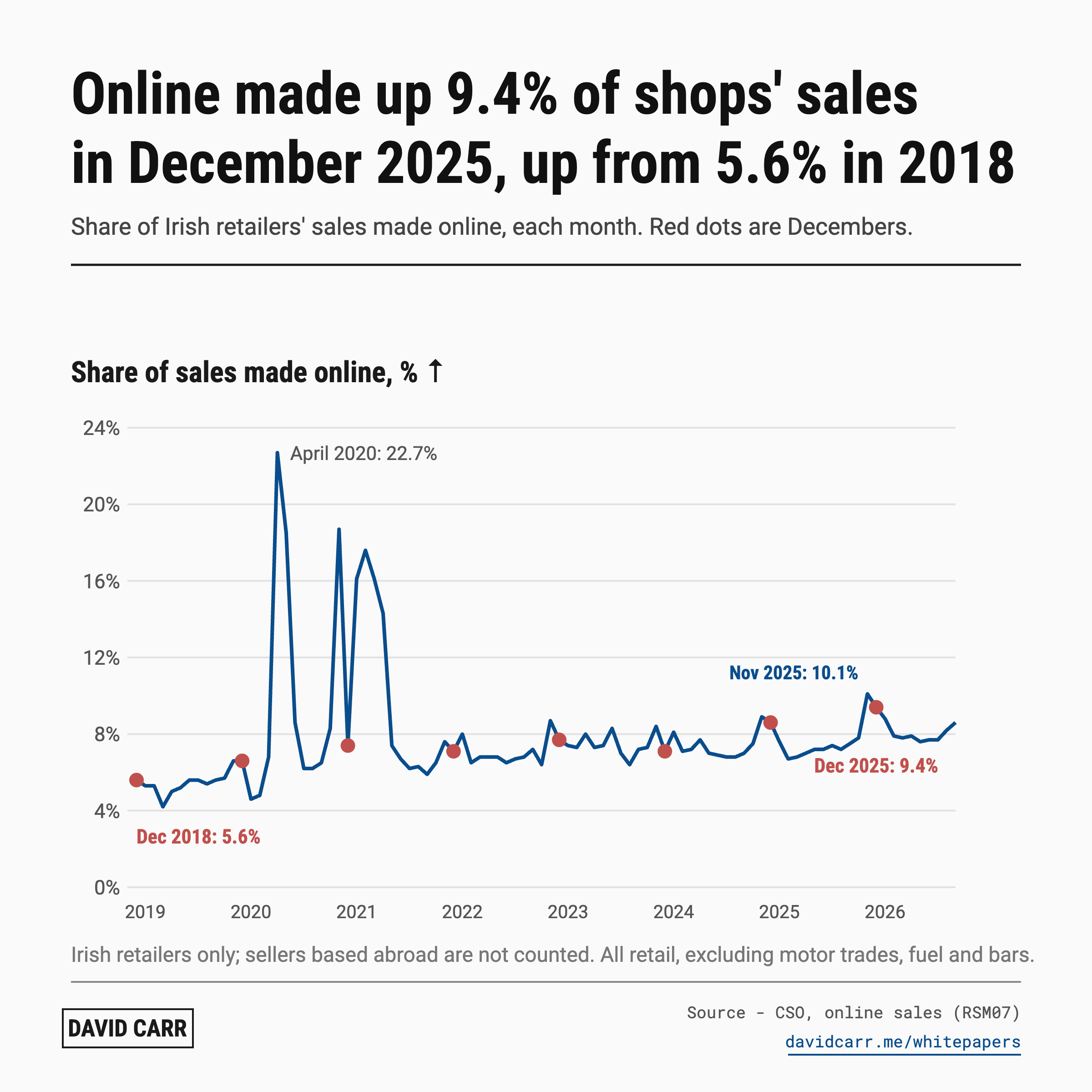
Online made up 9.4% of shops' sales in December 2025, up from 5.6% in 2018
- December 2018: 5.6%
- December 2019: 6.6%
- April 2020, with shops shut: 22.7%
- November 2025: 10.1%
- December 2025: 9.4%
Outside the Covid months, the online share has crept up. November is higher than December every year since 2020.
The CSO's online sales table. It counts Irish retailers only, so money spent with sellers based abroad is not in it.
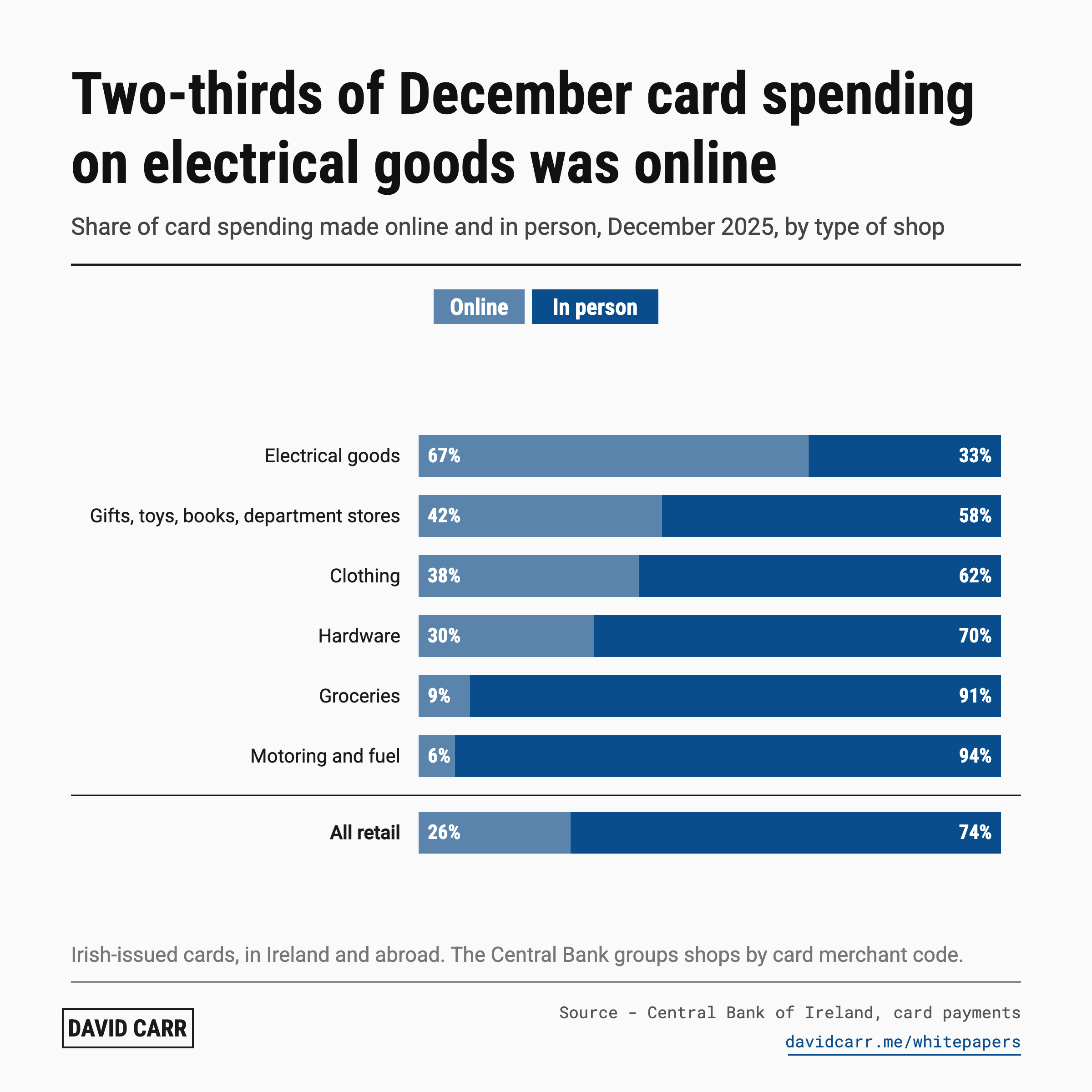
Two-thirds of December card spending on electrical goods was online
- Electrical goods: 67% online
- Gifts, toys, books and department stores: 42%
- Clothing: 38%
- Hardware: 30%
- Groceries: 9%
- All retail: 26%
What people buy decides how they buy it. Gadgets go online. The Christmas food shop is still done in person.
December 2025. The Central Bank sorts shops by the merchant code on each card payment, so a shop that sells online and in store counts in both.
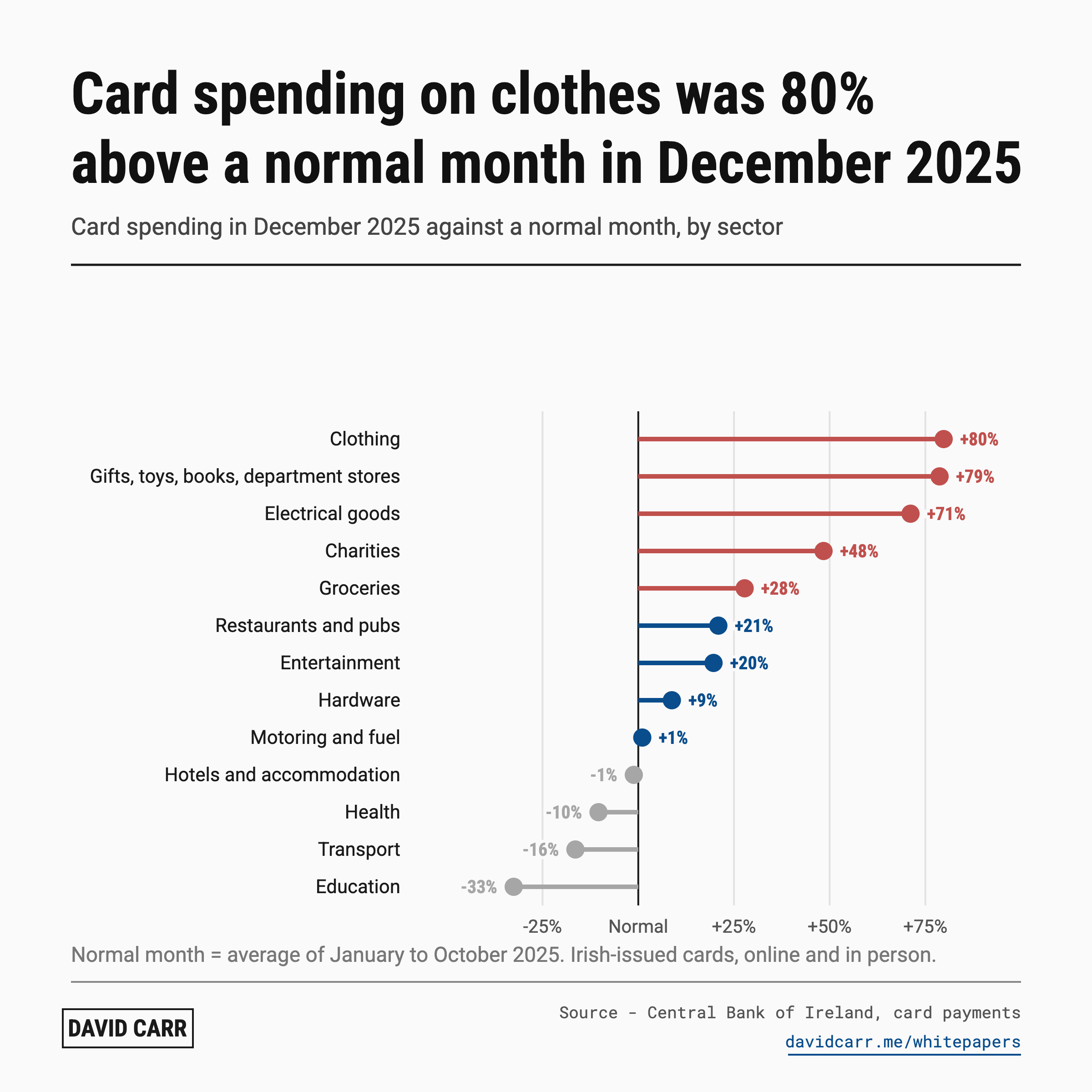
Card spending on clothes was 80% above a normal month in December 2025
- Clothing: +80%
- Gifts, toys, books, department stores: +79%
- Electrical goods: +71%
- Charities: +48%
- Groceries: +28%
- Restaurants and pubs: +21%
- Transport: -16%
- Education: -33%
December lifts presents, food and going out. Fees and travel drop back.
Card spending in December 2025 against the average of January to October 2025. Irish-issued cards, online and in person.
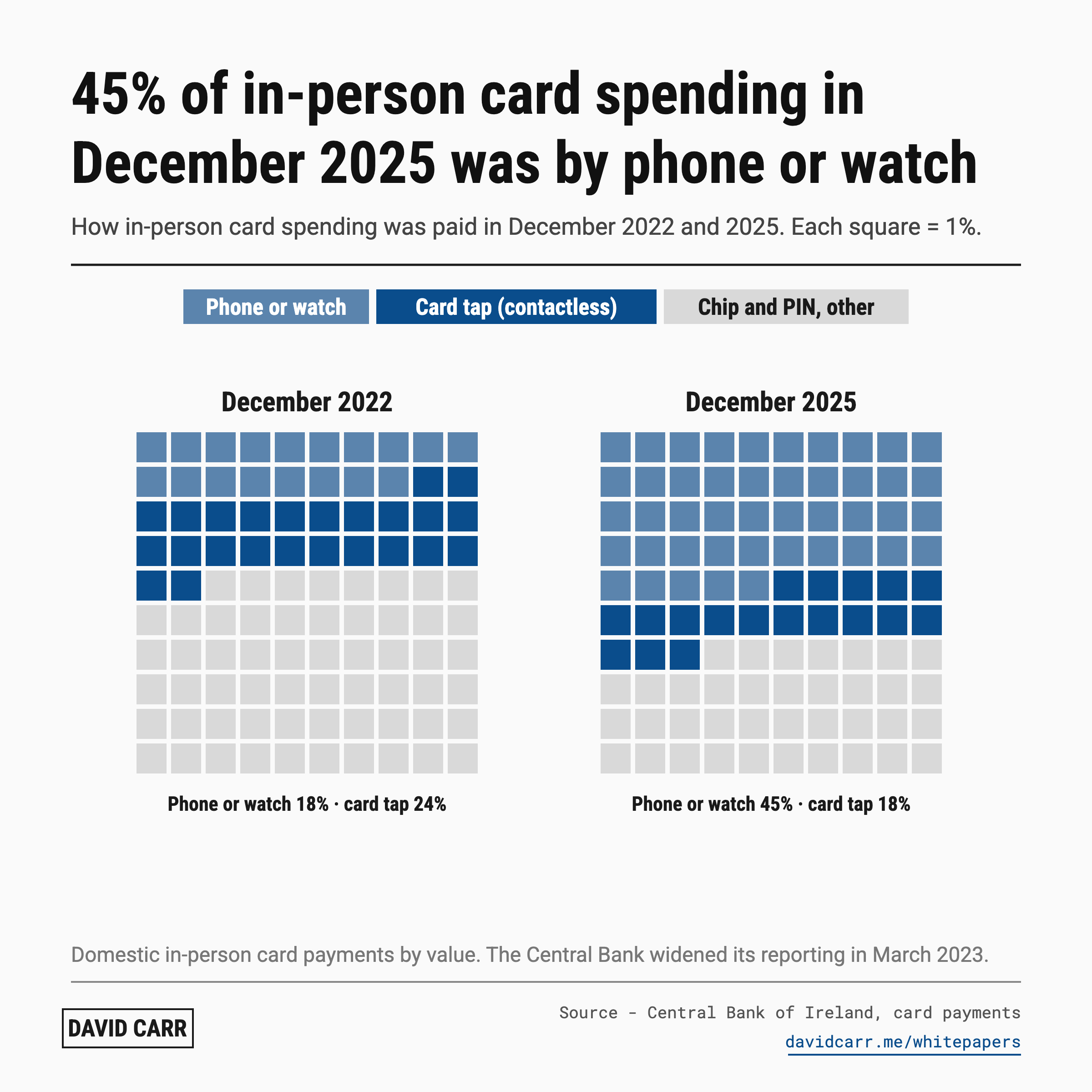
45% of in-person card spending in December 2025 was by phone or watch
- December 2022: phone or watch 18%, card tap 24%, chip and PIN and other 58%
- December 2025: phone or watch 45%, card tap 18%, chip and PIN and other 37%
In three Christmases, paying by phone went from about one euro in six to almost one in two.
Domestic in-person card payments by value. The Central Bank widened its reporting to more accounts in March 2023, which may move these shares a little.
Method, caveats and sources
The short answer. Irish shops take in about 60% more in December than in a normal month, and that has hardly changed since 2015. Toy, sport and jewellery shops, pharmacies, department stores, electrical and clothes shops see the biggest jump; motor dealers see a drop. Online, card spending peaks in November around Black Friday; in person, it peaks in December, with the busiest day just before Christmas. Online made up 9.4% of Irish retailers' sales in December 2025, up from 5.6% in 2018. Nearly half of in-person card spending that December was paid by phone or watch.
Data. Pulled on 23 November 2026. From the CSO's open data service (PxStat): the retail sales index RSM08 (2021 = 100, January 2021 to September 2026) and RSM05 (2015 = 100, January 2015 to June 2024), both by value and volume, not seasonally adjusted; and RSM07, the share of retail turnover from online sales, December 2018 to September 2026. From the Central Bank of Ireland: monthly card payment statistics (October 2022 to September 2026), and the daily card spending series (March 2020 to August 2022).
A normal month is the average of January to October of the same year. November is left out because it is already part of the Christmas season.
Value and volume. The CSO's value index is what shops take in. Volume takes price changes out. Neither is seasonally adjusted here, on purpose, so the December spike is kept.
Two index bases. The CSO rebased its retail sales index to 2021 and refreshed its sample, so the 2015-based and 2021-based tables do not match exactly for 2021 to 2023. They are shown side by side and never joined into one line.
Online. The CSO's online share covers Irish retailers only, not sellers based abroad. The Central Bank's figures cover cards issued in Ireland, wherever they are used, and count any payment where the card is not present as online. The two measure different things, so their numbers differ.
Card data breaks. The Central Bank's monthly series started in October 2022 and widened to more accounts in March 2023. Its daily series ended in 2022, so the day-by-day chart is for Christmas 2021, when some Covid rules still applied.
Also: What Christmas dinner costs in Ireland and Christmas songs.