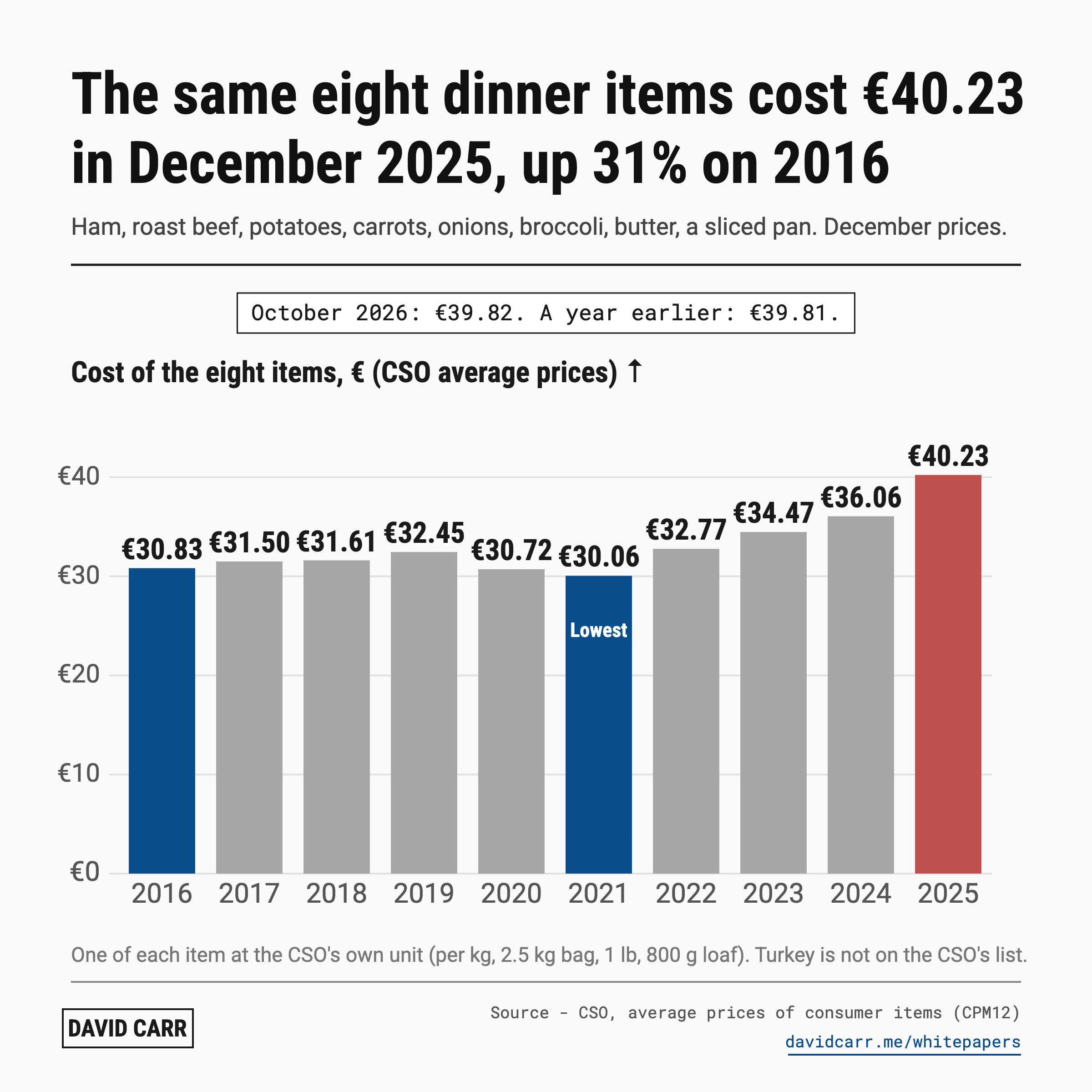
The same eight dinner items cost €40.23 in December 2025, up 31% on 2016
- December 2016: €30.83
- December 2021: €30.06, the lowest of the ten years
- December 2025: €40.23, up 34% on 2021
- October 2026: €39.82, against €39.81 in October 2025
From 2016 to 2021 the basket barely changed. Then it rose four years in a row. So far in 2026 it has held still.
One of each item at the unit the CSO prices it in: ham fillet (1 kg), roast beef (1 kg), potatoes (2.5 kg), carrots, onions and broccoli (1 kg each), butter (1 lb) and a white sliced pan (800 g). Prices from the CSO's average prices table. Turkey is not on the CSO's list.
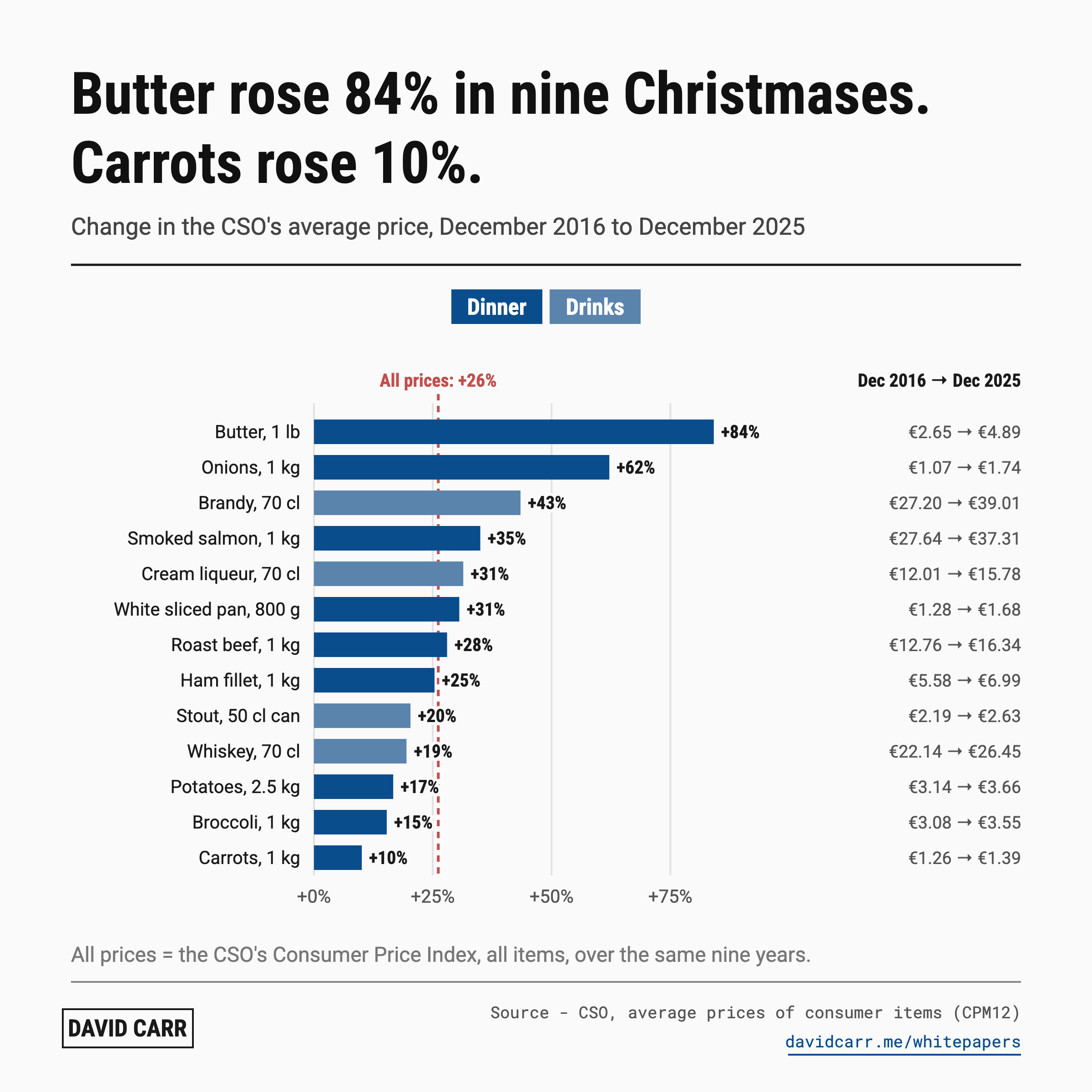
Butter rose 84% in nine Christmases. Carrots rose 10%.
- Butter: €2.65 to €4.89 a pound
- Onions: €1.07 to €1.74 a kilo
- Brandy: €27.20 to €39.01 a bottle
- Carrots: €1.26 to €1.39 a kilo
- All prices, the CSO's Consumer Price Index: up 26%
Every item cost more. Seven of the thirteen rose faster than prices overall, and six rose more slowly.
December 2016 to December 2025. Drinks are take-home prices: a 70 cl bottle or a 50 cl can.
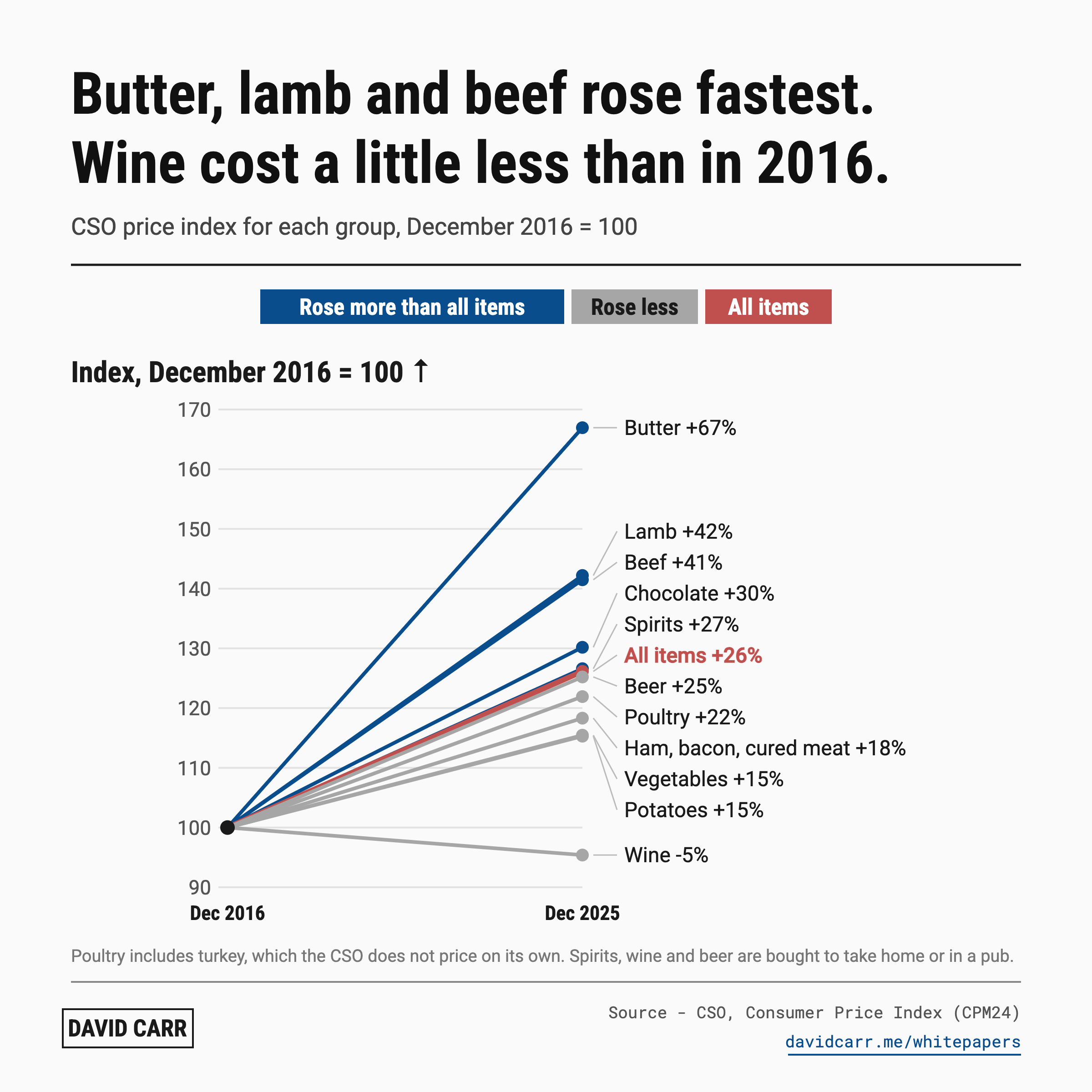
Butter, lamb and beef rose fastest. Wine cost a little less than in 2016.
- Butter: +67%
- Lamb: +42%
- Beef: +41%
- Poultry: +22%
- Potatoes: +15%
- Wine: -5%
- All items: +26%
Turkey sits in the CSO's poultry group, which rose a little less than prices overall.
The CSO's Consumer Price Index for each group, December 2016 to December 2025. These cover everything in the group, so beef includes steak and mince as well as roasts.
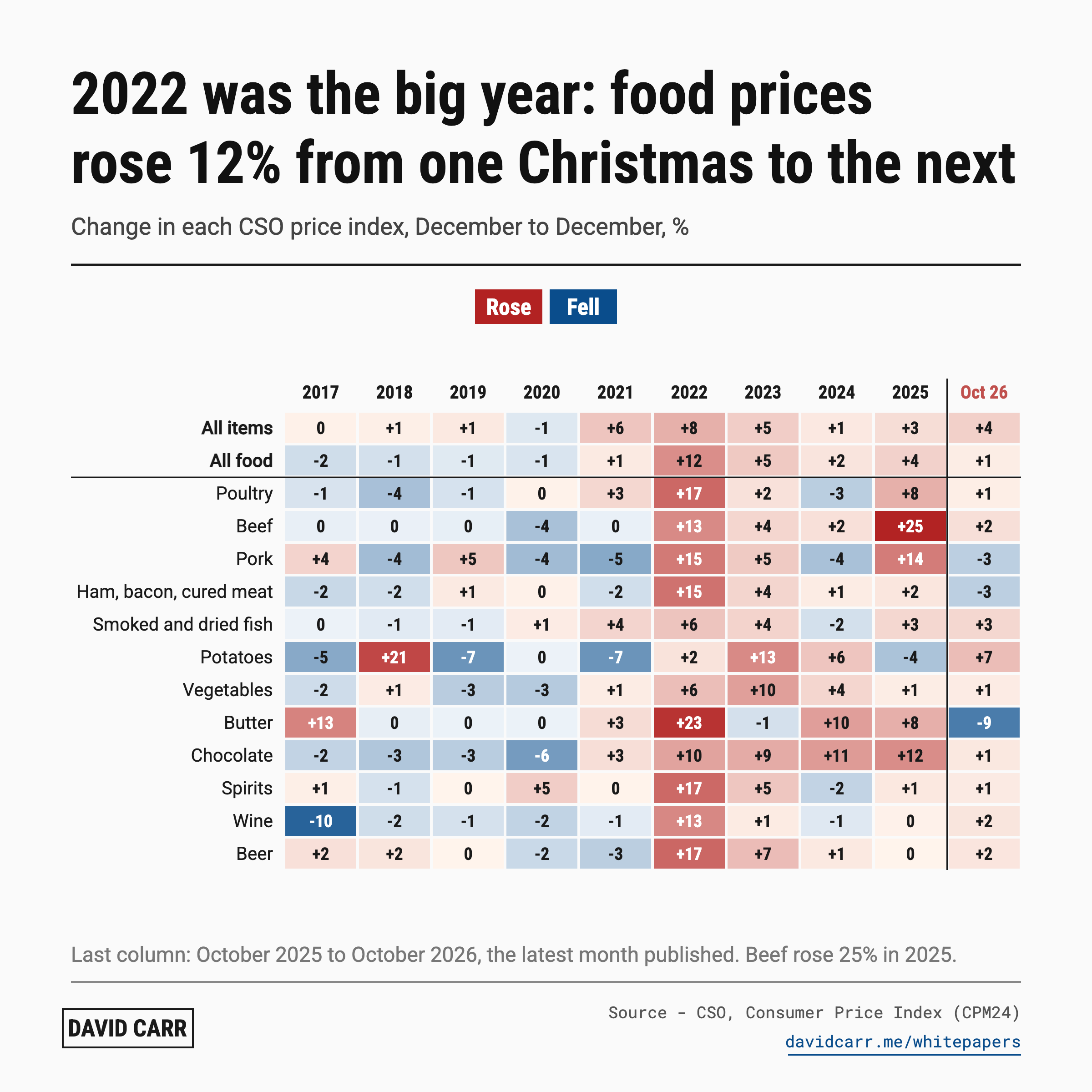
2022 was the big year: food prices rose 12% from one Christmas to the next
- 2022: food +12%, poultry +17%, spirits +17%, beer +17%, butter +23%
- 2025: beef +25%, pork +14%
- Chocolate rose in each of the last five years
- October 2025 to October 2026: food +1%, all items +4%, butter -9%
Food prices fell slightly every year from 2017 to 2020. Since then every December has been dearer than the one before.
Each cell is the change in the CSO's index from one December to the next, rounded to the nearest whole number. The last column is the latest twelve months the CSO has published.
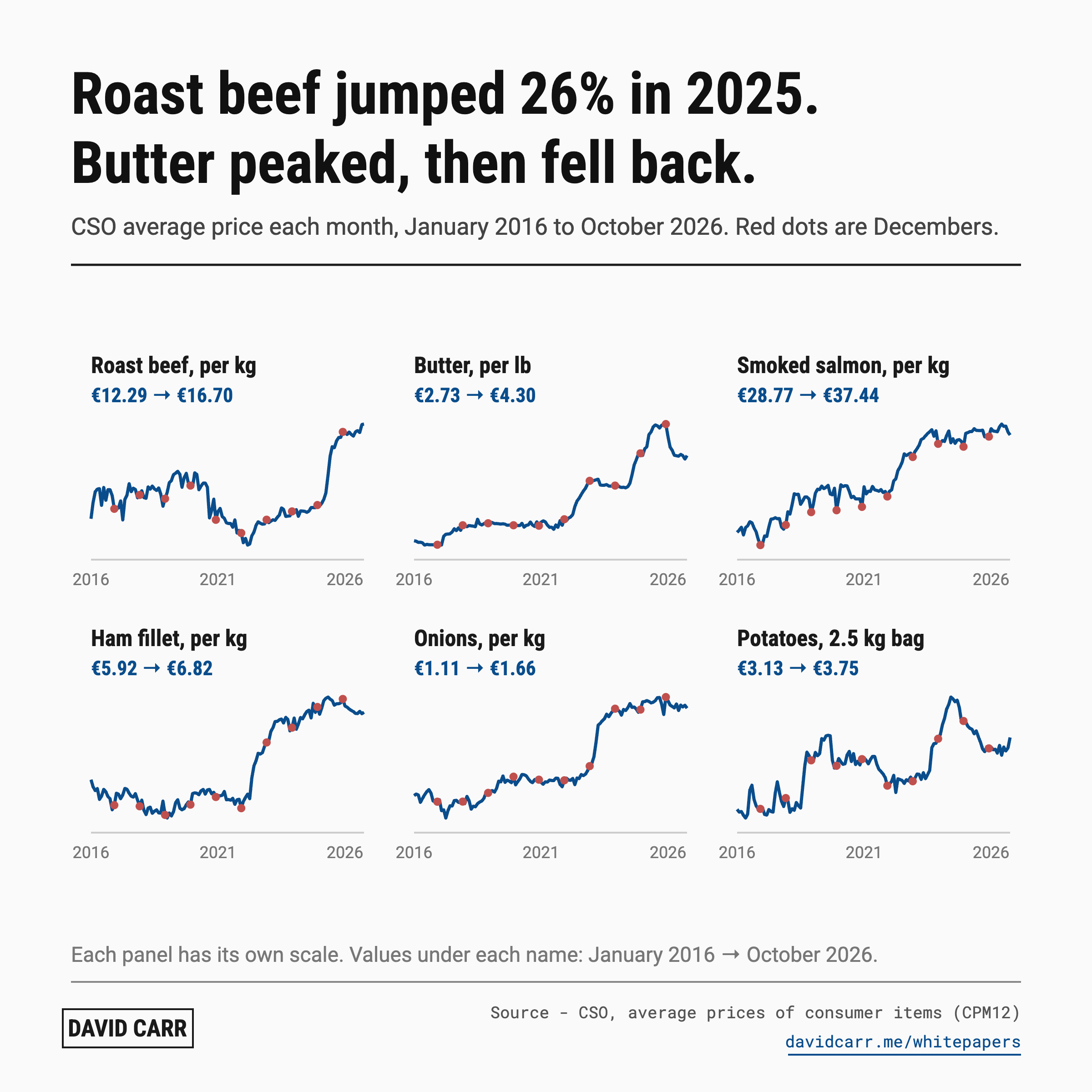
Roast beef jumped 26% in 2025. Butter peaked, then fell back.
- Roast beef: €12.93 a kilo in December 2024, €16.34 in December 2025, €16.70 in October 2026
- Butter: highest in December 2025 at €4.89 a pound, €4.30 by October 2026
- Potatoes: highest in June 2024 at €4.10 a bag
- Ham fillet: €5.92 a kilo in January 2016, €6.82 in October 2026
Several of these moved in steps: flat for years, then up sharply in 2022 or 2025.
Monthly average prices from the CSO, January 2016 to October 2026. Each panel has its own scale, so compare shapes, not heights.
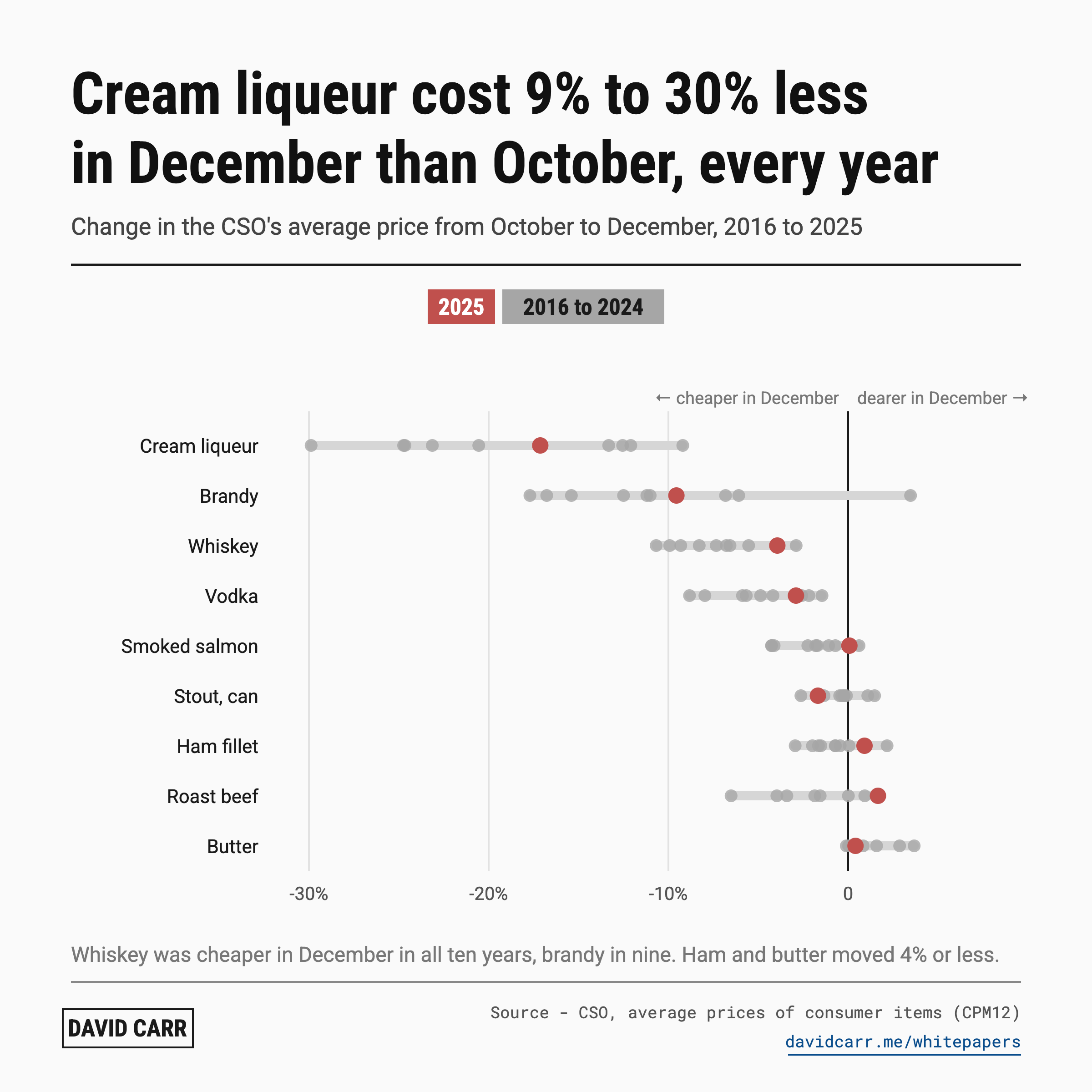
Cream liqueur cost 9% to 30% less in December than in October, every year
- Cream liqueur: cheaper in December in all ten years, by 9% to 30%
- Whiskey: cheaper in December in all ten years, by 3% to 11%
- Brandy: cheaper in nine of the ten
- Ham fillet and butter: within 4% either way
The bottles people buy for Christmas show a December dip in the CSO's data every year. The dinner itself does not.
Change in the CSO's average price from October to December of the same year, 2016 to 2025. The price usually goes back up in January.
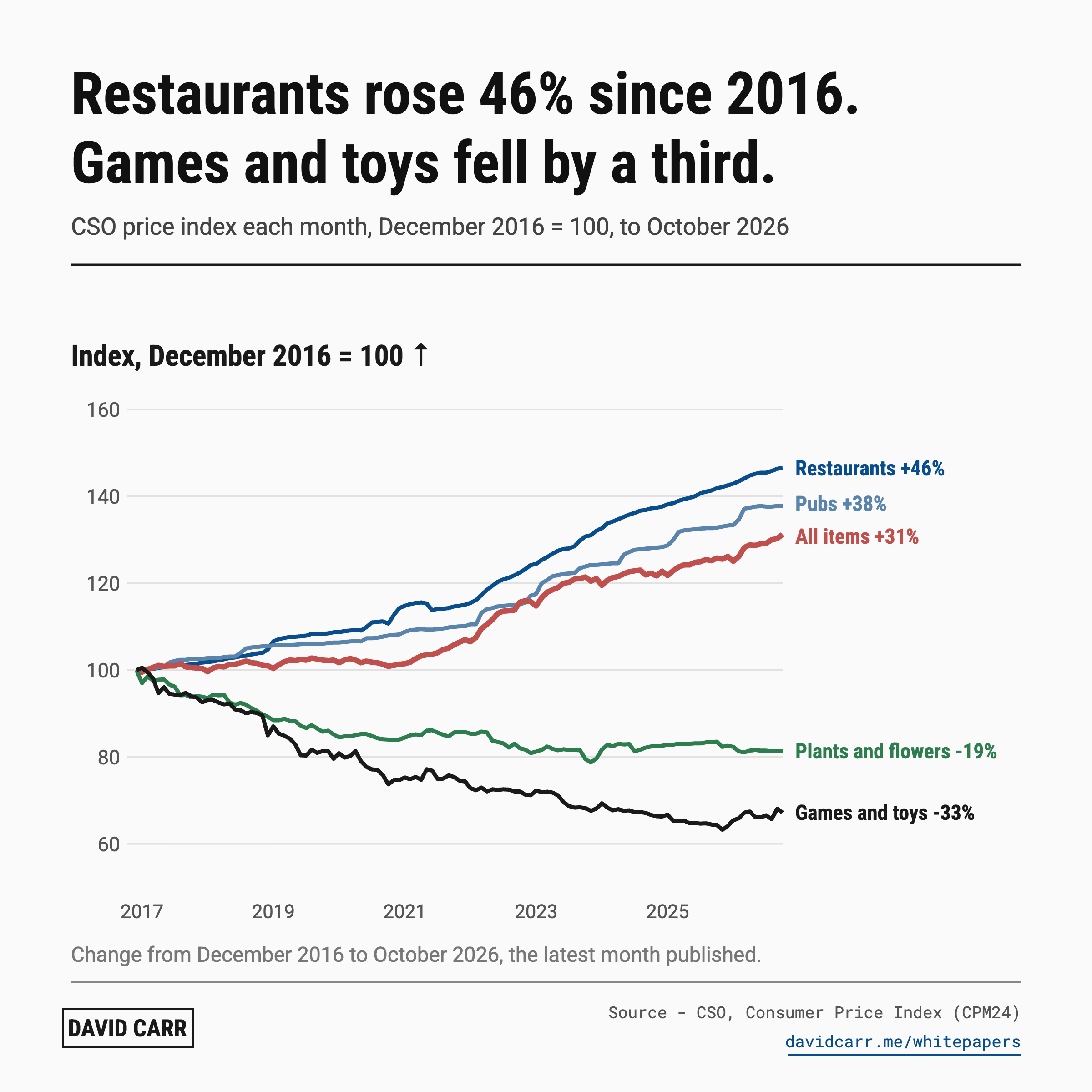
Restaurant prices rose 46% since 2016. Games and toys fell by a third.
- Restaurants: +46%
- Pubs: +38%
- All items: +31%
- Plants and flowers: -19%
- Games and toys: -33%
Eating and drinking out rose faster than prices overall. Toys and flowers went the other way.
December 2016 to October 2026. Eurostat's own index for games, toys and hobbies in Ireland shows the same fall to December 2025: 36% in both.
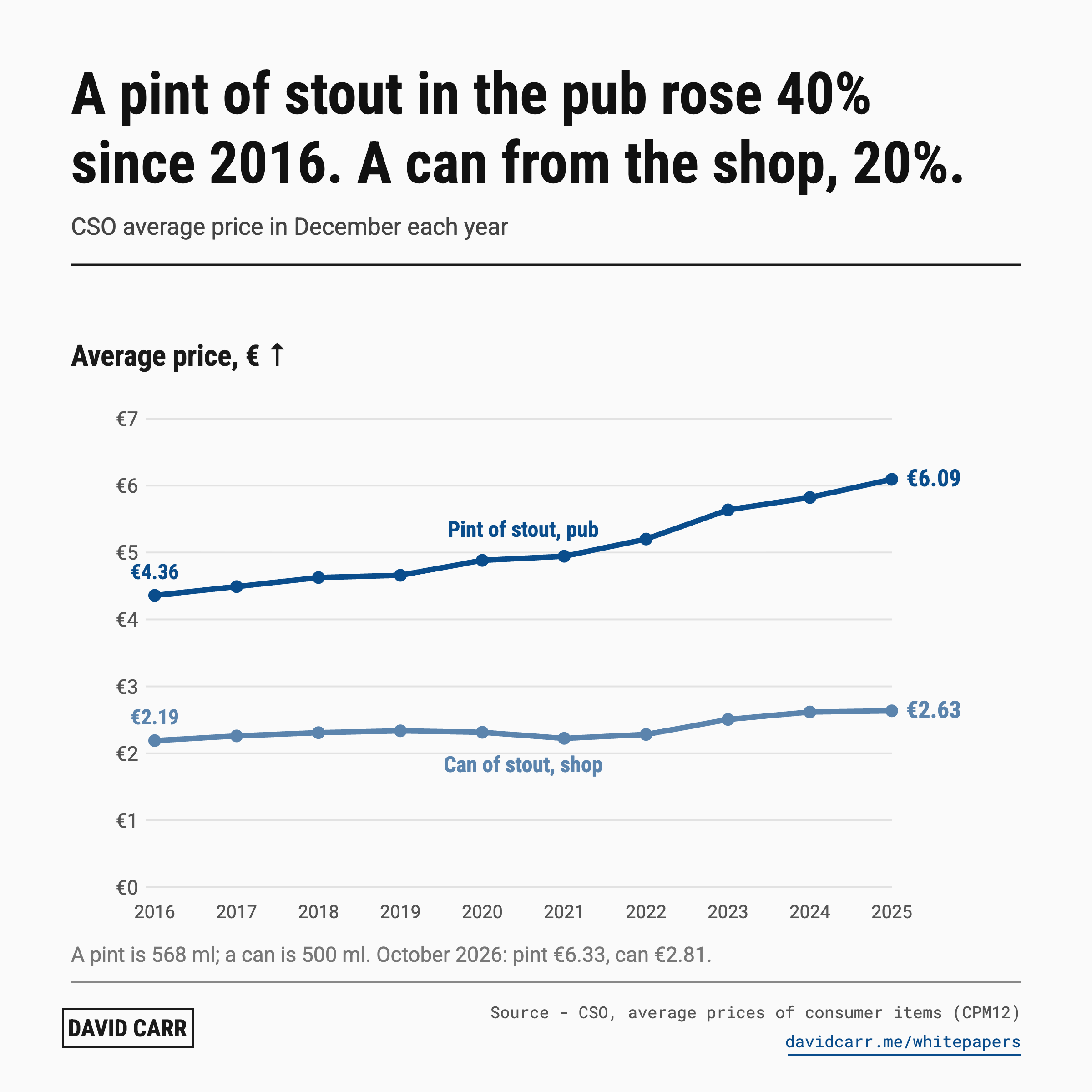
A pint of stout in the pub rose 40% since 2016. A can from the shop, 20%.
- Pint in a pub: €4.36 in December 2016, €6.09 in December 2025
- 50 cl can from a shop: €2.19 and €2.63
- October 2026: pint €6.33, can €2.81
In 2016 a pint cost about twice a can. By 2025 it cost 2.3 times as much.
CSO average prices for December. A pint is 568 ml and a can is 500 ml, so this compares what people pay, not price per litre.
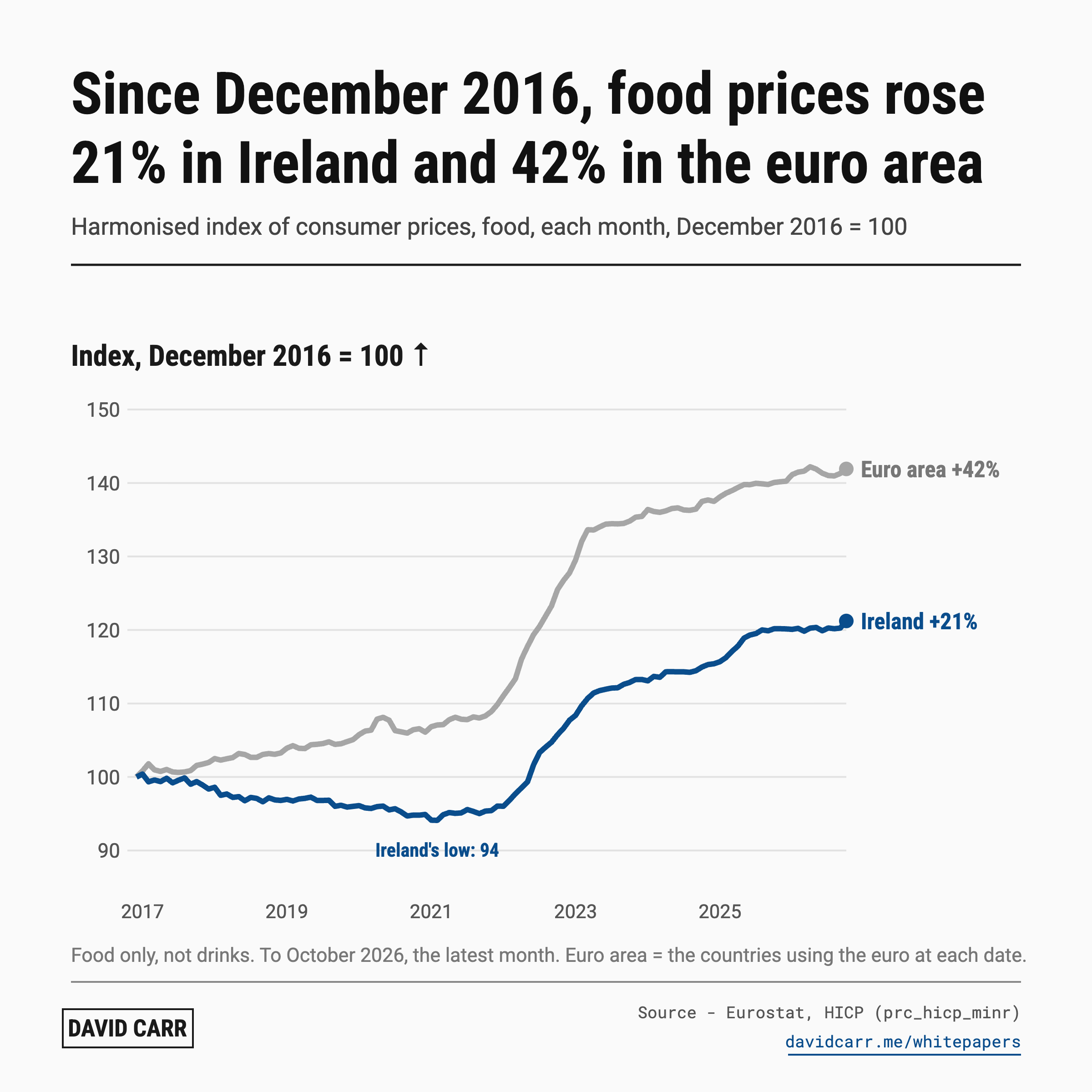
Since December 2016, food prices rose 21% in Ireland and 42% in the euro area
- Ireland: +21% to October 2026
- Euro area: +42%
- Ireland's food prices were lower in 2021 than in 2016
The gap opened before 2022, when Irish food prices drifted down and the euro area's rose. Both then jumped together.
Eurostat's harmonised index of consumer prices, food only. It is built the same way in every EU country, so it is the fairer comparison.
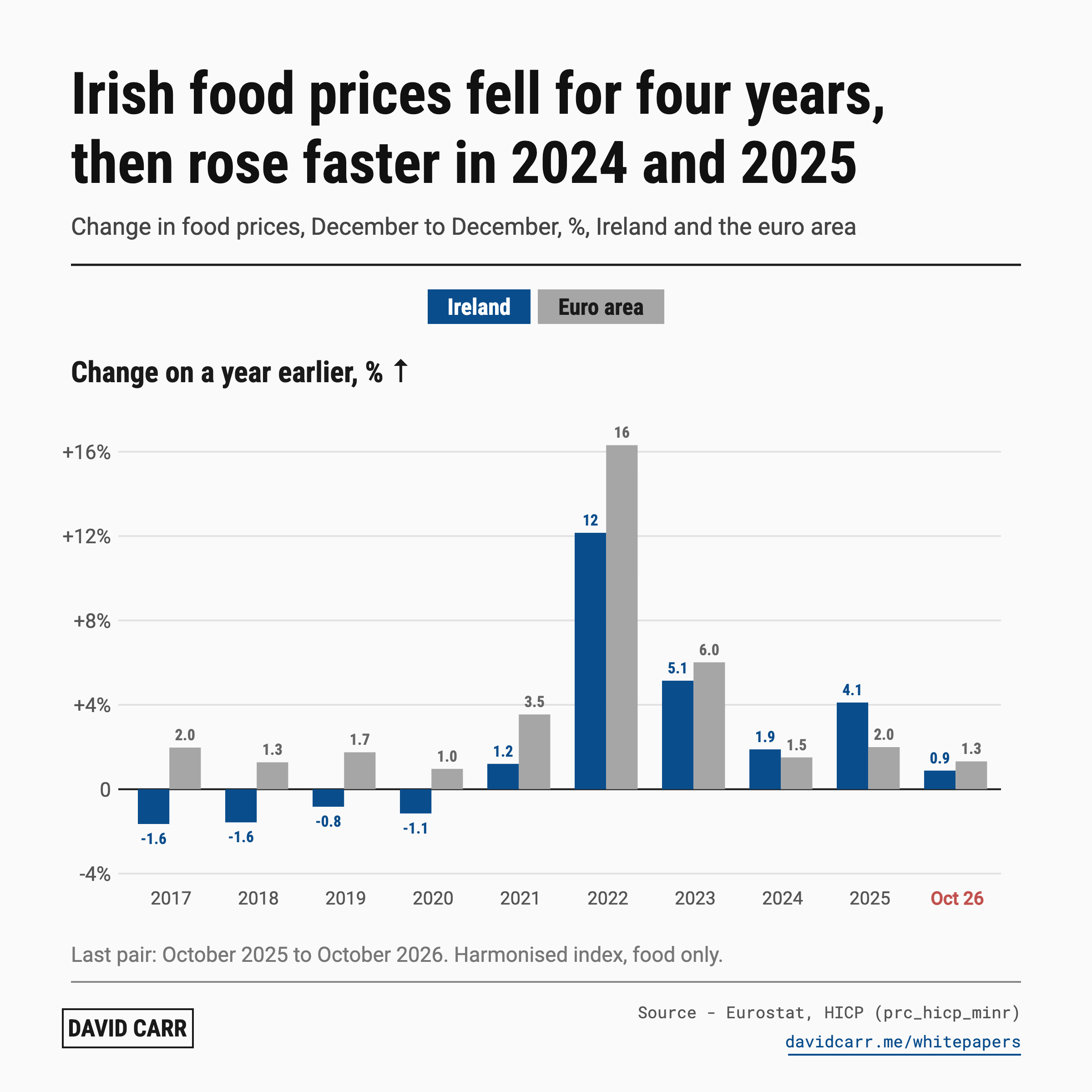
Irish food prices fell for four years, then rose faster than the euro area's in 2024 and 2025
- 2017 to 2020: Ireland between -0.8% and -1.6% each year
- 2022: Ireland +12%, euro area +16%
- 2025: Ireland +4.1%, euro area +2.0%
- October 2025 to October 2026: Ireland +0.9%, euro area +1.3%
In the latest twelve months Irish food prices rose less than the euro area's again.
Change from one December to the next in Eurostat's food index. The last pair is October to October.
Method, caveats and sources
The short answer. Eight everyday dinner items cost €40.23 in December 2025, up 31% on 2016 and 34% on 2021, when they were cheapest. Butter, onions, lamb and beef rose most; carrots, potatoes and wine rose least, and wine cost a little less than in 2016. Christmas bottles are cheaper in December than in October every year. Since 2016 Irish food prices rose about half as much as the euro area's, though faster in 2024 and 2025. In the latest twelve months, to October 2026, the basket barely moved.
Data. Pulled on 22 November 2026 from the CSO's open data service (PxStat): table CPM12, national average prices of 76 consumer items each month from January 2012, and table CPM24, the Consumer Price Index for every group of goods and services. Both run to October 2026, the latest month published. The Ireland and euro area comparison uses Eurostat's harmonised index of consumer prices (prc_hicp_minr), also to October 2026.
The basket. One of each of eight items at the unit the CSO prices it in: ham fillet (1 kg), roast beef, topside or rib (1 kg), potatoes (2.5 kg bag), carrots (1 kg), onions (1 kg), broccoli (1 kg), butter (1 lb) and a large white sliced pan (800 g). The quantities are the CSO's units, not a recipe. Turkey, Brussels sprouts, parsnips and wine are not on the CSO's average price list (the table has no wine price after November 2016), so they are not in the basket. Turkey is part of the poultry group in the price index.
Which months. The basket and most charts use December prices, so each Christmas is compared with the one before. December 2026 has not been published yet, so the latest figures are for October 2026, compared with October 2025. Some prices dip in December, so an October figure should not be compared with a December one.
Average prices. They are averages across many shops and brands, and the mix can change, so a single month can move more than the shelf price of any one product.
Euro area means the countries using the euro at each date. Eurostat's food index excludes drinks.
Also: What AI costs now, Christmas songs and What homes in Ashbourne cost.