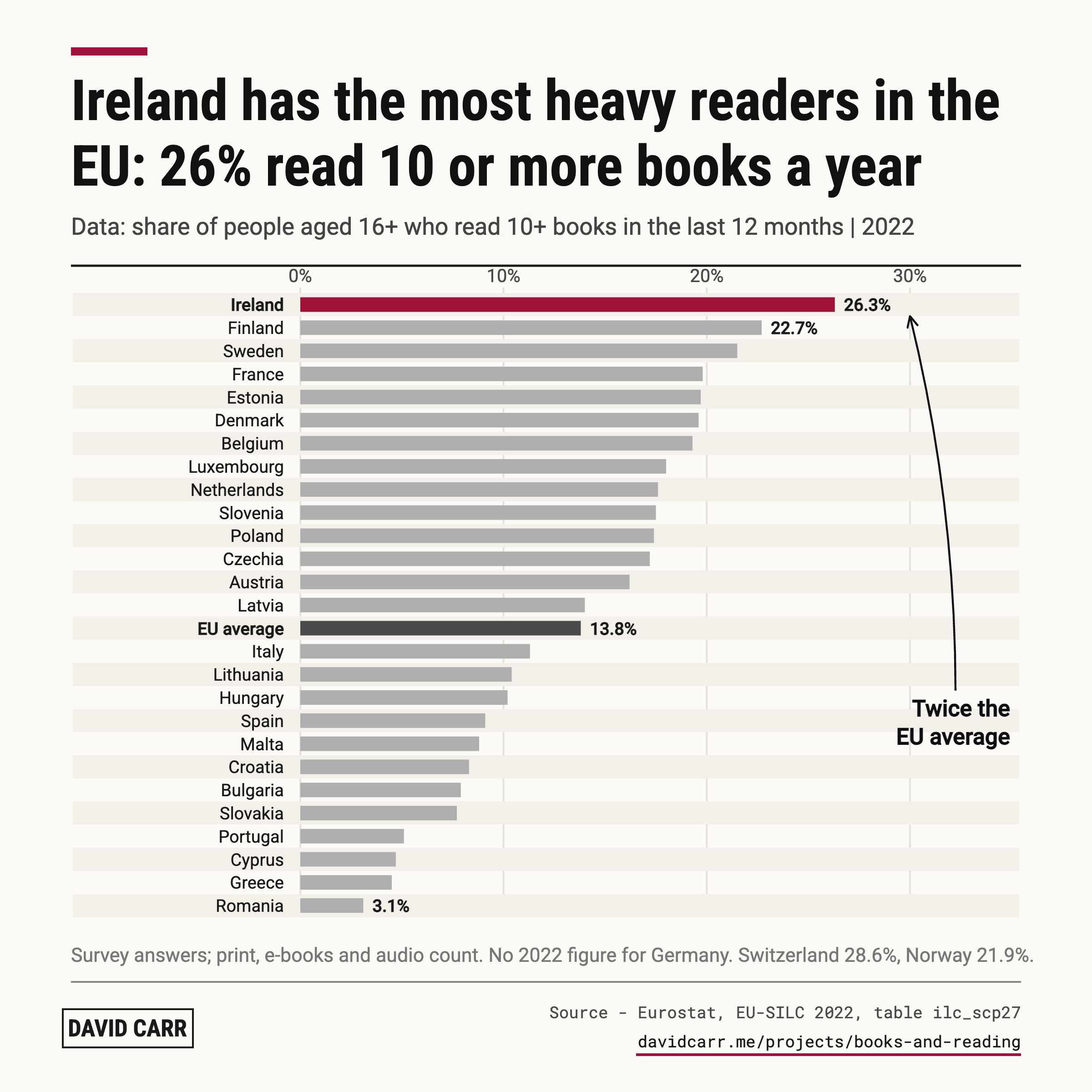
Ireland has the most heavy readers in the EU: 26% read 10 or more books a year
- Ireland: 26.3%
- Finland: 22.7%
- Sweden: 21.5%
- EU average: 13.8%
- Romania: 3.1%
Two in three people in Ireland (66.5%) read at least one book in 2022. Across the EU it was just over half (52.8%). Ireland does not have the fewest non-readers: Luxembourg, Denmark, Estonia, Finland and Sweden all have fewer. But it has the biggest share of people who read a lot.
Eurostat table ilc_scp27 (EU-SILC 2022), pulled 29 November 2026. A survey question: books read in the last 12 months, in any format. See also the Eurostat news item.
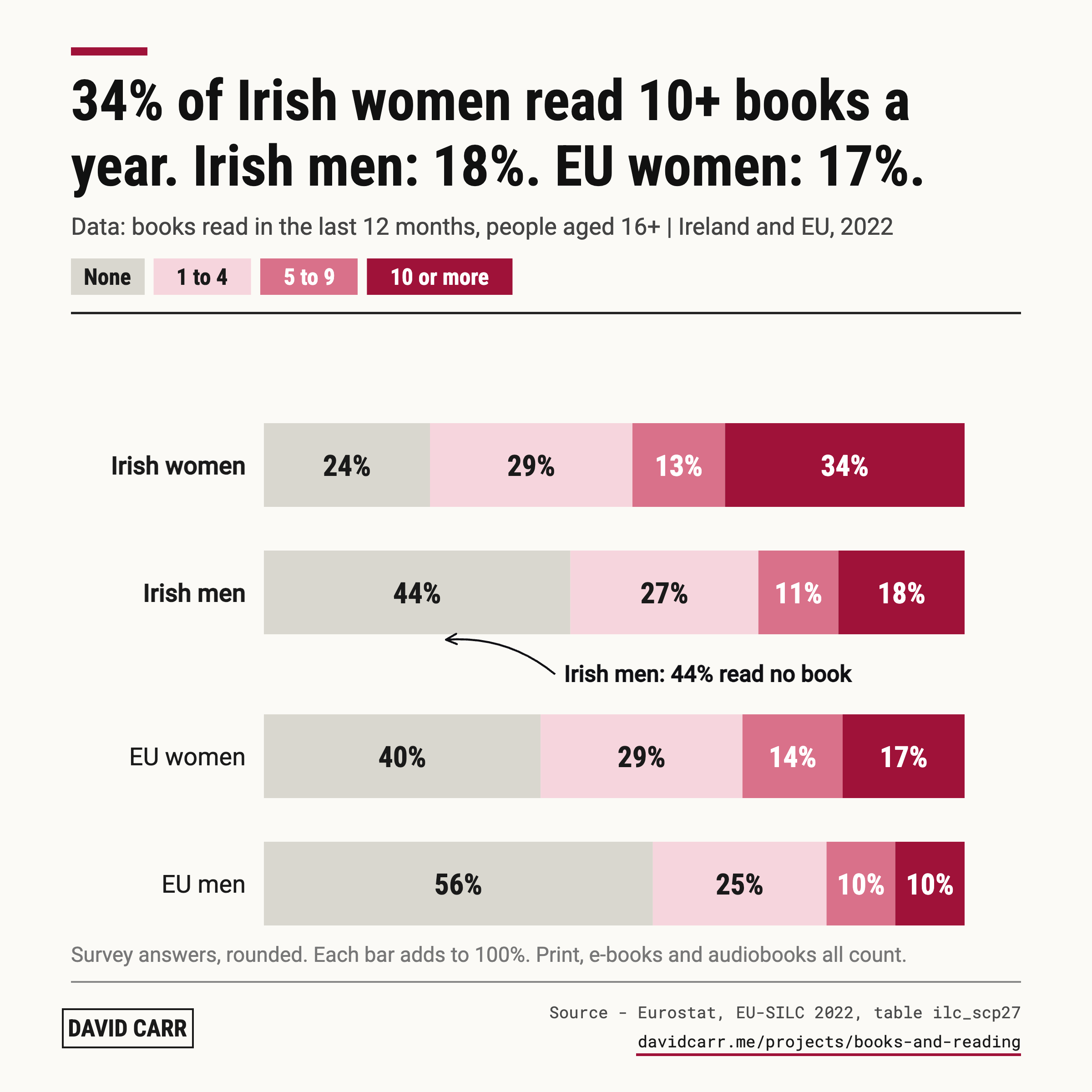
34% of Irish women read 10+ books a year. Irish men: 18%. EU women: 17%.
- Irish women: 24% read none, 34% read 10 or more
- Irish men: 44% read none, 18% read 10 or more
- EU women: 40% none, 17% 10 or more
- EU men: 56% none, 10% 10 or more
In every country in the table, fewer women than men read no books. Irish men have about as many heavy readers as European women overall: 18% against 17%.
Eurostat ilc_scp27, 2022, people aged 16 and over.
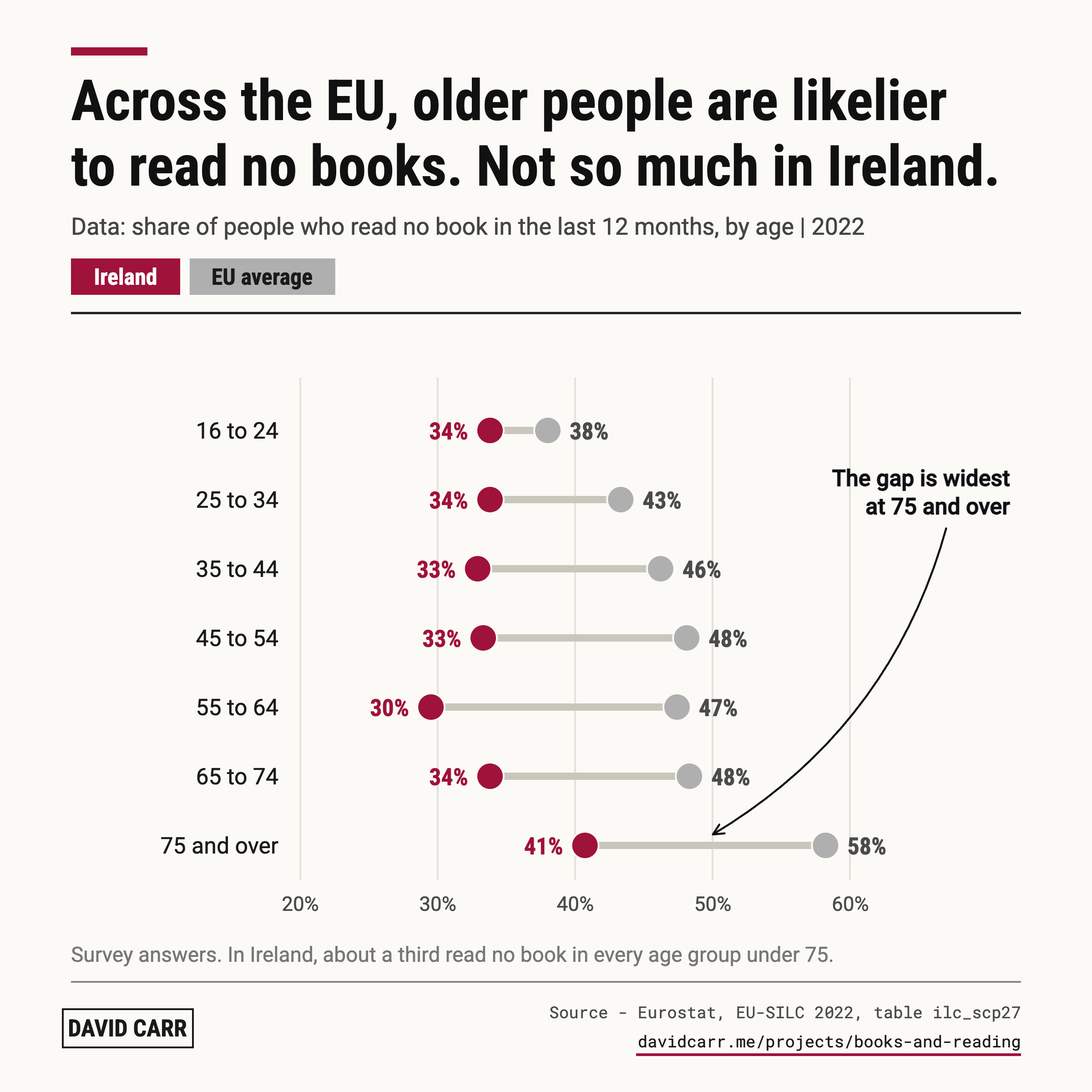
Across the EU, older people are likelier to read no books. Not so much in Ireland.
- 16 to 24: Ireland 34%, EU 38%
- 45 to 54: Ireland 33%, EU 48%
- 65 to 74: Ireland 34%, EU 48%
- 75 and over: Ireland 41%, EU 58%
In the UK the pattern runs the other way: YouGov found 53% of 18- to 24-year-olds read or listened to a book in the past year, against 65% of over-65s (YouGov, March 2025).
Eurostat ilc_scp27, 2022. Share answering "no books".
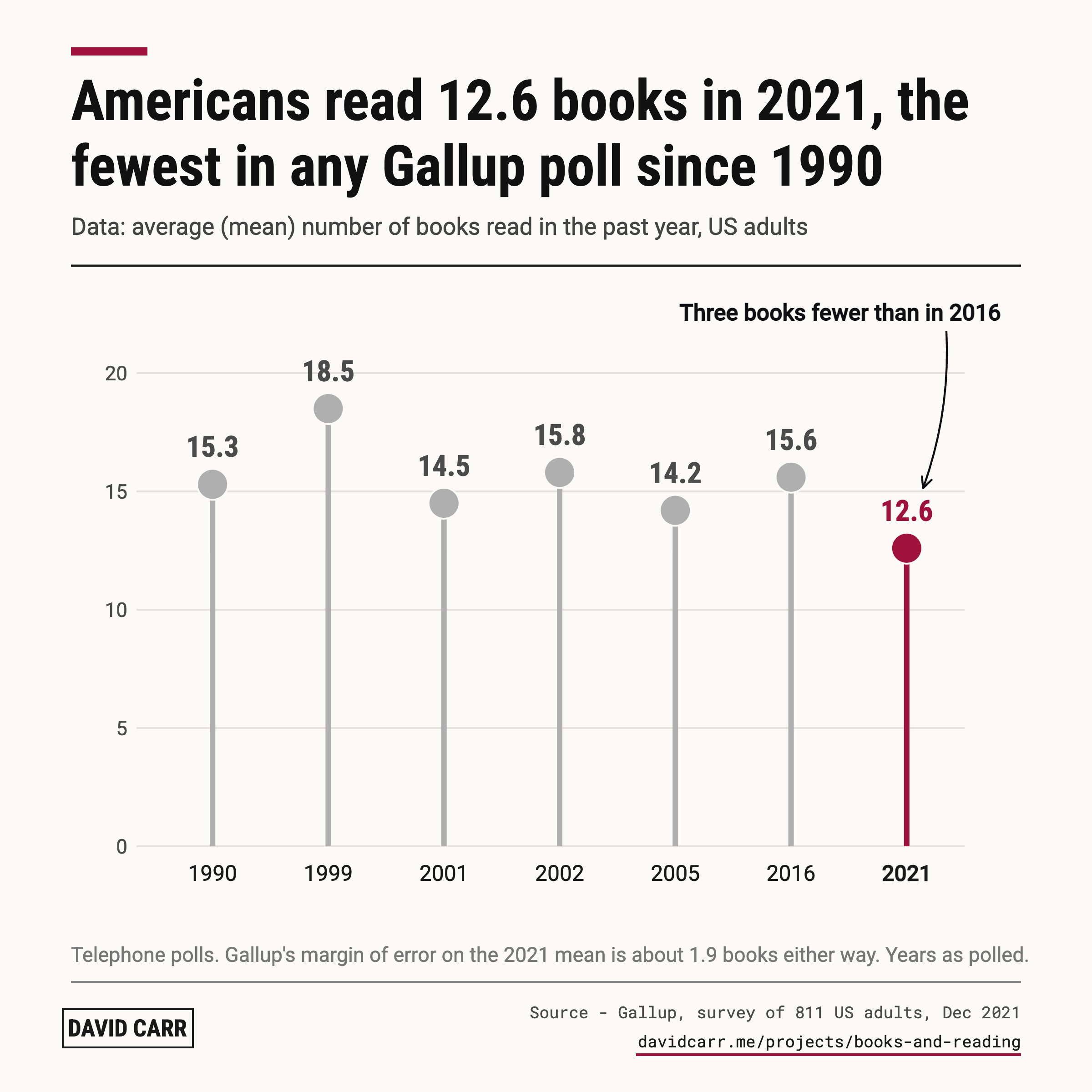
Americans read 12.6 books in 2021, the fewest in any Gallup poll since 1990
- 1999: 18.5 books, the high
- 2016: 15.6
- 2021: 12.6
The share reading no books stayed at 17%. The fall came from heavy readers reading less: the share reading more than ten books fell from 35% to 27%. A newer survey by Pew in October 2025 found a quarter of US adults read no book in the past year (Pew Research Center).
Gallup, telephone poll of 811 US adults, 1 to 16 December 2021. Averages are pulled up by a few people who read a lot.
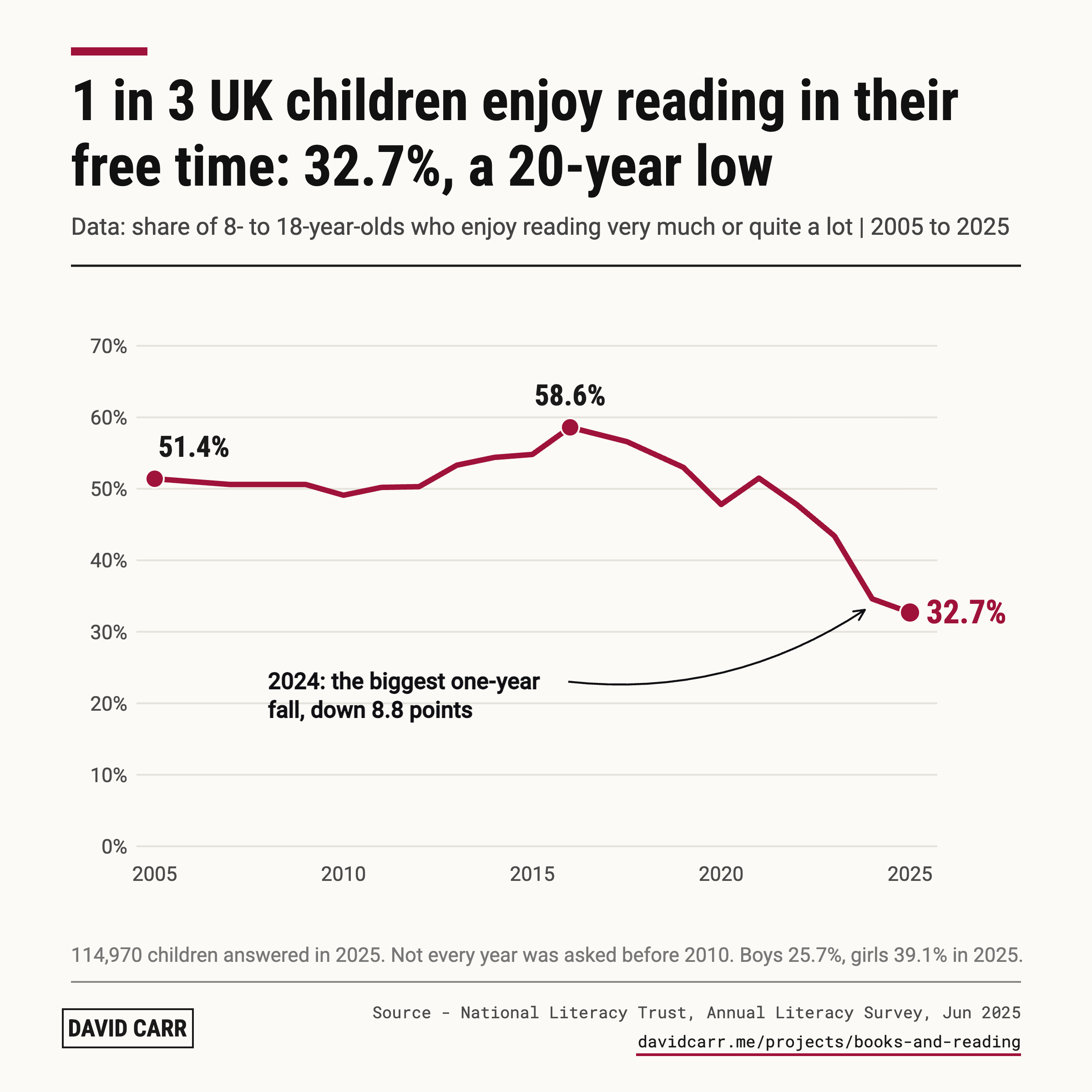
1 in 3 UK children enjoy reading in their free time: 32.7%, a 20-year low
- 2005: 51.4%
- 2016: 58.6%, the peak
- 2024: 34.6%
- 2025: 32.7%
Boys are furthest behind: 25.7% of boys aged 8 to 18 enjoy reading, against 39.1% of girls. Only 18.7% read something in their free time every day.
National Literacy Trust, Children and young people's reading in 2025 (June 2025), 114,970 responses. A charity survey run through schools.
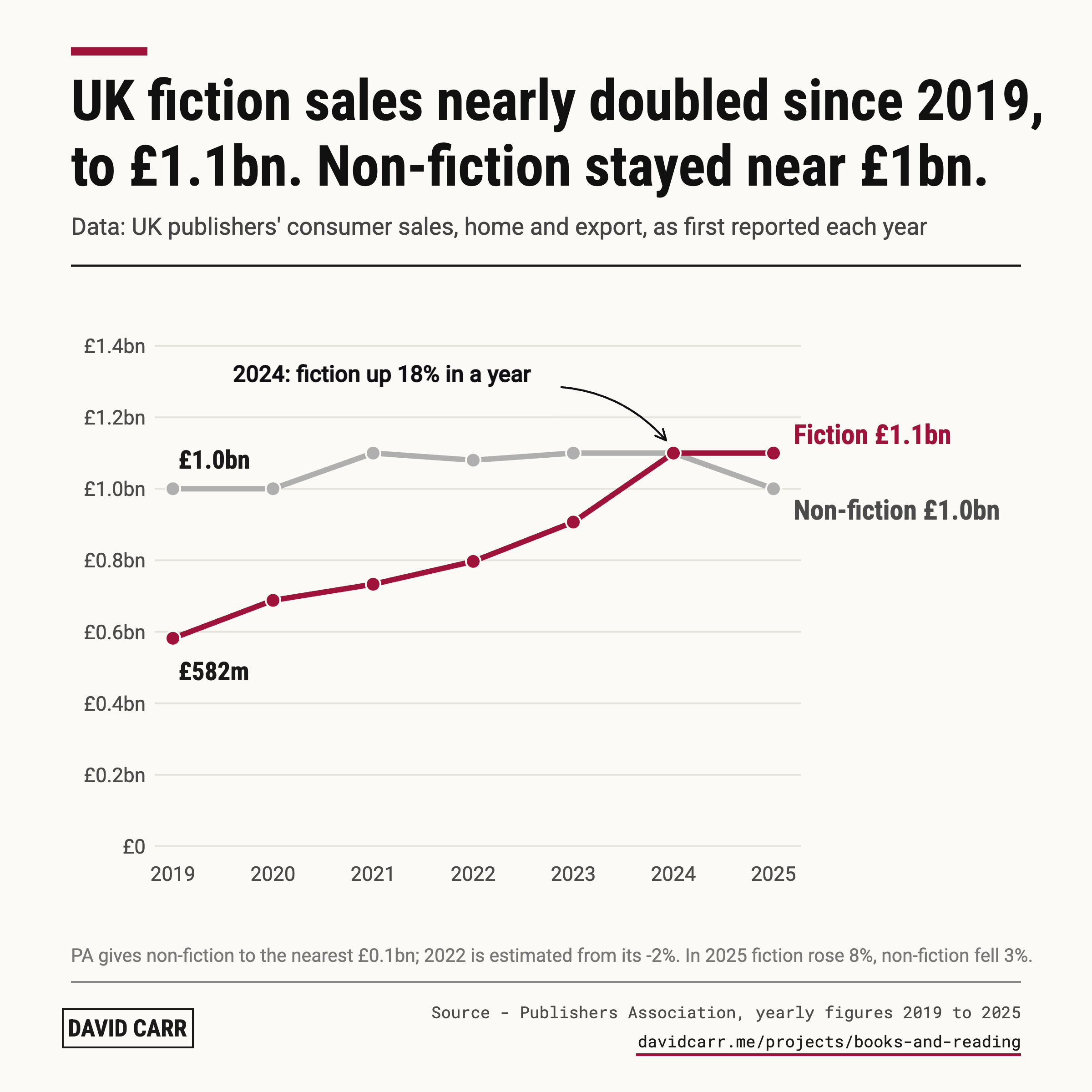
UK fiction sales nearly doubled since 2019, to £1.1bn. Non-fiction stayed near £1bn.
- 2019: fiction £582m, non-fiction £1.0bn
- 2023: fiction £907m, non-fiction £1.1bn
- 2024: fiction £1.1bn (+18%), non-fiction £1.1bn (-4%)
- 2025: fiction £1.1bn (+8%), non-fiction £1.0bn (-3%)
Fiction has grown every year since 2019, and in 2025 it was clearly the bigger of the two for the first time. Children's books were £493m in 2025, up 7%. Among UK readers, 55% read mostly or only fiction and 19% mostly non-fiction (YouGov).
Publishers Association figures for consumer publishing, home and export, as first reported each year: 2019, 2020, 2021, 2022, 2023, 2024, 2025. PA revises earlier years, so small gaps between years should be read with care.
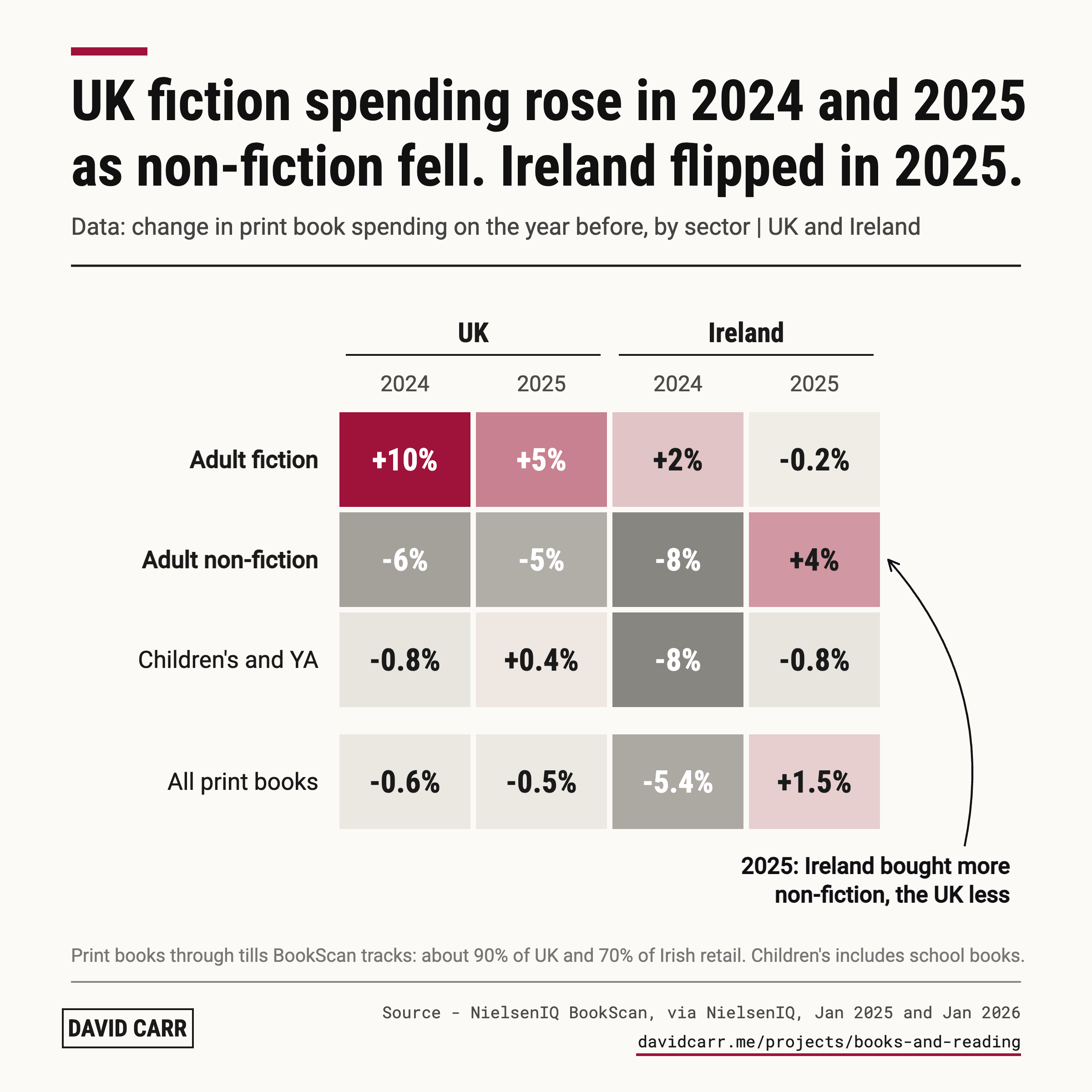
UK fiction spending rose in 2024 and 2025 as non-fiction fell. Ireland flipped in 2025.
- UK adult fiction: +10% in 2024, +5% in 2025
- UK adult non-fiction: -6%, then -5%
- Ireland adult fiction: +2%, then -0.2%
- Ireland adult non-fiction: -8%, then +4%
Ireland's bestseller of 2025 was a non-fiction book, The Let Them Theory by Mel and Sawyer Robbins, with 38,885 copies; second was the thriller The Housemaid by Freida McFadden (Irish Times). The UK's was Richard Osman's novel The Impossible Fortune (NielsenIQ). In 2025, Irish print spending rose 1.5% while the UK's fell 0.5%.
NielsenIQ BookScan reviews of 2024 and 2025, print books only. BookScan covers about 90% of UK and 70% of Irish retail sales.
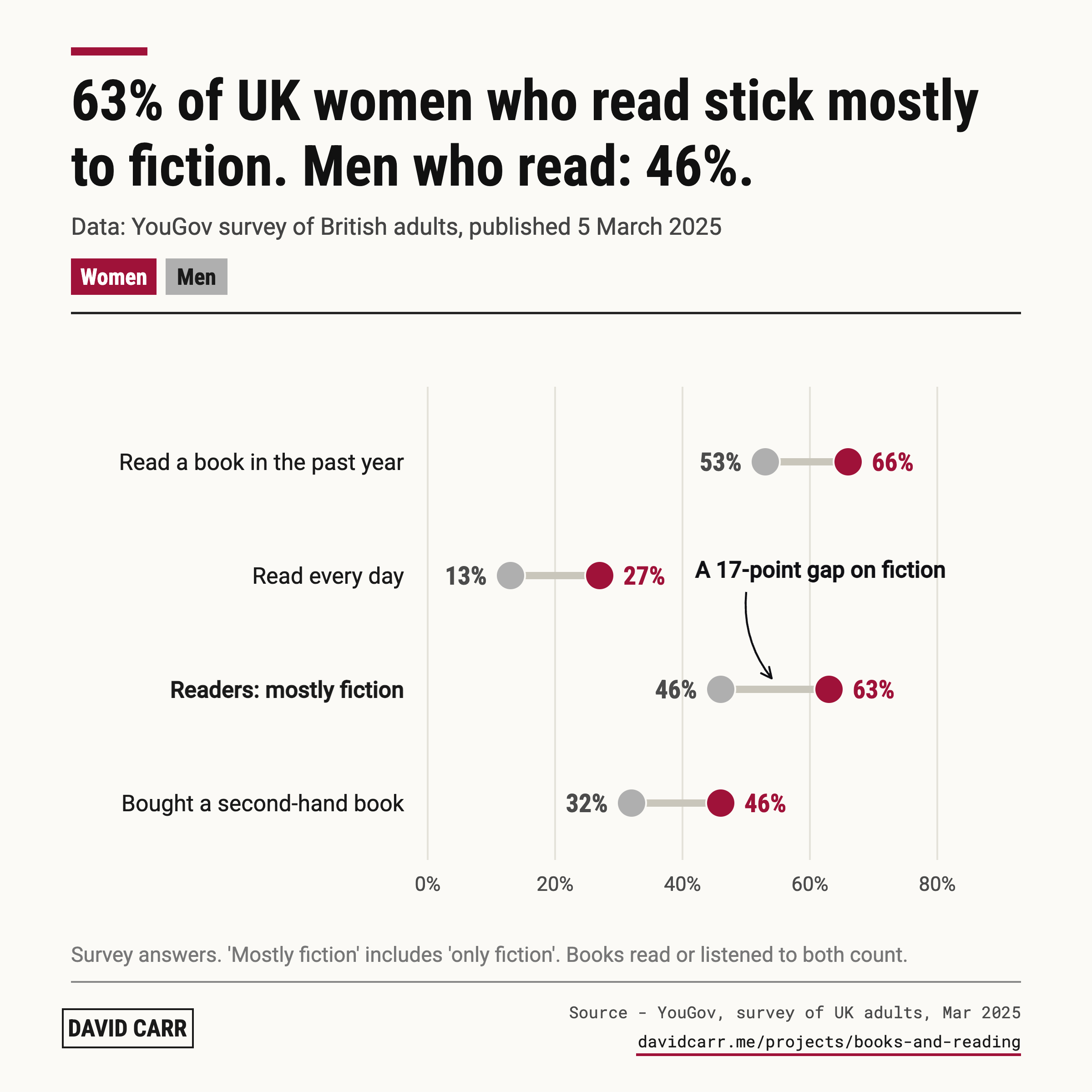
63% of UK women who read stick mostly to fiction. Men who read: 46%.
- Read a book in the past year: women 66%, men 53%
- Read every day: women 27%, men 13%
- Readers who read mostly fiction: women 63%, men 46%
- Bought a second-hand book: women 46%, men 32%
The median Briton read or listened to three books in the past year. Four in ten read none (YouGov). In Ireland, women are also far more likely to be heavy readers (chart two).
YouGov, survey of British adults, published 5 March 2025. YouGov did not publish the sample size on the article page.
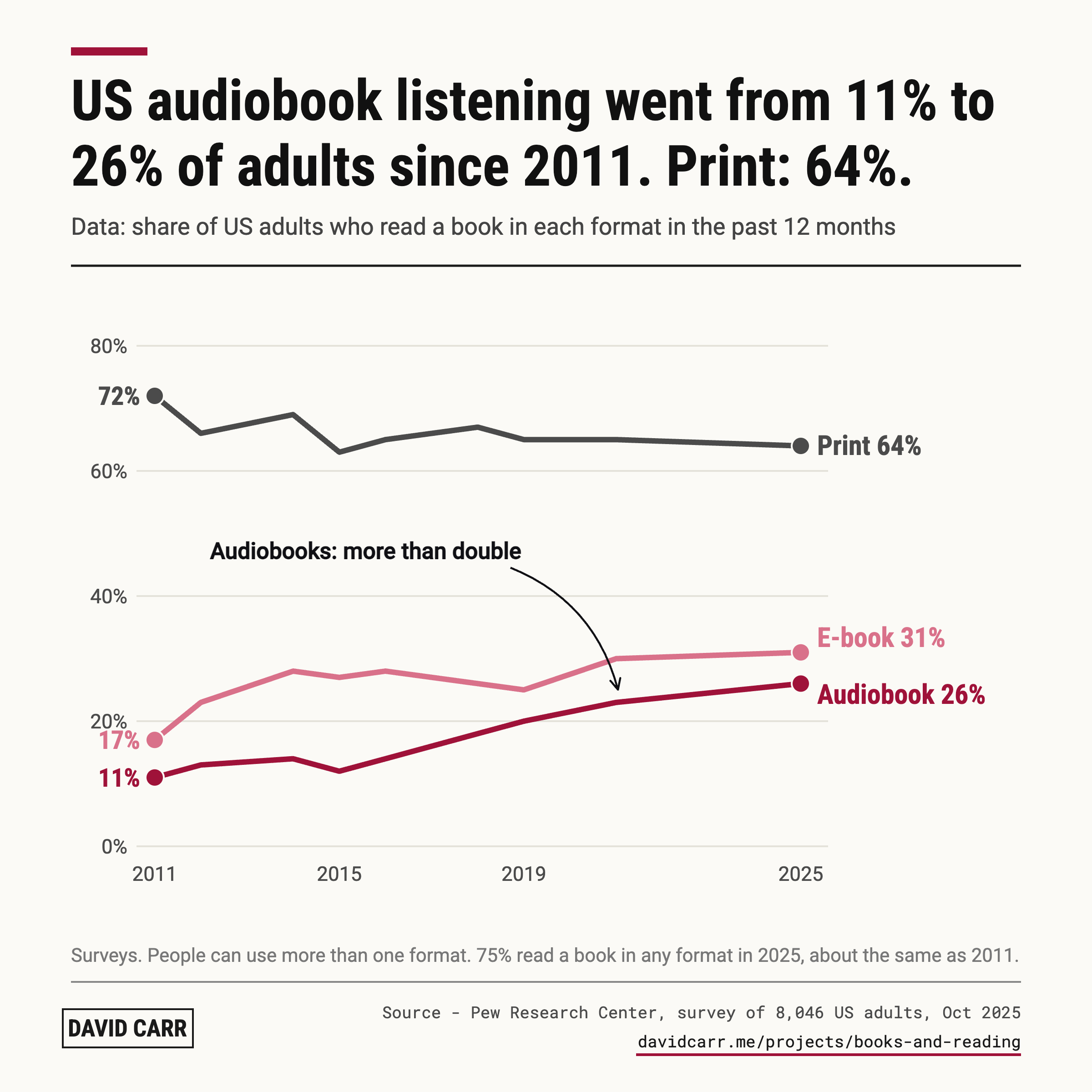
US audiobook listening went from 11% to 26% of adults since 2011. Print: 64%.
- Print: 72% in 2011, 64% in 2025
- E-book: 17% to 31%
- Audiobook: 11% to 26%
Young adults lead on digital: 41% of 18- to 29-year-olds read an e-book and 32% listened to an audiobook. Among over-65s, 13% listened to one. In the UK, physical books are the main format for 61% of readers, e-books for 24% and audiobooks for 14% (YouGov).
Pew Research Center, survey of 8,046 US adults, 6 to 16 October 2025, with earlier Pew surveys back to 2011.
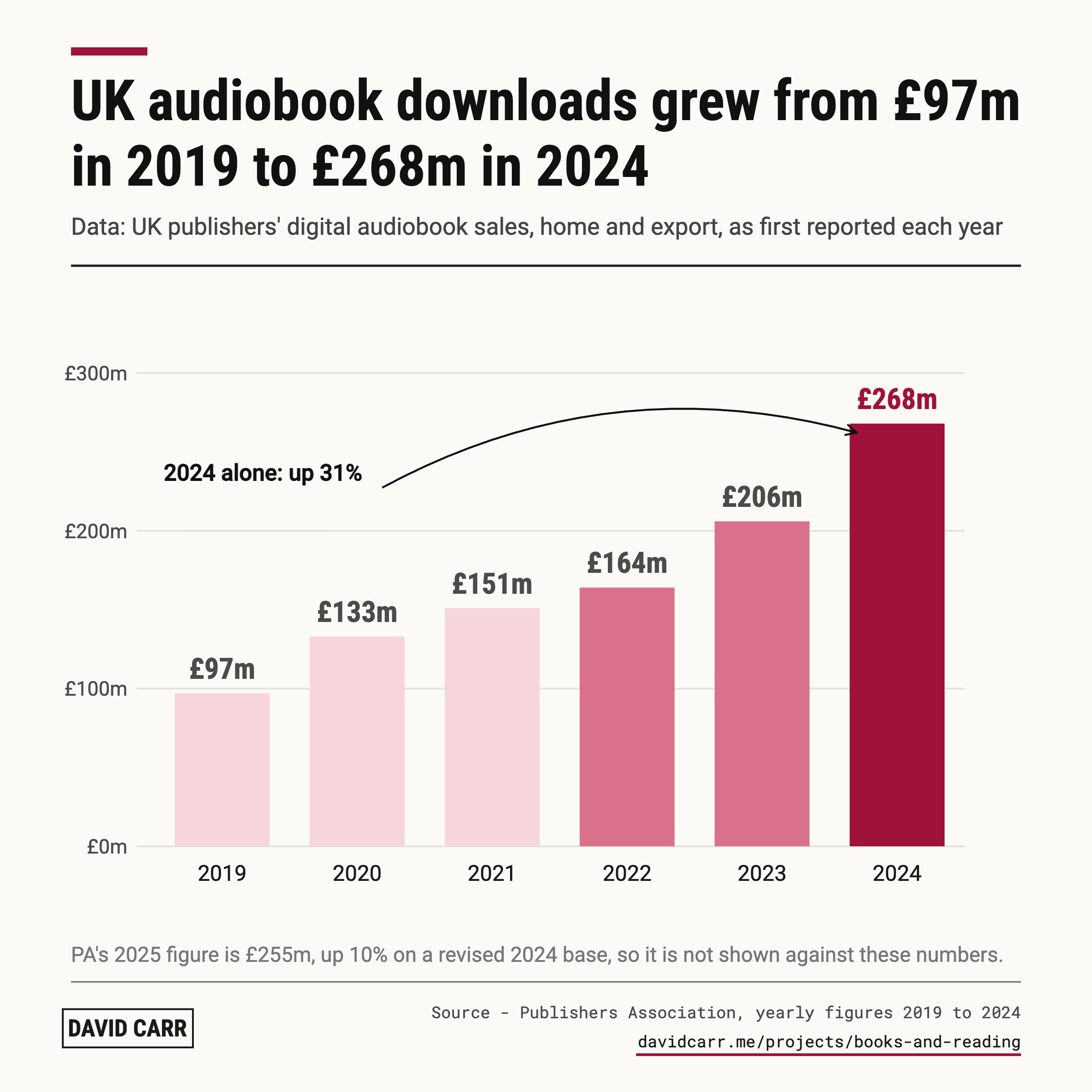
UK audiobook downloads grew from £97m in 2019 to £268m in 2024
- 2019: £97m
- 2021: £151m
- 2023: £206m
- 2024: £268m, up 31%
Streaming services pushed listening up. Spotify, which added audiobooks to Premium in Ireland and the UK, says the number of people starting an audiobook grew 36% in a year (Spotify, Oct 2025). Storytel ended 2025 with 2.67 million paying subscribers (Storytel). Irish libraries lent 1.67 million e-audiobooks in 2023, almost twice the 0.93 million e-books, both up about a fifth (PA via BreakingNews.ie).
Publishers Association, as first reported each year (2019 to 2024). PA puts 2025 at £255m, up 10% on a revised 2024 figure (PA).
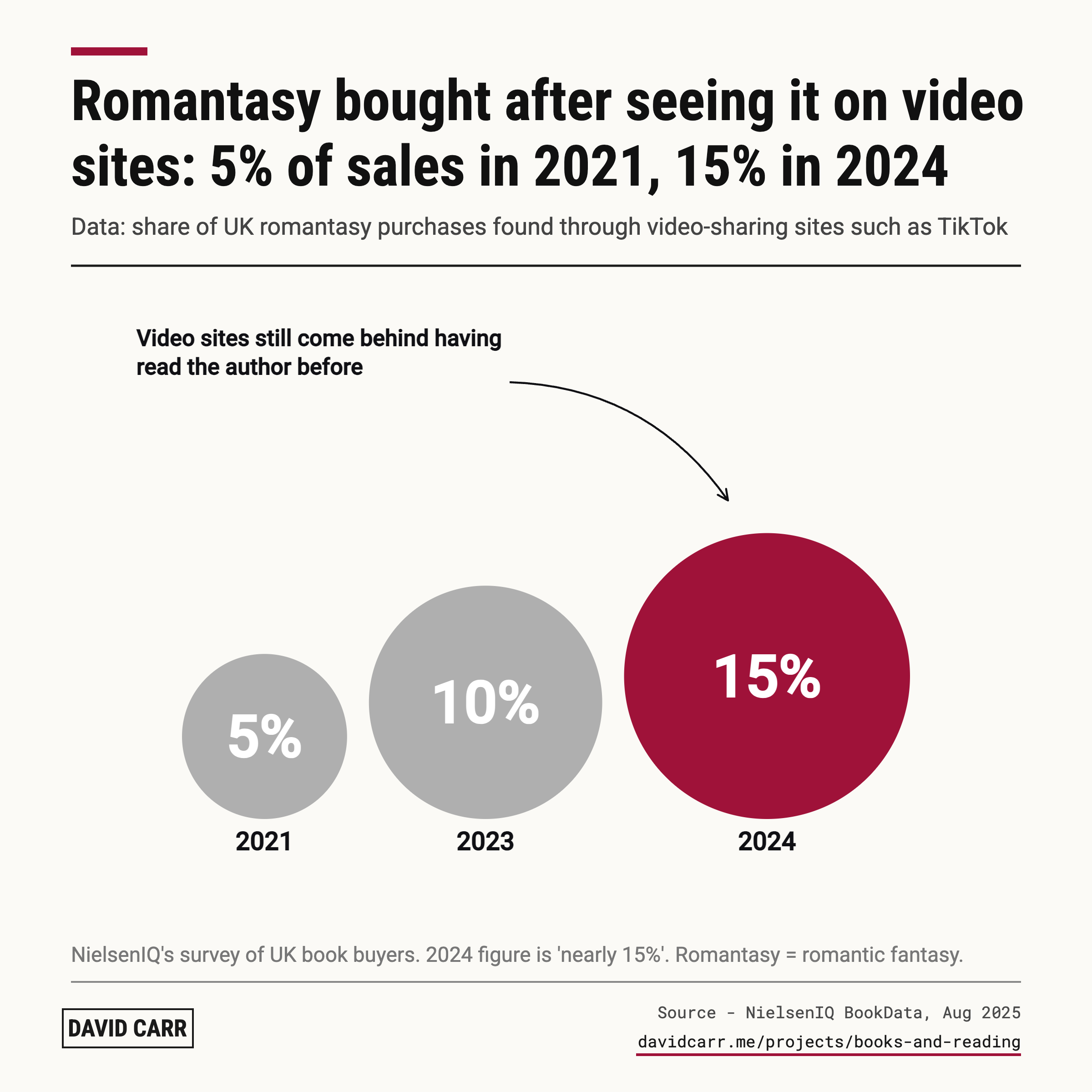
Romantasy bought after seeing it on video sites: 5% of sales in 2021, 15% in 2024
- 2021: 5%
- 2023: 10%
- 2024: nearly 15%
Science fiction and fantasy, where romantasy is counted, had its best UK year on record in 2024 at just under £84m, up 41% (The Bookseller). Two in three romantasy books (66%) were bought by people aged 13 to 34 (NielsenIQ via London Book Fair). In 2025 manga and horror also hit record sales in the UK and Ireland (NielsenIQ).
NielsenIQ BookData, romantasy consumer study, August 2025. Video sites still come behind having read the author before.
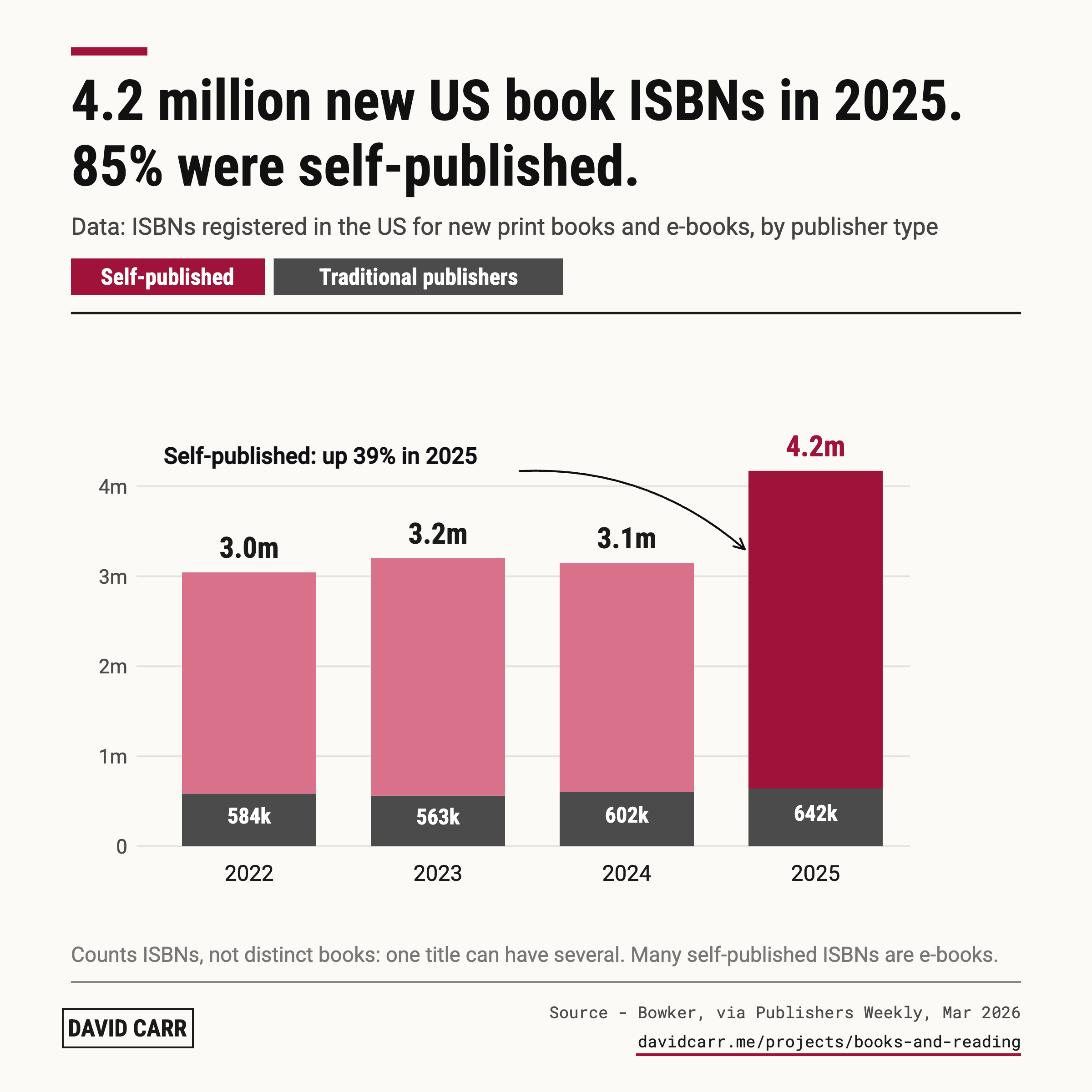
4.2 million new US book ISBNs in 2025. 85% were self-published.
- Traditional publishers: 642,242, up 7%
- Self-published: 3,529,980, up 39%
- Biggest traditional subject: adult fiction, 39,681
For every new book from a traditional publisher there were five or six self-published ones. Self-published fiction alone had 477,104 ISBNs, mostly e-books.
Bowker figures reported by Publishers Weekly, March 2026. ISBNs are identifiers: a hardback, paperback and e-book of one title each get one.
Method, caveats and sources
The short answer. Ireland has more heavy readers than anywhere else in the EU, and women read far more than men. Fiction is where the growth is: UK fiction sales nearly doubled from 2019 to 2025 while non-fiction stood still. Audiobooks are the fastest-growing format, though print still leads. Fewer children say they enjoy reading than at any time in 20 years.
European data. Eurostat table ilc_scp27, from the 2022 EU-SILC survey module on cultural participation, pulled from the Eurostat API on 29 November 2026. People were asked how many books they read in the last 12 months. E-books and audiobooks count. Germany has no 2022 figure. EU totals are Eurostat estimates.
Surveys. Gallup (811 US adults, December 2021), Pew Research Center (8,046 US adults, October 2025), YouGov (British adults, March 2025) and the National Literacy Trust (114,970 UK children, early 2025). Surveys record what people say, and people tend to say they read more than they do. No US government sources are used.
Sales data. Publishers Association yearly figures are publishers' own sales, home and export, as first reported each year; PA revises past years, so years are not perfectly like for like. NielsenIQ BookScan tracks print books sold through tills. Bowker counts ISBNs, not distinct titles.
What is missing. I could not find a free, recent count of new titles published in Ireland or the UK by subject, or Irish public library loans for 2024 and 2025. Both are left out rather than guessed. Paywalled Bookseller figures are not used except where the headline figure was free to read.
Also: How people spend a day and Screen time.