An Irish day: 10 hours on sleep and self-care, 5 on leisure, 4.5 on paid work
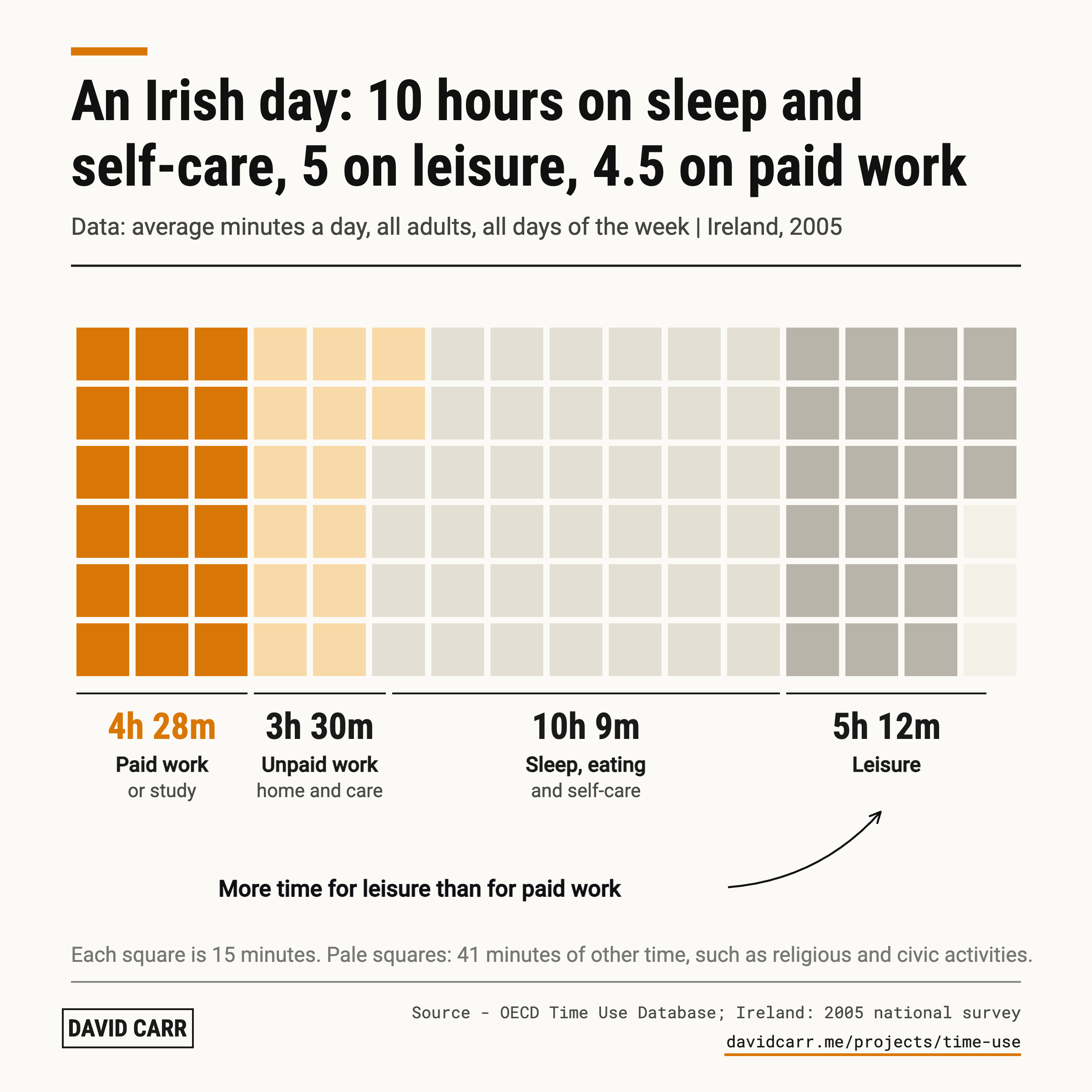
- Sleep, eating and self-care: 10h 09m
- Leisure: 5h 12m
- Paid work or study: 4h 28m
- Unpaid work at home: 3h 30m
Averaged over every adult and every day of the week, including weekends, retired people and students. That is why paid work looks short.
Ireland's figures in the OECD Time Use Database come from the 2005 national time-use survey, the most recent full diary survey of Ireland. Each square on the chart is 15 minutes.
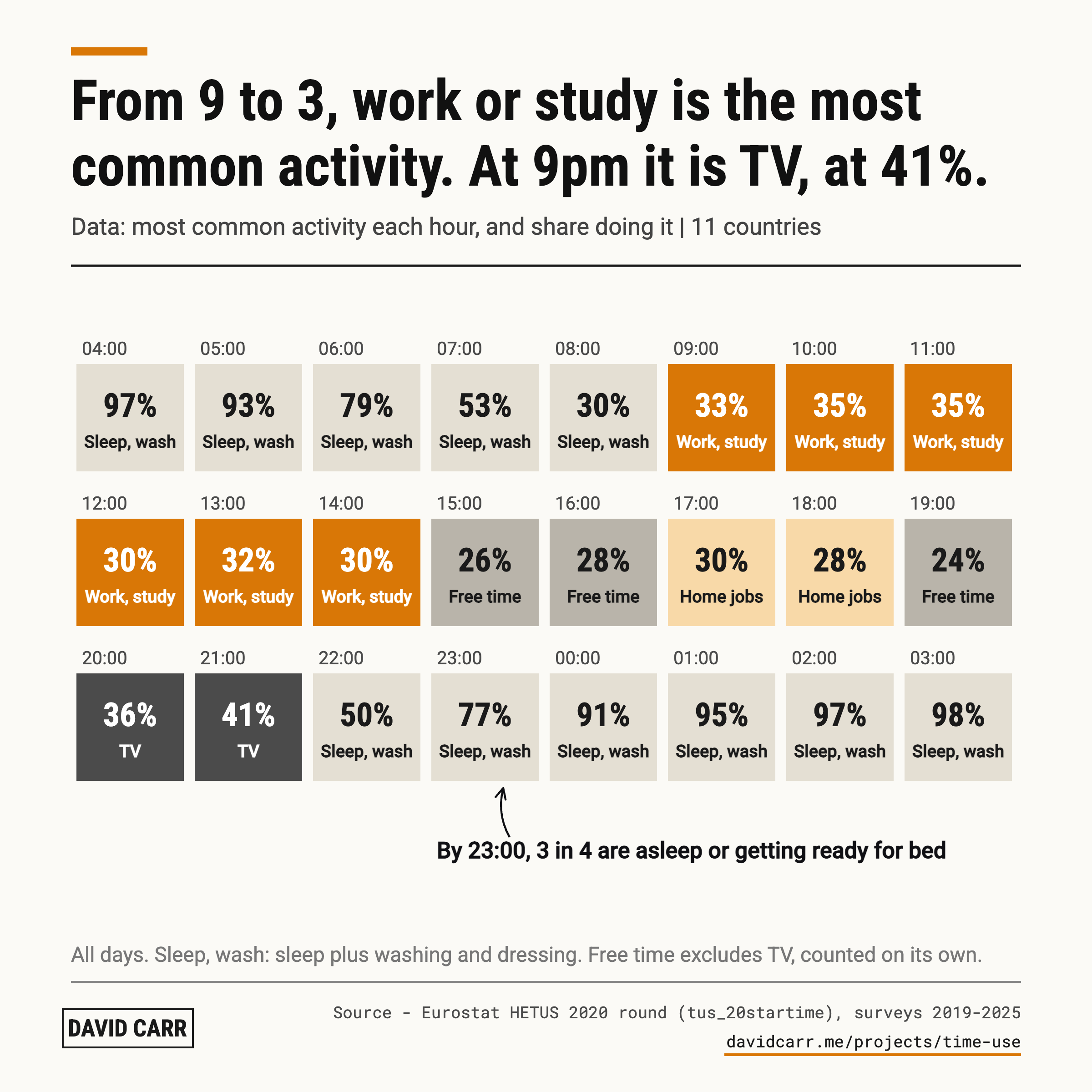
From 9 to 3, work or study is the most common activity. At 9pm it is TV.
- 08:00: 30% still asleep or getting ready
- 10:00 and 11:00: 35% at work or study
- 17:00: 30% doing home jobs
- 21:00: 41% watching TV
The evening belongs to the TV more than to anything else, for two hours. The screen time page goes further into screens.
Share of people doing each activity at each hour, averaged over the 11 countries in Eurostat's 2020 round. The 10-minute slots are averaged into hours.
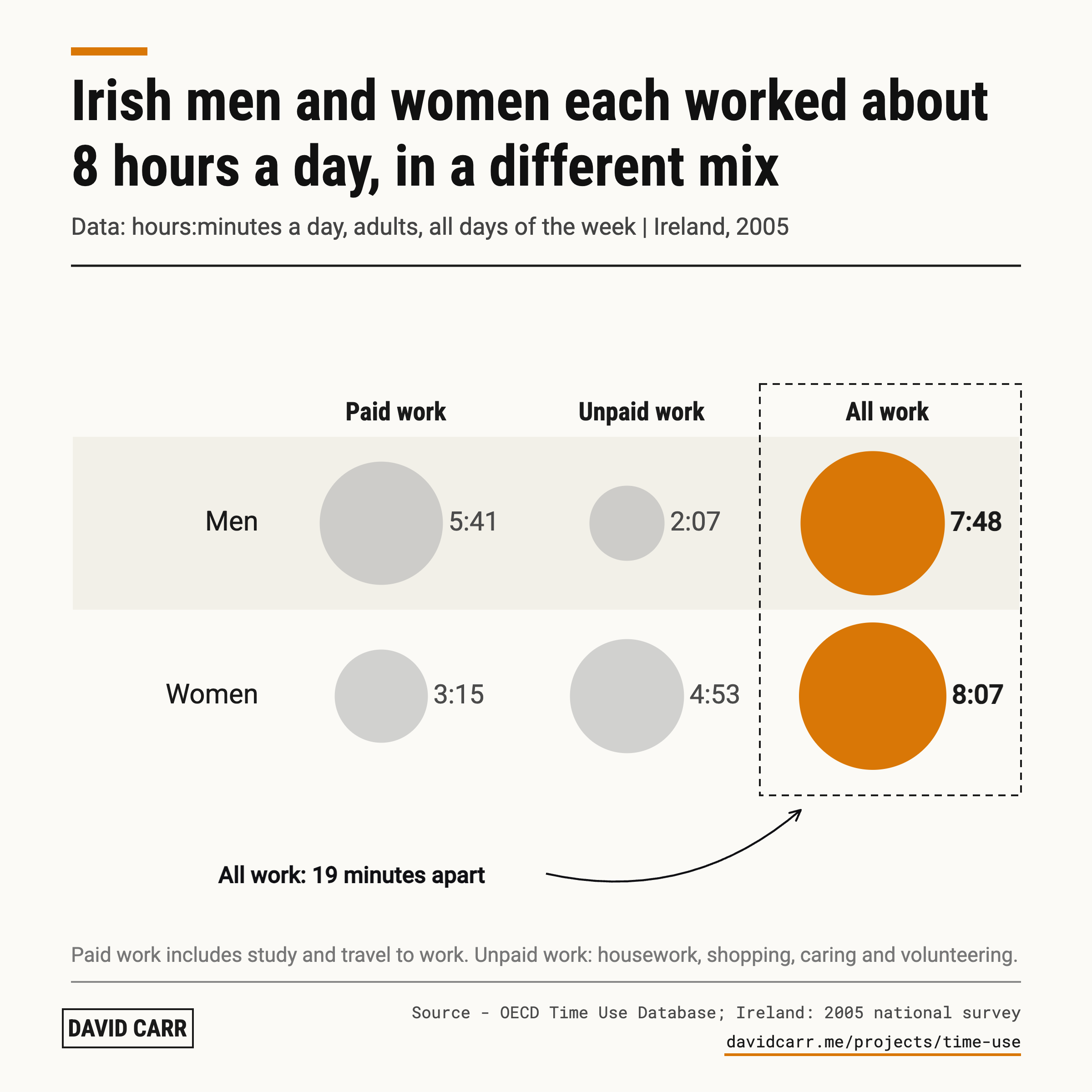
Irish men and women each worked about 8 hours a day, in a different mix
- Men: 5h 41m paid, 2h 07m unpaid, 7h 48m in all
- Women: 3h 15m paid, 4h 53m unpaid, 8h 07m in all
Counting paid and unpaid work together, the totals were 19 minutes apart. The split between them was not.
OECD Time Use Database, Ireland 2005. Unpaid work covers housework, shopping, caring for others and volunteering (OECD).
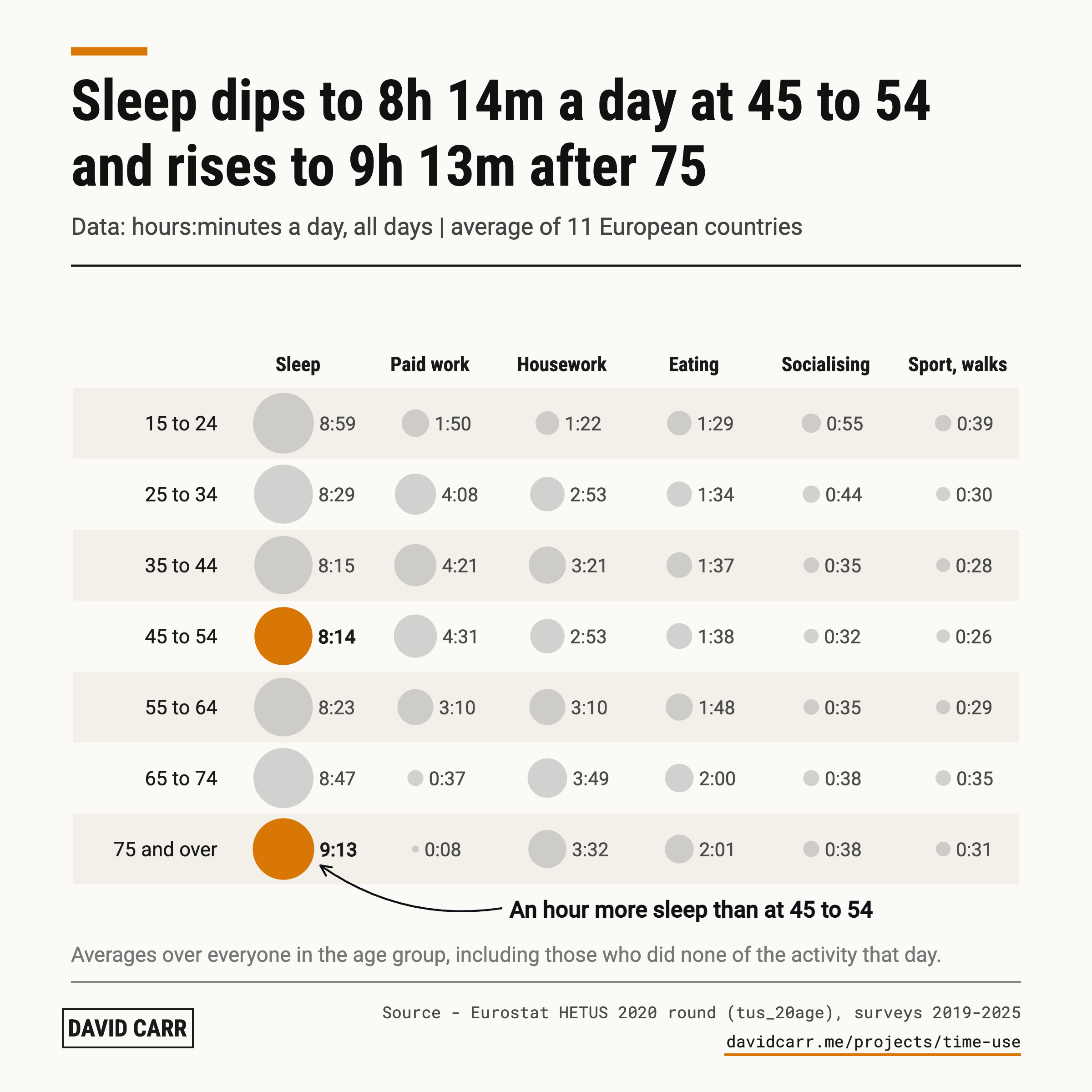
Sleep dips to 8h 14m a day at 45 to 54 and rises to 9h 13m after 75
- 15 to 24: most sleep among working ages (8h 59m) and most socialising (55m)
- 45 to 54: most paid work (4h 31m)
- 65 to 74: most housework (3h 49m)
- 75 and over: 2h 01m eating
Each age has its own shape of day. Paid work peaks in the 40s and early 50s, housework peaks just after retirement, and time at the table rises steadily with age.
Simple average of the 11 countries in Eurostat's tus_20age table (Bulgaria, Germany, Estonia, Croatia, Hungary, Netherlands, Austria, Poland, Finland, Norway, Serbia). Surveys ran from 2019 to 2025 (Eurostat metadata).
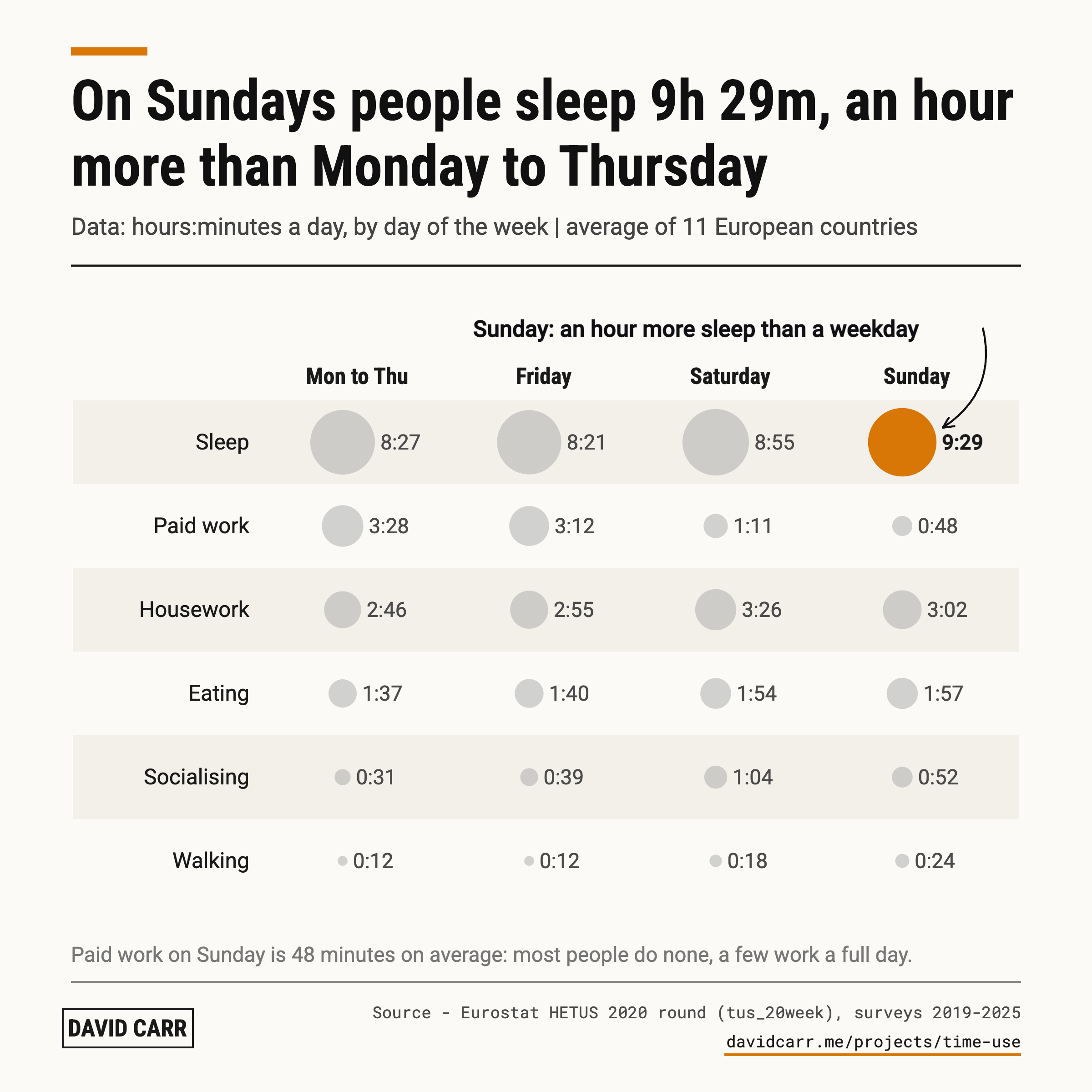
On Sundays people sleep 9h 29m, an hour more than Monday to Thursday
- Sleep: 8h 27m Monday to Thursday, 9h 29m on Sunday
- Paid work: 3h 28m, then 48m on Sunday
- Socialising: 31m, then 1h 04m on Saturday
- Walking: doubles to 24m on Sunday
Saturday is for housework (3h 26m) and seeing people. Sunday is for sleep, eating and a walk.
Eurostat tus_20week, average of the same 11 countries. Averages over everyone, whatever day they kept their diary.
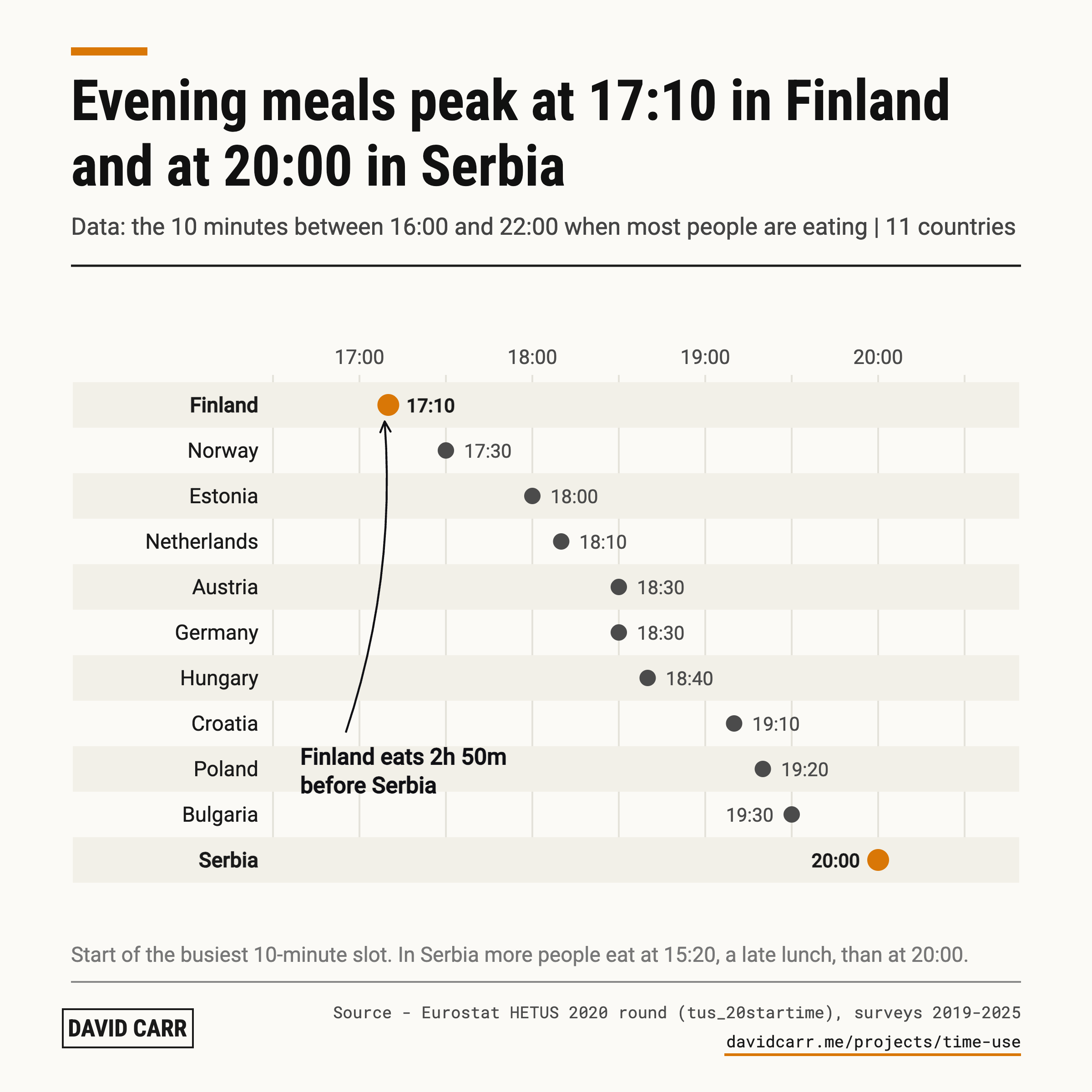
Evening meals peak at 17:10 in Finland and at 20:00 in Serbia
- Finland 17:10, Norway 17:30
- Estonia 18:00, Netherlands 18:10
- Germany and Austria 18:30
- Poland 19:20, Bulgaria 19:30, Serbia 20:00
The Nordic countries eat first, the Balkan countries last. The Netherlands has the sharpest peak: 32% of people are eating at 18:10.
The 10-minute slot between 16:00 and 22:00 with the highest share of people eating, from Eurostat tus_20startime. In Serbia the bigger peak is 15:20, a late main meal.
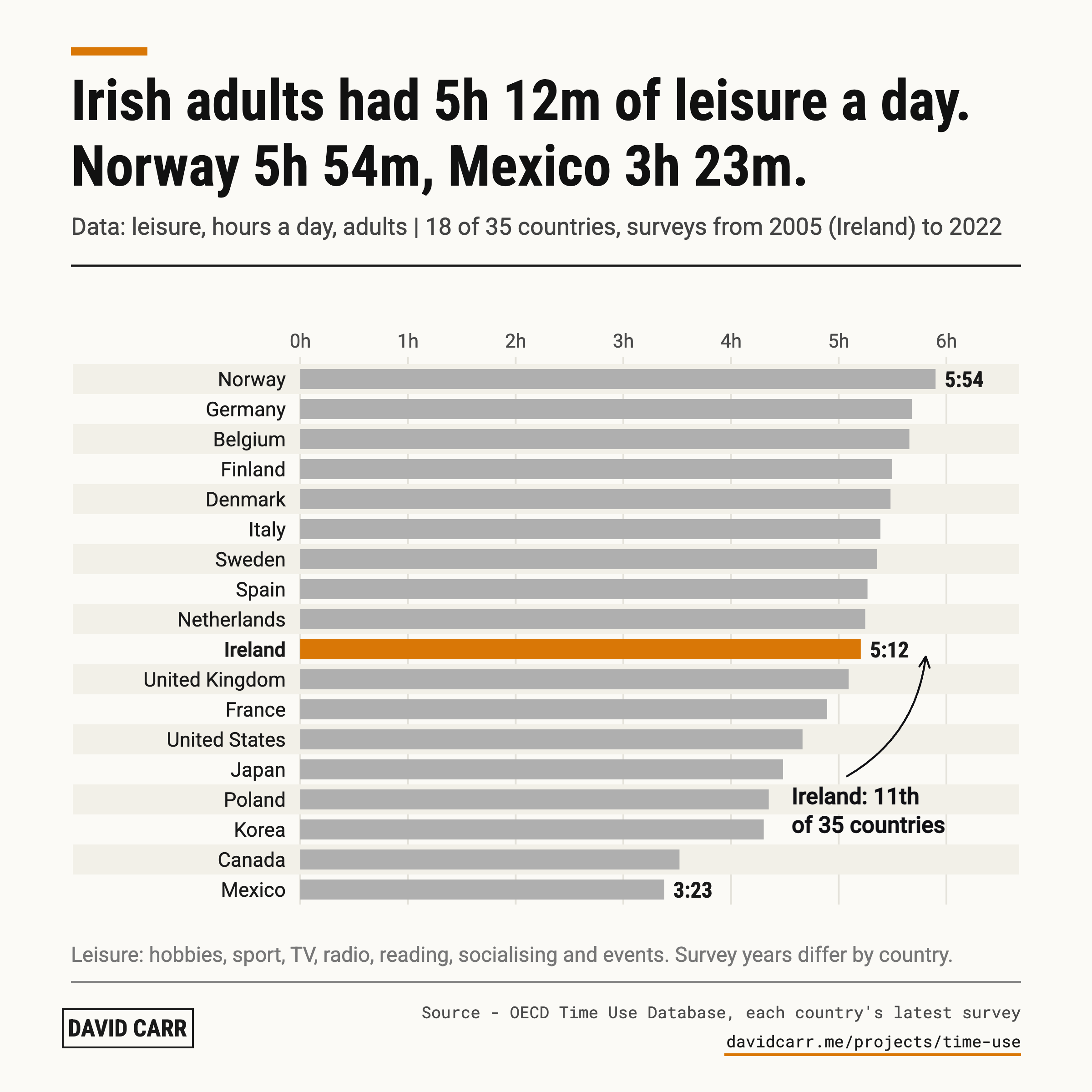
Irish adults had 5h 12m of leisure a day. Norway 5h 54m, Mexico 3h 23m.
- Norway: 5h 54m
- Germany: 5h 41m
- Ireland: 5h 12m, 11th of 35
- United States: 4h 40m
- Mexico: 3h 23m
Ireland sits in the upper middle, just ahead of the UK (5h 06m) and France (4h 54m).
OECD Time Use Database, each country's latest survey. Survey years range from 2005 to 2022, so the comparison is rough.
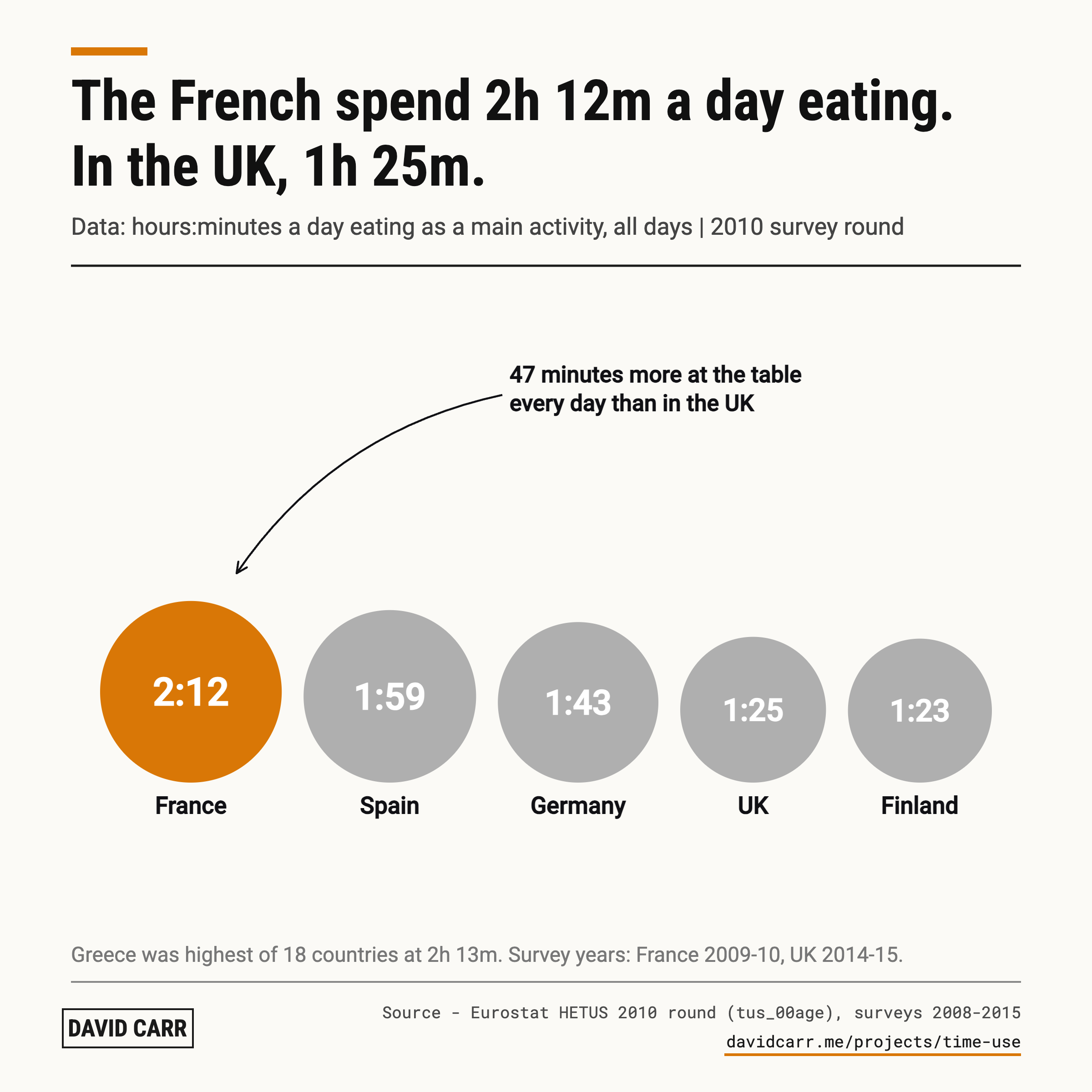
The French spend 2h 12m a day eating. In the UK, 1h 25m.
- Greece: 2h 13m
- France: 2h 12m
- Spain: 1h 59m
- Germany: 1h 43m
- UK: 1h 25m, Finland: 1h 23m
Eating as a main activity: a snack at the desk does not count, but a long lunch does.
Eurostat tus_00age, 2010 round. Surveys from 2008 (Italy) to 2015 (UK). Ireland was not part of the round.
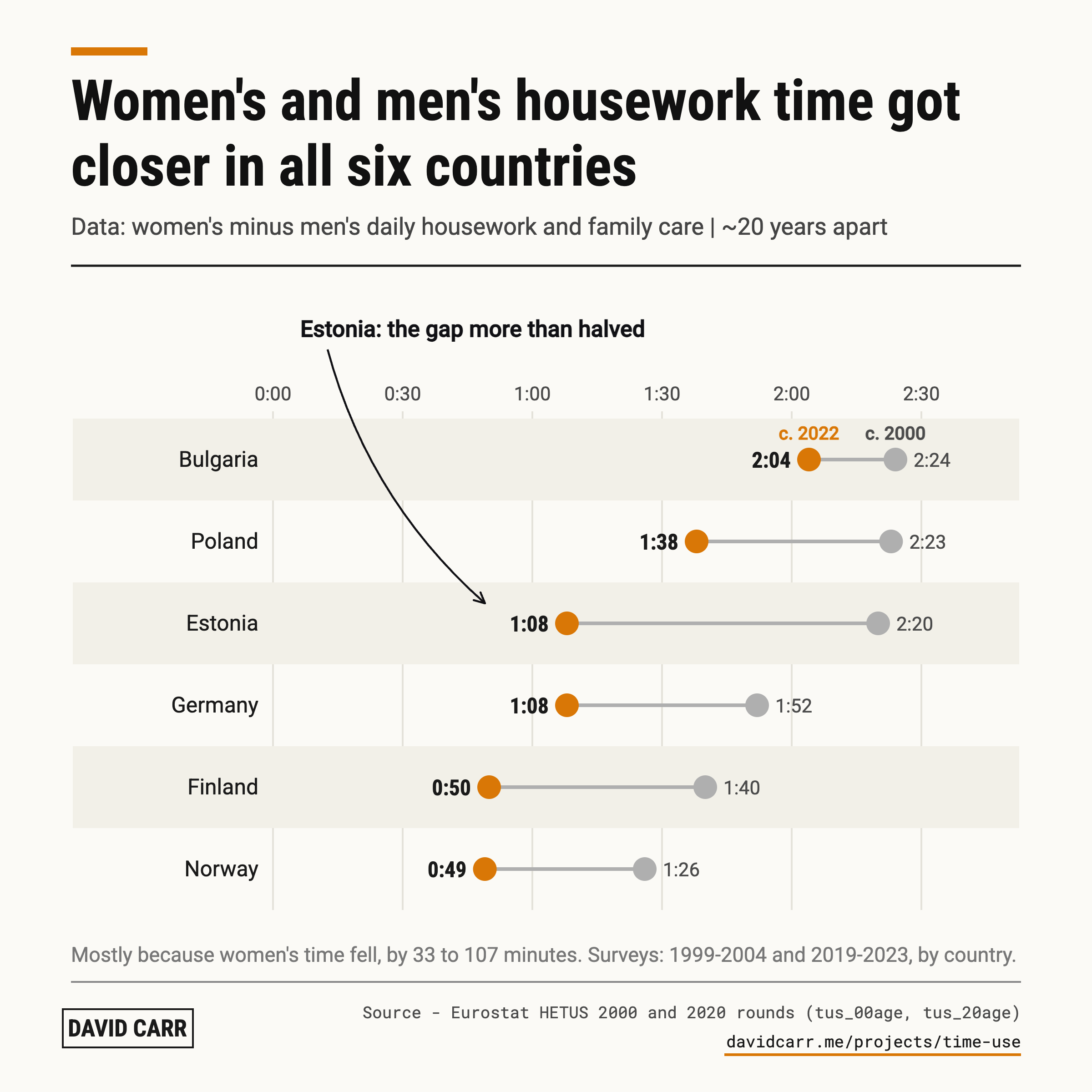
Women's and men's housework time got closer in all six countries
- Estonia: gap 2h 20m, now 1h 08m
- Germany: 1h 52m, now 1h 08m
- Finland: 1h 40m, now 50m
- Norway: 1h 26m, now 49m
- Poland and Bulgaria: smaller falls
Most of the change came from women spending less time on housework, by between 33 and 107 minutes a day. Men's time changed less, from 44 minutes less to 12 minutes more.
Household and family care, Eurostat tus_00age (2000 round) and tus_20age (2020 round). The activity codes were revised between rounds, so read small changes with care.
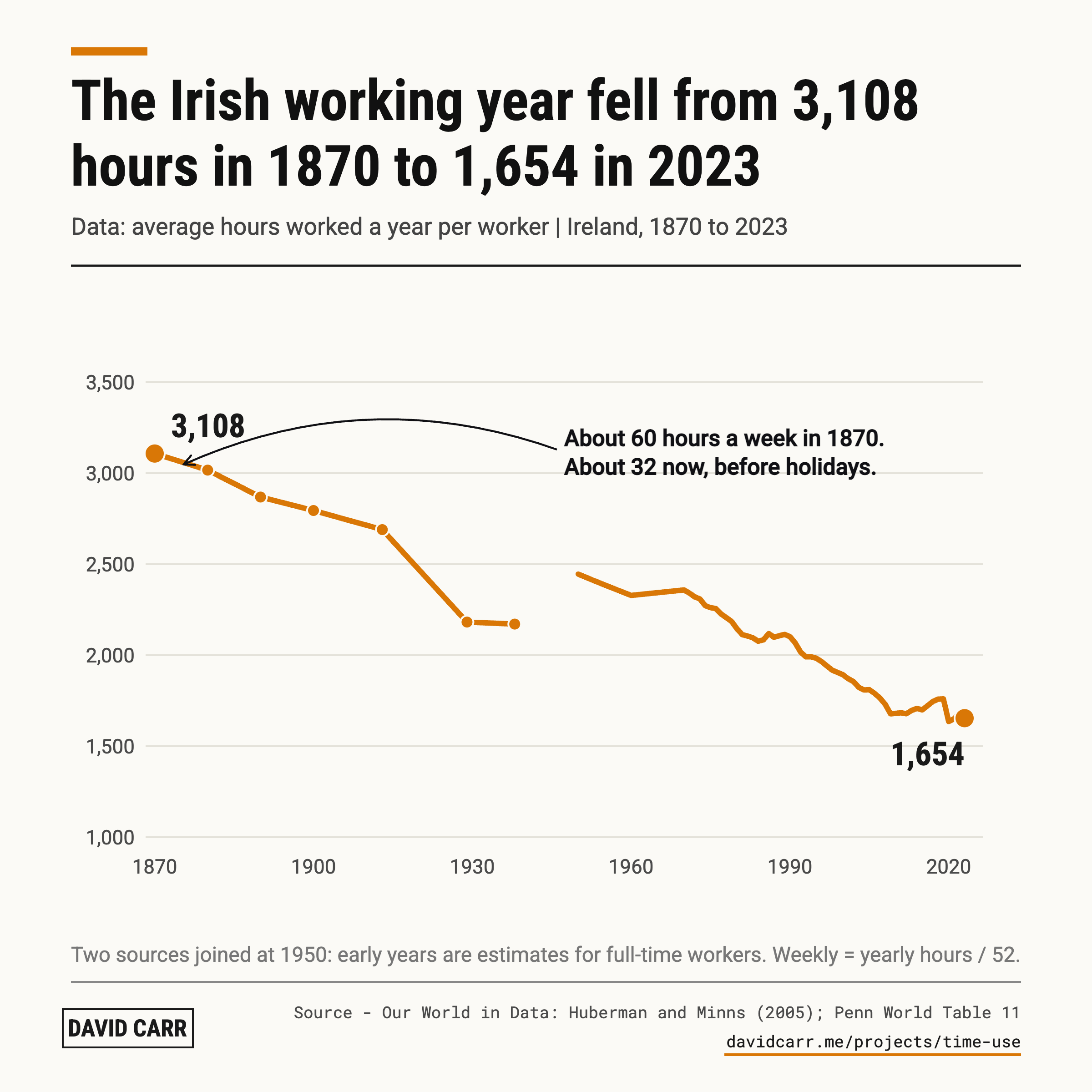
The Irish working year fell from 3,108 hours in 1870 to 1,654 in 2023
- 1870: 3,108 hours
- 1929: 2,182
- 1973: 2,309
- 2000: 1,893
- 2023: 1,654
Spread over 52 weeks, that is about 60 hours a week then and 32 now, before holidays are taken off.
Our World in Data, from Huberman and Minns (2005) up to 1938 and Penn World Table 11 from 1950. The two are not quite like for like.
Method, caveats and sources
The short answer. An average Irish adult spent about 10 hours a day on sleep, eating and self-care, 5 on leisure, 4.5 on paid work or study and 3.5 on unpaid work. Across Europe, sleep is lowest in middle age and on weekdays, the evening meal can be three hours apart from one country to the next, and the housework gap between women and men has narrowed.
Ireland. Ireland's only full national time-use diary survey was run in 2005. Its results are in the OECD Time Use Database (pulled from the OECD API, 29 November 2026). No newer Irish diary survey has been published, so the Irish figures are 20 years old. Ireland is not in Eurostat's harmonised surveys.
Europe. Eurostat's Harmonised European Time Use Surveys (HETUS): people keep a diary in 10-minute slots for one weekday and one weekend day, spread across a year. The 2020 round covers 11 countries with surveys from 2019 to 2025; the 2000 and 2010 rounds ran from 1998 to 2006 and 2008 to 2015 (2020 metadata, 2000 and 2010 metadata). Averages across countries are simple means, not weighted by population. Some 2020-round fieldwork fell during Covid restrictions.
Averages. Every figure is an average over everyone, including people who did none of that activity that day. So paid work looks low because it includes weekends, retired people and students.
Working hours. Annual hours per worker from Our World in Data, which joins Huberman and Minns (2005) to the Penn World Table. Read more on time use at Our World in Data.
Also: Screen time, How Ireland gets to work, How Ireland works now and Later lives.