Hermès passed Louis Vuitton in 2026. Nike went from 9th to 32nd in three years.
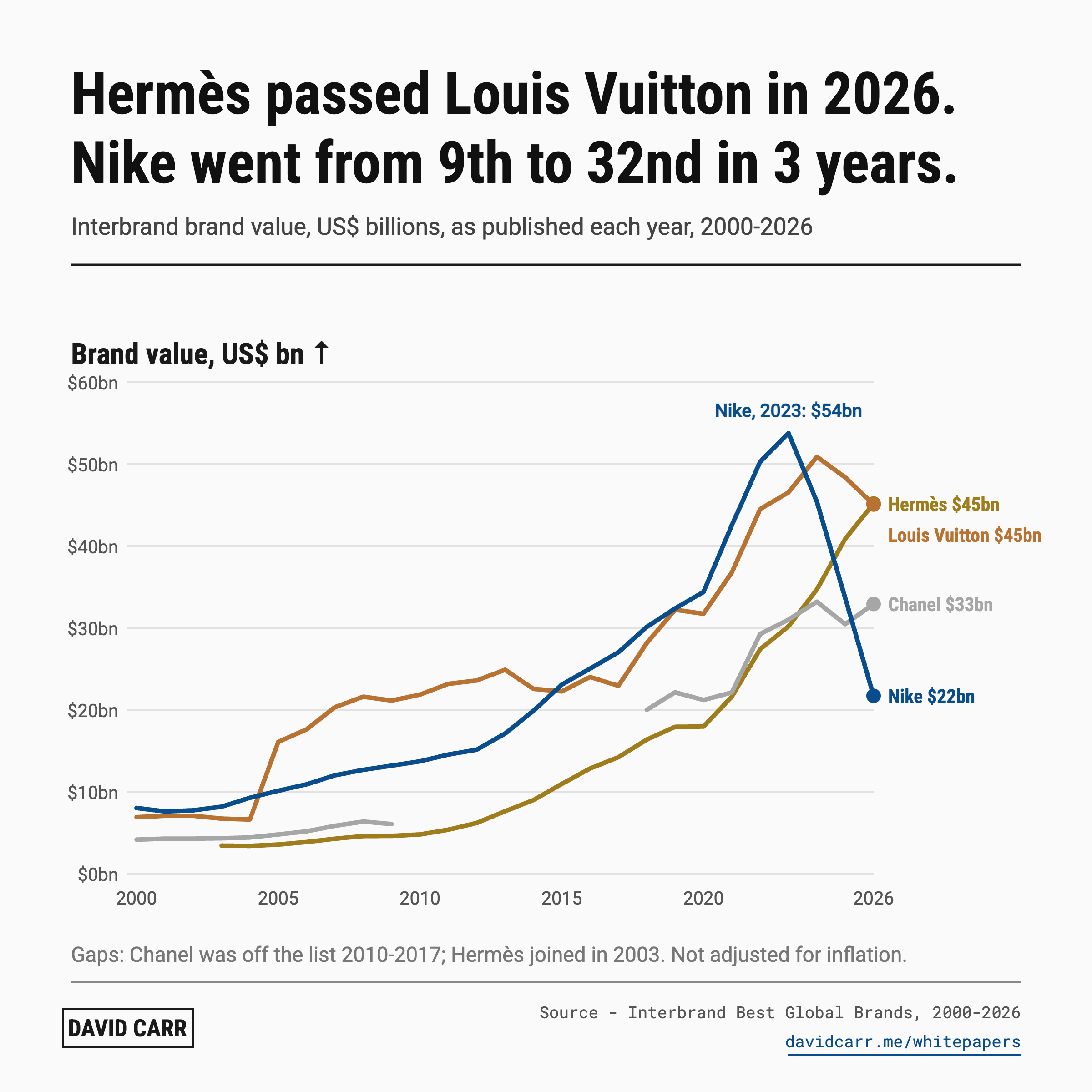
- Hermès: $45.2bn, 15th. Louis Vuitton: $45.1bn, 16th. The first year Hermès has been ahead
- Hermès joined the list in 2003 at $3.4bn, 73rd
- Nike: $53.8bn and 9th in 2023, $21.7bn and 32nd in 2026, down 60%
- Chanel: $32.9bn, 24th
For most of the 2010s Nike and Louis Vuitton ran close at the top of fashion. Hermès climbed steadily and is now level with Louis Vuitton.
Interbrand’s value as published each year, in US dollars, not adjusted for inflation. Chanel was off the list from 2010 to 2017.
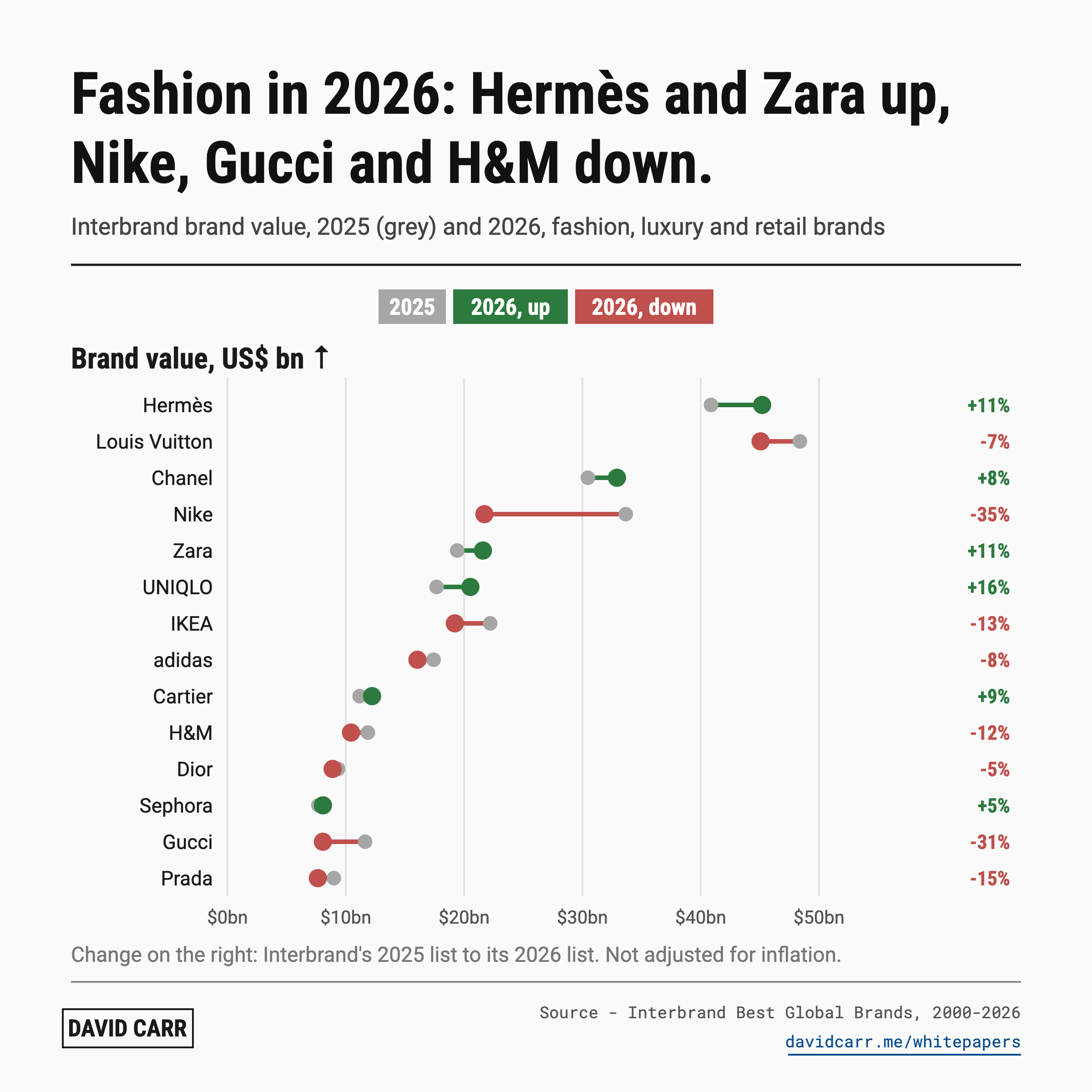
In 2026, Hermès, Zara and UNIQLO gained. Nike lost 35% and Gucci 31%.
- Up: UNIQLO +16%, Hermès +11%, Zara +11%, Cartier +9%, Chanel +8%, Sephora +5%
- Down: Nike −35%, Gucci −31%, Prada −15%, IKEA −13%, H&M −12%
- Also down: adidas −8%, Louis Vuitton −7%, Dior −5%
Six of the fourteen fashion, luxury and home brands on the list grew in 2026. Eight fell.
Change in Interbrand brand value from the 2025 list to the 2026 list.
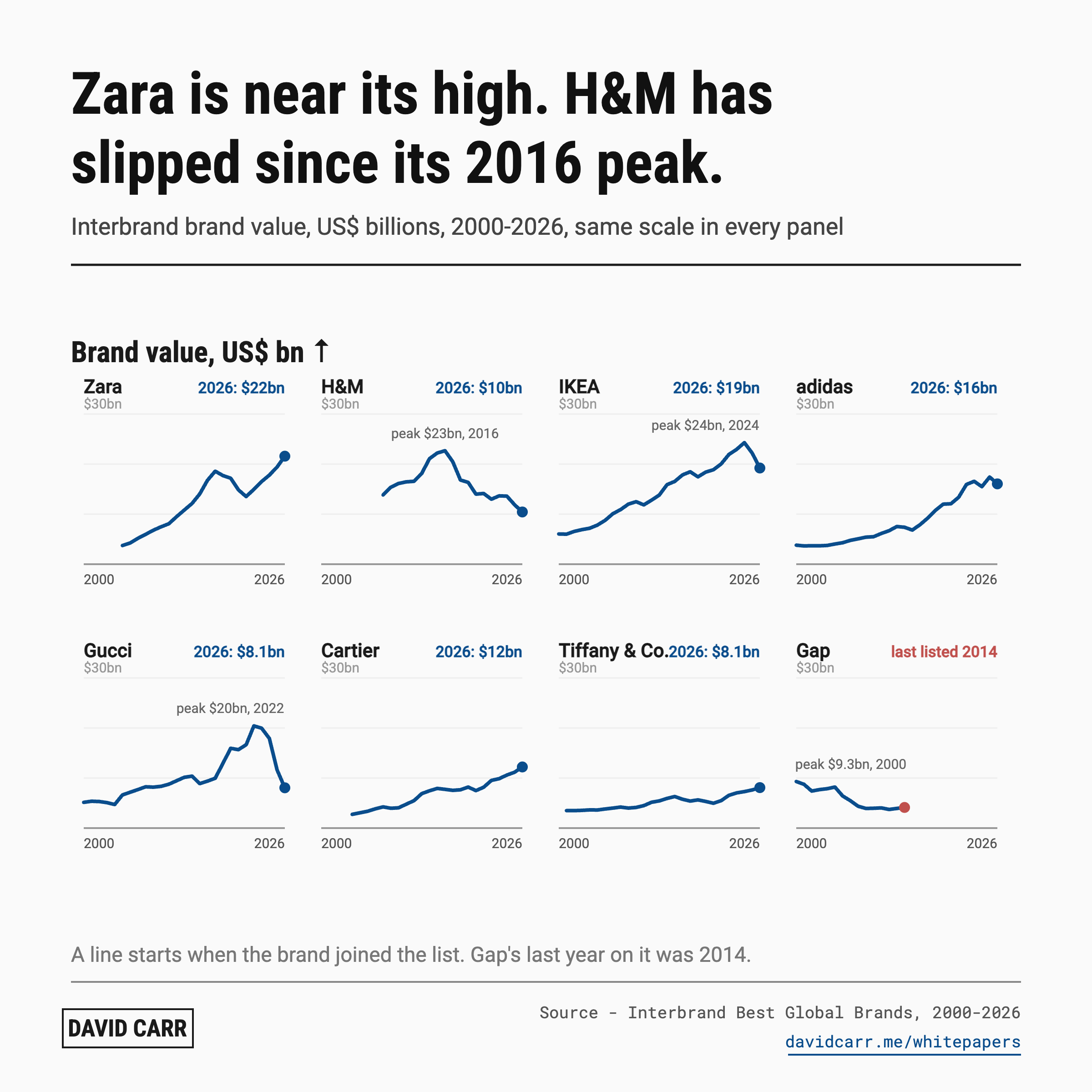
Zara is near its high. H&M has slipped since its 2016 peak.
- Zara: $3.7bn when it joined in 2005, $21.6bn in 2026
- H&M: $22.7bn in 2016, $10.4bn in 2026 (80th)
- IKEA: $24.3bn in 2024, $19.2bn in 2026. adidas: $17.4bn in 2025, $16.1bn in 2026
- Gucci: $20.4bn in 2022, $8.1bn in 2026. Cartier and Tiffany at their highest yet: $12.2bn and $8.1bn
- Gap: $9.3bn in 2000; its last year on the list was 2014
UNIQLO is not shown here: it only joined the list in 2025, at $17.7bn, and was $20.5bn in 2026.
All panels share one scale, top line $30bn.
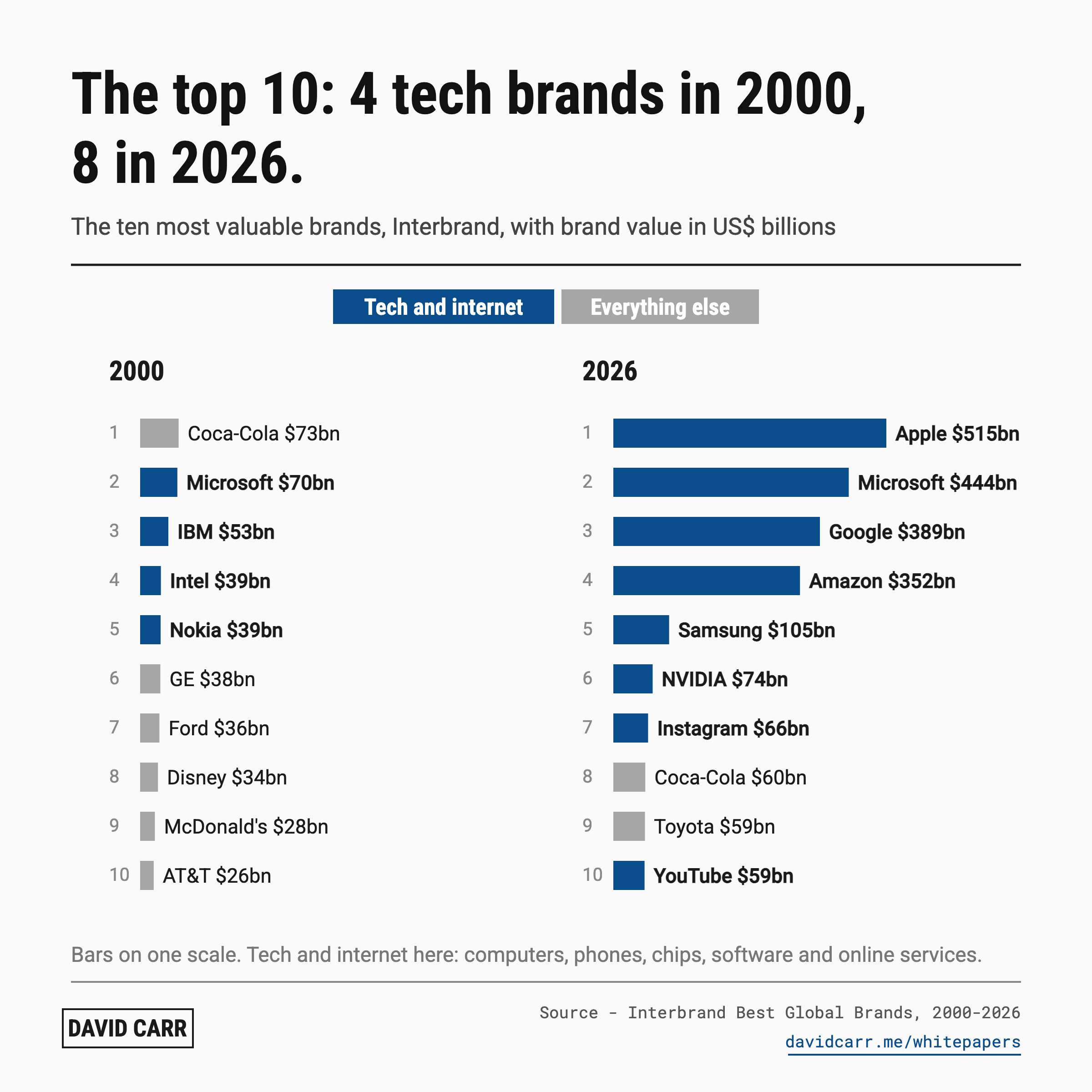
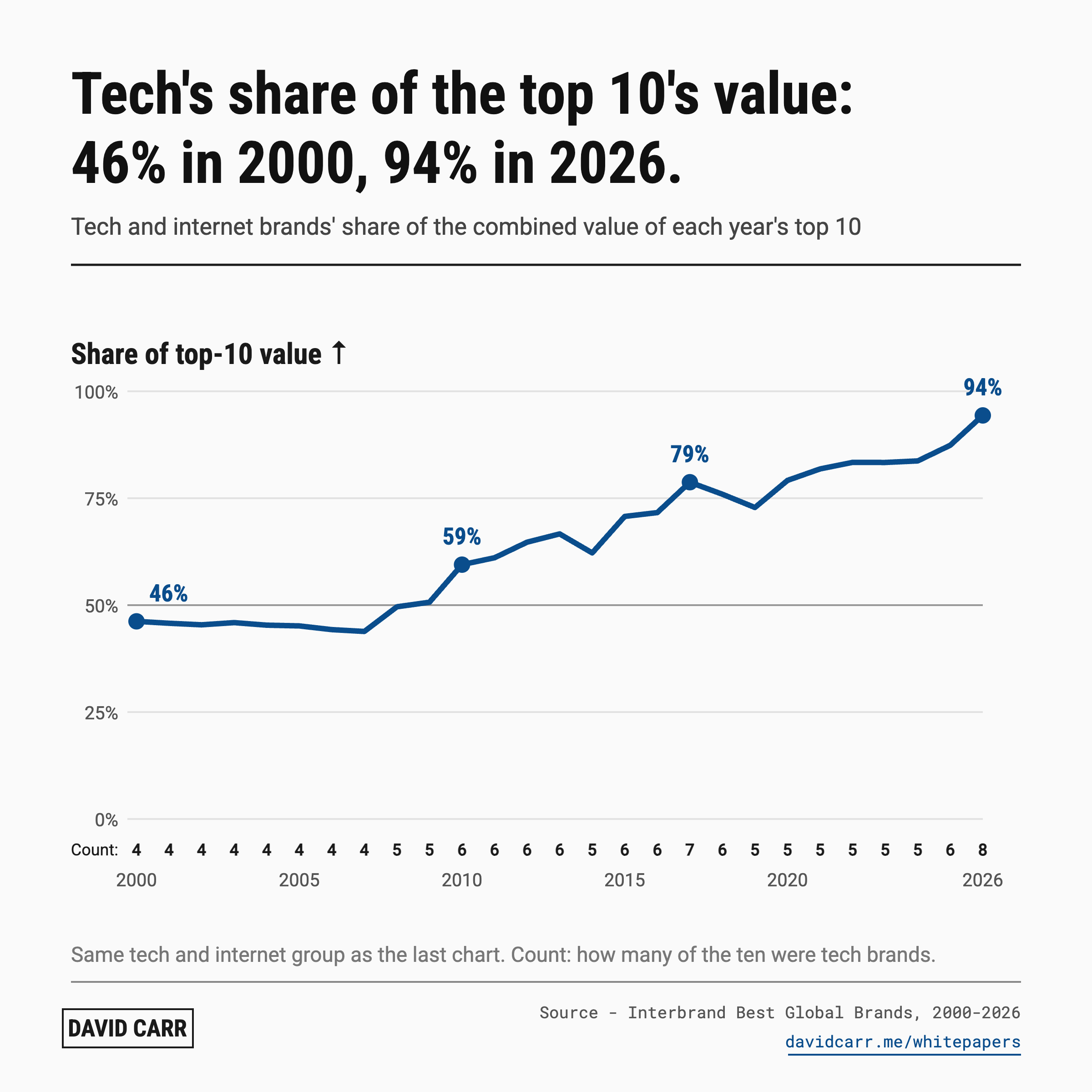
The top 10 had four tech brands in 2000. In 2026, eight.
- 2000: Coca-Cola, Microsoft, IBM, Intel, Nokia, GE, Ford, Disney, McDonald’s, AT&T
- 2026: Apple, Microsoft, Google, Amazon, Samsung, NVIDIA, Instagram, Coca-Cola, Toyota, YouTube
- Apple in 2026: $515bn. Coca-Cola, number one in 2000 at $73bn, is eighth at $60bn
Only two names are in both lists: Microsoft and Coca-Cola.
Tech and internet here means computers, phones, chips, software and online services. Amazon is counted as tech, as Interbrand now does.
Tech’s share of the top 10’s value: 46% in 2000, 94% in 2026.
- 2000 to 2007: four tech brands in the top 10, worth 44% to 46% of its value
- 2010: 59%. 2017: 79%. 2026: 94%
- The count of tech brands moved between four and seven until 2026, when it reached eight
Even in years when the count of tech brands did not change, their share of the value kept growing, because the biggest of them grew fastest.
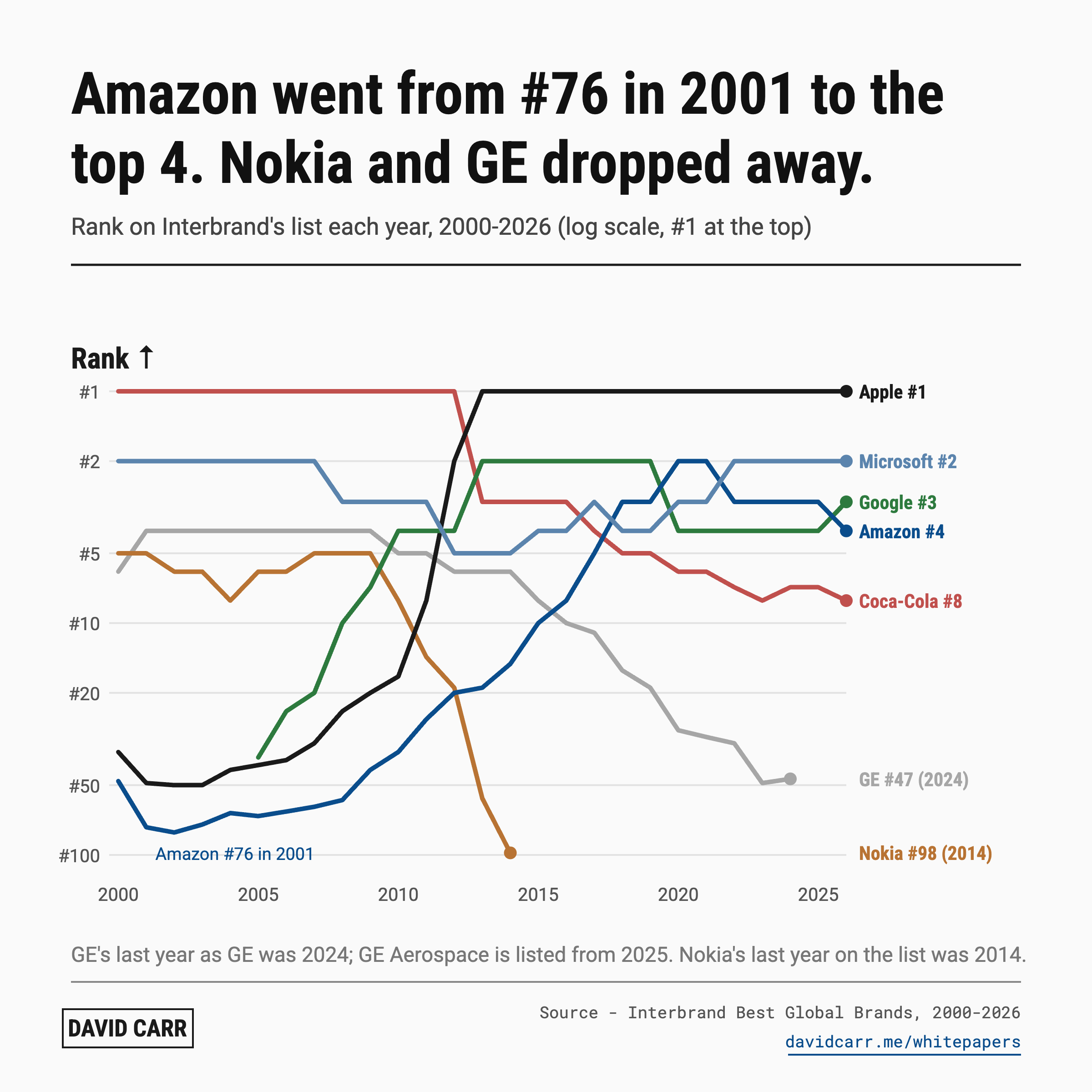
Amazon went from 76th in 2001 to the top four. Nokia and GE dropped away.
- Coca-Cola was first every year from 2000 to 2012. It is eighth in 2026
- Apple has been first every year since 2013
- Google joined in 2005 at 38th and was in the top 10 by 2008
- Nokia was fifth as late as 2009; its last year on the list was 2014, at 98th
- GE was 47th in 2024, its last year under that name
Four brands have held the top four places since 2018: Apple, Microsoft, Google and Amazon, in changing order.
Rank on a log scale, so moves near the top show clearly.
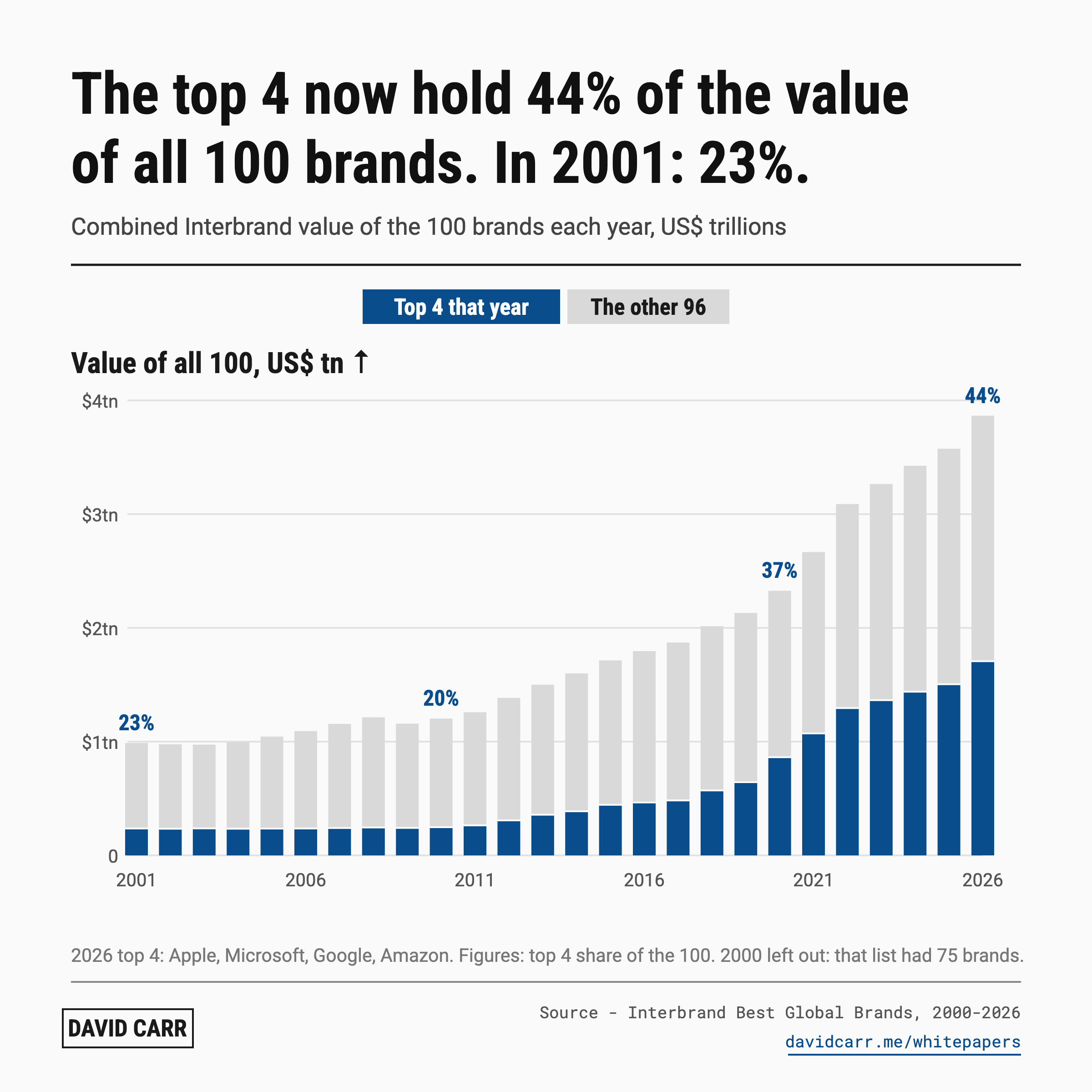
The top four brands now hold 44% of the value of all 100. In 2001, 23%.
- Combined value of the 100: $988bn in 2001, $3.87 trillion in 2026
- Top four’s share: 20% to 25% every year from 2001 to 2017
- 37% in 2020, 42% from 2022 to 2025, 44% in 2026
- 2026 top four: Apple, Microsoft, Google and Amazon, worth $1.7 trillion together
The list has grown almost four times in value since 2001, and about half of the growth went to the four at the top.
2000 is left out: Interbrand’s first list had 75 brands.
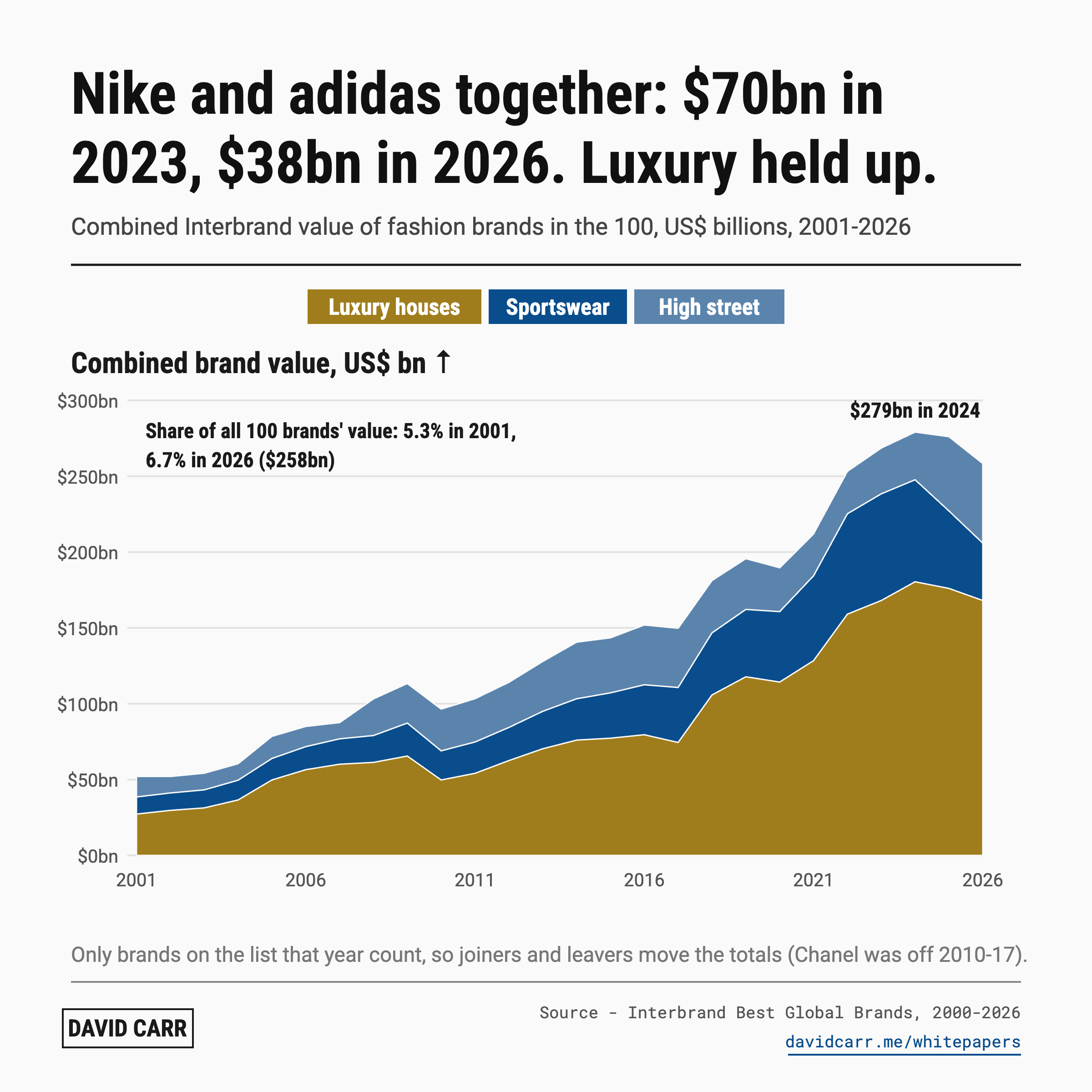
Nike and adidas together: $70bn in 2023, $38bn in 2026. Luxury held up better.
- Luxury houses on the list: $27bn in 2001, $180bn at the peak in 2024, $168bn in 2026
- Sportswear: $11bn in 2001, $70bn in 2023, $38bn in 2026
- High street: $53bn in 2026, helped by UNIQLO joining in 2025
- All fashion together: 5.3% of the 100’s value in 2001, 6.7% in 2026
Fashion brands grew a little faster than the list as a whole over 25 years. The fall since 2024 is mostly sportswear.
Only brands on the list in a given year count, so a brand joining or leaving moves the totals. The 2010 dip is partly Chanel and Rolex leaving.
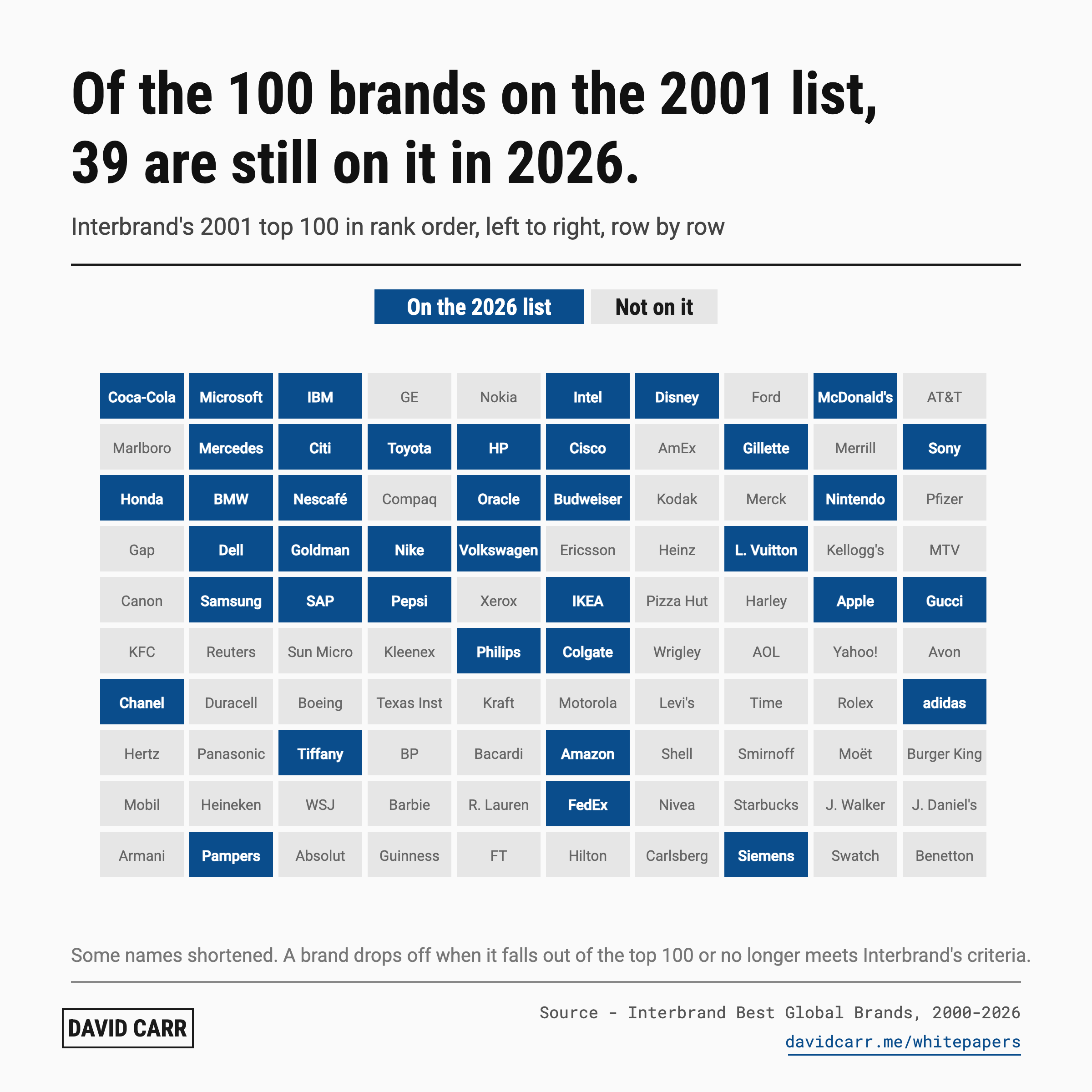
Of the 100 brands on the 2001 list, 39 are still there in 2026.
- Still there include Coca-Cola, Microsoft, IBM, Disney, McDonald’s, Nike, Louis Vuitton, Gucci, IKEA, Amazon and adidas
- Gone include GE, Nokia, Ford, Kodak, Gap, Levi’s, Marlboro, Yahoo! and Starbucks
- Of Interbrand’s first 75, in 2000, 33 are on the 2026 list
In 25 years, three in five of the world’s most valuable brands changed.
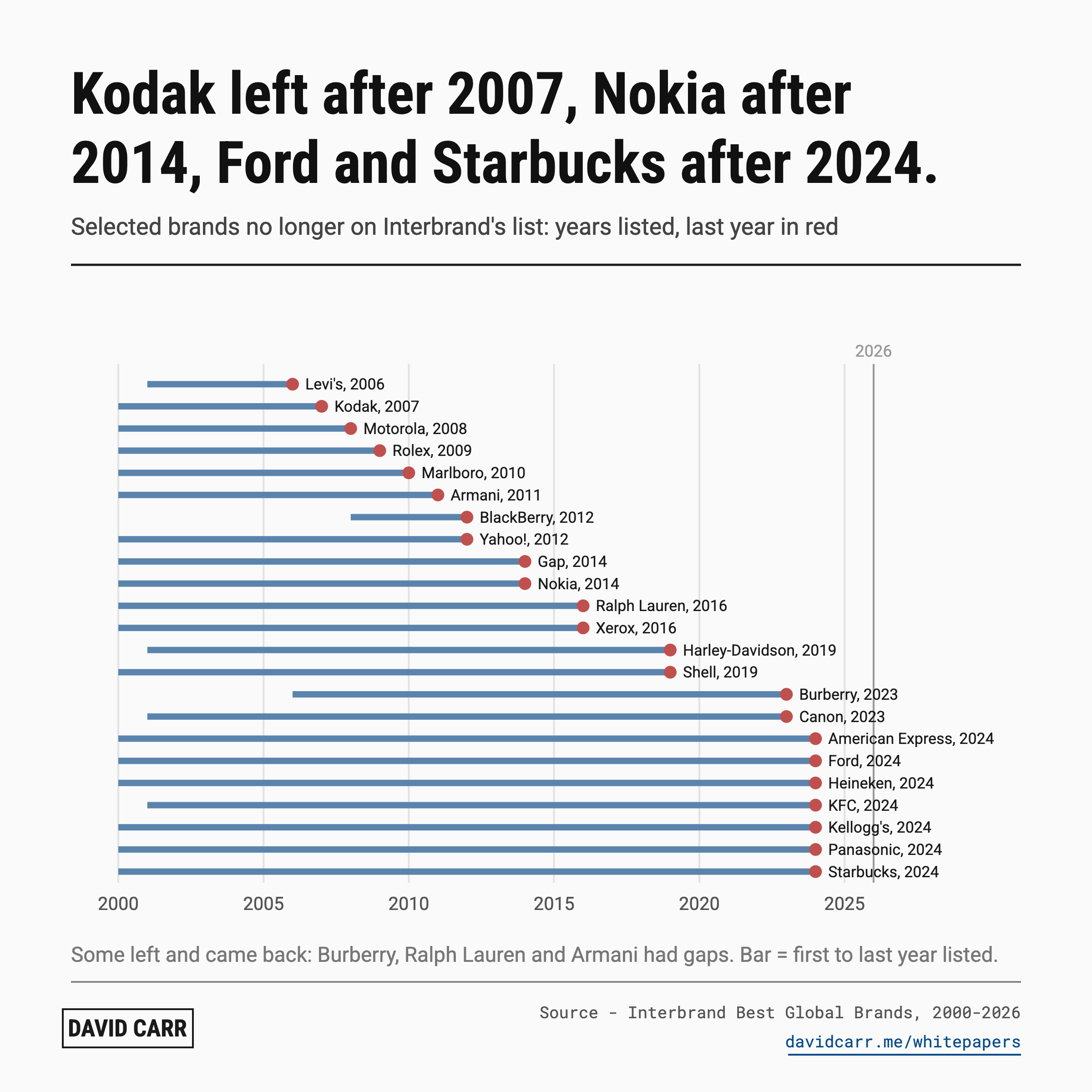
Some brands on both lists dropped off for a while in between.
Kodak left after 2007, Nokia after 2014, Ford and Starbucks after 2024.
- Levi’s 2006, Kodak 2007, Motorola 2008, Rolex 2009, Marlboro 2010
- Yahoo! and BlackBerry 2012, Gap and Nokia 2014, Ralph Lauren and Xerox 2016
- Burberry and Canon 2023
- 2024 was the last year for seven: American Express, Ford, Heineken, KFC, Kellogg’s, Panasonic and Starbucks
The year shown is the last year on the list. It says nothing about the company’s sales: a brand can fall off when others grow past it, or when it no longer meets Interbrand’s rules.
GE is left out: it appears as GE Aerospace from 2025.
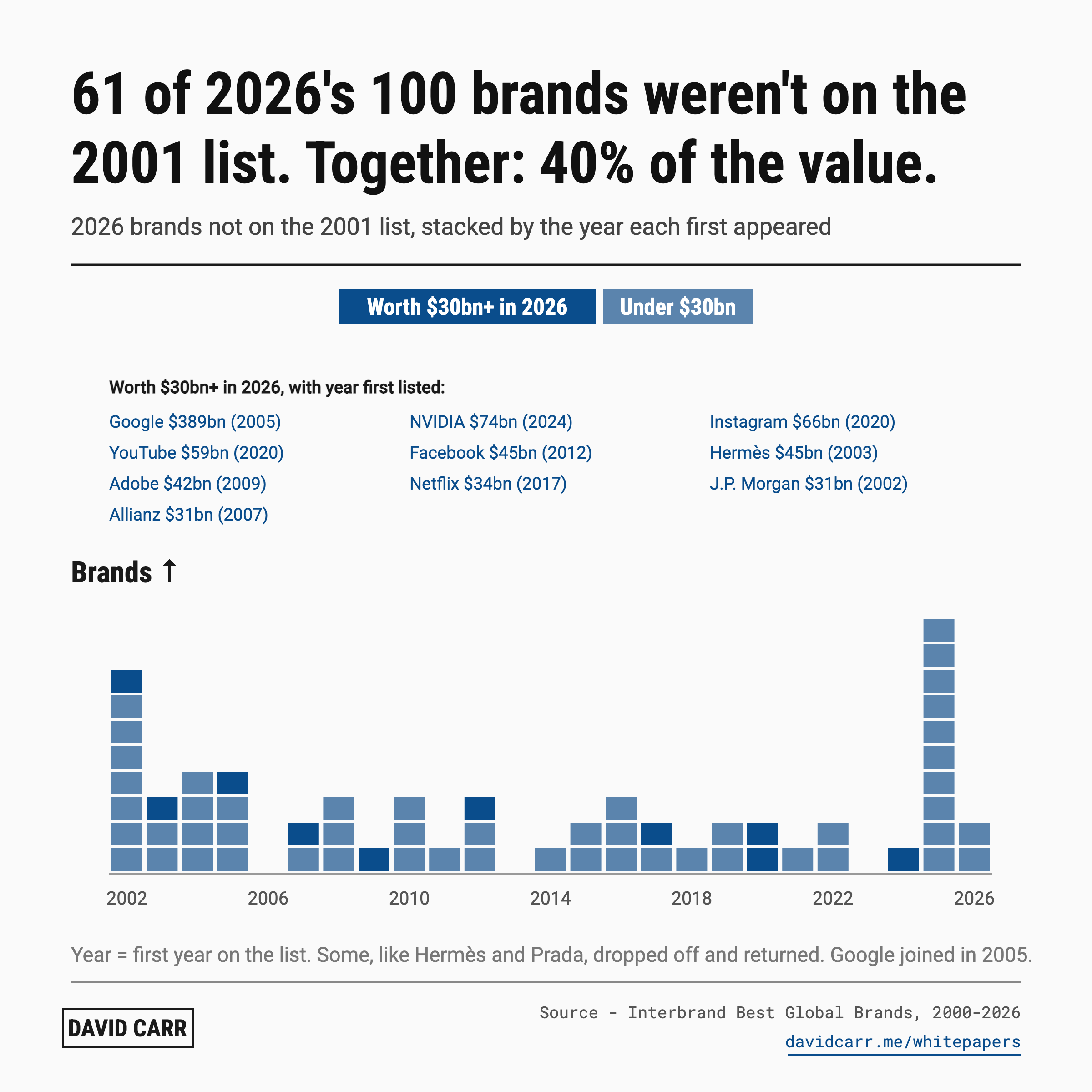
61 of 2026’s 100 brands were not on the 2001 list. Together they hold 40% of the value.
- Their combined value: $1,556bn of $3,866bn
- The biggest: Google ($389bn, first listed 2005), NVIDIA ($74bn, 2024), Instagram ($66bn, 2020), YouTube ($59bn, 2020)
- Fashion and shopping newcomers: Hermès (2003), Zara (2005), H&M (2008), Sephora (2021), UNIQLO (2025)
- 2025 brought 12 new brands, the most of any year
Most of the newcomers’ value sits in a handful of internet names.
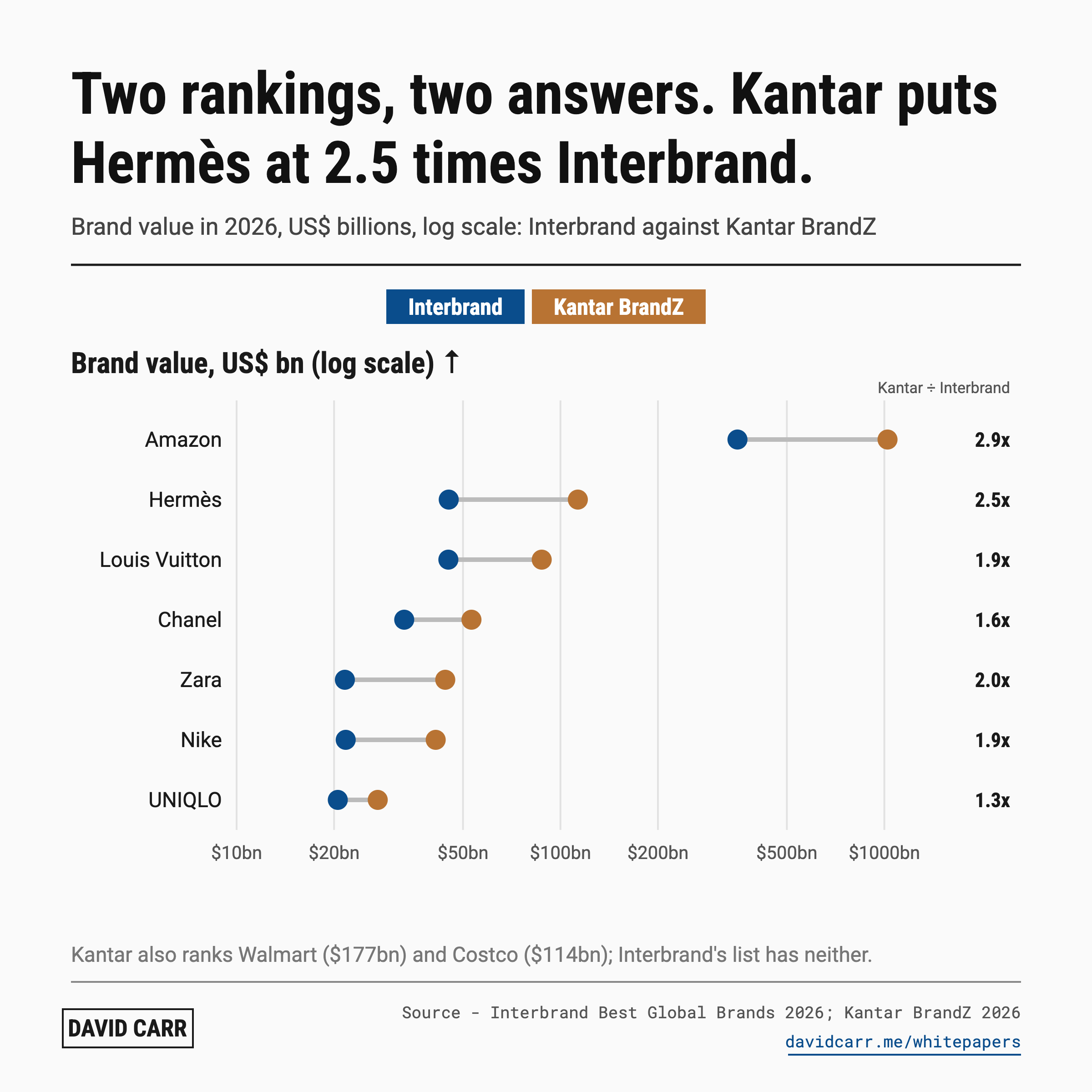
Two rankings, two answers. Kantar puts Hermès at 2.5 times Interbrand’s figure.
- Hermès: $45bn (Interbrand) against $113bn (Kantar)
- Amazon: $352bn against $1,023bn
- Louis Vuitton 1.9 times, Nike 1.9, Zara 2.0, Chanel 1.6, UNIQLO 1.3
- Kantar ranks Walmart at $177bn and Costco at $114bn. Interbrand’s list has neither
Brand value is an estimate, not a price. The two firms use different methods and get different numbers, but both put Hermès and Louis Vuitton at the top of fashion.
Kantar BrandZ 2026, as tabled on Wikipedia. Interbrand only lists brands with a large share of sales outside their home market, which is one reason big domestic retailers are missing.
Method, caveats and sources
The short answer. The top of the list has turned into a tech list. In 2000, the ten most valuable brands were split between tech and names like Coca-Cola, GE, Ford and Disney, and tech held 46% of the top 10’s value. In 2026, eight of the ten are tech and internet brands, with 94%. Apple, Microsoft, Google and Amazon alone hold 44% of the value of all 100. In fashion, Hermès passed Louis Vuitton for the first time in 2026, while Nike fell from 9th in 2023 to 32nd. Only 39 of the 100 brands on the 2001 list are still on it.
Data. Every Interbrand Best Global Brands list from 2000 to 2026, 2,675 entries in all. 2012, 2013 and 2015 to 2026 come from Interbrand’s own site. 2000 to 2011 and 2014 come from Interbrand’s earlier ranking pages, which its site no longer shows, read from Wayback Machine copies. The 2000 top 10 matches the copy on Wikipedia. Kantar BrandZ 2026 comes from the table on Wikipedia, which cites Kantar. All pulled 27 November 2026.
What brand value is. Interbrand estimates how much of a company’s future earnings come from its brand, and puts a present value on that. It is an estimate, not a market price, and other firms get different answers (last chart). Interbrand only includes brands with public financial data and a big share of sales outside their home market, so very large brands that sell mostly at home, like Walmart and Costco, are not on its list. Values are in US dollars as published each year, not adjusted for inflation, and Interbrand does not restate old years when it changes its method.
Groupings. Tech and internet, luxury, sportswear and high street are my own fixed lists of brands (in the data notes), because Interbrand’s sector labels change from year to year. Amazon counts as tech throughout. A brand’s year of leaving is its last year on the list; some brands left and came back.
Also: What lasts: companies and Stripe.