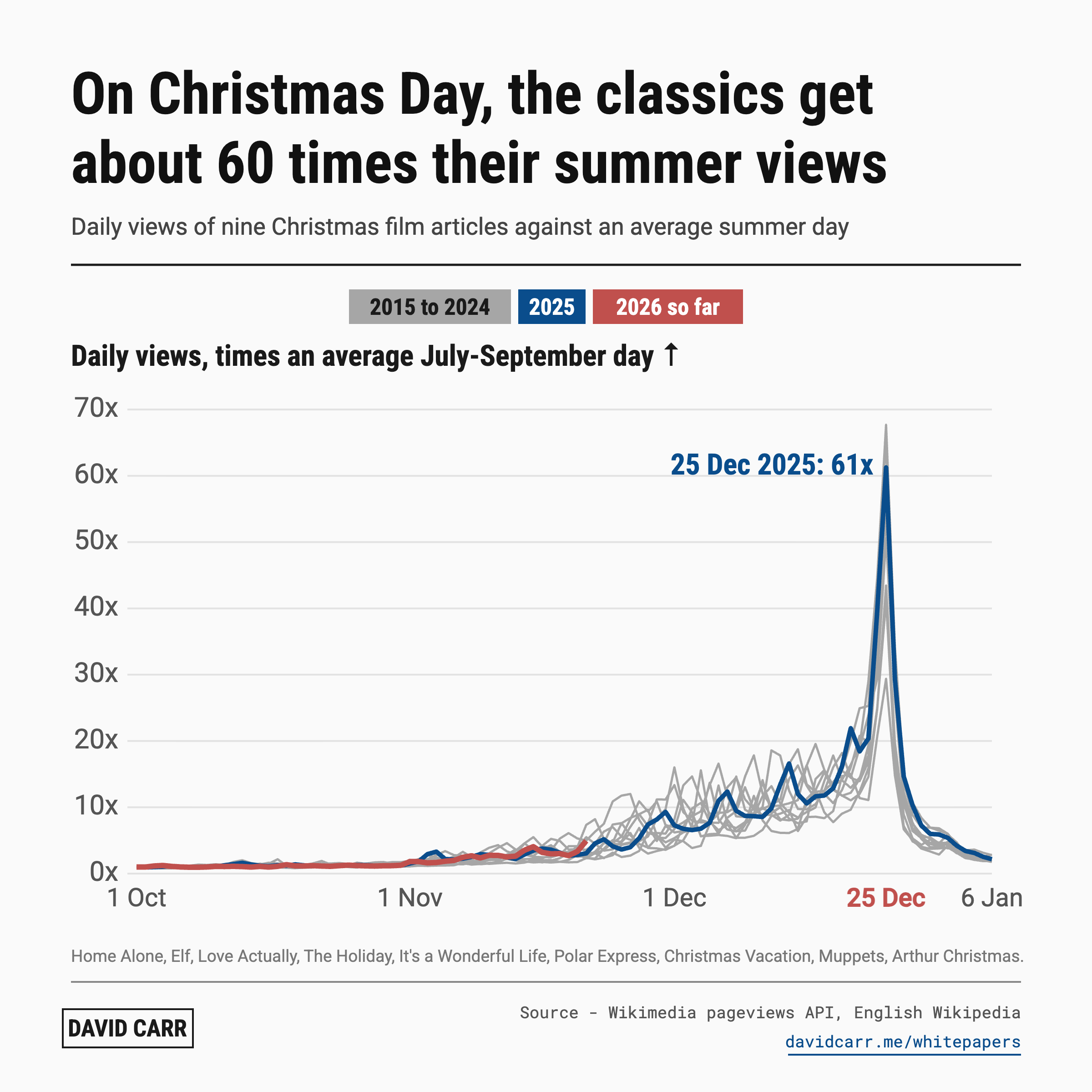
On Christmas Day, the classics get about 60 times their summer views
- Nine classic Christmas film articles, added together, measured against an average July to September day
- Twice the summer level by early November, then a long climb through December
- Christmas Day 2025: 61 times a summer day. Top day of the season every year since 2015
- By 6 January it is nearly all gone
The same shape every year. 2026 is tracking close to 2025 so far.
Wikipedia views are attention, not viewing figures. Someone reading about Home Alone may not be watching it.
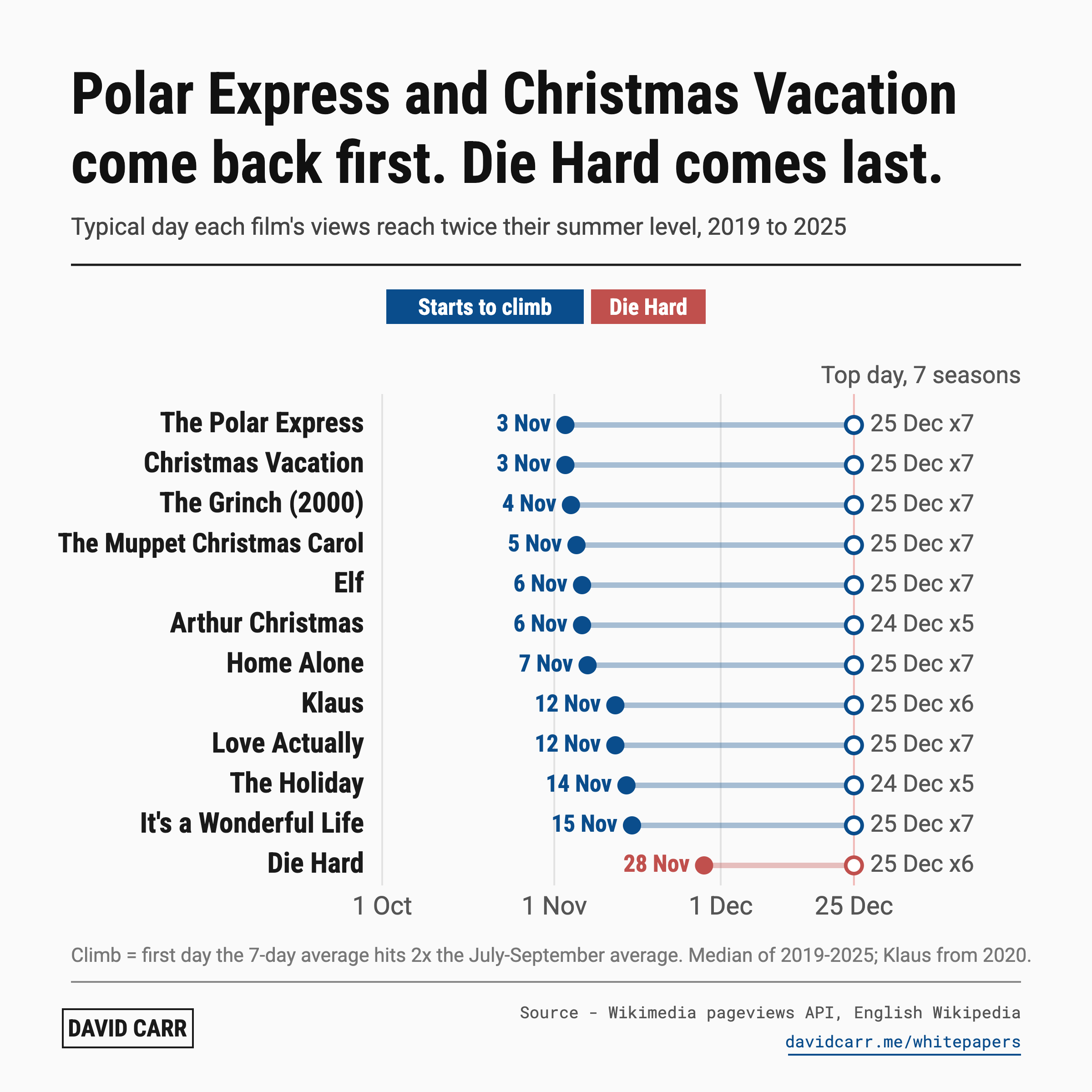
Polar Express and Christmas Vacation come back first. Die Hard comes last.
- The Polar Express and Christmas Vacation: around 3 November in a typical recent year
- Elf, Home Alone, the Muppets and Arthur Christmas: within the first week of November
- Love Actually, The Holiday and It's a Wonderful Life: mid-November
- Die Hard: around 28 November
Ten of the twelve usually peak on Christmas Day. The Holiday and Arthur Christmas usually peak on Christmas Eve.
Median of the 2019 to 2025 seasons; Klaus from 2020, its first season after release.
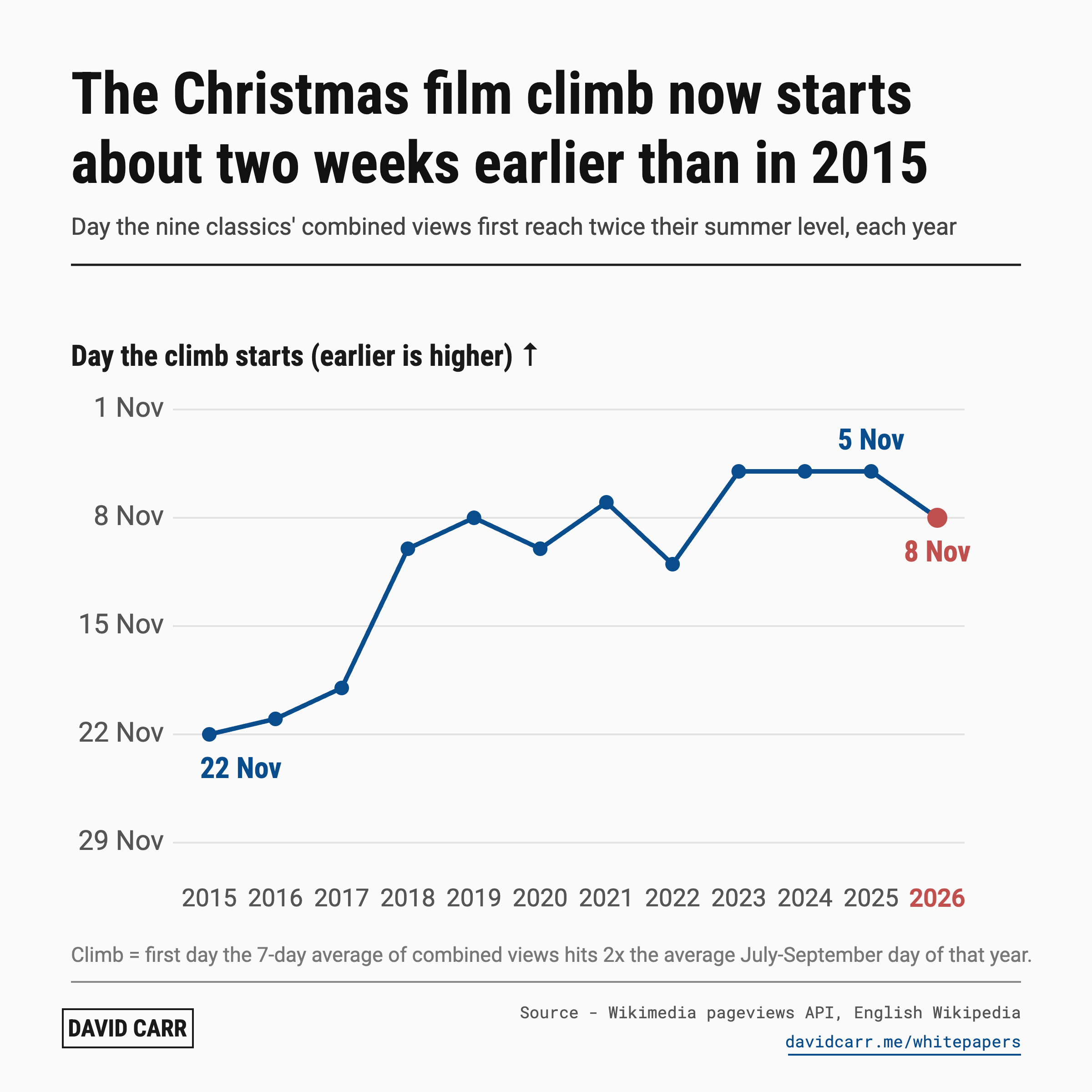
The Christmas film climb now starts about two weeks earlier than in 2015
- 2015: 22 November
- 2018: 10 November
- 2023 to 2025: 5 November
- 2026: 8 November
Christmas arrives earlier on Wikipedia too. The songs page found the same thing on Spotify.
The climb date is the first day the 7-day average of the nine films' combined views reaches twice their average July to September day.
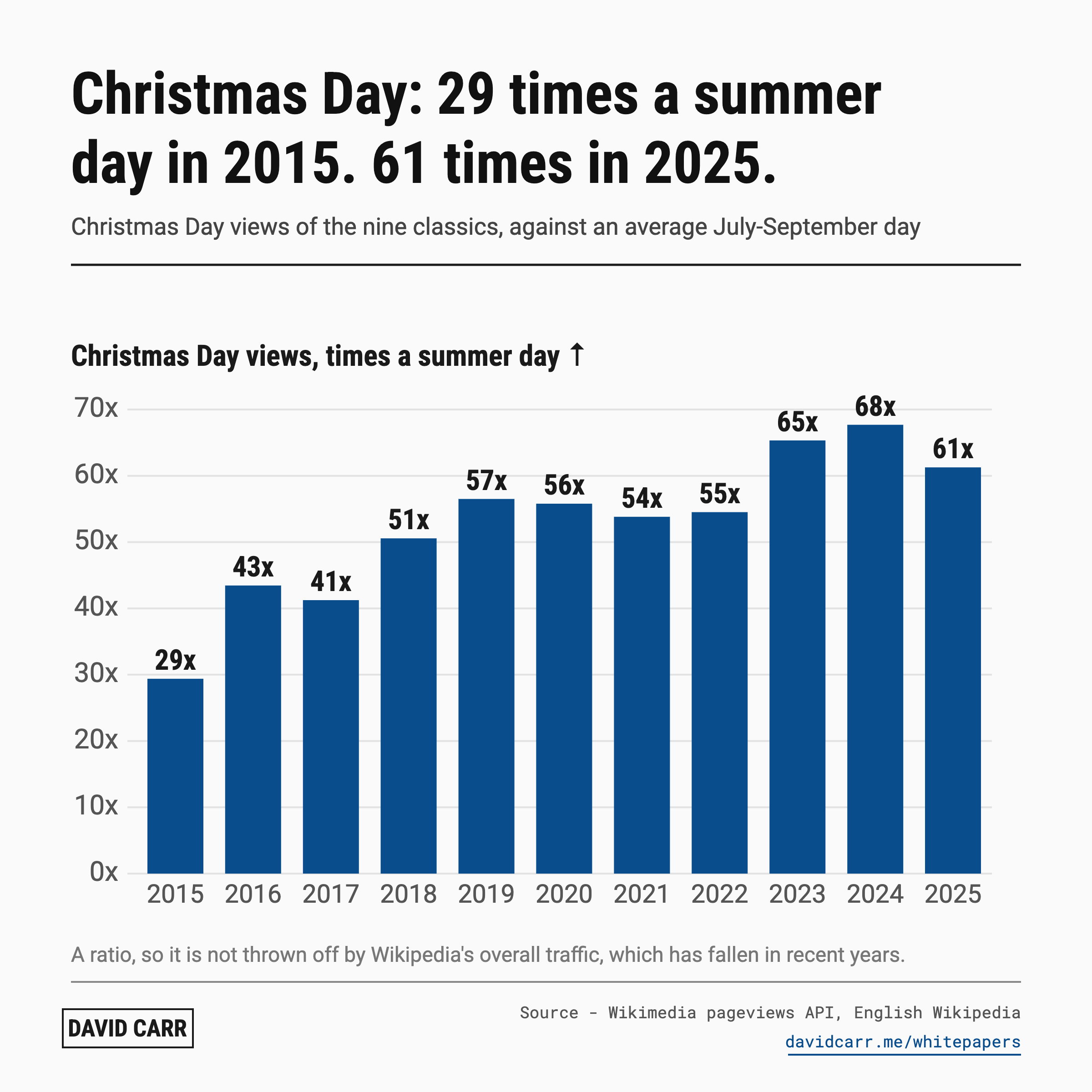
Christmas Day: 29 times a summer day in 2015. 61 times in 2025.
- 2015: 29x
- 2019: 57x
- 2024: 68x, the highest
- 2025: 61x
The Christmas Day spike has roughly doubled against the rest of the year.
A ratio, not a raw count. Raw views of many Wikipedia articles have fallen in recent years; the article on Christmas itself got 1.5 million views in December 2015 and 0.57 million in December 2025.
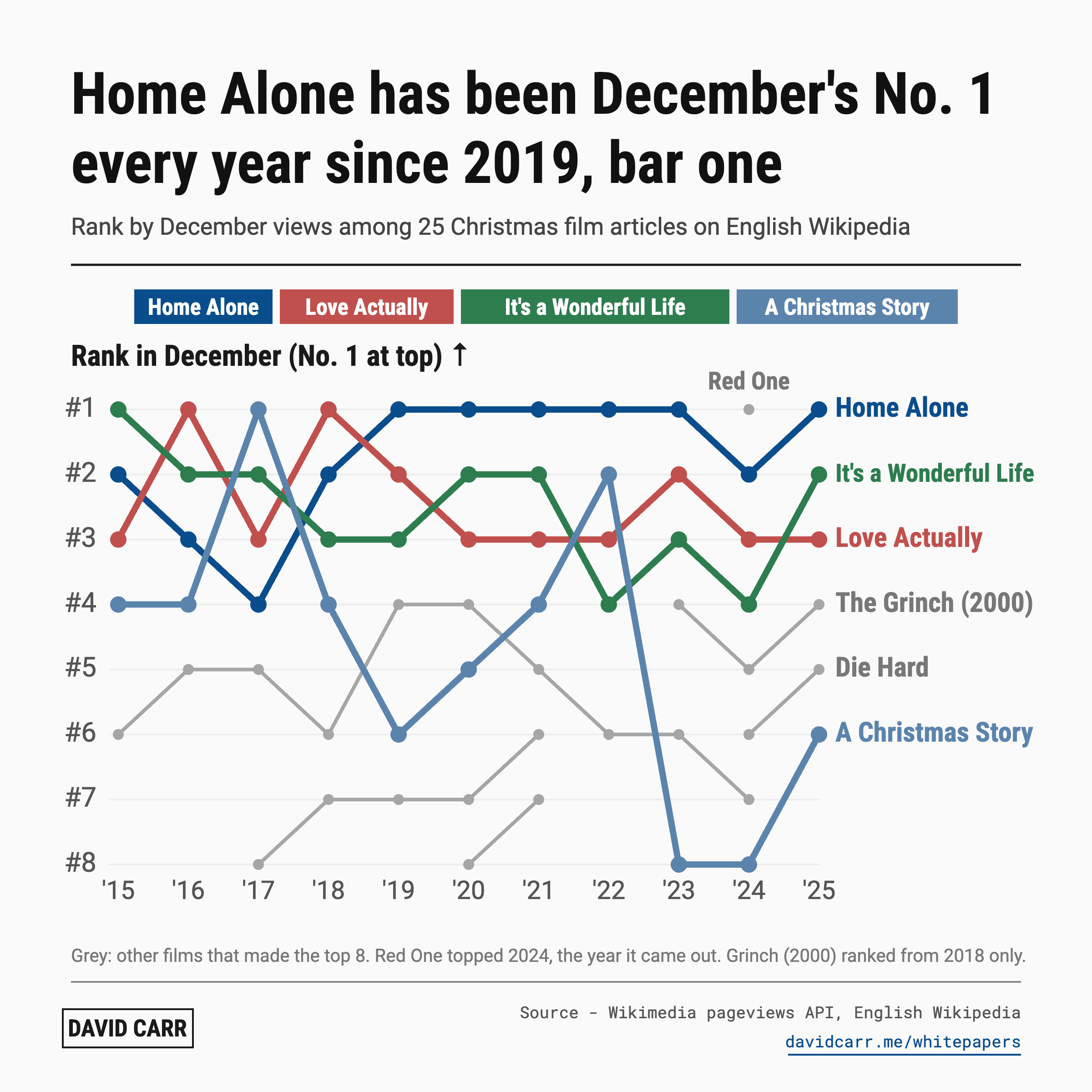
Home Alone has been December's No. 1 every year since 2019, bar one
- 2015: It's a Wonderful Life. 2016 and 2018: Love Actually. 2017: A Christmas Story
- 2019 to 2023 and 2025: Home Alone
- 2024: Red One, the year it came out, with 2.2 million December views
- December 2025: Home Alone 823,000, then It's a Wonderful Life and Love Actually
No single winner before 2019. Home Alone has held it since, apart from a newcomer's first Christmas.
Ranked among 25 Christmas film articles. The 2000 Grinch is ranked from 2018 only, because its article sat under other titles before that.
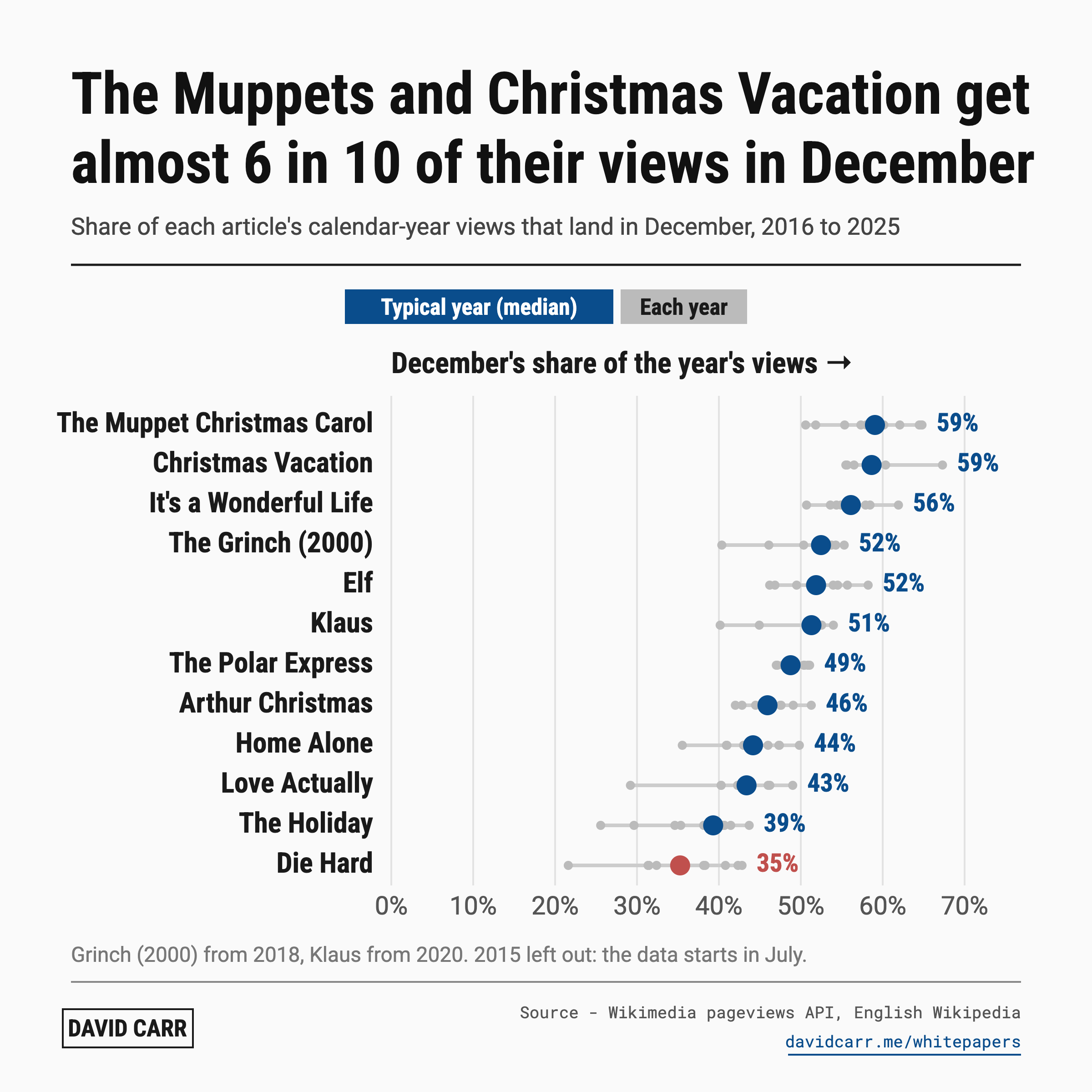
The Muppets and Christmas Vacation get almost 6 in 10 of their views in December
- The Muppet Christmas Carol: 59% in a typical year
- Christmas Vacation: 59%
- It's a Wonderful Life: 56%
- Home Alone: 44%, Love Actually: 43%
- Die Hard: 35%, the lowest
The films people only think about at Christmas get the biggest share. Home Alone and Love Actually get read about all year.
December views divided by calendar-year views, median of 2016 to 2025.
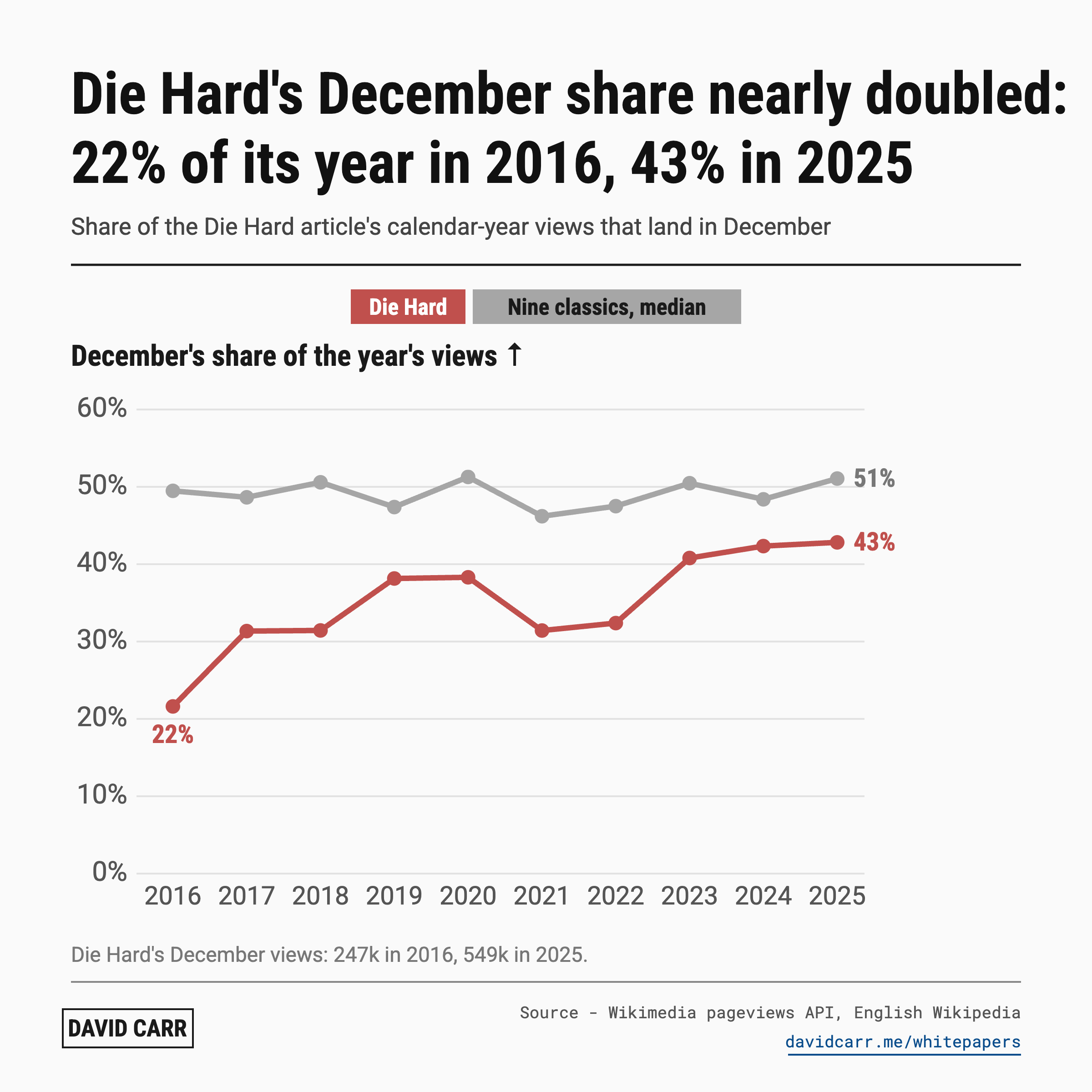
Die Hard's December share nearly doubled: 22% of its year in 2016, 43% in 2025
- 2016: 22%
- 2019: 38%
- 2023: 41%
- 2025: 43%
- December views: 247,000 in 2016, 549,000 in 2025
So does it spike at Christmas? Yes, and more each year. It is still below the other classics, which sit around 50%.
This measures when people read about Die Hard, not whether it is a Christmas film. That one stays open.
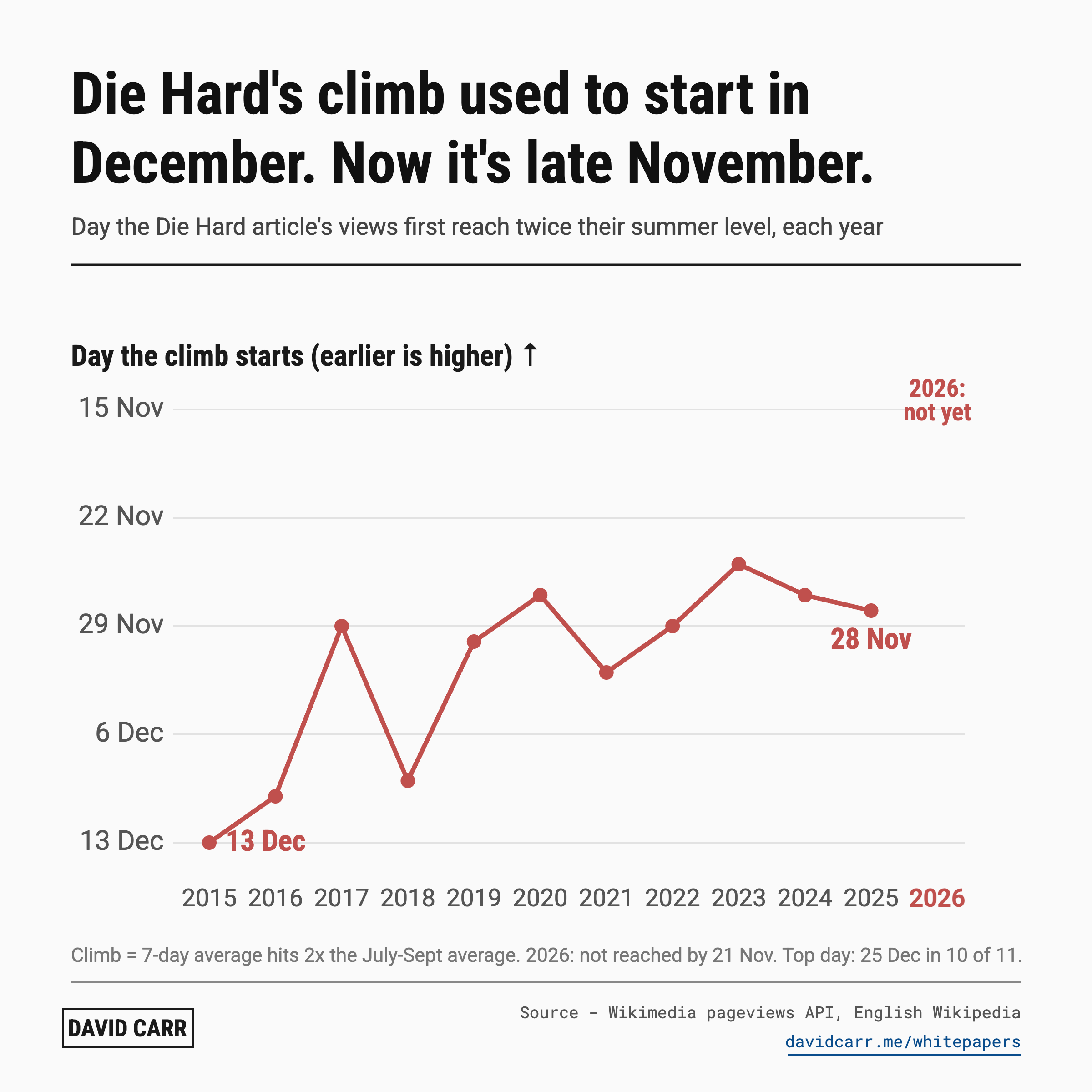
Die Hard's climb used to start in December. Now it's late November.
- 2015: 13 December
- 2016: 10 December
- 2023: 25 November
- 2025: 28 November
- 2026: not reached by 21 November
Its top day was Christmas Day in 10 of the 11 seasons since 2015.
2017 was early (29 November) and 2018 late (9 December), so the move is not a straight line.
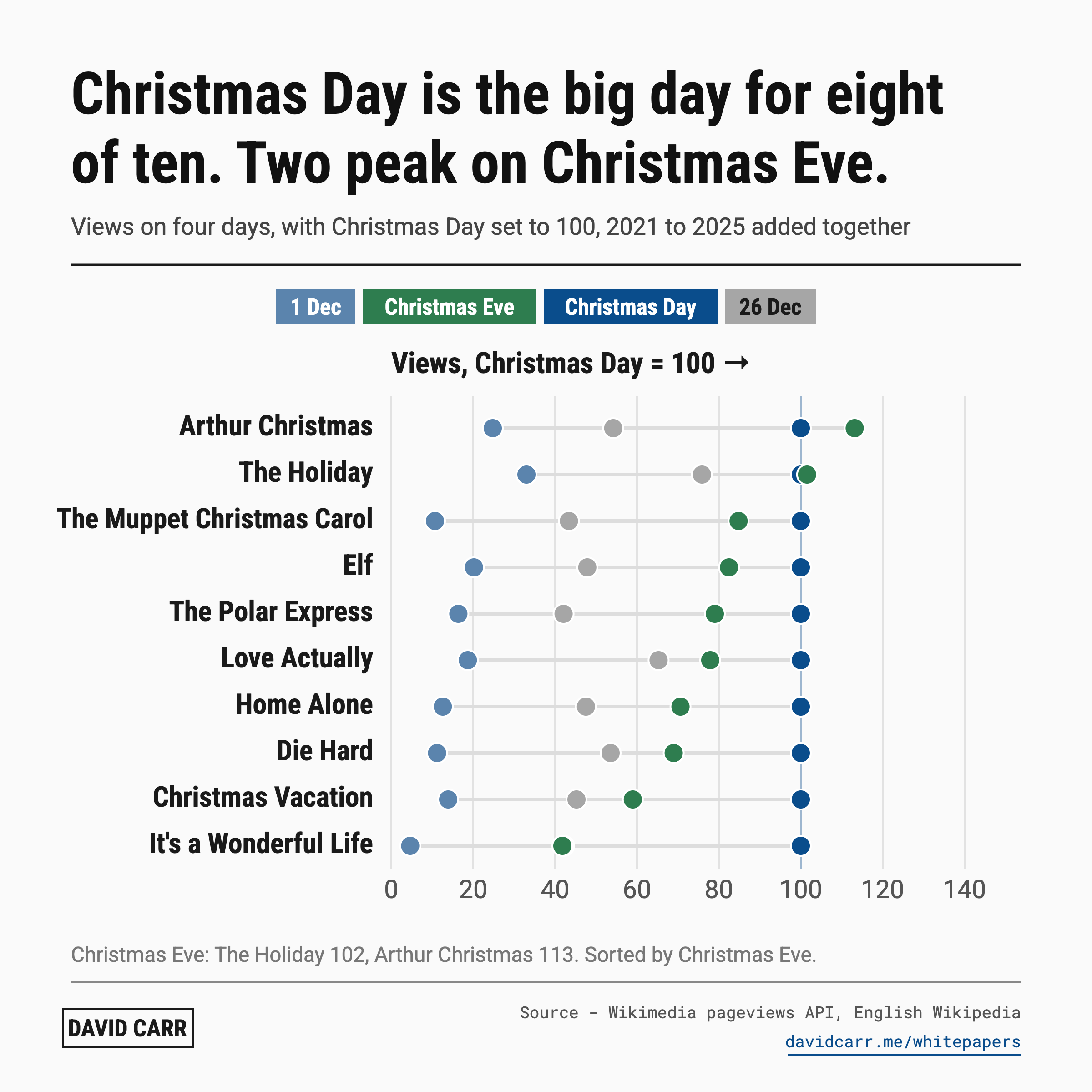
Christmas Day is the big day for eight of ten. Two peak on Christmas Eve.
- Arthur Christmas: Christmas Eve is 113, against 100 for Christmas Day
- The Holiday: 102
- It's a Wonderful Life: 42, the biggest Christmas Day lead
- 1 December: between 5 and 33 for every film
Love Actually and The Holiday hold up best on 26 December, at 65 and 76.
Views on each day for 2021 to 2025 added together, with Christmas Day set to 100.
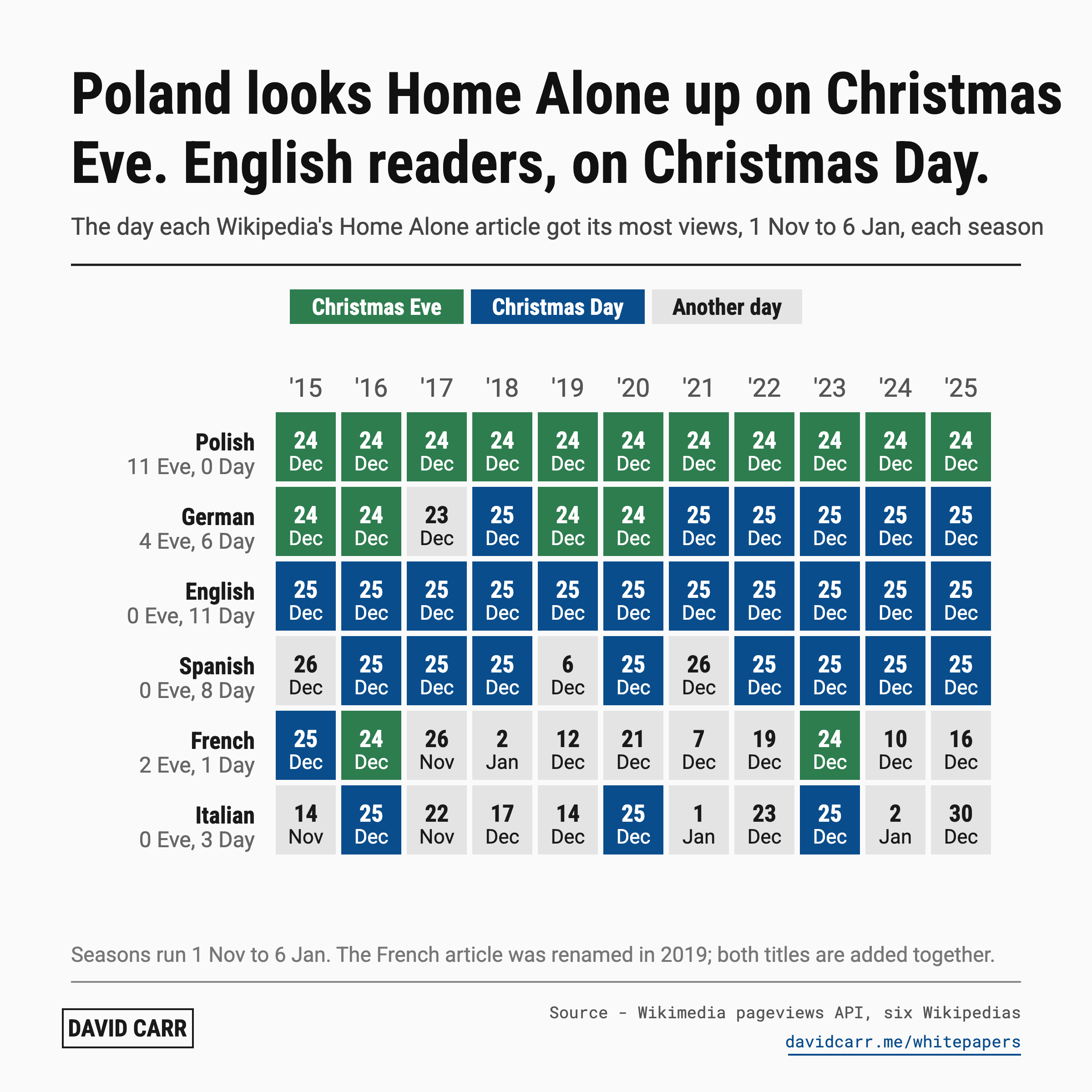
Poland looks Home Alone up on Christmas Eve. English readers, on Christmas Day.
- Polish Wikipedia: top day on Christmas Eve in all 11 seasons
- English: Christmas Day in all 11
- German: Christmas Eve 4 times, Christmas Day 6
- French and Italian: the top day moves around, from late November to early January
The same film, a different big day. In Poland and Germany, Christmas Eve is the big evening of the holiday.
Home Alone's article on six Wikipedias. Titles: Kevin sam w domu (Polish), Kevin – Allein zu Haus (German), Maman, j'ai raté l'avion ! (French), Mamma, ho perso l'aereo (Italian), Home Alone (Spanish).
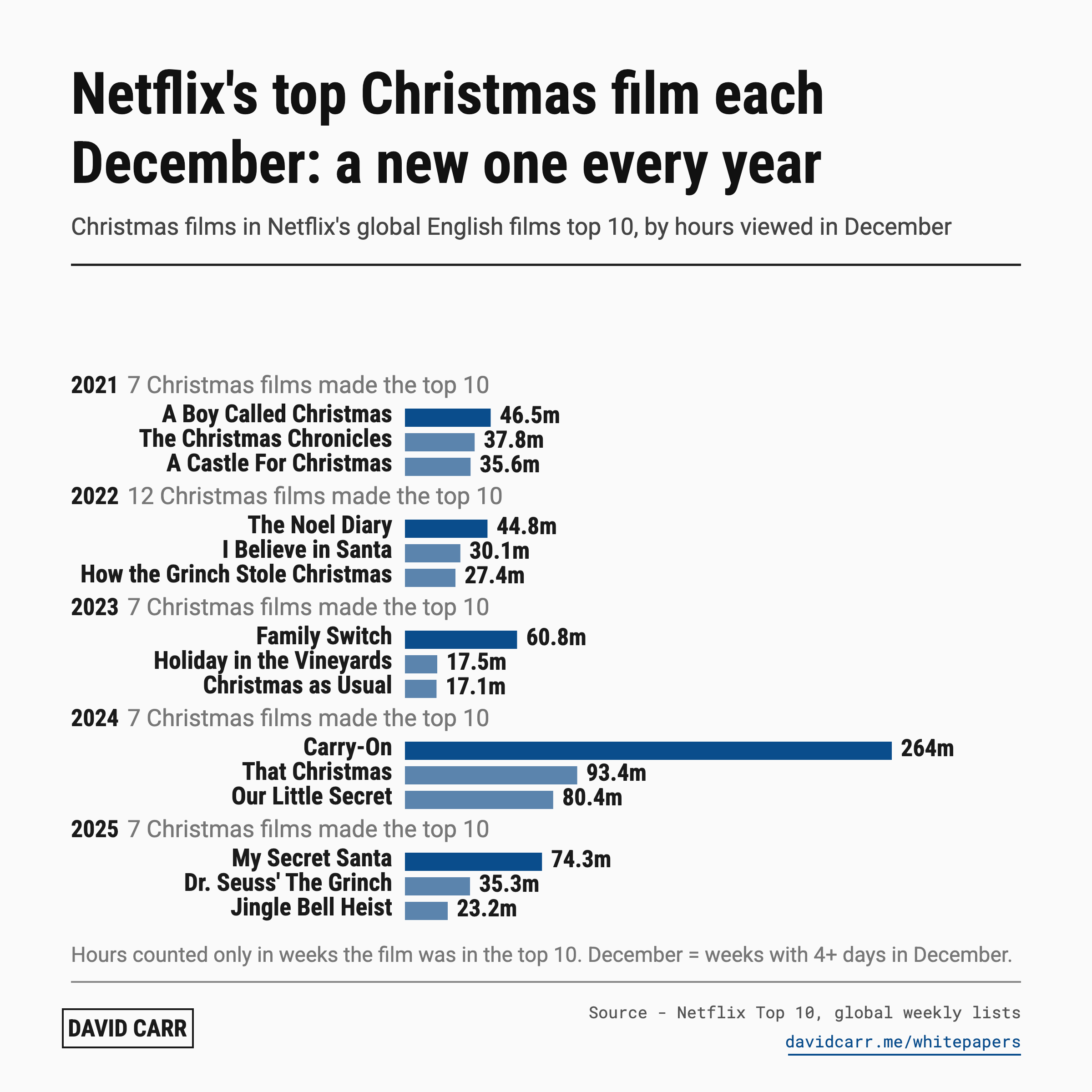
Netflix's top Christmas film each December: a new one every year
- 2021: A Boy Called Christmas (46.5m hours), The Christmas Chronicles (37.8m), A Castle for Christmas (35.6m), A California Christmas: City Lights (34.5m), The Christmas Chronicles: Part Two (26.6m), Single All the Way (25.0m), Love Hard (7.2m)
- 2022: The Noel Diary (44.8m), I Believe in Santa (30.1m), How the Grinch Stole Christmas (27.4m), Scrooge: A Christmas Carol (26.9m), Falling for Christmas (23.4m), and seven more between 7m and 11m
- 2023: Family Switch (60.8m), Holiday in the Vineyards (17.5m), Christmas as Usual (17.1m), The Grinch (2018, 13.6m), Catering Christmas (12.5m), How the Grinch Stole Christmas (8.9m), B&B Merry (6.3m)
- 2024: Carry-On (264m), That Christmas (93.4m), Our Little Secret (80.4m), The Grinch (2018, 70.7m), How the Grinch Stole Christmas (29.0m), 'Twas the Text Before Christmas (11.8m), A Royal Date for Christmas (7.8m)
- 2025: My Secret Santa (74.3m), The Grinch (2018, 35.3m), Jingle Bell Heist (23.2m), The Christmas Chronicles (16.3m), How the Grinch Stole Christmas (13.3m), A Cowboy Christmas Romance (6.5m), A Merry Little Ex-Mas (5.4m)
Each year's No. 1 came out that same year. The two Grinch films are the old ones that keep coming back: in the December top 10 every year from 2022.
Hours viewed in December weeks while the film was in Netflix's global English films top 10. December = the four or five Monday-to-Sunday weeks with at least four days in December.
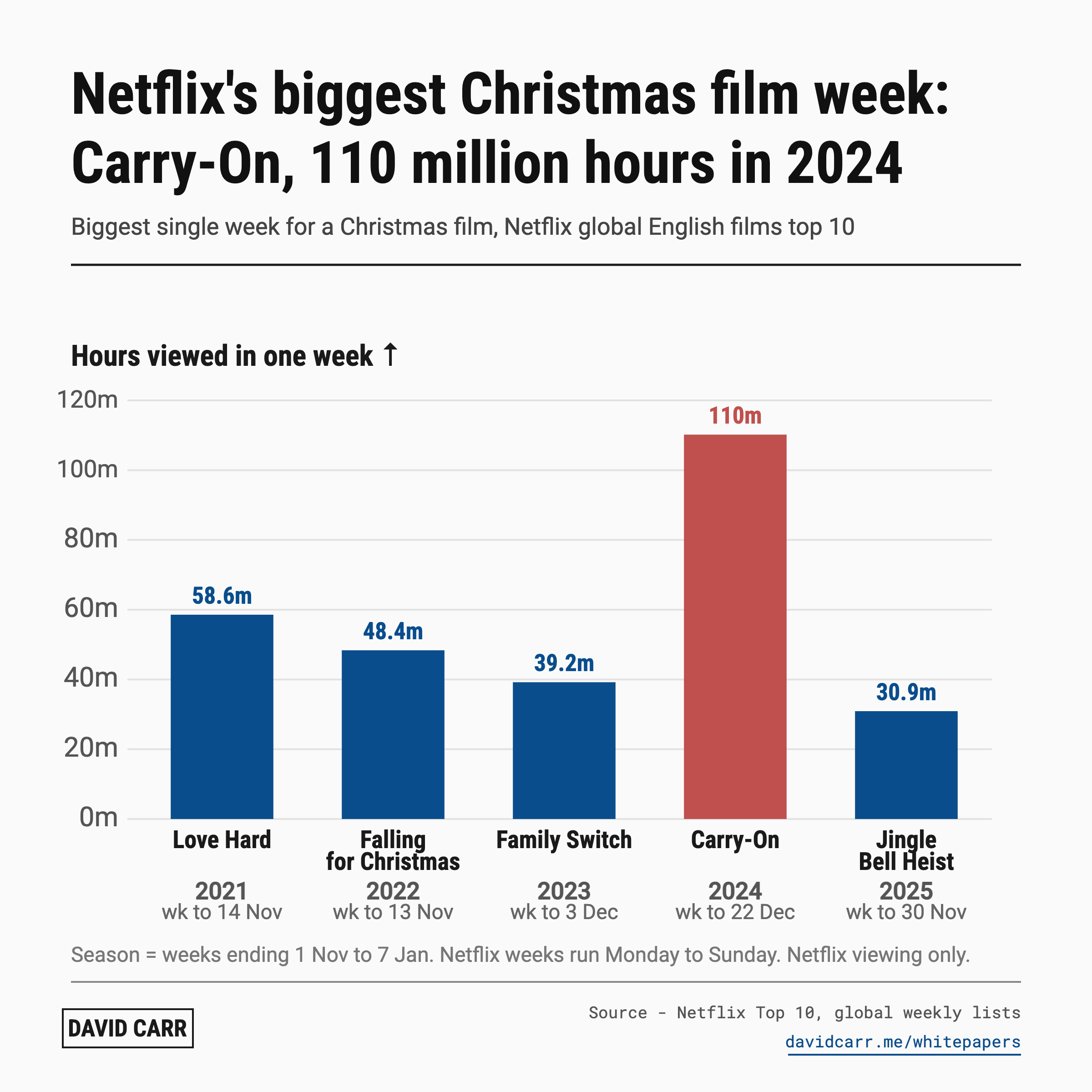
Netflix's biggest Christmas film week: Carry-On, 110 million hours in 2024
- 2021: Love Hard, 58.6m hours in the week to 14 November
- 2022: Falling for Christmas, 48.4m, week to 13 November
- 2023: Family Switch, 39.2m (22.2m views), week to 3 December
- 2024: Carry-On, 110m (55.1m views), week to 22 December
- 2025: Jingle Bell Heist, 30.9m (19.3m views), week to 30 November
In three of the five years the biggest week came in November, when a new Christmas film landed. Carry-On is the odd one: an action film set at Christmas, like Die Hard, and the biggest by far.
Netflix's own measure. Views = hours viewed divided by the film's runtime, published from June 2023 only, so earlier years show hours alone.
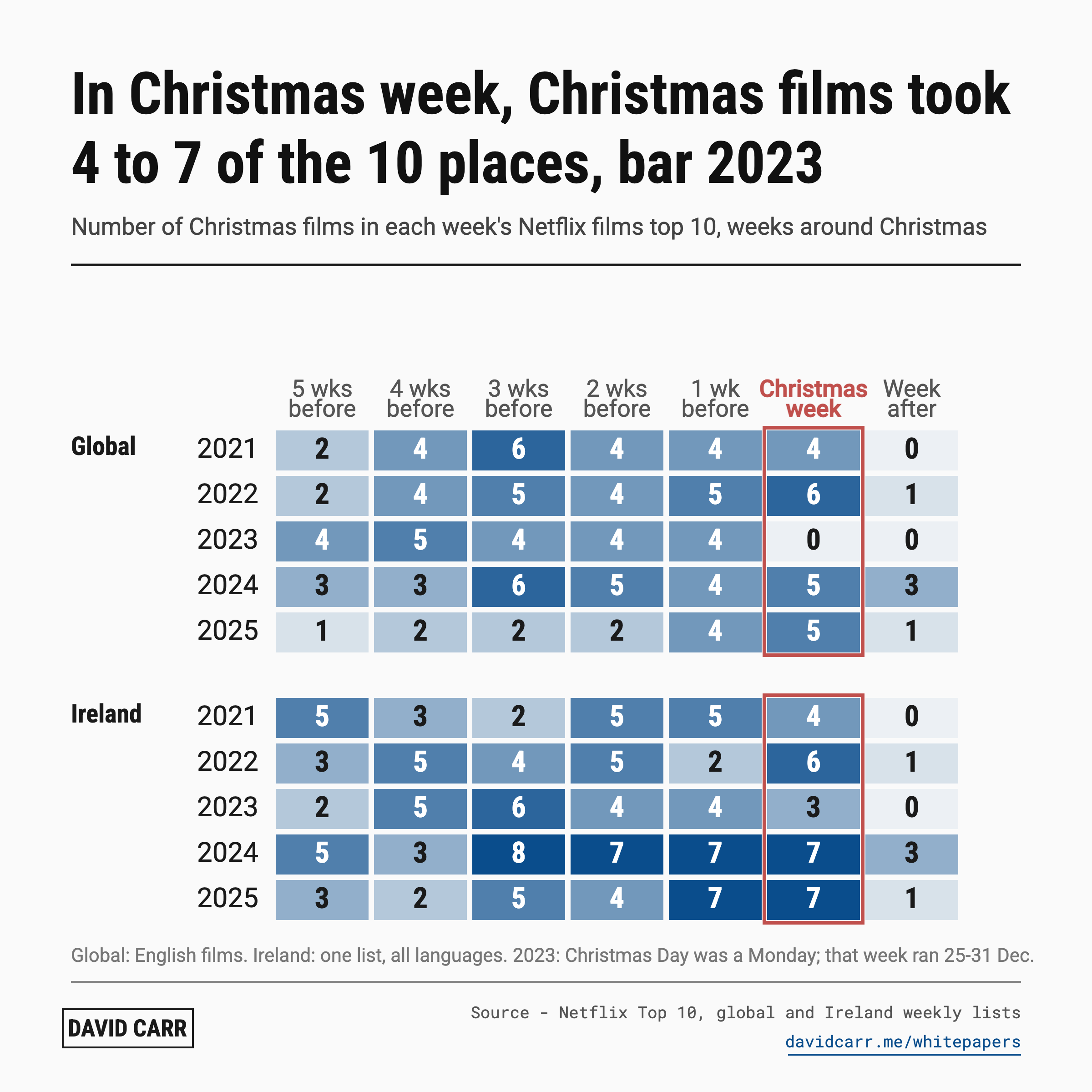
In Christmas week, Christmas films took 4 to 7 of the 10 places, bar 2023
- Global, Christmas week: 4 in 2021, 6 in 2022, 0 in 2023, 5 in 2024, 5 in 2025
- Ireland, Christmas week: 4, 6, 3, 7, 7
- 2024 in Ireland: Christmas films held 29 of the 40 December places (72%). Global that month: 50%
- The week after Christmas, they fall away: 0 to 3 in every year
2023 is the gap. Christmas Day was a Monday, so Christmas week ran 25 to 31 December, and the Christmas films had dropped out globally by then. The week before, they held 4 places.
Global = Netflix's English films list. Ireland = Netflix's one films list for Ireland, all languages, so the two are close but not like for like.
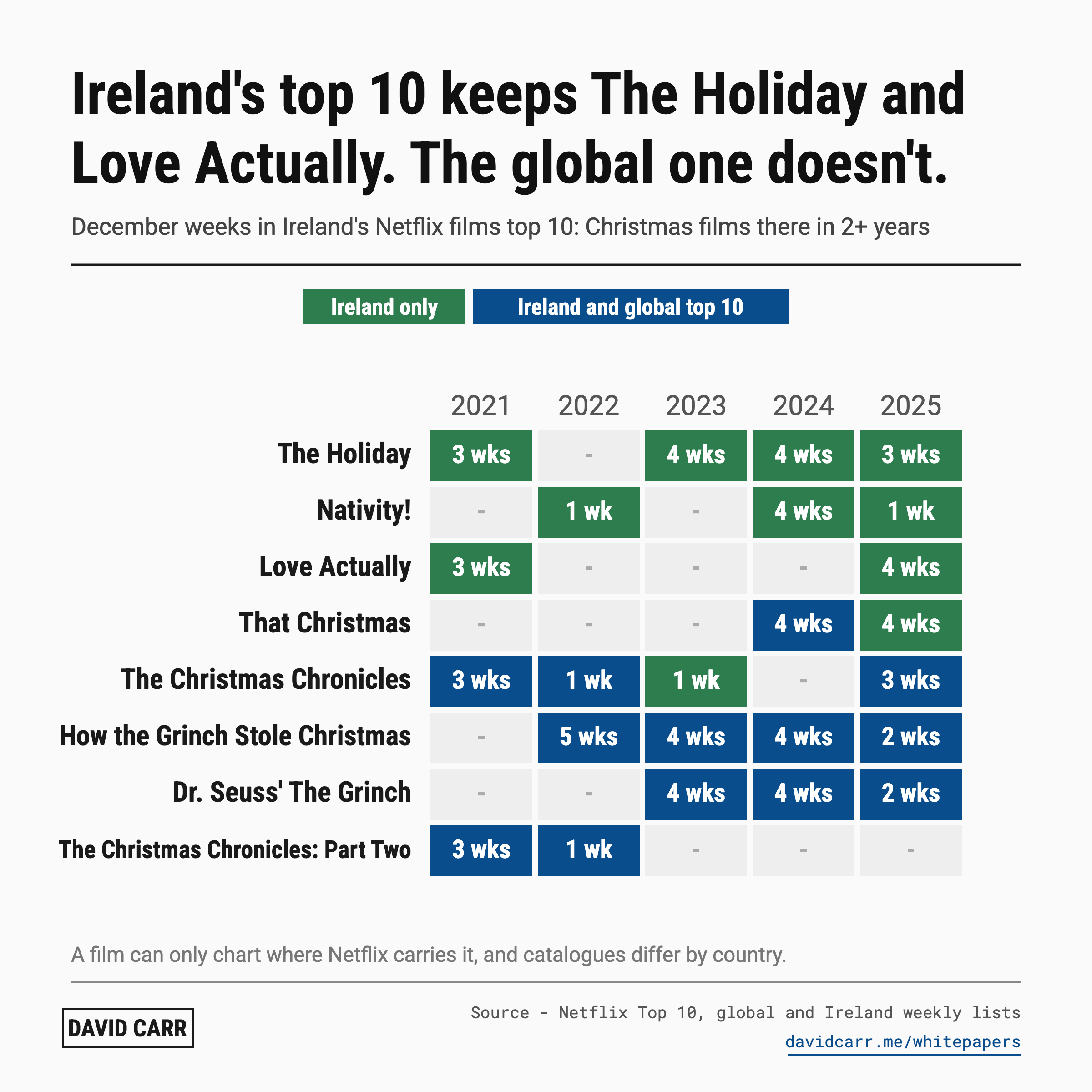
Ireland's top 10 keeps The Holiday and Love Actually. The global one doesn't.
- The Holiday: in Ireland's December top 10 in four of five years. Never in the global one
- Nativity!: three Decembers in Ireland, never global
- Love Actually: 2021 and 2025 in Ireland, never global
- That Christmas: global and Irish in 2024, Irish only in 2025
- The two Grinch films: in both lists every December from 2022 (the 2018 one from 2023)
On Wikipedia, Love Actually was the No. 2 or 3 Christmas film every December from 2021 to 2025 (chart 5). On Netflix it shows up only in Ireland's list.
A film can only chart where Netflix carries it, and catalogues differ by country. So this shows what Ireland watched on Netflix, not that the rest of the world passed it over.
Method, caveats and sources
The short answer. Christmas film articles start to climb in early November, about two weeks earlier than in 2015, and peak on Christmas Day at about 60 times their summer level. Home Alone has been the most-read in December every year since 2019 except 2024. Die Hard climbs later and less than the classics, but its December share has nearly doubled since 2016. Polish readers look Home Alone up on Christmas Eve; English readers on Christmas Day. On Netflix, a new Christmas film tops December every year, Carry-On had the biggest single week (110 million hours in 2024), and Christmas films usually take 4 to 7 of the 10 film places in Christmas week. Ireland's list keeps older favourites, The Holiday, Love Actually and Nativity!, that the global list does not.
Data. Daily views of each article from the Wikimedia pageviews API (per-article, all-access, user agent = humans only), 1 July 2015 to 21 November 2026, pulled on 22 November 2026. Anyone can check a film with the Pageviews tool. The raw pulls, a tidy extract and every number on this page are saved with the scripts.
Views are attention, not viewing. A visit to the Home Alone article does not mean someone watched Home Alone. Views also move with TV schedules, streaming releases, anniversaries and news.
Which films. The "nine classics" are Home Alone, Elf, Love Actually, The Holiday, It's a Wonderful Life, The Polar Express, Christmas Vacation, The Muppet Christmas Carol and Arthur Christmas: all had the same article title for the whole period. Die Hard is kept apart because it is the question. The December ranking uses 25 articles, adding A Christmas Story, Home Alone 2, The Grinch (2000 and 2018), Klaus, Red One, Violent Night, Spirited, Love Hard and others.
Renamed articles. Views of an old title are counted under that title, not the new one. The 2000 Grinch film's current title only has views from June 2017, and its earlier views could not be traced cleanly, so it is used from 2018. Klaus came out in November 2019, so its climb and December share start in 2020. The French Home Alone article was renamed in 2019; both titles are added together.
Summer level and climb. "Summer" is the average day from 1 July to 30 September of the same year. Comparing to it keeps the trend honest while Wikipedia's overall traffic falls. The climb date is the first day from 1 October on which the 7-day average reaches twice that level.
Netflix data. Viewing figures come from Netflix Top 10, which publishes every week since the week ending 4 July 2021 as downloadable files: a global top 10 per category with hours viewed (and, from June 2023, views), and a top 10 per country. I downloaded both on 22 November 2026, up to the week ending 15 November 2026. The global English films list and Ireland's films list are used. Netflix weeks run Monday to Sunday.
What Netflix's numbers measure. They cover viewing on Netflix only, not TV, cinema or other streaming services. Hours viewed is the total time people spent watching the film that week. Views is Netflix's own measure: hours viewed divided by the film's runtime. A film only appears in a week it made the top 10, so totals here are hours in those weeks, not all viewing. Country lists give ranks only, no hours.
Which films count as Christmas films. A film counts if its English Wikipedia article is in a Christmas films category (checked on 22 November 2026). A film with no Wikipedia article (most are TV films) counts if its title names Christmas, Santa or Merry. This brings in Carry-On and Family Switch, which are set at Christmas, and leaves out a few that are not in those categories, such as Champagne Problems and Goodbye June. "December" means the four or five Netflix weeks with at least four days in December. "Christmas week" is the Netflix week with 25 December in it.
Also: Christmas songs and How Ireland shops for Christmas.