Irish job ads peak in September, then fall about 70% at Christmas.
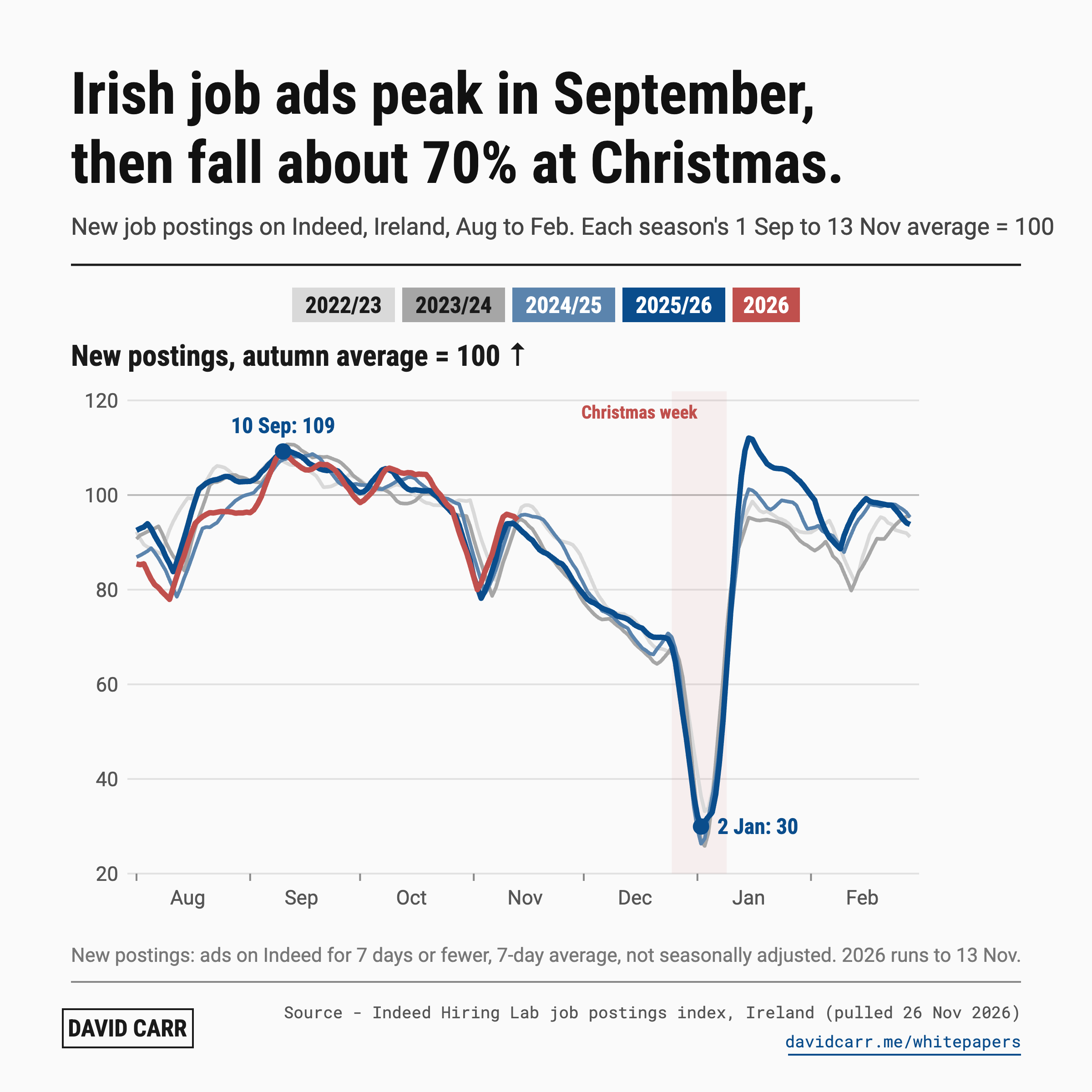
- Peak in each of the last four autumns: 8 to 18 September
- September peak: 8% to 11% above the autumn average
- Low: 2 or 3 January every season, 26 to 33 on a scale where autumn = 100
- 2026 so far tracks the earlier years closely
New ads build from August, top out in mid-September and ease through November and December. Then they all but stop for Christmas week.
Indeed Hiring Lab job postings index for Ireland, new postings (on Indeed for 7 days or fewer), not seasonally adjusted, 7-day average. Each season is scaled to its own 1 September to 13 November average, so years with more or fewer ads overall line up.
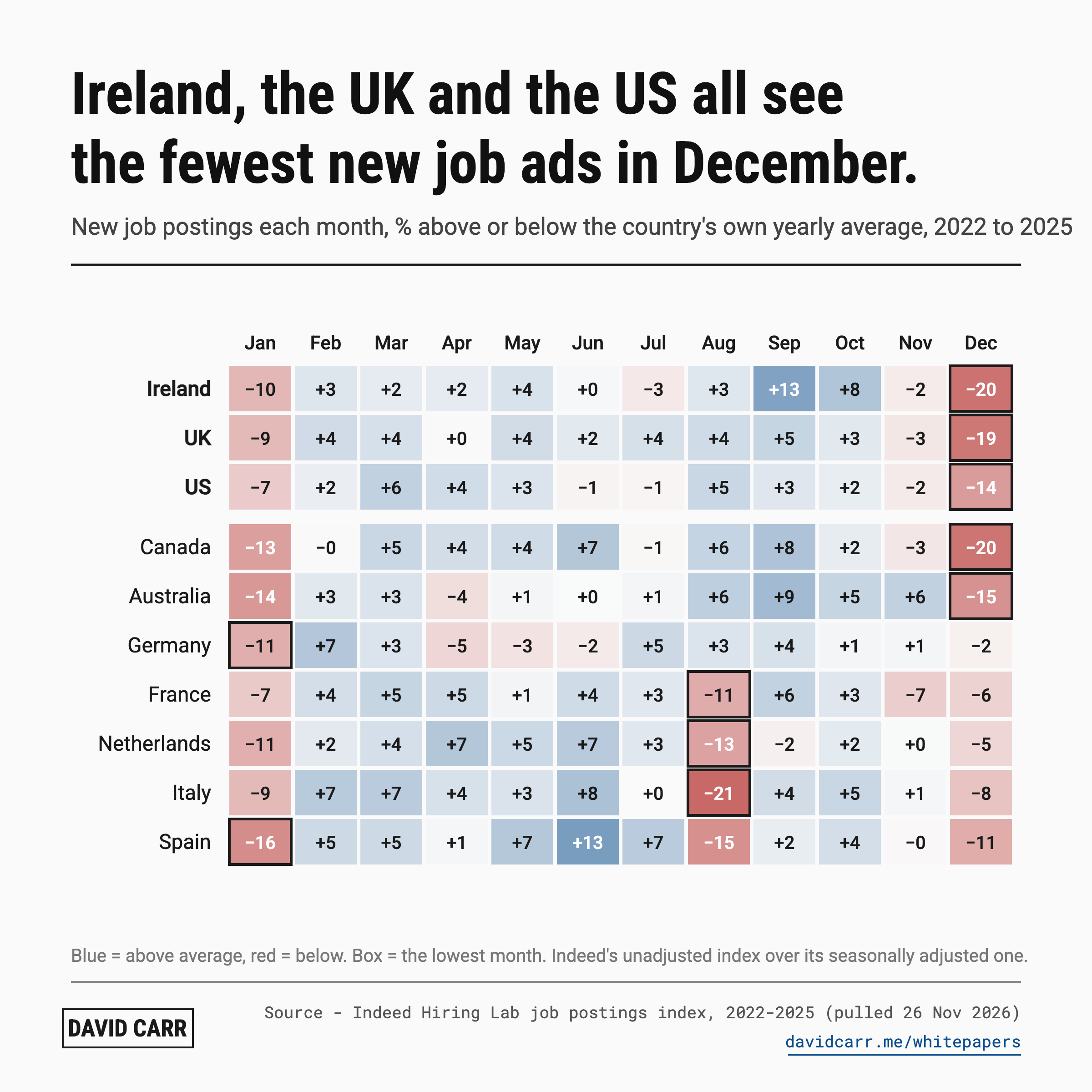
Ireland, the UK and the US all see the fewest new job ads in December.
- December vs the yearly average: Ireland -20%, UK -19%, US -14%
- Ireland's busiest month: September, +13%
- Canada and Australia also bottom out in December
- In France, the Netherlands and Italy, August is lower than December
Ireland, the UK, the US, Canada and Australia share a December low. France, the Netherlands and Italy take their quiet month in August.
Indeed Hiring Lab, new postings, 2022 to 2025. Each month is Indeed's unadjusted index divided by its seasonally adjusted one, averaged, then set against the country's own 12-month average.
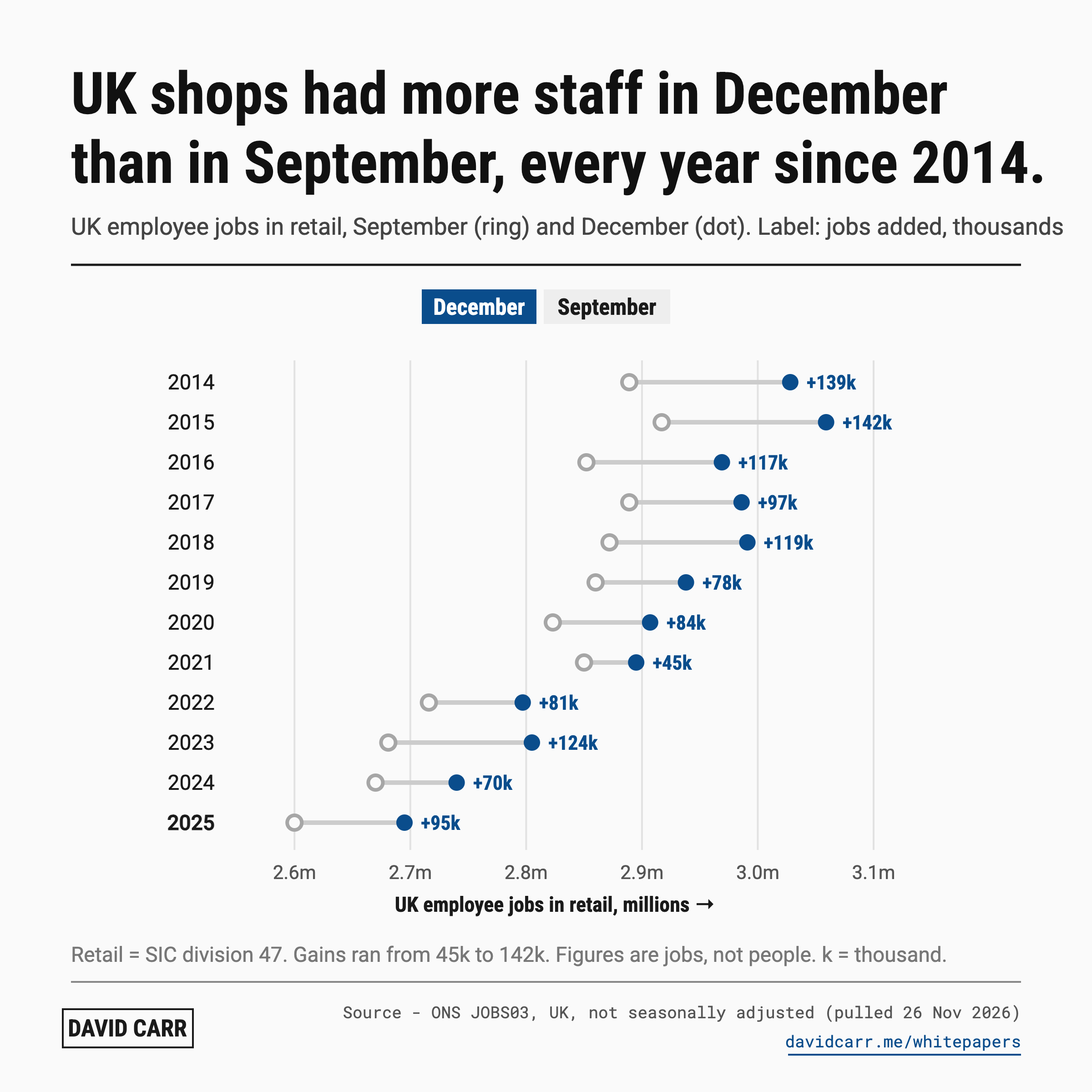
UK shops had more staff in December than in September, every year since 2014.
- 2025: 2.60 million retail jobs in September, 2.70 million in December, +95,000
- Biggest gains: +142,000 in 2015, +139,000 in 2014
- Smallest: +45,000 in 2021
- Average 2014 to 2025: about +100,000 a year
The December bump is there every year, even as the total number of retail jobs has drifted down.
ONS JOBS03, employee jobs by industry, UK, not seasonally adjusted, SIC division 47 (retail). Counts relate to the last month of each quarter and are jobs, not people, so one person with two jobs counts twice.
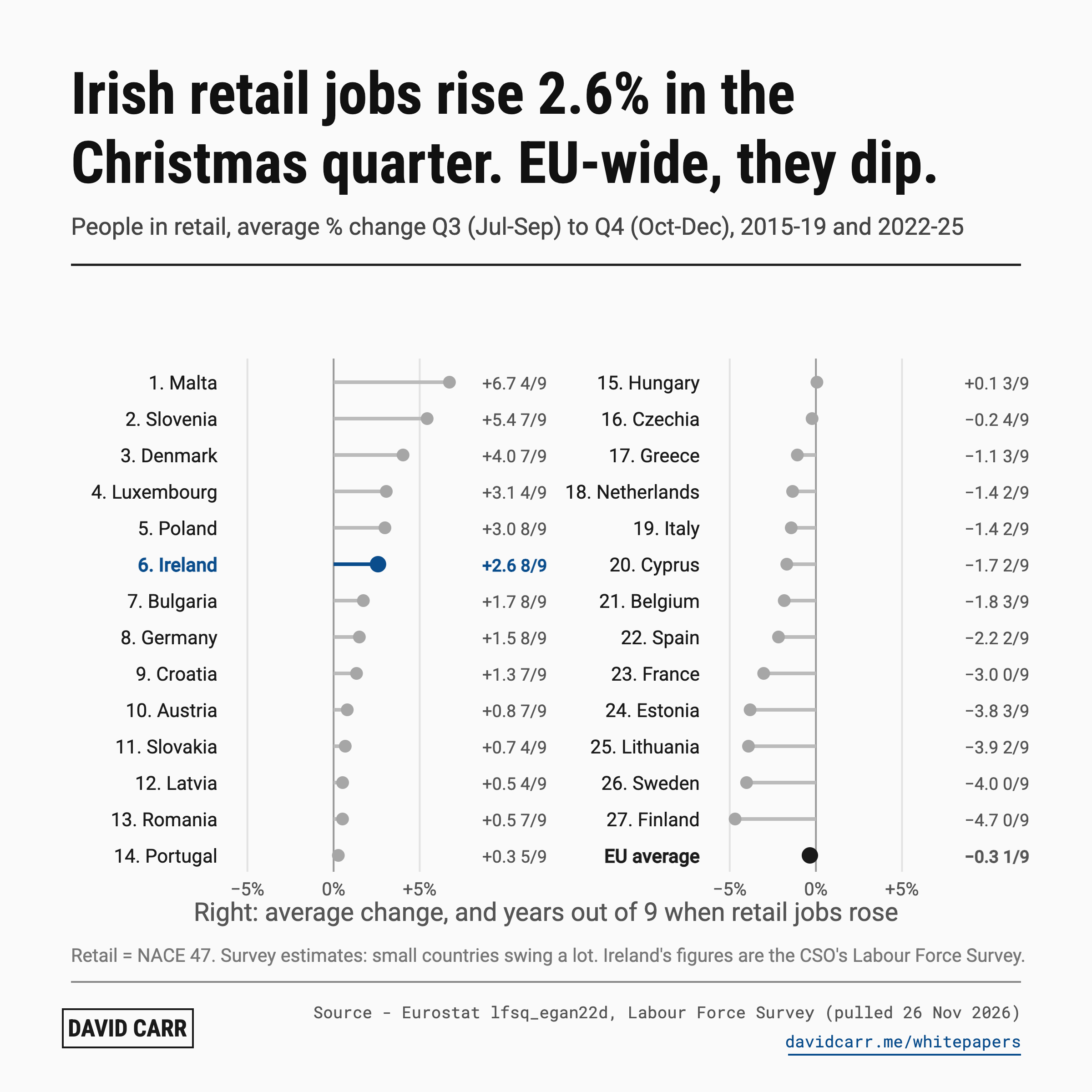
Irish retail jobs rise 2.6% in the Christmas quarter. EU-wide, they dip.
- Ireland: +2.6% on average, and up in 8 of 9 years
- Ireland ranks 6th of the 27 EU countries
- EU as a whole: -0.3%, up in only 1 of 9 years
- France, Sweden and Finland: down in every one of the 9 years
Ireland is one of a group, with Poland, Germany, Denmark and Slovenia, where shops take on more people in the last quarter of the year.
Eurostat lfsq_egan22d, people in employment aged 15 to 74 in retail (NACE 47), Q3 to Q4 change, 2015 to 2019 and 2022 to 2025. Ireland's figures come from the CSO's Labour Force Survey. Survey figures for small countries move a lot from year to year.
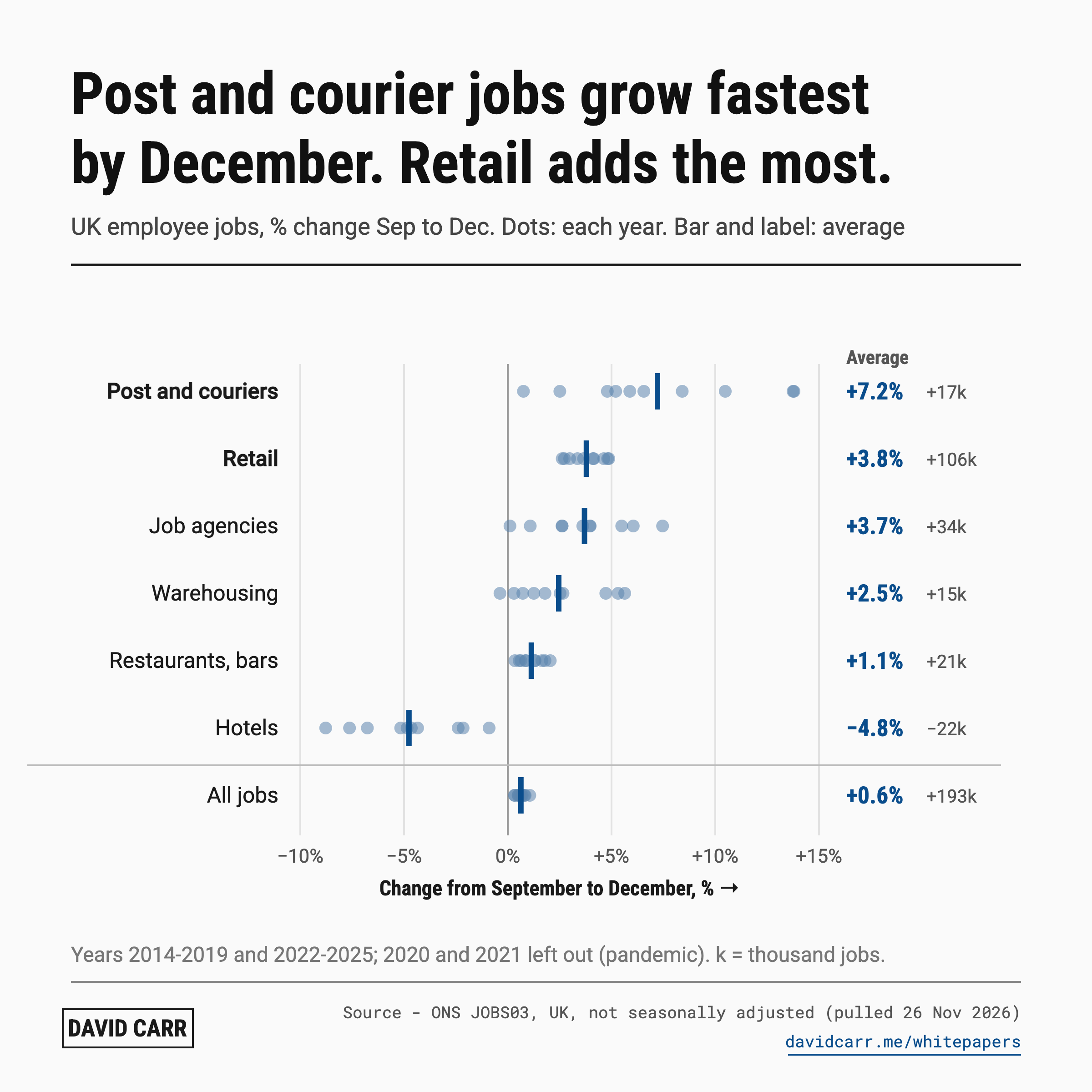
Post and courier jobs grow fastest by December. Retail adds the most.
- Post and couriers: +7.2% on average, about +17,000 jobs
- Retail: +3.8%, about +106,000 jobs
- Job agencies: +3.7%; warehousing: +2.5%
- Hotels: -4.8%, as the summer season ends
Across all UK jobs, December is only 0.6% above September. The Christmas rise is concentrated in a few sectors.
ONS JOBS03, employee jobs, not seasonally adjusted, September to December, 2014 to 2019 and 2022 to 2025. Job agencies (SIC 78) supply temporary staff to other sectors, so some of their rise is Christmas work in shops and warehouses.
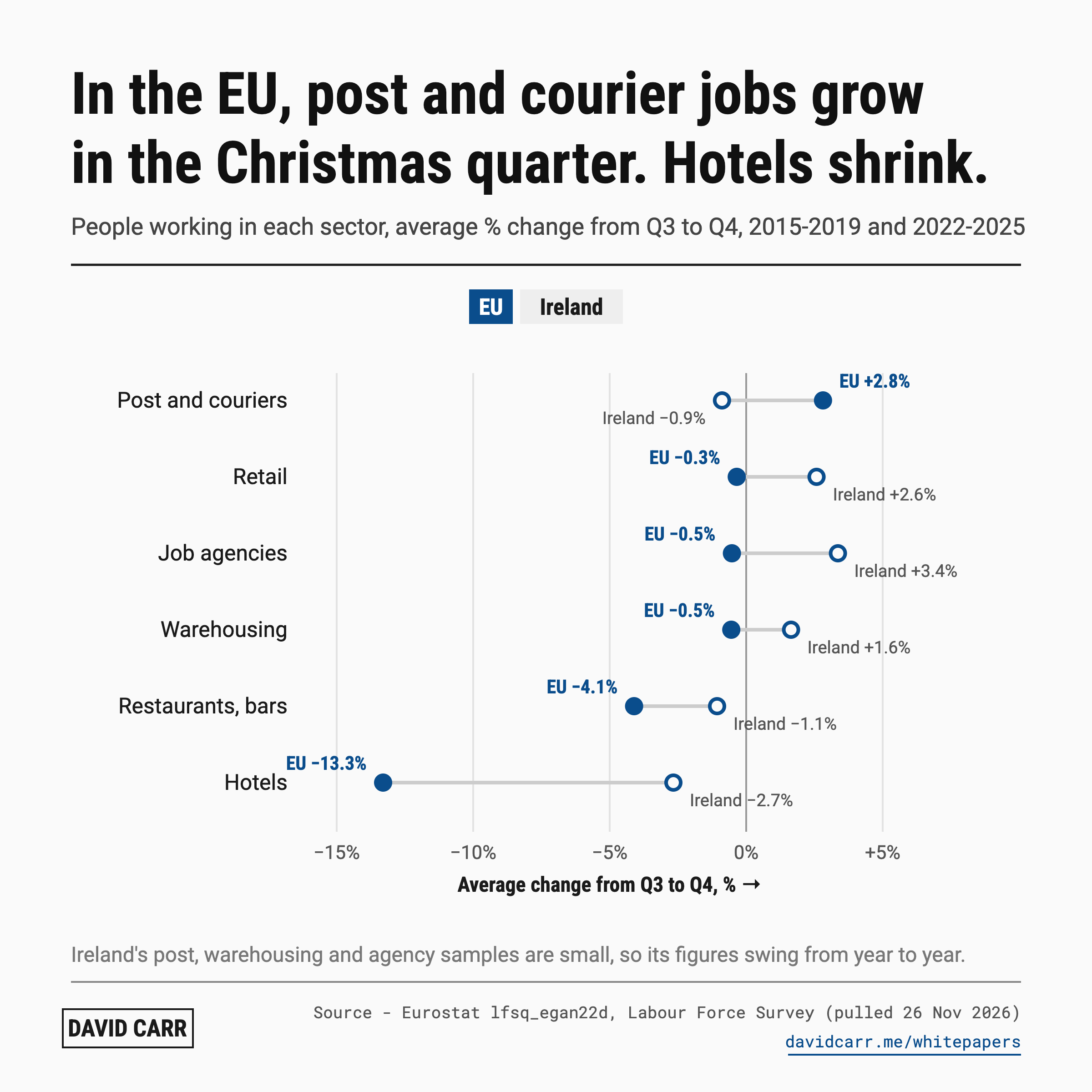
In the EU, post and courier jobs grow in the Christmas quarter. Hotels shrink.
- EU post and couriers: +2.8% on average, up in 8 of 9 years
- EU retail: -0.3%; restaurants and bars: -4.1%
- EU hotels: -13.3%, down every year
- Ireland: retail +2.6%, job agencies +3.4%, hotels -2.7%
Of the six sectors here, only post and couriers grow EU-wide in the last quarter. Ireland's hotels lose far fewer people after summer than the EU's.
Eurostat lfsq_egan22d, people in employment by NACE division, Q3 to Q4, 2015 to 2019 and 2022 to 2025. Ireland's post, warehousing and agency samples are small; read them as rough.
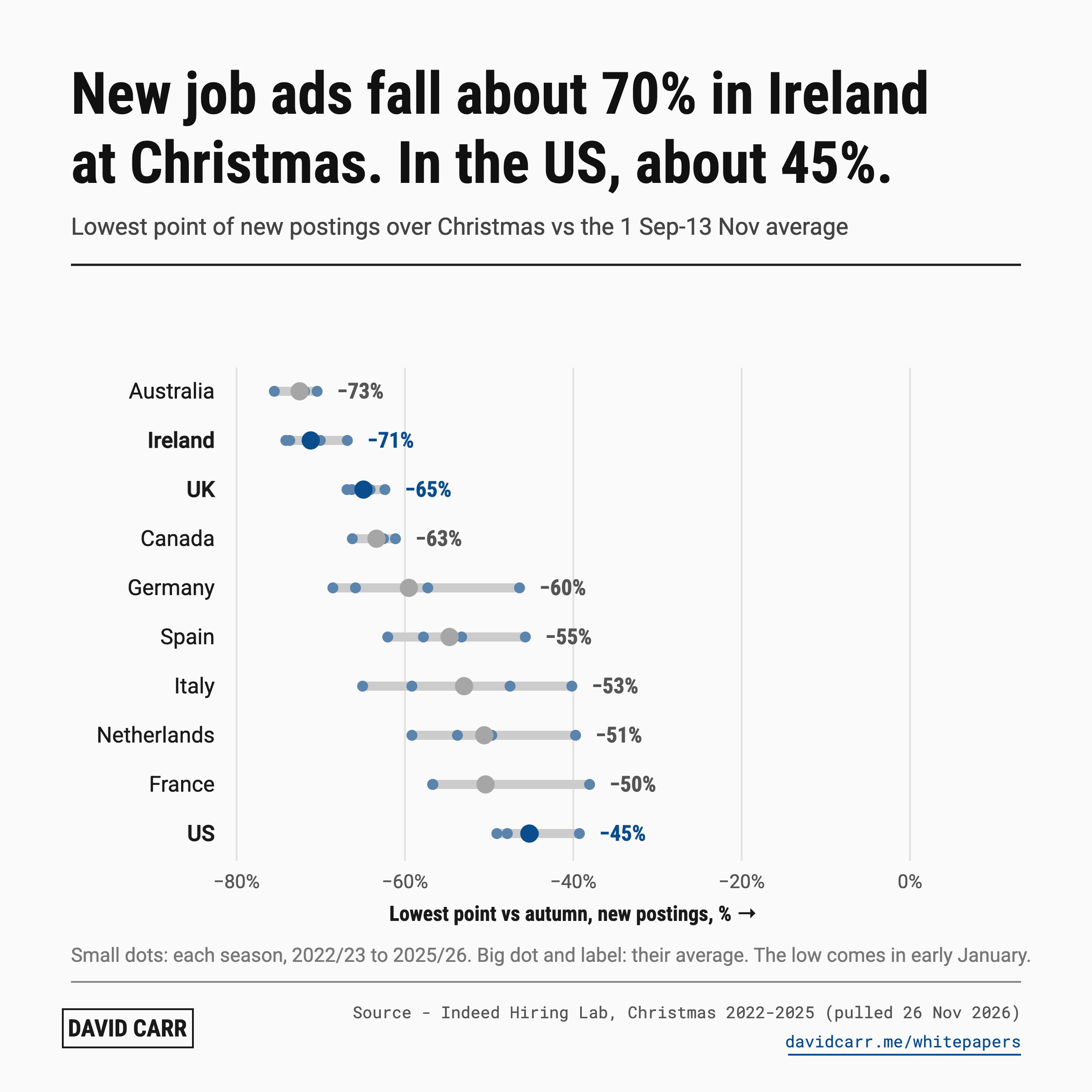
New job ads fall about 70% in Ireland at Christmas. In the US, about 45%.
- Lowest point vs autumn, average of four seasons:
- Australia -73%, Ireland -71%, UK -65%, Canada -63%
- Germany -60%, Spain -55%, Italy -53%, France -50%
- US -45%
Every country here has a Christmas pause in new ads. Ireland's is the second deepest of the ten, after Australia's.
Indeed Hiring Lab, new postings, not seasonally adjusted. The lowest 7-day average between 1 December and 20 January, compared with the same season's 1 September to 13 November average, 2022/23 to 2025/26.
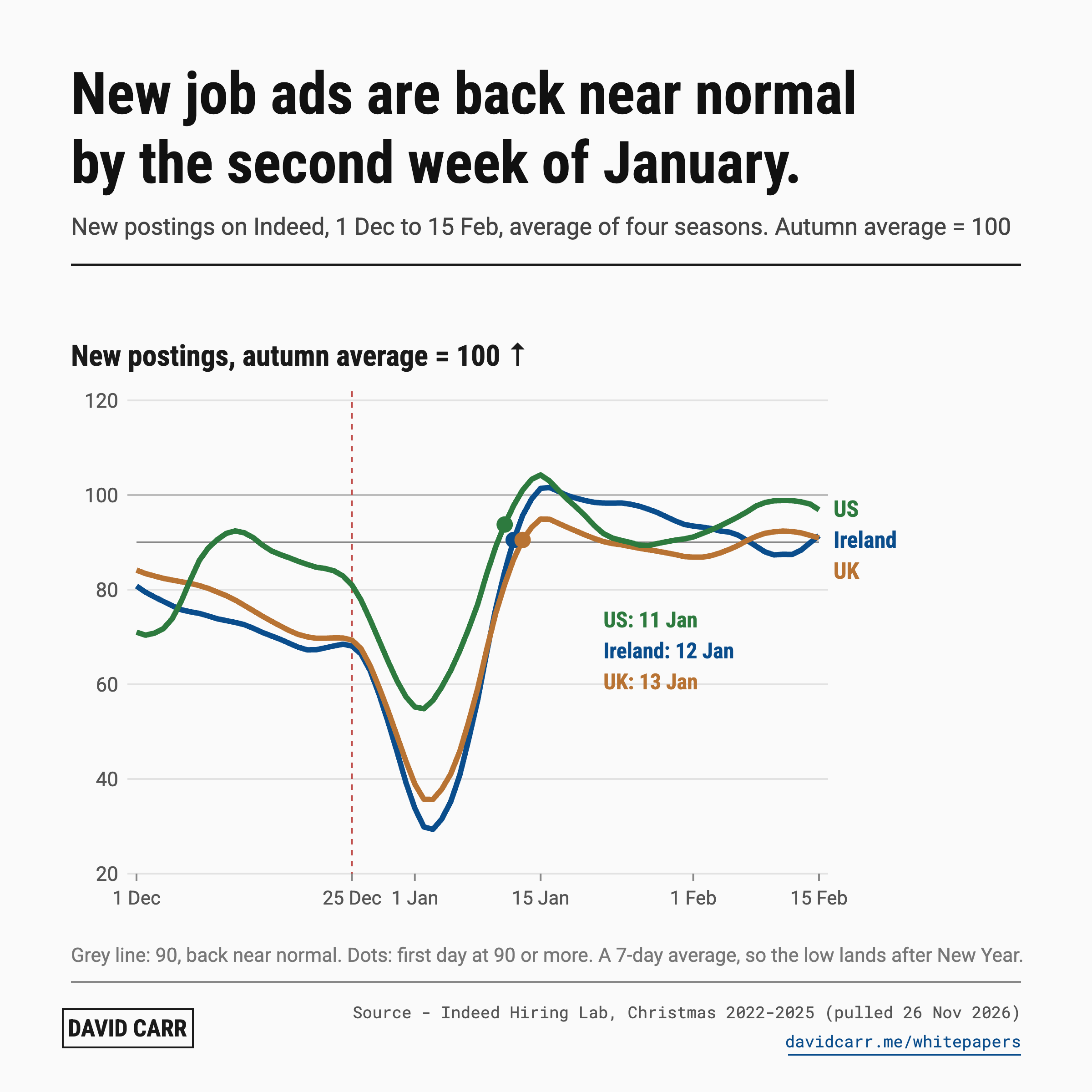
New job ads are back near normal by the second week of January.
- Back to 90% of autumn: US 11 January, Ireland 12 January, UK 13 January
- Ireland's low: 29% of the autumn level, just after New Year
- By mid-January Ireland and the US briefly top the autumn average
The pause is short. Within about ten days of New Year, employers are posting at close to their autumn pace again.
Indeed Hiring Lab, new postings, average of the four seasons 2022/23 to 2025/26. A 7-day trailing average, so the curve trails the calendar by a few days.
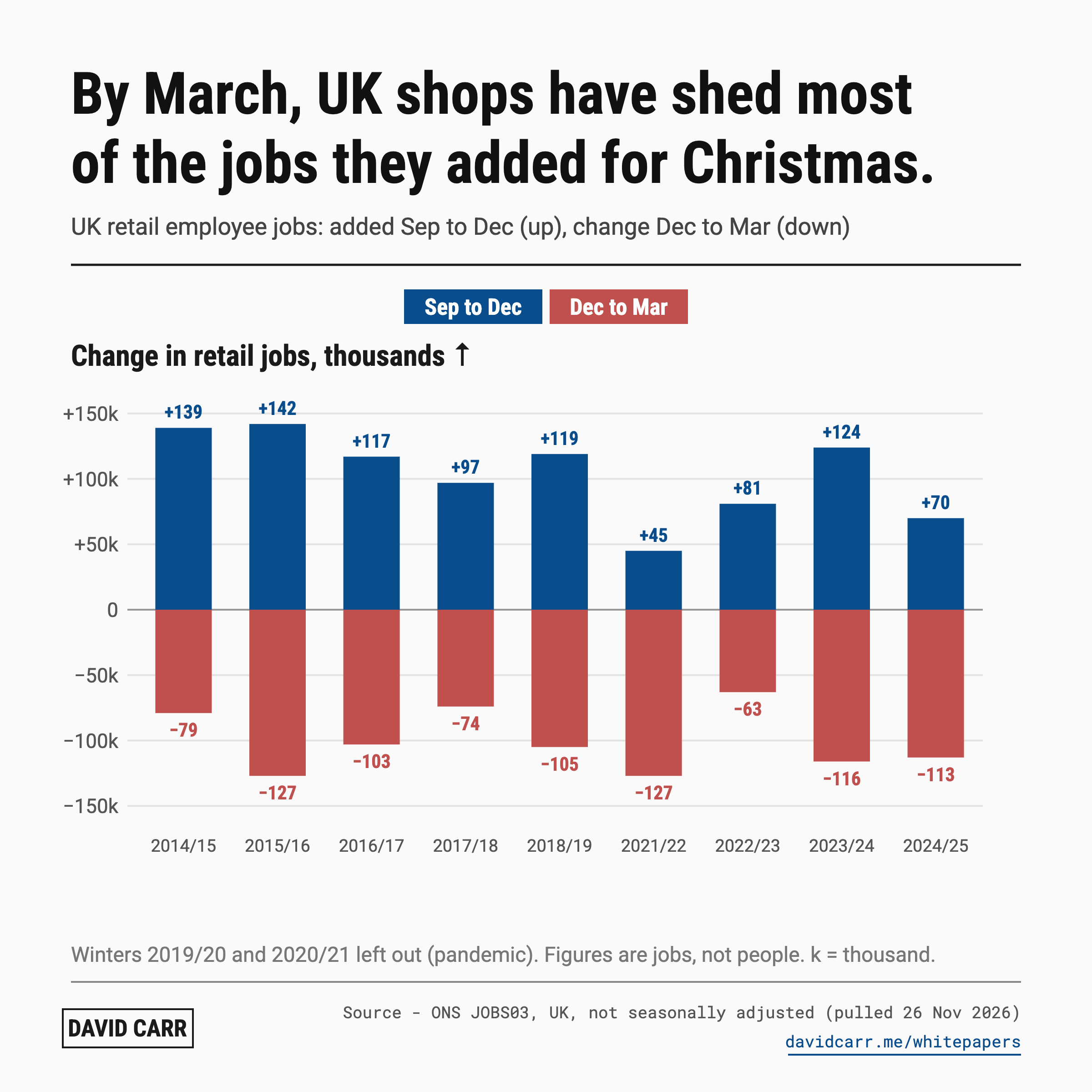
By March, UK shops have shed most of the jobs they added for Christmas.
- 2023/24: +124,000 by December, -116,000 by March
- 2024/25: +70,000, then -113,000
- In every winter shown, March undid more than half of the December gain
- In 2021/22 and 2024/25 March fell below September
The December jobs are mostly gone by the end of the first quarter.
ONS JOBS03, retail employee jobs, not seasonally adjusted. Winters 2019/20 and 2020/21 are left out because shops closed in the pandemic.
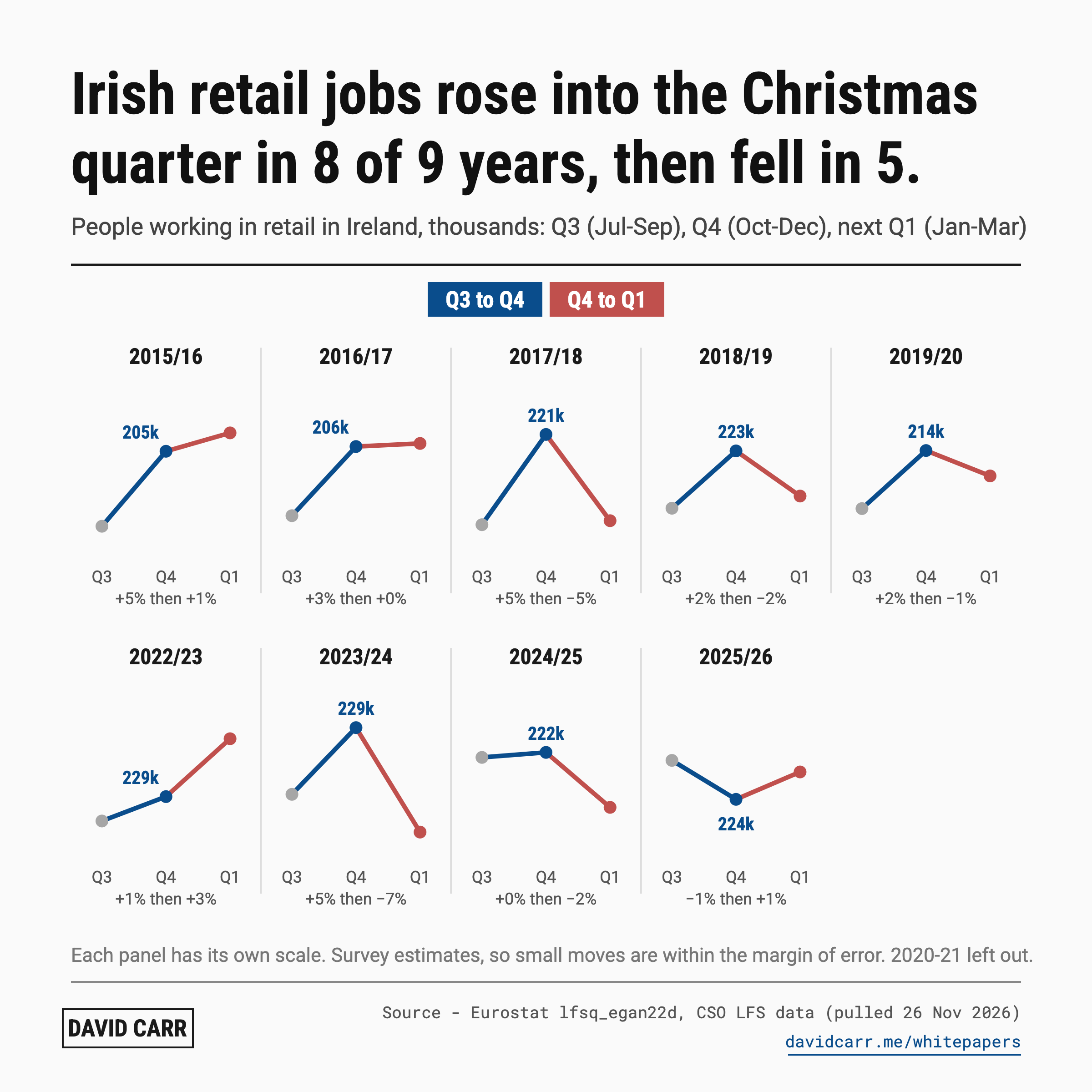
Irish retail jobs rose into the Christmas quarter in 8 of 9 years, then fell in 5.
- Biggest Christmas-quarter rises: about +5% in 2015, 2017 and 2023
- Biggest falls after: -7% in early 2024, -5% in early 2018
- 2025: the only year with no rise into Q4
Ireland's survey shows the rise more clearly than the fall. Quarterly averages smooth out a December peak that lasts only weeks.
Eurostat lfsq_egan22d, people in retail in Ireland (CSO Labour Force Survey), thousands, each quarter. Each panel has its own scale.
Method, caveats and sources
The short answer. New job ads in Ireland peak in mid-September, ease through the autumn and fall about 70% over Christmas week, more than in the UK (65%) or the US (45%). They are back near normal by about 12 January. In jobs, the Christmas rise shows up in shops, post and couriers, job agencies and warehousing. UK shops had more staff in December than September every year since 2014, about 100,000 more on average, and shed most of them by March. Irish retail employment rose into the Christmas quarter in 8 of the 9 years checked.
Data. Three sources, all downloaded on 26 November 2026. Indeed Hiring Lab's job postings index (CC BY 4.0), daily to 13 November 2026, for ten countries: total and new postings, unadjusted and seasonally adjusted. ONS JOBS03, employee jobs by industry for the UK, not seasonally adjusted, quarterly to June 2026. Eurostat lfsq_egan22d, Labour Force Survey employment by detailed sector, quarterly to Q2 2026; Ireland's figures in it come from the CSO's Labour Force Survey. Every number on this page is my own calculation on those files.
Postings are not jobs. Indeed counts ads on its own site, not hires, and its coverage differs by country. "New postings" are ads up for 7 days or fewer, which is why they fall so sharply when employers stop posting for a week. Indeed publishes its occupation data only seasonally adjusted, and none for Ireland, so it cannot show which job types rise at Christmas; the job-type charts use employment data instead.
Quarters hide December. The Labour Force Survey averages over each quarter, so a peak that lasts a few weeks is diluted. The ONS figures relate to the last month of each quarter, so they catch December directly. Survey estimates for small sectors and small countries swing a lot from year to year. The pandemic years 2020 and 2021 are left out of the averages.
Left out. US employment figures come from US government sites, which this page does not use, so the US appears only in the Indeed charts. Company hiring announcements are not charted: they are plans, not counts, and not every firm publishes them. One example, as a company announcement: Amazon said on 13 October 2025 it planned to hire 250,000 US workers for the holiday season, the same as in the two years before (CNBC). Pay and working conditions are not covered.
Also: The jobs Ireland does now and How Ireland shops for Christmas.