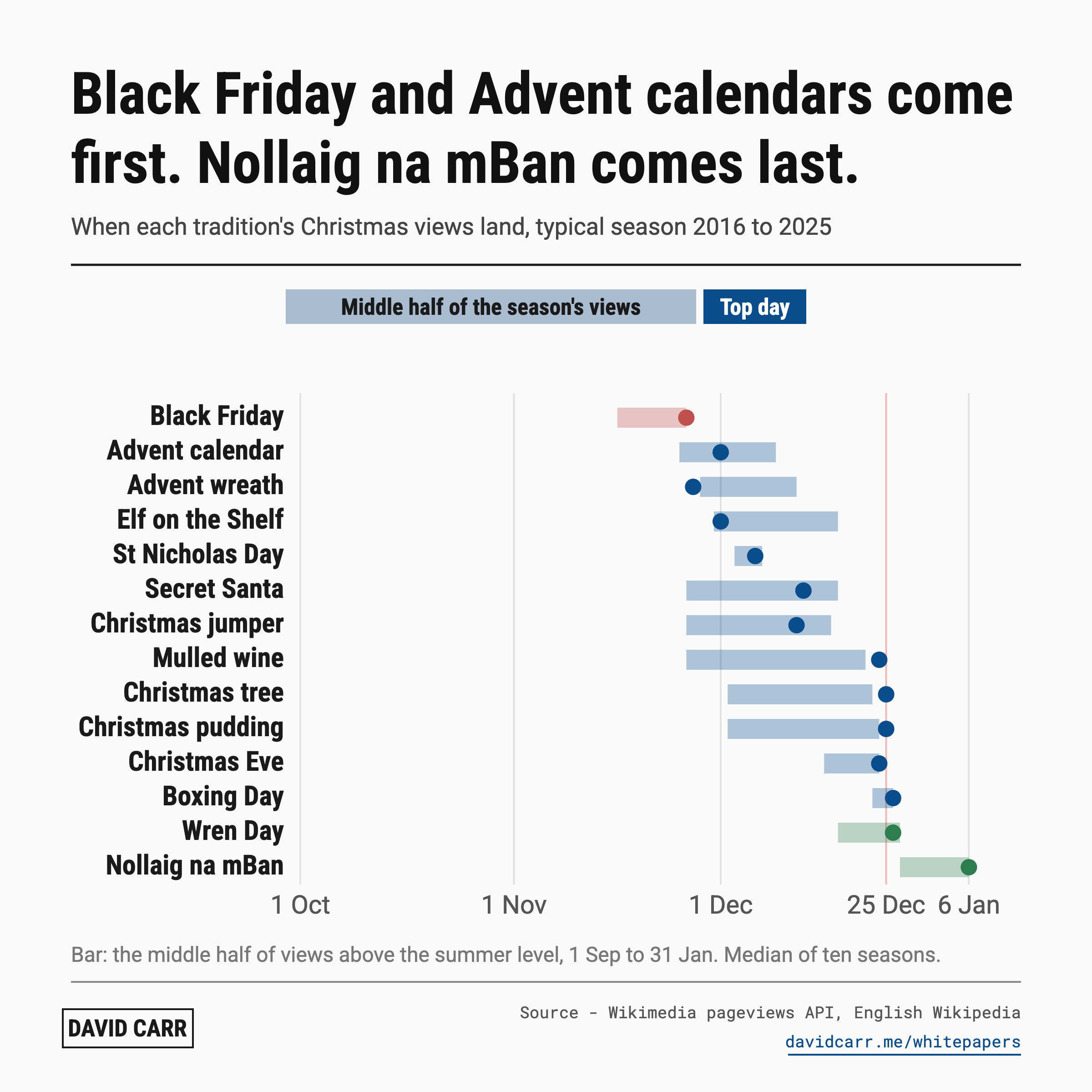
Black Friday and Advent calendars come first. Nollaig na mBan comes last.
- Black Friday: the middle half of its extra views lands between 16 and 26 November
- Advent calendar and Advent wreath: half their extra views are in by 2 December
- Elf on the Shelf, Secret Santa and the Christmas jumper: late November to mid-December
- Christmas tree and Christmas pudding: 2 December to Christmas Eve
- Nollaig na mBan: 27 December to 6 January
Most of the season sits in December. Black Friday is nearly over before the tree gets going.
Wikipedia views are attention, not practice. Reading about Advent calendars is not the same as opening one.
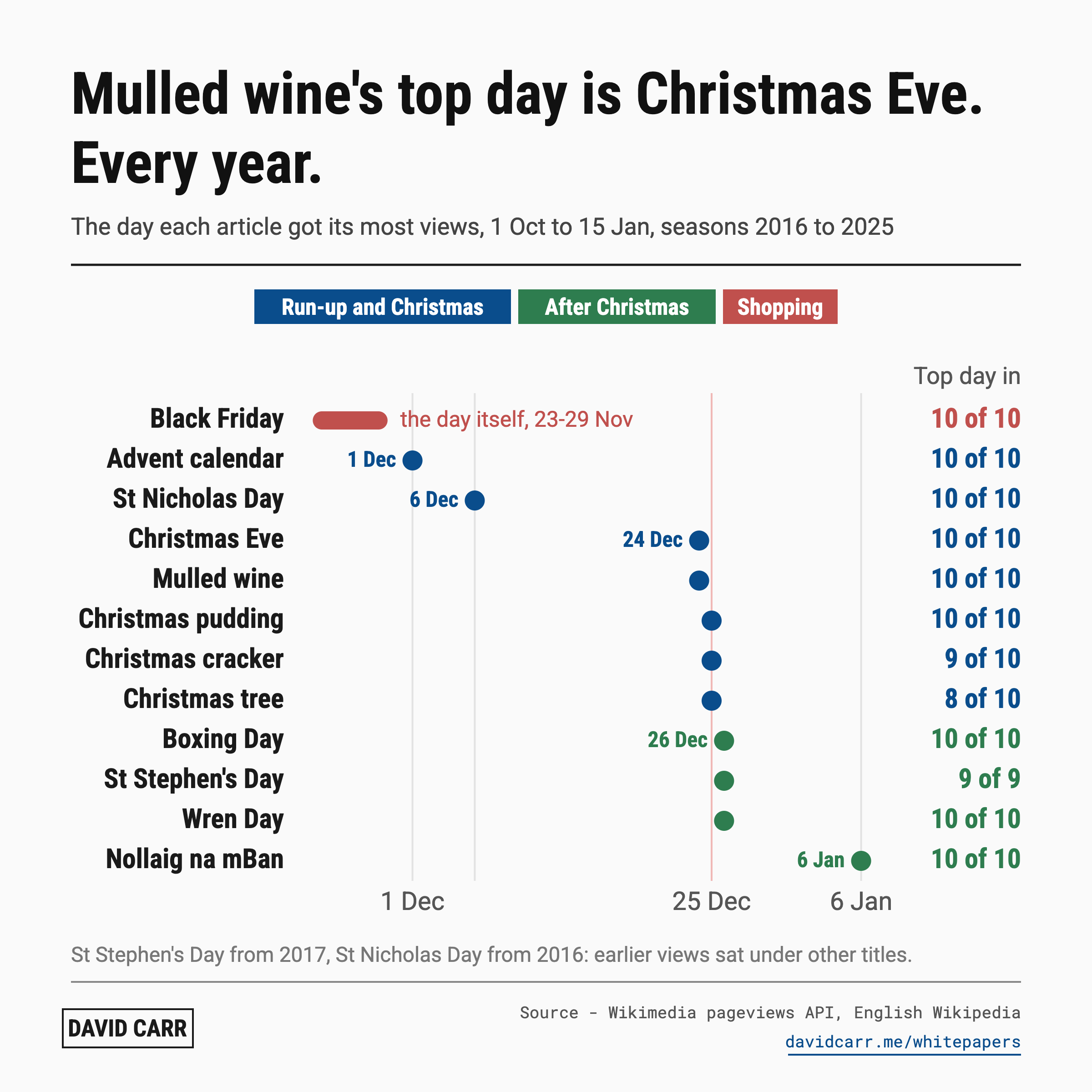
Mulled wine's top day is Christmas Eve. Every year.
- Advent calendar: 1 December, in 10 of 10 seasons
- St Nicholas Day: 6 December, 10 of 10
- Christmas Eve and mulled wine: 24 December, 10 of 10
- Christmas pudding: Christmas Day, 10 of 10. Cracker 9, tree 8
- Boxing Day and Wren Day: 26 December, 10 of 10. St Stephen's Day, 9 of 9
- Nollaig na mBan: 6 January, 10 of 10
Each tradition has its own day, and it does not move.
Top day = the day with the most views from 1 October to 15 January. St Stephen's Day from 2017 and St Nicholas Day from 2016, when their articles took their current titles.
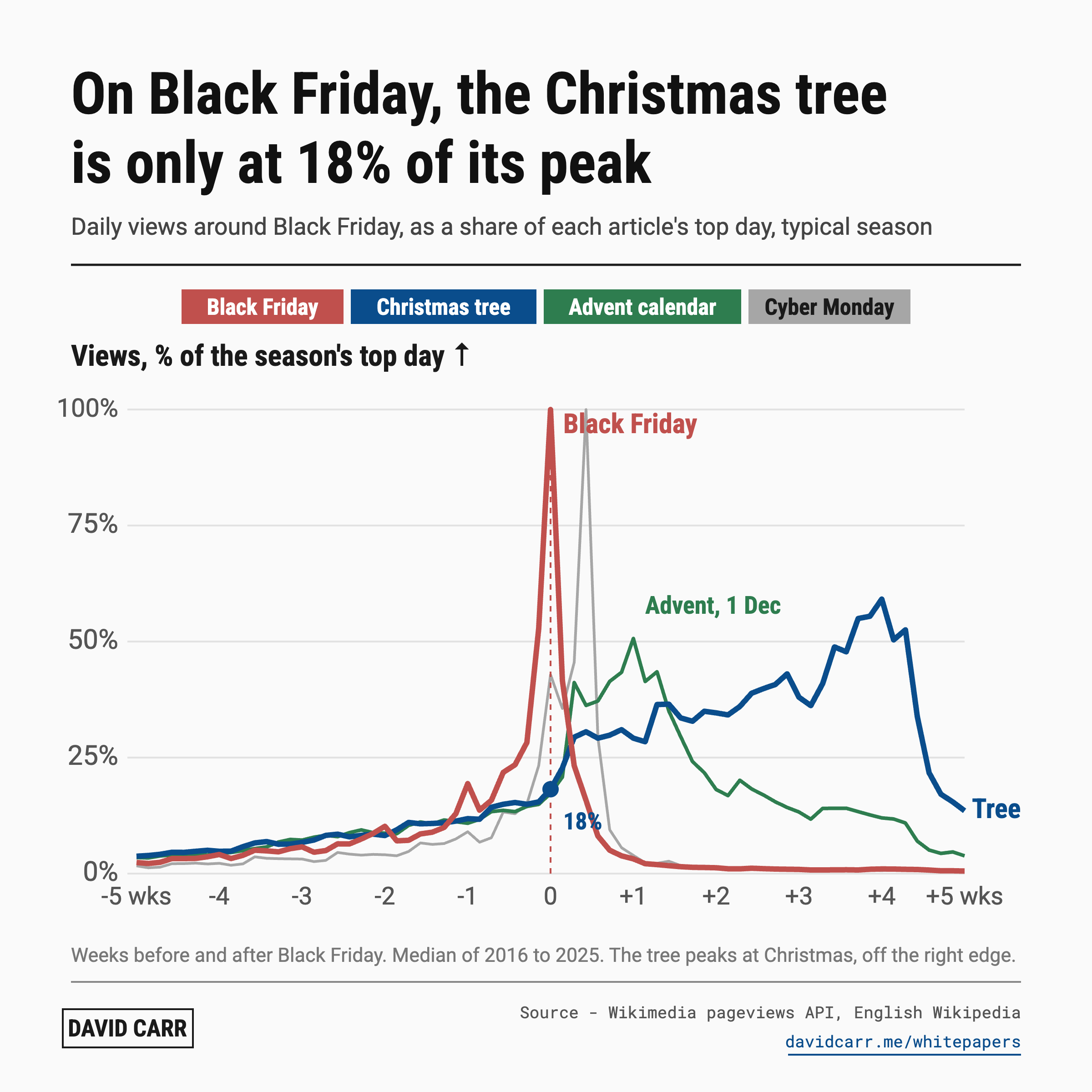
On Black Friday, the Christmas tree is only at 18% of its peak
- The Black Friday article's top day is Black Friday itself, every year since 2016
- A week later it is down to 3% of that peak
- The Christmas tree article is at 18% of its top day on Black Friday, and 59% four weeks later
- Advent calendars peak on 1 December, about a week after Black Friday
Black Friday comes and goes inside a week. Christmas is only warming up.
Black Friday is the day after the fourth Thursday of November, so it falls between 23 and 29 November. Lines are aligned on it each year.
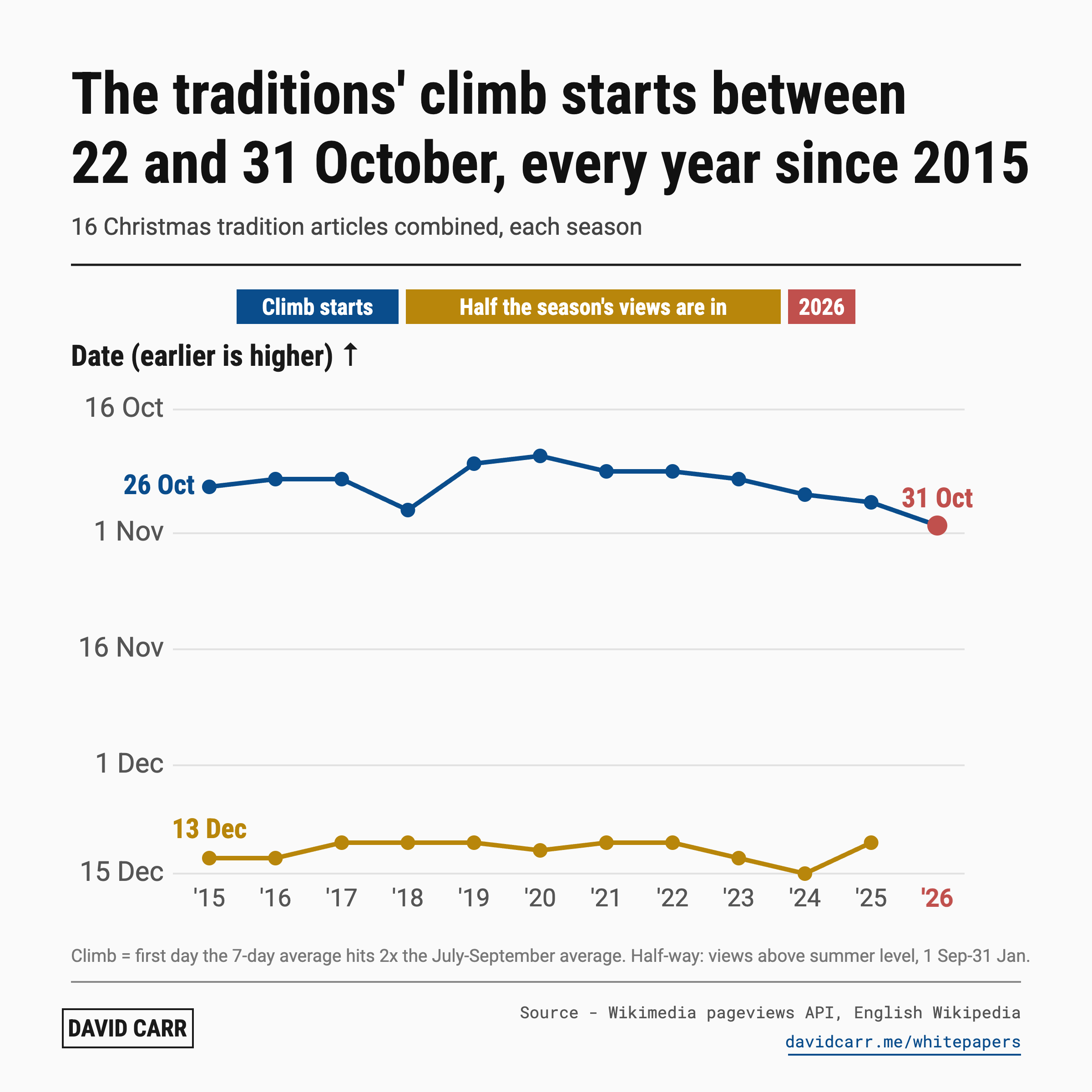
The traditions' climb starts between 22 and 31 October, every year since 2015
- The climb: the first day 16 tradition articles together reach twice their summer level
- 2015: 26 October. 2020: 22 October, the earliest
- 2026: 31 October, the latest so far
- Half the season's extra views are in by 11 to 15 December, every year
The Christmas films now come back about two weeks earlier than in 2015. The traditions have kept their dates.
Elf on the Shelf is left out of the 16: its article has spikes in summer and September 2017 that do not look seasonal.
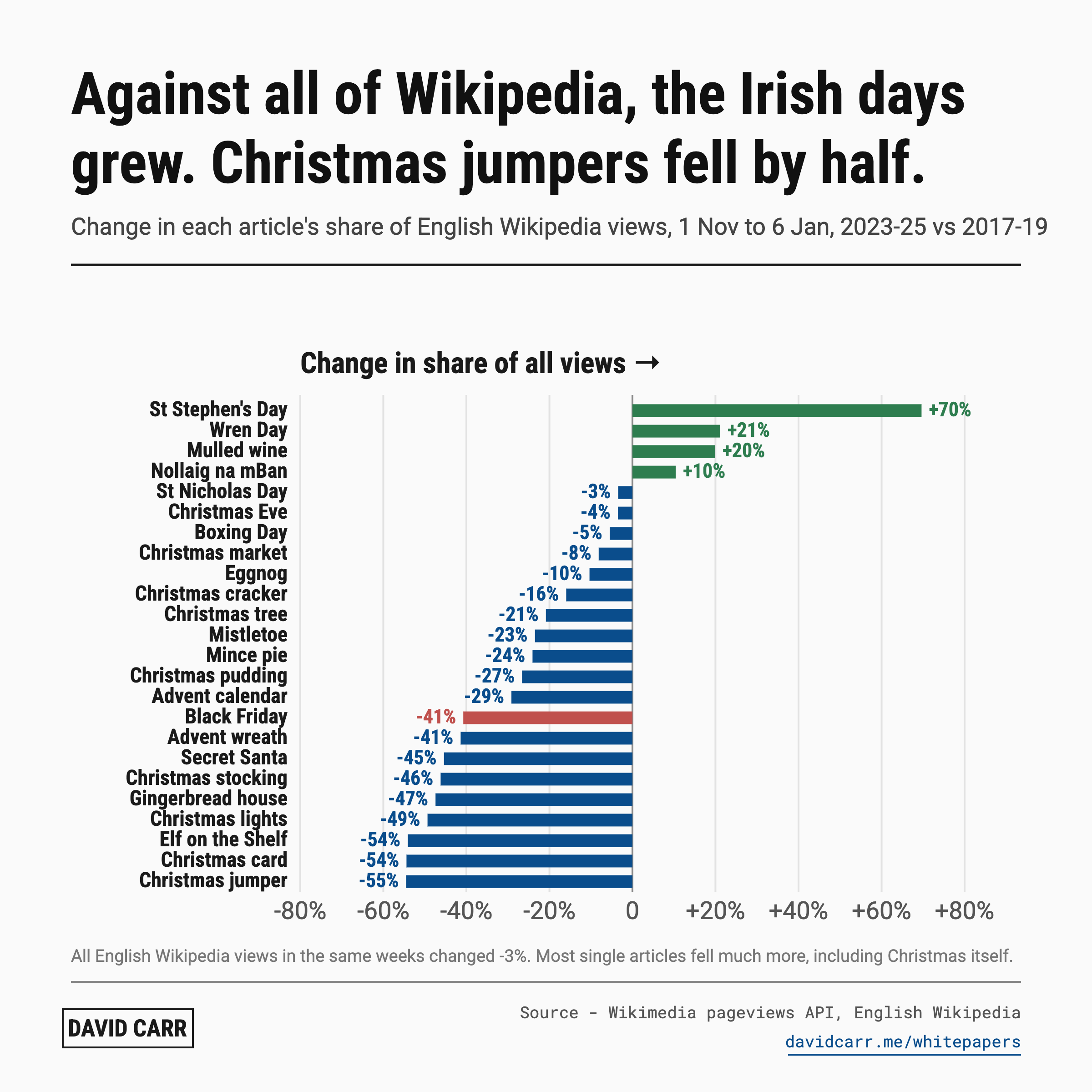
Against all of Wikipedia, the Irish days grew. Christmas jumpers fell by half.
- All English Wikipedia views in the same weeks: down 3% (2023-25 against 2017-19)
- Grew as a share of all views: St Stephen's Day +70%, Wren Day +21%, mulled wine +20%, Nollaig na mBan +10%
- The median of all 24 articles here: down 24%
- Fell most: the Christmas jumper -55%, Christmas card -54%, Elf on the Shelf -54%
- The Christmas article itself: down 22%
Most single articles lost views faster than Wikipedia as a whole. The days after Christmas held up best.
This compares each article with the rest of Wikipedia. It does not say why. St Stephen's Day is kept in many countries, Ireland among them.
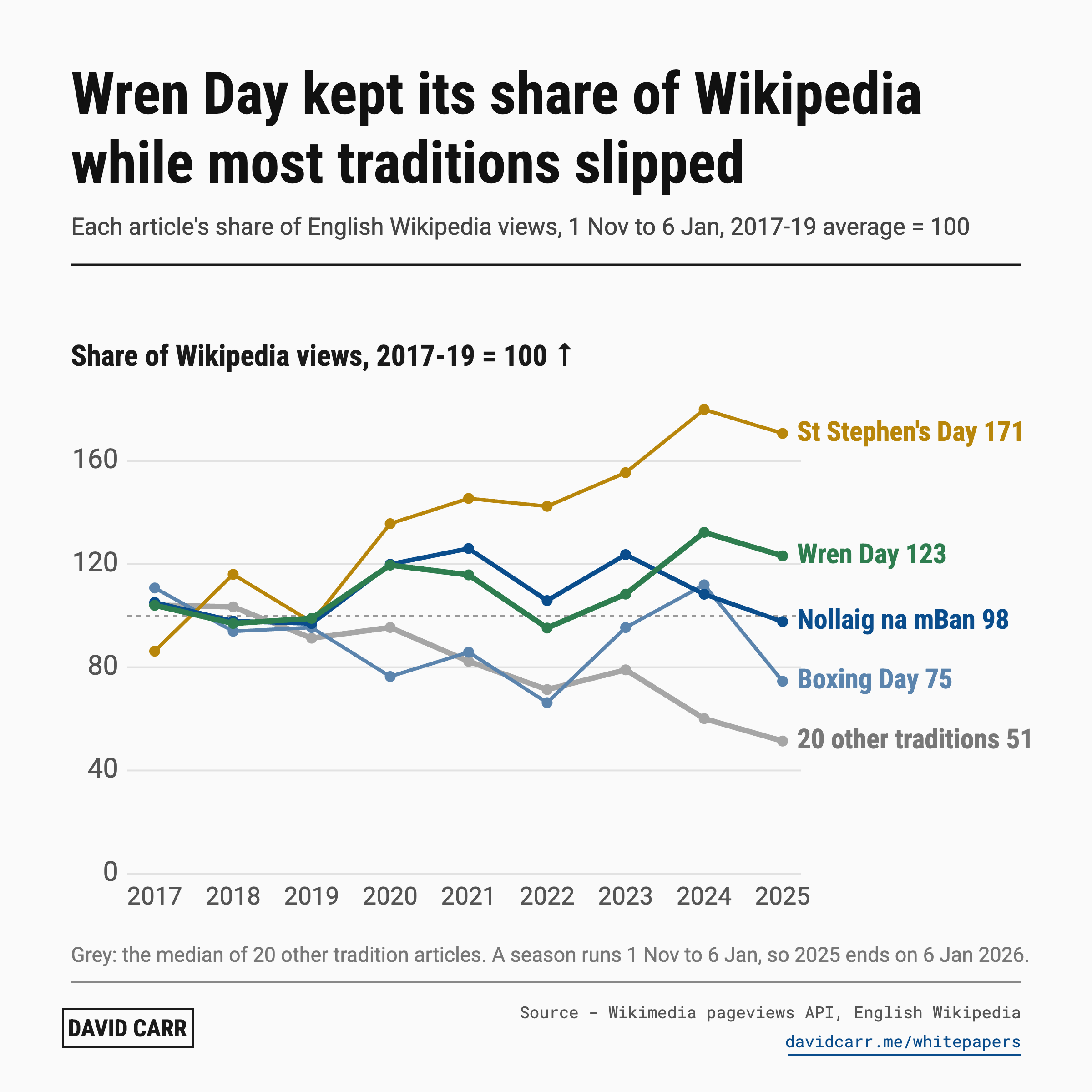
Wren Day kept its share of Wikipedia while most traditions slipped
- Share of all English Wikipedia views, 2017-19 = 100
- St Stephen's Day: 171 in 2025
- Wren Day: 123
- Nollaig na mBan: 98
- Boxing Day: 75
- The median of 20 other tradition articles: 51
The Irish days held their place. By 2025 the typical other tradition had about half its 2017-19 share.
A single season moves around: Boxing Day was at 112 in 2024 and 75 in 2025.
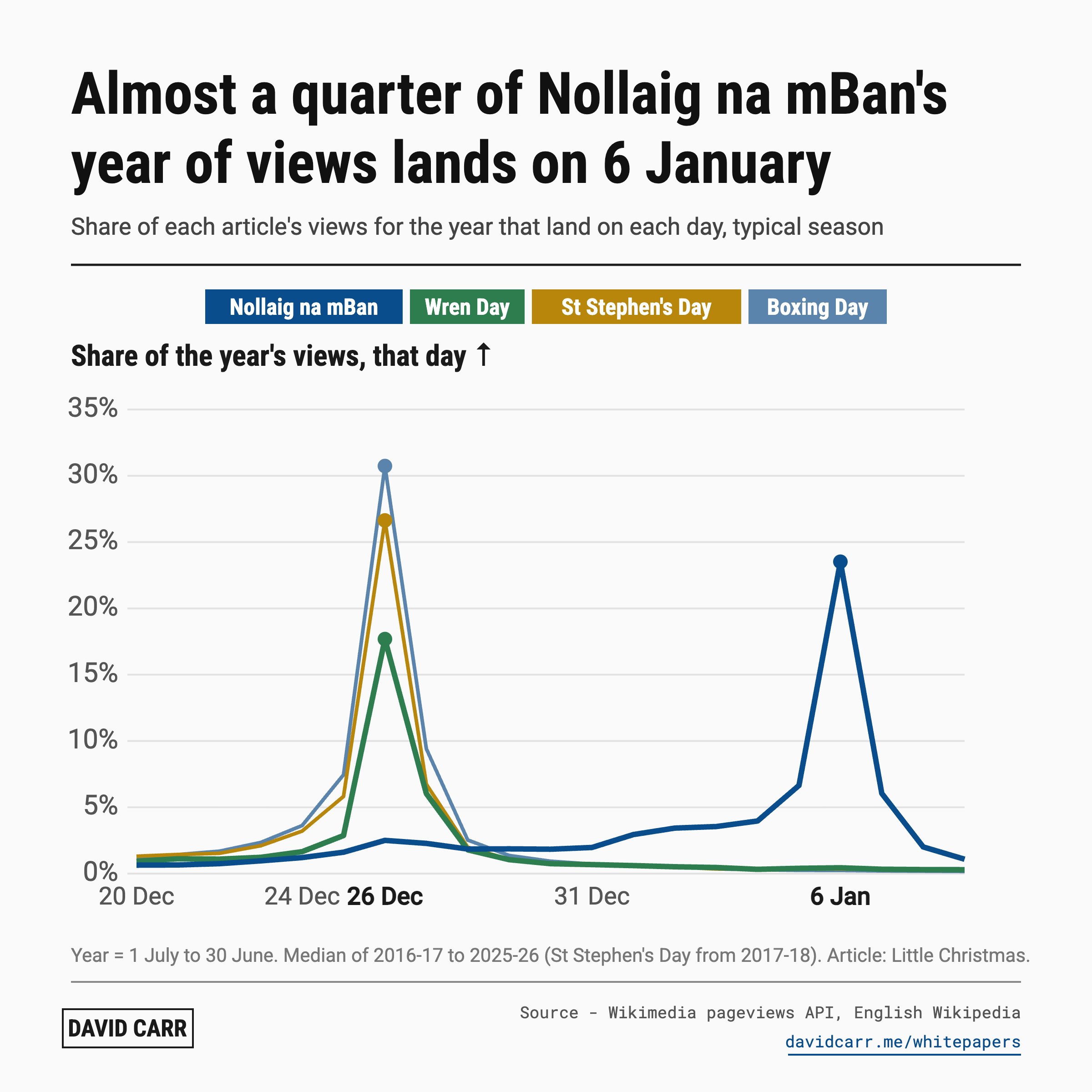
Almost a quarter of Nollaig na mBan's year of views lands on 6 January
- Nollaig na mBan: 23.5% of its year on 6 January
- Boxing Day: 31% of its year on 26 December
- St Stephen's Day: 27%
- Wren Day: 18%
These are one-day articles. For most of the year they are quiet.
The English article is called Little Christmas. It covers Nollaig na mBan, or Women's Christmas. A year here runs 1 July to 30 June.
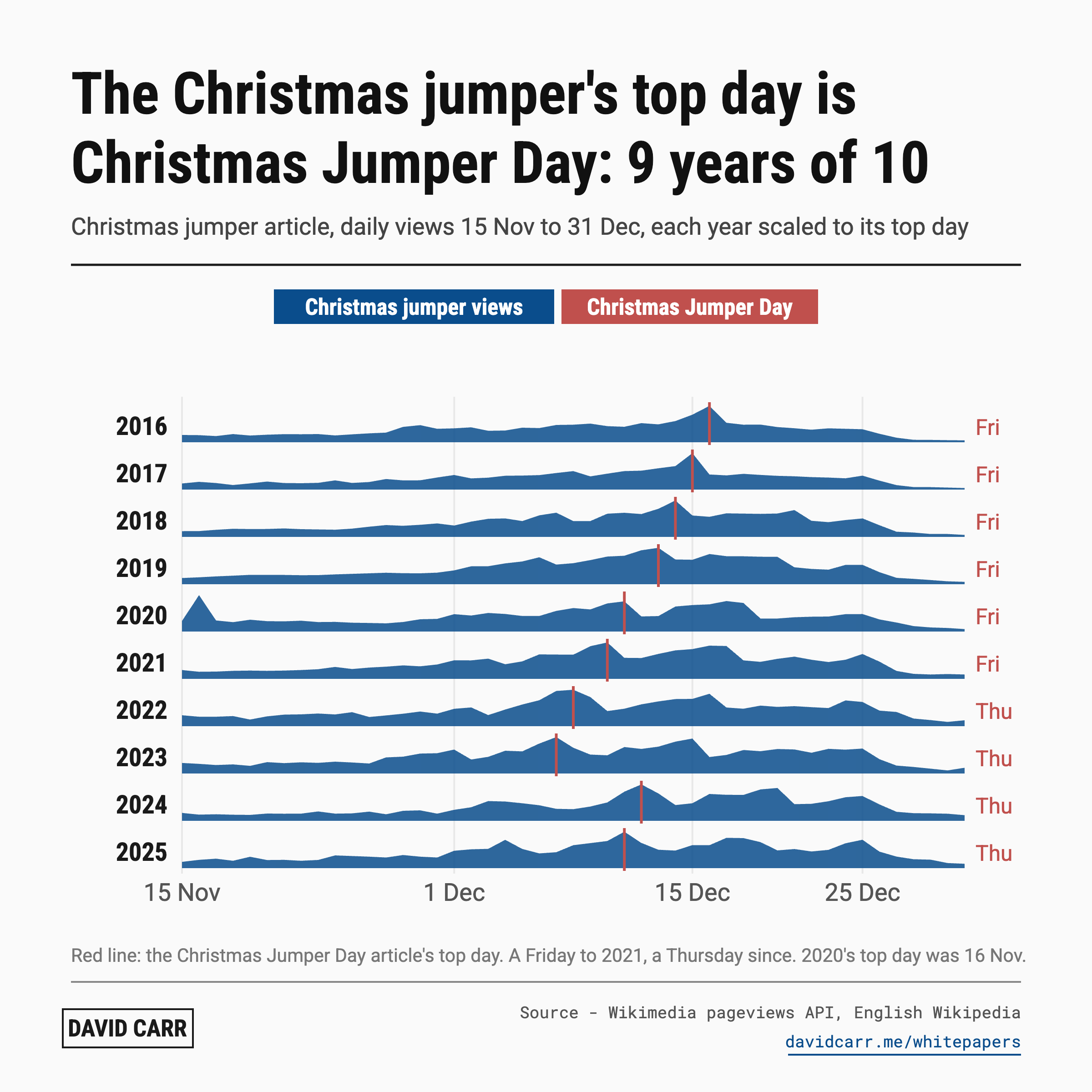
The Christmas jumper's top day is Christmas Jumper Day: 9 years of 10
- In 9 of the 10 years since 2016, the jumper article's busiest day was the same day as the Christmas Jumper Day article's
- The odd one out was 2020, when its top day was 16 November
- The day was a Friday up to 2021 and a Thursday from 2022
- Christmas Jumper Day fell between 7 and 16 December in every year
The jumper is a December thing, and the charity day sets its peak.
Christmas Jumper Day is a Save the Children fundraiser in the UK and Ireland. Its date here is read from its article's busiest day, not from the charity.
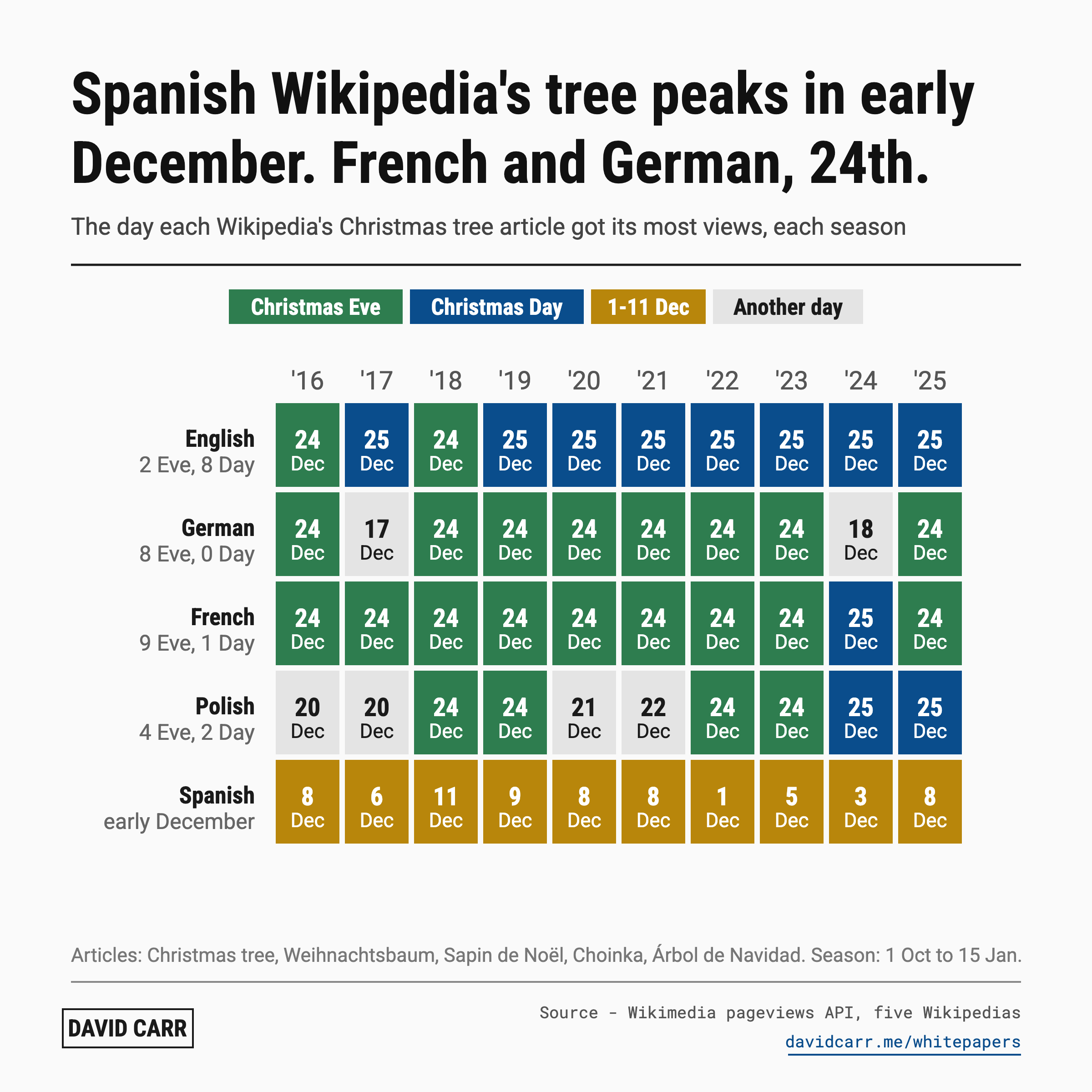
Spanish Wikipedia's tree peaks in early December. French and German, 24th.
- Spanish: top day between 1 and 11 December in all 10 seasons, most often 8 December
- French: Christmas Eve in 9 of 10
- German: Christmas Eve in 8 of 10
- English: Christmas Day in 8 of 10
- Polish: moves between 20 and 25 December
The same tree, a different big day.
These are languages, not countries. Spanish Wikipedia is read across Spain and Latin America; German, in Germany, Austria and Switzerland.
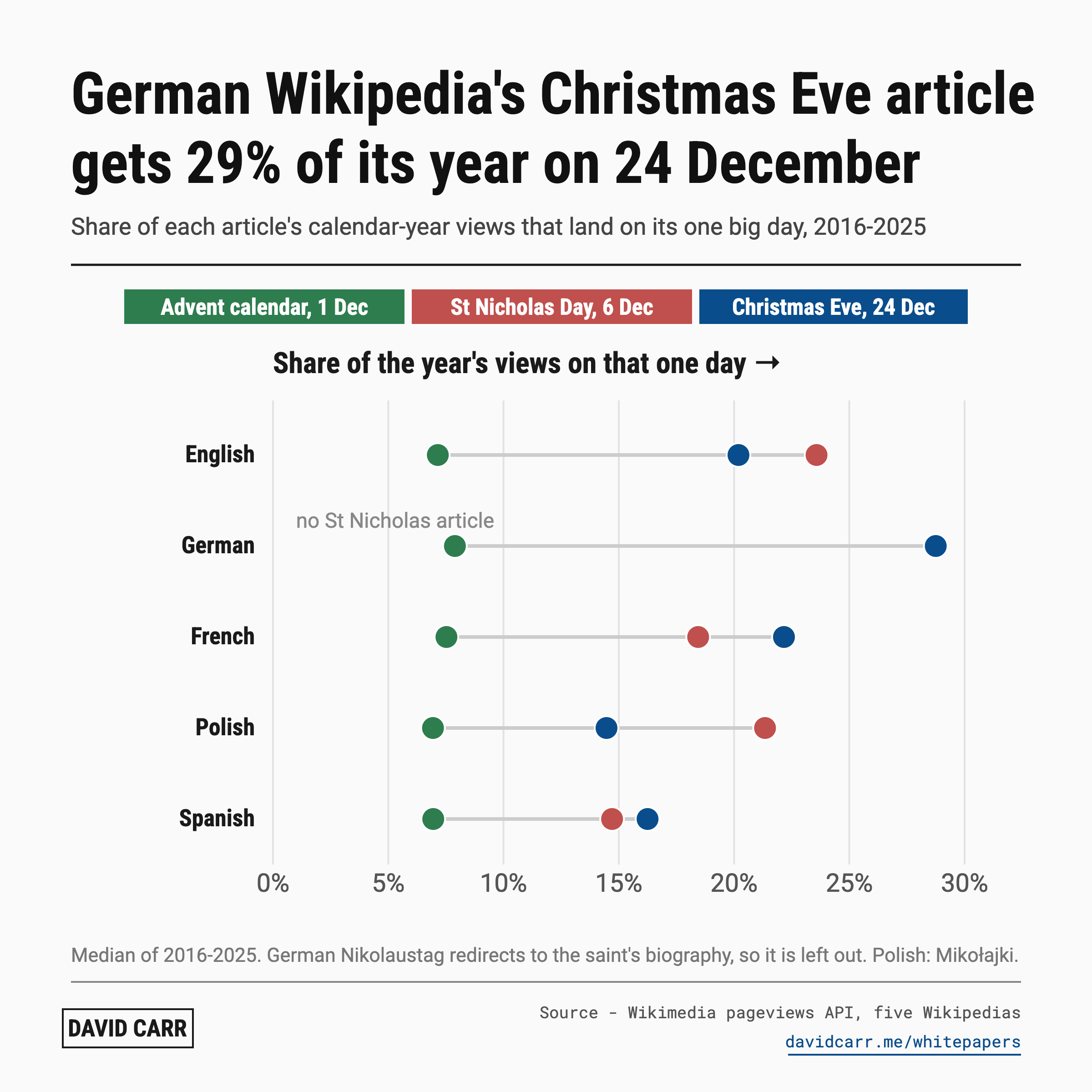
German Wikipedia's Christmas Eve article gets 29% of its year on 24 December
- Christmas Eve on the day: German 29%, French 22%, English 20%, Spanish 16%, Polish 14.5%
- St Nicholas Day on 6 December: English 24%, Polish 21%, French 18%, Spanish 15%
- All four St Nicholas articles peak on 6 December, every season
- Advent calendar on 1 December: about 7% to 8% in all five languages
Advent calendars build up to 1 December. St Nicholas and Christmas Eve are one-day spikes.
Share of calendar-year views, median of 2016 to 2025. German Nikolaustag redirects to the saint's biography, so it is left out. Polish: Mikołajki.
Method, caveats and sources
The short answer. On English Wikipedia, Christmas traditions start to climb in the last ten days of October, and it has stayed there every year since 2015. Black Friday peaks and is gone in a week, when the Christmas tree is only at about a fifth of its peak. Each tradition has a fixed top day, from Advent calendars on 1 December to Nollaig na mBan on 6 January. Against Wikipedia as a whole, St Stephen's Day, Wren Day, mulled wine and Nollaig na mBan grew from 2017-19 to 2023-25; most other traditions fell, the Christmas jumper by more than half. Spanish Wikipedia looks up the Christmas tree in early December; French and German Wikipedia on Christmas Eve.
Data. Daily views of each article from the Wikimedia pageviews API (per-article, all-access, user agent = humans only), 1 July 2015 to 21 November 2026, pulled on 22 November 2026. All of English Wikipedia's daily views come from the same API's aggregate endpoint. Anyone can check an article with the Pageviews tool. The raw pulls, a tidy extract and every number on this page are saved with the scripts.
Views are attention, not practice. A visit to the mulled wine article does not mean someone made mulled wine. Views also move with news, search engines and how often Wikipedia answers turn up elsewhere.
Against all of Wikipedia. Most single articles have lost views faster than English Wikipedia as a whole, so the growth charts use each article's share of all English Wikipedia views from 1 November to 6 January, three seasons pooled on each side.
Summer level, climb and middle half. "Summer" is the average day from 1 July to 30 September of the same year. The climb is the first day from 1 September on which the 7-day average reaches twice that level. The middle half is the stretch in which the middle 50% of a season's views above summer level land, from 1 September to 31 January.
Titles. St Stephen's Day moved to its current title on 30 October 2017, so it is used from the 2017 season. St Nicholas Day's 2015 views sat under another title, so it starts in 2016. Nollaig na mBan's English article is called Little Christmas. German Nikolaustag redirects to the saint's biography, so German is left out of St Nicholas.
The 12 Pubs. English Wikipedia has no article on the Twelve Pubs of Christmas in Ireland. The closest, The Twelve Bars of Christmas, is about a pub crawl in Chicago, so it is left out.
Also: When the Christmas films come back and Christmas Day weather in Ireland.