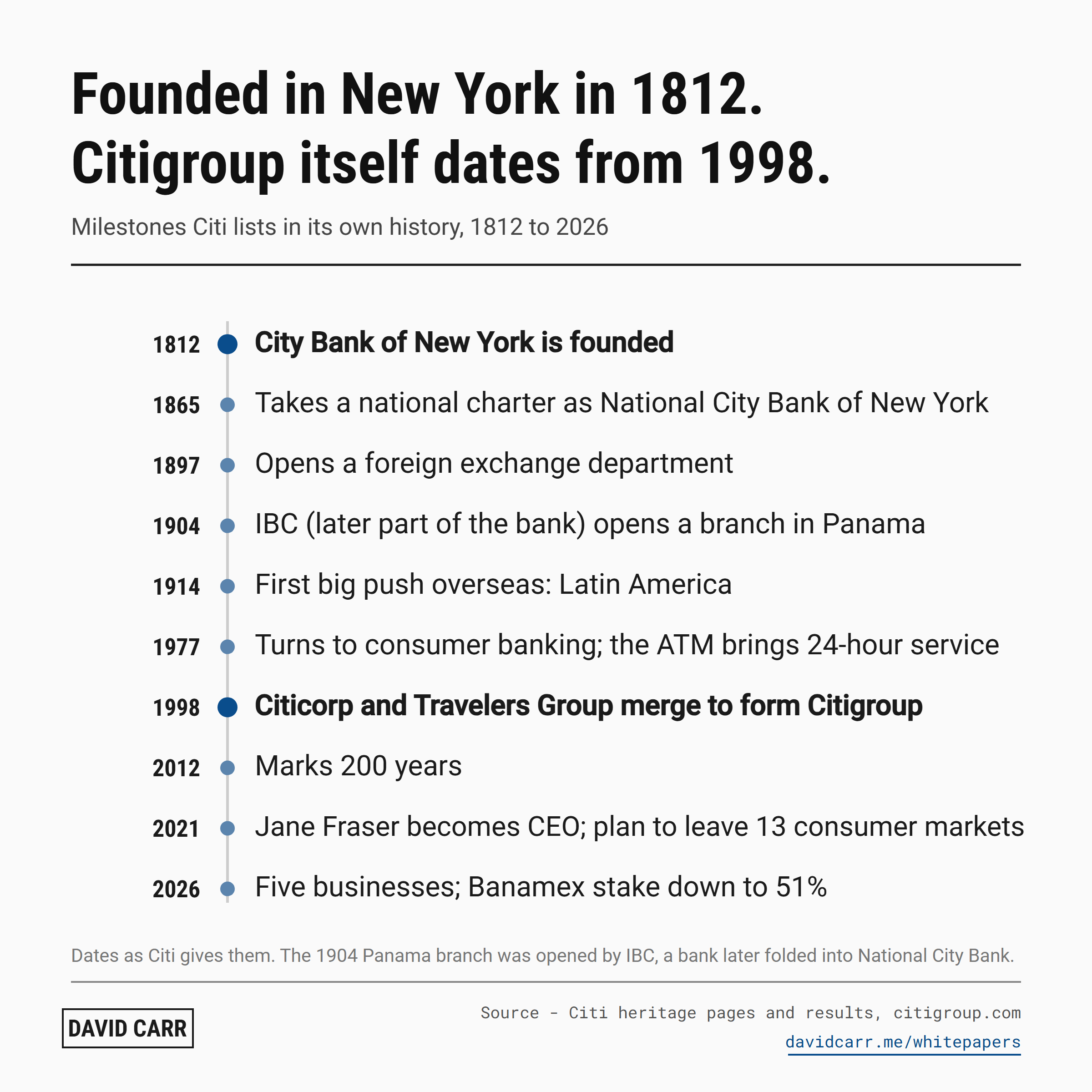
Founded in New York in 1812. Citigroup itself dates from 1998.
- 1812: City Bank of New York is founded
- 1865: National City Bank of New York
- 1914: first big push overseas, into Latin America
- 1977: consumer banking and the 24-hour ATM
- 1998: Citicorp and Travelers Group merge to form Citigroup
Citigroup is a 1998 name on a much older bank. The name on the door changed several times; the New York bank at its core goes back 214 years.
All from Citi's heritage pages. Citi lists Jane Fraser, CEO since March 2021, as the first female Wall Street CEO.
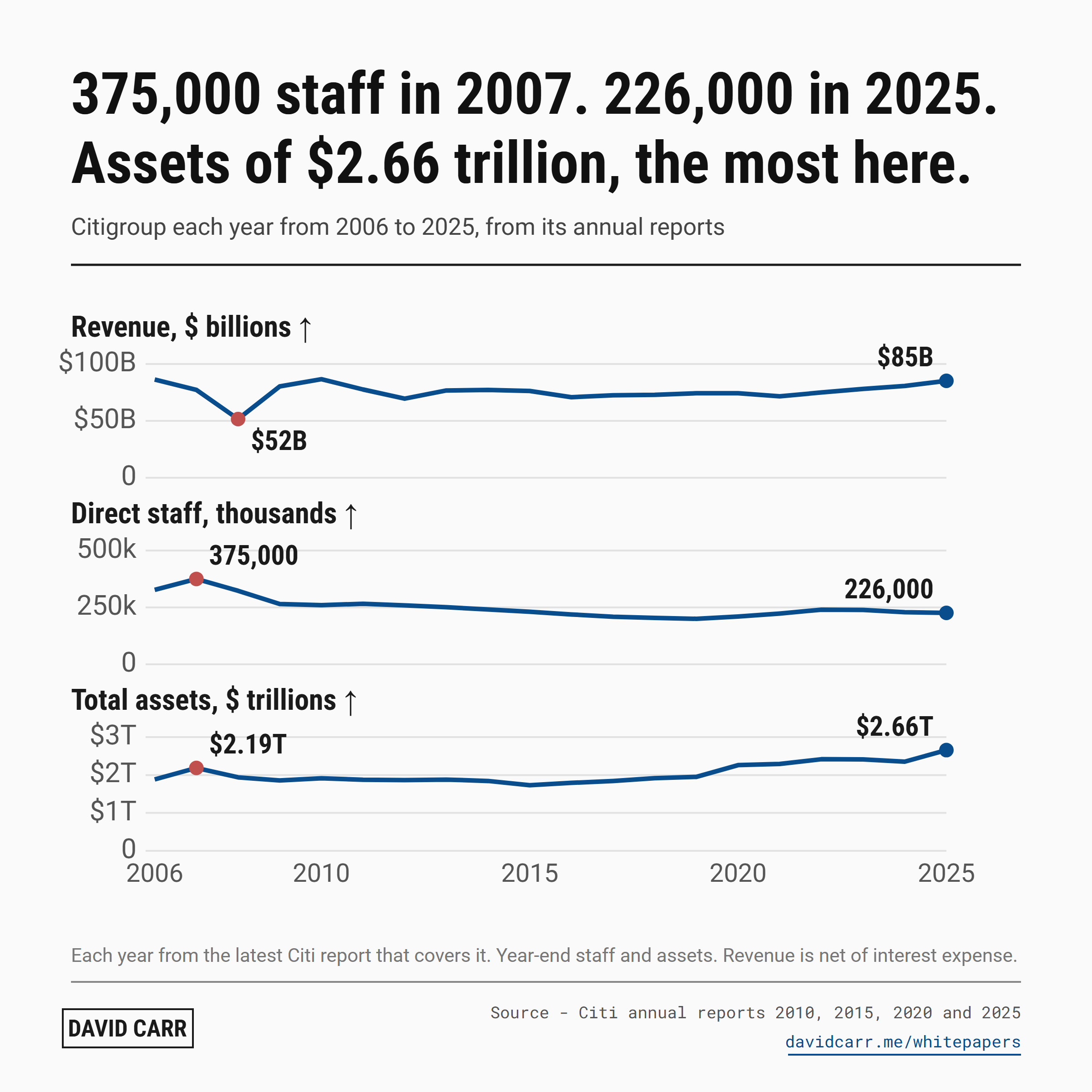
375,000 staff in 2007. 226,000 in 2025. Assets of $2.66 trillion, the most here.
- Revenue: $86.3B in 2006, a low of $51.6B in 2008, $85.2B in 2025
- Staff: 375,000 at the end of 2007, 200,000 in 2019, 226,000 in 2025
- Total assets: $2.19T in 2007, $2.66T at the end of 2025
Revenue is back near its 2006 level with about 100,000 fewer people. The balance sheet is bigger than ever on this chart.
From the five-year tables in Citi's annual reports for 2010, 2015, 2020 and 2025. Each report restates some figures, so years from different reports are not perfectly like-for-like.
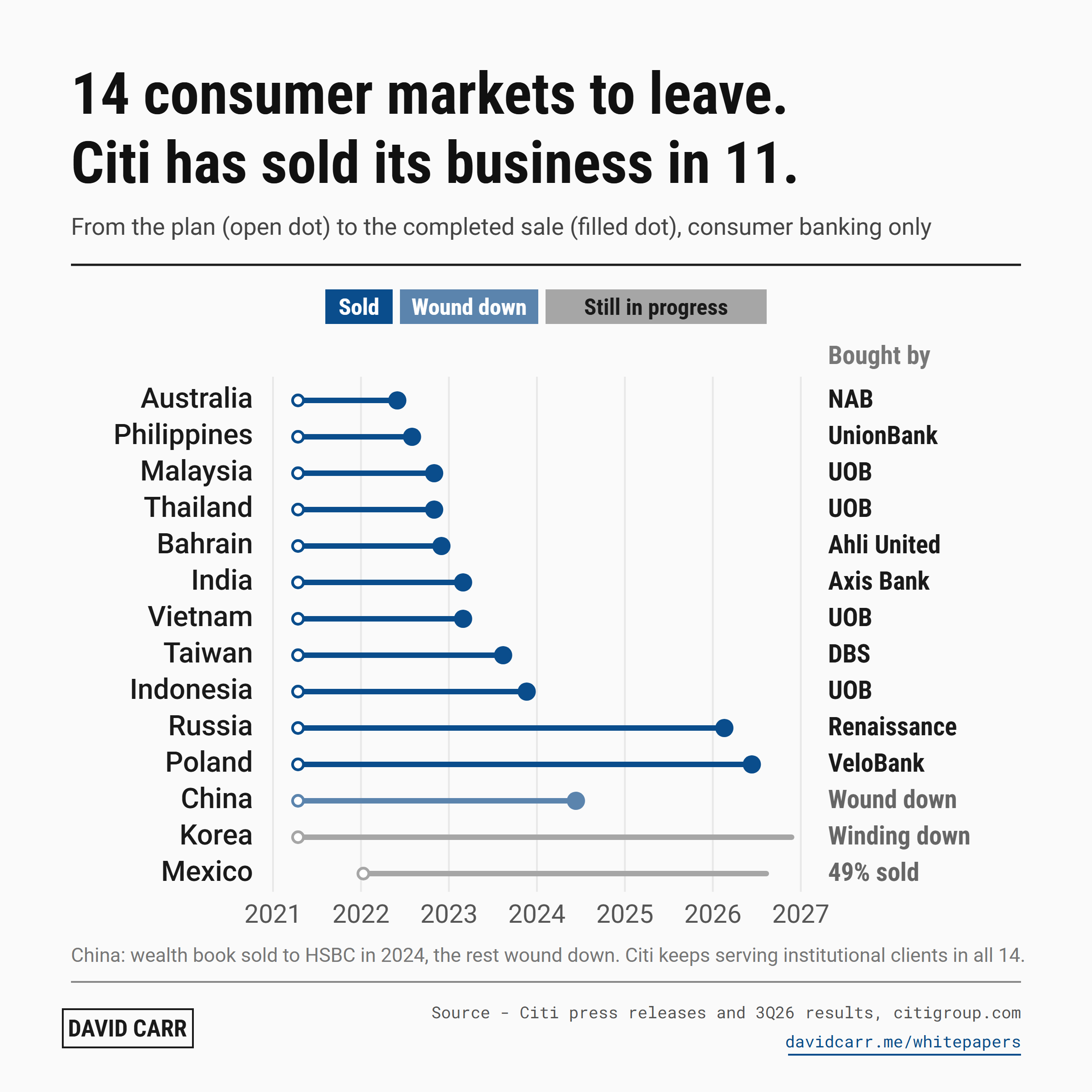
14 consumer markets to leave. Citi has sold its business in 11.
Most buyers were local or regional banks. UOB of Singapore took four markets.
Consumer banking only. Citi keeps serving companies and institutions in every one of these markets.
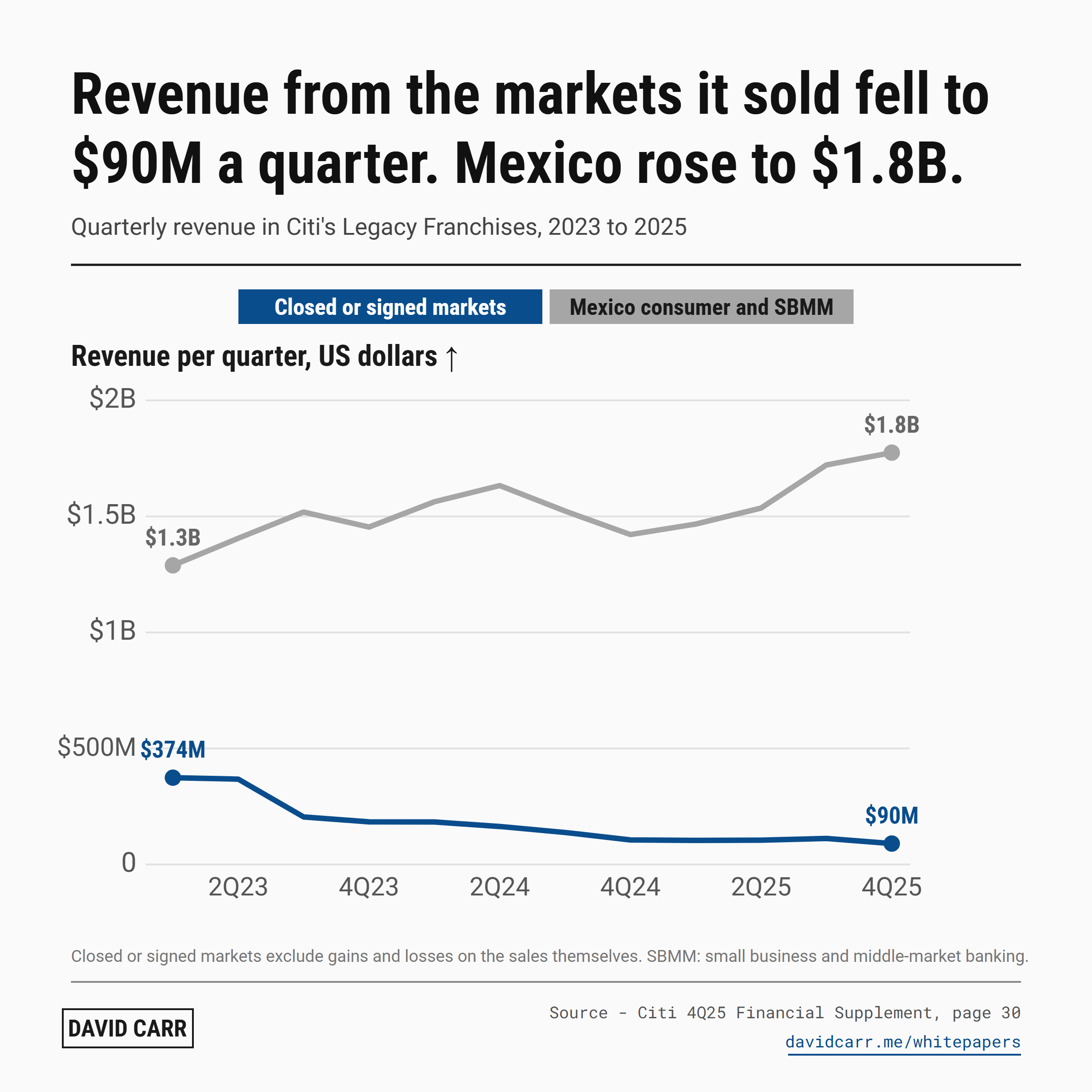
Revenue from the markets it sold fell to $90M a quarter. Mexico rose to $1.8B.
- Closed or signed markets: $374M in 1Q23, $90M in 4Q25
- Mexico consumer and small business: $1.29B in 1Q23, $1.78B in 4Q25
The sold markets have almost gone from Citi's numbers. Mexico, the one it is still selling, kept growing.
From page 30 of Citi's 4Q25 Financial Supplement, excluding gains and losses on the sales themselves.
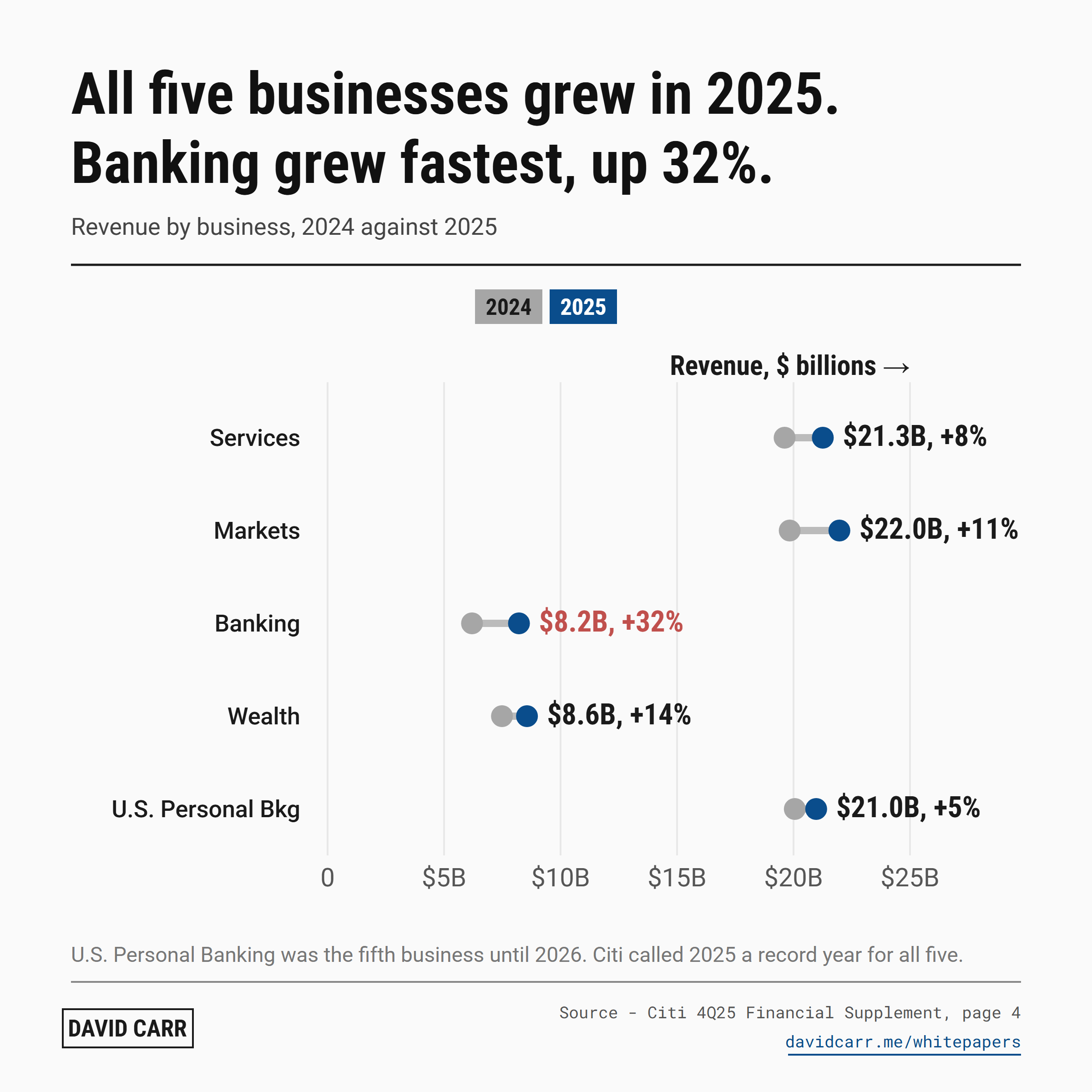
All five businesses grew in 2025. Banking grew fastest, up 32%.
- Markets: $22.0B, up 11%
- Services: $21.3B, up 8%
- U.S. Personal Banking: $21.0B, up 5%
- Wealth: $8.6B, up 14%
- Banking: $8.2B, up 32%
Citi's group revenue was $85.2 billion. Three businesses each bring in over $20 billion.
From Citi's 4Q25 Financial Supplement and results release, which call 2025 a record year for all five.
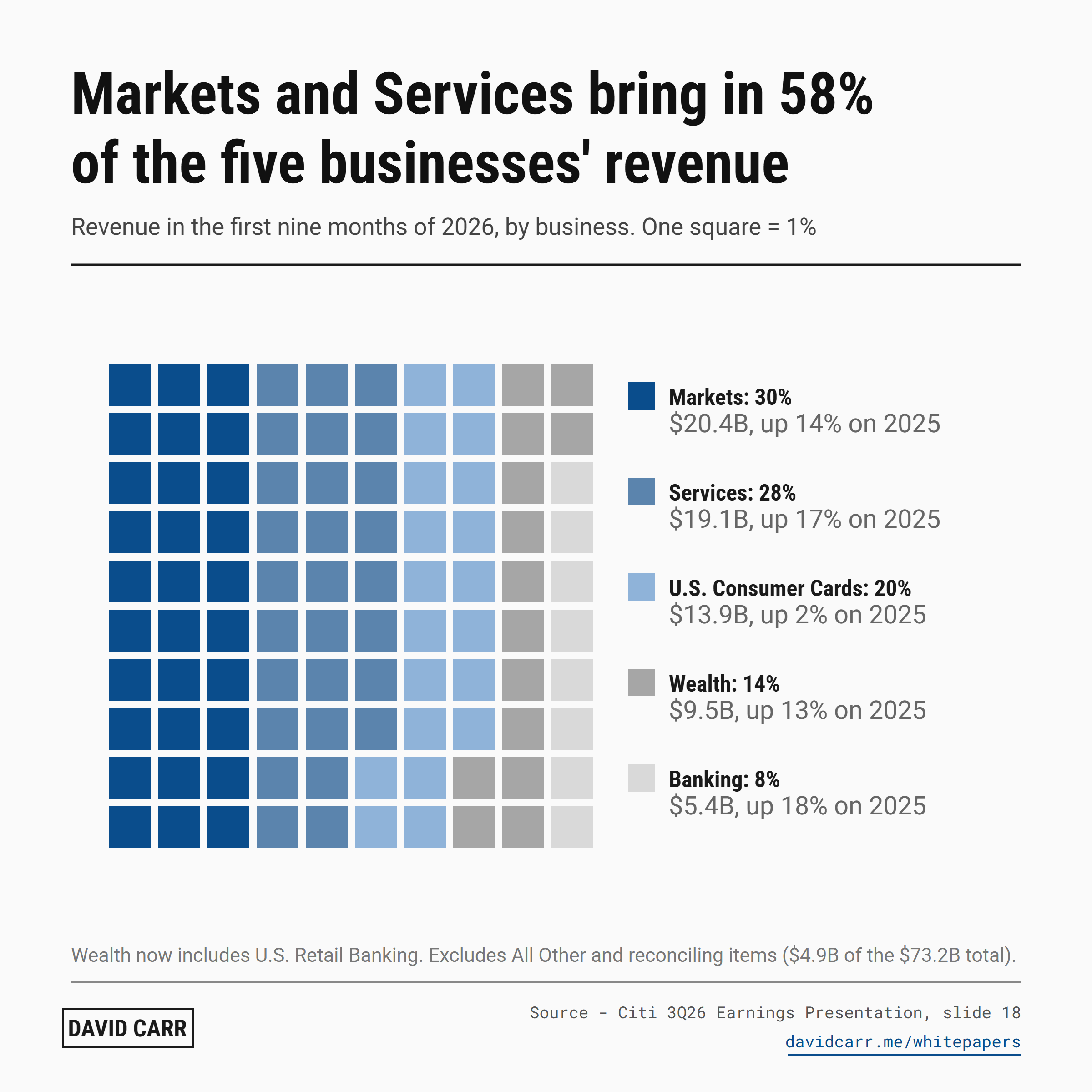
Markets and Services bring in 58% of the five businesses' revenue
- Markets: $20.4B, 30%
- Services: $19.1B, 28%
- U.S. Consumer Cards: $13.9B, 20%
- Wealth: $9.5B, 14%
- Banking: $5.4B, 8%
Early in 2026 the line-up changed: U.S. Consumer Cards replaced U.S. Personal Banking, and U.S. Retail Banking moved into Wealth.
First nine months of 2026, from slide 18 of the 3Q26 earnings presentation. Group revenue was $73.2 billion, up 12%.
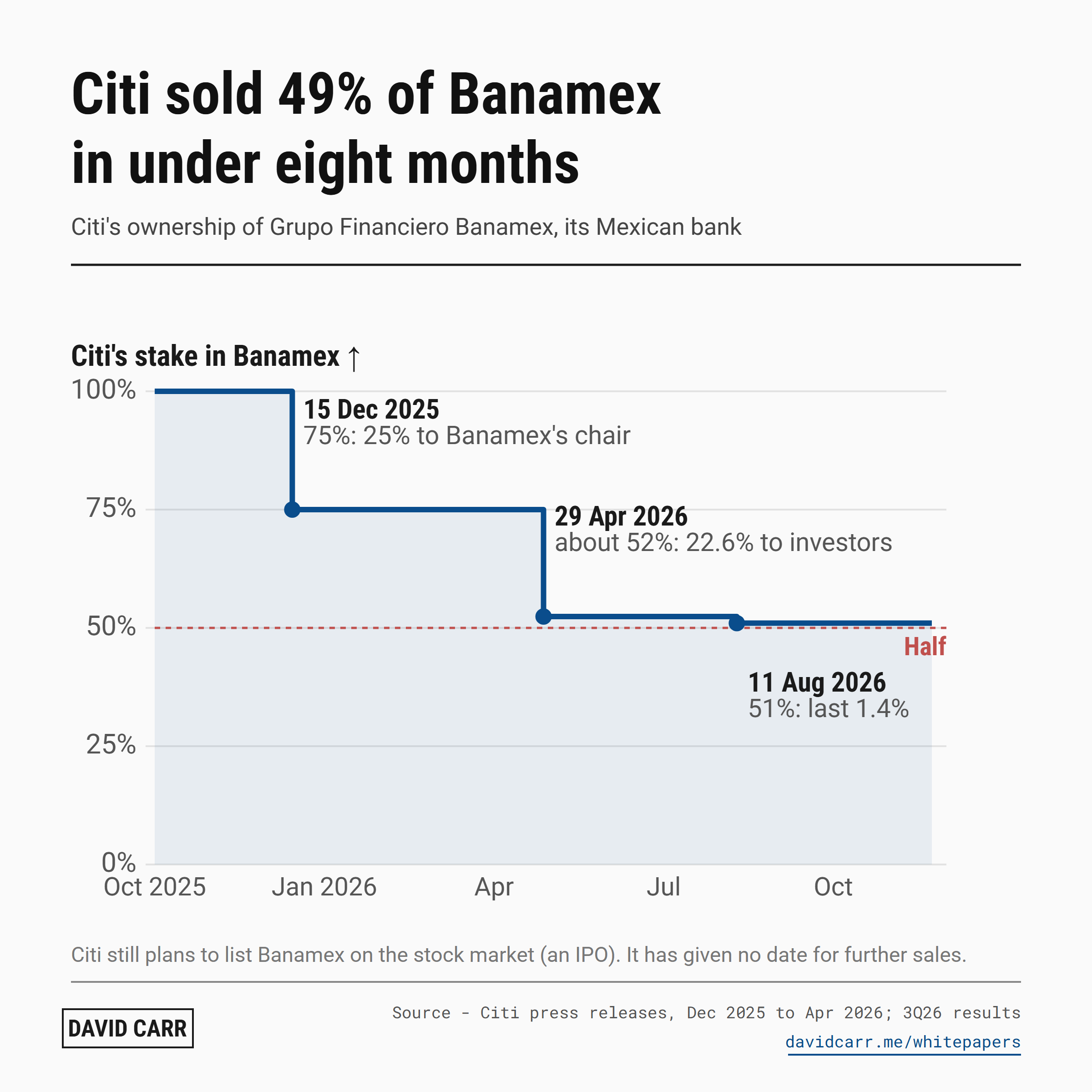
Citi sold 49% of Banamex in under eight months
Banamex is the last of the 14 consumer exits still under way. Citi still plans to list it on the stock market.
The about-52% step in April is worked out from Citi's figures: 75% less 22.6%.
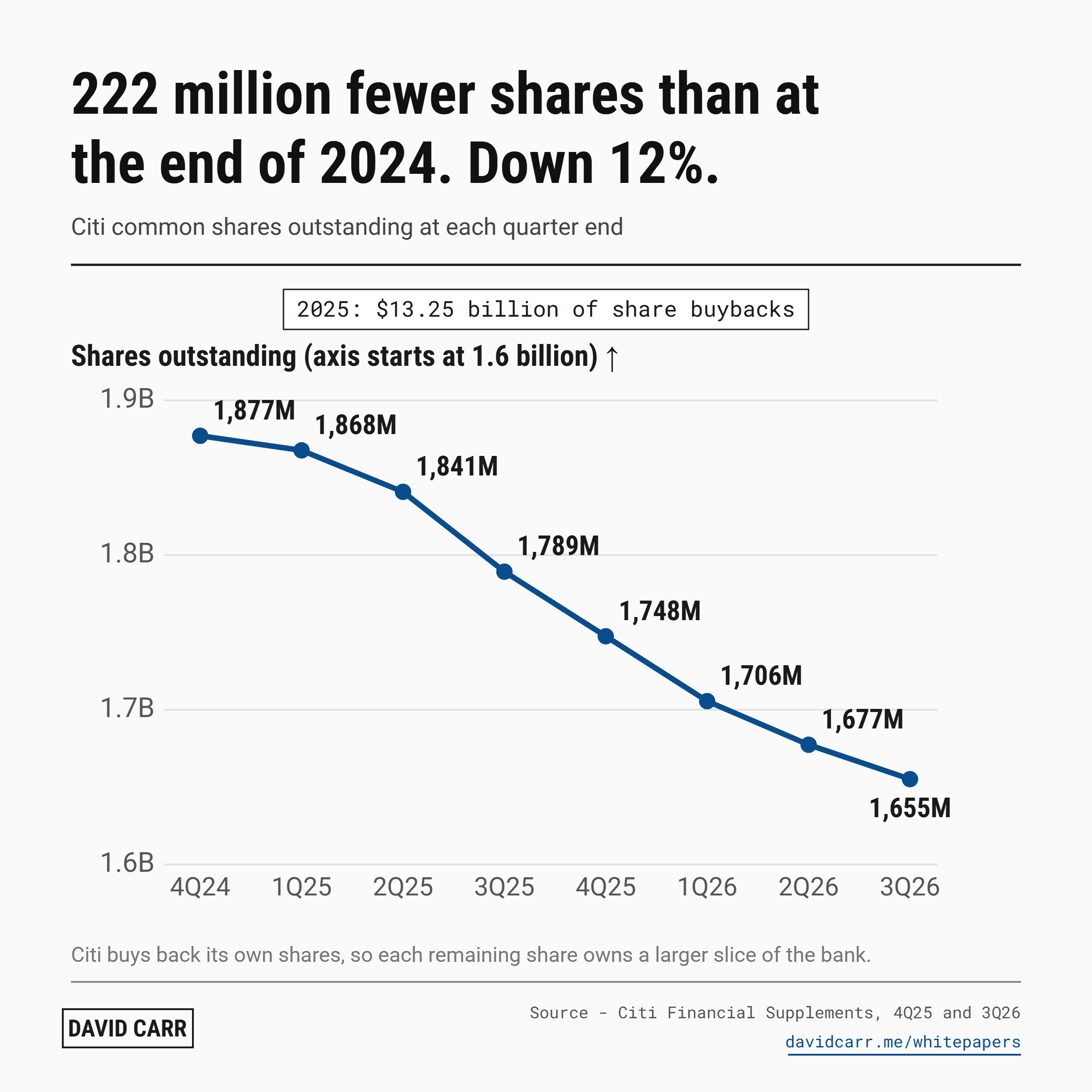
222 million fewer shares than at the end of 2024. Down 12%.
- End of 2024: 1,877 million
- End of 2025: 1,748 million
- September 2026: 1,655 million
Citi bought back $13.25 billion of its own shares in 2025 and $13.3 billion in the first nine months of 2026.
Shares outstanding from Citi's 4Q25 and 3Q26 financial supplements. Buybacks from the 4Q25 release and 3Q26 presentation.
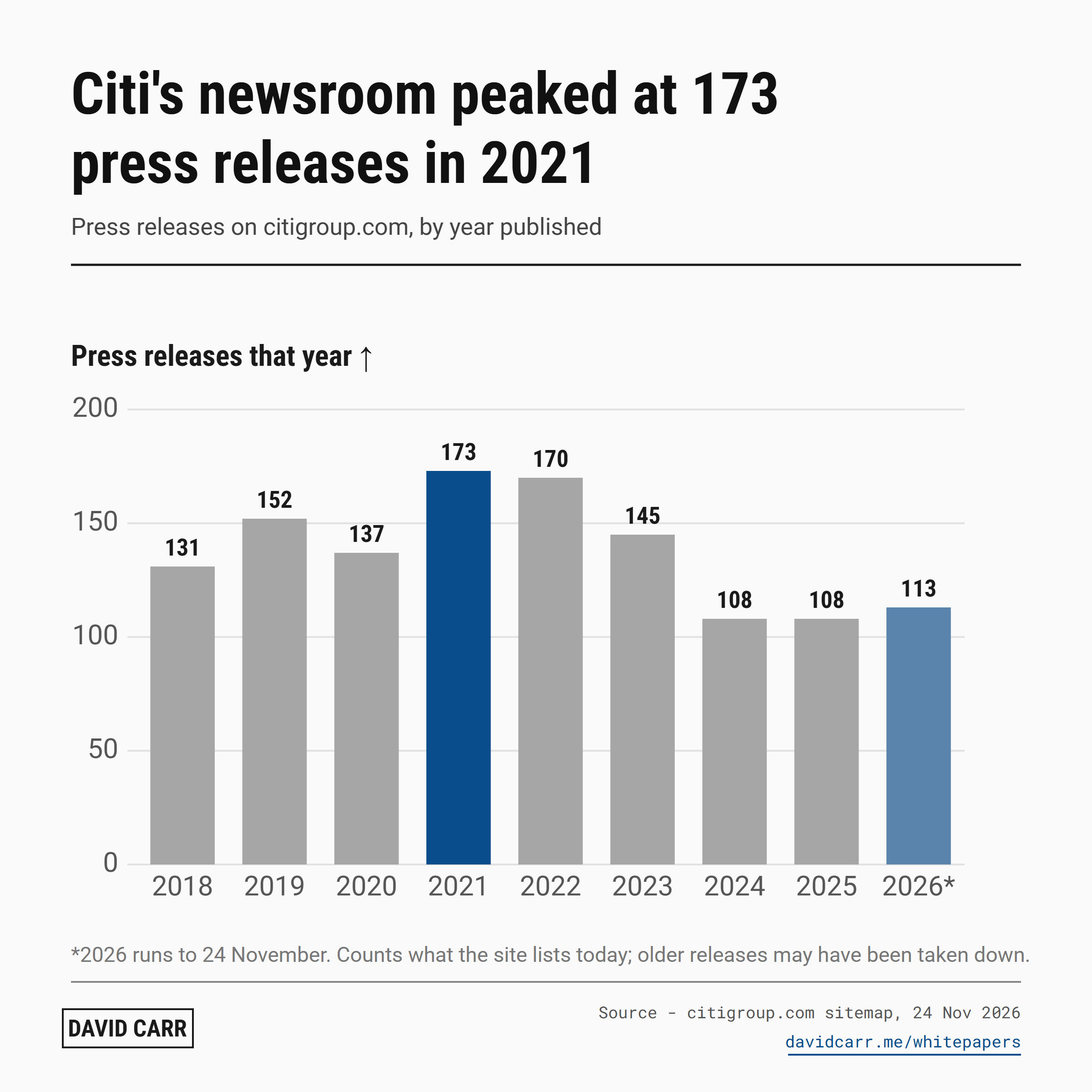
Citi's newsroom peaked at 173 press releases in 2021
- 2021: 173
- 2022: 170
- 2024: 108
- 2025: 108
- 2026 to 24 November: 113
2022 alone had 13 releases about the consumer exits, going by their titles. 2026 has already passed 2025.
Counted from citigroup.com's sitemap on 24 November 2026, by the year in each release's address.
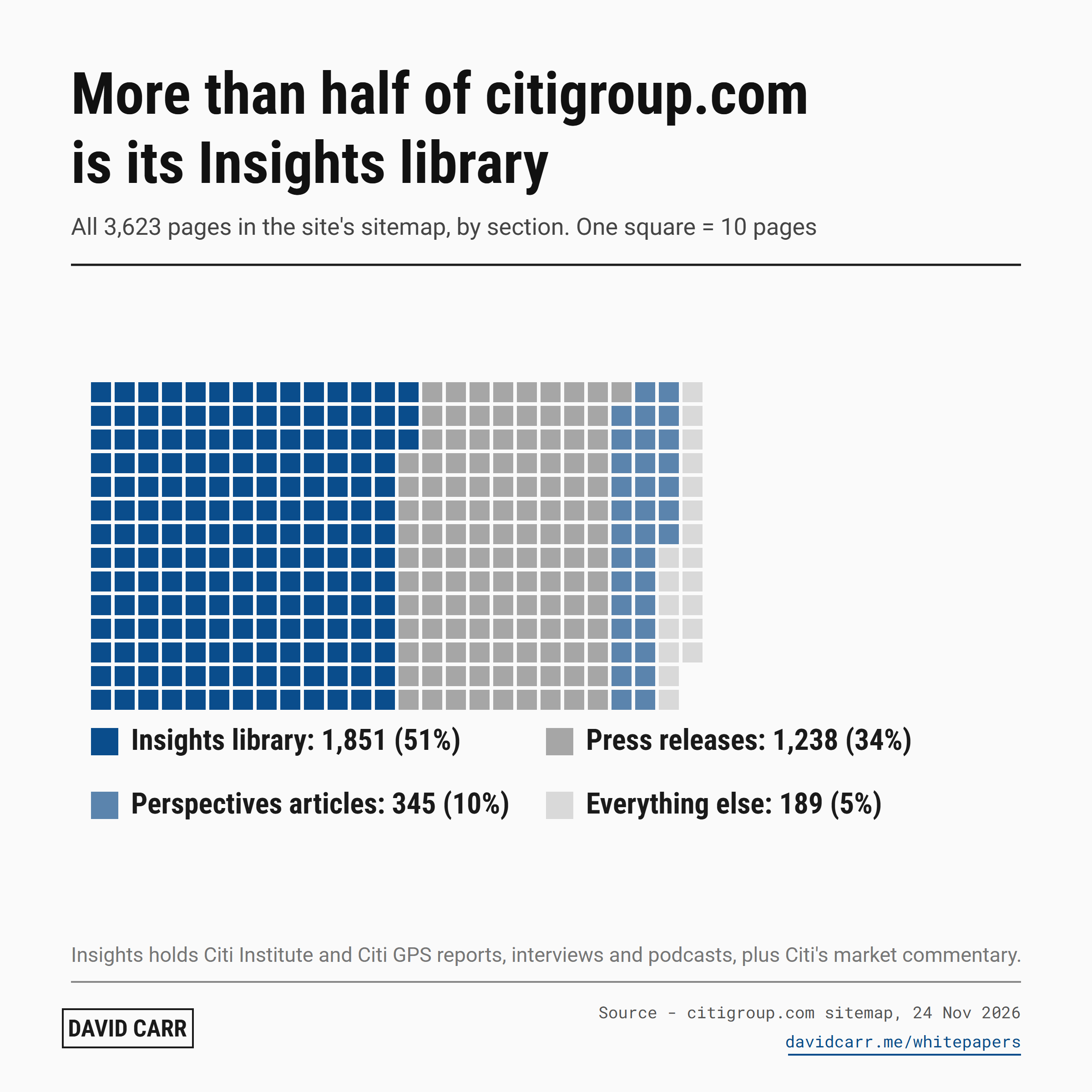
More than half of citigroup.com is its Insights library
- Insights: 1,851 pages, 51%
- Press releases: 1,238, 34%
- Perspectives articles: 345, 10%
- Everything else: 189, 5%
Citi publishes a lot of its own thinking. Citi Institute calls itself Citi's "public-facing thought leadership platform", free to read, with Citi GPS reports as its flagship.
All 3,623 pages in the sitemap on 24 November 2026. Content types from the Citi Institute FAQ.
Method, caveats and sources
The short answer. Citi traces its roots to a New York bank founded in 1812. Since 2021 it has been leaving consumer banking outside the U.S.: it has sold its business in 11 of the 14 markets it named, wound down China, is winding down Korea and has sold 49% of Banamex in Mexico. It now reports five businesses, which grew to $85.2 billion of group revenue in 2025. More than half the pages on its own website are in its Insights library.
Citi's own numbers. Every financial figure comes from Citi: its annual reports, quarterly results releases, earnings presentations and financial supplements, all on citigroup.com. Revenue is "revenues, net of interest expense", as Citi reports it. Business revenue follows Citi's own segments, which changed in 2026, so the 2025 and 2026 charts use different line-ups.
The 14 markets. Dates are the completion dates in Citi's own press releases. "Sold" means Citi announced a completed sale of that consumer business. China counts as wound down: its wealth portfolio went to HSBC in 2024 and Citi's 3Q26 results no longer list it among wind-downs.
The website counts. Taken from citigroup.com's public sitemap on 24 November 2026. They count what the site lists today, so anything Citi has taken down is missing. Press releases are dated by the year in their web address.
Left out. Share prices and analyst views, and anything on regulators or fines. Citi GPS has no public archive with dates, so there is no count of reports by year.
Also: Stripe, Revolut and Mercury.