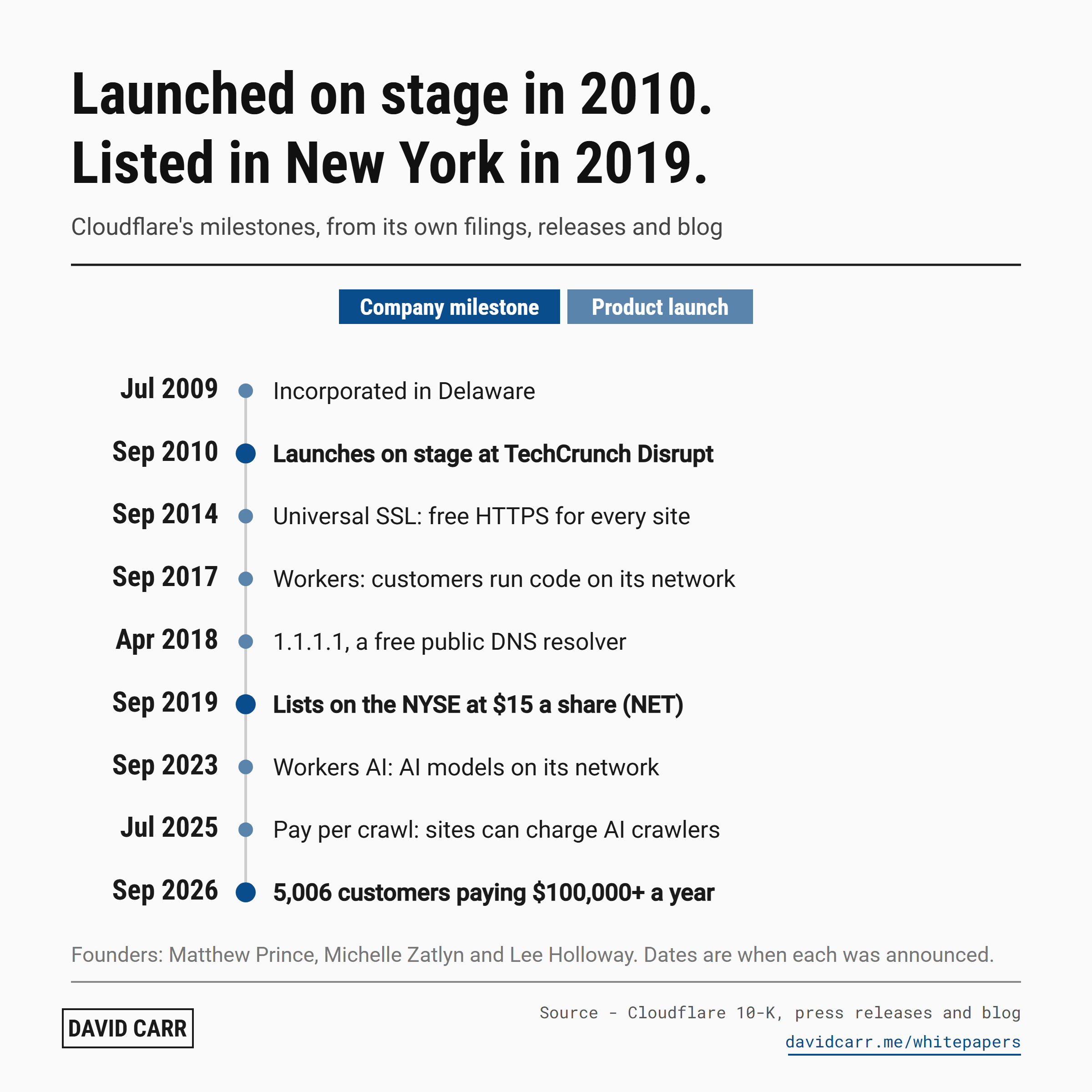
Launched on stage in 2010. Listed in New York in 2019.
Matthew Prince, Michelle Zatlyn and Lee Holloway started it as a way to protect websites. It now sells security, networking and a place to run code.
Dates are when Cloudflare announced each one, from its filings, press releases and blog.
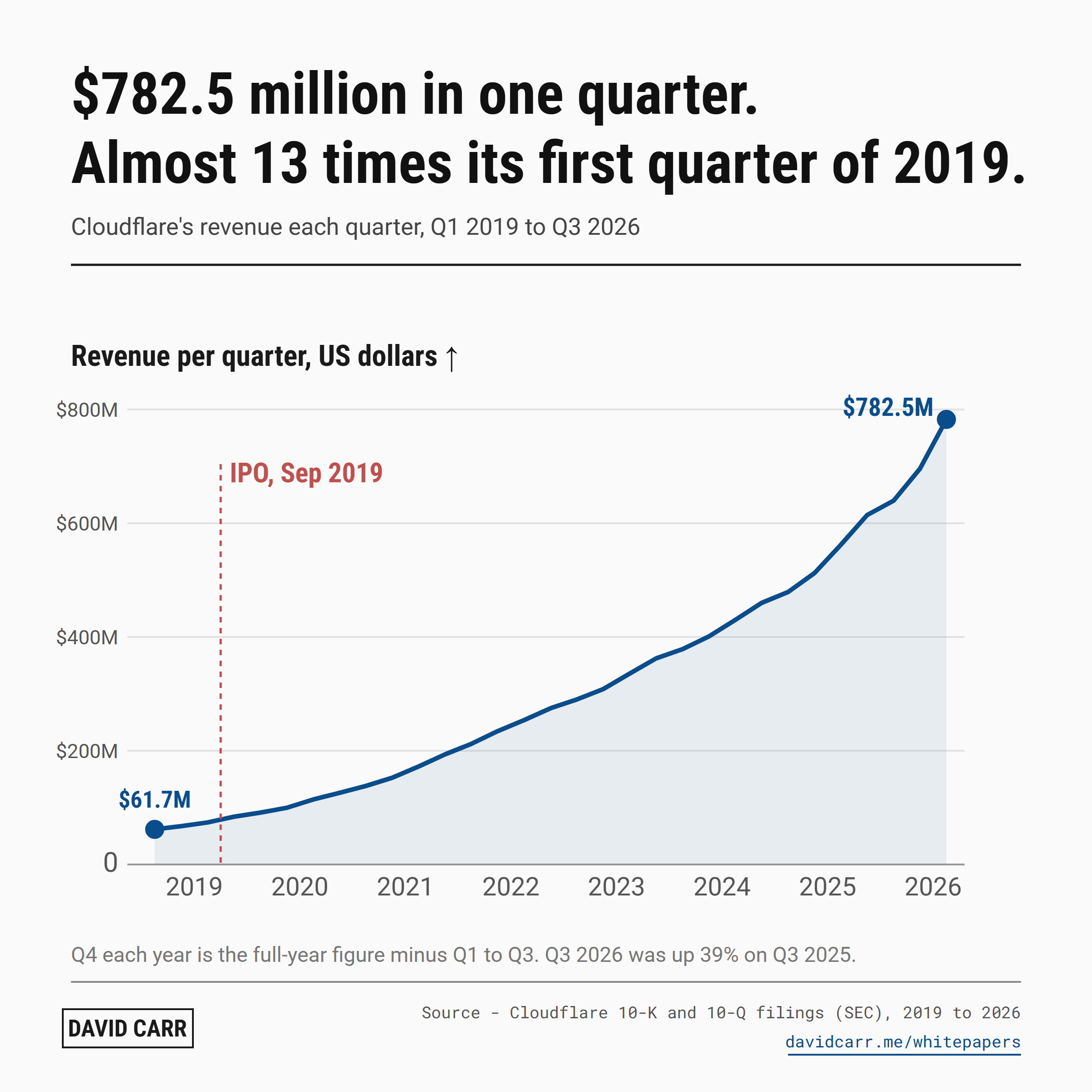
$782.5 million in one quarter. Almost 13 times its first quarter of 2019.
- Q1 2019: $61.7 million
- Full year 2021: $656 million
- Full year 2023: $1.3 billion
- Full year 2025: $2.17 billion
- Q3 2026: $782.5 million, up 39% on a year earlier
Revenue has grown every quarter on the chart. The 39% rise in Q3 2026 was its fastest year-on-year growth since late 2022.
From Cloudflare's 10-K and 10-Q filings, via the SEC's data API. Q4 figures are the full year minus the first three quarters.
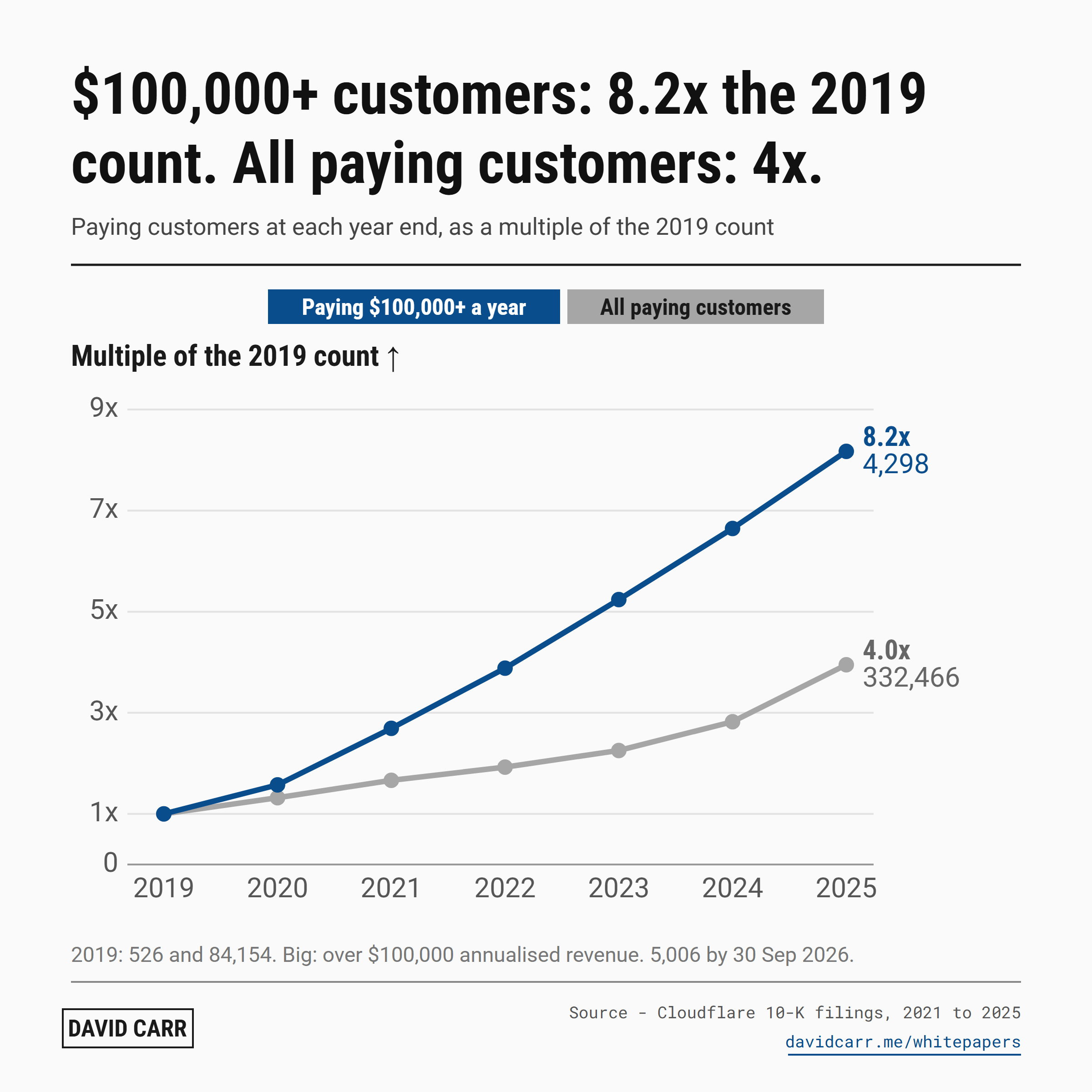
$100,000+ customers: 8.2x the 2019 count. All paying customers: 4x.
- End of 2019: 526 big customers, 84,154 paying in all
- End of 2022: 2,042 and 162,086
- End of 2025: 4,298 and 332,466
- 30 September 2026: 5,006 big customers
Most of its millions of users pay nothing. The growth that counts is the big accounts.
"Big" means over $100,000 of annualised revenue, Cloudflare's own measure. From the key metrics table in each 10-K.
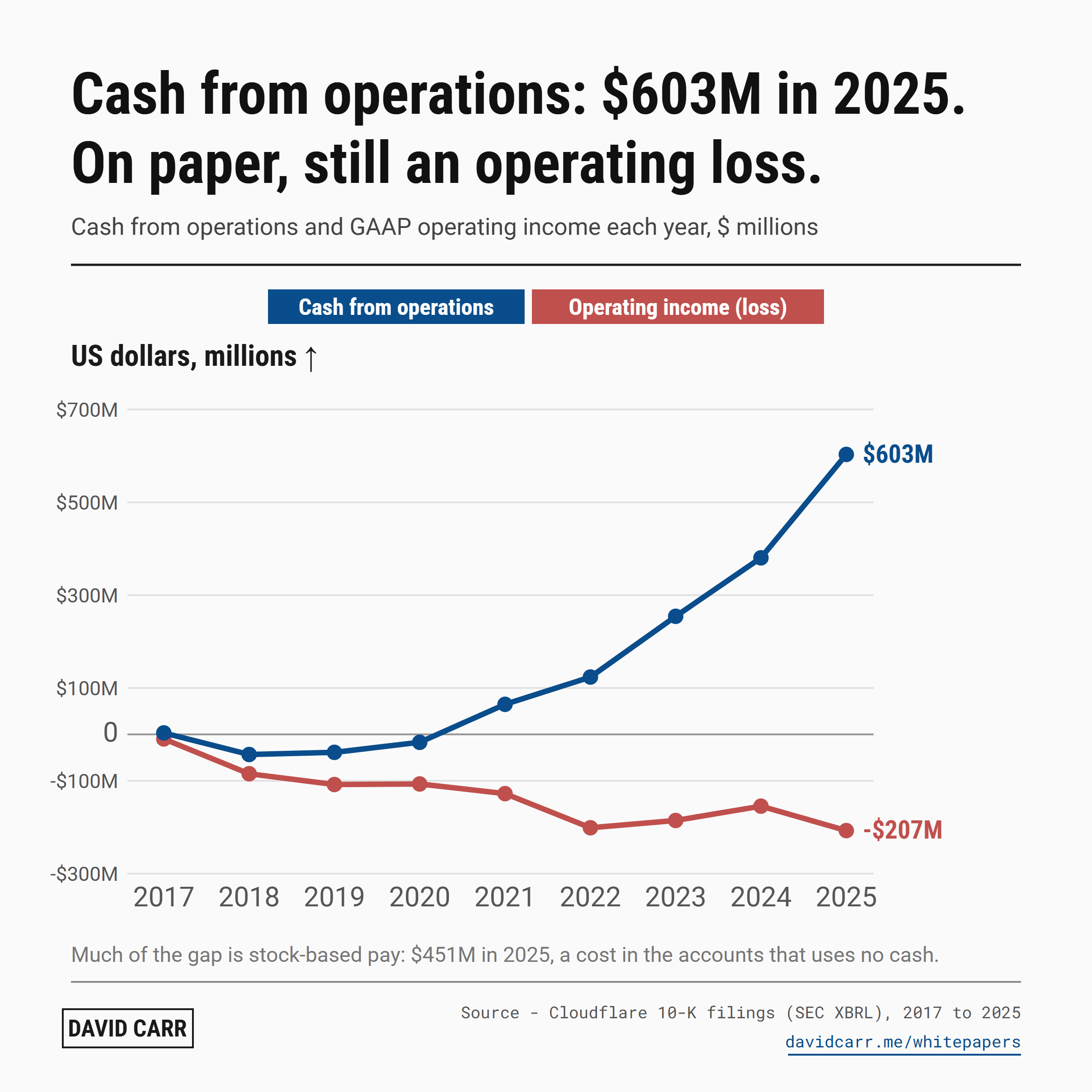
Cash from operations: $603M in 2025. On paper, still an operating loss.
- 2019: -$39 million of cash, -$108 million operating income
- 2021: operating cash turns positive again, $65 million
- 2025: $603 million of cash, -$207 million operating income
- Stock-based pay in 2025: $451 million
Two ways of counting tell different stories. Most of the gap is stock-based pay, which counts as a cost but uses no cash.
GAAP figures from the SEC's data on each 10-K.
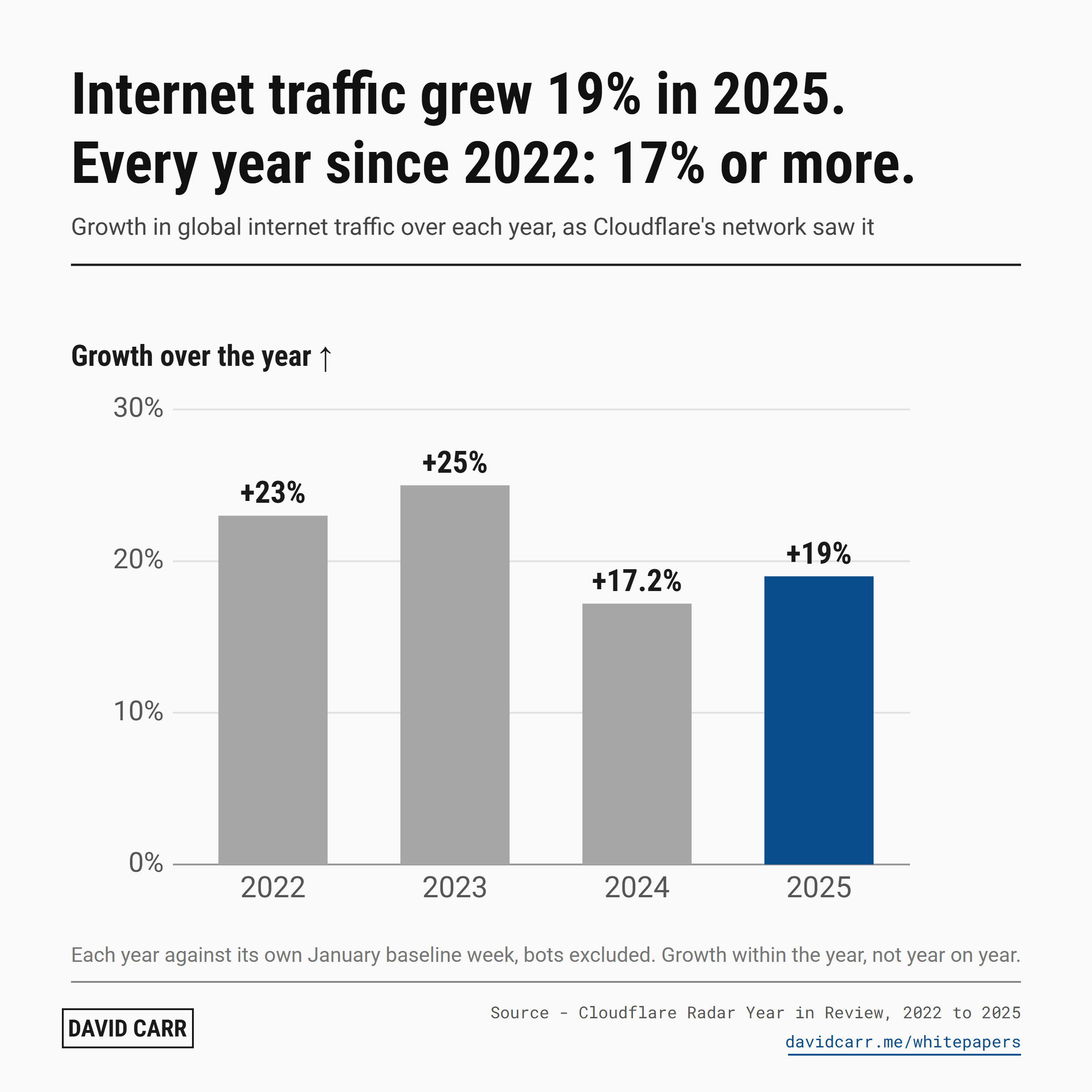
Internet traffic grew 19% in 2025. Every year since 2022: 17% or more.
Cloudflare sees a large share of the web's traffic. Growth picks up in the second half of each year.
Radar Year in Review. Each year is measured against its own mid-January week, with bots taken out, so it is growth over the year, not a year-on-year total.
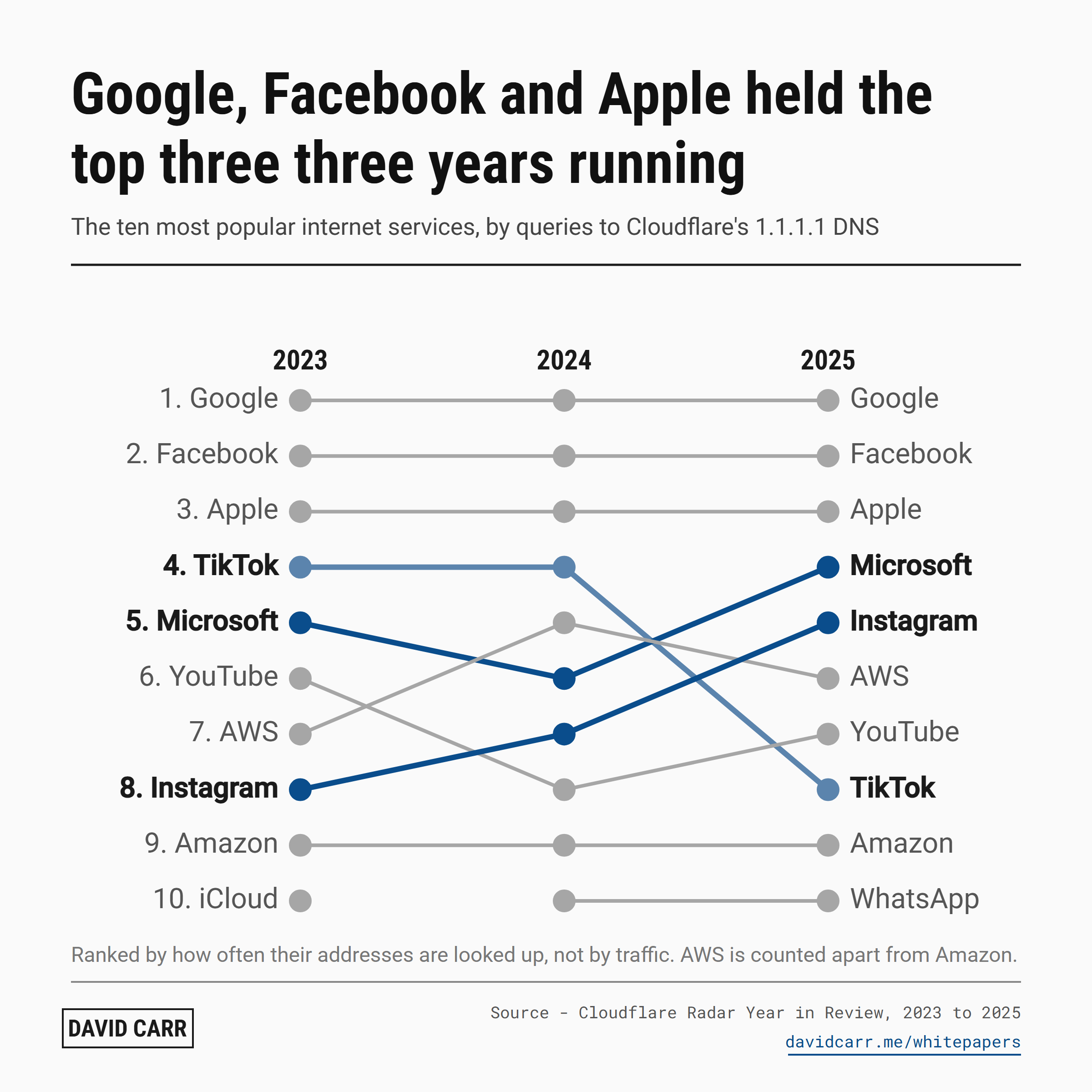
Google, Facebook and Apple held the top three three years running
- 2025: Google, Facebook, Apple, Microsoft, Instagram, AWS, YouTube, TikTok, Amazon, WhatsApp
- Instagram: 8th in 2023, 5th in 2025
- Microsoft: back up to 4th
- Generative AI, 2025: ChatGPT first, then Claude, Perplexity and Gemini
The top of the list hardly moves. The middle shuffles each year.
Ranked by queries to Cloudflare's 1.1.1.1 DNS resolver: 2023, 2024, 2025. Popularity, not volume of traffic.
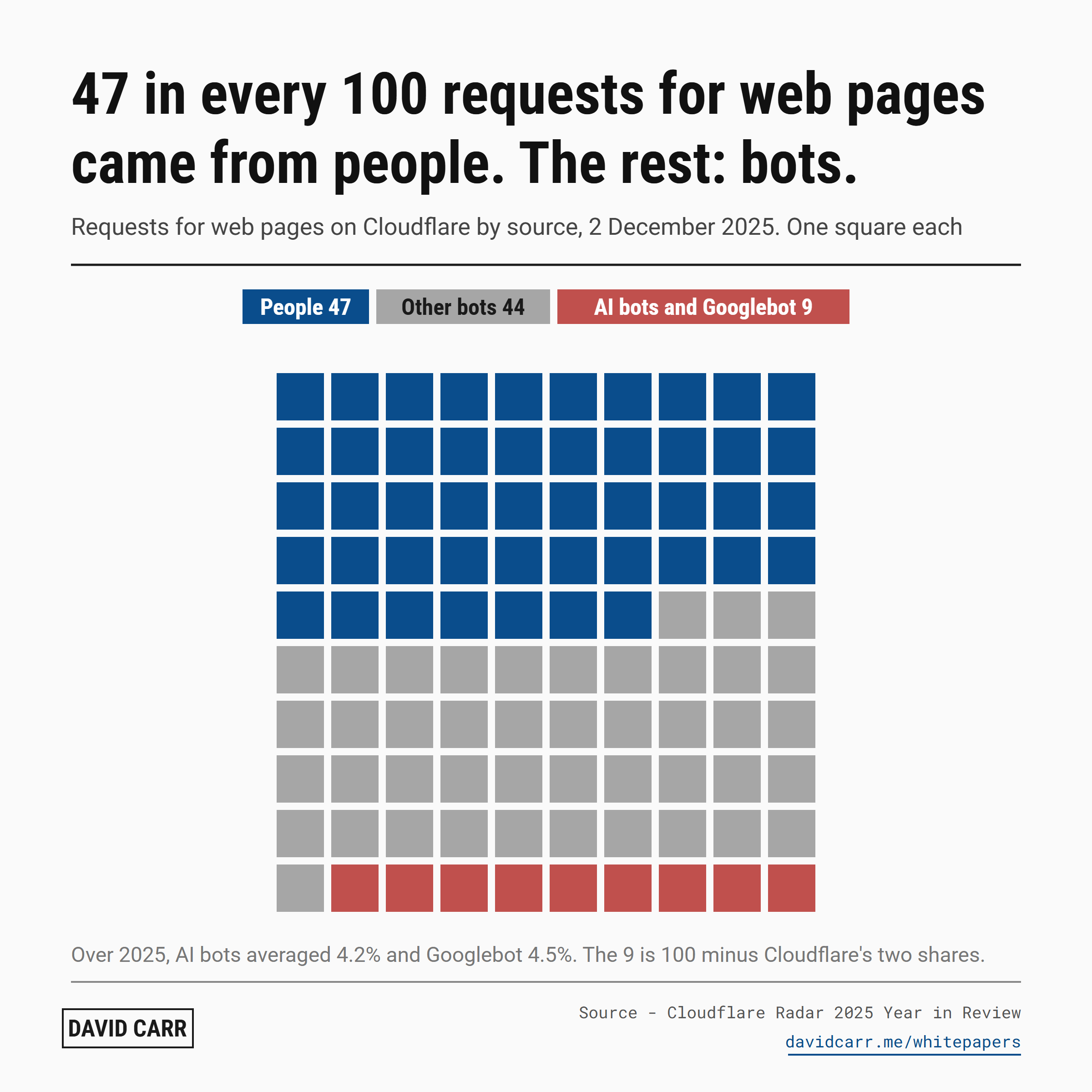
47 in every 100 requests for web pages came from people. The rest: bots.
- People: 47% (2 December 2025)
- Other bots: 44%
- AI bots: 4.2% on average across 2025, peaking at 6.4% in late June
- Googlebot alone: 4.5% on average
Bots made half of all web page requests at the start of 2025. From September, people sometimes made more than the other bots.
From the 2025 Year in Review. Web pages (HTML) only, so the shares differ from Radar's figures for all traffic.
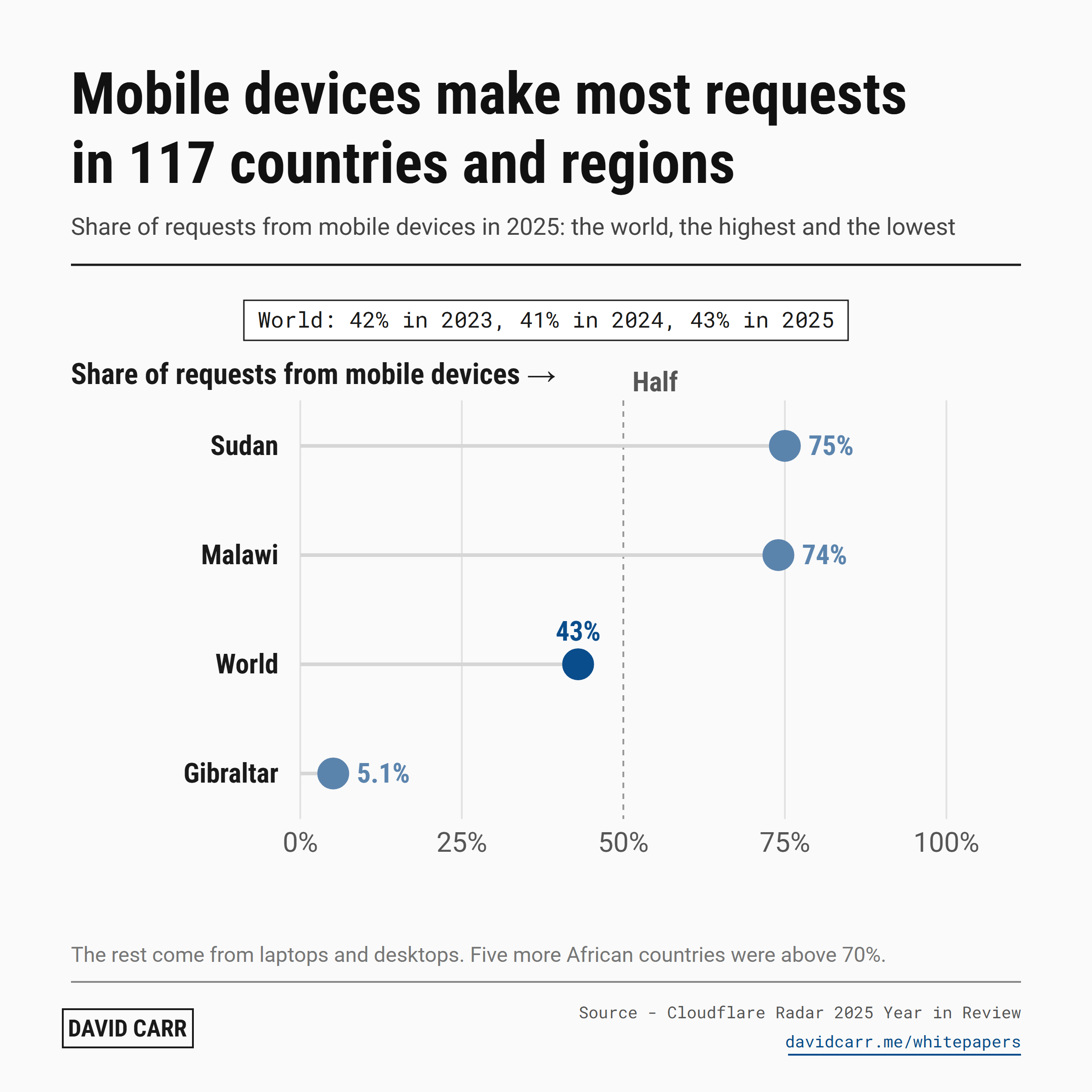
Mobile devices make most requests in 117 countries and regions
- Sudan: 75%
- Malawi: 74%
- World: 43%
- Gibraltar: 5.1%
Worldwide the split has hardly moved in three years. Country by country it ranges from mostly mobile to mostly desktop.
From the 2025 Year in Review. Five more African countries (Eswatini, Yemen, Botswana, Mozambique and Somalia) were above 70%.
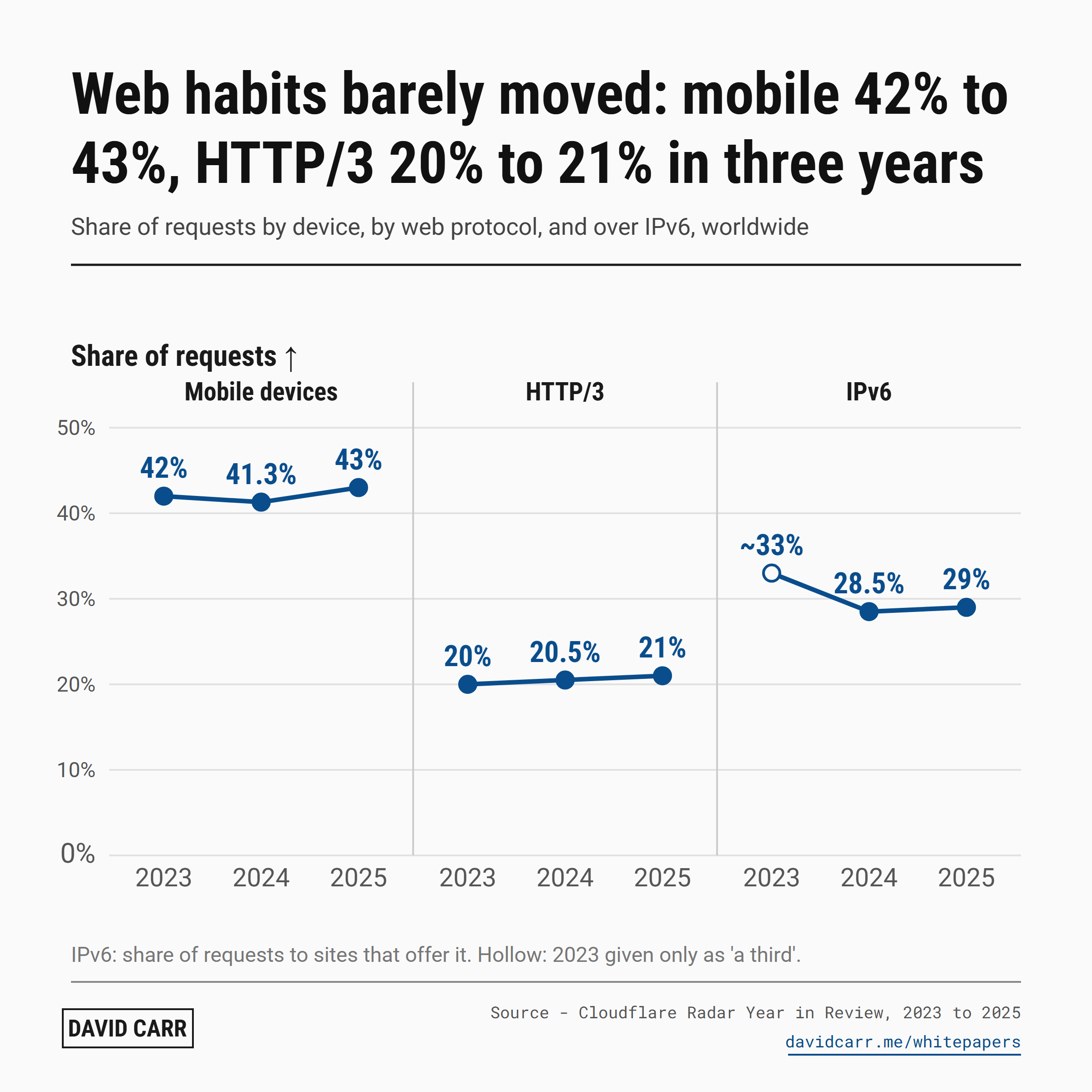
Web habits barely moved: mobile 42% to 43%, HTTP/3 20% to 21% in three years
- Mobile share: 42%, 41.3%, 43%
- HTTP/3 share: 20%, 20.5%, 21%
- IPv6 share: about a third, 28.5%, 29%
- India leads IPv6 at 67%
Newer internet plumbing spreads slowly. HTTP/2 still carries half of all requests.
From the Year in Review for 2023, 2024 and 2025. IPv6 counts requests to sites that offer it.
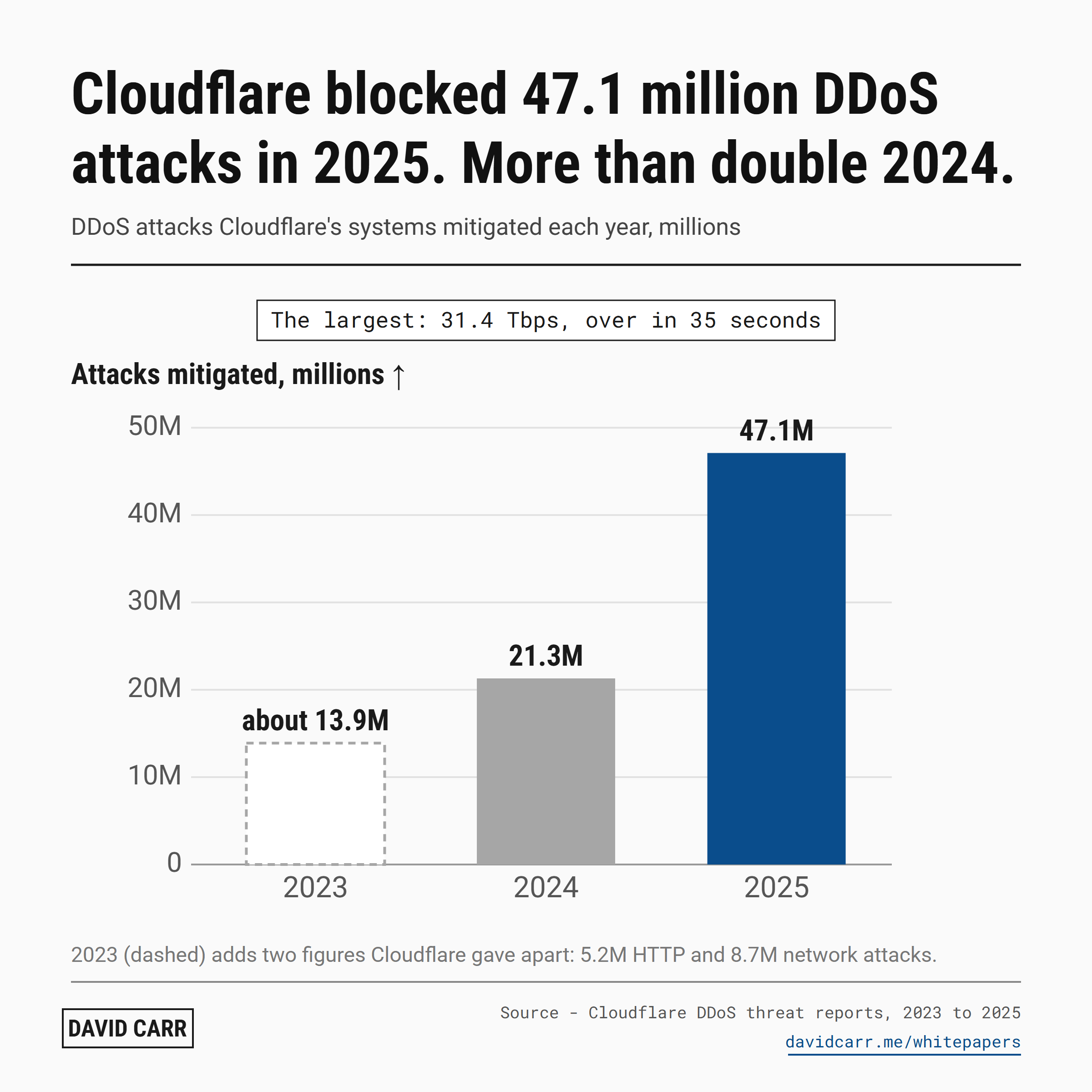
Cloudflare blocked 47.1 million DDoS attacks in 2025. More than double 2024.
- 2023: about 13.9 million
- 2024: 21.3 million
- 2025: 47.1 million, about 5,400 an hour
- Largest: 31.4 Tbps, over in 35 seconds
Its systems stop these automatically. The biggest attacks keep getting bigger.
2023 adds two figures Cloudflare gave separately (5.2M HTTP and 8.7M network attacks). From 2026 the reports count differently, so this year is left out.
Method, caveats and sources
The short answer. Cloudflare earned $782.5 million in its latest quarter, almost 13 times its first quarter of 2019. Customers paying over $100,000 a year grew twice as fast as customers overall. It makes plenty of cash but still shows an operating loss. Its Radar data shows internet traffic growing about a fifth a year, Google on top, and people making about half the requests for web pages.
Money and customers. Cloudflare is listed, so revenue, cash and customer counts come from its 10-K and 10-Q filings with the SEC, pulled through the SEC's data API on 23 November 2026 and checked against the filings' text.
Radar. Internet trends come from Cloudflare's own Radar Year in Review posts, 2022 to 2025. They describe traffic on Cloudflare's network, which carries a large share of the web but not all of it. Rankings measure popularity in DNS lookups, not traffic volume. Methods shift a little from year to year, so small changes should be read loosely.
Worked-out figures. Q4 revenue is the full year minus the first three quarters. The 9 requests in 100 from AI bots and Googlebot is 100 minus the two shares Cloudflare gave. The 2023 DDoS total adds two figures Cloudflare reported separately.
Also: Stripe and Databricks.