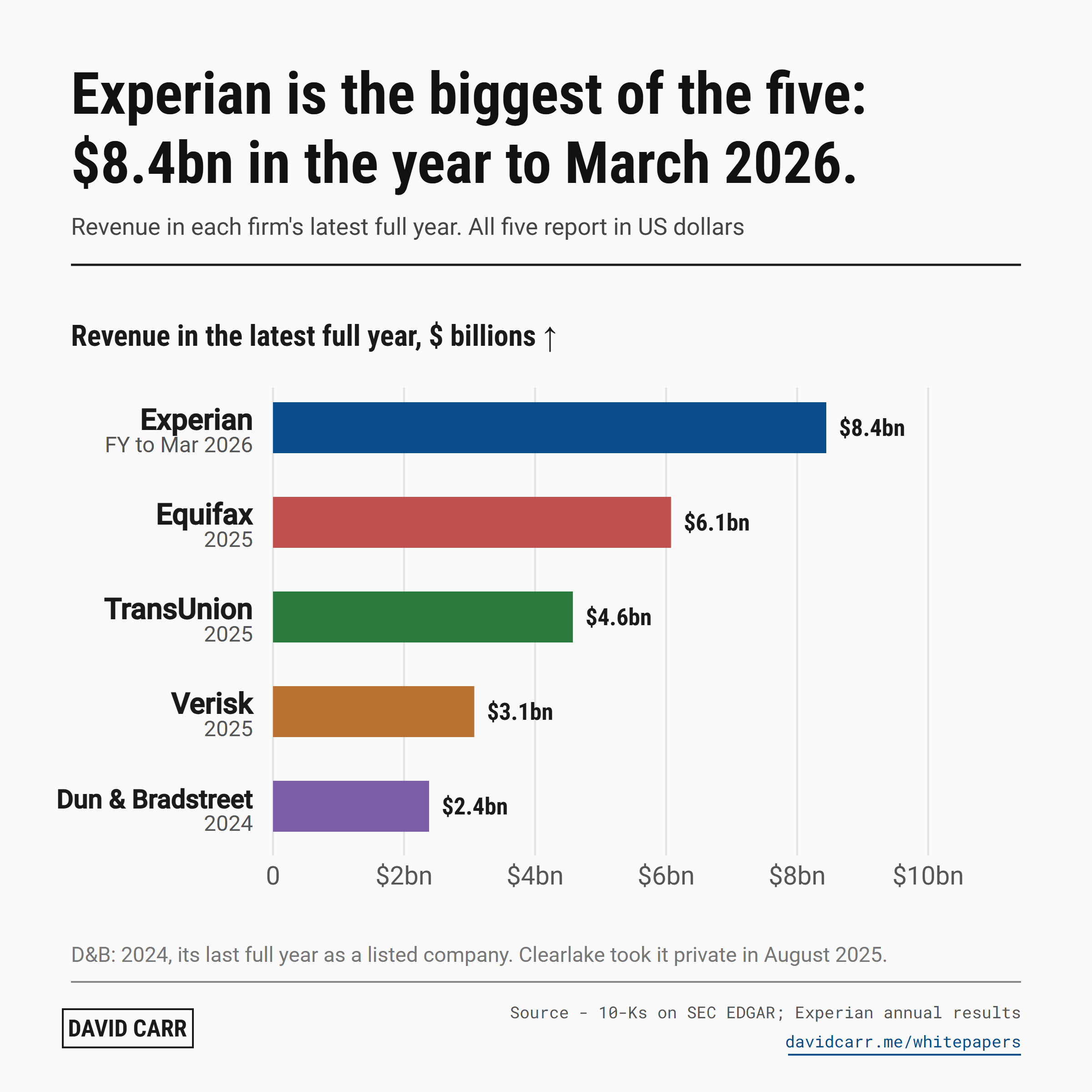
Experian is the biggest of the five: $8.4bn in the year to March 2026.
Experian takes in about three and a half times what Dun & Bradstreet did in its last full listed year.
All five report in US dollars, so nothing is converted. Experian's year ends on 31 March, so its latest year runs three months later than the calendar-year firms. D&B's latest is 2024: Clearlake took it private on 26 August 2025, and it has filed nothing since its first-half 2025 report.
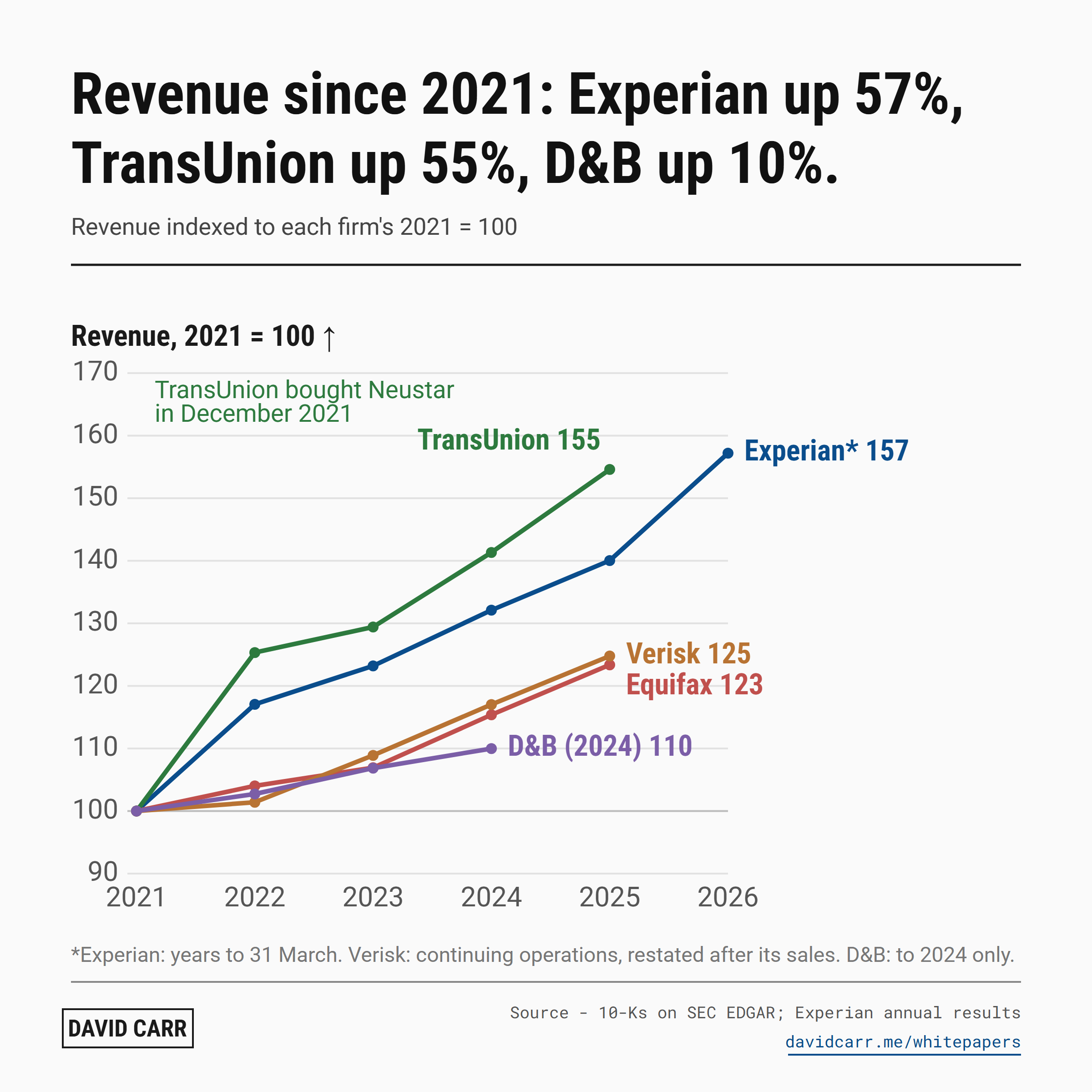
Revenue since 2021: Experian up 57%, TransUnion up 55%, D&B up 10%.
- Experian 157, TransUnion 155, Verisk 125, Equifax 123, Dun & Bradstreet 110 (2021 = 100)
- TransUnion's jump in 2022 is mostly Neustar, bought for $3.1bn in December 2021 (10-K)
- D&B's line stops at 2024
The two fastest growers are the largest and the third-largest. Both bought businesses along the way.
Experian's 2021 is the year to 31 March 2021, $5,372m as first reported. Verisk's figures are continuing operations as restated after it sold its energy business, so its 2021 base still includes units it sold in 2022. Counting insurance alone, the business it kept, Verisk is up 39% ($2,206.9m to $3,072.7m).
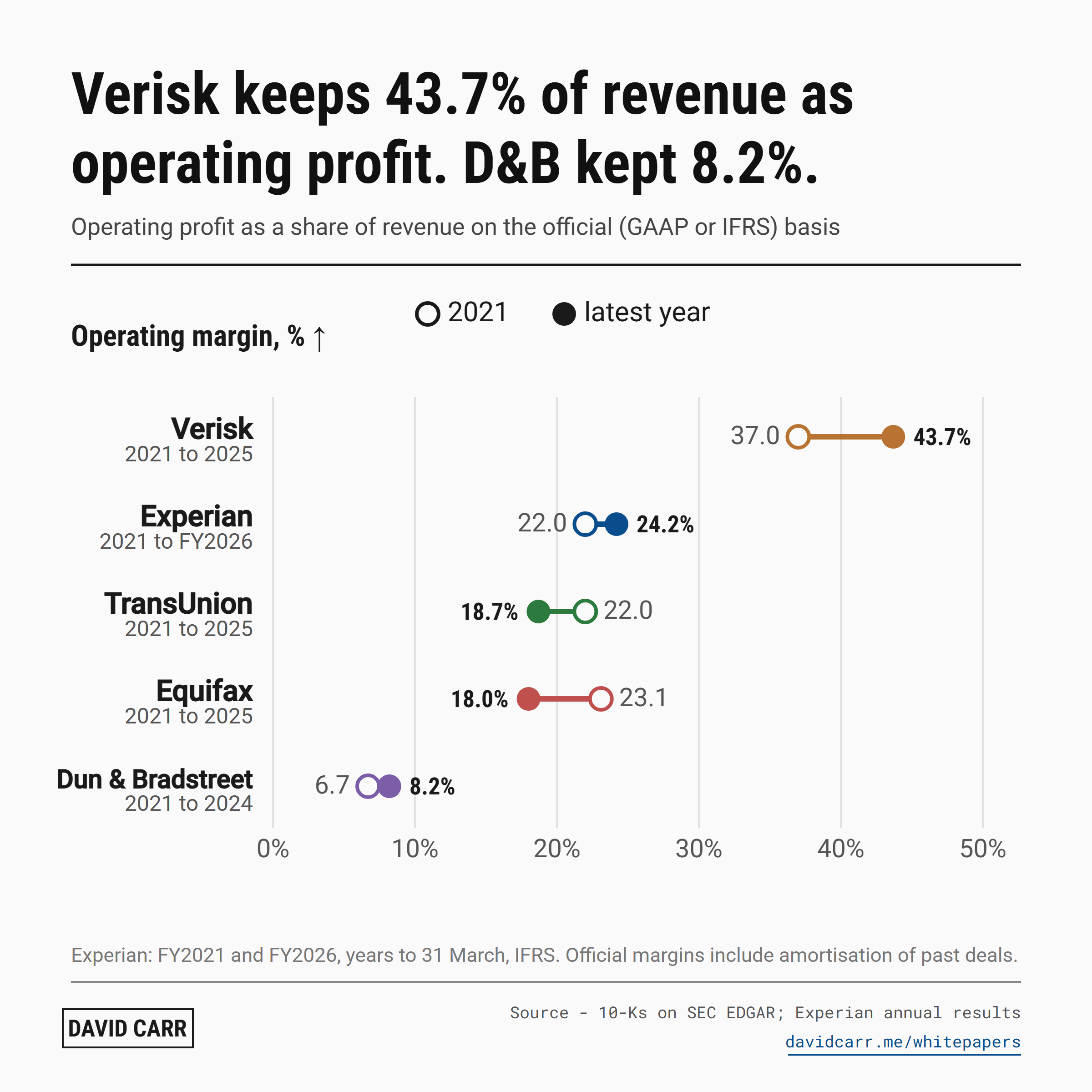
Verisk keeps 43.7% of revenue as operating profit. D&B kept 8.2%.
Three rose and two fell. Verisk's margin is more than five times D&B's.
GAAP for the four US filers, IFRS statutory for Experian. Official margins include amortisation of past deals and one-off charges, which weigh most on firms that bought heavily such as D&B, whose depreciation and amortisation rose from $80m in 2017 to $578m in 2024 after its 2019 buyout. Verisk's figures are restated for continuing operations.
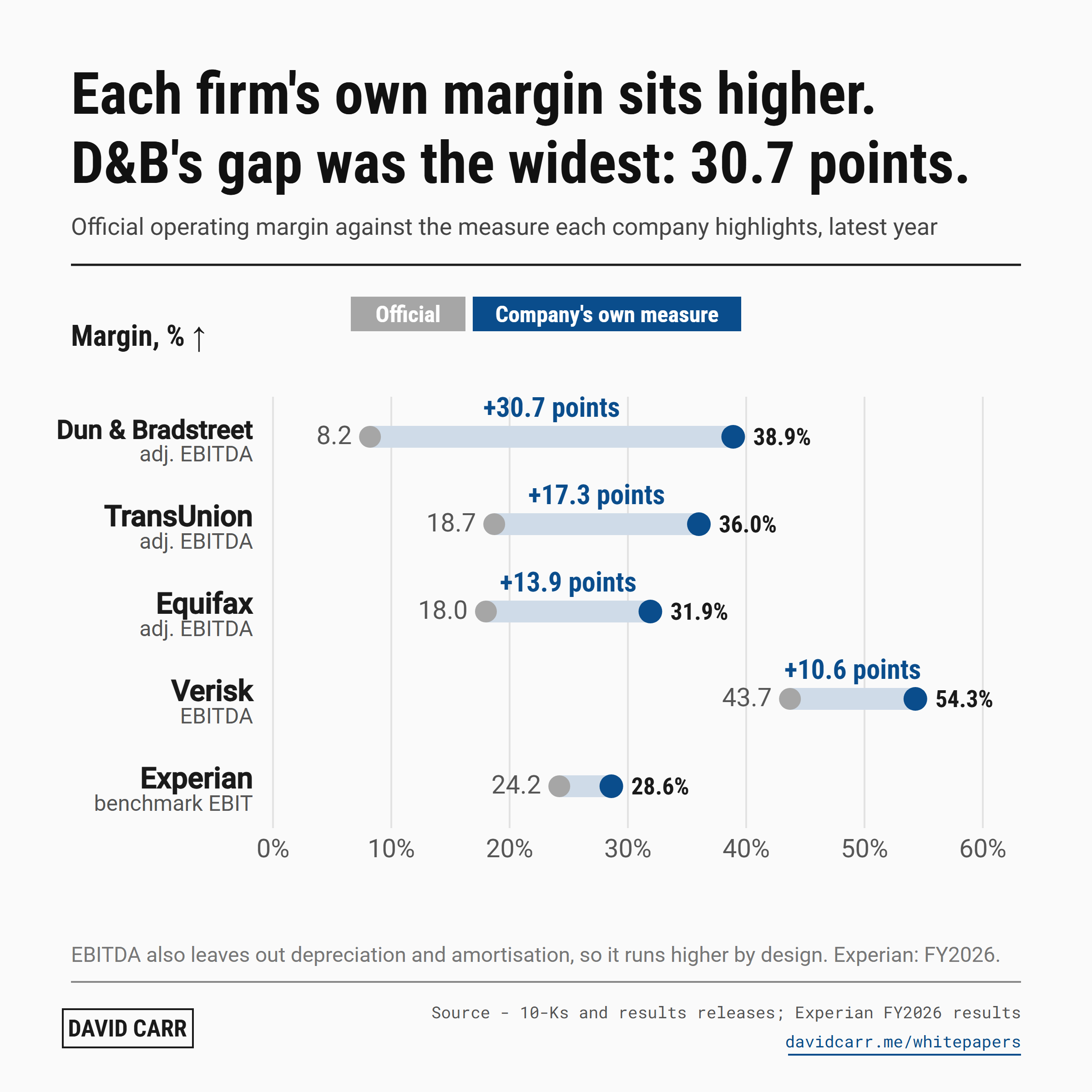
Each firm's own margin sits higher. D&B's gap was the widest: 30.7 points.
Four of the five highlight an EBITDA measure. Experian's Benchmark EBIT is closest to the official figure.
EBITDA leaves out depreciation and amortisation, so it runs higher by design. These are each company's own definitions, are not audited like the official figures, and do not match each other exactly. Experian's Benchmark EBIT margin is on revenue from ongoing activities.
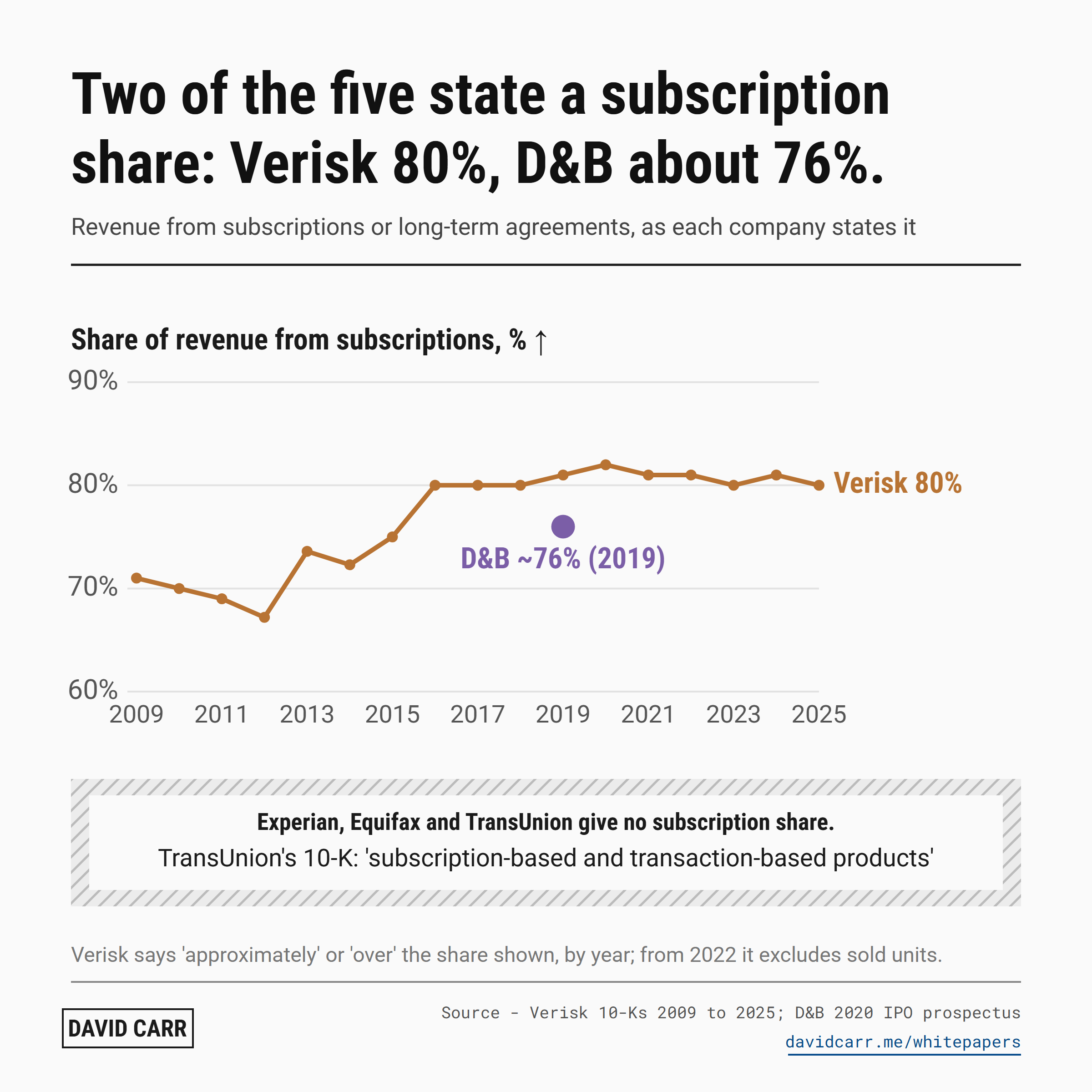
Two of the five state a subscription share: Verisk 80%, D&B about 76%.
- Verisk: over 80% from subscriptions or long-term agreements in 2025; 67.2% in 2012
- Dun & Bradstreet: about 76% of 2019 revenue from fixed-price subscriptions (2020 IPO prospectus)
- TransUnion: no share given; its 10-K describes "subscription-based and transaction-based products"
- Equifax and Experian: no share given
The three credit bureaus do not say how much of their revenue is subscription, so this cannot be compared across all five.
Verisk's wording moves between "approximately" and "over" from year to year. D&B's figure is one year only, from before its 2020 listing, and counts fixed-price subscriptions, a narrower measure.
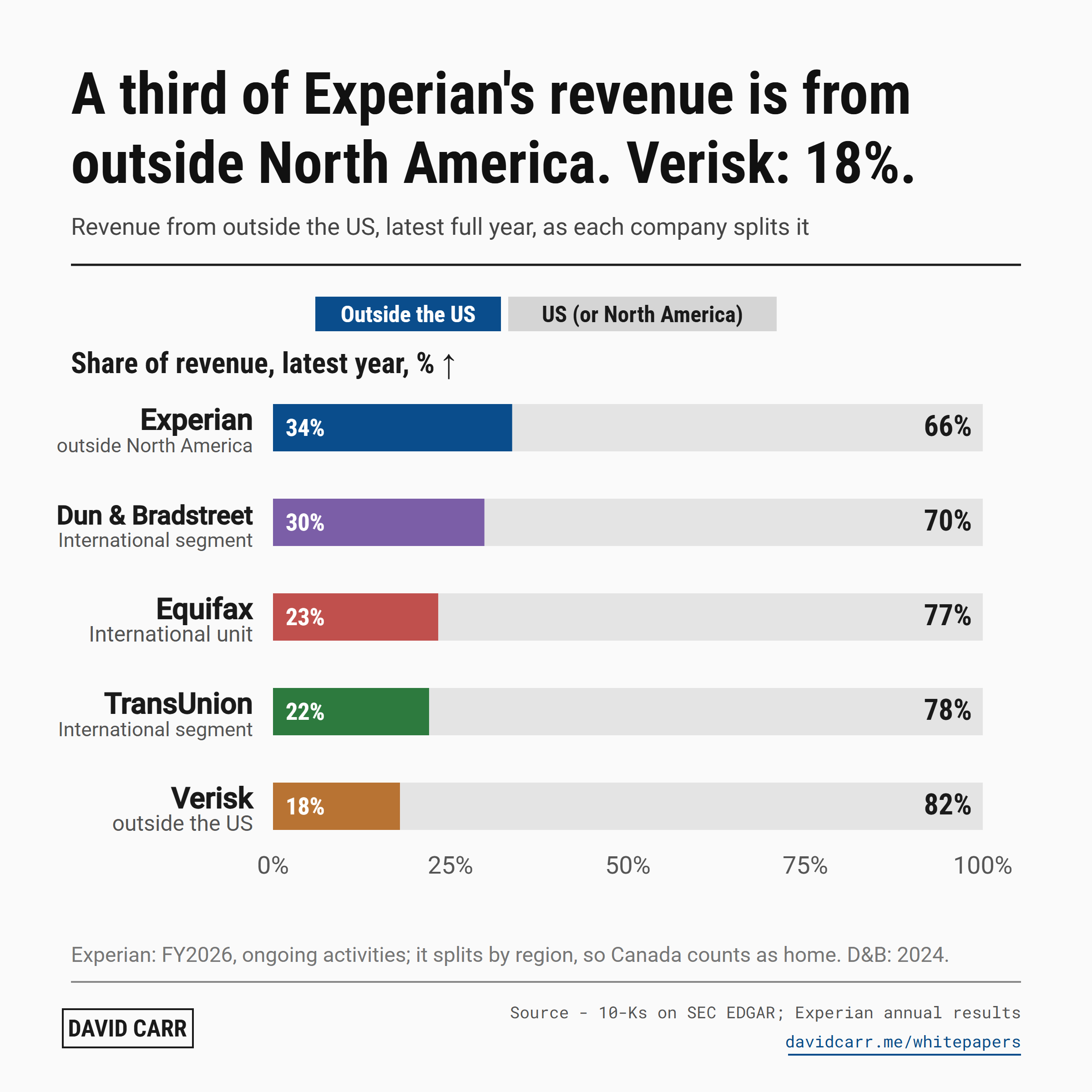
A third of Experian's revenue is from outside North America. Verisk: 18%.
All five still make most of their money at home. Experian, based in Dublin, has the largest share abroad.
Each firm splits revenue its own way. Experian's home region is North America, so Canada counts as home; Equifax and TransUnion put Canada in International. TransUnion's share is of revenue before eliminations ($4,589.7m). Experian's is of revenue from ongoing activities ($8,425m).
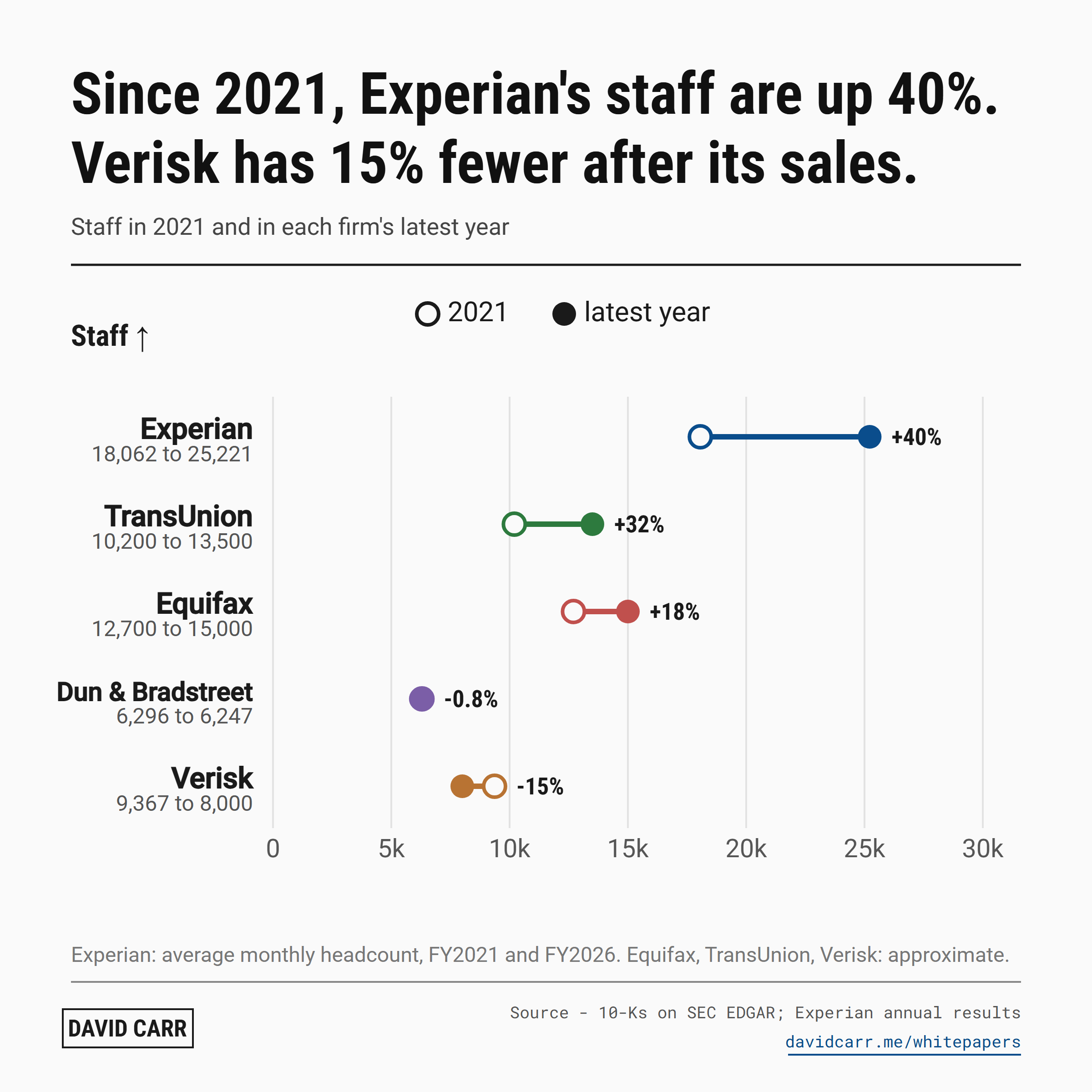
Since 2021, Experian's staff are up 40%. Verisk has 15% fewer after its sales.
- Experian: 18,062 to 25,221
- TransUnion: about 10,200 to 13,500
- Equifax: about 12,700 to 15,000
- Dun & Bradstreet: 6,296 to 6,247 (to 2024)
- Verisk: 9,367 to about 8,000
Three grew their staff, and two stayed flat or shrank. Verisk's fall follows the sale of its energy and financial services businesses.
Experian gives average monthly headcount for its fiscal year; the others give a count at 31 December, and Equifax, TransUnion and Verisk round theirs. TransUnion says about 42% of its staff work in its global capability centres in India, South Africa and Costa Rica.
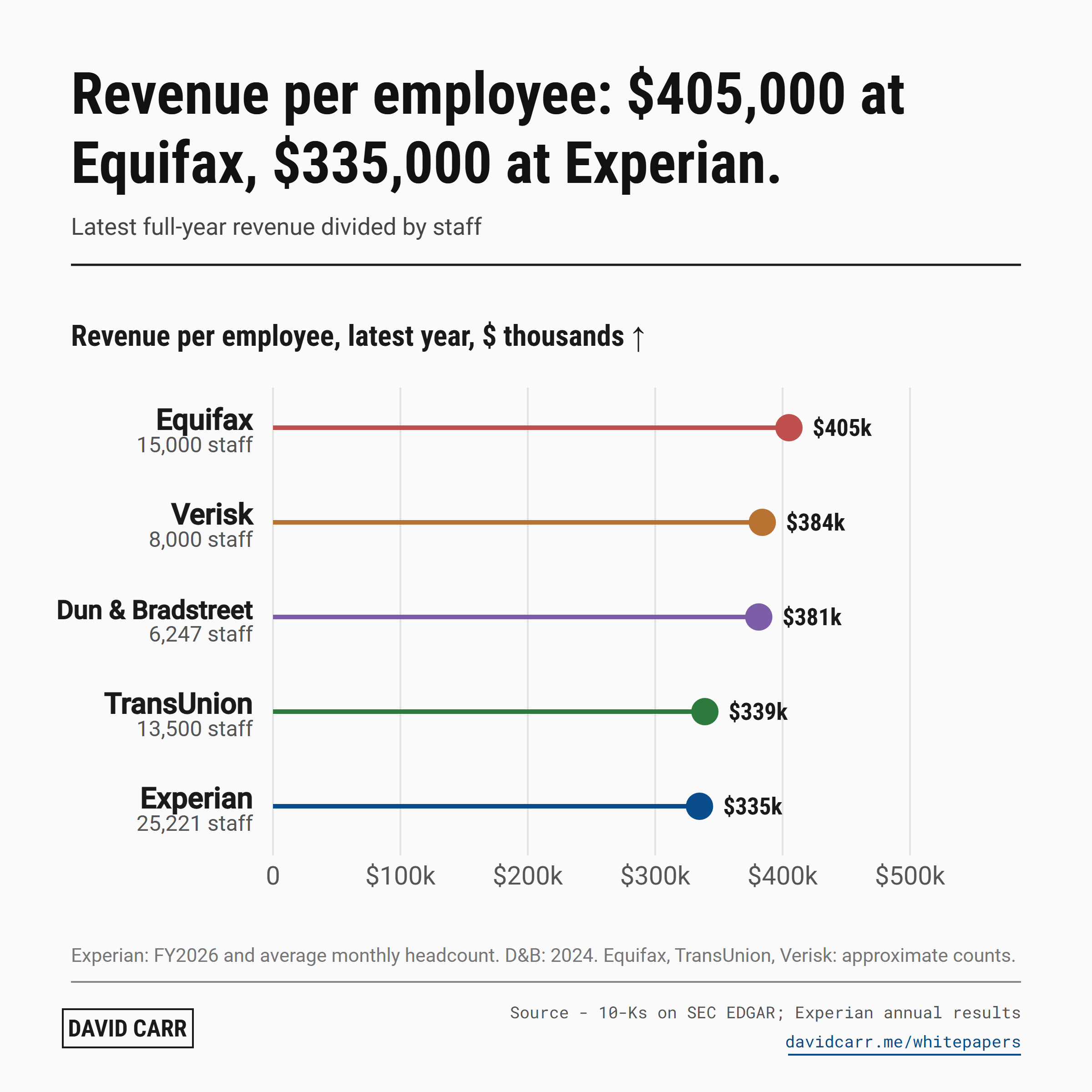
Revenue per employee: $405,000 at Equifax, $335,000 at Experian.
- Equifax $405,000; Verisk $384,000; Dun & Bradstreet $381,000 (2024)
- TransUnion $339,000; Experian $335,000 (FY2026)
The spread is narrow: the highest is about a fifth above the lowest.
Latest full-year revenue divided by staff. Experian's count is an average over its year; the others are year-end counts, three of them approximate. Verisk has the highest margin but not the highest revenue per head.
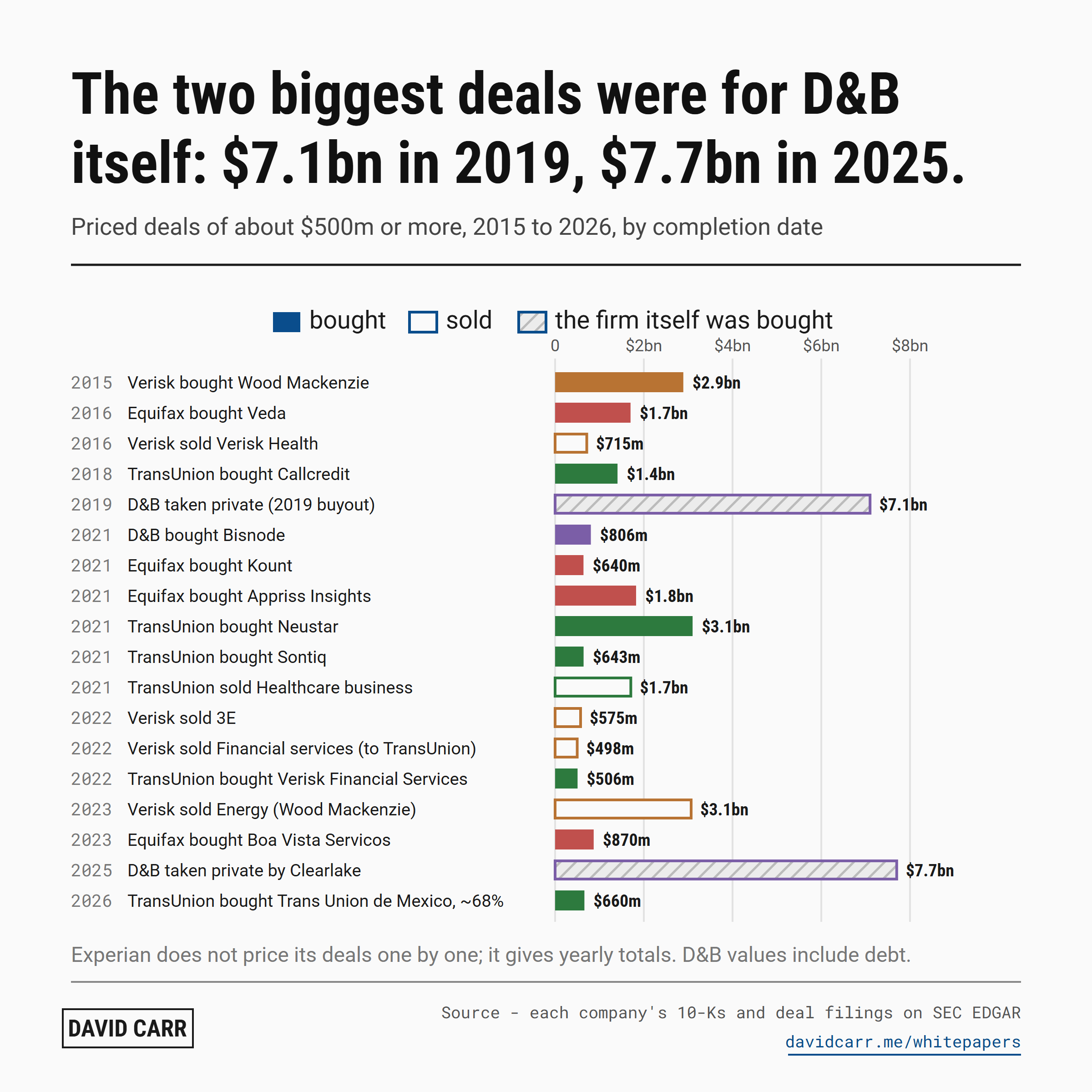
The two biggest deals were for D&B itself: $7.1bn in 2019, $7.7bn in 2025.
- Dun & Bradstreet: taken private in February 2019, about $7.1bn of total funds; Clearlake deal, $7.7bn including debt, completed 26 August 2025
- TransUnion: Neustar $3.1bn (2021); sold its Healthcare business for $1.7bn the same month
- Verisk: bought Wood Mackenzie for $2.9bn in 2015, sold it for $3.1bn in 2023
- Equifax: Appriss Insights $1.8bn and Kount $640m (2021); Veda $1.7bn (2016); Boa Vista $870m (2023)
- TransUnion: about 68% of Trans Union de Mexico, $660m (2026)
Among these deals, Verisk is the only firm that sold more than it bought. In 2022 it sold its financial services unit to TransUnion.
Priced deals of about $500m or more that the five company studies document, by completion date. Values as each filing states them; the D&B buyouts include debt. Experian is not shown: it reports a yearly total for acquisitions ($1,158m in FY2025, its largest year since FY2014), not a price for each deal.
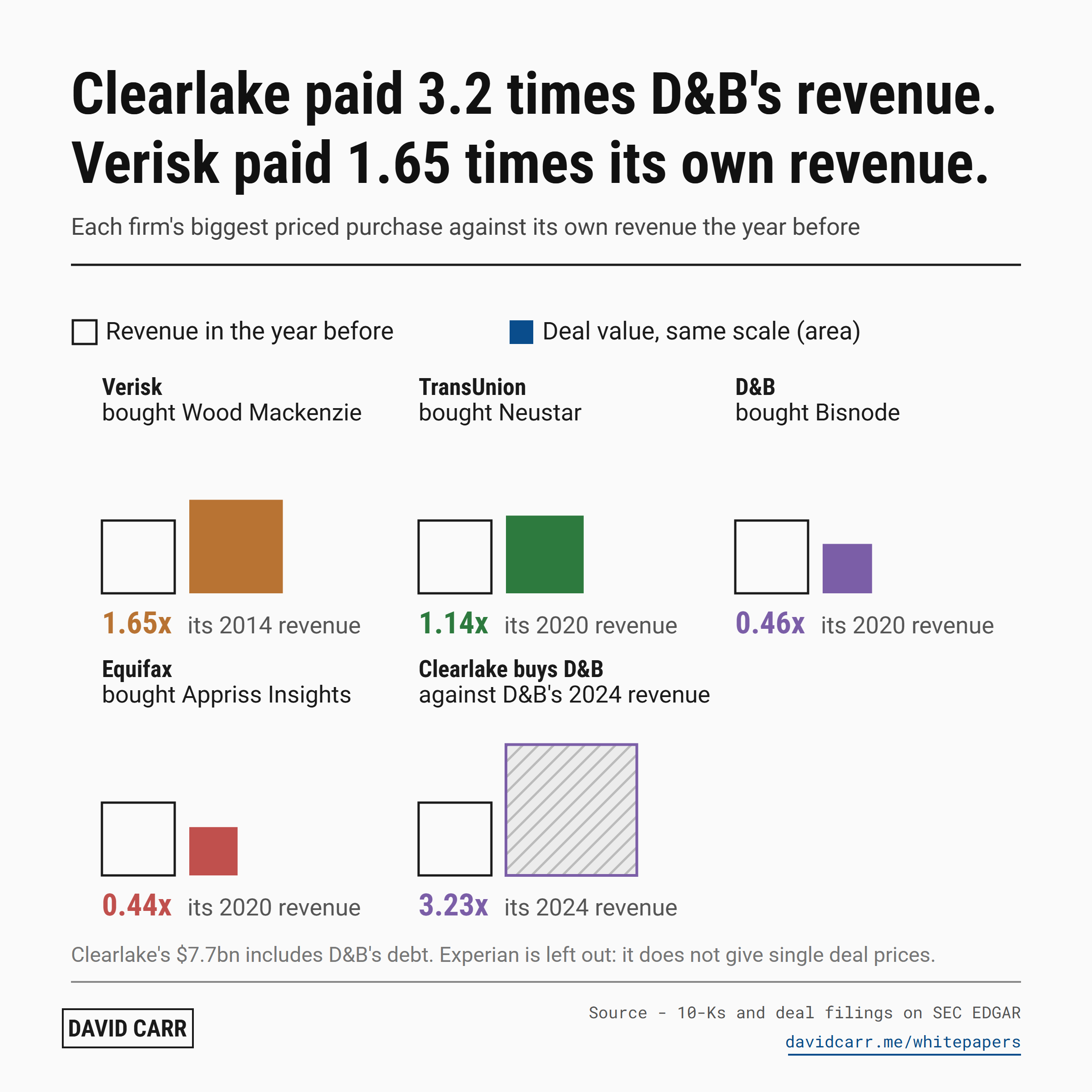
Clearlake paid 3.2 times D&B's revenue. Verisk paid 1.65 times its own.
- Clearlake: $7.7bn against D&B's $2,381.7m of 2024 revenue
- Verisk: Wood Mackenzie, $2,889.6m against $1,746.7m of 2014 revenue
- TransUnion: Neustar, 1.14 times its 2020 revenue; D&B: Bisnode, 0.46; Equifax: Appriss Insights, 0.44
Of these purchases, only Verisk and TransUnion paid more than a year's revenue for one business.
Each deal against the buyer's revenue in the year before it closed, as first reported. Clearlake's figure includes D&B's debt; the equity value was $4.1bn. Experian is left out because it does not give single deal prices.
Latest full year: 2025, except Experian (year to 31 March 2026) and Dun & Bradstreet (2024). Margins on the official basis.
Method, caveats and sources
The short answer. Experian is the largest of the five and, with TransUnion, grew fastest from 2021. Verisk is less than half Experian's size but keeps the highest share of revenue as profit. Dun & Bradstreet grew slowest and had the lowest official margin, and was bought twice. Revenue per employee is similar across all five. Only Verisk and D&B state how much of their revenue comes from subscriptions.
What was compared. Experian, Equifax, TransUnion, Verisk and Dun & Bradstreet, using each firm's latest full year. Every number comes from the companies' own 10-Ks, results releases, annual reports and deal filings, read through the five company studies and re-checked on 26 November 2026.
Different years. Experian's fiscal year ends on 31 March, so its "2021" is April 2020 to March 2021 and its latest year ends in March 2026. Dun & Bradstreet has no full-year figures after 2024: it last reported for the six months to June 2025 (revenue $1,165.0m, up 2.1%; 10-Q), then went private. It also has no 2019 annual figures, because that year was split by its first buyout; no chart here needs 2019 revenue.
Restated figures. Verisk restates past years after each sale, so its revenue, margin and staff are for the businesses it kept. Its 2021 base still includes two units sold in 2022, so its growth on this page is lower than its insurance business alone (up 39%). Other figures are as first reported unless the chart says otherwise.
Currencies. All five report in US dollars, so nothing is converted.
Different measures. Official margins follow GAAP (US filers) or IFRS (Experian) and include deal amortisation. Each firm's adjusted measure is its own. Subscription shares, regional splits and headcount bases are each firm's own definitions; the charts say where they differ.
Left out. Share prices, valuations and anything resembling investment advice. Market share, as no common source measures it. Data breaches, lawsuits and regulatory matters, which the company studies cover as dated facts. Smaller deals, and Experian's individual deal prices, which it does not publish.
Also: The financial data sellers, compared, The market research firms, compared and the five company studies: Experian, Equifax, TransUnion, Verisk, Dun & Bradstreet.