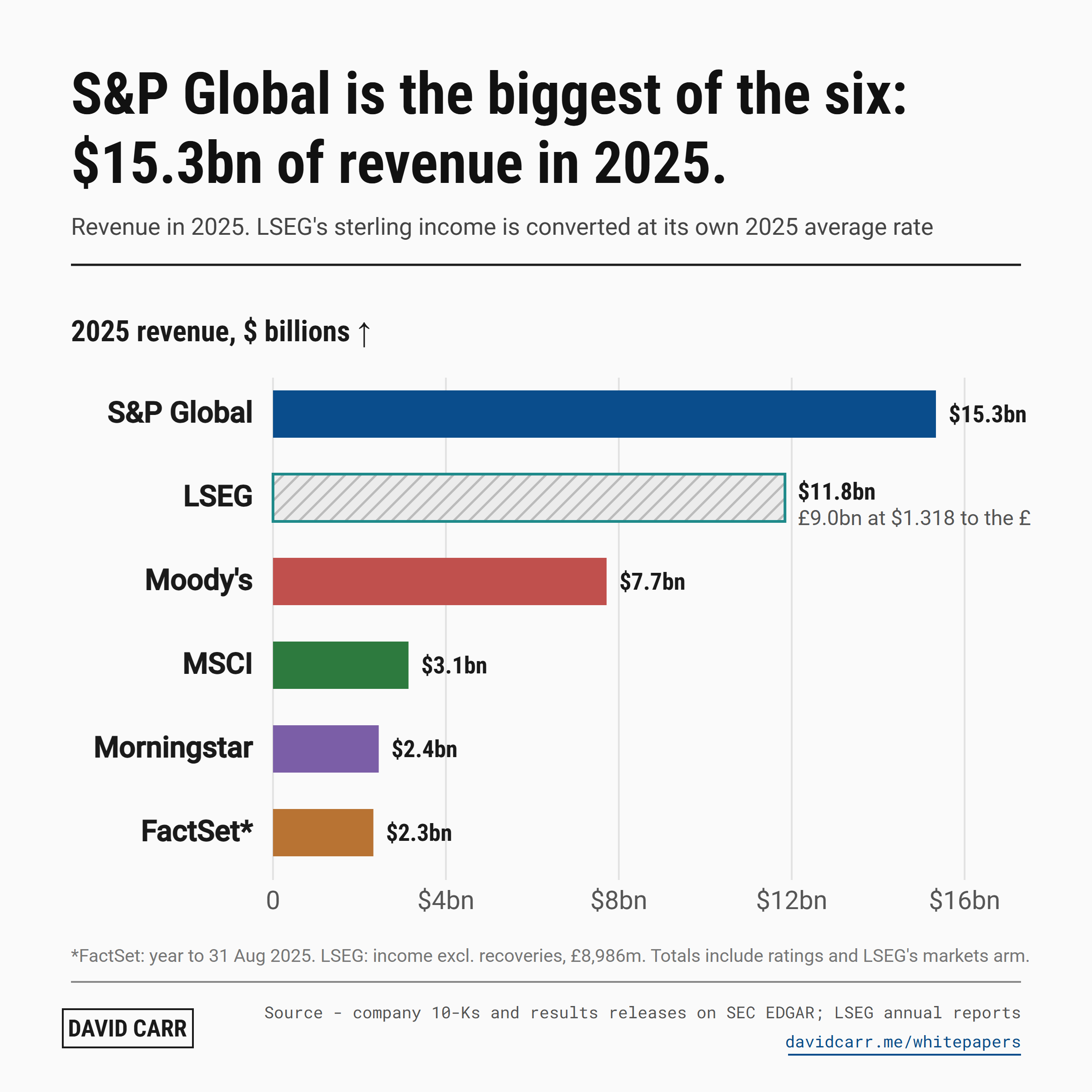
S&P Global is the biggest of the six: $15.3bn of revenue in 2025.
Two firms are much larger than the other four. S&P Global takes in about six and a half times what FactSet does.
LSEG's figure is total income excluding recoveries, and it includes the London Stock Exchange and the LCH clearing house. The conversion uses the GBP:USD average LSEG states in its own 2025 annual report. Nothing else on the page mixes currencies.
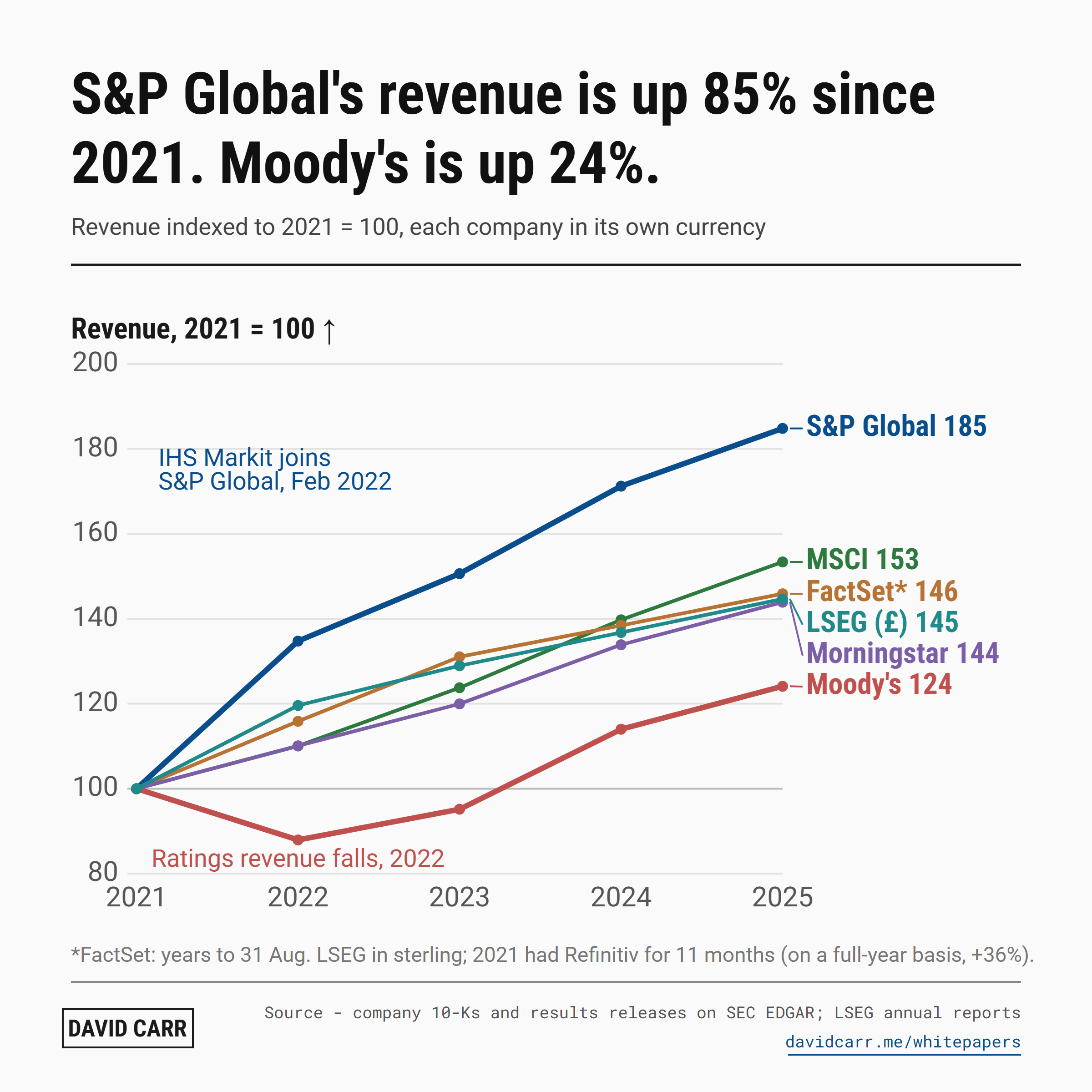
S&P Global's revenue is up 85% since 2021. Moody's is up 24%.
- S&P Global 185, MSCI 153, FactSet 146, LSEG 145, Morningstar 144, Moody's 124 (2021 = 100)
- S&P Global's jump is mostly the IHS Markit merger in February 2022
- Moody's fell in 2022, when fees for rating new bonds dropped
Four of the six grew by 44% to 53% in four years. The two outliers each have one clear cause: a merger and a bond market.
Each line is in the company's own currency, so exchange rates do not move it. LSEG's 2021 base includes Refinitiv for 11 months; on LSEG's own pro-forma basis, with 12 months, its growth is 36%. FactSet's years end on 31 August.
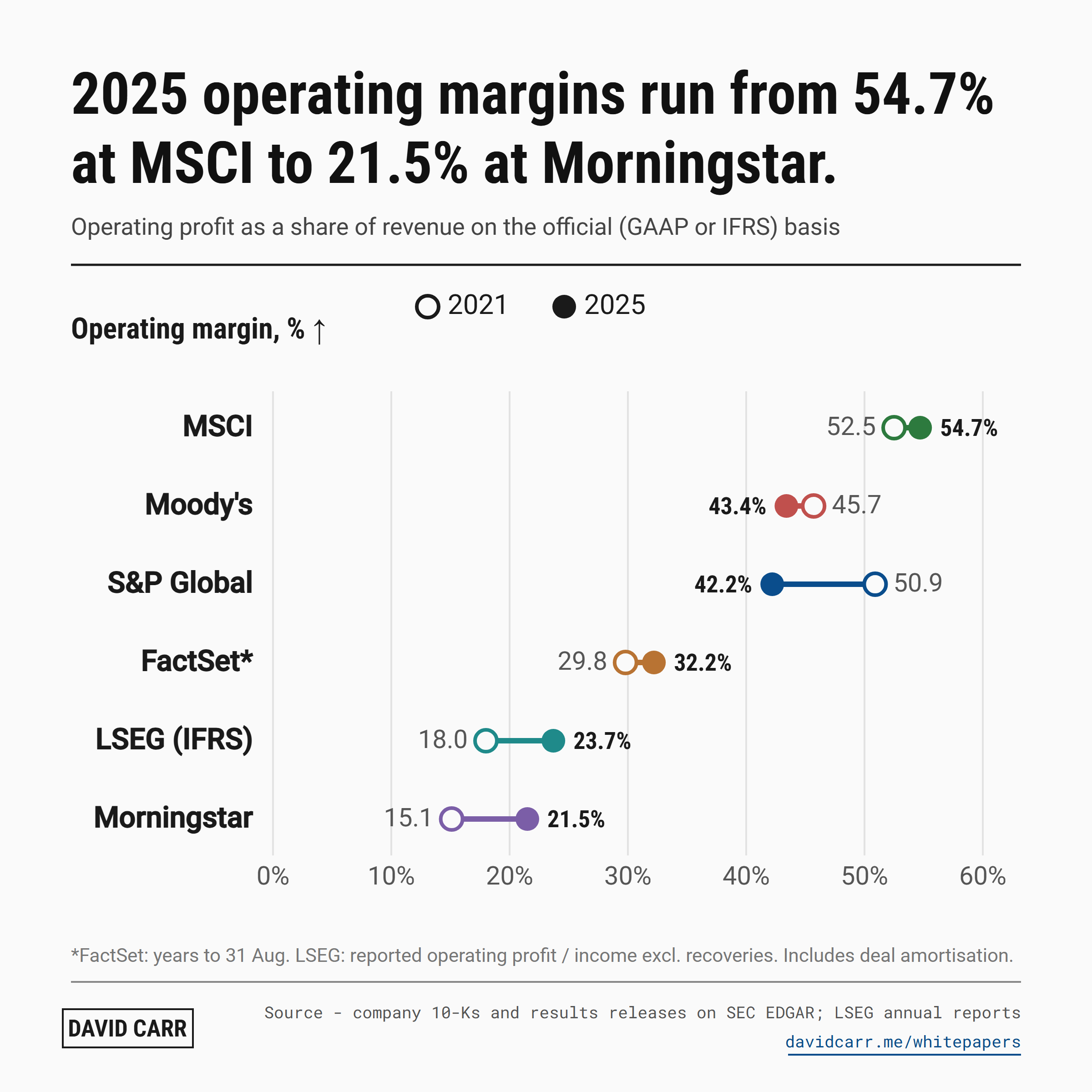
2025 operating margins run from 54.7% at MSCI to 21.5% at Morningstar.
- MSCI 54.7%, Moody's 43.4%, S&P Global 42.2% (10-K)
- FactSet 32.2%, LSEG 23.7%, Morningstar 21.5%
- Four rose from 2021 to 2025. S&P Global fell from 50.9% to 42.2%, and Moody's from 45.7% to 43.4%
On the official measure, the gap between the highest and lowest margin is 33 points.
GAAP for the five US firms; IFRS for LSEG (reported operating profit over income excluding recoveries). Official margins include the amortisation of past deals, which weighs most on firms that bought big: S&P Global after IHS Markit and LSEG after Refinitiv.
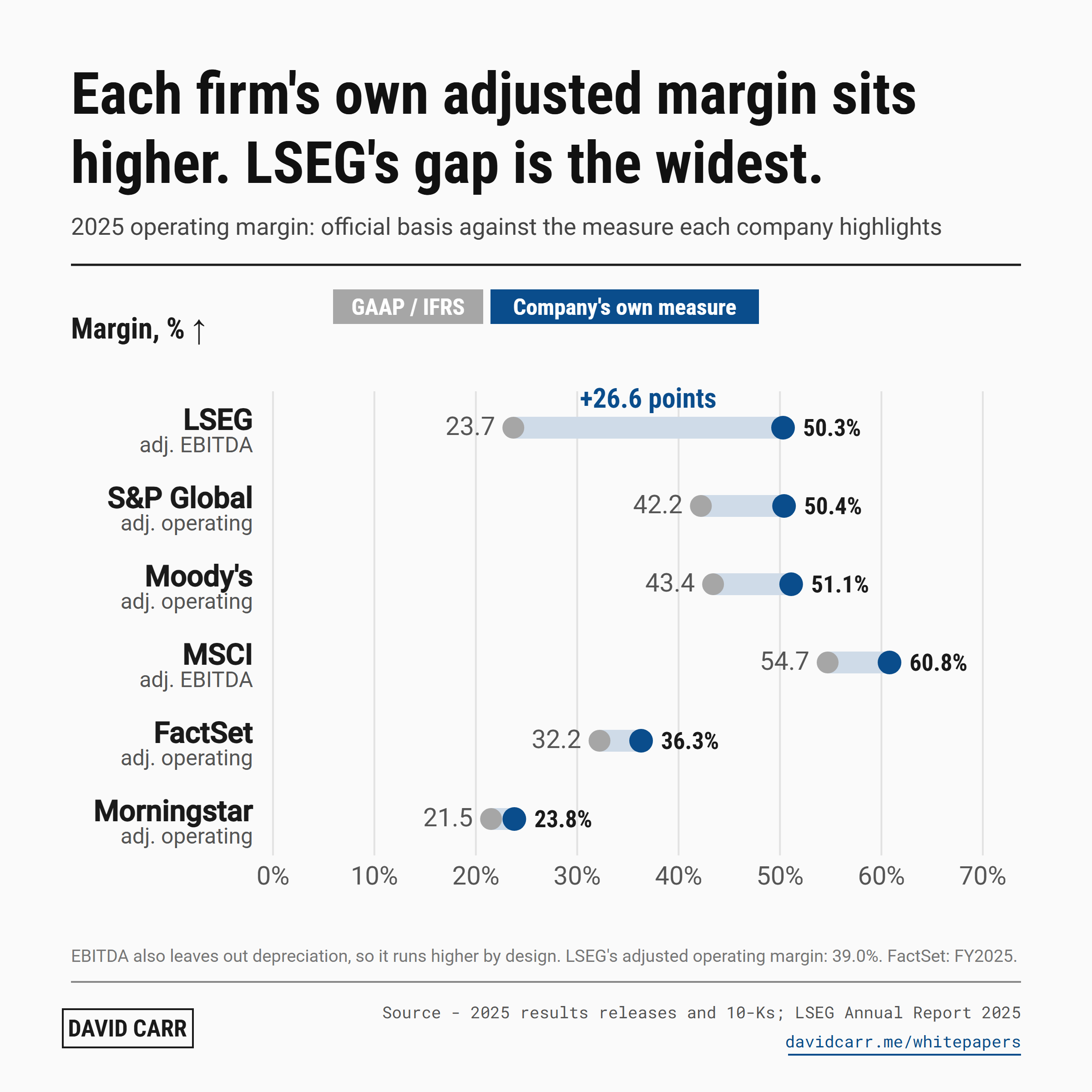
Each firm's own adjusted margin sits higher. LSEG's gap is the widest.
Every firm also publishes its own adjusted margin, and they are not the same measure. MSCI and LSEG use EBITDA, the other four an adjusted operating margin.
EBITDA leaves out depreciation as well as amortisation, so it runs higher by design. LSEG's adjusted operating margin, closer to what S&P Global and Moody's report, is 39.0% (£3,506m of £8,986m). These are each company's own definitions and are not audited like the official figures.
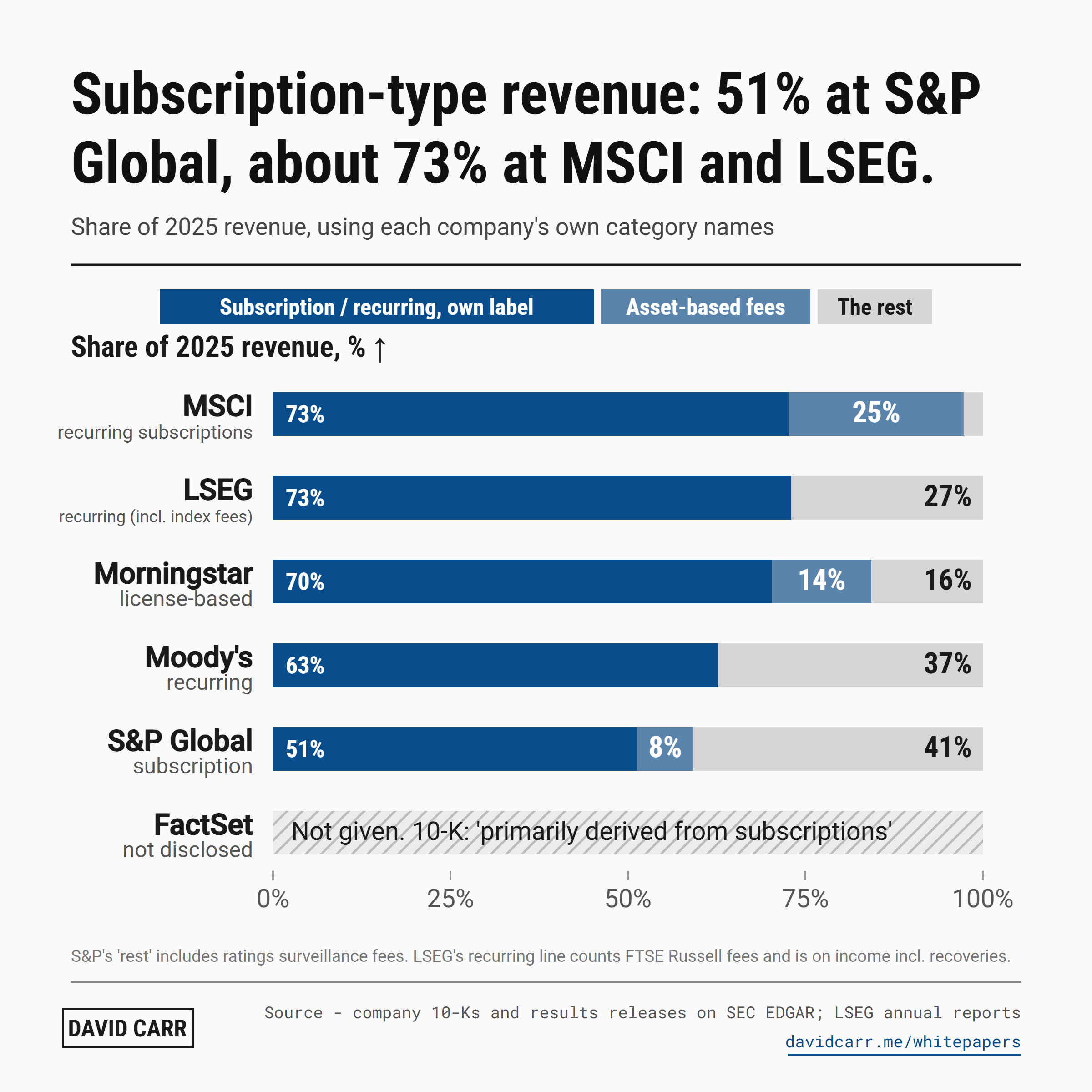
Subscription-type revenue: 51% at S&P Global, about 73% at MSCI and LSEG.
- MSCI: 72.7% recurring subscriptions, plus 24.6% asset-based fees on funds that track its indexes
- LSEG: 73% recurring
- Morningstar: 70.3% license-based, 14.0% asset-based
- Moody’s: 62.7% recurring
- S&P Global: 51.3% subscription, 7.9% asset-linked
- FactSet: no share given; its 10-K says revenue is "primarily derived from subscriptions"
No two firms draw the line in the same place, so this is the nearest thing to a common measure, not a ranking.
Moody's counts ratings monitoring fees as recurring. LSEG's figure is a share of income including recoveries and counts FTSE Russell's asset-based fees as recurring; MSCI and Morningstar show asset-based fees separately. S&P Global's remainder includes ratings fees, sales-based royalties and recurring variable revenue.
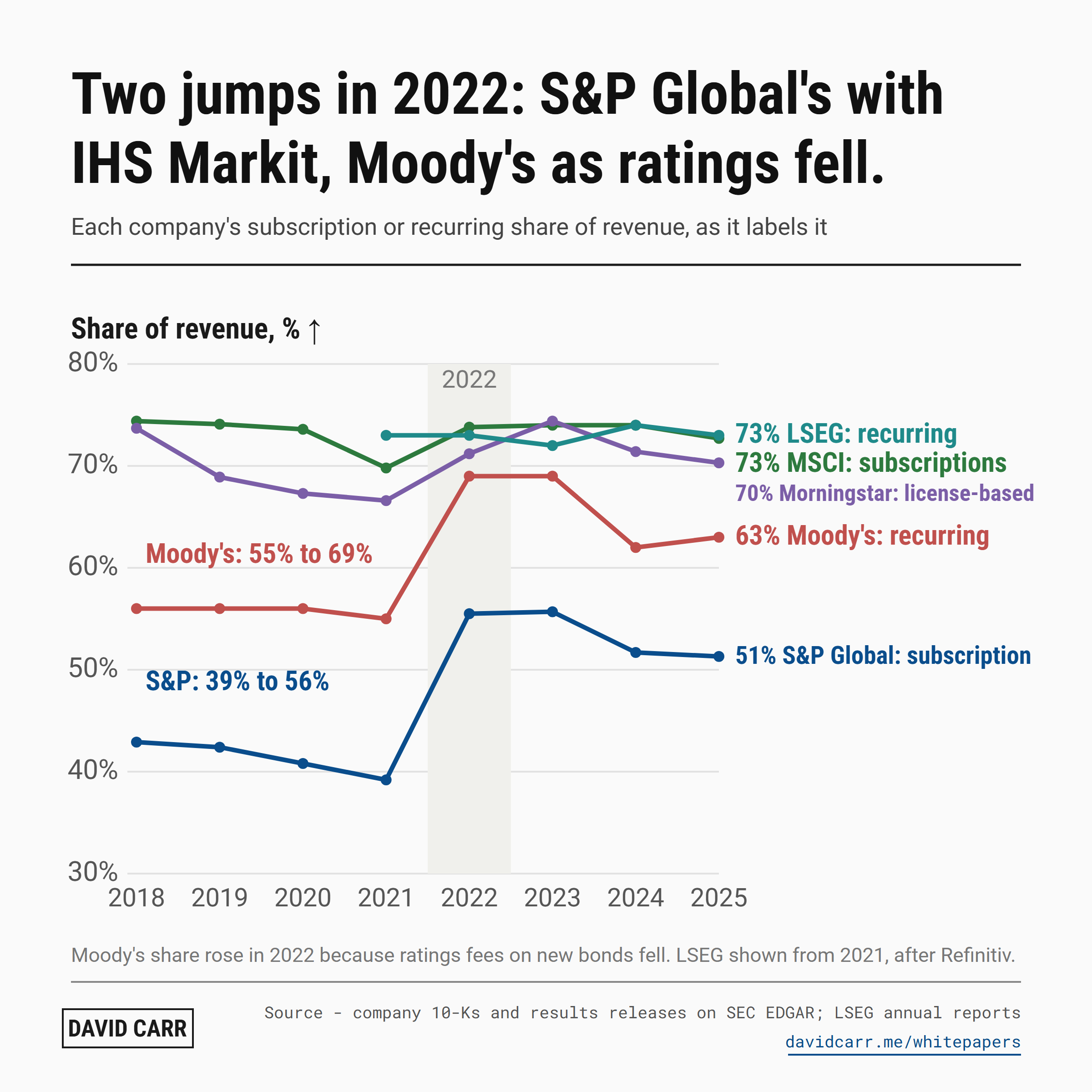
Two jumps in 2022: S&P Global's with IHS Markit, Moody's as ratings fell.
- S&P Global: 39.2% subscription in 2021, 55.5% in 2022, 51.3% in 2025
- Moody's: 55% recurring in 2021, 69% in 2022, 63% in 2025
- MSCI, Morningstar and LSEG stayed between 67% and 75% throughout
S&P Global's share rose because it added a large subscription business. Moody's rose because its one-off ratings fees fell; as bond issuance recovered, the share came back down.
Each line uses the company's own label: subscription, recurring or license-based. S&P Global's 2018 and 2019 come from its 2022 10-K. LSEG is shown from 2021, its first full year as a data company after Refinitiv.
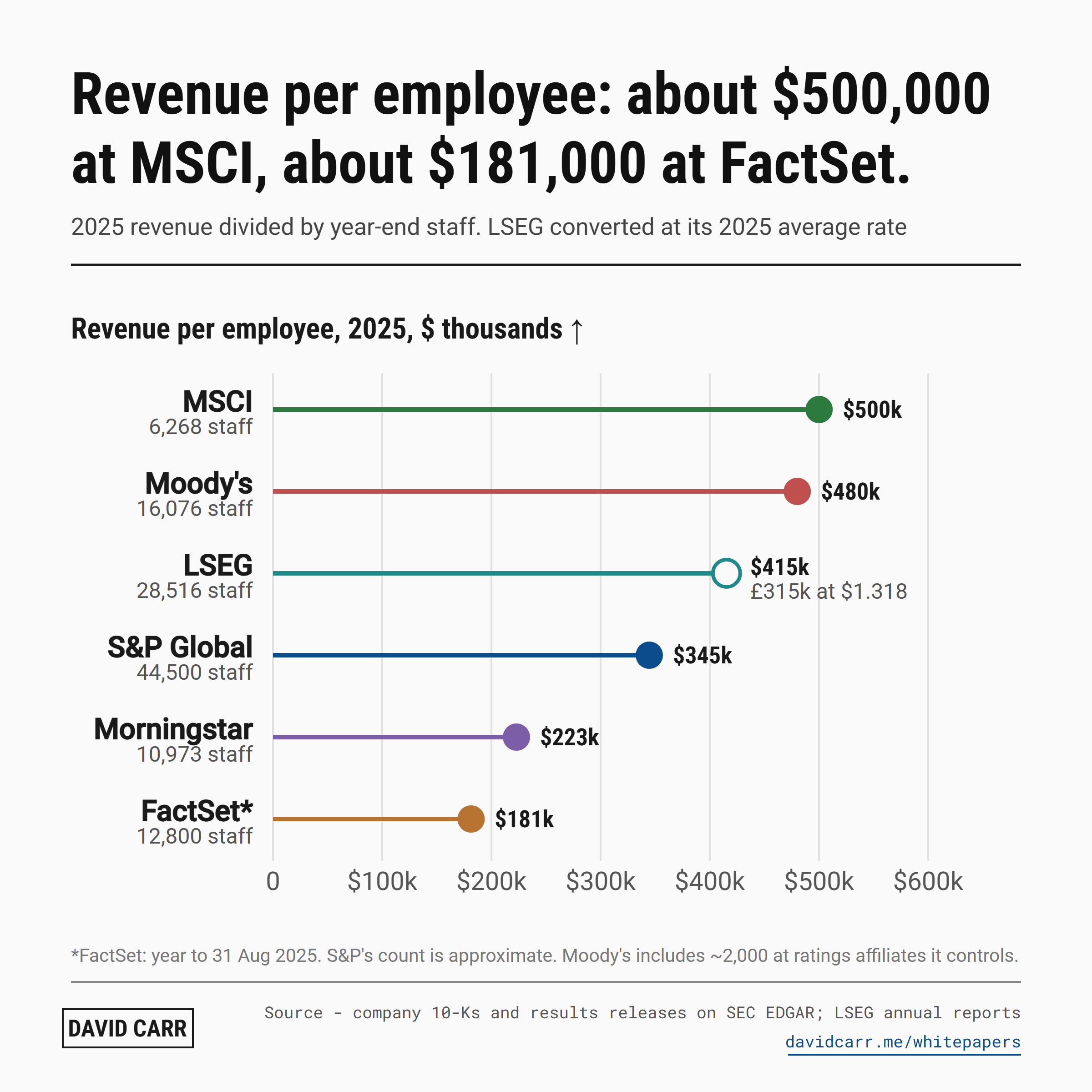
Revenue per employee: about $500,000 at MSCI, about $181,000 at FactSet.
- MSCI $500,000 (6,268 staff); Moody's $480,000 (16,076)
- LSEG $415,000, or £315,000 (28,516)
- S&P Global $345,000 (about 44,500); Morningstar $223,000 (10,973); FactSet $181,000 (12,800)
The two firms with the highest revenue per head also have the highest official margins, MSCI and Moody's.
2025 revenue divided by staff at the year end each firm reports: 31 December, except FactSet (31 August 2025). S&P Global gives an approximate count. Moody's count includes about 2,000 people at ratings affiliates it controls. LSEG converted at $1.318.
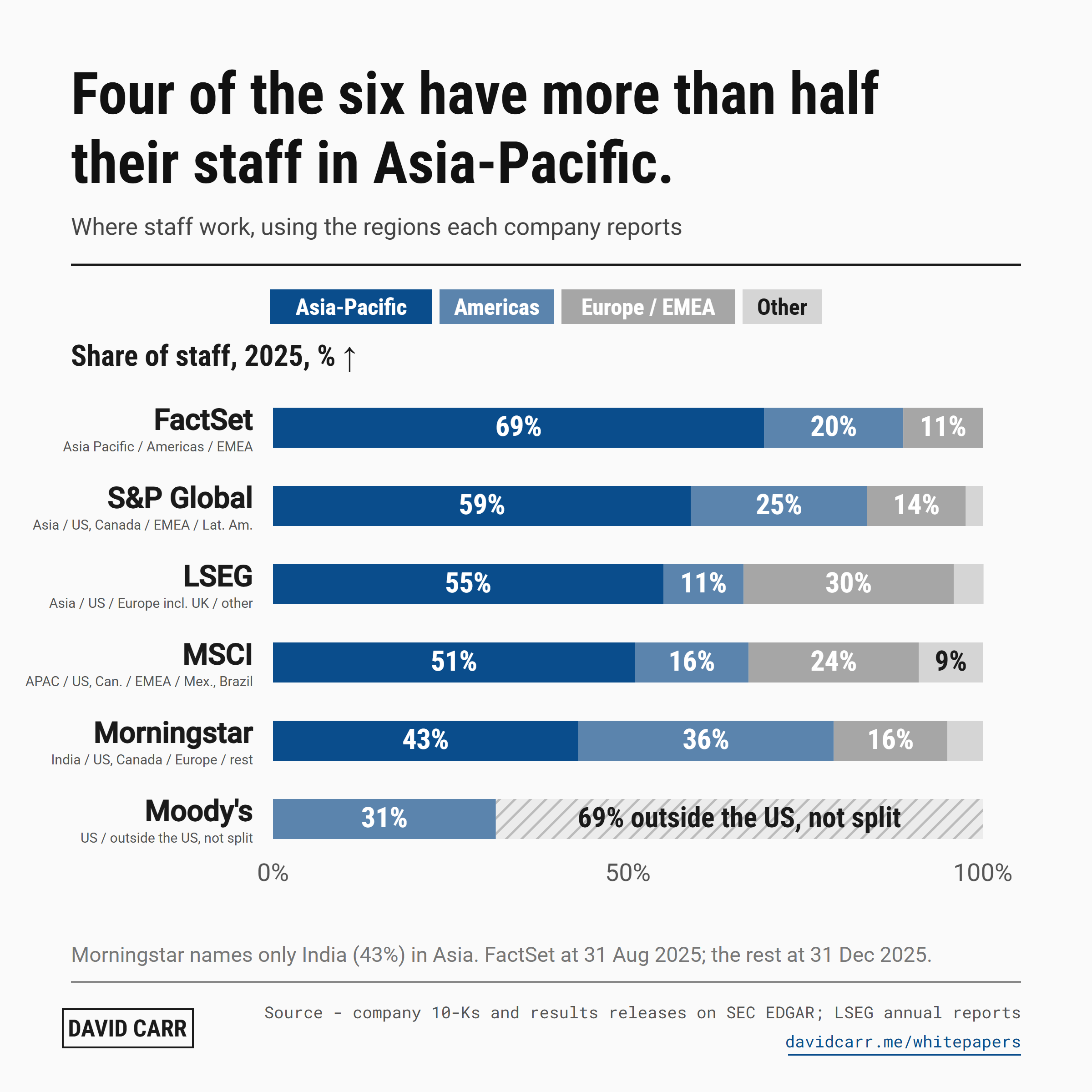
Four of the six have more than half their staff in Asia-Pacific.
- FactSet: 69% in Asia Pacific
- S&P Global: 59% in Asia
- LSEG: 55% in Asia, including 8,541 people in India
- MSCI: 51% in Asia Pacific
- Morningstar: 43% in India, the only Asian country it names
- Moody’s: 31% in the US, 69% elsewhere, not split further
At all six, most staff work outside the country where the company is based.
Regions are each firm's own, so the slices are not exactly alike: LSEG's Europe includes the UK, MSCI's "other" is Mexico and Brazil, Morningstar's "rest" includes Australia and the rest of Asia. Moody's publishes only a US and non-US split.
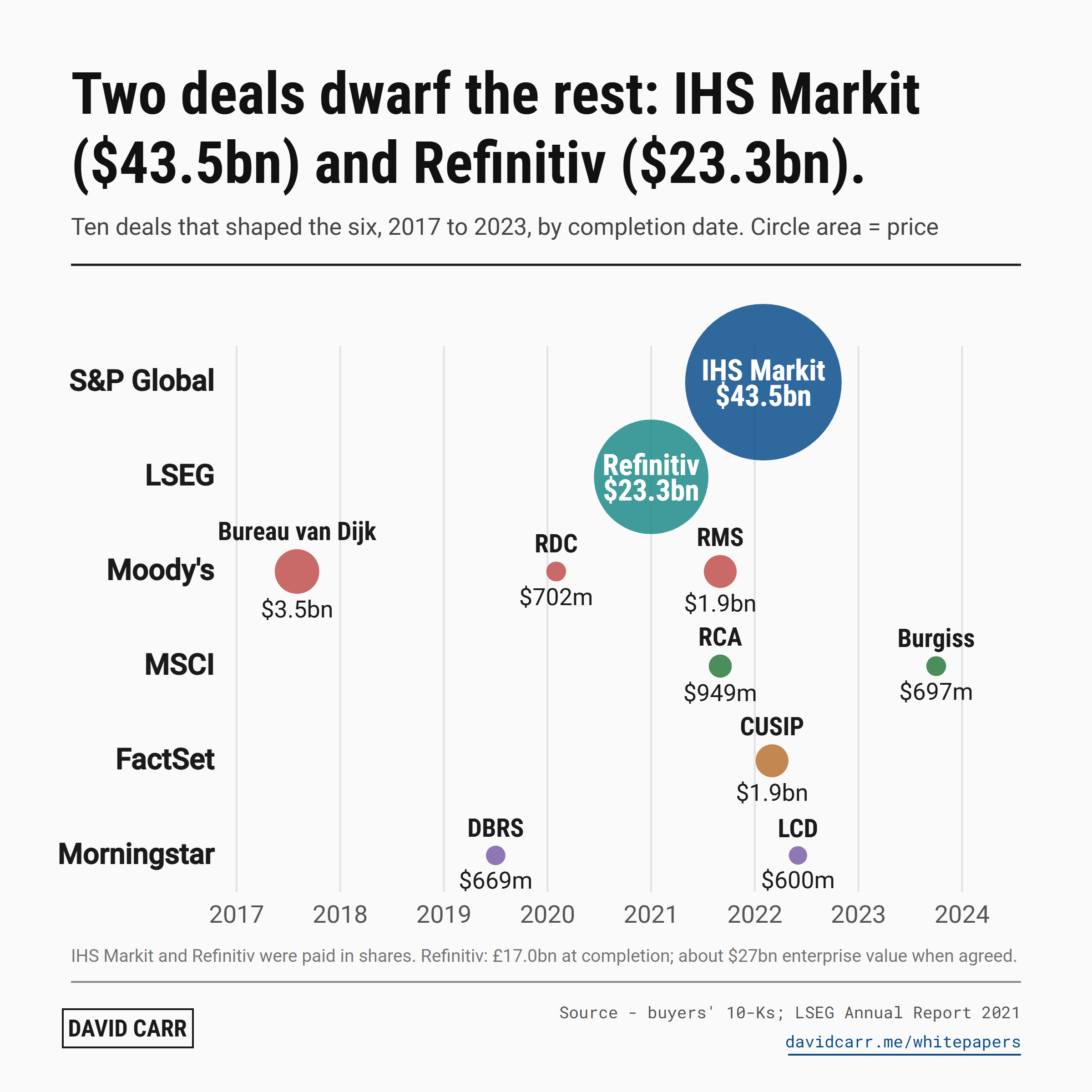
Two deals dwarf the rest: IHS Markit ($43.5bn) and Refinitiv ($23.3bn).
- S&P Global: IHS Markit, February 2022, all shares
- LSEG: Refinitiv, January 2021, all shares, £17.0bn
- Moody’s: Bureau van Dijk, 2017, $3.5bn; then RDC and RMS
- FactSet: CUSIP Global Services, 2022, $1.9bn; Morningstar bought LCD the same year. S&P Global sold both as a condition of the IHS Markit merger
- MSCI: Real Capital Analytics, 2021, and the rest of Burgiss, 2023
- Morningstar: DBRS, 2019, $669m
The two largest deals changed what their buyers are. Both were paid for in shares.
Prices as each buyer states them. Refinitiv was about $27bn including debt when agreed in 2019. Burgiss is the price for the 66.4% MSCI did not already own. The ten deals are the ones the six company studies document with a price; later deals are not shown.
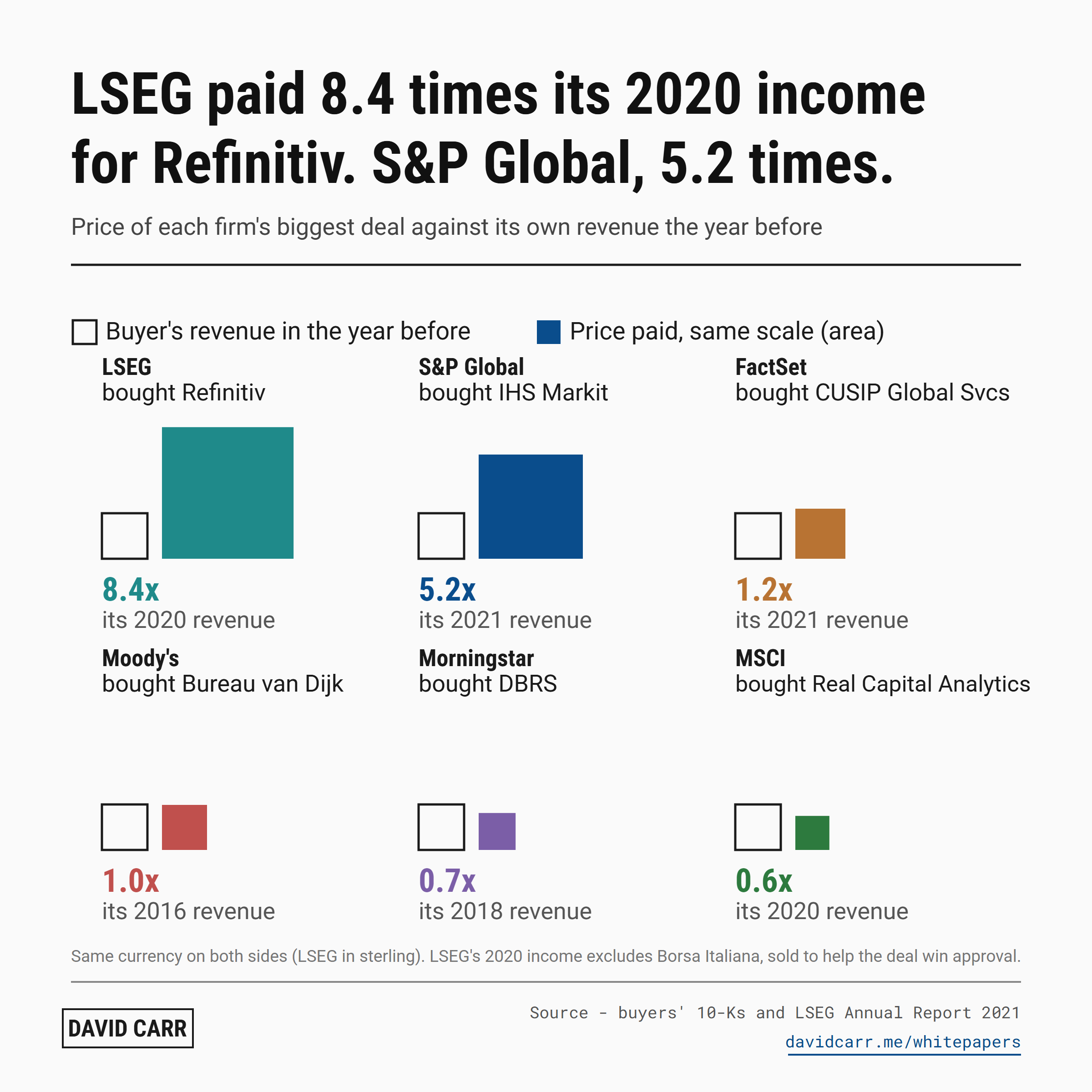
LSEG paid 8.4 times its 2020 income for Refinitiv. S&P Global, 5.2 times.
- LSEG: £17.0bn against £2.0bn of 2020 income
- S&P Global: $43.5bn against $8.3bn of 2021 revenue
- FactSet 1.2 times; Moody's 1.0; Morningstar 0.7; MSCI 0.6
Each firm's biggest deal, set against its own size. Three paid more than a year's revenue; LSEG and S&P Global paid more than five years'.
Same currency on both sides. LSEG's 2020 income excludes Borsa Italiana, which it sold to help the Refinitiv deal win approval. Each figure is the buyer's revenue in the year before the deal closed.
2025 figures. FactSet's year ends 31 August. Margins on the official basis. Recurring shares use each firm's own label, so they do not compare exactly.
Method, caveats and sources
The short answer. S&P Global is the largest of the six and grew fastest from 2021 to 2025, mostly by merging with IHS Markit. MSCI is a fifth the size of S&P Global, with the highest margin and the most revenue per employee. Most of these firms sell subscriptions, but each defines recurring revenue its own way. Four of the six have more than half their staff in Asia-Pacific. Two deals, IHS Markit and Refinitiv, each cost several times the buyer's yearly revenue.
What was compared. S&P Global, Moody's, MSCI, FactSet, Morningstar and LSEG, using full-year 2025 figures (FactSet: fiscal 2025, to 31 August 2025). Every number comes from the companies' own 10-Ks, results releases and annual reports, read through the six company studies and re-checked on 25 November 2026.
Currencies. LSEG reports in sterling. The growth chart keeps each firm in its own currency. Where dollars are needed, LSEG is converted at $1.318 to the pound, the 2025 average rate in LSEG's own 2025 annual report. Deal ratios use the same currency on both sides.
Different measures. Official margins follow GAAP (US firms) or IFRS (LSEG) and include deal amortisation. Each firm's adjusted measure is its own non-GAAP figure. Recurring revenue, headcount dates and staff regions are each firm's own definitions, and the charts say where they differ.
Left out. Share prices, valuations and anything resembling investment advice. Market share, as no common source measures it. Prices for the firms' products, which none of them publishes in full. Deals after 2023, and smaller deals, which were not checked for all six.
Also: Stripe, Pave vs its competitors and the six company studies: S&P Global, Moody's, MSCI, FactSet, Morningstar, LSEG.